← Revenue Builders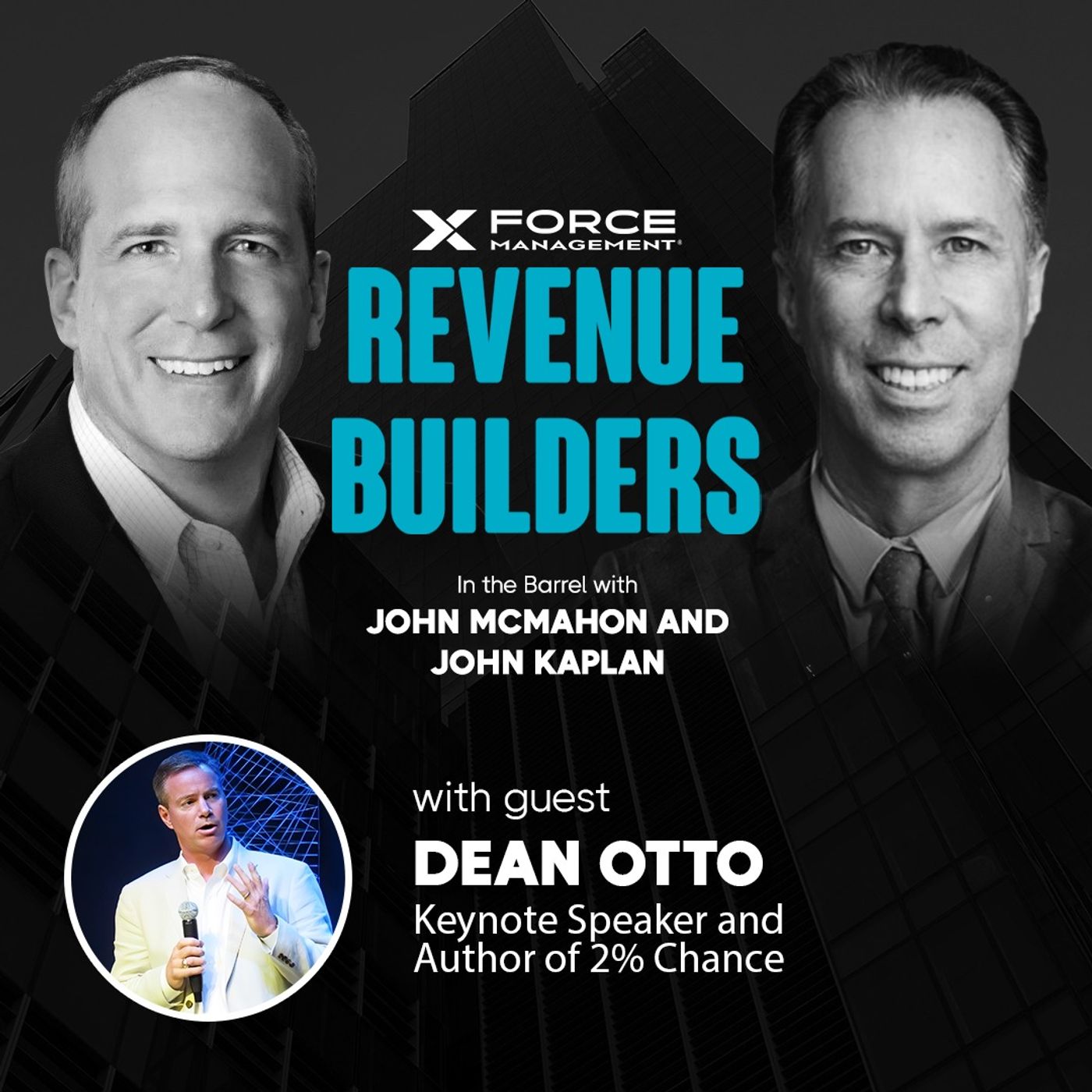
Revenue Builders
The Power of Belief with Dean Otto
01:05:05
In this episode of the Revenue Builders Podcast, our host John Kaplan is joined by Dean Otto, an endurance athlete with a background in senior strategic global account sales. Dean shares his journey of recovery after a near-fatal cycling accident that left him with a 2% chance of ever walking again. His incredible story is a testament to the power of resilience and purpose, from overcoming immense physical challenges to running a half-marathon with the driver who hit him and the surgeon who saved his life. Dean provides insights into his mindset, the importance of community and forgiveness, and how he's turned his adversity into a mission to help others. The episode also delves into his guiding principles of courage, commitment, conditioning, and the importance of intellectual and spiritual fitness. Tune in for a powerful and motivational story of overcoming the odds. ADDITIONAL RESOURCES Buy Dean’s Book and Book Dean as a Speaker: https://deanottospeaking.com/ Connect with De...
Loading summary
Transcript151 lines
- [00:05]
A
Welcome to the Revenue Builders Podcast, a weekly show featuring B2B sales leaders and executives. Hosted by five time CRO John McMahon and Force Management Co founder John Kaplan, the show goes behind the scenes with the people who have been there, done that, and seen the results. If you enjoy our content, please subscribe, rate and review the show to help us reach more people. Revenue Builders is brought to you by Force Management. We help companies improve sales performance, executing the growth strategy at the point of sale. Find us@ForceManagement.com Enjoy today's episode hi, it's Rachel with Force Management. Before we get started with today's Revenue Builders episode, a Quick Plug we know a lot of you are planning your SKO and planning for 2026 force has a ton of great resources for you as you strategize. We we just put out an ebook on six priorities for driving growth in your organization and we have a whole SKO resource page that has helpful insights as you think through making your SKO more than an event. Check it out in the show notes.
- [01:16]
B
Hello and welcome to another episode of the Revenue Builders Podcast. My name's John Kaplan and today my co host, Mr. John McMahon is taking a much needed break and vacation and he'll be joining us again next week. Today we have an incredible guest named Dean Otto. Dean is a speaker, author and endurance athlete whose story is a remarkable testament to resilience and the power of belief. Dean has an extensive software sales career. In his last assignment, Dean served as a Senior Strategic Global Account Executive for Braze, entrusted with managing and expanding key relationships with marquee clients. After a near fatal cycling accident left him with only a 2% chance of walking again, Dean defied the odds through determination, forgiveness and an unwavering mindset. His journey from the hospital bed to running a half marathon alongside the surgeon who saved his life and, and the man who hit him has inspired audiences worldwide. Get your popcorn ready. So Dean, take us back to that September morning in 2016 and you know, what do you remember most vividly about that moment? We're going to dig in a lot to this, but I just want to kind of, I just want to kind of begin with, you know, that moment that everything changed for you.
- [02:49]
C
Right. So I was just getting ready to do a normal bike ride. John it was, it was early. The time hadn't changed. It was super dark outside. There was a new moon, so the cloud level was low, so you really couldn't see any stars or anything. And I was going to do what I normally do on Saturday morning, which Is do some sort of run and then do my Saturday morning men's group meeting and then go out and fellowship with. With friends of mine afterwards. And that was the plan. Except six days before that, I was in London over there on business, and I ran a half marathon when I was there. And I pulled my hamstring, of course, and aggravated. In fact, you can see the jersey I wore For New York 2015, ten years ago, I pulled my hamstring there. I re aggravated that injury. And so I called my coach and I'm like, what do I need to do? And she's like, you can't run for like a month. You have to take time off. And John, I don't know if you know any runners, but we hate not running.
- [03:44]
B
Like, no, I love people tell me I can't run for a month. That's music to my ears, bro.
- [03:49]
C
Some people, it's like, man, this is a vacation for me. It was terrible. So I didn't want to get on the bike. I hated the bike. You know, I'd seen so many people get injured on bikes in the Charlotte area where we both live. And so with some trepidation, about seven months prior, I'd bought the bike to cross train to try to. You know. Anyway, it's. It's dark that morning. I head out of my neighborhood, and I get almost out of my neighborhood, and I hit this pothole. And it kind of jars my teeth, rattles my cage a little bit. And I'm thinking to myself, you know, it's. It's 6:30 in the morning. It's still not quite bright outside. Maybe this isn't such a great idea. And mind you, I've got lights all over my bike. I've got an LED vest on with flashing lights and all that good stuff. So I heed my own mind and I turn around. As I'm going back to my house, I don't get 100 yards back, and I hear this voice in my ear, and it's my dad. And it recalls a lesson I learned from him about finishing the ride that we can talk about later. But he's like, come on, Dean, finish the ride. Let's go. Like, this is no big deal. You've done this a million times. So I turned around again, and I head back out of my neighborhood. I get maybe 500 yards down the road, down Providence Road, which runs north and south through Charlotte, and three cars come flying by me like bullets. I look over at them and I don't understand why they're going so fast. On a Saturday morning at 6:30. I don't know if they've been out all night, if they've been drinking, if they're racing or what's going on. About that time I refocus my mind on the road ahead and I hear the brakes lock up. I feel the impact. I hear my rear tire explode. And then it was lights out for me. And I'm, mind you now, flying over the top of my handlebars, kind of like Superman on top of my bike. It knocks me about 100ft. And then I come to rest in the middle of Providence Road, the corner of Andover in Providence. And I'm completely paralyzed.
- [05:37]
B
I know exactly where that is.
- [05:40]
C
Yeah. Yeah, I'm completely paralyzed. I can't feel anything. And you know, I talk about this in my book and I talk about this in my keynote. I think we always revert to our training. Right. So training needs to be intentional. And if you do things long enough, it sort of becomes like a reflex. So seven years prior to that, I quit drinking. And so I learned a lot about myself through imminent, you know, self inventory and self analysis and self discovery and all that kind of stuff. And a couple of things that I learned is that, number one, I can't control things I can't control. So there's some things that are like, if you drop a hula hoop over your head, John, the only things that you can really control in your life are that space between your chest and the inside of that hula hoop. Everything else, you know, you're in charge of your attitude, you're in charge of the action, but you're not in charge of the outcome as much as we'd like to think we are. Yeah. So I had to give that to a higher power that I choose to call God. And I'm not invoking any religious preference on anybody, but that's. I have to have some sort of humility in my life and surrender that to that power. So I knew that I couldn't handle this. I couldn't feel anything. I prayed for the doctors to help put me back together again.
- [07:02]
B
And I prayed for my laying in the street.
- [07:04]
C
Laying in the middle of the street is the first thing I do, John. I wake up, the first thing I do, they're trying to pull the bike off of me. And I said, stop. I think I'm paralyzed.
- [07:13]
B
Oh, my Lord.
- [07:14]
C
And then I just closed my eyes and, and, and I. And I prayed to accept this as life on life's terms. And God's plan is way bigger than mine. I can't control it. And then I did something.
- [07:27]
B
Moment in the street.
- [07:29]
C
In that moment in the street. And here's the kicker, man. This is one's hard to believe, but it's the truth. I actually. I learned in recovery that I can't have resentments. Resentments are the number one thing that caused people who have quit drinking to go back to drinking. And so I had to release the resentment in that moment right then. So I prayed for this guy that literally just ran me over in his F150 truck while I'm laying in the street. And let me tell you something, John.
- [07:58]
B
Yeah, go.
- [07:59]
C
Go. It was the most spiritual experience I've ever had in my entire life. All the fear, all the panic, all the anger, it completely left my body. I mean, I can get the. I'm getting the feeling right now in my heart filled with. With just love and peace.
- [08:20]
B
Oh, my Lord.
- [08:21]
C
I mean, it was super powerful. And it wasn't because everything was okay, because clearly it was not, but I was okay. And I knew. I knew somehow, some way, I was going to be okay. I didn't know how, I didn't know why or what, but that's what I felt. And then, you know, they loaded me up into the ambulance and they. They took me to.
- [08:42]
B
I want to go deeper into. Into the rest of this after. Okay, after they pick you up off the street.
- [08:49]
C
Got it.
- [08:49]
B
What I like to do is level set a little bit because I think our listeners are probably like, holy smokes, let's be. So we don't get it lost. Let's talk a little bit. Who's Dean before this accident? Career, family mindset. Like, you know, who is Dean before this? And we're gonna, you know, obviously we're gonna spend most of the time on who is Dean now, but.
- [09:12]
C
Right, right. So Dean, I mean, I was an overachiever, a scrappy, you know, athlete. I was never the best athlete, but I was. I was pretty good at everything, but I wasn't great in anything. I was a dude that had the motor. So you put me on your best player and I would, like, lock him up, right? I would do the best I could to lock them up. That's what I could add. That's where I could add. I worked hard, but not hard enough. I consistently performed and achieved, but I also, like, consistently fell up the escalator. Like, even though my drinking was continuing to escalate, I continued to achieve to the point where I kind of didn't. And I wasn't willing at that point. To accept that that was the reason why I lost a job. But it wasn't soon after that that my wife and family had an intervention on me and really caught my attention, which again, that's also part of my talk and everything that I went through during that. But I was a normal guy. I mean, people liked me. I had fun, I had too much fun. And at the end of the day, after, you know, going through this and a lot of self examination, John, I think I was very selfish and I don't as much of a family guy as I was. I mean, I coached all my kids sports, like every sport they were in, I coached them. I was always there for them. I was not this guy that was day drinking, you know, where I'd wake up in the morning and hit a bottle of vodka. I was a weekend binge drinker and I wouldn't touch any alcohol until after I'd coached my game. And it was like, let's go, I deserve this.
- [10:55]
B
So in your mind you're thinking, hey, I got this under control.
- [10:59]
C
Yeah, I did. And then, you know, my wife's been talking to me. She actually got me to a 12 step meeting back in Atlanta a few years after we got married. I went to that and I was like, I always looked at the differences, John. I never looked at the similarities. When I read the book, I mean, I read the big book in like a day and I was like, that's not me. Because here, here, here, here are all the reasons why it's not me.
- [11:25]
B
Yeah.
- [11:25]
C
And then, you know, as that escalated and as I got to the point of the intervention, I knew it was coming. I mean, I didn't know when it was going to come, but I knew it was coming because I'd played the tape in my head a million times. And John, every single time I played the tape, I was going to walk out of there, tell everybody how crazy they were, that I've got it under control, that like, they don't know how hard I try. And that day, in that moment, I swear I might not have ever quit drinking if it hadn't happened right exactly then. But I had this tiny mustard seed of willingness and I leaned into it and I said, okay, look, I'm going to surrender. I don't know, I'm not going to say I'm going to quit drinking, but I will do what you guys tell me to do. So I went to inpatient treatment and I started going to 12 step meetings. And slowly over the course of a few months, I started to see the Similarities instead of the differences in my behavior and my attitude, my actions, and then the fellowship of the program just wrapped their arms around me. I mean, I had men that had, you know, 30, 40 years that were treating me like I was their best friend, and I was like, wow, I belong, man. And as human beings, that's what we need more than anything, man. We need to feel like we belong. And this was like, norman, cheers. It's like you walk in and like, everybody knows your name, you're having a great time. You're high five, and everybody's busting each other's tail, and it's a great time. And it's all the things that I thought I was going to get in the fraternity and in my partying life that were very superficial, yet now with a clearer mind and a different purpose, you know, I can see that, like, I've got a much greater use and better use of. Of my time in my life than what I was doing before.
- [13:14]
B
So I'm going to take a little bit of a risk.
- [13:17]
C
Okay.
- [13:19]
B
This isn't on the. Probably wasn't on the agenda. I'm just. I'm being very aware of own circumstances and aware of the audience that we have, the pressure that our audience is under and just. Just life in general. So I haven't had a drink in 35 years. Thank you. And mine's a little bit different story. I come from alcohol and substance abuse in the household that I grew up with. But there was different. And I'm going to try to tie back into your story. There was different versions of it. One version was one of the parents was, you know, was totally changed disposition, knock over the mailboxes and. And everybody in the. In the world and on the planet was aware that that was going on in my household. The other parent later on in life was. Had. Would. Could drink a fifth of J& B every day and not bat an eye until they couldn't. And they actually probably died from that. That poisoning. So the reason why I'm going to take a risk a little bit is that I don't think you can swing a dead cat in this world. And that's probably a bad analogy, but I don't think you can swing something and not bump into somebody that can relate to this, in. To. To this topic. I just made a decision My. My. 34 years ago, 35, I'm going to get in trouble because I think Sarah's 34, so. 34, my first child. I just made a decision that. That was not going to come into My household. But just for a moment, for people that are listening and you, you're the kind of, you're the kind of individual, I think that you're, you're focused on achievement, you're focusing on what you can control. You're focusing on, and you're in control. And just any advice that you have for people out there that are battling anything, battling mental health, battling addiction, battling anything, any advice that you would have. I know this is a little bit off topic from where we're going on your September amazing situation and recovery, but any words of encouragement that you could give the audience?
- [15:56]
C
Yeah, John, thanks for being vulnerable and thanks for teeing that up. You know, addiction and mental health, I mean, they're hand in hand. And in my experience, and I've worked with a lot of addicted men over the last 16 years, isolation is the biggest enemy.
- [16:15]
B
Amen.
- [16:16]
C
As we, as we withdraw. So people that are bipolar or people that have substance abuse problems, it, it's like mental health and, and, and substance abuse, it's like a cutting horse. It goes into the herd and it cuts you out and you get over there by yourself, and that's when your mind starts playing tricks on you. It starts to tell you things that aren't true. And if I could give any advice to anyone, talk to somebody about it. Trust your spouse, trust your best friend. Reach out to somebody that maybe has some experience with this, that you know, because I guarantee you, if you try hard enough, you're going to run across some people, like you said, that have had experience with this and find out, like, what they went through and what they did and what, What I like to share is my experience. I don't like to tell people what to do because, yeah, I mean, alcoholics don't like to be told what to do. But what I like to do is I like to share my experience. This is what I did and this is how it worked for me. And if anybody's out there that's having trouble with, with alcohol, you can look me up on LinkedIn and you can reach out to me and call me, I'll talk to you and I'll share my experience with you. I'd be happy to.
- [17:27]
B
That's awesome, buddy. I thank you for that. So we're laying in the. We're, we're laying in the street. They take us to the hospital. There's this big theme of. Help us understand how this concept that's become so big in your life right now, less than a 2% chance. So tell us, kind of get us back to that story. How does that manifest itself?
- [17:49]
C
Yeah, so. So they taped me up and they get me to the, to the hospital and I mean there was a, I don't know, six, seven, eight sequential miracles that all sort of happened. Like all the lottery balls had to line up for me, John, and they, they all did. So, you know, first of all, 70% of the people that hit people on bikes. This is hard to believe, but I looked it up, don't stop. So maybe they don't think they hit somebody or maybe they're scared that they're going to get arrested or whatever. They take off. So the guy stopped, he rendered a. There was a, an event in Charlotte that week. Actually was watching it on Sky News when I was over in London where there were tons of riots going on in Charlotte, you might remember. Yeah, there was a. That shot. Shot an African American man and you know, people were going crazy. But that was a blessing for me because the police and the EMS folks were positioned throughout the town, throughout different parts of Charlotte, so if there was trouble that they could get on the scene immediately. Cops were there in three minutes. The ambulance was there three minutes later. I'm not lying. I mean, I looked at the tape of the medic recording and all that stuff. I mean it was amazing how fast they got there, how they triaged me. They get me to what was then called CMC Maine, which is now Atrium Health. Yeah, it's only two miles away. It's the only level one trauma center in the entire region. If you're going to get shot, you're going to get hit by a truck. That's where you want to go. You want to go to CMC Maine. They get me there, they get me triaged. The time I got hit until the time I got through triage was 90 minutes. Okay. Now mind you, there's only one guy, maybe in the world, but definitely like in, on the east coast of the United States that can do this surgery. And it's a four hour surgery and I got 90 minutes like you have.
- [19:42]
B
They looked into it. You have a dislocated, shattered and dislocated spine. You know, without getting into the gory details.
- [19:49]
C
Yeah, so my back looked like a, looked like the hunchback in Notre Dame. There was a huge bump in it where the, the spinal cord was basically tethering me together. It. The, the T12 and L1 vertebrae were shattered and the bones were impinging upon on my spinal cord. It didn't penetrate the dura, which would have been complete paralysis. No, no, no turning back. But it had cut off all the blood flow. So I've got no blood going to any of the nerves below my belly button, right? So I've got three hours from the time of impact until if they can't restore the blood flow and get me fixed, I'm still paralyzed. So imagine if this happens out in Waxhaw or someplace and they've got to like, like, you know, hello, back me to cmc. I'm going to be out of time. But he gets in there and he's not a human being. I mean, he is like Superman. He goes in and he, he's got a photographic memory. He knows where the screws are supposed to go. Instead of taking multiple images of your.
- [20:47]
B
Spots there, you get hit at 6:30 in the morning.
- [20:50]
C
He's. He, he lives like a mile and a half from the hospital. Boom. He was on call one Saturday a year, John. He was on call that Saturday. So, I mean, now you're starting to understand the whole spiritual side of like, coincidence, I think. I don't think so, man. Too many things happening here, right? So he gets in, gets it done. And I'm laying in the, you know, in the recovery room, and he comes in and he, I mean, he looks really young. My, my father in law is making fun of him, calling him Doogie Howser. He's like, dude, he wants to talk to you. So I come in, he comes in and he's like, hey, I'm Matt McGirt. I did the surgery. I want to see if you've got any movement at all below your lower extremities. Now that already tested me like three different ways, and I scored a zero out of 15. So I'm completely paralyzed, right? And I can't, I can't move anything on my left side. And I concentrate super duper hard, man. And I'm trying to get my big toe to move just a tiny bit, man. And I barely. I don't know if you can see that or not, but yeah, to move maybe a centimeter, if that. And it was like a Disney movie, man. We're all crying and hugging and mind you, I've got my whole family there. I've got friends that have already heard about it. They're already there. And it's just like, it's a love fest, man. And the interesting thing is I challenged Matt to run a half marathon lane on that recovery room. I said, look, I just ran a half marathon like six days ago. Are you a runner? He's like, man, I ran Track at Duke. He went to Duke. Duke undergrad, med school, Johns Hopkins residency, Vanderbilt faculty. This guy's like the neurosurgeons. Neurosurgeon. He's unbelievable. And he said yes. And he got vulnerable for two reasons. One, he had spent a lot of time with my family, and he had prepared them for me to be in a wheelchair for the rest of my life. That's where the 2% chance, and it probably wasn't even 2%. I think he was being. He's like, look, you had no shot. So he connected with them, and then he connected with me. He saw a little bit of himself in me. We were both outgoing personalities, both super positive people. And. And he let me in. And from then on, we forged a friendship. And I walked into his office four weeks later.
- [23:04]
B
That, though, I want to get. Just before that, it's this whole mindset thing. You're waking up, he's saying, hey, I'm the surgeon that did the surgery on you. I want to check your. I want to check your vitals. I want to check the possibilities. And you immediately go into, all right, I'm just going to focus on this toe. Like, what is that? What is that?
- [23:28]
C
I can tell you, John, I was thinking about this because I thought you might ask that when I was probably in sixth grade, I had never won a trophy. And, man, I want a trophy really bad. And so every sport I ever played, I might not have been the best at it, but I gave it every single thing I had, man. And I won. We won that trophy that year. Our soccer team won the trophy. And I was an integral part of that team. And I'm just. I'm competitive. And when I'm. When I get a challenge, I just. I can get laser focused, and I can get super intentional about what I'm trying to do. And I just. I lock in. And. And my mom and dad used to say it. So, like, when you. Like, if you just lock into your schoolwork a little more, Dean, you'd make straight A's. Well, I've never listened. Now, once I did, of course I did, but, you know, I gotta get locked in, John. And. And. And I got locked in on that toe. And.
- [24:27]
B
And no time is spent. Like, you're waking up. Like, what the heck happened to me? My body shattered. My body hurts. I got all these tubes inside of me. Hearing people say that I got less than 2% chance. How does the mind not go to the emotional side of I might never walk again? Like, is there. I know we're going to get into it like you've created like a mindset that you can help others. So I just want to make sure we don't miss that, that there's got to be something, a mechanism that you're drawing upon that says, okay, my brain can go one of two ways right now.
- [25:05]
C
It's the power of positive thinking. It's the, I mean, I believe that. And I read a book every morning by a guy by the name of Emmett Fox. Emmett was a metaphysical teacher. He passed away back in, I think 1951. And he wrote a lot of really interesting books. Sermon on the Mount was one of them. And the book, this book is called around the Year with Emma Fox. And it's basically a one page devotional. And it'll have some sort of message around positivity. And then sometimes it'll have a little piece of scripture that's tied to it, sometimes it won't. Again, it's non denominational. But I got, I was given that book by my sponsor and I started reading it and it really changed my life. And, and I, I knew one of the exercises that he asked you do in that book is like the second you think of something negative like quash it and get out of your brain and start thinking about something positive. So if I'm going to have a chance every morning, like to have a good day, I need to read that message of positivity every morning. I do, I read some other literature, I do some prayer meditation and have some quiet time and get sort of spiritually aimed. And you know, luckily again that morning, that's like once I get locked in on a habit, I mean I'm, I just, I keep doing it. I mean I'm just, I just keep repeating it and it's, it's just, it's just discipline. And my dad was, you know, the son of German immigrants and you know, doing what you say you're going to do, doing it on time, finishing what you start, that was ingrained in him. He ingrained that into me. And it's just, it's just part of how I'm made up. It's my hard headed German nature, I guess.
- [26:50]
B
Yeah.
- [26:51]
C
So I lean on that.
- [26:53]
B
There's this other concept I want to delve into. I think this is an appropriate time. You said that 70% of the people don't stop. And yet I believe this gentleman's name is Will. That's right, Will stopped.
- [27:05]
C
Right.
- [27:06]
B
And not only did Will stop, but Will is emotionally spiritually wrecked, devastated. And he reaches out to you not knowing that you've already prayed for him or forgiven him. Can you tell us a little bit about that? Because, like, when I read that part of your story, I was like, whoa, like forgiveness and reconciliation set that up for us.
- [27:33]
C
Sure. So my coach, Kelly, Phil, now is. Got a coaching practice. You know, coaches a lot of world class and was a world class triathlete herself. She was the one that was training me for New York. And after New York, I kept her on because she got me in the best shape of my life. So I pulled my hamstring before I left London. I called Kelly. I'm like, what do I do? And she's like, you're on the bike. So he sought out Kelly. He found me on Facebook, found Kelly that was connected to me. And he reached out to Kelly and said, hey, I'm the guy that hit Dean. I'd love to come and apologize to him. Do you think he would, you know, be open to that? And she said, well, let me call his wife. I know Beth. And, and I'll ask her. And, and she, Beth comes to me and she's like, the guy that, you know, he wants to come talk to you. I'm like, that's going to be kind of awkward, isn't it? I was like, I've already, like, forgiven him. And my wife kind of shook a little sense into me. She's like, dean, come on. It's like this kid, I mean, let him come see you. And I'm like, you're right, you're right. That's.
- [28:37]
B
You're still in the hospital.
- [28:39]
C
Yeah, still in the hospital, man. I've been there eight days at this point. Wow. Maybe seven days. So, so he comes in and, you know, he calls Beth. They set it up. He comes in and I think it's going to be some sort of awkward. I'm sorry. You're forgiven. Goodbye, John. It turns into like a two hour conversation. And we've got tons in common. I mean, this kid is a choir boy. I mean, he is like, you know, was, was integral in the, in the mentorship program at Virginia Episcopal School. He's a very spiritual guy. He's got a spiritual wife. I mean, they're, they're, they're really just awesome people. And, and we, we, we built a relationship with them. We had dinner with them several times. And then, you know, serendipitously, like, I run into this guy, like four months after my accident on a trail at McAlpine park, and it was windy and I got off the trail to get on Another, like, little known trail, because I wanted to get out of the wind. And there he is with his wife and they're walking their dog. And like, oh, my God. Dean, how are you? What are you doing? I'm like, I'm training for my comeback race.
- [29:42]
B
You guys are doing it four months later.
- [29:45]
C
This is four months later. And they're like, if you're in, we're in. So they did it and their parents came. My son came home from Chapel Hill. Everybody painted up signs. It was unreal. And that's sort of where the news coverage started. Michelle Bog wound up.
- [29:58]
B
You guys wound up on Ellen, right? The Ellen show.
- [30:00]
C
We ended up on the Ellen show. We ended up on the Today show. We ended up on 700 Club. We ended up in New York Post. It went, it went viral. I mean, like, 2 million people saw the video in like 24 hours. John. My phone was ringing off the hook and I had no idea how to handle it. I was like, I called, I called Claire at the, at atrium, their PR person. I'm like, look, man, you're gonna have to run, like, interference on this. I don't, I don't want to be famous. I just want to, like, raise money for spinal corporations that weren't as fortunate as me and my outcome. So let's see if we can't get the focus on that. So they were.
- [30:34]
B
You're working, right?
- [30:35]
C
You're working.
- [30:36]
B
You've got to tell us a little bit about that. Like, you're, you're, you're go out for a ride on Saturday, and you probably got sales calls on Monday.
- [30:44]
C
Yeah.
- [30:44]
B
And you just finished them on Friday. And you get, you know, you get smacked and, and now you're in this recovery. We're hearing all this story about four months later, you're riding a bike and you, when you have less than 2% chance to not be paralyzed, realize. Yeah, is the work, how's the work fit in?
- [31:02]
C
Well, I was off for three months. They, they, they gave me three months to sort of get it back together because I had a really bad concussion on top of all the other stuff that was going on. And you're gonna think I'm lying, but this is the God's honest truth. But I literally. It was September 24th. John, is what.
- [31:20]
B
Yeah. Going in the last quarter.
- [31:21]
C
Guess what's exactly. Guess what happens on the 30th. Yeah. In the quarter, I closed 2 deals for my hospital bed. I mean, I'm sure out of my mind on pain meds, but I guess people just felt Sorry for me. And they bought for me. I don't really care.
- [31:33]
B
You'll take it.
- [31:35]
C
The sympathy close. Right? So.
- [31:38]
B
Right.
- [31:38]
C
So, yeah, I mean, I just kept working. Then they're like, danny, stop, stop. You're going, do not open your laptop. We'll talk to you in January. And then I remember showing up to, like, my first meetings up there, John. I was still like, man, I was not quite there. I mean, I didn't realize how bad the concussion was. And I had a helmet on. I had all the safety equipment on. But it really affected me. And it took another few months, so probably five or six months to where I was feeling normal again.
- [32:04]
B
Wow. And you're just. You were telling. I interrupted you. I'm sorry, but you were telling me you walked into your. You walked into the doc's office a couple of weeks later, a couple of months later, and.
- [32:16]
C
Yeah, four weeks.
- [32:17]
B
Four weeks later, you walked into his office. Probably shocked him.
- [32:22]
C
Yeah. He was like, oh, my God, this guy's for real. And now I've got to train for this half marathon. Because he thought there was no chance that I was ever in the hospital.
- [32:29]
B
You said, yeah, in the hospital bed. You said, hey, I'm going to run a marathon. And.
- [32:34]
C
Right.
- [32:34]
B
And he's. And you said. You said, I'm going to want to do it with you. And he's probably looking at, okay, sure, buddy. You know?
- [32:40]
C
Yeah. He's like, whatever, dude. You're all doped up on pain meds and you have no shot. Okay, I'll do it. And then he's like, shoot. Like, I've got to, like, learn how to, like, I gotta figure this out. So he. Matt, actually signed up for a half marathon to do in January just to prove it to himself that he could do it because he had been, you know, he had been battling a little bit of weight gain, too. I mean, he's worked hard, and he's a neurosurgeon. You know, it's. It's. You know, it's hard to stay fit doing that when you're, you know, working your eyeballs out. So it was a. It was a. It was a nice catalyst for him to get in shape. And then he proved it to himself. He's like, okay, I'm good. So he didn't think what was.
- [33:19]
B
Yeah, he ended up joining you guys. And then. Did Chris run it again? Did he run. He did the first one with you. Did he do the SEC or was only one. The one big one.
- [33:28]
C
Well, Will Huffman was the gym.
- [33:30]
B
Sorry.
- [33:31]
C
Yeah, well, that's okay. Will hit me now. That was just a 5K. So that was my comeback race. It was, it was a race in the south park area that I did. Yeah, yeah, he, he did that. He did the half marathon with us in Napa Valley on the one year anniversary date. Yes. This is what he doesn't tell us, John. I mean, he's got a heart condition. So like running for him, I mean, he ran in high school, but he doesn't, hadn't run forever. You know, it can not only be like a risk for him, it could be downright dangerous. But he never mentions it. He's like, if you're in, I'm in. I mean, the integrity and the thoughtfulness of this young man was just unbelievable. I mean, I talk. When I, when I wrote my book, the first four chapters, I basically tell the story from four different perspectives. Obviously, my perspective, which I think I had the easiest job, to be honest with you. The, the toughest job was probably Wills because he's the one that hit me, right? So I talk, we talk about what happened on his day, that day. Then we talk. The second toughest job is probably my wife because, you know, she's going through like, Emma's my husband. I have to take care of this guy for the rest of his life. Is he ever going to be able to walk again? Then the surgeon, yeah, he's under the gun to get this done, but I mean, look, there's only 2% chance, right? Like if he doesn't get it done, he's probably not, you know, the end of the world, but he's. He's like me. He's a driver. He's gonna do his best to get it done. And then I had the easiest job because I didn't see it coming, man. I just, I just got hit and, and defaulted to my training.
- [34:58]
B
Now you, you go and run this marathon. It's pretty cool for me, half marathon. Okay. Sorry, sorry.
- [35:05]
C
New York was the marathon. My back couldn't handle a half.
- [35:07]
B
My audience, our audience is gonna, they're gonna give me because they know Kaplan. Kaplan doesn't know what he's talking about on marathon. You stick me into a gym, I can have some conversation with you. I think one of the amazing things I read was, so you finished. Not only do you fitness, you go back for those guys, right?
- [35:26]
C
You go, yeah, yeah. Matt and I finished together. And we're all hugging and high five. And we look around and I look over at Janelle, Will's wife, and you can see she's panicking. I'm like, oh my God, where's Will? Matt's like, don't worry about it, I got it. Because have you, mind you, I've like emptied the tank to get this done and I put this crazy goal of trying to like break two hours in in the half, which for a normal 52 year old guy at this time, that's like not a super aggressive goal. I mean, I've run, I ran to York half in like an hour and 30 minutes. But for a dude that's just had four level spinal fusion, I mean Matt's like, I don't think anybody's ever done this before. So. So the expectation was crazy. But I, I put my head down and I was able to. I crossed the finish line. I never looked at my watch the entire time, but I looked down and it said 1:59,55. Like I beat it by five seconds.
- [36:20]
B
Of course you did. How?
- [36:21]
C
I mean, how? Again, all these things are not coincidences, John. So, so we're like, shoot. So he takes off, he goes back up the, up the course to go find Will. I grab a Gatorade, my legs are cramping. I'm. I feel terrible, but I'm like, God, we got to go find this guy because we're set out to do this together and we're going to finish this together. So we, we get almost a mile back up the course and there he is, man, he's got on a Carolina's neurosurgery and Spine associates jersey. Just like we all have matching shirts on and his is like white with salt and electrolytes just caked on there. And you could tell he just spent. And he just looks up at us and smiles and he's like, hey guys, thanks for coming back and getting me.
- [36:57]
B
I gotta tell you, dude, like the chills I'm getting is easing suffering through relationship or the flip side of that is by not isolating. And the friends that are involved that go back that, that metaphor for me is so powerful right now. Like your story is related to this. You don't make it isolation in isolation. Will isn't going to make it in isolation. Sellers don't make it in isolation. Companies don't make it in departmental isolation. It's a real powerful metaphor, dude. Really, really, really powerful. All right, so then I'm reading you're turning this adversity kind of now into a mission, or you're trying to figure out what you're going to do with it. You go back to the company. I think you're with Braze at the time you're with Braze? Were you at Braze?
- [38:01]
C
No, I still was sail through when I went through. When I went through the accident.
- [38:05]
B
No, no, but like, when you decide to. When you decide. I'm kind of getting to this epiphany of like, what am I supposed to do with this adversity and how do I turn it into a mission? So you go back into corporate America for, I want to say, eight, nine, six, seven years, Somewhere around that.
- [38:23]
C
About eight years. Yeah, years.
- [38:25]
B
And you're going back into sales leadership and I think you're in strategic accounts or something at break. And, and so you're bumping along and not bumping along. You're doing amazing things and then another setback comes your way.
- [38:39]
C
Yeah, I kind of attract them. If you live on the edge, I guess you're gonna, you're gonna attract these kinds of things. Yeah. So I'm working on a big renewal for a huge client in the QSR space. And I'm stressed out, John. I am working like non stop for several weeks on end and I am stressed out. Then I've got a good friend of mine that's coming in from Kentucky on his way to Hilton Head on vacation. I invite him over to spend the night and catch up and have some steaks and just have a good time. So we're having a good time and, and we sit down to dinner and finish our steaks and I start to eat my salad and all of a sudden, man, I get like really lightheaded and the lights get really bright and the lights get really dark like three or four times. And I, I look at my wife Beth, and I'm like, honey, I don't feel so good. And as I'm getting up to go lay down, John, boom, lights out. So apparently, and this over the course of about five or six minutes, I have three back to back to back seizures, like grand mal. Arms up here, eyes rolling back. I can't imagine watching my wife go through that. So I can't imagine her watching me go through that. Here's another one of those coincidences. We talk about the friend that I had with us.
- [39:56]
B
Oh, you're going to tell me he's a doc?
- [39:58]
C
No, it's not that good, John, but it's close. His, his daughter started having seizures before she was 2 years old.
- [40:05]
B
Oh, that's even better. So he knew what was going on.
- [40:08]
C
Knew exactly what was going on, man. So he knew exactly what to do. They called the ambulance, they got me into you know, again, back to CMC, ME at the trauma place. They're like, oh, yeah, Mr. Otto, we got your bed ready for you over in the. You know, over in the gold room over here. I'm like, got the. You know why? Way up on their loyalty platform. So anyway, they run every test known to man. Then, of course, their power goes out, so they can't run the rest of the tests. They're like, well, why don't you just spend the weekend with us, and then we'll start doing the test on Monday. I'm like, look, guys, I'm not gonna sit here all weekend while you guys, like, don't do anything. I'm gonna go home, we're gonna go get the test done. So we do every test on demand. Ambulatory EEG. They got 24 wires and a durag glued to my head for. For three days. I mean, they've got. I ended up. They put this thing. This thing that right here. This is a heart monitor that they implanted, like, in my chest, above my heart, like, between my. My. My. My breast muscle and my rib cage. And they left it there for six months. I mean, no. No abnormalities. I mean, I literally would get phone calls while I'm on my peloton cranking out a hard workout. And they're like, Mr. Auto, Mr. Otto, are you okay? I'm like, guys, I'm working out. It's cool. We're fine. Don't worry about it. Settle down. It's gonna be okay. But the conclusion after seeing the best cardiologist in town, the best neurologist in town, and speaking with a lot of other friends in the medical community was I kind of got perfect storm. So it was stress. It was likely dehydration. I mean, I go through probably four of these a day when I'm working, and I probably was so head down, John, that I didn't drink enough water during the day. And then I've also got a runner's heart. So I've obviously done a lot of cardio in my day, and my resting heart rate's about 42. So runner's heart. Your brain can trick your heart into taking a beat off. Yeah. So my resting heart rate goes from 42 to 21 when that happens.
- [42:02]
B
Wow.
- [42:02]
C
Put you on the ground. So it was a combination of those three things. No abnormalities around, you know, any seizures or anything, but. So it's a perfect storm.
- [42:15]
B
Perfect storm. Somehow God's getting your attention that there's another mission. I don't know. I'm just I'm just hearing your story.
- [42:25]
C
Exactly.
- [42:26]
B
You come to an inflection point. Tell us about it. And, you know, how did. How does it turn into a mission for you?
- [42:32]
C
Well, you know that half marathon that Matt ran on that January, right after my surgery? I spoke. Stryker asked us to both come speak like doctor and patient, to do a patient story at their national sales meeting. And this is the little trophy that they gave me. And this is like a die. Like, this is my back. This is exactly what's in there. And all their titanium. Right.
- [42:53]
B
Wow.
- [42:54]
C
They put. They gave that to me, and they just said, we want you to get up there. And. And I was like, I mean, I'm a sales guy. I'm a ham. I was like, fine, I'll go talk. So I throw right down a couple bullet points on a piece of paper, and I shove it in my breast pocket. I never look at it. I just get up there, man. I tell my story, man. People were crying. They were coming up to me and hugging me afterwards. And Matt couldn't be there, so we made a video kind of before that. Yeah. Talk about the. The medical part of it. But anyway, on that stage, I was like, man, I kind of feel like Mick Jagger. This looks really cool. I mean, I think I would like to do this for a living at some point. So I kind of parked that in the back of my head, John. And then people would, like, organically just reach out. Maybe they were there. Maybe they talked to somebody. Was there. Like, man, you need to get Dean Otto to come talk. So I talked to several other, like, medical device conventions and distributors and those types of folks. And then I. This happened, like. So I've got all these people saying, dean, you need to go do this. You're this. You're born to do this. You're born to tell your story. The story can reach so many people and help so many people, and that's really all I want to do. And I really just want to help people because it just gives me the best feeling in the entire world to be selfish about it. But it wasn't until that May 31st of 2024 to where I got all these little whispers in my ear, dean, go tell your story. Dean, go tell your story. And this was like the baseball bat just right across the board. It's like, look, I don't know how many times I got to tell you, Dean, you've got to go do this, and you got to go do it now. I made the decision. I talked to my wife. Luckily, I had a Killer year at Braves. You know, I was a top rep there my last year, and it afforded me the opportunity to go all in. I mean, I tried to scale this thing the year prior while I was still working. Impossible, man. You just can't.
- [44:41]
B
So you go, let's talk about that a little bit. You go from the notes at Stryker Conference in your pocket. You got to go to this articulation of this experience that others can understand your journey. So you got to be able to articulate it, not just feel it and tell it. And so you're. You're. You're thinking about stuff. So you write a book. Was this the time? Did you write a book earlier than this, or did you.
- [45:04]
C
I wrote a book before that. Yeah. So it was about four years after the accident. Again, people are like, you got to write this down.
- [45:11]
B
So that's called 2% chance. I can get it on Amazon, right?
- [45:16]
C
2% chance show book. Here it is on Amazon, so people can get it there. I wrote the book. Didn't really want to write the book. I mean, again, I was doing this to help people, and people were like, you gotta chronicle this. You gotta. We want. People need to hear this story. So I did it, John. But I didn't really have the time to promote it properly. So it just kind of sat there and a lot of people bought it. But it wasn't like I was out speaking and promoting the book and doing all that stuff. So then this event happens a year and a half ago that sort of pushed me over the edge, and I'm like, all right, it's time. I'm going to do it. I hired an agency down in Charleston called the keynote group to help me put my story together. And, you know, not because I can't really tell it chronologically. It needs to be in a little bit. So I've broken it down into about eight different modules where we can. We can customize it and personalize it, depending upon the company. And take us on a little.
- [46:15]
B
Take us on a little tutorial, brother. I think you call it, like, leadership through belief. You call it finishing the. The ride or the finish the ride story. Talk to us about what does it look like. Give us a little. Give us.
- [46:28]
C
Let me give you a little taste. So when I was 12 years old, my dad and I were always looking for that one thing that we could do together, where we could spend some more time together. We tried a lot of different things, John. We were both athletes. We both loved the outdoors. At the time, I wasn't really into hunting and fishing like I am now. Mostly fishing. My dad was. But we settled on cycling. So dad bought me this nice road bike and we started riding with the Louisville Wheelman. And when he was convinced that I could handle something a little bit bigger, he signed us up for this thing called A Century. And a century is 100 mile bike ride that you have to do in under 12 hours. Okay. Yeah. I grew up in Louisville, Kentucky and this bike ride is called the Horizontal 100. It's in Finley, Ohio. I'm sure you're familiar. Finley is Pancake Flat. Yeah. And there are tons of cornfields. I mean it's like one giant cornfield. So we, we set out on this thing and it's like 90 degrees, it's August 90 humidity plus. It's awful, man. We're trudging through this. I'm staring at my dad's big sweaty butt for, you know, the last six or seven hours and I'm, I'm over it. I want this.
- [47:37]
B
Pops is in front of you, he's.
- [47:38]
C
In office in front of me. And Pops is probably over it too, if we're being honest. So we pull into this rest stop and my dad's thinking we're going to do this little NASCAR splash and go like we're just going to get, he's going to get a drink of water and then we're going to take off and do the last 20 miles. I've got a different idea. So I go away from him. I'm like, I got to get away from him for a couple of minutes. So I go hide under this tree and get some shade for a second. Like the only tree in the entire like county. So I'm sitting under the tree and I talk to this guy and he tells me about this thing called SAG Wagon. Now SAG stands for support and gear. So if you've got broken bike or broken spirit, this thing like whisks you away back to the start finish line and air conditioned comfort. Right? This sounds really good to me right now, man.
- [48:23]
B
I like that value proposition.
- [48:24]
C
That value prop is awesome, man. So, so dad life says, come on, let's go. And he takes off. Dean does not. Dean decides he's going to wait for the SAG Wagon. So dad gets maybe a half mile down the road, he looks over his shoulder and he realizes that I'm not behind it. And let's just say dad's not very happy at this point. So dad turns around, he sprints back to where we are. He kind of levitates off of the bike, if you can imagine that, storms over. I am. And he looks at me and he looks at this guy that just told me about the sag wagon. He said, dean, you can either end up like that guy over there, or you can get back on that bike and finish this ride. Now, let's go right now. Now. He was a little bit stronger with his words than that. I'll save the expletives. Yeah. Let's just say I got back on the bike and I finished the ride. And I understood at that point that my dad wasn't talking about the bike ride really. He was talking about my life. And, John, I learned a lifelong lesson. What a gift that, like, you have got to finish what you start. So, I mean, I might finish it too fast sometimes and might, you know, but. But. But I'm going to try to give it the best I can every time, and I'm. I'm going to finish it. And it drives me crazy because my wife is not like that. I mean, she. She's a little add and she'll have a lot of different things going on, and some things don't get finished. And I'm.
- [49:52]
B
We have to have another podcast to let her.
- [49:56]
C
We should have her on. Exactly. After all the crap.
- [49:59]
B
Let me tell you something. No, no. After all the falling down you're doing, I think we need to hear from her about what her story is.
- [50:05]
C
You totally do. She's got one, John. Hers is probably better than mine. So. So, yeah, so that's. That's where that lesson came from. And so that's where that voice came from. And that's. That's why it's so important to me finish what I start. And it's a simple little lesson. We don't realize the things that we learn throughout our lifetime that make such a huge impression upon us. And we also don't know when we speak the people that it really lands with, that it really affects them personally and they really get something out of it. So, man, that's powerful stuff. And, you know, it motivates me, this theme.
- [50:43]
B
You get this theme of leadership through belief. Finish the ride, and then it turns into a kind of a framework. Can you. Can it kind of walk us through that a little bit without giving away the secret sauce? Because we want people to do. They want them to sign you up for skos, Right?
- [51:00]
C
I want to come talk to their companies about SK Group. Fired up. But I. I think, like, the. The pillars of my speech are really around courage, conditioning, and commitment. So I obviously had to have some courage to face what I faced, the young man that hit me.
- [51:19]
B
How do you define that courage? What is. What does courage mean to you?
- [51:23]
C
Courageous means showing up. Courage. Courage really means showing up. And that. That's like the most important thing for anything, man. We've gotta. We have to show up. I mean, that's. That's when the magic starts. But nothing's gonna happen if you don't show up.
- [51:37]
B
You know what I like? I like that. My. My favorite one is encourage. This one really means a lot to me in my life. Being afraid to go, but going anyway, right?
- [51:49]
C
You just. You just go. Just go, yeah, the worst thing can happen, right? So you go. I went. You know, Matt got vulnerable. The surgeon and came into my life. Will showed up for me and apologized. So that's a huge part of what we talk about. Then I talk about conditioning. This is super duper important, and this is the lesson that everybody needs to hear. So four things I think are super important that we do every day, John. And I think if we're going to live a happy and successful life, both at home and at work, we need to be working on four things all the time, and that's physical conditioning. I need to be clear in my mind. I need to be strong in case I get hit by a truck. I've got to be in shape. So any malady that hits me, I'm able to fight for my life. Right. Second thing is, is. Is emotional conditioning. And I relate that to communities. So what communities are you building in your. In your home life, and what communities are you building in your work life? Are you working with other teams at work, or do you work in a silo? Are you a cowboy or are you involving everybody? I've had my most success when I involved everybody. I might. Not everybody might not necessarily, like, agree with everything that they hear, but I want to hear them out and hear what their point of view is so I can take that into consideration moving forward. So I work on communities, both inside work and outside work. Lots of communities. People came out of the woodwork for me, throwing my freezer full of food, coming and mowing my yard, taking the garbage cans down. I mean, you name it. People were there for me because I invested the time in them building my community. But the real reward comes, John, when the other thing happens, when something happens to them and you're able to show up for them. Because for me, that's the gift. When I get to give it back, that's when I feel the best. I mean, it feels Great to get the gift, but it feels way better to give it something I didn't understand at Christmas when I was a kid, but really understand now. Then we have to work on intellectual fitness, right? Conditioning. So what am I doing on a daily basis to be intellectually curious? How am I honing my craft? How am I getting better at what I do? I mean, exactly like what you guys do at Force Management. It's amazing. It's the best sales training I've ever been through. You guys did not pay me to say this. This is just the truth. The 35 years. You all do an amazing job. And thank you for that training. I wish I had it way earlier in my career. And then most importantly and probably the most forgotten is spiritual fitness. And I think of spiritual fitness not from a religious perspective, but I think of it from more from a humility perspective. So there's. In my belief, I think there's got to be something out there that keeps the sun and the moon coming up and down and keeps the stars from running together. Right? If you can get a concept of that, you can think about, like, maybe there's something out there that's more powerful than you. That's not you. That's all it is. There's a power greater than us that's bigger than all of us, and it's not us. Right? And so I've got to do something on a daily basis to connect to that. Because like any relationship, it's a back and forth thing. If you're not investing time into meditation and prayer, you're not going to get anything back. You're not. You don't turn your receiver on. So turn your receiver on if you want to. If you want to hear the message, you have to be in the conversation. Those are the four things that I think are.
- [55:27]
B
I love that and I know they're. There's so much deeper than that for you, for. For you and your audience when you come speak. We're going to talk about that in just a second when you know what you're talking about. Reminds me of a post that I just did the other day. I do this thing called Motivation Mondays. And I do them for me, actually. I get a lot of great feedback on them. But actually, I don't know if people realize that they're for me, actually. I love that people seem to like them, but it really helps me get perspective. And the last one that I did a few days ago was on this intellectual curiosity and what it really means to the brain. So I did a little Research. And I found that, you know, the things that have made me really, really good in my life up to a point were the repetitions of things. I'm a former college athlete and I'm an overachiever in school and classroom work because, you know, I used to rewrite my notes over and over and over and over and over again. And then I convinced myself that I had a photographic memory. But without that, I actually did have a photographic memory, but it was after rewriting my notes 20 times before a test. So when I could read a test question, but in my mind, I said, well, I have a photographic memory. So there's all this effort that goes in, right. Which I really, really loved. And then what I didn't understand is the reason why life goes so fast when you get older is because your brain looks at repetition and doesn't record it anymore. Now listen to this. This is really wow. Because I'm 62 years old, I've got a six grandchild coming. My life is.
- [57:17]
C
Congratulations.
- [57:18]
B
Thank you, brother. My life is really fantastic. And I have this anxiety about how fast my life is going right now. Like, I have this. I have this little bit of anxiety. And then I realized why. Because when you get into a comfort space and you do things over and over and over again and you're disciplined and the 10,000 hours and all those things that we say, what actually happens is your brain stops recording the experience because it's seen it before, right? So what happens is my brain gets a little duller even though I'm putting all the reps in.
- [57:54]
C
So is that the same reason why a woman has the second baby?
- [57:59]
B
But I. Buddy, I. I'm telling you, we're. We're going to have to have a follow up to this podcast your wife's coming on. I'm saying you're going to have to sit there. You're going to have to sit there next to her. But. But the point is this. Like, what I love that you're saying is that all these circumstances that have happened to you and happened for you, and you haven't lost any of them, and you haven't stayed in any of them, and they, they. You're not defined by any of them. You are. You're using your intellectual curiosity on, okay, well, what's next? And I could kill it at braze. I could kill it where I am. And you got this little itch. You got this intellectual curiosity. Will this work for anybody else? I just wanted to give people some spirit and maybe you could help me support that no matter where you think you are in life, your brain craves. And we were. And we were really designed, I think, to be productive and creative for our entire lives, for the rest of our lives.
- [58:59]
C
Right? It's evolution, man. None of it happens unless we're not always seeking.
- [59:03]
B
Yes.
- [59:04]
C
Everything. And that seeking ties right back to the conditioning thing. It's all about the seek. It's not necessarily about the destination. You. The destination can change.
- [59:13]
B
Now, I've heard you say that. You say, hey, I'm not an outcome guy. I'm an input guy. Tell me a little bit about what you mean about that.
- [59:20]
C
Just like we said earlier, it's like you can drop a hula hoop over your head, man, and there's only. The only thing you can control is what's in between your chest and that hula hoop. Everything else. Something else is controlling that. It's out of your control. So if I've got a great attitude and I take the next right action, chances are the outcome is going to be pretty great. And so attitude so huge.
- [59:46]
B
I feel so blessed that. That I don't even know how somebody reached out to me and said, hey, have you seen this dude's story? And he's in Charlotte. And then our producer got in touch with you. Rachel got in touch with you. And I. I started, you know, getting ready for stuff. I'm like, oh. And I always do it too late. And all of a sudden, I start seeing this Ellen. You on the Ellen Show. And I started reading parts of your book, and I'm like, holy smokes. Like, I'm looking forward to this dude. And you didn't disappoint me. The authenticity, the reflection, the faith and spirituality, the frameworks that you've created. Now, most important, I think people are probably wondering, how do I get a little bit more Dean? So tell us a little bit. How can people engage with you? I know we got the. The. The book. The book that's called 2%. 2% chance.
- [60:45]
C
Yeah, I know we got recovery and.
- [60:47]
B
Rebuild, but what you did on this. What you did on this podcast is you showed your oratory skills and your storytelling skills and, like, how do they. They want to have you come speak. And by the way, folks, I'm just telling you, I got. Have had chill bumps. I hope you have the same. Why would I. Wouldn't you fill a. Why wouldn't you fill an auditorium, fill your people and have Dean come out and talk to him and get them. Get them.
- [61:10]
C
So kind of you. Yeah, that's so kind of you.
- [61:14]
B
How do we do that?
- [61:15]
C
So I've got a website, dean autospeaking.com. there are digital assets on there that are links to a speaker reel that's about five minutes long. Most people probably only want to watch a couple minutes of it, but it's got some tidbits in it. It's got some. I've got some new footage that's not on the speaker reel yet from some recent engagements that I've done. I just did a engagement with Wendy's a couple of weeks ago up in Ohio. Got some great footage from those guys. And then I'm on LinkedIn. Dean Otto, Dean Auto speaking. Both there. You can reach. Reach me at rdn auto Gmail.com and, you know, all my contact information is there. I would love to talk to folks that are either CROs. They're their designates, or chiefs of staff, event planners, folks in L and D, or folks that are planning, like, executive retreats where they need somebody to come in and lay their heart out to them, because that's what I do. This means a lot to me, and I'm. I'm just blown away by. By your engagement, John, and your kindness and your willingness to have me on your podcast and. We got to go, man. We need to go to your mom's donuts down in Matthews. That's, like, one of my favorite places, buddy.
- [62:25]
B
I really. I'm looking forward to meeting you in person, brother.
- [62:28]
C
Let's do it.
- [62:29]
B
You're amazing. Now, I think, is. Are there. Is there any fundraising or stuff that you're doing for. Is that all done from the spinal cord stuff?
- [62:37]
C
It's never done, but. It's never done. But I do a ride every year. I call it my gratitude ride. Yeah, it's. It's called Cycle to the Sea. So again, about four weeks after my accident, I ran to a guy by the name of Brian Muscarella. He. He lived in Matthews for a long time. He now lives in Fort Mills. But he had. He had a spinal stroke about 11 years ago, about a year before my accident. And so when that happens, like a blood vessel bursts and you have zero. Like, if they don't fix him in three hours, too, then they didn't because they didn't diagnose it fast enough. So he lost all feeling and mobility from here down. And he added the shirt on that said asap, which stands for Adaptive Sports and Adventures Program. And it's. It's part of Atrium Health Foundation. They can go online. I'll have a link on my. If you go to my LinkedIn. There's a. There's several links on post that people can donate to that if they like. It's at 180 mile ride from Charlotte to Myrtle Beach. We do it every year. Sole fundraiser for. For this. We do 60 miles a day. But I got the easy part, John. I get to ride my own bicycle. And I have, like, you know, this is the only three days of the year I get to ride my bicycle, but I've got police escorts and SAG vehicles and it's. It's an amazing.
- [63:57]
B
Maybe I'll come join you on this one coming up.
- [63:59]
C
All right, you're in, man. You're coming.
- [64:01]
B
I'm coming. I'll come and ride with you. But you got to have that SAG vehicle ready.
- [64:06]
C
Got the sag. We got the SAG cover, man. It happens. You're. It's the only ride. It's the only place you can ride 180 miles, John, and gain £20 on the ride. Because we bring a chef along with us. It's amazing. We ride 30, 60 miles a day. And these are men and women that are literally on hand cycles. Like the whole.
- [64:24]
B
Let's see if we can get John McMahon and I. John's a huge biker.
- [64:28]
C
You guys are done. Dude, I'm a pound on you. You're going.
- [64:31]
B
Stay on that. Dean, you're amazing. I'm so thankful for you. I'm thankful for your story. I'm thankful for the way you tell it. And thanks for spending time with us on Revenue Builders, but thank you, John.
- [64:44]
C
Right back at you. Thanks for having me. You're amazing, too.
- [64:46]
B
Thanks, buddy. And thank you all for listening to another episode of the Revenue Builders podcast.
- [64:53]
A
Thanks for listening to today's episode. Be sure to check us out@Force Management.com.