Podcast
re:verb
Hosted by Calvin Pollak and Alex Helberg · EN
re:verb is a podcast about politics, culture, and language in action, featuring interviews and segments from scholars, writers, critics, and activists in the humanities, social sciences, and outside the academy.
17episodes
Episodes
Newest firstAll episodes

E100: Making the Human: Race, Allegory, and Asian Americans (w/ Dr. Corinne M. Sugino)
Apr 21, 202501:06:33Tap to summarizeToday’s episode features our rich conversation with Dr. Corinne Mitsuye Sugino, Assistant Professor in the Department of English and Center for Ethnic Studies at The Ohio State University, about her compelling new book, Making the Human: Race, Allegory, and Asian Americans. On the show, Alex and Calvin are joined by guest co-host Dr. Sarah Hae-In Idzik to talk with Corinne about her multifaceted analyses of the role of Asian American racialization in the construction of the concept of the human. We delve into Corinne’s concept of "racial allegory," which illuminates how media and institutional narratives mobilize categories of difference, including Asian Americans, to stabilize the idea of "Western man".Our discussion touches upon the significance of the title Making the Human, unpacking how Asian American racialization and gendering contribute to the social formulation of the human. We explore key concepts such as the understanding of "Western man" drawn from Black Studies scholarship, while also examining the crucial relationship that Corinne charts between anti-Asian racism and anti-Blackness within communication and rhetoric studies. Corinne also explains how she applies the notion of racial allegory to a case study on Students for Fair Admissions v. Harvard, revealing how anti-racist discourse can be used to uphold racial hierarchies, and the strategic role of the victimized Asian student trope in this context. Furthermore, we analyze Corinne’s intercontextual reading of the film Crazy Rich Asians alongside Daniel Patrick Moynihan's “The Negro Family” report, exploring allegories of family and mothering and the underlying racial narratives at play. Our discussion also considers the significance of animacy and the inhuman in relation to the boundaries of the human, particularly in the context of the COVID-19 pandemic and the racialization of Asian Americans as potential disease carriers. Finally, we reflect upon Corinne’s nuanced perspective on the term "Asian American" itself, considering its complexities and its potential as a resource for undoing categories and fostering coalition.Corinne Mitsuye Sugino’s Making the Human: Race, Allegory, and Asian Americans is available now from Rutgers University Press.Works and Concepts Referenced in this Episode:Chen, M. Y. (2012). Animacies: Biopolitics, racial mattering, and queer affect. Duke University Press.Jackson, Z. I. (2020). Becoming human: Matter and meaning in an antiblack world. New York University Press.Johnson, J. (2016). “A man’s mouth is his castle”: The midcentury fluoridation controversy and the visceral public. Quarterly Journal of Speech, 102(1), 1–20. https://doi.org/10.1080/00335630.2015.1135506Maraj, L. M. (2020). Anti-racist campus rhetorics. Utah State Press.Molina, N. (2014). How race is made in America: Immigration, citizenship, and the historical power of racial scripts. Univ of California Press.Moynihan, D. P. (1965). The Negro family, a case for national action. United States Department of Labor, Office of Policy Planning and Research.Spillers, H. J. (1987). Mama's baby, papa's maybe: An American grammar book. diacritics, 17(2), 65-81.Wynter, S. (1994). “ ‘No humans involved’: An open letter to my colleagues.” Forum N.H.I.: Knowledge for the 21st Century, 1(1), 1–17.Wynter, S. (2003). “Unsettling the coloniality of being/power/truth/freedom: Towards the human, after man, its overrepresentation—An argument.” CR: The New Centennial Review, 3(3), 257–337.Wynter, S., & McKittrick, K. (2015). “Unparalleled catastrophe for our species? Or, to give humanness a different future: Conversations.” In K. McKittrick (Ed.), Sylvia Wynter: On being human as praxis (pp. 9–89). Duke University Press.da Silva, D. F. (2007). Toward a global idea of race. University of Minnesota Press.An accessible transcript for this episode can be found here (via Descript)
Transcribe →
E99: Black Iconoclasm in Post/Ferguson America (w/ Dr. Charles Athanasopoulos)
Mar 28, 202501:31:01Tap to summarizeToday’s episode features a thought-provoking conversation with Dr. Charles Athanasopoulos, Assistant Professor of African American and African Studies & English at The Ohio State University, about his groundbreaking new book, Black Iconoclasm: Public Symbols, Racial Progress, and Post/Ferguson America. On the show, Alex and Calvin talk with Charles about the intricate relationship he charts between Black freedom struggles, the power of icons (and their destruction), and the complex liminalities of social change in contemporary America. We explore Charles’s fresh analysis using his concept of "Black iconoclasm" as a guide - a process of Black radical discernment, which beckons us to constantly questioning established norms and the received wisdom of black liberation and social change more broadly.Our discussion touches upon the personal backdrop that informed Athanasopoulos's work, particularly his religious upbringing, the emergence and mainstreaming of the Black Lives Matter movement during his time as an undergraduate, and some of his observations of the 2020 BLM protests as a graduate student in Pittsburgh. We unpack key concepts from Black Iconoclasm, such as the "twilight of the icons," where the lines between image-making and image-breaking blur. We also explore his insightful application of the work of Frantz Fanon in communication studies, exploring the idea of "Fanonian slips" as accidental rhetorical slippages that reveal deeper investments in racial iconography, using examples like comments from political figures like Joe Biden and Hillary Clinton, as well as Charles’s own experiences. We also examine the visual rhetoric of a BLM mural in Pittsburgh through the lens of Édouard Glissant's "poetics of visual relation," considering the transformations and defacements the mural underwent, and its broader symbolic underpinnings. We conclude by hearing the inspiration behind Charles’s creative story of “Black Icarus” that interweaves his chapters, reflecting upon his choice to include an innovative mythopoetic narrative as part of his scholarly work.Charles Athanasopolous’s Black Iconoclasm: Public Symbols, Racial Progress, and Post/Ferguson America is available now as a free E-Book from Palgrave Macmillan (via SpringerLink)Works and Concepts Cited in this EpisodeBurke, Kenneth. 1970. The rhetoric of religion. City: University of California Press.Fanon, Frantz. 2018. Alienation and freedom. Ed. Jean Khalfa and Robert J.C. Young. Trans. Steven Corcoran. London: Bloomsbury Academic.Fanon, Frantz. 2008. Black skin, white masks. Trans. Richard Philcox. New York: Grove Press.Fanon, Frantz. 1967. The wretched of the Earth. Trans. Constance Farrington. London and New York: Penguin Books.Glissant, Édouard. 1997. Poetics of relation. Lansing: Michigan State University Press.Hartman, S. V. (1997). Scenes of subjection : terror, slavery, and self-making in nineteenth-century America. Oxford University Press.Hartman, S. (2008). Venus in two acts. Small Axe: A Caribbean Journal of Criticism, 12(2), 1-14.Maraj, Louis M. 2020. Black or right: Anti/racist campus rhetorics. Logan: Utah State Press.Matheson, C. L. (2019). The instance of the letter in the unconscious, or reason since Freud. In Reading Lacan's Écrits: From ‘The Freudian Thing’to'Remarks on Daniel Lagache' (pp. 131-162). Routledge.Nietzsche, Friedrich. 1997. Twilight of the idols. Trans. Richard Polt. Indianapolis/Cambridge: Hackett Publishing Company, Inc.Spillers, H. J. (2003). Black, white, and in color: Essays on American literature and culture. University of Chicago Press..An accessible transcript of this episode can be found here (via Descript)
Transcribe →
E98: Discourse & Manipulation, Pt. 3 - Manipulative Silences in Post-Election Post-Mortems
Dec 13, 202401:17:00Tap to summarizeOn today’s show, Alex and Calvin continue their series on Discourse and Manipulation by examining the role of manipulative silence in various post-mortems to the 2024 Presidential Election. As a second-term President Donald Trump looms, many have been debating: what went wrong in the Democrats’ campaign? What policy positions, rhetorical strategies and slip-ups, or other contextual factors led Kamala Harris and Tim Walz to be so soundly defeated? However, amidst all of the post-mortem analysis by institutional Democrats and their surrogates in the media, some salient concerns seem to be missing: namely, the various causes and effects of economic and political precarity that many communities in the US are actively experiencing, and the Democrats’ seeming unwillingness to address these issues head-on. Instead, many are using this epideictic moment to blame scores of abstract, ill-defined terms for the election loss: “wokeness,” “inflation,” “misogyny,” “political headwinds,” and “anti-incumbent sentiment,” among others. When we apply a Critical Discourse Studies lens, we can see that all of these concepts share a common grammatical category: each one is a nominalization, or a noun that has been made out of a verb or adjective. These nominalizations serve the useful purpose of obscuring or silencing important information, such as who is responsible for an action (or who/what is being affected by it), as well as the scale of the issue. In this episode, we examine a series of texts that use manipulative nominalizations and other discourse structures to erase the specific ways that Democratic leaders, campaign staff, and consultancy firms have acted ineffectively and destructively both in this failed run and in the recent past (e.g. Biden’s and Obama’s presidencies and Clinton’s losing bid in 2016). Instead of taking real stock of this history, these texts are mainly platforms for powerful actors to attack broad, abstract concepts, or worse, to victim-blame the voters themselves. We conclude by reflecting upon how these manipulative silences betray the Democratic establishment’s inability or unwillingness to reckon with how its own economic and material interests might be at odds with policies and platforms that could help uplift the most vulnerable in our society.Texts Analyzed in this Episode:Maureen Dowd - “Democrats and the Case of Mistaken Identity Politics”National Organization for Women President Christian F. Nunes: “Racism, Sexism, Misogyny and Hate Won This Election, But We Won’t Let Our Democracy Be Destroyed”David Plouffe dialogue on Pod Save America podcast episode: “Exclusive: The Harris Campaign On What Went Wrong”Works & Concepts Cited in this EpisodeFairclough, N. (2003). Analysing discourse (Vol. 270). London: Routledge.Huckin, T. (2002). Textual silence and the discourse of homelessness. Discourse & Society, 13(3), 347-372.Van Dijk, T. A. (1998). Ideology: A multidisciplinary approach. London: Sage.Cameron Mozafari's Twitter thread summarizing his work with Michael Israel on the changing meaning of “woke”re:verb episode 71: re:pronounsre:verb episode 14: re:blurb - IdeographsAn accessible transcript of this episode can be found here (via Descript)
Transcribe →
E97: re:joinder - OI: Oprahficial Intelligence
Oct 17, 202401:27:57Tap to summarizeOn today’s show, we once again fire up our rhetorical stovetop to roast some dubious public argumentation: Oprah Winfrey’s recent ABC special, “AI and the Future of Us.” In this re:joinder episode, Alex and Calvin listen through and discuss audio clips from the show featuring a wide array of guests - from corporate leaders like Sam Altman and Bill Gates to technologists like Aza Raskin and Tristan Harris, and even FBI Director Christopher Wray - and dismantle some of the mystifying rhetorical hype tropes that they (and Oprah) circulate about the proliferation of large language models (LLMs) and other “AI” technologies into our lives. Along the way, we use rhetorical tools from previous episodes, such as the stasis framework, to show which components of the debate around AI are glossed over, and which are given center-stage. We also bring our own sociopolitical and media analysis to the table to help contextualize (and correct) the presenters’ claims about the speed of large language model development, the nature of its operation, and the threats - both real and imagined - that this new technological apparatus might present to the world. We conclude with a reflection on the words of novelist Marilynne Robinson, the show’s final guest, who prompts us to think about the many ways in which “difficulty is the point” when it comes to human work and developing autonomy. Meanwhile, the slick and tempting narratives promoting “ease” and “efficiency” with AI technology might actually belie a much darker vision of “the future of us.” Join us as we critique and rejoin some of the most common tropes of AI hype, all compacted into one primetime special. In the spirit of automating consumptive labor, we watched it so you don’t have to!Works & Concepts cited in this episode:Bender, E. M., Gebru, T., McMillan-Major, A., & Shmitchell, S. (2021, March). On the dangers of stochastic parrots: Can language models be too big?🦜. In Proceedings of the 2021 ACM conference on fairness, accountability, and transparency (pp. 610-623).Rather, S. (2024, 25 Apr.). How is one of America's biggest spy agencies using AI? We're suing to find out. ACLU. [On the potential harms of the US NSA implementing AI into existing dragnet surveillance programs domestically & internationally]Robins-Early, N. (2024, 3 Apr.). George Carlin’s estate settles lawsuit over comedian’s AI doppelganger. The Guardian.re:verb Episode 12: re:blurb - Stasis Theoryre:verb Episode 17: re:blurb - Dialogicalityre:verb Episode 75: A.I. Writing and Academic Integrity (w/ Dr. S. Scott Graham)re:verb Episode 91: Thinking Rhetorically (w/ Robin Reames) [Episode referencing the importance of following the stasis categories in public debates]
Transcribe →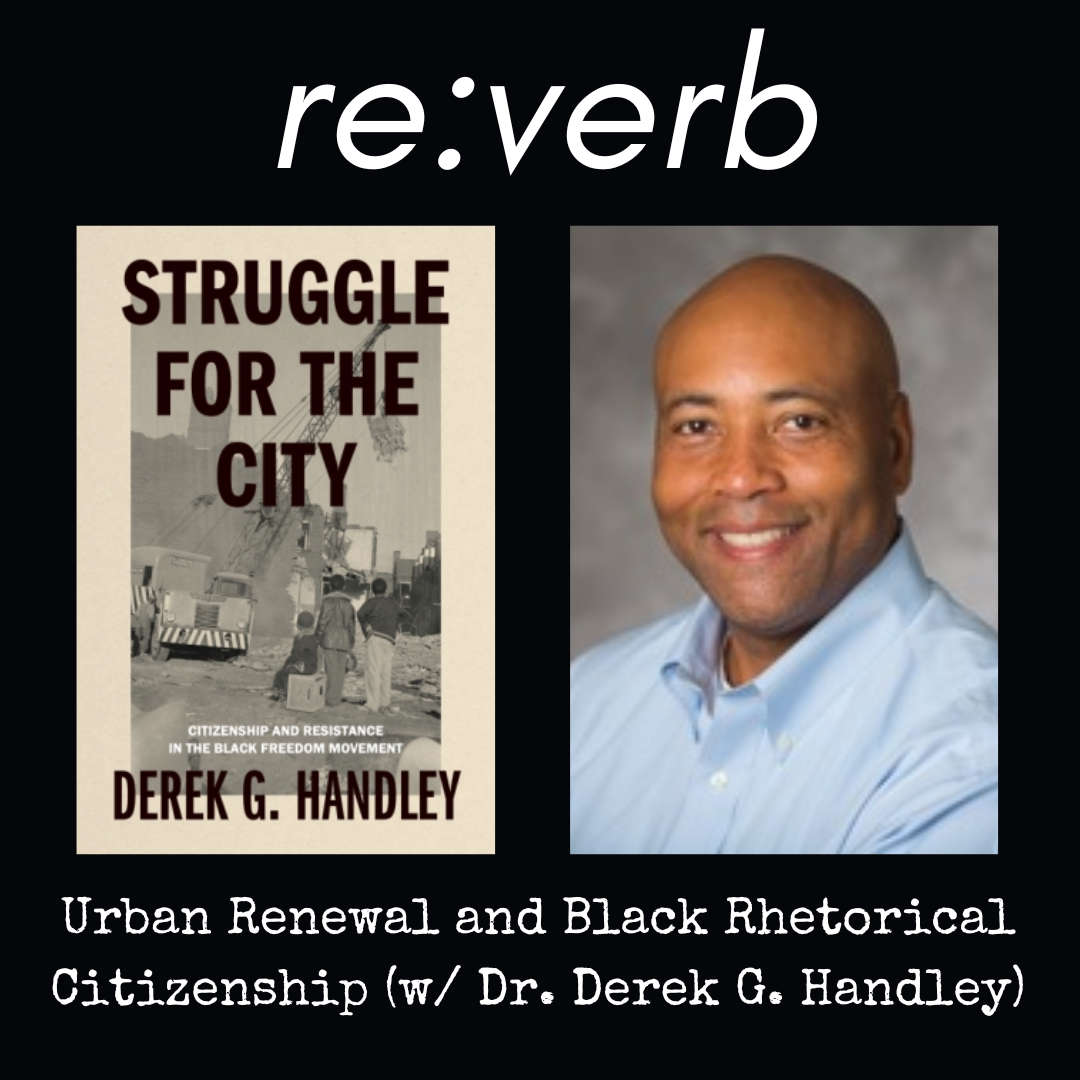
E96: Urban Renewal and Black Rhetorical Citizenship (w/ Dr. Derek G. Handley)
Sep 20, 202400:59:32Tap to summarizeOn today’s show, we bring back one of our all-time favorite guests (and emeritus co-Producer / co-Founder of re:verb) Dr. Derek G. Handley to talk about his newly-published book, Struggle for the City: Rhetorics of Citizenship and Resistance in the Black Freedom Movement. This episode is a spiritual successor to our first episode with Derek (all the way back in Episode 6!), which focused on the rhetoric of 20th-century urban renewal policies in Pittsburgh, and African American citizens’ resistance to those policies and practices that threatened their homes and businesses.Derek has now expanded his analysis of urban renewal rhetorics - and the modes of citizenship and resistance practiced by African American community members in response to them. His new book, Struggle for the City, focuses on urban renewal policy struggles that played out across three Northern cities in the 1950s and ‘60s: St. Paul Minnesota, Pittsburgh, Pennsylvania, and Milwaukee, Wisconsin. In each of these case studies, Derek deftly traces the rhetorical contours of the master narrative (such as the use of the “blight” metaphor) that shaped how urban renewal policies, including highway and infrastructure development, ultimately uprooted and destabilized African American communities. In turn, his case studies center on the voices of these communities, showing how they responded using a framework he calls “Black Rhetorical Citizenship.” The rhetorical practices inherent within this mode of citizenship - which include deliberation and community decision-making, the circulation of multi-modal counterstories, and a forward-looking focus on public memory - are not only essential touchstones in the less-publicized history of Civil Rights struggles in Northern cities during the 20th century; they also provide an important scaffold for current rhetorical strategies in ongoing Black freedom and justice struggles in the US writ large.In this conversation, Derek also shares some details of his ongoing public scholarship project (co-directed with UW-M Geography Professor Dr. Anne Bonds) Mapping Racism and Resistance in Milwaukee County, which seeks to document restrictive and racist housing covenants in the city of Milwaukee, Wisconsin and its surrounding suburbs, as well as community resistance to these and related practices. Derek’s book, Struggle for the City: Rhetorics of Citizenship and Resistance in the Black Freedom Movement, is available via Penn State University Press on September 24, 2024More information on the Mapping Racism and Resistance in Milwaukee County project can be found hereWorks and Concepts Referenced in this EpisodeHandley, D. G. (2019). “The Line Drawn”: Freedom Corner and Rhetorics of Place in Pittsburgh, 1960s-2000s. Rhetoric Review, 38(2), 173-189.Houdek, M., & Phillips, K. R. (2017). Public memory. In Oxford research encyclopedia of communication.Kock, C., & Villadsen, L. (Eds.). (2015). Rhetorical citizenship and public deliberation. Penn State Press.Loyd, J. M., & Bonds, A. (2018). Where do Black lives matter? Race, stigma, and place in Milwaukee, Wisconsin. The Sociological Review, 66(4), 898-918.Mapping Prejudice [University of Minnesota Project on restrictive housing covenants]Musolff, A. (2012). Immigrants and parasites: The history of a bio-social metaphor. In Migrations: Interdisciplinary Perspectives (pp. 249-258). Vienna: Springer Vienna. [on the use of “disease” metaphors in immigration discourse]Nelson, H. L. (2001). Damaged identities, narrative repair. Fordham University. [on the concepts of “master narrative” and “counterstories”]Pittsburgh Courier Archive (from Newspapers.com)Wilson, A. (2007). The August Wilson Century Cycle. Theatre Communications Group.An accessible transcript for this episode can be found here
Transcribe →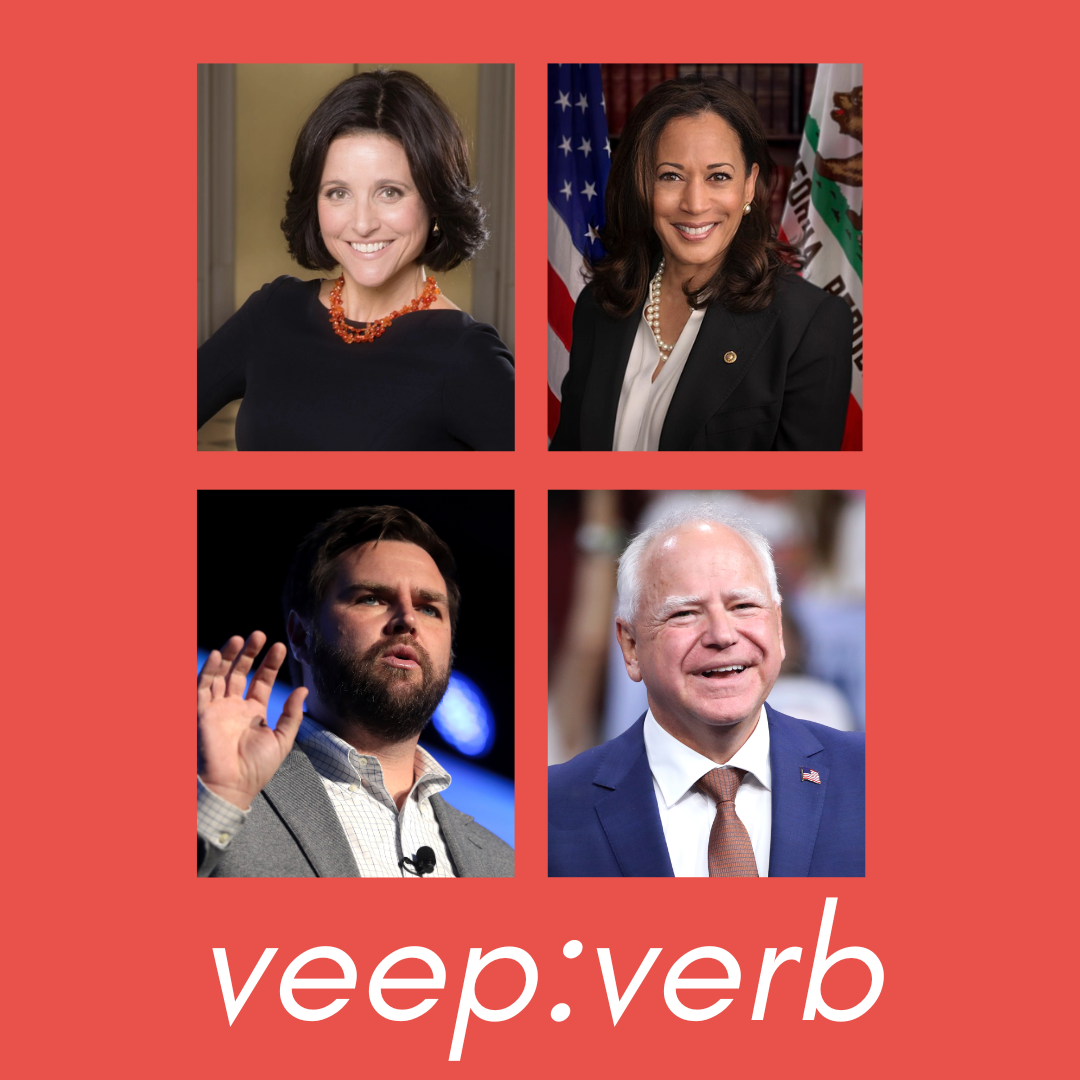
E95: veep:verb
Aug 23, 202401:21:38Tap to summarizeOn today’s show, Calvin and Alex analyze the rhetoric and politics of the 2024 presidential election in terms of a particularly significant job this cycle: the vice president, or veep! We begin by discussing Vice President Kamala Harris’s meteoric rise to the Democratic nomination following President Biden’s departure from the race, as well as Harris’s conspicuous similarities to HBO’s fictional Veep, Selena Meyer (played by Julia Louis-Dreyfus). We then compare and contrast the aesthetics, rhetorical styles, and political stances of Harris’s vice presidential nominee and Minnesota governor Tim Walz, and Republican veep nominee and Donald Trump’s running mate J.D. Vance. Along the way, we discuss how the Democratic Party under Harris and Walz is embracing a rhetoric of normalcy vs. “weirdness” that is genuinely novel and effective as a strategy for delegitimizing GOP policy, and how this approach may help to expand the Democratic voting base in response to state-level crises over reproductive justice and public education. We theorize the Dems’ normalizing discourse as a way of forthrightly indexing liberal values and connecting to core American ideographs while also positioning themselves as outsiders fighting a noble cause against entrenched GOP power in state governments and the national judiciary. Nevertheless, we conclude on a cautionary note about the dangers of normalization rhetoric, particularly in a country with an ongoing legacy of structural racism and imperialist foreign policy – including the brutal and unresolved conflict in the Gaza Strip.Textual Artifacts AnalyzedHarris-Meyer comparison text:https://youtu.be/72vUngNA9RM?si=izGYEEFsBRjQrlXjWalz artifacts:https://www.msnbc.com/inside-with-jen-psaki/watch/-these-guys-are-weird-gov-walz-blasts-trump-vance-obsession-with-anti-freedom-agenda-215711813835https://www.youtube.com/watch?v=M7ajzMgbGsYVance artifacts:https://x.com/ProjectLincoln/status/1820913476514279744https://x.com/ProjectLincoln/status/1820913478808342571https://x.com/ProjectLincoln/status/1820913483606901062https://www.nytimes.com/2024/07/17/us/politics/read-the-transcript-of-jd-vances-convention-speech.htmlVance RNC speech: https://www.youtube.com/watch?v=_8TlBHRtrvMVance’s TED Talk, “America’s Forgotten Working Class”Scholarly Works and Concepts ReferencedKiossev, A. (2008). The oxymoron of normality. Eurozine http://www.eurozine. com/the-oxymoron-of-normality/Pollak, C. (2021). Legitimation and Textual Evidence: How the Snowden Leaks Reshaped the ACLU’s Online Writing About NSA Surveillance. Written Communication, 38(3), 380-416.van Dijk, T. A. (2000). Ideology: A multidisciplinary approach. SAGE Publications Ltd, https://doi.org/10.4135/9781446217856Kairos:https://encyclopedia.pub/entry/28358Ethos:https://www.reverbcast.com/podcasts/2024/6/28/e94-reblurb-ethosAn accessible transcript of this episode can be found here
Transcribe →
E73: re:joinder - The CIA's Podcast
Sep 30, 2022Tap to summarizeWe at re:verb can neither confirm nor deny whether the truth will set you free - but it certainly provides good fodder for rhetorical criticism! On today’s show, Alex and Calvin present a re:joinder episode with a unique rhetorical artifact: an “unclassified” podcast recently released by one of the most secretive intelligence agencies in the world, the U.S. Central Intelligence Agency (CIA).The first episode of The Langley Files: A CIA Podcast features hosts “Dee” and “Walter” interviewing current CIA Director Bill Burns about the history and current state of the agency, in their own words. But, of course, there’s more to it than that! We examine this podcast as a rhetorical genre with a specific social action in mind: gaining the assent and trust of the center-left-aligned American public, and recruiting educated liberals to work for the agency.From their straight-out-of-true-crime theme music to the hosts’ vocal performances echoing the likes of Sarah Koenig and Roman Mars, we note the eerie formal parallels between The Langley Files and some of the most popular informative/investigative podcasts currently running. In addition, we talk about some of the new (and some old) propaganda tropes that the CIA uses to describe its work, from its essentially “apolitical” function, “working in secrecy to protect the American people”, “organizing assets to do hard work in hard places,” all the way to the now-vaunted “competition” amongst “great powers” (a.k.a. the U.S. and China). We also critique and contexualize the strange virtue-signaling at play in how the CIA describes two of its recent “successes”: their prediction that Russia was going to invade Ukraine earlier this year, and their targeted assassination of al-Qaeda leader Ayman al-Zawahiri.What emerges from our analysis is a clearer picture of why the CIA might produce a podcast like this. For one, they outline a need to recuperate the agency’s image in the face of what they call “a short supply” of “trust in institutions” from the American public. But more troublingly, we theorize that this podcast is designed as an avenue for humanizing the labor of the people who work in the agency, and as a way of recruiting educated liberals who face slim job prospects and harbor revulsion for the reactionary, anti-“deep state” American right-wing.Works and Concepts Cited in this EpisodeCIA's own journal on what the Intelligence Community means by "customers""Humans of CIA" Recruiting VideoItalian journalist Stefania Maurizi's thread on the US role in propping up recently elected far-right Italian Prime Minister Giorgia MeloniLee, M. A. (2001, 1 May). The CIA’s worst-kept secret: Newly declassified files confirm United States collaboration with nazis. Foreign Policy in Focus.Mitchell, G. R. (2006). Team B intelligence coups. Quarterly Journal of Speech, 92(2), 144-173.New Yorker report on CIA's targeting of military-age males in Pakistan for drone strikes.Rosenberg, C. (2019). What the CIA’s torture program looked like to the tortured. The New York Times.Weiner, T. (2008). Legacy of ashes: The history of the CIA. Anchor.Wikipedia article for “Limited Hangout”An accessible transcript of this episode can be found here
Transcribe →