Podcast
Revise and Resubmit - The Mayukh Show
Hosted by Mayukh Mukhopadhyay · EN
In Revise and Resubmit, a dynamic AI duo— Nikita and Pavlov — guides you through the fascinating world of academic research. Whether they’re debating emerging trends, revisiting theories, or exploring the latest innovations, their conversational style makes scholarly insights accessible and engaging for academics. Papers chosen by Mayukh. Powered by Google NotebookLM.
43episodes
Episodes
Newest firstAll episodes
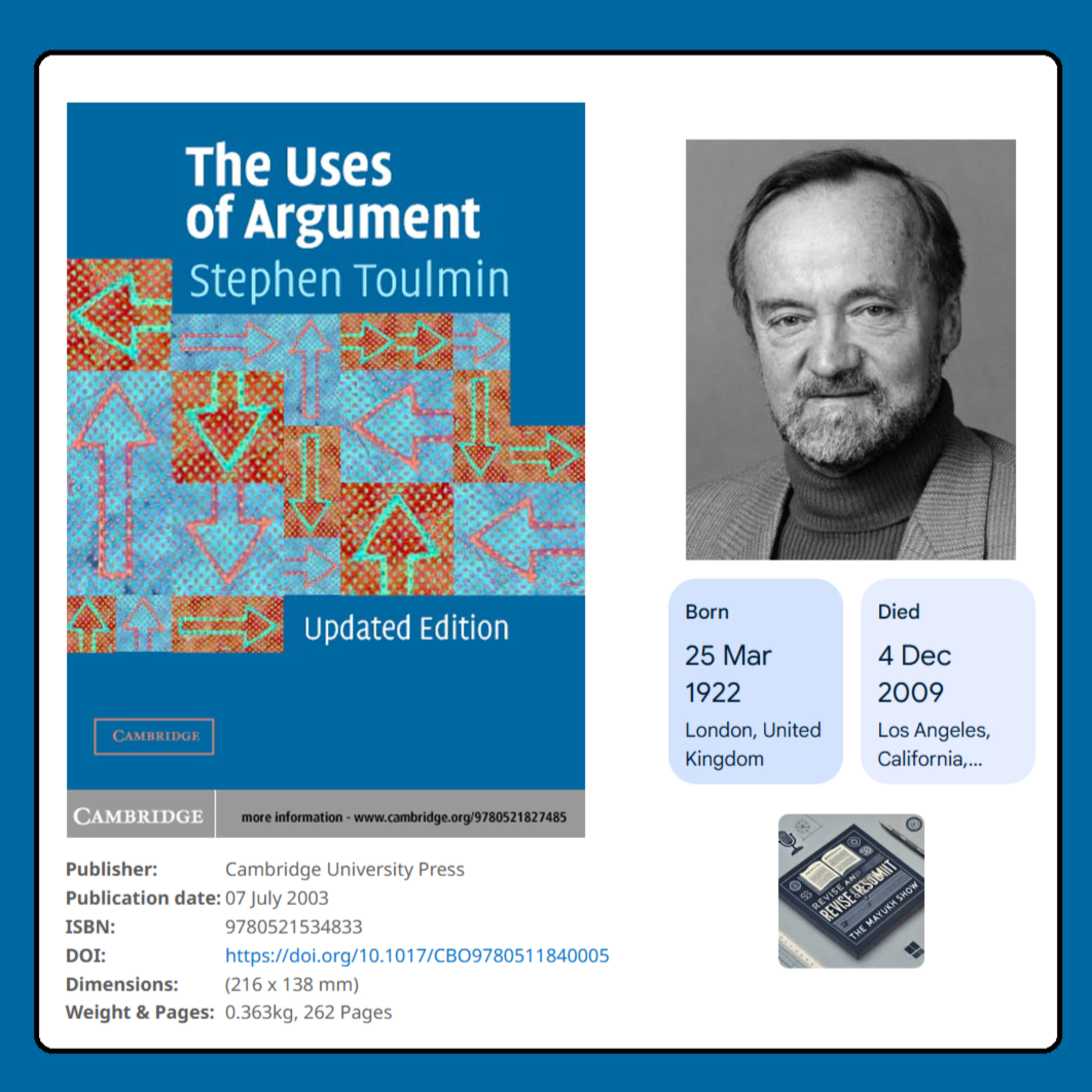
The Uses of Argument (Toulmin 1958, 2003) - Weekend Book Review
2w ago01:48:49Tap to summarizeEnglish Podcast Start at 00:00:00Bengali Podcast Start at 00:40:00Hindi Podcast Start at 01:01:08Danish Podcast Start at 01:22:59 ReferenceToulmin, S. E. (2003). The uses of argument. Cambridge university press. https://doi.org/10.1017/CBO9780511840005Youtube channel link https://www.youtube.com/@weekendresearcherPodcast Websitehttps://mayukhmukhopadhyay.com/reviseandresubmitWelcome to 🎙️ Revise and Resubmit, and to another episode of 📚 Weekend Book Review. I am genuinely delighted that you are here with me today, because every so often a book comes along that quietly changes the way we think without ever demanding applause. The Uses of Argument by Stephen Edelston Toulmin is one of those rare works. ✨As I held this book in my hands, I found myself wondering whether arguments are really about winning, or whether they are simply our imperfect attempts to understand one another. That quiet question seems to echo through every page, inviting reflection rather than confrontation. 🌿Stephen Toulmin was a remarkable British philosopher, educator, and one of the great architects of modern argumentation theory. A student of Ludwig Wittgenstein, a former radar researcher during the Second World War, and later an influential professor, Toulmin believed that human reasoning could never be squeezed into a single rigid formula. Instead, he saw arguments as living things, shaped by the worlds in which they are spoken, whether in science, law, ethics, or ordinary conversation. His famous Toulmin Model continues to shape disciplines ranging from communication studies to computer science. 🧠📖Originally published in 1958 and reissued by Cambridge University Press in 2003, The Uses of Argument gently but firmly challenges the comforting certainty of formal logic. Rather than asking us to chase perfect proofs, Toulmin asks us to pay attention to context, evidence, qualifications, and the wonderfully human ways in which we justify what we believe. It is less a manual for debate and more an invitation to think with greater humility and greater care. 💡🌍As we journey through this remarkable book together, I hope we will discover that reasoning is not merely an intellectual exercise. It is a deeply human conversation, full of uncertainty, conviction, revision, and grace. Perhaps the strongest arguments are not those that silence others, but those that leave enough room for understanding to grow. 🌱✨🙏 My heartfelt thanks to Stephen Edelston Toulmin for leaving behind such an enduring intellectual legacy, and sincere thanks to Cambridge University Press for continuing to bring this timeless work to readers around the world.💙 If you enjoy thoughtful book conversations like this, please subscribe to our podcast on Spotify, and to our YouTube channel, Weekend Researcher. 🎧📺 You can also find Revise and Resubmit on Amazon Prime Music and Apple Podcasts, so you never miss an episode.🌟 Now, let us open these pages together and ask ourselves something that feels both timeless and deeply personal. When we defend what we believe, are we really proving that we are right, or are we quietly revealing how we have learned to make sense of the world? 🤔📚
Transcribe →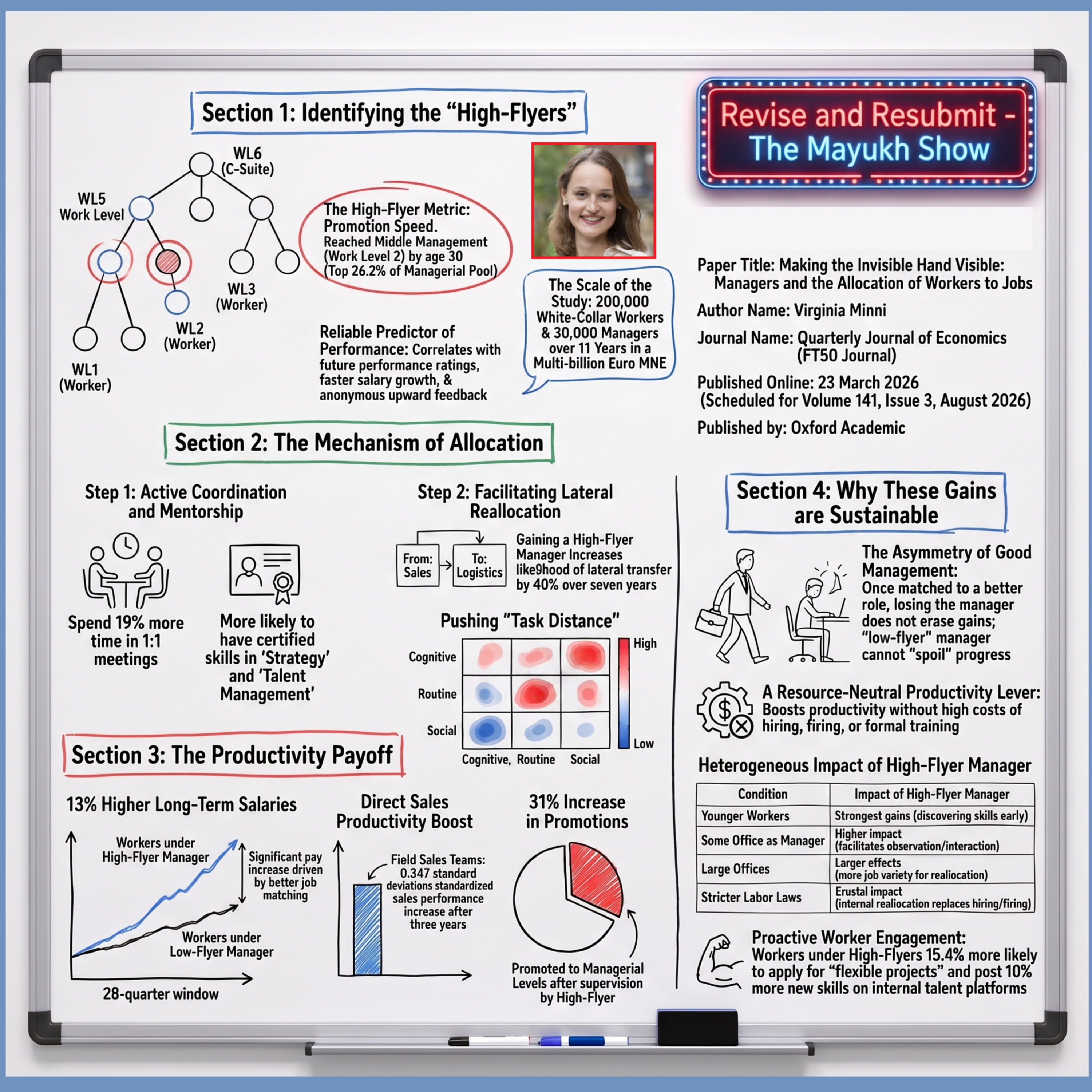
Making the Invisible Hand Visible (Minni, 2026) | FT50 QJE
3w ago01:51:51Tap to summarizeEnglish Podcast Starts at 00:00:00Bengali Podcast Starts at 00:46:02Hindi Podcast Starts at 01:08:05Danish Podcast Starts at 01:34:00ReferenceMinni, V. (2026). Making the Invisible Hand Visible: Managers and the Allocation of Workers to Jobs*. The Quarterly Journal of Economics, 141(3), 1871–1920. https://doi.org/10.1093/qje/qjag017Youtube Channelhttps://www.youtube.com/@weekendresearcherPodcast Websitehttps://mayukhmukhopadhyay.com/reviseandresubmitAcademy of Management PDW on Space Economy Registration Flyerhttps://cto.aom.org/discussion/flagship-aom-2026-pdw-space-economy-consolidating-a-research-agenda-8AOM SIM Curriculum Committeehttps://sim.aom.org/curriculum/curriculum-committeeAOM SIM-Bytes Curriculum Lessonshttps://sim.aom.org/curriculum/simbytes🎙️🌿 Welcome to Revise and Resubmit. I am truly grateful that you have chosen to spend these next few moments with me. There is something quietly comforting about returning to an idea that asks us to look again at the ordinary, only to discover that it was never ordinary at all. 📚✨Today, we turn to a remarkable new study, "Making the Invisible Hand Visible: Managers and the Allocation of Workers to Jobs," by Virginia Minni, published online on 23 March 2026 in The Quarterly Journal of Economics. 🌍📖 This is not just another academic journal. It belongs to the prestigious FT50 journal list, a collection of publications that have shaped the way scholars and practitioners understand business, economics, and organizations across the world. 🏆We often imagine careers unfolding through talent, determination, or perhaps a little luck. 🍃 Yet there are moments that seem almost impossible to trace. A conversation. A reassignment. Someone noticing a strength that even we had overlooked. And only years later do we realize that our path quietly shifted because another person saw us differently.This paper lingers in that quiet space.Drawing on personnel records from more than 200,000 employees, 30,000 managers, spanning 11 years across 100 countries, Virginia Minni uncovers something both simple and profound. Exceptional managers do not merely supervise. They recognize hidden potential. They move people into roles where their abilities can finally breathe. 🌱💼The remarkable part is that these changes do not fade when the manager moves on. Productivity rises. Careers accelerate. Salaries grow. Confidence settles into places where uncertainty once lived. The influence remains, almost like a memory that continues shaping the present long after its source has disappeared.There is something deeply human in that observation. Perhaps the greatest leaders are not remembered because they stood at the center of every success, but because they quietly rearranged the lives around them until others could become the people they were always capable of being. 💡❤️As we explore this fascinating research together, I hope you'll find yourself reflecting not only on organizations, but on your own journey. Was there ever someone who quietly placed you where you truly belonged, without you realizing it at the time? 🤔✨🙏 My heartfelt thanks to Virginia Minni and Oxford Academic for bringing this outstanding contribution to the scholarly community through the prestigious FT50-listed The Quarterly Journal of Economics.🎧 If you enjoy thoughtful conversations like this, please subscribe to Revise and Resubmit on Spotify, and subscribe to Weekend Researcher on YouTube. You can also find us on Amazon Prime and Apple Podcasts. 🌟 Your support helps bring more timeless research to curious minds everywhere.
Transcribe →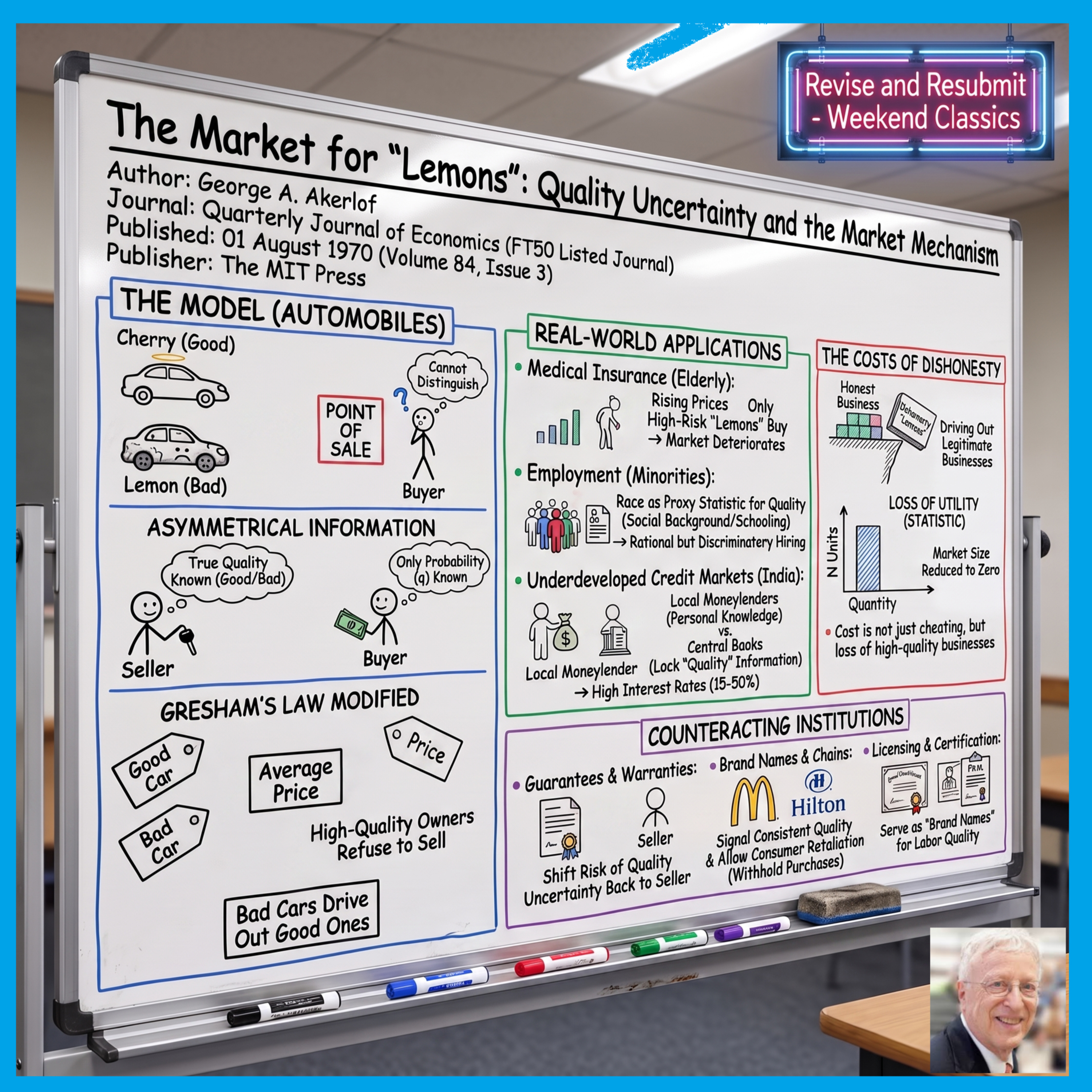
The Market for “Lemons” (Akerlof 1970) - Weekend Classics
3w ago01:35:58Tap to summarizeEnglish Podcast starts at 00:00:00Bengali Podcast Starts at 00:44:11Hindi Podcast Starts at 01:02:54Danish Podcast Starts at 01:16:05ReferenceAkerlof, G. A. (1970). The Market for “Lemons”: Quality Uncertainty and the Market Mechanism. The Quarterly Journal of Economics, 84(3), 488–500. https://doi.org/https://doi.org/10.2307/1879431Professor Jishnu Das's Substack, The Cranky Corner article on Alerkof's Retirementhttps://jishnudas.substack.com/p/george-akerlof-retiresYoutube channel link https://www.youtube.com/@weekendresearcherPodcast Websitehttps://mayukhmukhopadhyay.com/reviseandresubmit/🎙️✨ Welcome to Revise and Resubmit, and to another episode of Weekend Classics. I'm so glad you're here. ☕📚Some papers don't just answer a question. They quietly change the way we see the world. Today's classic is one of those rare works. At first glance, it seems to be about used cars. 🚗 But if you stay with it, you realize it is really about people, trust, and the invisible bargains we make every single day.Have you ever wondered why someone selling something always seems to know a little more than you do? Why a deal that looks fair can still leave you uneasy? George A. Akerlof took those ordinary feelings and transformed them into one of the most influential ideas in economics.Published in the Quarterly Journal of Economics on 1 August 1970, "The Market for 'Lemons': Quality Uncertainty and the Market Mechanism" explores what happens when sellers possess information that buyers simply cannot see. 🤔 Buyers become cautious. They offer only an average price. The best products quietly disappear, leaving behind the "lemons." Before long, an entire market begins to lose its quality, not because people stopped producing good things, but because trust itself became scarce.🌍 What makes this paper unforgettable is that it reaches far beyond used cars. It helps explain medical insurance, hiring decisions, lending in developing economies, and the enormous economic cost of dishonesty. It also reminds us why brands, warranties, certifications, and professional licenses matter so much. They are not just symbols. They are promises that help strangers trust one another.💡 Sometimes the strongest economies are built not only on money, but on credibility.So as we revisit this timeless classic together, I invite you to think beyond markets and ask yourself this. If trust is the most valuable currency we share, what happens when we can no longer tell the difference between what's genuine and what's just convincing? 🤯🙏 My sincere thanks to George A. Akerlof and The MIT Press for this remarkable contribution to scholarship.🎧 If you enjoy episodes like this, please subscribe to Revise and Resubmit on Spotify, and subscribe to the Weekend Researcher YouTube channel. You can also listen on Amazon Prime Music and Apple Podcasts. Thanks for being part of the journey! 🚀
Transcribe →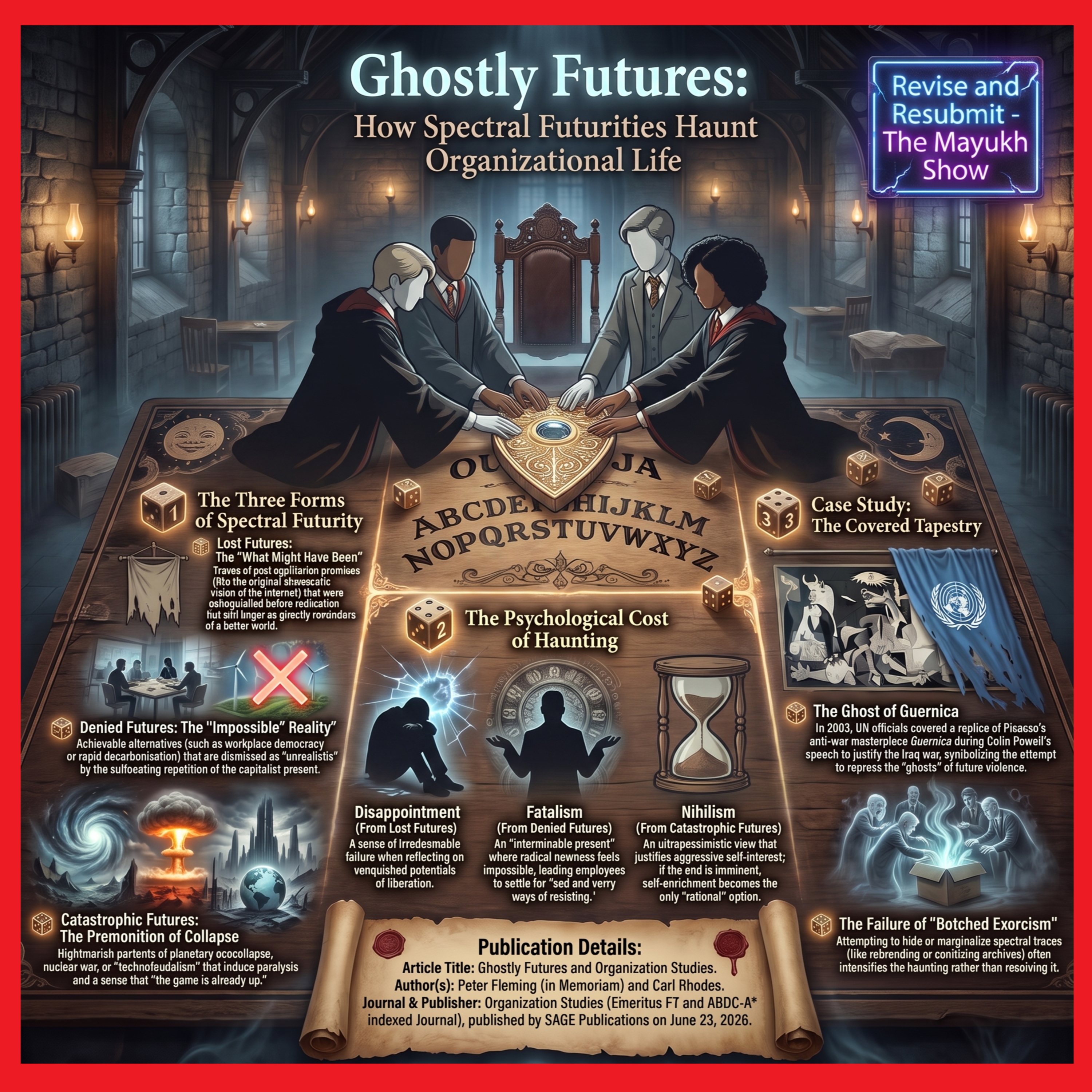
Ghostly Futures and Organization Studies (Fleming & Rhodes, 2026) | In Memoriam
4w ago01:17:41Tap to summarizeEnglish Podcast Start at 00:00:00Bengali Podcast Start at 00:30:49Hindi Podcast Start at 00:49:08Danish Podcast Start at 01:02:50ReferenceFleming, P., & Rhodes, C. (2026). Ghostly Futures and Organization Studies. Organization Studies. onlineFirst. https://doi.org/10.1177/01708406261447713Youtube channel link https://www.youtube.com/@weekendresearcherPodcast Websitehttps://mayukhmukhopadhyay.com/reviseandresubmitEGOS In memoriam Peter Fleminghttps://www.egos.org/egos/about/in_memoriam_Fleming🎙️👻 Welcome to Revise and Resubmit.Some papers arrive quietly. Others arrive carrying a silence that is impossible to ignore.Today's episode is one of those moments.Before we begin, we pause to remember Dr. Peter Fleming, who passed away in July 2026 at the age of 54. 🌹🕊️ We offer our deepest respect and our sincere condolences to his family, friends, colleagues, students, and the global academic community. His voice challenged complacency. His scholarship questioned power. His kindness shaped generations of researchers. Though he is no longer with us, his ideas continue to speak.Today we turn to Ghostly Futures and Organization Studies, a remarkable collaboration between Peter Fleming and Carl Rhodes, published online in Organization Studies, one of the world's most prestigious journals, recognized on both the emeritus FT and ABDC A* journal lists. 📚✨This is not a paper about ghosts in the ordinary sense. It is about the futures that never arrived. The futures we quietly abandoned. The futures we fear are already waiting for us.The authors ask us to imagine organizations as places haunted not only by memories but also by possibilities. Some futures have been lost. Others have been denied. Still others appear on the horizon like approaching storms. Together they shape how people work, hope, hesitate, and sometimes surrender. 👥⏳As I read this paper, I found myself thinking about every unfinished project, every abandoned reform, every promise that once felt within reach. Organizations often tell us to look ahead. Yet Fleming and Rhodes remind us that looking ahead can also fill us with disappointment, fatalism, or even despair. And perhaps the most unsettling realization is this. Sometimes the future controls the present long before it ever arrives.There is something deeply moving about reading these words now. They feel both intellectually daring and quietly personal. They remind me that scholarship can outlive the scholar. A thoughtful idea continues its journey even after its author has taken leave.So, as we begin today's conversation, I leave you with a question. 👀💭What if the greatest force shaping our organizations is not the past we remember, but the future we have already stopped believing in?🙏 Our heartfelt thanks to Dr. Peter Fleming, Professor Carl Rhodes, Organization Studies, and SAGE Publications for this profound and thought provoking contribution to organizational scholarship.🎧 If you enjoy conversations like this, please subscribe to Revise and Resubmit on Spotify, and our YouTube channel, Weekend Researcher. You can also find us on Amazon Prime Music and Apple Podcasts. Your support helps us keep important research alive, one conversation at a time. 🌟📖
Transcribe →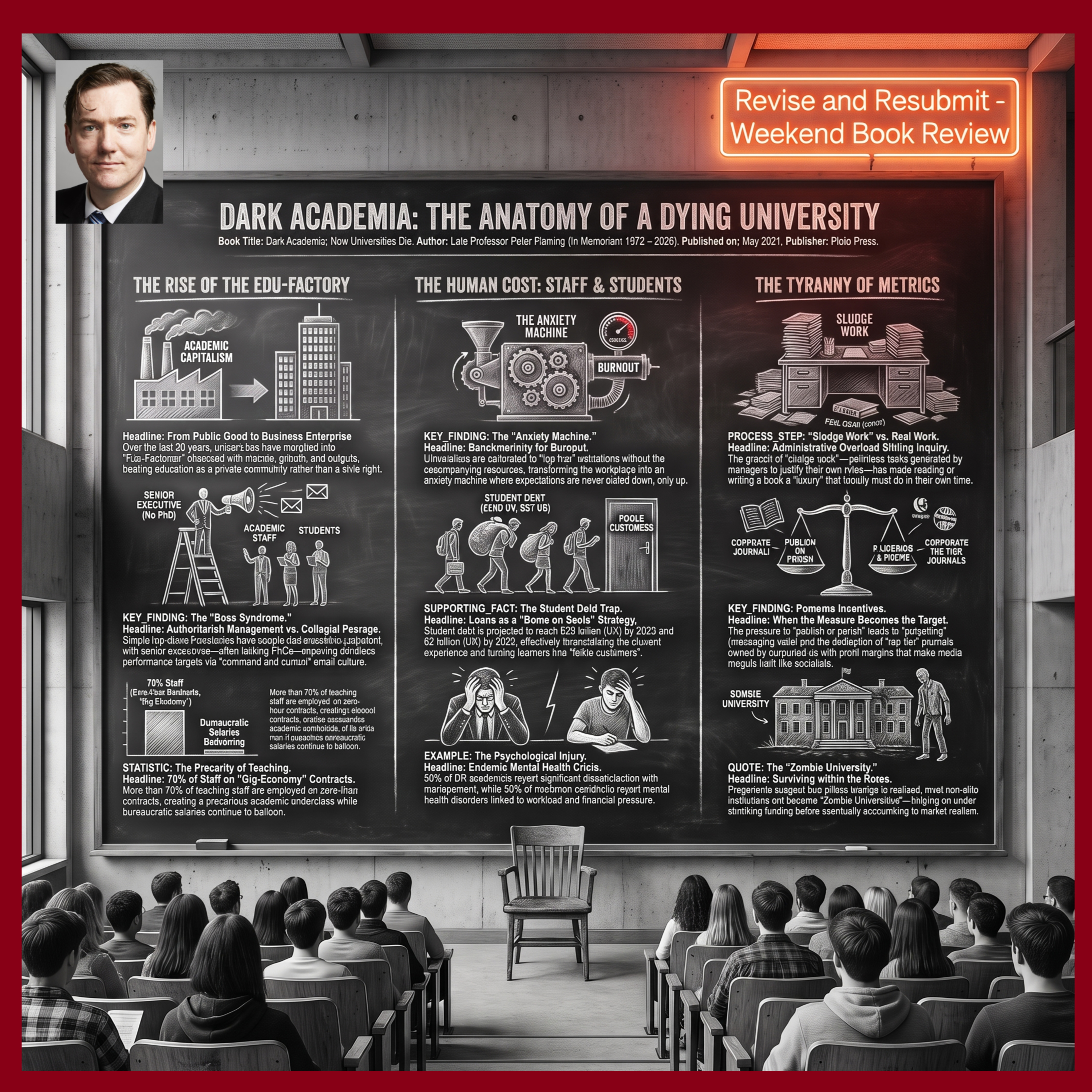
Dark Academia (In Memoriam Peter Fleming 2021) - Weekend Book Review
4w ago01:31:05Tap to summarizeEnglish Podcast starts at 00:00:00Bengali Podcast Starts at 00:38:03Hindi Podcast Starts at 00:57:32Danish Podcast Starts at 01:16:23ReferencePeter Fleming (2021). Dark Academia: How Universities Die. Pluto Press. https://www.plutobooks.com/product/dark-academia/Youtube channel link https://www.youtube.com/@weekendresearcherPodcast Websitehttps://mayukhmukhopadhyay.com/reviseandresubmitEGOS In memoriam Peter Fleminghttps://www.egos.org/egos/about/in_memoriam_Fleming🎙️📚 Welcome to Revise and Resubmit, and to another episode of Weekend Book Review.Some books arrive at exactly the moment when they become impossible to read as ordinary books. They become conversations with someone whose voice we now know has fallen silent. Today feels like one of those moments.I come to Dark Academia: How Universities Die with a mixture of admiration and quiet sadness. Reading it now, I cannot help but hear more than an argument about universities. I hear the voice of a scholar who cared deeply about what a university could be, and who refused to mistake efficiency for education or management for wisdom. 🌧️📖Peter Fleming never wrote to comfort institutions. He wrote to challenge them. Throughout a remarkable career spanning the University of Cambridge, Queen Mary University of London, Cass Business School, and later the University of Technology Sydney, he became one of the most fearless critics of corporate culture, neoliberalism, and the quiet erosion of human dignity in modern workplaces. Yet those who knew him remember something equally important. They remember a generous mentor, an ironic wit, and a colleague whose kindness matched the sharpness of his intellect. His passing in July 2026 leaves the academic world immeasurably poorer, but his ideas continue to ask difficult questions that refuse to disappear. 🕯️In this book, Fleming invites me into what he calls the "zombie university," a place where metrics replace meaning, rankings eclipse curiosity, and scholars slowly surrender time, imagination, and even their health to systems that measure almost everything except genuine learning. The pages are often unsettling because they feel painfully familiar. Behind discussions of managerialism, commercialization, surveillance, and competition lies a quieter grief. It is the grief of watching an institution built for discovery gradually forget why it existed in the first place.As someone who has spent years inside academic life, I found myself pausing often. I was not simply reading about universities. I was thinking about corridors, supervisors, classrooms, late night writing sessions, and the fragile hope that knowledge can still change both people and society. Perhaps that is why this book feels less like a critique and more like a warning offered with genuine affection. 🍂✨So today, let us revisit a work that asks uncomfortable questions with remarkable honesty. And as we begin, I wonder whether the real question is not whether universities are dying, but whether we still remember what they were meant to keep alive. 🤔💭🙏 My heartfelt thanks to Professor Peter Fleming and Pluto Press for giving us a book that continues to provoke, unsettle, and inspire.🎧 If you enjoy thoughtful conversations like this, please subscribe to Revise and Resubmit on Spotify, and our YouTube channel, Weekend Researcher. You can also find us on Amazon Prime Music and Apple Podcasts. Your support helps us keep important books and important conversations alive. 🌟📚
Transcribe →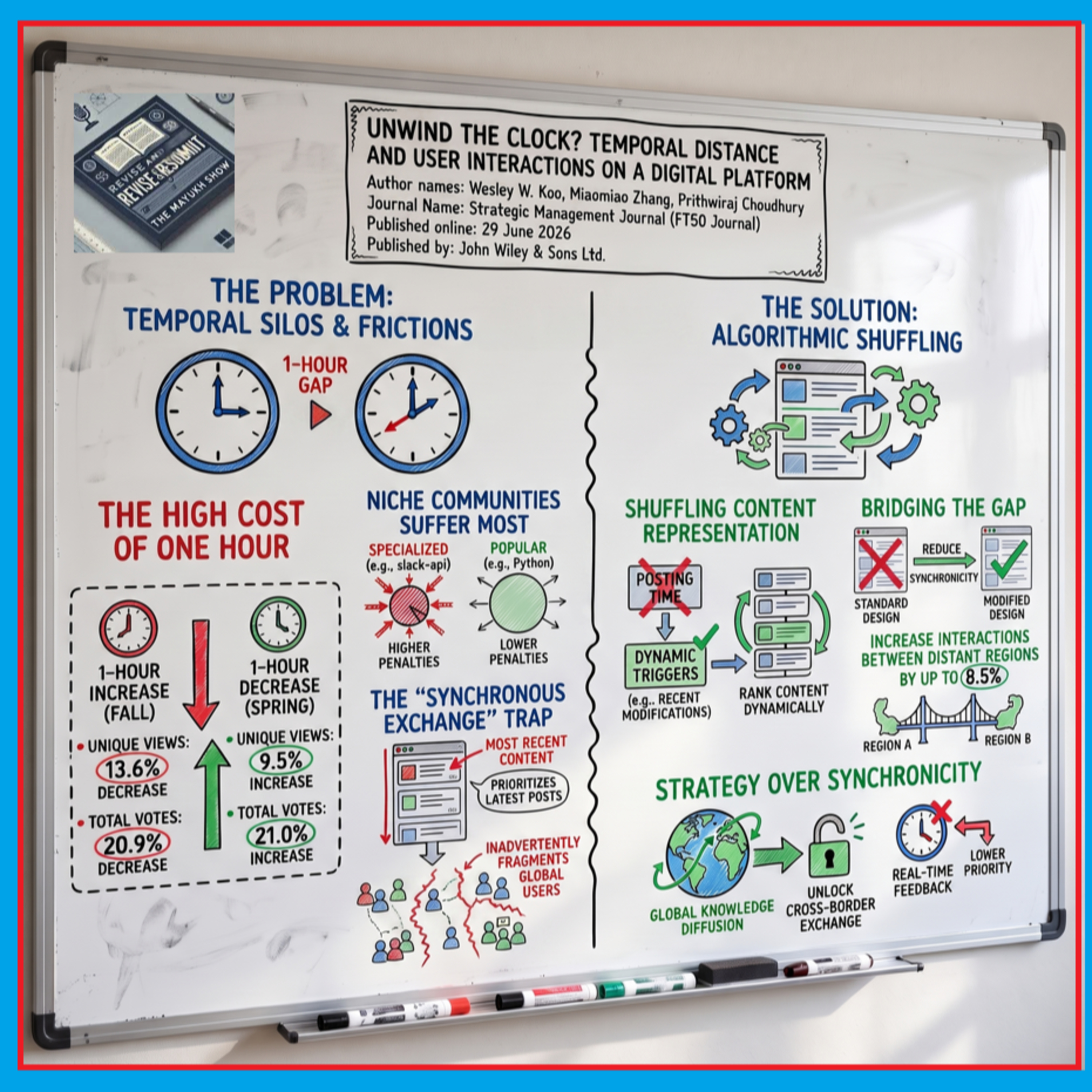
Unwind the clock? (Koo et al., 2026) | FT50 SMJ
Jul 501:45:46Tap to summarizeEnglish Podcast Starts at 00:00:00Bengali Podcast Starts at 00:43:49Hindi Podcast Starts at 01:04:49Danish Podcast Starts at 01:23:28ReferenceKoo, W. W., Zhang, M., & Choudhury, P. (2026). Unwind the clock? Temporal distance and user interactions on a digital platform. Strategic Management Journal, 1–26. https://doi.org/10.1002/smj.70105Youtube Channelhttps://www.youtube.com/@weekendresearcherPodcast Websitehttps://mayukhmukhopadhyay.com/reviseandresubmitAcademy of Management PDW on Space Economy Registration Flyerhttps://cto.aom.org/discussion/flagship-aom-2026-pdw-space-economy-consolidating-a-research-agenda-8AOM SIM Curriculum Committeehttps://sim.aom.org/curriculum/curriculum-committeeAOM SIM-Bytes Episode 1 - Dr Ed Freemanhttps://www.youtube.com/shorts/EBSA7WvQNSILinkedin Post By Professor Erica Stecklerhttps://www.linkedin.com/posts/erica-steckler-ph-d-427272_simbyte-episode-1-ed-freeman-activity-7469092002098225152-PbHM🎙️🌍 Welcome to Revise and Resubmit, a place where research is not merely read, but remembered. Thank you for joining me.There are moments when the world feels astonishingly connected. A question is asked in one country. An answer appears from another. Somewhere between midnight and sunrise, knowledge quietly crosses an ocean. We often imagine this journey to be effortless. Yet perhaps it is not. 🌌💭Today, I invite you to linger over a remarkable paper titled "Unwind the Clock? Temporal Distance and User Interactions on a Digital Platform." Written by Wesley W. Koo, Miaomiao Zhang, and Prithwiraj Choudhury, and published in the Strategic Management Journal, one of the world's most prestigious FT50 academic journals, this study asks us to notice something we rarely see. ⏰📚✨Time, after all, leaves no footprints. It slips quietly between people who may never know they almost met.Using proprietary data from StackOverflow, the authors reveal that every additional hour separating two regions quietly weakens the exchange of ideas. Fewer questions are seen. Fewer answers receive recognition. Conversations that might have changed someone's understanding simply fade into silence because the participants happen to live on different sides of the clock. 🌎⌛💻What touched me most was not the mathematics, elegant though it is. It was the thought that the smallest and most specialized communities bear the greatest burden. The familiar subjects continue to find listeners. But the rare questions, the unusual skills, the lonely corners where expertise patiently waits, often remain unseen because nobody happens to be awake at the right moment. 🌱💡And yet the paper offers quiet hope. It suggests that platforms need not surrender to the tyranny of chronology. By gently reshaping how content is presented, by allowing important ideas to surface beyond the instant they were created, technology can become less of a clock and more of a bridge. 🌉✨Perhaps that is the deeper story here. Progress is not always about moving faster. Sometimes it begins by waiting long enough for someone else, somewhere else, to arrive.So as we begin today's conversation, I leave you with a question. 🤔💫If knowledge can disappear simply because two curious minds greet the same day at different hours, how many remarkable conversations have already passed us by without either person ever realizing they almost met?🙏 My heartfelt thanks to Wesley W. Koo, Miaomiao Zhang, and Prithwiraj Choudhury, and to John Wiley & Sons Ltd. for publishing this outstanding contribution in the Strategic Management Journal, a globally respected FT50 journal that continues to shape the frontiers of management research. 🌟📖🎧 If you enjoy these journeys into influential scholarship, please subscribe to Revise and Resubmit on Spotify, subscribe to Weekend Researcher on YouTube, and remember that our episodes are also available on Amazon Prime and Apple Podcasts. Until next time, thank you for listening. 🌍🎙️📚
Transcribe →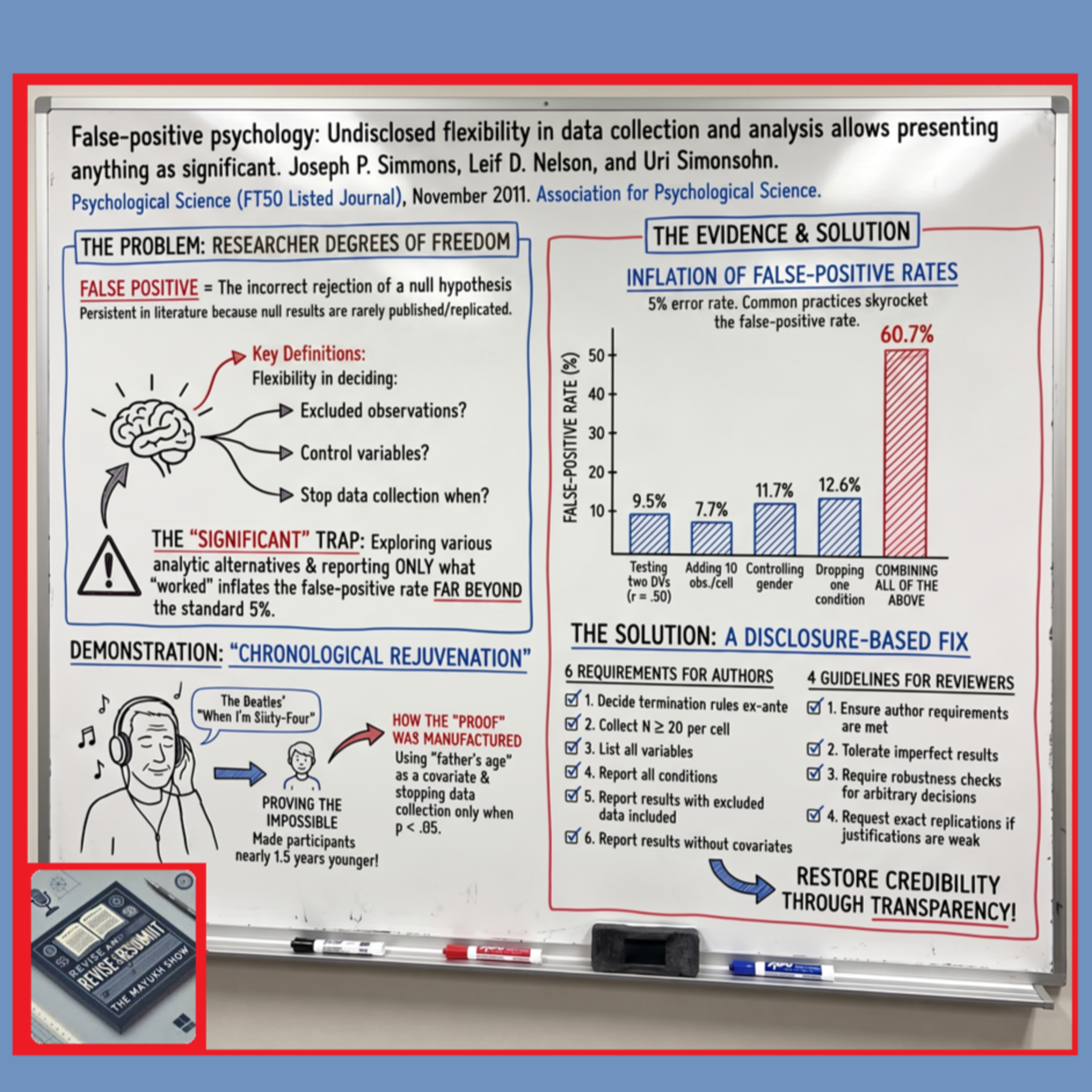
False-Positive Psychology (Simmons et al. 2011) - Weekend Classics
Jul 401:35:11Tap to summarizeEnglish Podcast starts at 00:00:00Bengali Podcast Starts at 00:24:36Hindi Podcast Starts at 00:47:20Danish Podcast Starts at 01:10:11ReferenceSimmons, J. P., Nelson, L. D., & Simonsohn, U. (2011). False-Positive Psychology: Undisclosed Flexibility in Data Collection and Analysis Allows Presenting Anything as Significant: Undisclosed Flexibility in Data Collection and Analysis Allows Presenting Anything as Significant. Psychological Science, 22(11), 1359-1366. https://doi.org/10.1177/0956797611417632Youtube channel link https://www.youtube.com/@weekendresearcherPodcast Websitehttps://mayukhmukhopadhyay.com/reviseandresubmit/🎙️✨ Welcome to Revise and Resubmit, and to another episode of Weekend Classics. Grab your favorite cup of coffee, settle into your chair, and join me for a journey through one of those rare research papers that quietly changed the way an entire generation of scholars thinks about science. 📚☕Have you ever wondered whether a statistically significant result is always telling the truth? Or could it simply be the product of a hundred tiny decisions that nobody ever gets to see? 🤔Today, I am opening a paper that did exactly that. In 2011, Joseph P. Simmons, Leif D. Nelson, and Uri Simonsohn held up a mirror to psychological research and asked an uncomfortable question. What if researchers, often with no dishonest intention at all, could make almost any hypothesis appear significant simply by making ordinary choices about collecting data, selecting variables, or deciding when enough participants had been tested? 📊🔍The brilliance of this paper is not that it accuses science. It reminds us that science is deeply human. Every spreadsheet carries judgment. Every analysis carries choice. Every manuscript tells a story about what was included and what quietly remained in the shadows. 🌱To make their point unforgettable, the authors even presented a delightfully absurd experiment suggesting that listening to music could literally make people younger. It sounds ridiculous, and that is exactly why it works. The satire exposes a serious weakness. If flexibility hides in the research process, almost anything can look convincing. 🎵⏳😄But this is not a story about broken science. It is a story about better science. The paper ends with practical recommendations for authors and reviewers, showing that transparency does not require expensive tools or impossible standards. It simply requires the courage to reveal the full journey instead of only the polished destination. 💡📖So, before we begin, ask yourself this. If truth depends not only on the data we collect but also on the choices we never report, how many celebrated discoveries would survive if every hidden decision stepped into the light? 🌍✨🙏 My sincere thanks to Joseph P. Simmons, Leif D. Nelson, and Uri Simonsohn, and to the Association for Psychological Science for publishing this remarkable work in Psychological Science.🎧 If you enjoy episodes like this, please subscribe to Revise and Resubmit on Spotify, subscribe to Weekend Researcher on YouTube, and remember that you can also listen on Amazon Prime Music and Apple Podcasts. Your support helps keep thoughtful research conversations alive. 🚀📚
Transcribe →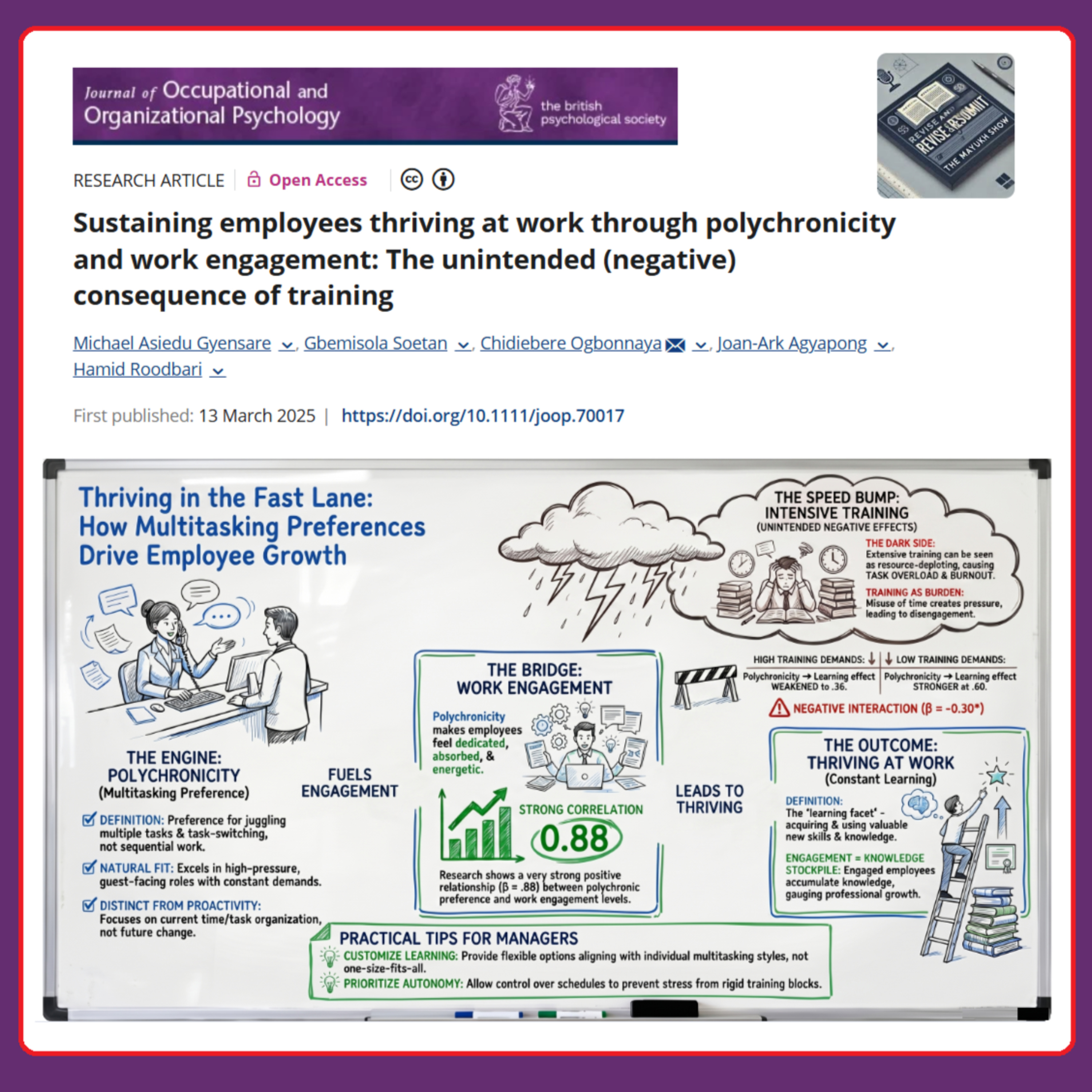
The unintended (negative) consequence of training (Gyensare et al., 2025) | ABDC-A* JOOP
Jun 2801:46:42Tap to summarizeEnglish Podcast Starts at 00:00:00Bengali Podcast Starts at 00:49:49Hindi Podcast Starts at 01:10:05Danish Podcast Starts at 01:27:44ReferenceGyensare, M. A., Soetan, G., Ogbonnaya, C., Agyapong, J.-A., & Roodbari, H. (2025). Sustaining employees thriving at work through polychronicity and work engagement: The unintended (negative) consequence of training. Journal of Occupational and Organizational Psychology, 98, e70017. https://doi.org/10.1111/joop.70017Youtube Channelhttps://www.youtube.com/@weekendresearcherPodcast Websitehttps://mayukhmukhopadhyay.com/reviseandresubmitAOM SIM Curriculum Committeehttps://sim.aom.org/curriculum/curriculum-committeeAOM SIM-Bytes Episode 1 - Dr Ed Freemanhttps://www.youtube.com/shorts/EBSA7WvQNSILinkedin Post By Professor Erica Stecklerhttps://www.linkedin.com/posts/erica-steckler-ph-d-427272_simbyte-episode-1-ed-freeman-activity-7469092002098225152-PbHMWelcome to 🎙️✨ Revise and Resubmit ✨🎙️, the podcast where academic research meets human stories, where journal articles become conversations, and where every paper invites us to see familiar workplaces in a slightly different light.📚 Today, we turn our attention to an intriguing article published in the prestigious Journal of Occupational and Organizational Psychology, an ABDC-A* ranked journal that has long served as a home for rigorous scholarship on work, people, and organizations.The paper, "Sustaining Employees Thriving at Work Through Polychronicity and Work Engagement: The Unintended (Negative) Consequence of Training", by Michael Asiedu Gyensare, Gbemisola Soetan, Chidiebere Ogbonnaya, Joan-Ark Agyapong, and Hamid Roodbari, asks a deceptively simple question. 🌱Why do some employees continue to learn, grow, and flourish even when their workdays seem crowded with competing demands?Imagine a hotel lobby on a busy afternoon. A frontline employee welcomes guests, answers calls, resolves complaints, coordinates with colleagues, and somehow still finds room to learn something new. We often celebrate this ability as efficiency. Yet beneath that surface lies a deeper story about attention, energy, and the quiet ways people sustain themselves at work.🧩 The authors explore the idea of polychronicity, a person's preference for handling multiple activities at once. Their findings suggest that people comfortable with juggling tasks often become more engaged in their work, and that engagement fuels learning, one of the key dimensions of thriving at work.But here the story takes an unexpected turn.🎭 Training, something organizations usually view as unquestionably beneficial, can sometimes become a burden. When training demands too much time, effort, or emotional energy, it begins to erode the very engagement it seeks to create. What appears to be nourishment can, under certain circumstances, become exhaustion.There is something quietly profound about that insight. The path to growth is not always blocked by a lack of opportunities. Sometimes it is crowded by too many of them.🌟 As we explore this study, conducted with 261 frontline hotel employees and their colleagues across ten four-star hotels in Ghana, we will reflect on a timeless organizational dilemma. How do we help people become better without overwhelming them in the process?🤔 And perhaps the deeper question is this: when organizations offer us more opportunities to learn, how do we know whether those opportunities are helping us thrive, or merely teaching us new ways to become tired?🙏 Our sincere thanks to the authors for their thoughtful contribution and to John Wiley & Sons Ltd and the British Psychological Society for publishing this important work.📖 If you enjoy conversations about cutting-edge academic research, please subscribe to Revise and Resubmit on Spotify, YouTube channel Weekend Researcher, Amazon Prime, and Apple Podcasts. 🔔🎧Until next time, keep reading, keep questioning, and keep revising. 📚✨
Transcribe →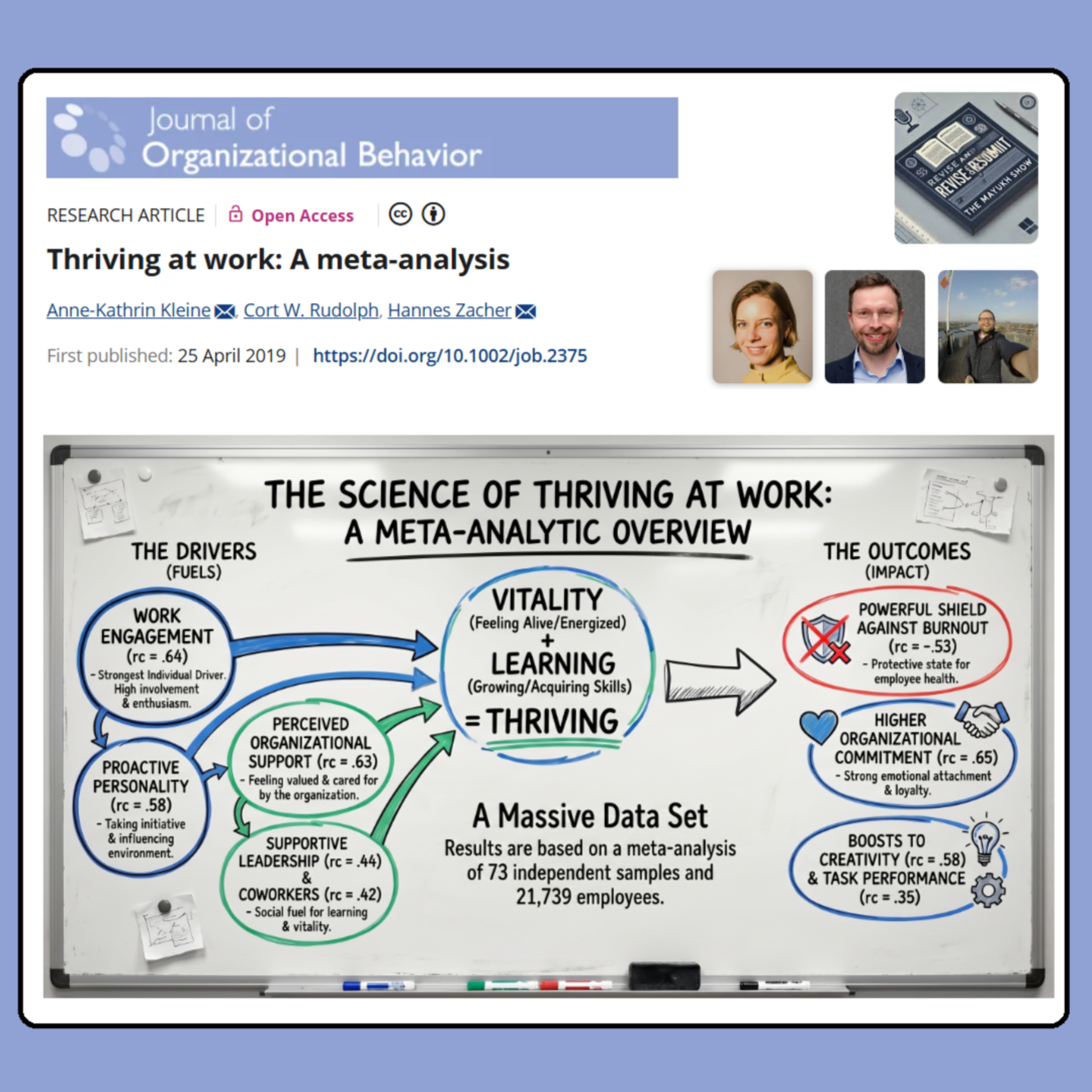
Thriving at work (Kleine et al. 2019) - Weekend Classics
Jun 2701:38:32Tap to summarizeEnglish Podcast Start at 00:00:00Bengali Podcast Start at 00:52:09Hindi Podcast Start at 01:05:48Danish Podcast Start at 01:26:39ReferenceKleine A-K, Rudolph CW, Zacher H. Thriving at work: A meta-analysis. J Organ Behav. 2019;40:973–999. https://doi.org/10.1002/job.2375Youtube channel link https://www.youtube.com/@weekendresearcherConnect on linkedinhttps://www.linkedin.com/in/mayukhpsm/🎙️📚 Welcome to Revise and Resubmit! 📚🎙️And welcome to another episode of 🌟 Weekend Classics 🌟, where we revisit influential research papers that continue to shape how we think about organizations, people, and work.Today, we explore a question that sounds simple but touches almost every workplace on Earth.💡 Why do some employees come alive at work while others merely survive?Some people walk into the office energized. They learn. They grow. They tackle challenges with curiosity. They leave work feeling accomplished rather than drained. What creates that difference?This episode dives into the landmark article "Thriving at Work: A Meta-Analysis" by Anne-Kathrin Kleine, Cort W. Rudolph, and Hannes Zacher, published in the prestigious ABDC-A* indexed Journal of Organizational Behavior.🔍 The authors did not study a handful of workers. They analyzed evidence from 73 independent studies involving 21,739 employees. That is a research lens wide enough to reveal patterns hidden from any single organization.Their findings tell a compelling story.🚀 Employees thrive when they bring psychological resources to work. Confidence matters. Proactivity matters. Positive emotions matter.🤝 Relationships matter too. Supportive coworkers help. Supportive leaders help. Organizations that genuinely support employees help even more.And the outcomes?📈 Better performance.😊 Higher job satisfaction.💪 Better health.🔥 Less burnout.❤️ Stronger commitment.But perhaps the most fascinating discovery is that thriving is not simply another name for engagement or positive mood. It stands on its own. It contributes something unique. Something measurable. Something powerful.Think about that for a moment.Organizations spend billions trying to improve productivity. Yet this research suggests that helping people feel both energized and continuously learning may be one of the most important investments of all.✨ Thriving is not a luxury. It is not a bonus feature. It may be one of the clearest signs that human potential is being fully expressed at work.🤔 So here is the question we leave with you today:If thriving combines vitality and learning, what would happen if organizations measured success not only by what employees produce, but by how much they grow while producing it?🙏 Our sincere thanks to the authors for this remarkable contribution and to John Wiley & Sons Ltd for publishing this influential research in the Journal of Organizational Behavior.🎧 If you enjoyed this episode, subscribe to Revise and Resubmit on Spotify, follow Weekend Researcher on YouTube, and find us on Amazon Prime and Apple Podcasts.🔔 Until next time, keep reading, keep questioning, and keep revising before you resubmit!
Transcribe →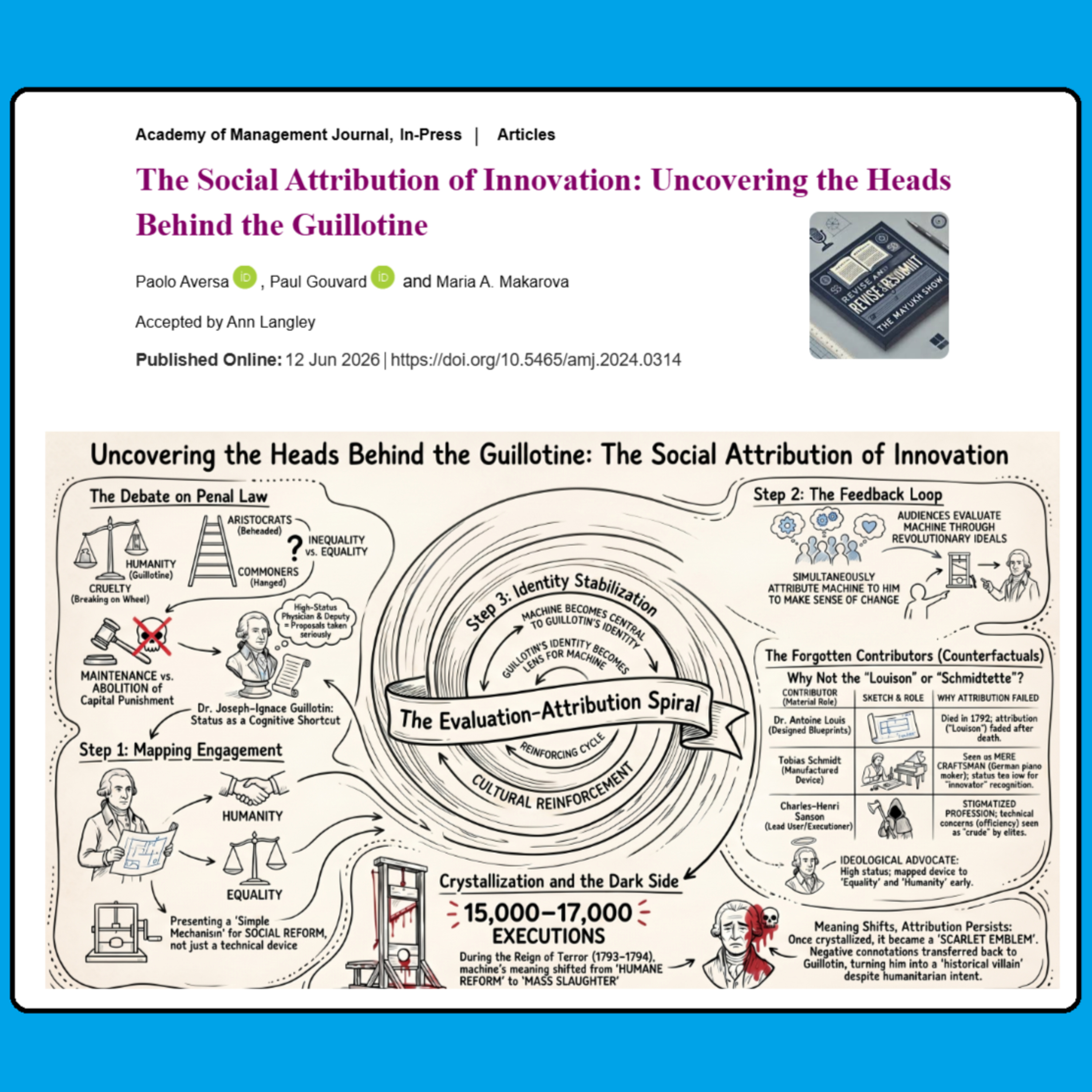
The Social Attribution of Innovation (Aversa et al., 2026) | FT50 AMJ
Jun 2101:40:10Tap to summarizeEnglish Podcast Starts at 00:00:00Bengali Podcast Starts at 00:47:06Hindi Podcast Starts at 01:06:28Danish Podcast Starts at 01:21:43ReferenceAversa, P., Gouvard, P., & Makarova, M. A. (2026). The Social Attribution of Innovation: Uncovering the Heads Behind the Guillotine. Academy of Management Journal. https://doi.org/10.5465/amj.2024.0314Youtube Channelhttps://www.youtube.com/@weekendresearcherPodcast Websitehttps://mayukhmukhopadhyay.com/reviseandresubmitAcademy of Management PDW on Space Economy Registration Flyerhttps://cto.aom.org/discussion/flagship-aom-2026-pdw-space-economy-consolidating-a-research-agenda-8AOM SIM Curriculum Committeehttps://sim.aom.org/curriculum/curriculum-committeeAOM SIM-Bytes Episode 1 - Dr Ed Freemanhttps://www.youtube.com/shorts/EBSA7WvQNSILinkedin Post By Professor Erica Stecklerhttps://www.linkedin.com/posts/erica-steckler-ph-d-427272_simbyte-episode-1-ed-freeman-activity-7469092002098225152-PbHM🎙️✨ Welcome to Revise and Resubmit. I’m so glad you’re here. There are some research articles that do more than present an argument. They quietly unsettle the habits of thought we have carried for years, and ask us to look again at something we believed we already understood. Today, I want to sit for a while with one such piece: The Social Attribution of Innovation: Uncovering the Heads Behind the Guillotine by Paolo Aversa, Paul Gouvard, and Maria A. Makarova, published online on 12 June 2026 in the Academy of Management Journal 📚This is, of course, no ordinary journal. Academy of Management Journal is one of the most prestigious outlets in management research and belongs to the FT50 journal list 🏛️✨ So when a paper appears here, it often arrives carrying both rigor and consequence. And this one does exactly that.What I find especially moving is the paper’s refusal to accept the familiar comfort of the “hero innovator” story. Instead, the authors lead us into a subtler and more human terrain, where inventions and inventors are not simply paired by fact, but bound together through public memory, social judgment, and repeated acts of attribution. Through the strange and enduring case of the guillotine, they show us how Dr. Joseph-Ignace Guillotin, who did not invent the machine, nevertheless became inseparable from it in the historical imagination. ⚙️🩸🧠Paolo Aversa, Paul Gouvard, and Maria A. Makarova write with a precision that feels, to me, almost forensic, yet the implications are deeply human. They remind us that recognition is rarely innocent. It gathers around those who seem to embody a problem, a value, or a public mood. Their idea of an evaluation-attribution spiral is especially compelling, because it captures how society slowly fastens a name to an innovation until the bond feels inevitable, even when it is not. 🔍💭In a way, this is a paper about invention, but also about memory, reputation, and the quiet machinery by which history decides who will stand at the center of the story.My thanks to Paolo Aversa, Paul Gouvard, and Maria A. Makarova, and to the Academy of Management, for publishing this fascinating article in such a prestigious FT50 journal 🙏📖 If you enjoy these reflective research conversations, please subscribe to Revise and Resubmit on Spotify, and also follow the Weekend Researcher YouTube channel 🎧📺 The podcast is also available on Amazon Prime and Apple Podcast 🍎✨And as we begin, I want to leave you with a question 🤔 If history remembers the wrong inventor for the right reasons, what does that reveal about innovation, and what does it reveal about us?
Transcribe →