← Rewilding Earth Podcast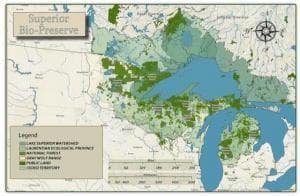
Rewilding Earth Podcast
Episode 150: Democratizing Wildlife Management Data To Protect Biodiversity And Habitat In The Superior Bio-Preserve
00:49:38
Loading summary
Transcript55 lines
- [00:08]
Kurt Mincke
We're just looking at general geographic connectivity in the area. And so we use this software called Omniscape, which is the next evolution of an old software called circuitscape. And so this is an open source software that was developed by the Nature Conservancy and it's designed to model omnidirectional connectivity. So that's just a basically a fancy word for if you think of having an image of the study area and the image is composed of pixels, this software can identify the connectivity score for every single pixel in the landscape. And so you get this wall to wall picture of connectivity, which is fantastic, incredibly powerful and it really models the real complexity of the natural world far more than just trying to model how to get from the least cost path from one forest to the next forest.
- [01:23]
Podcast Host
You're listening to the Rewilding Earth podcast.
- [01:40]
Bob Boucher
Geographic information systems and wildlife and habitat data have come a long way from the days of making maps with stinky markers and mylar. Recently, I had the opportunity to speak with one of the world's leading conservation mapping experts, spatial analyst, cartographer, teacher and author Kurt Mincke, with founding president of Superior Bioconservancy, Bob Boucher, a renowned landscape ecologist and advisor to the Beaver Institute. Their recent work represents a major breakthrough in using watershed units and GIS technology for beaver and wildlife management. In short, Bob and Kurt are working on nothing less than giving the information about wildlife populations and habitat connectivity back to the people. And with more eyes on the data and boots on the ground, wildlife management and biodiversity protection in the Lake Superior region and beyond can only get stronger. Kurt and Bob's project is about retaking the lead in science and technology that the conservation community largely handed over to agencies over 20 years ago.
- [02:41]
Guest Speaker
The concept is something that I had talked to Kurt about and we've been developing it. So it's the idea of using GIS units to subdivide a region, using watershed units as a wildlife management unit, gps. It's a dissection really of we started with big watersheds and then current using this GIS technology and USDA or USGS data would broke it down, down to a smaller basin, maybe 30,000 acres, 20,000 acres. And so it's a very innovative approach because wildlife management, for example, in Wisconsin, they just took the big and they cut it in three pieces, so 1, 2, 3 and then a little Mississippi unit on one side and they have no idea what they have. In this case, we're doing this for beaver, but it's applicable to all wildlife species, whether it's a bobcat or otters or any especially aquatic mammals. But you could use it for other things such as waterfowl management units because as beavers, if they're allowed to repopulate, you get a lot more. They change the hydrology so significantly that you get a lot more water being held and you also get a lot more ponds. And each one of those ponds in our region is equivalent to your rainforest or your coral reef. It's a per square meter, you're getting the greatest biodiversity and but they've never used that as a management unit. For example, Wisconsin has trapping of five to six months, which is common with a lot of the states. And the agencies were rolled practically as a trustee. So from the public trust doctrine there's the role of wildlife trustee because they are common. One of the things that is commons benefits. So they don't have really the right to mismanage it because they're in essence violating their trusteeship. So it would be this if you had your own trust, whatever the asset was in this case wildlife is the capital and that asset, if it's mismanaged, if the trustee is quote, allowing someone else to embezzle it or they just don't pay attention to it, they've taken that asset and diminished the quality which is yours. And my property is common on common land. So even that it also transits it's not just public lands. This is also true on private lands. That person who owns the land does not technically own any wildlife. And so when you put it into a GIS unit, let's say you're going to have trappers and this is this 30,000 acres base, the trapper would have a permit to go into that zone and could trap. However, let's say there's 100 beavers in it and let's say they feel that they can take 10 of them. Once that would happen, the trapper using similar. I don't know if you've ever seen onyx hunt, but it's or in some of the maps that use GIS as you walking and trails, you know where you are on the trail and you basically it's a GIS tool that allows you to know whose land you're on. So it says it's public land or you're on Mrs. Smith's ranch. And then if you're, let's say have a permit to hunt or trap or fish on that unit, you're allowed to. So it allows the agency really to allocate the resource. And then if there would be responsibility for the individual using it, he has a license to say, to hunt, that he registers his take when he does it. So if that person, that's once that 10 animals would be taken from there, zone would get closed and it would automatically close. So if someone would be using their phone, for example, to navigate, they would be on it and they would know that, oh, that closed yesterday, I can't go there anymore for that species, for example. So this is, we have the GIS technology and Kirk has the skill set to use this and subdivide these units and tie them in with the GIS part. The thing that's also really important about is that you would have improved baseline data. So once you had, let's say we knew that there's 100 beavers in this one sub basin, we know that at a given time. And that becomes a record similar to your health care record. So for instance, you have a chart and your general practitioner can put in, he's on this medication or he has this ailment, but he says, I'm going to send you to specialist. Well, that specialist then can look at it and see, oh, I see you're on a statin because you've got high cholesterol or whatever. The same thing. We would look at the unit as the health of that unit, biodiversity being that, and we would have records. So if somebody would. But then when there's turnover in agencies, you lose this institutional memory. Now this becomes a baseline institutional memory. And so that becomes the story of the land. And Kurt, why don't you tell them about the systems?
- [07:32]
Kurt Mincke
Okay, so, so this started for me a little over a year and a half ago when Bob approached me and wanted to model connectivity or model corridors in the whole Greater Laurentian Forest province around Lake Superior and Lake Michigan. And so over the last year I modeled that. We came with this fantastic model data set of all the connectivity across that Laurentian Forest province. And then there was a follow up analysis to model potential beaver population by all these watersheds. And we have, via the usgs, watersheds delineated at several different scales. So we can go up to watersheds that are like 6 or 700,000 acres, all the way down to sub watersheds like Bob said, that are 20 or 30,000 acres. And so I calculated the potential beaver population by watershed at different scales of watersheds. And we started then aggregating data by these watershed units. So we aggregated so we could calculate, for example, how many connectivity linkage acres are there in every watershed. What's the potential beaver population in A watershed. What's the percentage of beaver suitable vegetation, what's the percentage of wetland, percentage of forest, what's the percentage of urban developed. So that we have, like Bob's talking about this kind of developing health score or this picture of health for all these different watersheds up there. And there's over at the 20 or 30,000 acre watershed scale we have, oh, it's 3,000 watersheds in the area that we're working in. So we have a tremendous amount of data. And so when it came time to talk about this new paradigm for managing beaver harvest, we realized, well, the real problem is that the agencies don't know the size and distribution of the beaver population. They're not working on this. So the data that we have developed is the state of the art in this area right now. And so a solution to, well, and that problem that they don't understand where the beaver are on the landscape and how many there are results. In this wide open beaver season, there's no limit. You're not assigned a particular area, you just go trap. So a solution would be to implement this mobile phone based app for harvest Bob was describing. The trappers would be assigned a watershed to trap in. And when they're out there, they use this very intuitive mobile phone app to just collect the number of beaver that they harvested in that watershed. And it could collect other data. You're going to get the coordinates, the date, they could take a photo, for example, anything that the agency deemed important to collect about that harvest of beaver there. And so this all gets synced up to automatically to a database in the cloud so that they have all this data coming in as people trap beaver. And so they then have the ability to develop data driven population estimates per watershed because they have this real data coming in from these trappers. And this could also be part of them developing that quota that Bob talked about so that they can, if a quota for a particular watershed is 50 beaver and they hit that 50 beaver, then it's automatically closed. And then we took this a step further to thinking about the sustainability of beaver harvest. So I was able to identify the 20,000 acre small sub watershed and every one of the bigger watersheds that had the highest potential beaver population. And so we were thinking we can call these beaver recovery zones. So you think about the large 700,000 watershed as like a cell and the beaver recovery zones like the nucleus of that cell and that that beaver recovery zone would be off limits for trapping generally after the end of a year where beaver's been trapped everywhere. Except that one beaver recovery zone. That beaver recovery zone can be the nucleus from which beaver can disperse out into the greater watershed and rebuild populations and create a sustainable beaver harvest system.
- [12:25]
Guest Speaker
It's a type of refuge system. We haven't really once we did some of the national parks and things there hasn't really been any gains I'd say in what call the refuge system or wildlife rehab restoration areas. And because watersheds have the natural conduit for dispersal if you have the ideal spot in there. These refuges also from a we'll call it just a tourist standpoint become the places where people can go and view wildlife because wildlife's going to be thriving there. And that internal pressure that will happen there for really is populations that they breed. So they're going to need to spread out and that forces that sort of internal tensions because they're beaver and most animals are territorial they're going to want to they need to disperse as young are brought in. Kurtz did this analysis of the characteristics that would be we'll call it just the best habitat based and it hasn't necessarily been ground truth but in segment statistically it fits in but then those would be really safe zones. So from a wildlife management standpoint under the public trust doctrine you have less than it's one person in 3,000 traps and then it's a smaller percentage that even trap for in Wisconsin that have targeting beaver still if you have 3,000 people in total doing this, they can strip the wildlife right off. No different than we did buffalo or passenger pigeons. But so if we're interested and we're going to coexist with these and get the ecosystem benefits of flood fire biodiversity just while viewing cent it as a sort of a theme of value we need to change the paradigm of having wide open seasons with no accounting of the asset of its take or its current. How much money do we have in the tank? I don't know. It's like having no gas tank.
- [14:18]
Bob Boucher
Yeah, I have I have some questions about the app, about the agency about. Of course they're still going to set takes that are probably not in line with what's ideal for the area. But I think that's probably my feeling because of the wolf situation in Montana, Idaho and they just want to get rid of them all and they're very greedily going after it. That might not be the case here with beavers and especially with the small population of trappers relative to people who are ready to line up and go shoot wolves. But what do you guys worry about with the app, it depends on who's running it. Right. And who's setting the parameters. And it also depends on hunters paying attention to it because traditionally nothing tracked them. How are they going to take this?
- [15:05]
Kurt Mincke
I think it's a. That's a. It becomes a political question. That's from my side. The technology piece is the easiest part. Yeah, but getting a trapper to use a mobile app, depending on their technological literacy, may be a losing game for some people. They may not just not want to use it or may not know how to use it. And certainly there has to be some kind of carrot offered by the agency, some enticement to get them to use this. And so that's something that the agency has to come up with at a certain point for sure. So there are certainly issues with implementing a system like this. The idea is fantastic.
- [15:43]
Guest Speaker
The idea of compliance has always been when game laws are first installed and poaching still continues, no matter what laws you have. But for example, the adoption of phasing lead shot out of waterfowl hunting, that, you know, basically you tell them and then you require it. So there's this getting compliance of hunters, but you can simply do it in that if they. You then apply to. Let's say you've traditionally trapped in this, but then you have to apply to trapping it. So if you've got 50 trappers and they're all going to the same zone, they're just going to strip it. But you. You would have to have a quota and it could be a lottery. No different than lotteries are done with a lot of wildlife management. So to Kurt's point, the management could be. Could be designed in such a way that there's compliance, there's the. There's a. Most wildlife agencies, they have poacher hotlines and they attempt to, I think, in good faith to assume that there's going to be. People are going to follow the rules. In other words, if there's. If you can shoot three pheasants, you're going to shoot three pheasants and then you're going to stop, you're not going to keep shooting. And on that given day, so there's a take and there's a limit. It's whatever it is, five fish a day, 10 fish, slot sizes. Fisheries is managed that way. I've had a hunting license for over 60 years. Primarily I'll really hunt. It's because I have a couple dogs, some upland birds like pheasants, but. But in my life I have hunted a lot of different species, big game, small game. And so I think I understand the culture. I think that they would, you would. It would just be a matter really. It's more the agency adopting it. And there's been this resistance because for example In Wisconsin since 2014, they haven't even made any attempt to make any population estimates. They don't count them. So if you're not. When a tagging system used to be. So we knew how many tags we had in theory you might know where they were if there was a zone and then you would. Well we took too many or we didn't take that many and whatever they feel is the thing. But they haven't recognized in this case with beavers, they haven't recognized that they're really a hydrological element and you need to have a certain density of them to get the benefits of all this water retention. And, and you don't get that if they're on the run all the time. You have a six month season and they're not recognize as an element of healthy streams for flood mitigation, for reconnecting watersheds to flood plains. And then all the other subspecies that people don't pay attention to the little fish and forage things that live on these edges of whether it's an oxbow and a stream. So this is a really powerful tool, especially the baseline data going on forward and it may be something that may even require litigation. Wildlife is a public trust resource. So it's, it has to be held in trust by the government for the benefit of all citizens, not just the person who pulls a trigger or has a trap. There has, there's in technically there's a prohibition and this is this North American model of wildlife conservation, of commerce, of dead wildlife. So we had the Lacey act in 1918 that said you could no longer shoot waterfowl or deer and then take it to a restaurant and sell it. That didn't happen with fur, but that was 1916 or 1918 and so that would fur. They thought beavers were actually going to be extinct going like passenger pigeons in buffalo. So fur never got into that. We'll call it protective covenant. And then the other part is there used to be rule of law. So this is wildlife management law. So that there's enforced by a state or federal agency. There's also this concept of democracy of hunting or the opportunity for all. So in public lands if there's a hunting season, anybody can go to it. Versus in Europe it's privatized for the most part. In some cases it's privatized in this country. Like for instance, people who have a big ranch out west may say, okay, I've got, I've got these trophy elk and you can give me $10,000 and you can go and shoot the one. So it's over there in that field. So it's not really the fair chase idea. And then so wildlife's also supposed to be considered an international resource and this has to do more with migratory species. So there needs to be cooperation between countries and states, especially with waterfowl. And then there's a responsibility for scientific management. And also one of the last things, there's an ethics thing of fair chase that while I can only be killed for legitimate purpose, it can't be any killing contests. There should not be just shooting coyotes to see if you can hit them or prairie dogs. And so it's something that you're going to use as opposed to waste. And so those concepts are somewhat followed theoretically, but in many cases they're not in terms of really law in wildlife management.
- [20:38]
Bob Boucher
I had a picture too of if a trapper was not using this, an agency person could hop out of their truck and certainly have it in their hand and prove to the guy right there that he's not in the right area or he's over hunted this area or whatever else. A tool I think sounds like a great enforcement tool at least to bring proof to the charge that, you know, a hunter was most certainly not in the right place or doing whatever wrong thing. So maybe it's not so bad that if you don't have 100% adoption, the tool's still useful for an enforcement side or a proof side.
- [21:13]
Guest Speaker
Yeah, it certainly could be because you, you would. And also in theory, since everybody pretty much has a smartphones even, you know, and in many cases you need them for tickets and there's a lot of things that you can't really get through an airport or a lot of places without having some sort of technology. So the adopters and what. And I wouldn't say I would call trappers a very late adopter of technology as a group.
- [21:38]
Kurt Mincke
But a similar platform could also be used by citizen scientists to collect data. To collect data for where beaver lodges are, for example, so that you could have university participation and community participation in building a database on what's happening where.
- [21:54]
Bob Boucher
See, that immediately fills me with a sense of all right, there's a third party here involved now and it's universities and citizen scientists. And it's a, it's always a great idea to put a tool in the hands of anybody that's local that wants to do this stuff, you're building more interest. And therefore hunters are certainly going to eventually hear about all of that. And if they do something wrong, they're really going to hear about that. Most most likely because of the people who are out there, right out there with them doing the studies, doing the inventories and things. I think that's.
- [22:24]
Kurt Mincke
Yeah, you can have a program like map. Map your watershed or something like that. People would be really excited about that. Oh yeah.
- [22:33]
Guest Speaker
Having that baseline. For instance, birders, which are one of the biggest groups, they would. You could have these ideal watersheds during this window of time. For instance, migratory warblers come through here from May 10th to May 20th. And this is the hot spot for going to see Kirkland's warbler because they come through in mass and during that window. And so you could have. And so that becomes a data point which adds value to the biodiversity. And potentially down the road someone said, well, we can't put a pipeline through there because it's got this and this. Especially with endangered threatened species and sensitive habitats. That would be a way to really fix that into the health record.
- [23:14]
Bob Boucher
Yeah.
- [23:15]
Kurt Mincke
And part of this we're not really talking much about is the connectivity analysis too, and which is more easily shown than discussed. But the citizen scientists could go out and help us field truth that connectivity analysis too, to see if some of those critical riparian corridors we found from our analysis are in fact there or not. And what's going on the ground.
- [23:37]
Bob Boucher
Yeah, yeah.
- [23:38]
Guest Speaker
We've married this concept of watershed units with this large public land. And Kurt, why don't tell me a little bit about how Omniscape fits into this in terms of how you where this generated and how this connectivity. Because this end also raises the importance of certain watersheds for being protected at a higher level because it might be the only thing that's really connecting two big chunks of public land.
- [24:01]
Kurt Mincke
Well, connectivity science has been evolving for decades at this point. And so we have such a. This Laurentian Forest province is a pretty large complicated region with lakes and water, all sorts of things going on. And so there was a lot of thought given to what kind of approach we should use to model riparian habitat connectivity here. And we didn't have the situation, the classic situation where we want to know how deer get from habitat block A to habitat block B. That wasn't what we had. We wanted to model not a species specific linkage, but what they call structural landscape permeability, which just means that we're not basing it on a single species. We're just looking at general geographic connectivity in the area. And so we used this software called Omniscape, which is the next evolution of an old software called Circuitscape. And so this is an open source software that was developed by the Nature Conservancy and it's designed to model omnidirectional connectivity. So that's just a. Basically a fancy word for if you think of having an image of the study area and the image is composed of pixels, this software can identify the connectivity score for every single pixel in the landscape. And so you get this wall to wall picture of connectivity which is fantastic, incredibly powerful and it really models the real complexity of the natural world far more than just trying to model how to get from the least cost path from one forest to the next forest. And so we have this wall to wall data set that shows all the dendritic patterns of connectivity in the whole study area. And we were also able to include barriers such as transportation corridors and remove the bridge where a perennial stream goes under a bridge underneath an interstate, for example. And that river then riparian corridor provides connectivity. And so the software identified those as critical riparian corridors and pinch points for connectivity that allow biodiversity to flow from one side of the road to the other. So we have this fantastic data set for the whole area on top of the picture of where the beaver are. So it's all of it's riparian based.
- [26:34]
Guest Speaker
Yeah, yeah. The rivers ultimately are the corridor that they isn't broken even though in some cases it only might be a box culvert. But nonetheless, when you've got those identified at a certain point once if we get to the point where we're building our road systems for wildlife as opposed to slicing lanes for killing roadkill, you would put a bridge in because they're going to go underneath and they would have shoulders off to it. That would be on say the, the actual stream you'd be up to the some vertical distance. So there'd be areas where wildlife can move through, especially on these big critical ones. And expressways pretty much slice it there. There's. They're a wall and I think of how is a turtle going to cross a expressway anywhere? They're not. In Ben Goldfarb's book Crossings where he identified this problem with roadkill and also breaks in biodiversity ability, even cross that we valued those pinch points higher and we wanted to identify those. So this is a hundred thousand square mile area. It's a big area, but it's really one contiguous lobe of this lower boreal forest as it comes across. And it doesn't have much agriculture in it percentage wise. So it's mostly still forested. So it's intact system is really one of the bigger lowers in the 48 because we have a higher amount of rain, 35 inches of rain or so we have. And we don't have necessarily mountain ranges in it. We have the potential to have really high productivity in terms of biodiversity recovery. It's ideal beaver habitat. We already have the biggest recolonization of a large carnivore in the lower 48. So we went from 200 in 1973 wolves, and we've got 4200 or 400 right now, going to 200 to 4000 plus. And the forests have recovered because of that. And beaver on the menu for them, of course. And the system of wildlife management, now we can look at it more scientifically. We can have a baseline study. And this crossover, this omniscape that Kirk is brilliant at, really, to connect the dots, this is a real game changer for wildlife management in North America or the world, really, because it's applicable anywhere in this system. It works pretty well. We have 21 million acres of public land that we're trying to link together. And you have carbon storage potential here. You have climate resilience, you have Lake Superior, which is the most important. So this is the southern whole border of Lake Superior. And really, if we're going to approach this for our own well being for the next 500 years, we should not have any trapping in the Lake Superior basin because that structurally protects the lake itself, which is the most important freshwater body in this hemisphere. And fresh water represents only about 3% of the total water protecting that. This is the new paradigm of what we'll need to be doing.
- [29:37]
Bob Boucher
Yeah.
- [29:40]
Podcast Host
You'Re listening to the Rewilding Earth podcast. Did you know we also publish insightful and inspirational content from leading Rewilding scholars, poets, artists and organizers from around the world.
- [29:51]
Bob Boucher
You can publish.
- [29:51]
Podcast Host
Visit rewilding.org and sign up for our weekly digest to receive brilliant fresh insights on everything Rewilding. You'll find over a decade of articles and news from the front lines of wildlands, protection and all kinds of restoration efforts. Check us out@rewilding.org and don't forget to share it with friends.
- [30:08]
Bob Boucher
I think this is just a philosophical question because this is a podcast and people like weird little things like this. Maybe it's not a weird thing. There's no going back and I don't Want to seem like I'm arguing against using technology that's been used against nature in the past. Past. And so we're getting more data points. We have more citizen science. They're putting more real data into the system. We're learning more and more about populations and connectivity by the day. But so are the enemies of nature, because everybody has it and they can use it. Are there any things that you guys worry about with nefarious use of these tools? Because not a. It doesn't just open the world up for us to study, to know, to advocate. It opens the world up to them a little bit more too. Or is that probably late stage and you guys are developing and you haven't really wanted to think about that kind of stuff yet? No.
- [31:00]
Kurt Mincke
That kind of brings us to another point, is that we wanted to make all this data available to everyone. We wanted to democratize this information. And so it is up on the Superior Bioconservancy website. And we have two different web mapping sites up there, one related to beaver, one related to connectivity, that are both tied together. And you can explore your watershed on websites. So you can go in there and actually see what we've created and the data. And it's a tough one. The political climate is challenging, especially now. But I can only hope that you can. All you can do is try your best and have good intentions.
- [31:36]
Bob Boucher
And that's why I get really excited about Citizens Science, about getting people involved, because the more people involved, the more eyeballs out there, the more boots on the ground, the better. Because I think trapping especially connotes some sort of very loner thing. And nobody's watching trappers. Nobody. Where are they even? They're nowhere near any trails. You never see a trapper. You never see traps if for the most part, unless the guy doesn't know what he's doing. I think that's what's really nice about this, is it's just turning on a great big light and saying, here's everything. Everybody needs to fall in love with this. Pick it up, take your part. If you want to work on connectivity, you want to work on beavers, whatever it is, but use it and get out there. And maybe the best way to protect against nefarious uses of things is to get as many people involved as you possibly can, which would be the goal of any citizen science program in the first place.
- [32:31]
Guest Speaker
Yeah.
- [32:32]
Kurt Mincke
And another piece of that puzzle which Bob can tie into and talk more about is the tribes. There's a lot of tribes in this area, and we wanted them to have the same access to this data as everyone else and feel included a good portion of this.
- [32:45]
Guest Speaker
The ojibwe tribes, there's 11 bands but almost the whole overlay, not all of it but a good portion of it. They have what's referred to as usufructuary rights, the rights to hunt and gather. And so that's on the 21 million acres. And so they had to go to the Supreme Court to defend these rights. And they have a thing called the void decision. And they have a void actually inter tribal council it's a watchdog to make sure that those rights are upheld. And for example so when we calculated, let's say one watershed could have 400 beaver in it, technically this would be in the case is there's not one watershed that has other. It's a national park like Voyagers national park has the full carrying capacity there because they've been completely, they've been depleted. So let's say there's 400 there and let's say the take would be 10% of that a year. That take 40 beaver could be harvested from that. However they're entitled to 50% of whatever that harvest is. But before you can get to that quotient, that higher number you'd have to have the capital to have it there. It's what's the interest on the return investment. So if it's, if you've got $100,000 and you're getting 5% you're going to have $5,000. That's the take. That's your capital that's generated off of that. If it's not there then what has happened is the trustee relationship that the federal government has which they've deferred to the state and the state is mismanagement. The state is in essence embezzled their natural capital and but this now is a tool to say well how many do you have there? Well I don't know if we could have a season there or. And how come there's no more river otters? We're not seeing anymore. So part of the problem with the trapping is that 1 it's unregulated, 2 nobody knows where it is or what the capital is. But the other part is it's really a very non targeting thing. So for example for every beaver trap, if they use an underwater set, it's a cotton of bear, it's a drowning trap, body gripping trap and wildlife services traps a lot of beavers for nuisance because they don't do any non lethal. But for every 12 beaver they catch, they're going to catch an otter. If they kill a thousand beavers, they're going to kill 120 beavers or 120 otters because they're non selective. So there's a problem with that. They're using a grenade when they're not getting what they're actually even targeting us. There's a lot of flaws in the current system and if I think back to Glen Canyon, the part of the thing is the gate got damned because nobody knew what it was or where it was. So the idea of elevating its status. So if you have these watersheds and people live there and the person can go to a public meeting and say I looked at this website and it shows me that we have Kirkland's warrior there and we have this there. And if we're going to put this new bridge in, it should be across. So we have wildlife crossings here. We kill 15 deer there every year and crack up 15 cars every year. Why do we have to keep banging into things? The tools for democratizing this that a person who may not necessarily have. He may have a relationship to this land and he cares about it, but this ideally will give him if there's a developer or an extraction thing, whether it's a mine, whether it's a timber harvest, whether it's a different roadways or changing roadways, this gives a at least a springboard for defending resources and the planet.
- [36:24]
Bob Boucher
How proud would you guys be if somebody held up the app on their phone at a hearing to demonstrate that someone has just said something very incorrect about an area you're also talking about just to get people to really understand this. Most of the stuff that you would you're making available to the public is stuff that only the states were privy to if they had it at all. And so they were making decisions and they're like no, we know better than you because we know where this all is. And you never got to see see what they were talking about. You had to just trust me bro kind of thing. And now you don't have to trust anybody. You can, you have your own tools. It's the same database you're reading off of. Everybody's got the same playing field. And I think that really actually can only help us conservationists to move forward. I've always had a dream that someday a billionaire or someone will fund the ability to look at this on a global scale. The way that the granularity that you're able to get to now in your area, what would that be Like I've thought all over the world, and you can just pull something up now. There's a lot of big data sets out there, but it's still nowhere near us being able to type in where you guys are studying or where the highest concentration of data is in your study areas, having that all over the place. Do you ever think that you're part of that future thing where we're going to be able to do that practically anywhere in the world and have so much granularity? No. We only have this many zebras left. We know, down to the zebra or whatever.
- [38:00]
Kurt Mincke
I think I was telling Bob this. For me, this is a little bit of a throwback project, technologically, gis wise, because if I go back to the beginning of my career, in the early 2000s, it was there were a lot of small conservation nonprofits in the western US who were doing the groundbreaking research on connectivity. And the agencies didn't have anything. And then at some point that flipped and a lot of these little NGOs started getting staffed up with attorneys and doing policy and getting away from the science. And the agency started developing all that. And this is a throwback 20 years ago where it's a small nonprofit that has the best data for the whole region and better than anything the agencies have. And it is exciting to be able to have confidence that we have some really good data here.
- [38:51]
Bob Boucher
Look at Sky island alliance and other groups that are out there producing more data than they can sometimes handle because they have to go through all those camera trap photos and they have to identify what they're looking for. But anyway. And they have to have huge volunteer base to both handle the camera network and also go through all of the stuff. But it's there and it's. That is way more in that region than any other, any agency has going on. I can almost guarantee that. And I bet you that sometimes the agencies want to reach out and tap them on the shoulder and say, hey, can we have some of that data you got there? That is crazy, isn't it?
- [39:28]
Kurt Mincke
Yeah, absolutely.
- [39:29]
Guest Speaker
We're hoping actually this model can be applied across at least the United States. It's certainly very. Because you've got one federal agency, let's say usgs. And so it's a very apple. It's a very. It can be duplicated. If we find a billionaire, if you know anybody have them call me, I'd be happy to talk to them. And. And we can expand this and also that. Just amplifying that. The fact that we have it. We're right at the point of trying to get that, we had a meeting a couple weeks ago with the DNR where Kurt did a really good job introducing this stuff, but also then showing how they could have internal security measures of different levels. In other words, if you had sensitive data that you didn't want to release there, since let's say goshawk nests here, but for scientific purposes creating this sort of healthcare baseline ongoing and then democratizing that to really protect this public resource. And the other thing is the satellites, for instance, satellite observation is getting finer and finer all the time. Google came up with a thing I don't know if it's valid or not to identify looking at planets, data sets looking at. And then there's a signature that beaver ponds have that it's fairly similar. So artificial intelligence to just look at massive amount of pictures and dot this in. Then you could verify where beaver ponds were In Montana last year they they just hired a bunch of GIS grad students. They spent about $50,000 and they just gave them all the pictures and they said and they just physically looked at them and then they counted out how many beaver ponds that they could identify based on a pond structure with a dam and then where lodge would be that were active. And there's spectrometry, that is a new thing also with satellites that we. One of our board members, he works for a company called Orbital Sidekick. And they can measure, let's say using the same kind of pixel thing that Kurt was mentioning, say percentage of fields of crops density. So they've for crops. But they can also measure a plume that's coming off a gas. So they can see a leaking methane pipeline. They can see. So there's a things that we can't perceive, but the satellite can do it. So they're where they used to have to fly over or have guys crews go along these pipelines. They can identify them from space. So there's some efficiencies of that of course because you, you could also. Oh, because they come up as blue colors or red colors and then you know exactly the latitude, longitude of where that is. And so we have a very powerful tool here.
- [42:13]
Bob Boucher
I just think it's wonderful that it's not an agency and that it's you guys. What's the next step? What's the big goal?
- [42:21]
Guest Speaker
Well, I guess the big goal would be to save the planet. But at this point we're a little.
- [42:26]
Bob Boucher
Smaller goal than that. Just a little bit.
- [42:30]
Guest Speaker
Might as well go for the big one, shoot for the fence. I would say we're going to continue to develop this. We're going to see if we can get Wisconsin Department of Natural Resources to adopt this or some state in the union which could be California because they're pretty producing progressive or Wyoming or Colorado.
- [42:45]
Bob Boucher
I know a guy.
- [42:47]
Guest Speaker
Yeah, you do know a guy. Talk to you about that?
- [42:50]
Bob Boucher
Yeah.
- [42:51]
Guest Speaker
And so we had an initial meeting with them that went well. I followed up with an email to say we want to talk to their IT department to see what how they would integrate this potentially in Wisconsin, for example, this year 25 they have to do new beaver management plan. So they have to actually they're going through and it's a 10 year plan. This is the window when they're supposed to adopt new progressive scientific methods. So if we can get. But they've been very resistant to this historically. But we have some political help, some newly elected officials that are on board and we're going to be presenting this in June to a broader audience. And we're bringing in other wildlife professionals in a virtual conference, the Midwest Beaver Summit. And that's actually being facilitated by Molly Evers who is the supervisor for California for their beaver restoration project there. I think it's a matter of getting this in front of other people and having some vetting. Well, this is how it work or this is. So right now we've got a pretty good product. I think we need to take it for a test drive and see if it flies well and if there's obstacles, identify them or weak spots.
- [44:09]
Kurt Mincke
Yeah, absolutely. And not to mention we're not short of ideas. There's no other ideas about using carbon credits to help.
- [44:15]
Guest Speaker
The carbon thing is the sleeping potentials. When Kurt did the connectivity, the original concept is so we identified so that's it's about 38% of that landscape is already public. And the idea of E.L. wilson if we can get to 50% then we can maintain a system. So we're thinking oh let's add another 7 million of public private lands. That would be these corridors, this linkages that are critical. That is either in some cases somebody's 100 acres for their deer camp or in some cases it might be an industrial forest of 20,000 acres of some warehouser type company. And the idea that we would then purchase the carbon from that to create the linkage is in essence working similar to conservation easement. But those would be that you're not cutting trees now and we're strengthening that linkage and we would have additional covenants in there, for instance that no predators could be killed, no Beavers could be killed. You can still deer hunt on it. But it's, it would have a higher type of level into a privately held status. And we need a governance actually that is. Is support of that because that 7 million acres, that's two yellowstones of connective tissue that would link 100,000 acres. And so this whole system would be more robust. And the United States needs to be take a leadership role in climate and carbon sequestration and weaning ourselves off this plastic and fossil fuel lifestyle that is has evolved in the United States. And our carbon footprint as American citizens is so high we need to take, we need to take a step back and look at land use consumption, et cetera in, in a different paradigm that we're. We have an ethical approach to the planet which is missing thing.
- [46:06]
Kurt Mincke
And from the tech side there's some really exciting potential carbon data sets out there that can be incorporated into that watershed health score or to drill down to a private parcel and identify the potential carbon now. And some of those have been deemed to be like 90% accurate. So some pretty good filtering you can do from space on a parcel potential carbon to start prioritizing parcels for protection in that way along with the linkage data.
- [46:32]
Bob Boucher
Yeah. Okay. I'm listening to the podcast. I've heard what you guys have had to say. I'm excited about many different things. But where's the place that I go to? Is it Superior Bioconservancy to find out? Get on a list and keep up with this because this is a moving target. This is live and it's. But I imagine some people are be like what about the citizen science stuff? When am I going to have something on my phone in my area that I can actually walk around and add data to? And so they need to be on a list so they get alerted for those things. It's superior bioconservancy.org I would imagine.
- [47:08]
Guest Speaker
Yes. And that's. They can look at the maps and they can play around. At this point we don't have the capacity to add data, but we look at something as potentially a partner, let's say a university or the state in some ways having that like we'll call it the Commons library, where that would be cloud based but nonetheless protected and, and have some degree of security to it.
- [47:30]
Bob Boucher
Yeah, yeah. Kurt during this whole interview has been sharing little nuggets, little links to maps and things. So as always, no matter where you're listening to this, if you go to rewilding.org pod and look up this episode With Bob and Kurt, you will find a whole bunch of extra credit at the bottom of this page. And that will be links to all of these maps that you weren't able to see today because this is an audio podcast. And then we talked a very spatially and graphical kind of thing the whole time, which I know bothers Kurt. He's I want people to see these maps. That's how you understand this stuff. Well, to see those maps, go to rewilding.org pod and check out this episode, because I'm sure Kurt will be feeding me a lot more links between now and when this runs. Is there anything else you would like people to do or to support you guys and to find out more about all of this?
- [48:23]
Guest Speaker
Well, if they go to Superior bioconservancy, certainly we would appreciate any donation of any amount. And that way you become part of this database. If you're someone who has ideas about how to set up a citizen science program or you would like to partner with us in some dimension, please contact me either via email or through the website. There's a link in there and we would appreciate that support and we always interested in good ideas.
- [48:48]
Bob Boucher
Well, thank you guys. This has been great. I'm going to have to have yearly updates from you guys now. I don't know if you knew you were signing a contract to come back and back, but you effectively did. We need to hear from you.
- [49:00]
Kurt Mincke
I'm always happy to be on Rewilding Earth.
- [49:03]
Guest Speaker
Me too. Thank you.
- [49:06]
Podcast Host
Thanks for listening to the Rewilding Earth podcast. We do what we do because of you. This podcast is supported by listeners like you who long to live in a wilder world. Please consider donating@rewilding.org and subscribe to our weekly news and article Digest. While you're there to go the extra mile, you can follow and share Rewilding Earth on Instagram, Facebook and Twitter. Bonus points for sharing this podcast with your friends. To listen to past episodes, go to rewilding.org pod that's rewilding.org pod.