← Right About Now - Legendary Business Advice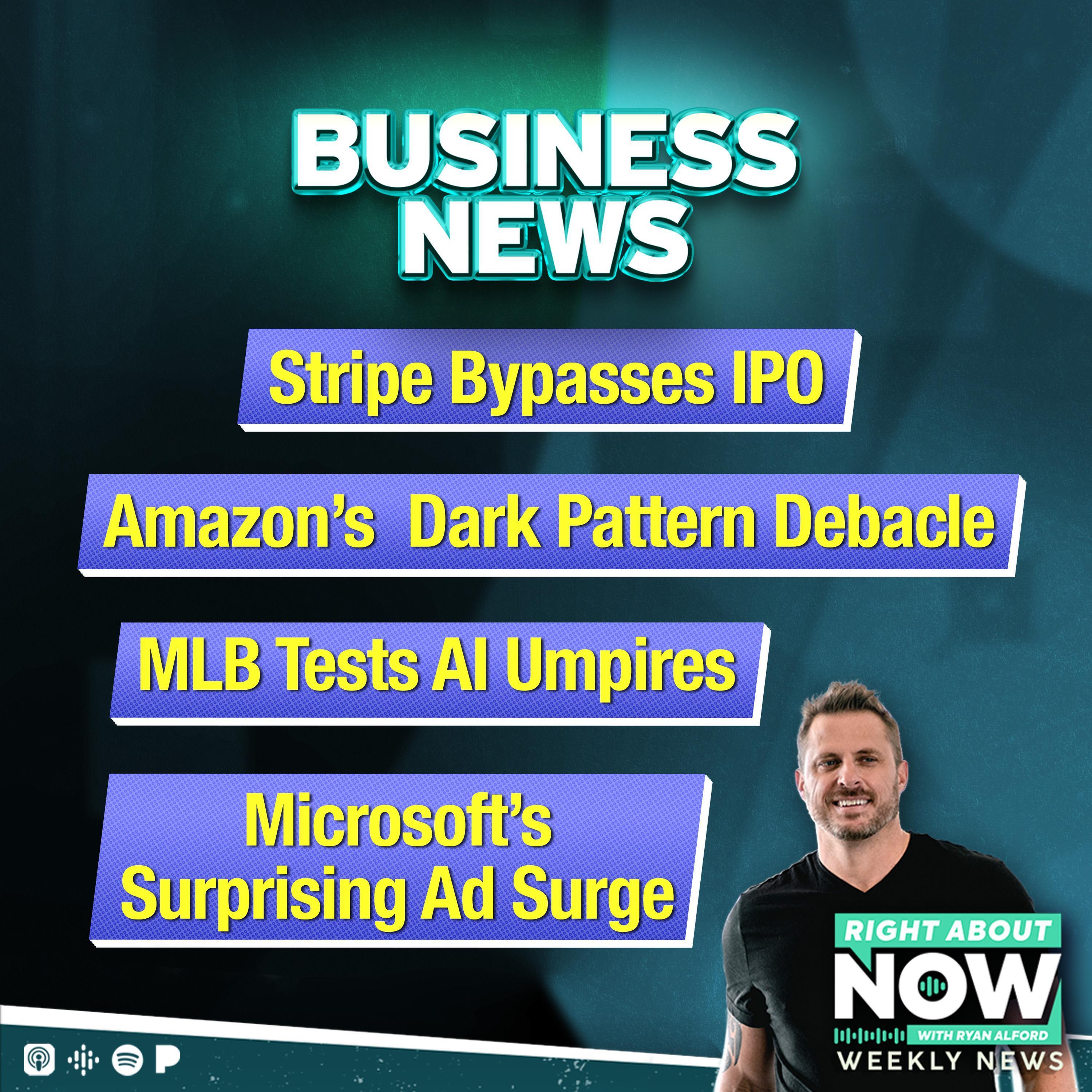
Right About Now - Legendary Business Advice
Business News: Stripe Bypasses IPO, Amazon’s Dark Pattern Debacle, MLB Tests AI Umpires, Microsoft’s Surprising Ad Surge
00:16:31
Loading summary
Transcript3 lines
- [00:01]
A
This is Right about now with Ryan Alford, a Radcast Network production. We are the number one business show on the planet with over 1 million downloads a month. Taking the BS out of business for over 6 years in over 400 episodes. You ready to start snapping necks and cashing checks? Well, it starts right about now.
- [00:24]
B
What's up guys? Welcome to Write About Now. It's our weekly business news that matters to you. And I and anyone doing business are trying to make it happen out there here on Friday, July 18, 2025. Let's top up your drink of choice. Switch that phone to Do Not Disturb and let's tackle seven stories with the insights you need and just enough attitude to keep the legal team on their toes. Let's get into it the MLB Baseball All Star Game usually feels like a summer reunion. Big names, relaxed pace, a lot of smiling for the camera. This year a new high tech feature stole the show. An automated ball and strike challenge system. Each team got two chances to question the home plate umpire when a pitcher or batter tapped the helmet. High speed cameras tracked the pitch. Control room checked the data and the decision came back in a few seconds. Five pitches went to review. Four calls were overturned. One reversal even turned a walk into a strikeout, changing the innings momentum. Commissioner Rob Manfred said the league is on track for a full rollout by next year. The players union agrees in principle, but once proof that the computer zone stays identical for the 6 foot 7 sluggers and 5 foot 9 hitters. TV networks, meanwhile, love the extra drama. Baseball needs it. They can show the ball's exact path in an on screen box, then replay the crowd's reaction. Why does this matter outside sports? It just shows how quickly subjective judgment can become data verified. Action if baseball, one of the most tradition minded sports, trusts a camera array over human vision on a pitch, any sector that leans on experience will face similar pressure. Think about frontline jobs or quality control at a factory, credit checks at a bank or gold line calls in soccer. Clients will ask if you can measure it. Why guess? Good point. So look at your own processes. Which decisions still depend on a hunch? Map out how you think you could replace that hunch with hard numbers before a rival beat you to it. Action Step for the week List three high stakes decisions your teams make and ask could a sensor, an algorithm or a quick audit strengthen or replace our manual call? Put a date on when you will test one of those upgrades. The clock is already ticking, sliding to our second headline where nostalgia is less of a crutch and more of a punchline. Microsoft. Yes, the same Microsoft Long Typecast as the enterprise dinosaur just strutted onto its Q3 earnings call flashing a fresh 20 billion but billion ad revenue badge. Not total revenue, mind you, just the advertising slice of the pie. Yikes. That's a lot of money. Bing search, LinkedIn sponsored content, Xbox in game placements and the new kid on the block Copilot ads. The last one's the real headline. Imagine querying Bing for best running shoes. Copilot summarizes 200 product reviews in one conversational answer and mid sentence recommending a brand that surprise just bid on that exact context. Microsoft claims those embedded suggestions drive a 1.5 times lift in conversion versus the classic blue link promo. Media buyers who once sent Bing pennies as an afterthought are now allocating double digit budget percentages to the platform. One agency CEO told Adweek that LinkedIn lead gen CPA dropped from from 148 to $97 in six months purely by toggling Copilot optimization. Google can still point to its 55% US search market share, but Redmond's roar is audible in Mountain View's glass halls. Xbox has already taken advantage of mid game dynamic billboards that update in real time based on audience. Geodata, a racing game set in Tokyo, now features a ramen shop actually two blocks from Shibuya Station. Shibuya? That's not what I want to say. And yes, that's a paid slot. Why does this matter for people like us? Because First Mover Advantage does not age well. Google has been resting on its near monopoly laurels for a while now. GPT's taking their lunch. Microsoft's taking their lunch. Everybody's coming for that lunch. But Microsoft tinkered, iterated, sanded off the rough edges and came back swinging. If you run marketing for any company still living off old guard dominance, think telcos, insurance giants, legacy banks. Microsoft's ad leaf is your friendly warning. Iterate or erode. Customers will explore anything that raises ROI by even single digit percentages. So if an underdog platform suddenly offers double that efficiency, loyalty evaporates. Competitive edges like the tub of leftover guacamole in your fridge brown fast when they're exposed to complacency. Third stop on our top news story. Stripe. Not that candy Stripe. Talking about Stripe the payment platform. That unicorn that just keeps throwing curveballs. Instead of the highly anticipated IPO, they announced a $3 billion employee tender offer. Not that tender, folks. Valuing the privately held firm at 91.5 billion. On paper, that's down from the frothy 115 billion whispers of 2021, but up sharply from the 65 billion reset during the 2023 tech stock chill. I mean, what's a few billion amongst friends? 65, 95, 1 15. It's all a bunch of billions if you ask me. But hey, reality check. Stripe pushed 1.4 trillion through its pipes last year. Some clogged up pipes, baby, serving 50% of the Fortune 100 in Nets transaction margins that would make a credit card issuer blush. Why punt the ipo? Two theories. First, Stripe's internal data says private markets still cough up eight figure checks with fewer quarterly report migraines. Second, by offering liquidity in house strife locks in talent that might have otherwise flee to a freshly minted public startup. Early engineers who joined at a 5 billion valuation can cash out condo money now without the roadshow circus. There's a macro wrinkle too. Private funds are starved for yield. They'll pay near public multiples for growth they can't find elsewhere. If you run a late stage startup, memorize this script Profitability plus optional liquidity equals bargaining power. Let's put it this way. Exit optionality is the new exit. Translation. If you can print cash privately, Wall Street's applause is just background noise. Cautionary side note though, it's kind of tender offer might work until your growth stalls. Private valuations are still subject to the gravity of real world performance. So if you're emulating Stripe, emulate the discipline along with the headline. Padding the cap table without a reliable revenue engine is like inflating a parachute in a hurricane. Great lift. Wrong direction. Let's pivot from Hush Hush tenders to courtroom spotlights. You know what I'm talking about. Amazon is under the judge's gavel after what the bench called a bad faith document dump in the FTC's lawsuit alleging prime enrollment. Dark patterns. We all love those. I love some dark patterns in prime enrollment. Sounds like a cool movie. We're talking tens of thousands of slack messages and PDFs delivered with the punctuality of doll up AOL. The FTC's charge Amazon making joining prime absurdly simple. Go figure. One click confetti animation if everything was that easy, one click to my honey. Confetti animation comes all while burying cancel membership Deeper than the Ark of the Covenant, Amazon retorts. Customers know the value churn is low. UX is transparent, the judge less amused, hinting at sanctions if discovery delays persist. This standoff hits while Amazon is trumpeting Prime Day 2 dot O, a 96 hour deal fest engineered to squeeze every spare nickel from your phone screen. Imagine the PR choreography on one stage, Amazon Live hosts scream 54% off these robot vacuums on the next. Regulatory filings describe manipulative design It's a marketer's migraine. At the end of the day, the takeaway is stark. Dark patterns are now regulatory red meat. If your product relies on maze like unsubscribe flows, plan for legal migraines. Build the business model on value, not on users forgetting how to escape. Ready for the next big headline? Let's check out the latest for you page update TikTok shop just released its July trend Ledger and it's a roller coaster. Line one kitchen gadgets up 132% think motorized small appliances. Rapid defrost trays AI timed rice cookers. Line two mini projectors up 119% outdoor movie nights are apparently the 2025 equivalent of the backyard fire pit craze. Line three lip oils down 42% oversaturation plus one viral video where a dermatologist compared flavored gloss to spreading salad dressing on your lips. I wouldn't mind. I like salad dressing. Average checkout time 26 seconds Return buyer ratio 80% Price sweet spot under 40 bucks Best practice? Drop a follow up demo within 48 hours to juice sales 26%. For legacy retailers, TikTok's velocity is existential. Your old six week product development? Sprint? That's glacial. One beauty brand told Glossy they now keep blank packaging inventory so they can label and ship within 72 hours of a trend spike. Factories in China run weekend shifts dedicated to TikTok reorder SKUs. That's not hype, that's supply chain Darwinism. Either you ride the algorithm or the algorithm rides you right out of relevance. If your logistics can't hit two day delivery windows. Enjoy the view from page two of search results where content goes to sleep, nap and die. Now caffeinate that anxiety with Starbucks new pricing ballet. The coffee behemoth Latest app build now displays real time cost tallies as you dump extra syrup, sauce, foam and oat milk on your venti. Call it whatever you want. It's alt milk. Officially it's price transparency aimed at streamlining choices and throughput. Unofficially, it's a sandbox for future demand based surges. Hello, $9 lattes during Mondays at 6 7am Crunch with same store sales slipping 4% last quarter, CEO Brian Nickel needs the average ticket to jog upper without sparking social media pitchforks. Can they get regulars on board? We'll see. Customers can tolerate a price hike if the UI frames it as personalization, not gouging. And once they accept that a soy milk pump costs more during their morning rush, the algorithm can creep prices across the menu like ivy on a brick wall for quick service restaurant competitors, the calculus is brutal. Either adopt flexible pricing or become the predictable margin starved option and predictability, my friends, is rarely where the profits hide. Buckle up for cruising altitude because Delta Airlines just posted numbers that look suspiciously like a fintech startup. Q2 operating revenue landed at 16.6 billion, pre tax income at 2.6 bills and free cash flow in the 3 to 4 billion range. Like some of that cash flow, passenger load factors are flirting with 86%, premium cabin sales popped 9% and loyalty revenue from its Amex Co brand soared 8%. Meanwhile, fuel costs dropped 11% year over year, thanks to a hedge position that would make a commodity trader blush. Delta also retired 10 gas guzzling 767s and welcomed fuel sipping Airbus A350s, saving 5 percentage points off cost per available seat mile. Some analysts read these figures and said great revenge. Travel's not dead, but Delta secret sauce isn't just packed flights, it's diversification. Cargo contracts, aircraft maintenance deals and a 50 year old joint venture pipeline with Korean Air and Virgin Atlantic mean revenue streams no longer fly in a straight line. CEO Ed Bastian brags that the airline is no longer just a seat seller, but a lifestyle enabler. Oh, I like that enabling that lifestyle translation. They want to be your bank, your wi fi provider, your vacation planner and thanks to those Amex points, your psychic predictor of aspirational travel dreams. Any industry that thinks its core product is safe should stay steady. Delta's pivot adjacent revenue is the new main cabin. And just because seven feels lucky, let's cover one more headline for the week. Walmart announced a partnership with Rivian to pilot an all electric delivery vans 15 major US cities by Q4 Initial fleet size 2,500 vehicles capable of 150 mile daily routes. The move slashes last mile carbon emissions by an estimated 30% in those markets and and dovetails with Walmart's pledge to achieve zero emissions by 2040. But the move isn't just about carbon. Rivian's onboard systems are feeding real time traffic and package density data into Walmart's Spark driver app, promising route optimizations that could chop delivery times by 18%. Retail analysts see a two punch strategy woo sustainably minded consumers and throttle Amazon's Prime Van visibility in suburban cul de sacs. Under the hood, it's yet another sign that logistics has become a brand message. Here's another way to put it. Your delivery truck is now your rolling billboard. And if it hums silently, that's even better. If your fulfillment isn't part of your marketing narrative, sharpen that deck. The big dogs have already moved on. All right, let's throttle back for final approach. What ties these seven stories together? It's not sector size or geography. It's velocity Speed. Baseball Strike Zone went from gut feel to laser accuracy in a single showcase. Microsoft flipped from punchline to add heavyweight by iterating on AI chat. Stripe found a faster path to reward employees without an IPO and Amazon found slow, sneaky zine can't outrun the FTC. TikTok shrank product launches from months to days. Starbucks turned supercharges into a user interface nudge. Delta diversified until airline felt like a limiting label. Walmart made package vans a marketing stunt and a carbon pledge and one battery powered rollout. Velocity beats legacy every single time. Speed matters, folks. Make sure you follow us on Apple Podcasts or Spotify, depending on where you're listening or watching today. YouTube Spotify. You can view it or listen to it. And of course find us on Instagram x LinkedIn and get that newsletter Ryan is right.com backslash newsletter so Monday's Talking Points hit your inbox before your competitors finish their first latte. There you have it, folks. We appreciate you for making us number one here on Friday, July 18, 2025. We'll see you next time. All right.
- [16:11]
A
About now this has been Right about now with Ryan Alford, a Radcast network production. Visit ryanisright.com for full audio video versions of the show or to inquire about sponsorship opportunities. Thanks for listening.