← Right About Now - Legendary Business Advice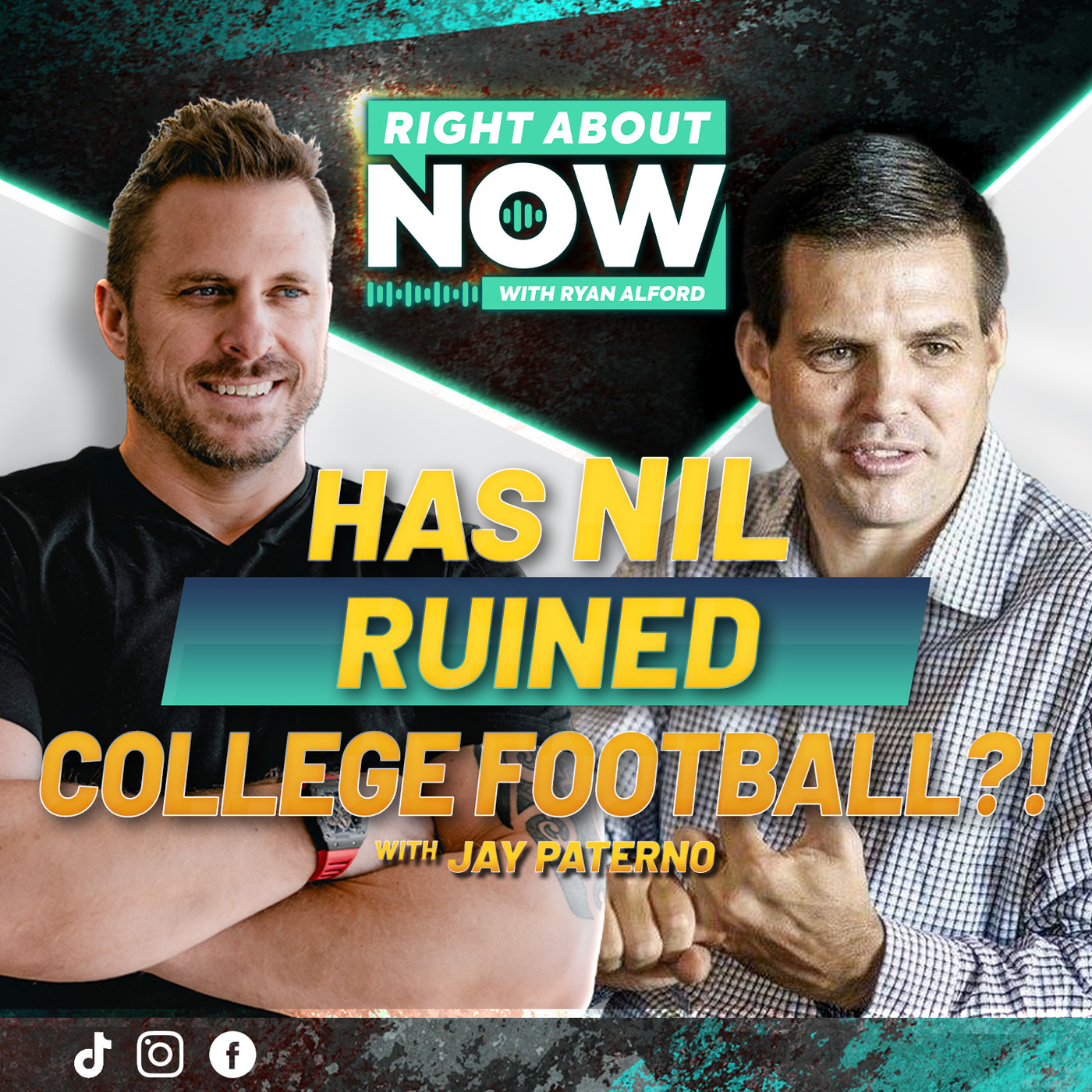
Right About Now - Legendary Business Advice
College Football’s Identity Crisis: NIL, Leadership, and Loyalty with Jay Paterno
00:18:37
Loading summary
Transcript37 lines
- [00:00]
Ryan Alford
The landscape of college sports just shifted, and today we're diving into the playbook of one of the industry's most respected voices. Join me, Ryan Alford, as I sit down with Jay Paterno to deconstruct the nil era, the high stakes pressure of modern coaching, and the critical mental health hurdles facing today's student athletes. From the insights in his book Blitzed to the unfiltered truth about gambling and transparency, this conversation is a masterclass in leadership for the new frontier of the game.
- [00:30]
Jay Paterno
What passes for leadership these days is I say it goes. I call it leadership by title. The president of a university and if I tell you do this, you got to do this, or I'm the athletic driver, I'm the head football coach. And if I tell you you got to do this, you got to do it because I have that title that does not endure and that's not successful. And ultimately, the people that you're in charge of, if they don't buy in and you don't have credibility, you can't leave them anywhere.
- [00:54]
Podcast Announcer
This is right about now with Ryan Alford, a Radcast Network production. We are the number one business show on planet with over 1 million downloads a month, taking the BS out of business for over 6 years in over 400 episodes. You ready to start snapping necks and cashing checks? Well, it starts right about now.
- [01:17]
Ryan Alford
Hey, what's up, guys? Welcome to right about now. We're always talking about how you get right in today's business world, how you keep up with everything that's happening. And of course, it's all about now. So, hey, you're gonna know this name. Got. We got a name. It's got us legacy in football, coaching, leadership at all. It's Jay Patern. Know what's up, Jay?
- [01:34]
Jay Paterno
Not much. How you doing?
- [01:35]
Ryan Alford
Hey, man, I'm good. If I get to have somebody out and talk business and football and college sports and all that stuff, it is a good day. Hey, guys, consolidation is a wonderful thing. And I know as a small business owner, it is everything. Let me tell you. Juggling multiple apps, managing business finances, being anxious about taxes, being behind on the books. Yes, that's why I love consolidation and why I love found. It can all become so much to deal with. Found helps you solve it all. They've automated things like tracking expenses, finding write offs, budgeting for tax time. You can even send invoices for free and pay your contractors. Everything, all from one app. That's consolidation. Found makes it easy to regain control of your business finances. So you can get back to doing what you love. I wish a program like Found had come around years ago when I first started my entrepreneurial journey. I've never felt more control of my finances, though. Now take back control of your business. Today, open a Found account for free@found.com that's f o u n DCOM. Found is a financial technology company, not a bank. Banking services are provided by lead bank member fdic. Join the hundreds of thousands who've already streamlined their finances with Found. We're going to talk with Jay about his perspective on mil its impact on the game. Talk to me about what you've been up to.
- [03:19]
Jay Paterno
I'm on the board of trustees at Penn State, which has given me a really, really good perspective on the business side, not just of football, but just how that fits into the entire universities. And I think more coaches should not necessarily become trustees, but verse themselves in the bigger picture. And that's one thing Joe was always great about. He understood the big picture of Penn State. I do a TV show called Nittany Game Week that goes 20 weeks. We're in 13 stations in five states that covers Penn State football. Written three books, do consulting at nil, a little bit of everything. Now I wake up in the morning and say, what do I got to do today? What role do I play?
- [03:50]
Ryan Alford
Appreciate what you're doing with keeping lessons and things learned and leadership. We may talk about it, but seems like it's in supply.
- [03:57]
Jay Paterno
What passes for leadership these days is I say it goes. I call it leadership by title. The president of a university. And if I tell you do this, you got to do this, or I'm the athletic driver, I'm the head football coach. And if I tell you you got to do this, you got to do it, because I have that title that does not endure and that's not successful. And ultimately, the people that you're in charge of, if they don't buy in and you don't have credibility, you can't leave them anywhere. And that's one of the things I think comes through in all the books I've written, is that whether it was my dad writing about my dad or the fictional coach in the two books I wrote, they're novels, but they're based on real stories. They're based on what's really going on in college football. You see that that coach has the same struggles or how do I handle this or how do I communicate? And I was really fortunate. I forget how many years ago it was now, but there was a group outside of Philly called telios leadership. And that's one of the things they talk about is building cultures, building organizations. And guys I know that are still in coaching and people I know that are in leadership positions, I still talk to them about some of the things that I got out of that. And if I was back in coaching, I'd be a much better football coach now than I was then. Some would say I wasn't much of one then anyway. So it's not a very high bar, but we had a lot of success. But an understanding of what it takes to lead is no questions in short supply.
- [05:09]
Ryan Alford
When you think about leaders and even great coaches, I often wonder like this, Nate. I always have this nature versus nurture thing. They just. Born to be a coach, born to be a leader, or can it be taught? I know everything can be taught. You've worked with some of the best, your father included. How much of his nature versus I don't learned behavior.
- [05:27]
Jay Paterno
I don't think any leader. I don't think there's any really great leaders that don't learn it. I think you have to have life experiences there. Some people have an innate charisma and innate ability where people will want to be around them. But there's also an element that only takes you so far because sooner or later, when things are great and you got that charisma, people will follow you anywhere. But when things aren't going well, that's when you really find out. And that's when communication really becomes something that you've got to learn. And that's something that, as you said, it's definitely nurtured. I spent my whole life, no matter who I was around, whether it was in football, whether it was in politics, whether business. Unfortunately, I have a little bit of a Forrest Gump type life where I've been around presidents of the the United States. I've been around CEOs of major, major corporations. I've been around even just people that were phenomenal leaders in their communities. But I was smart enough to take notes and always listen to what I could get from them. Always trying to steal stuff. I learned of my dad. My dad, as much success as he had in coach, as a coach, he was the same way, always making notes. And Nike would take them on these coaching trips every year. And he'd be there with all these other coaches, most of whom were much younger than he was. But he would pick their brains and they didn't even know it. He'd go back to his room, make all these notes. He'd come Back and say, well, Bob' Stoop says this approach or this guy is that approach or Pete Carroll's doing this or say so he would have all these notes from these guys. I think that's critical if you're going to be a leader anymore.
- [06:45]
Ryan Alford
I was a firm believer that the players should be paid. You've got 15 year old influencers that make money, but somehow college football players are not allowed to do that because their education gets paid for. It's great. There's that trade off. A proponent of them being able to benefit from their name, image, likeness. I was not a proponent of the wild wild west that we've gotten into with seemingly no rules and anything goes. Talk to me, Jay, where we're at, your opinions, your beliefs, etc.
- [07:12]
Jay Paterno
The reality is nil started because essentially lawsuits started to happen. And then California passed a law basically saying you can't restrict that. So all the lawsuits unfolded and nobody at the ncaa, nobody at the college football level, nobody at the Big Ten, the SEC or anybody took any kind of leadership on this thing. And we've just been getting jolted by every latest ruling by a judge. So the minute you think the system is set, a judge says, oh, you can't prevent, prevent them from doing this. And all of a sudden now that changes rules. Hey, Caitlin Clark at Iowa State Farm and Nike think there's a return on their investment by using her in a commercial. Or we've got a football poster that has my image on it for Penn State and there's corporations on there. I should be getting money for that. That's legitimate. Nil. What we went to very quickly is we invented these things called collectives. And I was one of the guys that founded Penn State's first collective with other people's money because I had four kids in college at the time, so there was no extra money for me. But the collective suddenly became Pay to play. Blitzed. Where the head me how this collective works? Well, we pay the players to promote the collective, to raise money to pay the players to promote the collective, to pay the players, because that's money laundering. Now the collective we started was, the idea was nonprofits would take players or athletes from Penn State and they can't pay them to make appearances, but the collective would pay them to go make an appearance at a food bank or promote events or things like that. So there was a legitimate element to it, but it very quickly became pay to play. And now we've gotten to where because of revenue sharing. Now some of that is tapered off, but Are seeing universities now take, if they have a deal with Coke or Nike or whatever, they're siphoning off some of that sponsorship money and putting it into this collective and giving it to their players to promote those products. So it's gotten to be where it's more legitimate, but there's still room for abuse, no question.
- [08:57]
Ryan Alford
Branding and benefiting from your name, image, likeness and being paid for that versus just being paid to play the game, that's two very different things. You could be a superstar in the NFL but not necessarily have any brand deals. They're unrelated.
- [09:09]
Jay Paterno
Well, I mean, even with some of the things that were going to collectives and this true story, there was one collective that was given every senior on one football team $50,000 a year and they were required to do two hours a month tweeting. Two hours a month, that's 40 hours. That's over $1000. I'm probably around 1200 something bucks an hour. And the players are actually complaining about it. If you want to make 1200 and change an hour, you better go to med school or law school. And you're not going to make that for a while after that or go to the NFL. But it's gotten to a point where it's definitely. There's supposed to be a market now of fair market value, but again, it's going to take a while to get the data to figure out what fair market value is.
- [09:44]
Ryan Alford
My biggest issue of it, Jay, is info. You know, everybody's salary, people speculate, oh, I think you got 2 mil. We have no perspective to judge the value. Yeah, exactly.
- [09:54]
Jay Paterno
They all claim they're making more than they do. I mean, no question.
- [09:57]
Ryan Alford
Exactly. If you get paid to do something, it's professional.
- [10:00]
Jay Paterno
You know, we're still in that. Like the parents with the sex talk, they don't want to have the talk. They don't want to own up to the fact that it's going on. We're still in that. Well, let's not talk about it. Let's not say they're employees. Let's say they're not really employees. We'll make them 1099 economy type stuff. Rather than saying they're employees. And what comes with that? Well, benefits come with it and collective bargaining comes with it. And all those things that have to come to make it like the NFL, that has to come. I can't tell how many head coaches or ADs or university presidents or people I've talked to will tell you we certainly we want collective bargain because it settles the whole market Down. But none of them want to say that publicly. They think that once you say that tonight, and I get the fact that they're reluctant to do that, but somebody's got to come forward and do it. And then you get the transparency you're talking about. You're getting the upfront stuff as well as you'll then have the ability to kind of regulate the agents that are involved and give the players some protection. When you have that like the NFL PA does.
- [10:52]
Ryan Alford
Yeah. And all this moving around year to year, you got to have some contracts or something. It's just not good. Two things can be true. I can believe you should be paid for your name, image and likeness. I might even believe you should be paid to get to play. But I can also believe there should be some limitations and some loyalty to the contract. If you're not going to be loyal to the school, then at least be loyal to a contract. It's just not good for college football, I don't think, to have these one year deals.
- [11:15]
Jay Paterno
Essentially that's one of the reasons, reasons schools want collective bargaining. And at the end of the day it'll protect the players and the schools. Because right now I can sign kid to a one year deal and if he's not good enough, I just run him off, say, hey, we're not sign you and see you later and go to the Portal. And nobody talks about all the guys in the portal that don't get picked up. Everybody assumes everybody gets a home and makes lots of money when they go to Portal. That's just not the case. Those contracts, they'll protect the school because again, the school's investing money in these guys. It's coaching, training, food, all that kind of stuff. And ideally you want to settle it down so that they can actually progress towards some kind of degree. Because in the day there's this whole education component nobody talks about anymore.
- [11:54]
Ryan Alford
It sounds cliche, but most of these guys, and they're like a commercial, they go on to be something besides a pro athlete, know that 95% of them are higher than that. Even if they make money in college, it's not going to be forever.
- [12:05]
Jay Paterno
That's another lawsuit that's going on right now. I forget what school it is, but it might be Vanderbilt or somebody. There's a basketball player who knows he's not going to go to the NBA and knows what he can make in Europe but is making more to play at the school. And he's saying, well, how come I'm only limited to five or six years? Because this is a chance for me to make the most money possible of all my options as a player. You can't kick me out. So I think that lawsuit is coming, and that'll be an interesting result in that one. Because if you can make a million bucks playing college basketball, but you can only make 500 grand in Europe, I'm going to stay in grad school forever and make a million bucks until they kick me out.
- [12:41]
Ryan Alford
It brings up a lot of questions, Jay, because for me, sometimes if you mess with the ingredients too much, your cake no longer tastes good. Part of me goes, oh, that'd be awesome if we could keep some of our favorite guys a couple years longer. But then I'm like, but does it stay the game that it is today? And I'm not talking about just the nostalgia. I'm talking about there's something about the ingredients of college football and the limited window that all these ingredients work together to bring fandom and interest and desire and all that. That if you mess with that too much, does it mess with it?
- [13:13]
Jay Paterno
There's a real danger of that right now. I hear more and more fans. And look, I'm 57 years old, so I'm old, but I'm not that old. But I hear more and more people my age and younger, 10, 12 years younger, that are saying, you know what? Yeah, I watch, I root for my team, but it's not the game that I love. It's not that. And when push comes to shove, I'm not going to a bowl game if 12 guys going to opt out. Me. Penn State's playing Clemson, and five of their guys on defense that are really, really good players are opting out. And you say, okay, well, is it really Penn State versus Clemson? And you know, Penn State's got guys opting out on their defense and offense. So it's not even a continuation of.
- [13:48]
Ryan Alford
Careful what you ask for. Because when it becomes the cfl, it wasn't very popular, no question.
- [13:53]
Jay Paterno
And if we start motioning guys like they do and put 12 guys in the field, then I'm definitely quitting. But for Penn State fans, Pinstripe bowl against Clemson is good, because that's a drive. You can drive up and back, same day, go to the game. If this bowl game were in Arizona, I'm not sure many fans would go out there to see a bunch of guys. And we've turned the bowl games into just television content more so than an experience.
- [14:13]
Ryan Alford
Talk to me about blitz for our listeners. I know it's like kind of fictional in some ways. But like talk to me about the.
- [14:19]
Jay Paterno
Premise and a novel. So it's fiction, but it's what I call non fiction fiction. So the stories you're going to read in there that are listed as fictional stories, they're real. It's really what's going on. It's just, it's easier when you're going to write about something like this that is current, that is controversial. It's a lot better to kind of make it a fiction because now lawyers aren't involved because if I write this about somebody now I'm getting sued. So I took it and made it what I call non fiction fiction. So it's a novel. So I can be brutally honest. I just change names and change schools and I make it very clear I'm not trying to sign them this to any one school or not. So I've changed names. So really what college football fans will get out of this book is what's really going on. The pressures of being a head coach, sitting in there and having to deal with have a day, you know, when the season's over where nine kids come in to meet with you one on one about transferring or not transferring or finding out from a third party that a kid is going to leave as well as all the other things that they're dealing with. They're dealing with the nil part, they're dealing with the business part, they're dealing with these kids when they get in trouble. They're dealing with a kid claims that one of his assistant coaches you used a racial slur or that they were harassed and now a report is written and the board of trustees gets involved. There's all elements of this thing from trustees all the way down to the players in this book. And then it talks about mental health aspect of it, not just on the players and which is nobody got prepared these players for the mental health part of the nil world. Nobody. And I've been consulting in nil for four years. And that's one of the things we talked about from day one is all of a sudden Junior is the breadwinner in the family and if he leaves from the school that he really loves to go somewhere else, there might be more in the family saying why aren't you moving? And that stuff they didn't used to have to deal with till they were in the NFL. Now all those things are hitting 18 year olds and 17 year olds and all that. The mental health part for the coaches and I don't want to get too much about what's going on Michigan. But certainly there is a situation where the pressure and some of the mental part of it were underestimated, maybe not handled correctly. And you look at the player from Dallas Cowboys who killed himself, I mean, these things are very, very real. No one's talking about. And those do come through in the.
- [16:21]
Ryan Alford
The book. It's like that's the layer that sort of always swept under the rug. Oh, it's just about money. They just want to do this all that well. Yeah, it is that. But like there is these components that go into the impact that's happens. It's deep.
- [16:35]
Jay Paterno
There's a point in the book where the head coach is actually goes and starts to talk to someone. Not a psychiatrist, but someone who. An outside advisor. Life coach isn't the right word, but a leadership person. And that person actually says the. The coach. When you go away with your wife to the beach, I want you to put your phone down two days. Put someone in charge when you leave. And if there's a major, major emergency, they'll know how to get you. But anything else, and he goes berserk. Like, you want me to do what? And that's how these coaches are wired. And when the phone rings at 12:30 at night, it's not the academic advisor telling you, congratulating you, having 15 guys make Dean's list, it's something very, very different. And that's the pressure you feel in the college game. Because unlike the pros, when they leave the building and the pros, they're grown men. And when in college, when they leave the building, you're still expected to have some influence. Song.
- [17:26]
Ryan Alford
Jay where can everybody learn more about what you're up to? Buy the book, all that stuff.
- [17:30]
Jay Paterno
My website is jv paterno.com My name J A Y, the letter V. Paterno.com I'm on Twitter or X or whatever it is now at J. Paterno, Instagram @JV paterno. But you can get the book on the website. You can get the book on Amazon or wherever you get books. And keep up with everything I'm doing and subscribe on the website or follow me on those social media platforms.
- [17:51]
Ryan Alford
You got a lot to contribute. You're still doing great things. I appreciate you for coming on.
- [17:54]
Jay Paterno
I appreciate you having me.
- [17:56]
Ryan Alford
Cool. I really appreciate it, Jay. Hey guys, you know, to find us Ryan is right.com we'll have links to Jay's books, his website, and all the ways to stay up to date to what he's doing, all his contributions to football leadership we appreciate you. And we'll tune in next time on RIGHT about now.
- [18:13]
Podcast Announcer
This has been Right about now with Ryan Alford, a Radcast network production. Visit ryanisright.com for full audio and video versions of the show or to inquire about sponsorship opportunities. Thanks for listening.