← Right About Now - Legendary Business Advice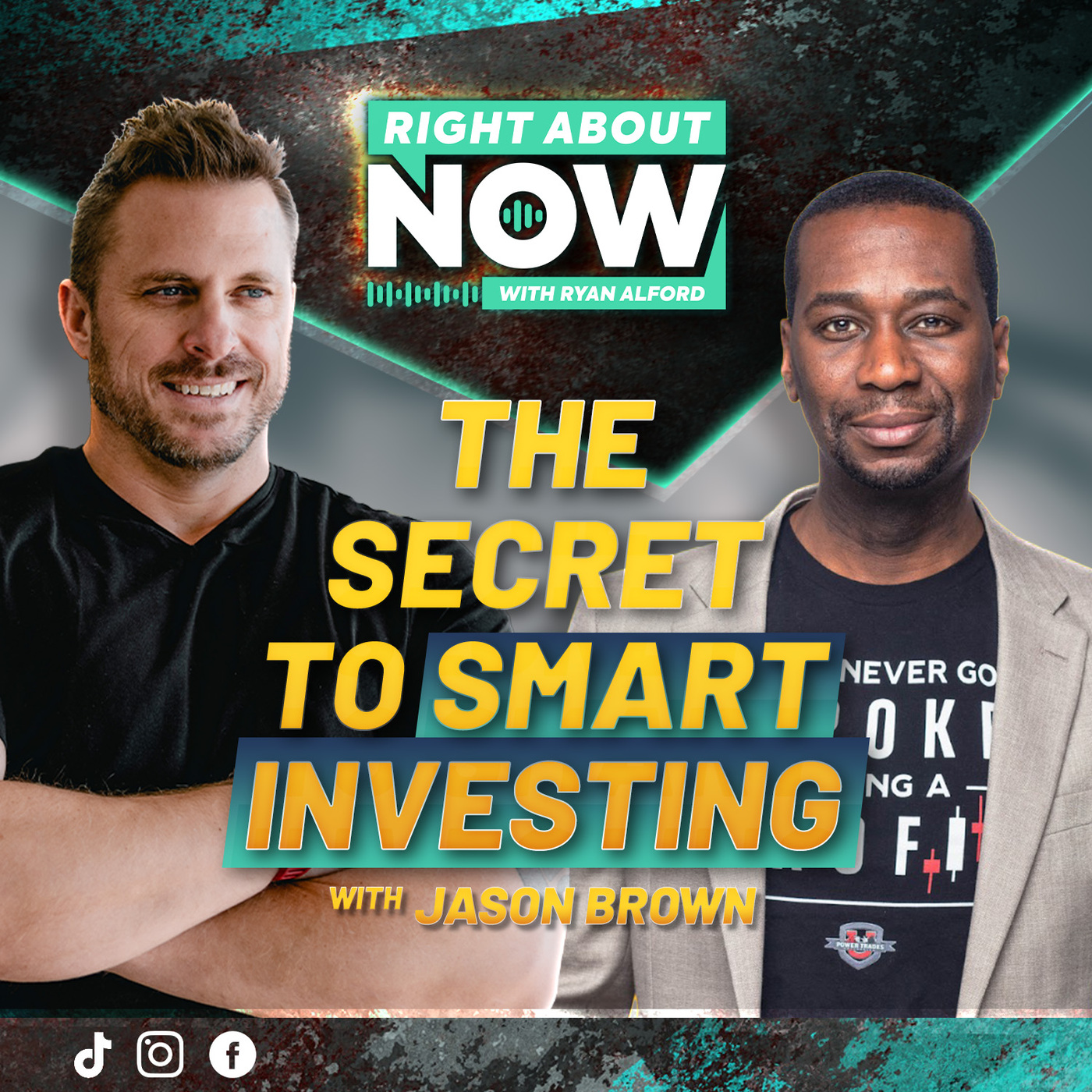
Right About Now - Legendary Business Advice
From Student Loans to Millionaire: Jason Brown’s Journey in Stock Trading
00:22:51
Loading summary
Transcript47 lines
- [00:00]
A
On today's episode of Right about now, talk to Jason Brown, stock market expert. He produces the Brown Report. You need to go check that out. Brownreport.com Anyway, Jason is amazing. We had him on the show. Talks all about options trading, how to learn and how to know the right things. Because ultimately we control our own financial destiny when we understand what is happening with our investments. Jason is a refreshing resource and someone that deserves your attention. As you'll see on today's episode, look.
- [00:30]
B
At the Mag 7 stocks and just follow the money. Money's going into AI infrastructure, cloud storage, data centers. I would tell people to look there, at least at the time of this recording.
- [00:41]
C
This is Right about now with Ryan Alford, a Radcast Network production. We are the number one business show on the planet with over 1 million downloads a month. Taking the BS out of business for over 6 years in over 400 episodes. You ready to start snapping necks and cashing checks? Well, it's starts right about now.
- [01:04]
A
What's up? And welcome to right about now. We're always talking about what's right and what's now. We can talk about last year, we talked about next year. No, we're not about the windshield looking too far ahead. We're not about the rear view mirror looking too far behind. We're actually about taking notice of what's here, what's now, and how to get ahead in business and in life. And that's why we bring all the experts. We got my friend, my buddy downtown, Jason Brown. I gave him a name he didn't even ask for. That's what I do, Jason. But welcome to the show, Ryan.
- [01:31]
B
Good to be here, man. I love it, I love it, I receive it.
- [01:35]
A
Good. I appreciate that. Some people like, I don't think they knew how to take me. I give everybody pet names. It's love. I don't know. This is what I do. I love what you're doing, Jason. Little options trading, power trades University, author of five Year Millionaire. Damn, I'm going to be a five year. Yeah, everybody likes to get in a hurry, but five years now is pretty good, Jason.
- [01:52]
B
It's a good reasonable time frame. That's why I like it. It's doable and it's not 40 years out, you're not looking at retirement. It's within your lifetime where you can still enjoy it.
- [02:02]
A
I know. Hey, man, I had student loans and I wouldn' say I used every dollar wisely. Some might argue using them for colleges and even wise, but we'll save that topic for another Day at another guess, but no. I got the intention of taking out the student loan, throw it in the stock. It actually seems smart. It's like, at least you're going to get a higher return. You would have hoped. I'd love to start there a little bit, Jason. And then building towards what you're doing with five year millionaire.
- [02:27]
B
Yeah, absolutely. So what happened? When I was growing up, we were poor, sleeping in sleeping bags, and I was trying to figure out how to change our family's financial tree. And I actually took $2,000 bank at 18. That was my graduation money. And I said, like, I want to invest. The girl asked me, like, why? I was like, I want to be rich. Like, why else do people do this? And so basically she said, you want aggressive funds. I'm like, yeah, that sounds about right. I need aggressive growth. And I'm thinking, okay, I'm gonna come back two, three years later, I'm gonna have $6,000. You hear people say, just put some money in, leave it, come back, it'll grow. Came back about two to three years later, and it was down to $700. And so they lost majority of my money. They lost thirteen hundred dollars. So I'm like, I could have lost my own money. What happened? And pretty. I don't know what to tell you, Mar. Goes up, goes down. I was like, I know what to tell you. Give me my 700. I can do this myself. And so I spent 200 on some Jordans. I was like, if I lose this other 500, at least I got some gym shoes out of the whole deal. You know I have something to show for that, right?
- [03:26]
A
Yes.
- [03:27]
B
I had 500 bucks. I'm working for Sprint PCs making $8 an hour. I make 64 bucks on a Saturday, $50 after you take out taxes. And I was like, I could just make 50 bucks with this $500. I wouldn't have to work a weekend. What I did was I bought sprint at $5. It fell down to $4. I was like, oh, man, I'm not that good at this. Maybe I'm not as smart as I thought. Sprint went back up to five. I thought, okay, just need to go to 550. It fell back down to four again. I thought, the stock market's rigged. That's why they asked for your Social Security number. They won't let it go to 550. I just had all these thoughts. It went back up to five. And I said, I've seen this before. I got out at five, it fell to four. I got Back in, it went up to five. I got out, made my first. I tell you that story because that was the first time I started to learn about patterns. If you drew that out on a paper, we call it a channel and stock pattern. So I got really good at these patterns and start studying what other patterns there were. And I said, how do I get more money into the machine? And so I had a scholarship to school, to Mike Ilitch School of Business, Wayne State University here in Detroit, Michigan. And I knew that. I went and saw financial aid. I saw my buddies getting student loan refunds. And I found out that because I didn't live on campus, she was like, oh, you can use the money to live on campus. I said, what if I live at home? She's like, well, you could move on campus, use it for living expenses. So like, basically I can use it for whatever I want. And for me, I saw that as an opportunity to get more money into the stock market machine. So I took that $10,000 student loan and I grew it to like $113,000 as a 21 year old college student.
- [04:52]
A
Amazing. What a great story that would be if that was the end. But I think there's a part two coming.
- [05:01]
B
There's definitely a but to that, right? Because, well, what happened was I dropped out of school after that. I made more money not being an engineer, and then I grew the account to about $300,000. In years later, at about 26, 27, I actually risked a quarter million trying to make half a million and I lose it all. So by the time I'm 27ish, I'm flat broke. Had to move back home to the neighborhood with drugs, gangs, bars on the window and really reset. But that's where this whole new Jason Brown was born. That's when I started documenting my life and saying, like, I know the stock market works. I've made money from it before. I just got to figure out what I did wrong. And that's kind of how I got into YouTube and teaching. And I was rebuilding my account and kind of forward and documenting the whole process along the way.
- [05:46]
A
Hey, man, I admire just the gumption of it all because I love people that take chances. You're watching your surroundings, you maybe not have known everything, and we don't always know everything, but you're watching. Hey, people are investing in doing these things. You get interested, you put 2,000 in the bank, you realize what a facade that is. And what happens is you get put into one fund where some guy that gets paid 30 grand a year, pays attention to it for about 10 minutes a month. It's the Aggressive Value Fund here at Liberty Mutual Bank. Well, I'm making up bank names, but, I mean, I could see it. And we'll get you in the aggressive fund, son. We'll get you in that one. We'll see how it goes in a couple years. Yeah, how it goes. Oh, I remember starting in school and they want you to get in the 401k plan. They give you four boxes to check, and it's like, I'll give you. I took that aggressive one. I don't think it went as bad as yours, but it didn't go wonderful. Then I realized, okay, I can diversify this thing and do it like I want, but admire again. You're wanting to get ahead. You're wanting to do the right things. You're hearing the signals. This is how you do it. And then you earn it up. And you took a little bit of the slow path. And it sounds like you got a little greedy. And I'm just going to say, I don't know. I mean, every detail of that. But maybe it was oversold to you, misrepresented. There's probably a lot of details to that, but it sounds like maybe you tried to get in a hurry.
- [07:02]
B
When I saw the opportunity with the stock market account to $300,000, when I started to lose it, there was a lot of different things wrapped up into it. A, I did get greedy. I was risking a quarter million trying to make half million. I was actually up a hundred thousand dollars in that trade before it went against me. And I remember saying, 100,000, doll. Not enough. I'll never say that again, by the way. But at that moment, I was like, a hundred thousand dollars. What I'm gonna do with that? Because I was trying to make half a million in my head. I was trying to make half a million in one investment. Not really. I could have made a hundred thousand four more times, but that was part of it. One of the principles I learned from it that I talk about in my book Five Year Millionaires, that I didn't have an I'm wrong level. So I didn't have a level and say, hey, if this goes against me, when am I going to get out? How am I going to save my account? I didn't have any protection. Now I talk about how to use put options as protection. It's like, I should have took a portion of that money and prot. Quarter million. I didn't. I just thought, it's going up and I'm going along for the ride, never thinking that it can go down. So it definitely humbled me. But I wouldn't be the same guy I am today if it went right. Number one, you wouldn't like me because I'd be super arrogant, think I knew everything. But number two, when the times get tough in the market, I'd realize I didn't really know anything. I don't think I knew as much as I thought. I was just riding the wave of the market going up. And I think a lot of people invest like that. They get a little bit of success, but they don't really know what they're doing until they've been through an up market, down market and a sideways market. Tariffs, Covid, all that.
- [08:25]
A
No kidding. Talking with Jason Brown. He is a stock market expert, options trader and author, five year millionaire. So, Jason, we got the good, the bad, the ugly, and we came on the other side. This is the quote from the book, the Roadmap for investing in the Stock Market, wealth accumulation and financial independence. We want that plan.
- [08:44]
B
Yeah, the plan starts with you got to be educated. First of all, everybody wants to invest in the stock market, but it's hard to invest if you're not educated about how it works, when to buy, when to sell. And the first thing I tell people, or at least the roadmap that we talk about in the book is, number one, you got to have an account, you got to have access to the market. And we want you to practice before you ever put real money down. But then that goes into the education piece because it's like golf. If you don't know what to practice, you start to develop a bad swing. You want to be educated to the point of what am I practicing and how do I know I'm practicing in it the right way? And the steps you want to take, or at least that we teach, is number one, you want to be able to read stock charts. A lot of people start with fundamentals first. But the reality is if I look at a stock chart, I could tell just by looking at is the stock in an uptrend, is it in a downtrend, is it in a sideways? If it's in a downtrend, then I can go look at the fundamentals and find out why it's in the downtrend. If it's in an uptrend, then I can go look at the fundamentals and find out why. But initially that chart is going to tell you if you're in a stock that's going up, going down, or is going sideways. Then from there, just taking a look at the fundamentals and saying, like, well, why is it going up and why do I think it's going to continue to go up? And then the third piece of it is using options. Options to supercharge your results as well as protect your account. Most people don't get excited about investing because they say, oh, I only have 500 bucks. I only have a thousand dollars, I only have $4,000. That's not going to do much. And depending on who you're talking to, some people say, I just put. Keep adding money to it and over time it'll, it'll grow. But if you understand options, you can actually control some of the higher quality, better stocks and get an exponential return even with a little bit of capital. So it's really key to learn. Learn about call options and put options and how you can supercharge your account as well as protect it from losses.
- [10:32]
A
Talk to me, Jason. I'm gonna play. I'm not always like, devil's advocate is not the right word here, but more I try to play reality. You and I would probably think we're probably cut out of similar, similar cloths, being aggressive, wanting to make our own path. That entrepreneur or type spirit. Some people just don't want to take the time to learn it, as crazy as that might sound, and it might sound lazy. It looks like Chinese checkers or something on the board. How you navigate this is that just when, hey, you need to find a good financial advisor trust, or is it, stop fooling yourself, learn this stuff. It's important, get over it, you know which one, it's both.
- [11:05]
B
And to be honest with you, and I would never shun someone who doesn't want to learn because you do have to have an interest. I don't have to say you have to be passionate about it, but you have to have an interest to want to know, how do I grow my money? How you know, what are they doing with my money versus just me signing this paper. And I'm sending me a statement every month that I don't know how to read. So you have to have some interest. And I think it's very important that we're not trying to take people who aren't interested in the market and make them interested. If you're already interested, we're saying, hey, here's a roadmap and a blueprint to help you get better and understand it. If you're not interested in managing your money, you are left to finding a good Financial advisor or a person you trust. I think what's important there is that you understand no one's going to manage your money like you are. So just make sure your expectations are in alignment. People say, well, I don't really want to learn it. I just want to give it to somebody. And I want them to give me the 100% return returns or the 50 returns that I see sometimes you make. And I said, unless you got a 10, 20 million dollar account, your account ain't big enough for someone to focus solely on you and your money and to grow it like that. They're going to stick you.
- [12:10]
A
You got 100, that box at the end of the sheet.
- [12:13]
B
Yeah. And they're just going to stick you in some fun, right. And go find a hundred more people like you because they only make 2% off of. In order for them to make their living, they just got to find a bunch of you who don't care just long as your expectations are aligned. And I think the other thing that's a little bit dangerous about that is people say, I find someone I trust. But how do you know who to trust if you don't understand it yourself? And most people don't have an answer for that. They say something like, oh, this person went to school for it. Going to school does not equal trust. Going to school just means you know how to pass a test. Taking the series 6, 63 and 7 just means you know how to pass the test. I found when I went to study to become a wealth manager, I studied to become a financial Planner. Passed the 6, 63 and the 7th, and right before we filed it with the state and the SEC and you got to get sponsored and all that stuff. They wanted me to shut down my own website. And he said I couldn't talk about ST anymore. Then I said, okay, no problem. How does it work? When do we actually pick the stocks and help people? Oh, we don't pick the stocks. We pick from these three different funds from American funds, Fidelity. And I forget who the third company was. It was like, oh, they just supply everybody these funds and they change one letter or one ticker symbol. And now it's like our custom fund. I'm like, so we don't even manage the money? Like, no, like you just got to be licensed in order to sell these securities and make a list of all your friends and who's their financial planner or who they use and see if you can bring their account over. And I thought, that's interesting because people would have thought they could trust Me, just because I had had a license and I wasn't even managing the money. I was basically a licensed sales rep. You have to have a little bit of interest in this and you have to be educated enough to the point to understand how do you even pick somebody that you trust and is knowledgeable.
- [13:47]
A
Yeah, good advice. And I'll say this, as you were talking, Jason, I was thinking back to college or to my education. Why are we teaching sixth graders this? We should have. I know there's finance and stuff once you get in college and even high school a little bit, but we should be teaching our youth this from the get go. I mean, shouldn't we get financial excellence in sixth grade? Feel like we should be starting earlier.
- [14:08]
B
You know, that's interesting conversation. I got so many thoughts around that.
- [14:12]
A
You'd have to make it corrective for that.
- [14:14]
B
We should be introducing this stuff earlier. There's so many problems with trying to do it. You got the parents who don't understand it so they can't help at home.
- [14:22]
A
You got the teachers for Jason, come on, man. Luckily, my wife's a principal and was a math major. Daddy's pretty good a lot of things. Mommy's gonna have to help you with that math.
- [14:33]
B
Send them same kids home and be like, we want to buy some stocks and invest. Parents are like, what?
- [14:40]
A
True. But yeah, there's a balance there. But I'll let you finish your thought.
- [14:44]
B
The school's trying to cater to the average student. So maybe in affluent neighborhoods or unique schools able to introduce some of these extracurricular or non traditional learning paths. But when you try to look at school as a whole and they're trying to teach a broad spectrum of kids, I just don't think they have the bandwidth to introduce investing and investing concepts. A, if the teachers don't understand it themselves and then B, they're trying to just kind of blank. Could teach it across all students. Although I believe all the students could learn it. I just don't know that the schools are ready to kind of take on that task.
- [15:17]
A
I like big challenges, Jason. I like big one at big. Hey, we doing enough of the same for too long. My wife, she's middle school principal talking about a tough job. She agrees with it, but it's more than she, hey, she's got enough problems that day. I'm like, man, we keep. What do they say? Stay the same, stay the same. There's something there. There's. There's a balance. I don't know if we're going to solve that today. But it made me think, I think.
- [15:36]
B
There'S a huge opportunity there, though, for.
- [15:38]
A
Sure, if we had financially secure, at least knowledge kids in those areas. And maybe it's not stock options, but it's something, I mean, just teach them.
- [15:46]
B
How to use credit. You know, let's start there. Let's teach them how to balance a checkbook or create a spreadsheet with a budget. The whole gamut of financial literacy is just missing from school at an early age. Teach them how to pay taxes. Most kids probably don't even know that they don't even get to keep 100 of their paycheck, especially if they started a business. There's so many things in the financial literacy space that could be taught in schools. But like you said, I don't know that we go solve that today, but maybe, maybe somebody's listening. We go create some type of cool partnership.
- [16:14]
A
There you go. As we close out here, Jason, talk to me about the Brown Report. How do people. What's the first step here, both with you and in general, how you guide people? Power Trades University. I know we got that, but walk me through some practical steps for our audience.
- [16:28]
B
Yeah, there's two things that we like to start people off with. So at the Brown Report, we have the Stock Market Starter Pack. Those are for people who say, I don't even know where to open an account. I don't know how to read a chart, I don't know what I'm looking at. I don't know how much money I need, how much I want to make. And the Stock Market Starter Pack, we walk you through all that. How to get your first account open, how much money you need, how much you can expect to make, how to read the three most profitable chart patterns. And it's completely free PDF download. The second one is the Stock Option Starter Pack. So maybe you've already been investing, but you want to know how to supercharge your account or your returns as well as protect it when the markets dip. Or learn how to make money from stocks in the market falling. We got the Stock Option Starter Pack. So both of those are available@thebrownreport.com One of the best free resources to get anyone from a beginner to someone who's even been experienced to the next level.
- [17:16]
A
I love it, man. I mean, what's realistic if someone coming in, they say they don't have a million dollars? And how to become a billionaire in five years, but like, or maybe a multi millionaire? What's realistic year one following something like this and no Guarantees you can't control everything.
- [17:30]
B
But generally speaking, in my book 5 Be a Millionaire, I break down how you can start with $4,000, and if you can earn 10% a month for 60 trades or five years, you'd actually have $1.2 million. Most people think to become a millionaire in five years, they got to start with a hundred thousand or they got to start with half a million. But really, if you can start with 4,000 do dollars, you could grow it to a million, 1.2 million in five years. When you say what's realistic? I like to answer that two different ways. What's realistic for people who are knowledgeable and what's realistic for people who are not knowledgeable. When people are not knowledgeable, they don't believe you can earn 10% a month. Most people don't make 10% a year in the market because the S P 500 returns on average, 11. For those of us who are using options, reading stock charts, I have those trades where I earn 10, 20, 30, 40, 50% a month. And so that is realistic, but it's not realistic without knowledge and without practicing, without learning the industries. I know that 10 is doable. And what I love about what we do, all our trades are recorded, Everything is timestamp. You can go back over the years and say, do these trades really make 10% on average a month? Do a segment on the Charles Swab Network live from the New York Stock Exchange. I do a segment called three Stocks, three Options. Those are public stock picks that I give with the option trade. You can also go see those trades and see, like, what, Whoa, it went up 50%. It went up 30%, 20% in a month or in two months, and average 10%, knowing that it's possible and then getting the knowledge. So I think you can realistically expect 10% a month, but you have to grow into that 10% a month. You still got to open account. You got to learn, you got to practice.
- [19:05]
A
Fair enough. Lastly, Jason, any hot stock tips? Anything on the radar that somebody should be aware of?
- [19:11]
B
I like to say follow the money. At the time of this recording, the money is going into AI, is going into semiconductor stocks, is going into cloud and storage right now. Now, follow the money. The simplest way for most people, listen, look at the Mag 7 stocks. You got Microsoft, who's crushing it with their Azure cloud services. You have Apple, who has yet to do the Siri refresh. They just released the new phones, but they also haven't really made their big splash in AI. But that stock's moving higher. You got Nvidia who's just crushing it, making the chips and building data centers. Look at the Mag 7 stocks and just follow the money. Money's going into AI infrastructure, infrastructure, cloud storage, data centers. I would tell people to look there at least at the time of this recording.
- [19:53]
A
Jason jam packed action value all in one where can everybody learn more? You mentioned it thebrownreport.com I think I heard but give those digital digits where the digital locations.
- [20:06]
B
The best place is thebrownreport.com from there they can connect with me on LinkedIn and connect me on Instagram. I'm the Brown Report on Instagram, the Brown report on YouTube. I'm pretty much the Brown report everywhere. So they just go to thebrownreport.com and check out free PDF and and all things Jason Brown.
- [20:21]
A
I know downtown Jason Brown. I like that though. Especially Detroit too. Detroit, man. Downtown Jason Brown seems to fit. I love my Detroit people. They're like gritty but fun and nice. The ones I know, some of my friends are all from Detroit that way.
- [20:33]
B
That's funny. I also have a place downtown Detroit too.
- [20:37]
A
Hey, see downtown Detroit. Jason Brown. I love it, man. I appreciate you coming on Ryan.
- [20:43]
B
I appreciate you brother.
- [20:44]
A
Hey man, you know where to find us. Ryan is right.com I'll have highlight listen links, everything from today's show. TheBrownReport.com will have links there and of course where to find us anytime, anywhere at Ryan Alford had that blue check before you could buy, baby. We'll see you next time. All right about now this has been.
- [21:03]
C
Right about now with Ryan Alford, a Radcast network production. Visit ryanisright.com for full audio and video versions of the show or to inquire about sponsorship opportunities. Thanks for listening.