← Right About Now - Legendary Business Advice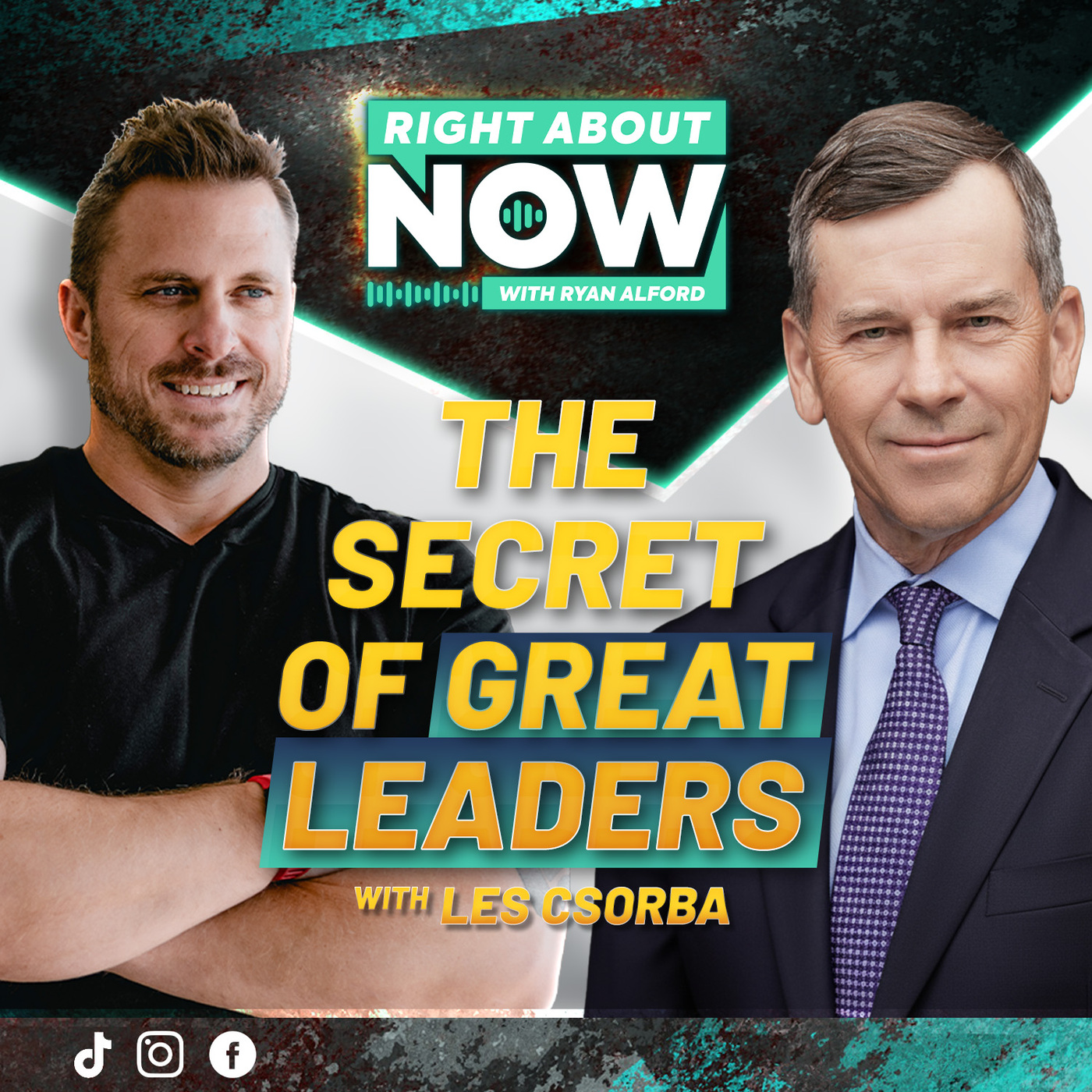
Right About Now - Legendary Business Advice
Inside Executive Search: Why Empathy & Self-Awareness Build Better Leaders with Les Csorba
00:14:06
Loading summary
Transcript27 lines
- [00:00]
A
On today's episode of Right about now, talk to Les Chorba. His new book, Aware the Power of Seeing Yourself clearly is coming out and guess what? This is impactful. We need to see how others see us if we want to get ahead. It's about self awareness, but ultimately it's about understanding the good, the bad and the ugly about the way we're managing, talking and seeing our people. We got to be aware of what we're doing. Les talks about that along with his experiences working with some of the greatest leaders of the world, ex presidents, some of the largest players at some of the largest companies. Les gives all those insights and more how see yourself clearly right now.
- [00:42]
B
There are some common characteristics of highly self aware leaders. They tend to be more objective, they tend to have a little bit more respect and they're kinder and they also tend to be the kind of leaders and people that can make friends with people that they don't agree with all the time.
- [00:58]
C
This is Right about now with Ryan Alford, a Radcast Network production. We are the number one business show on the planet with over 1 million downloads a month. Taking the BS out of business for over 6 years and over 400 episodes. You ready to start snapping next and cashing checks? Well, it starts right about now.
- [01:21]
A
Hey guys, what's up? Welcome to right about now. We're always giving you what is here, what is now so that you can get right. That's what I always say. And look, in my career I've actually had to do this quite a few times. You're not great at it. I wasn't. That's like looking in the mirror and knowing what am I seeing? How are people seeing me? You got to see yourself clearly. That's why we've got the author of Les Chorba. He is the author of Aware the Power of Seeing Yourself Clearly. What's up, Les?
- [01:47]
B
Hey, Brian, thanks for having me. Great to be with you.
- [01:49]
A
Yeah, man. I like this topic. The fact that I like this topic and when your people reached out, I was like, I'm self aware. To remember how unclearly I've seen myself at times that this is an important topic.
- [02:04]
B
Yeah, well, yeah, self awareness, it's not anything new and it's been talked about for centuries in terms of the wisdom of self awareness. But what's new is we're at historically low levels in our institutions, our leadership and I would also argue our relationships. That's what the book is about is how do you show up as the best version of yourself, really? By understanding your Strengths and your flaws.
- [02:24]
A
You worked with the senior George Bush, the President, the father he had the father son. And you've worked with some of the who's who. And the greatest leader of the modern planet is the President. Typically at the time you've seen a lot. Who's the most self aware leader you've ever worked with?
- [02:39]
B
It's interesting you bring up George Herbert Walker Bush because I had the honor of working with him in the White House and presidential personnel, which is how I got into the head hunting or executive search business. But his longtime friend James A. Baker iii, you know, the former Secretary of State called, told me that George Bush was the most self aware person he had ever met. I think that there are a lot of contemporary examples of self awareness. Jamie Dimon, the chairman CEO of JP Morgan Chase is a guy that was still working on stuff. And in fact the argument I make in the book is that the best leaders are those that don't view themselves as the complet finished product. And Jamie Dimon is working on being more empathetic as a leader and maybe cleaning up some of his language. And I just love that icons like that are still working on stuff.
- [03:21]
A
Yeah, I've had enough failures to know if I think I've got to the destination of having it all figured out. Reality likes to set in on me quickly. It's like I know what I don't know probably better now than I ever did. But we always need guides and books like yours to kind of help us. I don't care who you are, there's always something that you could do better or be more aware of or empathetic. I mean empathy is a really important word I think in that self awareness. Dig into that a little bit for.
- [03:50]
B
Me less obviously empathy is huge in leadership. I make the argument in the book that the best of the best leaders over sort of the career that I've had are those that have incredible self belief without the self absorption. And if you think about it, that's a pretty hard combination to pull off without having a high level of awareness and the courage to engage those flaws or weaknesses, but also leverage the strengths and turn them into superpowers and really have an impact on the world and humanity. Whatever you're creating and building or whatever it is, empathy is huge. You got to be the kind of leader that can be make the tough calls, be decisive, provide feedback that's clear. But you also have to be empathetic at times as well. So it's a balance.
- [04:29]
A
You brought up a really interesting Point confidence and arrogance is a fine line. Who have you seen and worked with in your time that you feel like, demonstrated that? When I think of George H. Bush, I don't know that the self awareness thing actually makes sense. When I think back to him, I don't know if I think of him though, as maybe the most confident president ever. Maybe. Tell me a leader you've worked with that was confident but not arrogant.
- [04:50]
B
Yeah, well, I mean, I mentioned Jamie Dimon. I think he has that balance between confidence and humility. He's certainly very blunt, very direct, very decisive. He was really one of the few CEOs during the financial crisis that really not only survived but thrived. And he's the type of leader now that kind of has this sort of obsession, just this radical paranoia, if you will, healthy paranoia, just to make that everything is going well. He's got that confidence. He shared with me the story 15 years ago or so. He was at home taking a work call and he got very irate and very angry with one of his colleagues, the other other line, and used some pretty salty language. When he was finished with the call, his middle daughter started crying and said, dad, why are you so angry? And of course, that was a defining moment for him in terms of how he showed up with his team as well as his family. He knew he needed to be more empathetic and show up with more sensitivity with his team and his family.
- [05:40]
A
Talking with Les Torba, he is the author of Aware the Power of Seeing Yourself Clear. Really, let's give some value here for our listeners that might be different spaces, places in their leadership journey. What are some blind spots that you see or talk about in the book that are common for, you know, whether early, middle or late leaders?
- [06:00]
B
There's so many. There are leaders that are obviously micromanagers over controlling leaders that get overly emotional or distracted easily, or they're the smartest guy or gal in the room. But I think the most prevalent, fastest growing blind spot in corporate America is people pleasing. Over 52% of Americans refer to themselves as being people pleaser. I'm the classic people pleaser. And in some cases, people pleasing works well. Somebody that can always say yes and solve problems and be well liked. But in terms of leadership, if you want to lead, you can't worry about being liked. You got to be clear. You got to give clear direction and expectations. You got to provide feedback, even if it's tough feedback. And so people pleasing is a real issue. It has a lot to do with our culture. Obviously, this constant validation in our culture, the digital culture of constant feedback and all the algorithms that are positive reinforcements I think has contributed to this people pleasing that we have in our culture and in our businesses.
- [06:54]
A
Yeah, I'm going to go there. Even if you want coddling is what I'd call it. Yeah. When I say that, I don't go. I want to go back to the old days where we just overworked and you know. No, it's not that, but it's like this. It's work for a reason. We have jobs to do, we need outcomes to happen. Yeah, we all have personal things. We need empathy and all that. But we threw the baby out with a bathwater a little bit in, in some of this. And remembering, I joke sometimes you need to hear about Google having these nap pods and like other things and I'm just using them as the example. But like, is the job to make sure that the employees are comfortable or is the job to sell something and to be a bottom line in some.
- [07:31]
B
Cases, some of our cultures, which have been designed to be very people oriented and people friendly, which are great, by the way. You want a people first culture, but in excess it can be detrimental to the purpose of your business, whatever it is, to solve whatever problem and to create value for your customers or your shareholders. So leaders have to be mindful of that for sure, and aware of it for sure.
- [07:51]
A
You got a couple names that are on here. Elon Musk, Warren Buffett. Talk to me about these guys. Are they self aware?
- [07:59]
B
I actually think Elon Musk, for whatever faults or however controversial he is, I would actually consider him to be fairly self aware. I mean, he has identified his issue as being pathologically optimistic, which makes sense if you think about it. If you're building five, six, seven companies and you want to send a rocket to Mars and you want to build EV vehicles and you want to build these underground tunnels and all the things that he has done and accomplished, you have to be optimistic. But I think the reason he recognizes that it's a potential blind spot is any strength that's overused can derail. And the way that would derail is if you're hard on people or if you have deadlines or expectations that are unrealistic, that can be a derailer. I would consider him to be pretty aware of the thing that could hold him back, which of course is this pathological optimism.
- [08:46]
A
It's interesting. He has to be because you might mistake him like an evil genius. But I don't think of him as evil. I'm just saying he gets, gets bucketed there. I think he has to be optimistic because negativity and disbelief are all excuses for things not to happen. And the reason he has made some of the impossible possible is that optimism like we all do, growing old. If you start burning too many bridges, you can't get back across.
- [09:11]
B
Well, he also has that incredible self belief that I talked about earlier. And I do believe that if you just read his the epic biography by Walter Isaacson on Elon Musk. I mean clearly the guy is motivated more than just creating wealth. He wants to save humanity. Humanity. And he wants to create an alternative universe or planet for all of us to live on in the event of some catastrophe. He's got bigger objectives beyond his own success and his own wealth. And then you mentioned Warren Buffett, by the way. Warren Buffett I would also argue is very self aware, which has a lot to do with his humility and his midwestern values. He's talked about how he's got, he's obviously from Omaha and has that nice Nebraska personality. But the problem is, as he's recognized over the years, he may have been too slow to move out underperforming managers because he's so loyal to them and he gives them so much authority. And so he's recognized that that was an area that perhaps he needs to be on guard with. I think all of these incredible leaders that have succeeded do have a certain level of awareness that has really contributed to their success.
- [10:09]
A
I hope we can move past this point of the politics. Some of the leaders, the things that are happening now where it's almost like so venomous that some of our leaders don't really care to be self aware because they're in such battle with one another that it seems like, like we've thrown out, I don't know, the playbook here of modern leadership in a lot of ways.
- [10:31]
B
I'm so glad you raised that point because it's timely for the moment that we're in as a country. Our research at Heydrich and Struggles shows that there are some common characteristics of highly self aware leaders. They tend to be more objective, they tend to have a little bit more respect and they're kinder. And they also tend to be the kind of leaders and people that can make friends with people that they don't agree with all the time. And so that objectivity, that humility, that ability to reach across and bridge the boundaries that divide us is an important characteristic of a highly self aware leader.
- [11:05]
A
Yeah, we need a lot more objectivity and I mean, even if I fall on certain lines a certain way, I just think a lot of subjectivity happening. I can even agree with sometimes someone's. But I just don't like some of the methods that are happening today. And that's why we all need this book, Aware the Power of Seeing Yourself Clearly. Where can we get the book, Les? And any other projects in the works?
- [11:27]
B
Yeah, no, thank you very much. The book is available on all major retailers. Amazon, Barnes and Noble, anybody can go to. If they're interested, go to my website, Les Chorba. L E S C S O R B a dot com. There's a self awareness scorecard if any of your listeners are interested. It's a 30 question survey, takes probably 15, 20 minutes. But I. I'm grateful for your support and really enjoyed being with you.
- [11:51]
A
Yeah, my pleasure. Les. We need more of this and more of leaders like you. Hey guys, you know where to find us. Ryan is right. We're gonna have links to Les's book. Look, you think getting ahead is the addition of all of the outputs that you do when in reality being self aware allows you to reflect on what can take you forward. We appreciate Les, we appreciate you for making us number one. We'll see you next time on right about now.
- [12:17]
C
This has been Right about Now with Ryan Alford, a Radcast network production. Visit ryanisright.com for full audio and video versions of the show or to inquire about sponsorship opportun. Thanks for listening.