← Right About Now - Legendary Business Advice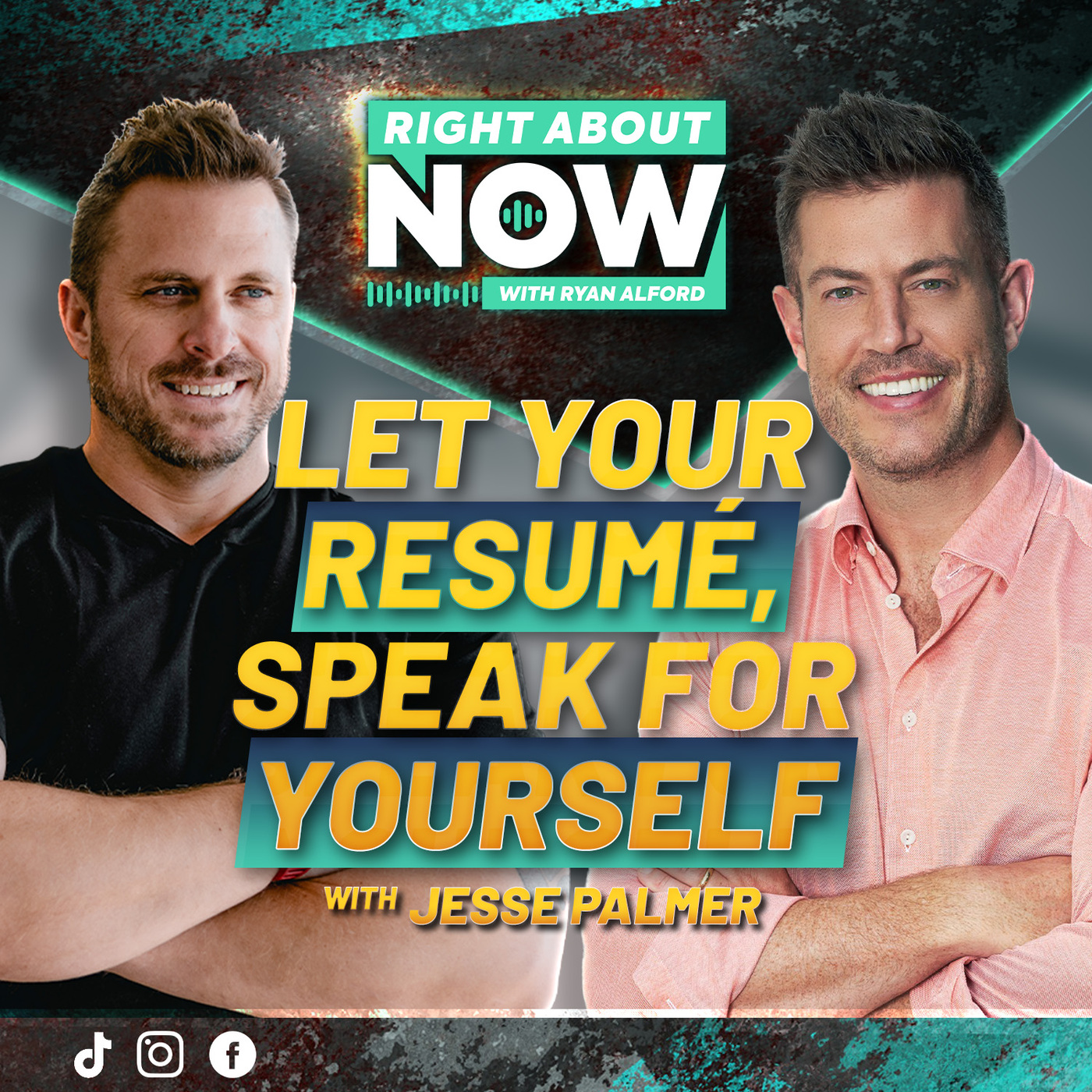
Right About Now - Legendary Business Advice
Jesse Palmer's Secret For Longevity In The Broadcast Industry
00:14:31
Loading summary
Transcript39 lines
- [00:00]
A
We cut through the noise to cover the topics that matter for your personal and professional growth. Today, we're diving deep with Jesse Palmer to unlock the playbook for success, discussing everything from his journey in college football and ESPN to becoming part of the most talked about franchise in pop culture, the Bachelor. I hope you enjoy this episode.
- [00:20]
B
You got to be careful who your circles are. Every football player's got a kind of a tiny circle. You got the team, you got the offense, but you get like four or five dudes, different positions that you kind of run with. You got to be careful who those guys are. I was always trying to make sure they were positive people that were appreciative of what we were doing and loved what we were doing.
- [00:36]
C
This is Right about now with Ryan Alford, a Radcast Network production. We are the number one business show on the planet with over 1 million downloads a month, taking the BS out of business for over 6 years and over 400 episodes. You ready to start snapping necks and cashing checks? Well, it starts right about now.
- [00:59]
A
Hey, guys, what's up? We're talking Bachelor today. We're talking college football. We're talking Jesse Palmer. What's up, brother?
- [01:06]
B
Good, brother. Good being on with you.
- [01:08]
A
How are you doing? I'm doing great, man. Fabulous. I've been dying to have you on the show. I've been a big fan from afar watching you play college football. I remember you playing. I'm old enough to remember that.
- [01:17]
B
I was gonna say you're definitely eight. You're dating yourself.
- [01:22]
A
There's something about you. I see you on television. I'm talking to you now. There's a joy and a happiness. You know, some people, you feel like they carry the weight of the world, have issues or whatever. It may even be polarizing, maybe for people with you, because I always just sense and have always liked this about you. There's just kind of like this. I'm in this moment and I'm enjoying it, and I'm a happy person. And I've just always respected that about you. And the more I talk to you sitting here, it feels real, even like, appreciate it. And I don't know if you've ever talked about that. I don't know. And I don't know where that comes from. Just that joyous spirit or happiness.
- [01:55]
B
You're the first person that's ever actually asked me that. I try to think of myself as being a guy that's in the present. I try to stay cognizant of that. You know, it might have to do with playing football all those years and just listening to buddies and teammates always talk about woulda, coulda, shoulda. I shouldn't have come to Florida, man. I should have gone to South Carolina. I would have been a starter and I'd be in the league right now if I'd done that. If I didn't come here, I wouldn't have torn my acl. I should have never married that girl. If I didn't do that, I would have had this time to do these things. And on the flip side of that, people always just so worried about the next contract, what was happening way down the line. And it just seemed so stressful to me. And I wasn't even the one saying those things, right. Those weren't even my thoughts. But just being surrounded by all that fear all the time and that, I don't say negative energy, but the nervous energy, that's a good way to put it. It was draining on me and I just felt happiest and the most comfortable when I just really thought about the here and now and at espn, like when we're in studio and we're doing a halftime. I'm just really trying to enjoy that moment and that halftime. And I'm not worrying about the one hour long college football final that's going to go live at 2am that we're all going to be dreading because we've been awake for 15 hours. You know, it's just people have told me that's a very Buddhist way of thinking about things, and I'm not a Buddhist. It's just how I have tried to compartmentalize things because our lives can at times seem. There's a lot going on and they give you that anxiety. I don't even have kids yet. I can't imagine we were talking before we started. You've got four boys, dude. I can't imagine you having to think about balancing that. And your wife and your kids and now your podcast and your job and your family and your travel. God, I don't know how you do that either. You must be the same. You must just be in the moment.
- [03:33]
A
Is there a moment that sticks out? One of your best moments? I'm sure you've had a ton. Now, whether it was at a game where the energy is so high or maybe in studio. Is there a moment or two that are standouts at this point?
- [03:45]
B
Yeah. It's funny, you can think back and I remember so many games and amazing environments that I was in at the time. There have been a few oh crap moments, though. The first was when I called my first game with Brett Musburger. He's such a legend.
- [03:59]
A
Yeah.
- [04:00]
B
And he's a guy that's called so many big games in college football, in the NFL. He's been to, like, Ali Frazier. He's done so many different things. Olympics, every. But we. South Carolina doing a Texas A&M, South Carolina game. And the broadcast started, and the place is going nuts, and they're playing Space Odyssey, and the place is absolutely freaking out. And all of a sudden, he comes on and you hear the classic, you are looking live. And I had this whole crap moment where I just froze. Crap. Like, I'm in the booth with Brent Musburger about to call this game. How cool is that? And then him and I called an Iron Bull. We did a Bama Auburn game, which was incredible. Him and I called the Rose bowl, which I still can't believe I did that. It's like, stuff that when at espn. My first game I called was Rice versus utep. And it was the greatest thing of all time. It was. It was the greatest.
- [04:48]
A
You're definitely a junkie.
- [04:50]
B
If you told me that, like, down the road, I'd get a chance to be in. In Pasadena, Rose bowl with Brent Musburger. I mean, it's amazing, the journey and how lucky I've been. Honestly, I don't take a second of that job for granted.
- [05:02]
A
What do you think's attributed to your longevity with espn? You're easy to work with, I'm sure. It's kind of where I was wanting to go. Like this nature, nurture thing with you, man, I can't quite put my finger, you know, both your joy in doing things, your attitude. I'm almost kind of getting at what makes you successful while also asking that longevity is not easy in the sport you described.
- [05:23]
B
This kind of goes back. Playing football, I just work really, really hard at it. And I study a lot. I watch a lot of tape. I watch so much film every year. I've got just books and binders of notes that I've taken watching teams. I put a lot into it. And a lot of people that do this job, everybody sort of has their own path and their own way that they operate. Some guys are great at just not studying and just kind of showing up and watching the game and giving it to you raw and live. I do it the way I used to play quarterback, where you watch film, you study the opponent, you do it for a week, and then you're able to sort of take everything that you've studied and you've got in your head and you sort of kind of spit it out on game day with respect to what you're seeing. So I hope part of my longevity has to do with the product that I'm putting out. And a lot of that really is preparation and really real, really hard work. I'm not the guy that just kind of shows up and wings it for the fans and the viewers at home. Hopefully that comes across.
- [06:11]
A
No, it does. I always feel like you're over prepared. It does come across. It's a compliment robotically. Not because you're a robot, but the detail. Yeah, it's there. Is it nature or nurture for you, man? Is this all like, did your parents just raise you well or you just built this way?
- [06:26]
B
I was very, very lucky. I had two incredible role models and my mom and my dad, they definitely instilled a lot of discipline in me, a lot of work ethic and a lot of gratitude and appreciation growing up at a very young age. And I think staying close to them throughout my entire life and having the messages reinforced over and over I think has definitely helped a lot. And I think trying to be around like minded people. We talk a lot about my teammates back in the day. And football is a funny thing, college football especially. There's like 120 dudes in there in the locker room, and there's a lot of guys. You got to be careful who your circles are. Every football player's got a kind of a tiny circle. You got the team, you got the offense, but you have like four or five dudes, different positions that you kind of run with. You got to be careful who those guys are. I was always trying to make sure they were positive people that were appreciative of what we were doing and loved what we were doing. I think family and I think my circle, my teammates and my buddies I think are. And my wife Emily's is really the biggest reason. I remember like playing for Sean Payton with the New York Giants. And I remember, remember like, he would grind. He was like a John Gruden disciple who would grind all hours of the night. We'd be in our quarterback meeting Friday morning. Sean had the biggest eye bags. He was crushing dip coffee. It's like double fisting coffees. And was going through it and he would put so much work into our game plan, our playbook for that was huge. And we would lose a game and be really disappointing and just put up six points and just all 160 yards. And I think to myself, man, how's he gonna change? Obviously that was not a good outcome. We lost the game. That was embarrassing. How is he going to change his preparation the next time? And to his credit, he never did. He trusted the process. He went back in the office at 4am on Monday and just started the whole thing again. Trusting that in believing in what he was doing was right. That really sort of taught me you've got to find whatever it is that gets you ready and just believe in it. And I have good days in studio and I have bad days in studio and I have good days in the booth and I have bad days in the booth. But I don't try to deviate too much from what got me here and what's allowed me to be successful these last 15 years.
- [08:16]
A
Yeah, I think it's good for people to hear that because, dude, man, you look like you got it all together. You're a good looking guy. You've been on the Bachelor, which we're going to get to, and it's like, no, this guy is busting his ass, working hard, preparing, and it doesn't just get handed. It's hard work. It's good for people to hear that from you because, you know, you deal. I'm sure you've dealt with that in your life. Oh, yeah. Easy or something.
- [08:38]
B
Yeah, yeah, for sure. Listen, no doubt about it. And I tell people this all the time. My career at Florida and playing in the NFL and being on the Bachelor to some extent, did that help me land espn? Absolutely it did. Of course it did.
- [08:49]
A
Yeah.
- [08:49]
B
But once you get there, what do you do with it? Because we've also had a lot of. We've had NFL hall of Famers at ESPN that got a job because of that, but they didn't last very long because they didn't work very hard. At the end of the day, it's your resume, your game tape, your film and what you put out on camera at ESPN and studio and in the booth, that is your resume and it speaks for itself.
- [09:08]
A
Let's talk about the Bachelor. You were the Bachelor and you're the host. The Bachelor. Place in Chris Harrison. I don't know how old you are. How are you? 40 yet. Are you getting there?
- [09:16]
B
I'm in there.
- [09:17]
A
You're in there. Getting in there somewhere. We're in there somewhere. But Chris Harrison looks whatever. But he's done the Bachelor for 28 years or whatever, so you got to follow him up. I think you've done a great job. I don't know, just talk about that Bachelor experience. What's that been like?
- [09:29]
B
Yeah, it's been wild. I mean, going back to 2004, when I became the Bachelor, that was kind of this. That was this amazing opportunity. It's funny, I've always sort of been a guy that just kind of tries to take opportunities and make the most out of them and just kind of have fun with again, kind of being in the moment, not worrying about what the repercussions are of it. I'd be lying if I told you that in 2004 I knew what I was doing. If I had said, trust me, I'm going to do that. I'm playing in the NFL right now. I'm going to do this job, and in a couple of years, this is totally going to open doors for me. And my broadcasting career had no idea in 2004 that I wanted to be on television at all. That whole thing happened beyond a shadow of a doubt. I don't know if it really helped me with espn, but it definitely helped me with Food Network with Good Morning America. And obviously being the host of the Bachelor now, years and years later, Daily Mail and some of these other shows that I've been associated with. It has been so cool this year, coming back years and years later to be part of the franchise again. And the amazing thing has just been how much bigger the show is now. Dude, when I did it in 2004, reality TV was like a brand new thing. And I remember being in the locker room with all the guys, the New York Giants, like Michael Strahan, Tiki Barber, Imani Toomer. I'm having to explain to them what reality TV is. And then also what the Bachelor is. What is that? Sweet. You're going on a reality show to get a date. Is that kind of what you're doing? Like, it's a little bit more than that. Like, you're going on. You're hopefully going to get married. It's all on reality TV and explain all that. And then today, to fast forward, the budget's obviously way bigger. Obviously. The travel's crazy. It's still the nuts and bolts of the same, and the concept of it is the same. But the fans and Bachelor Nation has just grown by leaps and bound. They've multiplied. I can't think of another show that has a fan base so into it and just so, so emotional about it and so invested in it. It's like a Clemson fan base or an SEC fan. That's what it feels like.
- [11:20]
A
Yeah, right.
- [11:21]
B
It's just they are so passionate about it and that's Been really, really cool to sort of be back.
- [11:25]
A
Part of that, I think you've done a really good job. Last thing I want to say, because I didn't know, because you're a charismatic guy and you've been the Bachelor and I was like, how' to be Switzerland? Because that's kind of what Chris Harrison, like, his greatest attribute was. He was so switch. That's why you'd respect him. How is Jesse going to do this? Not because you're arrogant or you got to be center of attention. It's just more you're that guy. I think you've done admirable job of finding that neutral zone.
- [11:50]
B
So I'll give you the line. I appreciate it, dude. Yeah. I've tried to not make it about me. I don't want to be like the old Uncle Jesse who's like, back in my day, I would have done this. Or this is what you need to say. This is Clayton's. This is his game. This is his deal. He's got to figure it out. I'm sort of there to try to keep them trying to give him the seven iron. As much as I hold it for him, I'm like, dude, just lay up.
- [12:09]
A
Yeah, lay up.
- [12:10]
B
Yeah. But times he's swinging for fences.
- [12:13]
A
Jesse, everybody knows probably where to find you, but where do you direct people when they're wanting to keep up with you?
- [12:18]
B
Oh, just Instagram, Jesse Palmer on Instagram and Jesse. Jesse Palmer TV on Twitter is pretty much it.
- [12:24]
A
Hey, man. Hey. I really enjoyed this. I hope we can do it again down the road and would love to stay in touch.
- [12:29]
B
Absolutely, brother. Thanks so much for having me on. I really appreciate it.
- [12:32]
A
We really appreciate him. You know where to find us. Search for Jesse Palmer. You'll find all of the content today. I'm Ryan Alford on all the platforms. We'll see you next time on the Radcast.
- [12:42]
C
This has been Right about now with Ryan Alford, a Radcast network production. Visit ryanisright.com for full audio and video versions of the show or to inquire about sponsorship opportunities. Thanks for listening.