← Right About Now - Legendary Business Advice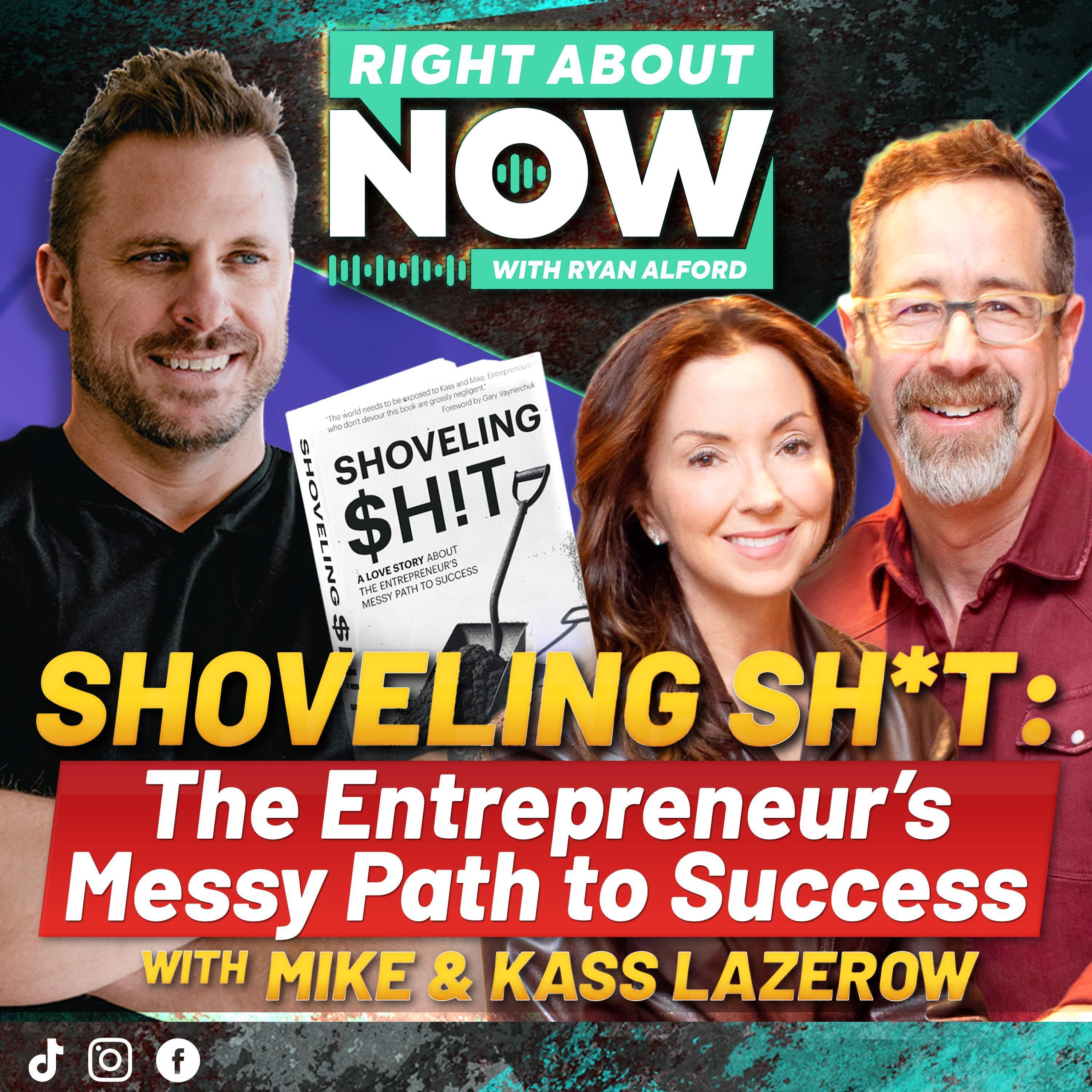
Right About Now - Legendary Business Advice
SHOVELING SH*T: The Entrepreneur's Messy Path to Success with Mike & Kass Lazerow
00:37:11
Loading summary
Transcript119 lines
- [00:00]
Kat
Did you know a 2018 study showed half of prenatal vitamins tested had unacceptable levels of heavy metals? I'm Kat, mother of three and founder of Ritual. When I was four months pregnant, I couldn't find a prenatal I could trust. So I created my own. Ours is made traceable third party tested for heavy metals and recently earned the purity award from the Clean Label project. But don't just take my word for it. Get 25% off@virtual.com podcast.
- [00:30]
Mike Lazaro
I don't even know who invested in us, but I know everyone who said no.
- [00:33]
Cass Lazaro
You need someone who's not gonna drop the ball when you hand off things to them.
- [00:37]
Ryan Alford
This is Right about now with Ryan Alford, a Radcast Network production. We are the number one business show on the planet with over 1 million downloads a month. Taking the BS out of business for over 6 years and over 400 episodes. You ready to start snapping necks and cashing checks? Well, it starts right about now.
- [01:00]
What's up guys? Welcome to right about now. We're always talking about how to make you get right and in the moment. We could talk about yesterday, we could talk about last week. We could talk about a month from now. We could talk about the future. But we're here to talk about now because you know what action is now and present is here and we need to talk about shoveling some is what I that's why that's what we do on this show. We talk about what's real. That's what it is to be an entrepreneur to business person in today. So you know, I went right to the source. Cas and Mike Lazaro, they are authors of Shoveling Shed. They're entrepreneurs few brands you've heard of. You know, we'll let them name drop. What's up guys?
- [01:40]
Cass Lazaro
Hi. Thanks for having us.
- [01:42]
Mike Lazaro
It is great to be here. Love the energy and congrats all of.
- [01:47]
Ryan Alford
Your success, guys set the table for our audience. They know they're going to know you now, but they probably know a lot of the things that you guys have touched. You've touched a lot of things as serial entrepreneurs and now authors of an amazing book. But I'm going to let you know, we'll we're going to make this an actionable learning lesson here of a show. We can, I'm sure they can find your stories all over for the long narrative. But it's important though, especially as a couple, as a married couple with children, everything you've been through, I do want you to set the table for Them. And I'll let. Maybe Mike, you choose. Your Cass could go first.
- [02:26]
Mike Lazaro
Cass, please take it away.
- [02:28]
Cass Lazaro
All right, so, you know, we're Cass and Mike Lazaro, and he and I have been working together, if you can believe this, 28 years together. We started working together when we were just dating, and I had this crazy idea to start Golf.com, where avid golfers could come and track their handicaps online and book tee times. And then we started a big company called Buddy Media, and we ran that and grew that it was the top social media marketing platform for all the top Fortune 500 brands. We sold that to Salesforce in 2012, and we've been investors and VCs since. And we wrote this book, Ryan, because we want to help entrepreneurs. We want to help them with the cheat codes. We have, like, 50 plus in this book. And we're really here to connect with your audience and. And help them to not step in the. That we have stepped in.
- [03:26]
Ryan Alford
Let me just say this. I'm glad you cast a little something called golf.com Brilliant, brilliant idea. I read this book, and I was. I was reading it, I was going, I wish I had had this 10 years ago, you know, because I'm about 10 years into my. I worked for 15 years for other agencies, and I was like, damn, I wanted this 10 years ago. I would have saved me a lot of pain. I'm telling you, there is gold in here. Like, it's. And it's. And it's phrased and formulated in a way that it's absorbed. Like, I'm, like. That made sense to me, the way you kind of positioned it with the examples combined with the stories. So it is the narrative of the entrepreneur's guidebook. You know, that's not as interesting as shoveling. I know. I'm a creative guy, too. I love shoveling. It is. It really. It really reads that way. And I sit here amazed. It's the names like golf.com and the things that you guys have worked on and seemingly how I don't want it to just kind of fade off to the side. Like, those are. That's a big fucking deal. Like, yeah, you know, like, that's a huge. You think, okay, Well, I had Golf.com. did you have the URL when you came up with a name or did.
- [04:44]
Cass Lazaro
So, if you can believe it, back in, you know, 1998, when we started the company, the only URL we could get at that time was Golf Serve. So our original company's name was Golf Serve. And then we backed into this asset that we were able to buy. Mike, who is it from that we bought it from?
- [05:01]
Mike Lazaro
From NBC.
- [05:02]
Cass Lazaro
Yeah, from NBC that had just had it dormant, like made no sense.
- [05:07]
Mike Lazaro
$289,000.
- [05:10]
Ryan Alford
Ah, I was hoping you're going to say Mike yet. $289.
- [05:15]
Mike Lazaro
No, no, I mean it was, it was worth that.
- [05:18]
Ryan Alford
I believe me, as that asset in the, in its time for something like this. Oh, I mean that's probably cheap, but.
- [05:25]
Mike Lazaro
It'S a different world, right? Like now it's all about apps and streams and like the front page of a website. Doesn't matter. But when we started, there were people at Yahoo that created the index of the web, right? Like people who base it. Oh, you're interested in golf here. 10 sites you should check out. So it was important back then?
- [05:43]
Ryan Alford
Yeah, it was. What was it like running golf.com we.
- [05:46]
Mike Lazaro
Probably learned more from golf.com than we learned anywhere because it was both a colossal failure and an epic success. And so we started the company and within a year of doing the company, we got an offer from a Sequoia backed golf company in Silicon Valley called chipshot.com 10/99, eat toys going public. Worth billions of dollars. Internet's here. Height of the frenz. I'm like 12 years old. I forget how old I was. I was like, Cass is a little older, or some people say a lot older. And we didn't know, we didn't know much. And these guys are like, we want to buy your business and then merge it with our golf club manufacturing business. And Sequoia had like backed Google and all these big companies. And then April 2000 came around and the whole market crashed. And we got a call actually right before that saying, oh, by the way, we're out of business. We can't pay any of your people and you can buy it back, but you know, there's nothing we can do for you. And we just had to shovel shit. I remember that call. Really? I mean, that calls like in my, not only my mind, it's like in each cell, like, I was like, what this happen is this reality? Like, and we're pot. We're totally in. So when you work with your spouse, there's no like, oh, my spouse has a great job. Like, we'll fine. It's like, oh, no. We're like having one kid, health insurance, zero income now and no money. We hadn't really made any money at the time.
- [07:26]
Cass Lazaro
And don't forget, Mike, that ship shot had already transferred in those like two and A half months. They had transferred the bank account, so we had no access to anything. Yeah, so that was.
- [07:36]
Mike Lazaro
Cass is like. Cass is fucking the best. Like, I'm, like, freaking out in the corner. She's like, we got this.
- [07:41]
Cass Lazaro
I was mad. I was really mad.
- [07:43]
Mike Lazaro
She got all the employees. She was super transparent. You know, she runs the companies. I do, like, sales and biz dev and raise money. And we spent three years, three months trying to raise money to kind of buy it back and relaunch it. And somehow Cass ensured that none of the employees left, which was miraculous.
- [08:02]
Ryan Alford
Talk to me about the raising money thing you talk about in the book, by the way, the Handbook for an Entrepreneur.
- [08:07]
Cass Lazaro
It's, you know, it's a muscle that you have to develop, and you get better at it the more you do it. So there's a lot of fear that you build up, right? Like, oh, my God, I don't want to ask this person for money. God. At the end of the day, you know, it really is about your own fear, because all they're going to say is yes or no, right? It's like they say, no, just move on. And that's something, I think, for me, Mike's much better at it than I am. But for me, I think I just realized, oh, like, the worst thing could happen is they just say no. Right? That's it.
- [08:39]
Mike Lazaro
So I think that what you've done, Ryan, what, like our friend who were talking about Gary Vee and others, that's raising money, right? You don't go to investors, you go to customers. You win the business, you generate the revenue to then generate the profits to plow back in the business to grow. And so our heroes are the people not that have the safety of venture capital. Right. But it is those entrepreneurs, like a lot of your listeners, who don't have the safety net, who are running restaurants, who are running service companies, who are.
- [09:13]
Cass Lazaro
Running agencies, and they need the revenue to survive.
- [09:16]
Mike Lazaro
And that's how you fundraise. And if you do a good enough job on the customer side, then maybe you have the ability to, you know, raise money to do an acquisition or to take some money off the table or to do to make some moves, Right?
- [09:32]
Ryan Alford
Yeah.
- [09:32]
Mike Lazaro
We've always been in businesses up until now that requires building software and a lot of upfront costs. And frankly, it's just easier for us than, I think, what you and a lot of others have done, which is hard.
- [09:47]
Ryan Alford
I appreciate you saying that. It is hard. But at the same time, though, like, there's brilliance in both sides. I Think, you know, like depending on what works for you. Like, because I ask even for my own self. I mean, because I'm developing something now that's tech heavy. And you know, it's like. And I've never had a partner and I'm like. Or I've never had a dollar from anyone. I have no debt in the bank. So protect that. Yeah. And it's, it's not easy and it's.
- [10:17]
Mike Lazaro
Not poo that like that's very rare and awesome. Investors are great, some of our best friends, but you're bringing a partner on board. And so unless you're ready to communicate and report and listen, it's work, you know, it's work. It's a relationship.
- [10:38]
Ryan Alford
I do think it's fascinating for you guys being a husband and wife, founders of companies and investors together. You talk about in the book if you are going to have a partner and a founder, those skill sets that work like you fill a gap. Like I have a certain number of skills you need to work with another person or group that fills the holes you have and vice versa. And it sounds like that work. Maybe that's why it has worked. I know it's been work, but for you too because like you said, Mike, you know, you've got the operator and then the sales and marketing and you know, maybe idea. God. I don't want to say you don't have ideas, Cas, but I'm just.
- [11:19]
Cass Lazaro
The split is totally there and you're. You're dead.
- [11:21]
Mike Lazaro
Nailed it.
- [11:22]
Cass Lazaro
Yeah, you nailed it. Because that's exactly what you need when you have co founders. You really do need to figure out like how to balance out the skills. And if you overlap, there's going to be just absolute micromanagement and like paralysis of decisions. So the best thing you can do is have a co founder or more than one co founder that had different skills. And that's when things really gel and you build this like implicit trust and you can move very fast.
- [11:49]
Ryan Alford
That's been the hardest thing for me. I've become a chameleon in some areas. But I know where the gaps are. And as an entrepreneur and I think there's people listening to can relate if. Because it's like trust is the word cast as the perfect word. Because I don't, I don't have a hard time trusting people. Like I trust my employees. I'm not a micromanager. But when you don't have to think about your weaknesses because you know it's getting. It's like having a good wife or a good partner or get anything like they got your back, you know, you don't have to think about it because, yeah, thought takes energy, takes is distraction.
- [12:24]
Cass Lazaro
It's the mental bandwidth that it takes up in your brain going, is this person really doing their job? And then that takes you away from doing what you're great at.
- [12:34]
Ryan Alford
Yeah. And has that worked for you? Oh, yeah. It seems like it's got to be your super strengths, is being able to kind of count on it.
- [12:42]
Cass Lazaro
I call it our superpower. Because when I say I'm going to do something for Mike, he doesn't have to worry when, you know, he says he's going to do something, he delivers. So when you have that and you're starting a company and then you're running it and then you start to get like, super fast and you hit the gas and you're scaling, that's what you need. You need someone who's not going to drop the ball when you hand off things to them.
- [13:05]
Ryan Alford
Now, as investors, how do you evaluate your investments? How do you. I mean, are these just. They just get put in front of you and you go, oh, we like this. We don't like that one. Is it that easy?
- [13:17]
Mike Lazaro
It seems like that. I mean, looking at our investments, we've done space, we've done liquid death, which is water in a can. We've done game companies, we've done music festivals. We actually spent a lot of time thinking about that because we did the first 75 deals off our own balance sheet. And then we started a firm, which just meant accepting some outside capital as well. And how you make decisions about investments is how you make money. I mean, that's the make or break. And what we realize is how we make decisions as investors is how every entrepreneur should look at their business. And so we put together what we call the go gauge. But it's a very simple six questions. Idiot proof. The six things are very simple. And it's what's the product? Why is it different? And what's interesting for you, and I know a lot of your marketing background is not that different than how you come up with kind of great marketing ideas. Right. What's the product? Why is it different? Who's going to buy it? Not what the market size is, but who specifically is going to buy it and how many of those people. Right. We're in the golf business. We didn't own a golf course, so we're not getting tee time revenue. So really hone into, like, who's going to buy it? And then it Comes down to where we think we've outperformed, which is sales and marketing. How do you get people to find out about the product distribution and operations? How are you going to get the product to people which, you know, for this company, liquid death. We had no idea how hard that was going to be. We're putting the water in the can in Austria, shipping it by boat to the US Just to get it to distributor, to wholesalers, to get it to distributors, to get it to retail, to hopefully get it to a customer.
- [15:03]
Ryan Alford
H2. Oh, no.
- [15:05]
Mike Lazaro
So have we done another deal? Have we done another liquid deal? No, because they're very hard. And the last one is just. Does a financial model make sense? Not from a Goldman Sachs analyst perspective, but from brass tax unit economics. You're selling it for Y. Can you make it for less than Y? What is the kind of net profit that you're going to make off of the product? The margin. And then what do you need to support the company? And especially early on, things pivot so much. You talk to customers, they punch you in the face, and you got to change. So we just want to make sure we start with something that makes sense on the spreadsheet and then pivot from there.
- [15:49]
Ryan Alford
I like that. That sounds practical, but with a blend of intuition and belief, which I think that's kind of got to be it, right? It's like, yeah, the numbers got to look good and I have all this stuff, but you got to believe in it, right?
- [16:03]
Mike Lazaro
So what I just said is, like, the table stakes. And then if we get through that, they meet Cas and the entrepreneur. Boom, boom, boom. And it's impressive in a great way. You know, every entrepreneur, even when we say no, let's just say gets a lot from their conversation with Cas. We hated when investors would take a meeting and then they ghost us. They're like, they don't even. And I know every one of their names because those are the people I remember. I don't even know who invested in us, but I know everyone who said no. Like, every round.
- [16:35]
Ryan Alford
Oh, my God. You and I are cut from the same cloth, brother.
- [16:39]
Mike Lazaro
Everyone who says no, Like, I have a. And I have all my rejection letters right here from college. I have, like, I have 100 jobs that I was rejected from. But regardless, for me, it comes down to, do I want to have dinner with this person once a week? Like, is this someone I want to hang out with? Because you look at, like, scopely. Took 10 years to go from that initial money we gave to a $5 billion exit, right? You look at Mike Cesario, liquid death, he's in it six years we've been working together. We love each other, we love hanging out. Right. We love jamming on the business, we love working on problems. So for us it's do we love the entrepreneur and is it the right entrepreneur for this company just because it makes sense on paper? It could be the wrong entrepreneur. I'm not going to build a space product on the wrong guy.
- [17:24]
Cass Lazaro
And also coming back to what you said, Ryan, which is, does the entrepreneur or do the co founders know what they don't know so that they're filling in the gaps, those holes you talked about earlier with the right people around them in their leadership team.
- [17:39]
Ryan Alford
Right.
- [17:39]
Cass Lazaro
So I'm always looking for that. I'm looking for humble pie kind of entrepreneurs and ones that know, say, look, this is not my expertise, but here's, you know, the person who does it, I love.
- [17:52]
Ryan Alford
And then get back to the book. Leaders shovel first.
- [17:56]
Cass Lazaro
Yes.
- [17:56]
Ryan Alford
This is a big one. And you know, I have to a sub section within this and I have my shuffle that it's. I had it with the, I had a page folded, but my shovel is what I use to actually keep the page, the bookmark, you know, so I'm telling you guys, buy for the shovel, stay for the book, you know, like. Yeah. Yes. So it sounds obvious, but I'm gonna let you guys, I mean, at its core, right, if, if you're gonna get the team, they got to see you shovel. Not only you need to do it first, it's. It reminded me of kind of the analogy of like CEO and official mop mopper of the office, you know, kind of like, yeah, is that, am I making the right connection? I mean, that's what I took away from it.
- [18:46]
Cass Lazaro
It's kind of like, I mean, we're talking startup world here. So if you want to get a group of people to jump and take a risk and work for you when you have nothing but like air, right? As promises like, hey, we're going to make this a big company and you really are just selling them a story, right? You're selling them an outcome. You're selling them a feeling they get when they come into the office, then you also have to make sure that you show up every day and you're no better than they are. Right. You're a good leader. You're going to handle, you're going to make the tough decisions and you're going to be 100% transparent and you're going to lead by example. And that can be, you know, putting together mailing lists like we used to do in the old days. Like everyone's stuff in envelopes. Or in our Golf.com days, we'd ring a bell and everyone would start packing golf balls into packets. Or it's basically saying like, we're going to give back to this community and we want everyone to be a part of what we're doing because it's really incredible. So it's all about leaders shoveling first.
- [19:54]
Mike Lazaro
It's also a very different vision, I think, for leadership than maybe some younger entrepreneurs have. Too many of our companies that we work with, the founders treat them like democracies. And I don't know if everyone's noticing. We're kind of pressure testing democracy as a model for government. Let me just tell you, it does not work at companies. Your job is to be the boss, not the buddy. You're benevolent dictator. You make the decisions. People want to be led with compassion, with clarity, with transparency. Not by a dick. Like just tone it down, listen to your people, but make decisions, communicate why align everyone's interests correctly with financial incentives and the rest take care of itself. If you're working for a company that has a leader that isn't leading, that just makes decisions based on the last person she spoke to or he spoke to, those are not going to feel like very empowered employees. And so it's really kind of look at yourself as a very nice dictator. You have the most to gain, but you have the most to lose.
- [21:10]
Ryan Alford
Yeah.
- [21:10]
Mike Lazaro
Like if it goes out of business, you know, it's on you if you run out of money and you're not going to be worrying about, oh, I listened to this person and you know, tried to make a decision that kind of, you know, threaded the needle between what everyone wanted.
- [21:26]
Ryan Alford
Yeah.
- [21:26]
Mike Lazaro
And that gets so many companies turned around.
- [21:29]
Ryan Alford
I want to spend a moment here because I'll say this, I have failed more than I can count. I am not the best leader on the planet at all times. But I'll tell you the one mistake I haven't made in my 10 year journey. I'm not everybody's buddy. Like I'm, I'm not best friends with any. Like, I like my employees and I want good people and I don't, I want there to be camaraderie and all that. That's the one thing I think I've figured out early on is just this is just not going to be my best friend for, you know, like it just does not work that way. And that's number one. So I related heavily to that, Mike. And number two, we do live in this world where this generation in pre Covid and post Covid. I've struggled a bit with the employees that worked well under me pre Covid and the ones post Covid. My wife's like, totally used to be so good with employees. Now everybody doesn't like you. And I'm like, no, I haven't changed. But there's this sort of coddling. And you know, again, there's some fine lines here, providing the benefits of work and making it feel comfortable and all that. And some of the amount of coddling, it's a fucking job, you know, Like, I don't know when that switch you perspective on that. You know what I'm trying to say?
- [22:54]
Cass Lazaro
You and I are going to be friends on this. And I think it. Listen, I think, you know, Covid really did impact a lot of people, and it really changed how people work. It also changed people's perspectives. And I think somewhere along the way, probably, you know, result of, you know, helicopter parenting, right? You know, all of us wanting more for our kids but not letting them fail, right? You need to have really good. You have to have kids that can fail, right, in safe ways so that they understand that they are resilient and can overcome failure. So you have that, then you get Covid, and then you have technology. And I think you're getting this collision of all of these traits and producing people who they kind of want to work, but they don't want to work that hard, right? And they need a lot of encouragement. And that's on top of like the previous generation that needed a lot of validation, right, that they were the greatest things in the world. Because somehow in our country, we give out trophies for second, third and 50th place.
- [24:08]
Ryan Alford
Oh, don't get me started on that one.
- [24:11]
Mike Lazaro
Well, Cass, second place is okay. Like, that's silver medal in the Olympics. Let's not go crazy about this. Like, second and third. I'm not saying you're happy with it, but let's still like bronze medals just after that.
- [24:22]
Cass Lazaro
I didn't. I'm not talking about the Olympics, but.
- [24:25]
Mike Lazaro
Cass is the most competitive person you'll ever meet.
- [24:27]
Ryan Alford
Like, oh, I like Cass.
- [24:29]
Cass Lazaro
Okay. You know, but. But I. I hear it. I hear what you're saying. I hear it. I felt your pain as well. And there's this kind of like, yeah, I'll do. I'll do what I can between these hours. And, you know, we got to get back to wanting to show up and rise to occasions, that kind of mindset.
- [24:49]
Ryan Alford
I, I, it's a struggle. I mean, I, it's real. And I have some good people now, and I love them and they do a good job and, and not even my current. I've, I've downscaled. I'm lean right now, baby. I'm lean and mean and dangerous. Yeah, lean is good. But, you know, I've watched it, man. And that's why I was, you know, relating to these parts of the book where I'm just like, yeah, and I gotta read this title.
- [25:16]
Mike Lazaro
You couldn't attend every one of four kids games and practices like you do without having a team. That is epic. I know your businesses, and they're very service and operations intensive.
- [25:34]
Ryan Alford
Yes.
- [25:34]
Mike Lazaro
So the shit don't shovel itself at your businesses.
- [25:37]
Ryan Alford
Absolutely.
- [25:38]
Mike Lazaro
AI, that's just gonna push a button and boop.
- [25:41]
Ryan Alford
I wish, Mike, but no, you're right. You're right.
- [25:44]
Mike Lazaro
And so knowing how there are entrepreneurs who can't leave their desk, and that's not an entrepreneur, that's a job.
- [25:53]
Ryan Alford
Yes.
- [25:53]
Mike Lazaro
You should be able to empower people, pay them well, communicate clearly the focus of the organization, what we're trying to accomplish, where we're going, what's most important. Give them the resources they need to do their job. And if they do it, that goes on the promotion list when you need to hire someone who's above them. Right. So we have people who started as babysitters for us who ended up as senior people. One who's a senior executive at LinkedIn. Abby Lauderback. And we believe that people do well, care about their future. Too many entrepreneurs think it's all about money. Employees want to know that you care about them, and that means that you're thinking about what's next for them. What's the next step in your organization or outside the organization. And if you do that, they feel like they're seen.
- [26:50]
Ryan Alford
Yeah, it's good. Good points, Mike. And true. And I do. I've had a lot of good people. It's just that, that I felt that change though, like, last. It's like, because I've gone through and I look, let me call out a space spade. Eighteen months ago, I kind of was just fried. Like I'd been, I'd done the ad agency business and, you know, for others and myself, look, service business for 20 years straight, you know, it weighs on you. Like every conversation was weighing on me, like, you know, because, you know, in the service business, you only hear about what's bad you know, like, I only get to answer the how can I save the business calls, you know, or how are we going to land this plane calls. And I was just fried. So I kind of, I kind of indirectly stepped out of the business, thinking it could kind of run itself. Yeah, that didn't work.
- [27:43]
Mike Lazaro
I mean, when you think of. I mean, hopefully it's okay. I ask a question, but when you think of everything you've Learned in the 10 years, like, what are the cheat codes for you that you wish you'd done? All these cheat codes are just stuff we learned the hard way, right?
- [27:57]
Ryan Alford
Yeah.
- [27:57]
Mike Lazaro
Like, especially this one. Caswell, admit I'm not a born leader. I was an awful leader. I would wander the office, I would tell the engineers, hey, wouldn't it be cool? Like, I would do everything you shouldn't do, but are there any cheat codes that you've picked up that you think that are like gold for you now?
- [28:18]
Ryan Alford
I mean, mine became more self awareness as a leader. And learning that is a different self awareness than employee Ryan. You know, like even at the highest level, I mean, I was a CMO and been, you know, the highest of big time agency. Like it's. But still it's a different self awareness you have to have with your leader combined with. I am a. I could be myopic and here, let me, let me explain. I'm very flawed person like we all are. I know my flaws. I know them well. No one knows them more than me, but I'm very driven. Very driven. I can't imagine someone not being driven like I am. And I used to think everybody was that way. Like they. We all had our different flavors of ice cream, but we started at a baseline that everybody's this way. Right. This is the human nature. This is humanity. We are Americans. We're all driven to like, just do incredible things or not subtle for average or whatever. And I just, I. Even as an entrepreneur, I thought I worked my first four years thinking everybody was that way. So I just assumed that was the baseline. And then they had skills in specific things, but it was never in question. That part. And learning that that is not true. Especially with hard, unrealistic expectations.
- [29:49]
Cass Lazaro
Yeah.
- [29:50]
Mike Lazaro
Yeah.
- [29:50]
Ryan Alford
Is the number one thing. Yeah.
- [29:53]
Mike Lazaro
I mean, I think what saved our marriage and our companies was kind of my self awareness journey. And I don't know if it's just guys.
- [30:03]
Cass Lazaro
Wait, wait, what?
- [30:05]
Mike Lazaro
But like I, I mean, I kind of not teared up when Ryan's talking about like what he's gone through. You know, you expect everyone's the same you look at. We all look at our positives, and I could sell anything. I can do some stuff, but I'm not always present. I don't always care enough. I'm not always empathetic in how I deliver news. And I think one of the things that Cass has done and great leaders do is they just get better 1% every day. And like Cass now, when she lays someone off, it's the best day of their life. Like, literally, I've seen this so many times.
- [30:46]
Cass Lazaro
That's exactly.
- [30:46]
Mike Lazaro
They're like, no, they're like, I now know my strengths, my weaknesses. You see me. You know me. You're right. This isn't the right fit. If we like them, we'll help you get on your feet, because it's just a fit thing. Right. Whereas it took me a while to develop any sort of rapport that people would say positive things right after they came out of meetings with me.
- [31:10]
Cass Lazaro
You know, Ryan, when you said that you thought everybody was just this driven, I related it exactly to the. My thought. I thought everyone in the world was going to be as competitive as I was or I am, and wanted to win as much as I did. Right.
- [31:27]
Ryan Alford
Yeah. Or not lose.
- [31:29]
Cass Lazaro
And that's. That's been a lesson that I've had to learn over 30 years. And I think what helped me overcome that one was to really start concentrating on people's strengths and how they can be puzzle pieces to a great team. Right. And fit them. And then my expectations went down because we were using their strengths.
- [31:51]
Ryan Alford
Yeah, you nailed it, Cass. And I've gotten better at that. That summarizes the question that Mike asked me. Like, what that journey and things that I've learned. I mean, is kind of that. And then if I can't, I've also learned. And then if I can't find this. Not that they don't have strengths, but can't find their strengths that are applicable to what we do. It's time to see them off, you know, and get them somewhere where they.
- [32:19]
Cass Lazaro
Are valued more or moneyball them and put them in a different position.
- [32:24]
Ryan Alford
Yeah.
- [32:24]
Cass Lazaro
You know?
- [32:25]
Ryan Alford
Yeah. I love this right here. Don't shine the turd.
- [32:32]
Mike Lazaro
Speaking of bad habits that I have.
- [32:36]
Ryan Alford
Oh, man. My wife would throw this one at me occasionally. You know, being a marketer, you tend to want to shine the turd. Lipstick on the pig, whatever you want to call it.
- [32:48]
Cass Lazaro
It's exactly it. Like, it's funny that there's this conflict between, you know, you're selling a story, so it's gonna Be a little bit more rosy than perhaps, you know, it is at the time. But then don't shine the turd when it comes to, you know, X, Y and Z. Mike used to have the tendency to tell a lot of, you know, tell things that were just more rosy than they were. And we learned it the hard way in a, in a board call after we kind of re, you know, financed the company of Golf.com and started it over and our new board just. I could, I can still remember it. He slammed his hand down on the speaker and was like, don't shine the turd ever.
- [33:36]
Mike Lazaro
No, I listened. I mean, he was right. He was right. The sales sucked.
- [33:40]
Cass Lazaro
It's just self awareness. And I think you already have it, Ryan.
- [33:43]
Ryan Alford
I hope so. I have worked on it very hard. I did not have it when I was 27, but I'm 47 and it's been a journey. What looks like success going forward when you think about, like when you put your head down at night, what does the future look like with which you are satisfied and happy?
- [34:03]
Cass Lazaro
For me, I will only speak about me, but I really have my cup filled by helping people. So I often feel like less productive or just less me if I'm not giving. So if you said to me, like, why are you guys still investing in things? Because we want to give back as much as we can. We spent 18 years helping cycle for Survival. And I think one big thing would be that there is no more cancer and that Mike and I were like a small part of that through our network, through being the first corporate team for Cycle for Survival. I would love that. That would be like, boy, like, I don't know, it would just be such a joyous thing and then touching as many entrepreneurs as we can.
- [34:48]
Mike Lazaro
I mean, for me it's like, I think it's simple. It's basically, I'm a capitalist, so I love business, I love the game. You somehow keep score with money. I'm not optimizing just for money, but we bought companies, cash flow businesses. We're investing, we just love it. And I think why we wrote this book is very simple. We want to get our experience, our ideas out there and it's become a great platform. We're speaking to organizations where we've up leveled kind of who we're talking to and who's bringing us in. And a lot of it is let's keep doing what we like to do and if it feels good, let's keep doing it. And if we don't like it, we stop doing it. While we take care of our health.
- [35:33]
Ryan Alford
Mike Cass. This felt like old friends talking and we're just getting to know one another. I can't be happy enough for. I can't. You know, like, I thought about, like, the la. Towards the end of the book, you talked about founder fear and like, the fear of being an entrepreneur. And, you know, I think as you leave a legacy, I think about, like, if you can remove one ounce of fear from an entrepreneur to be or in the middle of it with this book, I think you'll sleep well at night because that's a job well done. And that's what shoveling shit. Well, just call it what it is with the upside down exclamation point, which is kind of what it is. It's like, yeah, that's what it is. Yeah. Buy it for the shovel, stay for the content, baby. Thank you so much for coming on.
- [36:22]
Mike Lazaro
Thank you. We appreciate it a lot.
- [36:25]
Ryan Alford
Where can everybody buy the book? Learn more.
- [36:28]
Cass Lazaro
They go to shovelingshit.com and they'll see it there. And we have tons of packages and extra bonuses if you just buy one book. So we're trying to help as many as we can. So send everybody that way, straight to the site.
- [36:41]
Ryan Alford
Shoveling shit dot com. Is that it?
- [36:43]
Mike Lazaro
Yeah, that's it.
- [36:44]
Ryan Alford
I love that. More direct to the point. It's a masterclass in entrepreneurship and it will remove fear. I was. I was removed fear. As I was reading it, I was reminding lessons I learned and learning things as they went. Cass and Mike, thank you again.
- [37:01]
Cass Lazaro
Thank you. Appreciate you.
- [37:03]
Ryan Alford
Hey, guys, you know where to find us. Ryan is right.com will have highlight clips, the full episode and all the links because it's pretty easy. Remember shoveling shit dot com. Go there, baby. Get the book. I'm telling you, it is the best book I've read in years. It is the masterclass in being an entrepreneur and doing it the right way.
- [37:22]
This has been Right about now with Ryan Alford, a Radcast network production. Visit ryanisright.com for full audio and video versions of the show or to inquire about sponsorship opportunities. Thanks for listening.