← Right About Now - Legendary Business Advice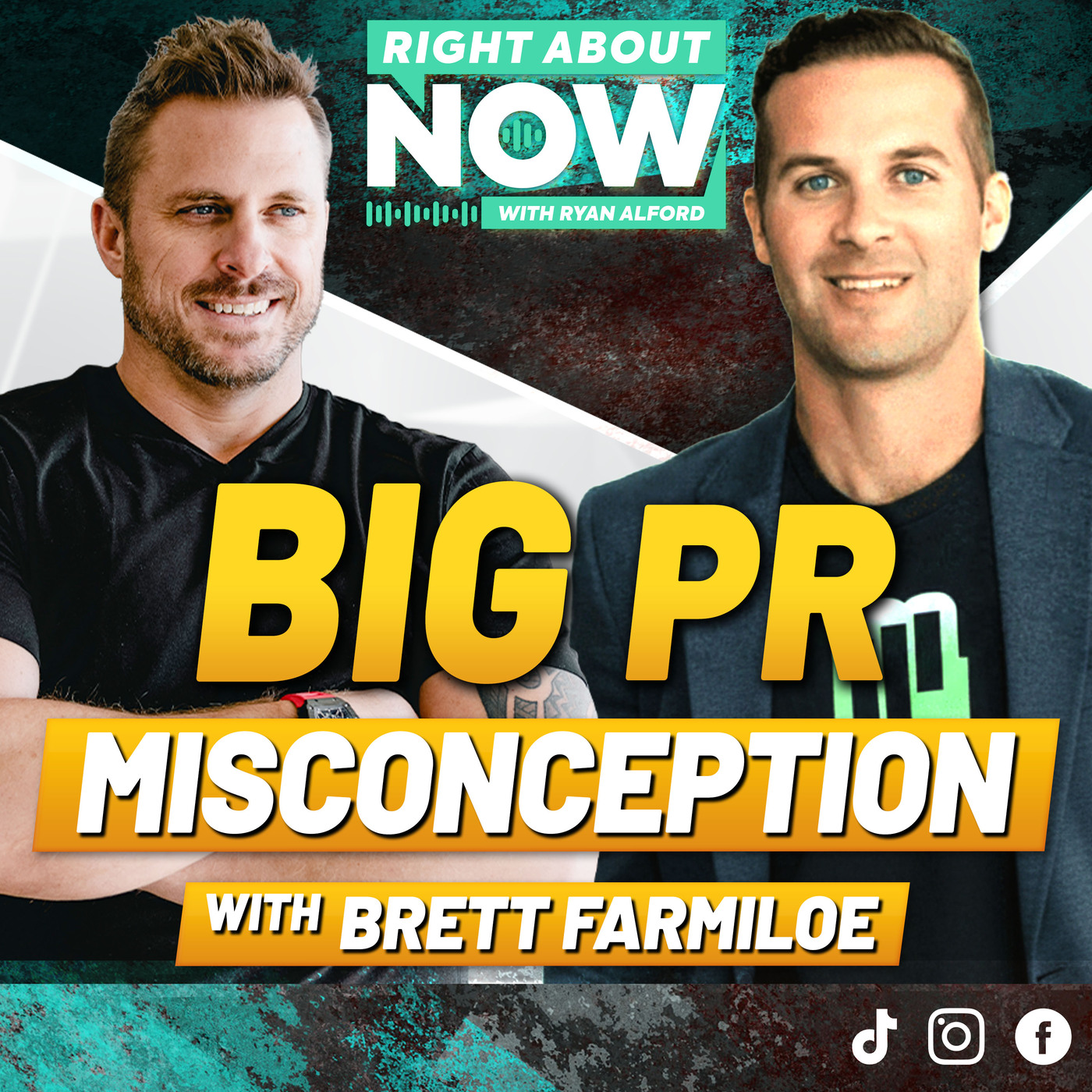
Right About Now - Legendary Business Advice
The Future of PR: Earned Media, AI in Journalism & Visibility Strategies with Brett Farmiloe
00:21:36
Loading summary
Transcript51 lines
- [00:00]
Ryan Alford
Hey guys. On today's episode of Right about now, talk to Brett Armelo. He is the CEO of Featured.com we talked about everything Earn Media PR, everything they're doing with Harrow. Help a reporter out. Brett is an incredible knowledge base for everything you need to know about getting the word out there in EARN Media. What does that mean? You're an expert, you've got all kinds of knowledge, but people don't want you selling to them. They want you informing them. Brett talks about how Featured and Haro allow you to do this in an organic, transparent way. Also, quickly meeting the journalist so that you get featured like you want to. You can talk about your expertise. This is what PR looks like in 2025. All that and more today, right about.
- [00:42]
Brett Armelo
Now, PR is just so hit and miss. Sometimes it's about the timing of the placement, sometimes it's about the outlet itself. And PRs do a great job of helping clients understand that ROI and helping quantify the impact of that. But that's probably the biggest misconception is that, hey, I got featured in fast company. This is going to move my business dramatically forward. It might, it might not. And the key with going back to the AI visibility piece of where we're at today is you've got to experiment. It's sometimes a quantity and quality game where it's something that's a persistent thing. You go to the gym and you're not going to see results just like in one workout. It's a consistent effort that ultimately moves things forward.
- [01:21]
Narrator
This is Right about now with Ryan Alford, a Radcast Network production. We are the number one business show on the planet with over 1 million downloads a month. Taking the BS out of business for over 6 years and over 400 episodes. You ready to start snapping next and cashing checks? Well, it starts right about now.
- [01:43]
Ryan Alford
What's up guys? Welcome to Right about now. We're always talking about how you can get your marketing and your business right now. It's not about last week, it's not about two years ago. It's about the future. It's about the here and the now. And that's why, hey, this is a topic I like. I've got my notebook out people, because I'm going to be taking notes because I like to get featured. We got the CEO of feature.com it is Brett Armelo. What's up Brett? Ryan, it's just ready to talk some good old fashioned public relations. Am I allowed to call it that? Is that not sexy enough now? Sounds great to me. Earned Media. That's what I would call it, Brett. I think we'll do a little lesson for the audience first. You got paid media, you got earned media. Hmm. And most people probably that listen to this show probably know the difference, but I'm going to lighten them a bit. Paid media, expensive. And paid earned media means you did the work, you earned the right to get the coverage. Is that a simple enough summary, you think, Brett?
- [02:38]
Brett Armelo
I think so. I think that's pre pretty clear.
- [02:40]
Ryan Alford
What got you into earned media, brother.
- [02:42]
Brett Armelo
I ran a marketing agency for 10 years and we had about 500 small business clients that we were servicing. And the hardest thing to do was get them featured in the media. And the thing that they had an abundance of was knowledge to share about their business, but nowhere to share. It created a platform that allowed them to answer questions that pertain to their expertise. We take those insights, get them placed in articles, and essentially that platform, which is now featured, took off faster than the agency. Sold the agency at the end of 21 and been focused on featured for the last three and a half years.
- [03:09]
Ryan Alford
What is that balance? I'll even put myself in this. I thought maybe earn media and was dead three or four years ago. Here's why. Not because it was physically, but I just thought, can you really get featured again without running an ad? Is everything pay to play? And where's the line there? And was I just wrong?
- [03:27]
Brett Armelo
Yeah, I mean, the problem to be solved on both sides is on the business side of things. You want to be featured in the media because it creates visibility for yourself and your business in front of customers. The problem on the journalism side of things is that sourcing experts for stories is an infinite problem. There's always some story that's being created where an expert is needed to provide insight for a story, to inform the journalists on what to write about and or to back up the claims that's being made in that article. So that's a problem to be solved on. On that side of things. And I think it's just amplified in terms of the rise of AI making sourcing even a harder problem for journalists. And now it's also a more pressing problem on the business side of things because now the more that you're featured in the media, the more that AIs and LLMs are starting to cite different references and recommend products and services when your customers are querying these AI bots. It's an interesting time in 2020.
- [04:20]
Ryan Alford
Very interesting. I'm glad you went there, Brett. Smart guy. Because with the SEO thing Slash AI thing. It's so fascinating to me because I've watched all the performance marketers now go, and suddenly they're going, yeah, you need to work on brand, you need to work on pr. And I've been like, I've been telling you that for 20 years. The race to the bottom with performance marketing, with everything's a deal and an offer eventually doesn't work because not everyone's buying today. But got to establish yourself and be in front of people when they're looking for things, searching AI or whatever. And when you get featured in media, to your point, when people ask questions about a topic, then your answers or what you said get cited. That's the key. Am I hearing you right?
- [05:01]
Brett Armelo
Yeah. I mean, that look, we're pretty new. We don't even know what to call it yet. Is it. Is it aeo? Is it geo? What the heck is AI?
- [05:09]
Ryan Alford
What? What?
- [05:10]
Brett Armelo
AI visibility? We haven't even defined the category, let alone what works yet. A lot of people are in an exploratory phase where they're setting up controlled experimen. They're saying, hey, we're going to give it six months on featured, and we're going to get featured in as many publications as possible. We're going to measure the AI visibility for certain prompts and queries based off of which questions we're responding to. And we're going to measure it and see if it does anything for our business. So I think that we're in that research exploratory phase where it's a pretty exciting time. If you could just imagine way back in the day when SEO was just emerging and setting up all these different experiments, it's a more informed version of that.
- [05:44]
Ryan Alford
What's the biggest misconception amongst people with pr and what. What's the biggest misconception?
- [05:51]
Brett Armelo
It's really hard to measure in terms of the success of it. I learned this really way back. I helped the actor Hugh Jackman launch a coffee company and back in like 2012, and when we first launched, he was on Rachael Ray, he was on the Chew, and he was on some other TV show. And what's the value of each one of those appearances? And so I was over here behind the scenes looking at tweetdeck on Twitter.
- [06:15]
Ryan Alford
I remember that.
- [06:18]
Brett Armelo
And I'm looking at the Google Analytics, I'm looking at the Shopify sales and everything like that. And we're on Rachael ray passing out 200 bags of coffee and seeing what impact that would have. PR is just so hit and miss. Sometimes it's about the timing of the placement, sometimes it's about the outlet itself. And PRs do a great job of helping clients understand that ROI and helping quantify the impact of that. But that's probably the biggest misconception is that, hey, I got featured in fast company. This is going to move my business dramatically forward. It might, it might not. And the key with going back to the AI visibility piece of where we're at today is you've got to experiment. It's sometimes a quantity and quality game where it's something that's a persistent thing. You go to the gym and you're not going to see results just like in one workout. It's a consistent effort that ultimately moves forward.
- [07:06]
Ryan Alford
Nailed it. Brett Farmelo, he is the CEO of featured.com Brett kind of like brand mar. It's the same thing like brand marketing. You need to keep your brand top of mind. No matter what people want to say, there's still a purchase funnel. You can call it a purchase cycle, you can call it whatever want. You got to get people at the top of the funnel. That means they're aware of you so that when they are ready to buy, they have you in the consideration set. And I think pr, much like brand marketing, is getting you in that awareness cycle with those people. And that's a hard thing to measure sometimes because you don't know when 20, 35%, whatever it is of those people are going to convert. That's the problem. That's always been the challenge with brand or PR is because just because you go on Rachael Ray and a million people watch the show and you hand out 300, it doesn't mean you're going to sell $3 million worth of coffee that day.
- [07:56]
Brett Armelo
Yeah, you know, on the B2B side of things, it's always you're looking at leads and you're asking them, how did you hear about us? And things of that nature. The unique aspect in terms of the funnel is that yes, traditionally search was top of funnel and then you had more competitive keywords for more middle, bottom of the funnel type of stuff. But what we're seeing today with LLMs, it's a dramatic transformation in terms of now people might start top of funnel in an LLM and gradually work themselves all the way to the bottom of the funnel and be ready to purchase when from an LLM over to a website. That's a really interesting space because basically someone's saying, hey, give me the best PR platforms that are out there. And there might be 10 recommendations. Okay, these three sound interesting. What's the differences between these three? Okay, here's my business and my problem, my challenge, my budget. Which one would you recommend? And now I've gotten from top of funnel all the way to bottom of funnel without doing any external research. And that's the most interesting thing that's emerged from these LLMs is the trust factor that people are willing and able to trust an AI recommendation and take action.
- [08:55]
Ryan Alford
Yeah, an ll. Is it learn language or language learned model, Large language model. There it is, everyone listening. Most people probably know that at this point our audience. But when you're plugging in those prompts, that's what Brett went through is kind of the prompt of this question, then that question. And if you aren't prompt, we have to have a prompt engineer on. Talk some more about that. We're in like the 2.3.0 phase of that. As smart as these things get. Brett, you've been around. You had your agency and now you're doing feature dot com. I want to get to HARO here shortly. Is it not just blow your mind where we've gotten can LLM and AI in general?
- [09:30]
Brett Armelo
Yeah, it's interesting because you bring a couple reporter out, which we just acquired just a few months ago, and HARO is just a three times a day email newsletter that summarizes journalist queries, puts that into a single newsletter and sends it out to sources and they can respond directly to the journalist and get in touch to help each other out. And we're talking about this really advanced technology and HARO is a blast from the past. This is 2008 at its finest, where almost nothing has changed in terms of that initial email to where we're at in 2025. And it's because it work. And at the end of the day there's really complex technologies, but it's about connection. It's about the value proposition of helping each other out and solving each other's problems. And that hasn't changed no matter how far technology has advanced.
- [10:12]
Ryan Alford
Let me just acknowledge what you just said. We make things too complex. Bring back the simple concept email and prompt of like, hey, here's an expert at xyz. And that was around you. I was like, I remember it. I literally remember being in the industry. I remember when I first got your team reach outers. I remember that hero name. And then I think I ran into it, I don't know, a few months ago. This was always a great concept. I don't know why it went away. Sometimes we bury things that are effective or, I don't know. Why did it go away?
- [10:38]
Brett Armelo
There's a variety of reasons. And what we've really been focused on since bringing it back is restoring quality and trust at the core of the platforms. One of the things that we've done is we run every single pitch through an AI detection and make that transparent for journalists to see if they care about whether or not something's 100% AI generated. They're able to one click filter out those pitches so that their inbox is spared from just stuff we've done profile verification and source verification so that people are who they say they are. A lot of different things that we've had invest in over the last few months, simplicity can sustain that makes a.
- [11:11]
Ryan Alford
Lot of sense that vetting out bad players, just people that aren't maybe being transparent about their credentials, things like that. Is that what I'm hearing?
- [11:17]
Brett Armelo
Yeah. The more simple a solution is, the more exposure it becomes as it becomes more popular. You've got to have some safeguards behind the technologies so that can continue the value proposition and the mission can continue to be effective. That's what ultimately led to ending up in our hands, is that this simplicity just wasn't worth investing in. And for us, it's 100% worth investing in because we think that this is a space that's going to continue to grow.
- [11:41]
Ryan Alford
We have AI now. It's making things easier, it's simplifying certain things, it's allowing more tasks to get done faster, from research to other things. But there's this fine line with journalism and all these other things. If it's your ideas and you've distilled them through 10 prompts with AI not just going, hey, write an article for me about X, okay, that's lazy. But if you've used it properly and you just do it and it generates something because of your intellect and strategy of prompting or whatever, what that outputs versus all the AI content. Where do we fall on this? Okay, I don't want any AI content. Okay, what's the point of these tools then? I don't know. We're going to hit this point. I know where people are like, oh, I don't want any AI content. But okay, where do you fall on this?
- [12:25]
Brett Armelo
The expert side of things? The biggest, biggest barrier to sharing knowledge is time. And most of our knowledge is not on the Internet because time has prevented us from sharing that knowledge. And yet people want an outlet to share knowledge in meaningful ways. AI represents this opportunity to help Match and identify certain opportunities and get that initial draft out so that you're able to take across the finish line. But the human in the loop is what's most important on that side. Publishers and journalists are still figuring it out. I've talked with hundreds of journalists, hundreds of publishers about their AI policies, what their approach to AI is, things of that nature. And there's two different camps. There's a camp that's like, I don't care. Look, I'm going to get an AI pitch. What matters most to me is that the credentials check out, that the source is verifiable, that it could support my story. And most journalists will take 100% AI generated response and they'll just get in touch with that person directly and get what they actually need to take it across the finish line. And then there's a camp that's like, look, no matter how much AI prompting that you've done, it's still AI generated. We think that our end product is going to get penalized for featuring AI generated content.
- [13:31]
Ryan Alford
We're cool.
- [13:32]
Brett Armelo
We don't want it. It's just the earliest stages of this where it reminds me of when social media just opened up for businesses in 2007, 2008. Twitter's just coming about. And I would travel around the country giving speeches about social media policies. And I remember how terrified people were about commenting as a brand. What if someone says something negative about me? How do we respond to that? Do we respond to that? And those are questions that just eventually will get sorted out as people become a little bit more comfortable with this new era that we're living. Definitely reminds me of when social media emerged and there's different policies and different overreactions and under reactions to certain things and it'll just figure itself out along those lines.
- [14:13]
Ryan Alford
I agree with you. And it is like the wild, wild.
- [14:15]
Brett Armelo
West a little bit.
- [14:16]
Ryan Alford
Some people we've run into, it can only tell you the size of the companies like that are, oh, no, AI, give me a break. I get they don't want 100% fake. Doesn't sound right, bot writing. But when these things are getting smart and learning how to take your writing samples and do things back to time, that will figure itself out. We live in a world where if this does adapt, people get more comfortable. When we figure out these norms, are we still going to need experts to comment on it or are they AI is just going to be so smart that we take it all for gospel?
- [14:45]
Brett Armelo
Yeah, there's always going to be a need for human feedback Where I think we're at today in 2025 is that there's two camps in terms of AI outputs. There's pre training and then there's post training. The pre training data is amazing. Essentially the whole Internet has been ingested to go into these different models and now we're in a phase of post training. We need to look at these output outputs from these different models to keep advancing them. And the only way that's possible is through insights from true experts. You're seeing a lot of that in academia right now to better train these models. You're going to see more of an opportunity in the professional domains. If you go to human resources or technology or finance or marketing, how do you grade these outputs and how do you keep improving them? And for that, humans are always going to be in need of evaluating those outputs and improving them. We reach asi. Artificial superintelligence, probably. I have no idea when that is, but it's a ways off and we don't have anything to worry about up until then.
- [15:42]
Ryan Alford
Brett, I was going to say you know what you'd recommend to people, but your product kind of is the solution in a lot of ways. So talk to me about what's the process for working with Featured and or Hero and the best way for people to utilize it.
- [15:54]
Brett Armelo
Featured.com is a freemium model. Anyone can answer up to three questions a month at no cost and then we have paid subscriptions after that starting at $11 a month. How featured works is publishers are able to ask questions vetted, experts are able to answer those questions and then those answers get passed along the publisher for consideration. The best thing to is to sign up for featured, answer a couple questions, create your profile and see what happens, See if you get featured and if it works, continue to share that knowledge. I always encourage people to set up alerts that they get notified when there's new questions that pertain to their expertise. That way they're not spending an infinite amount of time evaluating these opportunities and it comes to you. Featured's pretty easy to use in that regard. Also a great way to receive high quality content written by human experts for your website. If you don't want to try to get featured in the media, you could also just receive featured content that's written by human experts. Experts and then Harrow Help Reporter out. You can go to helpreporter.com, input your email address and then you'll start to receive three times a day emails, morning, afternoon and evening editions with different queries from journalists that are looking to get connected with sources and you could just.
- [16:58]
Ryan Alford
Reply directly and is there a cost for Haro?
- [17:00]
Brett Armelo
HARO is totally free on both sides.
- [17:02]
Ryan Alford
How do we make money? Brett?
- [17:05]
Brett Armelo
It is free for free for sources, it's free for journalists list fully supported by newsletter ads. So in every HARO edition, there's a little text ad up top that advertisers pay for to get distributed out to all of our source lists. And that's how we make.
- [17:21]
Ryan Alford
We're building a list. That's what we're doing. Is that what I'm hearing? The more people that are on the list is the monetization.
- [17:26]
Brett Armelo
Haro is the largest expert source place on the Internet. That's the value proposition for journalists is the diversity of who they're able to get connected with and how fast. That's the truism that's been around with HARO forever. You could literally get connected with anyone in the world. We've heard journalists that gotten connected with like Jane Goodall. Jane's not looking at Arrow. She's not reading these emails. But the magic of it is that someone sees this HARO query, thinks of someone in their life, forwards it on and we make it really easy to get connected with that journalist without having to sign up.
- [17:58]
Ryan Alford
I love it. I'm going to go sign up. I need to get on this. I need to get some fear.
- [18:01]
Brett Armelo
Get back, man. Haro 2.0 or 3.0 or whatever you want to call it in there.
- [18:06]
Ryan Alford
Then get them featured in here. Haro. I'm getting in on featured.
- [18:09]
Brett Armelo
You actually get early access to HARO queries. If you're not wanting to sign up for two platforms, you could just go to featured.com we have early access to Haro queries on Featured because the limitation of HARO is journalists are often looking for a source fast and they might request something and then the next HARO newsletter goes out three, four hours from now. We'll post that immediately on Featured so they can start to get responses and then use a second wave of HARO to get captured.
- [18:34]
Ryan Alford
Brett, very insightful. I love the products. If you're listening, you need to take advantage. This is all part of the marketing mix these days. This is 2025 marketing mix using earned media, using sources being featured. People buy from people and they need to know your expertise and this is the way to share it without sounding sales guy at all times. I love it. Brett. We've nailed the dot coms forever. But social, anything else, hit anything you want there with how people stay up to date with what you're up to.
- [19:00]
Brett Armelo
Yeah. Feature.com helperreporter.com and then I could be connected with on L&Happy to connect with anyone. The biggest thing that I've learned as an entrepreneur is that great ideas come from anywhere and it's the founder's job to listen to every idea, especially from the people who are using the product on both sides. Be a great filter, prioritize, and that's how you can keep iterating and innovating on what you're building.
- [19:24]
Ryan Alford
Brett, it was a pleasure meeting you and having you on the show.
- [19:26]
Brett Armelo
Ryan, thank you.
- [19:27]
Ryan Alford
Hey, guys, you want to find us ryanisright.com we'll have links to Featured, we'll have links to Harrow, and of course, of course we'll drop LinkedIn for Brett so you can tell them more all the features you want added to the feature. Features on Features. It's met as it gets. We appreciate you for making us number one. We'll see you next time on Right about now.
- [19:47]
Narrator
This has been Right about now with Ryan Alford, a Radcast network production. Visit ryanisright.com for full audio and video versions of the show or to inquire about sponsorship opportunities. Thanks for listening, Sam.