← Right About Now - Legendary Business Advice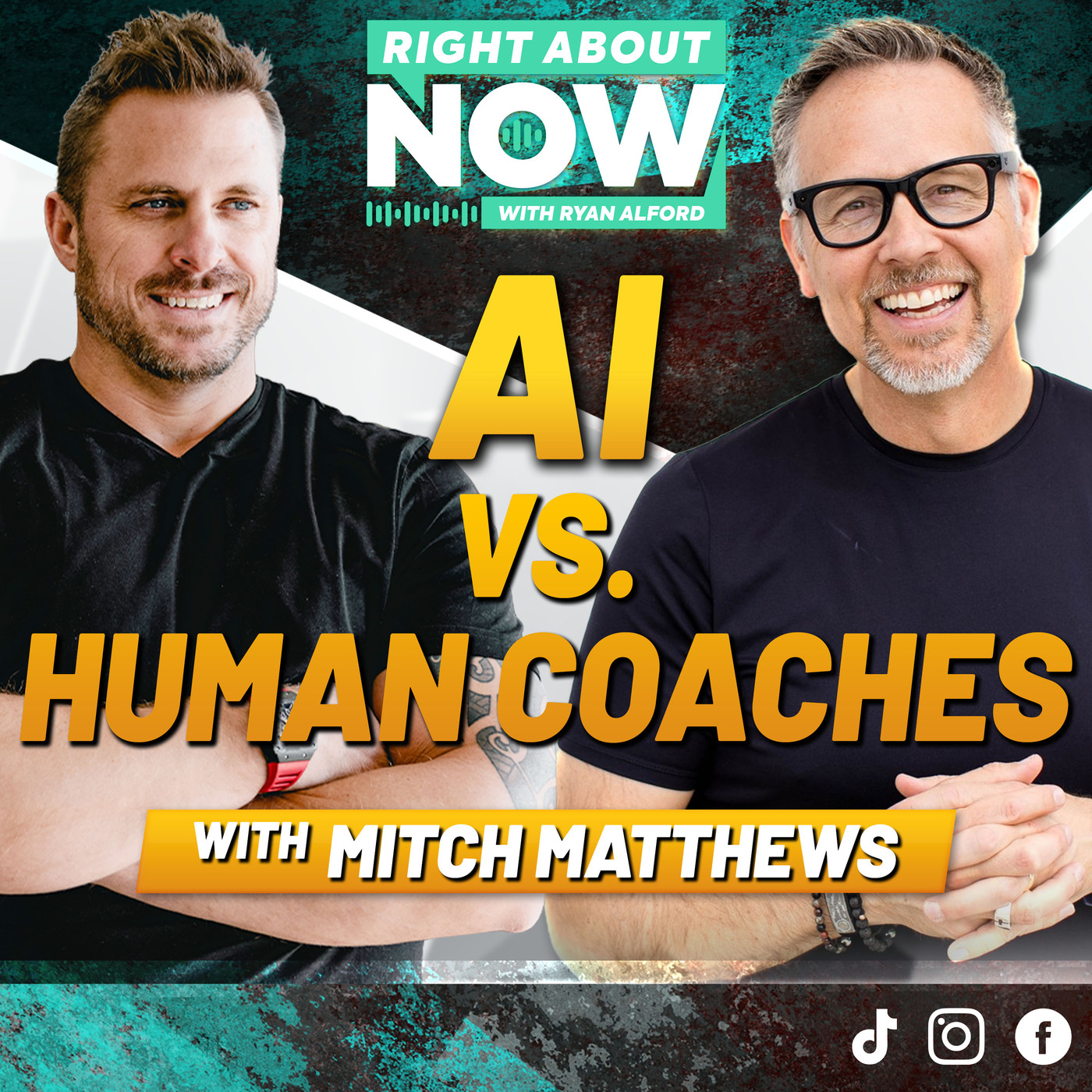
Right About Now - Legendary Business Advice
The Human Zone: Why AI Can't Replace Coaches | Mitch Matthews
00:25:39
Loading summary
Transcript71 lines
- [00:00]
A
On today's episode of Right About Now, I talk with Mitch Matthews. He is a keynote speaker and a success coach. And he's got the six figure sequence as his framework. It's helped people scale. We talked about his podcast, Dream Think, Do. Ultimately, all that matters is Mitch is a hell of a guy, a lot of fun, a lot of insights. I really enjoyed this talk. I think you will too. The tenets of success, how to get ahead, and ultimately how to dream bigger.
- [00:29]
B
Now, the imposter syndrome only hits people who are stepping out and doing big things. So I always say, hey, if you start to have those voices in your head saying, are you really? Should you really take that as yes? I'm actually on the verge of doing something big. That's Winder syndrome, not imposter syndrome. Most people think they need to have fully arrived on every corner of their life in order to have credibility to teach. And I say, don't worry about the destination. Don't focus on the destination. Teach from your journey. This is Right about now with Ryan Alford, a Radcast Network production. We are the number one business show on the planet with over 1 million downloads a month. Taking the BS out of business for over 6 years and over 400 episodes. You ready to start snapping next and cashing checks? Well, it starts right about now.
- [01:23]
A
What's up, guys? Welcome to Right about now. We're always helping you get right now because you got to take action today, baby. It's not about last week. It's not about next week. It's about today. That's why I got Mitch Matthews. He's a speaker, He's a success coach. He is the host of Dream Think, do get the Hell after it podcast. I'm adding names to everybody now. Mitch, what's up, brother?
- [01:49]
B
I'm gonna talk to my producer right now. Yeah, I love it.
- [01:54]
A
Yes. I. If nothing else, I've got, you know, DJ Jockey, you know, is in my future. You know, you definitely got the voice.
- [02:03]
B
But you got the face for it, too. I know some people are in radio because they should never be on camera, but you, baby, you got it all. Plus the belt. You got the belt.
- [02:12]
A
I know. Yeah. Come take it out of my hands.
- [02:16]
B
I don't know that I can even lift that thing. For crying out loud, man.
- [02:19]
A
Yeah, it's. It is heavy. I don't think. It's not like £50, but anyway, what's going on, brother? Appreciate you being here. A lot of knowledge to share. Love what you're doing. Hey, I like success. Who doesn't like success. Who doesn't want to. Who doesn't want to love a success coach? You know, it's like the past, the glory coach.
- [02:43]
B
Right, exactly. Well, it definitely lends itself. I love a title that. That kind of demands a question. And people ask, what's a success coach? And I do love that question because success is unique to each person, but most people don't define it. Right. And it's one of those. The people that are the most successful often have defined what success is for them, and they are shooting for that. And it doesn't have to be what everybody defines as success, but if you know what your target is, you're going to be a lot more likely to hit it. So I love. I love a title that kind of begs a question.
- [03:17]
A
Yeah. And you took words out of my mouth. I was going to say the fastest way to miss the target is to not know what it is.
- [03:23]
B
That's exactly right.
- [03:25]
A
And I think it is a lot. I mean, you know, and I wanted to get down this path. We could go a lot of different directions, but I really like. You know how.
- [03:32]
B
You're right. We got four hours.
- [03:34]
A
I know. Four hours broken is the only one that can pull that off, you know. Right.
- [03:38]
B
Come on.
- [03:39]
A
And then I'm still like, are people really listening for three hours? Right.
- [03:43]
B
Right.
- [03:43]
A
Maybe they are. I don't know. We'll see. But no bridging and helping people. You know, I mean, I call it simplified. It's almost like alternative income streams, almost leveraging, I don't know, thought, knowledge, past success, wisdom, all of those things. And, you know, because I think that you nailed it with. The path to success is different for everyone. Yeah. But I think we all need options and we all should be diversifying, you know, our ability. Look, we all. Unless you've independently wealthy, you know, congratulations.
- [04:21]
B
Right.
- [04:21]
A
We all need different income streams, you know, different ways, ways and options. I like options, Mitch. Yep. You know, come on, talk to me about what you're doing.
- [04:30]
B
Well, yeah, absolutely. So we've been. I've been a coach since 2002 and hadn't had so much success with that in 2006. Other people started to come and say, hey, how are you doing this? And so we started to train up other coaches in 2006. And so we've been able to help coaches and speakers about a thousand or more over the years to be successful both profitably and having an impact on the world, which I love. But in the last few years, our biggest move has been something we call the Authority bridge. And that is helping wildly successful people. That's your audience, right? People that are successful in different fields, different industries, different roles. To add coaching and speaking to what they do, not necessarily blow their life up or leave that thing that they are really good at to become a coach or a speaker, but to actually add coaching and speaking and consulting to what they do so they can have more impact, have more income, but also have some variety in their life.
- [05:35]
A
That's interesting. And yeah, let me ask a question that always comes to my mind that I think might come to our audience. Usually I hope, I think I represent the audience. I hope, I don't know, you never know. 25 year olds trying to get after it and 50 year olds way more successful than me. So who knows? But, but we'll say everybody's a coach, right? You, you know, so everybody's a coach. How is this a real legitimate opportunity in 2025 still?
- [06:04]
B
So what's interesting about that, Ryan, is we have a coach certification program. But what's hilarious about it is, or ironic, as I said, you don't need a coach certification. What's interesting is that there is, you know, there's a belief there's a lot of coaches out there, but we did, we did research and 85% of the coach training programs that are out there have no business training at all. So that means that about 85, probably maybe tipping over to 90% of the people that call themselves coaches don't actually have a viable business. So no matter how many coaches are out there, there's not that many that are actually building a business that has impact and brings in income. But I always say, as a coach, your biggest competitor is not other coaches. It's the couch, it's comfort. It's the comfort zone. Right. So I always say, you know, you don't need to have a, a huge following, you don't have to have a huge tribe in order to have a really profitable coaching and speaking business. You just need a core group of people that know truly what you do and what you offer. And you can allow that, you know, if you have that clarity to be able to onboard great fit clients. It's amazing. You know, we have, we have people that have 200 followers on Instagram, but have a $200,000 coaching business because they know what they deliver and they know who they serve. And what's beautiful about that is again, they're not worried about, you know, a thousand or thousands of coaches out there because they know who they help.
- [07:42]
A
Yeah. Riches in the niches baby. Right, Exactly. Right.
- [07:45]
B
And it's that thing of, you know, we live in a world where, you know, our brain is wired for competition. Right. Like evolutionary psychologists talk about upward and downward comparison, which is how our brain is wired. It's a part of what's kept us alive. Right. Like it's. It's one of those things that allowed us thousands of years ago to bring value to a tribe so we don't get kicked out and be eaten by lions and tigers and bears. So upward and downward comparison, that's good for our brains, but comparison also is dangerous for us as far as. Especially in a world where we're scrolling all the time and it looks like we're comparing or it allows us to compare ourselves to a lot of other people. And it's that, as you well know, what happens on a lot of people's social is not what's actually happening in their world. So we say, hey, don't focus on that. Focus on bringing value. Don't focus on the competition. Focus on helping those people you're passionate about helping in tangible ways. And it's amazing how you can actually build a business and have actual impact. That is incredibly satisfying.
- [08:54]
A
Yeah. A lot to unpack there. A lot of good wisdom. Mitch talking with Mitch Matthews. He's a speaker and success coach. Success being what you want it to be and not what you think your friends want. Yeah. And a lot of what you were just saying there, a lot of people think build a framework of success around what, you know, they think other people view as success when they haven't defined it. So I think that's the key. And then, you know, the noise of the coaches. I'm sitting there thinking, you know, how many of these coaches are, you know, I guess anybody consider a coach? Right. But if you don't actually coach anyone. Right. It's like, we need a new name, Mitch. We need to start.
- [09:34]
B
That's probably true. Ryan, you and I should come up with that, patent that thing and make billions, Right? Absolutely.
- [09:40]
A
Category of one, not.
- [09:42]
B
That's exactly right.
- [09:43]
A
We're not coaches. How about not coaches?
- [09:45]
B
Yeah, right.
- [09:45]
A
Exactly. I love it. Yeah. But, yeah. So what's the biggest. So target audience, Diversification options, sharing knowledge. They could always, you know, leveraging their 200 to 2000 whatever it is. Right. When their circle in their niche that they can help specifically getting focused on how. Who they help, how they help them. Yep. What's the biggest flip of a switch for people getting into this route? You know, like, what's the holdback? Like what is it? I mean, my first thought is people are so, yeah, I can be, believe it or not, self deprecating and like, you know, I don't know the, what they. Imposter syndrome. Even when you've got 25 years experiences on, then you're like, am I really any good at this?
- [10:35]
B
Am I, am I just faking it? I mean, really? Yeah, Which I, I do, I do. Flip the impostor syndrome a little bit. Ryan, you'll appreciate this. I always talk about the imposter syndrome, probably would be better defined as the winner syndrome. Because what's interesting about imposter syndrome is the people that experience imposter syndrome, which is that that small voice in our head saying, should you really stand up in front of this group of people, should you really take this chance and do something big? Right? That what's interesting about that is people who are not taking risks, people who are not asking to lead, people who are not asked to stand in front of a room and deliver something. Those people don't get. The imposter syndrome, right? The imposter syndrome only hits people who are stepping out and doing big things. So I always say, hey, if you start to have those voices in your head saying, are you really, should you really take that as yes, I'm actually on the verge of doing something big. That's Winter syndrome, not imposter syndrome.
- [11:35]
A
I love that. And is that, is that one of the biggest hurdles for, for people you work?
- [11:39]
B
I think it is. I think one of the other things, you know, we walk people through this authority bridge process. A lot of people, you know, a lot of the people that we tend to attract are natural coaches, they're natural mentors. Somebody's told them, oh my gosh, you should be a coach, you should be a speaker. They've even had people probably offer to hire them or boy, they have people reaching out to them all the time saying, can I pick your brain for this? Can I get your insight on this? One of the things, probably the biggest hurdle when it comes to people saying, could I really make this a viable business? Is most people think they need to teach from the destination. Most people need, they think they need to have fully arrived on every corner of their life in order to have credibility to teach. And I say, don't worry about the destination, don't focus on the destination. Teach from your journey. Because what's interesting is, is that, you know, we talk, you talk about marketing so well, one of the things that, especially in the coaching and speaking and consulting world, when you look at most people that have gotten a little bit of coach training or they want to call themselves a coach. Most of what they're doing is ego based promotion. Look at me, look at me. I'm a really good coach. I'm coaching now. Did I tell you I'm coaching? Right? But what we, what we really encourage people to do is something we call value based promotion, which is about bringing value by teaching from your journey. Meaning we can talk about things that we're trying, talk about things that we're experimenting with, talk about the book that we're reading and how we tried this thing, right? And sometimes the ones that can bring the most value are the ones where it's like, well, I tried it and it went down in flames. Like I made every mistake. But hey, I tried it again, did a little different and it worked, right? People love that. And then they feel invited onto the journey. And what's beautiful is when you teach from the journey, you never run out of content. But when you teach from a destination, there's a shelf life to it. I mean, if you look at sadly, you know, people that win gold medals, God bless them, you know, every Olympics, people, people win gold medals, and then you'll see a lot of those folks go out on the speaker circuit. But most of the time those gold medals have about a four year shelf life on being able to speak. Because what happens every four years, another set of gold medals get given, right? And, and what's sad about that is when you teach from a destination again, it's one of those things that you tend to run out of audience, you tend to run out of stories, you tend to run out of credibility, all those things. But when you teach from the destination, you truly are doing the things that you are teaching. You will never run out of content. You build credibility and you truly connect with that ideal client, that person that wants to work with you.
- [14:33]
A
Mitch, I love that. What I would say is you just gave the playbook for modern social media too. Like, that's what it should be, you know, it should be. That's what works today, right?
- [14:43]
B
And it's, it's one of those things. I don't know about you, but we're, we're doing a ton of experimenting with AI, right? And there's a lot of people, oh, AI is going to be the death of coaching. It's like, well, it's going to be the death of some types of coaches, there's no doubt about it. But it's one of those things we're calling to like we're encouraging our folks that we work with, that we help. Right. Hey, maximize AI and maximize the, what we call the human zone. And the human zone is truly the elements of a coaching relationship or a speaking relationship or even a consulting relationship. Where the human zone is that part of connection, it is that trust, it is that accountability. Because I know, like, I still maintain a, an executive coaching business like success coaching, where I work with CEOs and founders and entrepreneurs and they could definitely get some of the questions I ask from a chat chatbot.
- [15:42]
A
Right.
- [15:42]
B
They could, they could train up a chat bot in some of the things that I do. Right. And they could definitely get those questions from a chatbot and they could probably have some good interaction. But from an accountability standpoint, from a trust, from creating a safe space, that's the human zone.
- [15:57]
A
Right.
- [15:58]
B
And it's one of those things that if you truly know what you're delivering there, we can also continue to outrun AI at least until the robots take over. Yeah.
- [16:09]
A
Until they're in full human form. Which.
- [16:12]
B
Exactly.
- [16:13]
A
Right.
- [16:13]
B
If you want to be a different story altogether.
- [16:15]
A
But we watched Westworld at all.
- [16:17]
B
Yeah, exactly.
- [16:19]
A
How many sci fi movies had to predict the future? We still had to go create it, you know.
- [16:23]
B
That's exactly right. It's amazing how often art truly predicts the future. Right. James Cameron. I don't know, man. There's a, there's a part of me that thinks he has a, a time machine somewhere.
- [16:33]
A
So. Yeah, y. The human zone. I love it. We've talked about that at our agency a lot. And I, I think knowledge has gotten really cheap. Experience, human experience is still extremely valuable. And I think that's what if I'm encapsulating. That's what it feels like you're saying.
- [16:52]
B
Truly. Truly. And it's one of those things too, is that we teach a question based coaching approach. And some people are like, that sounds a little touchy feely, but it's not. It's one of those, it's actually science based, it's neuroscience based where you're truly drawing out the best in your clients. Right. And you know, in our authority bridge process, we're training up people that have had a lot of success. But we also say you, you can connect based on your success, but the questions draw out the value from your client. Right. So yesterday I was working with a CEO, amazing leader, incredible. But she had a challenge on her team and we had a session. And what's funny is, is that I asked her a series of questions. I definitely had some opinions on what she could do and maybe even what she should do in this scenario. But I. I kept those and questions and help to draw out the solution from her. And that was a solution that she owned.
- [17:52]
A
Right.
- [17:52]
B
And it's one of those things where she's hilarious. She's like, I pay you an insane amount of money to help me know that I know what I'm doing. I'm like, yep.
- [18:04]
A
Hey, you know, sometimes we all need a little bit of validation and.
- [18:08]
B
Right.
- [18:09]
A
You know, confidence that comes with having someone on our. On our team. You know, sometimes it's not always about learning something new. It's like having someone in your corner. Yep.
- [18:20]
B
100.
- [18:21]
A
That's what the best coaches are, Right? Yeah. I mean, I think it's that I'm not always teaching you a lesson. I'm sometimes just giving you confidence in what we both already know to be true.
- [18:32]
B
Absolutely. And I. I do. Like, I know you bring a ton of value, but I know you use the coaching approach, too. And one of the things we teach is, like, you can still teach. You can still offer a strategy, but always flip that and come around and ask questions. It was interesting. We helped a nursing education organization. They were training up thousands of nurses because there was. There was a major challenge in the medical world in that people were leaving doctor's appointments, not understanding what their diagnosis was and not understanding their treatment plan. And they tried to equip doctors to flip that conversation. And the doctors were incredibly resistant. And what was amazing was we equipped nurses with two questions, and it increased understanding and compliance about 100% in both cases. And those simple questions were, what did you hear? And what's something you're going to do because of it? And just to have someone verbalize it, what they did was sometimes it helped to uncover when there was misunderstanding, helped them to actually verbalize their understanding and commit to something specific they were going to actually do. And what I love about those nursing questions is those are questions that every leader can ask their team. Because, you know, in a corporate setting, the greatest. The greatest lie is that communication has actually happened. Right. So to be able to say, hey, guys, this was a great meeting. What did you hear? And what's something specific that everybody's gonna do?
- [20:08]
A
A lot of wisdom, Mitch. Yeah. As we close out, man. Yeah. I feel like, you know, the risk takers and the dreamers, like, it feels like that circle is diminishing. How do we make people dream bigger, think more?
- [20:24]
B
Yeah. I love it. And. And truly dream, think, do it. My hope Is, it's a catchy name, but dream, yeah, right. I appreciate it. But it's also a three step process and I'm a big believer in helping people dream and I'm a big believer in helping people to think. But it's important to give yourself space to do both independently. So I always say, hey, give yourself space and time to dream without thinking too early, without planning too early, without strategizing too early, without starting to ask some of those questions of, do I really have enough money? Do I really have enough time? Give yourself space to say, hey, what if? What would I love to do this year? What would I love to experience this year? And in some ways, if we're going to wrap it up with one thing, probably this is, this might be marketing suicide, but I'm actually going to suggest a switch of words. Even though the podcast is called Dream Think, do I have a lovehate relationship with the word dream? Because dream sometimes has, you know, kind of some triggers to it. Some people wonder, oh, am I dreaming or am I goal setting? Is my dreaming big enough? Is it, Is it too small? Whatever it might be? So I always say, hey, if you have any kind of wrestling match with the word dream, maybe it's even too touchy feely for some people. Just flip the word dream with experience. And even as we're moving into, you know, this next year, say, hey, what are some things I'd love to experience in this next year? Take the word dream out of it. Just, just flip that with experience. What are some things that I'd love to experience in the next year with my family or with my team?
- [22:05]
A
Tangible.
- [22:06]
B
Dive into that, right? Because experience, it's amazing. Because experience is also visceral, right? To be able to say, hey, I want to experience more joy or I want to experience more health, I want to experience more success. It's like, okay, awesome. What does that mean? Like, dive into what that word might mean or how you might do it without necessarily worrying about bud budgets or the clock or any of those things. And it's amazing where your brain and heart might take you with that simple question. What's something I want to experience more in this next year, in this next month, in this next week? See where it takes you, Mitch.
- [22:41]
A
Where can everybody learn more and how to work with you and how to become a success. A not success coach, right? Exactly.
- [22:51]
B
I'm loving that title. I love it. Successful success ninjas. Maybe we can be success ninjas, right? So they go to mitchmatthews.com is a great place to start. And they can also go if we. We send out a four Things email every week. That's, that's packed with four different things that I'm learning that I'm using, that I'm. That I'm experimenting with. And people can go to Mitch Matthews.com backslash four things to grab that.
- [23:17]
A
Mitch Matthews, the dream enabler. Appreciate you, brother.
- [23:21]
B
Brian. Keep up the great work, brother. You are needed.
- [23:23]
A
Hey, guys, we appreciate Mitch. Go check out his work. He's the real deal. I've talked to a lot of people. This was as insightful as it's been in a long time for me and I really appreciate for Mitch for coming on. A ton of value here on Right about now. Go to Ryan is right. You'll see the full highlight clips, all the links to Mitch's stuff, and of course, where to find me at Ryan offered anywhere on social media. We couldn't do it without you. We'll see you next time. Right about now.
- [23:50]
B
This has been Right about now with Ryan Alford, a Radcast network production. Visit ryanisright.com for full audio and video versions of the show or to inquire about sponsorship opportunities.
- [24:02]
A
Thanks for listening.