
Podcast
RIMScast
Hosted by The Risk and Insurance Management Society, Inc. · EN
The official podcast of RIMS, the Risk and Insurance Management Society. Tune in for weekly discussions about risk management hot topics, interviews with leaders in the profession, and updates on RIMS events and education.
43episodes
Episodes
Newest firstAll episodes
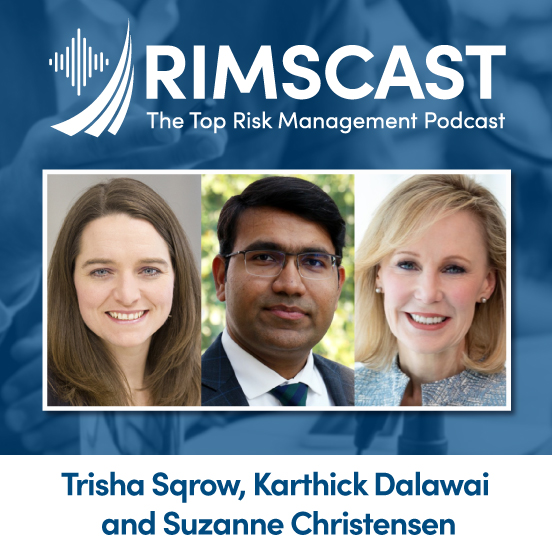
Risk Quantification Through Value-Based Frameworks
Oct 29, 202400:25:46Tap to summarizeWelcome to RIMScast. Your host is Justin Smulison, Business Content Manager at RIMS, the Risk and Insurance Management Society. In this episode, Justin interviews Trisha Sqrow, of Marsh Advisory, and our Council Vice-Chair 2024, Suzanne Christensen, of Franklin Templeton Investments, and making his debut on RIMScast is Karthick Dalawai, of Penn Mutual Life Insurance Company. Karthick, Suzanne, and Trisha discuss value-based frameworks in terms of benefits, their experience with them, and value metrics. They share the concept of a value-based Enterprise Risk Management (ERM) framework to align risk management activities with the creation of shareholder value. They mention risk quantification methodologies to assess financial and non-financial risks. They explain the use of scenario analysis to tailor risk management practices to your organization's risk appetite and objectives and give ideas on how to get buy-in from the boardroom. Listen in for ways to implement a value-based ERM framework in your organization. Key Takeaways: [:01] About RIMS. [:15] About this episode. From RIMS headquarters in New York, we will be joined by three members of the RIMS Strategic and Enterprise Risk Management Council to discuss risk quantification through a value-based framework. [:43] The RIMS ERM Conference 2024 will be held on November 18th and 19th in Boston. Opening keynote speaker John Hagel recently appeared here on RIMScast. Register at RIMS.org/ERM2024. [:58] We will talk about everything from RMIS and AI to D&O, ESG, the SEC, and various other acronyms. If you are a RIMS-CRMP holder, you can earn recertification points by attending the RIMS ERM Conference 2024! [1:16] For those of you interested in studying for the exam, a pre-conference workshop will be held on-site on November 16th and 17th. Register now; a link is on this page! [1:30] The next RIMS-CRMP Exam Prep will be held with Purima virtually on November 14th and 15th. The next RIMS-CRMP-FED Exam Course will be hosted along with George Mason University from December 3rd through the 5th. [1:45] Links to these courses can be found on the Certifications page of RIMS.org and through this episode’s show notes. [1:53] RIMS Virtual Workshops! Elise Farnham of Illumine Consulting recently joined us here on RIMScast. On December 4th and 5th, she will host Applying and Integrating ERM. On December 17th and 18th, she will host Captives as an Alternate Risk Financing Technique. [2:14] Other dates for the Fall and Winter are available on the Virtual Workshops calendar, RIMS.org/virtualworkshops. [2:23] Interview! Returning to the show are Trisha Sqrow, of Marsh Advisory, and our Council Vice-Chair 2024, Suzanne Christensen, of Franklin Templeton Investments, and making his debut on RIMScast is Karthick Dalawai, of Penn Mutual Life Insurance Company. [3:00] These brilliant minds, Trisha, Suzanne, and Karthick, will present the session “Risk Quantification Through Value-Based Frameworks” to kick off Day 2 of the RIMS ERM Conference 2024 on November 19th. [3:15] Today we’ll get tips on how to launch a value-based framework, what the benefits and limitations may be, and how to convince your board to buy in. Karthick Dalawai, Trisha Sqrow, and Suzanne Christensen welcome to RIMScast! [4:54] Karthick explains that Enterprise Risk Management in its current form and where it goes from here to enable leaders to make informed decisions tie back to metrics and the quantification of results. [5:22] Doing risk management thematically is good and influential, but anything you don’t quantify you can’t improve. Risk quantification is essential for a good enterprise risk management program. [5:49] Trisha’s risk management path has evolved toward a value-based framework. She suggests an organization could start by measuring its overarching risk appetite, understanding its risks, and putting its ERM framework in place. [6:22] The parameters could be how much financial, regulatory, or strategic risk you want to take. Hone in on what the risk translates to by quantifying the value. [7:03] The metrics may not always be dollar amounts. There may be safety value metrics, or cyber security impacts. There is a way to tie those back to financials in many cases, but you can look at different values. [7:51] Karthick says it’s easier to quantify financial risk than intangibles like cyber risk or talent risk. Having a common denominator makes it possible to explain risk so IT, HR, and all departments understand the enterprise risk, not just the risk in their slivers of the organization. [8:58] Defining risk under a value-based framework takes three keys: uncertainty, deviation from the company strategy, and taking the right opportunities to increase value. If you planned to grow 10% and you grew 15%, analyze that opportunity. What was the cost of that benefit? [10:20] Suzanne adds that scenario analysis helps. Why did your growth vary from your planned growth? What do you have to have in place to manage it? With a 15% growth, you’ll need more resources and a plan for the logistics. You may need to make a lot of other arrangements. [11:06] You need to think about those things in contingency mode. Scenario analysis does that; it helps you work through those plans. [11:30] Karthick describes the possible limitations of a value-based framework. The common denominator is a financial metric. Executives need to understand what factors contribute to that value. Tying the risk appetite to the value occurs high in the organization. It’s all-encompassing. [12:07] You have to break the framework into layers by what it means for the different business units and how they measure business. Rightly implemented, a value-based framework is of great value; otherwise, people might become disconnected from it. [12:37] Suzanne agrees that people might not buy in if the framework is not well-implemented. Suzanne and Karthick discuss avoiding bias and starting with wrong assumptions. [13:02] Karthick believes that gets into the risk culture of the organization. Is it conservative or more aggressive? When you have a quantifiable and measurable risk appetite, some people may tend not to breach it at all. Many times, risk decisions need not be risk-optimized. [13:48] Having a measurable risk metric guides how much risk people can take to add value to the organization, not just to manage the downside. Tie it back to the business metrics through which leaders measure their performance. Having a good manager is a win-win. [14:16] Suzanne adds that weighing the cumulative impact of multiple decisions while figuring out a strategy for the organization helps you think about the risk appetite of the firm and if there is room to take more risk. [14:53] Trisha considers the risk culture of the organization in helping people understand value-based frameworks. There are a lot of conversations to be had with various departments. A financial office does not have the same risks as a manufacturing facility or an airport. [15:28] Work with the people looking at safety metrics and help translate them into dollar amounts, considering insurance and claims. What value does the framework add? [15:45] Help people understand the value-based framework and have conversations around it. How much risk can you take? [16:19] Plug Time! RIMS Webinars! On October 31st, TÜV SÜD GRC discusses “Mastering Property Renewals: Strategies for Success in 2025 with Risk Engineering”. [16:34] On November 4th, I will be hosting a special RIMS Webinar presentation, “Lessons from Veterans on Strategic Risk Leadership”. That session will feature insights and perspectives from risk managers who previously served in the United States Armed Services. [16:53] On November 14th, Marsh will present “Risk Perception and Management: Insights for a Changing Landscape”. [17:00] On November 21st, HUB International returns with the fourth installment of their Ready for Tomorrow series, “From AI to the SEC: The Future of D&O Litigation and Regulatory Exposures”. [17:15] On November 25t...
Transcribe →
Financial Risk Management with Chris Willey of American Eagle FCU
Oct 22, 202400:35:10Tap to summarizeWelcome to RIMScast. Your host is Justin Smulison, Business Content Manager at RIMS, the Risk and Insurance Management Society. In this episode, Justin interviews Chris Willey of American Eagle FCU. Justin asks Chris how banking and financial risk management has evolved since Chris entered the profession, in the past 15 years after the housing crisis, and in the past two years after the SVB collapse. They talk about Chris’s 2023 RIMS ERM Global Award of Distinction, how leadership has reacted to the ERM program, and how the program has changed since last year. Chris explains American Eagle FCU’s ERM philosophy, including its nine risk categories. Chris shares her thoughts about what it takes to activate an effective ERM Program today, and how ERM can help improve the banking sector and the risk industry overall. October is Cybersecurity Awareness Month. Chris tells what that means to her. Key Takeaways: [:01] About RIMS. [:15] About this episode. From RIMS headquarters in New York, our guest is Chris Willey, the VP of ERM at American Eagle Financial Credit Union. She is also a recipient of the 2023 RIMS ERM Global Award of Distinction. [:43] The RIMS ERM Conference 2024 will be held on November 18th and 19th in Boston. Opening keynote speaker John Hagel recently appeared here on RIMScast. Register at RIMS.org/ERM2024. [:58] We will talk about everything from RMIS and AI to D&O, ESG, the SEC, and various other acronyms, in addition to future casting and risk quantification. [1:10] RIMS-CRMP holders can earn recertification points by attending the RIMS ERM Conference 2024! For those interested in studying for the exam, a pre-conference workshop will be held on-site on November 16th and 17th. Register now; a link is on this page! [1:34] The next RIMS-CRMP Exam Prep will be held with Purima virtually on November 14th and 15th. The next RIMS-CRMP-FED Exam Course will be hosted along with George Mason University from December 3rd through the 5th. [1:50] Links to these courses can be found on the Certifications page of RIMS.org and through this episode’s show notes. [1:57] RIMS Virtual Workshops! Elise Farnham of Illumine Consulting recently joined us here on RIMScast. On December 4th and 5th, she will host Applying and Integrating ERM. On December 17th and 18th, she will host Captives as an Alternate Risk Financing Technique. [2:20] Other dates for the Fall and Winter are available on the Virtual Workshops calendar, RIMS.org/virtualworkshops. [2:28] Interview! My guest today, Chris Willey, is the Vice President of Enterprise Risk Management at American Eagle Financial Credit Union. In 2023, her ERM program received a RIMS ERM Global Award of Distinction. We didn’t get to connect last year to discuss it. [2:49] We’re here now, and we will learn all about Chris Willey’s ERM philosophies, how American Eagle FCU handles certain risks, and what their risk register looks like. We will also get some tips for staying cyber secure, as October is International Cybersecurity Awareness Month. [3:06] Chris Willey, welcome to RIMScast! Congratulations again for your ERM program being one of the honorees of the 2023 RIMS ERM Global Award of Distinction! [3:51] Chris started at the credit union 34 years ago in Internal Audits where she got to see and understand the entire organization. In 1998, the board of directors started a risk management department. Chris applied and got the job. [4:25] At first, they worked on traditional risk management, including insurance and fraud. Over the years, they added responsibilities. ERM was the last piece they added to their risk management repertoire, 14 years ago. [4:56] Around the time of the housing crisis, one of the credit union’s high-risk areas, the board asked Chris to create an ERM program. Credit union regulators were also instrumental in starting ERM. While not required, having an ERM program is necessary to understand your risks. [6:26] Chris has one staff member, Theresa, the Assistant Vice President, who helps with all facets of risk management. Chris and Theresa do a lot. Chris says it would be nice to have another person helping them. [7:28] After the Silicon Valley Bank collapsed in March 2023, the interest rate risk and liquidity risk got a lot of attention. American Eagle FCU was on top of it. Their interest rate risk was increasing and the ERM program had already begun taking measures to thwart risk. [8:10] American Eagle had scaled back some of their lending and beefed up their liquidity because of what happened on the West Coast. That helped put them in a great spot. [8:44] The regulators had come down hard on them and American Eagle did a lot of things to prove that they were going to be OK. The regulators are the insurers so wanted to make sure American Eagle had enough liquidity in case something happened like that at the credit union. [9:04] It was a lot of work. The CFO and others in the organization put in additional monitoring tools. That’s what the ERM program does. It says, “Hey, we’ve got a potential issue or higher risk.” It’s a call to action to ask, "What are we going to do differently to mitigate the risk?" [9:37] American Eagle’s interest rate risk is still trending a little bit higher but it’s under control and being monitored. The regulators gave them a great pass last year and are working on this year’s audit. [10:12] When the American Eagle FCU ERM program was awarded the 2023 RIMS ERM Award of Distinction, regulators were thrilled. The board of directors was very happy to hear of it at a board meeting. The Risk Council Team was also thrilled and felt they were on the right track. [11:11] The award came at a good time for the ERM program. Since then, American Eagle has had a few new executive leaders. The ERM program team is educating the risk council on what ERM is and the nine risk categories, definitions, KRIs, and what they should keep or change. [12:43] American Eagle is getting to the point of putting new KRIs in place to see where they land with the risk ratings. They are asking if their risk tolerance or appetite should be increased. American Eagle FCU has been risk-averse. You can take calculated risks with an ERM program. [13:41] If the risk gets to be above your expectations, you can try to reel it back to a more manageable level. [14:04] American Eagle FCU is growing in its assets and also in its team members. The ERM program is adding a People Risk category to help create a culture that’s engaging. The board of directors is excited to see what that will look like. [14:39] Plug Time! RIMS Webinars! On October 24th, Hub International returns for the fourth installment of their Ready for Tomorrow series, “From AI to the SEC: The Future of D&O Litigation and Regulatory Exposures”. [14:56] On October 31st, TÜV SÜD GRC discusses “Mastering Property Renewals: Strategies for Success in 2025 with Risk Engineering”. On November 4th, I will be hosting a special RIMS Webinar presentation, “Lessons from Veterans on Strategic Risk Leadership”. [15:17] On November 14th, Marsh will present “Risk Perception and Management: Insights for a Changing Landscape”. On Thursday, December 12th, OneTrust returns to deliver “Staying Vigilant: 7 Practical Tips for Ongoing Third-Party Risk Monitoring” [15:43] More webinars will be announced soon and added to the RIMS.org/webinars page. Go there to register. Registration is complimentary for RIMS members. [15:55] There is another webinar you sho...
Transcribe →
Safety and Preparedness in 2024 with National Safety Council CEO Lorraine Martin
Aug 27, 2024Tap to summarizeWelcome to RIMScast. Your host is Justin Smulison, Business Content Manager at RIMS, the Risk and Insurance Management Society. Justin Smulison interviews National Safety Council CEO Lorraine Martin about National Preparedness Month, a new OSHA proposed statement on workplace safety in extreme heat, National Recovery Month, drug overdose deaths at work, and some related topics. Lorraine also invites you to the NSC Safety Congress & Expo from September 13th through the 19th. Listen for information and insight from NSC CEO, Lorraine Martin. Key Takeaways: [:01] About RIMS. [:14] About this episode. Justin introduces return guest National Safety Council President and CEO Lorraine Martin. She will tell us what’s going on with safety and preparedness in the U.S. and the world. [:44] Virtual Workshops! Applying and Integrating ERM is back and it will be hosted by Elise Farnham on September 25th and 26th and also on December 4th and 5th. [:58] On October 9th and 10th, Chris Hansen returns to deliver Fundamentals of Insurance. Other dates for the Fall and the Winter are available on the virtual workshops calendar at RIMS.org/virtualworkshops. [1:16] RIMS-CRMP Prep Courses! On September 10th and 11th, the RIMS-CRMP Exam Prep will be held with NAIT. There is another RIMS-CRMP Exam Prep on September 12th and 13th. [1:31] The next RIMS-CRMP-FED Exam Prep course will be hosted along with George Mason University on December 3rd through 5th, 2024. Links to these courses can be found on the Certification Page of RIMS.org and in this episode’s show notes. [1:46] Events! We’ve got the DFW RIMS 2024 Fall Conference and Spa Event happening on September 19th in Irving, Texas. Learn more about that event in Episode 299, which features an interview with the Texas State Office of Risk Management. [2:04] Also on September 19th is the RIMS Chicago Chapter’s Chicagoland Risk Forum 2024. Register at ChicagolandRiskForum.org. [2:13] Registration opened for the RIMS Canada Conference 2024 which will be held from October 6th through the 9th in Vancouver. Visit RIMSCanadaConference.ca to register. [2:26] Registration is also open for the RIMS Western Regional, which will be held from September 29th through October 1st at the Sun River Resort in Oregon. Register at RIMSWesternRegional.com. [2:39] We want you to join us in Boston on November 18th and 19th for the RIMS ERM Conference 2024. The agenda is live. The keynote will be announced soon. We want to see you there! A link is on this page. [2:55] The nominations are now open for the RIMS ERM Award of Distinction 2024. Nominations are due August 30th. A link to the nomination form is in this episode’s show notes. [3:09] If you or someone you know manages an ERM program that delivers the goods, we want to hear about it. A link is in this episode’s show notes. All RIMS regional conference information can be found on the Events page at RIMS.org. [3:26] Interview! I am delighted to be rejoined by National Safety Council President and CEO Lorraine Martin. Her timing is perfect for National Preparedness Month in September. We’ve got so much to discuss in the way of natural catastrophes and other risks. [3:46] We will also talk about National Recovery Month, and how prescription opioids can impact employees and employers and why it is such an important business risk. That dovetails into last week’s episode with the NCCI. [4:02] We’ll talk about the NSC’s Safety Congress and Expo on September 13th through the 19th in Florida and we’ll also talk a bit about Lorraine’s background in the U.S. Air Force, her decades at Lockheed Martin, and how those shaped her risk perspective. [4:24] Lorraine Martin, welcome back to RIMScast! [4:45] Lorraine started her career in the U.S. Air Force. Justin thanks her for her service. After the Air Force, Lorraine spent nearly 30 years at Lockheed Martin. [5:29] The Air Force and all the armed services ask their people to do high-risk things to protect our nation and support our allies around the world. As a member of the armed services, you understand how important safety is to those you protect, and the risks that go with that. [5:55] Lorraine started in the Air Force in the early ’80s. Being a five-foot female in the Air Force she had combat boots and survival suits that didn’t always fit. She saw the need to keep everyone safe. That means being open and expansive to make sure to cover everybody. [6:44] At Lockheed Martin, Lorraine ran some of the aircraft manufacturing programs. There was potential for serious injury and fatality (SIF), with energy, heights, and all kinds of things that need to be done safely. [7:08] The products being built had to go do important things around the world, so they had to meet safety standards for operation and bring everybody home. Lorraine needed to understand safety in manufacturing and in the mission. [7:30] Justin and Lorraine met after Lorraine joined the NSC as President and CEO in 2019. Less than a year later, COVID-19 hit the U.S. Lorraine has been at the NSC for five years. Time sometimes flew by and In some cases, it felt like the world stood still for everybody. [8:13] On RIMScast in 2020, Justin and Lorraine talked about technology and the importance of reaching people, through podcasts, Zoom, or Teams. Lorraine is responsible for providing training so people can be safe. She had to learn how to do that when she couldn’t be with them. [8:40] The NSC had to become good at virtual training and helping customers and stakeholders understand what remote and virtual learning looks like. The world has come so far in understanding what people can do virtually. It’s not everything! Human interaction is still critical. [9:01] Lorraine says we learned so much, whether for drivers' fleet training or for folks doing CPR. The NSC was able to reach more people, which is great when you’re talking about safety. In many cases, the NSC reached them in a more cost-effective manner for all involved. [9:27] The NSC focused on what was happening to humans as they were being buffeted during this time, from 2020. On RIMScast, Lorraine and Justin had talked about mental health. The NSC pioneered some research that looked at how psychological safety impacts physical safety. [9:55] Lorraine believes that since 2020, we’ve come so far in understanding that physical safety can be impacted by many different aspects of your life like distraction, fatigue, or substance abuse, that can cause you not to be on your game. [10:22] The NSC honed in on the issue of a person not being on their game as being impaired, and they shouldn’t do something that would put themselves or somebody else at risk. [10:38] The NSC leaned into trainings around being able to identify impairment and giving people the skills to take action so they can take somebody out of harm’s way. It’s easy to say and hard to do but so critical. [10:55] The NSC and RIMS both used the pandemic as an opportunity to dial up virtual offerings and dial back some live events. Many of the right live events have come back. There is some training that is important to be in person. [11:18] In-person collaboration and interaction support mental health. Isolation as a result of the pandemic was a burden for many folks. [11:47] The NSC received positive feedback on their SAFER initiative, ensuring people were safe in returning to work. A task force of stakeholders from government, non-profits, public health medical professionals, and Fortune 500 companies advised NSC and NSC advised workplaces. [12:30] The SAFER guidelines included ventilation, vaccination, and all of the things a business would need. It was a one-stop shop for policy statements, legal statements, and other best practices for workplaces to use to safely accommodate workers at work. [13:10] The SAFER initiative is still going on. It’s funded now by the CDC. NSC is now looking at long-term COVID, mental health and well-being, the overall long-term effects of a pandemic, and how workplaces prepare for whatever’s coming in the future. [14:06] Lorraine just listened to a piece on NPR about COVID-19. We’re still learning. We’ve found a way so that most folks do not perish from it, but we don’t know everything about it and probably won’t for some time. [14:28] In Long COVID there’s some inflammation or reaction that’s still happening long after the initi...
Transcribe →