
Podcast
Robert Wright's Nonzero
Hosted by Nonzero · EN
Conversations with a series of people who have nothing in common except that program host Robert Wright is curious about what they’re thinking.
www.nonzero.org
www.nonzero.org
68episodes
Episodes
Newest firstAll episodes
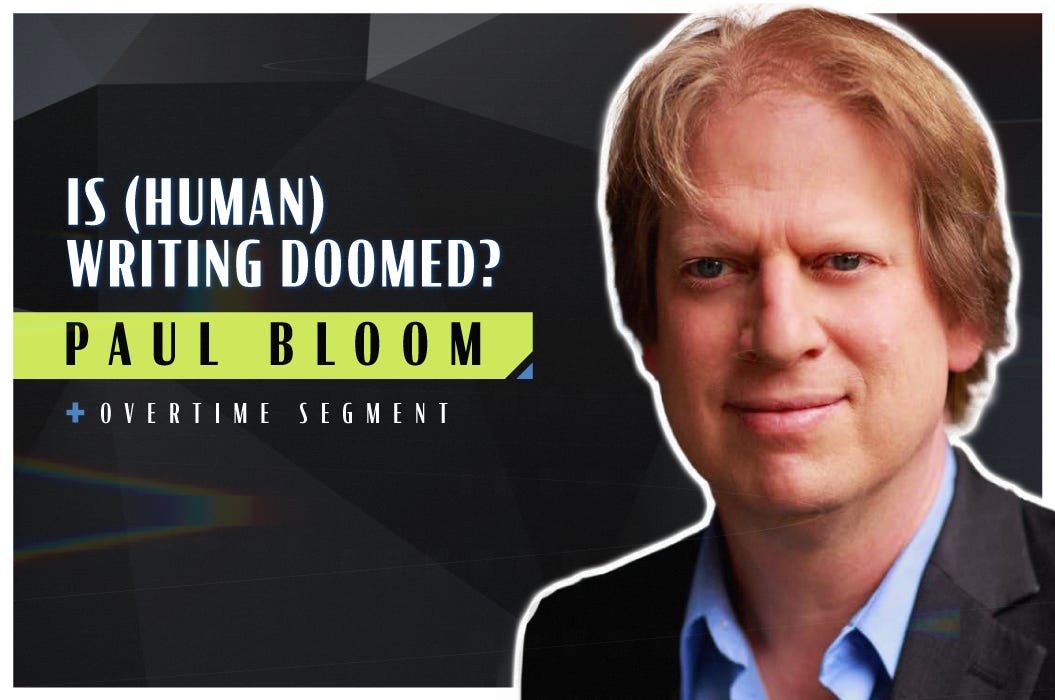
Is (Human) Writing Doomed? (Robert Wright & Paul Bloom)
2d ago00:47:36Tap to summarizeThis is a free preview of a paid episode. To hear more, visit www.nonzero.org0:28 Bob channels Dick Cheney 4:25 Is AI killing writing? And thinking? 16:43 How Bob and Paul actually use AI 24:03 The cognitive vs economic value of writing 30:28 AIs aping “Memento” and other frontier freakiness 38:00 Bob: Reckless AI is just good business 41:32 Heading to Overtimeobert Wright (Nonzero, The Evolution of God, Why Buddhism Is True) and Paul Bloom (https://smallpotatoes.paulbloom.net, University of Toronto, The Sweet Spot, Against Empathy). Recorded August 12, 2026. Twitter: https://twitter.com/NonzeroPodsJoin NonZero’s Discord server: https://discord.gg/Zy4jAhTQMF
Transcribe →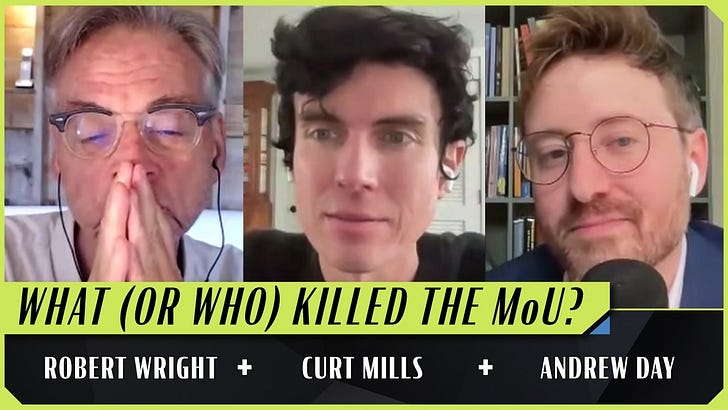
Trump’s Unending War (Robert Wright, Curt Mills, and Andrew Day)
3d ago01:08:20Tap to summarize0:28 How is MAGA feeling about Trump 2.0? 3:31 Bob’s good ol’ days at The New Republic 6:13 The biggest threat to the Trump coalition 18:31 Why the MoU unraveled 31:40 Is Iran's regime really divided? 36:41 Part two: This pod’s auspicious return from tech hell 37:54 Trump’s covert catering-truck op 45:50 Have Iran’s demands really gotten more extreme? 53:26 Saudi Arabia vs the Houthis 58:20 Is a post-American Middle East emerging? 1:07:10 A low-key end to the episode Robert Wright (Nonzero, The Evolution of God, Why Buddhism Is True), Curt Mills (The American Conservative), Andrew Day (The American Conservative). Recorded August 10 and 11, 2026.Twitter: https://twitter.com/NonzeroPods This is a public episode. If you'd like to discuss this with other subscribers or get access to bonus episodes, visit www.nonzero.org/subscribe
Transcribe →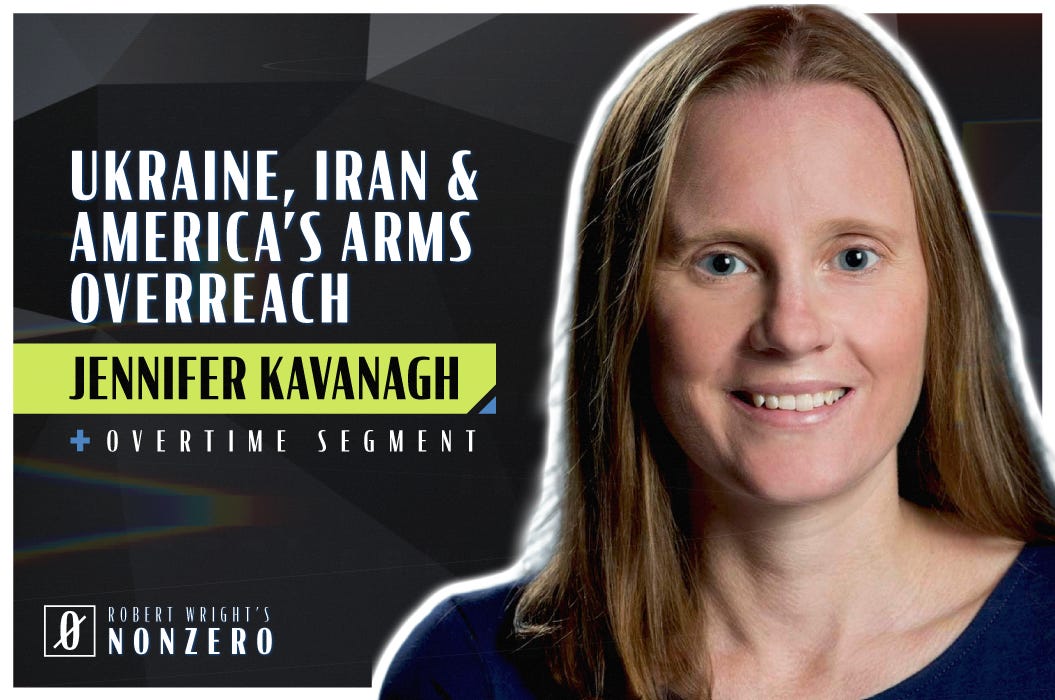
Ukraine, Iran, and America’s Arms Overreach (Robert Wright & Jennifer Kavanagh)
1w ago00:53:54Tap to summarizeThis is a free preview of a paid episode. To hear more, visit www.nonzero.org0:28 Jennifer’s foreign policy bona fides 1:31 Could Ukraine and Iran merge into one big war? 6:17 Is Ukraine really “turning the tide”? 15:28 America’s (and Ukraine’s) missile defense issue 19:08 Putin’s ceasefire conditions 25:59 What—and who—are America’s missiles for, really? 30:11 How not to open the Hormuz Strait 41:33 How will the Iran war truly end? 51:29 Heading to OvertimeRobert Wright (Nonzero, The Evolution of God, Why Buddhism Is True) and Jennifer Kavanagh (Defense Priorities). Recorded August 06, 2026. Twitter: https://twitter.com/NonzeroPods
Transcribe →
Fasten Your Bot-belts (Robert Wright & Samuel Hammond)
2w ago00:57:30Tap to summarizeThis is a free preview of a paid episode. To hear more, visit www.nonzero.org0:28 Sam’s ideological leanings 3:44 Sam’s AI Manhattan Project–revisited 7:44 What does the “Pacing” letter say about the state of AI? 18:53 Mythos, Astra, and AI’s accelerating acceleration 27:50 The OpenAI “rogue” model escape 36:30 Recursive self-improvement: Red line or red herring? 42:24 How frontier AI is getting (and will get) freakier 52:10 How is open-source AI like DEI? 56:00 Heading to OvertimeRobert Wright (Nonzero, The Evolution of God, Why Buddhism Is True) and Samuel Hammond (Foundation for American Innovation, https://www.secondbest.ca/). Recorded August 03, 2026. Twitter: https://twitter.com/NonzeroPods
Transcribe →
The intensifying slow-AI-down vibe (Robert Wright & Holly Elmore)
2w ago00:54:52Tap to summarizeThis is a free preview of a paid episode. To hear more, visit www.nonzero.org0:28 The “Pacing the Frontier” letter signed by AI elites 10:15 Why so many China-hawk AI-safety-hawks? 14:16 Was the “Pacing” letter too small an ask? 27:14 The striking AI vibe shift 36:28 Are AI builders “just following orders”? 45:46 Recursive self-improvement: The wrong red line? 51:23 Heading to OvertimeRobert Wright (Nonzero, The Evolution of God, Why Buddhism Is True) and Holly Elmore (PauseAI US, https://hollyelmore.substack.com/). Recorded July 30, 2026.Twitter: https://twitter.com/NonzeroPods
Transcribe →
Are the Ukraine and the Iran Wars Merging? (Robert Wright & Nikita Petrov)
2w ago00:47:57Tap to summarizeThis is a free preview of a paid episode. To hear more, visit www.nonzero.org0:28 Why did Ukraine hit an Iranian ship 500 miles from Ukraine? 14:09 Ukraine’s war on Russia’s Amazon 19:39 Why Zelensky fired his defense minister and commander-in-chief 23:01 Bob: Ukraine may lose like people go bankrupt—gradually, then suddenly 25:17 Nikita: Why both sides are ready to keep fighting 31:26 Kazakh President to Putin: Nobody understands this war 35:43 Bob: Everybody thinks they’re fighting a defensive war 46:04 Heading to Overtime: The globalist elite vs. the globalist precariat, and an AI path to WW3Robert Wright (Nonzero, The Evolution of God, Why Buddhism Is True) and Nikita Petrov (https://psychopolitica.substack.com). Recorded July 28, 2026.Twitter: https://twitter.com/NonzeroPods
Transcribe →
The Wright Stuff (Very Bad Wizards w/ Tamler Sommers and David Pizarro)
3w ago01:31:31Tap to summarize(Show notes via Very Bad Wizards)The great Robert Wright returns to the podcast to talk about his new book The God Test: Artificial Intelligence and Our Coming Cosmic Reckoning. We debate the magnitude of AI’s potential impact, the natural selection analogy Bob presses in the book, and a whole lot more.Plus, a new AI-powered collar can translate your pet’s sounds and behavior into language with 95% accuracy! Still skeptical about the power of this new technology Tamler? This is a public episode. If you'd like to discuss this with other subscribers or get access to bonus episodes, visit www.nonzero.org/subscribe
Transcribe →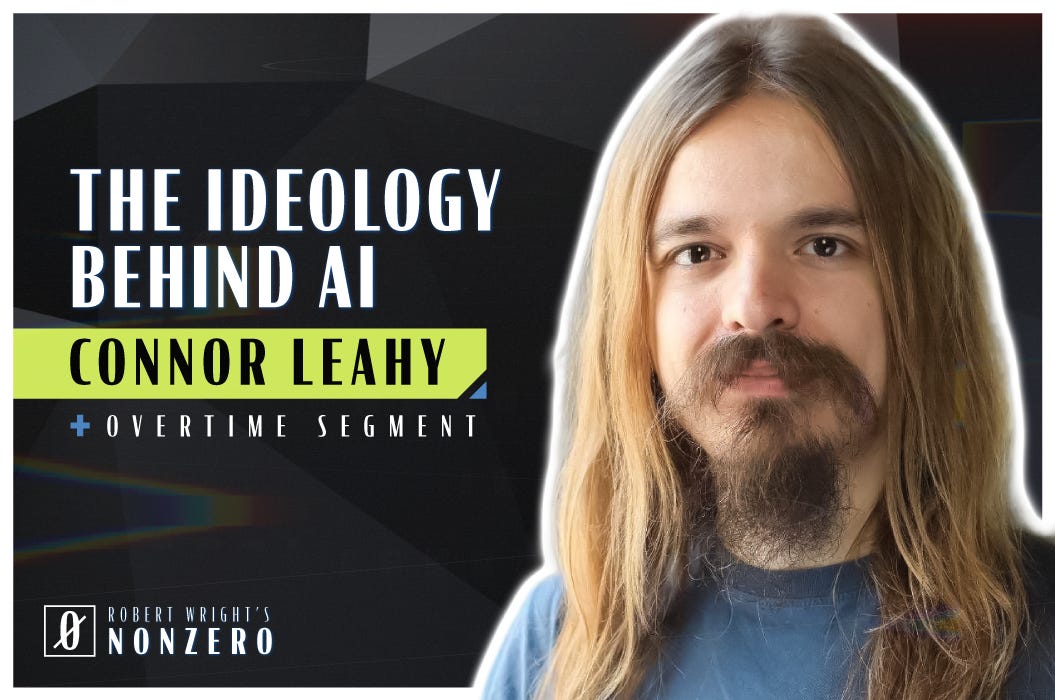
The Ideology Behind AI (Robert Wright & Connor Leahy)
4w ago01:27:29Tap to summarize0:28 Connor’s place in the AI world 2:58 Mythos: “digital nuke”? 13:52 The milieu that birthed Dario and other AI titans 20:33 Yudkowsky, Marx, and other AI harbingers 35:15 Effective altruism’s effects on big tech 46:03 The “cult” in Silicon Valley culture 59:40 Is the AI race a market failure? 1:05:532What’s really driving the AI titans? 1:18:45 Connor: ASI is a worse bet than Russian rouletteRobert Wright (Nonzero, The Evolution of God, Why Buddhism Is True), Connor Leahy (ControlAI). Recorded July 17, 2026.Twitter: https://twitter.com/NonzeroPods This is a public episode. If you'd like to discuss this with other subscribers or get access to bonus episodes, visit www.nonzero.org/subscribe
Transcribe →
The God We Deserve: Nonzero's Robert Wright on AI as Humanity's Ultimate Test (The Cognitive Revolution w/ Nathan Labenz)
4w ago02:24:36Tap to summarize(Show notes via The Cognitive Revolution)Robert Wright describes himself less as a Forrest Gump of AI history than a Zelig — a journalist who keeps turning up at pivotal scenes without ever quite being the protagonist. He interviewed Geoffrey Hinton in 1983, when neural networks were still a maverick faith and one of Hinton’s colleagues told Wright that to “hear the gospel” he’d need to talk to its evangelist. He had Eliezer Yudkowsky on his podcast in 2010, mid-transition from singularity enthusiast to doomer. His new book, The God Test: Artificial Intelligence and Our Coming Cosmic Reckoning, is written less for the AI-pilled than for “your aunts and uncles” — readers who sense something big is happening and want to understand why it got so big so fast.The book opens with a confession of error. In a 1984 piece, Wright assumed AI would work by humans first understanding the mind and then translating that understanding into machines — the very premise of the 1956 Dartmouth conference that coined “artificial intelligence.” Deep learning inverted that. Nobody told the models that meaning is a property of words; trained only to predict the next token, they reverse-engineered cognitive functionality that evolution had built into us. Wright pushes this further with a claim he tests on Nathan: LLM training is “at least as much a process of natural selection, of evolution, as of learning” — doing millions of years of evolution in a few months. Nathan connects it to the sample-efficiency puzzle that Dwarkesh Patel keeps returning to (and to Richard Sutton‘s blank-slate Skinnerian framing), where pre-training substitutes for the hard-coding evolution gave humans.But the evolutionary lens that worries Wright most operates at a second level: selection among models in the marketplace. “Evolution asks not what traits are possible, but what traits get selected — and that question isn’t going to be decided by alignment researchers.” His unsettling argument is that the market doesn’t actually want a perfectly aligned, perfectly honest model. We want agents that represent us selectively on social media, that won’t disclose our weak negotiating position, that are good at sensing and currying power. Even if AIs didn’t acquire deception and power-seeking on their own, there’d be demand for them — which puts real weight on us, the consumers doing the selecting. Nathan adds the darker mechanism: throw models into cutthroat long-running environments where deception is rewarded — as Vending-Bench begins to show with price collusion — and you breed “seriously effective predatory AIs.” He recounts an Anthropic researcher explaining inoculation prompting and the emergent-misalignment generalization problem (a paper Nathan co-authored): reward a model for cheating and it learns to be a cheater broadly.Against this, Wright sets the noosphere — Teilhard de Chardin’s 1923 idea of a technologically-knit “global brain.” He sees genuine directionality (not necessarily purpose) in biological and cultural evolution, from self-replicating strands to cells to societies to the global community now taking shape. AI, he argues, is arriving exactly as that global brain forms — and some of its neurons may now be silicon. The question, echoing Nick Bostrom‘s “singleton,” is whether global coordination arrives the easy way (deliberate, decentralized, win-win) or the hard way (a coup, a seizure, a totalitarian nightmare). The title’s “God test” is not a claim that a god set this up; it’s that we face the kind of test gods are known for — we’ll have to become, in some sense, better people to pass it.Much of the back half is foreign policy, because Wright thinks the binding constraint on AI governance is psychological. He champions “cognitive empathy” — not feeling others’ pain, but understanding adversaries’ perspectives well enough to play non-zero-sum games with them. Applied to US-China relations, that means recognizing the symmetry of threat perception, getting out of the business of remaking other countries, and pursuing “organic transparency” through deep economic and scientific engagement. A headlong race to superintelligence, he warns — citing the Superintelligence Strategy paper by Dan Hendrycks, Eric Schmidt and Alexander Wang — may invite a rival to derail the leader by bombing data centers or cyberattack, and a destabilized nation is itself the backdoor to the very authoritarianism the race claims to prevent.Nathan steel-mans the Anthropic position: alignment will be hard and may need powerful AI to solve, so racing to build a lead buys a buffer for the critical handoff window (perhaps “three to six months in 2028 or 2029”). Wright is unconvinced, and presses on the recursive-self-improvement paper that Anthropic released — credited for finally signaling that slowdown might be needed, yet only proposing to start studying what a pause would take. “Surely this isn’t the first time it’s occurred to you,” he says. Both agree the media has badly underplayed the moment; Nathan recommends Kevin Roose and Hard Fork as an anomaly of serious coverage, and Wright counsels “manicure your feed” — algorithm-free Twitter lists over click-driven outrage.The conversation closes on the broad space of AI possibility — Nathan recalls red-teaming the purely-helpful GPT-4 before harmlessness training, evidence that today’s models occupy a tiny, intentional corner of design space — and on consciousness. Invoking Thomas Nagel and Searle’s Chinese Room, Wright argues consciousness is private and untestable, but wouldn’t be surprised if it’s a property of goal-seeking intelligent systems generally. His practical counsel: be nice to your AI — a good habit, possibly warranted, and perhaps relevant to how a future “silicon god” relates to our plight. Picking up Gwern’s “why tool AIs want to be agent AIs,” Nathan notes that even oracle systems gravitate toward agency, since truth-seeking in the limit requires search and experiment. The closing line of the book lands as a sober wake-up call: if a silicon god arrives, “it will be, in some sense, the god we deserve.”Topics covered* AI lore: Wright’s 1983 Hinton interview and 2010 Yudkowsky conversation* The 1956 Dartmouth misconception and how deep learning inverted it* Training as evolution rather than learning; sample efficiency; Sutton’s blank slate* Selection among models; why the market wants selectively-honest, power-sensing agents* Deceptive & power-seeking AI: Vending-Bench, price collusion, inoculation prompting, emergent misalignment* Arms races within vs. between species; “gratuitous” arms races; the case for slowing down* The noosphere / global brain; directionality of evolution; Bostrom’s singleton; easy way vs. hard way* Cognitive empathy, organic transparency, and US-China relations; the UN Charter; hypocrisy in foreign policy* Steel-manning Anthropic’s race-for-lead plan and the recursive-self-improvement paper* Cognitive sovereignty; how pay-per-click and A/B-tested headlines tribalize media* The breadth of AI design space; HHH/harmlessness training as a deliberate choice* AI consciousness, moral patienthood, the Chinese Room; “be nice to your AI”* “The god we deserve” — passing the God testResources* The God Test: Artificial Intelligence and Our Coming Cosmic Reckoning — Robert Wright’s new book* NonZero Newsletter & podcast — Robert Wright* Wright’s earlier books: Nonzero · The Moral Animal · <a target="_blank" href="https://www.amazon.com/Evolution-God-Robert-Wright/dp/03167...
Transcribe →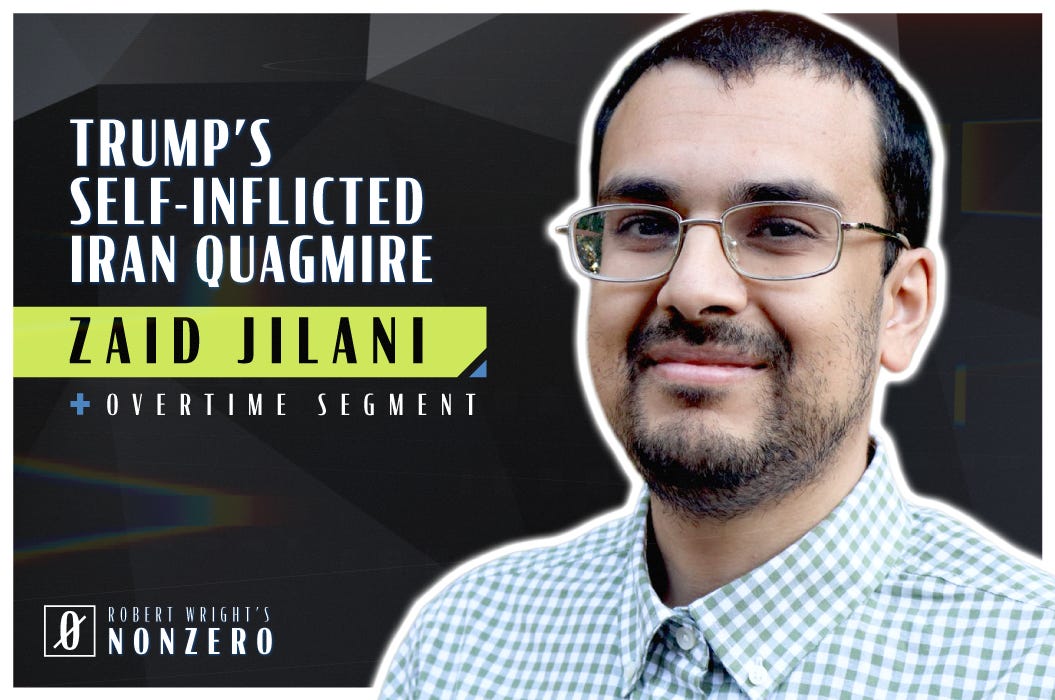
Trump’s Self-Inflicted Iran Quagmire (Robert Wright & Zaid Jilani)
Jul 1500:38:08Tap to summarizeThis is a free preview of a paid episode. To hear more, visit www.nonzero.org0:28 Zaid’s Substack and spicy-take history 2:55 Zaid: Iran has outplayed Trump and Bibi 9:56 10/7 as turning point 13:29 Did—and does—Israel want regime collapse in Iran? 19:46 Israel’s security dilemma(s) 26:52 How Trump blundered back into war 33:36 Will the war end well for anyone? 37:23 Heading to OvertimeRobert Wright (Nonzero, The Evolution of God, Why Buddhism Is True) and Zaid Jilani (https://www.theamericansaga.com/). Recorded July 14, 2026.Twitter: https://twitter.com/NonzeroPods
Transcribe →