← Russian Roulette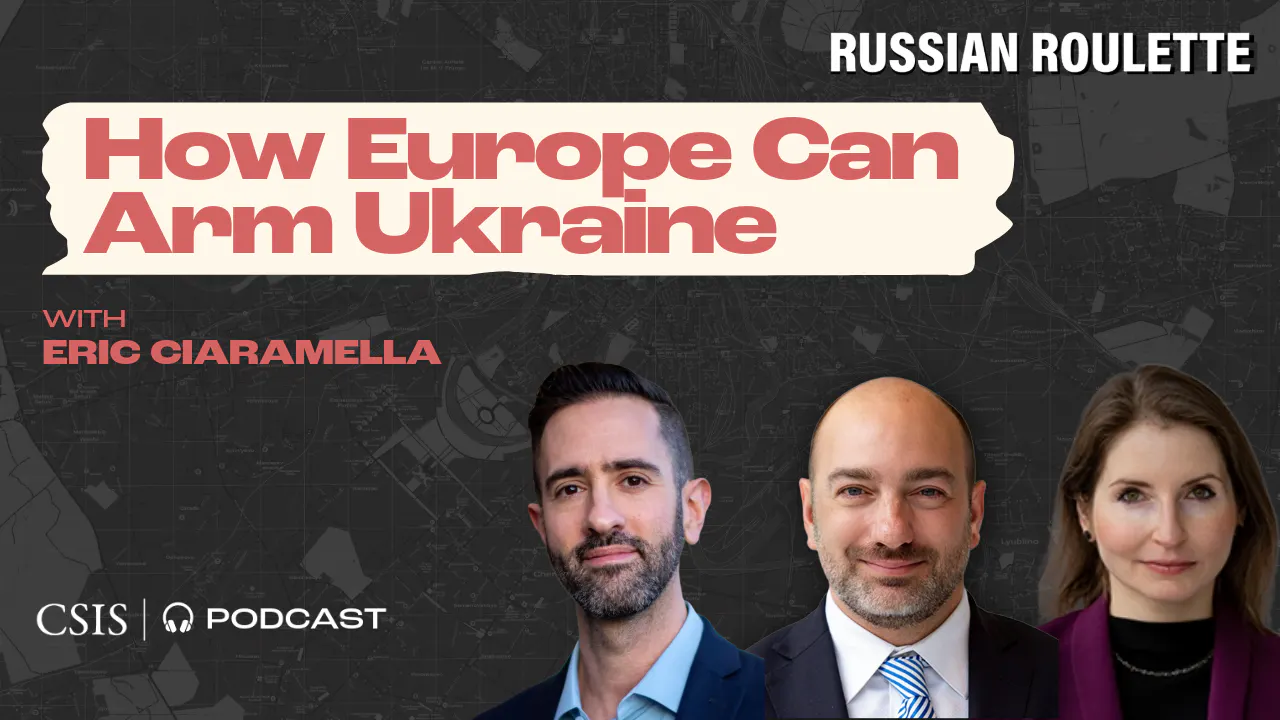
Russian Roulette
Eric Ciaramella on How Europe Can Arm Ukraine
00:47:27
Eric Ciaramella of the Carnegie Endowment for International Peace returned to the show to discuss his recent article with Sophia Besch on the ways that European states can support Ukraine militarily without the involvement of the U.S. Max and Maria asked him about his piece, the funding questions behind its ideas, and Eric's overall assessment on peace negotiations with Russia.
Loading summary
Transcript30 lines
- [00:07]
A
Welcome back. I'm Max Bergman, Director of the Stewart center and Europe Russia Eurasia Program at csis.
- [00:12]
B
And I'm Maria Snigavaya, Senior Fellow for Russia and Eurasia.
- [00:16]
A
And you're listening to Russian Roulette, a podcast discussing all things Russia and Eurasia from the center for Strategic and International Studies.
- [00:31]
B
Foreign.
- [00:36]
A
Hello everyone and welcome back to Russian Roulette. I'm Max Bergman here with my co host as always Maria Snagovaya. And today we are thrilled to welcome back Eric Charamela to the show. Eric is a Senior Fellow in the Russia and Eurasia Program at the Carnegie Endowment for International Peace where he focuses on Ukraine and Russia. Previously, Eric served as a Deputy National Intelligence Officer for Russia and Eurasia, as at the National Intelligence Council. And before that he served as Director for Ukraine on the National Security Council staff and then as Acting Senior Director for Europe and Russia. Lastly, Eric has also served as a Senior Political Analyst at the Central Intelligence Agency where he focused on Europe and the post Soviet space. Eric, welcome back to the show.
- [01:20]
C
Great to be with you, Max and Maria.
- [01:22]
A
So Eric, we wanted to have you back because you have a really excellent piece with your colleague Sophia Besch, also a good friend of the show, in the pages of Foreign affairs for all our listeners. The piece is titled Fortress Ukraine How a Coalition of the Willing Can Rearm Kyiv Without Washington. And for those who are interested, we have a link available in our show notes. Eric, maybe you could please outline what was the main thrust of your argument here? What prompted you and Sophia to write this piece?
- [01:51]
C
Thanks. So what prompted us to write this piece is that we're almost at the year mark of what has been a really massive European effort to wrap their arms around Ukraine in this era of greater U.S. unreliability and erratic foreign policy and specifically the European diplomatic initiative to create what's called this coalition of the willing and develop options for Ukraine's long term security that could be injected into any peace deal if the ongoing negotiations lead to one. What's been interesting to watch is how seriously many European leaders have taken these conversations. There's been extensive talks, not only at the political level but among military leaders really diving into the weeds about how to organize what they're calling a multinational force for Ukraine, a reassurance force, a deterrence force. Been called a lot of different things, but the idea that if there is a ceasefire, there would be some European troop deployment going to Ukraine to work on things like supporting Ukraine's force regeneration and reassuring the population, maybe protecting some critical infrastructure it's had a bunch of different sort of permutations in the public narrative, but this has been the main thing that's been talked about and touted, particularly by the British and French who are leading this effort. This all fits into the wider conversation that we've been having now for four years of this war about Ukraine's long term security and what's been called security guarantees. Although that's. We could talk about this a bit more. Sort of not probably the right term to be thinking about, but basically, if the war stops or pauses, how do you make sure that it doesn't happen again? And this is the current, at least European response to that conversation in the context of President Trump's really urgent push for these talks between Russia and Ukraine aiming towards a ceasefire. So that's all the context. What Sophia and I wanted to argue was that, you know, all of this is good, laudable, admirable. It's great to see the Europeans stepping up, having serious conversations about military planning in, you know, not necessarily with the United States out of the room, but with the United States not leading the conversation and really kind of kicking the tires on what they can do. That's great. At the same time, the entire policy proposal and idea here, particularly when it comes to the multinational force, is dependent on a cease fire, which of course is dependent on Russia agreeing. So Russia, by extension has a veto over this entire policy and concept for Ukraine's future security. So what Sophia and I wanted to reorient the conversation about security guarantees into is to talk about what can we do now, what can we be doing, whether or not a ceasefire is reached, some sectoral ceasefire, a general cessation of hostilities, or the war just continues, what can we be doing now to build Ukraine's capabilities and help them transition from this day to day, week to week, month to month survival mode, where they're scraping the bottom of the barrel and going around hat in hand to different European capitals, ask for this funding package and another funding package. How do we have a more cohesive and longer term plan for what will be the central element of deterring a future Russian attack, which is the Ukrainian armed forces. And so we explore a bit there the aspects of security assistance, the organizational and bureaucratic things that would need to be brought into place so that you can match this strategy with the day to day work. And then the resourcing question, which I think is still the big outstanding one, especially now that we have the Hungarians blocking this 90 billion euros loan from the European Union. So that's the Basic argument. Happy to dive into detailed elements there.
- [05:57]
A
Yeah, no, it's. It's a great piece. Really recommend everyone check it out. I think we'll maybe get into the security assistance side in the second half of the conversation. I want to maybe level set on, on where you see negotiations in the coalition of the willing. I mean, my view maybe to be somewhat cynical about the coalition of the willingness was that there's, we got to bifurcate the diplomatic play in the military side and that the diplomatic side, you know, this time a year ago, the British and French are pushing this. I think it has a lot of diplomatic benefits for both countries. They don't have a lot of money, so they can't really support Ukraine financially in the same way that they would like to. They also were able to use the coalition of the willing as sort of a way to demonstrate to the Trump administration that, one, they're tough, you know, they're ready to deploy. Two, they back his ceasefire efforts. But that has spun up this whole military effort where I don't quite see the political will to ever really deploy the force into Ukraine, in part because, as you noted, Russia could veto it. And if Russia said yes to this force, I think I'd be very concerned that you've put a bunch of NATO troops that aren't really that well equipped and that that might be a target for the Russians in some ways. But it seemed like a force that, that is not really going to be deployed. But that has been a huge focus of the last year of European political, military, diplomatic focus and energy. And it seemed like what you're trying to do with this piece is try to shift the conversation to, okay, some. A lot of what was happening on the military side was useful, but we need to refocus it. Is that.
- [07:33]
B
How.
- [07:34]
A
What do you think of that characterization? Where do you see this coalition of the willing playing right now diplomatically? Is there a need to kind of shift the frame over, over how it's structured?
- [07:45]
C
Yeah, I think, you know, there is a need, and I even see this starting to come out in a bit of the, you know, rhetoric and public communications from various leaders. But a what is it not going to be? It's not going to be a peacekeeping force. It's not going to be an interposition force that gets deployed to the front and is the thing standing between the Ukrainians and the Russians going to war again, it's not going to be combat backup, as far as I understand. It's not going to be brigades deployed, you know, 25 to 50 kilometers from the front for quick reaction to go fight the Russians if they try to, you know, make an incursion along some part of the line. I think what it could be, realistically, is one, training and advising. And the training part, again, Europeans have been doing quite well on NATO territory. Logistically, it is challenging to get Ukrainian troops out of the country, and there have been some successes and some notable failures in that. But what we hear increasingly is that there's a disconnect between, you know, NATO training doctrine and what happens, you know, just general rules of engagement and training on NATO country territory and what the Ukrainians actually need and what the battlefield actually dictates in terms of training. So the idea that you would relocate this training effort to Ukrainian soil where you can have NATO trainers, you know, co pilot with Ukrainians who actually understand the battlefield and design training that integrates, you know, NATO operations and concepts into what it is that the Ukrainians need, I think that would be, you know, much better. Not to mention the logistical fact that it's a lot easier for Ukrainian troops to go to some other part of the country than leave number one. Number two, the, the advising part, and I think this is key. Ukraine has had significant challenges with force management, manpower equipping across the force. There is a huge disparity between different units. You have some units that are extremely well equipped, trained, supported, have really good communications, and have naturally Ukrainians forming lines out the door to join these units because they're known to be highly effective with really good commanders and with the best kit. And then you have other units that are completely on the opposite end of the spectrum. So fundamentally, that is a question of broader force management. And the idea of the advising piece is that you would have, you know, NATO planners embedded at different levels of the Ukrainian force to help them think about their force and integrate this question of manpower, which is not only about getting more people in the door, but about producing real capability that is integrated and effective at the end. And there is a challenge there, and the Ukrainians recognize that. I think the problem is that they're in such a acute firefighting mode, understandably, given that they're still in the middle of the war. So there hasn't been this attention put on, you know, kind of the longer term and the sustainability and the kind of credibility and effectiveness of the force. So that's the second piece. So training, advising, and then the third part, which is, you know, it straddles the line between, I think, these training and advising and something that's a little bit More operational, but thinking more about air defense and coastal defense and things like that, and Ukraine's overall defensive strategy when it comes to fortification construction, so on and so forth. So you can imagine a future European force that can bring in some army engineers to help the Ukrainians construct better and deeper fortifications along the line. You can imagine them bringing demining specialists to help them more quickly demine along the Black Sea coast. You can imagine them, you know, working in country to improve, you know, air defense. You know, the operational understanding of what it is that the Russians are throwing at them every day, and then different kinds of capabilities and then integrating that knowledge and that sort of day to day sort of, you know, understanding of the airspace into this technological innovation where we've seen actually the Europeans lean forward quite a bit. Not only the Danish model, where, you know, you have the Danish government supporting the Ukrainian defense ministry to buy Ukrainian kit made in Ukraine, but you also have the Dutch, you have the Brits, the Germans, who are doing all kinds of joint ventures and so on and so forth. But all of that to be not one off, but integrated into this broader strategy that is focused on developing actual capabilities which are going to take a few years. When you think about the R and D cycle, the production, the scaling, the training that would go into all of that.
- [12:42]
B
Thank you very much, Eric. And one of my, my understanding of the issues that are faced by the countries in Europe is that every single one has a different standard, right. And they also are concerned about preserving the national sovereignty and therefore some of the idiosyncrasy that goes into military and somewhat inevitable. How do you envision them circumventing these challenges vis a vis Ukraine, Right. Once they supposed to standardize and centralize some of their equipment, training and whatnot.
- [13:10]
C
That's a great question. And I think that's where, you know, NATO and the EU and potentially this coalition of the willing have a role to play. You know, NATO traditionally has been the venue through which European countries seek to adopt unified standards on, you know, weapons and procurements and whatnot, to again meet the various annual national programs and so on and so forth. And then the EU has been the mechanism through which a lot of the funding comes through and the incentives for joint procurement development, so on and so forth. But you're totally right that, that a fundamental problem here is you have 25, 27, 30, whatever, however you count it, different procurement, arms and defense industries, which are very intensely protected and guarded by the national leadership. And that is it. That is, I think why in the case of Ukraine. Sophia and I are arguing that you have to take the elements that we have currently that are working quite well through NATO, through the EU bilateral mechanisms, the Ukraine Defense Contact group, all of that. And you really need this unified kind of strategic oversight and political guidance that can help to mediate between a lot of the competing interests. I mean, it doesn't make sense. We have this just brief example in the piece, but it doesn't make sense that you've got multiple partners of Ukraine going to Ukraine and saying, oh, your future air force needs to have this Gripens, Rafales, F16, whatever it is. I mean, the Ukraine. First of all, maintaining an air force is extremely expensive. So this is ultimately going to fall to a large extent on Ukraine's external partners to fund. We've seen how hard it is for them to get pilots trained just for the small number of F16 that have been provided. We need to think rationally and strategically about this as a 5, 10, 15 year project and think what is the capability that is best needed in the Ukrainian environment? How do we build a pipeline towards that? Not, oh, here's a bunch of money that's coming through in this massive, you know, new EU funding mechanism. We each want a piece of that pie. I want French industry, I want Swedish industry, I want British industry to all get a piece of it. Everyone will get a piece of this because each European country has a role to play. But you need to rack and stack the priorities here and understand what makes sense. And that is a conversation that needs to be had together jointly with the Ukrainians. And we've had a chicken and an egg problem for the past several years, which is that, you know, we collectively go to the Ukrainians, we try to talk about their future force design. And we've, you know, the us, the Brits, the Germans have gone through several iterations of this. And the Ukrainians then say, well, how do we design a future force when we only have two months of Runway with support from you guys? And we're constantly asking for enough to just get us through this next 6 to 12 month period. How can we think about 5 years from now? And then it goes back to the Europeans saying, well, we can't commit the resources until we know what your plan is. And so you're never going to break that cycle until you have everyone sit down and really do this kind of intensive planning and build the bureaucratic structures that's going to manage this problem in tandem with the day to day fight.
- [16:39]
A
Let me just follow up quickly on that point because Part of this, you could say, like, look, the Ukrainians should develop their plan relying on the Europeans when they're just sort of a mess with 27 different EU militaries and different procurement offices and different industrial priorities. It's just, you know, to point to ask the Europeans to come up with a coherent defense plan is something that they can't really do themselves without the United States presently. So I guess the question then, is this an issue that Ukraine should really be thinking about this in terms of if you come up with a plan that is longer term that this war is going on to, you know, a 2030 plan, or 2029, 2028, whatever year that is a little bit further out. And you, you go to the Europeans and say, this is what we need to get funding to do, and these are the capabilities that we want. Is that one way to do this? Or is it just if you're Ukraine and you're fighting a war and you're focused on, oh, my God, the guys at the front are running out of artillery to then do some sort of, you know, blue sky planning about 2029, this is very hard. So maybe that's too, too hard for the Ukrainians to do. That's sort of the conundrum, it seems, is that the Ukrainians are only looking at what's front of them. The Europeans are disorganized about how to actually do military planning in the US which could do this is sort of out of the game.
- [17:58]
C
Totally. And I think that's why these, you know, exercises haven't worked in the past, because the Ukrainians did see them as just blue sky kind of. Why are we doing this thinking? Because we've got wolves closer to the shed here. And I think that's where the Europeans need to demonstrate, you know, a real value proposition to this, which is you're not doing the planning because we're, you know, you're in school and we're making you do your homework. You're doing the planning so that we can allocate and mobilize the resources that are necessary to build this ship as you're sailing it. And I think, you know, in an ideal world, you'd probably have a kind of a small cell, a very senior, seasoned people in Ukraine who kind of report to the president, the defense minister, you know, Commander Syrsky, and have their backing to engage in this kind of intensive effort. There are people like that in the system who can do it, but they need to have the political kind of top cover from Kiev, and then you would have this team on the European side that represents at least enough of the breadth of European interests. It's not going to be every country having a seat at the table table and having this very, you know, formulaic. Everyone's got their flag and their two minutes of intervention and then you go through two hours and nothing is done. You kind of really need just high level envoys working it out and then developing this plan and taking it around to the different capitals and to Kiev and saying like, this is the way, you know, this is what we think the Ukrainian army in 2030, 2035 can and should look like under our best analysis of what the disparate scenarios might be here. And this is what the investments you need to make now in order to get to that place. But I think you're exactly right that like the impetus for this and again, that's why, you know, think tanks that we're not representing any particular government, we're trying to put the idea out there in the hopes that it sparks some interest in both Ukraine and European capitals and even in the US government where there is still a lot of this work, frankly going on. I think the criticisms that, you know, the US is completely absent from this is not quite right at a political level for sure. But on a day to day basis you look at European Command and Security Assistance Group, Ukraine, sag, you, General Buzzard and so on. I mean they're doing a huge amount of work on a daily basis and can be brought into this effort. The problem again is that you just have these kind of disparate groupings and everyone's got their narrow focus, understandably driven by the battlefield, which is still super urgent. But we have to zoom up one level and create the structures that then lead us to this policy outcome that's a little bit more sustainable.
- [20:51]
B
Thank you, Eric. And this vision that's really in a lot of ways reassuring. I think it does demonstrate the path forward for Ukraine. Would you mind perhaps in order for us to assess the sustainability, the feasibility of this vision, perhaps you could tell us to what extent it compares with past experiences. For example, like Israel or maybe Finland in the past before you joined NATO. Like to what extent the vision that you're offering is actually comparable to those examples and what is not comparable?
- [21:17]
C
Yeah, I think there are some comparisons that can be made to the extent that, you know, both of those countries have had a long standing strategic culture of self reliance and focus on defense. In Israel's case, you know, though more reliant on US aid certainly, you know, since The Yom Kippur War, but with Finland prior to Naito, you know, definitely their own defense industry, their own, you know, kind of planning where they really couldn't count on any other countries to back them if, if the balloon went up. So, you know, you have that mindset, that seriousness, I think that permeates the political culture, you know, the mandatory service, so on and so forth. But I would say that the, the analogies sort of end there. And the Ukraine situation is more complicated by a long shot, I think, because of the asymmetries in power and resources between Ukraine and Russia. The fact that this is a war that's currently going on and has been draining Ukrainian resources for four years makes all of this planning much, much more difficult. And, you know, we want to be clear and acknowled, acknowledge that. And the fact that unlike Israel, which had one main partner for many years, and Finland, which had kind of half, maybe with Sweden, Ukraine has dozens of partners, all doing different things and all trying their best and with very good intentions. But going back to what Max was talking about earlier, you know, we don't quite have the institutional structure to manage something like that. There isn't total overlap between the EU and NATO, you know, and even within those structures, Ukraine is not a member of either of them. So each organization has a huge interest in Ukraine, but they're not a member. So, you know, you really need to kind of take what you have that's working and probably create something a little bespoke for this situation. All of which is to say it's doable. It's not like we're talking about creating a parallel NATO or anything like that. We wouldn't want to, but sort of a new Ukrainian defense and deterrence pact organization kind of thing, which is not some clunky consensus based organization, but probably takes a lot from the coalition of the willing to say these are the countries that are most interested in sticking with Ukraine for the long haul. How do we synchronize these efforts better and create the dynamics where Ukraine can plan with a longer time horizon? And that again gets to the resources question, which to me is not quite there yet.
- [24:03]
A
I want to maybe go a little deeper on some of the security assistance questions. I recently had a piece in Foreign Affairs. It had the title Europe Needs an Army. I think if I had to do it over again, I would say the title should have been Europe Needs a Pentagon. In part to address what you're talking about, which is this sort of organizational aspect. In your piece, you cite the Economist estimated that Ukraine will need close to 390 billion, let's just say 400 billion between now and 2029, both in economic and military support. On the one hand that sounds like a really big number, but it's also, you know, I think 0.02% or 0.2% of, of the EU's GDP. And what we've seen recently is the EU in December. No one really thought that this was, that this was on the table. You know, this is sort of a plan B that no one realized that there was a plan B. When the, when the unfreezing Russia's assets are, or doing a loan based off Russia's frozen assets where they announced that they were going to give Ukraine a 90 billion euros loan. Hungary is currently blocking that. That's causing a lot of consternation right now. I don't have the kind of panic level because, you know, the eu, this is where EU lawyers are amazing and they tend to find a way. And I think also we're in a period where it's another six weeks until the Hungarian election and then I think we'll be in a different place. But I think the EU will find a way to fund this. But maybe we could talk about what, what do you think this should be funding? Right, so how do you, how do you sort of break this up? The, the money that is needed between the long term and the short term? I mean, part of me thinks that this is really where the role of the EU playing quarterback makes a lot of sense. If they're going to conjure the money, they can be in charge of sort of making the decisions. And have the Ukrainians come in and say, well, we want gripen fighter jets actually instead of the French Rafales. That then enables the EU money to flow. But should it be focused on things like fighter jets? Or how does the Ukrainians and the Europeans use this money effectively to build that sort of longer term force that you're talking about? Is this into air defense? Or are you starting to invest in the kind of maybe the next generation weaponry that is, is currently being planned or iterated on the battlefield right now? How do you just conceive of getting to that next force? Because I think in some ways it's much easier to be like, well this, you know, we currently build this truck in Finland, so that could be useful for Ukraine. Let's just buy more of that off the shelf. So how do you kind of balance the off the shelf verse? We want to get Ukraine to another level so that it can fight The Russians and have the upper hand.
- [26:48]
C
I think any estimates at this point are very, very back of the envelope because it's going to require a level of planning that, you know, certainly Sophie and I were not able to do in our piece, but, you know, give kind of pretty general ideas of at least the scale here. And like you said, it's a big number, but it's not an impossible number to achieve. What I think needs to be done is, number one, to find a way to cabin off specific funds that go beyond what is needed to sustain Ukraine in the current fight. Procuring munitions, air defense interceptors, all of that. And you would have some portion of the annual defense aid, 20%, something like that, whatever it is, devoted to, you know, this kind of future force and longer term procurements. And again, within that, I think some of it probably needs to be off the shelf things from different European countries because that will make sense for whatever it is that Ukraine needs in terms of, in terms of mobility, in terms of air defense, coastal defense, whatever it is. If there is a good off the shelf solution, it probably makes sense. And you know, if there is a way to use this future force discussion and the monies that could be, you know, reserved for that as a way to also prompt different European firms to expand their production lines because they see that this is going to be a long term acquisition, over five, 10 years, etc. Etc. That would be great, number one. But number two, I think the sustainability question ultimately comes down to Ukrainian industry. And Ukraine has shown a remarkable ability to regenerate but really reimagine its own defense industry, which was once the, the jewel of the Soviet Union and had fallen into disrepair. And for, you know, the couple of decades after the collapse of the Soviet Union, its main customer was Russia. And you know, that was severed in 2014. And you had a lot of these industries that languished and were very legacy. But you know, Ukraine has been able to take a lot of that engineering and technical expertise and know how and create this highly innovative, decentralized industry which has focused really on drones, but can do a lot of other things. And the Danes were the first to recognize a lot of potential in there and kind of broke the. I mean, it wasn't really a taboo, but they sort of pioneered the idea that a European country can go in and make targeted kind of impact investments and had a lot of success with basically juicing up the Ukrainian indigenous production. Other countries have followed suit. I think you need to do that in a more systematic way and help the Ukrainians think about again, as they're transitioning from survival mode to sustainability, how do you go from having all of these artisanal underground workshops that are dispersed across the country to having something not necessarily centralized, but something that can be scaled for the production of more of increasingly complex systems and that will include a tech transfer piece as well, which some European countries have already been leaning in on, like the Brits for example. And so again, I think that you only generate momentum and incentive for these conversations if you can show that there's a check there waiting to be cashed. And so it really does all flow from the resources. The resources have to flow from a general framework of a plan. I mean, you need to know that there's something coherent enough for you to buy into. But then once you start, you know, getting the Europeans to sign up to be part of this, then you really juice these conversations about what do we want the Ukrainian defense industry to look like, where are growth areas, where are areas where we need to consolidate, what are the main technological gaps that we need external support for, and so on and so forth. And like you said, how do we balance that with what can we just procure off the shelf? That makes sense because Ukraine ultimately is no country makes everything that they need. So there's a balance in any kind of national procurement strategy. But again, I think the sustainability question here you need to have. And this was part of the Israel model, I will say, just going back to that, I mean, baked into our aid to Israel when we had these 10 year memorandums that have been renewed at, you know, again, 10 year increments was this thing called offshore procurement, which has since kind of tapered off. But the idea was again, starting in the 80s and early 90s that a portion of US aid, 25% I think, would be reserved for Israel to spend on domestic industry. And Israel was able to use that to create one of the foremost, most innovative, cutting edge industries in the world from which the United States now procures certain systems. So that's a model. I mean, it makes sense, it could be used. There is a return on investment there. But the fundamental problem is you've got so many different allies and partners, each trying to help where they can. And it is not really yet strategic.
- [32:07]
A
Can I ask about maybe the, the political hot potato question when it comes to weapon systems tends to be long range strike cruise missiles. The ATACMS conversation, you know, here in Washington, you know, I, I could see this sort of both ways. On the one hand, Ukraine is developing its own indigenous form of long range strike. This, this sort of famous pink flamingo which may be, you know, somewhat overhyped, but will, but we'll see it's making maybe some effects. You know, I guess the question here is should Europe be really investing in Ukrainian long range strike or its own and then transfer that and how do you see the long range strike, long range cruise missiles that you know, could strike deep into to Russia? Is that something, I mean, is that a priority for NATO right now, recognizing they have air defense limitations? The idea is that they're going to invest in long range strike and they would strike deep into Russia if Russia were to attack. But, but that seems like there's still a hesitance to transfer many of these weapons systems. How do you see, see that playing out in perhaps a 2027, 2028 strategy?
- [33:14]
C
I think long range strike is going to be critical to any Ukrainian defense and deterrence strategy going forward. No question. And the trajectory that Russia is on, churning out ballistic and cruise missiles and drones on a monthly basis, I mean, I was reading earlier today there again that the Ukrainians are saying that they can actually show that many of the missiles that are striking Ukrainian cities were manufactured in the last 12 months. So Russia is ramping up this production. That trend line we have to just accept is going to continue and probably accelerate. So that does raise an air defense component. But then it also raises the kind of mirror punishment which Ukraine has devoted a lot of resources to and has shown some really innovative outcomes when it comes in particular to long range drones. The missile program is much more expensive and much more complex. I do think you're right. It's still kind of too soon to tell whether this Flamingo or any other long range Ukrainian missile really is kind of the thing or if it's been a little overhyped. But certainly the drones I think have a lot of potential. And I do think because of the political limitations in Europe and the tech transfer and the, the speed or lack thereof at which European manufacturers can produce these things. I think going big, betting big on the Ukrainian solution is probably the right solution here for Ukraine. Again, you've got other national rearmament programs in Europe that they may want to procure their own solution or they may want to procure a Ukrainian solution in the end, some of the Scandinavians or whatnot. But I think for the Ukrainians, investing in their indigenous capacity is probably the way to go on this question.
- [34:59]
B
Thank you, Eric. And another question, the elephant in the room, of course, the funding issue. We at this point I Just used to hearing the news from the eu, struggling to extend another line of funding for Ukraine and countries like Hungary consistently vetoing even less financially significant EU endeavors. So where do you envision the findings going to come from? How to make this sustainable, you know, how to convince all the actors to sign up for this without blocking disinvestment?
- [35:32]
C
Yeah, it was initially hopeful when the EU found this last minute 11th hour solution that no one was really talking about in December and managed to skirt the Hungarian and Slovak unease with it by, you know, basically allowing them to greenlight it without participating in it. And what I thought, and maybe still think here, is that that is a template, maybe going forward for a core coalition to raise funds and, you know, invest in some of these longer term projects. The fact that Hungarians have found a way to hold it up again makes me a bit more pessimistic, but again, we'll see. I think like Max was saying, the EU lawyers are very, very good at what they do. And I think they are starting to think about how to create a more agile system that can respond to the real needs of the day. I mean, ultimately, when you look at what the EU was able to come up with in the COVID pandemic, it was a significant amount of cash, recognizing the sort of transformational and serious crisis that was underway. I think this is at that level and should generate, mobilize those kind of resources. You do also have the question of the Russian sovereign assets. I wouldn't want to push that completely to the side. I do still think it's legally complex and you can't really bank on it coming through anytime soon, but certainly people should continue to focus on that. Again, ultimately, when you look at it in the grand scheme of things, and we noted this in our piece, we're talking about every European country raising its aid to Ukraine from 0.2% of GDP to something like 0.4 or 0.5%. It's not ultimately going to break the bank. And if Europeans are serious that the fate of Ukraine is integral to the security of the continent, which I believe it is, if they are serious about that, European leaders need to make a case to their publics that, you know, by funding Ukraine over the long term, we're essentially saving us from having to go to war. You see that in some of the rhetoric, but you don't see it often translate over into the finance ministries, maybe with the exception of some of the northern European countries, where I think there is much greater political consensus there. But I think fundamentally we're going to have to find a way to operate outside of this clunky consensus based decision making where any one spoiler can completely derail the entire plan. I mean that's just, there's no way for Europe to be a geopolitical actor if you've got spoilers like this who can prevent any kind of action. And again, we'll see what happens with the Hungarian election in a few weeks time. That could be the, the main thing that, that changes the dynamic. But in the case that we still have Orban, then I do think the commission needs to be thinking much more seriously about how to find these mechanisms to, to use qualified majority voting or to, you know, allow for the EU to become more multi speed. And it's been, it's been this kind of taboo. But ultimately there is still a core of Europe that cares about Ukraine and wants to move forward and has much more ambitious plans and is being held back by the least common denominator. And that's just totally not sustainable for the long term.
- [39:01]
A
Definitely. I, you know, the one, one just other thought on the funding is that, you know, we've really seen Germany and the Nordics step up. The irony here is, you know, during COVID you mobilized roughly 800 billion euros in the economic recovery fund, borrowed for the first time using the euro. You know, you have a currency, you can use it. The obstacle to that is really Germany that doesn't really want to issue euro bonds. So you have this sort of weird dynamic. Germans really insisting that that was a one off. And so my view is they're going to muddle through, figure out a way forward. The reparations loan is I think still on the table. We'll see how that plays out. Maybe one final question though, Eric, you're a keen observer of Ukrainian politics and of this war, maybe what is your take both on the kind of current state of where this conflict is headed, but also Ukrainian politics and where the Ukrainian public is, you know, is there growing frustration with zelensky? We've seen General Zaluzhny, who's the ambassador now in the U.K. sort of step up and increase some of his criticism of Zelenskyy. Where do you see Ukraine kind of moving politically over this next year and how do you see the war kind of unfolding at least as we are looking ahead into 2026.
- [40:21]
C
So you know, we're living in this moment or Ukrainians are living in this moment of suspended political processes because of martial law. And there is still a wide Ukrainian societal consensus that the formal political process of Elections and campaigning and whatnot needs to wait until after the war. I have not seen any evidence that Ukrainians are changing their view on that because of the logistical security and other challenges associated with conducting an election during a war. That being said, it's wrong to conclude that all democratic sort of disagreements and politics have completely evaporated. I mean, we saw large scale protests last summer over a threat to Ukraine's independent anti corruption bodies, which led to a policy reversal by the President and by the government and ultimately brought us this revelation of this huge scandal late last year which implicated not Zelensky himself, but members of his team and led him to fire his longtime chief of staff, Andre Yermak. So the people of Ukraine and the civil society of Ukraine, which is still very robust and dynamic, can still make its displeasure with the government known. But Ukrainians have become very pragmatic and mature, I would say, in being able to express this dissatisfaction, but not let it turn into a fundamentally destabilizing thing that then makes them more vulnerable to the Russians. So again, I think you can have these two things in, in tandem and require accountability by the government, even when there are no formal electoral processes. I'm not too worried about, you know, what General Zaluzhny is saying. I think it's, it's good to be having these debates. I will say in the wake of Yermak's dismissal, some of the appointments that Zelenskyy have made has made have been, you know, pretty positive in terms of, particularly in the defense and security sector. So bringing Carrillo Budanov, the former head of military intelligence in as the chief of staff, Mykhailo Fyodorov as Defense minister, who was the digital transformation minister and is kind of the father of the drone project. I mean, Budana Fyodorov, they understand the battlefield, they understand Ukraine's strengths and limitations. And I think they could be the types of people who, who you could get to transition from this firefighting mode to something more strategic. So I'm, I'm optimistic there. Final word just on the negotiations, because I think that is the big X factor in Ukrainian domestic politics and certainly in the course of how things shape out over 2026, on the surface, it really does look like the talks are going nowhere. I mean, the Russians are just reiterating their longstanding demands. There's been intense pressure put on the Ukrainians from the Trump White House to make further concessions, especially when it comes to the Donbas. So I think the experts kind of conclude that these aren't really going anywhere. That being said, and I did publish a piece recently on this that was kind of counterfactual and trying to think about what we might be missing here. What I understand, you know, the Ukrainian leadership is taking these talks quite seriously in the sense that they recognize that it is a priority of President Trump and they see that there is. If there were a potential to reach a deal, this would probably be the way to do it. With intense focus from the United States. And the fact that they've brought the Russians into this sort of trilateral format, I think there's still a long way to go. I mean, you know, when you hear Steve witkoff saying, oh, it's 95% done, we just have a couple of eyes to dot and t's to cross. I mean, actually what's left is still the biggest issues of territory and Ukraine's long term security. But I think that there still is a potential, a non zero potential. It's not likely 20%, 30%, that the ongoing talks, the Abu Dhabi Geneva process, could lead to at least maybe some sort of energy ceasefire, sectoral cessation of hostilities. Maybe there's a way to pull something out of that. And so I think it's good that the Ukrainians are putting their best foot forward. They have a very talented negotiating team. They've brought in a lot of good people. I think it has, you know, bought them some goodwill with the Trump administration to show that they're taking it seriously. And let's see what happens. I mean, it does have this perverse effect of leading some Ukrainians to think that maybe peace is around the corner. And then it does dampen, I think, the mood to kind of continue fighting. If you think the war is about to end at the same time, what else are you going to do? I mean, you have to talk while fighting. And in many of the wars, you know, that we've seen over the last 25, 50 years, you realize that actually once there was a sort of settlement reached or a ceasefire, that actually the parties had been talking and fighting for many, many years before. So I think it makes sense to do it. I wouldn't hold out huge hopes, but let's see. And as Budanov says, you know, you sort of hope for the best, prepare for the worst. Plan B, which could be Plan A, is just continue the war and we have to make sure that we have the defense posture and external relationships that enable us to continue. I think it would be naive to put all their eggs in the basket of a peace settlement. And, you know, but they have to do both at the same time.
- [46:03]
A
Eric, thank you so much for that. Unfortunately, we're going to have to end it there. There's a lot more we could discuss and we'll have to have you back as things unfold. Seems like we rarely end this podcast on a somewhat optimistic note, but I think that, I think you you kind of outlined some hope that hopefully these talks can actually result in something. So Eric, thank you so much for joining us. And as always, another big thank you to all of our list for tuning in and we will see you next time on Russian Roulette.
- [46:38]
B
You've been listening to Russian Roulette. We hope you've enjoyed this episode and tune in again soon.
- [46:43]
A
Russian Roulette releases new episodes every two weeks and is available wherever you get your podcasts. So please subscribe to our show, share our episodes online, and give us a five star rating. Also, be sure to check out our our sister podcast, the Europhile, where we talk Europe through a Washington lens. This show is made possible by a grant from the Carnegie Corporation of New York.
- [47:03]
B
Also, don't forget to subscribe to the CSIS channel on YouTube for live and recorded video events featuring leading experts. Finally, you can read all the latest analysis by the Europe, Russia and Eurasia Program at the center for Strategic and International Studies website CSIS.org SAM.