← Russian Roulette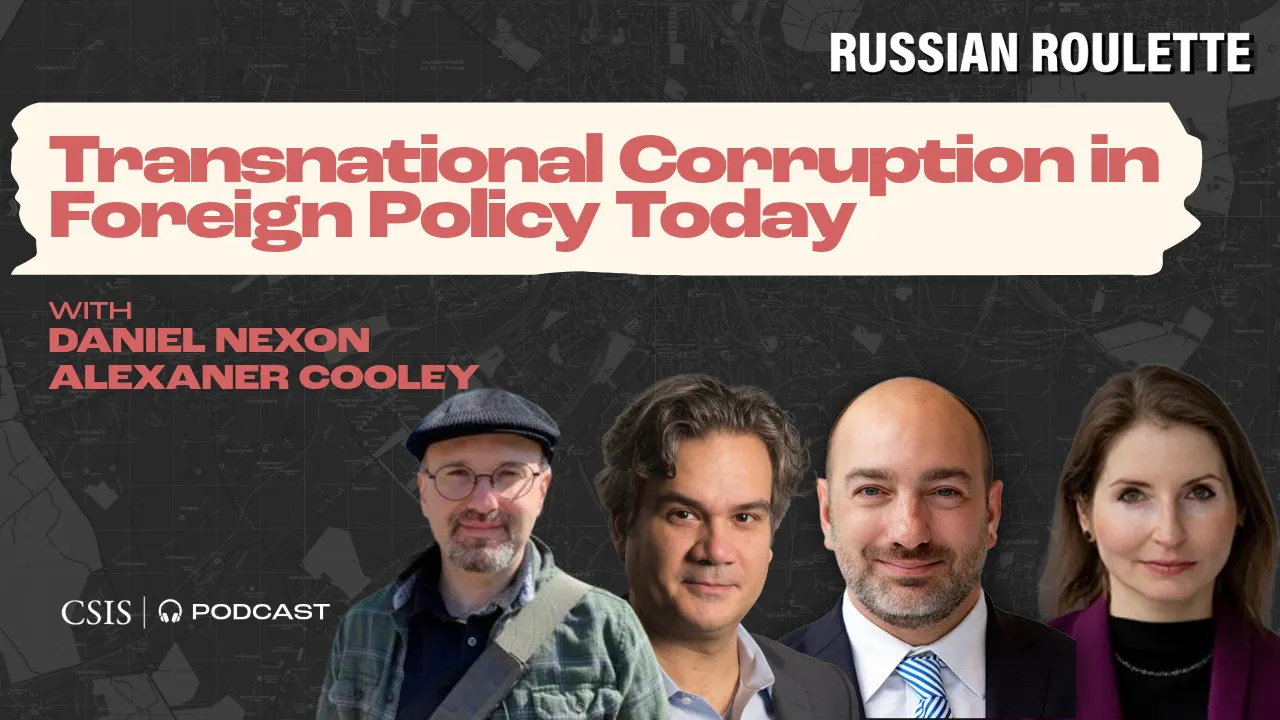
Russian Roulette
Transnational Corruption in Foreign Policy Today
00:53:10
Max and Maria spoke with Alexander Cooley and Daniel Nexon about how authoritarian and illiberal governments leverage transnational corruption as part of their foreign policies and global strategies.
Loading summary
Transcript46 lines
- [00:07]
Max Bergman
Welcome back. I'm Max Bergman, director of the Stewart center and Europe Russia Eurasia Program at csis.
- [00:12]
Maria Snigavaya
And I'm Maria Snigavaya, senior Fellow for Russia and Eurasia.
- [00:16]
Max Bergman
And you're listening to Russian Roulette, a podcast discussing all things Russia and Eurasia from the center for Strategic International Studies. Hello everyone, and welcome back to Russian Roulette. I'm Max Bergman, here as always with my co host Maria Snagovaya. And today we're joined by Alexander Cooley and Daniel Nixon for a conversation about the dangerous role played by kleptocracy and corruption in contemporary foreign policy, in particular in Russia, and how that's impacting the negotiations over Ukraine. Alexander Cooley is the Claire to Professor of Political Science at Barnard College. From 2015 to 2021, he served as the 15th of Columbia University's Herriman Institute for the Study of Russia, Eurasia and Eastern Europe. His most recent book, co authored with Alexander Dukalski's, came out last summer and is titled Dictating the Agenda the Authoritarian Resurgence in World Politics, which is available from Oxford University Press. And you can see the link in our show notes. Welcome to the show, Alex.
- [01:23]
Alexander Cooley
Thanks. It's great to be with you.
- [01:25]
Max Bergman
And now to Daniel. Daniel Nixon is a professor at Georgetown University with a joint appointment in the Department of Government and the School of Foreign Service. In his academic work focuses on international relations theory, power politics, empires and hegemony and the international order. Daniel, thanks so much for being here with us as well.
- [01:43]
Daniel Nixon
It's great to be here. Thanks for having me.
- [01:45]
Max Bergman
And today our focus is also going to be on discussing a recent piece that Alex and Daniel co authored in Foreign affairs titled the Age of Geopolitical Power, Private Gain. The link to the piece is also in the show notes. So let's get to it. Alex and Daniel, let's just start maybe by hearing your piece in Foreign affairs, maybe you could give us sort of the top line and what sort of motivated you both to write it. ALEX maybe I'll start with you and
- [02:11]
Alexander Cooley
then to Daniel yeah, so I myself as a scholar before I started teaming up with Daniel, did a lot of work on post Soviet politics and in particular post Soviet Central Asia, Eurasia. And I was particularly interested in how these areas and these countries were becoming integrated into the global economy, into sort of global transnational networks that supported and bolstered both their kind of usually single party regime rule. But also after a number of different scandals and investigations came out, how many of these sort of kleptocratic grand corruption network that were integral to scandals like Kazakhgate, or questions about Gulnara Karimova, daughter of the former president of Uzbekistan, how they all created these networks of intermediaries, advisors, offshore companies, reputation launderers that essentially kind of whitewashed what they had done until they were held accountable by the US Legal system. So this kind of notion of a kind of a transnational network of corruption, right, that, that, you know, corruption isn't just about someone taking a bribe, you know, in exchange for access or a contract. It's got this entire international architecture and scaffolding, right, that makes it operate. So what we've seen over the last, I would say 15 years is that progressively some of these modes, and they do link up with illiberal forms of governance, have started to move westward. And that we see many aspects of this replicated certainly in Russia, but certainly in a government like Viktor Orban's. And increasingly we are seeing this sort of kleptocratic mode both in Western politics, including in elements of President Trump's foreign policy and the way that President Trump is utilizing some of these sort of networks and also forms of international ordering in areas like post conflict peace negotiations and big economic deal making in the Arabian Gulf.
- [04:25]
Max Bergman
And Daniel, curious for your thoughts as well.
- [04:28]
Daniel Nixon
I mean, I think that pretty much sums it up. My own background in this, my own interested in this comes in part from just listening to Alex talk about it for many, many years, particularly as we were working on issues about change in international order and how that, you know, which was a bunch of work that culminated a book we published in 2020 called Exit from Hegemony. But my interest got really piqued, honestly, when I was working on progressive fore, in very loose association with the Sanders campaign. In 2016, when I began to, listening to Alex talk, look at what I could see happening in the United States and other places in the world, started to really think that perhaps if you were on the left, which I am, the threat to your policy objectives that might be the most pressing was the emergence of a kind of globalized kleptocratic and oligarchic network that was emerging from the post Sovietization of the Western democracies. And so that was how I initially cut into this. But obviously my fundamental interest is American foreign policy, US International ordering, and particularly the ways in which the particularly under the Trump administration, we've seen in 2.0, we've seen a shift towards engaging in ordering activity that has been, whether by design or by accident, promoted this kind of kleptocratic aspect of contemporary international order.
- [05:56]
Max Bergman
Alex, maybe I could follow up on the your point about the scaffolding that had been set up to support kleptocratic governments. And maybe you could break that down a little bit of what are you referencing there? I mean, you know, London, for instance, became kind of the epicenter for Russian money. London grad, Russian real estate, Abramovich buying Chelsea. And a lot of this was sort of legal forms of in overt of a lot of Russian oligarchs having properties, businesses, other things. Is that what you're referring to or is it more the kind of broader legal structure that was then created to sort of facilitate a lot of the various shell companies and other things like that?
- [06:37]
Alexander Cooley
Yeah, it's actually both. So let's start from the premise that we have someone who is very wealthy and has come into their money by dubious or questionable means. Right? Now this person faces a couple of like really pressing challenges, right? One is how can they ensure that this money is protected, right? And especially if you come from a country like Russia or say Kazakhstan or places in Western Africa, anywhere where like, property rights may not be guaranteed, your challenge is you might be politically aligned now with the ruling regime, right? But if you lose power, you're going to lose your assets too, right? They're going to be clawed back, nationalized. You're going to be fine, right? So your first challenge is then to sort of turn bad money into good money. And where do you do that? You do that by investing in western assets, banks, real estate, places like the uk, London, New York, Geneva, where your property rights are going to be protected, right? You don't have to generate large returns. In fact, sometimes you're willing to take sort of losses, but you want to go into a rule of law sort of place that sort of one part of the way that you do that is to create a network of sort of shell and anonymous companies that camouflages who you really are. And so this is why we have an entire global industry as was released, as was revealed by the release of the Panama Papers, right? Where we saw an industrial a scale production of these books of shell companies within shell companies. I buy this Panamanian legal firm. So you want to sort of anonymize that. And then you want to sort of spread out your wealth amongst different sort of jurisdictions too, so they're not all in one place. And of course you have agents who hire this. As you mentioned, these activities step by step are usually legal. But the overall sum of this is again, you're creating protections for what is essentially bad or questionable money. The other part of this is if you're a Russian oligarch, Abramovich is a great example. You don't want to have people saying that you're a corrupt figure or a politically questionable figure. You want people to know you as a philanthropist or someone who is investing, putting big money into a football club. And I know Masha might appreciate this, but I'll never forget the scene at the final after he had been sanctioned, the final Chelsea football match where Abramovich was forced to let go of the team. There was a moment silent for Ukraine, but a lot of the Chelsea fans were sort of singing and chanting his name. Right. So I think that's the financial. The money laundering, but there's also the reputation laundering. And these are the aspects of this kind of grand kleptocracy network.
- [09:31]
Maria Snigavaya
So thank you so much, Alex and Daniel, on the broader scale, though, I want to ask you, from the perspective of the end of history, to what extent do you think this ideal that was envisioned by some of the greatest thinkers of the 1990s, globalization, that will pull all these countries at relatively different levels of development into this liberal international global order, to what extent do you think it failed to deliver in a way? Instead, as your own scholarship shows, it seems like the autocrats have been very actively using the freedoms and opportunities created by this order against us. What is your take on that, Alex, maybe, or Daniel?
- [10:15]
Daniel Nixon
Yeah, I mean, so Thomas Wright, who was at Brookings then, was in the SC and is now out. I don't know where he is right now. He's actually a former student of mine, but he wrote a book many years ago in which he talked about the convergence wager. And this was the idea in the 1990s that if you promoted on even different tracks, things like marketization, capital mobility, integration into global trade networks, also democracy, also these other things that they would all bootstrap at each other. They mutually reinforce each other. And the kind of extreme version of this was, you know, I remember a World bank paper in the 90s or early 2000s that argued that you would produce democracy in Russia if you could build a middle class, because the middle class would inevitably choose democracy. So this idea that sort of, in some respects there's a. It's interesting that the debate is recalled the interwar period in many ways, but dates back to this very much older liberal notion that all good things go together and that all elements of kind of liberal economics and liberal politics are mutually reinforcing. And so even if they get Staggered in different ways. Even if democratization is lagging or marketization is lagging, they will all kind of ultimately converge on each other. And this is, I think, the policy version of the end of history, that if we just use the post war period to push through this grand liberal project, then we will end the great ideological rivalries of the past. We will have a world of peace and integration by market logics. Obviously, we could debate how well it worked. I think that a couple decades of great power piece is actually a pretty good deal, but nonetheless, clearly it seems to have fallen apart. And one of the big ways it went wrong was it really underestimated how things like capital mobility, how the liberalization of monetary flows across borders would enable money laundering, would enable the looting of wealth by kleptocrats, and then that infusion of that wealth into more quote, unquote rule of law societies like Britain, like the United States, where it would indeed then do political work, often political work on behalf of the interests of the very people who were taking advantage of global markets. And Alex has chronicled that pretty extensively in his career. And so I think in that sense, one of the ways in which this wager failed was was it created the very conditions for its own subversion by allowing people who were fundamentally illiberal, either anti rule of law or anti democracy or other aspects of liberalism, to exploit things like shell corporations, to exploit things like foreign direct investment as a way of then not just carting their assets, but building political power in the places that they were moving into. And that's a lot of what we're seeing now is the blowback to that.
- [13:03]
Maria Snigavaya
And I want to turn over to Alex by flagging that Trump's administration national security strategy actually agrees with you. It flags specifically that China, as an example, used the opportunities created by the efforts to drag China into this liberal order. They call it rule based international order. And instead China got rich and powerful and used its wealth and power to its considerable advantage.
- [13:31]
Alexander Cooley
Yeah, so I think there's some really interesting differences between the National Security Strategy and Trump 1.0 and the recent National Security Strategy, specifically on this notion of kind of predatory corruption or strategic corruption. Right. So when you look at sort of Trump 1.0 in the era of great power competition that was spelled out in the National Security Strategy, that there, there was an anti institutional lens there too. Right. We don't believe in multilateralism. We are back into an era of great power competition. But one of the things that was consistently pointed to things like the Trump administration's Africa strategy. Right. As well as nss was that China was using predatory economic policies. Right. To capture state elites in places like Africa or sort of Southeast Asia, sort of the strategic corruption kind of card. And you know, and Russia was in that boat too. But really the concern about China, the Belt and Road had just come out. And I think the fair observation was that in the Belt and Road you were creating these incentives for private payoffs within this overall package of sort of development, insistence and infrastructure lending to these sort of partner countries. Right. You also had a number of measures that were passed, sort of catsa, the Xinjiang sanctions. Right. All of which sort of, I think sort of promoted anti corruption guidelines, but also made them a part of the strategic competition. Fast forward now. Yes, the dominant kind of prevailing view now is that China benefited from all this liberal ordering stuff. Right. They sort of were free riders on the system. They were sort of closed an illiberal back. They have taken advantage of us. Right. And the institutionally like one of the really big differences is that we've seen a kind of a systematic pause on the enforcement of many of these sort of anti corruption kinds of guidelines that were out there. Sort of first freezing, then really narrowing the scope of the Foreign Corrupt Practices act enforcement and then freezing the Corporate Transparency act, which in the early 20s came into law here and essentially banned the use of anonymous Shell companies are saying that every US entity that was a shell company had to report its true owner, the beneficial owner, as the lingo goes. So there we see some real kinds of differences in the kind of institutional environment. And I think the latter are being sort of undertaken in the spirit of kind of institutional rejiggering, that the whole system is kind of rigged, it needs to be sort of redone. US Businesses shouldn't be at a competitive disadvantage. But the reality here is that many sort of US companies have been at the forefront of wanting these guidelines to stay in place because they actually see it as a competitive advantage. So that's sort of a different era. But I think real differences here on how Trump 1.0 and 2.0 viewed strategic corruption in the context of sort of global competition.
- [16:46]
Max Bergman
Maybe I could turn it back to Russia, Alex, to sort of pick up what you just talked about. Sort of the difference in the preceding, I guess eight years, four years between Trump one and Trump two. How do you see Russia now approaching this space or using kleptocracy we're making had tons of inroads. We've already talked about Chelsea. I support another football club in London and not the one that is doing very well, the one that is doing very poorly. But, you know, the Russians had made all these inroads. But then the war in Ukraine you mentioned, you know, Chelsea supporters clapping for Abramovich during the moment of silence. But we did see suddenly Boris Johnson do a big shift. There was a big eviction, I think, of a lot of the Russian kleptocratic money. Has Russia sort of been beaten back from using kleptocracy as a weapon, or have they adjusted? And how do you think they're approaching right now, the second Trump administration?
- [17:40]
Alexander Cooley
Yeah, that's. That's a great question, Max. So I would view in a couple different ways, there are some things that have been beaten back and put in the dustbin of history and some modes that have been restructured. So what we had for a couple of decades that you alluded to this London grad, right, was this idea that you could have nationals, have these tran from countries like Russia live these transnational lives, right? They could remain loyal to the Kremlin and its goals and ambitions, right? But they could own real estate in places like London and New York, have their families, attend schools, be philanthropists, fund cultural organization institutions, the whole kind of thing. Essentially what the war in Ukraine did was put an end to that lifestyle, right, that we saw immediately as anti corruption activists, right, had been lobbying for a long time. We saw the designation of these transnational Russian oligarchs as security threats, an interagency force called klepto capture put together to go after their assets, international cooperation on this, and a kind of, kind of a momentum of where the anti corruption movement had been going by bringing in the question of who enables, right, the accountants, the lawyers, right, the individuals who enable these kinds of issues. And then, and you saw that in London too. And so all of a sudden, London oligarchs had to choose were they going to sort of defect and go to the west or were they going to go back? Most of them have gone back, right? But, but this, this moment that we had is no longer in effect. The other thing that we've seen is that this kind of illicit, kind of shadow behavior has now become institutionalized by Russia in response to sanctions. And the scale of this, as you know better than anyone, is really enormous. It's quite creative in terms of what it utilizes. So, for example, it uses re export, right, and the legal mechanisms of the Eurasian Economic Union, right? So you can bring in washing machines from South Korea via Kyrgyzstan, strip them for parts, dual use goods coming from China via Kazakhstan.
- [19:45]
Max Bergman
Right.
- [19:46]
Alexander Cooley
So, you know, you can use that formal governance, economic space here. The creation of the shadow fleet, right, is sort of another institutional innovation, different sort of swap deals over natural resources that they've reached with other countries that have been sanctioned, including Iran. So you've seen them sort of scale up, trying to create this kind of post Western or shadow Western sort of economic space to come around sanctions. But the kind of individual corruption we were talking about, we've had a kind of a separation of their kind of personhoods from working and being individuals in the West.
- [20:22]
Max Bergman
And so, and I guess this for both of you, how do you then see the way that Russia is engaging with the Trump administration? And particularly when it comes to these negotiations in Ukraine? There's been reports in the Wall Street Journal and other places about the Russians trying to offer the Trump administration negotiators, Steve Witkoff and Jared Kushner, all sorts of sort of sweetheart side deals. I mean, that strikes me as just like straight out of the Russian playbook, that they would read reports of other things that are allegedly happening with the Trump administration, side deals over tariffs, other things like that, and say, okay, well, the way to make progress here is through the tool of corruption. Do you see the Russians trying to use that tool?
- [21:06]
Daniel Nixon
I mean, I think, again, Alex is really. We're firmly in Alex's domain, but the answer, obviously is yes. You know, and I think that you're exactly right to flag that. You know, whether or not it works. They're reading the same material that everybody else is here about what's been happening in the Gulf with sovereign wealth funds, with side deals there. They're reading. They have their own intelligence networks, they have connections to a lot of the people involved, particularly because, as we've already discussed, there's been a long standing. There's been a long standing set of economic ties with Russian capital and former Soviet capital in terms of things like the ru, the luxury real estate market and investments in real estate. And so, yeah, that's what they're trying to do. And. But not. But everybody is trying to do that to some degree. So, you know, when Ukraine gave Rumor Mining rights, you know, they say it was a purely economic decision, but I don't think it's an accident. I don't think anybody else does that. They selected a buddy of Trump's to get that deal, not because they necessarily are like, oh, we want to do corruption, but because that is their understanding of how to curry favor with this administration.
- [22:20]
Alexander Cooley
I think there's a bit what's so fascinating about this, we look at it sort of from global perspective, right, Is if you don't know a lot about Russia, as listeners of this podcast do, right. And the history of sort of U.S. russian relations, perhaps you could be fooled into thinking that economic relations between the two were once really super robust and now they've been interrupted by this war. And if we just start them again, right, we're going to have sort of a bonanza. And that's kind of the underlying theme we've been getting from a lot of this reporting in the Wall Street Journal about some of these talks between Dmitryv Kushner and Witkop. And so the dangle here is of course, the frozen assets, Russian central bank assets. And I think this is one of the downsides of not having a plan of what to do with these and sort of the debates about their legal status, freezing versus expropriation that I think a lot of European countries got bogged down in. Now they're being dangled as a shiny object that potentially be used in the latest sort of framework of the peace deal as a source of investment for joint US and American projects. I think there's a kind of projection that somehow Russia is a bit like the Gulf countries, that they have a sovereign, active sovereign wealth fund that is making hundreds of billions of dollars of investments in all of these legitimate companies sort of overseas. That's not the case, right, with this Russian sovereign wealth fund. But I think what you see is a kind of a language here. There's an ease where I think, especially because they are coming to be sort of envoys from the private sector, they're quite used to dealing with sort of these fund managers, managers that also double in sort of their political roles. So, but yes, in terms of intent, certainly I think this was to try and capture the attention and create new incentives for the US to settle the conflict on more favorable terms to Moscow.
- [24:22]
Daniel Nixon
I just wanted to say that, you know, we, we talked very briefly before about the so called convergence wager and the ideas of commercial liberalism. Economic, political liberalism would bring about peace and prosperity. That markets, market logic, self interest would sort of triumph over warfare, triumph over conflict. There's a weird funhouse mirror version of this right. Going on in the sense that, you know, what we're talking about Russia doing and other actors doing is dangling essentially commercial deals will all make a lot of money as a mechanism for coming to peace. And I think that's worth noting here that we're not talking about in some ways there's A kind of similarity, a family resemblance here, even though it's a distorted, different version of that.
- [25:07]
Max Bergman
Alex, I just want to quickly follow up on your view of Kirill Dmitriev, who has become the kind of leading interlocutor for these peace talks. He's the head of the Russian sovereign wealth fund. You mentioned that. It's not. There's. The Russian sovereign wealth fund is not the same as the Emiratis or the Saudis, maybe. Could you unpack that a little bit? How do you. What do you see the role of Dmitriev? Is he, you know, how should we think of him? Is he really tight with Putin? Is he freelancing? What is his role in the play of Russia? What is his character?
- [25:43]
Alexander Cooley
So it's a good question, and I think probably one that Masha would have a better answer than I do. What I find fascinating about this is who is actually speaking on behalf of Putin, right. Mitriev seems to have really antagonized Lavrov, right. Russia's longtime sort of foreign minister. There's a noticeable irritation, right, that somehow the kind of the, the shiny objects that are being dangled are actually distracting away, right, from sort of hammering out the final details of this proposed plan and also creating an unnecessary distraction and frankly, domestic blowback. Right. About the optics of this in terms of how it's been being sort of covered. So which one of them is actually favored by Putin? I have no idea. But certainly I don't think Dmitriev would be acting completely unauthorized. Right. I think rather, these are sort of like different attempts at influence or to sort of curry influence. I think, more broadly speaking, this is a really interesting moment for Russia in terms of the instruments of influence that it has, for the longest time, 25 years, it has positioned itself as the leading revisionist power against the liberal world order. Right. And it sort of opposed all of these elements together. Right. U.S. foreign policy, its hypocrisy, its hegemony, its domination of international kind of order, its capricious sort of military interventions, its support for liberalism, the list goes on, on and on. And it has invested in these kinds of global partnerships with client states, Maduro being the obvious example, but also Bashar al Assad, the regime in. In Iran and so forth. And now it is seeing these clients picked off one after the other and actually remaining pretty silent on it in terms of sort of criticism. Right. If you're the major revisionist power and you see this kind of behavior, you would think that you would be really upset or really vocal. We're not getting that out of the Kremlin and out of Putin, which to me says, anyway, it's all about Ukraine and about getting these final concessions on Ukraine. And so I think the actual levers that they have are ones that are sort of appealing now to Trump's inner circle, political supporters, factions, clients, to try and get this over the line because the geopolitics actually has really turned against them.
- [28:12]
Maria Snigavaya
On that same note, if I can maybe take this one step further, some of the observers who've been watching Russia trying to adjust to this new reality post 22, which were really self inflicted in a lot of ways, flag that maybe we are seeing an emergence of alternative polls and it's not just this axis of upheaval versus the liberal community of countries, but also the order that's rule based and the order that's based on circumventions of rules, tools, right? They created, they invested a lot in these alternative infrastructures, both logistical and financial, that allow them to circumvent sanctions very actively. They build alternative corridors, right? They're investing in cyber. And as argument goes, this is actually quite a competitive offering because you don't have to comply with all these multiple boring and annoying bureaucratic rules that the west imposed causes. So they argue, potentially maybe we're witnessing indeed this competitive offering that is going to represent a challenge for the United States and the west broadly going forward. So what is your take on that, Daniel? Maybe over to you.
- [29:20]
Daniel Nixon
One of the things that Alex and I have been talking a lot about recently, and I think it's because it's in the general ether, is that while for a long time we associated concepts like the rule based order with liberal order in the sense that we've been talking about that actually the constitutive feature of modern international order is what, you know, Max Weber or somebody else would have said a long time ago, which is legal rationality, the idea that authority, legitimacy stems from having clear and consistent rules that are fairly applied. And that this is something that sort of rests under liberalism and things that we just simply call liberal. And that was really baked into what we tend to think about as liberal institutions. We could go back to the League, the education movement, we could talk about the un we could talk about all these things that we're talking about now. And so in that sense, yeah, we really are seeing not just kind of competing orders that are following rule based logics, but are more or less politically liberal. But we're actually seeing the emergence of a, not just a shadow in terms of, okay, we've got some illicit activity going on out there or on the dark web, but a really kind of robust network work of ordering of activity, which is antithetical to this kind of legal rationality. And that's really interesting. And I think that this is part of the reconfiguration we're seeing now, because I don't want to overplay. There's lots of corruption everywhere and there's a lot of hypocrisy everywhere. But if you look at an institution like the European Union is really predicated on this legal rational notion of authority and of legitimacy. And it really is about doing things in a legal rational way, sometimes in a way that's anti democratic as a result, because it's technocratic. And what has been the big change, particularly in the last year and a half or so or the last, is been precisely. Or last year has been precisely that the United States has moved away from that entirely. Right. And has embraced, you know, they would say it's a purely pragmatic power, political, realistic, whatever you want to use approach to international order. But what it fendally is is one that is antithetical or opposed to this idea of a legal rational strata of how we do things. And so that combination is really kind of configuring international order in really interesting ways. And you know, depending how you look at it, they're exciting ways or scary ways. And that's a kind of different way to think about what's happening. And if you think about it that way, it becomes even more complicated because it's not just about governments. It's about bureaucracies within those governments, it's about different international institutions. And it's not even always state to state. But we have different forces within the European Union, in the United States, within other locations, some of which are more comfortable with more promoting of this kind of legal rational approach to international politics. Other ones which are opposed to it, sometimes in a more sort of straightforward kleptocratic way. Other ones in a more straightforward parapolitical or imperialist or expropriative way. These things come together. And that's a kind of way that we're not used to thinking about these dynamics, I think.
- [32:25]
Maria Snigavaya
Thank you very much, Daniel. Alex, what do you think? Is that going to be a competitive offering this alternative to the legal rational order?
- [32:32]
Alexander Cooley
Yeah, absolutely. I think we see some of the modes already taking place. I think one area where they're converging both in the US and Russia, Masha, is in the area of cryptocurrency, right so we've seen sort of Russia really lean into the use of crypto for a lot of its operations and sanctions evasions also for a lot of its transnational repression activities. Activities. That's the way it sort of secures sort of contractors, this sort of gig economy that some have, have written about. So crypto is always the medium to do this. But I think now that you have a crypto friendly administration and president, they are in the position of regulating the industry, right? Enforcing what was on the books in sort of a proto way which is included, granting pardons to some previously indicted officials and using crypto in diplomacy and especially sort of with the UAE and investments in sort of crypto ventures that family members, both in the Trump family and the Witkoff family have established. So they're kind of coming at it from sort of all sides here. So I think, you know, when we think about ordering, we think about the hegemony of the dollar, right? We, we kind of always sort of debated, you know, can Russia really put together a coalition to create alternative kinds of spaces to de dollarize? But now we see one of the additional vectors is coming from within the US itself using these kinds of sort of alternative currencies.
- [34:09]
Daniel Nixon
Can I just add that this is for some people who are crypto boosters in the United States, including some of the people we call tech bros or whatever. This is a deliberate political project. There's a very strong notion that cryptocurrency can break dollar hegemony, which would then open up space for concepts like the network state or a more kind of right libertarian approach, or a techno feudalist approach, if that's your preferred term. You know, we could label these things different ways. But so there are these, you know, kind of very complicated convergences of things that are being done, I think strictly out of sort of self interest or necessity, sometimes by kleptocratic or authoritarian regimes and things that are much more deliberate, robust ideological projects from actors within the West.
- [34:52]
Maria Snigavaya
And Daniel, you really anticipated my next question because it was exactly to what extent we over focus on the opportunistic nature of this development and underestimate the ideational ideological side of it, specifically in the context of Russia. But of course, feel free to take it wherever you see fit. To what extent do you think over focusing on the kleptocracy and corruption really is capable of, for example, explaining the war in Ukraine? And then what is it that we're seeing? Is that a deliberate ideological offering that they come up with this, what this brotherhood of thieves is only adjusting, and I'm just citing your formulation from the foreign affairs is really adjusting to the realities that are already out there in all sorts of tactical ways.
- [35:34]
Daniel Nixon
I mean, you could probably tell us better than. I mean, you could tell me better than I could tell you. And Alex, I'm sure, has a lot of much more specific Russia things to say about this. My sense of which could be wrong is that we've seen a kind of process of bootstrapping, that is to say that things that began as elective affinity have then been translated into more robust, articulated ideological motivations. So I'll give you an example. My sense is that when Russia went all in on trying to stamp out LGBTQ rights, that this was largely politically instrumental. Right. It was related to the regime's efforts to completely discredit and delegitimize what was left of the old reformist movement. And it was connected, obviously, to the deals it was brokering with the Orthodox Church about establishing a kind of, you know, again, legitimacy, authority in that, from what Alex has told me. And again, you know, you all can elaborate on this. I think to some degree, Russian elites were taken by surprise by the degree to which Western far right elements and reactionary elements were really excited about this. Right. Really saw this as, oh, wow, you know, this is something that we can get behind and started to see Russia as a kind of at the vanguard of predicting traditional family values. Once that realization sunk in, Russia leaned into it very heavily, right. Funding international right wing NGOs, conferences, part of, I think, a broader set of opportunism that was involved in funding anti establishment, anti, you know, NATO groups within Europe. And that was for a long time, both the left and the right, but the right got a lot more payoff from it. And so you see this kind of. This kind of process over time of convergence where, you know, Russia has seen increasingly its cultural conservatism, some of these activities, the ideological skin on it as the ideological skein over it as being instrumentalizable, as a. As a weapon for foreign policy. And as it's done so, it's affected the beliefs in Western right wing movements and Western, you know, sort of neo oligarchic movements and those sorts of things. And they have also, in turn, adapted their beliefs around that. So it's a really, I think, complicated, interesting process that mixes opportunism, necessity, but also stories, narratives that have been weaponized, instrumentalized and taken in as part of this political, broader political project of destabilizing, quote, unquote, liberal order.
- [38:10]
Alexander Cooley
Yeah, I'LL say a couple more things on here because I think Dan covered it really well. One is I get frustrated when sort of commentators on Russia say, well, you know, what's Russia's vision for the world? Like, you know, who's going to be sort of supportive of Russia the way they are of the US or liberal world order or the way they are even sort of a Chinese world. Right. Russia is always the spoiler. And I think what Russia is doing is it's actually very selectively brokering from a number of pastiche of sort of alternatives. Right. The Russian world is this world. It's this world of picking and choosing the traditional value stuff, the oligarch stuff, the personalization of power, the corruption, the payoffs, and appealing to the global south and appealing to the rule of law. In other words, we sort of criticize it for not being consistent and they don't care, right? Because to them this is the most sort of effective, effective kind of, kind of opportunistic means of sort of mobilizing and sort of appealing. So I think that's, you know, I think sometimes that we're missing when we're looking for sort of like a coherent alternative to what's happening now.
- [39:18]
Max Bergman
I think that's a very interesting point. I mean, one thing that strikes me maybe to bring this back to kind of Ukraine in Europe, but maybe from a Europe perspective, you know, the region that is sort of most attached to the rules based international order that, that really most embraced it in part because their whole experience was actually the change through trade, was that by integrating economically and coming together that it would lead to this sort of postmodern harmony because that's the European Union in sort of a nutshell on how they see it. So in some ways I think we can forgive the Europeans and particularly the Germans for believing that that would translate globally. But it does strike me now that they are in Europe and I include Ukraine in this, are in kind of this big time struggle with Russia. And just from, I guess maybe a big broad question, then we'll bring it back to kind of Ukraine and negotiations. The big broad question is that, you know, Alex, in your, in your book Dictating the Agenda, the authoritarian Resurgence in World Politics, it strikes me now that the US is getting, you know, is basically rejecting a rules based international order. Russia, similarly, China, also very revisionist, is that the one sort of non revisionist power is potentially the Europeans. My favorite EU corruption scandal, which I saw it happened like in the last six months, was the head of the College of Bruges which is sort of connected to the eu. Frederica Mogherini, there was this big scandal that she used her influence and called someone at the EU to try to get a grant not for her, but for her college. And this was like a big scandal because she was sort of working, I guess working the angles on how to actually get fund. But it shows how kind of anti corruption. I mean it's not that there's not corruption in the European Union, but so I guess the question is, is there a potential there for Europe to fill a bit of the vacuum, to say, okay, come do business with us, it's stable. You, you know what the rules are, legal system, you can count on, on our judicial system if you do business here or if you put park your funding here. And I guess when it replies to Russia that they are incentivized to do it in part because of the geopolitical competition they have with Russia. I'm just curious for, I'm trying to find some hope and optimism for your authoritarian resurgence. Or do you just see all is screwed. Viktor Orban will be president of Hungary forever. We'll see what happens, what happens in about six weeks. But Alex, over to you.
- [41:49]
Alexander Cooley
Well, I'll give you a pessimistic note and an optimistic note. I'll start with the optimistic note, which is, you know, I think throughout this whole process, the very kind of inefficient muddling through different sort of factions in the European Union being sort of out of touch. Like they eventually sort of get there on a lot of these issues.
- [42:09]
Max Bergman
Right.
- [42:09]
Alexander Cooley
And they do sort of extend this sort of sanctions package. They have now taken up the burden of sort of supporting Ukraine, you know, since the US has dropped out. So there is a sense that they do have capabilities and even, you know, the, the current sort of peace plan calls for them to kick in another hundred billion. Right. So there is a real realization that they do have the resources to do it. And I think some ideologues perhaps also underestimate just how highly invested members of the European Union are also in the American market itself. Right. Norway, which is not a member of the European Union, has a $2 trillion sovereign wealth fund and which its norm is to allocate a trillion that into American equities. So there are these sort of connections that are there. And yes, the anti corruption culture is very strong. The deliberative processes aren't efficient, but they do create consensus along the way and a sense of sort of high stakes that we can't actually completely be left behind so they generate momentum and inertia. Right. And I'm also sort of skeptical that attempts to create wedges, right. By overtly supporting groups like the AfD, for instance, are going to be successful just because we've seen the opposite effect in elections in places like Canada and Australia. It's like the moment the US gets involved in supporting these movements, they also lose some of their popularity. Where I am concerned on the corruption front, right, is the US is a big norm setter, right. There's just no way around this. And U.S. legislation, its guidelines has been absolutely first in the world. Right. The FCPA came into effect in the 1970s. It took the European Union until 1998 in some countries to actually like ban corporate corruption. Right. So the US has always been perceived at the cutting edge and indeed a lot of the innovations had some geopolitical drivers. Russia's been a big part of the story in terms of some of the things that the US has done on the transparency side. But what you're seeing now and sanctions has actually sort of fast forward this is that the center of gravity for providing the kinds of legal services you were referencing, Max, in London, for instance, that used to be provided in London, in Geneva actually even in Lisbon, they are all shifting eastward, right. They are in Dubai, they are in Singapore, they are in Hong Kong. And so a lot of the global elite, right, precisely because they see kind of real kind of reforms and oversight even in places like Switzerland, right before was sort of considered to be a secrecy haven are and even sort of European wealth managers are opening offices in these jurisdictions where oversight is more lax. So you could say the US right is following the greater global post Western trend. And in fact that European Union is going to be in terms of the like the enforcement of the anti corruption norm really the last area where it's done so aggressively.
- [45:28]
Daniel Nixon
Yeah, I mean if I could put my international relations realist hat on for a second and I would say that, you know, the big lie of the convergence wager was that countries engaged in these kinds of policies, the United States, various European countries, the European Union weren't engaged in power politics, that their activities were somehow neutral, they were non political or apolitical. They were purely technical. This was in fact the criticism of the classical realists of the interwar period, something that actually contemporary international relations realism has forgotten. Right. It just says, well, these things don't work. Rather than understand that they have a political, that they have this, they actually have have quite powerful political implications. And so there's a story clearly A story about that, about the 2014 Ukraine crisis, where the EU negotiators didn't really think very much about whether Russia would be opposed to this and about what the implications might be. Even after Russia torpedoed the Armenian negotiations, we're still like, well, it's fine. And anyway, Russia will benefit anyway because they'll have a market vector into the European market. And I think that, you know, obviously I don't think people think that anymore, but I don't think that the EU and some of the actors in it have made to the adjustment to think about those activities and those kinds of capabilities as actually being useful power, political capabilities that they can leverage for their benefit. And some of this has to do with, you know, the idea that you've mentioned earlier that the European model, as a kind of rule of law model, particularly if you double down on it, is much more attractive in a world when the United States is going the direction it's going. And that's important to investment. It's important to other things. It's also what's happened now, finally, and I don't think it's even gone far enough yet, is the securitization of corruption, the recognition that transnational corruption is a security threat to the project. But it also means getting a little bit more serious about not just being kind of a, you know, not trying to upset the United States too much, not trying to cause blowback. And I understand that Europeans are in really tough position now, but not just being a kind of passive recipient of influence efforts. Right. So the European Union has a lot of vectors they can have, which they've figured out during trade negotiations on the United States, they also have, you know, just as the United States can try to put its thumb on the scale for AFD or for Orban, other actors in Europe can put their thumbs on the scale in the United States and elsewhere for political ideologies, movements, parties, elites, who they find more convivial. And I think that the European Union is, you know, despite all discussion, Euroscleros, it's still the second or third largest consumer market in the world. It has a lot more regulatory capacity now than the United States has. As the United States has been eroding its regulatory capacity, which is incredibly important, international power, political resource. And it still, you know, despite all the discussion about European defense, really the fundamental problems there are misallocation. It's not having capabilities that the US Supplies, it's not, not spending enough. And so all of these things are reparable over time. And they can also be thought about in the context of maybe trying to influence the United States, influence other places in a direction that would be more convivial to the eu. So I'm optimistic if actors within the EU can get their act together. I'm optimistic if they can be a little more flexible on some of the rules based elements of the arrangement to deal with problems like Hungarian vetoes or Slovakian vetoes. And those are adjustments that either will be made or they won't. And I hope they are made.
- [49:10]
Max Bergman
Alex, maybe one last question for you. What is your sort of take on the Ukraine negotiations and where they're headed and whether if Russia is trying to play this sort of dangle the side deal to the White House and to the the US does that, is that really going to have a real impact on, on Ukraine and their ability to say no to a bad deal or how do you, how do you see this playing out?
- [49:36]
Alexander Cooley
Yeah, I mean, I think the Ukrainians right now are pretty honest and candid that this is really about them. That you know, no amount of sort of security guarantees or sort of investment deals or any of these other kinds of bells and whistles that are being sort of dangled are really going to be consequential. And you know, they, they see how a policy, security policy, sort of economic support can sort of change on a dime. So they're not going to put themselves in a position to do that against. Right. I think the two really important issues from their perspective are what is the size of the Ukrainian military. I think there's increasing confidence actually in their own sort of capability as well, sort of their technological edge. And then I think too the sort of question of giving away the rest of Donetsk, right. That is really inhospitable fighting terrain, urban and semi urban kinds of areas. You know, that is also good. I think a red line that is going to be resisted on security grounds, but also in the fact that you're giving Russia a prize that actually it would take years and years of this kind of close quarter or fighting to sort of secure. So I think those are the two kinds of issues that are the actual red lines for the Ukrainians. I think if they can have, you know, some sort of framework in which, you know, the US gets on board and supports something like this, I think they're okay with it. I think they're, they're kind of self preserving and sort of cynical enough in some ways to sort of realize that, you know, they're sort of incentives for the, the U.S. that's fine. I think the sort of bigger kind of question is, you know, the durability of something like this, right? Like in the absence of sort of like a credible guarantee, like what do the forms, what the mechanisms of sort of oversight look like? Because, you know, this reliance on some sort of, you know, third party guarantor to be the tripwire, that just seems to me to be really not credible at the moment.
- [51:38]
Daniel Nixon
I mean, I'll just add, I think we can expect the United States to be distracted for a bit. And if we one thing we've learned about this administration is that its attention gets focused on things. And when it does, its attention is on those things. And when its attention goes elsewhere, you know, those things kind of languish.
- [51:55]
Max Bergman
Well, I guess Steve Witkoff and Jared Kushner aren't negotiating with the Iranians. Or maybe they still are. I don't know. Unfortunately, we're going to have to leave it there. Alex, Daniel, thank you so much for taking the time to chat with us about such an important topic. And to all of our listeners, as always, a big thank you for tuning in and we look forward to seeing you next time on Russian Roulette.
- [52:21]
Maria Snigavaya
You've been listening to Russian Roulette. We hope you've enjoyed this episode and tune in again soon.
- [52:27]
Max Bergman
Russian Roulette releases new episodes episodes every two weeks and is available wherever you get your podcasts. So please subscribe to our show, share our episodes online and give us a five star rating. Also, be sure to check out our sister podcast, the Europhile, where we talk Europe through a Washington lens. This show is made possible by a grant from the Carnegie Corporation of New York.
- [52:47]
Maria Snigavaya
Also, don't forget to subscribe to the CSIS channel on YouTube for live and recorded video events featuring leading experts. Find. Finally, you can read all the latest analysis by the Europe, Russia and Eurasia program at the center for Strategic and International Studies website csis dot org.