
Podcast
Scaling Theory
Hosted by Thibault Schrepel · EN
Scaling Theory is a podcast dedicated to the power laws behind the growth of companies, technologies, legal and living systems. The host, Dr. Thibault Schrepel, has a PhD in antitrust law and looks at the regulation of digital ecosystems through the lens of complexity theory. The podcast is hosted by the Network Law Review. It features scholarly discussions with select guests and deep dives into the academic literature.
16episodes
Episodes
Newest firstAll episodes
#22 – Vint Cerf: How Internet Scaled
Sep 100:50:33Tap to summarizeMy guest today is Vinton G. Cerf, widely regarded as a “father of the Internet.” In the 1970s, Vint co-developed the TCP/IP protocols that define how data is formatted, transmitted, and received across devices. In essence, his work enabled networks to communicate, thus laying the foundation for the Internet as a unified global system. He has received honorary degrees and awards that include the National Medal of Technology, the Turing Award, the Presidential Medal of Freedom, the Marconi Prize, and membership in the National Academy of Engineering. He is currently Chief Internet Evangelist at Google.In this episode, Vint reflects on the Internet’s path from ARPANET and TCP/IP to the scaling choices that made global connectivity possible. He explains why decentralization was key, and how fiber optics and data centers underwrote explosive growth. Vint also addresses today’s policy anxieties (fragmentation, sovereignty walls, and fragile infrastructures…) before looking upward to the interplanetary Internet now linking spacecraft. Finally, we turn to AI: how LLMs are reshaping learning and software, and why the next leap may be systems that question us back. I hope you enjoy our discussion.You can follow me on X (@ProfSchrepel) and BlueSky (@ProfSchrepel).
Transcribe →
#21 – Melanie Moses: From Cells to Algorithms
Jul 29, 202500:50:31Tap to summarizeMy guest today is Melanie Moses, a Professor of Computer Science at the University of New Mexico, an External Faculty at the Santa Fe Institute, and Chair of the New Mexico AI Consortium. Melanie's work spans a wide range of disciplines all unified by her deep understanding of complexity theory.In our conversation, Melanie and I explore how scaling theory reveals surprising patterns across nature, technology, and society. We discuss what decentralized systems like ant colonies can teach us about building more robust AI, and what the immune system tells us about information networks. We also delve into the costs of building scalable infrastructure, and why we might need new approaches to governance that can scale with our global challenges. Finally, we explore whether there could ever be a universal scaling law and what young researchers should know about pursuing interdisciplinary paths. I hope you enjoy our discussion.You can follow me on X (@ProfSchrepel) and BlueSky (@ProfSchrepel).References:Melanie Moses’ Biological Computation Lab https://moseslab.cs.unm.eduMetabolic Scaling From Individuals to Societies (PhD, 1993) https://www.unm.edu/~melaniem/DISSERTATION_MEM.pdfCities as Organisms: Allometric Scaling of Urban Road Networks (2008) https://www.jtlu.org/index.php/jtlu/article/view/29Biologically inspired design principles for Scalable, Robust, Adaptive, Decentralized search and automated response (RADAR) (2011) https://ieeexplore.ieee.org/document/5954663
Transcribe →
#20 – Melanie Mitchell: The Science of Artificial Thinking
Jul 7, 202500:41:43Tap to summarizeMy guest today is Melanie Mitchell, a Professor at the Santa Fe Institute, author of "Complexity: A Guided Tour" and "Artificial Intelligence: A Guide for Thinking Humans." Melanie studied under the legendary John Holland and has become one of the leading voices bridging complexity science with research in artificial intelligence.In our conversation, Melanie and I explore the fundamental nature of intelligence and why today's AI systems might not be as intelligent as they appear. We discuss the persistent misunderstandings around modern AI, the concept of "jagged intelligence," and why the Turing Test is misleading us. We also talk about embodiment, metacognition, and how complexity science principles like emergence could reshape our approach to building truly intelligent machines. Finally, we delve into what biology can teach us about creating more sustainable and genuinely intelligent artificial systems. I hope you enjoy our discussion.You can follow me on X (@ProfSchrepel) and BlueSky (@ProfSchrepel).
Transcribe →
#19 – Paul Seabright: How to Scale a Religion
May 29, 202501:15:39Tap to summarizeWelcome back to Scaling Theory. Today, we are taking on a surprising but deeply relevant topic: religion. We are not entering the realm of theology, but rather looking at religion the way an economist might look at a multinational corporation or a digital platform. Think of it this way: in the U.S. alone, faith-based organizations generate more annual revenue than Apple and Microsoft combined. So when we ask how religions scale, we are really asking how some of the world’s most enduring (and powerful) institutions grow, adapt, and persist.Our guest is Paul Seabright, Professor of Economics at the Toulouse School of Economics and author of The Divine Economy: How Religions Compete for Wealth, Power, and People.Paul and I talk about how religions scale, why rituals, doctrines, and compelling narratives matter for growth. We explore how religions act as multi-sided platforms, how they build robust networks that resist churn, and how technologies like the printing press and social media can reshape their reach. Toward the end, we explore whether new movements in the Silicon Valley function like new religions, and what their chances of success might be in today’s competitive market for belief. I hope you enjoy our discussion.You can follow me on X (@ProfSchrepel) and BlueSky (@ProfSchrepel) to receive regular updates.
Transcribe →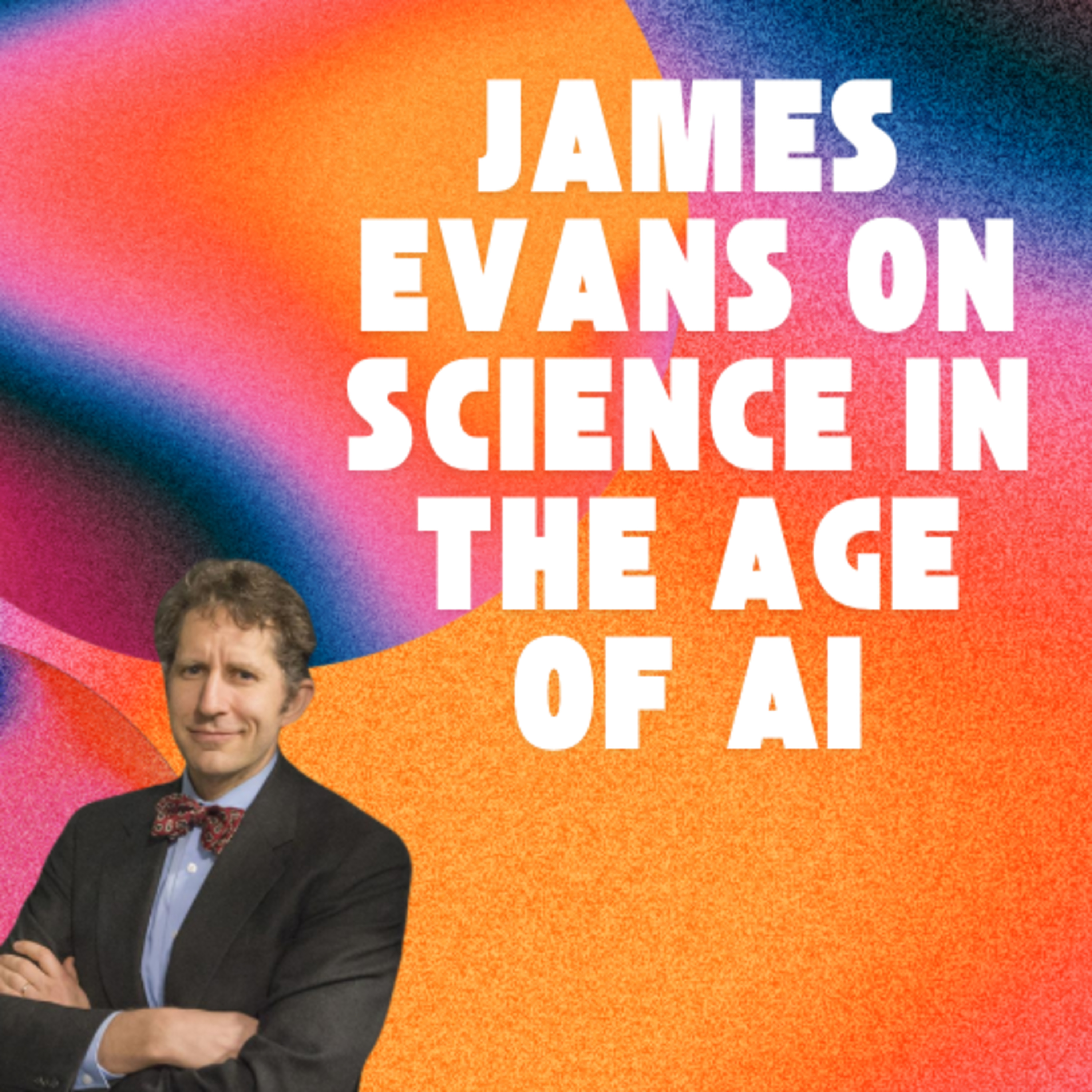
#18 – James Evans: Science in the Age of AI
May 7, 202500:40:56Tap to summarizeToday’s episode is different from all the previous ones, as for the first time on Scaling Theory, we focus on research methodology, exploring how AI is reshaping the very process of doing research and what that shift means for science and society at large.I sat down with James Evans, Professor of Sociology, Computational and Data Science at the University of Chicago, External Professor at the Santa Fe Institute, and Faculty Member at the Complexity Science Hub in Vienna, to explore how AI is transforming the way we simulate, scale, and understand human behavior, and what that shift means for science and society.We dive into his pioneering work on using large language models to simulate individuals, societies, and entire social systems. James and I explore the strengths and limits of AI agents for both the social and hard sciences before reflecting on the future of social science itself. We talk about research centers entirely run by AI and conferences conducted by AI agents, without any human involvement. We also discuss the role of small research teams in disruptive innovation, and how to cultivate proximity and serendipity in a research world where we increasingly cooperate with machines.You can follow me on X (@ProfSchrepel) and BlueSky (@ProfSchrepel) to receive regular updates.References:- Simulating Subjects: The Promise and Peril of AI Stand-ins for Social Agents and Interactions (2025) https://osf.io/preprints/socarxiv/vp3j2_v3- LLM Social Simulations Are a Promising Research Method (2025) https://arxiv.org/pdf/2504.02234- Large teams develop and small teams disrupt science and technology (2019) https://www.nature.com/articles/s41586-019-0941-9?wpisrc=- AI Expands Scientists' Impact but Contracts Science's Focus (2024) https://arxiv.org/abs/2412.07727- The Paradox of Collective Certainty in Science (2024) https://arxiv.org/html/2406.05809v1?utm_source=chatgpt.com- Being Together in Place as a Catalyst for Scientific Advance (Research Policy, 2023) https://www.sciencedirect.com/science/article/pii/S0048733323001956
Transcribe →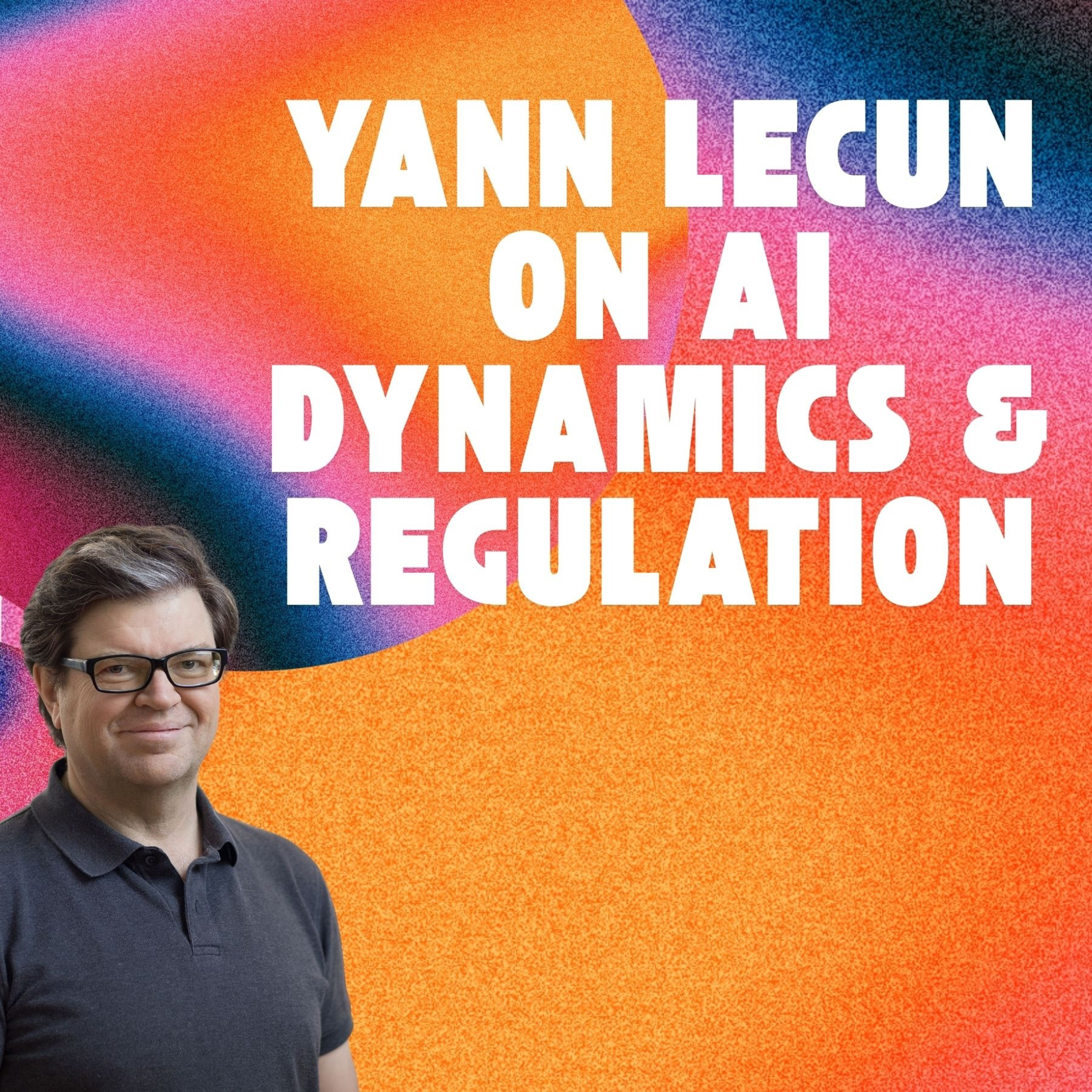
#5 – Yann LeCun: AI Dynamics and Regulation
May 27, 2024Tap to summarizeMy guest is Yann LeCun, a pioneering French-American computer scientist, known for his groundbreaking work in machine learning, computer vision, and neural networks. Yann is the Silver Professor at the Courant Institute of Mathematical Sciences at New York University and serves as the Vice President and Chief AI Scientist at Meta. Yann is one of the world’s most influential computer scientists. He has accumulated over 350,000 citations on Google Scholar, he is one of the founding figures in the field of deep learning thanks to its contribution to convolutional neural networks and backpropagation algorithms, and he is a vocal proponent of open source. In recognition of his significant contributions to artificial intelligence, he was awarded the Turing Award in 2018, often referred to as the “Nobel Prize of Computing.” Our conversation is structured into three distinct parts. We begin by discussing the overarching dynamics in the AI space, then narrow our focus to the firm level, and finally, we conclude with an exploration of the challenges that lie ahead. By the end of this discussion, you will learn whether open source has a chance to make it in AI, the key factors for scaling an AI foundation model, the role ecosystems play in market dynamics, Meta long term strategy in the space, how concentration among chip manufacturers impacts AI companies, the current effect of the European AI Act on AI companies, what Yann would like to see regulators doing, and more. I hope you enjoy the conversation.
Transcribe →