← School of Podcasting: Expert Tips for Launching and Growing Your Podcast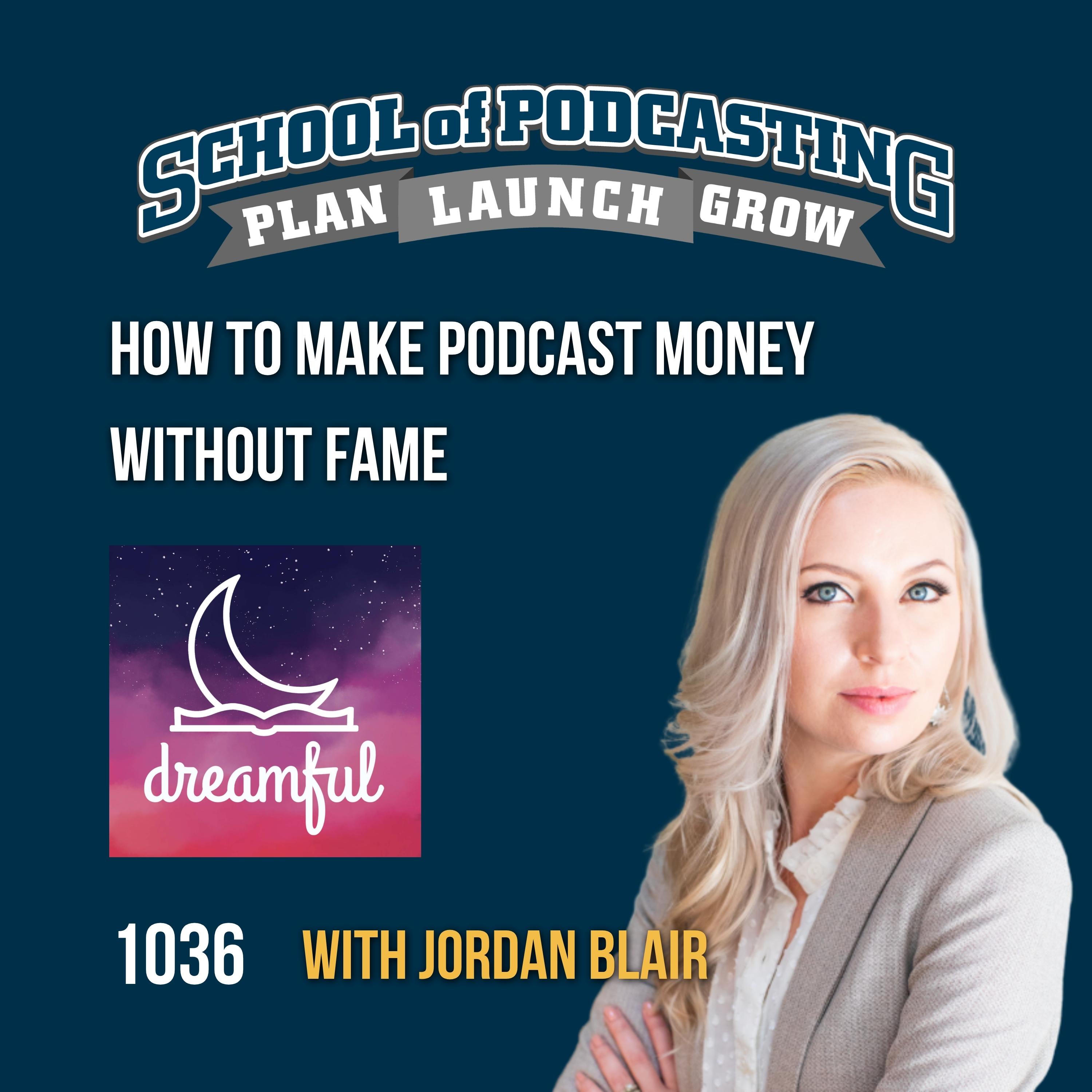
School of Podcasting: Expert Tips for Launching and Growing Your Podcast
How to Make Podcast Money Without Fame
00:48:42
Loading summary
Transcript62 lines
- [00:00]
A
I hear people all the time. Oh, you have to be a celebrity. Oh, you've got it. Well, think about this. What if your podcast could start making real money before you hire a team or build a huge audience or become Internet famous? Because today I interviewed Jordan Blair from the Dreamful Podcast. She also works at buzzsprout and she's going to break down exactly how she monetized her show as a regular creator and what you can steal from her strategy. Hit it, ladies.
- [00:29]
B
The school of podcasting with Dave Jackson.
- [00:35]
A
Podcasting since 2005. I'm your award winning hall of fame podcast coach, Dave Jackson. Thanking you so much for tuning in. If you're new to the show, this is where I help you plan, launch and grow your podcast. And over the next couple months, I'm going to have some interviews of people who don't have teams of 18 who aren't celebrities and yet are making money with their podcast. So if you're a person that's like, I never want to make money with your podcast, this show is not for you. There are some great ideas here on making sure the content matches the audience. And if you're selling something, the product matches the audience. Because when you think about it, when you make money with your podcast, you're asking the audience to take money out of their purse or their wallet or whatever. They're going to bust out the credit card and they're going to spend money. And that means it's either going to be on a sponsor, on an affiliate link, on a. The best is a product or service that you do. Consulting, a book, courses, whatever. It could be some sort of tip or donation. It could be, you know, a. For example, I love the show Pod News Weekly. It's James Kridlin and it's Sam Sethi. And for me, it's information. I can't get anyplace else. I say that is valuable and consequently I give them value back. You'll hear a lot of people talk about this. And I saw Jordan Blair, she works at buzzsprout. You've heard her, you've probably heard her laugh. And she does the Dreamful Stories podcast. You can find that@dreamful stories.com we'll have a link to that in the show notes. And she's not a celebrity. She doesn't have a team of 22. And yet she's been able to monetize her podcast. And so I wanted her to come on the show and explain about it. And I'll talk about this in a second. But it started with a blog post. But. Jordan Blair, thanks for coming on the show.
- [02:37]
B
Thanks for having me.
- [02:38]
A
When did you know you wanted to start a podcast?
- [02:41]
B
Okay, so to start, I really love podcasts so much, and I got my kids kind of into podcasts, and they were wanting to listen to them to go to sleep. But really when I looked through, back in this day was before there was a huge boom of sleep podcasts, and I was looking through, and all the podcasts seemed, like very, like, bright and high energy. And it was more for, like, toddler story time at that point. So, like, in the kids and family category, and I was looking more for things that were similar to, like, Palm app or those, like, sleep stories where, like, actors or famous people would, like, read them. And there's, like, this gorgeous, like, bedding of music, and I couldn't find it anywhere. And so I just was like, okay, well, you know, I was a theater major, and I also was a children's librarian at one point. And how hard could this be? I'm just gonna, like, do it myself.
- [03:37]
A
And.
- [03:38]
B
And so I started the podcast for my kids, and I didn't really intend for it to be for anyone. Like, I didn't put any pressure on myself to make it, like, a big thing, and I actually was not. I didn't promote it really at all either. So that's. That's kind of how that started.
- [03:59]
A
I know so many podcasters that started their podcast because they went looking for a podcast, a certain type of. And when it didn't exist, they're like, well, then I'm gonna have to make it. So do you remember the early days? Like, your first, say, 10 episodes?
- [04:14]
B
Yeah. I think what happened was my husband had, like, shared on Facebook, my wife's doing this thing. And so I had, like, I don't know, 30 or 40 downloads for my first episode, which I was like, wow, that's crazy. And then, so my first month of doing my podcast, I had, like, a total of, like, 75 downloads. And then the month after that was, like, a hundred, and then 150. And so it was just. It was really, like, nice and pleasant. And what's so funny is about seven months into doing the podcast, I. It was spring, and it just kind of got, like, really crazy, because if you have children, you understand that teachers and schools cram all of the events in the last few weeks of school, like, the last couple months of school, there's just a million things to do. And I was super burned out. And I was like, okay, well, I. Oh. And it was also Covid, too. And so, like. So there was just, like, all these things going on. I'm like, okay, I just need to, like, take a break. So I took a break from my podcast, and I. I was like, there's not that many people listening, so it's, like, not a big deal. And what was really funny was buzzsprout sends these achievement emails. So Buzzsprout, that's the company I currently work for. Right. But I had started my podcast with them, and so they have these, like, milestone achievement emails. And I was just chilling at home, not doing anything, not thinking about my podcast, and I started getting these achievement, milestone emails into my inbox, and it was like, ping, ping, ping. And it just, like, it kept going. And it was this really crazy thing because I just completely put my podcast outside out of mind, and I wasn't doing anything with it. I wasn't promoting it. I just had. I just needed a break, and something happened. I don't know what, where I started just, like, growing, and it just took off like a rocket. And I suddenly was getting achievement emails for, like, 5,000 downloads. And then it was like, 10,000 downloads, and that was 20,000 downloads. And then it Was like, pretty soon, like, 75,000 downloads, and then like, a hundred thousand downloads. And I was just like. I was literally. It gave me such anxiety because I was like, no, no, no, no, no. I didn't. I didn't want that. And I started having nightmares about it. It was awful. But once I kind of, like, calmed down, I was like, okay, this is fine. Everything's cool. And I came back to it, and I got to, like, interact with more audience members and stuff like that. I chilled, and it was okay. It's a good thing.
- [06:43]
A
Yeah. Because when you're first talking, you're like, well, nobody's going to hear this. And now it's like, wait, no, the people are going to hear this. Now, is there any difference? Because you're over 13 million downloads. That's. That's a lot of downloads. Getting that 13. Does it feel different than the first million, or is it just now you're like, yeah, it's another million. Whatever.
- [07:05]
B
Yeah. You know what's so funny? I think it's one of those things where you think like, oh, man, when I reach a million downloads, that's gonna change my life, and it's gonna be game over, and everything's gonna be awesome, and I'm gonna be, like, celebrity, because I've got millions, millions of downloads. And really what happened was I was so excited for my first million downloads. And it was a huge celebration. I posted about it, and everyone was, like, congratulating me, and it was awesome. And then that feeling just kind of, like, went away. And it's like, okay, well, I guess what's next? Yeah, and it's like, that's the 2 million. And then it's like, okay, well, 2 million didn't really feel much better than the first million. And then you get 5 million, and it's like, okay, yeah, I guess I got 5 million. And then you reach 10 million. You're like, this is really cool. But, like, I don't feel it. And what's so funny is when you have millions and millions of downloads, I find that your listener engagement doesn't go up. So if we have, like, a chart of listener engagement versus, like, downloads, it would just be like, the same I co host Buzzcast, which is like our podcast about podcasting. And we're not remotely close to how many downloads Dreamful has. I think last summer, we just broke 500,000, which is great. Like, it's really big, too. But we have so much engagement on that podcast, and there's people just writing in almost every single day and interacting with us, and it's, like, awesome. And then with Dreamful, it was like I would ask listeners for something, and then it would take, like, two months for somebody to, like, write in. And it was just like. It felt so weird because I was like, there's. There's, like, millions of downloads here, but, like, no one's reaching out to me. And I don't know, it's just. It's so funny.
- [08:47]
A
Maybe they fell asleep before the call to action. I don't know.
- [08:51]
B
I think that's exactly what it is. Like, they can't be bothered, and they've forgotten by morning.
- [08:57]
A
As you're getting these downloads, one of the questions that we always hear, especially for people that do want to monetize, what are your thoughts on how early is too early and when do you know it's time to maybe think about monetization?
- [09:12]
B
I think that in the context of podcasting, monetization is really for the independent podcaster, not, I'm going to quit my job tomorrow and have a podcast and make money. Make just as much, if not more, that I did at my day job. It's really just supporting your hobby. It's supporting your passion. It's just, you know, making enough to maybe upgrade your equipment or pay for hosting fees or whatever. And so with that in mind, I think that you can Start monetizing right away. And I think this is really unpopular. I think that my co hosts will also disagree with this. But this is what I think. I had started a listener support page before my podcast launch just because I was looking at other podcasters and I was like, this is what they do, so I'm going to do this too. And it was really cool because when I launched my podcast, when my friends and family would go to the page and look at it, they saw that there was a way to support the podcast. And so, you know, my mom and some of my friends and some of my husband's friends, like, support the show. And so literally, like at the time of launch, I had like $35 a month coming in, which was great. I mean, that covers it. So I was like, cool, this is awesome. And so I definitely think that it's really good to start as early as you can, at least signing up for a way for people to donate or support the show. Because what you want to do is you want to have that call to action early on in the podcast, like episode one, start telling people, hey, you can support the show by clicking this. And you know, I'm just getting going. If you want to help out in any way or if you find value in this and you want to like see me continue, you can just click this link and you can do like a one time payment or monthly or whatever. If you have that call to action earlier on, I think it's really great because it gives people the opportunity to support your show at an early stage too.
- [11:19]
A
Do you have a preference of when you do that in an episode? Is it at the beginning, is it at the middle, is it at the end, or does it matter?
- [11:27]
B
It's kind of hard because there's different things to the call to action for monetization. Especially if your whole pitch to your audience is that you are bringing value to them. And so if they get value out of the podcast or if they learn something or they, if they had like an emotional interaction with you like that they can support the show. And a lot of times if you put that right at the beginning of the episode, that can feel a little weird. Like, you haven't given me the value yet, so why. But it's also like if they're a returning listener and they are continuing to get the value out of your podcast and they're enjoying it and you're like, with them on their commute, they might go, oh, yeah, that's right, I need to do that. And so, like, real quick before they put their phone down or whatever, they will support the show. So there's benefits to having it at the beginning, but it does kind of feel a little weird because you haven't added that. I think mid rolls are really great for call to actions. Or if you're in between segments and you just say, like, hey, I actually just want to take a quick moment to, like, say, if you want to support the show, we have, like, buy me a coffee enabled. We have listener support enabled, anything like that. And you can do it this way. Clicking the link in the show notes. I think that the worst place ever to put a call to action for your. For your audience to do something is at the very end of the episode. I talked to this one guy at PodFest, and he was telling me, you know, I haven't gotten anyone to join my subscription. And, you know, it's just every single episode, I tell them, like, oh, I've got bonus episodes. I've got all this stuff, and they never, ever, ever will subscribe to it. And it's been months and months and months, and I haven't gotten a single person biting. I said, okay, well, where are you putting that call to action? Like, where are you asking them? And he's like, well, after the show wraps up, and then at the end, I tell them that they can do that. I'm like, no, yeah, we got. We got to experiment a little bit. You got to. You got to put it in the middle or put it in the beginning.
- [13:28]
A
Yeah, the minute you. You hint that the show is over, if you're like, hey, as we start to wrap up here, well, they're gone. That's all you had to say. They're like, on to the next episode. So as you started to monetize, you remember which kind of strategy you tried first.
- [13:44]
B
It was the listener support and subscriptions. And I don't recommend that people start subscriptions right away simply because it is hard enough starting a podcast. I mean, it's not like the hardest thing. If you're trying to do a marathon, you're not going to, like, sprint at the very beginning. Like, you're going to pace yourself. And I think a lot of times with subscriptions, people kind of just go out of the gate and they just start creating episodes, and they're just a machine cranking out all these different episodes. I personally did it because I had set my publishing schedule at, like, a cadence that was manageable. So I released every other week, and that was it. So it wasn't crazy for me to Release a bonus episode like once a month and start building up that back catalog of bonus content. Which I feel like if you are a couple years down the line and you're saying, hey, I've got over 50 bonus episodes, or I've got over a hundred bonus episodes, if you subscribe, that's pretty enticing to people who really love your content, want more of it. And so I think that it is a benefit in that way. But I do not recommend that people right out of the gate start making all this like bonus content for their subscriptions. Like maybe try listener support first and see if you get people supporting the content. Because, I mean, you're already creating value with your podcast. Like, podcasts take work, they take passion, they take intentionality, and they take so much effort. And so just making a podcast in the first place and giving it out to people for free and is providing value. And I think if you definitely indicate that to your listeners, they're more inclined to support your podcast.
- [15:32]
A
And I know you, you said you played a little with Amazon Associates for affiliate marketing and then you did something with puzzles that seemed to work. So tell us about your journey through affiliate marketing.
- [15:44]
B
Well, I started with affiliate marketing because I was really nervous about sponsorship. Sponsorship seemed like the big carrot at the end of the stick and I was very scared of it. Like, it seem like little me is not going to be able to do sponsorships. So I'm just going to like kind of dabble in affiliate marketing and see if I am worthy of taking the next step of sponsorships. And the reason why I did affiliates at first was because I had this mindset of nobody's going to know. Like if no one buys it, I'm not going to be embarrassed because no one's going to know that I did this like affiliate marketing campaign and you know, put out these ads, put out these call to actions, maybe made like a social post about it and not a single person bought anything. Right. And so I think that actually affiliate marketing is a great place to start, is a great place to dabble in experimenting with how to place ads and how to do host read ad reads and promote things that aren't yours. And so, yeah, I just kind of like went to some like affiliate sites and I found this really cool wooden puzzle company. And I thought a lot of my listeners, they deal with like anxiety and they are finding ways to relax before bed. And I thought, and one of the ways that I relax is I love puzzles. I do puzzles like crazy. I actually have some of these puzzles And I really enjoy them. And so I was like, great. They have like a referral code sort of thing. And so I did a couple ad reads, I put the affiliate link on my. On my website. And yeah, it went bananas. It was awesome. And it made me feel really good about my ability to convince people that this is a really good product for them. And I got. Yeah, there was. There was like one month where I got like over $1,000 and I was just like, holy cow, this is awesome. And I didn't do anything. I did like one ad read and it just stuck and it was awesome.
- [17:42]
A
Well, I always say if you can talk about something that you know. So this is a puzzle you had. You already said this would fit my audience. And then you talk about it, you know, good things can happen. It's amazing when you find the right product for the right audience because it can just out of nowhere you're like, wait, what? You know, so. Yeah, that's crazy.
- [18:03]
B
Yeah.
- [18:03]
A
I think in the blog you mentioned that you feel like Amazon is maybe a little too much work, and I wanted to see why.
- [18:14]
B
First off, I found it horrendously confusing.
- [18:18]
A
The.
- [18:18]
B
I don't know if you've ever been on the platform, like on the back end of like the affiliate platform. It reminds me of the Amazon website, like pre 2000s, 1992.
- [18:33]
A
Yes.
- [18:34]
B
Yeah. It is really hard to navigate. It's hard to understand. Their help articles are really confusing to me. And it just took so much time. And then I, when I kind of figured out what I was doing with it, then you have to go and like, select the products and then you have to, like, promote them. And I was just like, this is way too hard. And I just, I don't know, I don't like spending more than like a few hours on something. And the Amazon associate thing, it just, it seemed really wonky and I didn't feel good about it. I don't know. I don't know. It's so hard to explain, but I know that it is beneficial because Amazon has a saying where if someone clicks on your link for anything, anything that they buy in the next like 24 hours or something, you get a kickback on. So. So it does make sense. But just for me, I was like, I don't have time for this. I don't want to figure this out. It was just a little clunky.
- [19:26]
A
Well, that's. I always tell people the stuff that's not fun, don't do or outsource. You know, there's no reason. And yeah, that's the. It's kind of the. It's almost like a slot machine. You're like, okay, they went over to buy a Samsung Q2U, where I'll make, I don't know, $1.37 or something like that, and then they'll buy a, you know, 80 inch flat screen TV. And I'm like, okay, we've. We've hit, you know, but that doesn't happen that often. So. Yeah, well, talk about you. You now have partnerships and the first one approached you, which has got to be kind of a fun thing. How did you feel when somebody approached you and said, we'd like to give you money for, you know, being on your podcast?
- [20:07]
B
Oh, man, it was so great because, like I said, I. I wanted to do sponsorships, but I was too scared to do it. And so for a potential sponsor to approach me and say, hey, our. I don't even know who, I can't remember who. It was like marketing director or whatever, really loves your podcast and they want to, like, work something out where we'll give you, like $50 to your Patreon and then you can do an ad read for us. And I was like, okay, here's my chance. I'm just gonna, like, experiment with this a little bit. And so I just wrote them back and I said, oh, my gosh, this is amazing. I'm so excited. And it was like a beauty brand that had just released, like, sleep strips. And I was like, this is perfect. And my audience would absolutely love this. And I just wrote them and I explained, here's how podcast sponsorships work. And I worked out, I think, like three ad spots with them. And then I actually negotiated a higher rate because I was like, this is typically what they go for. And I also negotiated a giveaway for my listeners because I just thought it'd be fun. And they agreed. So. So that was. That was really my first entry into partnering up with sponsors, was explaining what it was, explaining the value of it, and like, sort of like educating them on why my podcast is value to valuable to them and then doing a little bit of negotiations and.
- [21:32]
A
Yeah, and did you have anything on your website that was like, click here to sponsor the show or did they just come out of the blue?
- [21:40]
B
I didn't. I was really focused on my listeners and people sending me, like, story suggestions and things like that. And so it was out of the blue. I wasn't expecting it.
- [21:50]
A
Interesting. Yeah, because I always tell people it's when they're looking for sponsors, they go, you probably have to go knock on their door. You know, on occasion, there's situations like yours. So once that first one was done and you went, hey, look, I can make money with this thing, did you then, like, turn around and start knocking on doors? Did you go to an agency? Or how have you been getting your current, you know, partners?
- [22:13]
B
I started by just knocking on doors myself. I would just, like, cold email brands that already had sponsorships. So basically, it's a lot easier to reach out to brands that you already know are sponsoring other podcasts. And so a lot of times what I would do is I would listen to other podcasts in my niche or in my community and see what brands were sponsoring them, and then I would just, like, find the information and then send them an email, and I would keep it, like, super casual because I want to make sure that I don't get sent to, like, the spam folder or to the trash. And so I would just say, like, hey, I'm Jordan. I am the host of Dreamfold Bedtime Stories, and I really, really like your. Your brand, and I think my listeners would, too, and, like, let me know if you'd like to partner up. And it was just one of those things where, like, I would spend my entire weekend emailing a whole bunch of different people and finding different brands that would work with my listeners and just doing, like, tons of research and trying to figure out how to get ahold of them and, you know, you know, making sure that I don't get, like, sent to the trash. And so it. It turned into, like, an extra job. And so I. I eventually did start working with a media agency. And, you know, the thing is, is, like, these ad agencies or media agencies, they take, like, 30%, you know, your revenue, but at the same time, you're not spending all this time researching brands and sending out cold emails, and you've, you know, you get your weekends back, and it's pretty awesome.
- [23:43]
A
Yeah, it's one of the things I always say, you. You pay for things with one of two currencies, either money or time, and use the one you have the most of. And so once you've started getting partners and you're like, okay, this is, you know, I've got a track record now. I can prove this. Okay, now let's take some of that profit from the show and give me my time back so I can keep my sanity so I can keep the show growing. So it's amazing.
- [24:10]
B
Yeah.
- [24:11]
A
Now, when you get into partnerships and Stu, were there any lessons you had to learn about Being compliant with the ftc?
- [24:18]
B
No, I just, I just looked into it, basically. I don't know how to explain it. Like, I just gave it a quick goog to figure out how exactly to do these host red ad reads and stuff like that. And I figured out pretty quickly that you're supposed to disclose. And so I was doing that right away. I was actually surprised that people weren't doing that. And I don't know exactly where I learned it from. I'm pretty sure I just like googled it and learned it somewhere in a blog or somewhere in some like a YouTube video video of someone explaining this to me. But yeah, so I, it was, it was pretty easy to figure out that you have to disclose that is the show is sponsored by this company or if you're doing affiliate marketing, you do not say that the show is sponsored by them. So I learned those two things. Like if it's, if it's affiliates or a different kind of like ad buy, you absolutely do not say that the show is sponsored by or brought to you by this company. But if you are being sponsored by a brand or a company, you have to say that is brought to you by. The episode is brought to you by or sponsored by this company.
- [25:20]
A
So for somebody who's thinking about adding subscriptions, because we mentioned there's, you know, listener support, that's where they can just chip in and give you money. Kind of like buy me a coffee. Or they can use Buzzsprout's tool. And then there's the subscription part where you're giving them maybe ad free stuff. If you have ads or, you know, bonus content and things like that. Well, what does an ad read sound like for that? Because some people, like, I don't know what to say because anytime we go to promote ourselves, we all get really weird. We're all like, oh, I feel so salesy. And it's like, so how did. What would one sound like for yours?
- [25:55]
B
I love this, Dave. This is one of my favorite things is thinking back at how awkward it was to ask for money on my podcast. And I always tell people, look, it's going to be painful. It's going to be weird. You're going to feel kind of dorky doing it or feel awkward, like you're begging for money or something like that. But the second you get an email that you have a subscriber, the second you get like an email that someone contributed to your PayPal or your buy me a coffee or whatever, it gets way less awkward. So I think that people should Go for it and just keep at it until you get the first one and just go through that painful process. I think that the ad read for your support or subscriptions is going to depend on what kind of subscription you have. So there's different ones, like, there's different selling points you've got like ad free listening or, you know, bonus episodes or perhaps for the entire, like back catalog of your podcast. And so really I think you have to figure out what the selling point is for people. Like, why are you creating the subscription? What is it about the script subscription that you think will be enticing to your listeners and make sure that you really lean into that. And again, I, I have to say that it's really good to remind people that, hey, you keep turning, you keep tuning in week after week. Like if you love this podcast and you get excited every week when it comes out and you like what I'm doing and you also want to get ad free episodes or, and you want more of this podcast and you want bonus episodes delivered to you every single week on your podcast app or you enjoyed the last three episodes and to hear the rest of you can go ahead and subscribe and binge the entire back catalog. I think things like that are really good. So basically you just need to say like, hey, if you really like get value from the show, if you enjoy it, if you love joining me every week, if you, whatever they get from the podcast that is free and available to them, you know, I kind of like lead with that and then you give them an offer of if you want more, if you want this, if you, if you desire to hear more of this podcast, podcast, if you really hate the ads, then you can go ahead and support the podcast somewhere else. So I, I like to just do it that way and make sure that you direct people to the link in the show notes. Always, always, always have a link in the show notes. You want to make it as easy as humanly possible for people to give you money. So make sure you have links everywhere. I want them on your social media, I want them on your website, I want them in the podcast apps. Like you have to have links everywhere so that people can know how to support the show.
- [28:36]
A
Well, first of all, like 13 million downloads, congratulations on that. That's amazing. I don't know too many people that can say that. And you've been doing this, you know, for a while, seven years now with your show. 7ish. If you were to go back today, would you do anything differently?
- [28:53]
B
Yeah, I definitely would. I think When I first started seeing the growth and I saw the potential of this becoming my job, and I no longer had to do whatever I was. I was working, like, four different jobs. When I started my podcast, which sounds insane, but when I saw an out, like, I was like, okay, bye, guys. I'm out. This is what I'm going into. But when I was trying to make that happen, really what I did was I just looked at all these different major network podcasts that were monetizing their show, and I was like, okay, how are they doing this? Okay, they're doing this through, like, live Q&As. They're doing this through merch, and they're doing it through all these different subscription options and, you know, sponsorships and ad reads and all this different stuff. And so I thought, okay, well, if I'm going to make it, I have to also do this. And it's so funny, because if I could just go back, I would just tell myself, hey, chill. Let's just focus on, like, a couple streams of revenue that we know are going to work for your show. I would. I would stop myself and say, okay, breathe. And we're going to think about what your listeners are actually asking for. Or ask your listeners, hey, what would you pay for? Because I wasted so much time on energy on things that my listeners absolutely did not want. I did, like, a whole merch line of, like, snuggle up and sweet dreams. And I was like, they're gonna love this. This is adorable. Like, why would they not want it? I did all these, like, promotional images, and I had this, like, storefront set up. Not a single person bought anything. Like, not one out of millions of downloads. No one bought anything. And I didn't even, like, stop to ask my listeners, hey, what do you want from me? Like, what would you be interested in if I offered it? And I think that that would be a huge difference. I think if I had taken a moment to take some of my stories and maybe make a book on, like, Amazon or something like that, or, you know, I have a friend who's, like, an illustrator. If I had just taken a moment to really focus on that, I think that could have made money for the podcast. Instead, I think that I could just focused on my subscribers and making sure that they are feeling, like, really engaged with and things like that. So I think just taking a beat and saying, okay, what is the path of least resistance that my listeners actually want and is going to give me a return on the investment of my time and effort and energy and just Focusing on that. And you know what? If it's not. If it's not as successful as you hoped, you can pivot, but just don't stretch yourself thin is a big thing that I wish I didn't do.
- [31:48]
A
Yeah. Is there anything looking back, that seems to suck the life out of you when it comes to your podcast?
- [31:55]
B
It's so funny. I hate editing. I hate it. I hate it. I hate it. I'm starting to like it more. But it was so funny because, you know, I mean, another great way to monetize your podcast is to get hired in the podcasting industry, and then I guess you're, you know, in podcasting. But it's so funny because when I got hired on as the podcast producer for Buzzsprout, like, one of the main things that I do is editing, and it sucks because I'm really freaking good at it, and I hate that I'm really good at it. So basically, when I was able to, like, the second I was able to with my own podcast, I. I outsourced editing, and I outsourced it to my friend that I trained on it, and she's the one that does it, and she's amazing, and I just. I don't deal with that. So all I have to do is just sit down, like, do my. My episode, and then I send it off to her. And it is amazing. It's the best. But, yeah, I think editing caused me probably the most tears. Especially, like, when I was using a software that would, you know, after four hours editing, it would, like, shut down and corrupt the file, and I'd lose it. And I just. I couldn't deal with that. I'm not emotionally capable of handling that kind of stuff.
- [33:13]
A
Excellent. I've always thought this about sleep shows. If the goal is to make me fall asleep, why do I need more than one episode? Like, why do I just listen to episode one again, and if it works, I'll fall asleep? Have you had people comment on your show on. Like, obviously it's great because you've got the audience. What does your audience say about it? Like, why. Why is yours so much better than somebody else's?
- [33:38]
B
I think it's really funny because I do have some audience members that will write me, and they'll say, I'm really frustrated because I really want to listen to the Winnie the Pooh episode, but I can't get through the intro before I fall asleep. But one of these days I'm gonna do it. And, like, so you do have the. Yeah, you do have the People that they are really just hyper focused on a certain kind of story. I actually try to do. I vary it. So I have a lot of, like, fairy tales and I have a lot of, like, kids stories. So Winnie the Pooh stories like Piglet Neore and stuff like that is so popular. And it is in the public domain, as in recent years. And so I know, amazing. I check the. But that's like my. My New Year's thing is I go check the public domain, like New Year's Day. And it's so funny because I get people that are just hyper focused on those kind of stories because it brings them back to, like, childhood and they feel comforted. And I think that it is like a variety because they'll ask me for more. They'll be like, I need more chapters. I want to hear the one of like the Heffalump. I want to hear, like, this kind of stuff. And then I get other people that are like, I really like when you do spooky stories like, will you please do some, like, horror ones like Jekyll and Hyde or like Dorian Gray, things like that. And so I have this smattering of things. And I have other people that love when I do, like, nature readings and like, essays, like transcendentalism essays. And then other people who love when I dabble into, like, Greek mythology and Egyptian mythology. Like when I do those series, they beg for more of them. And so I don't know, I think I just have it, like, varied. And so people like to jump around and have options. But there's definitely some people that get very upset with me when I do a spooky episode and it like, queues up for them.
- [35:24]
A
I can see that. Thanks. I wanted a nightmare. Yeah, exactly. Yeah.
- [35:29]
B
I've gotten a couple complaints about that, but I'm just. Whatever. It's like one person.
- [35:33]
A
You can't please everybody. Well, no, if you want to go check out her show if you're having problems sleeping. And this again, is kind of geared towards kids. Dreamful stories.com Jordan, thanks so much for coming on the show.
- [35:46]
B
Thanks. Thanks for having me.
- [35:50]
A
And I'll have links to her show and everything out@schoolofpodcasting.com 10:36 I love all the people over at Buzzsprout, but as someone who likes to make people laugh, it's great to have somebody like Jordan who loves to laugh. And I'll have more about our discussion right after this. Are you dreaming of starting your own podcast, but not sure where to begin? Podcasting in six weeks gives you a clear step by step path to go from idea to launch with confidence. This practical course is designed to help you create records, edit, publish and promote your podcast in just six weeks. Now, whether you're starting from scratch or feeling overwhelmed by the technical side, you'll get the guidance, structure and tools you need to launch a podcast that sounds professional and reaches the right audience. When you're ready to stop overthinking. When you're ready to start podcasting, join Podcasting in six weeks today and turn your voice, your ideas and expertise into a show people want to hear. The best part is it's only a dollar. Check it out. Classes start June 3rd. Go to schoolofpodcasting.com six weeks at PodPage if you have something you want to promote, you can put it on the sidebar, you can put it on the front page, you can put it at the bottom of every single episode. PodPage is super flexible and super easy to build the website you want. Check it out@podpage.com and start your 14 day free trial. No credit card needed. By going to podpage.com preview
- [37:40]
B
the School of Podcasting yeah, yeah, yeah.
- [37:44]
A
A couple quick things I wanted to add here and she even said my co host over at Buzzcast and I'll put a link to that in the show notes. That's a great show. Might disagree with her. And that was she was talking about monetization up front. And this is one of those things. I always use the analogy of stepping on a scale. Do you step on it once a week or do you step on it once a day? Well, you can step on it once a day as long as you are aware that your weight actually naturally fluctuates a little bit. And so when you see it go down and then the next day maybe it goes up a little bit, but the next day it goes down, then maybe the next day. Yeah, as long as you're aware of that and can mentally handle that, then by all means weigh yourself every day. I do. Now, if you are going to monetize up front, realize there are two things you're looking at now. And that's your engagement, whether that's your completion rate, your downloads, there are all sorts of ways to do that. But you're also adding, hey, how much money am I making? And remember, you don't monetize a podcast, you monetize an audience and you don't have one yet. Really. And so as long as you're okay with that, that hey, I'm going to check to See if we made any money, but I'm not expecting any. I think you're okay with that. It can be kind of mentally hard to be rejected twice, you know, oh, I didn't get as many downloads as I thought. And the other thing that I loved about that was, if you notice, when she went for sponsors, the first one she talked about, there was one that she used. I cannot state that enough. When you can talk about a product from your own perspective, it doesn't feel like you're selling. You're telling your friends, hey, this is really cool. And I think it would fit you because, well, you know your audience and you know it would fit them, so. But she also said that she educated the sponsor about how podcasting works, and that's because a lot of these old fat white dudes in suits came over from radio and they want to pay you next to nothing. And you're like, yeah, this isn't radio. As much as YouTube and Spotify are trying to turn it into radio, it's not. And I have a much deeper connection with my audience than the people on the radio do. I know at night here in Akron, Ohio, where I live, one of the easy listening stations, I'm here to tell you, it's Siri. Siri is the dj, and she's like, you know, all out of Love by. What was that name? By Air Supply. And then the next song starts. Phil Collins. Whatever Phil Collins sang, I was going to say in the air tonight. But would that be on an easy listening station? I don't think so. One more night. Phil Collins. And it's. There's nobody there. So we have a deeper connection than that. So that were two things that jumped out. Also, did you notice that when I asked her, when did you get that first sponsor? She said, oh, I don't really remember. I was just focused on my audience. I don't think that's a coincidence. And she mentioned affiliate marketing. I did an episode on that not too long ago. Schoolofpodcasting.com 1031 I'll put a link in the show notes. And I just wanted to point out again, she doesn't have a team of 18, and yet she's monetizing her show. Keep that in mind. It is possible, but it started with knowing her audience and giving them what they wanted. And then at the end, she even mentioned that they like a little variety. And she was doing things, in some cases, that people didn't like. Well, how do you know? Well, because you tried something new and your audience will say, hey, if you could not really scare the pants off me as I'm trying to go to sleep, that would be better.
- [41:26]
B
Yeah, yeah, yeah.
- [41:29]
A
Oh, where am I gonna be August 21st through the 23rd? Charlotte, North Carolina. Empowered podcasting three. I went last year and the minute it was over, I'm like, I'm going back to this one. You gotta check out this one. Especially designed for independent podcasters with the maximum capacity of 2, 250 people. I love that because I get to meet everyone. Check it out. Empowered podcasting.com
- [42:01]
B
Ooh, now that's a good question.
- [42:04]
A
Most of us use some sort of remote recording for interviews, etc. Etc. And most of us have gone through more than one. So think of a new podcaster. They say, I want to record remotely. Who do you recommend and why? And then let us know any horror stories from previous ones you've used. I need your answer by May 22, 2026. And don't forget to say a little bit about your podcast and your website. Just go to schoolofpodcasting.com? by May 22 or click the link in the show notes.
- [42:50]
B
And now Dave has another reason to hate Spotify.
- [42:58]
A
I need to add this to somewhere on the school of podcasting of a blog post about why I do not like Spotify. And I was getting ready to tell you that if you're on Spreaker, you may want to think about looking at other media hosts, because the Inception point AI, which I like to refer to as Ensloption Point AI, this is a company that's putting out hundreds of AI shows a day, new shows, not episodes shows, and they were on Spreaker. And the way this works is you put 1, 2, or 3 ads at the beginning, and then your AI voice comes on and explains that I am an AI voice, and I'm going to tell you about such and such. And by that point, most people tune out. In fact, I heard this today on a podcast with my kids. It's funny how they're very anti AI and that seems to be among them. That's growing. That sentiment is growing. That sentiment is definitely growing. You saw the graduation speech, and she started to talk about AI as the next Industrial Revolution, and she got booed. She was booed at the graduation speech, and she was like, did I struck a chord? You know, and. And she's like, you know, trying to play it off. And like, all the social media posts were like, no, you struck a nerve. And so after you sat through three crappy ads to then Be surprise. You're listening to AI Slop. You go in, tune out. Well, Inception Point has stopped using Spreaker and they moved to where, you guessed it, Megaphone. And who owns Megaphone, you guessed it, Spotify. You suck. Why? Because if you think about it, by the time you've listened to all three ads and go, oh, crap, this is AI the advertiser has already received what they wanted, which was to get their message in front of you. And for me, I don't know what we do with this stuff, but I don't think we should support it. I know there are people that work with the technology that are going to put in things so that people can flag it as, hey, this stuff I made is AI Slop, you know, because the people that make that stuff care so much about the podcasting space, which they don't. All they want to know is they got paid. As they light the fuse and light podcasting on fire, they're going to make their money until, you know, somebody puts out the flames. And right now, that match is in the hand of Spotify. And that podcast that I mentioned is from this old marketing. That's Joe Pulizzi, who I love, and Robert Rose, who also is a great guy. Joe is the guy behind the Content Marketing Institute. He has a great book, Content Inc. That I love and I love that show because there's. There's a bit of banter at the beginning, but these two people know to kind of keep it focused. They kind of know who their audience is. Again, that always helps, so that the banter is still somewhat related to their show. And then they always have wins and losses of who did something good in marketing and who did something bad. But if you'd like to do something good in podcasting, well, there's a place to do that. And that is the school of podcasting. If you go over to schoolofpodcasting.com, click on the join button, use the coupon code Listener. This gets you access to everything, all the resources, all parts of the community, all parts of the courses, and one on one coaching with me. And if you want one, we throw listener parties where the group of people here will get together and listen to your show. You get to watch us listen to your show because you know when we're supposed to laugh and when we're supposed to cry. And boy, the people that are doing that are getting tons of value. Use the coupon code when you sign up@schoolofpodcasting.com I'm Dave Jackson. I've been helping podcasters for over 20 years, and I can't wait to see what we're going to do together. And until next week, take care. God bless. Class is dismissed. Now behind the show. All right, a little behind the show. I am horrible at asking questions. I love to give my audience. My audience, my guest. The audience would be you. To give my guest a lot of background information and if you can, avoid giving them multiple choice. And that's what I did. Here, let me play you the original version of this. So do you remember the early days, like your first, say, 10 episodes? And I should have stopped there, but I didn't. Was it a handful of people or did it take off? Or, you know, sometimes we just go, well, I'm just gonna put this out for my kids. And then you log in later. You're like, wait, how do I have. I don't have 150 kids. How did I. You know? And to be honest, I don't know what I'm doing there. But this was finally the question. Do you remember the early numbers at all? So the edited version was, do you remember the early days, like your first, say, 10 episod? Do you remember the early numbers at all? There you go. Anytime I can make myself or my guest sound smarter and do the edit without making it sound like it was edited, I will do that every single time. If you need help with your show again, schoolofpodcasting.com use the coupon code Listener.
- [48:40]
B
Yeah,