← School of Podcasting: Expert Tips for Launching and Growing Your Podcast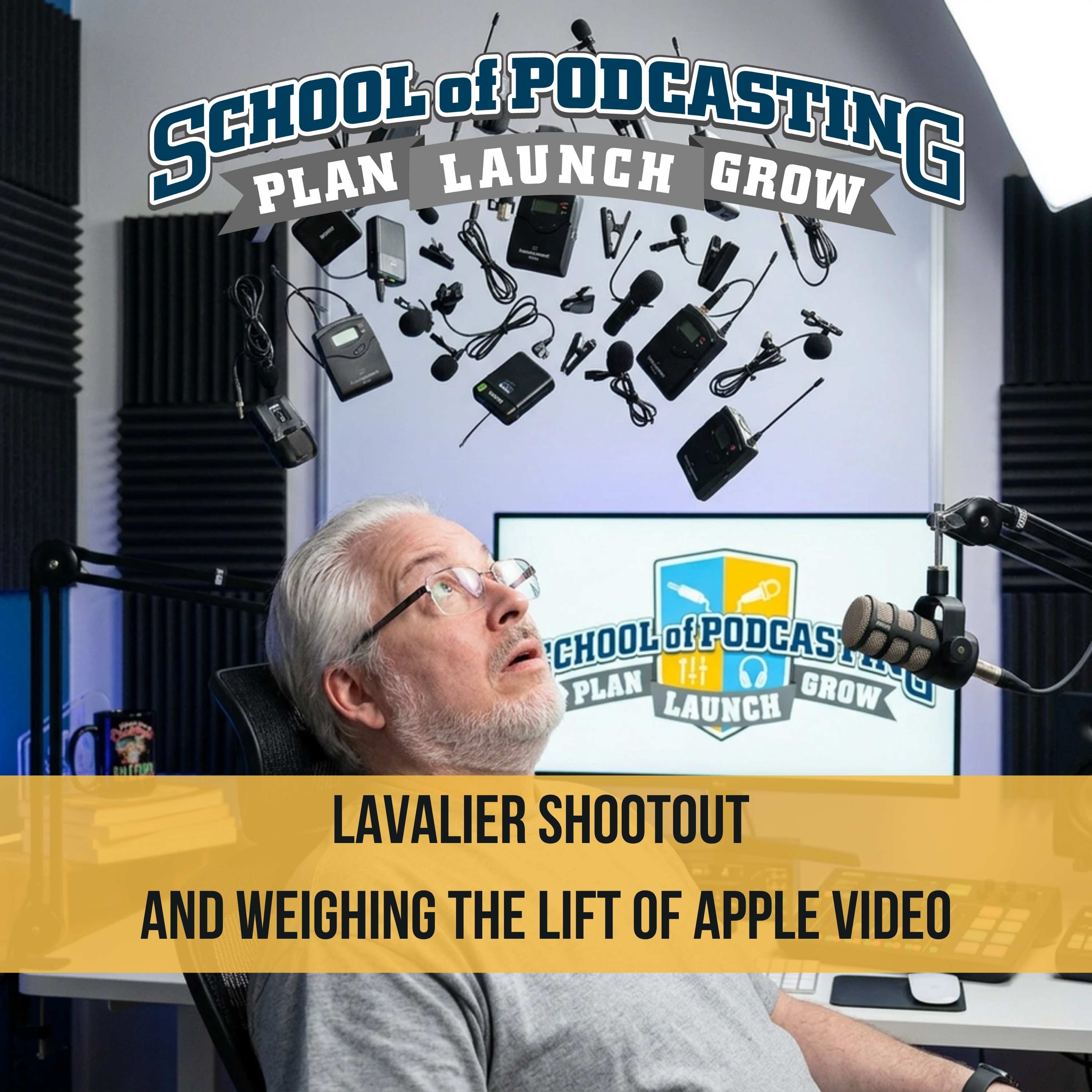
School of Podcasting: Expert Tips for Launching and Growing Your Podcast
Lavalier Shootout - Weighing the Lift of Apple HLS
00:43:15
Loading summary
Transcript40 lines
- [00:00]
Dave Jackson
Today on the school of Podcasting, we're gonna have a good old fashioned microphone shootout. But these are wireless microphones. They're lavalier mics for those looking to maybe do some video with their phones. And why, in the end, it doesn't really matter. Yeah, it's. It's amazing. Also, we got an update on the whole Apple HLS video. I don't know about you, I'm not super excited about this, but. But some really great things came out from Captivate to help you make a decision. And I'm going to let you know why. I think Elsie Escobar is amazing. Hit it, ladies.
- [00:39]
Elsie Escobar
The school of Podcasting with Dave Jackson.
- [00:44]
Dave Jackson
Podcasting since 2005, I am your award winning hall of fame podcast coach, Dave Jackson. Thanking you so much for tuning in. If you're new to the show, this is where I help you plan, launch and grow your podcast. The website schoolofpodcasting.com Today we are talking wireless lavalier microphones because everybody's obsessed about video. And what's interesting about this is there are so many choices. And I kept buying them and it turns out I'd forgot I'd already bought a number of these microphones. And I was like, why? Why do I have whatever it is, four or five? So I thought we could listen to them. And if you're like, ooh, should I go with the road or should I go with the DJI or the Hollywood or Hollyland, whatever it is, and in the end, you're gonna find out it kind of doesn't matter. So I realize these are as exciting as yesterday's toast. And so we're gonna go through this as quickly as we can. So what we're gonna do is listen to me explain the microphone, and then we're just going to compare them back to back. And then I'm going to share with you something you may not know when you're watching your favorite YouTuber, that there's. There's a thing that's going on there that nobody's talking about.
- [02:05]
Elsie Escobar
Yeah. Yeah, yeah, yeah.
- [02:07]
Dave Jackson
All right, so here is who we are looking at. You've got the. I keep calling it the DJI Mic 3. And it turns out after I looked at it, it out turns it's the DJI Mic Mini, which in reality is the DJI Mic 3. But it was 45 bucks. Like, that's dirt cheap. Now, the reason it was dirt cheap is this does not. The version I bought does not come with a charging case. Now do I need a charging case? It sounds Great because you know, every time you put it back in the charging case, it charges the stuff. So you can just record episodes forever and ever and ever. And for me I thought, well, I'm not out on the road. It's not like I'm recording multiple interviews. I want to record a five minute YouTube video. And so I didn't buy all the other ones. Have had a case. I bought this one without the case. Buy the one with the case. And here's why, strictly for organization, because it is so easy to lose the stuff that comes with it. So luckily I had a bag actually from DJI. I had the original DJI mic one. So anyway, so it's the DJI mic mini $45. The Hollyland Lark M2. That goes for 91 bucks. And right now I would say that's best value for your buck. We're going to hear these in just a second. Then I had the Rode wireless micro. That's 91 bucks. Then we had the Rode Wireless Go. Now the ones I have are the Rode Wireless Go 2. Can't buy those anymore. I have the Rode Wireless Go 3 is available for 191. And then topping out at $384, the Shure Move Mic, which is about the size of your pinky. It's the smallest of the group and it's kind of weird. The smaller the unit, in many cases the. The more money. But actually we're going to hear two versions of these. One where I clip them to the top of the sweater that I'm wearing. It's kind of cold here in Ohio right now. Which I'm like, hey, where'd spring go? But we're going to start these off with the DJI Mike Mini. The quick brown fox jumps over the lazy dog. Please bring pizza pronto. Now The Hollyland Lark M2S. The Quick Brown fox jumps over the lazy dog. Please bring pizza pronto. The Rode Wireless Micro. The quick brown fox jumps over the lazy dog. Please bring pizza pronto. The Road Wireless 2. The Quick Brown fox jumps over the lazy dog. Please bring pizza pronto. And the sure Move Mike. The quick brown fox jumps over the lazy dog. Please bring pizza pronto. Now I'm going to. I was going to play some other clips where if you instead of clipping these on your clothes, because these were all on the collar of my shirt, so basically on my collarbone. And it turns out that if you hold these in front of you where it can pick up your S's and T's, they all sounded better. But then you're doing a video of you holding a little square or a little thing. So I thought the whole point was to not have to worry about having a microphone in the shot. You, et cetera, et cetera. Obviously the one that costs the most, the Shure Move Mic sounds the best. And all of these have noise reduction. None of these had any processing whatsoever. There's no processing here in post production. But that's the thing I want to point out here. I'm now going to rapid fire these and I'm going to put some post production on them. And that's when I say I don't think it really matters. Check this out. DJI Mike Mini the quick brown fox jumps over the lazy dog. Please bring pizza pronto. Hollyland Lark M2s the quick brown fox jumps over the lazy dog. Please bring pizza pronto. Rode Wireless Micro. The quick brown fox jumps over the lazy dog. Please bring pizza pronto. Rode wireless. Go. The quick brown fox jumps over the lazy dog. Please bring pizza pronto. Sure Move Mike. The quick brown fox jumps over the lazy dog. Please bring pizza pronto. So I've said it before. I think you can kind of make any mic sound like any mic in post production by adding some eq, removing some room noise. I use a plugin called Droom. I have another one that's called and these are from a company called Accentize. There's another one called D Revive Pro. I have the kind of expensive version of that that was almost $300. I did not use that one. I wanted to use kind of inexpensive plugins, but it was basically droom and some EQ. One last quick example, here's the Hollyland Lark M2. The quick brown fox jumps over the lazy dog. Please bring pizza pronto. The quick brown fox jumps over the lazy dog. Please bring pizza pronto. So again, I think if I were to buy another one, which I'm not, obviously I have enough. I need to have a garage sale. I would buy one with cases and it's strictly for organization because I have like the shore kind of comes with a bag that has, you know, you little sleeves to put things in. That's fine. But I do like the ones that have a case because it's just easy to see that everything is in there. The tool I was using to record those, which was the Rode Micro and the DJI Mic Mini were made to record directly into a phone. And so I used two things. One is an app. Thank you Daniel J. Lewis from the Audacity to podcast called Zoom and Handy Recorder. And then the other thing I do is I bought these little kind of USB C extenders. I got a pack of four for eight bucks. They're great, but they come in a little bag and they just scream, lose me. And I did twice. I have eight of these things in my house somewhere. And so this is where you want to come up with a strategy of. Of where to store these. Otherwise you got to take your phone out of your case. The other thing I can let you know is if you don't pair your mics with your phone or the receiver or whatever on a regular basis, you will forget how to do this. And then you have to go to YouTube. Now, the good news is you can find the answer of how to repair your device together quickly. But it is frustrating. This also means that if you do. If you announce in a podcast episode that you're going to do a microphone shootout, you might want to start charging everything so it's ready when you're ready to record. Don't ask me how I know that one. And if you want to go kind of to a pro level, you could go to the DJI Mic 2, which is about the size of your thumb, and then buy a wired lapel mic to plug into the receiver, which you could then hide in your shirt and such. And the advantage of that is we're going to get our nerd on. It's 32 bit float, which means it's almost impossible to record bad audio. And you can kind of position it so it'll sound pretty decent. The new DJI Mic 3, which I accidentally got confused with the DJI Mic Mini because, you know, they look identical, is also 32 bit float, but it doesn't give you the ability to plug in any a wired lavalier. So if you're a person that's looking to get better audio into the I just want to record into my phone. These are some pretty decent options. My favorite is the DJI Mic Mini. You might go DJI 3 if you wanted to. And the rode wireless go. I also was again would use that one if I was plugging into a corded lavalier and then the shure. That's the reason I bought that one. The thing is you just have to remember to take it with you when you go on the road or things like that. That's a tip that you can take with you if you plan on recording people. When you go to conferences, you might want to remember to put the mics, because they are so small in your suitcase.
- [10:56]
Elsie Escobar
Yeah, yeah, yeah.
- [11:00]
Dave Jackson
Are you Dreaming of starting your own podcast but not sure where to begin? Podcasting in six weeks gives you a clear step by step path to go from idea to launch with confidence. This practical course is designed to help you create, record, edit, publish and promote your podcast in just six weeks. Now, whether you're starting from scratch or or feeling overwhelmed by the technical side, you'll get the guidance, structure and tools you need to launch a podcast that sounds professional and reaches the right audience. When you're ready to stop overthinking. When you're ready to start podcasting, join Podcasting in six weeks today and turn your voice, your ideas and expertise into a show people want to hear. The best part is it's only a dollar. Check it out. Classes start June 3rd. Go to schoolofpodcasting.com six weeks.
- [12:01]
Elsie Escobar
The school of podcasting. Yeah, yeah, yeah.
- [12:05]
Dave Jackson
All right. Some new steps were taken moving towards Apple implementing this HLS video. Now, if you're not interested in video at all, class is dismissed. But this is going to be something that could change some things. I am trying to stay open minded. I will be honest with you. I'm not super excited about it. I think it's fine with video. But here's what Captivate is one of the people that have been approved and there were a number of ones. And if I were to say one thing, there are a couple things that I just kind of go, this doesn't seem very Apple. And what I mean by that is I love Apple. I'm sitting here with an Apple watch working on my Macintosh computer and I was around when Apple moved podcasting into then itunes. So I will be forever grateful for Apple. But I thought it was odd that when they came out there were only four media hosts and it sounded like the other media hosts weren't aware of, which I thought was odd. Now there's like 14, I think. So everybody is there. I think it's odd. And I could be wrong unless they change something. But as of right now, this isn't on, you know, your TV. There's no way to watch podcasting on your TV. I can watch YouTube, but I can't watch these videos. And I just actually checked. I went to YouTube. I was watching Billy Corrigan, remember him? The guy from the Smashing Pumpkins was interviewing the lead singer of the band Disturbed, which was very interesting because they were talking about the Jewish Palestinian conflict and I didn't know the lead singer of Disturbed was Jewish. And he was giving me boots on the ground kind of report and I switched it to 720. Because here's the thing, Captivate came out and this is not a Captivate thing. It's how is Captivate, the company, going to implement this video part from Apple? And this isn't new, by the way, it's a new way. But there's been video in Apple Podcasts since 2005. So here's what they've come up with. It will cost $12 a month per show. Now let's stop right there. If Captivate is one of the, there's Captivate and there's Transistor, who has also been approved or whatever. They've been given the green light. And Captivate and Transistor have different business models than almost every other media host. And that is as many shows as you want, as many episodes as you want. Your bill only goes up if you go over 20,000 in the case of Transistor and 30,000 for Buzzsprout. So if I like right now I have, I think 13 shows on captivate. And so if I want to do all of those in video, that's 12 times 13. And you get a thousand views. Now before you go, wait, hold on, that's a thousand views on Apple. Not everyone. And if you go over a thousand, you will be billed more. And that amount has not been disclosed. Now here's the part that is kind of tricky. The video goes to Apple and all apps will get the audio from the video unless you add a second file. Now there's an asterisk on that. In that case, all the apps except Apple will get that second audio and Apple will continue to, you know, your audience in Apple will continue to receive the audio from the video. Now why is that a big deal? Because we often edit tighter. Do I dare say better? Because it's easier to edit audio because you don't make jump cuts. I was just watching again Billy Corrigan, who gave a huge amount of background information about a question that I would have cut out. But I realize had he done that, it would have been harder because it's video. It's much easier, much, much easier to edit audio than video because people are watching the whole thing. And so consequently you might take out, I've done this. I'll have a 90 minute show. I will take out two to three minutes of nothing but ums. Now before we go crazy on that, people say ums, I'm going for low hanging ums. Like, hey, I think it was last Tuesday. I can get rid of all that. Consequently, the, the audio and the video are going to be different. And everybody was like, well, somewhere. And this is where I'm going to try to track down Justin Jackson. He's a good guy over at Transistor and he's very excited about this. So I feel like I'm missing something and Justin can fill it in for me. But the audio and the video could be different now, especially if you, you know, buy into everything on YouTube. You need to get to the point as quickly as possible. So consequently, it might be, well, this might be the sound of the show if I was on YouTube. Hey, which wireless lavalier microphone is best for you? Hit it, ladies.
- [17:53]
Elsie Escobar
The school of podcasting with Dave Jackson.
- [17:59]
Dave Jackson
Well, first of all, we wouldn't even have that. That would be gone. And I would be talking about lavalier microphones because apparently people on YouTube are so insanely just chomping for content that they can't take four extra seconds for your intro. Which means either, A, we have to shorten the intro that will then shorten the intro on audio, or is it that your intro isn't good? There's a novel idea. Maybe the reason people on YouTube are skipping the intro is because it's not as good as it should be. It's not as tight as it should be. There's an idea. I think it's always been backwards because, you know, YouTube has the algorithm that will bring you thousands of people from heaven instantly with the flick of a switch. And yet that's not the place to go. Hey, new people who have never heard of me, I'm Dave Jackson. I've been podcasting since 2005. And here's, you know, a little bit of why. Maybe I know what I'm talking about. No, no, let's not do that on YouTube. But yet, I think the last time I checked, almost 90% of you follow me in Apple, you know, and the different apps, like, if you find the show, you follow it. And yet every week I start off reminding you who I am. It's kind of backwards in my book. But anyway, that's one of the things that people are like, hey, this isn't cool. Because either, A, I have to have no mistakes in my video and I might have to shorten up my intro, to which I go, I don't know. Are shortened intros really a bad thing? So the thing is, even the cleaned up version that you've done, because in Captivate, you can upload the cleaned up. Here's the alternate version of the audio. So I upload the video to Apple, the video goes to Apple, and the audio from the video goes to Apple and then this alternate edited version goes to everyone but Apple. And then you go, so how is Apple going to get my edited audio? And the answer is they're not. To which I kind of go, hmm. And I get why? Because like I said, I've cut out minutes of a show that was simply filler words and background and, you know, editing. So now at this point there's no video ad spots and all of this rolls out in May. So there's a lot, a lot to wait and see. People like Buzzsprout and I think every host at this point that is going to be rolling this out is testing it because video can be very, very expensive. And so what's going to happen at Captivate is you can upload up to 1080. Now we're talking, you know, resolutions and video and I believe was up to 90 minutes. And there are people making 3 hour 4k podcast to which I go, that's a movie. You're making a movie. And God bless you if you can hold my attention for three hours. Okay, and does it need to be in 4K? Like I said, I just went to my TV, I got a big TV and I said, look, show this to me in 7:20. And I didn't see a whole lot of difference. A little bit. I was watching again Billy and the guy from Disturbed. So I got two bald headed dudes and the, the sheen off their heads. And I'm not making fun here, look, I'm headed that way anyway. But you know, there's a little more detail and that's where I go, do we really need to see the pimples on somebody's, you know, like, I don't know that I need. I remember I was at the NRB show, this was probably 10 years ago and they had 8k already. And I just remember thinking, I don't need that much detail of everyone. And so what Captivate is doing is you can upload 1080, they're exporting it at 720, which is why I went to my TV and said, what does 720 look like on a TV? And so some people were not happy about that. And again, if you really want 4K and you want it to be three hours, you can reach out to Captivate and they'll come up with a special plan for, for you. But again, we got a lot, a lot to wait and see.
- [22:33]
Elsie Escobar
Yeah, yeah, yeah.
- [22:35]
Dave Jackson
And so Elsie Escobar and Rob Walsh, two of my favorite people, were running this webinar and they both Had a fear about this whole video, video, video, video. Now realize they are going to make 12 bucks a show and maybe some extra scratch if you go over a ousand and again let's 1, 000 views on Apple so they could benefit from people using Apple. And this is why this, this is something that's missing with some of the gigantic companies in podcasting. And by that I'm, I'm gonna big, big quotation marks around YouTube and Spotify is that I love transistor and Blueberry and Libsyn and Captivate and, and you know, you know, all the og because not only do they care about their audience, they care about the space. They realize that if we ruin the space, there's nobody to sell ads to, there's nobody to sell media hosting to. There's. If we ruin podcasting, then it all goes away. And the other thing I love about Elsie for me is the fact that we are really different people. I mean I love her to death, but we are very different people. And I always love to get Elsie's input on things because it's going to be different than mine. And often she has a very good point. But this is one where myself and Rob and Elsie all had the same point and I was like. And she just said it so well because, well, she's Elsie and of course she did.
- [24:27]
Elsie Escobar
This is a big question that comes up all the time as a platform, do you recommend adding video or do you urge caution? So overall, you know, obviously video is a great option addition, but it shouldn't be at the expense of your audio show or add additional workloads that you might not have the bandwidth for. So consider what extra you need to do and if that, you know, and any additional costs is worthwhile for you, then you do it. So for me, what I say too is that for video podcasters this is really a no brainer, right? With the caveat that as they move forward with even more focus for, for your audio. So you have to be very clear that the audio, and I'm sure all video podcasters that have done this for a while really do focus on really great audio. So you keep on doing that. You know, in the past, video folks tended to publish video to YouTube and then edit the audio from the video to optimize the audio files for the podcast apps. And you can still do that. So now it would mean to do the audio edit for the video basically in that one take form that I mentioned before. Now for audio podcasters only that have not gotten into video first, this Is my advice to you.
- [25:49]
Dave Jackson
Please give Elsie your undivided attention.
- [25:53]
Elsie Escobar
You know, I would keep the audio production and start testing your video process and only publish to YouTube. Weigh the lift, assess your own capacity to be able to produce the video portion and make an educated decision based on that. And, and I would say to you, if you're just starting out, produce at least 10 episodes with video and audio and with your new workflow and urging caution. What we say is it depends on your goals, which are informed by your personal bandwidth, resources and your. Why this is what I don't. I want you to listen to this.
- [26:37]
Dave Jackson
Okay. Again, if you haven't given her your undivided attention, get your pencils out.
- [26:42]
Elsie Escobar
Kids, do not add video to your podcast because of fomo. That's not. No.
- [26:51]
Dave Jackson
Yeah, we don't want people to pod fade because they start getting into video when they felt the pressure to do it and they didn't really want to do it. If, if you're sitting there thinking right now, I really don't want to do video, don't do a video. It's really that simple. There's more time in the day to consume audio than there is any other form of content. So if you want to stick with audio, by all means, stick with audio. So much wisdom there. One more time.
- [27:18]
Elsie Escobar
Way the lift.
- [27:20]
Dave Jackson
I love that. My Buddy from episode 613, Monica Rivera, is a big walker. I totally respect her. She gets up in the morning and does her morning walk. And I was watching her little, you know, kind of short, whatever you want to call it, and she's now throwing on a 30 pound weight as she walks around. Now, if she had maybe done that when she first started out, it was like, oh, I don't even want to walk. And then you go, oh, by the way, here's an extra 30 pounds. She probably would have said, yeah, that's enough walking for me, and never walked at all. So what we're worried about seeing is, is the person that just got into podcasting, I'm on episode eight and everybody is saying I need to do video. And I tried to do it, but it's too much. Wait, so what happens is they don't stop doing video, they stop podcasting, period. And we lose both the video and the audio. That's what we're worried about. Because, look, I don't care how good AI is, it will never be better than Theater of the Mind. Never. So Elsie mentioned something there about one take video editing. This is where if you want to do switchy screens and all Sorts of, you know, that kind of stuff. You could get yourself a stream deck. I use ecamm. I do this on Saturday. But I definitely am not a one take person. I am. But there's no editing and man does a show. But if you are a video first person, here's the thing, the other side of this where we're like, hey, you might want to think about this. As Elsie said, if you're doing video, there is a thing called first mover advantage. And so when this really starts to roll out and people like, hey, there's video in Apple podcasts, people are going to go looking. Now, from what I've seen so far, there's no like, show me video filter. It's you look for podcasts and then if you have a video option, it gives you a little icon that, hey, there's a video. And then you can switch back and forth. And again, Justin Jackson has a video showing this. I'll have a link to that out in the show notes. But if you are a video person, you might want to check this out because it's only 12 bucks. Now, if you go over a thousand views, number one, let us know. I think we're all going to learn this together. There is a part of me there. I have two sides of my brain. Part of me thinks we're going to roll this out and it could be a big nothing burger. I mean, does anybody remember the Apple Newton? Yes, of course you don't. That was before there were Palm Pilots. I mean, not everything Apple does is great. A lot of it is. But just I'm saying there's a part of me that goes, hmm, I'm not really quite sure I'm seeing this. And then again, the flip side is I remember the only time I've ever seen hockey stick growth was when Apple put podcasting into itunes back then. And I remember looking at my numbers going, oh, holy cow. Thank you, Apple. So that may be something to think about, but it doesn't do any good to add video to your workflow if it's going to completely decimate you and just wipe you out. So I agree with Elsie. If you want to try video, let's do the free one. Let's start off by doing it on YouTube and again, weigh it. How much does this add to your workflow? Let's see. Let's test the waters before we go jumping in and do it as an experiment. Your podcast is always an experiment. Let's try it. And then if it doesn't work, don't kill your Podcast because you think you have to do video. There's a name for the person that wants you to do video a lot, and their name is YouTube, and of course they do. But you don't have to do video. As Rob said, audio has outperformed video Quite like 15 to 1, because there's just more opportunities to listen than to watch. So keep that in mind. Let's try. If you want to test the waters with video, go to YouTube. And then if you're like, yeah, well, then you've got the videos, you can go ahead and add them to your podcast. When you look at the pieces of a podcast, your media host is the engine, but your website is the home. It's where your audience learns who you are, explores your episodes, and decides to follow your show. At PodPage, we build podcast websites that are fast, reliable, and designed to convert visitors into listeners. Every episode is automatically published, SEO optimized and structured for growth so you can focus on creating your podcast, not managing your website. If your media host powers your podcast, PodPage gives it a place to live and a place to grow. Give your podcast the home it deserves. Start building your podcast website today by going to podpage.com preview and enjoy a 1414 day free trial. Podpage.com preview.
- [33:10]
Guest (possibly Tim Ferriss or another interviewed expert)
Ooh, now that's a good question.
- [33:13]
Dave Jackson
Most of us use some sort of remote recording for interviews, etc. Etc. And most of us have gone through more than one. So think of a new podcaster. They say, I want to record remotely. Who do you recommend and why? And then let us know any horror stories from previous ones you've used. I need your answer by May 22, 2026. And don't forget to say a little bit about your podcast and your website. Just go to schoolofpodcasting.com? by May 22 or click the link in the show notes.
- [33:58]
Elsie Escobar
The school of Podcasting.
- [34:00]
Dave Jackson
I was listening to the Media Roundtable. This is a show with Dan Granger, who's the CEO and founder of Oxford Road. And he was interviewing Tim Ferriss, which of course is the entrepreneur, and he's the host of the Tim Ferriss show and the Four Hour Workweek. He's that Tim Ferriss. And Dr. Laurie Santos, who is the host of the Happiness Lab, she's the author of that book. And, and Tim said this. Since we're talking about getting people to watch us and then move over to our audio, that's not really a great strategy. Growing a video audience. Sure, that's a strategy, but if you're hoping the Videos will grow people on your audio. Well, here's Tim, the creators, right.
- [34:47]
Guest (possibly Tim Ferriss or another interviewed expert)
Who right now, and I've seen this, who are making compromises to appease the algorithm gods. Yeah, they're going to be roadkill. Right. So for instance, I mean I've had shorts that have had hundreds of millions of views, downloads impact 0000 because the platform's directive is to keep people on the platform. That's how they derive the most value from these people in terms of serving advertising and otherwise. So anything that the platform can do to prevent people from leaving the platform, they will. If you're competing in an algo chasing game and by extension if you're marketers who are depending on people who do that, I think the window for that working is going to close very quickly. I think it's going to be really hard to make that work longitudinally from a marketer perspective. I would look at that. I would be reading things like the Blue Ocean Strategy. I would be reading things like a very old book. There's one chapter in it, the 22 immutable laws of marketing. There's one chapter called the Law of Cat category. I would read that 1000 true fans by Kevin Kelly. I'd be reading that. I think that a lot of the people who are actually going to convert the best right now would not consider themselves creators. They would not have extremely large audiences, but they would have people who really, really, really trust them.
- [36:10]
Dave Jackson
Thank you, Tim. And now I get to add all those links in the show notes because if you're like me, I'm like, wait, what were those titles? Yeah, I'll have them in the show notes. And he also said one other thing I'm just going to throw in here because Tim is kind of the mad scientist that tries all these different things. And I was kind of surprised when I heard this.
- [36:28]
Guest (possibly Tim Ferriss or another interviewed expert)
And then there's the question of how you use these tools or which tools you choose not to use. Like, I have not had social media on my phone for three or four years now and you might think that my professional life is sort of predicated on some of that. But my mental health is also predicated on on minimizing use of some of those. So there are ways to work around it. Right. I can still use those things on a laptop. I'm adding friction where it's beneficial to me to have friction and I'm removing friction, say just in life.
- [36:57]
Dave Jackson
I'll have a link to that episode. It was really interesting. He talks about how when you take care of your body you take care of your mind. But part of that was, yeah, no social media on his phone. I was like, what? What? What am I gonna be August 21st through the 23rd? Charlotte North, Empowered Podcasting 3. I went last year, and the minute it was over, I'm like, I'm going back to this one. You got to check out this one. Especially designed for independent podcasters with a maximum capacity of 250 people. I love that because I get to meet everyone. Check it out. Empowered podcasting dot com.
- [37:40]
Elsie Escobar
The school of podcasting. Yeah, yeah, yeah.
- [37:44]
Dave Jackson
I want to bring up something. I was listening to the new media show with Rob Greenlee, a good friend of mine, and he was interviewing Sharon Taylor, who was the chief revenue officer at Triton Digital. Now, when you hear that name, they own Spreaker and Omni Studio, and they were talking about back in the day when CPMs were not that great. And correct me if I'm wrong, Sharon says, yeah, there's still that rate.
- [38:17]
Elsie Escobar
Yeah, I think that we both have lived through that time of programmatic ads being like, this dirty concept.
- [38:22]
Dave Jackson
It was a dirty concept, and it also, in the early couple of years, the CPMs were just horrible. So it was like, you know, you just scrape them by with like, two, three dollar CPMs, and it's like, those CPMs still exist. Wait, one more time.
- [38:38]
Elsie Escobar
Those CPMs still exist.
- [38:40]
Dave Jackson
All right, let's continue.
- [38:41]
Elsie Escobar
The benefit now is that there's a greater array of advertisers and more money at the top of the funnel. And so, like, you should be looking at total spend of these, you know, advertisers, and not a, you know, a single CPM anymore.
- [38:53]
Dave Jackson
So what I'm hearing there is the good news is there are more people getting into spending advertising dollars now. Why are they doing it? Because it's dirt cheap. And they go, look, we've got so much more money. Yeah, because it's more people. Not because the price has gone up to something that would be remotely fair to the podcaster. I mean, have you ever been in the store and there's like, a great deal on toilet paper? Don't you buy more of it? Because, hey, look how cheap it is. So I'm not quite sure I am happy that more people are getting into advertising. That's brilliant and kudos to people. Like, sounds profitable. And Oxford Road for helping to educate people about the powerful connection that podcasters have with their audience. Can we just get them a little more money now instead of these horrible CPMs?
- [39:45]
Elsie Escobar
Yeah, yeah, yeah.
- [39:46]
Dave Jackson
Hey, a quick note. This is from a blog post on PodPage and it's for anyone using WordPress. I am the head of podcasting at PodPage and Brendan Mulligan put out this post letting people know a collection. It's basically about 30 plugins. It's a collection called the Essential Plugin Suite. Things like countdown timers and pop up builders and testimonial widgets, they were all sold on a marketplace called Flippa. I loved Flippa. He was faster than lightning. Boy, that's real. I mean, that's. I barely. Flippa, by the way, was Flipper. It was a dolphin. And that's enough of that tangent. Anyway, I always thought it was odd. It's like in the 60s, I was very little when the show was on. Let's take a tangent, shall we? Here's the question. Flipper understood English so they could go, flipper, go tell old man Martin that, you know, Timmy's fell down the well. And Flippa would go, you know, whatever. And they would go, great. And I'm like, wait, so the people on the land understand dolphin and the dolphin understands English. Why not just pick one and go with it? I always thought that was odd. Anyway, meanwhile we have these 31 plugins. And the changelog described it as routine compatibility fix. But what I actually did was hide a back door, a secret passage into any site running the plugin. And it took eight months. It sat there doing nothing for eight months. So you're like, oh, it's a great plugin, I love it. And yeah, basically this month In April of 2026, it activated and within days thousands of websites are compromised. Some had hidden spam links injected. They were visible only to Google site owners. I don't know why people do this, but anyway, I will, without getting into all the nitty gritty, he has a list here of what you should do. And if you weren't aware, PodPage has a WordPress integration. And as we like to say here, The website schoolofpodcasting.com the coupon is listener when you sign up for a monthly, quarterly or yearly subscription. And don't forget, not only does that come with step by step courses and one on one coaching and an amazing community, it comes with a 30 day money back guarantee. So if you're worried about it, you don't have to worry. You got 29 days to figure it out. Schoolofpodcasting.com, use the coupon code listener. And until next week, take care. God bless. Class is dismissed. If you like the show, please share it with a friend. If you like the show, pretty, pretty please share it with a friend right now. Yeah, but this is wireless, not navigation. Wireless navigation. No, it's a wireless lavalier. Wireless navigation. Where did that come from? Which? Wireless navigation? Why do I keep saying navigation? They're going to make 12 bucks a show for everyone. Why is my voice cracking? 12 bucks a show. Oh, who are these people? And again, Justin Jackson has a video. Let's not have the burp in there, shall we?
- [43:15]
Elsie Escobar
Yeah.