← School of Podcasting: Expert Tips for Launching and Growing Your Podcast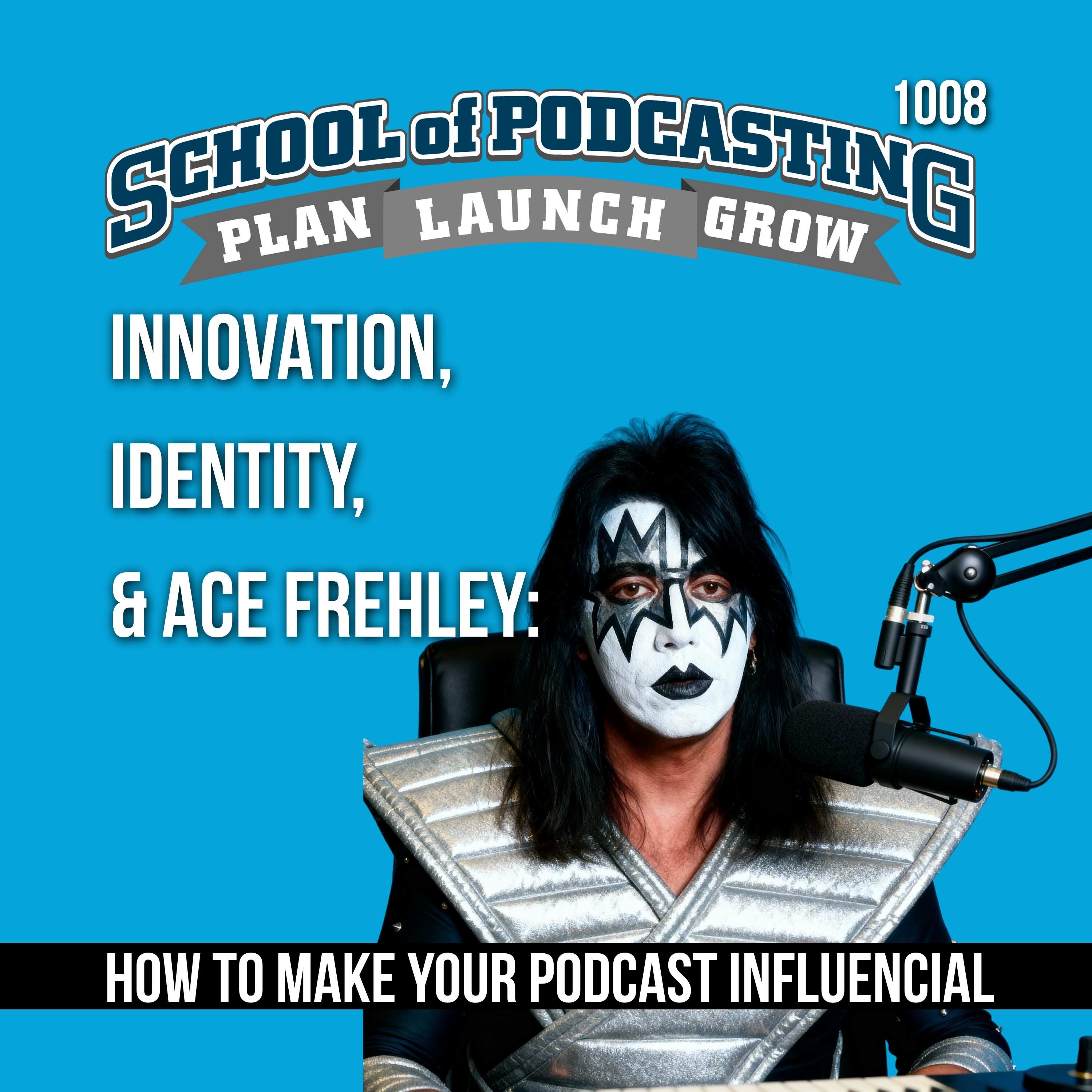
School of Podcasting: Expert Tips for Launching and Growing Your Podcast
You Can Be an Influencer Without Being the Best: Lessons from Ace Frehley of Kiss
00:37:21
Loading summary
Transcript19 lines
- [00:00]
A
Hey, we're gonna do one of those episodes where Dave talks about dead people and then we compare it to podcasting. And today we're talking about Ace Frehley from kiss, who technically wasn't the greatest player, but despite the odds, he became a huge inspiration for millions of guitarists around the world. And maybe just like Ace, he may have wondered if anyone would ever listen. Many podcasters like you might question your own voice. Like, is anybody going to really listen to me? Your superpower may be that everyone can identify with you, they relate to you, and they want more from you. So today we're talking Ace Freely and podcasting.
- [00:49]
B
The school of podcasting with Dave Jackson.
- [00:55]
A
Podcasting since 2005, I am your award winning hall of fame podcast coach, Dave Jackson. Thanking you so much for tuning in. If you're new to the show, this is the longest running podcast about podcasting. And we talk about planning your podcast, launching your podcast, growing your podcast. It's all there@schoolofpodcasting.com this is kind of a weird episode, a little different, but I want you to hang with me because there's some really good points in this. But once again, Dave is going to talk about a dead dude. Couple weeks ago, the lead guitarist of Kiss, his name was Ace Freely. And this is what was really weird about it. He fell down and ended up with a brain bleed. So, like, I want to, like, go around my house now and baby proof it for, you know, me, and I'm not a baby, but my. My heart goes out to his family and his children, etc. But are you ready for a hot take? Because it turns out that Ace has influenced, like, millions of guitar players. And the hot take is. And this is something I think a lot of guitarists think, but nobody will say out loud. He wasn't amazing. What, What, What? Like, he wasn't bad. But when you go. And Ace influenced all of these people. Well, my favorite quote from Ace Freely was, if I had known I was going to influence so many people, I would have practiced more. And so I say this for those people that are thinking, oh, why would anyone listen to me? A lot of people were inspired by Ace Frehley. And what I mean by this is, is. And this is kind of one of his key ingredients. I could really relate to him. Like, you start off as a guitar player learning Chuck Berry licks, and then you kind of graduate to Ace Freely. And where I have seen, like, Ozzy Osbourne's guitarist, Zach Wilde, I saw him right in front of me do things on the Guitar and my brain went. I still don't know how he did it. I know. I just watched him do it. I. I don't know how he did it. Ace Freely. I was playing his licks when I was 12, right? Not that they were bad. Not just. He just technically was not the most lickety split kind of thing. But when you heard Ace, what you heard, and this sounds stupid, was Ace being Ace. So to bring that into podcasting, just be yourself and you never know who you're going to influence. It's amazing, as I look back at this and he. He kind of took inspiration from other people. In some cases, he just outright stole. I'm sorry, borrowed. I'm sorry. He was inspired by Robbie Krieger from the Doors. If you listen to the. For all my Kiss fans out there, if you listen to the solo in the song she. Yeah, that's straight out of a door song, just for the record. But here's the one thing that made him stand out. And he was in the band Kiss and they already had, you know, fire breathing and blood spitting and lights and all sorts of stuff, but he never stopped trying to be better. And so he decided he wanted to have a smoking guitar. And I looked into this. There is only one guitar player who has had a smoking guitar and his name is Ace Freely. And so this is a hard one. What can you do that would make you absolutely unique in the podcasting space? And I'm here to tell you that's a hard one to come up with. But if you can. And people have ripped off other things he's done, like shooting rockets off the top of your guitar. Very close to having a smoking guitar, but not quite. Ace did it first and other people have ripped it off, but nobody has ripped off the smoking guitar with a bright light in it. And so I think if you did, that's like blasphemy. Like, everybody knows who does that and you just stole it. You suck. So that's one thing. He was being himself, and yet he still found something to set himself apart. The other thing you can learn is continuous improvement. So speaking of that smoking guitar, he started off where he would just light a smoke bomb with, I don't know, a match, A car lighter matches something and throw it in the back of the guitar and it would then come out the front of the guitar. Sounds cool. Except, oopsie, you just ruined your guitar. Oh, that's not one of our top answers. Yeah. So that later turned into, what do you do when you don't know what to do you call in somebody who knows what they're doing? And that's what he did. He bolted an engineer and said, hey, eventually this morphed into having, like, a D cell battery after it went through electronic ignition. And then they somehow tied it into the knobs that were on the guitar. They kept tweaking it over the years, and eventually it was really cool. He brought in this halogen bulb and the smoke, and it wouldn't ruin the guitar. And the last time I saw them in concert, they somehow rigged the guitar to where he would just be playing it, let go, and it would float up, smoking and light billowing out of it into the rafters. He didn't start that way. So that's another lesson here. You start off with what you want or what you have, and then you can slowly integrate. Most great ideas are not right out of your thoughts. It's like, hey, I got an idea. Let's put smoke bombs in the back of my guitar. And somebody went, wait a minute. What if we do something that's a little safer and we do this? And then somebody said, but we could do this. And then somebody said, what if we had it float in the rafters? So realize sometimes you're on version two of an idea. And Ace never stopped, even though he had this huge explosion in stages and going. He's like, hey, how can we make this better? So he was really into constant improvement. And he had that one thing that set him apart, because even though he was in Kiss and yes, they wore makeup, they weren't the first band to wear makeup, I. E. David Bowie. So keep that in mind. And if you're sitting there thinking, who would listen to me? Realize that you don't have to be the absolute best, the smartest, the bestest, whatever. You can influence people without being the bestest, greatest, etc. Etc. Is bestest a word? Anyway, you get the point. This guy inspired millions of people by being okay. Like, oh, you know, he had his own style. I remember when I saw him, he would constantly kind of point at the ground and then bend down. Like he, like, really needed to go number two. And I remember thinking, that's a weird stage presence. But it was Ace being Ace. So this guy inspired millions. You could inspire millions.
- [08:35]
B
Yeah, yeah, yeah.
- [08:36]
A
And I mentioned. I think one of the reasons he inspired so many people is because as a guitar player, you could relate to him and go, I think I could. I think I could play that. And then you find out you could. But also, he always connected with his audience. There are Tons of videos now popping out where he would meet somebody at like, a 711 or whatever, and always took time to hang out with the audience and take pictures and whatever. So on one hand, his language, his guitar language, right? It was something that people could connect with. So make sure you're not talking above your audience with a bunch of jargon, but also make sure you're not talking under them to where your audience is. Like, really? You don't think I know that? He kind of, you know, people identified his guitar notes as a guitar player, as a language that they could identify with. So be sure to be yourself, but also know who your audience is so you can talk the same language.
- [09:39]
B
Yeah, yeah, yeah.
- [09:40]
A
Over the years, he kind of had business issues with Kiss with the other two members. And I thought this was brilliant for a guy that said, I'm not really much of a business guy. When he left the band, along with another guy named Peter, Peter sold his makeup because he made it right. He had the copyright on his face makeup. Ace did as well. Peter sold his makeup to the band so the next guy could use it. Ace came up with a way that he would lease them the makeup for the next person. So he got paid every year they went on tour because that guy was using my makeup, and I was like, that's a pretty cool thing. So keep this in mind. Your content that you make is worth something. So as you work a deal with Spotify or Netflix or whoever, make sure you retain the ownership of your stuff. Kind of sticking with the business side. There was a time when he was in Kiss and kind of wasn't having fun anymore. Yes, he was making lots of money, and he walked away from basically a $15 million contract. Why? Because he wasn't having fun. And he could leave, do his solo stuff and still make money. Nowhere near that kind of money. But at this point, he had money in the bank and was like, yeah, I'm not going to stick around and do a show that's not fun. And I thought that was kind of cool. And keep this in mind. When you're not having fun with your show, it's time to leave. If you're with a network and they're kind of reneging on a lot of the stuff they promised, it's time to go. Because that stuff will suck the fun out of it. And then you will actually stop doing what you love to do, which is creating your podcast.
- [11:35]
B
Yeah, yeah, yeah.
- [11:37]
A
And this is really great. If you have a team and that is, you know, your role, and you stay in your lane. Ace Freely. I said he wasn't very good. He was the king of the pentatonic scale, the blue scale. So technically there are people that could do more and they could do it faster. But Ace kind of, again, was just being Ace, and that's why he fit. If you think about it, the bass player spit in blood and breathing fire. Paul Stanley, one of the best showmen and actually like super talented singer. And I remember just the one time he was running around. He looks like a bobblehead. His head's going around so much. He jumped up and again he's in these giant heels, kicked his legs out and then landed on his knees. And I was like, that. That would hurt, I would think. And then he got up and started singing. It was amazing. And so if you think about it, if Ace was super flashy and was running around like the guy in ACDC whose role is to run around because everybody else is standing there, it would be too much. So he knew his role and he played it well. And so when I look at his guitar playing, yes, there are people that are technically better, but he played the right thing for the song. And there are times if you're on a panel or whatever it is, and there are times when you talk, and there are times when your guest or your co host talks, and that's what people call chemistry. And there are times. I'm so grateful to have Jim Collison as my co host on Ask the Podcast Coach because I'm doing a lot on that show. It's a live show. I'm looking at a chat room. I'm switching scenes in ECAMM Live, which is what I use to stream live. I'm looking at my note joy to find out what's the next question if there isn't one. There's a lot going on on my end and Jim is great at watching me. And if he sees I'm out kind of harvesting the next topic, he will keep talking and give me time. And he also knows there are times when I'm like, okay, I'm out of stuff. And I'll be like, what do you think, Mr. Collison? And that's my cue to him to like, hey, talk for a couple minutes while I go find something. And that is not something we do audibly. It's just something because I've been doing the show with him for probably a dozen years now. We just know what to do. We both know each the part that we play and when to play it. And I think that's something we can learn from Ace Frehley. He played the right notes for the song. Not so much to make him look amazing, but to make the song amazing. And you can do the same thing with a podcast. You don't have to be the star. If you're doing an interview, let the guest be the star. Now, you always do something at the end to remind people, it's my show, but let them shine, and they will then, you know, share that shininess of them with their audience, hopefully. So there are times when the best thing to do is let somebody else take it.
- [14:40]
B
Yeah, yeah, yeah.
- [14:42]
A
Ace had some serious struggles with addiction and drugs, and eventually his daughter helped him get sober. So don't let setbacks define your career. Keep working and overcome them. Because sometimes you're like, oh, I want to do this, but I don't have this one piece of equipment. Well, you can probably get around that. But the final takeaway, be innovative. Be authentic. I know a lot of people hate that word, but that's the only word I can come up. Be audience focused. Protect your rights. Keep leveling up. And above all, be yourself. Because that's what Ace was. When you heard Ace play, my favorite was there was an album called Creatures of the Night. And to make a long story short, he didn't play on that album. They got a new guy, but they still had his cover or his face on the COVID And I remember listening to that with a friend saying, did Ace take some lessons? Like, how did he get so much better? Because there was some lickety split stuff on that. So you knew him when you heard him. Why? Because there was only one Ace. Freely. And be yourself because you're the best person at being yourself. And when you try to be someone else, it's hard and it rarely, if ever, works. Hey, it's Dave. And I get it. You don't even know what you need when it comes to, you know, the gear. And there's so much software and microphones and mixers and hosting platforms and all sorts of stuff. It's easy to get lost and analysis. Paralysis kicks in fast. And then you go to Facebook. Well, that's like adding more chefs into your kitchen, and the recipe gets messy really quick. I've been helping podcasters for almost 20 years, and what I do is I listen to what you want, and then I recommend what. What you need. And the other thing is, I'm cheap. So I'm going to recommend that the money you spend is mine. And so you can sound like a million bucks. You can look Amazing without spending so much money that you need to take out a second mortgage. Come visit me over@schoolofpodcasting.com join. Use the coupon code LISTENER. That's schoolofpodcasting.com join. Want more podcasting tips? Join the 1700 people who read my newsletter at podcastingobservations.com that's podcastingobservations.com.
- [17:28]
B
The School of Podcasting.
- [17:30]
A
All right, in the US we just celebrated Halloween where we get all of our obese children to dress up in, you know, Spider man and all these other outfits and hand them more candy because, I don't know, I wonder why childhood obesity and diabetes is so rampant in America. So that was October's little thing that we do now in November, we, like, everybody just takes off their belt and we have a humongous meal. Why are Americans so fat? I don't know. What do we do in December? We eat ham. You know, January, we eat sauerkraut. Every holiday comes with food. But anyway, I do want to kind of bring up food because my buddy Josh Liston said something that was so absolutely brilliant. And you got to check out Josh's new show. It's called Saki this. Now, if you're an American and you've never partaken of any kind of Japanese food, it looks like sake. This S a K E this. Josh and his co host are both comedians and they find it's all about Japan because they both go there or want to go there, but they find these weird stories. I think I told you the one time about how they have a hotel room that you can rent for like a dollar a night, as long as you don't mind that everything is being live streamed, except, of course, the bathroom. And so that's the question. Would you mind having a bunch of people watch you sleep for a dollar if you could stay in the hotel for free? Something like. So a lot of weird stories. Very funny stuff, real or not, where he'll come up with words. And anyway, I'll put a link in the show notes to that. But Josh said something. We were doing some consulting, and we're talking about AI and he said, you know, AI is usually when we're impressed, we're not impressed by the content. We're impressed that they were able to make the content. Now there are times with videos and things that you're like, wow, that's actually really cool. But it's usually like, wow, that all almost looks real. Or if it does look real, okay. But here's the Question. Have you ever shared AI content for the content, or was it like, look at this. This is amazing. Look at what it did. And I was like, that is a really good point, because for me, I'm sharing it, going, hey, I think I'm going to wet my pants. This is getting better. But I've never truly shared something, especially written by AI, that I went, this is amazing. I've never thought of this. What a way to put two and two together. Never have. And so being that we're. We're in food season here in America, I used to say this, and I was like, hey, I was going back through some of the old archives, and I was like, oh, that's a good analogy. I need to bring that back. So here's the thing we're going to talk about, and we're not talking James Brown, but we are going to talk about the mashed potato. No, here's the thing. Growing up, I've mentioned this before, we did not have a lot of money, and so I don't know if you've ever had them, but you can get mashed potatoes out of a box. They are powdered, and in theory, you mix them with water and presto, instant mashed potatoes. Now, my mom tried this and was like, wow, these taste like the box. I mean, they were bad. And so she worked a deal, and she, like, she was like a chemist, a mad scientist, and she came up by mixing it with milk instead of water and then adding boatloads of butter, it became edible. But when you think about now, that didn't take much work. Once she got it down, you would basically whip out a bowl, dump these flakes in it, pour some milk in, throw in some butter, and stir it, and you were good to go. However, when you got truly honest mashed potatoes, where you take potatoes and you mash them, and by that, it means you typically, depending, most people peel them, then they cut them, and then you take all the little slicey and diceys and you take something and you just beat the snot out of them until they are lumpy, but not, you know, that whole nine yards. And then again, you throw in the butter and the salt and. Mmm. And when you eat homemade mashed potatoes, you go, oh, these are so much better. Those are something like if somebody goes, hey, you want to come over for Thanksgiving? And I go, maybe. And they go, we're making homemade mashed potatoes. I'm there. But if they go, oh, we've got, you know, Betty Crocker fresh out of the box, mashed potatoes, that's okay. I think I'll stay here. And so yes, it's easier to make mashed potatoes out of a box. It's quicker, probably cheaper and not as messy, not as much mess to clean up. But in the end, the true honest mashed potato, the homemade mashed potato is something that you will remember that is remarkable. And so keep that in mind. I don't hate AI, but I was like, that's a great analogy. And when Josh said, yeah, have you ever recommended something that was actually written by AI? And when you do, is it because the content was remarkable or was it more the awe of the technology coming so close, but not quite? And I went, huh? That made me think, ooh, now that's a good question. We're going back to a classic. I need this by November 21, 2025. Go to schoolofpodcasting.com? to answer and that is what do you wish you had known before starting your podcast? So this is for those people who have a podcast to help those people that don't have one or maybe are thinking of starting one or starting another one or anything like that. So what do you wish you had known before starting your podcast? Go to schoolofpodcasting.com? and don't forget to tell us a little bit about your show and your website. Oh, where am I going to be? Well, November 8th I'll be attending Pod Indy in Whiteland, Indiana. Then January 15th through the 18th I'll be be in Orlando, Florida speaking at PodFest Multimedia Expo. Then in February 17th through the 20th, this is in 2026 I'll be in Nashville, Tennessee talking at the NRB 2026 International Christian Media Convention. For more information, go to schoolofpodcasting.com where.
- [25:09]
B
Yeah, yeah, yeah.
- [25:11]
A
I always say that we often don't see those low hanging fruits, those things that might be considered a mistake. When there Ares and I was on Pod Match, I was looking for potential guests or potential shows for me to be a guest on. And I found someone. I'm not going to say who, but to make a long story short, I thought I would remind you that Google Podcasts is no more. Yeah, it went, went out of business, which is a bummer because it had 3%, 3% of the market, which is big when you're brand new. And you know, Amazon doesn't have 3% except in India I think for some reason, you know. And I went to this person's site who does help in podcasting and one of the buttons on the Front page was Click here to listen to me in Google Podcasts, which, when you clicked on it, it said, he. That doesn't exist anymore. I think the final. Final date was sometime in July of 2024. So you might want to check your website, because the fun thing about subscription buttons, or now follow buttons is that you set them up once and then you can leave them alone. And so you might want to look because you don't want to send your audience into a black hole. So keep that in mind. And then I made a new episode of a show that I haven't done for a year just because I felt like it. Again, your podcast is a recipe, not a statue. And I was like, you know what? I miss doing that show. Let me do an episode. And so I did an episode of the podcast Rodeo Show. Long story short, there were many things on that website that had been sitting still for an hour, an hour for a year, in a month. And if I was like, nobody has ordered a review on that particular site. Well, when I clicked on it, I found out why it went to Fiverr, which is what I was using to advertise the gig, as they call it. And Fiverr was like, hey, we're waiting for you to fill in some tax information. Which was funny because Fiverr needed to check their stuff. Because when I went to fill in my tax information, I went to a site that just sat there and spun. And I was like, well, that's fun. So as the year wraps up, you might want to. If you've been taking a break, I'm not a big fan of seasons, but if you took a break and you came back, you might want to go out and check and make sure everything works. I had another person this week that this kind of drives me nuts where you've made this really elaborate contact page where it's like, hey, why do you want to contact me? Please pick one of the following. You want to, you know, have a potential, you know, etc. We should meet and talk to each other. We should do this. Potential, this. And I'm like, hey, I just want to let you know your contact form doesn't work, and you've made them so complicated that it doesn't work. I ran into that, and so, you know, let me leave you a voicemail. It drives me bonkers when you make me contact you on Blue sky or whatever. Like, no, you gotta go over and send me a DM on Twitter or Instaface or Chatbook or whatever's going on. Like, no. And if you're wondering why you're not getting any engagement, Go out and engage on your website to make sure that's working. Because it may be that, hey, the form works, but it's sending it to an old Hotmail account that you haven't used since, you know, the Obamas were in the White House. So as we get ready to round the corner and head towards 2026, if you've been, you know, taking a break or coming back or just go out and go, what do I want people to do on my website? Oh, I want them to follow the show on Apple and Spotify and Pocket Cast. Good. Go click all those buttons, make sure they work. Oh, I want them to be able to leave a voicemail. Great. Go leave yourself a voicemail and make sure you get it. You know, Oh, I want them to leave me a comment or I want them to send me an email using the. Go. Do everything you want your audience to do and make sure it works.
- [29:36]
B
Yeah, yeah, yeah.
- [29:38]
A
All right. I'm gonna do something that you can only do maybe, but I think only I can do this because. Or anybody else that does a podcast about podcasting. So what I'm going to do is tell you how the sausage is made. How did I make this content? And 99% of the time, the audience doesn't care. They just want the sausage. They don't care how it was made. But just to let you know, the first time I sat down with my bullet points to talk about Ace Frehley and what podcasters can learn from him, it was like 40 minutes long. Ish. And I listened to it back, and I was like, ooh. I went very nerdy, even more than today, into the guitar, especially talking about his smoking guitar and the this and the D. Like, I went way. And I was like, nobody cares. We just need to know it was a smoking guitar. Nobody else had one. And so what I did was I listened to it, and I'm like, well, most of this are the points I want to make, but obviously there's some things here that could be cut back and focused on. So I transcribed that rough draft. I took that rough draft. I threw it into magi, which is my AI tool, which gives me access to chat and Claude and all sorts of stuff for basically the price of chat. And I said, hey, here is my transcript from a podcast. Can you help me identify the key points that I'm trying to make and the benefits or how they pertain to podcasting? And it gave me, I think, like, seven out of what was really 10 or nine. And I was like, okay. And so I took that and really focused and recorded that. And then I did add one just now, which was the one about, hey, stay in your lane and play what's right for the song. In other words, know your role if you're on a team. And so that's. If you ever want some critiquing of your show and you don't feel like going to Podcast Hot seat or Podcast Rodeo show, you could try. Now, realize that AI doesn't have feelings and it doesn't understand nostalgia and things like that. But you might be able to get some feedback by transcribing the first run of a show and then asking it, hey, what was I really trying to see here? And it might help you stay on track, because the first time I, or actually the second time I recorded it, it was like closer to 15 minutes. So it really, for me, I thought, help me stay focused. I didn't nerd out quite so much on the guitar, which is more pertinent to you because you may or may not play the guitar. But that was something I tried and was like, huh, that wasn't bad.
- [32:33]
B
Yeah, yeah, yeah.
- [32:36]
A
One last point, and it dawned on me. I should have said this at the beginning of the show, but for the better part of a year or so, maybe two, I've been saying that when you join the school of podcasting, you get unlimited consulting. And I'm now going to be completely transparent with this and say, going forward, you will hear me say that you get five hours of consulting per month. Now, why am I doing that? This is really weird because, A, I think I've only had somebody come close to five hours a month once. But the other thing is, there are two things. One is when you just say it's unlimited, it somewhat devalues it a little bit, like, ah, we don't care. Just throw it out the window. It's unlimited. We've got that. You know, like if you had unlimited toilet paper and it was free, you would clog your toilet every time. You would just be like, who cares? Give me another one. I'm going to wrap it around. I'm going to turn myself into a mummy. We don't care. So there's that aspect of it to it. And then the other thing was, and I don't mean this in a demeaning way, but it does kind of have that what's the catch? Thing going on to where people would go like, okay, so if I signed up on Monday and I wanted to do Something else on Thursday, I would go, yeah, it's unlimited. If it's available, just take it. And they go, okay, but what if I wanted to do something the following Monday too? And I go, if it's available. Like, it confused people. Which makes sense because when I originally launched this idea, I had other consultants kind of coming out of the woodwork going, hey, you can't do that. I was like, yeah, I can. It's my show. I like to help people. So it sounds like I'm cutting back on the consulting. Well, you used to have unlimited. Now you only get five hours. Well, between you and me, five hours is pretty much, from what I've seen, unlimited. It just is a little more easier to comprehend on the brain. And if somebody does do five hours and go, can I get another one? What do you think I'm going to say? I like to help podcasters. It's what I've been doing. I've been doing it for 20 years. So when you hear me say that, you know that I know that I know that you know that you know that I know. So when you go over to schoolofpodcasting.com, don't forget to use the coupon code listener. That's L I S T E N E R when you sign up for either. A monthly quarterly seems to be a very popular choice because people want a little bit of a discount, but they don't want to pay for the yearly thing, which has a deeper discount. But the quarterly thing is going gangbusters right now. So if you've ever been thinking about if you have monthly and yearly sneak in a quarterly, it's going over well. But use that coupon code listener when you sign up. And remember, that gets you the courses, it gets you an amazing community, which I'm going to be working on really hard towards the end of the year to really kind of stir that up a bit. And of course, five hours of one on one consulting with myself every single month. Go to schoolofpodcasting.com start and I can't wait to see you on on the inside. Because I'm Dave Jackson. I help podcasters. It's what I do. Been doing it for 20 years. And until next week, take care. God bless. Class is dismissed. And other potential garp guitar and likewise other potential garb. Geez. And what I mean by this is you have an option. You need to be quiet, little phone. Be quiet. So when I say that you get five hours of consulting every hour. Every hour. That doesn't make any sense. Five hours, every hour. Hey, here's another hour. Have five. All right. Little ace force. Right. Right. Then it was right.