← Science Weekly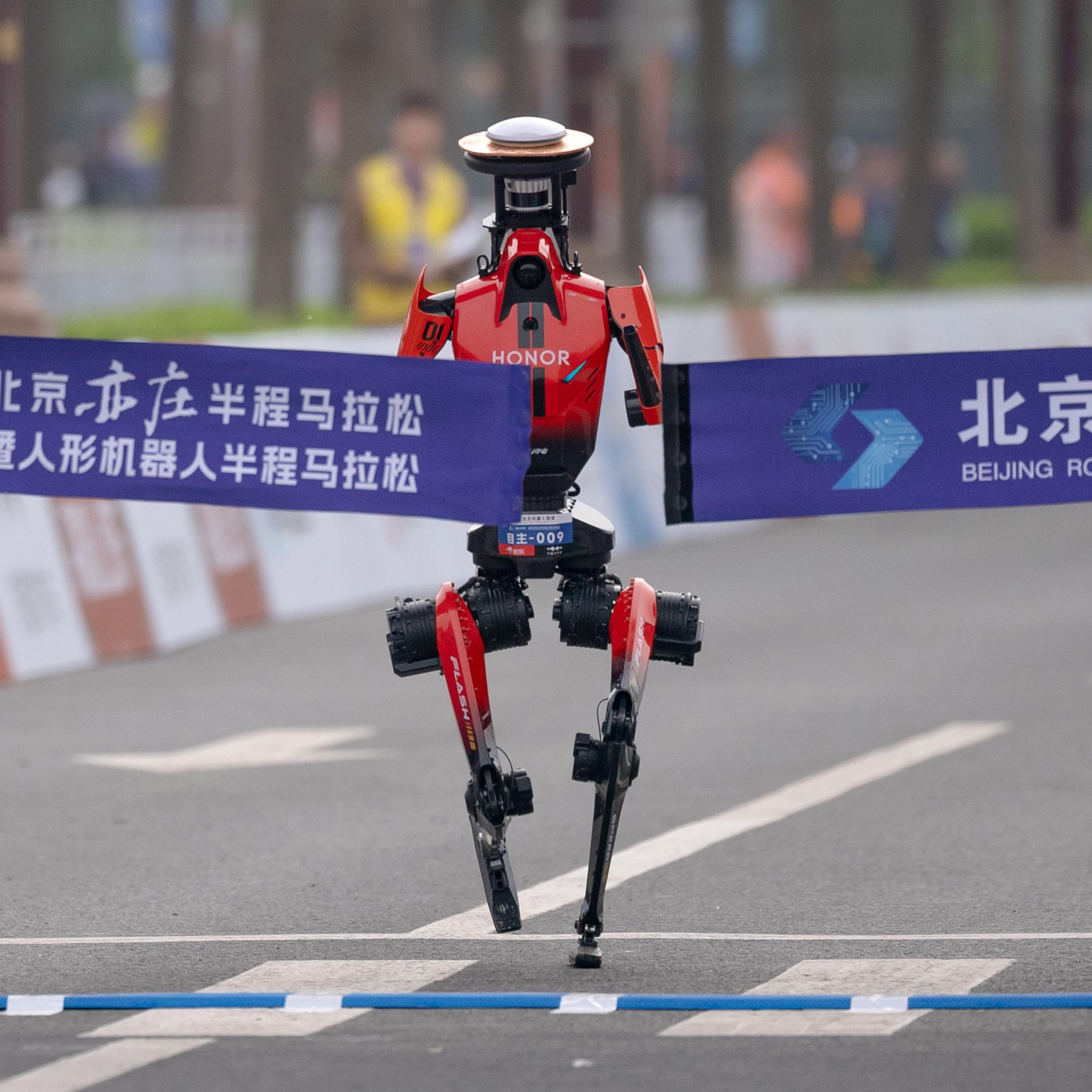
Science Weekly
Are robots nearing their ChatGPT moment?
00:17:07
Ian Sample hears from senior China correspondent Amy Hawkins and from Nathan Lepora, professor of robotics & AI at Bristol University, who researches how robots can achieve human-like dexterity
Loading summary
Transcript60 lines
- [00:00]
Guardian Announcer
This is the Guardian.
- [00:11]
Stephen (Smash Daddy)
Running a business means juggling a lot of moving parts. And when your communication tools can't keep up, things start to slip. Missed calls, slow replies, scattered conversations. They're not just frustrating, they're lost opportunities and revenue left on the table. That's where Quo comes in. Spelled Q, U, O. Quo is the number one rated business phone system on G2, trusted by over 90,000 businesses. One shared business number for calls and texts, so every conversation stays visible, organized and accountable. It works from an app or computer. You can keep your existing number, add teammates and sync your CRM, letting you scale without adding complexity. And with built in AI, Quo logs calls, summarizes conversations and flags next steps. Even after hours. Stop missing customers. Stop leaving revenue on the table. Try Quo Free and get 20% off your first six months at Quo.com Tech. That's Quasho.com Tech Quo. No missed calls, no missed customers.
- [01:20]
Hayden
Howdy, howdy ho, and welcome to Fantasy Fan Fellas, I'm Hayden, producer of the Fantasy Fangirls podcast and your resident lover of all things Sanderson.
- [01:28]
Stephen (Smash Daddy)
And I'm Stephen, your bookish Internet goofball. But you can call me the Smash Daddy.
- [01:32]
Hayden
And we are currently deep diving Brandon Sanderson's fantasy epic Mistborn. But here's the catch. Steven here has not read Mistborn before.
- [01:41]
Stephen (Smash Daddy)
That's right.
- [01:41]
Knox or Jamie (Podcast with Knox and Jamie)
Hey.
- [01:41]
Stephen (Smash Daddy)
Hey. So each week you'll get my unfiltered raw reactions to every single chapter.
- [01:46]
Hayden
And along the way, we'll do character deep dives, magic explainers, and Steven will even try to guess what's next. Spoiler alert. He'll be wrong.
- [01:53]
Stephen (Smash Daddy)
News flash, I'm never wrong. Episodes come out every Wednesday and you can find Fantasy fanfellas wherever you get your podcasts.
- [02:06]
Ian Sample
Last month at the London Marathon, Sebastian saway smashed the sub two hour barrier, shaving 65 seconds off the previous fastest time.
- [02:17]
Carvana Customer
An historic performance. 1:59:30.
- [02:21]
Amy Hawkins
Absolutely incredible. I've never seen anything like that.
- [02:26]
Ian Sample
But it wasn't the only record breaking race that caught the world's attention in April.
- [02:32]
Amy Hawkins
It was human versus humanoid.
- [02:34]
Carvana Customer
More than 100 robots racing against runners Sunday in Beijing.
- [02:40]
Ian Sample
In Beijing's half marathon, a robot named Lightning beat the human record by a whopping seven minutes. It's just the latest in what feels like an acceleration of robotic breakthroughs powered by AI and the country racing ahead of all the others. Lightning's birthplace, China. But beyond running really fast, what do we actually want from robots? What will it take for them to get there? And are we ready for what happens when they do. I'm the Guardian science editor, Ian Sample and this is Science Weekly. Amy Hawkins, you're the Guardian's senior China correspondent and you've been looking into China's robotics boom. So first of all, who is this company behind the half marathon robot? Have they been in business for years or are they new? What's their story?
- [03:49]
Amy Hawkins
So they're a company called Honor, which is actually a smartphone company, which has only recently, within the last year or so, pivoted into robotics and embodied AI, which is what people are calling robotics. I think that shows just how fast the sector is growing in China. Like it's not even one of the big, more famous robotic companies, but so many companies are trying to get in on this moment. China's got a much more sophisticated and low cost manufacturing supply chain. So the parts of the supply chain that are needed to build these robots is very readily accessible in China. And it gives China a bit of an edge in that part of the AI race.
- [04:25]
Ian Sample
So this is really coming about through this sort of marriage of AI with robotics, who are the most important companies, and are they the sort of the longtime big players or are they disruptive companies coming through?
- [04:38]
Amy Hawkins
No, I would say most of the kind of big players in robotics at the moment are ones that have been founded maybe within the past few years. And actually some of the bigger tech giants in China, like Baidu and Huawei, have struggled a bit to kind of pivot their energies towards robotics. But the big ones at the moment are companies like Unitree. They're the ones that made the dancing humanoid robots which have been on display at China's spring gala. You know, they do kind of amazing martial arts and dancing and they're probably the leader of the pack. And they plan to IPO this year and they want to raise more than $600 million. And that would be China's biggest tech listing in a number of years.
- [05:22]
Ian Sample
You talk about Unitree trying to raise this 600 million IPO. What is the scale of the investment going into robotics in China?
- [05:31]
Amy Hawkins
It's really, really huge, in part because the government has decided to make it a priority. And China has a very top down economic model. And so, you know, where the government goes, money, investment, political will follows. And so the Chinese government has already launched what they call a national venture capital guidance fund, and that will invest 1 trillion yuan over the next 20 years, which is more than £100 billion, purely in robotics. And then many cities have launched their own funds on top of this. So the kind of regional governments are competing to attract the best companies. So Beijing and Guangzhou in South China have each launched funds worth more than $1 billion to support robotics researchers and designers. And the market itself reached an estimated $47 billion in 2024. And it's growing at a rapid rate.
- [06:23]
Ian Sample
It's felt like for decades that robots have really not progressed beyond this sort of, you know, almost like your dustbin on wheels type robot, you know, your very basic type robot. And it seemed like robotics certainly hasn't had its chat GPT moment where suddenly you get a total inflection and the technology is suddenly dramatically more effective and, you know, finds more markets. I'm interested in the kinds of robots that China is actually focusing on building. I mean, are they going for a particular style of robot, or are they looking to put robots into particular roles that are ones that they haven't been doing before?
- [07:03]
Amy Hawkins
Yeah, you're right. I mean, the kind of big question with these humanoid robots that we've seen, you know, winning races and doing kung fu dances and so on is kind of why, like, why would you need a robot that can run fast or do an impressive dance and where they're going to be more useful in factories and in household settings where they can do things like household care or cleaning and cooking. And that is what a lot of Chinese companies are focusing on now is how to actually create robots that can intelligently move through space without having to be pre programmed to do a certain routine. For example, running a race is basically running in a straight line. It's not that difficult to ask a robot to do that. Whereas putting a robot in an unfamiliar room and asking them to clean it is a lot more of a challenge, and lots of companies are focusing on that now.
- [07:54]
Ian Sample
Amy, these companies have clearly got challenges on their hands with these robots. I mean, how are they trying to tackle, for example, this issue of a robot having to navigate a space that is. It's completely new to. It hasn't been in before.
- [08:07]
Amy Hawkins
If you think about large language models, which we're all familiar with, like chatbots, they're trained on a data set which is kind of almost unlimited. It's all the text on the Internet and they can have so much data to train their models on. But for robots which are trying to figure out how to move through space, it's a lot harder for them to acquire the data that's necessary to train sophisticated models. Also, companies are approaching this in a few different ways. I spoke to a company recently that has invented a glove that, that a human being can wear to do various tasks. Like cooking and cleaning and peeling a banana and folding laundry. And this glove is fitted with sensors which can then harvest that data. And that glove can then be put onto a humanoid robot hand and the humanoid can learn from the data in the glove how to do certain tasks. That's one way. Another way is some companies are paying human beings to wear kind of GoPro cameras on our heads while they do daily tasks and they film all this data and then that is fed into what's called these world models. And some companies are building 3D worlds in which to train their robots about how to navigate space. So there's a few different approaches and, you know, companies are each taking a bet on why their approach is going to work.
- [09:34]
Ian Sample
Robots are making massive strides, but what will it take to get them from running and dancing to washing our dishes and fixing our sinks? According to many roboticists, it comes down to just one thing.
- [09:49]
Nathan Lepora
It's the hands that the critical thing. They're the things that come into interaction with the environment and do the work.
- [09:56]
Ian Sample
Nathan Lepore is professor of robotics and AI at the University of Bristol. And his focus is exactly what many of these companies are grappling with. How to give robots what he calls human, like dexterity. He told me where the field has got to so far.
- [10:14]
Nathan Lepora
When I first started in the field maybe 15 years ago, it seemed like this kind of distant dream and you couldn't really see how it was going to happen in the short term. But things are moving so fast in robotics now with AI, new hardware, new fabrication methods, we're getting close. It's kind of becoming clear, you know, how this problem will be solved, but we're still not there to actually get it fully to the human levels of dexterity.
- [10:41]
Ian Sample
Nathan, talk me through what's difficult about getting a robot to do what our hands can do. I mean, you can think of these revolutions. We had the Industrial Revolution where we brought in machining to do a load of tasks that humans did. And then with computing, with AI, we're thinking about having the sort of cognitive revolution where a lot of our cognitive powers are taken over by machines. But with the Industrial Revolution, we never nailed this dexterous capability that you would want from a robot. Why has that been so hard?
- [11:12]
Nathan Lepora
We can make machines do very repetitive things, you know, and that's how a lot of industry works. You know, you've got a machine that's kind of tailor made for a specific job, you know, securing caps on bottles, whereas our hand, it's like a general purpose machine. The most obvious way is to put a motor in every joint of the hand. That's not how the human hand works. We have, you know, tendons, muscles in our forearms. We coordinate within our body how the hand moves. And it's a really challenging design problem to crack that problem in terms of the hardware and the AI, and then to simplify it down so that it's, you know, can be made more easily and is more affordable, it's really hard.
- [11:53]
Ian Sample
So it seems from the outside, from a sort of lay view, that robotics hasn't quite had its sort of chatgpt moment yet. And I wonder, you know, are there say, three big challenges that robotics needs to crack in order for it to get there? When we see this kind of step change that we've seen with the LLMs,
- [12:15]
Nathan Lepora
with the chatbots, with robot, it's multiple things that need to be got right before they become really practically useful. And so, like three things would be, you know, the body, design of the body, how it's actuated. You know, if you like the design of the robot hands, the brain, you need the AI, but also you need an AI that's appropriate for controlling robot hands and robots and dexterity, and that can be quite different. It's kind of a form of embodied AI. And then you need the sensing as well. Sensing is critical. And probably the hardest part actually, you know, something that's a sophistication of like human skin. You can think of our skin as like high resolution sensor, you know, covering our hand, that can feel, you know, forces in fine detail. You know, think about the kind of exquisite detail that you can feel with your fingers. Now, to design that kind of skin for a robot is a really, really challenging problem. And it's been basically holding the field back for decades. But recently there's been an explosion of new companies building robot hands because of a need for humanoid robotics. And that is driving forward developments in miniaturizing motors, high power density motors, all these other kind of constituent technologies that are needed in order to bring that together to make a hand?
- [13:29]
Ian Sample
Nathan a lot of the discussions around AI today will raise concerns around what it means for job losses. And one of the reasons is that a lot of the tech firms, a lot of big tech, talks about how AI is going to drive a lot of people out of their jobs. Okay, don't you ever sort of get worried about the disruption that might come when robots have the kind of physical capabilities that, that humans have. And so this will start hitting some of that labor, some of those jobs, because at the moment people say, well, look, if you want to survive, you know, you know, the AI revolution, what you need to be is like a plumber or an electrician.
- [14:08]
Nathan Lepora
I don't worry too much about this because, you know, the evidence in the past has always been when one type of job stops, you know, they kind of work gets displaced into other valuable activity. There are other concerns of what will be done with those robots as well. You know, what, what's their use within society? So humanoid robots with hands, you know, they can be very useful as assistants for us, but you know, on the other hand, you know, they can be used as soldiers. They could be used, you know, in security. It's a powerful technology and I think we'll need to see how that develops. And probably some controls will need to be put in place by governments as these technologies come through.
- [14:45]
Ian Sample
I was wondering if we will all end up getting jobs repairing robots. But then I thought, well, no, there'll probably be robots to do that, won't there?
- [14:52]
Nathan Lepora
Oh, you're absolutely right. The big change to come is when robots will be building other robots. Once that happens, the cost of a robot should come down because you won't need human. At the moment, all robots are built by humans. Sometime in the future, robots become dexterous enough that they will be rebuilding each other and improving those builds as well. That can be done with AI, you know, on a kind of self sustaining loop where the robots will become more dexterous.
- [15:20]
Ian Sample
Coming up, China's robots are racing ahead. Can humans keep up?
- [15:38]
Andrew
Many business leaders see AI's tremendous potential for their companies, but are still struggling to turn that potential into measurable results and competitive advantage. I'm Andrew.
- [15:48]
Guardian Announcer
And I'm Sarah Elk. And on our new podcast, Winning with AI, we're talking to CEOs who are using AI to drive business transformation, delivering real wins and changing how their companies run.
- [15:59]
Andrew
We'll hear how leaders empower and mobilize their people and make the use of AI part of how the whole organization thinks. Winning with AI.
- [16:13]
Ian Sample
Amy, China is obviously leading the way in this sector. Where does the government see all of this going? Where will these robots fit into society?
- [16:24]
Amy Hawkins
China does already have what some people call dark factories where they're entirely staffed by robots and so you don't need to turn the lights on. And those will be factories in which the tasks are very kind of repetitive, simple tasks where they've decided to use robots rather than human workers. But for sure, kind of part of the push towards developing more and more sophisticated humanoid robots is to get them to a place where they could replace human workers in jobs where they can't currently replace them. What the government's really worried about is actually it's got a shrinking workforce because of the aging population. So it's worried about not having enough workers to work in factories and on their manufacturing line and also to look after its ever increasing elderly population. But that says, you know, in industries where there are risk of people losing their jobs, for example, taxi drivers, there has been some pushback and some taxi drivers in Wuhan, which is a city which has seen quite a lot of robo taxis or autonomous taxis rolled out recently, protested about the fact that, you know, these driverless taxis were taking their jobs. Actors have kind of complained about AI taking their jobs. And so there is a bit of a pushback now about the risk of job losses. But the view from the government is definitely very much like these robots solve a problem rather than create one.
- [17:45]
Ian Sample
And when you're out and about in China, do you encounter any in the
- [17:50]
Amy Hawkins
real world when it comes to the humanoid robots? I would say that you mainly see them at press conferences and at kind of PR events. But when you're walking out in the streets, you know, I haven't encountered a humanoid in the street just yet. But you do see some robot dogs, which is another kind of side of robot development which people get as pets as well. As, you know, some areas already have quite sophisticated drone delivery systems. So in Shenzhen, which is a city in South China, there are lots of places where you can order food delivery and then it will be delivered to you by a drone flying through the sky. And so, yeah, again, I mean, delivery and logistics of the huge industry in China. And that's another field in which people are trying to develop robots to be able to operate in that space. But actually, food delivery is one of the areas where human workers feel the most safe because they haven't yet found a robot who can run up 10 flights of stairs to someone's office building or, you know, navigate a lift successfully. And so there are these kind of spaces in which robots aren't very useful yet.
- [18:52]
Ian Sample
Must be fascinating to be over there and to watch it all. Amy, thank you so much.
- [18:56]
Amy Hawkins
Thanks for having me.
- [18:59]
Ian Sample
Thanks to Amy Hawkins and Professor Nathan Lepora. You can keep up with all of Amy's reporting from china@theguardian.com. This episode was sound designed by Joel Cox and the executive producer was Ellie Murie. We'll be back on Tuesday. See you then.
- [19:29]
Nathan Lepora
This is the Guardian.
- [19:41]
Amy Hawkins
Acast powers the world's best podcasts. Here's a show that we recommend.
- [19:48]
Knox or Jamie (Podcast with Knox and Jamie)
Do you like being educated on things that entertain but don't matter? Well, then you need to be listening to the Podcast with Knox and Jamie. Every Wednesday, we put together an episode dedicated to delightful idiocy to give your brain a break from all the serious and important stuff.
- [20:00]
Amy Hawkins
Stuff.
- [20:01]
Guardian Announcer
Whether we're deep diving a classic movie, dissecting the true meanings behind the newest slang, or dunking on our own listeners for their bad takes or cringy stories, we always approach our topics with humor and just a little bit of side eye. And we end every episode with recommendations on all the best new movies, books, TV shows, or music.
- [20:17]
Knox or Jamie (Podcast with Knox and Jamie)
To find out more, just search up the Podcast with Knox and Jamie wherever you listen to podcasts and prepare to make Wednesday your new favorite day of the week.
- [20:27]
Andrew
ACAST helps creators launch, grow and monetize their podcasts everywhere. Acast.com Many business leaders see AI's tremendous potential for their companies, but are still struggling to turn that potential into measurable results and competitive advantage. I'm Andrew.
- [20:45]
Guardian Announcer
And I'm Sarah Elk. And on our new podcast, Winning with AI, we're talking to CEOs who are using AI to drive business transformation, delivering real wins and changing how their companies run.
- [20:56]
Andrew
We'll hear how leaders empower and mobilize their people and make the use of AI part of how the whole organization thinks. Winning with AI.
- [21:06]
Carvana Customer
Hey, sweetie. Your mother showed me this Carvana thing for selling the car. I'm gonna give it a try. Wish me luck. Me again. I put in the license plate. It gave me an offer. Unbelievable. Okay, I accepted the offer. They're picking it up Tuesday from the driveway. I haven't even left my chair. It's done. The car is gone. I'm holding a check anyway. Carvana, give it a whirl. Love ya.
- [21:28]
Guardian Announcer
So good you'll want to leave a voicemail about it. Sell your car today on Carvana. Pickup fees may apply.