Loading summary
Transcript236 lines
- [00:00]
Ian Coss
Support for catching the codfather comes From Rogers Fish Co. Founded by Roger Berkowitz. Offering an array of New England seafood and entrees shippable anywhere in the US more@rogersfishco.com.
- [00:16]
Sponsor/Advertisement Narrator
This show is supported by Blueland. Living a cleaner and more sustainable lifestyle by reducing single use plastics is a small action that makes a big difference. And Blueland is on a mission to make it easy for everyone to make those sustainable choices. They believe that hardworking clean products can be the norm, not the exception, so that you can do better for your family and the planet at the same time. From cleaning sprays and toilet bowl cleaner to dishwasher and laundry detergent tablets, Blueland's 100% microplastic free EPA safer choice certified formulas are safe to use around people, pets and plants. You'll love not having to choose between the safe option and what actually gets your house clean. Blueland products are independently tested to perform alongside major brands and the formulas are free from dyes, parabens and harsh chemicals. Plus Blueland is a certified B corp and certified cruelty free by Leaping Bunny. Their formulas are EPA Safer Choice certified and many have received the Gold material health certificate from cradle to cradle and and right now, Blueland has a special offer for listeners. Get 15% off your first order by going to blueland.comprx you won't want to miss this. Blueland.comprx for 15% off. That's blueland.comprx to get 15% off.
- [01:40]
Ian Coss
Can you tell me about how you did ultimately get arrested?
- [01:48]
Carlos Rafael
This all started a few years back when I wanted to sell my business, see my legacy. It was to grow this to a point that I would turn it over to my kids. I did it. That said, I'm done. I wanted to give the business to my, my middle daughter. And I told her, Stephanie, I was 62 at the time. I said, stephanie, Danny Stallia, I had enough. I'm going to give you the business. I don't want no money. At the end of the year, the profits you split with your sisters, it's yours. So she looks at me and she says, do you think I want the kind of life you have? And she didn't want a company over 100 million just for that.
- [02:46]
Ian Coss
Can you blame her?
- [02:47]
Carlos Rafael
No, no, no. Because I see what I did to my family. I never get to spend time with them. I never get to go to the school place and all this other shit. And you can buy those things back. It's over. But if you get the American dream It's a certain amount of sacrifice you got to make. It doesn't come from heaven. And they say lock, lock. You have to go look for luck. Luck doesn't come to you. And by luck is work your butt off in America and you will get ahead. She said, I don't want that kind of life. Are you crazy? So that's why I ended up getting in a shader. Because if I were to get out at 62, none of this bullshit would have happened.
- [03:43]
Ian Coss
Carlos Raphael leans back and lights a cigarette, one of many over the course of our convers. Could you talk about all the Scarface pictures?
- [03:59]
Carlos Rafael
My daughter gave me that one. She bought that one in New York.
- [04:03]
Ian Coss
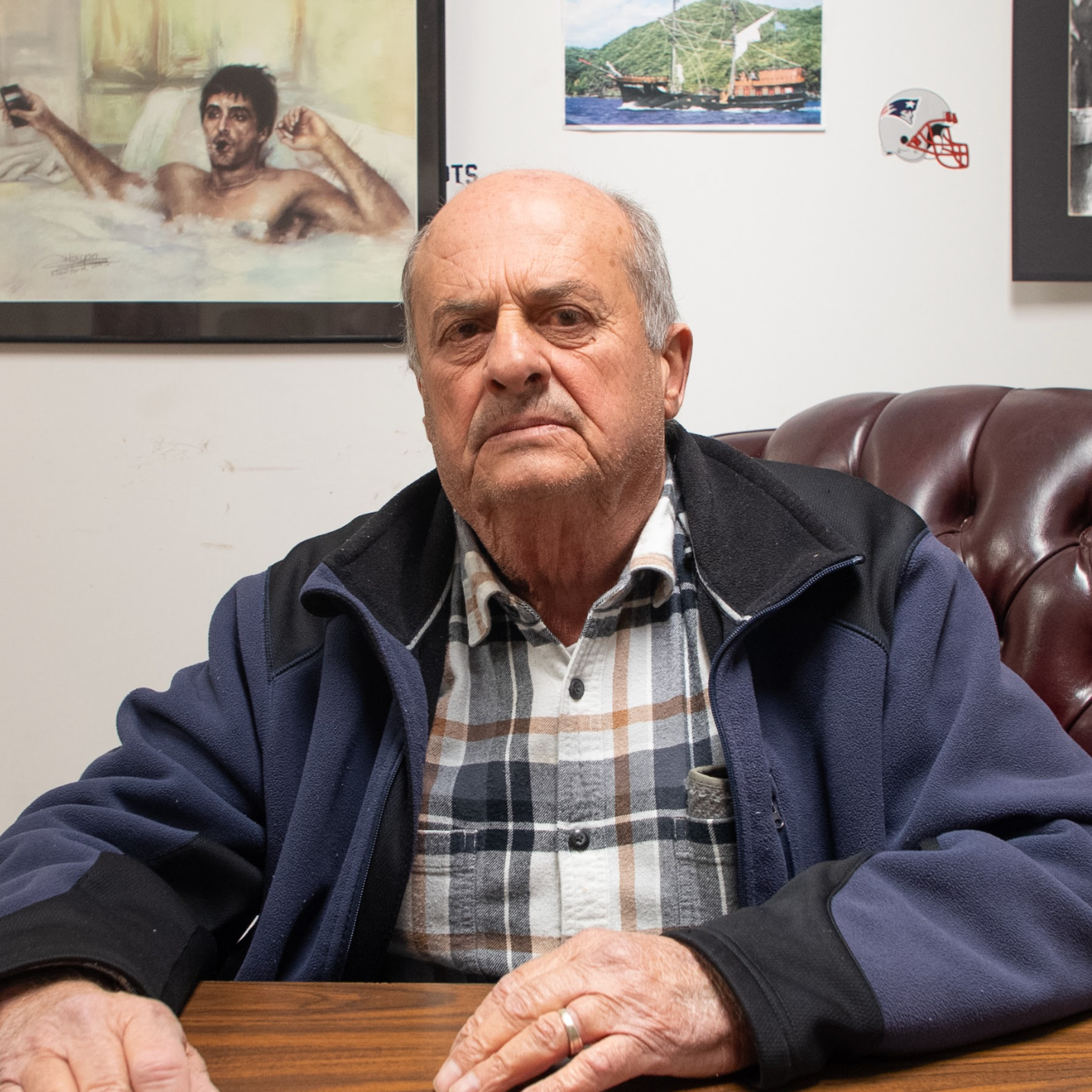
Carlos office is covered with images from the movie Scarface. There's an actual cigar from the set, a hand drawn sketch of Tony Montana, the cocaine kingpin, and a still from the film of Al Pacino in the big hot tub. Carlos told me that Netflix once approached him about making a movie about his life and asked who should play him. Carlos didn't need to think about it. It was obvious.
- [04:29]
Carlos Rafael
I said, scafix, he'll be the only one could do the job the right way.
- [04:34]
Ian Coss
Al Pacino.
- [04:35]
Carlos Rafael
Al Pacino.
- [04:36]
Ian Coss
So you can picture an older Pacino if you want, but with jowls hanging under his chin and totally bald except for the sides of his head. That's Carlos. And what did the producer from Netflix say now?
- [04:49]
Carlos Rafael
I ask him. For When I mentioned $20 million, the guy I said, forget it. Look, if I'm gonna, something's gonna get done. I want money.
- [04:57]
Ian Coss
And you'll see as we go along. There are some parallels for sure between Carlos Rafael and Tony Montana. It's the story of an immigrant who has to make his own luck and is willing to push that luck again and again and again. Hunger, opportunity, excess, ruin. There's a famous scene in the movie when Montana is out to dinner and gets in a heated argument. It's at a fancy restaurant, everyone's very well dressed, lawyers and bankers, and they all fall silent watching as Montana lunges across the table, spilling wine and food all over the white tablecloth. But then Montana turns and addresses the crowd directly, calls out their silent judgment of him, saying, you need people like me.
- [05:53]
Carlos Rafael
You need people like me so you can point your fucking fingers and say, that's the bad guy.
- [06:00]
Ian Coss
Then he asks, so what does that make you? Good? You're not good. You just know how to hide, how to lie.
- [06:10]
Carlos Rafael
Me, I don't have that problem.
- [06:14]
Ian Coss
When he's done, Montana stumbles out shouting over his shoulder, say goodnight to the bad guy. I can hear a little of Carlos in that scene. Even after he was investigated and labeled a crook, after federal agents carted him off to jail and dismantled his enemy empire, he keeps pointing his finger right back at the government that brought him down, saying that right there, that is the real bad guy.
- [06:50]
Carlos Rafael
They think they solve the problem they haven't solved because fishermen a lot smarter than they are.
- [07:15]
Ian Coss
From GBH News, this is the Big Dig. I'm Ian Coss. Carlos Rafael is an American success story. He started from nothing, working in a neglected industry in a neglected city. And he built something real. His business was fish, Carlos Seafood. And by the end of his run, he owned the biggest fleet of boats in the most valuable fishing port in America. So why did it all come crashing down? And why does Carlos insist to this day that he did nothing wrong? Welcome to season three, Catching the Codfather. It's a story about work, about dreams, and ultimately about how all of us relate with our government. Part 1 Red Lobster. Hey there. I'm so glad that you decided to check out this show and I want to let you know that as these episodes are rolling out, I will be doing weekly messages to our Big Dig mailing list with some behind the scenes photos and details from my research process. So if you want to get all of that in your inbox every week, just go to wgbh.org thebigdig and you can sign up. Also, if you're getting eager to hear the rest of the series that isn't out yet, you can go ahead and sign up for our membership program, the HOV Lane and get early access to the whole thing. You can find that@wgbh.org Hovlane thanks for coming along. Enjoy the show. I want to introduce you to our sponsor for this season, Rogers Fish Co. Because they really have an interesting story of their own. The Roger we're talking about here is Roger Berkowitz, who is truly a legendary Boston fishmonger. Like when Julia Child wanted to buy fish for her TV show, she would go to Rogers Family's fish market. And now you can too, because Rogers delivers restaurant quality flash frozen seafood direct to your door. We'll be sharing more about what they offer as the season goes along. But in case you were wondering who this Roger is, now you know more@rogersfishco.com maybe you've heard of these scary things out there called forever chemicals, but what would you do if you discovered they were in your drinking water? This is the reality for residents of a town in New Hampshire, and possibly for you too. If you want to hear that story, check out the podcast Safe to Drink, a new four part series from our neighbors and friends at New Hampshire Public Radio. Truly, that team is so good, they have the Pulitzer Prize nomination to prove it. And in this series, they take us deep inside a major water contamination event. So follow Safe to Drink on your favorite podcast app. All four episodes are out now. Carlos Rafael grew up in the Azores, a string of islands in the Atlantic that are maybe a quarter of the way to North America if you're coming from Europe. So way out there and small enough that you have to really zoom in on the map in order to see them at all. The Azores are part of Portugal, and in the 1960s, when Carlos was a kid, Portugal was fighting colonial wars on several fronts. In Mozambique, in Angola, in Guinea. Carlos had friends who were drafted off their tiny island and sent abroad, who died in the jungle fighting for a lost and distant cause, a pointless cause. His parents did not want that for their son. So they sent young Carlos to study at a monastery.
- [11:26]
Carlos Rafael
That's the way they would keep me off the military fest in the monastery.
- [11:30]
Ian Coss
I have to. I mean, I've only known you for about an hour, but it's hard for me to picture you in a monastery.
- [11:37]
Carlos Rafael
All my friend says, what a hell of a priest you would have made. But once my sister, she told me, dad has an American passport.
- [11:47]
Ian Coss
Carlos's dad had an American passport. This revelation is not entirely surprising in a place where lots of families move back and forth to the U.S. but it was news to Carlos, infuriating news, because it meant his dad had an easy out all along and was so comfortable in his island life, he. He just didn't want to take it and instead sent his son to a monastery.
- [12:12]
Carlos Rafael
I freaked out. I said, oh yeah, we going to America? He says, you know, you're not going to America because you stayed in a monastery. That's where they put you here. So I did shit so they could throw me out.
- [12:27]
Ian Coss
Every night. The priests in training would have dinner, then go to prayer and by 9:30 they'll go up to their dormitory.
- [12:35]
Carlos Rafael
So everybody went up to the dorm. I went to the football field and I jumped the fence and I took off.
- [12:43]
Ian Coss
Carlos didn't care about actually getting away with this little escape act. He wanted to get caught, he wanted to get punished.
- [12:52]
Carlos Rafael
Didn't look too far. I went for a walk until I was about a quarter of 11. When I come back, I jumped the fence And I come back. Well, little I know that the priest was upstairs waiting for me. He says, you'll be an expelled tomorrow. I'm calling your parents and we're shipping you back home.
- [13:10]
Ian Coss
Now. Carlos would find out if his gambit paid off. It looked like either way, he was leaving the Azores. Could be for the US could be for Angola. Which one was up to his father.
- [13:22]
Carlos Rafael
So I was terrified to get home. I said, he's gonna beat the living crap out of me. My father says, I'm going to teach you a lesson. We're not going any place. He's the one. He was in the right place. He should have stood there and all that. But there was my mother. She every day would be harming at him, and she says, you know what's going to happen if he goes. He'll probably come in the Coffin.
- [13:46]
Ian Coss
Carlos was 15 at this point. At 16, he would register for the draft.
- [13:51]
Carlos Rafael
So after she keep battling and battling, he decided to come here.
- [13:55]
Ian Coss
So you got out just before your 16th birthday.
- [13:58]
Carlos Rafael
I got here in March. June would have been too late.
- [14:08]
Ian Coss
Carlos boarded a TWA flight and followed the same route across the sea that people from the Azores had taken for generations, to the small coastal city of New Bedford, Massachusetts. The flight attendant gave him a little set of plastic wings he could pin on his shirt. He was proud of those wings, proud to be starting fresh, proud to be in America, finally free.
- [14:35]
Carlos Rafael
When I arrived in the United States in 1968, I always said to myself, I am not going to be working for anybody else all my life. I'm going to do this for myself.
- [14:49]
Ian Coss
And it turned out that Carlos was arriving at the right time, a time of crisis, actually, for the industry that defined New Bedford. But as Carlos himself has told me, a crisis now, that is when you can make a lot of money. And Carlos Rafael would do.
- [15:14]
Gary Studds
Throughout the world, New Bedford, Massachusetts, is best known as the whaling city.
- [15:20]
Ian Coss
New Bedford, as you may know, is the port that inspired Moby Dick and where the author Herman Melville set out on his own whaling voyage.
- [15:29]
Gary Studds
The first whale ship, the Dartmouth, sailed out of this port.
- [15:32]
Ian Coss
But if you stepped off a boat there in the 1960s, when Carlos arrived and wandered into the neighborhoods along county street or Rivet street, you'd find a very different world from the one Melville knew.
- [15:49]
Maria Tomasia
That entire area was all Portuguese.
- [15:52]
Ian Coss
Maria Tomasia, like Carlos Rafael, came to New Bedford from the Azores.
- [15:57]
Maria Tomasia
It's like every island or every tower had their own club. You know, there's the Ponte Delgado Club, there's the Fial Club. There's the Medires Club. There's a Fisherman Club Central Luza Club, or for the Son Club. So everybody had their place to socialize.
- [16:17]
Ian Coss
There were two Portuguese newspapers. There was a Portuguese radio station, a dedicated Portuguese library with over 3,000 titles in it. This was the capital of Portuguese North America. The Portuguese immigration here started in the Moby Dick era, the middle of the 1800s. Whaling ships out of New Bedford would stop in the Azores and Cape Verde to pick up supplies. People got on board as well. And then more people followed and more.
- [16:49]
Maria Tomasia
People, and they saw there was a fishing industry. You lived by the water. You know, once you live by the water, it's very difficult to go anyplace else and not see that water.
- [16:59]
Ian Coss
By 1970, Massachusetts was home to one third of all Portuguese immigrants in the entire country. And most of those people were clustered in the coastline near New Bedford. Within the fishing industry itself, there's actually an interesting ethnic divide. Historically, at least for many years, the scallop boats tended to be run by Norwegian immigrants, but. But the draggers, the boats that went after bottom fish like cod and flounder, they were overwhelmingly Portuguese, 80 to 90%, by one estimate. They will be the focus of this story. And in the 1970s, when Carlos was still new in town, those fishermen were in trouble.
- [17:46]
Maria Tomasia
I would be mostly as a translator.
- [17:48]
Ian Coss
The man the fishermen went to for help was Maria Tomasia's boss, New Bedford Congressman Gary Studds.
- [17:56]
Maria Tomasia
They were concerned about the fact that, you know, there were other people out there.
- [18:04]
Ian Coss
Other people out there, other people competing for the same cod, haddock, and flounder off the coast of New England, but with bigger boats, bigger nets. What the fishermen described was a foreign invasion.
- [18:19]
Maria Tomasia
That's how they would talk about it. They felt that they were taking away what was theirs.
- [18:26]
Ian Coss
Okay, coming up, we've got a Russian.
- [18:28]
Gary Studds
Midwater trawler 12 and a half miles off the coast.
- [18:31]
Ian Coss
It's a little hard to imagine now, but in the 1970s, foreign fishing boats could come as close as 12 miles off the coast, and they could catch whatever they wanted. This audio is from a Coast Guard flyover just off Cape Cod.
- [18:46]
Gary Studds
Okay, this is a Bulgarian.
- [18:48]
Ian Coss
There were German boats, Russian, Spanish, Japanese, all drawn to the rich coastal waters of New England. And because they were so far from port, these ships were essentially floating factories. They filleted, froze, or canned the fish right on board, working for months at a time on a massive scale, probably averaging somewhere in the neighborhood of, say, 35 to 40 tons a day.
- [19:13]
Rodney Avila
I used to see miles and miles and miles of these ships, they look like big cruise ships.
- [19:19]
Ian Coss
Rodney Avila was a young fisherman at the time, just starting out.
- [19:23]
Rodney Avila
And I used to say, I'm gonna have no fish when I grow up.
- [19:29]
Carlos Rafael
Modern trawling techniques are sweeping everything from the sea.
- [19:32]
Ian Coss
This foreign presence really ramped up over the 1960s so that by the mid-70s, if you looked at the total catch on New England's foreign very best fishing grounds, 90% of it was pulled up by foreign boats. 90%. And the fishermen and scientists alike could see the effects disappear.
- [19:53]
Carlos Rafael
Like the headache had all already disappeared. The butterfishes all disappear. The flu is all disappeared.
- [20:00]
Maria Tomasia
And that's how the whole thing came to be, is that they wanted something done about it.
- [20:13]
Ian Coss
That's where Congressman Gary Studs came in.
- [20:16]
Gary Studds
For several of the reasons that I cited in my brief remarks, I think that the time is right to ask to extend these protections.
- [20:23]
Ian Coss
One, the Canadian Studs was always a bit of an odd fit to represent the working class Portuguese hub of New Bedford. He was formal, clean cut, Yale educated. In pictures of him from the 1970s, he looks like he could be in the 1950s with black horn rimmed glasses and plain suits.
- [20:42]
Gary Studds
Decisions to make with some resources still available to protect.
- [20:45]
Ian Coss
And on top of all that, Gary Studs was also concealing the fact that he was gay. The suggestive term people used for him at the time was a confirmed bachelor. Not a strong political brand in those days. But Studs was driven.
- [21:01]
Maria Tomasia
When I first met him, he introduced himself in Portuguese.
- [21:06]
Ian Coss
So when he ran for that seat, Studs took a six week intensive course in Portuguese, then spent another six weeks traveling around the Azores, Cape Verde and mainland Portugal.
- [21:18]
Maria Tomasia
Omaria Convazos, you know. Yeah, so that type of thing, it's. You've gotten anything good lately.
- [21:29]
Ian Coss
In 1973, New Bedford sent Studs to Washington as their representative. And in that very first term he also landed a seat on the Merchant Marine and Fisheries Committee, which meant he was actually in a perfect position to do something about the whole foreign invasion issue. So that same year Studs teamed up with Congressman Don Young from Alaska to, to introduce what they like to call the Young Studs Bill, but was commonly known as the 200 mile bill.
- [22:00]
Gary Studds
This will probably be something like a 200 mile economic zone.
- [22:05]
Ian Coss
It would establish a new ocean boundary that foreign vessels could not cross. An invisible fence exactly 200 miles offshore. And inside that fence, our richest fishing grounds would be reserved exclusively for American boats.
- [22:20]
Gary Studds
A 200 mile extension of US coastal jurisdiction.
- [22:24]
Ian Coss
You would think that bill would be an easy Win. I mean, who would oppose kicking out foreign fishing boats? Gary Studs was about to find out.
- [22:34]
Gary Studds
The problem, as it has so often been in subsequent years, was the United States Department of State.
- [22:39]
Ian Coss
And it turns out the bad guy in this story is the U.S. department of State, which makes some sense. The diplomats wanted to resolve these fishery issues diplomatically with an international treaty. They did not want to just unilaterally draw a line in the ocean. It could impact trade, military movement, intelligence gathering. Studs was saying, it can't wait. By the time a big international treaty is ratified, the fish will be gone. That's when Studs realized there was a deeper problem underneath it all.
- [23:14]
Gary Studds
I discovered that the biggest problem that those of us who represent maritime areas have was that nobody in Washington knew anything about it. And the best example I can think.
- [23:23]
Ian Coss
Of this is Studs recalling the story in a speech a few years later where he gave a specific example to illustrate the challenge. For years, Studds had tried to get the American lobster designated as a, quote, creature of the shelf, meaning it lived, as the name implies, on the continental shelf and could be protected from foreign fishing boats.
- [23:47]
Gary Studds
We held hearings to find out why the State Department had not designated the lobster to be a creature of the shelf. And the State Department, I kid you not, came in and testified. I can still picture them, three men there they were, all lined up in very, very fancy three piece suits to inform the the House Committee on Merchant Marine and Fisheries that the lobster was not a creature of the continental shelf because international law defined a creature of the shelf as an animal which never left the ocean floor and that the State Department had verified that when the lobster was excited, it jumped up and down and left the ocean floor. Now I am. I wish I could tell you I was exaggerating to make a point, but I am not. I asked the Department of State if they thought the kangaroo was a creature of the earth and there was no response whatsoever. I threatened on several occasions to put an unpegged lobster on the witness table in front of them to see if any of them had ever met one. I seriously doubt it. Washington is populated by people who think that lobsters are red and that is the source of, or at least the symbol of a great many of the problems that we have had over the years in trying to accomplish things.
- [25:05]
Ian Coss
If you don't know lobsters, when they are alive and uncooked, are not red, they're greenish brown. That year the bill went nowhere and the foreign harvest of the seafloor went on. Carlos Rafael is in his early 20s. At this point, he's been in the country for maybe five years. And while Gary Studs is learning the ways of Washington, Carlos is learning the trade of a fish cutter. What does it take to cut a fish?
- [25:39]
Carlos Rafael
What does it take? A little bit of knowledge. But you learn as you learn, you get to it. And once you get to it, I mean the name of the game is sharpen your knife.
- [25:51]
Ian Coss
Carlos started out working under a Cape Verdean man who showed him how to hone his blade until it was so sharp he could shave the hairs off his forearm.
- [26:01]
Carlos Rafael
Once you got a gig of it, once you know what you're doing and you got a sharp knife, then it's like ice cream, it's easy.
- [26:07]
Ian Coss
In an eight hour shift, each fish cutter was supposed to fill 16 boxes, 125 pounds each. So 2,000 pounds of fish a day for an average cutter.
- [26:19]
Carlos Rafael
I won't say I was the best one in the city, but I bet you I was the fourth of the fifth best in the city as a fish cutter. I would cut 20, 22, sometimes 24 boxes by 2 2:30 in the afternoon. So I would go into the men's room upstairs, I would sit and smoke a cigarette and the boss would come, gets your butt to work and said, I'm not going to work now, I'm having a cigarette. You've been here for 20 minutes. I said it's too bad you're fire. So I must have got fired 50 times working for this company. But he could never fire me because I was almost way over.
- [27:05]
Ian Coss
As Carlos said before, he did not come to this country to work for someone else. This was not his American dream. But it was also not a great time to strike out on his own. Even from the floor of the fish plant, Carlos could tell the industry was in trouble.
- [27:22]
Carlos Rafael
You know, not much fish around and so far we're going through a crisis.
- [27:25]
Ian Coss
Way back then, catches were down. Some species had virtually disappeared. And Gary Studds knew all this too. So Studs came back around for another time. Try this time smarter.
- [27:39]
Gary Studds
The presence of the foreign fleets out there who were literally raping the resource. The Eastern bloc countries, the Soviets, the Japanese.
- [27:44]
Ian Coss
This time, Studs mounted a public campaign for the 200 mile bill. He held hearings. He met personally with President Ford. He teamed up with a whole fleet of fishing boats that sailed down the coast and up the Potomac to D.C.
- [27:59]
Gary Studds
The Foreign Fishing activity.
- [28:02]
Ian Coss
In the campaign worked legislation under which the United States laid claim to a.
- [28:06]
Sponsor/Advertisement Narrator
200 mile limit on its coastal waters.
- [28:09]
Ian Coss
This time the Bill passed and in 1976, 50 years ago, Gerald Ford signed what became known as the Magnuson act after Warren Magnuson, the senator who co sponsored it today. I guarantee you any fishing captain in the country will know exactly what you mean if you say the name Magnuson. One of Stud's staff members told me that years later, as the Magnuson act became increasingly controversial, Studs would sometimes say, thank God they didn't name it after me. Around the time the 200 mile limit went into effect, Carlos Rafael became the foreman of the fish plant, running the whole operation. It was clear that kicking out the foreign boats would be good for the local fleet. And pretty quickly he made his next move.
- [29:15]
Carlos Rafael
I went to the owner and I told him, I'm giving you two months to get somebody to replace me because I'm going to do this for myself or you're never going to make it. A that's your opinion. We will see if I make it or not.
- [29:30]
Ian Coss
The rebellious teenager who ran away from the monastery and cherished his plastic wings was going to follow through on his promise to work for himself in America.
- [29:41]
Carlos Rafael
I went to a friend, I asked him for five thousand dollar loan. I asked for ten, but he had the time. He says, carlos, I don't have 10, but I got five if he'll help you. I said the five will have to do. And I had 27 cents left of my own.
- [29:55]
Ian Coss
That was the beginning of Carlos seafood, just with $5,000.27. And truly, Carlos timing was very, very good.
- [30:09]
Gary Studds
Now, with extended jurisdiction, the fishing industry is booming again.
- [30:13]
Ian Coss
Because after the 200 mile limit went into effect and the foreign fleets were gone, Congressman Studs helped use federal money to usher in a golden age for the New Bedford fleet.
- [30:24]
Rodney Avila
The government came down with his government guaranteed loan again.
- [30:28]
Ian Coss
RODNEY AVILA New BEDFORD FISHERMAN so if.
- [30:30]
Rodney Avila
You could prove that you were a fisherman, they'd loan you all the money you wanted to buy a boat.
- [30:36]
Ian Coss
Interest rates at that time were quite high. If you were buying a house, you might pay 10%, 15% interest. But if you were buying a fishing boat, it was basically free money.
- [30:48]
Rodney Avila
I had a guy approach me to build 34 boats. He says, all you'll do is sit home and manage the boats and I'll do all the rest.
- [30:56]
Ian Coss
So it almost turned fishing boats into like an investment asset.
- [31:00]
Rodney Avila
Operations. Exactly. Accountants bought boats, lawyers bought boats. I know a dentist that owned boats. I know a used car salesman own the boat. And the catching was good because there was a lot of fish around.
- [31:14]
Ian Coss
Remember, 90% of the fishing pressure had just been removed in some areas. So at this point, overfishing was not really a concern. How could our dinky little fleet even approach the damage that those floating factories had done? So you took that $5,000.27, what did you buy? What did you set up?
- [31:39]
Carlos Rafael
I would buy fish at night from the fishing vessels. Lobsters, monkfish, scallops.
- [31:46]
Ian Coss
At first, Carlos was just a small time dealer, a middleman scouting for side deals around the docks.
- [31:52]
Carlos Rafael
I would buy during the night, I'd go sell it in the next day, get the check, go cash the check and go pay the fisherman.
- [31:58]
Ian Coss
But in those days, if you were making money in fishing, you'd be stupid to not put that money into a boat. So that's what Carlos did. He bought two boats. In fact, and I should clarify, Carlos did not captain those boats. He never captained his boats. In fact, Carlos told me he went out to sea just once, right around this time.
- [32:18]
Carlos Rafael
And I swore I'll never go again. Why? Because that's not fit for human beings.
- [32:24]
Ian Coss
Carlos got so seasick on that trip, he offered to pay for all the extra fuel if the captain would just drop him off at the closest port. He literally, literally leapt off the boat as it approached the dock. And from that point on, Carlos Rafael was not a fisherman, he was a businessman.
- [32:43]
Carlos Rafael
So I think I did pretty good. But I would work 20 hours a day, 18 hour days. I didn't have no breaks.
- [32:52]
Ian Coss
Vast quantities of valuable, healthy protein can.
- [32:55]
Gary Studds
Now be harvested by the US industry if it expands its capabilities.
- [33:00]
Ian Coss
Many feel that from 1976 to 1982, the New England fishing fleet doubled in size from 600 boats to 1200 boats. And it wasn't just about the total number. These were bigger boats with more powerful engines. They were made of steel instead of wood. They had new nets, new fish finding technology. The skipper stays close, close to the.
- [33:26]
Gary Studds
Cabin during the tow, watching a remarkable.
- [33:29]
Ian Coss
Collection of electronic instruments. If you ever look at footage or pictures of fishing boats, you can spot the differences right away. On the older boats, the pilot house, the enclosed area, is way in the back with the open deck space in front, because the crews would haul nets on board by hand over the side. The modern boats have a pilothouse toward the front, so they can pull their nets up from the back of the boat with a hydraulic winch.
- [34:00]
Gary Studds
Finally, the net comes winding back onto the overhead drum and the fish are shaken down into the caught end.
- [34:05]
Ian Coss
It was like the leap from propeller planes to jet engines. A whole new era, a new generation of technology. Demand for seafood was growing very fast at that time. And so Magnuson offered a chance for the US industry to modernize, to reclaim its ocean food chain. Studs himself called Magnuson a rebirth for the fishing industry. And locally at least, he was a hero.
- [34:37]
Gary Studds
Please give a rousing New Bedford welcome.
- [34:39]
Ian Coss
To Congressman Gary Studds. I talked to one congressional staffer who told me that he knew people in New Bedford who would display a picture of Studs in their home right next to a picture of the Pope.
- [34:55]
Maria Tomasia
And that's what Gary Studs was for. That was their savior because they loved him.
- [34:59]
Gary Studds
This fishing industry has known times in the past when everyone thought all was lost. In the days when the whaling Maria.
- [35:06]
Ian Coss
Tomasia remembered that later on, when Studs sexuality was revealed as part of a congressional when he was publicly censured and when he chose to run for office again as the first openly gay congressman in American history. Even then, the city and the Portuguese community did not turn on him.
- [35:30]
Maria Tomasia
As soon as they saw him, they would start yelling and applauding. And I was like, unbelievable.
- [35:41]
Ian Coss
You have to understand that for coastal communities, the Magnuson act was like the New Deal because each new boat employed a crew, each crewman supported a family, and together they supported a whole waterfront economy.
- [35:59]
Gary Studds
We believe that the future of this city and the future of this fleet and the future of this industry will match in magnitude its magnificent past. Good luck to us all.
- [36:11]
Maria Tomasia
So it was just tremendous in every way. Everybody was benefiting from it. And that's what the America dream was about.
- [36:25]
Ian Coss
Carlos Raphael and Rodney Avila were part of a whole generation who rode the Magnuson wave. To this day you can walk along the harbor in New Bedford and see the boats they built from 1978, 79, 1980, the boom times. But for the fishing industry, Magnuson was always a Faustian bargain. They asked the government to get involved in their business to formalize what had been informal, to regulate what had been unregulated. They got their wish, but they also got more. And my uncle again, Rodney Avila, he.
- [37:11]
Rodney Avila
Said to me, you don't want the Magnuson Act. And I kept saying, why? They're going to take my fish. And he said to me, there'll still be enough fish to support you. But once you let the government into your living room, it's like your mother in law coming to visit you. You never get them out.
- [37:46]
Ian Coss
Taking care of your eyes shouldn't be a hassle. That's why Warby Parker is a one.
- [37:51]
Sponsor/Advertisement Narrator
Stop shop for all your vision needs. Our prescription glasses and sunglasses are expertly.
- [37:56]
Ian Coss
Crafted and unexpectedly affordable. Stop by a nearby store or use our app to virtually try on frames.
- [38:02]
Sponsor/Advertisement Narrator
And get personalized recommendations. Did we mention we offer eye exams.
- [38:06]
Ian Coss
And take vision insurance too? For everything you need to see, head to your nearest Warby Parker store or visit warbyparker.com today.
- [38:13]
Sponsor/Advertisement Narrator
That's warbyparker.com this show is supported by Odoo. When you buy business software from lots of vendors, the costs add up and it gets complicated and confusing. Odoo solves this. It's a single company that sells a suite of enterprise apps that handles everything from accounting to inventory to sales. Odoo is all connected on a single platform in a simple and affordable way. You can save money without missing out on the features you need. Check out Odoo at o d o o.com, that's o d o o.com.
- [38:52]
Ian Coss
We're going to jump forward in time because I want you to see where all these changes are headed, why they matter, specifically to Carlos Rafael. It's 2015, almost 40 years after Magnuson became law, 40 years after new England fishermen cautiously welcomed the government into their world. Now the boom times are over. The fishing industry is struggling. A disaster is a disaster, and that's true whether we're talking about crops or whether we're talking about fish. The years leading up to 2015 had been brutal for New England fishermen. A dramatic sequence 77% cut in the cod catch. The catch quotas set by the government kept getting lower and lower. That's going to be a heck of.
- [39:46]
Gary Studds
A number of people out on unemployment.
- [39:48]
Ian Coss
The regulations kept getting tighter and tighter.
- [39:51]
Ron Mullet
Prospects are the bleakest they've ever been.
- [39:53]
Ian Coss
That I'm going to be tied up for months. And that's the kind of draconian bureaucracy.
- [39:56]
Gary Studds
That fishermen are living with and struggling to maintain.
- [39:59]
Ian Coss
For many fishermen, it meant the end of a career, the end of a way of life.
- [40:04]
Carlos Rafael
We are the most regulated fishery in.
- [40:06]
Ian Coss
The world, and Carlos is tired of it all. He employs hundreds of people, manages dozens of boats. But his own daughter doesn't want to take over what he's built. So he decides to put the empire up for sale. In May of that year, Carlos got a phone call from a broker, someone who helped very wealthy clients manage their money. This broker had a pair of Russian businessmen in New York who had made an awful lot of money, something involving healthcare equipment. Now they're looking for a place to invest it. Carlos told the broker everything was up for grabs. The boats, the nets, the dredges, permits, property, a fish processing plant, the. The whole enchilada, as he put it.
- [40:59]
Carlos Rafael
I give him a silver platter. The whole enchilada.
- [41:03]
Ian Coss
The price was $175 million. No problem, the broker said. Let's talk. Two weeks later, the Russians drove through the chain link gate and parked in front of the fish plant, a plain blocky building made of corrugated metal like a big shipping container with a sign on the side, Carlos Seafood. The Russians drove a BMW 5 Series, the sport version with a V8 engine. They wore Louis Vuitton shoes and Versace belts, pinky rings, Rolexes. Carlos was in his usual outfit of jeans and a worn out flannel, the breast pocket stuffed with slips of paper and of course, a pack of cigarettes. He did not look like a man worth $175 million. Carlos led the men through the plant and up a metal staircase to his office, the one filled with pictures of Scarface.
- [42:07]
Carlos Rafael
This is Xavier. How you doing? That's the salesman.
- [42:10]
Gary Studds
How's it going?
- [42:11]
Carlos Rafael
How are you? I'm Bob. Sergey.
- [42:13]
Ian Coss
Hello.
- [42:14]
Sponsor/Advertisement Narrator
Hello.
- [42:14]
Ian Coss
Meet you. The Russian buyers, however, are not buyers. Those are both names? Yes, but they are very curious about the business and they are recording everything. They're undercover feds.
- [42:31]
Carlos Rafael
That motherfucker believe that shit.
- [42:34]
Ian Coss
Like I'm picturing you in a white van with headphones on.
- [42:37]
Ron Mullet
There are white vans.
- [42:38]
Ian Coss
Ron Mullet was the case agent with the irs.
- [42:42]
Ron Mullet
But I don't recall if on that particular day white vans were involved. I was certainly somewhere where I could respond if things went sideways in there.
- [42:54]
Ian Coss
So how did the IRS first get interested in Carlos Rafael?
- [43:01]
Ron Mullet
They recognized that he was growing in a time where the industry was shrinking.
- [43:06]
Ian Coss
Most boats sit idle, confined by federal rules that limit when they can fish and what they can catch.
- [43:11]
Ron Mullet
People were having a hard time meeting their loans on their boats. Yet he was succeeding. And he can step right up and has an abundance of cash to buy them out and buy their permits. Most importantly, that led to different theories from other law enforcement that he must be involved in some other illicit illegal activity. And it ran the gambit. Some agencies thought he was involved in human trafficking or smuggling. Some people thought it was drugs. People thought there was public corruption. Several different agencies had feelings that it was something, but none of them could figure out what it was.
- [43:47]
Ian Coss
The irs, despite its reputation, does not just investigate tax fraud. As one agent put it to me, we do everything but crimes of passion, as long as there's money involved, will take it. That's why these other federal agencies wanted to brief Mullet on Carlos Rafael. There was obviously Money involved here. It was just no one knew where it was coming from.
- [44:11]
Ron Mullet
I listened to their brief, I thanked them for their time and I left and put the briefing sheet in my drawer, expecting never to look at it again.
- [44:20]
Ian Coss
A few months later, Mullet heard from a source that Carlos was looking to cash out and figured maybe this was his chance to get a peek inside the fish plant. Mullet recruited a pair of undercover agents with Russian accents, then a third agent to play the broker and sent them in to buy Carlos seafood. Again, none of them knew what kind of business Carlos was really in. It could be drugs, it could be arms dealing. So they had no idea what the man was capable of. And it didn't help that the building was full of long sharp knives used to filet fish. There was an uncertain moment early on when raphael noticed his three guests were all wearing the exact same 18 karat gold Rolex watch. But the leader of the group didn't miss a beat. Those are Christmas gifts for the boys, he said. Sir Ron Mullet was listening intently for any signs of trouble and also for any clues as to what Raphael's true business was.
- [45:27]
Carlos Rafael
Like.
- [45:27]
Ian Coss
You diversify, right? The men got to talking and Carlos was happy to talk about his business. This was his life.
- [45:34]
Carlos Rafael
Like scallops, you said? Yeah, we got 12 of those, 12 scallop boats, right?
- [45:39]
Ian Coss
He talked about scalpers and draggers, he talked about the regulations he had to deal with, the sectors, the quotas, the permits, stuff the IRS agents didn't really understand.
- [45:50]
Carlos Rafael
Yeah, that's the scope. I gotta take this scope. Yeah, sure, Yellow.
- [45:53]
Ian Coss
And more than anything, Carlos talked about the art of buying and selling fish. An obsession he has maintained since his days as a small time dealer.
- [46:03]
Carlos Rafael
Hey, cocket, I told you 500 water. I told you 575. You buy the, then you got to set a pack up, then you, you gotta freeze the motherfuckers, then you gotta mask them. What the fuck do you want for me?
- [46:14]
Ian Coss
But for the undercover agents who again were pretending they wanted to buy out the whole business, there was a mystery staring them in the face. That asking price of 175 million, as big as Carlo's Seafood was that number seemed like a lot. So the agents asked for some proof that this business was really worth what Carlos said it was worth.
- [46:38]
Ron Mullet
And he within probably the first 10 or 15 minutes, he called his accountant.
- [46:45]
Carlos Rafael
Why do you go to the office, get the financial statements? I think I'm done. A dog's just to let him pick.
- [46:49]
Ron Mullet
To send this stuff over. This financials and tax returns and stuff.
- [46:53]
Carlos Rafael
All right, no doubt about it. So we'll take a right. She's going to offer. She said about 10, 15 minutes. She'll be.
- [46:59]
Ron Mullet
But early on it was. There's a part of the business that she doesn't know about. And we're not going to talk about that.
- [47:05]
Carlos Rafael
About Carlos Seafoods. Don't ask that question.
- [47:07]
Ron Mullet
What do you mean?
- [47:09]
Carlos Rafael
Because she's gonna go through your la.
- [47:11]
Gary Studds
La la la la.
- [47:11]
Carlos Rafael
Because she don't know nothing.
- [47:14]
Ian Coss
That's what I meant. We want to talk with you separately about it.
- [47:17]
Carlos Rafael
Okay. Because. Yeah, yeah, yeah.
- [47:19]
Ian Coss
That's what we're talking about, Carlos. So the accountant is on her way over with the financials. She'll be there in 10 minutes. The plan had been to take a break and go down to the docks. But now everyone understands that there is a certain corner of the business, that if it comes up, the accountant will cover her ears and go, la la la la la. That's what he means by that. So what to do? These buyers seem serious and they are clearly smart enough to know that the business on those official financial statements is not worth $175 million. Which means Carlos has a decision to make quickly.
- [48:00]
Carlos Rafael
They coming back and they say the numbers doesn't justify 175 million. So stupid of me. I go in the bottom draw of.
- [48:10]
Ian Coss
This desk where they're sitting at right.
- [48:11]
Ron Mullet
Now, and what he did is he.
- [48:13]
Carlos Rafael
Opened a drawer and I got another.
- [48:15]
Ron Mullet
Set of books and he put it on the desk right here.
- [48:19]
Carlos Rafael
Tell me it's not worth $175 million.
- [48:27]
Gary Studds
There you go.
- [48:29]
Carlos Rafael
There he is. This is.
- [48:34]
Ian Coss
Yeah, that's where we want to go.
- [48:35]
Carlos Rafael
The la la la before she gets it. Yeah, this is at Kabo Seafoods. Okay.
- [48:40]
Ian Coss
This set of books was labeled simply cash.
- [48:44]
Carlos Rafael
This would have been another $600,000 in my bottom line.
- [48:49]
Ian Coss
However, the lines of numbers on the ledger did not reveal a smuggling operation or a drug business. It was more fish, more prices, more lists of pounds and species. Because while other fishermen had been suffering and protesting under the system of regulations created by the Magnuson Act, Carlos Rafael had figured out a way to break the system entirely. To catch whatever he wanted to catch and get away with it for years. And this was not just about being a rebel and reeling in a few too many fish that he sold on the side. This was an operation. Carlos falsified official documents. He manipulated gaps in the enforcement system. He built up a network for selling black market fish to high end restaurants involving a mafia associate. Two corrupt Cops, duffel bags full of cash and money hidden in offshore bank accounts, all adding up to millions of dollars worth of fish. The fishing was not a front, it was not a distraction. The fishing was the crime.
- [50:11]
Carlos Rafael
You will not see it on paper.
- [50:12]
Gary Studds
I lost.
- [50:13]
Carlos Rafael
Yeah, that was Carlos seafood.
- [50:16]
Ian Coss
With the tension broken and all his cards on the table, Carlos joked with these men who he had only met that day, that he's really trusting them. At this point. I do not know.
- [50:27]
Carlos Rafael
You could be the fucking irs. Any. This could be a fucking cluster fuck. So I'm trusting you. We have the same affinity for IRS as you do. I regret that for the rest of my life.
- [50:52]
Sponsor/Advertisement Narrator
They.
- [50:53]
Carlos Rafael
Son of a. They would have never, never got me. But hey, it's over.
- [51:05]
Ian Coss
This is a story about one man's choice to break the rules. But I see it as part of a much bigger story. Americans, we've always hated government regulation. That rebellious attitude Carlos has is not unique. It's part of the American dream, really, that desire to be autonomous, to work for yourself, to make your own luck, as Carlos put it. That culture has always been there, but the place we are in now somehow feels different. Today, the very idea of government regulation has become polarized. And I mean that on both sides of the political spectrum, it seems like people are instinctively for it or against it before they even know what it is like. As a matter of principle, people on the left are mostly focused on the benefits of regulation, how it can be a tool for justice, for safety, preservation. People on the right seem to be mostly focused on the harms and the costs, to the point that there is talk of dismantling the regulatory state entirely, shutting down whole agencies, stripping it down to nothing. Surely there is some nuance between these extremes. But the fact is most of us don't want to look that close. It's boring, it's complicated. So we look away. Fishermen do not have the luxury of looking away. Nor for that matter, do truck drivers or small business owners or nurses. Fish farmers, a lot of us. And I should be clear here that I am one of the lucky Americans who leads a pretty unregulated life. I make podcasts that go out on the Internet. I don't need a permit or a license. I can say whatever I want, including swears. I can make any number of episodes. Anyone can listen to them anywhere. It's a little hard for me to appreciate what it means to have your day to day work monitored by the state, to constantly bump up against rules that feel arbitrary. It's hard for me to appreciate the anger that someone like Carlos Rafael feels. But that anger is real. And that is why I am telling this story. The details of the operation aside, could you talk a little bit more about your motivations? Why it felt like these rules shouldn't be followed?
- [53:39]
Carlos Rafael
It was not for the money. See, I'm the type of guy that I know the whole team from the bottom up because I started as a load and fishing boats. I know what it takes, what you need to raise a family and to get ahead in life. And they forced me to do bullshit so I could keep all these people working.
- [54:00]
Ian Coss
So you felt like you had to break the law and order to protect the people who worked for you?
- [54:05]
Carlos Rafael
No questions asked. No questions asked. They force you to do it? They forced me to cheat.
- [54:19]
Ian Coss
They forced me to cheat. When I walked out of Carlos Seafood that first day, I was skeptical of what I just heard. It all felt pretty self serving. Of course, Carlos sees himself as the hero, the rogue fighting back against an overbearing state. On its own, he was easy to dismiss. But then again, I mean, we have.
- [54:46]
Maria Tomasia
To look at both sides of the story. Every calling has two sides.
- [54:49]
Ian Coss
As I've talked with more people who fished out of New Bedford, who worked for Carlos and who knew him, the image I get is not simple. When you first met him, you'd say.
- [55:00]
Carlos Rafael
Oh, this guy's a mafiaso.
- [55:03]
Ian Coss
But actually he had a heart in the fishing industry. Carlos Rafael remains a deeply divisive figure.
- [55:11]
Carlos Rafael
If he wasn't born crooked, he must.
- [55:13]
Ian Coss
Have learned it before he could talk. Someone who inspires jealousy, fury.
- [55:18]
Gary Studds
Only Carlos turned into the biggest crook in America.
- [55:22]
Ian Coss
Just Carlos. He is a product of his own moral depravity and someone who, despite all his crimes, all his deceptions, a lot of people continue to root for. Do you blame him for what he did? Do you think what he did is wrong? No, I don't. No, I don't. So who is Carlos Raphael really? A folk hero? A crook? A righteous rebel? A selfish con man. I believe in order to judge the crimes of Carlos, you also have to judge the whole system that he chose to break. So we're going to cover those 40 years, from the passage of Magnussen to the arrest of Carlos Raphael. To understand that system and and the anger that grew up around it. And here is my hope for the series. If you are one of those people who instinctively thinks government regulation is good and necessary, this story will make you question that instinct. If you are someone who thinks regulation is flawed and burdensome and unnecessary, this story will make you question that instinct. And if you were someone who before today thought lobsters are red, then if nothing else, you are about to learn a whole lot about where your fish comes from.
- [56:59]
Gary Studds
We've got riot gear, police lined up all down the street here, all the.
- [57:04]
Ian Coss
Way past the gate in part two. What the government gives, the government can take away.
- [57:11]
Gary Studds
People are being taken into custody left and right here. The last of the dealers are now out of the lot, hitting the pavement pretty fast.
- [57:18]
Ian Coss
That's next time.
- [57:31]
Sponsor/Advertisement Narrator
Sa.
- [58:39]
Ian Coss
Catching the Godfather is produced by Isabel Hibbard and myself, Ian Coss. It's edited by Lacey Roberts. The the editorial Supervisor is Jennifer McKim with support from Ryan Alderman, and the Executive Producer is Devin Maverick Robbins. If you want to hear more stories like this one, produced by the same team, I want to make sure you know this is the third season we have done together and if you want to hear the rest of them, just search for the Big Dig wherever you get your podcasts. I talked to a number of Gary Stud staffers for this episode, all of whom helped inform the story. They are John Sasso, Paul McCarthy, Steve Schwarden, Mike Forest, Tom McNaught and Mary Breslauer. Susan Dudley, who you will hear later in the series, also provided valuable insights for the episode. For the archival material, we owe a thanks to the M.L. barron Historic Archives, the New Bedford Fishing Heritage center, and the Portuguese American Archives at UMass Lowell and UMass Dartmouth. And a special thank you to Roberto and Giannuario Leo. You can find a video version of this episode on YouTube featuring incredible archival footage produced by Joni Tobin and Annie Gerson. The artwork is by Bill Miller. Our closing song is Viva Viva New Bedford by Georges Ferreira. The Big Dig is a production of GBH News and distributed by prx.
- [60:34]
Sponsor/Advertisement Narrator
Museums are more than places we visit on a field trip across the country. Museums protect our shared history, care for wildlife and collections, strengthen local economies, support job training and spark curiosity in people of all ages. Right now, you can help make sure museums stay strong for future generations. Museum Advocacy Day is a national moment when people contact Congress to ask for continued support from museums and the federal agencies that fund them. Learn how to take action@aam-us.org and tell your representatives that museums matter to education, to communities, to the economy, and to our democracy.
- [61:18]
Ian Coss
Hey, I want to make sure that you know this series you're listening to right now is part of an ongoing feed telling stories from the past to help us understand our present. Our first season is all about infrastructure. The second season is about gambling and we've got more seasons planned. So if you want to stay on top of what the team and I are doing, go ahead and follow or subscribe to this podcast wherever you listen. We've got some really exciting stories coming up and I hope you'll stay with us. Thanks.
- [61:52]
Carlos Rafael
From PRX.