Loading summary
Transcript207 lines
- [00:00]
Ian Coss
Support for Scratch and Win comes from Progressive Insurance. Do you ever think about switching insurance companies to see if you could save some cash? Progressive makes it easy to see if you could save when you bundle your home and auto policies. Try it@progressive.com Progressive Casualty Insurance Company and affiliates. Potential savings will vary. Not available in all states Joe's Market in Quincy is one of the busiest lottery retailers in Massachusetts. Long time thank you.
- [00:28]
Joe
Long time no see.
- [00:29]
Ian Coss
It has all your convenience store staples, but the area behind the counter is dominated by scratch tickets. At least 50 different clear plastic boxes, all numbered and all dangling colorful tickets.
- [00:44]
Joe
Oh, here's another guy you want to talk to. Come on over here.
- [00:47]
Ian Coss
Maybe five steps away from the counter at the back of the store is a little nook, a tv, a folding table, a wastebasket and a swiveling desk chair. I know it sounds like I'm describing an office, but it's more like a very modest lounge for the regular lottery players. Could I ask you a few questions for the podcast?
- [01:07]
Jack
Sure.
- [01:08]
Ian Coss
So what are you playing right now?
- [01:10]
Jack
I play $50 every day.
- [01:12]
Ian Coss
Have you won yet?
- [01:13]
Jack
Right there. So far I already spent 300 bucks on the bucket. There's nothing.
- [01:17]
Ian Coss
What this man is playing is the State's brand new $50 scratch ticket. He points at the serial number on the top right corner to show he's keeping track. This is ticket number seven for today.
- [01:29]
Jack
This is the number seven.
- [01:31]
Ian Coss
The other six are in the trash bucket already. Six $50 tickets.
- [01:36]
Jack
I keep going until I'm broke.
- [01:39]
Ian Coss
So why do you keep playing?
- [01:40]
Jack
I'm dreaming to get that big one so I can retire. I'm 75 years old. I don't have money in retirement. Too late to stop now because I already spent so much money. So maybe this one, but end up getting broke and broke.
- [01:56]
Ian Coss
This man is happy to talk money. A couple times he opens up his wallet and shows me exactly how much he has left, how much he's spent. But he doesn't want to say much about himself, including his name. I know that he lives nearby and that he works as a mechanic, which fits with the dark blue work pants and black T shirt. He comes in here on his lunch break, part of his daily routine.
- [02:23]
Jack
Yesterday I had 1500 count that, only about 900 left, 600 already out. If the wife find out.
- [02:32]
Ian Coss
He looks at me and draws a hand across his throat. You're dead.
- [02:38]
Jack
Done.
- [02:39]
Ian Coss
There is a kind of grim humor at Joe's Market. Everyone here knows the odds, knows the payout rate, knows that they're probably not Getting their money back. One man I met calls it the Massachusetts state robbery. Another calls it organized crime with suits.
- [02:57]
Joe
That's what they call them, organized crime.
- [03:01]
Ian Coss
And yet everyone is still here laughing at the folly of it all. And you know what? I'm here too. The well meaning, presumably liberal journalist who rarely gambles himself, gawking at this man who casually drops half a grand on his lunch break. It's weird. It's weird that we're all here with this thing that we can't turn away from but can't fully embrace either. The reason I am here is a number. A number that once I saw I could not stop thinking about. So the U.S. census Bureau collects lottery sales figures for every state. And the key number to look at, really the metric of any lottery's success is sales per capita, usually per adult. When I first came across these figures, I could see right away that there's a spread. You know, there are some stragglers on the low end, like Wyoming, North Dakota, where the average adult only spends around dollar a year on the lottery. Then there are a lot of states in the middle. California, Texas, Illinois, all in about the $300 range, which feels like about what I would have guessed if you asked me to. But when you get to the top of the list, things get weird. New York, Michigan, Georgia, they're all respectable at around five or six hundred dollars per adult. And then there is the loan outlier, way off the charts at $1,037. That's $1,037 of lottery tickets per adult sold every year in the state of Massachusetts. When I first saw that number, I had a hard time believing it. I had to check it in a few different places, make sure I was understanding what exactly was being measured. It just seem and also unexpected, like why us? Why here? You got a winner right now.
- [05:21]
Jack
100.
- [05:22]
Ian Coss
Oh n. On his next $50, ticket, number eight for the day. The anonymous mechanic finally catches a break. So what are you gonna do with that hundred dollars?
- [05:31]
Jack
I'm gonna buy number two.
- [05:34]
Joe
All right.
- [05:35]
Jack
I'm gonna buy number 21. You got 24. Give me number 20.
- [05:40]
Ian Coss
He quickly scratches that next round of tickets. Then he takes one last walk from the folding table in the back up to the counter.
- [05:49]
Jack
I'm gonna buy one more.
- [05:50]
Ian Coss
I'll go back to work then another last walk.
- [05:53]
Jack
I'm gonna buy another one, see what happens.
- [05:57]
Ian Coss
And one last, last walk.
- [05:59]
Jack
No winner. I'm gonna buy one more. Number 12. That's it.
- [06:03]
Ian Coss
This time it sticks.
- [06:05]
Jack
That's it. I'm done.
- [06:09]
Joe
Back to work.
- [06:10]
Ian Coss
I try to ask his name one more time as he opens the door and he responds, jack. Thank you, Jack. Which I know is not his name. It's the name of the store clerk. Everyone turns to look.
- [06:24]
Joe
I am the Jack. Everybody's Jack.
- [06:26]
Ian Coss
Everybody's Jack, someone says. And with that, the man is gone. There's a way in which gambling is the perfect American pastime. We love taking risks, dreaming big, going all in rags to riches. There's a magic in that. But then, why all the gloom and shame, the false names and hand wringing? Why me lingering in the convenience store like an ethnographer observing some exotic ritual? Maybe it's because gambling is, in a way, deeply un American. It flies in the face of our supposed meritocracy, our self reliance and work ethic, our religious fervor. We love it and we hate it. Yet over the last generation, the place of gambling in our society has changed radically. And I mean radically. If we go back to the time when my parents were born, Las Vegas had the only casinos in America and there were no state lotteries at all, let alone sports betting. It was a different world. Today, I would argue that legal gambling is more ubiquitous than at any time in American history. I mean, this year's super bowl is being played at the Caesars Superdome in New Orleans. Caesars, as in the casino and sports betting company which will also take millions of dollars in bets on that game. It's already starting to feel normal. But a few years ago, that would not be normal. The world we live in now was made possible by state lotteries. It was the lotteries that did the slow cultural work of normalizing gambling decade by decade and destigmatizing it. To some extent they made all this possible, but obviously that cultural work remains somehow incomplete. We can't fully accept what we so clearly want. And no gambling enterprise captures that strange tension quite like the one that brings in $1,037 every year for every adult in the state of Massachusetts. From GBH News, this is Scratch and the making of America's most Successful Lottery. I'm Ian Coss. If you're sticking around from our last series on the Big Dig, know that this too will be a story about the machinations of state government. There will be wonky policy and backroom deals, but but mixed in with a little mystical numerology and organized crime. We're going to tell the story of how this small, super liberal college filled and once puritanical state somehow created the gold Standard of American lotteries. That story both begins and ends with our lottery's signature innovation. This is part one, the instant ticket. The first modern lottery in America started in New Hampshire in 1964. And it was a world away from the scene I observed at Joe's Market.
- [10:22]
Jonathan Cohen
Do you want me to go back into New Hampshire and how preposterous the game was?
- [10:25]
Ian Coss
Sure. Jonathan Cohen is the author of For a Dollar and a State Lotteries in Modern America.
- [10:32]
Jonathan Cohen
Yeah, I mean, so the New Hampshire lottery that started in 1964 was rooted in horse racing, but it was unrecognizable to a modern lottery game.
- [10:42]
Ian Coss
At that time, really, the only place outside of Vegas that you could legally gamble was at the racetrack. And, and there were all kinds of laws limiting or prohibiting other kinds of gambling. So to get around that, New Hampshire, being the first out of the gate, attempted to create a lottery based on horse racing. The result was a strange hybrid multi step game.
- [11:05]
Jonathan Cohen
And you had to put your name in a little slot and then you pull a lever down on a box and it cuts your ticket in half. And then they draw a ticket, but the ticket isn't actually who wins the lottery. It's like to associate a ticket with a horse and then you have like a separate drawing for what horse race we're going to do. And then it's like, oh, Ian Coss, like you have horse number seven and number seven won that race. So now, like, you win the lottery. Congratulations.
- [11:25]
Ian Coss
Tickets went on sale in March. The drawing to select the final contestants and their horses was in July, and the horse race itself was in September. So six months from purchase to pay.
- [11:38]
Jonathan Cohen
Off all this to say the games were slow, they were expensive, the prizes were small, and they were hard to understand.
- [11:45]
Ian Coss
The New Hampshire lottery was not a great success. So the next two lottery states, New York and New Jersey, started to innovate, bringing the game closer to something we would recognize with regular drawings and no horses involved.
- [12:01]
Jonathan Cohen
Which sort of starts this trend of just like, more faster with bigger prizes.
- [12:05]
Ian Coss
But still, a weekly drawing is not the same thing as instant gratification. And it would take a few more years to get there. It's hard for me to imagine a world without scratch tickets. Americans spend more on scratch tickets than we do on pizza, more than we do on all Coca Cola products. Yet the scratch ticket as a consumer item has only existed for 50 years. Not so long ago, the very idea of an instant lottery was odd, scary even. We're talking about huge sums of money at stake, all bound up in flimsy pieces of paper sitting on the shelf of a convenience store. What if the tickets could be copied or rigged? What if they could be hacked? The leap to instant was perilous and almost didn't happen at all. In fact, the creation of the first scratch off lottery ticket unfolds something like a Rube Goldberg machine. A long chain of events, each of which had to happen just so.
- [13:23]
Joe
Today, a new moon is in the sky. A 23 inch metal sphere placed in orbit by a Russian rocket.
- [13:29]
Ian Coss
We'll begin that chain in October of 1957 with a 10th grade student in a suburb of Detroit named John Koza. Do you remember when Sputnik launched? Like, did you hear it on the news?
- [13:41]
John Koza
Oh, absolutely. Everybody was listening to it.
- [13:45]
Joe
You are hearing the actual signals transmitted by the earth circling satellite. One of the great scientific feats of the age.
- [13:52]
Ian Coss
You could hear those little beep, beep.
- [13:54]
John Koza
Beep, beep, beep, beeps, the beeps here.
- [13:57]
Ian Coss
And so was that part of the inspiration for you? Was it almost like a patriotic duty to study science and computers and be at the frontier of knowledge?
- [14:07]
John Koza
Well, this was in the middle of the Cold War and everybody from the government to universities to business got interested in promoting sciences.
- [14:17]
Ian Coss
Coass's high school started bringing in guests to lecture on different technical fields. And one of those lectures was about the very young field of computer science. Now, in 1957, a cutting edge computer weighed upwards of 750 pounds. It was not something you would have at home, but Koza was interested, so he decided to build his own using.
- [14:41]
John Koza
Surplus parts from jukeboxes and pinball machines.
- [14:46]
Ian Coss
It was a very simple computer that did a single task.
- [14:50]
John Koza
It was a computer that calculated the day of the week for the date, which of course is a fairly simple calculation. But at the time this was all wired up with relays and rotary switches and so forth.
- [15:04]
Ian Coss
Ziggio, July 4, 1776. What's the day of the week?
- [15:09]
John Koza
Well, I don't know, but you could answer that question.
- [15:14]
Ian Coss
Ten years later. John Koza was, according to him, one of the first people in the world to hold an undergraduate degree in computer science. And also one of the first to pursue a PhD in the subject.
- [15:27]
John Koza
I think I might have been the 12th or 13th in the country.
- [15:30]
Ian Coss
And at this point a second and largely unrelated interest begins to alter his course in life politics.
- [15:38]
John Koza
When I was a graduate student at University of Michigan in the 60s, I had published a board game involving the electoral college.
- [15:47]
Ian Coss
Koso was deeply fascinated by how we select our president. And at the time a lot of other people. His board game about the Electoral College hit the shelves just before the 1968 election, which, remember, was a truly chaotic election cycle. Lyndon Johnson dropped out, Bobby Kennedy was assassinated. George Wallace was running as a serious third party candidate.
- [16:12]
John Koza
So it was quite an unusual election. Yeah, and there was a lot of attention on the Electoral College, on the.
- [16:19]
Joe
All important Electoral College board and those all important electoral votes that gives.
- [16:24]
Ian Coss
With all that news coverage, Koza thought that a game about the arcane functioning of US elections might just break through. It was a flop in any case.
- [16:34]
John Koza
An executive of this game company in Chicago, this was a company that made supermarket and gas station giveaway games, read an article about this game that I had produced, and he thought it might be relevant to his company's business.
- [16:52]
Ian Coss
The executive invited Koza to Chicago to meet and Koza agreed.
- [16:56]
John Koza
They were looking for somebody who knew something about probability and combinatorics and finite mathematics, which, as it happened, was something I was very much involved in as a student. Now, mind you, that had nothing to do with the game involving the Electoral College, but was just a fortuitous case. They reached out and they found exactly the right person.
- [17:24]
Ian Coss
You can think of John Koza as a serial problem solver. In fact, the first line of his Wikipedia page is not even about scratch tickets. It's about the use of genetic programming for the optimization of complex problems, whatever that is. There's also a paragraph in there about how he has spent decades, decades, leading a campaign to ditch the Electoral College and instead elect presidents by popular vote. He's still working on that problem. But the point is, when Koza sees something that's not working smoothly or not working as good as it could be, he gets in there, whatever the problem is, that's a powerful kind of mind. And this game company had a problem for Cosa. Supermarket games were popular in the 1960s. Stores would give them out for free as a little treat for customers. And the prizes were fairly small, sometimes less than one penny. But these games did already use a kind of rub off film. They were, in effect, proto scratch tickets.
- [18:31]
John Koza
And we got to talking and it turned out that they were trying to produce a kind of game where every ticket could be a winner.
- [18:39]
Ian Coss
The way this particular game worked is there were 10 scratch off spots on the ticket, each of which revealed a playing card. Ace, king, queen, jack. Players were allowed to scratch off only three spots, and if they got a three of a kind, then they won a small prize. The game company already had the basic technology for printing these tickets. Where they needed help was figuring out what to print on them. So while still chipping away at his PhD, Coza worked with this game company to develop a system for generating and printing up to 500,000 different ticket combinations, each of which had the potential to win. Had a three of a kind. In the 1960s, that took some doing, but with the stakes fairly low, the security around these games was also fairly low.
- [19:33]
John Koza
Probably in about half the games we ran, there would be sort of a little run of tickets in a little town and you'd realize that somebody in that town figured out some weakness in the game that we had missed.
- [19:45]
Ian Coss
For example, a player might figure out a way to actually see what was printed underneath that scratch off film and know where the matching playing cards were.
- [19:55]
John Koza
And of course, we would fix it for the next game. So we never had a big problem, but it was a knife edge process.
- [20:02]
Ian Coss
I don't know if you were thinking about this at the time, but it was giving you a chance to like beta test and experiment with this idea of scratch off tickets. And you sort of like worked out all the bugs, right?
- [20:15]
John Koza
So the biggest single game we ran was the one for Shell Oil in the United States with 150 million tickets. And we had no problems at all with that game. We had perfected a system that could.
- [20:27]
Ian Coss
Produce a very, very secure ticket, unpredictable and unhackable. A perfect game of chance. And just when it seemed like they had it all figured out, this game company he was working for, J and H, went bankrupt. In December of 1972, Cosa was cut.
- [20:48]
John Koza
Loose, which coincidentally was exactly the month when I graduated and got my PhD.
- [20:56]
Ian Coss
So now you're a newly minted PhD, unemployed, with years of experience in the nascent instant ticket business. What do you do with all that?
- [21:07]
John Koza
Well, again, a lucky coincidence. In the last year of J&H's existence, we actually made some sales calls on state lotteries, trying to see if they would like to run a game like this.
- [21:24]
Ian Coss
The idea was to take this ticket design that Coza had perfected in the form of a fun promotional gimmick and bring it into the big leagues of actual gambling. Instead of fractions of pennies, the ticket would offer up thousands of dollars. That is, if they could find a state willing to try it. In 1972, there were just seven states operating lotteries, and it turns out none of them were interested in a scratch ticket. It's hard to imagine passing on that pitch now, but you have to understand that these early lotteries were fragile and extremely Conservative agencies. Gambling at the time was largely associated with the underworld, the mob.
- [22:13]
Joe
Mike, you don't come to Las Vegas and talk to a man like Mo Green like that.
- [22:19]
Ian Coss
In 1972, just as Koza was first pitching his idea from a scratch ticket, the Godfather was the number one movie in America. It showed the extortion and murder lurking beneath the glitz of Vegas, the almost magnetic attraction between gambling and crime.
- [22:38]
Joe
Don't ever take sides with anyone against the family again.
- [22:46]
Ian Coss
This was a shadowy business the state was wading into, and any whiff of irregularity, a fixed drawing, a forged ticket, would shatter the public's trust again. Jonathan Cohen.
- [22:59]
Jonathan Cohen
They were so concerned about organized crime and this imprimatur of legitimacy that they didn't get, like people who designed games for a living, to run the lotteries. They got like FBI agents.
- [23:09]
Ian Coss
In fact, the directors of the first three state lotteries were all former FBI.
- [23:14]
Jonathan Cohen
Men to assure the public that the games were fair, even if they were designed poorly.
- [23:19]
Ian Coss
That was the focus. Security, integrity, not innovation, and certainly not combinatorial mathematics. But in the 1970s, the focus would start to change, because just as the specter of organized crime forced those early lotteries to be cautious, it soon would force them to be aggressive and competitive. One state in particular would lead that charge. And John Koza, unemployed and looking for an opening, would join them. The Massachusetts lottery, launched in 1972, offering only a single product, a weekly drawing so generic it was called simply the game. By 1973, excitement around the game had already worn off. Sales were in decline. But it's not because there weren't people who wanted to gamble. That same year, 1973, WGBH ran an hour long special on the issue of gambling.
- [24:43]
Joe
Good evening, I'm Alan Raymond and this is Stateline. Tonight, we'll be discussing proposals to legalize gambling in Massachusetts.
- [24:51]
Ian Coss
The host interviewed a whole range of experts and public officials with a whole range of opinions. But they could all agree on one thing.
- [24:59]
Joe
Illegal gambling is a way of life. In Boston and across the Commonwealth, illegal.
- [25:03]
Ian Coss
Gambling run by organized crime was everywhere.
- [25:08]
Joe
$2 billion a year is being gambled illegally. We've averaged about 500 arrests a year.
- [25:13]
Ian Coss
It was a big problem.
- [25:15]
John Koza
Illegal gambling is wrong.
- [25:16]
Ian Coss
Illegal gamblers have ways of making people pay, and no amount of law enforcement could solve it.
- [25:22]
Joe
Perhaps the most you can hope to do with such a public desire to indulge is to try to keep it at some kind of tolerable level.
- [25:31]
Ian Coss
The discussion of gambling policy in the 70s really reminds me of the discussion around drug policy. In more recent years, we were losing the war on gambling just like we lost the war on drugs. The demand was just too strong. And this looming presence of illegal gambling exerted two opposing forces on the state lotteries. I've mentioned how it required caution to avoid any appearance of corruption. FBI agents as lottery directors. But on the other hand, it required urgency action, because one of the reasons to have a state lottery in the first place was to put those illegal operations out of business. And in 1973, the state's brand new lottery, with its single weekly drawing, wasn't going to cut it.
- [26:23]
Joe
If legalization is to have any effect on organized crime, better services have to be provided by the legal operation.
- [26:33]
Ian Coss
That last voice in the radio special was Ted Harrington, who served for several years as the head of the region's organized crime strike force.
- [26:42]
John Koza
Most people like to gamble, and yet it was declared illegal.
- [26:48]
Ian Coss
That's Harrington speaking today.
- [26:50]
John Koza
As Al Capone said, performing a public service, I'm giving the public what they want. And at the initiation of the lottery.
- [27:03]
Ian Coss
The underworld was still providing better services. In the early 70s, Harrington had helped to develop a key mafia informant named Vincent Teresa, Known to his critics as Fat Vinnie the stool pigeon. The two would meet in guarded motel rooms around the state to discuss new intelligence or prepare for testimony, testimony that would influence the national conversation around organized crime. Vincent Charles Teresa has 28 years experience in the criminal world. Teresa made national news in 1971 when he testified before a senate committee. And the coverage focused on his main message.
- [27:43]
Joe
Yeah, I'm talking about a definite syndicate operation that strictly starts with gambling. It all starts with gambling. It all starts with gambling.
- [27:54]
Jack
Without gambling, they got nothing.
- [27:56]
Ian Coss
Did his testimony inform your thinking?
- [27:59]
John Koza
Well, of course, it shaped everybody's conception of organized crime.
- [28:06]
Ian Coss
Teresa once described gambling as, quote, a chain link fence that stretches to every place in the world. The standby and the foundation. From it comes the corrupt politician and policeman, the bribes and payoffs and sometimes murder. If you could crush gambling, you would put the mob out of business.
- [28:27]
Joe
They must have daily action legal betting on all forms of gambling.
- [28:33]
Ian Coss
This is why Harrington and others were pressuring the state to be much more aggressive in the legal gambling services they offered.
- [28:40]
Joe
We're proposing to compete with them in an area which we feel we can.
- [28:45]
Ian Coss
Compete with them at that time. Numbers, rackets and sports bookies could offer their customers daily action, tax free winnings, better odds, better payouts, anonymity, and the ability to bet on credit simply wouldn't.
- [28:58]
Joe
Be as effective as theirs.
- [28:59]
Ian Coss
I Suppose so. Why on earth would you play the boring state lottery?
- [29:04]
Joe
Sorry, we have run out of time. I'd like to thank you all for being here tonight. And thanks to all of you who called. This is the Eastern Public radio network.
- [29:15]
Ian Coss
In 1973, it was time for the lottery to up its game to provide what Al Capone would call a public service, but wrapped up in a new and legal packaging. And John Koza, the unemployed computer scientist, had the perfect idea for them. The instant ticket to cosa. The potential of this game design seemed obvious. You could print millions of lottery tickets, ship them to every corner of the state, and packaged within each one would be suspense, entertainment and the promise of instant riches. So after he was laid off, he and another jobless colleague, Dan Bauer, decided to start their own company, Scientific Games. It was just the two of them, operated out of an apartment in Ann Arbor, Michigan, and a kitchen table in Chicago. They started going back to those same lotteries they had pitched before. But this time there was one that was ready to hear them out. Massachusetts. Even better, the director of the Massachusetts lottery was no FBI agent.
- [30:24]
John Koza
The director there was a PhD in mathematics, so he happened to really understand the scientific basis for what we were doing.
- [30:36]
Ian Coss
Everyone called the lottery director, Dr. Dr. Peralt. And in addition to being a mathematician, Dr. Perrault also happened to be an expert bridge player who once took his eight children on a family vacation to Las Vegas, in part to study the wheels and cards as illustrations of statistics. So when John Koza, Ph.D. in computer science, arrived in Massachusetts, things seemed promising. The man in charge spoke his language, combinatorics and all, and the people around him were eager to try something new.
- [31:12]
John Koza
The Massachusetts lottery was very innovative. That is, they were prepared to try an instant game.
- [31:18]
Ian Coss
There was just one problem.
- [31:20]
John Koza
They had already given a contract for the instant game to another company.
- [31:26]
Ian Coss
Another company had beaten them to the same idea. It was not a scratch ticket exactly that this other company was offering. It was much more low tech, like an advent calendar with little paper flaps. But still, it claimed to offer the same basic novelty of an instant reveal. The brand new tickets, it turned out, were already on their way. And Coza could see immediately that those tickets were deeply flawed.
- [31:54]
John Koza
And had they run it, it would have been a disaster. And there would never have been an instant lottery in any state for decades. It would have been a totally discredited idea at that.
- [32:12]
Ian Coss
The genius of an instant ticket was that it offered something no illegal operation could. And it did that by playing to the state's advantage, technology. The Only way a ticket like this could work was if it was so sophisticated, no one could copy it, no one could alter it, and no one could hack it. The Massachusetts Lottery had already rejected nearly 20 prototypes by the time they settled on a final design, the one with the paper flaps, only to have John Koza, this recently graduated whiz kid with a dimpled chin and a comb over, show up and tell them it was flawed. So on the spot, they made a deal. Koza could take home 50 tickets and do his best to prove they could be hacked.
- [33:00]
John Koza
They gave us the tickets. I went back to Ann Arbor, Dan went back to Chicago, and they gave us a week or so.
- [33:08]
Ian Coss
Armed with his obsessive personality, plus years of experience playing cat and mouse with would be scam artists on his supermarket games, Koza got to work. The competitor's ticket was made of pretty thin paper with flap doors over the hidden numbers held down by glue. Koza's goal was to reveal those numbers without visibly altering the ticket. And within 24 hours, he had done it not just once, not twice, but three separate ways.
- [33:39]
John Koza
As I say, they were extremely flimsy tickets.
- [33:42]
Ian Coss
So the two salesmen got back on a plane and flew back to Boston. This time, Dr. Peralt was waiting on the Runway to greet them and carry their bags. Everyone reconvened at lottery headquarters. Probably half a dozen men in dark suits gathered around a conference table in eagerly awaiting the presentation.
- [34:06]
John Koza
Remember, they had not only given a contract to this company to print the tickets, tickets were already printed and in the warehouse ready to be issued, and there were 25 million of them.
- [34:20]
Ian Coss
Patiently, Koza walked the lottery staff through each potential vulnerability.
- [34:25]
John Koza
One of them involved a cystoscope, which is a medical device.
- [34:31]
Ian Coss
A cystoscope has a tiny lens on the end of a thin flexible tube. A doctor might use it to examine the inside of a patient's bladder. Koza used it to peer underneath the ticket's flap doors.
- [34:44]
John Koza
That was one way in. And these tickets were printed on just really ordinary paper with line printers. A line printer is like a typewriter. It would make a physical bang impression and indent the paper.
- [35:00]
Ian Coss
So method number two was that if you ran the tickets through a photocopier, that raised impression was just prominent enough that the hidden numbers would come out in the copy. The danger in all this is that any convenience store clerk with a stack of tickets would be able to figure out which ones are the winners and decide who gets them again. Lotteries were terrified of losing credibility, and this would have done just that. Now, the average convenience store clerk might struggle with the first two methods Koza demonstrated, especially the cystoscope. And so to drive the point home, he had a final foolproof technique. In a dramatic demonstration, Coza opened a bottle of Fresca, something you could certainly find in the average convenience store. He poured the Fresca on the ticket, and the glue, which was supposed to be the ticket's sacred seal, simply let go. You could peel the whole thing apart, read the numbers, and glue it back together again. The lottery staff were horrified.
- [36:11]
John Koza
It was compelling, let's put it that way. When the demonstration was over, there was.
- [36:16]
Ian Coss
No doubt the lottery canceled their existing contract and put out a new bid. John Koza's company, Scientific Games, won the contract. Their product, which used heavy paper, an indentation free printer, and of course, that famous shiny metallic film, became the world's first scratch ticket.
- [36:39]
John Koza
Now, mind you, this was the very first ticket. As you can see, it was not very artistic.
- [36:44]
Ian Coss
Koza kept one of those original tickets preserved like a rare plant specimen in a block of solid resin. Yeah, I mean, the first ticket looks more like a receipt or something. It's not a receipt.
- [36:55]
John Koza
Yeah, that's true.
- [36:56]
Ian Coss
It's not very glamorous looking at all.
- [36:58]
John Koza
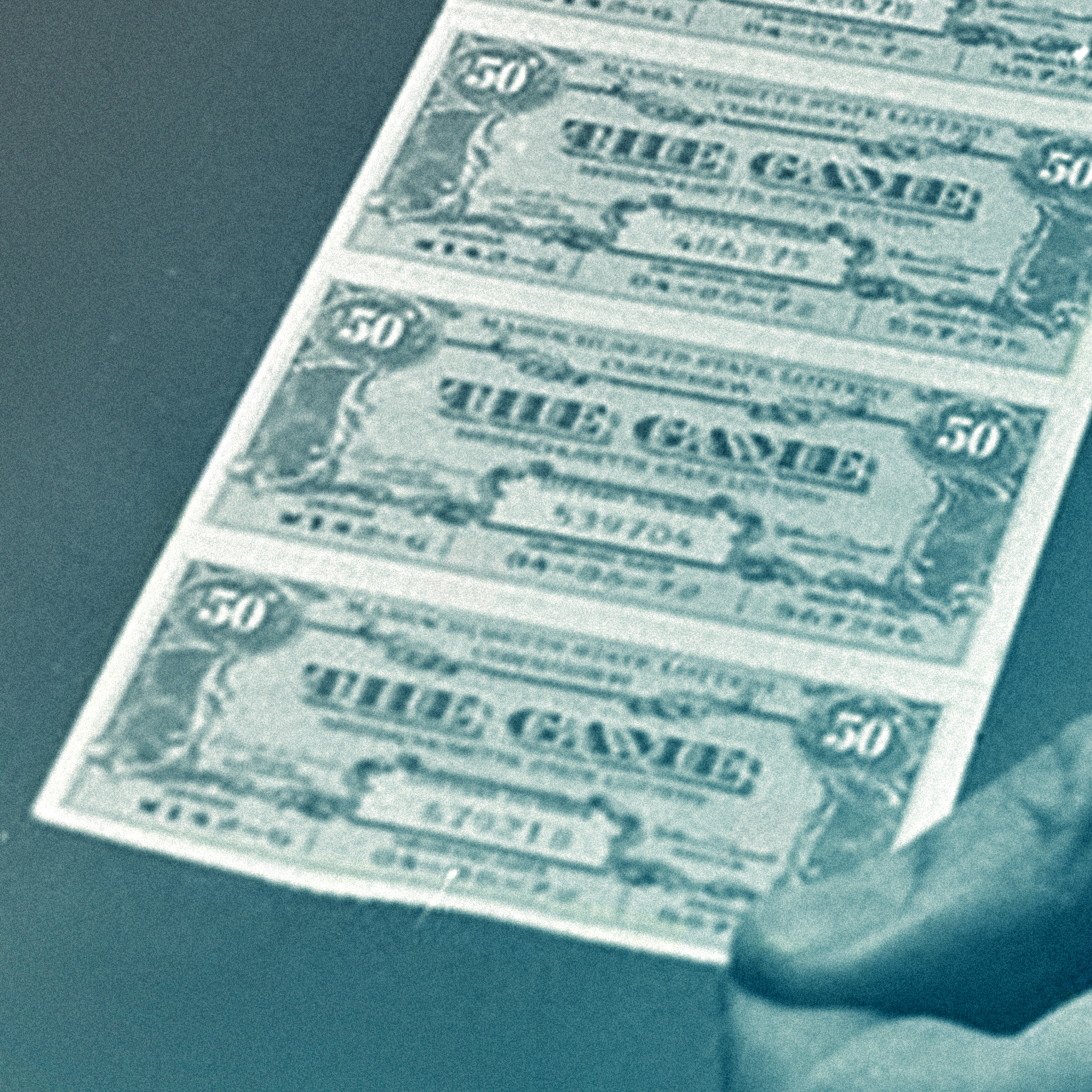
It's not glamorous at all. Very boxy and wordy. It says one in five tickets wins. And then it says, using edge of coin, rub square spot at right and a number appears. So we had to tell people that. So rub the spot, then rub the four round spots. And if four matches, you win $10,000. And with three, you win 1,002, you win $10 and one match, you got two free tickets.
- [37:28]
Ian Coss
Wow. I love that. You have to explain on there that you have to use a coin and voila, a number will appear. Like the fact that you explain that is hilarious.
- [37:37]
John Koza
Absolutely. Nobody had seen a ticket like this before in a State Lottery.
- [37:43]
Ian Coss
On May 29, 1974, just over 50 years ago, people walked into convenience stores and gas stations around the state and saw that ticket. Could you just introduce yourself?
- [37:58]
Geraldine Stewart
Hi, my name is Geraldine Stewart. I live in Springfield, Massachusetts.
- [38:02]
Ian Coss
And can you take me back to 1974 and. And how you first heard about this thing called an instant ticket?
- [38:11]
Geraldine Stewart
I don't remember exactly how I heard about it. I'm sure it was on the news, so I thought I would go out and buy a ticket.
- [38:18]
Ian Coss
Do you remember the store you went to?
- [38:20]
Geraldine Stewart
I believe it was the Pride station in East Long Meadow. It's a gas station and they also sell lottery tickets there. So I Thought, well, hey, I could use that, so I'll try it. And I was lucky.
- [38:31]
Ian Coss
Stewart won a thousand dollars on that first ticket. And she wasn't the only one playing.
- [38:36]
Joe
These people were ready. They knew it was coming.
- [38:39]
Ian Coss
Like they were lined up in the morning when you opened.
- [38:41]
Joe
Yeah, yep, lined up.
- [38:44]
Ian Coss
In 1974, Glenn Mayette ran a country store in Hanover, mass.
- [38:49]
Joe
People would scratch them immediately on the counter. Some would take two steps away and scratch it on an ice cream chest. Some would feel like they had to go outside and sit in their car.
- [39:00]
Ian Coss
He remembers the very first customer of the day was a lottery regular. And she just kept coming back up for more tickets than going back to scratch them in the freezer section.
- [39:10]
Joe
It was just crazy. It's like I thought she was going to lose her mind.
- [39:15]
Ian Coss
The appeal of the instant game is the same appeal as the slot machine. There's no waiting, so if you don't win, you can always try again. And if you do win, well, now you've got more money to play with. It was self feeding in a way that no lottery had ever been before. One liquor store owner described the scene as instant insanity. A pharmacy set up a separate sales counter at the back of the store just for lottery tickets so non lottery customers wouldn't be disturbed by the unruly crowds. Within a day, stores across the state had run out of tickets and were waiting to be resupplied.
- [39:55]
Joe
People just like it fast. They don't want to wait.
- [40:01]
Geraldine Stewart
It's the drama in it.
- [40:02]
Joe
It's like fast food. You go pull up at a McDonald's, you don't even have to get out of your car. Give me this, that and the other thing. Fast and snappy sometimes.
- [40:10]
Geraldine Stewart
Well, if I scratch the ticket, if I'm sitting in my car after I buy it, will it be a winner or will it be a winner when I scratch it when I'm home, you just think of all these crazy things that now hopefully you're a winner.
- [40:26]
Ian Coss
That first ticket also had a secondary game on it where you scratched a spot to reveal a single letter. If you then collected all the letters to spell the word Instant, you won $10,000. The catch, which was not well advertised, was that only one out of every half million tickets had the letter S. Sending players with all the other letters. On a frantic statewide search for stores that were rumored to have the mythical S. The State sold over 20 million tickets in two months. Did you realize that you had created something that would be huge?
- [41:07]
John Koza
Absolutely.
- [41:07]
Ian Coss
That would spread.
- [41:08]
John Koza
In fact, when I submitted the Business plan to our local bank. I had predicted that we would sell $6 million in tickets the first year. And the vice president of the bank that I was working with at the time, he said, I can't submit this to the loan committee. They will just laugh at this. So we cut it back to a million. And the first year sales was $6 million.
- [41:34]
Ian Coss
Wow.
- [41:35]
John Koza
And that was because the other lotteries in 75, I think it was five or six other state lotteries simultaneously started instant games.
- [41:45]
Ian Coss
The other states had waited for someone else to take the plunge, but once they saw what was happening in Massachusetts, they jumped right in.
- [41:53]
John Koza
We knew we hit the world by the tail.
- [41:59]
Ian Coss
Do you still play scratch tickets?
- [42:01]
Geraldine Stewart
Oh, sure. I haven't been as lucky, though.
- [42:05]
Ian Coss
Again, Geraldine Stewart, the thousand dollar winner. Here's the question, I guess. Do you think you've spent more than $1,000 on lottery tickets at this point?
- [42:14]
Geraldine Stewart
Yes, absolutely. But I wanted to tell you that my son never bought a scratch ticket in his life. And he's 50 and he decided a day ago he had some extra money, so he bought a ticket. Yeah, he won $500 on that one ticket, his first scratch ticket, and he won $500.
- [42:37]
Ian Coss
Did you tell your son that he should quit while he's ahead and keep the money from that first ticket and never buy another?
- [42:44]
Geraldine Stewart
No. No. I know my son.
- [42:50]
Ian Coss
Today, Americans spend over $100 billion a year on lottery tickets. Almost two thirds of that total is spent just on. On scratch tickets. Yes, the Powerball jackpots are what you see in the window of the convenience store. They get more press and the keynote numbers are always flashing on the TV screen in the corner. But the scratch ticket is the bread and butter, day in, day out game that keeps the money flowing. We spend more on scratch tickets than we do on movie tickets, concert tickets and sports tickets combined. At 5, 20, maybe $50 a pop, that is a lot of scratch tickets. And do you come in here every day?
- [43:36]
Jack
Of course I do.
- [43:36]
Ian Coss
I live right across the street at Joe's Market in Quincy. For every hardcore player I meet, like the man who called himself Jack, there are many, many casual players. Usually cigarettes in the newspapers, the people who stop by for cigarettes or to get cash from the ATM for the car wash. And the tickets are right there. So why not try your luck? Have you. Do you play other lottery games or just scratch tickets? Just scratch tickets. I met a lot of those people. Why this ticket of all the options up there? Because it caught my attention and I just decided to buy it it was a whim. Yeah.
- [44:14]
Jack
If I win a sale, would you rather.
- [44:17]
Ian Coss
Right, yeah.
- [44:17]
Jack
If I lose, you share with me.
- [44:21]
John Koza
I know.
- [44:23]
Ian Coss
And what are you playing today? $20 cash. Word. And two $10 ones. How do you pick? I mean, there's so many tickets up there. These games have changed since 1974 in important ways, which we'll get to later in the series. They are not the same boxy, wordy ticket with just four spots to scratch and a max prize of $10,000. But the basic appeal remains the same.
- [44:48]
Jack
It's just been a hit. Scratch tickets. People want scratch tickets.
- [44:52]
Joe
Absolutely. You want to win on the spot.
- [44:54]
Ian Coss
Is that why you still play?
- [44:56]
Joe
Yeah. Lack of brains.
- [45:04]
Ian Coss
There is this innocuous quality to scratch tickets. They don't really feel like gambling at all. When I was a kid, my stepdad's family would throw a big Easter party. But the prize for the egg hunt was not candy or knickknacks. It was scratch tickets. Every kid ended the hunt with a lap full of scratch tickets. I've heard so many stories like this. The stocking stuffers, the work party gifts. These tickets have found their way into every corner of life. And of course, nowhere is that more true than the place where it all began. Sorry, could you tell me about this dream involving the number 2? I just scratched a 2 and underneath it was 4 million. But I mean, like I said, it's a dream, so. But you put some weight in it come true.
- [45:51]
John Koza
You know, you want to believe that.
- [46:01]
Ian Coss
If you've ever been to this state. You know, we just love to celebrate our distinctions. The first public school in the country, the first public park, the first newspaper, the first college, the cradle of liberty, the best educated state in the nation. We even had bumper stickers made after the 1972 election when we were the only state that voted against Nixon. They said, don't blame me, I'm from Massachusetts. And yet, for all that chest thumping, no one here seems to talk about the fact that by pretty much every measure, we have the most successful and innovative lottery in the nation, the gold standard. Why isn't that on a bumper sticker? Why isn't the invention of the scratch ticket celebrated on the wall of the airport terminal alongside the telephone and the game of basketball? This is a story we've been looking away from for a long time. And it doesn't end with that first instant ticket. It took the better part of two decades for the Massachusetts lottery to crawl its way into that number one spot, bringing in more dollars per capita than any other State by a that is the story we will tell over the rest of the series. It's a story of power, money, politics, crime and vaudeville.
- [47:35]
John Koza
You made me love you I didn't wanna do it.
- [47:42]
Ian Coss
In episode two we meet the singing, dancing state treasurer who got the lottery started in the first place. That episode's out now, so why not give it a chance?
- [48:00]
John Koza
You made me sad but there were times dear you made me feel so bad.
- [48:14]
Ian Coss
The series is produced by Isabel Hibbert and myself, Ian Koss. It's edited by Lacey Roberts. The Editorial Supervisor is Jennifer McKim, with support from Ryan Alderman. Mae Lei is the Project Manager and the Executive Producer is Devin Maverick Robbins. Special thanks to Jonathan Cohen for helping me connect with John Koza and just in general for sharing so much material and insight from his own research. Research Cohen's book For a Dollar and a Dream is really a fascinating and important work on this topic. Thanks also to the staff of Joe's Market in Quincy and Mayette's Country Store in Hanover for being so welcoming. You didn't have to let me hang out and talk to your customers. It means a lot that you did. The artwork is by Bill Miller and Mommy Hawa Bao. Our closing song is you Made Me Love youe, performed by Massachusetts State Treasurer Bob Crane. Scratch and Win is a production of GBH News and distributed by prx.
- [49:22]
John Koza
You know you made me, you know you made me, you know you made me love you and all the time you knew it.
- [49:47]
Ian Coss
Thank you. Hey, I want to make sure that you know this series you're listening to right now is part of an ongoing feed telling stories from the past to help us understand our present. Our first season is all about infrastructure. The second season is about gambling, and we've got more seasons planned. So if you want to stay on top of what the team and I are doing, go ahead and follow or subscribe to this podcast wherever you listen. We've got some really exciting stories coming up and I hope you'll stay with us. Thanks.
- [50:31]
Joe
From prx.