Loading summary
Transcript265 lines
- [00:00]
Ian Coss
Support for Scratch and Win comes from Progressive Insurance. You chose to hit play on this podcast today. Smart Choice. Make another smart choice with Auto Quote Explorer to compare rates from multiple car insurance companies all at once. Try it@progressive.com, progressive Casualty Insurance Company and affiliates. Not available in all states or situations. Prices vary based on how you buy. As I was sifting through the database of the GBH archives looking for material for the series, there was one item that caught my eye right away because it was about the city where I live, a small city of about 65,000 people just outside of Boston called Medford.
- [00:43]
John Hashimoto
At the Sunnyhurst Farms Market in West Medford today, customers were lining up for a dance with Lady Luck.
- [00:49]
Ian Coss
It turns out that decades ago, a young reporter with very large glasses named John Hashimoto had toured the local convenience stores talking to lottery players and clerks, trying to understand a puzzle about the city's finances. Then, as now, the city was strapped for cash. Cuts to services were looming, but no one in town wanted to talk about raising taxes. The mayor was refusing to even put a tax hike referendum before the voters.
- [01:21]
David Gilmartin
And yet I come in here every.
- [01:24]
Ian Coss
Single day and get my scratches. Somebody's got to keep the government going. For all the agonizing over taxes, people here had plenty of money when it came to playing numbers and scratch tickets.
- [01:36]
John Hashimoto
What better proof than the latest lottery sales figures which show this small blue collar town selling more than 17 and a half million dollars worth of tickets.
- [01:44]
Ian Coss
Last year, $17.5 million spent on lottery tickets while the city struggled to close a $4 million budget gap.
- [01:53]
John Hashimoto
Like most of Massachusetts, Medford would rather play the lottery than pay more taxes.
- [01:59]
Ian Coss
Okay, let me see a lucky roll. Cash flash. Lotteries in America have always been bound up with government finances. Thomas Jefferson was a big proponent of lotteries as an alternative to taxes, as a way to bring in revenue, but voluntarily. Lotteries helped fund the Continental army during the Revolutionary War. Afterwards, they helped pay for the construction of the Washington Monument in the Erie Canal. They were a reliable and popular source of money.
- [02:35]
John Hashimoto
A joint legislative hearing on a proposal to allow off track betting in Massachusetts.
- [02:39]
Ian Coss
But in the modern era, that logic has been pushed to a new extreme. In a way, states in cities like mine were testing the limits of Jefferson's original argument. Can gambling revenue truly replace taxes?
- [02:55]
John Hashimoto
It's a measure that would allow the state to raise much needed revenue without raising the dreaded T word taxes. For the 10 o'clock news, I'm John Hoshimoto.
- [03:10]
Ian Coss
From GBH News. This is Scratch and the making of America's Most Successful Lottery. I'm Ian coss. In the 1980s, the rise of modern lotteries collided with another historic trend. An anti tax movement that swept across the country and transformed American politics, conservative politics in particular. In Massachusetts, these two forces interacted in a unique way, creating a lottery that is more politically potent than perhaps any other in the country. This is part five, the Cherry Sheets. I feel like I should warn you up top that there are no mob hits in this one. No break ins, no wiretaps. It's time to drill down on the policy side of lotteries and it will get wonky. But I promise you, it is also a juicy story and it's absolutely essential for understanding what state lotteries have become. So if you look at all the money spent on lottery tickets, about 60 to 70% of that money is paid out in prizes to the lucky winners. Once you take out the overhead costs of actually running a lottery, the rest, maybe 20 or 30%, is returned to the state as government revenue. One of the unique qualities of the Massachusetts lottery is where that revenue actually goes, how it's spent. In a lot of states, lottery money is set aside for a specific cause, like education or the environment. In others, the money just goes straight into the state's general fund. But in Massachusetts, the money goes to cities and towns. It does not fill state coffers, it fills municipal coffers, local coffers. That is very important because when the modern anti tax movement first got rolling, the tax in question, the most explosive radioactive tax of the day, was essentially a local tax, and that is the property tax.
- [05:35]
Isaac Martin
Property taxes in one form or another predate the Republic. This is the oldest form of taxation that's still in use in the United States.
- [05:44]
Ian Coss
Isaac Martin is a professor of urban studies and planning at the University of California, San Diego. And he wrote a book called the Permanent Tax how the Property Tax Transformed American Politics. As Martin explains it, there is a simple reason why the property tax is the old standby of American taxation.
- [06:07]
Isaac Martin
If you are trying to set up a government for the first time, what you want is a way to tax something that people can't run away from. And the way you do that is you tax the land.
- [06:22]
Ian Coss
The trouble with taxing land is that unlike income or sales, a piece of land does not have an obvious inherent value.
- [06:30]
Isaac Martin
Yeah, I'll say it's the sort of easiest to start, but the hardest to perfect.
- [06:38]
Ian Coss
And that difficulty, that mystery of what property is actually worth, that's what ultimately makes Them so political?
- [06:46]
Isaac Martin
Absolutely. There's always a fight over the value of property at tax time.
- [06:51]
Ian Coss
I'm talking with Somerville mayor Lawrence Breta. In the 1960s and 70s, that fight became unusually heated. States were reforming how they assessed property values, causing sudden increases in people's tax bills, which nobody likes. At the same time, their residents wanted better schools, better parks, and it wasn't clear how to pay for it all. And your personal opinion on this?
- [07:19]
Barbara Anderson
My personal opinion is that the property owners of my city, at least, just cannot accept any more on their property taxes.
- [07:27]
Ian Coss
Around the country, there were hints of a backlash. Various groups mobilized to advocate for tax relief on the right and the left. But in California, a groundswell of fed up property owners seized the moment.
- [07:41]
Barbara Anderson
A million and a half people signed petitions to put Proposition 3, the Jarvis Amendment, on the June ballot.
- [07:47]
Ian Coss
They passed something called Proposition 13, a ballot measure to permanently cap property taxes.
- [07:55]
Isaac Martin
If you think about the idea of a local tax in California, it doesn't sound like a national news story, but Proposition 13 seemed like more than that.
- [08:06]
Barbara Anderson
California has long been considered a trendsetter, a birthplace of new ideas that go on to sweep the country.
- [08:12]
Ian Coss
Prop 13 became a huge story, a national story nationwide.
- [08:18]
Isaac Martin
It seemed like a signal of maybe a sea change in American public opinion.
- [08:28]
Ian Coss
An amorphous backlash had been focused into a kind of movement, a pretty radical movement at that, one that didn't just seek to reform property taxes, but to severely limit them, regardless of the consequences.
- [08:42]
Barbara Anderson
And I get the idea. Well, let's try it here in Massachusetts.
- [08:48]
Ian Coss
In 1978, Roy Switzler was a state rep who also had a real estate business. He had followed the campaign in California and could see that Massachusetts was perfectly suited to be the next battleground in this fight.
- [09:03]
Barbara Anderson
Massachusetts was known at the time as Taxachusetts. For too long, the label of Taxachusetts has driven established industry and business from our state. Don't you resent it when out of.
- [09:19]
Ian Coss
State friends kid you about living in Taxachusetts?
- [09:23]
Barbara Anderson
We were the highest tax state in the country, across the board.
- [09:29]
Ian Coss
In fact, in 1978, the same year Prop. 13 passed, the leader of that campaign visited Massachusetts and said, I never thought I'd find a state where property taxes are worse than California, but I have, and you are here. Roy Switzler teamed up with a young organization called Citizens for Limited Taxation, and they began planning their own ballot initiative.
- [10:00]
Barbara Anderson
Proposition 2 and a half.
- [10:02]
Ian Coss
They called it Proposition 2 and a half. Under Prop.
- [10:05]
John Hashimoto
2 and a half, cities and towns cannot tax property at more than 2.5%.
- [10:10]
Ian Coss
The measure would limit the total property tax revenue for any city at 2.5% of all its property value. So, say in a small town, all the property adds up to a million dollars. The maximum the town can collect in property taxes is 2.5% of that, or $25,000 each year until they reach the 2.5% level. Additionally, the law would limit how fast that total amount could grow. So even if the property values of a city are rising quickly, the amount collected in property taxes could only grow each year by, again, 2.5%. It's a lot to make sense of. I know. It was a lot at the time, too. But Switzer and his allies made it simple. How would you make the case to voters at the supermarket?
- [11:02]
Barbara Anderson
Are you concerned about your property taxes?
- [11:04]
Chet Atkins
Yes.
- [11:05]
Barbara Anderson
Sign here.
- [11:06]
Ian Coss
They had no problem getting enough signatures.
- [11:09]
Barbara Anderson
And the thing went on the ballot.
- [11:12]
Ian Coss
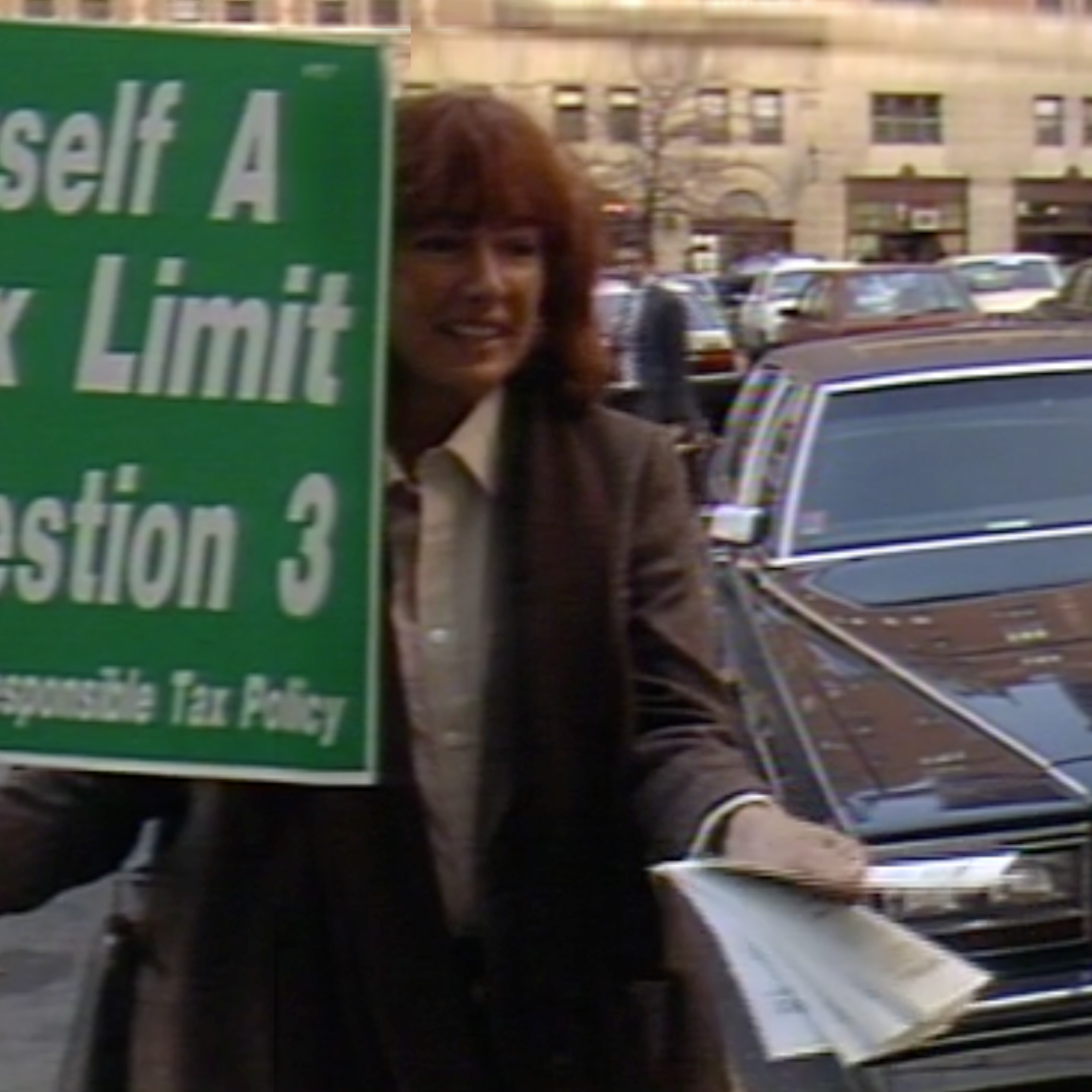
The tax revolt here and in California ran on populist energy. They may have gotten some big checks from business groups, but the image was of an outsider campaign challenging the entrenched interests of the state. So Roy Switzler, a sitting state rep, was not the man to be the face of that campaign. Fortunately for us, WGBH produced a half hour feature on the person who became that face, Barbara Anderson.
- [11:44]
Barbara Anderson
She is likable, important, completely unintentional, very articulate, revolutionary.
- [11:50]
Ian Coss
The piece opens with this long montage of voices.
- [11:56]
Susan Scher
As the governor of the.
- [11:57]
Ian Coss
Commonwealth, ending with Anderson herself.
- [11:59]
Susan Scher
I have never liked the idea of anybody being able to tell me what to do.
- [12:05]
Ian Coss
Barbara Anderson passed away in 2016. She was at times compared to both Joan of Arc and Lucille Ball. Her movement was compared to the Boston Tea Party and the Minutemen of the Battle of Lexington and Concord. Pretty heady stuff. But her rise to that position was entirely unexpected. Barbara Anderson's origin story goes like this. In the 1970s, she was a housewife living in a small coastal town called Marblehead, where she taught swimming lessons at the local pool. Until one day, frustrated with her own tax bill, she quit the pool job to volunteer her time with Citizens for Limited Taxation.
- [12:51]
Barbara Anderson
And Baba was brought in as a secretary.
- [12:54]
Ian Coss
Basically, she started as a secretary for the head of CLT in 1977, answering the phones. But there was a lot of turnover in those years. The founding director left suddenly, then his successor left soon after. Anderson, though, was still there.
- [13:13]
Susan Scher
Yeah, this is Barbara. Thanks, and we'll keep you informed.
- [13:16]
Barbara Anderson
So because the others were gone, she's answered the phone, they call up, say hello. Well, they're not here, but I'm here. Can I answer? And that's how Barbara became who she became.
- [13:28]
Ian Coss
In 1980, Anderson became the director and figurehead of CLT. Three years from secretary to director. And that same year, 1980, proposition two and a half appeared on the ballot.
- [13:47]
Lawrence Bretta
So this was a time when female icons were only emerging.
- [13:53]
Ian Coss
Susan Cher got to know Anderson very well because they would often do battle over tax issues. Cher represented the League of Women Voters, a group she had worked with since the early 70s.
- [14:05]
Lawrence Bretta
It was a time when Ms. Magazine had just started, the National Organization for Women had just started. Women had just started actually running for office and getting a bathroom in the state house so that they could run and use the facilities when they're on the floor of the legislature. So all of those things were just happening. She was an anomaly, and she was speaking about an issue that had resonance with a lot of people, and she knew how to use it.
- [14:36]
Ian Coss
What Anderson did is she made Prop 2 and a half personal. Property taxes are about homes, about the domestic world, right? And so what better spokesperson than, in the language of the day, a homemaker. Here she is on WGBH making her case.
- [14:54]
Susan Scher
I clearly remember sitting on my front porch in Danvers getting the latest notice of the property tax increase and just sitting there in tears knowing that there went the monthly movie, you know, there went. Because we just didn't. We had put all our money in the house. We were trying to fix it up. Andy was working all these hours and we were just newly married, and it really hurt, it really hurt to pay the property taxes, and nobody cared.
- [15:19]
Ian Coss
According to Susan Scher, when the ballot campaign got underway, there was no natural advocate to take the other side against two and a half. There was no organized pro tax lobby, even if there were many people and organizations who relied on those taxes. That's why it was her group, the League of Women Voters, who rose to the occasion.
- [15:41]
Lawrence Bretta
And one of the things that disturbed me at the time was that the league said, we're not going to have debates because we won't win a debate. Because as soon as you say that you want to limit taxes. That was just they won before they even started.
- [15:59]
Ian Coss
Instead, the league held town halls across the state to try and at least educate citizens on what their property taxes were for and also warn them of what services would have to be cut if this measure passed. In the city of Springfield, where we.
- [16:13]
Chet Atkins
Have trash collection once per week, provinces.
- [16:16]
David Gilmartin
In two and a half may have.
- [16:17]
Ian Coss
Trash collecting once per month. In many cities, those warnings were pretty dire, caused serious cuts in our public Health, public safety. We likely would have to close this library, unfortunately. But still, they were just that, warnings.
- [16:32]
Lawrence Bretta
Our stories are always about, well, if they do this, this horrible thing is going to happen. You know, houses are going to burn down because we don't have firefighters and hospitals are going to close and that kind of thing.
- [16:46]
Barbara Anderson
Tell you what I'm going to do. I'm going to cut your property tax, your excise tax.
- [16:49]
Ian Coss
The image I get is of two parallel campaigns, Cher and the League talking about the value of city services.
- [16:56]
Barbara Anderson
Massachusetts will lose police and fire protection.
- [16:59]
Ian Coss
Schools and teachers Will. Anderson and CLT talked about the burdens on individual taxpayers.
- [17:05]
Barbara Anderson
It means they can keep their homes and know that their property taxes can.
- [17:08]
Ian Coss
Go down as if services and taxes were somehow unrelated.
- [17:13]
Susan Scher
Senator, you don't mind if I use your visuals here, do you? Okay.
- [17:16]
Ian Coss
But ultimately, the ballot measure is a blunt political instrument, a yes or no vote. And CLT had framed the question for.
- [17:24]
Susan Scher
Us, ladies and gentlemen. All we are saying is let's put a limit on how much they can take. It is all our money.
- [17:33]
Ian Coss
This narrative, disconnected, is both a legacy and really an innovation of this time. Historically, discussion of taxes was always tied to discussion of spending. They go hand in hand. What Prop 13 and then 2 and a half did was put just the tax part directly before voters.
- [17:53]
Isaac Martin
You could decouple the question of taxes from the question of spending.
- [17:58]
Ian Coss
And that tactical move, according to Isaac Martin, has had truly profound political implications.
- [18:05]
Isaac Martin
You could ask people, hey, do you want lower taxes? And not tell them what it would cost them in terms of lost public services? And that that could become a winning election issue.
- [18:16]
Ian Coss
That's so interesting, partly because it's a ballot initiative. It doesn't have to reckon with its own consequences. And so it allows taxes as a standalone issue to become what they are, you know, what we know them as is like an issue that people campaign on and identify with.
- [18:34]
Isaac Martin
Absolutely.
- [18:36]
Barbara Anderson
Well, the first thrill tonight was to find myself for the first time in a long time in a movie on prime time.
- [18:44]
Isaac Martin
And the Republican Party starts to make room for a new generation of politicians who begin campaigning on tax cuts, tax cuts and more tax cuts. And don't worry about the deficits. Don't worry about where the spending is going to come from. Let's just cut taxes.
- [19:01]
Barbara Anderson
Every taxpayer in America knows only too well that government continues to grow, to get bigger every year, and that means a bigger bite out of everyone's paycheck. Do we want to go on as.
- [19:12]
Ian Coss
We have in 1980, on the same day that voters In Massachusetts made their choice about Prop 2 and a half. They also made their choice for president. We can see now that those two votes were part of the same larger political trend.
- [19:28]
Barbara Anderson
The time is now for Reagan.
- [19:31]
Ian Coss
That night, Reagan's victory was called before the polls had even closed. In California, it was clear which way the winds were blowing and they blew the same way in Massachusetts.
- [19:43]
Lawrence Bretta
I think I got a call from our state rep because he knew I had been involved in it.
- [19:49]
Ian Coss
Susan Scher spent the night of that election waiting by the phone making and taking calls.
- [19:56]
Lawrence Bretta
So I was standing in my kitchen with a very long cord.
- [20:00]
Ian Coss
What did he tell you on the phone?
- [20:02]
Lawrence Bretta
We lost. That's all you have to say? I didn't cry, I didn't scream, I didn't have a glass of wine. You know, when you're so involved in something, you either. I think you either have the emotions like I did everything I could or you think I failed. And I know I was thinking I did everything I could.
- [20:30]
Ian Coss
In a way. That November night in 1980 was the high watermark for the property tax revolt. There wasn't another wave of copycats after Prop 2 and a half. It was really just California and Massachusetts.
- [20:44]
Isaac Martin
So the property tax crisis and the property tax revolt came and went within a few years. And the energy tapered off pretty fast after Proposition two and a half.
- [20:54]
Ian Coss
But in those few years, a much longer lasting and farther reaching movement had been set in motion. A movement that is very much alive and well today. Think of H.W. bush telling viewers to read my lips. Grover Norquist's anti tax pledge, or later the Tea Party. These can all be read as offshoots of what sparked in California and caught fire in Massachusetts.
- [21:21]
Isaac Martin
You can think of the property tax revolt as a kind of ladder that anti tax activists climbed. And then they didn't need it anymore and they sort of kicked away the property tax issue and started to pay a lot less attention to property taxes and focus on other tax issues once they had acquired the model for how to do populist campaigns on tax cuts.
- [21:49]
Susan Scher
You really think we won on question three?
- [21:51]
Ian Coss
Yeah, Barbara Anderson definitely acquired that model and used it to great effect for the rest of that decade. But I want to stay on the story of Prop 2 and a half in itself, because just as Anderson scored her first big victory, she also kicked off a new battle over how to save those cities and towns from the hurt that was coming their way.
- [22:17]
Barbara Anderson
She threw the grenade, but there was no solution to it. She just said, it's enough with property taxes. After that you're on your own.
- [22:25]
Ian Coss
And one thing those cities and towns could still count on was their lottery. The idea that lotteries could replace taxes once held a kind of mystical appeal. It was like the philosopher's stone, the fountain of youth or nuclear fusion maybe. A way to eliminate the tough choices of life and simply have it all. A painless popular tax. But it was always a mirage. You don't have to be an economist to see that the numbers don't add up. They never added up anyway.
- [23:11]
John Hashimoto
I'm just saying, would it be a good idea if all of our taxes were collected by people buying lottery tickets?
- [23:17]
Barbara Anderson
Yeah, but I don't agree with it.
- [23:19]
John Hashimoto
Because it wouldn't work out that way.
- [23:21]
Ian Coss
I love this clip of a WGBH reporter out polling this idea among lottery players in the 80s.
- [23:27]
John Hashimoto
Why don't we just, I mean, why don't we just have a national lottery.
- [23:30]
Ian Coss
And you know, the question is phrased in a pretty leading way, but even still, no one seems to bite.
- [23:36]
David Gilmartin
I don't think so. You can't depend on this. People might just stop buying tickets and you still need that tax dollars to keep society going.
- [23:43]
Ian Coss
Out of curiosity, the tax revolt didn't change these basic facts, but it did prompt a fresh wave of interest in so called non tax revenue. In the 1980s and 90s, 25 new states added lotteries, half the country pushing the lottery map west and south into states that had resisted legalized gambling but liked the idea of cutting taxes.
- [24:07]
Barbara Anderson
I support your right to express at the polls your views on the lottery as a voluntary way to raise money.
- [24:14]
Ian Coss
Let's put this issue rest lottery ballot measures passed in California, Missouri, Oregon and in states that already had lotteries like Massachusetts. The tax revolt created a new kind of pressure to step up and produce. But because of the unique structure of our lottery, the way it paid out revenue directly to cities and towns, that pressure did not always come from the top of state government. It really came from the bottom up. And it began as soon as Prop 2 and a half pass. When we talked before, you described yourself as a politician in recovery. Could you say what you mean by that?
- [24:58]
David Gilmartin
I think I also said that I'm glad that I did it, but I could never talk anybody into doing it.
- [25:04]
Ian Coss
David Gilmartin is the former mayor of Fitchburg, Massachusetts.
- [25:09]
David Gilmartin
All the fallout from Prop 2 and a half, it was serious, it was rough and I'm glad I was there to handle it. I don't know how other people would have done it, but I made the decision to walk away.
- [25:20]
Ian Coss
Gil Martin was 25 years old when he decided to run for mayor of his hometown. He was working as a firefighter at the time. And Fitchburg, for context, is an old industrial city that in the 1970s had fallen on hard times, which for the fire department actually made for a busy and dangerous job.
- [25:41]
David Gilmartin
Vacant buildings, things like that, they were just going up all the time. And one night there was a guy who was killed and three other firemen never worked again when the front wall of a four story building came down on them.
- [25:57]
Ian Coss
Wow.
- [25:58]
David Gilmartin
And I thought, you know, maybe I can make a difference. I think I know how to at least put the brakes on this.
- [26:07]
Ian Coss
So we challenged the longtime incumbent running on a platform of change, and he won. Gilmartin was sworn in as mayor on his 26th birthday, January 4th.
- [26:19]
David Gilmartin
And I made my resignation for the fire department. So this is very theatrical. I went on the stage wearing my uniform.
- [26:27]
Ian Coss
He went up in the full dress uniform of a firefighter. You know, the officer's hat, the double breasted jacket, the braided cord hanging from one shoulder.
- [26:36]
David Gilmartin
Somebody came out, I took off my hat, took off the blouse, handed it to them, and I put on a jacket, a Harris tweed jacket.
- [26:45]
Ian Coss
So there was literally like a ceremonial transition from firefighter to mayor.
- [26:49]
David Gilmartin
Yes.
- [26:50]
Ian Coss
This was January of 1978, so just a few months before Proposition 13 passed in California. And Gil Martin followed the news with some interest.
- [27:01]
David Gilmartin
I kind of thought that there would be a ripple effect. And there was.
- [27:05]
Ian Coss
By January of 1981, that Ripple had arrived in Fitchburg. It was proposition two and a half. And it was no longer just a ripple.
- [27:15]
David Gilmartin
And what it did is it changed the equation for taxes. In the old days, you'd total up all your expenditures once the budget was finalized and then you figured out your tax rate.
- [27:27]
Ian Coss
This flipped that from now on, the tax revenue was capped at 2.5% of total property values.
- [27:34]
David Gilmartin
This is how much money you're going to have to work with.
- [27:36]
Ian Coss
And of course, it was the mayor's job to make the hard cuts, to be the bad guy. The state, cities and towns were facing a collective budget gap of about $600 million announced he needs to cut $1.2 million from the school system. $600 million worth of local services that had to be cut or paid for or some other way.
- [28:01]
John Hashimoto
Schools, parks, the city hospital.
- [28:03]
Ian Coss
In other words, those dire warnings that the two and a half opponents had talked about were coming to life. Game now has leagues. Playoffs are scheduled at the end of the summer. The effects of Prop 2 and a half have not yet reached this program. After Prop 2 and a half passed, there was an unprecedented surge in applications to private schools, with mostly from upper and middle class parents concerned about their town's public schools.
- [28:31]
John Hashimoto
Eventually you're gonna hit a point of.
- [28:33]
Ian Coss
No return where a town hits a wall, it can't fund even basic services anymore. David Gilmartin recalls a pair of police dispatchers who started declining to respond to non urgent calls, citing the impending budget cuts from Prop 2 and a half. The officers were disciplined, but still that was the level of uncertainty, an alarm really.
- [28:55]
David Gilmartin
Once you started losing that revenue stream, there wasn't much else. And look what we've replaced it with. Meals, taxes, hotel taxes. You know, I think Fitchburg's got one hotel left that doesn't make up for what happens.
- [29:09]
Barbara Anderson
The moment of truth is just about honest, is that correct?
- [29:12]
David Gilmartin
So there was quite a bit of angst. Am I going to keep my job or. You're not gonna cut this guy, are you? Or you're not closing the parks, are you?
- [29:21]
Ian Coss
We're gonna be substantially hit by all of this.
- [29:23]
David Gilmartin
Mayor. And the question is, and I didn't have an answer until I'd worked out the budget.
- [29:31]
Ian Coss
A lot of the cuts Gilmartin made were not things people would see right away. Open positions were left unfilled. Maintenance was deferred. A plan to put lights up at the Little League was put on hold. But there is one cut he will never forget.
- [29:48]
David Gilmartin
I had to close the fire station.
- [29:50]
Ian Coss
The firefighter who decided to run for office because he watched one of his comrades perish in a burning building, who walked onto the inauguration stage in his firefighter's dress uniform. He had to close a fire station.
- [30:04]
David Gilmartin
And that was painful. Oh, I had a relative who worked out of that station in the horse drawn days and the people in that neighborhood were upset, but there was nothing I could do that hit home with me. But I had no choice. I had no choice.
- [30:23]
Ian Coss
Had you worked out of that station?
- [30:24]
David Gilmartin
I did, yeah.
- [30:26]
Ian Coss
Do you have any memories of it, like what it looked like inside?
- [30:30]
David Gilmartin
Yes, it's still there. It had a hose tower where you dry the hose. It was wainscotted inside, brass sliding poles, and it had individual bunk rooms upstairs and a kitchen. It was cozy.
- [30:48]
Ian Coss
When you close a fire station, is there some kind of process or ceremony of decommissioning that building?
- [30:56]
David Gilmartin
Many, many years ago? There used to. They'd make the last run, the last alarm, and they'd sound a box and that would be it. We did not do that. I didn't. We just closed it. Guys cleaned out their lockers and they went to work in a different house.
- [31:16]
Ian Coss
Why didn't you do the last alarm?
- [31:18]
David Gilmartin
I didn't think it was appropriate. Everybody knew we weren't trying to do this quietly or pull the wool over anybody's eyes. But I hated having to do this, and I just wanted to get it over with.
- [31:39]
Ian Coss
As David Gilmartin worked his way through the budget, there was one wild card still in play. A last ray of hope, really. And it is also how all of this ultimately does connect back to the state lottery. So every year when the legislature gathers on Beacon Hill to create the state budget, they carve out some money for local government called local aid. This is money that's collected through state taxes, but goes to local coffers once the budget is done. Notices then go out to every city and town letting them know how much money they got. At one point in time, these notices were printed on pinkish paper, earning them the name cherry sheets. Local aid was not typically a hot topic in the budget process. In fact, it was largely an afterthought. But the 1981 budget was bound to be unlike any in state history. Mayors were waiting anxiously to get their cherry sheets to see how much help they'd have from the state. And by total coincidence, that same year, those mayors gained a new champion on Beacon Hill. James Siegel. We heard him briefly just before the break.
- [32:55]
Barbara Anderson
I was appointed to be the first executive director of Mass Municipal. They just had created the organization and I came in exactly at the same time as two and a half was affecting all the cities and towns in a most detrimental way in history.
- [33:10]
Ian Coss
The Mass Municipal association represented all 351 cities and towns in the state. Siegel's job was to be their voice in Boston in the State House. He was known as a low key numbers guy, someone who mostly worked behind the scenes and didn't make waves. Now, at age 35, Siegel was about to go against all that. To save the cities and towns, he would have to go on the offensive and change the way the whole state budget process worked to turn it on.
- [33:42]
Barbara Anderson
Its head and make local aid the first priority as opposed to the last priority, was the challenge. And that's what we undertook in the efficient and economic management of the state.
- [33:56]
Ian Coss
The state budget process unfolds in three acts. First, the governor offers up a budget proposal. Then the House of Representatives, and finally the Senate. There is competition between the different versions, and hopefully they all get resolved between January and June, when the fiscal year turns over.
- [34:16]
Barbara Anderson
In Elder affairs. We are recommending $68.5 million.
- [34:22]
Ian Coss
So in January of 1981, Governor Ed King, a conservative democrat, kicked off the process with his budget addressed to the legislature, staking out his vision. But with the impacts of Prop 2 and a half just coming into focus, there was really one number everyone in the room was waiting to hear.
- [34:42]
Barbara Anderson
In the 1982 fiscal year, $37.6 million more should be available for payments directly to cities and towns than was certified for the current year.
- [34:56]
Ian Coss
That was his lifeline. Facing up to $600 million in lost revenue, Governor King would offer the cities and towns 37.6 million.
- [35:07]
Barbara Anderson
I know I can rely on your consideration and assistance.
- [35:11]
Ian Coss
Thank you. The budget was a shock.
- [35:18]
David Gilmartin
Of the seven budgets that I've seen since I became a member of the legislature, that it's the single most irresponsible one that's presented.
- [35:25]
Barbara Anderson
I think this is war. It simply isn't even worth arguing about. It's war because the whole issue this year is two and a half. Here we were cutting $600 million. So it wasn't even a recognition that two and a half had taken place. I think it was totally unacceptable.
- [35:41]
Ian Coss
In an unprecedented move, the governor tried to hastily put together a second budget proposal and then a third. But by that time, it was already clear the governor was irrelevant. The reckoning with two and a half would have to happen inside the true power center of state politics, the legislature itself.
- [36:03]
Barbara Anderson
Even though they've gotten local aid, they really can't meet many of the challenges that we were looking at.
- [36:09]
Ian Coss
James Siegel began his lobbying campaign in the House, which again, typically hosts the second act of the state budget drama. And in that campaign, Siegel also formalized a goal. He wouldn't try and get the state to fill that entire $600 million hole, but he wanted half.
- [36:29]
Barbara Anderson
Okay, we're going to tighten up, but you've got to help us to the extent of half of it. $300 million. We couldn't swallow that in a year.
- [36:35]
Ian Coss
And that's the pitch he took to.
- [36:36]
Barbara Anderson
Legislators and try to make sure that some of these revenues go back to the cities in hands.
- [36:41]
Ian Coss
It's important to understand that local aid was not usually a big cause for Democrats because more local aid meant less state spending. If anything, it was Republicans who, who usually supported local aid, who wanted that money to go back to the local level. So Siegel, a liberal Democrat and now the voice of those local governments, quickly found himself at odds with some of his party's most powerful figures.
- [37:10]
Barbara Anderson
Tom McGee was a Marine who was in a tank in Saipan, which was one of the worst battles in World War II in the Pacific.
- [37:19]
Ian Coss
He's talking about House Speaker Tom McGee.
- [37:22]
Barbara Anderson
He was small. He was a fighter. He was very tough. He almost did not say a sentence without the F word at least twice.
- [37:30]
Ian Coss
Tom McGee was one of many Democrats who did not want to increase local aid, at least not at the expense of state spending. So when McGee heard that Siegel was snooping around the statehouse, having private meetings with his members, the old Marine sent court officers to gently escort Siegel out of the building. He was not welcome there.
- [37:53]
Barbara Anderson
And it showed that they were not going to increase local aid at all.
- [37:57]
Ian Coss
Which meant it was time for Siegel to turn to his final option. Act 3 of the Budget drama. The Senate.
- [38:06]
Barbara Anderson
The Senate was watching what we were.
- [38:08]
Ian Coss
Doing in the House, and Siegel saw an opening to play this round differently to avoid that kind of showdown.
- [38:15]
Barbara Anderson
I couldn't take on the House and the Senate and the governor. I didn't think. And Bill Bulger was the president of the Senate, and I did not want to take on Bulger because he's the toughest man I ever met.
- [38:25]
Ian Coss
In case you're wondering, Bill Bulger, the Senate president, is the kid brother of Whitey Bulger, the notorious mob leader we heard about in the last episode. There is an old line in Boston that what one Bulger did with a gun, the other did with a gavel. Bill Bolger wielded the gavel, and I.
- [38:46]
Barbara Anderson
Just didn't think I could beat him. King and McGee.
- [38:49]
Ian Coss
So you were pursuing a kind of good cop, bad cop strategy of you're playing confrontationally with the House, throwing F bombs or at least receiving F bombs. But then on the Senate side, you're trying to negotiate, meet in the middle.
- [39:06]
Barbara Anderson
Exactly. Exactly. I was not going to have a confrontation with the Senate.
- [39:10]
Ian Coss
And Siegel had something to offer the Senate, too. A chance to show up their rivals in the House. As I said before, the Senate proposes their budget last. But since the question of local aid had so far gone nowhere with both the governor and House, the Senate had a rare opportunity to take control, to swoop in to the rescue of cities and towns.
- [39:33]
Barbara Anderson
We made the Senate the good guys.
- [39:35]
Ian Coss
Siegel's partner in this maneuver would be the chair of the Senate Ways and Means Committee, an ambitious and clean cut young man who looked like he could be a member of the Beach Boys, but happened to share a name with a legend of country music, Chet Atkins.
- [39:51]
Chet Atkins
I was frankly, as I look back, very arrogant and very young.
- [39:58]
Ian Coss
This is an older, wiser Chet Atkins.
- [40:01]
Chet Atkins
So a person who had been entrusted with an enormous amount of power and was intent on breaking eggs to make an omelet.
- [40:11]
Ian Coss
Where would you meet with Chet Atkins? Can you set the scene a little bit?
- [40:16]
Barbara Anderson
Yeah, I'd come into his office and I'd sit across the desk again.
- [40:20]
Ian Coss
James Siegel.
- [40:21]
Barbara Anderson
They were not comfortable meetings, even though we were on the same side. I'd say there was a little bullying and involved.
- [40:28]
Chet Atkins
I was brash. And I think at, at that point I realized a eureka moment, that this was our chance to really make a profound once in a generation impact.
- [40:47]
Ian Coss
Atkins saw himself as a reformer who was ready to break some eggs if it would make government work better. And the disruption of Prop 2 and a half was the perfect opening to make much bigger, broader reforms in state finances. In other words, Atkins was happy to root around in the budget and find that $300 million that Siegel was looking for. Tell me about some of your egg breaking. What did that look like?
- [41:16]
Chet Atkins
Like the registry. Motor vehicles had always been and sacrosanct, filled with people who were politically connected. But it was a huge problem.
- [41:27]
Ian Coss
So Atkins and Siegel looked into reforming the rmv, right down to how parking tickets were collected.
- [41:34]
Barbara Anderson
Cost me, by the way, personally, probably $800 in parking tickets. I had to pay.
- [41:40]
Chet Atkins
Crazy things. The state ran a bunch of pheasant farms, raising pheasants and then releasing them into the wild for people to hunt.
- [41:50]
Ian Coss
So they cut the pheasant farms probably.
- [41:53]
Chet Atkins
Up well over 100 of little things like that that had never been changed over time.
- [42:00]
Ian Coss
And big things too. Privatizing a city zoo, eliminating whole programs, cuts to higher ed and mental. As the process wore on, Siegel recalls that the pair got pretty close to that 300 million mark. But then they hit a wall. They couldn't find any more places to squeeze money.
- [42:22]
Barbara Anderson
We were in the twos. I think Chet had gotten it up into the twos. But we couldn't figure out how to.
- [42:27]
Ian Coss
Get there until they realized there was another source of funds staring them in the face. A source that was growing year by year, that was popular, and that was almost by divine ordinance, already dedicated exclusively to the support of cities and towns.
- [42:45]
Barbara Anderson
The lottery, of course, was coming to the cities and towns anyways, but we just included it in the number that we were doing.
- [42:50]
Ian Coss
Including lottery funds in their budget was largely a semantic move. The lottery had always supported cities and towns. It would still support cities and towns, but it wasn't just a nice bonus at this point. The lottery was now part of a promise from the state to make the towns whole. After a devastating financial shock, the state.
- [43:15]
Chet Atkins
Lottery was at an inflection point.
- [43:18]
Ian Coss
And even more than that, as Atkins saw it, the lottery needed some help.
- [43:23]
Chet Atkins
Fulfilling its potential, needed more advertising and ability to get into new kinds of.
- [43:32]
Ian Coss
Games, things that the legislature, which had always set certain limits on the lottery's operations, could provide. And you could see at that moment in 1981 that this thing could get a lot bigger. With a few tweaks, this thing could bring in a lot more money.
- [43:47]
Chet Atkins
Yeah, it was pretty clear.
- [43:53]
Ian Coss
So you were, in essence, gambling on the lottery, that it would come through for you? We were gambling, yeah.
- [43:59]
Barbara Anderson
Yeah, that's. That's. That's right.
- [44:07]
Ian Coss
The complete budget was printed out at a nearby shop, where the staff was sworn to secrecy. There was incredible anticipation at this point, and Atkins did not want the media or his rivals in the House House getting a peek at what they were doing.
- [44:22]
Chet Atkins
They were looking for us to pull a rabbit out of a hat.
- [44:29]
Ian Coss
Finally, the copies were stacked in boxes and delivered to members of the legislature. It was unlike any budget they'd seen before. The document ran 953 pages, bound in two volumes with green covers. It was so big, it earned its own nickname, the Green Monster. And when did people start calling it that?
- [44:51]
Chet Atkins
As soon as it was released. And, of course, my nickname was Chester the Molester.
- [44:56]
Ian Coss
That's right. They called him Chester the Molester.
- [45:01]
Chet Atkins
It was a good rhyme. And people felt that I had molested their sacred cows.
- [45:13]
Ian Coss
The strategy all along was that the budget would make the hard cuts no one wanted to make, but then combine it with something incredibly popular. Increased local aid. Atkins figured if that 300 million for cities and towns was in there, he could get away with a lot in the Senate, especially with Bill Bulger at his back. But the real test was whether the Green monster budget, with all its nips and tucks, could get support in the House.
- [45:43]
Chet Atkins
I would say any bicameral legislative body, there's always tension between the House and the Senate.
- [45:50]
Ian Coss
As a character on the west wing once said, the Republicans aren't the enemy. They're the opposition. The Senate is the enemy. And so the idea of getting people in the House to support a Senate budget, that's like crossing party lines, practically.
- [46:07]
Chet Atkins
It did. People were stunned, and it generated a tremendous amount of anger.
- [46:14]
Ian Coss
In July of 1981, with the fiscal year technically over and the state still in limbo, the House and Senate budgets disappeared into the shrouded process known as the conference committee, where key members of each chamber hammer out the Final deal. The committee dragged on for weeks, with Atkins and House leadership trading jabs in the press while continuing to work behind the scenes. State employees stopped receiving paychecks. Pension payments and welfare checks stopped, too. Workers at Boston's wastewater treatment plant even threatened to walk off the job and flood the harbor with sewage if there wasn't a budget soon. The meetings ran late into the night, one or two in the morning, fed by cheap cheese pizza, since no one dared get caught ordering expensive toppings during a fiscal crisis. Then, three weeks into July, a finished budget emerged. It was essentially the Senate budget. But what do you attribute to the fact that you were not able to get your proposal through? What?
- [47:29]
Barbara Anderson
I mean, what failed?
- [47:30]
Ian Coss
What happened? Well, I think that both the governor and the House leadership had to admit that, at least in terms of political jockeying, they had lost this round.
- [47:41]
Barbara Anderson
And there is exists the pride of authorship on some instances. And there are various reasons that bills don't go through. In this instance, it was felt by.
- [47:52]
Ian Coss
The legislative committee at last, the cherry sheets went out to the cities and towns letting them know how much they would receive in local aid. And of course, the lottery money went out with it. But the two were now linked in a way they had not been before. The mayors and town leaders were counting on it, not just to continue, but to grow and keep growing. David Gilmartin in Fitchburg was counting on it. Was it a relief when the state budget finally passed?
- [48:24]
David Gilmartin
Yeah, it was, because what I had were contingency plans.
- [48:27]
Ian Coss
Yeah.
- [48:28]
David Gilmartin
You know, and if we go beyond this point, these are the things that are going to happen, and those are things I really didn't want to do.
- [48:35]
Ian Coss
So you had the next round of cuts teed up? Yep, on the chopping block.
- [48:40]
David Gilmartin
Right. We really would have had to. To let people go.
- [48:44]
Ian Coss
Yeah. What for you is the long legacy of Prop 2 and a half? How has it changed local government and how has it changed the city of Fitchburg?
- [48:57]
David Gilmartin
Some things that that happen as a result of Prop 2 and a half are still there, and those are things that never got done. Even after state aid and two and a half communities started putting off, you know, paving streets or painting windowsills in public buildings. And I think that legacy is still with us. The idea behind Prop 2 and a half was to get rid of things to make government more efficient. The lesson of it is that nothing is as easy as it seems.
- [49:34]
Barbara Anderson
The final paper is 24415 proposition proposal 5, proposition 2 and 1 and a half, override order and ballot question to invest.
- [49:42]
Ian Coss
We still Live in the world Prop two and a half created Just this past year, the city where I live, Medford, for the first time ever voted on a referendum to override two and a half. This is the only way a city can raise its property taxes above that limit set in 1980 by a direct vote of the residents.
- [50:03]
Barbara Anderson
We will have three minutes for the.
- [50:05]
David Gilmartin
First two hours of public comment.
- [50:07]
Ian Coss
When the city council formally proposed that override last summer, they opened the floor for debate and public comment.
- [50:14]
Lawrence Bretta
I am in third grade and I'm.
- [50:16]
Ian Coss
In Ms. Sto's class. It went on for three and a half hours. How many homeowners are in the city right now that we're trying to get this money from?
- [50:24]
Isaac Martin
I look forward to the chance to.
- [50:26]
David Gilmartin
Vote because I want my taxes to go up.
- [50:29]
Ian Coss
My parents retirement is this home. People rose in opposition. They rose in support.
- [50:35]
Barbara Anderson
I do support all of these Prop 2.5 overrides.
- [50:38]
Ian Coss
I'm opposed to all of these overrides.
- [50:40]
Susan Scher
I support an override.
- [50:42]
Ian Coss
But what's stunning to me is how little the fundamentals of the debate have changed. The two sides are still largely talking past each other. I have been a public school teacher for 17 years in neighboring districts. One side talks about benefits, about money for teachers and books. The other about burdens, about seniors who can't afford the taxes on homes they've lived in for decades. I don't know what this city is doing. My taxes have tripled. And we remain deeply divided about how to pay for our local government.
- [51:17]
Barbara Anderson
We don't have deep pockets. We're a working class town. God help us forever and ever to pay our bills.
- [51:24]
David Gilmartin
Good night and good health.
- [51:26]
Ian Coss
Thank you.
- [51:27]
David Gilmartin
I'm going to go to the podium. Name and address for the record, please.
- [51:38]
Ian Coss
When I talked with Jonathan Cohen, the lottery historian, about this strange confluence of events around the Massachusetts Lottery, Prop 2 and a half, he said it's hard to interpret because it's unique. There is no other lottery that dispenses money directly to municipalities and no other lottery that became so deeply enmeshed in a crisis of municipal funding. It's an N of one in math speak. But he could see how all of this created a unique kind of political constituency. Every year our lottery sends over $1 billion into local budgets. That's just a slice of the total local aid fund, but it's a significant slice. Significant enough that there are 351 mayors and town leaders out there with a pretty strong incentive to keep that lottery going and make it as profitable as possible politically. It's unassailable and largely unrestrained. And that, according to Chet Atkins, the man breaking the eggs to make that massive budget, really began in 1981, after Prop 2 and a half. Were there actually concrete changes made at the lottery as a result of Prop 2 and a half and that 1981 budget, like increased advertising, for example?
- [53:06]
Chet Atkins
Sure, there were a lot of changes like that in the lottery. We basically gave them free rein. We essentially said, we're getting out of your business and telling you what to do. You tell us what you need to maximize your revenue, and we're gonna be very predisposed to give you what you need.
- [53:31]
Barbara Anderson
Good evening and welcome to Megabucks Live. I'm Tom Bergeron.
- [53:34]
Ian Coss
I trust you have your tuxes and evening gowns. In the next few years, the lottery got exactly what it needed. A new ad firm, a new TV host, and a new game that helped spark a national craze. This September in Florida, a record $105 million jackpot sparked the latest outbreak of lottery fever. People are buying anywhere from one that's next.
- [54:04]
Barbara Anderson
You made me love you I didn't want to do it I didn't want to do it? You made me want you and all the time you knew it I guess you always knew it you made me happy Sometimes times you made me sad but there were times, dear, you made me feel so bad.
- [54:41]
Ian Coss
The series is produced by Isabel Hibbard and myself, Ian Coss. It's edited by Lacey Roberts. The editorial Supervisor is Jennifer McKim, with support from Ryan Alderman. May Lei is the project manager, and the executive producer is Devin Maverick Robbins. There's one book I did not mention in the episode but was really important for my thinking on it, which is Don't Blame Suburban Liberals and the Transformation of the Democratic Party by Lily Geismer. I highly recommend it. For more info on the series and full Transcripts, go to gbhnews.org scratchandwin. You can also find videos of the episodes on the GBH YouTube channel with incredible archival footage. The artwork is by Bill Miller and Mami Hawabawo. Our closing song is you made me Love youe, performed by Massachusetts State Treasurer Bob Crane. Scratch and Win is a production of GBH News and distributed by prx.
- [55:51]
Barbara Anderson
You know you made me, you know you made me? You know you made me love you and all the time you knew it. Thank you.
- [56:26]
Ian Coss
Hey, I want to make sure that you know. This series you're listening to right now is part of an ongoing feed telling stories from the past to help us understand our present. Our first season is all about infrastructure. The second season is about gambling, and we've got more seasons planned. So if you want to stay on top of what the team and I are doing, go ahead and follow or subscribe to this podcast wherever you listen. We've got some really exciting stories coming up and I hope you'll stay with us. Thanks from PRX.