← Second in Command: The Chief Behind the Chief with Cameron Herold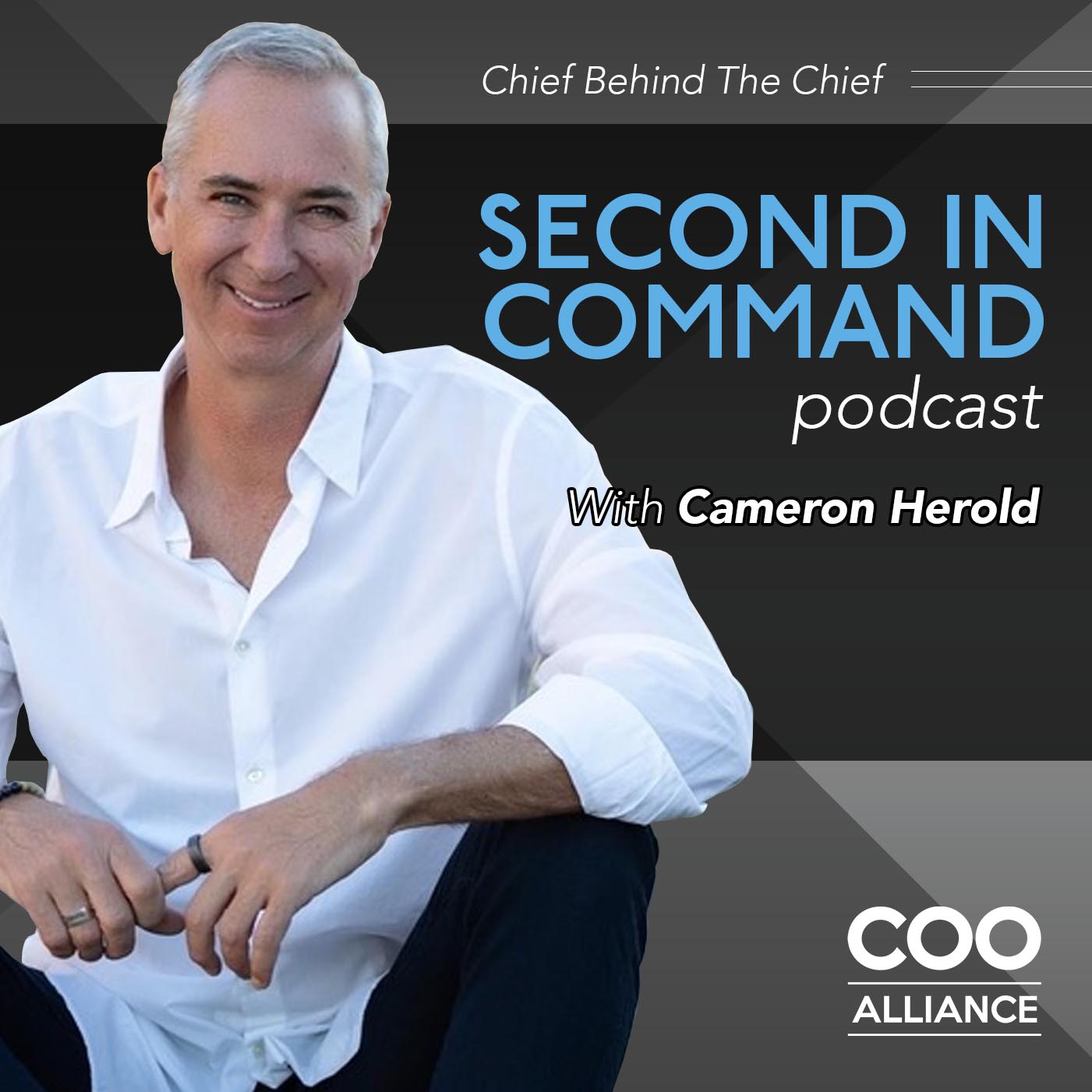
Second in Command: The Chief Behind the Chief with Cameron Herold
Ep. 453 - Scaling Management Consulting Group Founder & CEO, Susan Goebel
00:23:25
Loading summary
Transcript62 lines
- [00:00]
Cameron Herold
Hey, it's Cameron Herald, the host of the Second in Command podcast. Before we dive in, there's something you need to know. If you're a coo, VP Operations, or you're in any role where you're the second in command to the CEO, the COO alliance is the place for you. If you're the integrator to the visionary, you're going to want to join us. The COO alliance is the world's leading community for the second in command. We've had over 500 members like you join from 17 countries to grow their skills, connections and confidence. You'll get the tools, friendships, and a 10x guarantee to ensure that you get your money's worth. Go to cooalliance.com to learn more and see if you qualify. You can even book a free call with our team to ask questions. Now, let's jump into this week's episode.
- [00:44]
Susan Goble
I find that usually the owner is at the point where they are spending more and more time in the business. They're starting to get disengaged. Why is it always me fighting this fire? Why can't I have anybody else on the team? How come those seemed like there was more money spent this month than what we expected? These little things that they wind up saying that just uncover that there is something wrong in this system as they're growing. I've got more leads coming in, but why am I still working 60 hours? This is insane. I thought I hired somebody. Welcome to the Second in Command podcast produced by the COO alliance and brought to you by its founder, Cameron Herold. In the Second In Command podcast, we Talk to top COOs who share the insights, strategies and tactics that made them the chief behind the chief. And now here's your host, former COO of Closers I.O. and alumni member of the COO Alliance, Savannah Brewer.
- [01:47]
Cameron Herold
Hey, Susan, thanks very much for doing this. I really appreciate it.
- [01:51]
Susan Goble
Cameron, thank you so much for the invite. This is amazing.
- [01:54]
Cameron Herold
Yeah, I'm looking forward to having you talk to us and walk us through what your business does and why you're a partner of the COO Alliance. You, with your business Scaling Management Consulting group, run a fractional COO business. So that is a huge need. And in fact, I actually started my business 17 years ago as a fractional COO, way before I think the whole fractional thing had even started. My company was originally called the Back Pocket COO because I was kind of in your back pocket and you could pull me out when you needed me. So walk us through what a fractional CEO business and what you know, what does the scale scaling management consulting group do? And we'll start from there.
- [02:36]
Susan Goble
Well, great question. And yes, being fractional, that's just a term and I love back pocket CEO because that is exactly what we are. We are there as fractional CEOs your second in command. I know that's a term your audience knows well, that can truly assist in the strategy, the assistance with the people management, the day to day tasks, all that chaos and operational inefficiency that happens with growing and scaling companies, people process profitability. And so all of our bench of fractional COOs, they are individuals who have at least a couple decades worth of experience in wherever they are. And we don't necessarily match by industry because sometimes you need to match for the problem more than you do the industry, no matter what the CEO says, says and you need to fix that. We're also not your forever people. We are the people to get you from point A to point B successfully so that you can continue to grow and scale.
- [03:34]
Cameron Herold
And let me guess that point A to point B, there's two main scenarios, point A to point B. Scenario one is problem to solution, everything's working, problem goes away. Scenario two is you have a fairly junior team or a mid level team that isn't really seasoned and you can't afford a true CEO. You can't afford a $350,000 real true, someone who comes in with P and L responsibility, strategic insight, autonomy, can tell the CEO what needs to happen and they'll help you get there by kind of coaching and growing your team and being in the business with you. And then once they've helped you grow the team, they can remove themselves. Would that be scenario number two?
- [04:16]
Susan Goble
That would absolutely be scenario one and two. You've got a problem, you need somebody with a specific expertise in order to get you from. I have this issue and I need to solve it. Which oftentimes in the conversation I find it's always interesting because when I'm talking to people, they haven't always done the whys, they haven't really done the root cause analysis. Right, right. They come in, they think they have this problem, but it's actually a slightly different problem. Or there's other things that the CEO needs to do because they have the expertise to be able to fill that gap.
- [04:46]
Cameron Herold
Yeah, they do have the problem, but they've got, they've got an underlying root problem that maybe is causing seven issues. Right. Or is the root cause.
- [04:54]
Susan Goble
Well, exactly. And so you can't just Go in and solve for the one thing that's a symptom, right? Yes, we can solve for that. We can make that go away. And two months later, you're going to have a slightly different symptom of the same problem that we didn't solve initially. And so we have to solve that route.
- [05:09]
Cameron Herold
And you try to explain that to the CEO before you get there. Is that something that sometimes, I mean, if you see it, or is it something that often happens as you get deeper into the business and understanding, you start to uncover everything else that's there? It's like, my kid has a cold, my kid's sick a lot. Oh, shit. You actually have black mold in your house. Like you didn't know when the kid's in the office. Right. Is that kind of what happens, or is it a bit of both?
- [05:33]
Susan Goble
Yeah, sometimes on the calls where we're, you know, we're doing the deep dive and we're having the conversation, understand the business, I can see it. I can say, look, I already know that this is the thing that you're talking about. But the actual root cause is that, however, half the cases aren't like that. The CEO thinks they've got a pretty good understanding and they've got probably 80% of it. But when you dive in and you're talking to other layers and other perspectives in the business, you're like, oh, wait a minute, there's a different piece that we didn't know about and we have to solve for. And so then you can go in and make sure that that is taken care of so that your problem comes away completely and it doesn't come back in that form at all ever.
- [06:11]
Cameron Herold
That's interesting. I was sitting with a CEO today of two companies in Dubai, and we were sitting, having lunch, and 90 minutes later, I was able to very quickly give her 10 or 15 things to focus on over the next quarter that she didn't even see coming. And it was because you can kind of see the forest for the trees. Right? We've been around this long enough. We've seen all these issues before. How do you help the CEO and the company prioritize all of the potential opportunities? Right. You come into a company for the one big problem, you notice there's seven other ones, you notice there's like a complex problem, and then all of a sudden you have a grid of, like, projects amongst different areas, communication, people, strategy, financial, et cetera. How do you help them prioritize all of that so that you don't turn this into a big Hairy mess.
- [06:57]
Susan Goble
What an interesting way to put it. A big hairy mess. You know, it's interesting because when you walk in and you have those 15 things that you were talking about with that CEO, I bet you in your head, though, you said, yeah, but you really need to solve one and two, because you've been there and you've done that. And so we've done the same thing. There is a matrix of criteria that you're looking at, okay, well, is this a road bump where, you know, this is a little rocky right now, but if you don't solve for this problem, the company's not going to be there. You know, there are big issues that have to be taken care of, and sometimes that's not the thing that the CEO has as their sweet spot. So they have blinders onto that, you.
- [07:34]
Cameron Herold
Know, and it's interesting. The kind of one big hairy thing that I saw was so obvious. But is there a typical starting point? I won't tell you what mine is, but I will after you. I get your answer. Is there a typical starting point that you look to solve problems first? If you've got 10 problems without tell it saying which the 10 are, which of the 10 do you try to solve first?
- [07:57]
Susan Goble
Money.
- [07:58]
Cameron Herold
Yeah.
- [07:59]
Susan Goble
Right.
- [08:00]
Cameron Herold
Like more money coming.
- [08:01]
Susan Goble
Because without the money, you're not going to be there.
- [08:03]
Cameron Herold
Yeah, More. More money coming in, more gross margin and less money being wasted, right? Yeah, correct. Because.
- [08:09]
Susan Goble
Because there's not a day the profitability and the business model are critical.
- [08:14]
Cameron Herold
Yeah.
- [08:14]
Susan Goble
And as you grow, that can shift and change. And. And I know I've seen it with a number of companies. Sorry, I didn't mean to talk over you there, Cameron. No, this is great that the automation and the AI has disrupted a lot of business models.
- [08:25]
Cameron Herold
Yeah.
- [08:26]
Susan Goble
And so being able to see where you can make best use of different systems and tools and processes to be efficient, to generate more leads to. To help your team and enable them to really be better at what they're doing by using all of those things that are available in the right way.
- [08:43]
Cameron Herold
One of our newest COO alliance members is an AI automation company, and they go into businesses and identify all of the opportunities to leverage AI systems to either augment people, replace people, or make people's lives easier and faster. But it's pretty incredible how quickly they can come in because they see the business from that very different lens. But I've always said there's not a single problem that exists that writing a check can't solve. Right. If you have problems and you have money, the problem goes away. So if you solve the money problems, then you can buy the other solutions. Right. But if you're always focusing on the, I call it the high PITA stuff, the high pain in the ass project, those don't necessarily get you to the results as fast. So, okay, so money first, money first, absolutely.
- [09:28]
Susan Goble
People second.
- [09:30]
Cameron Herold
When a company is looking to bring in a fractional coo, my guess is that they might have a COO in place, but that person's not really a coo, are they? They're more like a director with a big title.
- [09:44]
Susan Goble
I've actually seen an EA given a COO title.
- [09:47]
Cameron Herold
Yeah, yeah, it's crazy. Like there's been a lot of title inflation. 30 years ago to have a C level title you had to a major player at a major company and then the bank started giving away vice president titles. And then with the advent of the email, because we had signatures and we could start using it as marketing the title. I think that's where title inflation started to come from. So how do you tell an entrepreneurial company, hey, I know you've got a coo, but we're coming in as a fractional coo. Do you try to get them to retitle people or do you, is it okay with the people that they've got? Like, how do you deal with that or even worry?
- [10:19]
Susan Goble
Yeah, we usually don't worry about the fact that they've got a specific title. You know, you can lead really well in an organization without a title as long as you have the buy in that you need. And so we're there to support. We are not the forever people. And so if you have somebody who you think and yes, you've given them the name coo, that's great. But ultimately there may be a director of operations or an operations manager, but you see the potential in them. There is a way to grow those leader. You have a great program, for example, to cover being able to grow those leaders and give them the skill sets. We are there then to support them. But more importantly, we're also there to be and I love in the back pocket. That's a great way to put it. You know, the ability of an owner and a CEO and the other C suite folks that are usually there, sometimes a fractional cfo, for example, which is a great person to have on the team, they need the strategic ability to see at the 30,000 foot level and to have that person, they can say, hey listen, I've got this thing, I need to talk it out. Because that ability to communicate and see other Perspective from people who have been there and done that is critical.
- [11:26]
Cameron Herold
It's interesting. I think the first fractional kind of role I ever heard about was 24 years ago in October of 2000, and it was kind of a fractional. Hey, it's Cameron. I hope you're loving today's episode. Quick question for you. Does your company have a strong leadership training program in place to grow the skills of everyone who manages people? If you want to help yourself and your company grow, get everyone who manages people learning from my invest in your leaders online training program. There are 12 core leadership skills that I cover online and for only 650 per person, they're all going to really grow. CEOs pay me $78,000 a year to coach them one on one. And now you can all benefit for 1% of what they pay me. These are the same leadership skills that I created and certified everyone in at 1-800-got junk when I was there as CEO. Go to investinyourleaders.com today and use promo code podcast10 before the end of the month to get 10% off each manager you sign up. Now back to the show actional technology officer, someone who could come in and help you set up WI fi and set up Internet and put software in place because companies didn't understand all that stuff. And there were these companies that would come in and kind of do that for you. And then I think it became the fractional cmo, like a kind of marketing expert to come in. But I think now you're right. It's the fractional cfo, the fractional COO and the fractional CMO are really kind of the three critical ones. Right. It's almost irresponsible. Where does the company make a mistake when they're looking to bring in a company like you?
- [13:09]
Susan Goble
Well, first they say you must have industry experience.
- [13:12]
Cameron Herold
Right?
- [13:13]
Susan Goble
Industry experience is absolutely important. I mean, I'm not going to say it's not. And if you're looking to solve that transition, that change agent piece to get you from A to B, it's less important for the CEO role if you have the experience around you for, for the industry specifics, because the business problems are what you're looking for the CEO to solve. The second thing I find, and I'm just, I was just dealing with this with a, with a client and they're looking for a unicorn. Oh, I've got these 100 things and you must fit all 100 of them.
- [13:41]
Cameron Herold
Right?
- [13:42]
Susan Goble
You're never going to have that happen. Oh, by the way, and this is my favorite one out of this particular incident was, oh, by the way, they even have the profile of the, the tool that I like. Oh, except this one is just a hair off. But they've got the industry experience, they've got the depth of knowledge, they've got a proven track record. They see the problems that you have coming, but this is just a hair off. So no.
- [14:05]
Cameron Herold
It's interesting in all of the CEOs that I've coached, like really deep coaching over the last 17 years and I've, I've directly coached about 170 companies, typically in the 5 million to $50 million zone is the group that I work with. I don't think, in any case, have I ever had any industry experience whatsoever. Even when I was coaching the CEO and the COO for Sprint, I've never worked for a cell phone company. I don't know anything about cell phone companies. I had no business coaching the CEO of the 80th largest company in the United States. Except he really wanted some entrepreneurial wisdom brought in and he wanted someone who could see it from a very different lens. So does that actually help you when you don't have industry experience?
- [14:43]
Susan Goble
Do you think it does? It very much does because you can use different models that people who have just been brought up in the one vertical, they won't see and they won't see the application of, oh, I can use this hub and spoke mechanism over here. It's totally a applicable to what this client needs over there. So it's really good to have that different perspective.
- [15:03]
Cameron Herold
Now you guys are, your pricing is kind of value based, right? It's like the person who walks in and walks around the machine for 30 minutes and then hits the machine once with the hammer and charges $1,000 and the CEO goes, wait, you hit the machine once and charging me $1,000. He goes, yeah, I charged you $5 to hit the machine and $995 to know where to hit it. Is it a bit of that approach that some of the things that you're moving inside of a company are because of that wisdom and the time and you're able to really. It's like a, what is it? Small hinges move big doors? You know, you can make a few small moves that make big roi. Does that help companies understand the ROI of bringing you in?
- [15:44]
Susan Goble
People do have a hard time understanding that. And so let's look at it this perspective. Yeah, if we come in and we are maybe a day, a week at $10,000 a month, okay, what can we do with that time that we're giving you with the experience and expertise. Well, sometimes we can go in and we deal with the financial pieces first. So now you are operationally, you have a better profit margin, you have more money at the bottom line, which means you have more money to spend on solving other problems in other areas. Your ROI is pretty immediate there. When I say immediate, I don't mean the first week that somebody comes in. That's not a reasonable expectation of a fractional first 90 days. Yeah. Ultimately solving those headaches where you are if you have the wrong hire, as an example, because this is a nice soft one to touch if you have the wrong person in the seat and they are the wrong person for your company and your culture and your core values. The amount of cost and effort that it takes, you and your team as distraction is huge. But people don't look at it in terms of money on the bottom line like they do. I paid this, this bill, this invoice, this.
- [16:45]
Cameron Herold
You know, there's a data point by the group Top Grading, Brad Smart's book Top Grading, and his son Jeff wrote the book who. And they have a data point around the wrong person, and they said that it costs 15 times their annual salary in terms of problems, mistakes, opportunity cost, negativity, the cultural cancers, missed results, the fact that you spend all this time with the wrong person instead of your strong people. So if you're spending $150,000 on somebody, it's actually costing you $2.2 million because of all the mistakes if they're the wrong person. So, yeah, identifying that wrong person is a big one for sure. How do you help companies to wrap their head around? And by the way, what's a typical engagement cost with your brand and with the people that you put in? I know they've got like 20 years experience, which is why, you know, your company is a partner for the CEO alliance. Why? What's the typical engagement cost? And then what's the typical value that a company gets out of that? Over a year.
- [17:41]
Susan Goble
So typically, people will come in and we do serve mostly that five to $30 million range. We'll do above and below of as needed, $10,000 a month for a day, a week. That's our typical cost. We do do hourly blocks and whatnot, but again, we'll just use the $10,000 price point they come in and they're going to save. We find on average, there's one or two people who are the wrong hires. So there's your money right off the Bat. If you're in the first 90 days, you can take. Take that out. We go in and we also set up things like forecasts and cash flow so you can see the bumps coming in the road. And one of the big things that 99% of the organizations we go into, I find, always have as a key piece to look at tech stacks and invoices. 60% of the companies aren't invoicing for all of the things they're supposed to be invoicing for.
- [18:31]
Cameron Herold
Wow.
- [18:32]
Susan Goble
And no follow up. That's a massive one. And the other one is the tech stack. I actually had a company, we went in, we were helping. They had 700 items on their tech stack because the owner kept going and buying, but then never canceling.
- [18:46]
Cameron Herold
Oh, my gosh.
- [18:47]
Susan Goble
Just very excited about all these new tools. You're like, wow. You know, one of these that we did, one of the very first ones, it was $40,000 a month recurring that we saved them.
- [18:55]
Cameron Herold
Whoa. That's insanity.
- [18:57]
Susan Goble
It is, yeah.
- [18:58]
Cameron Herold
I'm the opposite. I'm the guy who goes through, like, my Apple, you know, subscriptions every month or two and cancels them all. And I heard of a. I heard a great entrepreneurial hack one time. It's that what you need to do every couple of years is, is cancel all of your credit cards, say they were stolen, get them all reissued so that the. And make sure that the accounts don't transfer over for auto billing so that you have to automatically or one by one, reset everything up to go through that painful process of like, do I really need this? Like, there's a lot of money that gets wasted in these companies.
- [19:31]
Susan Goble
Yeah.
- [19:32]
Cameron Herold
Okay. How does a company properly decide when to bring in a fractional coo? They're thinking of looking for one. They might have some pain points. How do they know it's time?
- [19:41]
Susan Goble
I find that usually the owner is at the point where they are spending more and more time in the business. They're starting to get disengaged. Why is it always me fighting this fire? Why can't I have anybody else on the team? How come those seemed like there was more money spent this month than what we expected? These little things that they wind up saying that just uncover that there is something wrong in the system. As they're growing, I've got more leads coming in, but why am I still working 60 hours? This is insane. I thought I hired somebody interesting, but they didn't. They didn't hire the right person or. You know what happens when. When a company grows and scales Quickly. You know, I brought on Susie, Sally and Joey because I knew them and bumped into them in the grocery store. It looked like they had the right skill set. Yeah, you know, but they did.
- [20:28]
Cameron Herold
It's interesting. The one thing you just pointed out that you actually put in place is things like budgets and cash flow statements. I hadn't thought, thought that a fractional COO would do that. I've always said that that's one of the very first things that a fractional CFO should do. But the reality is, I don't know, 70 or 80% of COOs tend to have finance reporting up into them. So that's interesting that that is a really big thing that you bring in. So they're really getting two birds for one stone there. Whereas if they bring in a fractional cfo, they're not going to be able to deal with all the rest of the operations in a business. But if they bring in a fractional coo, they are going to be able to do some of those very critical, almost like the base of the pyramid or foundation of the home things. Budgets and cash flow are critical. And then looking across the general ledger at all the expenses and waste, that's pretty important too.
- [21:17]
Susan Goble
Well, I think that's one of the unique things about how we approach it. We are a team based environment and so it's not a good idea to look at us in an organization like us as an executive recruiter. That's not where we are. We've already done the vetting. We already know who they are, we already know how to pair properly to solve the problems. And so when they, when you get the CEO from us, they are the face front and they are absolutely the person who's going to be in your business. But behind them you have myself, you have my CEO. And we have a couple of times a month we all meet together and we talk about the files. Who needs this? What's the challenge with that? What are we seeing over here? Their industry trends that we need to be aware of all of these different pieces to make it better in value for the client and get them where they need to go.
- [22:04]
Cameron Herold
That makes sense. All right, any final points you want us to know about? If somebody's thinking of a fractional CEO or thinking of comparing your firm to another, what's kind of one final thought you want to leave everyone with?
- [22:15]
Susan Goble
Just reach out and ask the questions. Don't think you're too small. Don't think the problem isn't right. Don't think that we can't solve it. But come in with an open mind, because sometimes the challenge that you think you have isn't actually the challenge you have.
- [22:28]
Cameron Herold
And if anyone would like an introduction, just drop me a note. I'll introduce you to Susan directly Again. Susan Goble is the founder of the Scaling Management Consulting Group. They're a partner of the COO alliance, have been for a couple of years. Happy to do those intros. Susan, thanks very much for sharing with us. Really appreciative of your time.
- [22:43]
Susan Goble
Cameron, thank you. It was a joy to chat today.
- [22:45]
Cameron Herold
Appreciate it.
- [22:49]
Susan Goble
You've been listening to Second in Command, brought to you by COO alliance founder Cameron Herald. If you enjoyed this episode, please be sure to like, share and subscribe to us on Apple Podcasts, Spotify and their other podcast streaming platforms. For more best practices from industry leading COOs, visit COOAlliance.com.