← Second in Command: The Chief Behind the Chief with Cameron Herold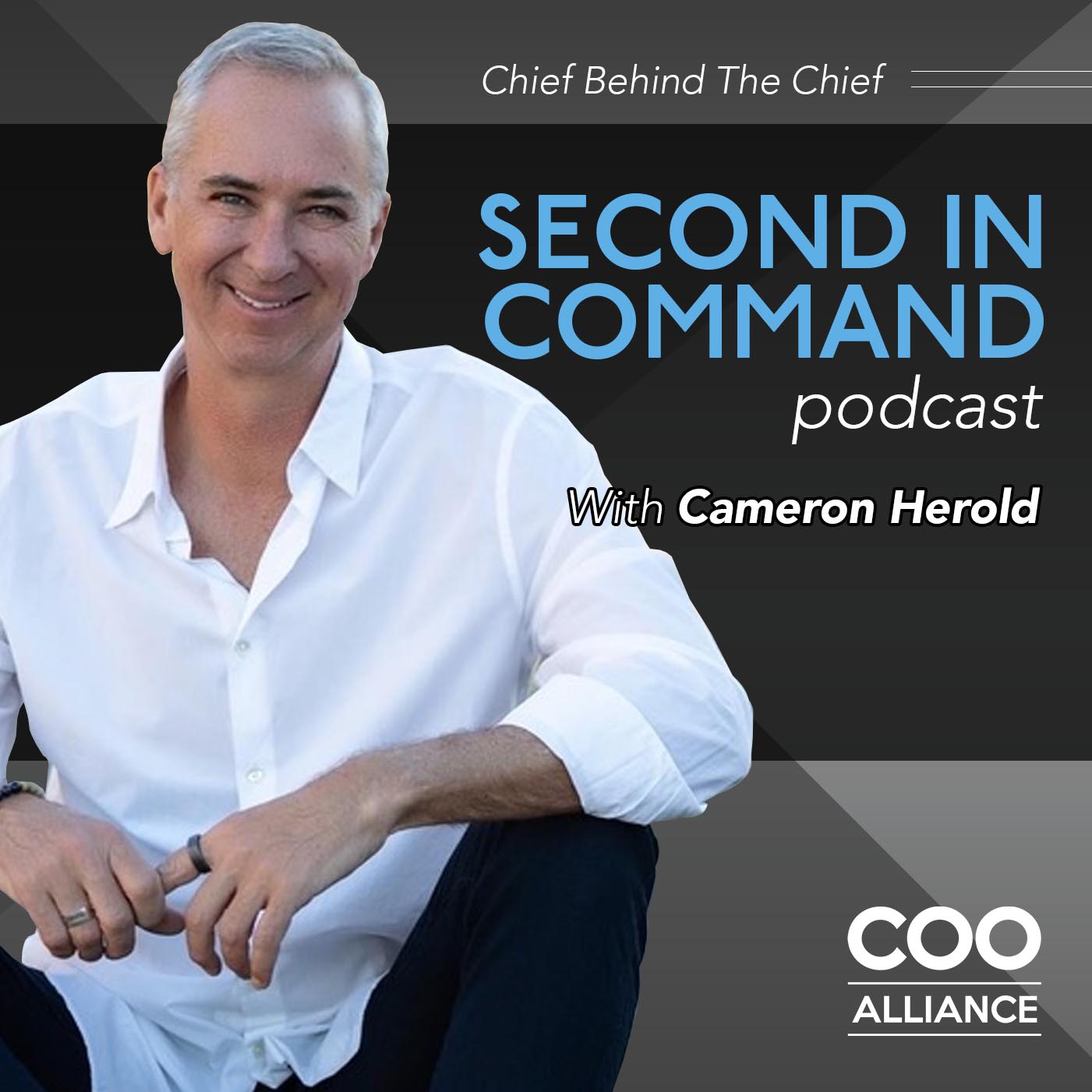
Second in Command: The Chief Behind the Chief with Cameron Herold
Ep. 469 - Navigating the COO Landscape: Leadership in a Changing World
00:13:39
Loading summary
Transcript13 lines
- [00:00]
Cameron Herold
Hey, it's Cameron Herald, the host of the Second in Command podcast. Before we dive in, there's something you need to know. If you're a coo, VP Operations, or you're in any role where you're the second in command to the CEO, the COO alliance is the place for you. If you're the integrator to the visionary, you're going to want to join us. The COO alliance is the world's leading community for the second in command. We've had over 500 members like you join from 17 countries to grow their skills, connections and confidence. You'll get the tools, friendships, and a 10x guarantee to ensure that you get your money's worth. Go to cooalliance.com to learn more and see if you qualify. You can even book a free call with our team to ask questions. Now, let's jump into this week's episode.
- [00:44]
Savannah Brewer
Something that really impacted me in a negative way growing up was being told by the school system that I wasn't trying hard enough, when in fact I was trying hard. But the system itself was kind of boring and I was in a distracting environment. So trying harder wasn't necessarily the fix for me. And the fact that I was being told that I was stupid probably impacted me more negatively. It hurt my confidence, hurt my ability to then focus, hurt my desire to study more than focusing might have actually helped me.
- [01:20]
Cameron Herold
Welcome to the Second in Command podcast, produced by the COO alliance and brought to you by its founders, Cameron Herold. In the second in command podcast, we talk to top COOs who share the insights, strategies and tactics that made them the chief behind the chief. And now here's your co host, former COO of a multi eight figure remote company and alumni member of the COO Alliance, Savannah Brewer.
- [01:49]
Savannah Brewer
Hi, I'm Cameron Herold. I have Attention Deficit disorder. In fact, I have 17 of the 18 signs of ADD clinically diagnosed. It was around 10 years ago. I was being nominated or was nominated for an award with the International Dyslexia association for someone who's overcome intense learning disabilities and done really well in their career. So I was diagnosed with attention deficit disorder and also a form of dyslexia called dyscalcia, where I transpose and flip all of my numbers. And then I have been not clinically diagnosed, but diagnosed by a physician as having or being on the spectrum for bipolar disorder. So let me talk to you about Attention Deficit Disorder and why ADD is not actually a disorder. Why it's a superpower for anybody who is an Entrepreneur. So I grew up as an entrepreneur and grew up in an entrepreneurial family and I was always distracted. I can remember going back all the way back to grade two where sitting in a classroom, there was just a million other things for me to be thinking about. Just to sit and listen to the teacher was really hard. When there were 30 other kids in the classroom. I was actually in Winnipeg, Canada, and we were in an open office kind of concept classroom, I guess, where our class was beside another class beside another class. And there were no walls, so I could see all these other kids all the way down the edge of the school. There was stuff up on the walls of the classroom, there were bookshelves. There were just a lot of things to be thinking about. So I knew at a very early days that I couldn't focus and that there were lots of things that I was noticing. But the fact that I was noticing them all was also pretty intriguing to me. So at a young age I knew that I was different. Now I think one of the things that I kind of learned at that very early stage was not only was I noticing all of these things, but if I focused, I could focus in kind of very finite periods of time. So I now call it hdadd, which I kind of joked as high definition Attention Deficit Disorder that I can't focus, but when I do it's really crystal clear. But I do it for very small chunks amount of time. Like I can focus for 15 or 20 minutes and then it's like my brain needs to relax, I need a break, maybe I need to move around. In fact, this is the third, no, this is the fourth spot that I've sat in doing work today. And it's only 3:00 in the afternoon. So I've already moved around because I need new stimulus. I need new things to look at, they need new distractions to highly focus me. Another thing that I've learned with my Attention Deficit disorder is that when I have a lot of other stuff around me, a lot of kind of ambient noise, maybe people walking around, maybe a coffee shop is a good example, I tend to actually be able to quite highly focus. And it's because there is so much other stuff going on that it forces me to focus. And then I get very kind of into that zone. But I've been in kind of like a beige room or a boardroom where there's not enough distraction. Then my mind finds those other distractions. I don't know if that makes sense to somebody who maybe doesn't have add, but I know those who do have ADD will appreciate it. One of the big things I noticed as an entrepreneur is it's not really a disorder to have ADD if you're the entrepreneur. Because I don't want to be super focused for 40 hours of the week. I need to see what's happening with the market and my customer and the economy. I need to see what's happening in the room and with my employees and the feelings. I need to be able to notice stuff on the website and with our marketing material and with the numbers and the dashboards that we look at. I kind of need to be hyper aware of everything. But because I'm seeing it all, because I'm noticing it all, because I'm seeing opportunities and problems and strengths and weaknesses and I get kind of that bigger picture and I see all those details, it can be a little bit overwhelming. So what I become very good at is taking all those overwhelming lots of things that I see and delegating them to other people as projects to fix, opportunities to work on things, to take a look at, questions to answer for me because it's kind of overwhelming in my brain to see them all. So I've had to notice that noticing is actually a superpower for me. Something that really impacted me in a negative way growing up was being told by the school system that I wasn't trying hard enough, when in fact I was trying hard. But the system itself was kind of boring and I was in a distracting environment. So trying harder wasn't necessarily the fix for me. And the fact that I was being told that I was stupid probably impacted me more negatively. It hurt my confidence, hurt my ability to then focus, hurt my desire to study more than focusing might have actually helped me. So I think while the teachers or trying to say focus more, you'll do better and you're not focusing, you're not trying, you're getting a C minus or a 65% on your test. That kind of routinely beat me up and hurt my self confidence, which really gave them the exact opposite of what they were trying to do. The kind of net effect was I got worse at school and tried less in school because I realized that I wasn't ever going to be as smart as the person who was getting the 98%. However, because I wasn't the person getting Yes, I have a group coaching program for CEOs.
- [07:00]
Cameron Herold
And the beauty of my group coaching.
- [07:02]
Savannah Brewer
Calls is you actually get to ask me questions on every call.
- [07:05]
Cameron Herold
You're not just listening to other CEOs. Drop me an email cameronameronherald.com for more information.
- [07:13]
Savannah Brewer
In the 98%, I noticed all the other opportunities and I was selling things or starting little businesses or building successful companies, which I've done up till today. So people with attention deficit disorder can often be very bad at time management. And it's not so much that they're bad at time management as they are bad at priority management. So they have lots of stuff to do, but they get distracted by the big shiny object, by that next thing, by the thing that excites them or energizes them. So what I tend to do is make lists. In fact, when I find myself getting very overwhelmed with all these ideas floating around, maybe it's stuff with the business, stuff with my health, stuff with my marriage, stuff with my kids, stuff with general life, and I'm overwhelmed with all the things I have to do. I write lists and every time I get all the stuff out of my head and just even onto paper, it allows me to breathe. Then I can sit back and take a look at all those lists and decide who can I delegate those to? Which ones do I need to do, in what order? And it's that simple. Kind of, I guess, priority management that's more important than task management. So it's a bit of a subtlety there, but it's around managing priorities that I tend to be quite good at. Something else that people with attention Deficit disorder tend to do is we tend to leave things to the last minute. Now, we're not doing it on purpose, we're not procrastinating. But it's because we notice all these other opportunities that we get distracted. So things end up getting pushed to the last minute because we're distracted with all the other stuff. So we're not trying to procrastinate, we're not being lazy. We're probably doing more than we even should be doing. But things get pushed off because of the distraction of all the other stuff. So it's the balance, I think, of delegation and priority management that allows us to get stuff done. And then we tend to work very well under pressure because we know that now we're under that time constraint. Kind of like Parkinson's law says that work expands to fill the space that we give it. But when you have attention Deficit disorder and stuff ends up getting pushed to the end because of the distraction, that timeline compressing on you does force you back into that HD add, right? You get super hyper focused for that 15 or 20 minutes to get to completion. If I was going to talk to an employee who has ADD and you're in an entrepreneurial environment or in a business role that doesn't require you to be super highly focused. Right. If you're in a role that requires super high focus all the time, you probably should switch roles. Let's say that you're in a good role for you, you're okay with working in that ADD kind of environment. I would start with changing your environment a couple of times a day. So you sit in different areas, sit in a coffee shop, work from home, change locations in your business, sit out on the floor, sit in a boardroom, sit in a meeting room, move to different business areas to work to allow your mind to kind of free itself up. You'll often find that if you're working in the same place all the time, you will tend to drift a little bit. So that would be number one. Number two is making lists. So make all inclusive lists of all the stuff you need to work on. Prioritize them into A's and B's. So what are all the things you need to do and which are the A priorities? Which are the B priorities? And then number The A priorities 1 through 7 or 1 through 12, whatever it is, try to number the B priorities the same.
- [10:21]
Cameron Herold
If you're the COO or second command.
- [10:23]
Savannah Brewer
To the CEO of a company doing.
- [10:25]
Cameron Herold
Minimum 2 million in revenue, come check us out@cooalliance.com and welcome home.
- [10:33]
Savannah Brewer
And then start working on the priorities in the number that they're in. So it's that priority management will allow your mind to focus on those critical few things. And then a third tip is to use the Pomodoro technique where you work in bursts of 20 to 25 minutes. And then naturally as an alarm goes off, it allows you to take a five minute break, give your brain a rest, maybe change locations, maybe do a quick little bit of exercise, and then come back in and hyperfocus again for 20 or 25 minutes. Even me right now filming videos. I couldn't do this for eight hours a day, but I can find three or four videos that I can film quickly. Film those over a period of a half an hour to an hour. Then I'll shut things down, I'll change locations, and I'll work on something completely different. The big stigma that needs to be changed is that attention deficit disorder is not actually a disorder, it's not a disease. We're just not like the medical community and we're not like the teaching community. So people with addiction maybe don't fit into that. Small box. But you also don't find a lot of teachers and a lot of doctors who become great at being entrepreneurs because they're so hyper focused and they're so linear, they miss everything else around them. So it's not a disorder unless you want to be a teacher or a doctor. And we need to break that stigma. Because the real problem is when you tell someone who is highly functioning and thinks different from you that they have a problem, you're actually hurting that person's confidence more than their skill set would ever be a deficiency. And then I think the last thing to remember around attention deficit disorder is our own self confidence. Right? No one's actually going to build up your confidence the way you do. So if I go back and look at my business career, all the businesses that I've built, all the speaking events that I've done, the books that I've written, the amount of money that I've been able to make, it slowly starts to internalize that. Actually I am quite smart. I just see the world differently and perceive things differently than the teachers do. So my self confidence over the years has really, really grown and I've been able to shed the confidence or lack of confidence that the school system actually gave me. I even hold my university transcript on my phone to show people that I'm not as smart as they think I am and I'm not necessarily wired the way that people are told they have to be wired. So hopefully those ideas help you. If you like this idea, definitely want to click below and subscribe. We've got a lot more content that we can share with you and share this video as well. I think we need to get people to understand that attention deficit is not a disorder at all. It can actually be a superpower for those who are in the business world.
- [13:03]
Cameron Herold
You've been listening to Second in Command, brought to you by COO Alliance Founder Cameron Herold. If you enjoyed this episode, please be sure to like, share and subscribe to us on Apple Podcasts, Spotify and our other podcast stream streaming platforms. For more best practices from industry leading COOs, visit COOAlliance.com.