← Second in Command: The Chief Behind the Chief with Cameron Herold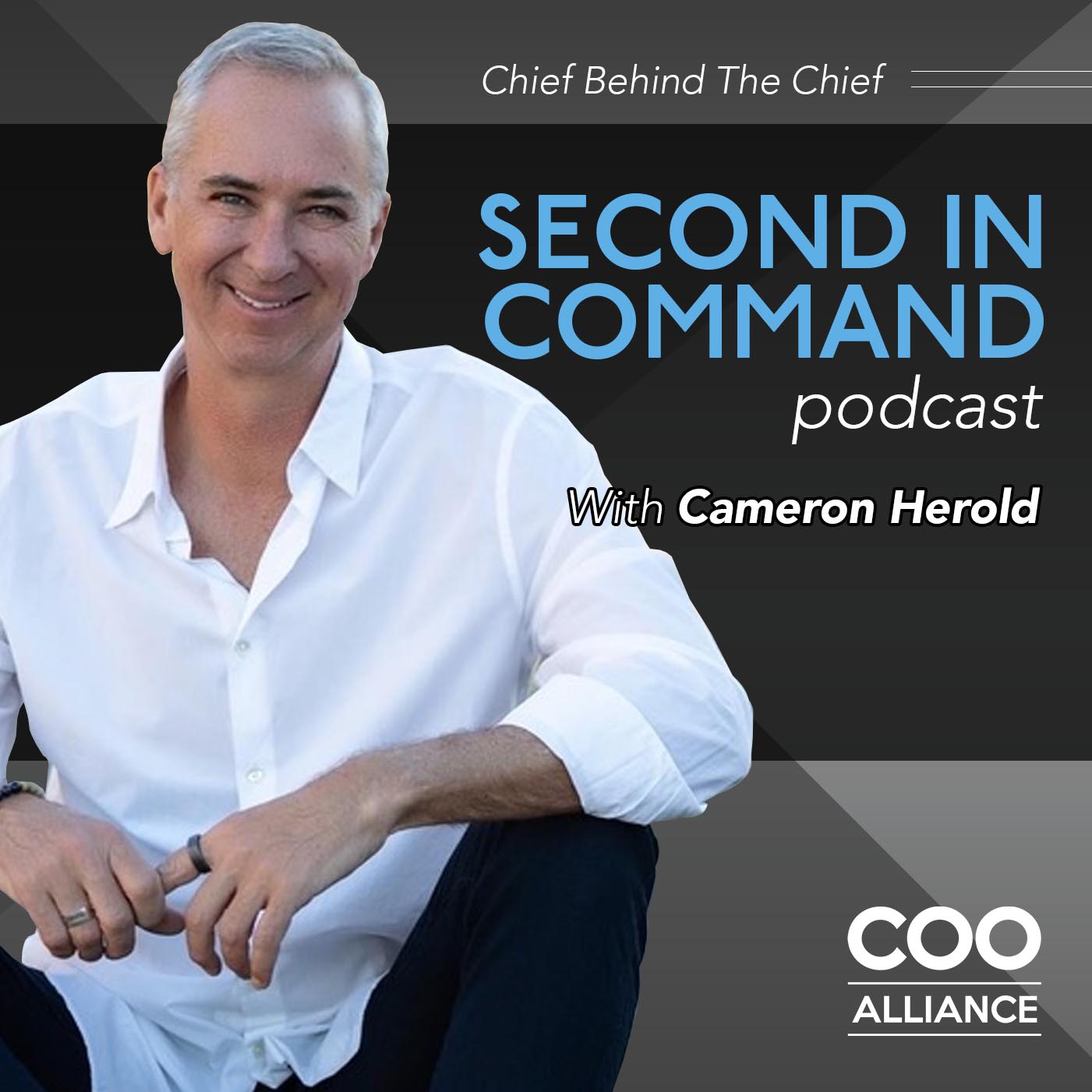
Second in Command: The Chief Behind the Chief with Cameron Herold
Ep. 475 - Secrets to CEO-COO Harmony That Skyrocket Business Success
00:26:31
Loading summary
Transcript195 lines
- [00:00]
Cameron Herold
Hey, it's Cameron Herald, the host of the Second in Command podcast. Before we dive in, there's something you need to know. If you're a coo, VP Operations, or you're in any role where you're the second in command to the CEO, the COO alliance is the place for you. If you're the integrator to the visionary, you're going to want to join us. The COO alliance is the world's leading community for the Second in Command. We've had over 500 members like you join from 17 countries to grow their skills, connections and confidence. You'll get the tools, friendships, and a 10x guarantee to ensure that you get your money's worth. Go to cooalliance.com to learn more and see if you qualify. You can even book a free call with our team to ask questions. Now, let's jump into this week's episode.
- [00:50]
Narrator
Welcome to the Second in Command podcast, produced by the COO alliance and brought to you by its founder, Cameron Herold. On the second in command podcast, we talk to top COOs who share the insights, strategies and tactics that made them the chief behind the chief. And now, here's your host, Cameron Herold.
- [01:14]
Unknown Speaker
Okay, on today's episode, we're going to talk about working together with your coo. Almost like building that business marriage, right? If you're in a traditional marriage, husband and wife, there's a really great tips that you can learn about working together with your spouse. It's almost like the book Men are from Mars, Women are from Venus. We're going to talk about the business versions of that. Men are from Mars, Women are from Venus. And how do you work together as that CEO? CEO relationship. How does the CEO make the CEO look good? And how does the CEO make the CEO look good? What kinds of roles and responsibilities should you split up? How do you organize your meeting rhythms and stay in tight communication with each other and stay on the same page?
- [01:53]
How do you.
- [01:53]
How do you ensure that your COO is on page with the vision and the culture and the strategy that the CEO wants executed? And how do you make sure the CEO stays on the same page with the plans that the COO is going to be executing on? We'll see you on the inside. Lots of great information for you and this part of our book or book content from the second in command, we'll see you on the inside.
- [02:18]
You've done the work. You've figured out the kind of COO you need. You've gone through a recruitment and interviewing process that has led you to the right person and you've onboarded them into your organization. Now there's one more part of the process you still have to figure out. How will you and your new second.
- [02:33]
In command work best together to achieve.
- [02:35]
Everything you want for your company? The key is to take an intentional approach, so start by revisiting all the information you've gathered during the interview process about what the COO is like. Use that information to start building healthy communication and strong trust from the beginning, which is particularly important if other members of the leadership team feel they've lost.
- [02:55]
Power to the coo. Engage in trust exercises so you're both okay with telling the truth all the time.
- [03:02]
Open up to each other about your past failures. Teach each other skills that you're strong in. Walk each other through your colby Disc or StrengthFinder profiles, focusing on your weaknesses. Tell each other about your upbringing.
- [03:16]
Have each team member answer five questions.
- [03:19]
About their personal lives. Sample questions include your hometown, first job, worst job, number of siblings, greatest fear, and something that nobody else knows about you. Everyone, including all C level executives, needs.
- [03:32]
To be on the same page about.
- [03:33]
The different roles and responsibilities of the CEO and coo.
- [03:37]
You can only avoid stepping on each.
- [03:39]
Other'S toes if everyone in the company knows who to contact for what, who.
- [03:43]
Makes which decisions, and who is and isn't involved in different areas.
- [03:47]
There may be areas the COO is responsible for that used to fall under the purview of other executives, so make sure people have familiarity with the new.
- [03:54]
Org chart and chain of command.
- [03:56]
Because the COO role is company specific, everything must be spelled out, including how you measure the COO's success. At the same time, the CEO needs.
- [04:06]
To feel good about their own new role and responsibilities after handing off some of what they used to do.
- [04:11]
Once the COO finishes onboarding, the CEO.
- [04:13]
Will not have all the information on.
- [04:15]
Every subject anymore, so it's important to recognize where your role ends and the COO's begins, as well as when you both need to confer before making a decision.
- [04:24]
Without full clarity and commitment to the.
- [04:26]
New structure, I've seen CEOs start meddling in the COO's responsibilities almost straight away, especially if they're in areas the CEO used to love working on but are a better fit for the coo. This kind of meddling has a negative impact on productivity and damages trust in the relationship. You need to have explicit discussions about.
- [04:44]
Who deals with what.
- [04:46]
You also need to involve your leadership.
- [04:47]
Team so that everyone is on board.
- [04:49]
With the new path forward. The COO won't make all the decisions.
- [04:52]
In a business area from day one.
- [04:54]
A gradual transition will likely allow you to feel comfortable with the new arrangement.
- [04:59]
Maybe you both need to attend certain.
- [05:00]
Meetings or phone calls at first, and then you gradually phase yourself out and.
- [05:04]
Make it clear when employees should no.
- [05:06]
Longer go to you with questions on that topic. If everyone continues coming to you with.
- [05:10]
Questions and you engage, it will inevitably.
- [05:12]
End up minimizing the COO and creating triangulation and miscommunication. Lack of coordination between the two of you will lead to unnecessary complexity and.
- [05:22]
Left hand right hand issues.
- [05:24]
Divide and Conquer look at everything that.
- [05:27]
Needs to get done and decide who.
- [05:29]
Should invest their time and energy in each item, who is the best fit for each type of meeting, the different customer and supplier relationships, and every other business area. You might not hand off everything to the COO at once, but you can.
- [05:41]
Gradually divide the responsibilities over time.
- [05:44]
If you have 12 core suppliers, nine might start reporting to the COO right away, whereas the other three will require more onboarding and opportunity to shift the relationship. That division will depend on your own UA's preferences and bandwidth. Whatever you decide you're looking for clarity regarding what is on each person's plate. Jen Leach, President COO and co Founder of Truss, describes how she and her CEO defined their domains. We each wrote down what accountabilities we.
- [06:11]
Were holding and what we loved and.
- [06:13]
Hated most about our work. Then we looked for patterns. I took the work that required detailed execution example Finance and policy management example People and culture. He took the work that involved developing external relationships and public Persona. Example sales and marketing at 1,800 got junk. Brian had great relationships with the first 12 franchise partners. When I came in as the COO, I said we needed to start encouraging those partners to come to me. We needed to build our relationships and trust and they needed to know that I was capable and that Brian didn't always have the information on what we were doing anymore. We intentionally built a communication path to keep each other on the same page, which also required Brian to trust me. It wasn't always easy, but we worked at it. We needed to act like Navy seals if we ran into a hostile situation.
- [07:02]
We had to trust that each of.
- [07:04]
Us had our own side of the room covered. We couldn't second guess the other person or check to make sure they were doing their job in combat. That kind of distraction gets people killed and in business it loses clients and productivity. Clarity around roles and responsibilities is key to success. Make each other look good the CEO.
- [07:25]
And COO need to act in front of others. Like parents around their kids.
- [07:29]
It's dad's job to make mum look good and vice versa. Parents can fight behind the scenes, but not in front of the kids. The COO's job is to make the CEO iconic. The CEO rolls out the good news.
- [07:41]
The COO rolls out the bad news and owns the tough decisions.
- [07:45]
In turn, it's the CEO's job to.
- [07:47]
Shine the spotlight on the COO internally.
- [07:49]
To explain why they need to make those difficult calls in those kinds of situations.
- [07:54]
The COO needs the full support of the CEO.
- [07:57]
COO alliance member Hunter McMahon of iDiscovery Solutions describes this dynamic with his CEO.
- [08:04]
He's the best visionary I've ever met.
- [08:06]
And a huge leader in our space. I love talking to our colleagues and.
- [08:09]
Clients about times when he was thinking.
- [08:11]
Years ahead of the curve and I've been able to see it come to reality.
- [08:15]
Similarly, I've heard him introduce me and.
- [08:17]
Refer to me by being an expert in our space and in our business, seeing and managing operations like it was a fun creative space.
- [08:25]
Which to me it is.
- [08:26]
We all have flaws and limitations, but highlighting those to anybody doesn't have a net positive impact.
- [08:32]
Instead, focus on strengths and build relationships.
- [08:36]
Eric Church and Roy Disney While I'm talking about making each other look good, I want to share some thoughts from.
- [08:42]
A close friend and Acacia fraternity brother.
- [08:44]
I've known since 1987 who now does my old job at 1-800-got- junk Eric Church. I asked Eric for his thoughts on.
- [08:52]
How a CEO and COO work together.
- [08:55]
What he sent me was so powerful, I asked him if I could put it in the book. Every Magician's Invisible Hand Disney.
- [09:03]
Just two syllables is all it takes to conjure the memory of a man.
- [09:06]
Who'S made hundreds of millions of people smile.
- [09:09]
The world has admired the magical mind.
- [09:11]
Of Walt Disney for nearly a hundred years. I admire his older brother Roy. Walt was clearly the visionary behind the magic, but his brother Roy helped bring.
- [09:21]
Walt's visions into reality.
- [09:24]
Even though Roy Disney was a co founder, it was not Disney Brothers or Disney Enterprises. It was the Walt Disney Company. There can only be one CEO, one iconic visionary, one lightning rod to pull power from the sky. We know it takes every player in the band to make the music come alive. But the public needs a figure to focus on.
- [09:42]
This is why nearly every famous band has an obvious lead singer.
- [09:46]
I'm fortunate to partner with Brian Scudamore, the visionary of our business ote brands. Like Roy Disney, I too am a CO founder, but I never refer to myself that way. I feel strongly that every iconic leader should be elevated and supported by their coo. Never feeling they're in competition with them. Brian and I are famously unified in our vision and the direction of our path forward. But it doesn't always begin that way. In private, we arm wrestle. In public, we're aligned. A COO should be the implementer of the CEO's vision. This requires the COO to have the ego strength to judge himself or herself only by the achievement of outstanding results without any need for public credit or affirmation.
- [10:27]
There can only be one Winston Churchill, one Steve Jobs, and one Elon Musk.
- [10:33]
Even though each of these men was supported by people who implemented their vision and brought their music to life. When I've worked for weaker CEOs, I've had to step into the CEO role. Although I did a reasonably good job, I found it to be exhausting to do the job of the CEO.
- [10:47]
I had to contort myself out of.
- [10:49]
My natural shape to such a degree that I finally concluded it wasn't sustainable or healthy. When Brian approached me to be his coo, we created a list of our strengths and weaknesses and we found that we were a perfect fit. He is strong where I am weak. I am strong where he is weak. We are two sides of one coin. This serves our company as we approach every challenge from a different perspective. Then, after much deliberation, we land on an informed path decided by Brian, our CEO.
- [11:17]
Our ego is loosely defined as our.
- [11:18]
Conscious mind, that part of our identity that we call ourself. By this definition, the COO must be selfless during working hours, wearing only the cloak of the company, subservient to its vision, its culture, as set by the CEO.
- [11:32]
The COO must be comfortable with his.
- [11:34]
Or her ego strength and forego the need for control. Otherwise, anything with two heads is a monster. Eric Church COO OTE Brands 1-800-Got Junk Wow. One Day Painting and Shackshine Eric's beliefs the best CEO succession plan is rarely the COO. The COO should never be in competition with the CEO. The CEO is the external embodiment of the company. The COO is the internal coach of the company. The CEO is the lifeblood of the organization, and the COO is the heart that keeps the blood coursing through the organization's body. Great COO's are rarely great CEOs and vice versa. Date night. Date night.
- [12:19]
It's time for you and your COO.
- [12:21]
To get away from the office and day to day demands of work, making time to just hang out and build a relationship as humans who happen to run a company together, you might play squash or golf, go for a run, visit a bar or grab coffee. I recommend setting a regular time, preferably weekly, to develop the foundation of trust and friendship that will benefit everyone you supervise and serve.
- [12:43]
Deepening the CEO COO relationship has the capacity to supercharge the organization.
- [12:49]
Date night can take on many forms, but the key is to get away from the office, whether it's going to someone's home.
- [12:59]
Cameron Herold
Hey, it's Cameron. I hope you're loving today's episode. Quick question for you. Does your company have a strong leadership training program in place to grow the skills of everyone who manages people? If you want to help yourself and your company grow, get everyone who manages people learning from my Invest in your leaders online training program there are 12.
- [13:18]
Unknown Speaker
Core leadership skills that I cover online.
- [13:20]
Cameron Herold
And they're all going to really grow. CEOs pay me $78,000 a year to coach them one on one and now you can all benefit for 1% of what they pay me. These are the same leadership skills that I created and certified everyone in at 1-800-got junk when I was there as COO. Go to investinyourleaders.com today and use promo code podcast10 before the end of the month to get 10% off each manager you sign up. Now back to the show.
- [13:52]
Narrator
Foreign.
- [13:57]
Unknown Speaker
If.
- [13:57]
Cameron Herold
You haven't already signed up for my.
- [13:59]
Unknown Speaker
Online training where I cover the 12.
- [14:01]
Essential leadership skills for anyone who manages people, go check out investinyourleaders.com ch and you can use promo code Cameron10 for.
- [14:12]
Cameron Herold
10% off before the end of the month.
- [14:15]
Unknown Speaker
Close to 5,000 leaders are already going through my content.
- [14:20]
A club or a retreat. Brian and I used to work from the tennis club.
- [14:24]
Sometimes we'd be on our computers next.
- [14:26]
To each other and we wouldn't talk.
- [14:27]
For two and a half hours.
- [14:29]
At other times we'd chat about six different things. Time away from the office builds trust and offers better opportunity to communicate without interruptions. A regular change of environment makes for a better, more collaborative relationship, TJ Hawk.
- [14:43]
COO and partner at Rentwell Maintenance Services.
- [14:46]
Says of his relationship with his CEO, we take trips twice a year to connect. One of them is usually themed around.
- [14:52]
Spirituality as well as business.
- [14:54]
We also read the same books and talk about them. Our families get together occasionally, he says. All of these points of contact have built trust between the two of them and have led to an incredible bond, which he is so very thankful. In surveying seconds of command for this book, I heard from one COO who noted, we spend a lot of time.
- [15:14]
Together and brainstorm on all key topics.
- [15:16]
The bedrock of our trust is the personal relationship that we've built over time. Skip Level Meetings Skip level meetings can be delicate because they involve the CEO talking to the COO's reports. Without the COO, the purpose isn't to undermine the COO, but rather to maintain.
- [15:36]
Relationships and generate ideas to discuss with the COO later.
- [15:40]
Done well, these meetings can have a positive effect on organizational advancement, but done badly, they can cause disruption and confusion. If you've agreed that marketing now reports to the coo, for example, after a.
- [15:52]
Few months you'll lose touch with what.
- [15:54]
Marketing is doing because you're no longer in all the meetings or dealing with the team. Periodically, it might be useful for you to skip over the top of the COO and marketing head to sit down.
- [16:03]
With the marketing team and ask questions.
- [16:06]
Walk through the numbers and receive a briefing on what the department is doing.
- [16:09]
And how it's going.
- [16:10]
A CEO skips the COO and meets with reports for one of two to get feedback about a potential initiative or to get feedback about what would improve the organization. Potential initiatives might include launching a new product or marketing strategy where it would be good for leadership to know what the teams think. Getting feedback to improve is more open ended. What's going wrong? What can we do better? It's no different from a CEO speaking to customers, which involves skipping over sales.
- [16:38]
Marketing operations and customer service. You can take what you learn and.
- [16:42]
Bring it back to the business areas.
- [16:43]
Involved for more context.
- [16:46]
Whatever employees or business area heads answer, it's your job as CEO to say that's interesting, thanks for your input. Or I like that. It's not your job to commit to taking any particular action in a meeting. In fact, it's important not to commit.
- [17:01]
If you're used to working without a coo, it's tempting to take the feedback.
- [17:04]
You receive and run with it.
- [17:06]
That's natural. You hear about a problem and you want to fix it. That's likely how you've always operated. Now though, you have a second in command who oversees the people you're meeting with and that partner might have other ideas or more background you're not aware of. That's why you don't commit without knowing the whole story. The COO will know about politics within the team and who does or doesn't have the skills to address a particular situation. Your job is to learn, observe and ask questions but not to make commitments or solve problems. If you commit to a Solution without the COO's insight, it could cause a bigger problem. Instead of jumping to action, reflect on what you've heard and ask do you mind if I share that with the coo? Or could you share that with the coo? When you follow this guidance, skip level meetings offer a great way to gain insights, generate ideas, and form connections with people who don't directly report to you. In some cases, you may have a good cop, bad cop dynamic. Tell the reports you'll take their feedback and sit with it. They don't need an immediate fix, they just appreciate being heard.
- [18:07]
Waiting and conferring is essential for such.
- [18:09]
Meetings to work because otherwise you get.
- [18:10]
A situation similar to when a child.
- [18:12]
Plays one parent against the other. As COO alliance member and line drive EBV Anthony Crissy says, making unilateral decisions creates distrust and usually results in missed steps in the process. Maybe the COO already said no to a particular idea and you don't want to undermine their authority. Employees aren't necessarily trying to be manipulative, but a lack of coordination between CEO and COO will have a negative impact. Part of the CEO's job is to always shine a spotlight on the COO. If the CEO makes unilateral operational decisions.
- [18:45]
The COO gets unintentionally undermined.
- [18:48]
Your job is to gain information that.
- [18:50]
Can help the COO do their job.
- [18:52]
You help the COO see what's coming they might not otherwise see, but you don't do their job for them. As the CEO, it's not your responsibility to get involved in business areas that you've delegated to the coo. However, it's good to have leadership team.
- [19:06]
Meetings to ensure everyone stays on the.
- [19:08]
Same page and that the organization continues moving toward your vivid vision.
- [19:12]
The coo, in turn, needs to constantly.
- [19:14]
Stay up to speed on the CEO's.
- [19:16]
Vision for the company.
- [19:17]
If you stay on the same page, there's no need to play catch up. If you're having a contractor build a home, you will likely visit the site.
- [19:24]
Periodically to see how it's going and.
- [19:26]
Ask clarifying questions, but you'll let the contractor get on with the building.
- [19:30]
The contractor, meanwhile, will likely need to check in with you periodically to make sure they're interpreting your vision correctly and.
- [19:37]
See if it needs tweaking. But they don't tell you what kind.
- [19:40]
Of house you should want to live in.
- [19:42]
You need to stay in your respective roles while also staying on the same page in considering best practices for skip levels. Griff Long of orangetheory Fitness says there's a delicate balance to be considered when the COO's direct reports may have a closer or longer relationship with the CEO. While being onboarded as the coo. It is important for one to develop a strong relationship with their direct reports.
- [20:04]
So there is a consistent narrative being carried through when the CEO performs a skip level.
- [20:09]
Delegate, delegate, delegate. Knowing what I know now, I would have delegated even more even faster at 1, 800, got junk. Earlier on, I would have put a greater focus on growing people and aligning people and doing less myself. Because I came in as a mentor and had previously done similar work. I tended to do tasks myself when I could have focused more on employee growth. I probably could have scaled the organization even better and even faster had I gotten out of my own way. If you're moving quickly, whether as CEO or coo, you need to intentionally pause and ask yourself who else could do what you're doing now and how could you grow people? When I started, my main question was.
- [20:50]
How quickly can I get this done?
- [20:52]
I didn't feel threatened because there was.
- [20:54]
No worry about being put out of a job.
- [20:56]
Every time that I hired more smart.
- [20:58]
People, there was more to do. However, I learned it was important to balance short term speed with long term efficiency. I could have multiplied my results by getting good people to do more of the work earlier rather than doing it myself. At the pace we were growing, I should have been spending more of my.
- [21:13]
Time recruiting, growing and aligning people. Early on, Brian didn't direct me on.
- [21:18]
Shifting this focus, but after about a year he pushed me in the direction of getting out of the day to day. When we were first building, I used to send our franchisees weekly metrics on.
- [21:28]
How they were doing compared to each.
- [21:29]
Other on the measurable parts of their business. Whenever I would send out the dashboard, there was always a minor mistake or.
- [21:35]
A less than optimal presentation.
- [21:37]
One day, one of my team members asked to send it out for me. Their version was way better than mine and by delegating the task or being forced to delegate it, I freed up.
- [21:46]
All of those hours.
- [21:47]
It's about getting shit done, not about doing it yourself.
- [21:51]
As CEO, it's important to notice if.
- [21:53]
Your COO is trying to do everything themselves, because in that scenario they're not scaling a scalable approach to business is.
- [22:00]
Bringing in people and continuing to grow them. Don't burn out.
- [22:05]
Sunil Rajasekhar, President and CTO@mindbody, says he would advise his 22 year old self.
- [22:12]
Don't burn out.
- [22:13]
You're not invincible.
- [22:15]
COOs risk burnout when they don't keep themselves in balance.
- [22:19]
Sometimes they forget that the job is not a sprint. If they work 50 to 70 hour weeks and skip vacations, they'll show up stressed, unbalanced and fail to give the best advice. Burnout leads to missed opportunities.
- [22:32]
Of course, a CEO is in danger of burnout too.
- [22:35]
That's why you need a COO who helps resist the madness rather than getting sucked into it. At one point as a coo, I.
- [22:42]
Surveyed my direct reports and asked what.
- [22:44]
Area of the business I could get better at. Many said I needed to take more time off, be more relaxed and show up less stressed. If I did, they said they would be more inspired. They didn't want to feel like the only way they could succeed in their job was by being a workaholic. A COO's work is never done. They'll never get it all done or get fully caught up. There's always more to do toward building the business, but they need to stay in harmony and think strategically rather than.
- [23:11]
Succumbing to the temptation of solving everyone's problems.
- [23:13]
For them, it's a question of mastering life work Balance. A COO needs to remember that their job is to grow people so they can solve their own problems and make their own decisions. Getting sucked into doing the work instead of growing people to do the work means a COO will never have a life as a CEO. If you see your COO working around the clock, it's a sign of a big problem. Culturally, something isn't working in the organization.
- [23:41]
An overworked COO will not inspire the team. Instead of putting in 80 hour weeks.
- [23:46]
They need to systemize and automate so the business can scale. As Michael Gerber puts it, they need.
- [23:52]
To work more on the business than in it.
- [23:54]
It's particularly toxic when both the CEO and COO are workaholics.
- [23:59]
If working is your hobby, you're creating a dangerous culture in your organization because.
- [24:03]
Most of the people who work for.
- [24:05]
You aren't there as a hobby, they're there because it's their job. Ongoing Communication in addition to non work bonding, the CEO and COO should also.
- [24:15]
Carve out time for regular connection on business issues.
- [24:18]
Years ago when I was reporting to the CEO of Boyd Auto Body, I said I wanted to have a weekly one on one hour call with him. He said he didn't need a weekly call and I replied maybe not, but I do. I needed the time to bounce ideas, talk about what we were working on, make sure we were aligned, ask for coaching or support, and check in on.
- [24:39]
The rest of the business.
- [24:40]
In order to execute my job most effectively, the CEO and COO need to engage in ongoing communication and make sure they're up to date on what each other is working on and struggling with. Keeping lines of communication open also allows you to adjust and redefine roles if needed. You may need to reshuffle six, 12 or 18 months in which will require a discussion, but you'll have a much.
- [25:04]
Better sense of what needs to happen.
- [25:05]
And what the next step should be.
- [25:07]
If you stayed on the same page.
- [25:09]
The formal structure of a weekly same page meeting works best to keep the collaboration in balance. With Brian, we had a weekly one on one or an hour and then a weekly off site to reinforce our connection. We also frequently got together for lunch, drinks, coffee or a run. We continually communicated and had stretches of working side by side to stay in sync. We also had a weekly leadership team meeting to stay on the same page and a monthly leadership team meeting specifically regarding financials and 12 month strategic planning and brainstorming.
- [25:40]
Quarterly we'd meet about the quarterly plan.
- [25:42]
And then annually we'd meet for two days to work on the annual financial plan.
- [25:47]
Everyone needs to be in the loop regarding the plan.
- [25:49]
As far ahead as you've strategized, you've.
- [25:55]
Narrator
Been listening to Second in Command, brought to you by COO Alliance Founder Cameron Herold. If you enjoyed this episode, please be sure to like, share and subscribe to us on Apple Podcasts, Spotify and our other podcast streaming platforms. For more best practices from industry leading COOs, visit COOAlliance.com.