← Second in Command: The Chief Behind the Chief with Cameron Herold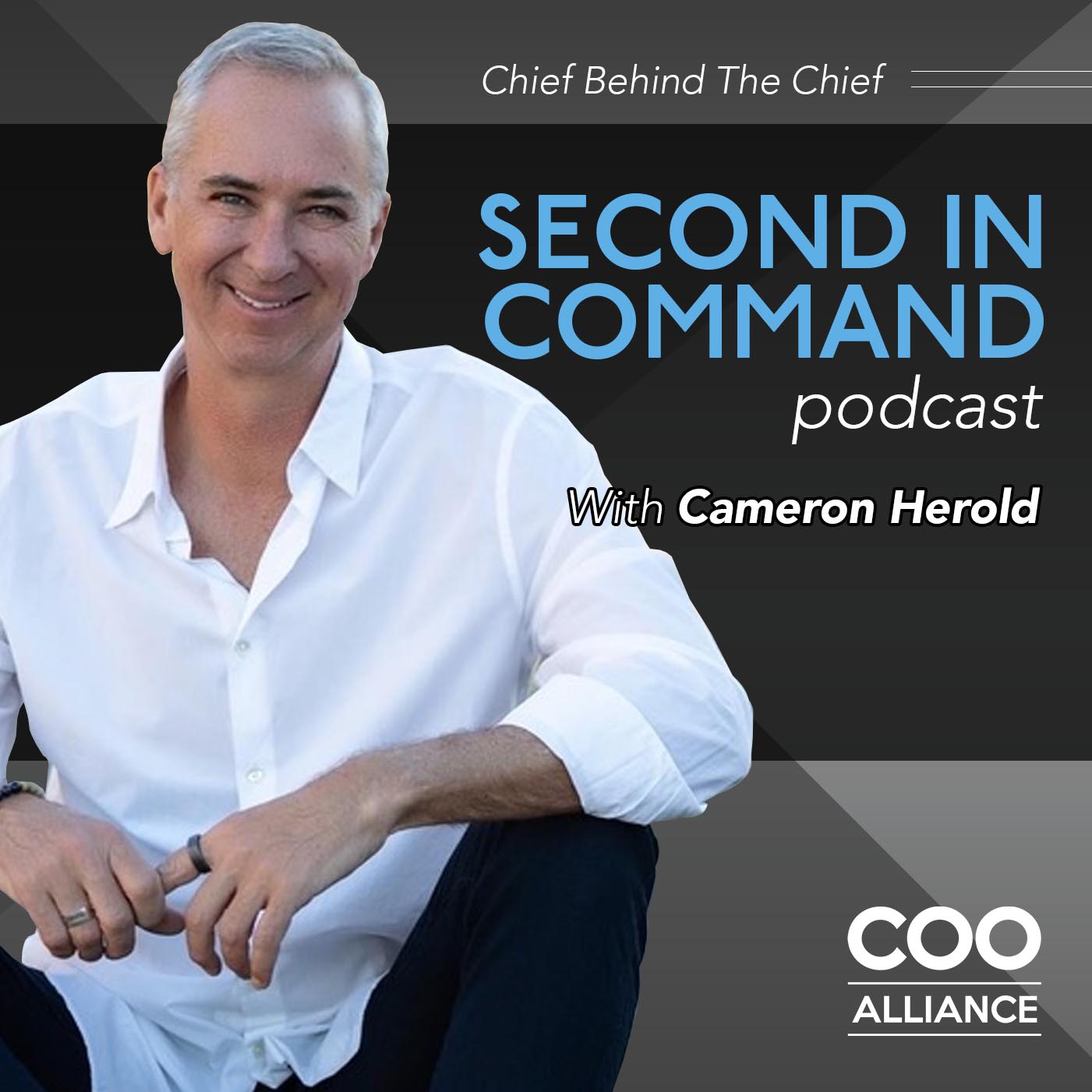
Second in Command: The Chief Behind the Chief with Cameron Herold
Ep. 501 - Unlock Success with Soft Skills: The Secret to Transformational Leadership
00:14:58
Loading summary
Transcript20 lines
- [00:00]
Cameron Herold
Yeah, but those are skills that we have to make sure. I like flipping the org chart upside down. I like putting the CEO at the bottom of the org chart, supporting the C level and VPs who support the directors and managers who support the employees. Like an inverted pyramid with all the customers here so everyone can see the vivid vision. And then you build your company inside your core purpose and your core values. Well, one of the things I have to make sure people are good at is interviewing. Again, these are skills that aren't taught in eos or in scaling out what we give the people the systems, but we don't give them the skills to actually manage the system.
- [00:38]
Podcast Host
Welcome to the Second in Command podcast, produced by the COO alliance and brought to you by its founder, Cameron Herold. In the second in command podcast, we talk to top COOs who share the insights, strategies and tactics that made them the chief behind the chief. And now, here's your host, Cameron Herald.
- [01:02]
Cameron Herold
I've seen far too many businesses fail at hiring due to a fundamental flaw, lack of formal interviewing training. In this episode, I'll emphasize the importance of structured training, practice and feedback in interviewing skills. Drawing from my experience hiring thousands, I'll introduce practical techniques for spotting a players and avoiding cultural misfits, including how to probe with proper questions and cross reference ratings. We'll also explore the 12 core leadership skills every management team needs to master and discuss how AI can help but never replace human judgment in assessing behavioral traits. How much training have you had? Have you gone through the top grading training?
- [01:46]
Guest Speaker
Yeah, a long time ago.
- [01:48]
Cameron Herold
Did you ever have anyone video you doing interviews and give you feedback on that? No. Did you ever role play or practice doing interviews?
- [01:56]
Guest Speaker
A little bit, but not a lot.
- [01:57]
Cameron Herold
Yeah. So you've had kind of base level training on interviewing? Yes. To really train your team. So at 1,800 got junk we had to hire. Well, let me back it up. At College Pro painters, we had four months to recruit, hire and train 800 franchisees. Imagine recruiting, hiring and training 800 franchisees in four months. I hired Kimbal Musk back in 1993 as a franchisee for me. His cousin Peter rye, who built SolarCity, I hired him the same year. So imagine being in the 30 people to hire, recruit, interview and hire. And then in one month we had to train those 800 people how to interview and hire 8,000 students to paint houses. So in four months, five months, we had to hire 8,800 people. And we did it every year for seven years. We became operationally world class at interviewing Very similar. Like Brad and Jeff Smart. I know their systems inside and out. Great systems. But I've been trained in it. I've practiced it, I've role played it. I've had videos of me, I've had feedback, I've watched it, I've given myself feedback. I've been trained in this stuff. I also make sure that anybody in my companies has been trained in this base level skill more than they train them on what the genius network is or what financial literacy is. We train everybody on what we do and not on how we need to do what we do. It's kind of like Simon Sinek's golden circle. Simon used to be on our board of Advisors back in 2004, five years before he wrote the book Start with why. But you have your why, your how and your what. Simon's obsession is the why, right? Core purpose, your core beliefs, your core values, your bhag, your vivid vision. Most companies train on the outer circle, on what we do, how our systems work, what the genius network is, all that stuff. I train on the how, all the soft skills of leadership. So the reason that interviewing is hard for you is you've never really had enough training to be really good it at. Imagine if you'd had the training on interviewing that you've had on copywriting, right? Then it gets easy. So for me, interviewing is really, really simple because I've had an obscene amount of training around it. For me, copywriting is so difficult because I've never done any work around it. You'd be like, well, have you not taken a letter and written it out? No, I've never done that. Have you ever written Dan Kennedy stuff? No, I've never. You'd be like, how could you have not done this? Well, because I spent my 10,000 hours on the soft skills of leadership and you spent years on marketing. So you're operationally world class around marketing and biz dev and relationships.
- [04:15]
Guest Speaker
I can even write better than Paris.
- [04:17]
Cameron Herold
On propolis back there. That guy sucks. But those are skills that we have to make sure. I like flipping the org chart upside down. I like putting the CEO at the bottom of the org chart, supporting the C level and VPs who support the directors and managers who support the employees. Like an inverted pyramid with all the customers here so everyone can see the vivid vision and. And then you build your company inside your core purpose and your core values. Well, one of the things I have to make sure people are good at is interviewing. Again, these are skills that aren't taught in eos or in scaling up, we give the people the systems, but we don't give them the skills to actually manage the system. Yeah.
- [04:52]
Guest Speaker
And by the way, I was. I'm asking you this in a very purposeful manner, doing my best to communicate as I can, because the actual question I had was, how do you spot and hire true A players and avoid cultural misfits? And of course, you can give a really good answer to that. The depth of it is. Well, even if you say whatever it is, there's this part of me that's always had this.
- [05:12]
Cameron Herold
I've read the book.
- [05:13]
Guest Speaker
I've read the entire giant book of top grade. It's a big book. And there's this part of me that, like, still has difficulty with it.
- [05:20]
Cameron Herold
So the real question, how do you spot them? The first is be. Be so well trained in interviewing that you actually know how to run the torque system, the thread of reference check. Right. Be really well trained that you know how to probe and ask all the proper questions. Be so well trained that you can actually run a series of one on one interviews and then cross reference based on. So you're actually rating the same person, but three of you who have interviewed them rate them on those things. Behind the scenes, it's just being trained in it that's number one. I'll give an example of how well trained I was to spot something. This was back 30 years ago. One of the things that someone had to be really good at to be a franchisee was time management and project management. So I really wanted someone who understood priority management. I'm interviewing this candidate and he was explaining his time management like it literally sounded like getting things done. David Allen's book, it's like, pick your A's and B's, number your A's, put how many times, you know, minutes for each A, put them into your calendar. Fucking color code. I'm like, God, this guy really knows time management. But my spider senses were saying he knew how to do it, but he'd never done it. I know how to win an Olympic gold medal. Who here knows how to win an Olympic gold medal? We all do. We all know. Just be fucking faster. Who knows how to set a world record? Who knows how to do front crawl? We all do. We would drown racing in it. Right? So I could explain how to win an Olympic record. If you hire me because I know how to do something, you will fail every time. Hey, it's Cameron Herold, founder of the Second in Command podcast. Are you or your COO struggling to level up? Every COO or second in command should join our COO alliance. Check out cooalliance.com for just the cost of a few copies a month. You get world class training, 12 monthly mastermind calls, 12 monthly AI expert calls, and two live events a year with top COOs globally. Since 2016, we've been building and growing the COO alliance to put the tools, peer support and strategies in place to help grow COOs and their companies. It's backed by rave reviews from hundreds of COOs and their CEOs who have seen insane growth. We also have a 10x guarantee. It's your time. Check out COO alliance.com and sign up for a quick call to learn more. So in this interview, I'm like, this guy, something is like, he knows how to do this. I'm like, this was back prior to PDAs. This was 93, 94. I said, where's your daytimer? He goes, out of my car. I'm like, and everything you've just described is in your daytimer, like quarterly, pending, monthly, your weekly. You do all this? He goes, yeah. I'm like, can you go grab your day timer?
- [08:03]
Guest Speaker
Are you talking, David?
- [08:04]
Cameron Herold
No. He goes, for what? And I said, I just want you to flip through your day timer and show me. You can show me from across the desk. I don't need to see the details. I want to see if everything you told me you know how to do is actually what you do. So he goes, sure. He grabbed his jacket, went out to the car. I've never seen him since. Because I knew that what I was looking for was not how to do it. I was looking for someone that had done it and could prove that they've done it. Then I can also use the torque process, the threat of reference check. So again, this is the stuff that I talk about in my invest in your leaders training. One of the modules is interviewing. You need your people to be base level certified on every skill. If I gave you the 12 core skills that people need to be good at, all of your management team, all of your leadership team, and even you should have at least a bronze level of competency on every skill. Silver's pretty damn good. Gold means you can certify other people in those skills. When you can actually bring training into your organization like that, then it gets easy to hire people and interview people. So your problem isn't that it's hard to find people, it's that you're still at like a bronze basically level of competency.
- [09:12]
Guest Speaker
Well, at this stage, do you think I should even be doing that.
- [09:16]
Cameron Herold
No, you should be interviewing for Culture Fit and not for actual skill set. And often when you're, when your company gets to a scale that like as an example, we were hiring a head of engineering in it at 1-800-got junk. We didn't know anything about engineering and IT. We didn't even know how to interview to see if they had the skills. So we brought in the head of IT from Business Objects and the head of IT from Ave Books, Boris Words, who had literally just sold for about 400 million to Amazon. And they interviewed our final three candidates for us. When we were looking for our CFO, we brought in the former CFO of business objects, Crystal Decisions, former CFO from Arthur, from Deloitte Institution Vancouver, our head of accounting. They interviewed for skillset and we interviewed for Cultural Fit.
- [10:01]
Guest Speaker
Okay, so. Well, you have your. The 12 core leadership skills that everyone should master. So can you talk about them and I'd love to hear your spin on it now with AI, you know, I mean, do you consider this a something to master?
- [10:16]
Cameron Herold
Yeah, I don't think. Let me go through the 12 and I'm pretty sure that at least 9 or 10 of the 12 can't be replaced with AI. You might build the leverage and make you better, but you still have to be good at it because you're implementing a soft skill with humans. So here's the 12 skills off the top of my head. I'll see if I can do them. Situational leadership. And if you ask, if you want to write them down, you can ask me questions, I'll explain them. But situational leadership coaching, one on one coaching, delegation, time management, project management, handling conflict interviewing, running effective meetings, reverse engineering, vision, delegation. Those have become the 11 of the 12 core skills. You can't really AI your way out of that, like delegating a project to someone. But almost none of us have had any training on delegation. Well, the onus is on the receiver. If you want to get back a result on time and on budget and the work that you're looking for, it's your job to delegate it in a way tying it with situational leadership. The ability to adapt your leadership style to make sure your person you're giving it to has the skills and confidence to do it and then to coach them and make sure they have the time blocks. But if you've never had any skills in this, then of course shit doesn't come back to you on time or on budget or drives you crazy. So I think there's skills that you can maybe leverage. But I don't think any of those can really be. I'll give you an example how AI can help you with interviewing. Let's say that who's got a behavioral trait that they need someone they're hiring for to be good at? Who's hiring somebody right now? Okay, detail oriented. Great. So how do you find that? Fuck, I don't know. So you go on to ChatGPT and you say, what are five questions I can ask to start the interview process to see if someone's detail oriented. Cool. One example would be describe your closet to me. Right? When you just. And don't say, is it organized? That's way too leading. Describe your closet to me, a detail oriented person. A person like me will tell you that when I used to have a closet, now I travel was all my shirts were hung color coded. Like dress shirts light to dark, jeans light to dark. Like everything was color coded. Of course it is, right? If you're detail oriented, if you're like a normal human, it's just like shit in a closet. But someone who doesn't think like a detail oriented person would probably just say, I don't know, it's like a walk in closet. Like they don't even know where you're really going with that. Now, interviewing isn't just the five questions. Interviewing is then being able to probe around the five questions and being able to rate somebody on those five questions or being able to know how do I actually define what I'm looking for. So I know it when I find it. So I think ChatGPT can help you figure things out if you know what it is you're trying to find. So I teach that as to. As an example, if you're hiring a salesperson, there's not a single salesperson that will ever make it through an HR screening process. HR people hate salespeople. HR people are about details, policies and procedures, following the rules. They're a little bit more kind of play it by the book. Salespeople are making shit up. They're winging it. They're not following. Like they're way up. There's no box anyway. They're so outside of the box it doesn't even exist. And they're too high gregarious. Right? High energy. They scare HR people. So don't get HR people interviewing salespeople. But if I'm looking for an HR person, I don't want somebody who thinks outside of the box and doesn't follow rules. Jesus. So behavioral traits have to match the role that you're looking for. As an example, we were hiring and one of our traits had to be tenacity. So we defined it as the dog like work ethic to get over, under, around any obstacle put in one's path. Then we actually knew what questions to ask to see how tenacious someone was. So One of our VPs one day said that somebody was a five out of five in tenacity. I'd rated the person as a one, so clearly there was a mismatch. I'm like, how could they possibly be a five? He goes, they're a hard worker. They were a bricklayer. I'm like, no, they were lazy. They dropped out of everything. They never got help in anything. They ended up with a shitty job to be a bricklayer. They're not a hard worker, they're a lazy. He's like, oh my God, you're totally right. There's a difference between someone who works hard and somebody who has to work hard, right?
- [14:22]
Podcast Host
You've been listening to Second In Command, brought to you by COO alliance founder Cameron Herald. If you enjoyed this episode, please be sure to like, share and subscribe to us on Apple Podcasts, Spotify and our other podcast streaming platforms. For more best practices from industry leading COOs, visit COOAlliance.com.