← Second in Command: The Chief Behind the Chief with Cameron Herold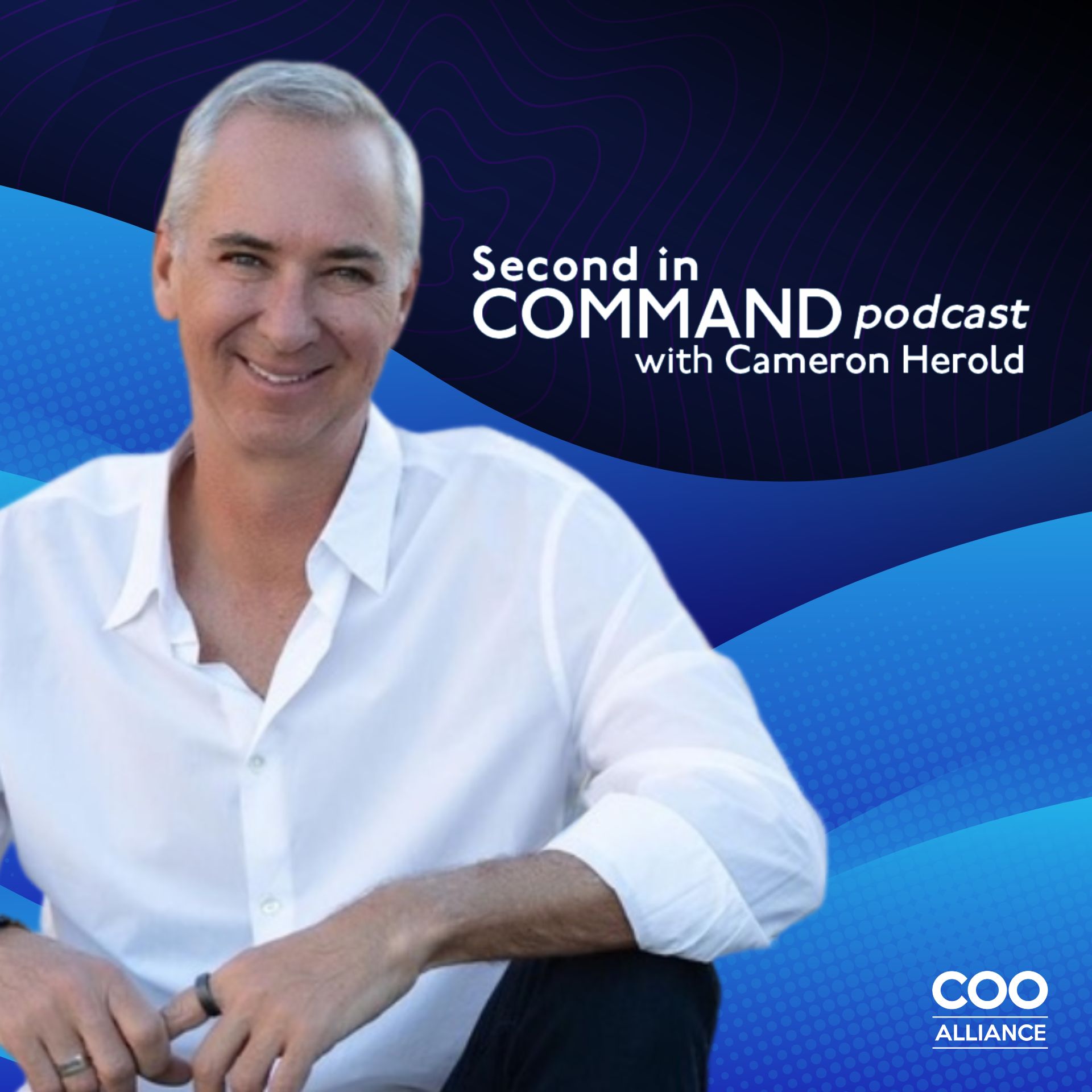
Second in Command: The Chief Behind the Chief with Cameron Herold
Ep. 558 - EOS Worldwide President & Integrator Kelly Knight - How Integrators Really Win Big Now
00:43:54
Loading summary
Transcript69 lines
- [00:00]
A
As Gino sold the organization and as we have grown and as we have owners and private equity and all those things, I think that's one of the greatest challenges that I've personally faced is how do I keep all of those stakeholders in alignment and get that human energy, all of those arrows that we write about in traction and some of the other EOS books aligned, moving together, not in chaos or in conflict with one another. That we have vision shared by all, core value shared by all, and we have right people in the right seats. Welcome to the Second in Command podcast, produced by the COO alliance and brought to you by its founder, Cameron Herold. In the Second in Command podcast, we Talk to top COOs who share the insights, strategies and tactics that made them the chief behind the chief. And now here's your host, Cameron Herold.
- [01:00]
B
All right, our guest today is EOS Worldwide's president and integrator, Kelly Knight. Kelly's worked with 11 visionaries to date in her career and credits her father for being the first person to show her how to take an idea and make it real. Prior to joining eos, Kelly honed her skills as an expert team builder for more than 20 years while leading dynamic organizations in the financial services industry. She's hardwired to find talented people and guide them to reaching their full potential. Kelly harmonizes the major functions of EOS while driving accountability and organizational clarity. Her gift is leading with positivity and heart, with a passion for uniting teams to achieve the extraordinary. Today, Kelly's focus is sharing EOS with the world and growing the EOS community with people who are passionate about helping entrepreneurs get everything they want from their businesses and live their ideal lives. This will be a great episode for you to share and to listen to. Everyone out there knows of EOs, and now you get to listen to the integrator and president of EOS Worldwide. So, Kelly, welcome to the Second in Command podcast.
- [02:08]
A
Thanks for having me, Cameron. Great to be here.
- [02:11]
B
Yeah. Really looking forward to doing this with you and getting to know you and talking about the role that you've been in for a number of years and the organization you're with. In many ways, I think it was eos, and you're the president and the integrator of EOS Worldwide. I think it was really EOS that pretty much popularized the role of that second in command, whether it's an integrator, a coo, vp, operations, whatever different companies in different parts of the world call that role. It feels like EOS was the one that popularized that role. Have you got any thoughts around that?
- [02:41]
A
Yes, I would agree. Although it is interesting. When I joined EOS Worldwide, really as part of the succession plan for Geno and Don, the original founders for eos, I knew nothing about eos. So coming the organization, it was new to me as a title, so to speak. You know, second in command, president, coo, integrator is what we call it here at EOS Worldwide. But it was very still new to me. But it actually originates back to the 1960s when it was used in different terms and conditions within different industries, but became popularized, at least in my world anyway, through eos, because that's just purely my experience. But it's absolutely true. I mean, it's become helping entrepreneurs get what they want from their business. And in our case, our core focus is helping them live their EOS life. That's all become very much a raving fandom of people who have really benefited from eos, which is really a system for managing human energy. So I think for that reason, you know, that what we do every day as second in command is align human energy toward a common purpose, cause or passion that we have. And entrepreneurs tend to get stuck. There's the frustrations that exist. And so integrators are part of being that missing puzzle piece to a visionary for whom trying to do everything, including manage a team and manage all the people, process data issues is very, very hard. So I just think over time it's become popularized because entrepreneurs change the world. That's always been true. Our founding fathers change the world. So over become very popular to have that yin and yang between the visionary and integrator.
- [04:25]
B
And yes, I like where you're. Sorry, go ahead.
- [04:29]
A
I was going to say I happen to think EOS did that, but clearly there's a lot of different operating systems and a lot of different organizations that have contributed to that too.
- [04:37]
B
Oh, for sure. And you know, I think back to Sheryl Sandberg. I think she was kind of the queen bee of cos or of second commands, where she was the COO for Mark Zuckerberg. And she kind of walked into the organization as almost the adult in the room with eos. Why don't you tell us where the genesis of EOS and what EOS is? I know you talked about aligning people with, you know, passion and vision, but can you get into a little bit of the nitty gritty of what EOS is? There's a lot of people that certainly know of EOS. I think probably 35 or 40% of our members of the CO alliance use EOS, but then there's gazillions of companies out there that have never heard of it. So why don't you give us the lowdown around what EOS is and then I want to dig into a little bit more of your role.
- [05:15]
A
There's sure, EOS stands for Entrepreneurial Operating System and it was fundamentally founded by our founder Gino Wickman and also his co partner, co founder Don Tinney. But it was originally founded because Gino came from the entrepreneurial world. It came from a family business where the headline is that his family too got stuck just like many other entrepreneurs. And the pain of kind of coming out of that and finding a clear path forward was really challenging. Genome did not want other entrepreneurs to suffer in the same way that he and his dad and his family had done. So he tinkered and honed and refined some different things, putting them together to really create a proven system which includes a process, a system, a model, a toolbox that help entrepreneurs in a very simple, practical way get everything they want from their business. And so the model consists of things like vision, traction issues, people, process, data. Those are the six key components. And to the degree that you get strengthened in those six key components to 80% strong, that then helps you align human energy towards a common purpose, cause or passion to get what you want from your business. So that's kind of the headline there. But clearly each of those go deeper than that. That's the headline.
- [06:34]
B
Of course that's the headline. Okay, so you spoke to, you know, him working in a family business and his dad even almost being frustrated in that entrepreneur visionary role. Can you speak to what EOS really kind of laid out for everyone, which is the real difference between the visionary and the integrator and what those two roles are and why they're so specifically laid out versus maybe other titles in the organization? Because the EOS is used amongst the entire leadership team. But it's almost like visionary integrator is kind of scattered throughout the entire system. Why is it so separate or so different from maybe the head of finance and the head of marketing and head of operations, etc.
- [07:15]
A
Sure. So the visionary integrator are complementary roles to one another. And the idea is that the visionary is able to be free to be uniquely who they're meant to be. The unique ability being big ideas, big relationships. Sometimes tinkering and honing in a workshop can be research and development, but essentially really the big ideas person that's able to set and chart the course and, and be the Navigator for the organization. The integrator is meant to be that complimentary piece that is really running the day to day business. Beating the drum consistently, keeping the trains running on time, responsible typically for the P and L, all the financial components. It's a singular source of accountability truthfully for whether the company is succeeding or failing. If there is a failure within the organization, you're going to go to the integrator because it's that person who is managing the leadership team and harmoniously integrating communications and process and the way that things flow towards the greater good. That's really what the integrator does. So the two together, it's very unique. They're only 5% of the of those that are visionaries are also integrator. And so it's very unique to find someone who encapsulates all of those capabilities in one human. So what we're really doing is taking the unique ability, as Dan Sullivan and strategic Coach will say, to complement one another towards Rocket Fuel, which is one of our books that's kind of like the bible for thinking about the visionary integrator relationship. And there's really a three part puzzle because it's the visionary, it's the integrator and then it's the organization. So to the degree that you get that combination, the right visionary and the right integrator together that meld to build this great organization is to the degree that you're going to get what you want from your business. We often say that as goes the VI duo, so goes the leadership team. And as goes the leadership team, so goes the rest of the organization. So what's different about that than other seats on the leadership team is that the integrator really is the hub for making sure that everything is running smoothly.
- [09:23]
B
Yeah, it's almost like the, the husband and wife in a. In a traditional marriage and then you've got all the aunts and uncles. I don't know if they've. If there's an analogy that works with that. So you know, when I was playing the second command role at 1-800-got junk. Brian and I definitely had a very different relationship from Brian and the rest of the leadership team. We had our meetings that were separate from the leadership team and then we had meetings with the leadership team. We had meetings where we could argue and debate and look at the numbers and the data and almost stay in sync as that two in a box or that yin and yang. Does EOS have systems around that as well around the communication and meeting rhythms? Less of the L10 meetings that I know you work on for the leadership team. But what are the. Do they have meeting rhythms or processes to keep the VI system tight?
- [10:11]
A
We call them a meeting pulse at eos. But the primary big one for visionary integrators is what we call the same page meeting. And that is where you are aligning just the two of you. Nobody else is on at call, not an assistant, not other members of the leadership team. It's purely just the visionary and the integrator to keep those circles connected, to stay on the same page as the name would imply. Mark and I, as an example example, we happen to have a same page meeting once every week. It's on Mondays for 90 minutes. Purely dedicated to resolving the issues. We call it IVS to identify, discuss and solve our issues, solving them at the root so that they go away forever, permanently. Some other, you know, VI duos, though, we'll meet once a month for four hours, you know, for a half day together.
- [11:01]
B
Sure.
- [11:01]
A
Work for one, may not work for another. So it's really about keeping those circles connected, whatever that meeting pulse may be. Mark and I also do have a once a month, kind of like strategic working session where that's where we go deeper into visioning, working on the business versus in the business. But truly can be designed any way that you want it to be. But the same page meeting is critical. And then of course, as you indicated, there's the level tens. There's other meetings that we have as well. Our quarterlies are very instrumental. Every 90 days we meet together as a leadership team, which includes Mark, myself and our leadership team, where we chart the next 90 days of priorities. But that same page meeting is the most critical and it must be done and done well. It can't be done too infrequently. It can't be done with poor quality, meaning you're kind of flitting in and flitting out. It's really the most intentional relationship that is had in a company, an entrepreneurial organization.
- [11:56]
B
Love it. Now, you entered the organization right around the time when Gino was exiting, is that correct? Gino, I think, had sold to private equity or what was the timing of your.
- [12:07]
A
Right, so my coming in was really to fulfill the last component of Gino and Don's succession plan.
- [12:15]
B
Okay.
- [12:16]
A
Just incredible planners that some of the most disciplined people you will ever meet on the face of the planet are Gino and Don. And so for five years they were planning their succession. First came Gino and his succession plan with being the visionary seed that was Mike Peyton. Who became the successor to Gino. So then Mike Peyton was the visionary and Don Tinney was still the integrator at the time. And then it was Don's turn to get his succession plan in place, his successor. And so they went out to the marketplace. They were looking outside in the world, they were looking inside of us, the community of EOS simple vendors, to find the right fit integrator. Their hope had been that they would find someone who had been part of a company running on Eos was really verse build at us. Instead they got me. Which was, which was I came from the financial services industry. So the parallel, what was kind of a common business model piece to this, that made it make sense for me to come in despite by not being familiarized with eos, was that I was leading a financial industries organization that have advisors, financial advisors, and those financial advisors have clients very similarly to how EOS fundamentally, we serve EOS implementers, which are business coaches who have clients. So the business model comparison made a lot of sense to them and there were other qualities and traits that they were looking for at the time. But I really then came in to replace Don, become Mike Payton's missing puzzle piece and also fit EOS worldwide. And that happened in August of 2016. It was then thereafter, it was nine months after I had become the integrator that Gino officially said, we're going out to the marketplace. This is the opportunity for me to really kind of take some chips off the table, sell the organization, still be part of eos. He's still an EOS implementer today, coaching entrepreneurial organizations. But it was then, nine months after that that we actually sold the organization. So within 18 months of my coming on board, the organization was out to market, sold. And we were moving from that.
- [14:27]
B
How long did it take you? It's super intriguing that they didn't go with someone from inside the organization or, you know, as you mentioned, these former CEOs that are implementers, how long did it take you to understand the systems, to understand the EOS world? It's not, they're not that complicated. I mean, you, you read the book and go through a couple quarterlies and you get a pretty rudimentary, you know, overview of them, but how long did it take you to feel comfortable with them?
- [14:53]
A
So it's such an interesting question because EOS is certainly, you know, it's, it's simple. The system is very simple, but the depth at which you can go into the process, the model, the toolbox and its application, and I think of it like Lego. So they fit together in different and interesting ways that make it more creative and also help people in different ways because not every organization is the same as we know. So I candidly came in thinking if it takes me more than like a quarter or two to figure this out, then I'm not doing something right. But the irony is that that was born out of hubris because it really took me, I would say, Cameron, if I'm being candid, probably three years to really drink it and, and to understand it intimately and to be able to understand how to apply it and to explain it and those kinds of things. So it's interesting how sometimes very simple things can actually take quite a while to become more masterful. And it is a journey to mastery. I'm learning something every single day because the world changes. Our organization has grown by a lot. And how you use the tools to solve current day issues always is morphing and evolving. So I'm always learning so I don't have it all figured out.
- [16:08]
B
I think the second part of that is that your role wasn't to sit there and really implement the systems. Your role was to lead the entire organization. It's similar in a way to when I joined 1-800-got junk. Brian had spent 11 years building the company, getting it to 2 million in revenue. He'd worked in the trucks for years. I went out and spent a half day in the trucks and came in and said, okay, I get it. He goes, you've been out there for half a day. I'm like, I know we put stuff in the truck, we take it out of the truck. I got it. That's not what the business is about. Right. It's about. The business was about culture and franchising and scale and there were all these other leadership development pieces. So your role really had nothing to do with putting the system in place. It had to do with scaling up that organization. But how did you work through the transition with the people in the organization where the two founders are now leaving? How did you navigate that? And then can you speak, was it private equity that you sold to or who are the buyers?
- [17:04]
A
Sure. So I'll answer the first part first, which is Gino and Don, again are so masterful. They really knew that it would take time for an integrator coming not from the system, to get into and intimately understand the system. So there was quite a navigation, we called it navigation meetings. And so for many, many years, even after Gino had sold the business for five years, every single month for a half Day I met with Gino at his session room in Livonia, Michigan and it was an iterative process. You know, at the very beginning he was teaching me all of these different components of eos, the model, the toolbox all. Later it became really my coming to the table asking questions and really digging into help problem solving current day issues and how, how he might have solved them. But also to apply my different perspective given that he's not in working in the business all the time. So it was very thoughtful that way. And then also don Tinney spent 90 days with me, the very first 90 days and I made no decisions the first 90 days, which I would highly recommend for anyone going through a succession plan like this because it gave me the luxury of watching and observing everything and making sure that by the time I did start making those decisions after 90 days that it was informed that I could see how the team was working and idsing and solving issues and thinking and rather than making assumptions which can happen with someone who's brand new to the organization, you want to come in like sometimes like a stallion, like I'm ready to go, I'm ready to hit the ground running. But that peaceful onboarding and the thoughtful navigation is what I believe makes all the difference. And so yeah, it's critical. So there was short term onboarding but then there was long term navigation that really helped me to become who I am today. And Gino's whole goal was I want to make you a world class integrator, the best of the best. And it's just iterative iterate over time. I haven't arrived or gotten anywhere quite yet, but but it's a work in process. And the second part of your question is y we were sold to private equity. The Firefly Group is the name of the organization that purchased to so that also became a newfound set of relationships to work with and manage through because that was different than the prior ownership. And so that then became a, you know, an additive to what I call the stakeholders list. That's one of the more challenging things I think that second in commands face is managing the human energy, which I've already mentioned. But it's aligning the stakeholders top to bottom. And when I'm talking with other integrators or entrepreneurs and different get togethers, one of the things that's the most underestimated is just how many stakeholders each organization actually has. So when I ask the average second in command integrator, they'll say, I think maybe there's about five, five main stakeholders that we Serve. But then when we start digging in and I'm asking more questions, it's far more than that. So as an example, worldwide we have 27 groups of stakeholders. And so the management of the matrix, of how they fit together, how communic applications work, that's all really very complex. So as Gino sold the organization and as we have grown and as we have owners and private equity and all those things, I think that's one of the greatest challenges that I've personally faced is how do I keep all of those stakeholders in alignment and get that human energy, all of those arrows that we write about in traction and some of the other eos books aligned, moving together, not in chaos or in conflict with one another, that we have vision shared by all, core values shared by all, and we have right people in the right seats.
- [20:47]
B
I love it. Going back to the first 90 days part, it's so good to hear you say that. You came in that slow. I talked about it in my book, the Second Command, that in the first 90 days, the COO or the Second Command's role should be to make no decisions because you haven't got the trust and you don't know the team and you really have to kind of settle into that organization. But so often the entrepreneurs or the visionaries are so relieved to have that integrator in place that they almost say, oh, good, just kind of run with it and they abdicate. Do you think that Gino and Don were good at slowing things down or did you come in or was there a real meeting of the minds and the same page about that 90 days, or did you approach them with that? How did that all occur?
- [21:28]
A
That was purely their genius and they're both very, very patient. So while they're both high quick starts, if you look at the Colby assessment, they're both high quick starts, meaning they make decisions quickly, they move quickly. But interestingly, I've personally found entrepreneurs that are high quick start don't do everything quickly. They do day to day quickly. But the big life changing decisions for their families, yeah, they will agonize over them because they care so much and actually slow down. So a nine or 10 quick start in a normal day to day environment, typically you'll feel it really slow down because of the intentionality and the care at which they approach everything. And Gino and Don were very much that way. And, and so it was very methodical and planned out, each of them very different. So my relationship with Gino is very different than my relationship with Don and their approach While complimentary to my onboarding, very different. But I appreciate that difference as well as Mike Peyton because he also, I came in to be his visionary counterpart. So I really had three key people in my life all at the same time. I jokingly will say, Cameron, I couldn't have afforded to pay the three of them for the coaching that they gave me, if only for the fact that I was coming in to run the company. So I was just a huge beneficiary of their genius, their plans, their careful onboarding.
- [22:59]
B
So when they started to move away from the organization, which they did, and the private equity firm, or I think you said, called Firefly, when they then started to get involved, the organization shifted to become a franchise model versus, I don't know what it was before a license model or membership called it. Yeah. So how, how did, culturally, how did you navigate that cultural shift? Because that is a big shift. I built franchise organizations, I built non franchise companies. Anytime you switch those models around, there's some shifts. How did you navigate that?
- [23:34]
A
Right.
- [23:35]
B
With all the different stakeholders? I guess. I know that's a, a lot there.
- [23:39]
A
No, it's great. It's a wonderful question. And so it starts with sort of my obsession as the integrator or second in command. And that is what I call the three Ps, which is to protect, preserve and perpetuate everything that has made EOS good and holy and great in the world forever.
- [24:05]
B
Hey, it's Cameron Herold, your COO whisperer and guide to scaling businesses. Check out my YouTube channel at YouTube.com amronherald and that's H E R O L D where I share tons of raw tips and insider secrets to have you level up as a leader and grow your company from leadership hacks to growth strategies. It's all there. No fluff. Subscribe now. Hit that bell for notifications and comment on a few of the hundred videos that I've uploaded so far. And let's build your empire together. Let's go.
- [24:41]
A
And so when we think about the membership model, which was arranged in a very interesting way because the membership model was not royalties based, meaning our EOS implementers or business coaches did not pay us a percentage of the revenues that they brought in, it was a flat fee. There's no territories, no regions that you either had to be a part of or could not be a part of. So there's some very interesting things that Gino and Don very thoughtfully had put together. In its original state, we really converted over to franchise essentially to put bubble wrap around that model that was working really well to essentially protect it forever because there's different rules and regulations around what's membership and what's franchise in different states. And so rather than have to to have the complexity of knowing where the EOS model can be in the United States and internationally, because we are growing, the really the simplest and easiest thing to do was to move from membership to franchise. While it enters in complexity from a legal perspective also in the long term reduces a lot of complexity. So that's the why we did also strengthened our IP position because all of that, the quality and the care at which we would require delivery of EOs would become standardized and we could sure that we're keeping our commitments to those that we serve. That was another big component to it, that was the why then. It was how well moving entrepreneurs and humans through change, it can be very challenging. And so at the time we had over 400 EOS implementers, but we also had these other implementers that were sort of subscribed to this online training resource called Basecamp. They weren't technically part of our community, but they were able to be practitioners as an EOS implementer kind of on the side, so to speak. So between those two groups we had over 700 that we needed to move into. Either move to franchise or move you out one way or the other. And so it really required the how was to garner advocacy from some of our best US implementers to help them understand it first so intimately to say one on one, we made a lot of one on one phone conversations to them to talk about why were doing this and why it's actually helping them as individuals. It protects them too in ways that they did not have under the membership model provisions in the, in the agreement. So it actually was better, it was a win, win, win better for the implementer, better for EOS worldwide, better for the client because it elevates the standards, it elevates and protects what they can come to expect so that they don't have the things change on them either. So it's a mutual accountability. So in having those one on one conversations to have implementers understand why for the change and how it helps them, they then helped support garnering the rest of the community because of their influence and their trustworthiness and integrity. And so it was kind of the slow motion of moving through the rounds of change. And we had 82% of all of those implementers who actually ended up making the transition over to franchise. And those that didn't, it's okay, they, they are out in the world doing wonderful things and we wish them well. And so it was just a very thoughtful, very communications forward, relational forward set of steps to work from one thing to another thing. And that all happened in nine months. So that was interesting.
- [28:10]
B
It wasn't take very long. I remember it was pretty, was quite quick.
- [28:13]
A
Yeah. So that's with relationships is the core of it, Cameron.
- [28:17]
B
Relationships and communication. You spent a lot of time communicating and building trust and just, you know, like you said, picking up the phone and talking to people. Did the franchise model now have territories or have you gone with kind of like there's no territories and franchisees can overlap. How does that work?
- [28:36]
A
We still have no territories, meaning an EOS implementer that's here in the United States can have clients all over the world, in different states and counties, regions. There are no limitations with that. We are just now Moving to a 2.0 version of franchise, which is master franchise, with that primarily being international. So that is where you have new regions like Ireland and India and Africa, where we're intentionally putting in a master franchise framework. Where someone comes in, they essentially, they buy that marketing territory so that they can build their own network of US implementers. They do the recruiting, marketing, training, support, coaching, all in that region. But EOS implementers here can still go to India and they can have their clients there. And that's perfectly acceptable. And so what is the foundation of EOS is doing our best to really ensure that our target market, US implementers, have the freedom and autonomy to do what they do really well and at the same time put in the limited protections that we need to secure our IP and make sure we're not doing something that dilutes the brand.
- [29:49]
B
Makes sense. So in that kind of a model, one of the things that I always was wondering why EOS didn't do it, and maybe it was because the transition happened so early, but they never created their own software to have all these tools. And it felt like they were training all these companies to use the tools and then companies would say, okay, we're going to self implement now. It's like, oh shoot. But if you'd kind of locked them in and had them using your software forever, you would have had, you know, thousands and thousands of these licenses. And I think you partnered with 90io for a while or, or they were around the organization, but I think EOS has now created their own software. Is that right? Or am I getting something back full circle?
- [30:27]
A
Cameron? So there's a lot of little stories in here, but so first of all today we are still, you know, have a licensed partnership with 90io longstanding almost 10 years partnership with them and they've got a great platform and many, many thousands of us run companies are on 90 and loving it. We had separately a few years back built our own software. We. Okay, really the idea was exactly kind of where your head is at. Who better to create EOS software than the originator of eos, period.
- [31:00]
B
Yeah.
- [31:01]
A
But you know what, Cameron? What we came to find after a few years of doing it is that we are not a software company. Yeah, it's different to our DNA. It just did not work for the reason that it's not our core focus either. Core focus is helping entrepreneurs live their EOS life and the niche. The way that we do that is by developing master EOS implementers, not through software. So by lots of trials and tribulations and failure, we ended up just this year, June 1st, selling actually our software to someone who it is their core focus to build great software. And it's doing really, really well. And we've just recently this year also expanded our licensing opportunities. So products and services for which there is eos or a desire to have EOS in that product or service, we are licensing our IP out selectively to those that are interested in doing that. And so what it allows us to do is to keep EOS on the lips of more entrepreneurial, entrepreneurial organizations that can benefit from EOS without us actually having to create, develop or own everything. We totally never don't actually have to do that is what we learned from that whole experiment.
- [32:16]
B
It's Jim Collins hedgehog concept.
- [32:18]
A
Right.
- [32:18]
B
Really understanding what you're going to be best in the world at and sticking to that, you know, like at the end of the day, you know, this is an iPhone, but Apple doesn't even make it. You know, Apple doesn't make their own iPhone. Right. They outsource that to a third party because they realize they're good at design and they're good at marketing and they're good at all the software, but they're not good at making phones nor do they want to be. So I love that you kind of came full circle around with that. I, I watched someone else in this space, Vern Harnish, bump into trying to do software for years and could never really pull that off. It is a very, very different part of the business. So in your growth as a leader, you've kind of, you know, clearly done some stuff before. You said you were working in the finance space before. What do you Think has made you a good integrator. What have you had to work on over the years?
- [33:00]
A
Yes, well, I'd like to think I'm a, I'm a good integrator, but the truth is, is that like the humble part of me is just always thinking about the things that I need to improve on. Candidly, that's more of my obsession every day. But I think that actually stems from answering your question. Answers your question. So it's my curiosity and learner profile. So if you look at all the assessments out there, it comes back very clearly in alignment. I've taken probably every assessment made known to man.
- [33:28]
B
And what's your culprit profile?
- [33:31]
A
My Colby is a 776-2.
- [33:35]
B
Interesting. Very. Like we, we have all of our CO alliance members do their Colby A profile and when then we have their visionary do their Colby profile too. And most of the visionaries are like a 4, 3, 93 and most of the coos integrator second commands are high on the first two numbers high fact finder high follow through. So completely consistent.
- [33:53]
A
It is. And this, yeah, the six works for us at EOS too. So the 776 six isn't too far behind. Although Marco Donald is a ten. Quick start. So there's still four degrees of separation there.
- [34:07]
B
Yeah, which is fine. It's. It's better than a 10 to a 2. So something we've been working with a lot of our clients around is, is getting them to take the visionary Colby profile or strength finders or Myers Briggs or whatever, and then taking the integrators and plopping it into chat GPT or GRO and saying okay, the visionary, you know, the CEOs Colby a profile is this the COO's Colby a profile is that in a one pager in grade six language teach us how to communicate and collaborate and work better together. It punches out this amazing cheat sheet report. It's like so good.
- [34:40]
A
Isn't it? Amazing. It really is insightful. There isn't a day that I don't use ChatGPT for something like that. It's pretty awesome.
- [34:48]
B
Yeah, it's powerful. So I think one of the strengths of your model is that you're in the actual offices with your clients. You know, your, your implementers are there, they're working clients or getting to know the teams. Do many of the EOS implementers implement and, and run the quarterlies, run the annuals via Zoom or is, is, is it 80, 90% that are done in person?
- [35:11]
A
Well, it's a combination. So some do in person, eyeball to eyeball around a table in the very traditional sense. And then some are doing zooms and wildly successful at it. And we'll tell you, up until Covid, there really was not a lot of virtual going on. There were a couple early adopters, I'll say of that, but in fact, Mark O' Donnell was one of those. But back in 2020, pre Covid, it wasn't that way. Today, it's really a blend, and it just depends on the implementer. So some implementers, based upon location of clients, they might do all of theirs virtually over zoom, whereas some it's a mix. And then those that have their clients in their own backyard, we say 20 clients in your whole backyard is sort of the standard. So it really just depends. But we do now have the flexibility to do both. And I think that's incredibly powerful so that it eliminates borders in ways that I think prior to Covid, it was a little more compartmentalized, I would say.
- [36:08]
B
How do you allocate leads that come into the head office? If EOS Worldwide gets a client that says, hey, I want, you know, to help me, I want an implementer, how do you decide which implementer to give it to? If there's no territories, what's your model around that? I'm curious.
- [36:24]
A
Right. So we have a whole team, a warm leads team, that manages this, and they have a lot of intelligence, a lot of data around our implementers, and we sort of know where implementers want to be or don't want to be, whether they do virtual sessions, whether they don't. And so our team uses our database to make those intelligent decisions. And we also make sure that we're aligning to. There's a very short process that someone calling in, if they're calling in to speak to our warm leads team will answer a few questions, and then we can then give them the opportunity to get introduced to an EOS implementer. In a case where even maybe the chemistry, maybe while each EOS implementer delivers EOS purely in a session room, sometimes the chemistry of having the right person facilitating that style might not match. And so they can come back to the warm leads team and we can do a second introduction. So, but it's a very collaborative, relational kind of process, and we don't always get it right. Sometimes we have to go through the process. And that helps, though, refine our process and the data and the systems that we use to make it better and better all the time.
- [37:28]
B
Makes sense. Does you know, EOS being the entrepreneurial operating system? Does the system start to break down at a certain point? Does a company get to be too big for it? Or you know, do the EOS systems work regardless of size, regardless of scale?
- [37:45]
A
I would say it depends. So we certainly have organizations that are billion dollar companies with thousands of employees and we have some that are part of EOS that are, we say we're 10 to 250. 10 to 250 team members is kind of our sweet spot for size, but we have some that are larger and smaller than that. I will say, you know, EOS is able, even though it's a simple, practical set of tools, it is able to be customized to grow with an organ. But EOS works if you work eos. But there are times that it can get broken and it no longer works for some organizations. But I would say that's kind of the headline is EOS works if you work EOs. And you just have to keep changing, you know, some of the structure to your accountability chart for your people plan as an example. You've got to continue to evolve your data, which is another component to the six key components. So it's, you have to be very, very mindful as an integrator of any organization in a second command seat. We would also say of a company running on EOS is you're constantly thinking about the ever changing dynamic matrix of the stakeholders and also the system, the process, the model, the toolbox. So it can, it can be infinitely scalable, but you just have to be really committed to that process.
- [39:00]
B
Yeah, that makes sense for sure. I know in the franchising world you're not allowed to control pricing with your franchisees, you're allowed to guide them on pricing. You know, like every McDonald's restaurant, there's some, some market conditions and market pricing and labor conditions. Your EOS implementers don't all charge the same amount to work with a company there. Do you give them a range to stay within or do they set their own kind of range of pricing? How does that work out?
- [39:26]
A
We have minimums coming out of boot camp. So boot camp is the intensive three day training that a person goes through if they want to become an E. US Implementer. And so coming out of boot camp, the daily rate is 2,500. Someone can charge more than that. We really encourage though to keep initial pricing as a new, what we call professional EOS implementer pretty low, keep that barrier to low so that you're getting a lot of at bats. You're able to really become masterful at EOS by doing it many, many times over early on. We don't want price to be reason why you're not getting in and becoming great. But we have some EOS implementers that work their way up through. We've got three designation levels. When you come out of BO camp, you're a professional, and then you move up to certified. And then there's the expert EOS implementers. We're very masterful. Some of them charge 15,000 or more per day, so there's really quite a range. So anyone who may want to hire you can. You could come in at a lower level, have everything in between those, those, you know, two numbers that I provided. So. But until.
- [40:29]
B
Until they're. Until they're certified at that next level, they're not allowed to go with the next pricing. Is that how you do it?
- [40:34]
A
Well, they. They can. They absolutely can. So some, some people come out of boot camp and they might charge 5,000 as an example because of their experience, or they feel like that's what they can actually charge and, and still continue to get the repetition, the ATS and the capabilities to grow in. In their seat.
- [40:53]
B
Makes sense. Who do you compete against? Who are. Who's your competition in this space? Or do you. Do you kind of consider that you have competition?
- [41:04]
A
It's interesting. I mean, I think that there's a lot of just coaches generally, I would say our competition are just individual coaches doing amazing work. Whatever set of systems and tools and processes that they themselves maybe have cobbled together. I would say that's probably the largest category. I think we're probably the category creator in terms of what we do. But there's really hundreds of thousands of coaches out there. I would say that's really greatest competition.
- [41:31]
B
Yeah, it's death by a thousand cuts. Right. It's similar to Starbucks. There's not a big chain necessarily that they worry about, but on every block there's another coffee shop that they have to compete against. So that makes a lot of logical sense as well. All right, if you were to go back and give the younger Kelly some advice, what advice would you give the younger you? Maybe advice that you know to be true today, but you wish you'd known when you're just starting out in your career.
- [41:52]
A
Yeah, I would say to just be purely who I am in every moment that I show up one little step at a time. And because I think it early on in my career as a financial advisor, it was pretty. It was at the time, especially a pretty tough industry and so especially for females. And I think there were times that I conformed to what the expectations were of that, you know, at that time. And so it's been through iteration and growth and learning that I've become more comfortable in who I am and being able to just be, for good or bad, who I am in any one given moment, doing the best possible work that I, that I can. And just to acknowledge that we don't take on these seats, right? Cameron. We don't do what we do because we want to be liked all the time. We do it because we're passionate about certain things and we want to be great and we want to make great things happen. But it's not a popularity contest. It's about just doing something that you love with people you love, making a huge difference and staying true to that. So stay. I would tell my former self to stay true to who I am in every moment, no matter what it.
- [42:58]
B
I love it. My mom used to say, just be yourself. Everyone else is already taken.
- [43:02]
A
Your mom is very wise. Yeah.
- [43:05]
B
Kelly Knight, the integrator and president of EOS Worldwide, thanks very much for sharing with us on the Second Command podcast. Really appreciate the time today.
- [43:12]
A
It was great to be with you, Cameron.
- [43:14]
B
Thank you. We'll see you on the road.
- [43:19]
A
You've been listening to Second in Command, brought to you by COO Alliance Foundation, Cameron Herald. If you enjoyed this episode, please be sure to like, share and subscribe to us on Apple Podcasts, Spotify and our other podcast streaming platforms. For more best practices from industry leading COOs, visit COOAlliance.com.