← Second in Command: The Chief Behind the Chief with Cameron Herold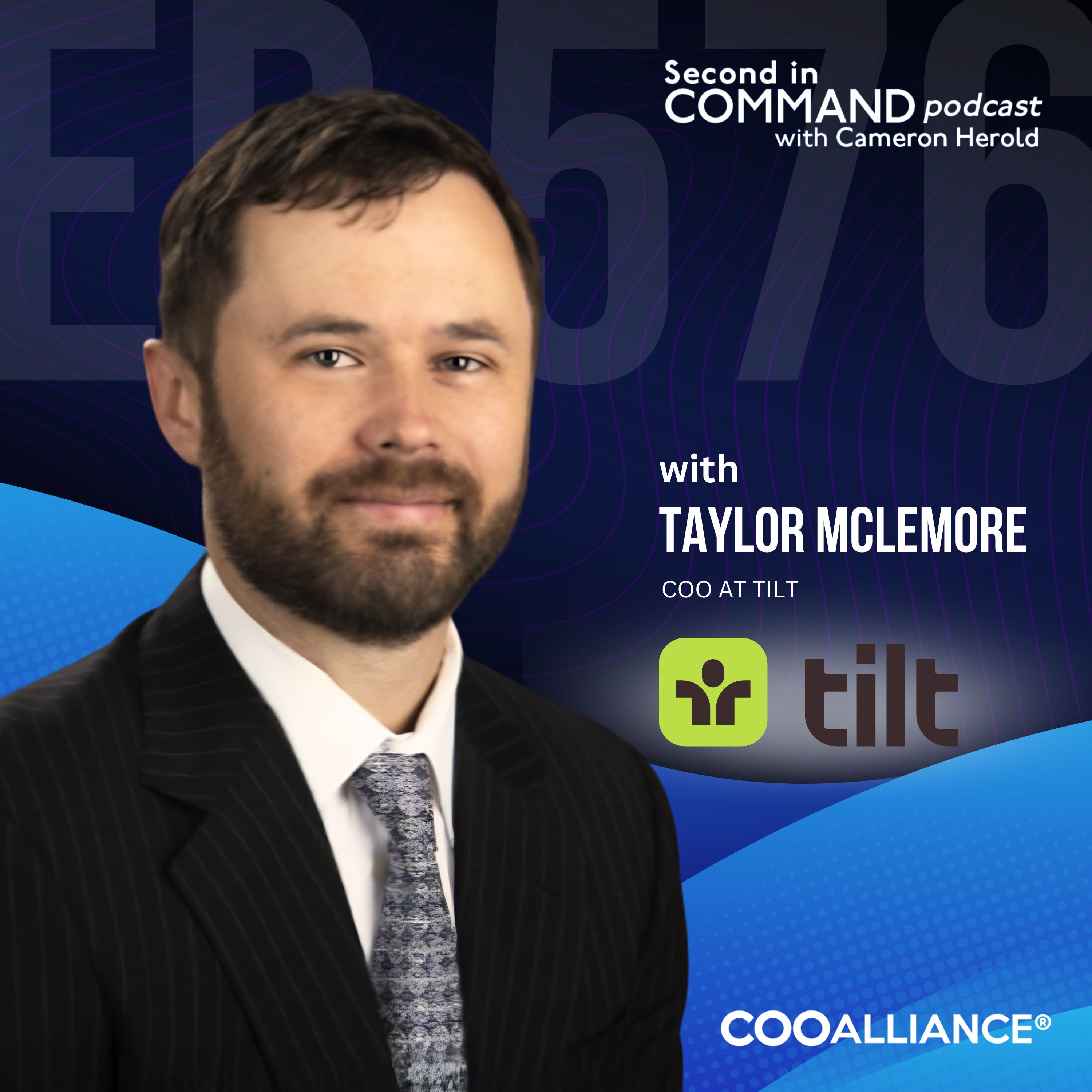
Second in Command: The Chief Behind the Chief with Cameron Herold
Ep. 576- Tilt COO Taylor McLemore - How To Approach Leave Management and Organizational Performance
00:41:38
Loading summary
Transcript68 lines
- [00:00]
A
I'm a big believer in the concept that the people with the greatest proximity to the problem have the best shot at solving it. So the more that any of these frameworks, whatever language we want to use on it, can give that flexibility to be like, hey, the CEO or the COO or anyone top down doesn't have all the answers. The most beautiful, creative, elegant solutions come bottom up. Welcome to the Second in Command podcast produced by the COO alliance and brought to you by its founder, Cameron Herold.
- [00:33]
B
In the second in command podcast, we talk to top COOs who share the insights, strategies and tactics that made them
- [00:40]
A
the chief behind the chief.
- [00:42]
B
And now here's your co host, former
- [00:44]
A
COO of a multi eight figure remote company and alumni member of the COO Alliance, Savannah Brewer.
- [00:54]
B
Today on second in command I am joined by Taylor McLemore, COO of TILT, a company reimagining employee leave through Empathy, technology and human centered design. Taylor is a venture builder, scale operator and community connector whose work spans techstars, Stand Together Able and multiple national boards focused on workforce, veterans and entrepreneurship. He's also the founder of the Human Potential Summit and has helped launch and grow initiatives that empower builders, leaders and communities all around the world. In this conversation, we explore the four principles Taylor and his team use to evaluate new AI tools to implement into their company. We also talk about the single document that creates clarity, performance and alignment across his organization and why the best operators give their teams creative space help define how they are winning in the role. If you're a coo, integrator or operational leader navigating scale, technology and human potential, this episode is for you. Let's dive in. We are live with Taylor. Welcome to the show.
- [02:07]
A
Thank you for having me. Excited to be here.
- [02:09]
B
Of course. This episode's been booked for quite some time, so I've been looking forward to it and talking about all of the things that you're up to in an industry I'm not actually super familiar with. On like, I've helped build a recruiting company, but in terms of like the more platform human resources side, that is a totally different world for me. So I'm excited to hear about what you guys are building and what you're up to. So let's start there. Tell us a little bit about Tilt. What do you do and who do you serve?
- [02:41]
A
Absolutely. So at Tilt, we provide a platform and service for eve of absence management, which sometimes I think operators and others, you know, they're like, I know what that is. But most likely my HR team manages it. So it's all forms of leave. And I like to describe leave as the intersection of life and work. So whether that is one of your employees is welcoming a child into their family. So it can be the best of times, it can also be the saddest of times. Maybe they lost a loved one and they're on bereavement leave. It's all of those things where life and work intersect. And then we as employers and company leaders need to figure out how do we manage that. Right? And there's a bunch of regulatory pieces. There's a bunch of laws that say what companies and can't do. Some of that's federal, some of it's state, some of it's even city level. And then there's the choices you make as a company, like what is our leave policy? What is our parental leave? Those sorts of questions. And so it is a area that I deeply believe is underappreciated in a few ways. One, the scope of it. HR professionals usually spend 20 hours managing a single leaf. So it's a big chunk of time. Yeah.
- [03:51]
B
Wait, hold on. Just to make sure I heard that correctly, you said an HR employee could spend up to 20 hours just working on one leave.
- [04:02]
A
You got it. So let's pick on an example. So remind me, you're based in California, correct?
- [04:07]
B
No, I'm in Texas. But California sounds cool.
- [04:10]
A
Okay, I apologize. I. So Texas is interesting because we can use Texas as an example. I love Texas. So if you are running a company in Texas, you know, and your HR team receives notice, hey, someone on the team is. And let's use traditional sort of giving birth as version of parental leave. But there's lots of versions of welcoming child into families, adoption otherwise. But let's say someone's planning on giving birth and they're a woman giving birth. So there's a medical side to this. There is, you know, not only giving birth, but then recovering as a human after you, you know, went through the miracle of life, all these sorts of things. And your HR team is sitting there and you're like, I have to plan a bunch of stuff. If we're big enough, I have to consider if we need to comply with the laws around that. There's multiple ones. I won't bore you with all of them. For Texas, there's no state required family leave law. There's a voluntary one. So there's actually a thing you could opt into to utilize at the state level. That's a choice to be made. And so your HR team is making all these decisions off of just your employee saying, hey, by the way, I'm going to have a kid. Then you have to coordinate with the manager because that, like, the experience of that employee going on leave is going to be highly impacted by how their manager handles it. Some managers have a lot of experience with it. Most have very little and struggle, honestly. And I'll keep on picking on this example of the thing that keeps our population growing, which is babies. You know, the number of times that manager, I don't know how to talk about pregnancy with one of my employees. Like that's a thing. Right? Like getting that right and not screwing that up. Not easy. Once again, this is all pre leave. Then you actually get to the moment of leave and then that manager needs to figure out where is the work that that person was doing going while they're gone. So then you have a bunch of team impact, right?
- [05:52]
B
Totally.
- [05:53]
A
And then hopefully someday that person returns to work because you thought that they did amazing work and that they had such an amazing experience, even though their life has changed significantly and their team welcomes them back with open arms and all these things go swimmingly and they continue to work at your company for years to come or it doesn't go well and you probably lose that person.
- [06:17]
B
That explanation makes a lot more sense now. I guess when I think of someone leaving, I think of, yeah, the manager replacing that person and making sure that there's like temporary help or whatever. I've actually never really had that on any of my teams, now that I think about it. I had one person and she just ended up leaving the company. She's like, I'm just gonna go do this thing over here. But yeah, I guess for bigger companies, the impact on that would be quite substantial when you think about all the. The legal aspect. Which I guess brings me to my next question. Are most of your clients more on the corporate side?
- [06:52]
A
Yeah, well, when you say corporate, I interpret that as like for profit and bigger. Is that what you mean? Yeah, we do, but we have a variety. Everything from, you know, sort of for profit corporations. Anywhere from 100 employees to thousands of employees. We serve all of that sort of span. But it's not just we also have school systems that we support. We also work with healthcare providers. A lot of healthcare entities are nonprofit versus for profit. So we're pretty agnostic as it relates to, you know, whether they're for profit or not. It's just, are they an employer and do they have responsibilities that they need to manage from a regulatory perspective? And then the thing that really Gets us excited is how do we help them see it as an opportunity? Because there's no question it's administrative overhead, all the forms, the process that we just described. But leave handled well is a massive opportunity to create a loyal employee that you retain for a long time, continues to be highly productive. There are tons of different forms of leave, from military leave to medical leave to, you know, the list is 50 plus. But I'll continue to pick on one of the more common forms, which is parental leave and a special birth giving. And it's, you know, imagine that that goes really well. That person likely will tell their friends, like, my company treated me extremely well because not everyone gets that, which is so unfortunate. And so it's this opportunity. And one of the things that we hold very true. There's an ROI to doing leave. Well. Now, it's hard to measure. Most things in HR world and HR tech are hard to measure. But we can draw direct lines to employee retention, productivity. And then the other thing is that when people return from leave, that their career path continues. That leave isn't not just this gap where you lose people, but also when they came back, if they were a shining star before, were you able to set them back up on a path? And it's not that they have to maintain the same trajectory, but is it a meaningful one between the employer and the employee?
- [08:49]
B
Awesome. What about this mission? I can hear when you're talking about it. There's some passion there. You get excited. What about this mission pulled you in?
- [09:02]
A
Yeah. So the first is that I don't believe I'm unique in this. I've had both very positive leave experiences, personally and negative ones. You know, to just give a quick thumbnail and color that in. On the positive side, I had a family member who was sick and went into the ICU when I was had only been at a company for less than two months. And I called my manager that I was reporting the CEO and I called Mike and I was like, what's going on? I don't even know what. Which ends up like, our world's upside down. And his response was, go take care of what you got to take care of. Call me when you know what's going on. Like, we got you. And like, for being a brand new employee, like, had I signed the employee handbook? Of course I had. HR makes all of us do that. Right. Did I have any idea what our leave policy was? I had no idea. But they showed up in a deeply empathetic way. And so from go, I was so loyal because I like these people treated me with such respect and dignity from day one. And that was my longest career stop I've ever had. So very positive. And then I've had, you know, negative experiences which I, you know, I don't know they're that valuable to dwell on. But you know, it's like one time, you know, we had a different medical situation and I told my manager and she's like, yeah, I'm sure you'll figure it out. It's like how night and day different is that. And she's not a bad person. I still have a great relationship with her even though we don't work together anymore. She's the example of the manager who had no training and didn't know what to do right. So I've been on both sides of that and I just believe it's this really, it's a cool business model because we have this compliance regulatory piece where people gotta kind of solve this problem which is a nice thing when you're selling. And we are deep believers that there's so much upside with how you manage leave.
- [10:48]
B
Well, what was the journey like for you in finding this position? Did you know people at the company or did you just apply off of? Indeed. Tell me about that process.
- [11:00]
A
Yeah, it's a fun story. I started my relationship with Tilt back when I was a venture investor. So the quick history, like if you want to take the, you know, 30,000 foot view of my career, it's started out in banking consulting. Got the heck out of there to go be an entrepreneur. Spent time as a builder, as a founder and CEO and then I spent a season as an early stage venture investor. I was a managing director at techstar and Tilt was actually my first venture investment ever at techstars. So I was fortunate. Got to meet, you know, the founder and get to know her and the team and this is, you know, early, early pre seed days. So it's so incredible how they've matured and evolved the company. And then, you know, I was embracing a new season. I was excited to get back into builder mode versus the venture investor mode. And they were at this fun point of doing the hard thing of scaling. And so that's when the, you know, I went from being investor to being board observer to being coo.
- [12:02]
B
All right, and you mentioned the owner. So you already had a relationship with her. Is she still running the business? Is that who you're working with?
- [12:10]
A
Yeah, exactly, yeah. Jen Henderson is the founder and CEO.
- [12:13]
B
Amazing. We'll talk a little bit later about Yalls relationship A little bit more in depth. But tell us first, what does your role look like now because you've been with the company for I believe, six years,
- [12:25]
A
so in different capacities. I've been in the COO role for coming up on about two years now, so I don't get to claim that I'm new anymore, but I also haven't been around forever. And so the periods before that were in those other capacities of being an investor and serving as a board observer.
- [12:41]
B
Okay, gotcha. What does your role look like now, day to day?
- [12:46]
A
Yeah, it's been an evolving portfolio is how I would say it, with traditional CEO responsibilities at the center of it. So responsibilities for operations, finance, hr, those sorts of elements. We're a growth stage company. We raised a Series B back in 2024, so we don't have overly developed like corp dev activities or things of that nature. But we do. We're starting to get into more and more of that. So that's part of my portfolio as well. And then there's a variety of just sort of dynamic coverage of most important things in the business that I've spent different time working on. A big part of what we do is the complexity of leave means that software hasn't solved all of it. There's still a human service element of how do we have leave specialists that engage when there's questions that don't fit in the automatic flows of step one, two, three and you're done. But rather, hey, I've got kind of a special leave situation, but we have people that are available to help. And so I've spent a lot of time working with other leaders and parts of the business to figure out how do we scale and optimize that. So I've had the opportunity to move around and focus on different parts of the business, mostly trying to enable how do we understand what the sort of the future of that part of the business is for scale while staying true to our mission. So I really embrace trying to cover the areas that need coverage while we then identify what does an amazing leader for this look like as we evolve and grow the business.
- [14:24]
B
I was listening to a podcast this morning about I guess the major hit that a lot of SaaS companies are experiencing with AI. How have you guys seen AI impacting your industry?
- [14:39]
A
Yeah, it's exciting. One of the things that we did in 2025 that I'm really proud of, our marketing team led by Brandon Salisbury, our cmo, did a superb job. We went out and said and really planted the flag that tilt is the AI leader in the leave HR tech space. There is lots of AI across HR tech. I would also say that a lot of it is driven by sort of like the big platforms trying to compete on how many AI features they have. And everyone's still, and this is not just true of HR tech, everyone's still trying to prove impact and outcomes of that versus just feature count. That said, because we are in a very compliance driven portion of HR tech, there's a fair amount of hesitation from people to say, like, wait, you're doing AI? What does that mean? And so AI is everywhere. We are trying to pull it forward in appropriate ways. And that was really a big push in 25 was to say, what does responsible compliant AI look like within leave management? And so I think you frame the question as the hit from AI. Fortunately for us, AGI hasn't arrived yet. The robots haven't taken over. And if you go ask ChatGPT some really complex leave questions in terms of compliance, it's going to get it wrong. It's too situational, it's too context dependent with like complex legal analysis. And I'm not saying never. I mean, we're building the stuff that'll actually give you the right answers in AI, but for us it's more of an opportunity than a risk.
- [16:18]
B
How do you make sure that. Because one of the things that they mentioned in this podcast episode was how many SaaS platforms are trying not to get left behind. So they're all trying to implement, you know, these models into their team. How do you make sure that you bring in the pieces, like you said, that are actually appropriate and helpful but still move at speed and not get like left behind? It sounds like you guys have done that if you are on the leading edge. So how have you maintained that with your team, like moving quickly but also making sure that you're bringing in the right things?
- [16:54]
A
Yeah, I'm a big believer that identifying your first principles is one of the best ways to create acceleration in a business. So we spent time identifying what are our first principles when it comes to the use of AI in our domain. So we have four first principles that we hold up, whether it's us building AI into our product or four tools that no company can build. Everything. That's the modern nature of a technology driven business. So the four principles are, first of all, that it's explainable AI. When I say do this thing, it's not a black box, that there is explainability there. The second is that it's auditable. So as much as everyone's worried about are you using my data for training and those sorts of things, you need to parse those out. That if you are using AI to deliver an outcome for a customer and you have to be using AI in a way where you can say why did it do that? What did it do? So that's the second part. Why did it do it is explainable. What did it do is auditable. The next is secure. HR is full of pii, Personal Identifiable Information. Certain spaces get into HIPAA territory like, you know, it gets into compliance acronym SOUP quickly. So you can't just be dumping PII into AI without knowing where it's going to go, what is your data sovereignty approach, so on and so forth. And so we really focus on. And then the piece that I'll really highlight there is that we built an AI governance council to help wade through this and apply those first principles. So that was like a big part of it. So the fourth pillar is compliant, which for us is highly specific, which is there's Department of Labor regulations on what you're allowed and not allowed to do with AI. There's not really that much federal stuff. Honestly, you know, there's lots of talk and we'll see how that evolves. The hard part, but also business security for us is there's a bunch of state level stuff emerging. There's California, Colorado, Utah have all shipped AI laws, which no one's actually totally like, they haven't been tested in the courts very extensively. So no one like there's a bunch of people with hypotheses about what they mean. So you know, to do this well, you have to bring all of that forward. And I know that's a lot of words, but if you don't have opinions on all of that, you're going to spend a lot of time just sort of like testing, iterating, building and be like, oh, but that's not auditable. So like our customers would never be okay with that. Or that's really powerful, but it ain't secure. Do they have, you know, good old COO questions? Do they have their soc, two things like that. So what we did to speed up in that was establish that first principles approach.
- [19:24]
B
What is the council that you mentioned?
- [19:26]
A
Yeah, it's a group of the executives that represent the different functional pieces. So for us, our head of security, it's our cto, it's our head of leave compliance, who's our legal expert on leave law, it's our, you know, general counsel and it's myself. And so that way you know, and we've really tried to build a clear process. Whether it's an internal like we're building this AI feature or it's we're considering an AI tool. We've established there's service level agreements internally. If someone brings a can I use this tool? We owe them a response in under five business days because we can't be slowing down AI adoption by just saying there's a bunch of red tape to push through. So it's this constant balance of what is enough governance for safety and alignment, but also efficiency so that people can move quickly.
- [20:15]
B
That makes sense. Cool. Thank you for sharing all of that.
- [20:22]
A
If you're the COO or a CEO of a high growth company based in the USA or Canada and you'd like a 30 day free sample of my Invest in your Leaders training, go to coalliance.comdownloads Sign up for the free 30 day access to my Invest in youn Leaders course. There's 12 core modules. It only takes you six hours to go through them. So in that 30 day period you can actually go through all the content for free. Again, go to cooalliance.com Downloads.
- [21:00]
B
I would love to talk about the dynamic with. Is it Jen? Yeah. Okay. Why do you think she chose you for this role? Especially coming as an investor? What was it about you that stood out?
- [21:13]
A
I think trust is the highest piece. Where we had a long established relationship, you know, having been she and the team were the ones building the company for many years before I joined on the operational level. But I'd been there to support through ups and downs and I think just being a thoughtful supporter. I think the other thing was intellectual honesty in the relationship. It's one of the things that I really focused on in my role as an investor and I deeply appreciated that. About working at techstars at the earliest stage with founders is like I built a reputation of I'm going to tell you what I honestly think and I'm also going to be clear about where I have significant data. Like, hey, I've done the thing you're talking about. I like, I'm not saying my solution's yours, but I actually know what I'm talking about versus I have some tangential data, but maybe it's further away. I really always tried to invest time to qualify those things and I found that it led to deeper, more honest relationships, vulnerable relationships where you're like, hey, I think you're making the wrong choice here. It's your call. Like I'm not the CEO, I'm not the founder. That foundation was what led to I think her interest in me joining to play this role at this time.
- [22:32]
B
What is your guys dynamic like throughout the business now? Kind of day to day?
- [22:37]
A
Yeah, it's evolving is the answer. And I think a lot of it is just trying to focus on what are the most important business needs and then also how can we be proactively thinking about the ideal alignment of our roles. A little bit of a tangent, but it applies to your question about our relationship is I don't think there's anything more fundamental to a company being able to perform well than role clarity. And that's true for a CEO and a COO or anyone in any role. Someone doesn't know what their job is and how they're going to be measured, how do they have any shot at getting anything done? And on top of that, if you don't tell them how they're going to be measured, how unfair is it to then hold them to high expectations? I want to be a part of high performing teams that are striving to do great things and then push even beyond it. And so if you don't spend the time like this is one of those classic slowdown to speed up things. And it doesn't have to be complex. It's a concept that I borrowed from some other management philosophy called roles, responsibilities and expectations. It literally is a Google Doc with three sections and just write it down. It drives me nuts the number of companies I've seen or been around where it's like, well do you have a role description or something that helps someone understand what their job is? Oh, we have the job description. When we posted the role, I'm like, that's a marketing document that you use to attract talent to apply. That is not an internal alignment doc to figure out. You do X, I do Y. So I have my own document for roles, responsibilities, expectations. She has hers. One of the things that I've installed across the company is that everyone has them. I think a lot of people have really appreciated you have to win's heart and minds on it. It's one of those like any slowdown to speed up is never easy, right? And we're far from done rolling it out because they're only powerful if they're living documents. If you do it once and then it gathers dust, it was a worthless exercise. If it's the thing that you pull out when you're like hey, we really screwed up for that customer and then we sit down and as we're retroing we're like, I'll use the baseball analogy. The two outfielders stare at each other and the ball drops between the two of them. The way that we figure out who should call the ball next time so that we catch the ball and get the out in the outfield is we look at the rr. Oh, neither of us wrote down to do the thing. No wonder we dropped the ball. Who's going to write down the thing? And it doesn't have to be overly complex. Like literally the other week, Jen and I were discussing who owns what part of investor relations, which is an interesting division of responsibilities between CEO and coo. And so we were working together to clarify if it's more of a strategic conversation. For example, we have investors that are also board members. She as CEO owns board director, relationship management. That's her portfolio. But you have a lot more investors on the cap table than are on the board. And all of them appropriately want how's the business doing? What's the quarterly or annual update on the financials? That flows through me that is much more just a flow out of information from finance, operational updates, those sorts of things. And by me owning that, it helps us through this me discussion and clarity process that as much as we can buy it her as CEO to be working on the business by taking the in the business stuff off of her plate. That's powerful. I think the CEO needs to also explore what is their balance of working in the business and on the business. And I use my roles, responsibilities and expectations doc as a place to also try to express that what is my balance now? I am much more in the business versus on the business balance versus the CEO. And I think that's very appropriate.
- [26:18]
B
I love that you brought this up. This is something that I actually just built out for a team that I'm doing some fractional sales management for, which is a totally new. I mean he helped build a sales recruiting company. We trained over 500 teams. But like sales management in itself, I've never been in that role. But I came in and this team has been established for quite some time. And it was just. Yeah, it's really surprising to me that they didn't have what I call like a job scorecard like you said. Like this is how you know you're winning in the position or not. And one of the things that I like to have on there is competencies which are like a little bit more expanded versions of core values. So it's like I'll have like the core values, but then the competencies of that role and like you said, there's something really great to come back to. Not just like for yourself, but when you're a manager holding someone accountable. Like you said, if something ball is dropped or someone's like, well, that's not a part of my role or I didn't agree to that. It's like, well, when you came on board, we went over this and every quarter, if you're going back to that and talking through how things are going and updating it, it's such a great way for the team member to actually know if they're winning. And then for managers to be able to have those conversations when there's, you know, clear things that might, you might be frustrated with. How is it always, you know, the manager's responsibility, like extreme ownership of if someone didn't do something right on the team, where was it not properly communicated that they were responsible for that? Or xyz, whatever. That piece was so very timely that you were bringing this up. And a huge fan of. You said you call them R and Es responsibilities.
- [27:56]
A
Yep. Role, responsibility and expectations. So role is just a job title, then responsibilities like what are you doing? And then the expectations is the outcomes are how we measure it. I like the term that you use too, the scorecard or something of that nature. And what I think is really interesting is if you keep a very flexible framework like that that you can modulate based on different types of employees, hopefully with employees that have more experience and are much more independent, you can just really beef up like what are the outcomes? And then you give them space to figure out how they're going to go solve the problem. Which is so much better than instead of being like here's the recipe and here's the 95 step process to do it. Give them the degrees of freedom to go be creative. Just tell them what they're responsible for versus, you know, sometimes you have whether it's an employee that has less experience, whether it's early in their career or earlier in sort of a new job pathway, so they're just less familiar with it. Being more prescriptive could actually be the kind thing to do or it could be a highly critical role. You know, a good example is like if you work on an assembly line and the part needs to be made within this millimeter sort of specification, like maybe 95 steps manual is exactly the right choice, other roles different. And like that's the beauty is that. But can you as a company really say what is a framework that creates as much opportunity for each person's brilliance to Emerge. And then also, I'm a big believer in the concept that the people with the greatest proximity to the problem have the best shot at solving it. So the more that any of these frameworks, whatever language we want to use on it, can give that flexibility to be like, hey, the CEO or the COO or anyone top down doesn't have all the answers. The most beautiful, creative, elegant solutions come bottom up. And they emerge from the person who sat with the problem for the longest, and they're like, darn it, I know a better way. And what you need to do is, how do you enable them? How do you give them agency to not be stuck with the solution and nowhere to go.
- [29:53]
B
I can't remember the term that you just used, but Ray Dalio. I believe it's Ray Dalio that has a chapter called weighted believability. And I had this exact. It was like maybe a year into my first executive position, and I was explaining why something was happening in this idea that I had. And the two other executives on the meeting that were not the owner started giving their feedback. And, like, very strongly, both of these guys are. They're sales professionals turned executives. So very persuasive. And I remember feeling like, man, like, this is my department. I know the most about this, but, like, I couldn't articulate my way through it. And I'm so grateful for the owner who taught me about weighted believability, where he really, like, he heard everyone out, and he was like, you know, you guys have some really persuasive points. And Savannah has way more believability because she's so close to the problem that, like, I'm just gonna trust her to go do what she thinks needs to happen. And I've been able to really bring that into, you know, future leadership situations because it's super important. Little like, side, side angle there. But I wanted to come back to side angle, sidetrack, rabbit trail.
- [31:07]
A
I'm picking up what you're putting down.
- [31:09]
B
Perfect. And coming back to that document when if you have people that are maybe more experienced and you're like, hey, this is the outcome, we don't really know what you're going to do. We just know we need you to fix this. Do you have them go out and start playing around doing their thing, and then you. You have them fill in that description on their own, or do you guys have, like, a meeting set, you know, 90 days after your role, like, we're gonna put in there what you're doing, or how do you keep that updated?
- [31:37]
A
Yeah, it's a great question. A few things come to mind and just give credit where credit is due. A concept that I borrowed from principal based management is the framework and the like. The process of building the roles, responsibilities and expectations. At least how I do it. It depends if it's an existing role or a new role. So if it's an existing role then hopefully there's an architecture already there. Like let's use software engineer as an example and let's say you have levels software engineer 1, 2, 3. For lack of a better system, it's probably mostly already defined and that can be good, especially if you're outcome focused in it versus being overly prescriptive. Now maybe it's the first time that you're hiring a software engineer too that's focused on DevOps. Okay, now we have an architecture to start with that we can then customize around. Hey, this is our first DevOps hire. Let's make sure that it's queued up for that. And then that is a collaboration between your HR team who is really your steward of the concept and figuring out how do you both maintain consistency but have it applied in a custom way for every human in every role, the hiring manager or the person that will manage them and then the most important person is the new person in the role. Because if it's a thing handed to you versus a thing that you felt some level of co creation in, there's a totally different level of ownership and buy in. So I think that creating that space is really critical. You have to do a lot of effort upfront to get buy in on the why. I just want to write lines of. No software engineer says I want to write lines of code. That's a horrible description. They would say I just want to go start solving problems is what they would say. Because that's why most software engineers that I know who are great at their trade love doing it. They love solving problems. So this is an opportunity where you need to say cool. To solve problems. You're going to need to collaborate with your team. Having role clarity is going to allow you to do that more efficiently and effectively. In my experience, software engineers are some of the best people at role definition.
- [33:36]
B
Why is that?
- [33:37]
A
There's no one profile for software engineering, but generally speaking they're problem solvers, they want to understand the why and they're system thinkers. So they. Yeah, exactly. So usually once you get the space to explain the why, they're oh cool, this is going to make it so much clearer. And like then they want to Run with it. That's awesome. Like, let them go. So that's an example of this. If it's a new role. So let's say you've never had a partnerships manager before and you're doing that. I really like this as something that you do with whoever is the hiring manager. Hiring that in of one first person enroll. It's like, yeah, let's write the job description to attract the candidates. But we also need to build the roles, responsibilities and expectations because we effectively need to write a business case for why we're creating a new role. And this is your underwriting for the case because it's like, well, why do we need a partnerships manager? Well, it's because we think we can drive new revenue through partnerships as a channel. Cool. You just described what the out and the role's responsibility and expectations should be. How much revenue do you think they're going to generate over what period of time? Write it down.
- [34:45]
B
Love that.
- [34:46]
A
Yeah.
- [34:46]
B
Which. Speaking of partnership managers, do you guys have one?
- [34:50]
A
We do. We have an amazing partnerships team. You cannot get very far in HR tech without partnerships because the HR tech stack is honestly messy and it's hard to, like, get all the pieces to play nice to each other or with each other. And that's one of the things that I think we've very effectively invested in is working on integrations with other parts of the HR tech stack. And because it's critical PII and other things like that, you have to build relationships between companies before everyone's comfortable to actually do the integration work. We have an amazing partnerships team and we've built strong partnerships with companies like Rippling, Paycor, paylocity, all of the HR systems out there. We have an integration with Workday. We're in their marketplace. Partnerships are at the center of our growth.
- [35:36]
B
How do you guys go about originally, like, finding those, you know, the ins, like getting in. My roommate has been talking a lot about partnerships, which is why I'm interested in it. Yeah. How do you go about initially starting that contact when there's a bunch of people vying for partnerships with some of these bigger brands?
- [35:54]
A
Yeah. I mean, it's a ladder that you keep climbing up over time to get enough credibility to be of interest to the larger partners. You know, HR tech is an interesting space. It's not that there's not new systems of record, but there hasn't been massive turnover. It's also a very fragmented market. Like, no one has 50% market share or even close. So the truth is that, like, it's A small world. So once you prove with customers that were willing to take a bet on you early that you have enough credibility, it's pretty easy to navigate to all of the relevant players, in my opinion. The question is how do you prioritize who the right ones are? Especially in our space where there's a lot of dominant systems of record, but none of them own the majority of the market. But each one is sort of focused on a different part of the market. Are they focused on SMB? Like, are they HR tech for SMB mid market enterprise? And so you start doing the three dimensional chess of slice and dicing, like where are you in the solution stack and for whom? And the list gets pretty short pretty quickly. And then it's a question of who's going to win the, you know, the dance card game as all this stuff aligns pretty quickly.
- [37:09]
B
Yeah, makes sense. Well, speaking of things that are going well, so your partnership management team is going great. Love to hear it. What are you looking forward to? What are you hoping is also going to go great in the next six months?
- [37:22]
A
Yeah, it builds on the partnership point and it's that we have some amazing existing relationship with partners and we're building new ones. Leave management doesn't stand on its own. Right. We have to integrate and play nice with multiple parts like the HR systems, like the ones I described, payroll systems. All of this coming together currently as I described. I would say the integration across the layers of the HR tech stack are messy. The question is, what if we made it actually work really well? Like that's interesting. The payroll information is flowing well. Another layer to, you know, not put everyone to sleep too much. But you know, the second you get into leave management, you quickly get into all of the insurance carriers that companies use. So if people are going on medical leave, I'll go back to the example that I was highlighting before. When someone gives birth in our country and they're like, I'm going to be out for some number of weeks. The main way that we as a nation have decided to underwrite that wage replacement period so that person's not going to be at work and the company could be like, hey, do we just keep paying them or do we defer that risk to someone else? We have underwritten most of that through short term disability. So literally when someone is giving birth, our main funding mechanism as a nation for that moment of employment journey is short term disability. And that's not the fault of the insurance carriers or anyone else, but it's an interesting choice that we've made. And so you have another party, you have the company, you have your leave administrator, you have a insurance company, you might have a state paid family leave program. Like it's the definition of like it's not rocket science. We're not putting, you know, anything on the moon here. But it ain't simple. And so the thing that gets me excited is all the hard work we are doing and we're going to do to take that which is complex and make it simple and approachable.
- [39:18]
B
I love that. I know this is a little bit of a weird comparison, but are you familiar with Deal?
- [39:24]
A
Yeah. Oh yeah.
- [39:25]
B
Yeah, I love Deal. Just like how they were able to bring all the pieces when I think of like compliance and regulations and all the different countries because I also helped scale an outsourcing company last year and I just learned so much about that space. And yeah, anything that you can just bring all the pieces together and make it as seamless as possible for the end user. I am a huge fan of. So thank you for the work and the impact that you guys are doing and I'm sure there are many happy moms and other people that have been impacted by the service that you guys provide.
- [40:01]
A
Thank you. It's a meaningful mission. We really care about it.
- [40:04]
B
Well Taylor, thank you so much for your time. If anyone wants to reach out or connect with you, where would be the best place to do that?
- [40:10]
A
Absolutely. I'm taylorr.tilt.com so am I self proclaimed nerd on all things both related to Leave as we were talking about today but also company scaling and building. I just, you know I have a passion for this. I think that entrepreneurship and building new companies is one of the greatest levers to change our world. I do not like I deeply align with mission and impact but profit is not evil. Profit is people voting with their dollars for great solutions. And I believe there's impact minded person in almost every company builder out there and the more that they can connect, why they're building, what they're building and then how they help customers vote with their dollars for a great solution, it's like that's where I just get excited is people thinking that way. So anyone out there who wants to chat about that, I would love to meet them.
- [40:58]
B
Amazing. Well thank you so much. Appreciate your time.
- [41:00]
A
Thanks for inviting me on. It was great to chat. You've been listening to Second in Command,
- [41:05]
B
brought to you by COO alliance founder Cameron Herold. If you enjoyed this episode, please be
- [41:10]
A
sure to like share and subscribe to
- [41:12]
B
us on Apple Podcasts Spotify and our
- [41:15]
A
other podcast streaming platforms. For more best practices from industry leading
- [41:19]
B
COOs, visit COOAlliance.com SAM.