← Second in Command: The Chief Behind the Chief with Cameron Herold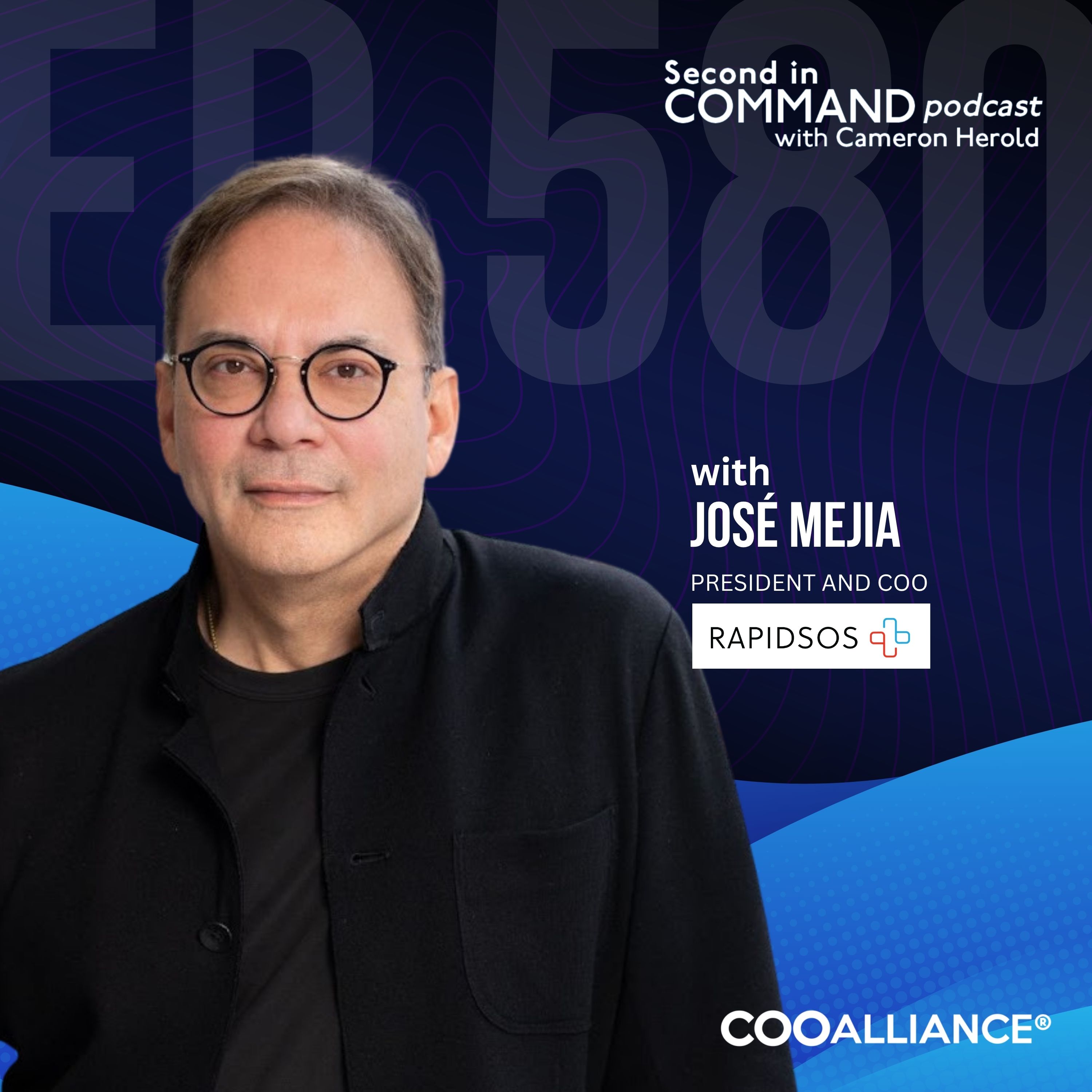
Second in Command: The Chief Behind the Chief with Cameron Herold
Ep. 580 - Rapid SOS President & COO José Mejia - Why Every COO Needs a Merlin-Style Leadership Edge
00:56:51
Loading summary
Transcript90 lines
- [00:00]
Jose Meja
And when you read the employee handbook, you know, on the one side you say, well, I want you to go see the Pope and call me afterwards. I want you to be like an owner. I want you to be like a Merlin. And then you look at the employee handbook and the employee handbook is like, okay, you are that we're here and, you know, we kind of distrust you. So, you know, so I have AI check every one of those. And basically the simple question is, does it sound like us? Is it us?
- [00:30]
Cameron Herold
Welcome to the Second in Command podcast produced by the COO alliance and brought to you by its founder, Cameron Herold. In the second in command podcast, we talk to top COOs who share the insights, strategies and tactics that made them the chiefs behind the chief. And now, here's your co host, Experience Driven growth strategist, former Chief Strategy Officer and author of no One Needs Another Company Mug. Lindsey Smith.
- [00:59]
Lindsey Smith
Hello and welcome to today's episode of the Second in Command. I'm Lindsey Smith and I am so honored to have our guest with us today, Jose Meja. He is the President and COO of RapidSOS, which drives the world leading AI safety platform connecting 500 million plus devices to 911. Growing up in rural Venezuela, receiving a Bachelor's of science from University of Michigan in Industrial Engineering, an MBA from Duke Fuqua, and an honorary doctorate from Arizona State. He has launched Bay Networks, Ariba, Grandada and scaled Lucent's global operations to over 80,000 employees in 70 countries with 48M and AS worth 30 billion. And as a founder of Unimos.org which has served over 30,000 kids, Jose blends operational mastery with purpose driven culture. Recently he achieved 174% ARR growth while championing ethical AI in public safety through harmony. He is also an Ellis island medal recipient and we are honored to have him in our show today. Well, Jose, thank you so much for joining us here on the Second in Command today.
- [02:11]
Jose Meja
Thank you. Thank you.
- [02:12]
Lindsey Smith
You're welcome.
- [02:13]
Jose Meja
I'm excited to be here.
- [02:14]
Lindsey Smith
We're looking forward to sharing your story with the world. And one of the things that has to be said is that you've come quite a long way from your upbringing in Venezuela and having $100 in your pocket at age 16 to being a COO with quite an impressive resume. And one can say that that happen overnight. I'm sure that there was some hard work, but talk to us about that journey. How did you get from where you were to where you are?
- [02:41]
Jose Meja
Well, thank you. It's been a while, but I still Remember a couple of things that are quite critical even in the culture of the places that I participate in. When I left Venezuela, I had never been in an airplane before, and we had paid for two months of English Language Institute so that I could learn English. So I did come legally. Okay, and then I had about $120. I remember one of the kids that I would train that was going to high school with me. His family was pretty wealthy and he had traveled a lot. And I said, well, you know, what do you think I should expect? And he said, well, Jose, just follow everybody. When you get in the plane and you land, follow everybody. And they're going to take you to this place where there'll be these big belts and the suitcases will come out, and then you're going to see these open sesame doors that open automatic. And you're going to see this yellow car and it'll say taxi. And just show the address you're going to and say thank you. And I said to him, well, I've been teaching you for three years, so if you can do that, I'm sure I can do that. And so I went into that plane and I walked to the bathroom maybe 10 times. I'm sure people thought I was sick, but I was just memorizing faces because I figured I better follow the people in the plane, not just everybody.
- [03:58]
Lindsey Smith
Smart.
- [03:59]
Jose Meja
And so I come to the conclusion of this but topic, you know, it was 11:30pm Philadelphia time I actually flew to Philadelphia.
- [04:06]
Lindsey Smith
You're in Philly.
- [04:07]
Jose Meja
It was at a time when airports would close. And so around midnight, we were one of the last flights. And my suitcase never came out. And it was one of my first crises. Right? This is a big deal if you think about it. You know, it's like, oh, my gosh, what do I do now? You know? And so it took a while to process it and think about how to get help and do it in a language that you did not even know how to speak it. And the next day, in the morning, I think about 10am My suitcase showed up. And I remember hugging my suitcase of happiness and telling myself, you know, anything is possible. You know, it's like, I could go to China now. So one of the sayings I have in most of the places that I've run and including at Rapid, is I tell people, I give them a license to execute. And the license says, if it's the right thing for the company, if it's the right thing for our culture, if it's the right thing for you, and we don't get in jail, go see the Pope and call me afterwards. And it comes from that beginning, you know, it was like this constant. And throughout my career, I've been in technology for a long time and have seen some incredible, incredible magic happen in technology. And so it makes you like, wow, the impossible is always achievable. If we could just get people focused on the problem solving because the purpose defines it and requires it. Yeah. So it was difficult time. I quickly learned I didn't have enough money to last. I worked in, I think five different jobs. Professor's cafeteria, the undergraduate library, the YMCA on the weekends. So it was like there were many jobs and there was a lot of pasta, parmesan cheese, because it was cheap.
- [05:58]
Lindsey Smith
True American collegiate experience. Cheap food, namely ramen noodles. Well, two things are true. I'm sure you've been on plenty of planes since that moment in time.
- [06:10]
Jose Meja
Oh, gosh.
- [06:11]
Lindsey Smith
Hopefully you haven't lost your luggage. But Philadelphia baggage claim is still awful, Awful, awful, awful. Who knows? All bets are off on that one.
- [06:20]
Jose Meja
Yes, I actually tend not to check luggages anymore.
- [06:25]
Lindsey Smith
I don't either. I used to spend a good deal of time on the road, upwards of 10 to 12 days a month and would be in six different climates. And I refuse to check luggage for that reason. You quickly learn that that is time loss that you could be spending on something else.
- [06:41]
Jose Meja
Yes. If you can fit as much as you can on your carry on luggage, you're going to be in best position.
- [06:46]
Lindsey Smith
Absolutely. So you get off the plane, you follow the people, you take the taxi, you find your luggage, you work all of the jobs and eat all of the foods just to keep yourself alive and afloat. And when did your career really start to take off?
- [07:00]
Jose Meja
Oh goodness. Probably during my first job working at IBM in the Research Triangle Park. I felt I was so lucky to get into IBM that point in time. There were no the startups of today and people wanted to work for a place like, you know, I don't know, Ford or General Electric and IBM was like the place to be. I felt very blessed that I had that opportunity. And then I was even more blessed by the team that I was with. I was with a team that I always use as an example of a great team because this team was sent to get our MBAs together at Duke University and the team helped each other. You know, we were working, we were getting our MBAs, we had a family and so we would do our homework, homeworks for each other, we would help each other if we didn't Go to class. It became a unified team that over 40 years we still meet and have been personal situations. And when you think about what that team has achieved, every one of the team has been amazingly successful. Amazingly like truly amazingly successful. And so it teaches you what a self directed team can do when they have a joint aligned goal, when they all like each other even though they're different, when they learn what are the strengths and weaknesses of each. And we help each other because we need to. It was very powerful. And so from that moment on, I think the connection with that thought process of that team and also some incredible mentors. I remember one of my mentors, his name was Charlie. I created an award called Charlie. One of the things Charlie would do is he would comment, okay, Jose, so what's the plan? And then you will go and you have the plan and you say, okay, well we think we can do six, say, you know, six turns of inventory or something like that. And he said, are you sure? I think you can do 10, you know. And he would push us to think out of the box, but he would push us in an enabling fashion. So this actually triggered me on something else that I wanted to share with you. I've always thought of the magic Merlin. Merlin with King Arthur, right?
- [09:18]
Lindsey Smith
Yes.
- [09:19]
Jose Meja
And I remember when I thought of Merlin, Merlin was always in the background. And Merlin yet was constantly enabling this King Arthur to be the greatest king there ever was. He's the one that convinced the king to dress as a normal human being and go into town and learn about the pains of the town. And I was so inspired by that in a way that I was thinking, you know, a great leader is like a Merlin. And nowadays even more so. Like, you know, our job is to enable people to be incredible, to be the best they can be, to do things that they didn't think they could do. You know, hey King, why don't you dress like a normal self and then go into the streets, you know, and eat their food. And so the other process of I think that AI is doing particularly for jobs like mine, it's enabling us to be more like a Merlin. More like people who can make others be successful and be creative and do out of the box and go see the Pope and call us afterwards. Because what AI does, most people would think about roles like mine, about KPIs and measure every thing there is and track everything and then goals. And so of course that's all needs to be done. But it's basic and by the way, it's all trackable and Done by AI.
- [10:40]
Lindsey Smith
Yes.
- [10:40]
Jose Meja
And so therefore, what is the role of leaders like us and how do we then redefine our role into this concept of being the Merlins that, you know, the world needs so badly? And I feel very engaged with that thought process. Even in what I do with rapidsos. I'm in love with what I do today and the company I'm in part of today. Because very few times can technology help save five lives every minute. I've been in six companies, from very, very large companies, you know, 60, 80 billion dollar companies, to startups that have grown to be very successful and they've done amazing stuff, but none have had the amazing impact that rapidsos is having so instantaneously. And so this purpose of saving, helping every human at their weakest moments and enabling those heroes to help them is such a powerful thing that for a leader is phenomenal because you look for purpose, right? It's like there's another key point is there's the Merling and then there is finding purpose because people love connecting to a strong purpose. It's a wonderful time. I'm enjoying myself more than ever today.
- [12:00]
Lindsey Smith
I think that's amazing. And I'm never going to think about a leader without them having on a magic hat like Merlin again in my life. And I know that sometimes when we're in a CEO or a second in command role, we have to act like a Merlin with the CEO, right? To kind of keep them on track and tame in some of their visions and help things. So why don't you talk to us a little bit about your relationship with your CEO and how you use your magic to help him shine his best and the company succeed.
- [12:29]
Jose Meja
So, you know, I also find myself probably in one of the greatest relationships of my lifetime. And I say this with so much in a very emotional way. The relationship I have with Michael, who is the founder of Rapid, is incredible. Trusting. Connect with each other. We fight and yet we love each other. We argue, we connect, we align, we think he's coachable, I'm coachable. We're very different ages. Okay, so typically I introduce myself as the senior citizen of Rapid sos, but we are very different ages and yet we are so helpful to each other. We jointly lead the company. I don't think we see each other or he sees me as the president and CEO and I see him as the CEO I actually see. I'm certain he would say this. We see each other as co leaders, helping navigate, helping find blind spots. We constantly have conversations when there is blind spots. I'M very quick. And he's also at connecting and saying, we got to talk about this. What do you think about this? There's this constant engagement, but even farther than that, we've come to a point where without, you know, when you're so connected with somebody that you can almost know exactly what the other one is thinking or doing. And so we are extremely aligned. I would say people in the company or even outside of the company that have seen us, they would say, wow, they're like one and the same in terms of their connection, how they come across. Even though they're very different people in their words and their engagement and their energy is different, there's real strong engagement between them.
- [14:31]
Lindsey Smith
And when you have the opportunity to be so aligned with your co leader, it really sets a tone for the organization because there's never friction, it's never, well, Ops wants this and the vision wants this. It's nowhere aligned, Right?
- [14:46]
Jose Meja
Yes. And importantly, it's the role modeling for that organization. Right. Because the organization is not sensing that there is. Okay, they're arguing or they're taking sides or even if they see us arguing, they see us arguing in this really very engaging manner. It's like we're almost co creating or brainstorming together, rather than I'm talking at you or you're talking at me or that kind of stuff, which I see quite a lot more unfortunately in many companies. And so, no, I think it's tremendously critical when we introduce ourselves. By the way, he says he's the founder, I'm the father.
- [15:30]
Lindsey Smith
That's funny. That's funny.
- [15:32]
Jose Meja
You know, and we all bring our different points of view. And you know, obviously I've been around longer than he has, so I have potentially a lot more things to that I can share in terms of living life and being thoughtful about blind spots. And we have our different points of views. I think I tend to be more of a censor about, you know, what's not being said. One of the things I've always done in companies is I introduce languaging and languaging as part of the creation of the culture. Right. And so, for example, one of those languages that we have is there's organizations that are in the battleground, in the common ground and in the underground. And when you're in the underground is, let's say you, Lindsay and I are talking and your little voice is saying, oh, I don't know, I disagree. But you don't say it, you don't express it. So it stays in the underground. And Underground is very dangerous in organization. What actually creates politics and it creates bureaucracy, and there's lack of open conversation, which is. So we talk a lot about the common ground. Are we in the common ground? Oh, Lindsey, sounds to me like you're in the underground. Are you in the underground? And people actually even joke about this. Right. And then the battleground is when two people actually hate each other. Right. I mean, I've been in situations where there's two leaders that people know. Be careful. So I actually see my role as a Maryland that is focused on creating an amazing common ground. And then I think of a culture more as a human being. So if you think about when we create companies, it's almost like they have a birth certificate, and it's like it becomes an individual almost, and it has its own rules, et cetera.
- [17:28]
Lindsey Smith
But, yeah, what's really interesting to me is looking at rapid sos and all of the AI, most of your conversations have been around the human. And I think that there's such a misconception in the world about how AI is going to take over everything. But would you agree that there are some things that AI will never replace?
- [17:51]
Jose Meja
Absolutely. I mean, you know, I can't say the word never per se, but my view is like anything, AI is a very significant transformational tool. And it's more than a tool. It is an enabler. When I think about it for myself, for example, I literally use it constantly, every single day. It does research, it does analytics. For me, it does content management, goes and senses what may be going on inside different groups so that I can get insights around. Oh, you know, maybe I need to intervene or maybe I need to send a message there, or maybe I need to help with here. Right. And all within the context of this Merling individual. Not necessarily to control, but more to enable the flow. Right. And I think one of the things that AI provides us is a lot of that transactional, analytical, even insights works that actually helps me and enables me to be a greater Merlin. And I think the world needs to think of it that way, in my opinion. And I don't perceive. I think, you know, I don't know about you, but I always love when I call for help and I get a human on the other line.
- [19:03]
Lindsey Smith
Oh, my goodness. My favorite thing is that, you know,
- [19:07]
Jose Meja
I mean, and what we got to do is help that human enable that human. And we actually do this. We do this today with all of our customers, where, you know, the 911 operator or the first responder is listening to a call, an Emergency call. And we're providing in the background, harmony, which is our AI is providing insights, and it's providing, oh, you should think about this. Or maybe they're in a Tesla car of model from 2020. And then there is information about they need to know. And instead of me having to go search, the AI is already giving it to me. Do you see what I'm saying? So it's enabling me. Right? That's powerful. That's a powerful way of using this.
- [19:48]
Lindsey Smith
How have you seen the AI piece transforms, specifically this emergency culture in which you're working?
- [19:58]
Jose Meja
Oh, dramatic. First, I just gave you one of those examples. But, you know, we've had examples of emergencies that have occurred where, you know, one that comes to mind is a mother with two children. They're driving in an automobile. They have to get off the road because another car is coming at them. They go into a lake. The car is going in the water. The windows are closed. She cannot open the windows. The car has given us already alerts about, you know, what's going on. We get text messages, we get videos, we get camera phone calls. The lady calls 911. By the time she's calling, we already know where she is. We already know what's going partially what's going on. And the moment she starts talking about the problem she's having, the AI has already researched a lot of this information is providing input to that 911 operator about what to say, what to ask, how to guide them, how to provide them with the right thought. Process is powerful inside our company. I use it to, for example, even just kind of monitor cultural alignment. And so, you know, track. When we do documents, when we do processes, does it connect to who our culture is? Are the words used by that process words that people would say, yeah, that's rapid sos. That sounds like rapid SOS because what you see many times is people talk about culture, for example, and yet they go and create processes and structure or employee handbook. And when you read the employee handbook on the one side, you say, well, I want you to go see the Pope and call me afterwards. I want you to be like an owner. I want you to be like a Merlin. And then you look at the employee handbook, and the employee handbook is like, okay, you are that we're here, and we kind of distrust you. So I have AI check every one of those. And basically the simple question is, does it sound like us? Is it us? Do those words represent what we say we are in the world? Okay? And it's amazing. It's amazing. The information that I get, that's unbelievable. Even studying and analyzing presentations to customers. And so you look at the presentation and you go like, is this presentation creating the impact not just in terms of the product itself, but in terms of who we are as a person called rapidsos. Right? Obviously, we use it for just tracking. We're a very huge data player. So we have billions and billions of data elements that we analyze literally all the time. We manage over a billion emergencies as of the middle of last year, almost 1.2 at the end of last year. And so that gives us tremendous amount of intelligence. And so the other thing that AI does for us is it goes and understands the ideosyncrasies of these emergencies. What happens, what the voice says, the content of the voice. And even internally, as my people are working through and the teams are working through, I can see, are they engaging in the common ground? For example, I can ask questions like that we have this color scheme that I have. Everybody is something I remember doing many, many years ago. And there's like, blue, green, yellow, and orange. And so. And these represent almost like personality traits. So think of it that way. So a yellow person is very structured. A yellow person likes to plan everything. When I'm talking to Lindsay, and Lindsay's yellow, she's already creating a detailed plan, and she's already worried about it because it's like, oh, my gosh, we gotta do all this. We gotta do this. We gotta do. And so they're worried people, right? And they follow rules. Well, orange people are very different. They are entrepreneurs. They just like to go and they launch themselves and they trust themselves, and they know they'll figure it out. Okay, well, here's what happens if you don't appreciate. Let's say I'm orange and you're yellow. You may look at me and say, jose doesn't plan anything. Oh, my gosh, he's a mess. Oh, my gosh, I hate Jose. Right? And then I would say, Lindsey drives me crazy. She's always asking me for all these details. And so the understanding that, no, it's not that I hate Lindsay, it's that Lindsay, that's the way Lindsay is. And the question is, how do I help use her strengths in our company? We all know our colors. We literally all know our colors. And it's mostly. And we even talk about that when it comes to customers or partners and say, are they very green? Okay, they're very green. How could we talk to them in a way that they. With what we're Saying, right, because even though I may be speaking English, you may actually be absorbing it in your own way, which could be quite different.
- [24:57]
Lindsey Smith
Right, right.
- [24:59]
Jose Meja
And we use AI again to help us with all of these traits and give us insights about how we're using these things.
- [25:06]
Lindsey Smith
Are you using a single AI platform for all of these different tasks or do you have different platforms?
- [25:11]
Jose Meja
Not right now. We're using different ones. Yeah. And so obviously we use different ones for a lot of our coding and product and engineering pieces. And even there we have different types. We use some around the analysis, for example, of all of our Slack messages and Google Documents and stuff like that. So there are different ones. And it's an evolving space. Right. I mean, one of the things that is for sure, it's very powerful. And there are many, many of these companies trying to come up with it. We ourselves are an AI company in how we provide the information, the insights that we provide, but internally we use other tools to help us with this.
- [25:54]
Lindsey Smith
Yes, well, I think that goes back to the human element. Just like you and I may not be fit for the same exact role because our personalities are different. The AI tools all have their own personality, and so you need to get the right one to fit whatever the job might be at that moment.
- [26:12]
Jose Meja
The other thing to think about is that if we think of AI in terms of personalities, let's say Lindsay number two and Lindsay number two could be the AI that is the best Merlin and partner for Lindsay. Lindsay number two has to appreciate what your colors are, how you engage, the words you use, the background you have, the experience you have, so that Lindsey number two can also coach you and provide. So this is a very interesting part of the equation because now you got AI as almost like your co partner, friend that is engaging with you and providing feedback and coaching and giving you insights as to things to think about and even just saying, remember, Lindsay, you're pretty yellow, okay? You're going to talk to these people and they're very green. And so I suggest, based on the typical things you use, that you change to this way. That's powerful, right?
- [27:13]
Lindsey Smith
No, that makes a lot of sense. And I think that going back to the concept that AI is going to evolve and take over as many things as it can. When you think about it as an augmentation of the humans and of the team and of the processes, it really just gives us that ability, back to your analogy, to be greater Merlins, to have more cool skills in the toolbox, to be able to create more of an impact completely.
- [27:41]
Jose Meja
Now let's talk about that because I'm getting emotional about this topic. But this is what I was saying earlier. It's like it's helping people like myself be a greater Merlin. Because now it's not just me helping Lindsey. We got, you know, in all ways. We typically will have hire sometimes coaches, right? To coach people or coach some leaders, et cetera. Here we have this incredible powerful set of AI individuals that are getting insights and knowledge. And if we think about it as a way of. Now I have even more ability to make Lindsay and this incredibly amazing human being, right? The best queen there ever was, the best king there ever was. Right? And I'm the Merlin together. And now I have my group of supporters which are these AI activities which are also helping Lindsay not only on an ongoing basis, right? And that all then elevates my role. It actually puts more pressure on what I do and how I do the job as a key leader of the company.
- [28:54]
Podcast Announcer
If you're the COO of a company based in the USA and Canada and you do at least 2 million or more in revenue and you'd like a free copy of my newest book, the second in command, go to cooalliance.com downloads or, or just go to the right nav bar and go to the download section and we will send you a free copy of my book the second in command, including shipping. Just go to coalliance.com downloads sign up and we'll send you a free copy of my newest book, the Second in Command. All we ask is you go to Amazon when you're done and leave an honest review. We hope you love it as much as the thousands of others are enjoying it as well.
- [29:38]
Jose Meja
I'm right now able to see instantly the status of things. The track, the trending of things, the analytics, the numbers, the KPIs. I can see them instantly because it goes and checks every single one of the systems we use and everything. And so spending even a lot of time thinking through that versus what are the challenges that are getting in the way of people being incredible? Are they using the license to execute enough? Are they in the common ground enough? Are they behaving in this culture of purpose? I want to go deeper into this side of purpose. I mean, in most, I think we don't appreciate as leaders the criticality of having a strong purpose. You know, in the case of rapidsos, thank God the purpose is so evident. You know, it's like you're saving lives. You know, there's five lives every minute. When I go visit customers this is one of the only companies where customers always hug me, always. And it's incredible the emotional side of this, but the purpose itself drives the company. It's inherent inside, it's in the DNA of the company. There are places and times when you have to lead companies that doesn't come across as easily and as openly. I remember one of my opportunities to lead was at Lucent and it was at a time when it was 2000. 2001 is a tough time for all of these tech companies. There was a bubble problem. And I remember having people meet me at the laboratories where something incredible was created. Or we had this little space where we would show all the patents that Lustin and Bell Labs had created. It was like the satellite or the transistor. And I remember I would have meetings there and I would ask people, let's just take a second to just see what surrounds us. And you go, can you believe the transistor was created here? Isn't that an amazing, incredible reason to make this place powerful? You looked for opportunities to create purpose. Right. And so because people, you know, all of us, when we are, we have our brain side and analytical side and our pragmatic side. But when we connect that to this emotional context of we're doing it because it's the right thing, because it makes sense, because it's a powerful thing to do, that purpose will drive us to do the impossible. I see that AI actually helps me even more. So elevate what I am and then figure out more. How do I multiply the opportunities? Right.
- [32:26]
Lindsey Smith
If you look at rapid sos, your purpose as you mentioned is evident. You're saving lives. And when you're involved in such a high stakes business, there's a lot of weight on your shoulders, I would imagine, as you're making decisions because quite they could be a matter of life or death. How do you navigate that inside your own role and then how do you permeate that throughout the organization?
- [32:50]
Jose Meja
Great question. Because it comes back to decisions and many decisions. You know, obviously we're a business and like every business you want to, you know, be profitable and make money, all that kind of stuff. But I do believe that there is a higher level question which is very related to purpose. And so in a case like ours, specifically when you're saving lives and is in, let's say 911 center or a first responder or one of our people needs something and it's a no brainer, it's like you go to your purpose. It's like we're Here to help every human in the world at their weakest, most vulnerable moments. Okay? If we're here to do that, okay, and you need that, well, go get it. You know, that's the point of go see the Pope and call me after you see the Pope. You see what I'm saying? It's like you don't vacillate. You don't vacillate. And I actually rather take the risk that people may make some mistakes or may decide something that maybe was overly. I'd rather they do that than not because the purpose demands it. And so we've done a lot of this conversation in our own companies. Like, you know, how much of what we provide to these centers do we charge? Can we charge them what we charge them? Are they able to do it or not? What about the organizations that cannot charge, that don't have the money? What about the organization, you know, what's our purpose? If we're actually after helping everyone that is in these vulnerable moments, then we need to do the right thing. And so that's when purpose becomes critically important. And the organization is constantly looking at you and saying, is he talking? Is he deciding? Is he thinking? Is the strategy connecting to that purpose? The words and the actions don't connect. Right.
- [34:43]
Lindsey Smith
How many employees are there in rapidsos?
- [34:46]
Jose Meja
Over 500. 500 employees.
- [34:48]
Lindsey Smith
And so I would imagine they're remote. They're not all together.
- [34:51]
Jose Meja
We're very virtual. There are areas of the company where there are more in, you know, like for example, we have a lot more people in the New York area, We have a group of people in the Bay Area, but it's an extremely virtual organization. It's an interesting question. I'll ask you. You know, I've gotten a lot of pressure over the years to, you got to come, you got to come every Tuesday or Wednesday. You got to come three days a week. And I remember telling myself, if I believe in self directed teams, if I believe that people are here for the right purpose, if I believe that they are like me wanting to be this an amazing success, why don't we allow them to participate in that conversation? So some of the conversations we have is, hey team, how do you feel when you are only talking to people on the video versus, you know, in person? You know, wouldn't that be cool if you actually, you know, and so can I get them on their own to make the right decision rather than me becoming dictatorial and saying, okay, you all better show up every Tuesday and Wednesday, okay? And then when in reality, what I want them to do, obviously is develop the personal relationship, but also problem solve together, you know. And so, you know, I'd rather that the self directed team working on a particular solution jointly comes together and meet. I'm more comfortable supporting that and even supporting the travel necessary to do that.
- [36:17]
Lindsey Smith
Speaking of travel, how often are you on the road and are you visiting your teams?
- [36:21]
Jose Meja
Oh my gosh, a lot, A lot. I'm glad that I have two wonderful adult children and they're doing great and I don't have a family set of issues, you know, but in a place like this and well, first all, I've always traveled a lot. The reason I travel a lot, to be completely honest, I remember thinking, how can you lead from an office and not going to the streets? So think about Merlin and the king, and the king going into town and eating the food and sensing the experience and you know, what kind of trouble are they dealing with. And so I love to experience the field experience, whether it's what the customers are sensing or what our own people, more importantly are going through and having to deal with. And. And I spent a lot of time appreciating that. And so I am on the road easily. Oh my God, nine months, ten months, a year, easily. Seriously. I think since December I've been at home potentially no more than a week.
- [37:28]
Lindsey Smith
Wow.
- [37:28]
Jose Meja
I'm not suggesting that's perfect, by the way, it works for me, but I love doing it. There are times when I do feel okay, you know, there's another piece because I've been around quite a while. I have friends everywhere. So, you know, the other thing I do is whenever I travel, I don't know if I'm in Orlando or in Miami or Chicago or in Detroit or, you know, Dallas. Then I take the opportunity to balance the stuff that I gotta do in this incredible love job that I have with reconnecting with friends. I'm a very friends and social individual. And so, you know, I haven't seen Lindsey in a while. Hey, Lindsay, are you around? You know, you want to have coffee, say, oh, Jose, you're around, you know, and so it's like this, it builds up this balance and thoughtful socialization that I think also provides you as a role model for the organization because you do want an organization that cares for themselves, that it connects with their family. That I am typically somebody that will constantly see if somebody is like, wow, okay, we got an individual that's working really hard and you know, I know that they maybe had just had a baby. I always know when somebody has had babies and. Or I always know when somebody has gotten married or their children has gotten married, and I send cards, that handwritten cards, and then I'll send them, you know, special awards. And so I love doing that, love doing it. And I think partially is to provide the incentive that this is a place that cares. This is a human. RapidSOS is a human, it cares. And so we have to demonstrate that it cares. And in and of itself, the Merlin that is actually helping that king in the good times and in the bad times, or in having complete 360 space as a human, these things become even much more critical in the AI world because it gives me, I have now more time to think about that, right?
- [39:23]
Lindsey Smith
You have time to do the things that the AI can't do. The AI can't write the actual note, right? They can't take it to the post office, at least not yet.
- [39:33]
Jose Meja
Or even calling somebody's spouse or somebody's daughter, right? Can't have the AI do that and say, hey, Lindsay, I heard your daughter just got married. That's exciting. Wow, what a wonderful thing. Or you just had a grandkid. Oh my gosh. We have like a slack channel, for example, with all the kids and all the babies and everybody shows them up. I love babies, I love children. And so I tell people, if you're having a bad day, if the black hole is getting you, two things that I say, if black hole is getting you, go have a Margarita Jose. If the black hole is getting you, go check one of those pictures of babies. Because the moment you see a baby picture of somebody you care, you smile. It's like instant, right? And the smiling process, believe it or not, opens the space. It makes you be able to problem solve much faster. It allows you to even be more social. Because now the smiling, you're in a better mood, you're in a better space, right? And so if I can create every lot of smiles, it creates the opportunity to be a significantly wonderful company that problem solves, that is very focused on humanity, that, that we have to be human. Especially in rapid sos, we have to be a human company.
- [40:47]
Lindsey Smith
I think the fact that you are virtual, right, with everybody spread out in all different areas, those human elements become even more important. Because when everybody was in one room, you could have a stand up meeting, you could have lunch together, you could do all of the things. But when people are spread out over the country, you have to find ways to still connect with them. And Dale Carnegie said one of the most important things that a person will ever Hear is their name. And the more you can recognize them on that personal level, the better off at the end of the day they're going to be. They're going to feel, you're going to feel, and then both of you are going to perform. So I really love those personal connections. Handwritten notes are a big one on my part as well.
- [41:32]
Jose Meja
Again, the elevation of the leader to be more so than ever. This Merlin think about. Merlin also created magic, right? And so if you can create magic for the people that work with you and their loved ones, can you imagine the power of that? It's powerful. And so I can't not overemphasize how much we more than ever have to think about the enabling of these incredible humans to do the very best things they can do. Think about the little suitcase that I lost, right? And then the next day I go, I hug my suitcase and I go, I can go to China now. The power that comes from that process. And if I as a leader can be there as that Merlin, watching Jose through that process, and then I'm saying, yes, Jose, powerful, yes, you can now go to China. What I've now created is an individual or a team that feels so powerful that they can do anything. They can do anything. And that is power and that is amazing energy and that is an amazing culture.
- [42:57]
Lindsey Smith
Jose, if you're looking at somebody who is saying, you know what? I think I want to ascend, aspire to be in a second in command role. I want to be a coo, I want to be a president, I want to be whatever it might be, what advice would you give them?
- [43:12]
Jose Meja
Yes. Well, first of all, certain things about you as an individual, stay vulnerable. Vulnerability is power. Don't try to show off that you are the knowledge of all. And in fact, your job is to create trust and to create culture or an environment where people can actually learn from their vulnerabilities. The second thing that I would say is, be that who you want to be already like I am somebody who is actually opposed to the way most performance management structures are in organizations where a manager has to grade the performance review for Lindsey and Lindsey and I actually believe we should be self directed people. You know, my mother used to say, Jose, your life is in your hands. And so I own my development, I own my future, and so act accordingly. And think of your boss more as the Merlin. Develop your plan of attack, develop what you can do. Take an action and actually think of the going to the Pope and make that partner which is your boss now, now truly becomes Somebody who is in with you in the creation of that uniqueness and powerful self. So I would say on your destiny, don't wait for others to tell you what to do, but listen to them because you're vulnerable and engage them in the process of being a great human and then connect with people. I used to be, when I was young, because that's, you know, how I save for the $120 is I would teach mathematics and physics and chemistry, and I was a bit of a geek between you and I, like, I really was more geek. And as I started learning to work with people and lead people and manage people, I. I became so appreciative of the connectivity. I want Lindsay and I to have a trusting relationship. I want Lindsay and I to know that I'm there and here for her no matter what. And sometimes that may be difficult conversations where I have to kind of share with her certain things. Difficult about me or difficult about her. But I do it in the common ground. Right. And so the common ground is a place where you're still connected. You're still almost hugging each other in a way. So I think these individuals need to appreciate that. They need to connect. They need to learn about each of people. Whether you use the colors or Lindsay is very yellow. How do I engage with her? How do I get her to appreciate that I'm here for the best of both of us. Vulnerable. Own your own destiny. Act already as if you had it within that vulnerability and create amazing trust all along, everywhere. Do it for the right reasons. And so I think if you do those things and you're hug new stuff, like AI, for example, hug it. You know, don't look at things as walls. I always have these stories as, you know, the greatest talent doesn't see a wall. The greatest talent expects it, but it's not a wall any longer. It's a big, beautiful redwood tree. And they hug the tree and they go, okay, what's the tree? What's inside this tree? Who lives in this tree? How big are the roots? How deep are the roots? So if you can do that, I mean, I think that I would love to hire you.
- [47:04]
Lindsey Smith
I love that. I love that so many of our listeners have those characteristics. Reach out to Jose because he would love to bring you on board. Jose, you are a very educated man. Is there a book or two that stand out to you that are something that someone should read if they're looking to continue to grow as a leader?
- [47:24]
Jose Meja
Yeah, you know, I had old friend of mine, he's no longer Around. He used to be the CEO of Intel and he wrote this great book about transformation and just kind of like doing things and always thinking out of the box. And I love reading books that are experiential and transformational. There's another one that comes to mind and actually there's a movie about it. It's called the Soul of Fire. And I remember reading the book, then later I saw the movie and then I decided to contact the individual. And the reason I loved it is because it was a story of crisis and how someone in the group of people that surrounded them created an opportunity for this person to be amazing. This is a person who his entire body, third degree burns at the age of 90.
- [48:14]
Lindsey Smith
Yes. I just watched this movie. I just watched this movie last week.
- [48:18]
Jose Meja
Oh, yes. It's powerful, right?
- [48:20]
Lindsey Smith
Yes.
- [48:21]
Jose Meja
I remember reading the book and then I remember seeing the movie and then I sent him a message and I said, oh my gosh, you know, like we should connect. And it's like, you know, they cut his fingers because they had to. And yet he plays the piano.
- [48:36]
Lindsey Smith
Yes. And his face is perfect because his sister put the water on his face.
- [48:40]
Jose Meja
Yes.
- [48:41]
Lindsey Smith
His face didn't burn. Yes.
- [48:42]
Jose Meja
Isn't that powerful?
- [48:44]
Lindsey Smith
Amazing. It was an amazing story.
- [48:46]
Jose Meja
I love stories that connect the dots with all the things we've talked about. If you think about it, even in that there was the individual, that was the radio person in the baseball stadium. And the guy would come and tell him, you will survive, you will do this. Right. And he would hear the voice, the kid would hear the voice and say, oh my gosh, I can't believe who he's talking to. Me. And eventually think about all the connected dots and how all these pieces connect to everything we talked about, Right?
- [49:19]
Lindsey Smith
Yes.
- [49:20]
Jose Meja
Love those books. Love those stories. Totally love those stories. One of the things I have shared with our organization is can we create a book of an amazing culture that is not written by an ex CEO or not written by a professor, but is in fact written by us?
- [49:41]
Lindsey Smith
What did they say?
- [49:42]
Jose Meja
We're on it. And just like that, people want to read the stories like stories, Right. Because they give you experiences. Right. I always thought is another interesting thought. Like I did it with my children and I always remember asking myself, can I give them an experience that they can talk about when they're in their 30s or 40s? Like, if I was able to do that, I was successful. Because it's like, I remember we did this with dad and we did this. This is how I learned how to cook. And this is how I learned those are powerful experiences. And now if I bring this back again to the role of a leader in the world of AI, I even have a bigger opportunity to create amazing experiences, like, huge. And so, yeah, when I bring our people together, it's about, can I give them an experience that recently, my leadership team, we were talking, where do we meet? And I remember telling Emily, who's our chief of staff, Emily, I want to meet in Chicago. So you want to meet in Chicago. It's too cold in Chicago. I want to meet in Chicago. And I said, why do you want to be in Chicago? Well, I went last July, I went to the Magic Cabaret. And in this Magic Cabaret, it's like a speakeasy initially. And then you go in, and then you experience magic, you know, and some incredible stuff I had to tell you. It's like you go, like, how the heck did he do that? How did she do that? And then the connected point was, to me, the Marilyn. And then you think about technology, everything we've done in technology. I mean, I'm one of those people that there was no Internet, there was no cellular phone. And I've been very involved in these things. I was involved in the company that created pretty much data networking, Rat Bay Networks, and I was involved in Lucent Bell Laboratories. It created all the wireless bands and satellite stuff. But at the beginning, this is like magic, right? If you think about it, it's like, what you're doing, what it's like magic. And so I wanted them to experience magic and connect magic to Maryland and then connect that to our role, not only with our culture and our people, but with all those incredible people that we support, all of these customers who trust us, all of these. And especially in this role, it's like. Of saving lives. It's emotional and powerful. And so more than ever, we have to be able to do this. And so, yeah, anyway, so creating experiences, right? It stays with you. You know, it's like, how many companies have I gone or leaders have I gone that took me to a Magic Cabaret and then connected that? So I was thinking of that. You see what I'm saying,
- [52:35]
Lindsey Smith
Jose? It's like you are inside of my brain. Because my favorite word in the entire world is experiences. And every single thing that I do and everything that I say, I cultivate it into some sort of an experience. Whether it is a trip or whether it's a staff meeting or whether it's a retreat, doesn't matter what it is. There is always some level of experience. So I really Love that we share that in common. And having been all over the world as you have been, what would you say has been the most unique experience you've ever had?
- [53:07]
Jose Meja
Oh my gosh. So many right now. I mean, I'm gonn. Well, I'll tell you one. So I went to San Pedro de Atacama, which is in the northern part of Chile. And the reason I wanted to go there is because the sky, it's the place where you can observe stars the most. The largest telescope is there. The hiking is unbelievable. And I landed in San Pedro de Atacama. My intent was to go on these hikes and just sense the place. And. And it also allows me to be creative and think about stuff. The second night that I was there, there was a shooting in San Pedro de Atacama.
- [53:46]
Lindsey Smith
Oh, no.
- [53:47]
Jose Meja
And about, I believe it was four people who got killed. And it gave me an opportunity to also go into the San Pedro Atacama town. And almost like, what do you use? Like, you know, do you have a 911 center? Do you have. What do your fire people do? How do they use that? And even that experience allowed me to come back and talk to the culture and the people of Rapid SOS about there are billions of people waiting for us to help them in this incredible purpose. But I loved the fact that when I went and did this, I had this opportunity to see things in the world that are so beautiful and unique and people were very helpful and social and the guys that were taking us through all these hikes, it was very much a place where I feel I grew up by being there. Right. And so feel extremely blessed. I should write a book on that. I think over the years I have traveled close to 11 million miles.
- [54:55]
Lindsey Smith
Wow.
- [54:56]
Jose Meja
And. Which is crazy. It's truly crazy to think about that. One of the favorite questions people have when I'm talking to them is like, where in the world is Jose? Remember where in the world is car in San Diego, that trip. Yeah. So I get that a lot.
- [55:13]
Lindsey Smith
So, Jose, what would you say to your 16 year old self in closing?
- [55:17]
Jose Meja
You were blessed. Incredible family, parents that cared and gave you an experience that you would have never thought was possible. You have being so lucky to meet such an incredible number of people worldwide that I want to thank if they're listening to this. I really want to thank you for all the support and all the help you provided over the years and just. Yeah, just keep smiling, Jose.
- [55:51]
Lindsey Smith
Well, Jose, you are quite the Merlin and it's been a joy to hear your story about what you've done and what rapidsos is doing. So keep creating the magic, keep focusing on the experiences. And thank you for sharing your story with us.
- [56:08]
Jose Meja
Oh, thank you, Lindsay. I appreciate the invitation to do this with you. I appreciate it. You keep smiling.
- [56:14]
Lindsey Smith
Thank you.
- [56:15]
Cameron Herold
You've been listening to Second In Command, brought to you by COO alliance founder Cameron Herold. If you enjoyed this episode, please be sure to like, share and subscribe to us on Apple Podcasts, Spotify and our other podcast streaming platforms. For more best practices from industry leading COOs, visit COOAlliance.com.