← Second in Command: The Chief Behind the Chief with Cameron Herold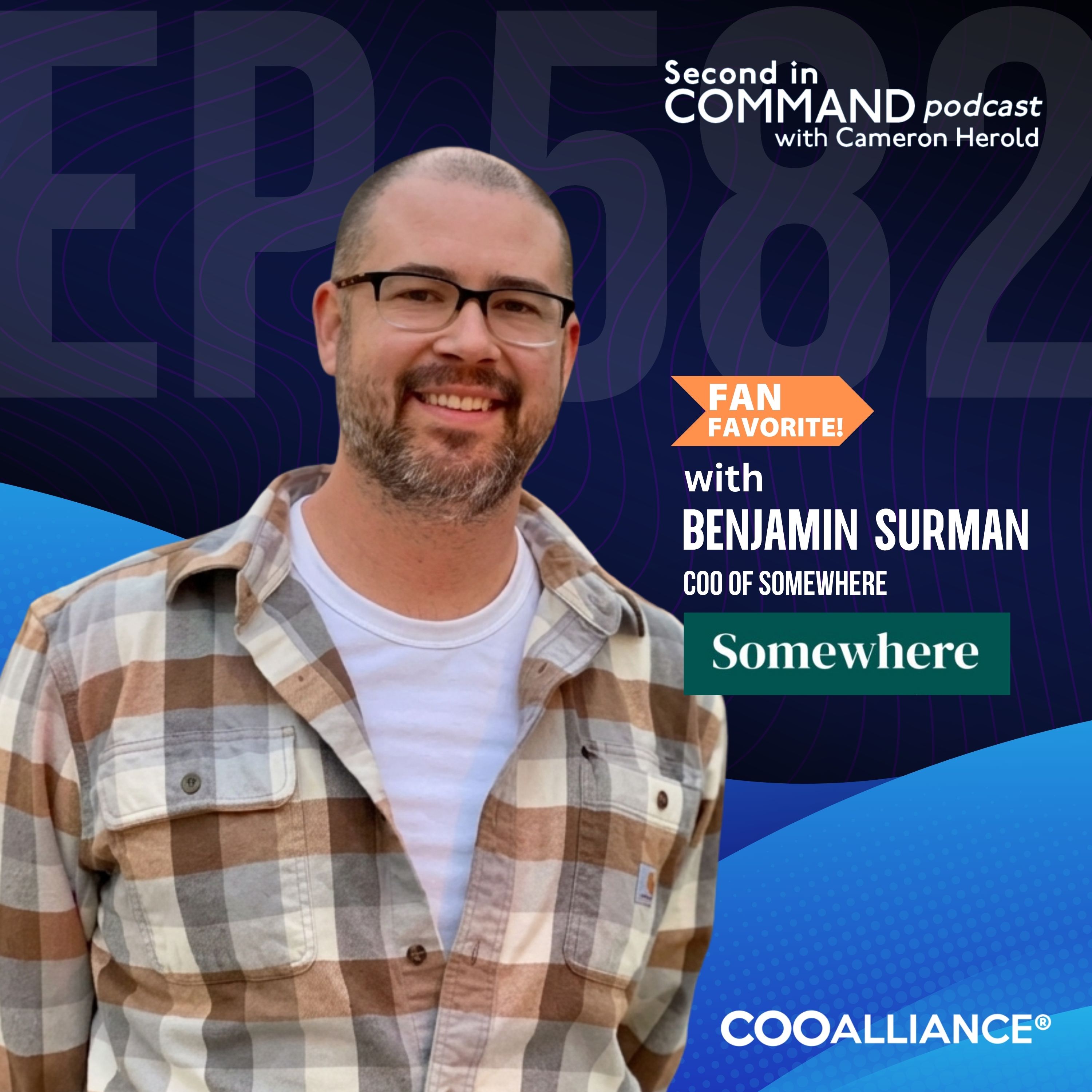
Second in Command: The Chief Behind the Chief with Cameron Herold
Ep. 582 - FAN FAVORITE | Somewhere COO Benjamin Surman – How Top COOs Slash Headcount and Boost Profits
00:38:44
Loading summary
Transcript90 lines
- [00:00]
Cameron Herold
Hey there. Just a quick note before we dive in. This is actually one of our older episodes, but we're bringing it back because it's one of the most downloaded ones we've ever released. Clearly it struck a chord with a lot of listeners, and I know there's so much value packed inside. So whether you're hearing it for the first time or revisiting it, enjoy this fan favorite.
- [00:23]
Podcast Narrator
Welcome to the Second in Command podcast, produced by the COO alliance and brought to you by its founder, Cameron Herold. In on the Second in Command podcast, we talk to top COOs who share the insights, strategies and tactics that made him the Chief behind the Chief. And now, here's your host, Cameron Herold.
- [00:48]
Cameron Herold
Our guest today is Somewhere's Chief Operating Officer, Ben Sherman. Somewhere used to be called Support shepherd, and I first learned about them through Sean Puri on my First Million podcast, which is my favorite podcast out there. Other than the Second Command, Ben is an experienced operations leader. He excels at spearheading strategic initiatives that drive significant revenue growth and align with the core organizational goals. What that really means is this guy can scale a company. They've gone from about a million dollars in revenue a couple years ago to around 25 million this year and expect to hit 50 million next year. His expertise lies in launching and optimizing new programs, seamlessly integrating them to enhance operational efficiency and productivity. He basically can automate the heck out of any business and really get incredible growth. At one point they were up 220 employees. He got them down to 175. Getting rid of 55 people because of optimization and automation and processes, got huge profitability and scale and growth back into the business. And now they're continuing to add people as they continue to grow. You're going to love his insights into global expansion, into hiring people in multiple markets like the Philippines and Latin America, and also in automating any kind of a business to get rapid growth. We'll see you on the inside. You can also watch this episode on our Second Command podcast YouTube channel. So, Ben, welcome to the Second In Command podcast.
- [02:14]
Ben Sherman
Thank you. Thanks for having me.
- [02:15]
Cameron Herold
Yeah. Looking forward to learning from you today. And I'm really looking forward to hearing about some of the kind of rapid growth you're going through. Just before we went live, you gave me a couple of key numbers that I'll get into in a second. But before we dive into the growth and how you've navigated the growth, why don't you just tell us a little bit about the company somewhere? What? What you guys focus on kind of what's your reason for being and then we'll dive in from there.
- [02:37]
Ben Sherman
Yeah. So we just recently rebranded somewhere.com formerly we were Support Shepherd. We are a global head hunting agency helping companies find great talent somewhere in the world. And that's why we've ended up rebranding as well as somewhere.com.
- [02:54]
Cameron Herold
all right. And so the supportshepherd.com I mean, when I first heard about the brand, I won't exactly say why at this certain point, but I'm going to bring them up in a second. But your, your founder has a pretty good megaphone. Was able to talk about it a lot. Why did they change the name over? Was it because. Was it clarify or was something confusing about the name Support Shepherd? What was there?
- [03:15]
Ben Sherman
Yeah, mostly to clarify. There's a lot of people who obviously the domain was support Shepherd.com. the brand name was Shepherd. Never really stuck. You got legal agreements that says Support shepherd llc and then of course, just the constant typos of Shepherd. I've seen every variation of Shepherd. So that was really the big driver. It's just like, let's get a single word domain. Let's rebrand to where people can easily remember us whether, whether they like the name or not. It's definitely stuck. And we have seen because of that a change in our business. But ultimately it was just confusion and we had to get that corrected before we continue to keep growing.
- [03:56]
Cameron Herold
It's interesting because when I first heard about the brand and heard about the business, I love the idea, I love the business model and I didn't love the name and I wasn't sure what I didn't love about the name. And I, I kept throwing that to the side saying it doesn't really matter. They'll be successful on their own. It's kind of like, you know, what's a Volvo or what's a. You know, why Apple? Like Ford was a guy's name. Like it doesn't really matter. But I, but I like that you have done the rebrand. So you got involved in the organization a year ago. You came in originally, you were a contractor. What were you doing at the time? And then how have you migrated so quickly into the CEO role?
- [04:30]
Ben Sherman
Yeah, so I actually, I started back in November 2021 as a contract just with Marshall to help him streamline processes. At the time, everything was running out of a Google sheet airtable. It was very rough. If you. So I helped come in like, well, let's just uncover this message you have and start Building out some processes, start implementing tools, so on and so forth. That led into just more of a growth role. And then later on I was basically at the point like, hey, I think I've done everything I can do for you as a contract. I'm going to move on. Marshall came back, said, hey, how about you become our coo, run this thing full time and just take the reins and do what you need to do to, you know, continue to grow this thing, as any CEO would probably do. Have less, less day to day, just tell me what's good, what's bad. And that's what I did. So I came on a COO and just continued to grow the business.
- [05:29]
Cameron Herold
Okay, so you joined the organization, kind of doing that consulting work around projects and SOPs and, and that was right in the middle of COVID Or towards I guess the tail end of COVID No, I guess right in the middle of COVID Really. So I'm sure it was a remote role at the time, right?
- [05:45]
Ben Sherman
Yeah.
- [05:45]
Cameron Herold
And.
- [05:46]
Ben Sherman
And the whole, the whole business is remote. Okay.
- [05:48]
Cameron Herold
It's still remote to this day.
- [05:50]
Ben Sherman
Yep.
- [05:51]
Cameron Herold
Was it, was it because you were able to kind of in a meritocracy style way, you know, prove your value from the work that you were doing that got you noticed or how were you able to get noticed when. Or did you even worry about getting noticed when you were just doing contract work?
- [06:05]
Ben Sherman
Yeah, I really wasn't concerned about being noticed. Also have a government business, contracts, a few other investments here and there, but it was more so just Marshall's actually lives 10 minutes for me. So while we're remote, we're not. The two of us are not. It was friends through DM type of situation. One thing led to another and I was most definitely never concerned with a full time role or moving on. But to your point, it was very much just seeing what was happening to the company. All because of the changes that I was making, conversations that I was having, tools I was putting in place to the point where it's like, hey, this guy doesn't know what he's doing. Just let him run with it.
- [06:49]
Cameron Herold
And do you think there was some value though, to being able to spend that time in person? The fact that you were 10 minutes away and based on your answer, do you look for to try to hire some people where you can have more FaceTime than we're able to do just via Zoom?
- [07:05]
Ben Sherman
Yeah, that's a great question. I do think there's value in Belly to Belly, if you will. I don't think there that it's necessary on a day to day basis. I would say that when I, whenever I did meet with him, as any CEO is busy, we got a lot done in a short period of time, just in person, within a two hour window. Like here's, here's all metrics that are happening. Here's what we need to do, here's where we're going. We iron it out there, right? In terms of people we're hiring now, that is not a criteria by any means that you need to be here. The majority of our leadership fall have no problem jumping on a plane to go anywhere in this world to meet with someone. The majority of our teams are in Philippines and Latino now. We are continuing to grow into other regions and also hiring here in the States. We have hired account managers stateside just to be able to have boots on the ground because again, coming back to this belly belly, clients do want to meet with somebody. Those clients still do exist and they're very valuable clients. So for us to have somebody locally to fly or you can even drive over to our clients is meaningful.
- [08:17]
Cameron Herold
So I'm going to ask you a little bit about Latin America and some of the kind of the ups and downs that you've had along the way. But I'm curious around some of the funding and how you've gotten to where you are. I heard about Support shepherd through Sean Puri, who I guess is one of your investors or minority partner. Sean's one of the founders of the My First Million podcast with Sam Parr and he didn't stop talking about you guys for the better part of a year. Was he part of the initial funding or have you done a couple of funding rounds? And was he part of the growth because of the megaphone or was there more strategic than just one guy talking a lot on a podcast?
- [08:55]
Ben Sherman
Yeah, so there's several points there. First is the whole company was bootstrapped by Marshall. There was no investment. I can't really talk about the details of, you know, any of our partners investment structures. The real capital came in obviously recently with Nick's acquisition. That obviously has the investor money, but until that point we were fully bootstrapped. And in terms of the growth, yes, Sean and Nick both attributed to a lot of the business that we could work with, the processes and tools that we put in place is what really made all those leads shine. Nick was actually a referral partner, just kind of ad hoc with Marshall prior to me joining as a contractor. And he was sending a good amount of business and a lot of that business simply wasn't getting closed. This was go back again, like working out of the spreadsheet and having teams, just not really on the same page as the process. Once we coped that, we saw immediate uptick in the amount of business that was being closed, the customer satisfaction rate improving, and then of course, driving down metrics just one after another. Things that I think most people wouldn't even thought to be a metric in a recruiting business definitely became part of overall success. And then having, of course, these two megaphones or three megaphones, being able to just immediately pipe in leads was. Was definitely tremendous to the growth and still is today.
- [10:25]
Cameron Herold
Do you know roughly how many referral partners you have? Is that still a part of your core growth strategy? And how did you manage your referral partners?
- [10:33]
Ben Sherman
Yeah, so they were, I would say the two, the two prime referral partners at the time. As the business grew, we added a few more and it just, they never really stuck. We never really had a program in place here. Recently we have brought on a CRO and with that we've built out an actual referral program. We now have about 4,000 referral partners who are sending us various amounts of business. And that's anywhere from, you know, a couple of leads a month, all the way up to a couple hundred. They're all, I would say more that like Micro Influencer, they have their own newsletters, their own little podcasts, so on and so forth, but they still add a tremendous amount of value. We also have referral partners who have no platform. They just have a very big personal network. And we see that a lot with real estate business, construction, business, finance. They just have a huge network and they're all sharing good ideas with each other. And one of them is you can hire somebody in Philippines, Latin, South Africa, wherever to, to do a lot of the roles that you're needing to fill. And those people send us, you know, they obviously want to get paid or credit towards their future hires and so they send us the referral that way.
- [11:47]
Cameron Herold
What percentage do you pay your referral partners?
- [11:50]
Ben Sherman
We have a tiered platform, but generally it starts off at, you know, when you first get started, about 250 cash payment. And then we do work that up to 15 of the business and then for of the deal closed once it's completed and in some various cases up to 25%.
- [12:10]
Cameron Herold
Nice. So there's a good little revenue stream there for the Micro influencers, the business people, coaches.
- [12:14]
Ben Sherman
Absolutely.
- [12:15]
Cameron Herold
Where do you find them? Do you, do you guys have like a formal affiliate manager who's out there looking to bring these people on. Are you, are you driving it through ClickBank without giving away like everything? That'll be the last question they ask around affiliates.
- [12:28]
Ben Sherman
It is purely organic. People ask us if they can join. We haven't reached out in a mass way to bring on partners. Some of the larger commission structures obviously come through Nick and Sean's network where they, where they see alignment. But other than that, there is no actual, we don't use clickbank or any of that, any of those tools to drive those signups.
- [12:54]
Cameron Herold
Interesting. All right, so I want to ask a little bit about Latin America. I mean the trend 15 years ago to the last maybe five years ago was everything was Philippines, Philippines, India, India, Philippines, Philippines. And then all of a sudden it was Eastern Europe and Latin America. People now talking a little bit about South Africa. What was the switch like to starting to hire people in Latin America? Clearly, I mean there's great time zones for that. Have you noticed any, any other benefits other than the time zones?
- [13:25]
Ben Sherman
Yes, there is. Not only the time zone, we have a lot of companies that need bilingual Spanish speakers or even Portuguese. So going into these regions is key for them. Logistics, business has a lot of a huge need for Spanish speaking. So going even into like Mexico City, it's great business for us. And there's also just, I would say a strong palette bank of finance and engineering roles that we can find and throughout Latin America.
- [13:55]
Cameron Herold
Oh, interesting. So finance and engineering in Latin America too. It's interesting. Yeah, I think, I think what's. It seems like the skill base has started to catch up with the demand and we're switching now. Why, but why are we switching off the Philippines then? Is it, was it, did we absorb all the best labor over there? Was. Was the cost of talent starting to grow to go up or was it just the time zones?
- [14:18]
Ben Sherman
I think part of it is time zones. A lot of. There's, there's a lot more strategy going into. At least what we're doing, there's more strategy going into place and talent. If you have a 24 hour operation, we can actually, we can strategically place Latin talent with Philippine talent to get you a 24 hour operation going. If you're needing something that's more SOP based, obviously the Philippines is still great. If you need more of that critical thinking, I think a lot of that starts to fall into to Latin America. And then there is one other little bit. If you have a visa in Latin America, you can come to America. And this kind of goes back to what we talked about earlier, the value of being a person. There are companies who say, hey, we want to still be able to fly people in for a quarterly retreat, quarterly meeting, whatever. It's much easier, cheaper to fly somebody from Latin America into California or Florida wherever to meet with your stateside team versus somebody in the Philippines or even Eastern Europe, South Africa.
- [15:19]
Cameron Herold
I love it. You mentioned that, you know, some of the funding happened with the, the acquisition. I mean, when the company was, was sold, was it a, was it a full sale or was it a substantial part of the company that was sold?
- [15:30]
Ben Sherman
Substantial part.
- [15:32]
Cameron Herold
And then how did that change the culture or shouldn't even say what changed culturally after that acquisition? Was there, like, did the infusion of cash or the new owner change? How, how did things change and how did the team need to adapt?
- [15:46]
Ben Sherman
Yeah, I think for us, nothing really changed. And the reason why is because Nick was already so much part of business prior to acquiring a large stake. The team was already used to working with him, knew his work standards. He worked very well with Marshall at the time on collaborating on a lot of our projects and solutions. So nothing truly changed in terms of, you know, morale or anything else of that nature.
- [16:16]
Cameron Herold
And then so the growth from the, the million dollars in revenue to. To about $50 million, I think, is what you said. Currently, that's over what period? Over three years.
- [16:25]
Ben Sherman
Yeah. So we're on, we're on track for 50 in the future. I think this year will be about close to 25.
- [16:31]
Cameron Herold
Okay.
- [16:32]
Ben Sherman
All said and done, but that is since, yeah, three years, that's pretty substantial growth.
- [16:37]
Cameron Herold
How many employees roughly were involved in the company when you got there three years ago? Two and a half years ago.
- [16:43]
Ben Sherman
When I started, there was close to 220. Obviously we, at the time, a lot of bodies were used instead of processes. So we turned down the headcount, got the processes working, automation working, brought that down closer to 100. And then we've been scaling back up with proper talent. Different regions. A lot of our business has changed. We were hyper focused. We taught EA roles in the Philippines before, so everybody was in the Philippines. Now we are global and we are bringing on recruiting talent that has experience hiring anywhere in the world, regardless of where they're based. And so that, that changes our business a lot in terms of the operations, but also what we can offer to clients. If you come on and say, hey, I want to hire in America, I want to hire in Latin America, I want to hire in South Africa, we have multiple recruiters on deck ready to go, who can place who can start screen and place talent anywhere in this.
- [17:42]
Cameron Herold
So it's interesting, at our last COO alliance event that we had at MIT, we had a group of about 55 COOs from all over the world meet at MIT for two and a half days and another event coming up in September. But our last meeting, we talked a lot about automations and processes and optimization of work. And for you to take a company from 220 people down to 100 and then kind of growing it back up, even if these were 120 people offshore at $30,000 a year, that's $3 million in savings. Like, that's a lot of money that is saved. That drops to the bottom line, a lot of gross margin that is saved. What were some of the systems and automations that allowed you to do that? Can you walk us through maybe the top two or three that come to mind?
- [18:25]
Ben Sherman
I would say most of it had fallen into the sales side of moving deals through. There were no automations in terms of communication, monitoring activity of deals. It was all just kind of at the time, relying, relying the front, front line to make contact when needed. So one of the big ones was just putting processes in place and said, hey, every two days there's no communication. I reach out to the client. Very simple stuff, right? That was not in place. But then also taking out elements of, for example, the billing process, the signature process, tying that all in. We do have two sides of this, of this pipeline, right? We have the client side, we have the candidate side, both our clients, and we have to sell to both. And so one of our big processes was.
- [19:20]
Cameron Herold
If you're the CEO of a company and you want to see how your salary or compensation stacks up against hundreds of others, go to cooalliance.comdownloads. we have a salary survey with a couple of hundred coos with their compensation, what their base pay is, their bonuses, the size of the company, whether they're male or female, what their exact title is. Go check out how your comp stacks up. It'll be great data for you to actually sit and talk with your CEO. Again. Go to cooalliance.comdownloads for a salary survey.
- [20:01]
Ben Sherman
Merging our signature system in with our billing system in with our ATS and with our CRM, which is HubSpot. And so we've, as the deal moved, it goes to the signature. All that was automated. Once the signature happened, the deposit happened. Also automated. It moved the deal to a recruiting ticket. A lot of the parts there were automated in terms of getting the necessary information for the job itself and then automating that into creating the job posts. And then at that point that's when the recruiter would be hands on to source a lot of the candidates. Obviously a lot of automation in place as well for the talent pool based off of what we have on the job to automatically start sourcing people faster and better than multiple having multiple people rotate through different jobs to get there. So at that point, like the whole, the whole business, like there is a point and most people have asked, like, why haven't you just automated the whole business? Right. End of the day, people still want to talk to somebody. They still want that like white glove approach, if you will. And they also want to know that you're in good hands of somebody who's talented rather than just a bunch of automations.
- [21:13]
Cameron Herold
Yeah, it's interesting. I mean there was so much that you saved on that automation. I'm sorry, I'm impressed that so much of it came from the sales side of the business too. It almost speaks to the point that any company today that is not leveraging this kind of automated workflow is out of business. Like they can't compete. They just can't compete. And it's funny that you mentioned a HubSpot. I was going to ask you if HubSpot was a CRM when you mentioned if we haven't talked to the client in two days to kind of ping them and get back in touch. So was any of the software that you used more of a pain than it was worth? And how do you identify which software tools to use versus which ones to stay the heck away from?
- [21:59]
Ben Sherman
Yeah, I think for us on that part was more on the ATS side. Since we are in the recruiting business. A lot of the ATS systems are really intended more for the internal recruiting teams of a company. Right. So your greenhouse leverage, you know, workable, so on and so forth. Those, those really aren't catered to us and so we, we use them and there's a lot of hiccups. We had to unfortunately build back up from a lot of them. But now as this business is changing, as the world is changing and more people are hiring both, obviously there's a lot of recruiting agencies in our space now. There are CRMs and HSS that are popping up. We do utilize recruit CRM which is entirely built for our business. We have very custom rules, fields, data points, processes built in, built into that system and it's married in with, with HubSpot. So we were fortunate to be able to have boiled it down to Two systems. Unfortunately, we did have to go through, I think, three or four different ATS before we found our crown jewel.
- [23:06]
Cameron Herold
And what's the ats? What does an ATS stand for?
- [23:09]
Ben Sherman
Applicant Tracking System.
- [23:10]
Cameron Herold
Okay.
- [23:11]
Ben Sherman
That's where the job goes out. The candidates come in. We. We source in. We constantly source to have our own down pool, which also gives us a little bit more of a unique edge.
- [23:23]
Cameron Herold
You guys are. Are like, it's not a new idea. This is an idea that's been around for a long time, and there were even some really strong brands that were already in this space. What the hell were you thinking? Like, nobody wakes up in the morning says, let me go into this mature space that already has a couple of major brand leaders in place. Like, why. Why did they pick this. This category? Was it. Was there so much mismanagement or so much opportunity or.
- [23:51]
Ben Sherman
I think there's so much opportunity. This is really a better question for Marshall, but him and his original co founder, Jomer, it was Jomer's idea. And he. He at the time was working out of a bpo. The majority of people obviously in Manila have a BPO job or traveling two hours into work. He addressed like, hey, here's all the issues of trying to work in Manila, and here's how everything can change with remote work. And the reason why Marshall, or how Marshall met Jomer was because of one of the businesses of E commerce that he was running at the time. And Jomer was assigned to, you know, you can found him through the Internet. And he was helping out on a lot of his bookkeeping, customer service, things of that nature, fully remote across the world. He really made a case to. To his point, like, look how well I've helped you grow your E commerce business here in Manila. Imagine what we can do for other people with other companies fully remote. And then you. You layer on just at the right time, Covid, the right bad time, Covid happens. And all of a sudden now everybody has to be remote, right? And that really opened the door for. For changing a lot of this and bringing on the idea of like, hey, let's just go find people for maybe smaller companies. Maybe they're just the founder and just see what sticks. And like I said, the business has changed dramatically since they first started. Marshall. Marshall did a great job of kind of being a salesperson along with Jomer right when they first got started of his own network. Hey, I've hired Jomer. Look what he's done for my E commerce businesses. We can find you similar people to do the Same for your e commerce businesses or your, you know, holding company, your family office, whatever. And they were all just EA roles and they, they started making it work and it was, you know, getting more progressive to bookkeeping and so on and so forth. So I think there's a lot of room in this space for, for competition and everybody kind of has, you know, their unique little differences here and there on how they, how they provide that service.
- [25:56]
Cameron Herold
It doesn't sound like the original idea was to create a 50 or 100 million dollar company though.
- [26:00]
Ben Sherman
Either was. It definitely was not.
- [26:03]
Cameron Herold
It seems like it was more that there was an opportunity and you know, we can capitalize this opportunity and probably have a good lifestyle business and replace our two hour commutes. Is that kind of the case? How did you as a company identify the systems to start automating? Who was kind of the lead on this?
- [26:22]
Ben Sherman
Yeah, it was, that was me. That was just me getting into the weeds, having conversations with everybody at the time who was working with the company, understanding what they were doing and really just very rudimentary stuff like what are you doing? What does your day to day look like? And just start pulling all these pieces out and then start automating accordingly from there. You know, they need a full team to, you know, handle the billing aspect. You didn't need to have slow down the sales team with signatures. So many things could have been automated. The recruiting team didn't need to spend too much time collecting information on replica role. Right. There's a lot of, a lot of items like that and it's just really getting to understand who is doing what. I'm kind of a nerd on the back end of it all. So I already knew a lot of these tools, workflows, automations. For me it was just like, okay, here's my bucket of problems, here's my shelf of solutions and just pulling one off and putting them together.
- [27:21]
Cameron Herold
Is there a process that you go through when you look for things to automate? Are you going through a value stream mapping? Are you putting it through the workout process from ge? What are you doing that allows you to see this stuff or is it
- [27:35]
Ben Sherman
just for this business? It was really just going through the, the knowns and unknowns. Right. And I think what, what really made us grow the most is uncovering what we didn't know that we didn't know. And that was all operational based it. You know, there's a lot that nobody knew that they were working harder. It was really that simple. And that's, you know, to your point as well. Like, this isn't a very unique business, right? Yeah. This is all just finding problems and creating solutions. And the majority of that just comes like uncovering what we don't know that we don't know and solving from there.
- [28:13]
Cameron Herold
It's interesting. It's almost like a fly trying to get out the window where it's just going to keep banging its head on the window until it gets out the window and it ends up dead on the windowsill. Like, we're going to keep trying harder. We're going to keep trying harder. We're going to keep like. And then you just came and looked and went, well, there's a door over here. Let's just quote the door. I'm frustrated for a lot of companies that their management team doesn't have the skills to manage leaders. I started a course called invest in your leaders just to give people the core skills they need to actually grow and lead people. And one of those skills is around hiring. But it feels like every early stage manager's solution to every problem is hire more people. And that's really never the solution. The solution is often saying no stopping what we're doing and then kind of automating and optimizing the workflows. Do you lean in that direction naturally? Do you lean against hiring more people and lean towards automations?
- [29:06]
Ben Sherman
Yeah, when I first came on that was the first thing on my mouth was stop hiring people. And the immediate answer back was no, we need to just keep hiring people. Unfortunately or fortunately, I was able to persuade them in to stop hiring and then also reducing as I started to see, like, oh, this stuff works. Right. And once you put the right processes and automation in place, then you can resume hiring and make sure you're putting the right people in the seats to operate whichever process needs to be operated on.
- [29:35]
Cameron Herold
And I don't remember if you said this before we went live or prior to going live, but you mentioned you got about 175 people currently and I think you said the goal is to get to around 500. I don't imagine that it's a goal to have 500 employees. Is that more of the forecast of where you expect it you're going to get to because of growth?
- [29:53]
Ben Sherman
Right. It's the forecast based off of the business that we are bringing in and the opportunities which Carolyn dive into those too much that expand our business offering.
- [30:03]
Cameron Herold
Now would your. Would your kind of like, you know, private goal to have less people than more? Like do you.
- [30:09]
Ben Sherman
Oh, absolutely. Yeah. Okay.
- [30:11]
Cameron Herold
Okay.
- [30:12]
Ben Sherman
For sure.
- [30:13]
Cameron Herold
It's Just like, I like, I like humans, but, you know, the pain in the ass factor of people is just a lot higher than processes. It feels like at times, too.
- [30:21]
Ben Sherman
Yeah, absolutely. That's. That's where the CEO comes in. I think he's very. He's very forward on empathy. So we can do more people, get more people in, make more people happy, and have people doing enough, but not too much. I can probably end up being too aggressive and like, more, more, more, more. You know, to the point of like, okay, when are you going to burn out?
- [30:43]
Cameron Herold
Michael Gerber wrote a book called the E. Myth or the E. Myth Revisited. And in the book he talked about that people don't fail. Systems fail. When you notice that someone did something wrong or someone dropped a ball, is that usually a flag for you that we can automate that system or automate a process? Do you look at it that way?
- [31:01]
Ben Sherman
100%. The other part of that is like, how many people had to get in to resolve this situation? That's probably the biggest red flag, right? That's a red flag in smoke show.
- [31:13]
Cameron Herold
Yeah.
- [31:13]
Ben Sherman
We got to fix something here because why. Why have multiple people, even across multiple orgs, stop doing what they're doing to find a solution here?
- [31:23]
Cameron Herold
Yeah. I was at an event 10 years ago and Ryan Holiday, who's now become a very prolific author, at the time, he'd only written Trust me, I'm lying. But he was standing, talking in a small group we were in, and he said, there's only four reasons why a company even has customer service people. It's because the product sucks, service sucks, we overset expectations, or the FAQs on our website suck. But you can actually put a goal in place to reduce customer service people down to almost zero if you fix the actual root problems and root causes. Does somewhere.com formerly support shepherd, does somewhere.com have the. That kind of a mindset as well? Is that customer service is kind of a band aid for broken systems?
- [32:03]
Ben Sherman
For sure. I. The best part of me try to instill into everybody, and this comes from my dad. I'm sure you got it from somebody. But treat everybody's. Treat all your business as if it's your very own company. Right? And so our teams, they are hiring people for these companies and so treat everybody as if you were going to be the employee inside this company with the person that you were finding to hire. And that changes mindset a lot. It does, you know, drive that empathy Mark. Understanding what needs to be done and finding the best talent, not just saying, hey, cool you want us to go find you somebody? Here's a bunch of people. Which one you want to hire? It's really having conversations with candidate, making sure the candidate is having a great experience because it's almost a blind date in some cases for the candidate. They have really no idea for a good portion of the time who it is that they're applying for. And so it is our job to make sure that the candidates are very excited about what they're applying for. Selling the company to the candidate and then, of course, selling the candidate to the client. And if the less selling that we have to do, which is honestly, it's monitored by how many contacts we've made at certain points of the stage, shows that, like, hey, we did a good job of presenting very top talent to the client, because the client didn't really have to go back and forth too much to determine who was going to be the next candidate. An even better metric for us is when we see a client say, hey, you presented me three. I wanted one, but I want to hire all three. We did a real good job at that time, right? And that's. We started seeing more and more of that again once we got in this mindset of, like, every business, every client's business is our business. We work for the client. We are the client. Pretend you're, you know, pretend you're the owner of the company. Who do you want to come in to help you grow this business? And again, not just focus on, this is my job to go find candidates for people and place them for, you know, a customer.
- [33:54]
Cameron Herold
It's interesting, like, a lot of what you're saying is the, the exact proper perspective to have for a company that you truly want to scale. But. And you're, you're doing it in the right way. You're balancing it with actually getting shit done. I think so often people will sit and pontificate on all these questions, but they don't actually get it done. You, you tend to, I think it feels like you, you view the business from this perspective and you drop in and kind of get it done. What's, what's the urgency that's within you on this stuff? Is it just because the growth is, is predicating or like, is making urgency happen, or do you have some feeling like, you know, we need to get this done? That's just naturally a part of you?
- [34:31]
Ben Sherman
I think it's just naturally a part of me. And I think it's started to naturally become a part of everybody else in the company, which is a good Thing now there's, there's less communication and more just getting it and getting what needs to be done done and doing the best that we can possibly do. Obviously balls are dropped so we can look back on those situations. But you know, we have a client guarantee. We've seen that dramatically go down because this went down. I extended the client guarantee from a 90 day window to a six month window because we're that confident that we're going to place the right talent for you and that you won't have to change anything that you've done. So that's, you know, I think it just boils down right back to treat everybody as if it's your own company.
- [35:14]
Cameron Herold
Yeah, I like this. All right, how about yourself, day to day? What do you focus on in terms of your day to day as a leader? And then how do you stay on the same page when the company is growing and iterating so quickly? How do you stay on the same page with the CEO or the vision of the organization?
- [35:27]
Ben Sherman
Yeah. So new CEO in place, new CRO, new head of marketing. We have a lot of people new in. I was carrying a lot of weight on my shoulder for the longest time. So we are still going through some learning curves of how often do we need to talk, what do we need to talk about, what do we need to move on first? Ultimately for me it's the morning start off of checking all the automated messages that have come through on the business that's closing forecast of what's going to close here soon and then touching base with all of our GMs in multiple regions. How are the teams doing, what projects are lagging, why are they lagging and find those solutions as needed. And then of course Regular meets with CRO, CEO of where we are aligned in terms of our KPIs headcount, the business coming in, the business is going out. What are we converting? So it's kind of boiled down pretty simple there.
- [36:23]
Cameron Herold
Yeah. But when it comes hard to look back, when a company is growing this quickly and you're the coo, you could tend to get sucked into every single aspect of the business. Every decision, every meeting. How do you orbit that giant hairball? How do you stay away from the, you know, all the minutia and all the stuff that should be somebody else's job? How do you decide what to say yes to with your time?
- [36:42]
Ben Sherman
Yeah, that, that all boils back down to our general managers for each region. They keep me out of a lot of meetings. Our chief of staff as well, she does a phenomenal job based in the Philippines. She knows when to step in, when, when to step out. And so decision making is often made by people who just learned, you know, through myself, who are in these GM seats. And even, honestly, even our recruiting managers know what decisions to make based off of what's happening on a certain account, certain client, candidate, whatever. They've all done a great job.
- [37:18]
Cameron Herold
All right, I want you to go back to the the 22 year old Ben Sherman and give yourself some advice. What advice would you give the younger you that you know to be true today, but you wish you'd known when you were only 22? You're closer to that age than I am. It's not that far to lean back.
- [37:33]
Ben Sherman
Yeah, there's a lot, you know, I would say probably just be more resilient and don't be afraid of, of ambiguity. Sometimes there is no answer. You have to go find the answer. Right. So that's what I would probably say. Don't be afraid to go find the answer.
- [37:55]
Cameron Herold
Yeah. I love it. Ben Sermon, the COO for somewhere.com, formerly support Shepherd. Thanks so much for sharing with us on the Second In Command podcast. Super appreciative of your time today.
- [38:03]
Ben Sherman
Thank you. Thanks for having me.
- [38:05]
Cameron Herold
That was great.
- [38:08]
Podcast Narrator
You've been listening to Second in Command, brought to you by COO alliance founder Cameron Herold. If you enjoyed this episode, please be sure to like, share and subscribe to us on Apple Podcasts, Spotify and our other podcast streaming platforms. For more best practices from industry leading COOs, visit COOAlliance.com.