← Second in Command: The Chief Behind the Chief with Cameron Herold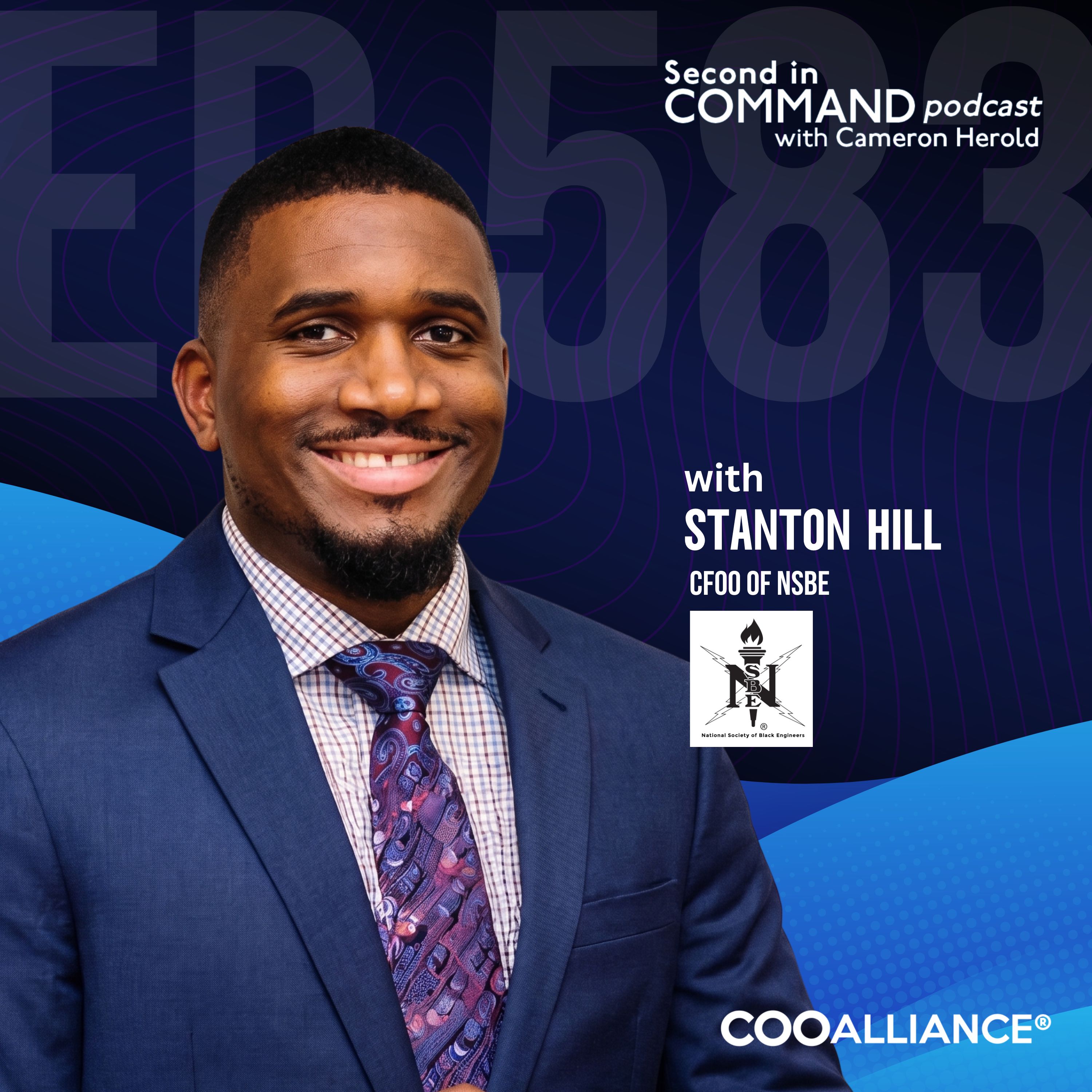
Second in Command: The Chief Behind the Chief with Cameron Herold
Ep. 583 - NSBE CFO & COO Stanton Hill - How to Build Unstoppable COO Teams That Win
00:46:23
Loading summary
Transcript80 lines
- [00:00]
Stanton Hill
Everyone's dealing with something internally. I always say life is undefeated. Whatever it is, big or small, you're dealing with something. I was always raised and taught. You know, there's three types of people. You're about to go through something, you're going through something, or you just came out of something. Right, Whatever the something is. And so, you know, as you're working with people, we're a small but mighty team. You get to know people over time. And so building those personal relationships has definitely been invaluable to getting the work done.
- [00:32]
Cameron Herold
Welcome to the Second in Command podcast, produced by the COO alliance and brought to you by its founder, Cameron Herold. In the second in command podcast, we talk to top COOs who share the insights, strategies and tactics that made them the chiefs behind the chief. And now here's your co host, Experience Driven growth strategist, former Chief Strategy Officer and author of no One Needs Another Company Mug, Lindsey Smith.
- [01:03]
Lindsey Smith
My name Lindsay Smith and I am so excited to welcome Stanton Hill to today's episode of the Second in Command. Stanton serves as chief financial and Operating officer for the National Society of Black Engineers, known as nsbe. It is one of the largest student governed organizations in the country. In his role, he oversees NSBE's finance, accounting and operational strategy, driving process improvements, fiscal transparency and and long term sustainability to support NSBE's mission to increase the number of culturally responsible black engineers who excel academically, succeed professionally and positively impact the community. I am so excited to have with us today on the Second in Command, Stanton Hill. And Stanton is quite an impressive gentleman who is the chief financial and Chief Operating officer for the Society of Black Engineers. Stanton, welcome to our show today and thank you for being our guest.
- [02:06]
Stanton Hill
A pleasure to be here. Thank you so much for having me, Lindsay.
- [02:09]
Lindsey Smith
The pleasure really is ours. And before we really dive into some of the really cool things that you do and that you've accomplished, I would love if you could just share with us the core as to what the Society of Black Engineers is.
- [02:21]
Stanton Hill
Sure, absolutely. The National Society of Black Engineers, or short for nsbe, that's what we call it internally and most of our people are aware of us, is really a membership association for black and minority engineers. We serve over 25,000 members. Typically we have more than 300 partners engaged year round. And really we look to provide a way that people have access, opportunity and a place for lifelong learning from our NSBE junior, which starts in third grade, up through the entire professional pipeline to really engage and support individuals on their academic and professional journeys. In the engineering space.
- [02:59]
Lindsey Smith
That's pretty impressive. I didn't realize that you started with third graders. And what a great time to really be a part of a student's life to help them understand what their future potential looks like. Do you get the opportunity to work with the students and the members directly?
- [03:16]
Stanton Hill
Yeah, in a number of ways, which is really interesting for us. So for me in particular, our organization, something that's unique is that it's student governed and so all of our board members are full time students. And so in that way I get to interface with our membership that are in leadership roles, our various in person events, whether that's something as simple as passing in the hallway, something more intentional in a leadership training or workshop, or perhaps just a registration. I had the opportunity to interface with a number of our members. We had our annual convention in Chicago in 2025 when we turned 50. And we had a young man, I don't remember his exact age, but he was definitely under 10. And he came to registration and his father made him a lifetime member of the National Society of Black Engineers, which was very awesome. And quite honestly, we asked the father and the son to come visit the museum, come meet our chair, come meet our CEO, because we thought it was just an impactful story that a family and a father and a son made the determination that a young man should become a lifetime member at such a young age of our organization and be exposed and engaged with engineering. So something small like that, just meeting him in passing or at registration and now we introduce him to the chair, the CEO, things like that are valuable experiences for us and for our members.
- [04:34]
Lindsey Smith
Oh, absolutely. Can you imagine being a 10 year old or less than 10 year old and having the opportunity to interact with, with all of these really, you know, big and important people. Because to a 10 year old, I don't care what role of leadership you're in, you are big and you are important to a 10 year old. So it's really exciting and quite impactful that you have the ability to have those conversations. So let me take us back a moment to when Stanton was 10 years old. What were you doing?
- [05:03]
Stanton Hill
Wow, you digging in the crates. So 10 years old, mid-90s. We didn't have a sense of where we were going. We were very focused on school though. My parents made that very clear that education was going to be the key to whatever I ended up doing. And at that time I come from a family of athletes and so at that time we were very heavy into basketball. Everything was practice, playing, structured, unstructured School teams. It was very sport centric, but also very focused on the academic side.
- [05:33]
Lindsey Smith
And so 10 year old Stanton was really focused on academics and, and at some point in time decided that you were going to essentially spend your career in another form of academics. What did that transition look like? How did you get introduced to this National Society of Black Engineers?
- [05:49]
Stanton Hill
Yeah, I was fortunate. In a previous role I worked at uncf, the United Eagle College Fund. And one of the executives there ended up coming over to NSBE and serving as the executive Director. And so after some time here at nsbe, he reached out and said, hey, I'm looking for a Director of accounting. Is that something you think you might be interested in? And so when the opportunity made itself available, I kind of did my research, asked around because I wasn't as familiar with the organization at that time. And the more I learned about it and heard that, you know, this could really be a good fit and a good opportunity, I jumped at it. And here we are about 10 years later.
- [06:27]
Lindsey Smith
That's incredible. So you started off in accounting and what did your internal progression look like from accounting to where you sit now in your role?
- [06:37]
Stanton Hill
Yeah, so the roles I've been able to be a part of within the organization, I was the Director of Accounting and then from there was senior Director of Accounting and Process Management, which really brought project management, establishing the project management office, much more in that realm to the role. So started kind of getting into the operations piece once that happened. And then we had a leadership transition and our structure went from an executive director structure to a CEO model, true C suite. And so when that happened, a lot of us that were senior directors were essentially elevated. And so the role then became a CFO role. And so I did that for about three years before the operating aspect was added to it. And so really the progression was I had only the finance and accounting team. I then had parts of operations relative to process and operations management, but there was still a person in the role at that time. So we kind of split and co owned some aspects from there. I then took on IT and operations as well as finance, and then most recently had the opportunity to take on our human resources function as well. So now I have all four of those in the combined CFO COO role.
- [07:55]
Lindsey Smith
One of the things I find Most fascinating about COOs or second in commands in general is that the COO or second in command role looks vastly different depending on who you're talking to and the organization that you're in. And I don't know if you've read the book the Second in Command, but it's something that Cameron touches on in that book and is certainly apparent within the COO alliance community. There's different titles, there's different things that people are responsible for, but there's this glue between second in command and I was a second in command for many, many years in corporate America and my title was Chief Strategy Officer. And so it was very different in terms of how I was looked at. And yet I did a lot of the same things that you are overseeing inside of your organization. I did not handle finance, but handled all the other elements. And so what's really cool is there's this unique bond that coos and second in command have where they have to think about what hat putting on and how they're going to solve the various problems. And I can guarantee you, although I've never been in your office, that no two days are ever alike. Would you agree with that?
- [09:04]
Stanton Hill
Absolutely, Absolutely. Which is part of the joy and the, you know, keeps you going, keeps things fresh. It's not monotonous. Every day is a new day, a new challenge, new problems to solve. And so from that perspective, there's definitely great opportunities to stretch yourself to get involved with different components and aspects of the organization and find new dots to connect between strategy and execution and kind of what's best for the Org.
- [09:29]
Lindsey Smith
Isn't it really fun when you're in an organization and you've been there for quite some time as you've been, and you're able to find new pieces to connect? Just like it's when you think you know everything that's going on, you realize that A and B aren't connecting the way that they should. And if you fix that, you create another opportunity.
- [09:46]
Stanton Hill
Yeah, I think to me, that's probably the most exciting thing. You're kind of playing half Tetris, half Jenga. You're tinkering, you're seeing what works, looking for the different connective tissue and determining how these departments should interface. Maybe you need to change something with external stakeholders, kind of what levers to pull. And in addition to that, you know, you're really keeping yourself fresh. You're always looking at new ways to innovate, new ways to go about getting the work done more efficiently to really drive that value for your organization. Regardless of what that end product looks like. I think there's a lot of similarities in that work.
- [10:19]
Lindsey Smith
Well, I think that certainly is true. And one of the things that I know about your organization is that you had to make a really big Pivot in Covid and predominantly, you know, you do in person events, but you had to switch to a hybrid or to a hybrid model right before you were able to come back during the COVID times. Talk to me about what that looked like for you.
- [10:40]
Stanton Hill
So NSBE has a significant annual convention and so we put a lot of emphasis on it. I've seen it as low as 9,10,000 people and at its peak I've seen it close to 15,000 people. And so, you know, it's a big event for us every March annually. And so that piece of the business is somewhere between 49 and 64% of our revenue if you look at it over a 10 year time span. And so with COVID obviously closing everything down, everything was shut down. We had to immediately pivot and change a lot of what we do and how we do it to deliver us offerings virtually for two years in a row, which was very difficult to do considering everything's in person. A lot of our planning had to go virtual, obviously, the execution, the member experience. And at that time there weren't a lot of platforms that were prepared to host, to do registration, to give you the various breakout rooms to execute four day event with thousands of people. And so with each event we kind of tinkered and found a new platform and new way to do it. So it was almost starting over, finding new platforms, new processes that would work for us. And then fortunately, you know, as things kind of settled down, we were able to move from purely virtual to hybrid. With first hybrid offering, which was in Anaheim, California at the time, which if anyone's done a hybrid event, hats off to the lift and workload. The one thing that people may not consider when you do something hybrid is you're essentially running two events in parallel, right? I have a, a team at a command center that's making sure everything virtually is happening. The streaming is working, the camera, the sound, et cetera, et cetera. Another group of people at the same exact time running around doing everything in person, making sure everything is good. From that perspective then obviously with things being hybrid, you still have Covid around, you're now dealing with health screenings, masks, hand washing, all of the things. So a really significant undertaking coming out of COVID and going into that. And it was just a lot of planning, a lot of emergency strategic meetings, standing meetings around what's open, what's not, where we can go, how many people can congregate in a room, you know what I mean, type of spacing, what does that do to the pricing model to Registration or to how many people we can even host, do we need to cap it? So a lot of different things that, quite honestly, we hadn't necessarily considered when we were purely in person, because it wasn't a thing to worry about. Right. It was, unless the fire marshal is going to shut you down, get as many people as you can. Whereas now it was, hey, I got to have this six feet. There's too many people. We need to think about doing this a little differently. So definitely a new way to do it, but a rewarding experience in retrospect, but very stressful at the time of.
- [13:20]
Lindsey Smith
Well, it's one of those things that. That was never on your bingo card or on your job description to figure out how to do that. How did. Managed to get. Did you see a drop in attendance when you went virtual from 9,000?
- [13:31]
Stanton Hill
Yeah. So we actually first ran into virtual fatigue. Right. And so it was, you know, the students, the members, everyone was doing their schoolwork, their job virtually. So then when you say, hey, you want to log on and come to a session virtually? I'd already been on the screen all day. Right. So the screen fatigue was real. Those were kids were teaching their kids or taking care of loved ones. So there was just kind of that steady state of high stress, which led, I believe, also to some of that fatigue that we saw with the drop in virtual. And then the cap with going hybrid was really who was comfortable coming out. Are you ready? Even if they say you can and it's allowed, what's your personal comfort level? So for us as an organization, we made the determination that the staff can choose whether they go out to Anaheim to put a vet on, because we needed just as many people to help moderate and manage all the different components virtually. And so it was a decent split. It was kind of more of a skeleton crew on site, and a lot of people stayed and ensured that our virtual offerings went off without a hitch. But we still had a good amount of people on site for Anaheim, which was really well received. And in some regards, because of it was open air. Who's mad at California? Palm trees, sunshine. So I think that was a nice foray back into getting us to in person and people getting comfortable with that again.
- [14:54]
Lindsey Smith
Absolutely. And so, Stan, when you bring your members together, you're bringing members who are students or who are, you know, looking for jobs, maybe. Maybe they're not quite all students. And you bring them together with people who are employers searching for candidates. Is that the structure of your event?
- [15:12]
Stanton Hill
Yes, that's a significant component of it. So our annual convention will bring the full range of our member base. And so we'll have our NSBE Junior, which is the, you know, starting with elementary up through high school. And they'll engage in our pre collegiate initiative activities. So that could be competitions, workshops, seminars, things of that nature that are geared towards that age group. They may come with a chapter and advisor, chaperones. And so you really get a lot of that youthful energy from that contingent of members. And then I'd say any given year, probably 7 to 9,000 of our attendees are all collegiate members. So undergraduate looking for internship opportunities, job opportunities. And so there will be Six Sigma training. There might be something around your pmp, other elements around any other engineering discipline or computer science that they're looking to hear more about as well as our two day career fair which is very well attended, that's always a hit every year. Everyone wants to get on that floor and you know, get in front of the companies and make those connections. And something that we do that I think is unique and has been really well received is we have a career fair prep center. And so prior to getting onto the career fair floor, you have the opportunity to go to this prep center for mock interviews, resume review. You can get your hair done, you can get your nails done. If you need a tie, whatever it is you might need to prep you and position you best to shine and have an opportunity to put to be your best self on the floor once you get in front of those companies.
- [16:51]
Lindsey Smith
Do you know what I love most about what you're talking about? It's that you're talking about the human as a whole. They aren't just a candidate for a job. But you talked about self care, whether it's their hair or their nails or it's making them feel and look presentable or feel really confident in getting a tie or whatever that might be. And there's so few places that really look at people as the whole package, right? They'll look at their skill set, their look at their resume, but they won't really help to support them. So I think that's amazing work that you're doing. I think I read here too. One of the things that you feel is a super skill of yours is being emotional support for your teams inside of the organization. Can you talk to me a little bit about what that looks like as part of your role?
- [17:34]
Stanton Hill
I think, you know, the leading with empathy part is probably undersold in many instances. You just talked about being the whole person, the whole human. And so really that's how we look to lead and part of the core values that we espouse internally, one of which is we care. And so I care just as much about the person and how they do the work as I do the output of what the work is that they do. And so if someone's not well, if they're not whole, you're probably not going to get the best work product, the best outcome, because of whatever it is they might be dealing with personally, professionally, et cetera. And so I really find that you have to take the time to get to know individuals. You have to take the time to understand where they are in that respective season and really support them to help ensure that they are going to be in a safe environment, an environment that they can thrive in and really just connect as best you can with those individuals and really hear people out. Everyone's dealing with something internally. I always say life is undefeated. Whatever it is, big or small, you're dealing with something. I was always raised and taught, you know, there's three types of people. You're about to go through something, you're going through something, or you just came out of something. Right, Whatever the something is. And so, you know, as you're working with people, and we are a small but mighty team, you get to know people over time. And so building those personal relationships has definitely been invaluable to getting the work done.
- [18:58]
Lindsey Smith
What does retention look like because of these values and the way you lead with empathy look like?
- [19:03]
Stanton Hill
Yeah, I think retention, you know, for any organization is essential. Right. Ours is unique in that while we're student governed, our board rotates annually. And so every year some people may stay in their role, but since you need to be a full time student, invariably I'm going to have some turnover in our leadership. And so because of that, we look for a lot of stability in our staff and our advisors that support and help with the shepherding and the advising and kind of supporting our student leaders as best we can as they do the important work that they do. And so for us internally, our retention has been pretty solid. I think it varies a lot by department in the nature of the work you might do. Some departments and some roles just have more volatility in general, I would say, you know, for an example, fundraisers may have more flexibility. Those roles are always in high demand. You can always go find a fundraising job and if you're really good in that space, we may not be able to retain you as well as others. But we have quite a few people within here, over five years, we just had one employee celebrate 25 years. We have two at 19, we have several at just hit 10 years like myself. And so we have pretty good portion of the staff that's well over five years of experience with the organization, which really helps to build that continuity, not just amongst the team, with our board
- [20:23]
Lindsey Smith
and our members a hundred percent, you know, you're talking about the empathy and how, you know, everybody's going through something or they're about to, or they just did. And it reminds me of an exercise that I did at the beginning of one of the events that I hosted in 2021. It was right after Covid and I had brought a team. I didn't have as many as you, but it brought about a hundred people together in Phoenix and wanted to help to level set the room because emotions were high, intentions were high. And so at the advice of Cameron, I had gotten a clear fishbowl and handed out a piece of paper to everybody and said, I want everybody to write one thing that they're going through right now. Maybe it's a divorce, maybe it's financial troubles. Who knows? It could be anything. Write it down. I said, and if you think I know your handwriting, use your left hand. I had everybody pulled them up and they all handed them to the front and I stood in front of the room and I read aloud with no names, just what everybody was going through. To really help people to realize that you have to understand it's not just what's going on in this room, it's what's happening in your life that you might not know about, but everybody's going through something. So I really love that you teach that to your teams on a regular basis because I think that that's a really important thing for organizations to be cognizant of and to teach their teams to be mindful of. So kudos to you on leading with that on the daily.
- [21:48]
Stanton Hill
Thank you. That sounds like a great exercise too. Probably. I'm sure it was very eye opening to those in the room to just how everyone deals with things differently and how they process. Some people can escape to their job and you'll never know anything's wrong. And other people, it affects them at work. Right. And so I would imagine that exercise was an experience.
- [22:07]
Lindsey Smith
It was, and it was pretty interesting because everybody had something. No one turned in nothing. Everybody turned in something. Which I thought was really the most mind blowing part of that exercise because like you said, some people hide things and you think life is perfect and never realize that there's things going on. So you have this group of members and then you have these corporate partners and the partners come to the organization and what does that interaction look like and how are you involved in selecting or shepherding the relationships with those partners?
- [22:40]
Stanton Hill
Yeah, so the beauty of a lot of the way things come together at NSBE is we have a lot of our NSBE members, be they current or former, and a lot of our partner organizations serving as internal champions. And so they help to bridge a lot of gaps, bring a lot of opportunities to the table to give back to the organization to keep the organization viable. And so oftentimes the way it will work is we have internal fund development staff who interfaces with companies. Members will bring connections from their various organizations that they're aware of. And then from our staff, from a board leadership perspective, we have a role of finance chairs and they work at a national and regional level to engage various partners and companies and supporters to come support different programs, different in person activities. We have over 500 chapters and so they'll come and you know, provide maybe chapter relief to support the smaller grassroots efforts that are going on on that level. And so really it's a team effort across the board to engage and interface with all those individuals and organizations.
- [23:54]
Redirect Health Announcer
Before we continue. Today's episode is supported by our trusted gold partner, Redirect Health. If you've ever felt like you're overspending on health care and your employees can't even afford to use it, then listen up. Redirect Health offers healthcare benefits that finally make health insurance optional. It's a 24 hour online primary care and RX membership that protects your business by guiding employees before problems happen. That means you're not overpaying for coverage that you don't need. It's like your mom is your doctor. You'll always know the healthcare you need, where to get it and when it makes sense to use insurance so that you can pay the least. Redirect health protection for business and guidance for people. Go check out redirect COO.com that's redirect COO.com and if you're talking to them, let them know that Cameron at the CEO alliance recommended you go there as well.
- [24:56]
Lindsey Smith
Stan, what does your direct team look like? How many people report up to you?
- [24:59]
Stanton Hill
So I have. Well currently since you say that, most recently I've had the opportunity to work with the fundraising department as well. So I have about 20 people that report to me through the different verticals of it, hr, finance and accounting and operations. And so right now I Have those individuals. And I have a lead that serves as the director or senior director for each of those various teams.
- [25:26]
Lindsey Smith
And so are you just meeting regularly with those directors of the teams or are you meeting with all of the team members?
- [25:32]
Stanton Hill
Yeah, so I typically meet with the directors only. And then what I'll do is I'll cycle through their various team meetings as touch points, ways to engage. And then something that our CEO has implemented and our previous executive director also did, is we just have an open door policy. You can touch base with anyone. It was much easier in person. Right now our organization operates hybrid, so you have to be a little bit more intentional with having all of those touch points. I can't just kind of walk by everyone's office like I used to or see people at the water cooler. But we really try to ensure that we have good touch points with everyone to keep the connectivity. One way we do that, we have quarterly all hands meetings in person. So everyone comes together from various parts. I have a person in California, one in Chicago, two here in Georgia, one in Jersey. So, you know, we're kind of spread out at the moment. But we were just all together for our annual convention. We'll all be together this month in April. So there's, you know, kind of a bi, monthly, I would say in person with everyone to keep the connectivity there.
- [26:36]
Lindsey Smith
That's really incredible. On a weekly basis, is that how often you're meeting? I'm just assuming here and maybe I shouldn't. How often do you meet with your team members?
- [26:45]
Stanton Hill
Yeah, so I have a standing meeting with my direct reports weekly, individually, and then a standing meeting with all my direct reports collectively weekly. So I do a.
- [26:55]
Lindsey Smith
Both and, and when you go into your individual meetings, what is your goal? How do you run them?
- [27:02]
Stanton Hill
Yeah, so when I'm meeting with each of my direct reports, there's a couple things that we want to accomplish. So one of the first things I want to understand is just how are they? Right. Just before we are, how are you? Where are you? How are you feeling? How are things moving in your world? Right. Because to your point earlier, it may have nothing to do with nsbe. Right. So let's just, let's first level set. Are we in the space that we can talk business at the moment? You know, really an understanding of. I tend to look at things in blocks. So I'll look at immediate needs midterm and then long term. And so we'll kind of run through where we are, what needs to happen in the near term, depending on what the immediate Needs are and then just kind of flow out from there. And then what we also want to do is ensure that we are making any of the connective links we need to make. And so I may talk to, for an example, my ops person and I know from a conversation I had with my IT guy that there needs to be a conversation so I don't try to solve it for them. But I'll say, hey, had a conversation. Make sure you all touch base on situation X and just give them the space to do what it is they do. And then I always end with, what do you need from me? Give them, you know, time to share anything, Give them the opportunity to manage up and let me know if there's something that I can assist with or jump in and help them with to get the job done.
- [28:21]
Lindsey Smith
That's really incredible. I love to hear that and I love that you're staying true to that. We care. You started off your meeting by caring about the human. And I think that's, you know, we've said it numerous times in this episode, but it's really something that's fundamentally needed inside of organizations. You have a lot of different verticals that you're supporting and that you're overseeing inside of the organization. How do you map out your days so that you don't become overwhelmed with everybody else's problems and can focus on the things that you need to work through? I like that smile.
- [28:53]
Stanton Hill
That's one of those questions that'll make you think a little bit. You know, for me, I take self inventory and I typically start with, we have kind of a master project plan that just looks at all of the work that's going on across the org. And so while I have kind of those four verticals that I'm directly responsible for, I just take a look at globally speaking, what's all the things that should be happening this quarter? And then I narrow it down to this month and then I narrow it down to this week because, you know, there's the things that are interdependent or things that I have to do before these other things can happen. I start big and I work my way small. And then I say, okay, what absolutely has to happen today and who do I need to engage with to get those things done? I don't spend too much time on emails in the morning because for me those are typically new directives. And so that'll get me off my spot. So I start with what do I know? I already need to do that. I need to get done within whatever timeframe I have that's available. And then I block out time for emails twice a day. I do it kind of mid morning and late afternoon and then I just triage those to figure out where those fit or what I can just kind of delegate and forward on to make sure that we follow up on them. So, you know, it's really just being disciplined and being intentional, honestly and understanding. There's some things I control, I can control and others I can't. So I just try to stay even keel, don't stress myself out any more than necessary, give myself grace, give the team grace while still obviously adhering to, you know, the deadlines and expectations of our CEO and board, etc. But yeah, just really moving with discipline, moving with intentionality and ensuring that, you know, hey, if I can't get it done today or this evening, I can guarantee you the work would be here in the morning. I'll just have to do it in the morning.
- [30:44]
Lindsey Smith
Do you have any morning or evening rituals that help you to stay disciplined in the morning?
- [30:50]
Stanton Hill
Meditate might be a strong word, but I give myself time to be. I don't know if I quite meditate, but I definitely, you know, once I get the kids off to school and before I kind of dive into the workday, I give myself 10 to 15 minutes of just nothing. I have the lights off, relaxing, I probably have music on and I'm just kind of level setting and just seeing okay. You know, it's kind of taking a self inventory and just preparing myself. Because you know, part of the being there for others, whether that's in your personal professional life, you keep pouring, right? You pour and you have to do things that pour back into you, right? Because you can't give from an empty cup. And so I try to just take some time and just make sure I kind of level set before I. Before I dive into what could be a regular day or it could be a crazy day. Every day is a new one.
- [31:43]
Lindsey Smith
What music would be on if I were to pull out your iPad or your iPhone or whatever device you're listening to? What song would I hear if I pressed play?
- [31:52]
Stanton Hill
If it's early in the morning, it's definitely some R and B. I need something calm. If I get too excited early, I might flame out. So if it's early, I'm very relaxed. It's definitely R and B. It's probably something older cousin or uncle put me onto, something from the 70s or 80s. Real calm, real mellow, maybe 90s. That's kind of my sweet spot right in There, and I'll kind of vibe out, have it on low, and just kind of mellow out a little bit. But in the evenings, to your earlier point, I have to do something. Like, at that point, you know, I have to move. So oftentimes I have the opportunity to coach my sons. They're very involved in football and basketball, so whether I'm coaching with them or training with them, I just get up and move. I get up, I get out, and I sometimes let them pick the music. So it's, you know, much more uptempo on whatever they want to listen to. And I just, you know, kind of go into that zone and forget the day for a little while and just spend some time with them. Being active.
- [32:52]
Lindsey Smith
That's incredible. How old are your sons?
- [32:54]
Stanton Hill
My sons are 16 and 12.
- [32:56]
Lindsey Smith
Okay. They're right in that sweet spot where they almost don't need you as much, but they kind of need you more than they did before.
- [33:03]
Stanton Hill
Yeah, yeah. But I am dangerously close to no longer being an Uber driver. So as soon as he gets his license, the two of them will be safe, because he's a safe, safe young man. But they will be getting to and fro on his time, and that'll free me up a little bit.
- [33:20]
Lindsey Smith
So you're gonna find a few more hours in the day that you didn't
- [33:23]
Stanton Hill
know you in the day for sure.
- [33:25]
Lindsey Smith
That's wonderful. That's wonderful. What do you like to do in your spare time?
- [33:29]
Stanton Hill
You know, in the spare time I spend a lot of time. My wife and I are avid movies, moviegoers, so do a lot of movies, a lot of comedy shows, a lot of plays. I do a lot of walking. I find as I'm getting older, just staying active, walking, enjoying, enjoying nature a little bit more. I used to not be an outside person. I'm finding that the outside, whether that's, you know, just enjoying the weather, assuming it's good weather or anything near water. Water is very calming. So if I can find a stream or anybody, a water lake or something like that, I'll go and just kind of sit by that. The water's calming. Maybe it's because I'm a water sign, I'm not sure, but that tends to keep me in a good space.
- [34:10]
Lindsey Smith
What's your favorite movie?
- [34:12]
Stanton Hill
Oh, it's not the best movie, but my favorite movie is still Independence Day.
- [34:17]
Lindsey Smith
It's a great movie. I saw in the movie theater.
- [34:20]
Stanton Hill
When you said 10 year old, I wasn't 10, little older than 10, but when you said 10 year old, I thought Independence Day was. I can probably recite that. That's a good one for me.
- [34:29]
Lindsey Smith
That was a great one. I saw that one in the theater on the big screen. It's funny to your point how there are certain things from your childhood that just stick with you. Even as you age, you remember those moments and what things look like today. These kids get everything on their phone or on Netflix, so they don't have the same experiences I feel like that we had.
- [34:48]
Stanton Hill
Yeah, I think that's their loss. But, you know, time change, technology evolves. Yeah. Certain things in theater or you had a concert or something, that you just had to physically be there to experience the moment. I think those moments are priceless.
- [35:02]
Lindsey Smith
Were you ever in theater?
- [35:04]
Stanton Hill
No, no, no, no. I could absorb it. I can appreciate the art, but it wasn't my calling.
- [35:11]
Lindsey Smith
Sometimes I find that there's great leaders who are very well spoken and when you dig deep, you find that they have had some sort of theatrical training or exposure. So maybe you just absorbed it all despite not being on the stage.
- [35:26]
Stanton Hill
I come from a family full of preachers, so very heavy in the church. So everyone spoke, preached, sang. So being in front of others was never an issue or communicating in that way. So it wasn't necessarily theater, but it was definitely, you know, you're going to get up here on Sundays or whatever other day and you're going to give the welcome. You're going to, you know, bring announcements, you're going to do something. And so they instilled that in my brother and I very young. So we got used to it.
- [35:55]
Lindsey Smith
That's incredible. It served you well and I know it will continue to serve you well. What would you say? Stanton is one of the greatest things that you have accomplished inside of nsbe,
- [36:04]
Stanton Hill
Greatest things accomplished inside the organization. You know, for me, I don't know if this is the accomplishment that maybe you're thinking of, but for me, what sticks out is when others want to, on their own accord, come to you, solicit your guidance, want your feedback. I've had individuals that want to join my department and figure out how they might be able to do that or things. Little small comments. I wish, you know, I wish I got to work with you more. To me, that more so speaks to kind of the impact and the feeling that you might instill in others that they want to work with you and collaborate with you. So to me, I think that from a human aspect that speaks most to it. Obviously, there's purely professional things where we've, you know, implemented strategic plans. We Implemented a new association management software. We've led the organization through its 50th celebration. So, I mean, there's a lot of things like that. I feel like when I leave the organization, it will be the impact on individuals and the relationships that were formed that will really speak to, I think, what's going to be most lasting.
- [37:15]
Lindsey Smith
That's really remarkable. You have become a mentor for everybody in the organization. And to say that that is the thing that you're the most proud of is really inspiring. So thank you for sharing that with me. When we think Back to our 10 year old who is maybe 13, watching Independence Day and going through schooling and working through all of the things that eventually will lead to where you are, what do you think was the most impactful thing that happened to you that allowed you to continue developing and to believe in yourself to get you to where you are today?
- [37:50]
Stanton Hill
That's a very easy question. That for me is a very easy question. So my father became ill when I was 14 years old, and when I was 20, he got a double lung transplant. So from that whole time he was, you know, dealing with his illness. And so he's here now, he's healthy. But as a young person, watching your superhero, right, not be able to function the way he had been really changed a lot of things for me. Whether that's from an accountability, whether that's from a maturity, you just grow up quicker. You don't have time to figure it out. And so if my dad was in the hospital, my mother was with him, and it was me and my younger brother, so I had to do what I have to do when I became a little older. You do the driving, you get the groceries, you get the dry cleaning, bring your brother to the hospital, y' all go home and go to sleep, make sure y' all get to school. And so for me, you know, not complaining, it's a blessing. Things happen, Everyone has their journey. But that experience really sped a lot of things up and kept a lot of things in perspective for me. And so I don't get bent out of shape about a lot of things because it's just not on the level that you need to get bent out of shape about it to me. And so that singular experience and then obviously the, you know, the aftermath and him dealing with his illness really just shaped, you know, everything about what I thought was and still do think is actually important more often than not.
- [39:24]
Lindsey Smith
It's interesting to me. I'm so happy to hear that he's okay. And you shared a story with us about how you had to essentially manage different aspects of your household and your family as a young person because others were unavailable to do so because of, you know, taking care of your dad and things. But that's eloquently translated into what you're doing today. And I think that when you dive into people, you find this moment or this experience that they had that you subconsciously might not even realize that you're doing the same thing you did back then, but today at a greater level for a bigger organization. And I just think that that's so fascinating that that's how life works.
- [40:08]
Stanton Hill
Everything's preparing you for something, right? And so I think the cumulative experiences will put you in position or give you the confidence or the disposition or whatever it may be, so that whenever the opportunity arises, you'll be in position to take advantage of it and meet the challenge. And So I agree 100%. Right. I mean, whatever we go through shapes us in terms of the nurture part versus the nature. And you know, I, I just think it's important to understand what those are for you and pull on those and, and leverage those and, and lean on them where possible.
- [40:43]
Lindsey Smith
I think that's incredible. Stan, the organization is a student led organization. And so that's a really different structure than most organizations out there. How do you feel that's benefited nsbe?
- [40:57]
Stanton Hill
NSBE does not get stale. NSBE is always fresh. NSBE is always pushing the envelope because by definition we won't stagnate because there's a new person with a new vision and a new way they'd like to go about getting the work done. And so from that perspective, I think it's benefited with an infusion of new ideas. For me in my role, you know, I tell my team and individuals I have an opportunity to work with. We are always interviewing for the job we have and the job we want. Right? Just every day is the next interview. And so the new board and that turnover actually plays into that for us. And so how do we continue to articulate, document our successes, the areas for growth and improvement, and serve our board to provide them with the information they need so that they can execute their vision for their term. And so each one has their own way of doing things. It's slightly different. And so it makes sure that you can articulate your position. It forces you to execute because you can't rest on last year because they weren't here last year oftentimes. And so to me, it just helps to keep you sharp, quite honestly.
- [42:08]
Lindsey Smith
What have you learned from the students that govern the board, you know, I've
- [42:11]
Stanton Hill
learned oftentimes from them that there are so many different ways to address a problem. They're all engineers. And so their way of thinking and the systematic approach really ties into a lot of what we do in operations or finance or just problem solving in general. Right. Engineers are problem solvers. We as leaders, we as humans, we all solve problems to varying degrees. And so I try to pick their brains and understand kind of what their viewpoints are, how they came to some of those conclusions, how they see things from their perspective, because oftentimes because they're younger, in college or recently out of college, or perhaps young professionals, they're closer to a lot of our members and so they have a better pulse and they can help us understand what might work, what their challenges are that they're feeling and experiencing on campuses or in their various companies. So they really help us to have the voice of membership and understand best who we're serving and how we can best fulfill our role as a association for them.
- [43:20]
Lindsey Smith
I love that you have such opportunity to have different perspectives and voices and visions come in and, and perhaps that's what has allowed NSBE to be around for the last 50 years and what will propel it forward for the next 50 years and beyond. Stanton, I've really loved our conversation today. Before we go, is there anything else that you'd like to share with our audience that you could think might help them as they're navigating their own career as a second in command or potentially a hopeful second in command?
- [43:53]
Stanton Hill
You know, I think just for people, whether that's, you know, if a coo, second command is something that you're interested in, I think mentorship is critical. Find someone who's doing what it is you want to do and try to build a relationship to understand how they do it, how they got there, what steps you might need to take, what gaps you might have to position you to get there, if that's what you're interested in doing. I think there's also the opportunity for just kind of taking that self assessment and understanding, you know, where I want to be stronger, what the market needs, kind of fulfilling the needs of those around you and understanding as best you can things globally and holistically within, whether that's your industry, your sector or your organization. You know, a lot of self directed work, reading, staying up the breast of things, because in this seat you really are managing the whole organization internally, oftentimes, while the CEO oftentimes is external faces. And so you really have to be well versed in policies and processes and procedures and understanding the needs of the people, the needs of various stakeholder groups. And so I think, you know, getting that mentorship, like I said, would be essential to helping you to get where you want to be or stay or progress, if that's the case, depending on where you are. And it really just don't let anyone tell you what you can or can't do. Just from a personal perspective, don't be afraid. Be bold, Put yourself in position, jump out there, take opportunities, take risks, depending on your tolerance for risk. And you know, don't be afraid to fail. You have to do it. And there's nothing like life, there's nothing like experience. And so you have to do it to get the confidence to get the experience. So jump out there, be bold.
- [45:36]
Lindsey Smith
I love it. Be bold, take risks, live in the experience, and continue to lead with empathy. And if everybody does those things, they'll have successful futures just like you. So, Stanton, thank you so much for being with us today. It was a pleasure.
- [45:50]
Stanton Hill
Thank you so much, Lindsey, for having me. Definitely enjoyed the conversation
- [45:55]
Cameron Herold
you've been listening to. Second in Command, brought to you by COO alliance founder Cameron Herold. If you enjoyed this episode, please be sure to like, share and subscribe to us on Apple Podcasts, Spotify and our other podcast streaming platforms. For more best practices from industry leading COO's, visit cooalliance.com.