← Second in Command: The Chief Behind the Chief with Cameron Herold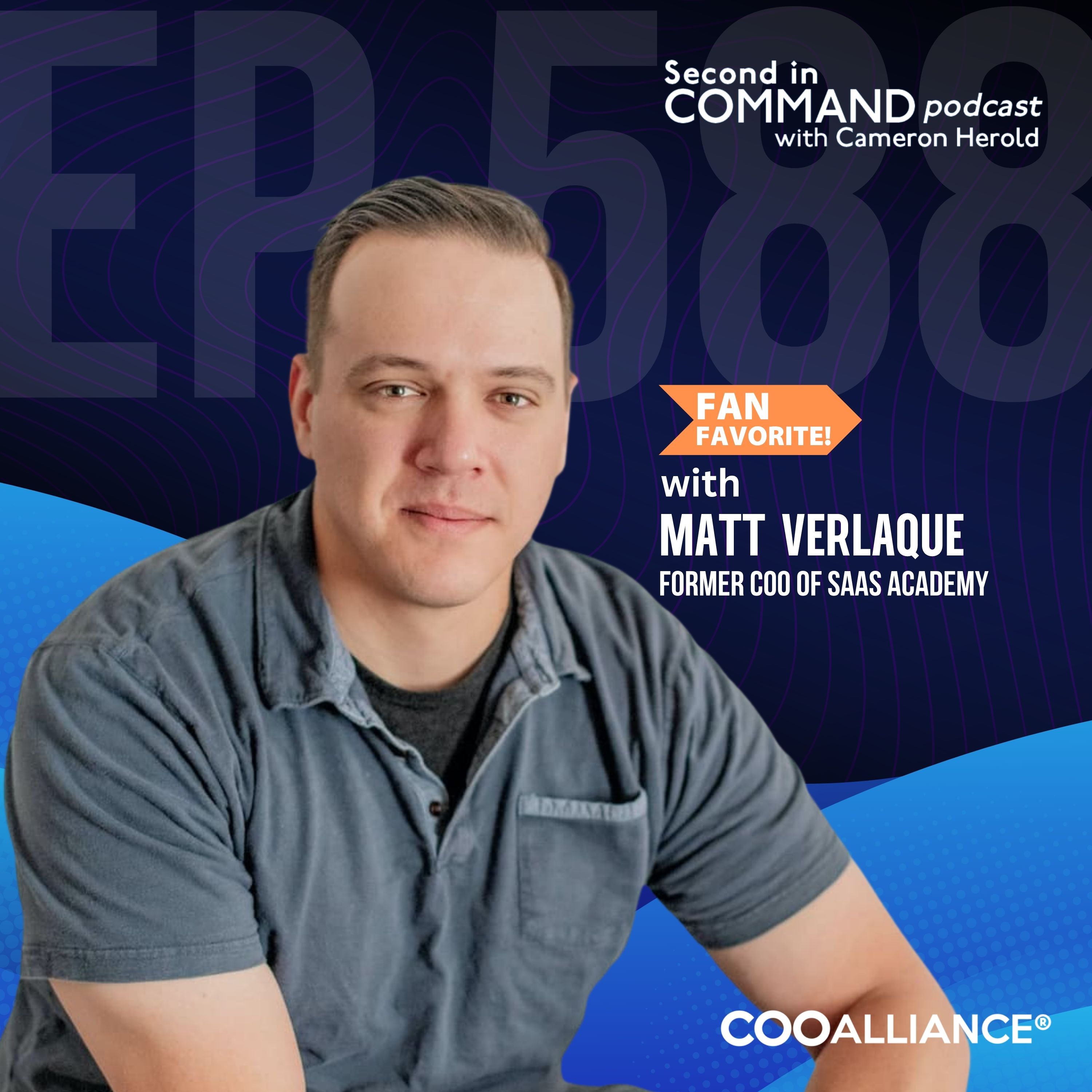
Second in Command: The Chief Behind the Chief with Cameron Herold
Ep. 588 - FAN FAVORITE | Former SaaS Academy (now Precision) COO Matt Verlaque
00:46:47
Loading summary
Transcript100 lines
- [00:00]
A
Hey there. Just a quick note before we dive in. This is actually one of our older episodes, but we're bringing it back because it's one of the most downloaded ones we've ever released. Clearly it struck a chord with a lot of listeners and I know there's so much value packed inside. So whether you're hearing it for the first time or revisiting it, enjoy this fan favorite.
- [00:22]
B
Welcome to the Second in Command Podcast produced by the COO alliance and brought to you by its founder, Cameron Herold. In the second in command podcast, we talked to top COOs who share the insights, strategies and tactics that made them the Chief behind the Chief. And now, here's your host, Cameron Herald.
- [00:46]
A
Hey everyone. Welcome to the Second in Command podcast. Today we have a special guest, Matt Berlacchi. Matt brings a ton of experience from the world of SaaS. Join us as we explore Matt's journey and he shares his valuable lessons from firefighting to marketing for gym owners. Matt has gained huge expertise in different industries. As a CEO of a successful marketing agency, he prioritized customer satisfaction which became his driving force as a COO. Now as the COO of SaaS Academy, Matt focuses on empowering entrepreneurs with invaluable resources. SaaS Academy offers tailored playbooks for every business scenario, helping their CEO clients truly scale with focused 12 week plans. SAS Academy helps businesses achieve their goals and his approach ensures clients maintain laser like focus and achieve remarkable results. In this episode, we dive into Matt Burlock's journey and uncover the secrets behind his success. Tools that you'll be able to use to help you in your role today too. Let's welcome Matt bierlachi to the second command podcast and make sure you subscribe to our second command podcast YouTube channels so you can watch and share their favorite episodes with your friends as well. So hey Matt, welcome to the Second in Command podcast.
- [02:00]
B
Thanks Cameron. Happy to be here man. Thanks for having me.
- [02:02]
A
I've been looking forward to having you on the show for a long time. I have been friends with your CEO Dan Martell for about 12 years now. I have the utmost respect for Kim as a leader and what you two have built with the SaaS Academy. So we're going to get in and talk about that in a little bit as well. But I want to start with your journey and kind of what got you to working with Dan and the SAS Academy and into the role of CEO. So maybe take us back to I think you said earlier you started off at one point working in the fire department as a Fireman?
- [02:31]
B
Yeah.
- [02:31]
A
Yeah.
- [02:32]
B
So I started. I started as a firefighter, first as a volunteer and then as a. As my career in 20 2008. So I always, you know, I always joke and say I, like, accidentally started a SAS company. You know, my. One of my shift partners, Jake, opened a CrossFit gym. And I was, you know, I built his website because I was like, a closet nerd nerd, you know, and we were just riffing on entrepreneurial challenges that he was having in his gym. And so that led to us exploring marketing automation, which explored us, which we explored then, you know, building marketing automation strategies and selling them to gym owners. Long story short, we were using other people's software to deliver that whole thing. And. And it was still a side gig at that point while I was in the fire department, and it was just becoming really, really painful. So I went to a coding boot camp on the side, like on my days off in the fire department, learned how to code, found the smartest guy in my class, and pretty much bullied him into being our cto. And we. We built some software from there, and I left the fire department to go full time on that first company in 2017. So after about nine years as a fireman. And so from there, I became a customer of SaaS Academy. I hired Dan as my coach. SaaS Academy was super small. He, you know, did my sales call on a cell phone himself. So it was a very nascent community at that point, which was a lot of fun. So joined there, took the company through a successful acquisition in 2020. Company that acquired us for about a year, and then did some investing and acquisitions with Dan in 2021, and then slid over to SAS Academy to become the COO in 2022. So that's been the journey. It was from. From coach to. To partner.
- [04:06]
A
Okay, so that's a really, really interesting journey. I mean, first off, like, starting as a firefighter, different from any of the other 285 guests we've had, for sure. But then second, sliding over and. And becoming an entrepreneur, building out a business, being in the space that you're in now, in the style space, but then also selling that company as well. So there's a lot of kind of transition points that I want to talk to you about. Why don't we stick on the firefighter for a second and just talk about some of the. The skills that you learned there that you still apply today on the business?
- [04:34]
B
Yeah, it's. It's actually. It was surprising, as I reflected on it, how many parallels there are of things that I learned in that environment that they really served me well in business. You know, I've described the fire department as having to make very permanent decisions in about five seconds with very incomplete information. And you know, anyone who's run a business that's growing at a rapid pace, you could probably apply that exact statement to, to growing a business too. So I think if nothing else, it, it builds the muscle of being able to analyze a situation pretty quickly, make a, a decisive, you know, directional assessment of where you need to go and, and get going. So that, that definitely helped. But I think the biggest thing, Cameron, that helped is really just small unit leadership in a nutshell. You know, in the, in the fire department, you're organized into companies. It's usually four or five people at a time. And you know, you're, you're making really important decisions with those people. And so I think that, you know, a lot of the time in business, especially as a company starts to grow and you, you know, start to go from the nascent, you know, one or $2 million stage to 10 million and upwards in revenue as the organization expands, sometimes you can lose the magic of those small units. And, you know, we really have to double back down into putting highly confident leaders, managing smaller squads of teammates. And so I think that leaning into that same type of configuration inside of SaaS Academy, which is about a 40 person headcount right now, it's really, it's changed things a lot for us over the past year where just the span of control, you've got to manage it, you know, so that was another big lesson I think I took from, from the fire department days when you were
- [06:01]
A
running the small teams at the fire department, kind of talking about the four to five people. Was it because of the nature of the fast decisions, like urgency, because you're dealing with kind of crisis? Was it kind of a command and control style of leadership or was it more of a modern style where you're, you know, not so much gaining consensus, but you're building teams and collaboration and empowering people. And where did it kind of fall in that spectrum?
- [06:29]
B
It was a hybrid of both. That's a really good question. It's a hybrid of both. So we had a, you call like an underpinning of, you know, there were, there were seven or eight general scenarios or like the, the general playbook that you would run. You would know what your job is. You know, like Cameron, if you were sitting behind me on the fire truck, you're the guy taking the hose and putting the Fire out. The guy sitting to your left is the one, you know, moving it along. So everyone had their job, but there's a, there's a point of diminishing returns with becoming too prescriptive because especially as the, the officer in charge in that environment, you can't see everything and you don't know what's happening around you, which is probably similar to anybody in a C suite. They think they know everything that's going on, but they're not the, you know, the guys in the front lines getting it done. So you also have to empower the team to make sure that they speak up if they see something that's about to happen, if they get a vibe that's something off, if they hear something you didn't hear, you know, you can't be so, you know, dominant in your leadership. Yeah. So it's, it's essentially a hybrid model of leadership is what I think worked best in the fire department. You know, we had a baseline. You can almost look at it as a playbook, right. Like a baseline set of standard operating procedures that we would assign by position. So for instance, if you were sitting behind me on the fire truck, you had a certain job and the person sitting next to you would have a different job. So we always had that baseline, like unspoken. This is how we're going to get things done in a variety of situations. But there's also a point of diminishing returns on becoming too prescriptive because, you know, as the officer in charge in the fire department, you can't see everything, you can't hear everything. So you want to make sure that your, your crew is like, trained properly and empowered enough where they feel confident speaking up in case they see something that's off or they hear something you didn't hear. So, so it's really a balance. You know, I'm a firm believer that a lot of the time the best ideas don't come from the top. So, you know, in that situation as well as in business, we've got to build a team that, you know, feels that they've got enough of a seat at the table and bought in enough where they're going to open their mouth if they, they see something going on.
- [08:19]
A
But I can imagine if you're too much in the command and control as well, that post crisis project or that situation when you're back at the firehouse or you're working on something that's simpler, then all of the real shit starts to bubble up to the surface again. Right. So you have to actually Kind of show up as a, a better leader than just come do as I say.
- [08:38]
B
Yeah, no, 100%. And it's like, you know, your performance on the fire ground is, is dictated by your performance in the firehouse. Right? I mean, you can, you can look at how clean the floor is and how clean the fire truck is and when the last time it got checked out, all the mundane stuff, there's a very high correlation between that and overall competence in, you know, when the, when the chips are down, so to speak. And again, I think it's, there's so many parallels, right? I mean, it's the, the boring stuff done with consistency over and over and over again for a really long time horizon. Like that's what build success in, in our world. But it's, it's the same thing over there.
- [09:10]
A
Yeah, it makes sense. So you leave there, you end up working, as you said you were doing kind of a bit of a side hustle, marketing, doing some marketing for a couple of fitness studios or gyms. And then all of a sudden it became a real business. You start to build this thing out. So you're now an entrepreneur at this point. So you're, Are you a COO trapped in an entrepreneur's body? Are you an entrepreneur trapped in a COO's body? Because I was very similar that way. Yeah.
- [09:35]
B
It's interesting. I think I can wear either hat pretty effectively. But the interesting thing is my co founder, Jake, of my first company, he was actually more the visionary, even though I was a CEO. And I think that's an interesting talking point because they don't necessarily need to be one and the same in that company. Jake actually had the COO hat. But really there were a lot of jobs that we felt were CEO type jobs that he weren't in his sweet spot, that were in my sweet spot. But I guess I would consider myself a pretty operational CEO. You know, I, I still oversaw like people product technology as well as just, you know, overall operations of the business. You know, where is. Jake essentially functions like a chief revenue officer where, you know, sales, marketing and customer success were his wheelhouse. So, yeah, Cameron, I don't know if we knew what, what the hell we were doing. To be perfectly honest, we, we kind of just divided up the jobs and went after it.
- [10:30]
A
I think you intuitively absolutely knew what you were doing because I think what most people sadly do is they say, well, this, this has to be the CEO's role and this has to be the COO's role. And the reality is, no, it Doesn't. Right. What makes the COO role quite complicated at times is we need to be great at all the stuff that the CEO sucks at or doesn't want to work on. And that's different company to company. Right. In let's say Shopify's case, you know, Tobias Luque is a very engineering and product CEO, very inward facing, doesn't really talk to the public very much. And then they have Harley Finkelstein, who's a very outward facing biz dev, sales, marketing, you know, CEO. Well now you guys at the SAS Academy, like, and it's the opposite, right? You got a very outward facing CEO and you got a very inward facing operational CEO. So no, it's just very different company to company.
- [11:24]
B
Yeah.
- [11:24]
A
So talk about some of the skills and the lessons that you learned having been an entrepreneur and running that business that you still carry with you today then as a coo.
- [11:33]
B
Yeah, there's a few. Customer obsession, I think is probably the number one, the number one skill set. And honestly, if your job title starts with a C and you don't have that, it's, it's a problem. You gotta, you gotta go build that muscle, you know, and so I just, I truly believe that you don't, you don't get to get off the ground whether you're, you know, a CEO, a coo, a founder, an employee, whatever, without just really, really caring passionately about the problem you're solving for the customer and the outcomes that they have from consuming your solution, whether it's software or coaching services, whatever it is. So I think that's probably the first one is being able to analyze a market, fall in love with your, you know, your customer Persona and the problems that they have and just really go hard on delivering results for them. I think that that's definitely a big one. And you know, it's interesting reflecting on it, a lot of the, the other things that I did as the CEO of UP Launch are still within my wheelhouse as the COO of SaaS Academy. So, you know, position to position, I don't know that the jobs changed that much. Like, I didn't do sales in my first company. I'm not doing, you know, we're overseeing sales here in SaaS Academy. So when it comes down to it, you know, it's, it's people, it's finance, it's operations, its culture, you know, overall leadership, coaching, leadership team. Those competencies stayed relatively constant company to company.
- [12:53]
A
In my case, there's definitely one area that I think crosses over and it's you certainly, as a CEO of your own business, had a very deep understanding of what it was like to be an entrepreneur and run an entrepreneurial company, whereas many CEOs don't have that right. They don't have the skin in the game. They haven't put it all on the line. They're not, you know, running a business and maybe not even earning an income for the first year. You definitely understood what it was like to run your own business. Do you think that makes you a better COO now in having, I guess, a greater amount of empathy for what the CEO Dan is going through at times?
- [13:26]
B
Yeah. I think there's two ways in our specific case that it shows up. That's definitely one of them is, I think, you know, if you've, you know, kind of earned your stripes on that, that entrepreneurial merry go round, you know, that you and I have both stepped on, I think it does. Does help you have certain conversations or at least understand the approach to certain conversations that founders or CEOs will have. So I think that definitely helps. And then this one, it's More bespoke to SaaS Academy, but going back to the customer obsession, in our case, like, we serve founders, we serve CEOs, there are customers. And so it also lets me show up better in my role in this company. In particular, having gone on the journey that our customers are, you know, essentially working with us to help them go on and be more effective at, like, it. It gives me a lot of empathy for our customer too. So I think it's a. It's a double header in my situation.
- [14:11]
A
Okay, so we're about one question away from diving into SaaS Academy and, and kind of your role there and what the business does. So I'm curious what some of the lessons were of selling your business. You know, when you. When you went through that process of selling to someone, what did you learn? What were the. What would you never do again? What would you absolutely do again? What were the. The kind of red flags others might notice in advance that you can help people with any lessons. There's.
- [14:35]
B
Yeah.
- [14:36]
A
Wow, that's a.
- [14:37]
B
There's quite a few. I wouldn't do anything different, you know, if I had the. If I had a time machine, the. The people we sold to were solid.
- [14:46]
A
The.
- [14:46]
B
The transaction was solid. Like, everything was. Everything was good. And the interesting thing is, like, we. We sold four weeks before COVID decimated the gym industry. So it also, you know, and we. We closed on January 28th.
- [15:00]
A
Right.
- [15:01]
B
Of 2020. So, you know, as a 12 person company, we would have been in a really bad spot, you know, having to, having to go through that. So granted that's not a evergreen lesson, at least hopefully not, but it was one at least through some serendipity that I think the team weathered the storm and the customers weathered the storm a little bit better. But you know, as far as lessons from that, from that experience goes, I think the biggest thing that I would have loved to have done different is I would have loved to have understood the business model of private equity and doing industry focused roll ups before so I could better comprehend how my company was fitting into the overall economic puzzle of the larger entity. I didn't really have a great concept of that. I was your classic first time founder, pushing on growth, running super lean, so on and so forth, investing in hiring, playing full out super aggressive the whole way through. And you know it. I don't know if it would have changed anything with the deal, but I think it probably would have helped me show up better post transaction to have a better understanding of how that business model worked. So there were, I think that's, that's one of the things. So like I used to distill that into a lesson. It's understand the business model of your acquirer and you know what the actual business case is on them acquiring you. So that way you can make sure that the Venn diagram overlaps. And again, like everything was cool, ours, ours overlapped fine. But I would have personally have loved to been able to see the matrix a little bit more on the way in and understand how everything was working well.
- [16:30]
A
It's interesting that so many of the acquiring companies have a very different strategic reason for buying you than another one would. Right. If there were five different potential suitors wanting to buy you, each of them may have a very different strategic reason for wanting you. Right. Some might want your employees, some might want, others might want your customer base, some might want your ip, some might want, you know, just the revenue roll up or, or even the debt. You know, it's weird like. So yeah, it's really, it's important to understand that for sure. That's a good lesson. Yeah. All right, you, you sell out of that and then all of a sudden you wake up one morning and say, I want to join Dan because he's, you know, a client or you're a client of SaaS Academy. How did that work?
- [17:10]
B
So we, Dan and I actually got started. We were exploring doing some acquisitions ourselves, um, which didn't end up being as much fun as we Wanted it to be. And that's when we, we came over to, to do SaaS Academy. But you know, what we both realized about each other from the coaching relationship that we had early on is that we worked well together, right? Like, I knew that he was legit and knew what he was talking about. He knew that I could execute. So we had a pretty solid mutual respect as like the coach client relationship. And so it was just one of those things where we both kind of said it right when, when we sold it, when I sold the company, I was like, at some point we'll do something together. I don't know when, I don't know what. But, like, I'd like to work with you, you'd like to work with me, we'll figure it out, you know, and so we just kind of took a couple of minutes to figure out what would work. You know, we, we did the acquisitions thing for a little bit. But then when the, when the opportunity came to, to jump over to SaaS Academy, I mean, for me personally, like, it was a little bit of, yes, I'd like to do this job and work with this team, but it was also a little bit of almost like paying it forward for me. You know, I didn't know anything about running a SaaS company. I was stuck at a $9,000 a month plateau with a five person founding team when I joined as a client. Like, so if you like math, we were broke, right? And I had no idea how to break through that. So, you know, when I, when I talk about UP launch, I say the win was ours. But SaaS Academy really gave us the map on how to fix all the things that needed to get fixed. And so to be able to come back into that team and help lead it through its next growth period is also really rewarding for me because changed my life, it changed the trajectory of my family's life. And, you know, we've had dozens and dozens and dozens of clients have their own perfect exits over the, over the years. And to be able to keep pouring onto that, pour fuel on that fire, man, that freaking lights me up, you
- [18:55]
A
know, so it reminds me of the TV ad from 30 years ago. The guy who liked the razor company so much he bought the company, right? It's like you just like, yeah, you guys are cool.
- [19:04]
B
I'm gonna go partner and join you guys. Let's do this.
- [19:07]
A
Let's scale this thing up. Yeah. All right. So you joined SAS Academy. You said you're about 40 employees now. How many were there when you joined
- [19:15]
B
it was about the same size. We've, yeah, we haven't grown headcount significantly since I came in.
- [19:20]
A
But you've grown, you've grown the actual. So tell us what the SAS Academy is because there's some people out there who haven't heard what it is yet. I'm, I'm in parts of enough communities where I'm absolutely up to speed on what it is. But why don't you tell us who it is?
- [19:32]
B
Yeah, sure, totally. So SaaS Academy is essentially the largest training and coaching company for B2B SaaS entrepreneurs that exist. We coach a little bit about 700 customers right now at a variety of levels. We've got some who are pre revenue all the way up to multimillion a month companies through three different programs. So we've got a mix of operational staff, full time coaches, part time coaches, and we've got an insane library of playbooks, templates, processes, SOPs, lessons that pretty much whatever problem you have in SaaS land, got a recipe that can solve it somewhere between 90 and 100% of the way for you.
- [20:10]
A
Is that really the core, the essence of the SaaS Academy is all of the playbooks that you've continued to develop?
- [20:18]
B
It's part of it. I don't know if it's the core. You know, we talk about it as content coaching and community, right. And so the content is essentially the backbone, right? The library of, you know, when you have the problem, here's where you can go to solve it. Then we, we coach people not just on how to implement the things in the library, but also how to get past their own stuff. You know, some, a lot of the problems are the founder needing to, you know, personally grow themselves in order to make the space for the company to grow underneath them. So that's a big outcome of the coaching and then the community as well. Because anyone's done this before, man, they know it's like a, it's a lonely thing, you know, like I don't have too many fire department friends who would understand what I'm going through growing a SaaS company and vice versa. You know, each, each one of these little tribes is different and so, you know, we, we really lean into the community to try to counteract some of the, you know, the it's lonely at the top phenomenon that a lot of people run into. So those are kind of the three legs of the stool you mentioned the
- [21:12]
A
founder growth and kind of helping the founders grow. Can you give us an example, like a concrete example of, of where many Founders get stuck.
- [21:21]
B
Oh absolutely. The correlation between pricing and self worth, that's a really good one. Right. Especially in the early stage, a lot of people are so nervous about like what if my software has a bug? What if it's not as good as this venture backed company over here? What if I'm a, you know, I'm a imposter syndrome. Kind of thing. Right. And all of those things manifest in their go to market strategy and their lack of willingness to charge what they're worth. And a lot of the time it's not until a, we call that out explicitly and help them work through it. And then also be like, do the math with them and say like, look at this price point. You need to do 4,000 calls a month to hit your goals and then they realize, oh, this actually this price point isn't even viable for this business I'm trying to build. I have to go change it. And that gets them thinking about it. But like the, the lid on, on the jar that keeps them from opening up to that before we have to prove it to them. A lot of the time is tied around like insecurity or self worth or am I good enough to do this? And we've got to break through some of those psychological barriers first in order to unlock the willingness to go solve the business problem.
- [22:28]
A
Love that. All right. And you also mentioned the community is, is important for the CEOs. I mean, what is it that they're getting out of that community?
- [22:37]
B
You know, it's funny, the first word that came to mind is empathy, which is probably an unusual answer. Right. But I feel as a CEO or as a founder, there's just, there's not a lot of people, not a lot of communities on this earth that can understand the pressure that comes with that role, you know, and like to call it out explicitly. It's a, it's a unique job in the sense of your ability to provide a living for the people on your team is directly correlated to your ability to be proficient in your own role.
- [23:06]
A
Right.
- [23:06]
B
If you can't run your company well, it costs other people their jobs and maybe not you yours.
- [23:11]
A
Right.
- [23:11]
B
And so it's a, that alone, that's one slice of a thousand different directions I could go with this answer. But that type of pressure, I mean it messes with people.
- [23:19]
A
Right.
- [23:20]
B
And so I think that being able to be in a room of a people who understand like the, what the stakes are running these companies and they're equally as motivated to go solve the problems is it's a magical room to be in. And I think that coupled with the fact that especially in our academy program we've got a pretty decent range of businesses in there. So you don't have to look, you know, when you're at one of our events, you have to look 20 or 30ft to your left or your right to find someone who solved whatever your biggest problem is. And so I think there's a lot of, of wisdom in that too. Just being able to say, you know, hey Cameron, like this is my biggest problem around finance. You probably solved this at you know, 1-800- got junk or whatever. Can you tell me for 60 seconds how you'd solve this? And you give me that one little nugget, right? Because it's not, you know, it's not what's taught, it's what's caught. A lot of the times you get that one little nugget that then goes and informs my tactics for solving this problem. And sometimes those conversations are the ROI on the whole trip, you know, but you don't have that without proximity.
- [24:16]
A
Yeah, I call it ideas having sex. You can take one idea plus one idea and it spawns into something else. That was what you were looking for. You didn't really expect, right? Totally. If you're the CEO or a CEO of a high growth company based in the USA or Canada and you'd like a 30 day free sample of my invest in your leaders training, go to coalliance.comdownloads Sign up for the free 30 day access to my Invest in your Leaders course. There's 12 core modules. It only takes you six hours to go through them. So in that 30 day period you can actually go through all the content for free. Again go to cooalliance.com downloads. I heard a friend of mine who runs the Genius network, Joe Polish said one time that you sell them what they want but you give them what they need. Is that kind of part of the model as well as you're selling them on growing the SaaS Academy. But then you're unlocking how to become a better entrepreneur and how to have a better.
- [25:23]
B
Yeah, we, we jokingly call it chocolate broccoli in our world, right? You sell the chocolate but you got a few in their broccoli too. And, and you can even see it in, even just within the business side of that stuff. Right? Like for instance, you know, when we look at our own go to market like everyone wants to talk about getting more leads, closing more deals. Like that's the chocolate, the broccoli's churn, right? Like if you don't have your attention stuff dialed in, it's like from a sequencing standpoint, it's not even the right move to go pour fuel on the marketing fire till you solve retention. But now everyone's going to be like, oh yes, I just want to go solve retention. You know. Yeah, it's, it's crazy important if you actually think about it. But sometimes you got to rope them with the chocolate and then when you get them in the coaching environment, say, okay, but let's actually look at all these numbers. This mathematically is the problem you need to go solve first. So I mean there's, there's a lot to the sequencing there, but you're right, man.
- [26:13]
A
So one of the things with joining the SaaS Academy is probably the component around roles and responsibilities. When you were joining, how did you decide what roles were going to stay with Dan and what roles were going to stay with you or move over to you?
- [26:27]
B
Yeah, well, it's an interesting, it was an interesting period when we joined, right, because so there's, there's a third, a third musketeer, right. Our Chief revenue Officer, Johnny. And so, so really the way that our organization is structured, right, you've got Dan, you' got myself and Johnny. The three of us make up the executive leadership team and then we've got our senior leaders that all report to either one of the two of us, either either me or Johnny, with the exception of one person. So within that, Johnny's role as a chief revenue officer, sales and marketing, he owns those. I own pretty much everything else. And then the newer evolution of this, which was candidly one of the best decisions we ever made, is that each of the three of us is the executive sponsor for one of the three programs.
- [27:11]
A
Right.
- [27:12]
B
So I head up our growth accelerator program, which is our early stage program. Johnny heads up the Academy, Dan heads up Boardroom, which is our high end mastermind for, you know, our top clients. And so instead of having like a traditional customer success department or a, you know, product or program department, which is where we came from, we gave individual accountability to each of the three executives. And so, you know, in addition to our departmental oversight, we each run our program with a very, very hands on methodology. And that has changed so much for us. I mean the velocity we can make decisions is probably 10x.
- [27:43]
A
What it was is you're not turning to the others on the executive leadership team for, for their approval. You're just making the call.
- [27:48]
B
Totally. And, and also around, even in the, even in the teams.
- [27:52]
A
Right.
- [27:53]
B
Like There's a, you know, there's sometimes where I think like standardization serves really, really well and there's sometimes where it serves as a roadblock really, really well and gets in the way. And I think that, you know, for, for certain areas like that, you know, if there was a, a customer success playbook that, you know, affected three programs, it might not be what's right. You know, a founder doing half million dollars a month needs to be treated a little bit differently than a founder who's making five grand a month because their problems are different and the way that they interact are different. The types of conversations they're ready to have are different. So I think it was really a decision to walk back some standardization, which at the time we felt was, you know, what we need to do to evolve as a company. And really what it comes down to is like just take the thing that worked when we were small and put it into smaller pods and it still works, right? You don't have to throw the whole thing out, you just move it down the stack. And that opened up a whole new world for us.
- [28:45]
A
You said something before we went live that you and Dan really do focus on kind of propping each other up. And I wrote about that in my book, the Second in Command, that I said the CEO's job, or sorry, the CEO's job is to make the CEO iconic. It's kind of to shine the spotlight on them and make them look good. And behind the scenes, it's the CEO's job to shine the spotlight on the COO internally who's often making the tough decisions and kind of sometimes happen to be the bad cop. How do you focus on propping Dan up and how do you think he focuses on propping you up internally or externally?
- [29:19]
B
Yeah, Dan and I have been through a really good evolution over the past year or so, especially around he's a very naturally hands on leader. And so I think he went through his own journey of having myself and Johnny in our roles and realizing that, you know, two people can't do the same stuff. Two people can't have the same conversations with the same team members about the same thing. And so, you know, it was, I think the first step in propping each other up was getting super comfortable about, you know, who's going to be doing what, who's going to be having certain conversations or handling, you know, managing certain outcomes. And so that was probably half of the journey is once we had that figured out, it was really solid because it gives us the boundaries to show up. How we need to show up. What I mean by that is we would never like, hold back a coaching moment.
- [30:09]
A
Right.
- [30:09]
B
If someone asks me a question about something that pertains to Dan's work or vice versa, it's just who we are as people. And as a company, we'll always coach and advise and help. But you know, one of the most empowering things is, is where we can say, look like this is ideation, not direction. At the end of the day, this is Matt's decision or this is Johnny's decision or this is Dan's decision. But you're asking me what I think. Here's what I think. Go take it to them and do what you think is right. So we always can lean in from like a personal and professional development standpoint, but not necessarily distributing the decision making across, across two or three different people. So I think that was really helpful for it. And then one of the other ways in particular is, and anyone who knows Dan will, will chuckle at this because it's who he is, you know, through and through. He pushes us constructively, us, meaning Johnny and myself, really, really hard to continue to level up in a lot of the areas that he's super dialed in. Right. So like a really good example of that is around, you know, content and branding and he's been pushing us to get ourselves out there into the world the way that he does, which is, it's really helpful because as someone who naturally is more comfortable behind the scenes, it's a really awesome like growth path to be on is figuring out how to overcome that and conquer it so we can have more than just the one personality, you know, running the company. So been really helpful, man. It's been, it's been super fun to have him leaning into our growth and, you know, for us being able to, to back him up where we need to.
- [31:31]
A
That's super interesting that, that, that he is pushing you in that area. I guess that dovetails into, to a question that I'd written down as well is I think it's like a marriage or like any relationship, at some point there has to be some conflict come up, right? Like at some point there's got to be tension or people get heated or have you had conflict and how do you work through them with Dan, with the CEO?
- [31:54]
B
Yeah, we definitely have. And I think the way that I found most successful to work through. There's two things I'm going to mention here. They're both super tactical ways to approach a conversation. They both serve really well. The first one is asking very Directly, what information do you need out of this conversation to build confidence in the answer?
- [32:16]
A
Right?
- [32:16]
B
Because that's where sometimes I think. And it's not just Matt And Dan or COOs and CEOs think a lot of times, anyone. It's like if you. You ask a question about something that is on your mind or is making you nervous or you feel, you know, anxiety or whatever around and you don't get the information out, you know, back to you in a way that builds confidence in the answer, it feels like this crazy open loop that you can't set down.
- [32:37]
A
Right?
- [32:38]
B
And so I think, you know, Dan is not unique in the sense that there's a certain way that, you know, he can queue up information more effectively than other ways.
- [32:46]
A
Right.
- [32:47]
B
And I think a lot of CEOs are like that. So it's figuring out, you know, what are you actually looking for here and how can I surface the information in a way that, you know, will. Will paint the picture in a way that you can grab onto it real quick and be good to go. And at that point, like, you can stop talking past each other and produce whatever it is, the report, the number, the additional data point you didn't verbalize, and, you know, communicate really, really clearly and concisely. And so, I mean, that's 9, 10 of problem solving, right? There is communication, right, between people. So I think asking the explicit question, like, what type of information you're looking for out of this conversation has been really helpful. The other thing, and I actually, I can't take credit for this. You know, one of our writers that we work with came up with this working with Dan, but is brilliant. You know, Dan, like a lot of. A lot of entrepreneurs, CEOs, it's like, I call it all switches, no dials, right? It's like all on full intensity all the time, right? It's. That's it. It's binary. It's a one or a zero, and it's usually a one. Right? And so it can be tough in a conversation to extract, like, what the true degree of importance is about what we're talking about. And so a lot of times be like, look 1 to 10. How important is this? And he's like, oh, it's a three. Like, cool. Well, for me it's an eight. Great. We'll do it my way, you know, or the other way. For him it's a nine. And for me it's a four. Awesome. We'll do it your way. And it's like, sometimes without, like, quantifying that, you get into this jousting match of like everyone trying to make your point, seeing, well, if you're both arguing about something, that's actually a 2 out of 10, what else could you have done in that 30 minutes? Right? Something a lot more important.
- [34:16]
A
Okay, so that dovetails into a question that I think a lot of entrepreneurial CEOs struggle with, and their COO definitely struggles with, which is the entrepreneur has that idea of the moment, right. The squirrel distraction. It's like, oh, here's a cool idea. And they want it put in place now. Yep. You. So is that the first question is like, what's the level of priority? Or like in when or how do you diagnose when this has to be put in place? Or. Or even if it does really need to be put in place and we can kill it in three days instead of like arguing about it now?
- [34:47]
B
Yeah, we've made a lot of progress on that front. Cameron, That's. That's a great question. I know that's something a lot of people deal with, you know, so for us, we do a few things. We run a super transparent and rigorous quarterly planning session, which gives us a lot of backbone to say, look, we're only playing 12 weeks at a time, like outside of COVID or a couple other world events. Like the whole world is probably not going to change 12 weeks at a time, you know, So I think sometimes the, the, like the reactionary tendencies comes from not having a plan that you agreed to in the first place, and then everything feels like a good idea. So when something shows up that is a good idea, I jokingly call it the good idea fairy. You know, flies in and drops off a good idea. I'll immediately overlay that with two things. With what the quarterly plan was inside, whatever teams it affects, and then the financial forecast of where we think we need to go. And what's the biggest lever we're looking to pull in a given quarter? Is it a growth lever? Is it a profitability lever? And I simply ask, does this more effectively than the stuff we said we would do get us those outcomes? And if it's a clear no, that's usually great. It can go into the icebox. We'll talk about it next quarter and figure it out. And if it's a clear yes, then maybe it is actually a good idea and maybe we should do it. You know, I think there's. There's definitely. You can be too pedantic or too rigorous with quarterly planning also, like, you've got to leave yourself space to get smarter. So, you know, it's. I, I don't, I don't love like the always say no to everything approach. I think some things are worth a look, but it's a look, not necessarily a blind yes. And I think that's where it comes down to.
- [36:19]
A
It's a really great approach. All right, so I know that one of the key areas that you are strong in is, is the people side of the business and developing teams. And I want to go there in a second. But before I forget, I want you to tell us what's something on the marketing automation side? You know, having run your marketing company that most businesses are missing out on? I know that's a very broad general question, but, you know, is, is there something that, that most businesses should take a look at or make sure is working?
- [36:46]
B
Yeah, if you mean like from a strategy standpoint or something to implement strategy
- [36:50]
A
or even tactical, like, is there anything even tactical on the marketing automation side that most companies should be looking at? Yeah.
- [36:56]
B
Yeah. I'll give you one on like on lead gen, you know, so we do a lot of paid acquisition, get a whole lot of leads and a whole lot of leads who are not B2B SaaS founders. Right. So, and so I'm going to explain what we do with that. But also the sequencing is really important, especially if you're at an earlier stage. So what we do with that is in our like, application process, which is what happens after you say, download a lead magnet or say you want to talk to one of our team. We'll ask a couple of, we call them funnel filters, right? A couple of questions like, are you a CEO or founder? What's your revenue level? What type of company running B2B, B2C marketplace, whatever. And then based on how they answer those questions in the form, it's just those couple of dropdowns before they get to like an actual application. We'll route them different places, right? So if they're 100% not qualified for anything that we do, we might send them to a webinar, tell them that, you know, here's your content. Awesome. Hope it helps. All good. Whereas if they are in our sweet spot, we'll push them directly to the book a call page and get that moved on. So we call that our funnel filter approach. Because what happens is as you start to ramp up volume without necessarily filtering for quality, if you're able to actually fill the calendars, you're ramping up volume, but you don't have a quality benchmark your time from a really important sales funnel metric is the time from the call was booked to the time when the call actually takes place. Because there's definitely a correlation between that time period extending and your show rate decreasing. And so if you can a go create the problem of getting the calendar filled up, that's the sequencing, right? If you have like two demos a week, this isn't for you. But if you can get the calendar full, then you start to index on quality. So it's like, then how can I filter out people who are less qualified to solve the proximity problem of having more calendar inventory to get my best qualified people on there? And all of that's fully automated. It's just routing based off the questions, a little bit of JavaScript, whatever. So I think that's, that's one example of something that's a relative feels like a small tweak on like a booking flow. But when you look at the like tie it all the way back to revenue, right? Like look at what the actual result of pulling the proximity of the calendar inventory forward by a week, look at what that does to maybe a 10 or 15% increase in show rate. What does that do to your revenue? Carry that over three or four months. You know, it's a couple of form fields that could have a five, six figure impact on the company pretty fast.
- [39:05]
A
I love that. It's huge. Yeah. One of the things we did at 1-800-Junk was, we started doing calls with potential franchisees in groups. So instead of one call with one potential franchisee, we do one call with six potential franchisees. And our success rate went way up because they didn't feel like the only loser anymore who is potentially buying the franchise. There were five others just like them and we only had to answer the question once. And it was really interesting how it really leveraged our time, but it also increased our closing ratio too. That's cool. All right, let's talk about developing teams. I know it's a passion. It's one of your sweet spots that you're really good at. Where do you focus? What do you think you do well there that others can do?
- [39:45]
B
I think the foundation for. And look, there's a lot of ways to crack this egg, right? I'll talk about my way, but the foundational belief for me is that you hire the whole person, not just the work version or the professional version. And that's not a way to say, oh, we don't have boundaries or work life balance. We have all of those things. That's not what I'm trying To say what I mean is that people who are engaged, a truly engaged employee, will show up with all of who they are, all of their beliefs, all of their stuff about how they grew up, all their stuff about their past employers and how they got treated. We hire the whole person. And so for me, I worked really, really diligently within our one on one process to not just make it like a transactional project update, okr, major boring stuff kind of session.
- [40:38]
A
Right.
- [40:38]
B
I mean, I would talk about human things, human elements. How are you doing? How's your spouse and your kids? Like, what are you. How are you feeling?
- [40:46]
A
Right.
- [40:46]
B
And I think just by creating the space to do that, and I can talk tactically about how I do that too, but I think just by creating the space and the comfort to have those types of conversations and the level of intimacy of those conversations should be driven by the teammate, not by you. I'm not a fan of. Tell me all of your childhood trauma. You have to. It's part of your job. But whatever they're willing to share. But these are relationships that are built over time. But I think that having that builds trust and that trust is truly the jumping off point for anything else and assuming positive intent and, and the whole nine yard. So I think that's like the, the underpinning of how I do things because without that, nothing else works, you know, So I don't know. We can take it anywhere. You can talk about the one on one process or we can talk about other things. You tell me.
- [41:29]
A
Well, I think what's really key there as well is that you actually care. Right. It's. It's so often that the, the executive will try to do a one on one which we cannot talk about right now, but, but they don't really care. You know, it's part of their checklist. Like ask how they're doing and how their weekend was. Like, dude, you don't fucking care. Like, let's skip to the next question. Right, right, right. So I think that is key. Yeah. Why don't you tell us about the one on one process you use and how you actually coach people.
- [41:55]
B
Yeah. So this is heavily inspired. I just want to give credit where it's due. Heavily inspired by Matt Machari and the great CEO within and the frameworks that I learned from there. So if you haven't read that, the book and what he's got online, you should go do it. It's an operator's gold mine. If you're a CEO and you haven't read it, do that. Today. But what I learned from Matt's process and I tweaked it a little bit. But essentially the framework I use is, you know, we talk about wins, both personal, professional. We'll do a cursory glance at okrs. I like hard time. Cap that to 5 minutes. I just want to make sure, like if, if someone's blocked or way off on one of their key things, they're not going to be able to get past that to open up and have a deeper conversation. So because they're always going to be thinking like we can have all this chit chat, but really like I can't do my job right now, you know, So I sequence that up front to make sure we don't have any issues there. From there it's freeform discussions and then we get to feedback, which I'll cover at the end. So the choreography of this whole thing, like if Cameron, if you were on my team, be, you go first on wins, then I go. Tell me how the okrs are going.
- [42:56]
A
Cool.
- [42:56]
B
We check that box. Whatever discussions you have, we do yours first, then I'll follow you and do mine and then we get to feedback. And so the way that I teach people when they come on the team is that this puts the ownership of the both the depth and the quality of the one on ones onto the team member. And I view my role much more as a facilitator to make sure that the conversations are taking place and make sure that we have the space to get them done and that I make it feel like it's not the same kind of meeting. Like we don't do any screen shares. It's always face to face. Sometimes we'll go out for a walk and do it on the phone. But it's got to feel like a pattern interrupt. It's got to feel different. But the person on the team drives the topic so that way they're getting out of the conversation what they need. So that's how that part goes. And then the very end is about feedback. You know, one of our company values is candid communication. And it's like you can say that there's levels to that game, right? You can say you want everyone to communicate candidly. Cool. Box checked. The next level of the game is like you want to make it known to your teammates and hold them accountable for speaking up when they need to speak up. Okay. It's like mid range. But the real way that game is played is as an executive or as a leader, like facilitating and extracting the candid feedback. Out of the team, right? You've got to actively. You can't sit in the boat and wait for the fish to jump in, right? Like you got to. You got to go get them and get the information you need. And so one of the mechanisms we do that with our, with our feedback block and the one on one is, you know, again, you would go first, I would go second. And it's what's one thing I did since our last one on one that you loved? And what's one thing you saw me do that I can change to get to the next level? And we do that for each other. And it's not optional because everyone's going to come in there and be like, oh, you did great. I don't have anything for next level feedback. Like that is an unacceptable answer in my world. There's always something. It could be. I showed up with a weird facial expression that made everyone think I was pissed off on a team meeting. And really I was like hungry or whatever. Anything, it doesn't matter. The point is to build the muscle of giving that feedback. So when you've got some real shit to give, it's not the only time you've ever gotten constructive or negative feedback in that meeting. So it takes the emotion out of it in a lot of the ways because it's just part of doing business. It's how we close the one on one.
- [45:07]
A
We always love bidirectional as well.
- [45:09]
B
Yeah, 100% it is.
- [45:11]
A
Do you receive the feedback then first? So when you're coaching someone, do you receive it first or do they? Yeah, you do, right?
- [45:16]
B
Yeah.
- [45:17]
A
I will lead by example. All right, let's go Back to the 22 year old Matt burlock and you're going to give yourself some advice. What advice would you give the 22 year old that you know to be today?
- [45:26]
B
22, I was living in a firehouse full time as my residence at 22. That was a fascinating period in my life. What would I tell myself then? I would say that your life is going to turn out nothing like you thought it would and just go with the flow and keep your foot on the gas and it'll all work itself out. And honestly I feel like that's true today. And as someone who is an overthinker, sometimes I need to tell the 37 year old Matt the same exact thing is like if you're not sure what to do, just keep doing more of what you're doing. And usually you can figure out how to solve every problem. You know, that's that's really what it comes down to.
- [45:57]
A
And I like the whole keep your foot on the gas too, right? Because whatever you're working on, just go all out. And then at some point you'll be able to trace your success backwards.
- [46:04]
B
100%, man.
- [46:05]
A
No doubt. All right, Matt Verlach, the COO for SaaS Academy, thanks very much for sharing with us on the Second Command podcast.
- [46:11]
B
Thanks, Cameron. Appreciate the time, man. Talk soon.
- [46:13]
A
Really appreciate it.
- [46:17]
B
You've been listening to Second in Command, brought to you by COO alliance founder Cameron Herald. If you enjoyed this episode, please be sure to like, share and subscribe to us on Apple Podcasts, Spotify and our other podcast streaming platforms. For more best practices from industry leading COOs, visit COOAlliance.com.