← Second in Command: The Chief Behind the Chief with Cameron Herold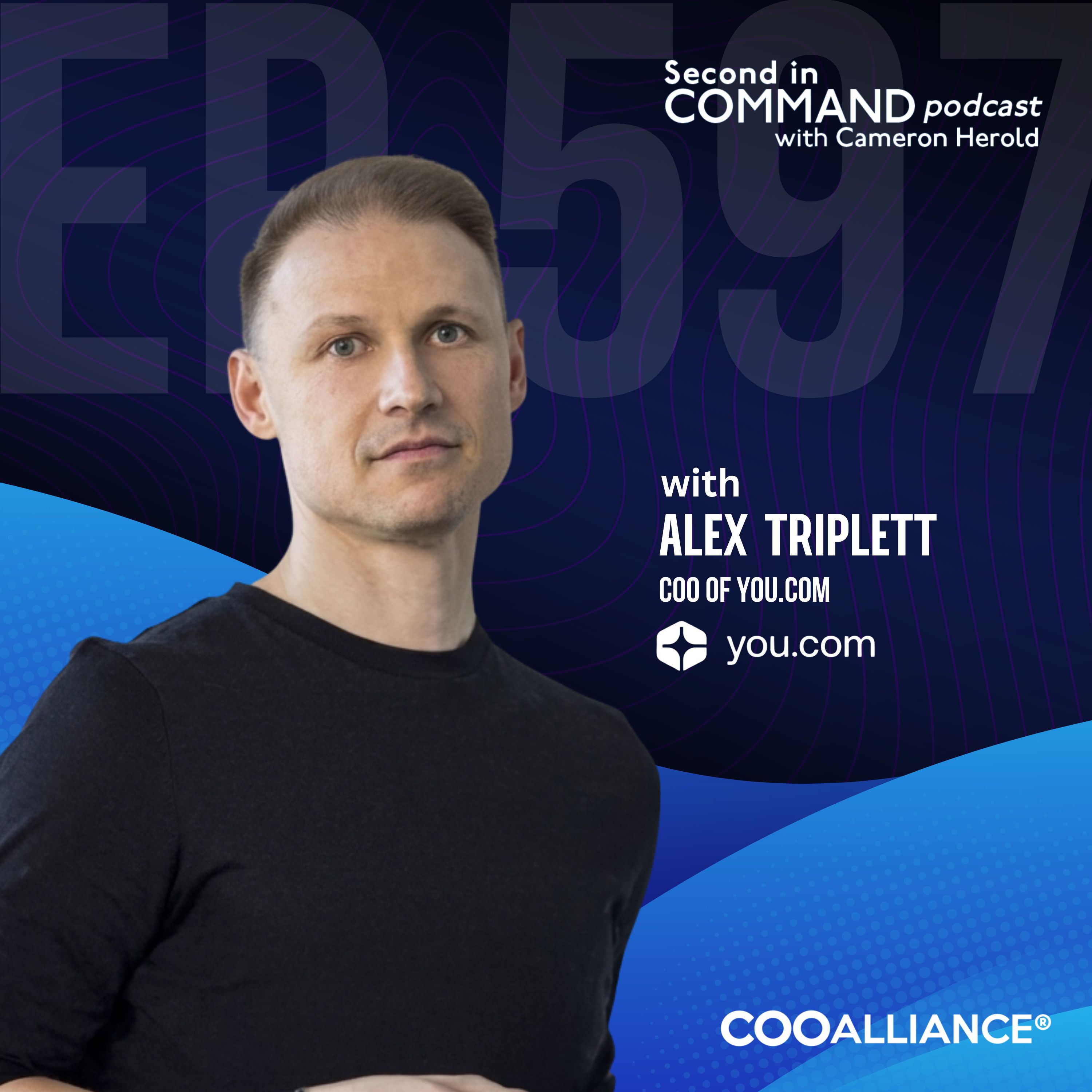
Second in Command: The Chief Behind the Chief with Cameron Herold
Ep. 597 - You.com COO Alex Triplett - How To Make or Break a COO in The First 90 Days
00:46:22
Loading summary
Transcript39 lines
- [00:00]
Alex Triplett
I am reasonably competent and dangerous around technology because I've spent a ton of time buying businesses, looking at architecture diagrams, demoing products, using products, understanding how things are built and what differences are in terms of architectural decisions, you know, code bases, delivery methodologies, so on and so forth. Because how else can I be competent and capable to lead folks if I can't put myself in their shoes, understand enough. So that's been one is this intellectual curiosity
- [00:31]
Cameron Herold
welcome welcome to the Second in Command podcast produced by the COO alliance and brought to you by its founder, Cameron Herold. In the second in command podcast we talk to top COOs who share the insights, strategies and tactics that made him the Chief behind the Chief. And now here's your host, Cameron Herold.
- [00:55]
Our guest today is Alex Triplett who is the CEO COO of you dot com. It's a brand that you may not have heard of, but they are huge. All of the top tech companies are clients of theirs and I've actually just added them to my watch list on Angellist. I want to be an Investor as Soon as possible. Alex started his career in investment banking and private equity. He made the jump 12 years ago to the corporate side at the Ion Group where he co ran the corporates division, leading 23M&A deals and driving 20 times revenue growth from 100 million to $3 billion while overseeing a team of 1600 people. He then served as joint COO and CFO at Appfire. Now@u.com Alex is scaling the infrastructure that powers AI search and agents for companies like Alibaba and Volkswagen. He can speak to the benefits of applying an investor's lens to OPS and why he believes in real time business reviews over monthly financial reporting. He takes the same outcomes based approach to AI adoption. He can share how he redesigned workflows around clear and measurable goals. He also speaks in layman's terms. You will understand everything he says. You'll have some huge takeaways on this. Grab a notepad, listen, write down all the ideas you're going to get from this and share this one. This is an episode that every entrepreneur, every leadership team member and certainly every COO can learn from. We'll see you on the inside. So Alex, welcome to the Second in Command podcast.
- [02:19]
Alex Triplett
Thank you Cameron. Pleasure to be here.
- [02:21]
Cameron Herold
Yeah, looking forward to this. I was taking a look at what you.com is doing and clearly you're not in a world that I'm orbiting in. I'm more in the entrepreneurial midsize company you guys have got every pretty Much every single brand name that is in the tech sector as a client right now, you guys are, are really kind of crushing it. Can you tell us who you.com is and you know what your core products and services are so that our listeners understand?
- [02:47]
Alex Triplett
Absolutely, Cameron. So at its most simple essence, we are Google search for AI agents. So let me unpack what that means. You have this complete paradigm shift with the advent of AI. We know that software and what humans would do in a digital or non digital way is getting replaced with agents all across the board. Whether it's an AI native business and legal like our customer Harvey, or whether it's a very large enterprise software business like our customer Salesforce. Now building and promoting agent force and other kind of tooling agents are how work gets done. Those agents rely on LLMs or large language models like OpenAI and Anthropic and Gemini and others to do core reasoning. But what they're all missing is that a model's training data only goes so far. It doesn't know what happened in the last couple of months. It has no idea what's going on in the Gulf region right now. It does not know that the Knicks just won in five. Go Knicks. I'm a Knicks fan, so it doesn't know those things.
- [03:50]
Cameron Herold
That was huge. I mean, are you kidding me? Game four was ridiculous.
- [03:54]
Alex Triplett
Oh man. Every, just the tightrope we walked and every time we'd get down and then we'd come back. So, so fulfilling. But the point of why we existed is LLMs are amazing and powerful, but they don't have that real time context from the web. And these agents often need to supplement core reasoning from an LLM with what we call augmented intelligence or real time intelligence from the web. And in the past you and I would go to Google, we type in a prompt and we get 10 blue links. And because we're humans, we read them very slowly. We don't go after page one. Very rarely do we click on page two and we often click on the first two or three that are surfaced because of our Personas and who we are and how we can get monetized by Google or other people. Yep, an agent doesn't need any of that stuff. An agent can read 100 responses like that. They can read full page contents like that. They can discern that the response in number 32 of 100 was the right one. And so we are providing search results that could be up to 100 pages full page contents. We have different endpoints that allow for an LLM to reason against the responses we provide. So we feed the web into an agent or into an LLM. We are Google for AI agents. That's what U.com is. And I think that people are starting to wake up to the fact that that search layer, that relevant real time information layer is so critical in making sure the accuracy of what happens with your LLM question Danswer or with your agent taking an action. And it's becoming more and more prevalent and I think we're in a good spot.
- [05:31]
Cameron Herold
So this is. So enterprise is using your tools, Is the consumer using it? Like are we using this instead of Grok or Perplexity or Cloud or gemini or like OpenAI or who's using the Google search for AI agents?
- [05:48]
Alex Triplett
Yeah, you could be using u.com with. So if you are a user of Anthropic, the web search is a third party. That's not anthropic. If you are the user of Salesforce, Agentforce, your web search is powered through you.com. if you are a user of Harvey and you're using the agent underneath the hood, they're using LLMs for a piece of it. And then the web service is powered by you dot com. So holy shit. They're a really important pick and shovel in the AI ecosystem because if you think about the stack, you've got the agent that you touch, you've got the column that you may touch or power the agent. If you keep going down, you've got this search layer, that's where we are and then you keep going down, you've got chips and you keep going down, you've got power. So we're one of that layer cake information search layer.
- [06:37]
Cameron Herold
So you're part of the system that we don't really see as the consumer but without you it's impossible to even get anything that we're getting correct. All right, so I don't know why you're not on my watch list on Angellist, but you will be now I'll have to go take a look and add you to that when I'm done. So in terms of working with enterprise, I know a lot of companies out there that are mid sized organizations are trying to sell to enterprise, trying to sell to larger accounts. What have you learned in the whole go to market space of working with some of these bigger companies? I feel like, you know, back in the day when I was doing sales, I'm going to date myself, going back 30 years ago, I felt like big corporate would always say yes to every presentation and you know, every one out of 50 might get to the finish line, but one of the 49 felt like I was just keeping them busy to validate their jobs to their boss. But there was never any intent. How do you sell to enterprise? How do you know when they're wasting your time? How do you get through kind of that clutter? Can you give us kind of a short course on that?
- [07:37]
Alex Triplett
Would love to. Our motion is comprised really of two, so we think of about. About it as a pincer. The bottom is what we call developer LED growth, or dlg, which is akin to what software companies call plg. We want to have users, typically engineers, that are builders. They may be inside of a large corporation, they may be you and me building on the weekend, you know, using Lovable or Replit or genspark or something. And we have an easy to use API. You can pick it up and plug it into your application and you can start running calls through it. And we give you 100 bucks of credits for free. So that's 20,000 web search calls for free. And so we love to have developer like Growth just adopt, which is really nice because that just builds up a good ecosystem of adopters. Typically though, with that motion, we're leading to what we call SLG or sales led growth, which is selling to the enterprise that you talked about. And this is where a lot of people that I think start in Silicon Valley and frankly, everywhere it's a struggle for the reasons you mentioned. Right. How do I get through procurement? How do we get to business decision maker? How do I run the classic medic or Medpic or all those Playbooks? And so we've come to find, firstly, it's a very technical sale in what we're selling, because we're selling an API that provides for web search, an API for those listening that may not be familiar. Application programmable Interface. So think of it as an electrical cord that hooks one thing to another thing. That's basically what it is in simple terms. And typically the evaluator of this is an engineer. So the beauty of this is engineers, they are really judicious with their own time and they typically will evaluate us versus a benchmark. Hey look, we have 100 questions. Your API can answer questions from the web. Can you answer them correctly and quickly? That's it. Benchmark us against some set of queries that you have. I love that because like an athlete, if you run fastest in this race or jump highest, you win. And so unlike when I used to sell enterprise software where there's art and craft of the demo and the pre sales and this and that, and you're not sure where you stand. A lot of times in a technical sale you know exactly where you stand. People will publish the benchmarks back and say, hey look, you hit X percent and someone else hit Y percent and that's why we're choosing you. So there's a portion of our SLG process that is, that is our sales led growth process that is technical. But then what it comes down to is also we're driving a business outcome. And the thing that I keep preaching to the team that I think is inherent in every enterprise sales motion is yes, you can cater to the engineer through a really good developer like growth motion or through a good technical sale. But ultimately whoever's writing that check or making the business decision, and they may well be a cto, a cio, a VP of Search, a VP of engineering, whatever, they may be technical as well, but they want to know that you're driving some business outcome. So one of the things that we really focus on is our ability to go in and say, yes, we're selling you a technical product that does this thing that you need. But then here's why we help you drive value because of XYZ and that linkage to like the business outcome and driving value. That's the important part. I once had a CRO that said because you can. That was his sales pitch and that was what he pitched to customers. I was giving you this thing or sell you this thing because then you can do something else. So at its essence, we try to marry that philosophy of finding the person or persons that really want to understand the business value that we're driving, make sure that's clear, do really, really well in the technical part, the evaluation, the benchmark. And so we marry those two things up and that's how we get enterprise deals done. And then the last thing I would note is many of these companies pecure in a certain way. They have standards, they have protocols, they have contracts. AI is revolutionized in the way that software is, or technology is, you know, provisioned and what access looks like and what a contract would look like. So I'm very sympathetic to those people in procurement or legal inside a large company that have a job to do, that have their template that works for SaaS because it's been honed for 20 years, works for software and service, but doesn't necessarily work for AI. So we try to also make an attempt to be really thoughtful about working with those folks, folks to get them over the line as well. Because look, they have a job to do. And so you want to wrap your arm around procurement or legal and say, we understand the positions you're taking, let us help you get through your job. So again, it's driving to their own business outcome. But that in a summary, Cameron, it's just business outcomes. When the technical sale, understand, put yourself in the shoes of the buyer, whatever counterparty the buyer you're talking to, whether it's procurement, legal, business person, executive engineer, et cetera.
- [12:17]
Cameron Herold
Interesting. I think I've just noticed one of your superpowers, which is the ability to explain the kind of complicated intact to kind of the layman. You work really well in sound bites and just even using like electrical cord examples like, oh, now I understand what an API is like. It was just so. It's so simple. Do you think that's why you're able to work at the executive C suite level? I know that you kind of work with Richard, who's the founder. I think you said you work with the cto. And then I believe you said the other kind of third in that if there were three in a box, is maybe the chief of staff or four in a box. Is that one of your superpowers, the ability to explain and communicate? Because I think you said earlier before we went live, that you're not truly a hardcore tech person either.
- [12:58]
Alex Triplett
Yeah, I think it's a combination of being really intellectually curious. And whenever I get involved in a company, I want to understand as deeply as I possibly can what do we do on a product and technical level. And I think anybody in a company, whether an executive on down, should have a vested interest in exactly what you sell. If you work for Coca Cola, you want to understand the products that you make. You may not get access to the secret formula, but you have a pretty good idea of what it takes to get those components and put it together. And you have relationship with bottlers that you may own or not own and how it gets out the door and why marketing is really important and how placement works and all those kinds of things that just makes life fun is understanding how things work. And so I take that to any position I've had. That would be kind of first and foremost. And so I was never a developer, but I'm reasonably competent and dangerous around technology because I've spent a ton of time buying businesses, looking at architecture diagrams, demoing products, using products, understanding how things are built and what differences are in terms of architectural decisions, you know, code bases, delivery methodologies, so on and so forth. Because how else Can I be competent and capable to lead folks if I can't put myself in their shoes? Understand enough. So that's been. One is just the intellectual curiosity and I think the second thing is figuring out ways you've said it. I think on your website or in some of your books on connecting the dots. If I'm connecting the dots for the entire organization, I've got to be reasonably competent in understanding most of the pieces of the organization and then be able to bring that to the other parts and say it in such a way where it's easily consumable. So the executive assistant knows what an API is and that's important. The sales team understands why we're building certain things. The engineering team understands the way that we sell and how we attract customers and you know, what concepts like annual recurring revenue and ARR or financial metrics are. And so the more that people kind of understand that it's self fulfilling, it's better. And so a lot of my job is doing exactly that. Intellectual curiosity to understand, understand because I just want to know. Ability to kind of abstract, connect the dots and synthesize and had a lot of practice.
- [15:10]
Cameron Herold
I like it. Yeah. Well you definitely have. Yeah. This isn't like your first time in working in a tech firm for sure. You've been in it for 20 odd years. So working with the team that you're working with right now, one of the lead roles that you mentioned is the chief of staff. I'm curious. It feels to me like it's become a title that too many small companies are using or maybe even mistitling an executive assistant. The only time I'd ever really seen the chief of staff before was the chief of staff for the President of the United States. And I mean I saw it on a, a TV show 30 years ago, but they certainly weren't an executive assistant. They felt like they were more of a traffic controller. They were more controlling a calendar. They were making sure that communication was happening. What's the chief of staff and what's the size of u.com? let's give us some perspective in terms of scope that you can talk about. And then what's a chief of staff do at a company of your size versus an executive assistant or whatever other titles they might have.
- [16:06]
Alex Triplett
Yeah, it's a great question and we're going to be a little bit. You'll hear in a second why we've got a chief of staff at our size. And then I can go on and talk about perspectives I've seen in other versions of Chief of staff. So we are about 120 people. So pretty reasonably sized series C company. We've got all the AI growth that you would want. 10x the revenue last year year and we're in approaching 9 digit of annual recurring revenues. Not there yet, but we are powering our way there. So from all aspects. Reasonably sized in a lot of angles, but not the type of company that would be big enough to necessitate a chief of staff. You're exactly right. Like a great executive assistant. I think they do a multitude of things. Ours run calendar, ours also will run office, they'll run events. We have really two incredibly capable executive assistants who want more and more and we give them more and more. They run the, the weekly all hands that we have. So they do all sorts of different things that are kind of above and beyond. Just hey, you're assigned to one executive take care of their calendar. Yeah, that's a job. But that there's so much more they can do and they can do for a chief of staff. The reason why we have it is our founder Richard. It's quite amazing. He's got his own venture capital firm. He's the founder and CEO of U.com, and he's the founder and CEO or co founder and CEO of a frontier lab called Recursive Superintelligence. And they just raised very publicly about 650 million on a 4 billion valuation recently. So he's got three businesses. And so part of the chief of staff's job is how do I figure out what is most important for Richard to do across the three businesses? And then there are certain things that he does a lot of speaking engagements, he gets asked often to participate in public events and things of that nature. Just given that he's been working in AI on the frontier for about the last 16 years and is one of the more cited authors in some of the early works that were really formative in bringing what we now know as artificial intelligence and large language models to the fore. So the chief of staff really acts as that thought partner to say what's priority? How do I ensure Richard is well prepped to address that priority? In some cases that can be scheduling. In a lot of cases that is, you know, we've got to go engage investors on the road because we're raising capital for some superintelligence. How do I, how do I manage Richard time? How do I help in that process? It's like, how can I put it? There's three or four roles in what there's a Business analyst, there's a strategist, there's a, you know, personal COO light. There's a scheduling element to it. And we pulled the guy Ryan out of being an investor. He was a venture investor. So it's perfect because a lot of what we do is, you know, capital raising.
- [18:51]
Cameron Herold
Okay, so help me understand this. I've always said that a person can only sit on one more than or sit on one toilet at a time. You try to sit on more than one toilet, it gets kind of messy. I got misquoted recently and someone said that I said you can only on one toilet at a time, which I did not say. I said sit. But either way it gets messy. How the heck does he work? Like the VC firm, I can kind of understand. But recursive, especially raising that kind of money, that kind of valuation, and then you, at the same time, size that you're at both series, you know, series C4U.com? How the heck does he do that? And how does your board even allow that? I mean, I guess Elon. So if Elon's doing it, everybody else can too.
- [19:32]
Alex Triplett
Elon can do it and Jack Dorsey can do it. And there's, I think, handfuls of people that can do it. Part of it, and this was a little bit of the attraction of me coming to you.com is if you've got somebody that can focus and has the appetite to focus on an incredibly wide breadth of the day to day, you know, running the engine for you.com and he's got, you know, similar. He's got more co founders at Recursive. So there's a, there's a whole, the whole team there. But with you dot com, that's the beautiful partnership that he and I have is he likes to do certain things and this is the relationship that I think makes sense for, you know, CEO and coo. He likes to do certain things, which is, and which is I want him to do is ultimately North Star vision, big pr, engage, big customers, large technical problems. And I do everything else.
- [20:23]
Cameron Herold
Got it.
- [20:23]
Alex Triplett
And that's perfect because I have a tremendous appetite to do many, many things. I want to drive business forward. I love owning go to market cycle, I love owning product, I love owning the operations, putting those three things together. And he and I work really well together because there's just lots of things that I'm perfectly happy to do and there's things that he, he would do but would prefer I did. That's the happy marriage and I think unlocks his ability to then Apportion his time appropriately. And that's what I tell him is like, look, I want you in high leverage, high alpha. And then if it's not high leverage, high alpha, it's going to be important, but maybe not quite there. I'll take it.
- [20:59]
Cameron Herold
Yeah. Stay out of the way of my swim lane. It's interesting I spoke about that in my, my newest book. It's called the Second in Command. It came out a couple years ago where I talk about the yin and yang approach with the CEO and coo. And part of it is deciding on roles and responsibilities, who's doing what. And you guys have clearly, clearly delineated that. But it also I think answers to me why you chose this COO role versus moving into a CEO role at some new company. Like you said, it's because you are kind of the Gwen of Basax that you, you're really here running the business while he's doing again, some of the high alpha stuff. But you are really, would it be fair to say that you are really there running the business?
- [21:37]
Alex Triplett
I think it's fair to say I run a, I'm running a large portion of the business. Yeah, yeah. There's a nuance in it. I would say yes, I'm probably running the business. But look, I report to Richard. He's the CEO, he's the founder. I really have a great relationship with him. And so it ultimately is one of these, it is very symbiotic yin and yang. And I think that's why we, we are very compatible because either of us have a particularly big ego about it. We just want to put points on the board and get stuff done. And so part of my job is how can I empower him to do the things that he can do best. And for him it's, I know Alex wants more and more and how can I give Alex more and more? So you're exactly right though. Alternatives to you.com are go run mid sized software company as CEO. And I felt long and hard about that and I felt like this period of time, particularly in technology, in AI, getting into this arena and aligning myself in a space that I thought was incredibly valuable in search and was probably a little bit underappreciated. And then a founder like Richard, who both I respect and admire as a visionary but also naturally has set himself up to say, I really need somebody like you to take more and more. I think this works really well.
- [22:47]
Cameron Herold
Did you know him prior or how did, how did they find you or you find them?
- [22:52]
Alex Triplett
Yeah, I met Richard Through a board member, which is always kind of a good thing is we had a mutual. One of my friends has been a lifelong friend for 20 years who was on our board, was led their series C. And just in the course of a cup of coffee, he said, oh, by the way, I've just gotten on the board of this really interesting business. I think you and the founder would hit it off. Or you open a meeting. And my default answer is, typically, I'm pretty open to meeting just about anybody at least once because you never know where it goes.
- [23:20]
Cameron Herold
I moved my. My residence and my company Dubai four years ago. And that's literally the default for everyone in Dubai or Abu Dhabi is yes, because everyone has moved there to. It's kind of like going to the bay area in 95. Like, no one was from there. Everyone moved there. Everyone was on this perpetual motion machine. And we said yes to everything. But it feels like so many people in, like in New York especially don't say yes because you're always gauging, like, why should I say yes? I'm protecting my time. What. What are they looking for? I love that. That is your default answer in a market where typically yes isn't the answer. All right, if you're an entrepreneur, you've got to go check out the Genius Network. The Genius Network is for ambitious, giving entrepreneurs who want to be part of the highest level connection group. And it's not just another mastermind. In fact, I have been a Genius Network member for eight years. Genius Network helps build a better entrepreneur by focusing on health, wealth, and making your business and life more elf, which stands for easy, lucrative and fun. Don't apply if you're just a taker, but do apply if you're a giving entrepreneur and you earn at least a million dollars or more in revenue. And to see if you qualify, go check out geniusnetwork.com apply again. That's geniusnetwork.com apply.
- [24:45]
Alex Triplett
You just never know. I mean, you never know when you open a door. And the worst case scenario is, yes, you spent 30 minutes or 45 minutes and one of you paid for the cup of coffee and you had a pleasant conversation, but you just never know where these things lead. And, and the other thing, the instinct that I've had is, and this is kind of just a human instinct more than a business instinct, but you just help people. You figure out ways to be helpful. You make an introduction here or there, you try to help people, you try to provide advice. You just never know when it gets repaid. So that's Also, my default is if someone asks me for help, I will likely try to do my best and help.
- [25:24]
Cameron Herold
That's been my default as well. My dad, one of my dad's mantras was the answer is yes, what's the question? It was just very helpful and very engaging. And that was probably one of his skill sets as an entrepreneur. So when you came in as CEO for you.com, my guess is that there weren't 120 employees, but there weren't three. How many were there when you joined and what was it like coming in into an existing team over top of an existing team? And what was your first 90 days like coming in?
- [25:56]
Alex Triplett
Great question. This has become interesting too, because there were actually 135 people when I came in.
- [26:00]
Cameron Herold
Oh, this is going to get good.
- [26:03]
Alex Triplett
Yes, exactly. So what we had done prior to me joining was we were going after the enterprise with the API business I talked about, which has long been the significant majority of our business. But we also had this other business line that had kind of arose in 2025 timeframe, which was building custom agents and providing a chat user interface or UI for enterprises. And the reason we did both of those things was the ultimate starting of U.com back in 2020 was to provide a consumer chat user interface. This is pre, kind of OpenAI's, you know, revolutionary announcements in the 21 and 22 time frame. This is pre perplexity and their, you know, progress with consumer. And then you're pre anthropic and all these other things. And what you need to do in consumer life is you need to have a massive amount of capital for either compute in AI or marketing. And U.com had not raised the massive amount of capital to do those two things. Although our UI was better in many ways, better answers, better responsiveness, et cetera. And we found the enterprise that had pulled us and said we want to use this. And part of it was accuracy of answers, but part of it was we were model agnostic. So you could use any of the large language models, whether it was Gemini, Claude, OpenAI, you know, Quinn, whatever you want, Kimmy, all those things. And we were having some progress there and also having some progress when customers would come to us and say, this is great that you're selling me this, this user interface, it's great that you're selling me these APIs. Gee, wouldn't it be amazing if you could wrap those APIs with a custom agent? Because I'd also want agents to do certain things in my company and I Don't quite know how to get that done. And sometimes in life when customers give you money, you do things which is not always good. So we had this other business, we're building custom agents and providing the user interface, small minority portion of our business. And you probably know from your experience, focus, free success. And so when I came into the company I said look, this search API business, this Google for agents, the market's very compelling, it's large, it's growing, it's underappreciated. All the things we talk about, the outside, the podcast, this is a great market and we were really good at this because we were the first to get here. We've got great product here, we've got great traction, momentum and growth. And then we've got this smaller business, not bad, like in a different world, that on its own is perfectly fine. We're providing a chat UI and some custom agents to enterprises but that's less scalable because if you bespoke products like a custom agent it's non repeatable, it's hard to resell that stuff. And I looked at that, I said we really ought to focus only on the APIs. And so to do that, how do I do that and separate the two, the two businesses? And we had this really nice solution where we created a joint venture. We found a professional services partner that loves doing professional services for Xai Grok or ServiceNow or Salesforce or others. And they've started many, many businesses like this where they will, they will spin up an entity that basically does services around a larger corporation and in our case they'll do services around u.com customers or frankly other AI customers. And as I was able to take a portion of the team, about 10 folks, put them into the JV and then we were able to go through a nice communication with customers and say hey look, we're not going to focus on this business, but this joint venture is. And so here's the glide slope off. So we went from about 135 people down to 110 because we also took the opportunity, I took the opportunity to exit some folks who really were really capable at enterprise software and those types of motions, but not as AI forward engineering forward, developer forward, those kinds of things. And so we took that opportunity as we did a little separation to also really I think unlock some folks that have better potential elsewhere and do a reset and then we hire back to 120. So that was the story of getting from 135 to 110 back to 120 and really just taking what we were doing 90% of and making it 100% focus, breed success. And then I tell you the, the, the power it unlocked within the company because when you tell people we're just doing one thing, we have one mission, one North Star which is also incredibly aligned to Richard's personal North Star's had for 20 years. All of that stuff in alignment, everybody gathered around one singular mission. Boom just exploded. So that's been the, that's been the sig that was my first 90 days and the second 90 days was now go to market and putting the pedal to the metal.
- [30:53]
Cameron Herold
That makes perfect sense. I, I love the whole, the, the whole principle around focus. I mean I read something about 40 years ago called the. The only person who gets anything done is the monomaniac with a mission. So that, that monomaniacal focus. But I also like the whole cut deep cut once. I mean if you're going to be moving 10 people out, you may as well get rid of any of the dead weight that you can or the people that aren't completely aligned. It's a chance to kind of, you know, make that, that huge cut. I'm also still a little bit curious though of, of when you came in as coo, how did you get the current team to know you, to like you and to trust you? And then how did you also get to know them and like them? And how long did it take or how long did you give yourself before you started to make big decisions? Did you come in on day one, start swinging for the fences, or did you come in on day one and okay, let me get to know the people and the history and like, does that make sense?
- [31:43]
Alex Triplett
Like it makes complete sense. And I took the following approach, which I've taken before, and, and I highly recommend it for any listener that's out there thinking about coming into a new situation and how to encounter it at any executive level, frankly is I did a bit of outside in for about four to six weeks. So thinking about u.com before I joined, doing as much research as I could possibly, you know, what do we do? What's our positioning? Who do I know within the company? Who are our competitors? Who are the alternatives? As much as you possibly can. So at least you have a baseline level of competency. And then the first 30 days of my 90 days is all about listening. It's the Socratic method of learning. I talked to as many people as I possibly could. So within a company at the time of 130 people, I talked to probably 45 people. I did one on ones with 45 plus people. I talked to as many customers as I could. So I talked to a couple dozen customers. I got it as close to the products as I could. So I just fiddled around and read and touched the products. Because businesses, at the end of the day all boil down to people, products, customers. And so to me, the first 30 days as an executive is get close to those three things and do it in a very organic way. And then at that point, the instinct I had before joining, which was, we really ought to focus on APIs because it's just a better business and we're, and we're, we do much more of it. It's where the significant majority of the revenue comes from. It's where the edge is. It's where the, the products are the best. That instinct then after 30 days was validated. And so then at that point, the next 30 days was I went back to the management team, I said, okay, great, I've done this listening tour. I've talked to 45 people. Here's what they say to a person. They said, and if we only did the one thing, and the One thing being APIs, we could really unlock something special. I kept hearing that over and over. And when I talked to customers, the happiest ones were the ones who were API customers. And then when I looked at our products and I thought, where do we have sustainable competitive advantage for the next in AI land? Two years is a long time, but I'm trying to think about 3, 4, 5, like, where can I squint and see like a moat, APIs? So I came to the executive and said, I really, here's what I'm hearing. And oh, by the way, then I back it up with data because I looked at the pipeline, where are our best win rates? Where's the best velocity? Where's the biggest pipeline? Look at the customers, where's the best retention? So you have all this data and you say, all right, the organization's saying this, the customers are saying this. I think we all have this instinct around product. Here's what the sales and pipeline data say. I think we ought to do this. And so then we worked for two or three weeks to go through how can we do this? Which was, how do we eloquently tell some amount of customers? We're not going to focus on the thing that we sold them previously, which is delicate, because I respect the relationships that are built and want to honor those. How can we treat people with care as they may not be with the organization any longer. They may be going out into this JV. How can we set up this JV? So we spent the next 30 days doing that and then we pulled the trigger on March 23rd, not that I remember the date. And from there we went.
- [34:59]
Cameron Herold
I love it. And I love that you actually did some of, of your understanding the company before you joined them. That makes perfect sense on how you kind of fast forwarded the 90 days. But then I really love and I'm completely aligned on that first 30 of only listening, talking to team members. The only thing I ever remember from I think is grade 9 or grade 10 science class was like state the hypothesis, test, test the hypothesis. And that's kind of what you did in the like. But so many people I think make that mistake where they come in before they really know the people, before the people know them. And they come in with that big idea even though it's right, but they cause too many ripple effects. And I think you did it well. I know you did it in completely the right way. Last couple of questions I've got is what do you focus on day to day and how do you kind of orbit the minutiae? I had someone tell me one time that I majored in the minors and, and, and they were so right. I was trying to get every franchisee at 1, 800, got junk to have the proper email signature and Alan Reamer from, from Philly said, you know, great. Yes. But you've got, you know, 100 franchisees that don't have a marketing budget, a marketing calendar, a marketing plan and you're worried about the signature major in the majors. How do you orbit orbit that? How do you stay focused on the, the important stuff and not get sucked into the day to day of every decision and every meeting.
- [36:16]
Alex Triplett
That is the classic question. And it is something that I think about almost every day and every week about how do I use my time and the most effective way to drive the massive, the most amount of value or the most massive amount of value for the company. What I try to do is I'm incredibly structured with my own time and I like to be very calendared and compartmentalize what I do. And so one of the things that I will do is at the start of every week I've got my to do lists and there are three or four things that I know are the absolute biggest ticket things that we need to focus on. It may be large customer engagement, it may be large product decision, it may be large prospect, it may Be reshaping the way that reporting goes. It may be empowering a team to fulfill something. So it's one of those big ticket things that if we just ignored everything else and I wasn't involved and it ran on its own, what do we have to get done that ultimately drives the P and L and drives shareholder buy because that's what I've got to be directly impacting those things. And so those are the first things and then trying to figure out how to apportion my week and my time focusing on those things. And then there's kind of a second level of things where it's executive overlay. So it is breaking ties, making decision on something, being the final say in a legal document, thinking about the strategy of a partner, opening up some accounts for the sales team where I've got direct relationships. Those things are really important and they can lead to the bigger things. So you don't want to forget them. But there can be 10, 20, 30 of those a week, a given week and sometimes they don't always get fulfilled. So again you're kind of like prioritizing those things. And then at the bottom is all the day to days. And I joke to people, the life of an executive is every day you wake up there will be a surprise. You don't know if it's good or bad. You just mentally prepare yourself it's going to be bad. Something bad will happen today. You are responsible for dealing with it. And so then there's no emotion, right? You just like you walk into it and it's like ah, this thing happened. Okay, no worries, let's figure it out. No problem. And there's that kind of mentality. But the other day to day thing is there's just lots of these little things as you, as you said the minutia, right? Majoring in the minors. And so what I try to do is I try to box when I look at slack, I try to box when I look at email and I try to chunk it. And I'm a huge fan of anti multitasking and there's like so much literature and research that shows you you just degrade your ability to make great decisions if you're looking at two or three or four different things at the same time or if you superficially float by things and don't kind of dive in. And I really don't like I enjoy slack because it's a great form of communication. Teams is the same thing but people making decisions on slack and teams like you're not thinking it through Decision making is not that. And so I typically will not look for two or three hours because I've got meetings I want to focus on or I have a thing that I want to read, or I have a decision that needs to be made or I've got a customer engagement, whatever, and then I've got a window. And I will go through my slacks and emails. And often if I read something and determine this requires more than one minute of cognitive thinking, I should not respond superficially to this person. I will unread it and deal with it later. Oftentimes in the morning or at night when I'm fresh after the gym in the morning at like 6:30 in the morning or at night after my daughter's gone to sleep and it's quiet and it's 8:30 because those things deserve time that I don't want to superficially flow by. So that's kind of my like you got, you got the start of the week checklist, you get the big huge alpha things you got to do, you got the medium things you got to do most of them and then you gotta time box the kind of day to day leaving some buffer for the surprise. But yeah, I'm a big, I'm a big like on the day to day minutia, I unread things all the time because I'm like, I don't care about the bubble, I don't care about the dopamine hit like social media, Slack media is not going to get me. I don't need my stuff to be read, I need it to be right.
- [40:40]
Cameron Herold
Or like there's some huge, huge, huge nuggets in what you just covered there. Which. Thank you. A couple that I want to just, just go back to. One is the idea of the top three. I mean even if you're just doing three big things on a weekly basis, that's 156 huge things that you're doing over the course of a year, which is way more than most executives ever get done. The second one was around expecting the unexpected when, when we were building what's now called Gerber Auto collision in the U.S. boyd Auto Body in Canada, it's now the largest collision repair chain in the world. My partner Terry said that he would always expect the worst or expect things to go sideways. And when they did, he crossed them off his list. And I said, what do you mean? He goes, you know Greg in our office, I'm like, yeah. He goes, greg pisses me off every day. I'm like, yeah, I know. He goes, so I wrote on my to do list one day, get pissed off by Greg. And he goes, 11 o' clock, Greg came in, did something, pissed me off. And Terry goes, I laughed and I checked it off, my list is completed. And then I dealt with the issue. I'm like, dude, that is so brilliant. It's ridiculous. Like, it's just so, you know, so it's, it's kind of. But I think that's really important as a mindset because stuff does happen, stuff does go sideways. And if you're expecting everything to go perfect, you're, you're completely setting yourself up for failure. It's why, by the way, most perfectionists really struggle at being entrepreneurs is they've never had to deal with adversity before. My wife got better than a perfect gpa. I didn't even know that it was a thing. She had a 4.2 or 4, 4.3 GPA. I had a 2.7. I, I mean, I was dealing with failure my whole life, so I'm used to it. All right, I want to go back to the the last little nugget for yourself. If you were giving some advice to the younger you, the 21 or 22 year old Alex starting off in your career, what advice would you give the younger you that you know to be true?
- [42:26]
Alex Triplett
Today you have two ears and one mouth and that is the perfect ratio.
- [42:32]
Cameron Herold
Use them in that ratio. Yeah, I love that. Alex Trippit the COO4U.com thanks so much for sharing with us on the Second in Command podcast. Really appreciate all the wisdom and the time today.
- [42:44]
Alex Triplett
Thank you Cameron. Really appreciate your time.
- [42:48]
Cameron Herold
You've been listening to Second in Command, brought to you by COO alliance founder Cameron Herald. If you enjoyed this episode, please be sure to like, share and subscribe to to us on Apple Podcasts, Spotify and our other podcast streaming platforms. For more best practices from industry leading COOs, visit COOAlliance.com.