
Podcast
Seize & Desist
Hosted by Asset Reality · EN
Welcome to Seize & Desist - the first podcast to explore the fascinating and complex world of seized assets.
In this show, Asset Reality co-founder and CEO Aidan Larkin will be joined by some of the industry’s most influential and renowned experts to discuss their perspectives on the latest headlines, trends and challenges shaping the future of global asset recovery.
They’ll explore how asset recovery impacts individuals and organisations alike and how it's evolving to keep pace with emerging technological advancements like cryptocurrencies, NFTs and other virtual assets.
Whether you're new to the world of seized asset recovery or a seasoned practitioner, join us inside the world of asset recovery and uncover the stories shaping its future.
Subscribe to be the first to hear new episodes of Seize & Desist.
Connect with Asset Reality on social media:
LinkedIn: https://www.linkedin.com/company/asset-reality/
Twitter (X): https://twitter.com/asset_reality
Stay up-to-date with the latest industry developments by reading our blog:
https://www.assetreality.com/blog
Connect with our host Aidan Larkin on social media:
LinkedIn: https://www.linkedin.com/in/aidan-larkin-29810781/
Twitter (X): https://twitter.com/AidanJLarkin
Seize & Desist is for informational purposes only and is not intended to provide legal, tax, financial, and/or investment advice. Listeners must consult their own advisors before making decisions on the topics discussed.
Asset Reality has no responsibility or liability for any decision made or any other acts or omissions in connection with your use of this material.
The views expressed by guests are their own and their appearance on the program does not imply an endorsement of them or any entity they represent. Views and opinions expressed by Asset Reality employees are those of the employees and do not necessarily reflect the views of the company.
Asset Reality does not guarantee or warrant the accuracy, completeness, timeliness, suitability or validity of the information in any particular podcast and will not be responsible for any claim attributable to errors, omissions, or other inaccuracies of any part of such material.
Unless stated otherwise, reference to any specific product or entity does not constitute an endorsement or recommendation by Asset Reality.
24episodes
Episodes
Newest firstAll episodes

Ep 36: Beyond the Figures: Measuring What Matters in Asset Recovery
2w ago00:45:09Tap to summarizeWhat happens to a seized mafia asset after the headlines fade? Dr Amber Phillips, Senior Lecturer in Criminology at UWE Bristol, has spent her career chasing that answer, starting with fieldwork in Calabria alongside anti-mafia organisations working to strip the 'Ndrangheta of its assets and its grip on local communities.She joins Jason Sandoval to unpack her 'Beyond the Figures' research with financial investigators across England and Wales and the gap between headline recoveries and what practitioners count as success. Amber argues for a fifth 'D', Destination, alongside disruption, disentitlement and deterrence, and previews her new NCA/Home Office study, funded through the Asset Recovery Incentivisation Scheme (ARIS), on whether asset recovery genuinely deters crime.⏱️ Timestamps02:00 – Amber's route into asset recovery via Calabria08:45 – how mafia power works and what asset recovery undermines14:00 – the GOEL social reuse model in Calabria17:50 – proposing a fifth D: destination as a measure of success21:00 – Beyond the Figures29:45 – how ARIS funding actually works👤 About Our GuestDr Amber Phillips is a Senior Lecturer in Criminology at UWE Bristol, specialising in organised and economic crime. Her career began in Calabria with anti-mafia organisations and she now leads a new NCA/Home Office study examining whether asset recovery genuinely deters crime.🔑 Key TakeawaysNumbers Do Not Tell the StoryAmber's research with financial investigators found headline figures often miss the disruption and investigative quality practitioners value most.Destination Deserves Its Own DAmber proposes adding Destination to the existing framework of disruption, disentitlement, deterrence and detection.Low Value Orders Can Outperform High Value OnesA small seizure from an early-stage offender can disrupt a criminal career as effectively as a six-figure one further down the line.ARIS Funding Shapes Investigator BehaviourHow ARIS returns are split between confiscation and forfeiture orders can push investigators toward the more lucrative route, not the more powerful one.📚 Resources MentionedDr Amber Phillips on LinkedInBristol247 on the NCA/Home Office studySeize & Desist E32 with Sal Melki, NCASeize & Desist E35 with Oliver Bullough📬 Stay ConnectedIf you found this episode useful, make sure you:Subscribe to Seize & Desist on Apple Podcasts, Spotify, or wherever you listenFollow Asset Reality on LinkedIn and Twitter/X for updates, resources, and future episodesShare this episode with colleagues working in asset recovery, investigations, or financial crime⚠️ DisclaimerOur podcasts are for informational purposes only. They are not intended to provide legal, tax, financial, and/or investment advice. Listeners must consult their own advisors before making any decisions on the topics being discussed. Asset Reality has no responsibility or liability for any decision made or any other acts or omissions in connection with your use of this material. The views expressed by guests are their own and their appearance on the program does not imply an endorsement of them or any entity they represent. Views and opinions expressed by Asset Reality employees are those of the employees and do not necessarily reflect the views of the company. Asset Reality does not guarantee or warrant the accuracy, completeness, timeliness, suitability or validity of the information in any particular podcast and will not be responsible for any claim attributable to errors, omissions, or other inaccuracies of any part of such material. Unless stated otherwise, reference to any specific product or entity does not constitute an endorsement or recommendation by Asset Reality.
Transcribe →
Ep.35: Dirty Money Wins with Oliver Bullough and Jason Sandoval
Jun 3000:46:30Tap to summarizeOliver Bullough has written three books on how dirty money moves around the world. His single biggest finding is so low-tech it almost sounds like a joke. Jason Sandoval, former DEA special agent and Asset Reality’s Head of European Operations, spent thirty years chasing the same problem. One investigated it, the other wrote about it. Together, they unpack why the global system for tackling money laundering is not working and what it would take to build something that does.⏱️ Timestamps02:30 – Money laundering as a meta-crime13:00 – Carousel fraud and what a mission-led response looks like24:00 – High-denomination banknotes and who is actually using them29:30 – Operation Destabilise and cash-for-crypto35:00 – Political will vs operational realities40:10 – Asset recovery as a fourteen-point swing42:20 – Oliver’s prescription👤 About Our GuestOliver Bullough is an award-winning journalist and author of Moneyland, Butler to the World, and Everybody Loves Our Dollars. He has spent his career mapping how dirty money moves globally, writing for The Guardian, The New York Times, GQ, and The Economist. This is his second appearance on Seize and Desist.🔑 Key TakeawaysCriminals Go Where Defences Are Weakest: As banks tightened controls, criminal wealth moved to crypto and trade finance, which remain vastly under-regulated.Carousel Fraud Shows What Works: The UK’s near-complete defeat of carousel fraud shows what happens when intelligence, law enforcement and legislation pull together with a shared mission.High-denomination Banknotes Undermine Everything: Fewer than 15% of US transactions are now done in cash, yet demand for $100 bills keeps rising. Central banks are printing them without asking where the demand is coming from.Asset Recovery Is a Fourteen-Point Swing: Taking assets from criminals degrades their capability and improves law enforcement’s at the same time.Political Will Is the Missing Variable: Every intervention Oliver identifies is achievable. The barrier is the political will to confront the interests of those with wealth to hide.📚 Resources MentionedEverybody Loves Our Dollars by Oliver Bullough: https://amzn.eu/d/06emtzVhButler to the World by Oliver Bullough: https://amzn.eu/d/gaqVRE9Moneyland by Oliver Bullough: https://amzn.eu/d/ezB43RvOliver Bullough on The Guardian: https://www.theguardian.com/profile/oliverbulloughSeize & Desist Episode 19 with Oliver Bullough: https://link.cohostpodcasting.com/d9980f5e-8a52-48d5-a31b-0ecfe2a3cc89?d=eJs8ymAzD&v=8112📬 Stay ConnectedIf you found this episode useful, make sure you:Subscribe to Seize & Desist wherever you listenFollow Asset Reality on LinkedIn and X for updates, resources, and future episodesShare this episode with colleagues working in asset recovery, investigations, or financial crime⚠️ DisclaimerOur podcasts are for informational purposes only. They are not intended to provide legal, tax, financial, and/or investment advice. Listeners must consult their own advisors before making any decisions on the topics being discussed. Asset Reality has no responsibility or liability for any decision made or any other acts or omissions in connection with your use of this material. The views expressed by guests are their own and their appearance on the program does not imply an endorsement of them or any entity they represent. Views and opinions expressed by Asset Reality employees are those of the employees and do not necessarily reflect the views of the company. Asset Reality does not guarantee or warrant the accuracy, completeness, timeliness, suitability or validity of the information in any particular podcast and will not be responsible for any claim attributable to errors, omissions, or other inaccuracies of any part of such material. Unless stated otherwise, reference to any specific product or entity does not constitute an endorsement or recommendation by Asset Reality.
Transcribe →
Ep. 34: The Implementation Gap: What You Seize Is What You Get
Apr 2900:48:08Tap to summarizeJill Thomas speaks with Tristram Hicks about why cash seizure is one of the most powerful tools available to law enforcement and what it takes to build asset recovery systems that deliver at scale. As one of the lead practitioners behind the UK's Proceeds of Crime Act and an international capacity building adviser, Tristram explains what turns legislation into results, why financial DNA changes how investigators approach every crime, and what FATF's new asset recovery guidance means for practitioners worldwide.⏱️ Timestamps00:05 – Introductions01:41 – POCA: from dozens of cases to 5000+ a year11:45 – The cash seizure spark that changed UK practice16:12 – Incentivisation and why recycling assets changes minds23:10– Financial DNA: every financial transaction leaves a trace27:30 – How things used to be vs what we should be working towards33:20 – The need for statistics in asset seizure37:30 – The importance of cross agency reporting systems 40:30 – Magic wand: bring cash seizure powers inland👤 About Our GuestTristram Hicks is the author of The War on Dirty Money and one of the most experienced asset recovery practitioners working internationally today. He spent ten years at the centre of the UK's Proceeds of Crime Act implementation, leading operational financial investigation teams at Scotland Yard while helping shape national policy. He has since worked across Europe, the Balkans, and beyond, advising governments on how to build asset recovery systems that deliver results in practice.🔑 Key TakeawaysCash Seizure Is the CatalystExtending powers from the border inland transformed UK practice. Most jurisdictions have the same dormant authority available today.Incentivisation Makes Legislation WorkThe UK's Proceeds of Crime Act succeeded because it built an implementation committee and recycled confiscated proceeds back to the agencies doing the work. Once the financial incentive was in place, national volumes grew 14-fold.Financial DNA Is EverywhereEvery financial transaction leaves a trace connecting people to people, places, and money.Embed Financial Investigators at the Front LineWorking alongside criminal investigators from the point of arrest is what converts law into seizures. Parallel structures are far more effective than isolated ones.📚 Resources MentionedThe War on Dirty Money by Tristram Hicks | AmazonTristram Hicks on SubstackTristram Hicks on LinkedInTristram’s Critique of the FATF GuidanceFATF Guidance on Asset RecoveryEU Asset Recovery Directive (2024)CARIN network📬 Stay ConnectedIf you found this episode useful:Subscribe to Seize & Desist wherever you listenFollow Asset Reality on LinkedIn for updates, resources, and future episodesShare this episode with those working in asset recovery, investigations or financial crime⚠️ DisclaimerOur podcasts are for informational purposes only. They are not intended to provide legal, tax, financial, and/or investment advice. Listeners must consult their own advisors before making decisions on the topics discussed. Asset Reality has no responsibility or liability for any decision made or any other acts or omissions in connection with your use of this material. The views expressed by guests are their own and their appearance on the program does not imply an endorsement of them or any entity they represent. Views and opinions expressed by Asset Reality employees are those of the employees and do not necessarily reflect the views of the company. Asset Reality does not guarantee or warrant the accuracy, completeness, timeliness, suitability or validity of the information in any particular podcast and will not be responsible for any claim attributable to errors, omissions, or other inaccuracies of any part of such material. Unless stated otherwise, reference to any specific product or entity does not constitute an endorsement or recommendation by Asset Reality.
Transcribe →
Ep. 33: Following the Mail: Postal Intelligence in the Age of Crypto Crime
Apr 200:45:46Tap to summarizeAidan Larkin speaks with Tara Kavanaugh, a federal investigator with the U.S. Postal Inspection Service (USPIS) and liaison to the FBI's dark‑web opioid task force. Tara draws on a career spanning HUMINT work in the Middle East, signals intelligence at the NSA and crypto‑enabled investigations at USPIS to explain how modern crime moves across the mail system, the dark web, and digital‑asset ecosystems. She outlines the realities of mail‑based fraud, fentanyl supply chains, dark‑web vendor activity, and the growing “scamdemic,” while highlighting how postal data and blockchain analytics help identify offenders. They also discuss inter‑agency collaboration, investigative tooling and why asset recovery remains central to disrupting harm.⏱️ Timestamps00:00 – Early Career & Intelligence Background04:40 – USPIS Crypto Investigations06:45 – FBI Liaison Role & Dark‑Web Opioid Task Force12:50 – Using Postal Intelligence to Strengthen Federal Cases15:30 – Blockchain Tracing Patterns, Playbooks & Criminal Methods21:45 – Agency Readiness, SOPs & Evolving Crypto Capabilities25:45 – Crypto ATMs, Victim Risks & the Growing “Scamdemic”32:40 - The Modern Investigator’s Toolkit & Global Collaboration👤 About Our GuestTara Kavanaugh is a federal investigator at the U.S. Postal Inspection Service (USPIS) and liaison to the FBI’s Joint Dark‑Web and Opioid Task Force. Her career has spanned HUMINT operations in conflict zones, counterintelligence work at the NSA, dark‑web investigations targeting fentanyl vendors, and blockchain‑based tracing of narcotics proceeds and scam activity. Tara works across local, state, federal, and international partners like Europol to disrupt digital‑asset–enabled crime.🔑 Key TakeawaysAsset Recovery Is Not PeripheralFrom fentanyl vendors to terrorist financing, taking the money disrupts crime faster than arrests.Inter‑Agency Collaboration Works When Data FlowsUSPIS, FBI, Europol, and others share seized server data to proactively identify vendors and cases. USPIS postal metadata, label history, and mail‑stream analytics give investigators visibility that other agencies don’t have.Crypto ATMs Are a Major Scam VectorElderly victims are overwhelmingly targeted, and the machines provide deceptive legitimacy.Blockchain Tools Have Improved DramaticallyWhat once required hours of manual tracing now surfaces automatically across chains.📚 Resources Mentioned9CRC on YoutubeEuropol's Project A.S.S.E.TAlison Jimenez on Seize & DesistRich Lebel on Seize & DeistOperation ShamrockAsset Reality's FCA Approval📬 Stay Connected If you found this episode useful, make sure you:Subscribe to Seize & Desist on Apple Podcasts, Spotify, or wherever you listenFollow Asset Reality on LinkedIn for updates, resources, and future episodesShare this episode with those working in asset recovery, investigations or financial crime⚠️ DisclaimerOur podcasts are for informational purposes only. They are not intended to provide legal, tax, financial, and/or investment advice. Listeners must consult their own advisors before making decisions on the topics discussed. Asset Reality has no responsibility or liability for any decision made or any other acts or omissions in connection with your use of this material. The views expressed by guests are their own and their appearance on the program does not imply an endorsement of them or any entity they represent. Views and opinions expressed by Asset Reality employees are those of the employees and do not necessarily reflect the views of the company. Asset Reality does not guarantee or warrant the accuracy, completeness, timeliness, suitability or validity of the information in any particular podcast and will not be responsible for any claim attributable to errors, omissions, or other inaccuracies of any part of such material. Unless stated otherwise, reference to any specific product or entity does not constitute an endorsement or recommendation by Asset Reality.
Transcribe →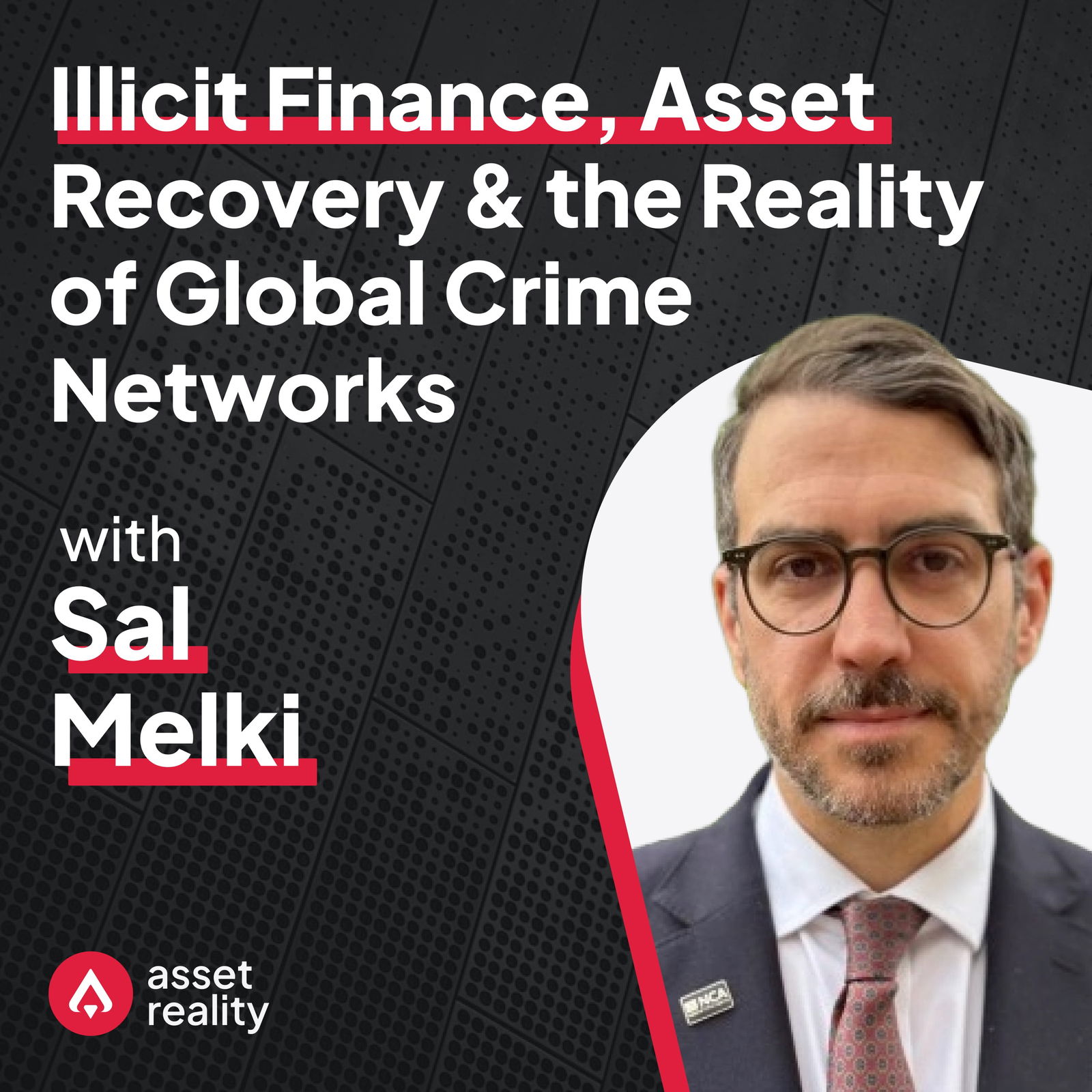
Ep. 32: Illicit Finance, Asset Recovery & the Reality of Global Crime Networks
Feb 400:49:39Tap to summarizeAidan Larkin sits down with Sal Melki, Deputy Director at the UK’s National Crime Agency and senior leader at the National Economic Crime Centre, to unpack how illicit finance really works today, from local cash couriers to global money laundering networks. Sal shares frontline insight on why money laundering is now easier than ever, how technology and crypto are reshaping criminal networks, and what actually works when disrupting and recovering criminal assets at scale. We also dive into Operation Destabilise, public-private data fusion, and why asset recovery has become one of law enforcement's most powerful tools against serious organised crime. ⏱️ Timestamps 00:00 – Introductions and Overview of the NCA and NECC 04:30 - Evolution of Organized Crime Networks 09:40 - AI, Synthetic Identities, and Emerging Threats 17:30 - Public-Private Partnerships & Data Fusion 28:40 - Crypto as an Asset Class 36:50 - Operation Destabilize 39:55 - Money Laundering as a Service 46:20 - Future Priorities 👤 About Our Guest Sal Melki is a Deputy Director at the UK National Crime Agency and a senior leader at the National Economic Crime Centre, where he leads the response to illicit finance, money laundering, and asset recovery. With a background in the Metropolitan Police and Counter Terrorism Policing, Sal works at the centre of the UK’s public‑private effort to disrupt serious organised crime.🔑 Key Takeaways Illicit Finance is the System Asset recovery is not a side quest. It is central to disrupting organised crime, from drugs and fraud to sanctions evasion. Money Laundering Has Scaled Professional laundering networks now operate like service providers, using cash, crypto, shell companies, and technology to move value globally. Technology Cuts Both Ways AI, crypto, and automation are making crime easier, but they are also powerful tools when law enforcement and the private sector work together. Data Fusion Beats Silos Proactive, shared intelligence across banks, crypto firms, and law enforcement delivers far more impact than reactive reporting alone. Disruption Matters You do not always need to arrest the kingpin. Taking money, increasing friction, and targeting facilitators change behaviour fast. 📚 Resources Mentioned National Crime Agency (NCA) National Economic Crime Centre (NECC) Operation Destabilise The Record | Inside Operation Destabilise INTERPOL Silver Notice Basel Institute on Governance | INTERPOL Silver Notice Explained 📬 Stay Connected If you found this episode useful, make sure you: Subscribe to the podcast on Apple Podcasts, Spotify, or wherever you listen Follow Asset Reality on LinkedIn for updates, resources, and future episodes Share this episode with colleagues working in asset recovery, investigations, or financial crime ⚠️ Disclaimer Our podcasts are for informational purposes only. They are not intended to provide legal, tax, financial, and/or investment advice. Listeners must consult their own advisors before making decisions on the topics discussed. Asset Reality has no responsibility or liability for any decision made or any other acts or omissions in connection with your use of this material. The views expressed by guests are their own and their appearance on the program does not imply an endorsement of them or any entity they represent. Views and opinions expressed by Asset Reality employees are those of the employees and do not necessarily reflect the views of the company. Asset Reality does not guarantee or warrant the accuracy, completeness, timeliness, suitability or validity of the information in any particular podcast and will not be responsible for any claim attributable to errors, omissions, or other inaccuracies of any part of such material. Unless stated otherwise, reference to any specific product or entity does not constitute an endorsement or recommendation by Asset Reality.
Transcribe →
BONUS: Aidan Larkin on Times Radio: What happens after a £5.1bn crypto seizure?
Dec 2000:07:38Tap to summarizeThis episode was originally recorded for Times Radio on 13th November 2025.In this special bonus episode, Aidan Larkin joins Hugo Rifkind on Times Radio to discuss what happens after a major seizure and why the landmark £5.1bn crypto seizure could redefine how governments handle digital assets. In November 2025, a Chinese national dubbed the “Bit Queen” was sentenced to several years in prison for orchestrating a staggering £5.1 billion cryptocurrency Ponzi scheme. The case made headlines worldwide, not just for its scale, but for the questions it raises about the future of asset recovery in a digital age. Aidan and Hugo explore:What happens after billions in crypto are seizedHow governments navigate cross-border asset recoveryThe diplomatic and legal challenges of returning funds to victimsWhy this case could set a global precedent for managing digital assetsResourcesCrypto Seizures: A Turning Point for Global Asset RecoveryBBC News: Cryptoqueen who fled China for London mansion jailed over £5bn Bitcoin stashStay Connected Subscribe to Seize & Desist for all the latest insights on asset recovery. Disclaimer Our podcasts are for informational purposes only. They are not intended to provide legal, tax, financial, and/or investment advice. Listeners must consult their own advisors before making decisions on the topics discussed. Asset Reality has no responsibility or liability for any decision made or any other acts or omissions in connection with your use of this material. The views expressed by guests are their own and their appearance on the program does not imply an endorsement of them or any entity they represent. Views and opinions expressed by Asset Reality employees are those of the employees and do not necessarily reflect the views of the company. Asset Reality does not guarantee or warrant the accuracy, completeness, timeliness, suitability or validity of the information in any particular podcast and will not be responsible for any claim attributable to errors, omissions, or other inaccuracies of any part of such material. Unless stated otherwise, reference to any specific product or entity does not constitute an endorsement or recommendation by Asset Reality.
Transcribe →
Ep. 31: Inside the 'Scamdemic' with Operation Shamrock
Dec 501:02:52Tap to summarizeAidan Larkin sits down with Erin West and Detective Matthew Hogan of Operation Shamrock to unpack the global 'scamdemic' that’s devastating victims and fuelling organised crime, exploring the human cost behind crypto-enabled fraud. Erin and Matthew share frontline insights on why law enforcement struggles to keep pace, how AI is supercharging scams and what systemic changes are urgently needed. We also spotlight Asset Reality’s new strategic alliance with Operation Shamrock, aimed at closing the enforcement gap and accelerating victim restitution worldwide. Timestamps 00:00 – Introduction03:30 – The Scamdemic: How pig-butchering scams evolved and scaled globally10:00 – AI and the psychology of scams15:00 – Human trafficking and scam compounds20:00 – Law enforcement challenges 29:00 – Why crypto recovery is easier than you think 46:00 – Social media’s role in enabling scams 59:00 – Community, Collaboration and the Crypto Coalition About Our Guests Erin West is the founder of Operation Shamrock, a nonprofit dedicated to disrupting the scam industry through education, advocacy and law enforcement support. After 26 years as a prosecutor, Erin now leads global efforts to fight transnational organized crime and protect victims. Matthew Hogan is a detective with the Connecticut State Police and co-founder of its cryptocurrency working group. He serves on the Secret Service Financial Crimes Task Force and works tirelessly to recover assets for victims of crypto-enabled fraud. Key Takeaways The Scamdemic is Industrial: Pig-butchering scams and sextortion are run from compounds housing tens of thousands of trafficked workers, weaponizing AI and psychological manipulation. Law Enforcement is Outpaced: Crypto recovery is technically easier than physical asset recovery, but resource gaps, bureaucracy and lack of training stall progress. Systemic Change is Needed: From unified reporting systems to breaking down silos, collaboration across law enforcement, tech platforms and financial institutions is critical. Our Partnership with Operation Shamrock Asset Reality and Operation Shamrock have formed a global strategic alliance to: Deliver monthly free crypto seizure training to U.S. and international law enforcement via the Crypto Coalition. Develop standardized playbooks for intake, seizure, and investigation workflows. Launch a global advocacy initiative making victim restitution a core success metric for crypto enforcement. As Aidan Larkin says: “This isn’t just about crypto, it’s about systemic change. If we empower local agencies with the right playbook and tools, we can disrupt billion-dollar networks before the funds vanish.” Learn moreResources Operation Shamrock Crypto Coalition Chainalysis Report: Seizable Crypto Assets in 2025 Stay Connected Subscribe to Seize & Desist for all the latest insights on asset recovery. Disclaimer Our podcasts are for informational purposes only. They are not intended to provide legal, tax, financial, and/or investment advice. Listeners must consult their own advisors before making decisions on the topics discussed. Asset Reality has no responsibility or liability for any decision made or any other acts or omissions in connection with your use of this material. The views expressed by guests are their own and their appearance on the program does not imply an endorsement of them or any entity they represent. Views and opinions expressed by Asset Reality employees are those of the employees and do not necessarily reflect the views of the company. Asset Reality does not guarantee or warrant the accuracy, completeness, timeliness, suitability or validity of the information in any particular podcast and will not be responsible for any claim attributable to errors, omissions, or other inaccuracies of any part of such material. Unless stated otherwise, reference to any specific product or entity does not constitute an endorsement or recommendation by Asset Reality.
Transcribe →
Ep. 30: Courts, Crypto & Code: Making Sense of Digital Asset Law
Nov 2500:35:12Tap to summarizeAidan Larkin talks with Canadian lawyer Jessica Stansfield about the evolving landscape of digital asset recovery. From tackling cryptocurrency fraud to navigating the complexities of tracing assets on the blockchain, Jessica shares her experience helping victims overcome legal and enforcement challenges. She also explores emerging trends, the growing role of technology in asset recovery, and the provocative debate around the idea that ‘Code is Law.’Timestamps 00:00 – Introduction and Background03:00 – Asset Recovery in the Digital Age09:00 – The Role of Blockchain in Asset Recovery12:00 – Victim Perspectives in Cryptocurrency Fraud18:00 – Legal Framework for Asset Recovery in Canada23:55 – Future Trends in Asset Recovery and Code is LawAbout our GuestJessica Stansfield is a leading authority in digital asset recovery and fraud litigation. As a Canadian commercial litigator, she has built a reputation for tackling complex cases involving cryptocurrency and emerging technologies. Known for her innovative approach, she leverages open-source intelligence and cutting-edge legal frameworks to trace and reclaim digital assets. Key TakeawaysComplexity in Asset Recovery: Fragmented frameworks and jurisdictional hurdles make asset recovery a challenging area of law that requires creative legal strategies and innovative investigative techniques.Digital Asset Fraud on the Rise: The explosion of cryptocurrency and digital assets has created new avenues for fraud, from elaborate scams to meme coin price manipulation, demanding specialised legal expertise to protect victims and recover stolen funds. Power of Open-Source Intelligence: Publicly available data enables asset tracing without traditional legal constraints, making open-source intelligence a game-changer in fraud investigations. Canadian Legal Tools: Canada’s courts provide powerful mechanisms for asset recovery. Mareva injunctions can freeze assets, while Norwich orders compel disclosure of critical information.Global Cooperation Matters: International collaboration is vital for overcoming jurisdictional challenges and ensuring effective enforcement across multiple legal systems. The ‘Code is Law’ Debate: As smart contracts become more prevalent, ethical and legal questions arise. Should exploiting code loopholes be considered fraud?Future-Proofing Asset Recovery: Shifts in regulatory enforcement and judicial interpretation will define how asset recovery adapts to emerging technologies and new forms of fraud. ResourcesWeirfoulds | Jessica Stansfield - InsightsBBC News | Quadriga: The cryptocurrency exchange that lost $135mWeirfoulds | Rule of Law ‘2’, Code is Law ‘0’?The Globe and Mail Feature | Medjedovic CaseSeize & Desist - Erin WestAsset Recovery International | Dublin Feb 25 - 27Stay ConnectedDive deeper into asset recovery by subscribing to Seize & DesistDisclaimerOur podcasts are for informational purposes only. They are not intended to provide legal, tax, financial, and/or investment advice. Listeners must consult their own advisors before making decisions on the topics discussed. Asset Reality has no responsibility or liability for any decision made or any other acts or omissions in connection with your use of this material. The views expressed by guests are their own and their appearance on the program does not imply an endorsement of them or any entity they represent. Views and opinions expressed by Asset Reality employees are those of the employees and do not necessarily reflect the views of the company. Asset Reality does not guarantee or warrant the accuracy, completeness, timeliness, suitability or validity of the information in any particular podcast and will not be responsible for any claim attributable to errors, omissions, or other inaccuracies of any part of such material. Unless stated otherwise, reference to any specific product or entity does not constitute an endorsement or recommendation by Asset Reality.
Transcribe →
Ep. 29: A New Era of Economic Crime Control
Nov 2000:55:14Tap to summarizeWhat does it take to fight economic crime on a global scale? In this episode of Seize and Desist, Aidan Larkin speaks with Adrian Searle, former director of the National Economic Crime Centre (NECC), who takes us inside its unique multi-agency approach to tackling financial crime.Adrian explains why collaboration across law enforcement, government, and the private sector matters, how global information sharing is reshaping the fight, and the roles of technology and AI in driving global financial intelligence and asset recovery. Timestamps00:00 – Introduction and Background 03:00 - Bridging Public and Private Sectors Responses13:30 – Collaboration and Information Sharing20:00– Technology and AI in Economic Crime 43:55 – Future Directions and Challenges in Asset Recovery About our GuestAdrian Searle is a leading authority on economic crime and financial intelligence. As former Director of the UK’s National Economic Crime Centre (NECC), he helped shape a multi-agency approach to tackling financial crime, driving collaboration between law enforcement, government, and industry. Today, Adrian works in the private sector, championing innovation, real-time intelligence sharing, and technology-driven solutions to strengthen asset recovery and disrupt illicit finance. Key TakeawaysNECC’s Multi-Agency Model: The UK’s National Economic Crime Centre (NECC) is a uniquely collaborative unit that unites agencies to combat economic crime more effectively, enabling a full-spectrum approach to economic crime.Collaboration as a Force Multiplier: Meaningful cooperation across law enforcement, government, and industry is essential to disrupting economic crime. Global Information Sharing at Scale: Robust domestic and international information sharing is vital to addressing fast-moving economic crime threats. Quality Over Quantity in Data: A focus on higher-quality data is critical for better insights, decision-making, and operational outcomes. Real-Time Financial Crime Intervention: Real-time detection and intervention, especially in the realm of cryptoassets, offer promising new avenues for halting illicit activities as they occur. Technology and AI as Enablers: There is a significant opportunity to leverage emerging technologies and AI for better data interpretation and intelligence processing, although challenges like data integration and accuracy remain significant hurdles. ResourcesNational Crime Agency (NCA) | National Economic Crime Centre (NECC) LinkedIn | National Economic Crime Centre (NECC) NCA | 10 years of the Joint Money Laundering Intelligence Taskforce (JMLIT) Royal United Services Institute (RUSI) Stay ConnectedDive deeper into the world of asset recovery by subscribing to Seize & Desist DisclaimerOur podcasts are for informational purposes only. They are not intended to provide legal, tax, financial, and/or investment advice. Listeners must consult their own advisors before making decisions on the topics discussed. Asset Reality has no responsibility or liability for any decision made or any other acts or omissions in connection with your use of this material. The views expressed by guests are their own and their appearance on the program does not imply an endorsement of them or any entity they represent. Views and opinions expressed by Asset Reality employees are those of the employees and do not necessarily reflect the views of the company. Asset Reality does not guarantee or warrant the accuracy, completeness, timeliness, suitability or validity of the information in any particular podcast and will not be responsible for any claim attributable to errors, omissions, or other inaccuracies of any part of such material. Unless stated otherwise, reference to any specific product or entity does not constitute an endorsement or recommendation by Asset Reality.
Transcribe →
Ep. 28: Property: Crime’s Favourite Laundromat
Nov 1300:53:53Tap to summarizeWhen billions in dirty money move through hidden pipelines, who stops it? In this episode, Aidan Larkin speaks with investigative journalist and co-founder of the Organized Crime and Corruption Reporting Project (OCCRP), Paul Radu, about the uphill battle to reclaim stolen assets. Paul reveals how real estate has become a global laundromat for illicit cash and why political will and public accountability are often missing from the fight. They delve into the collision of cash and crypto in laundering schemes, the role of technology in exposing networks, and why professional enablers must be held accountable for facilitating financial crime. Timestamps00:00 – Introduction and Background 03:00 – Scale of Illicit Finance and Asset Recovery 08:50 – Real Estate, Political Will, and Law Enforcement Challenges 17:45 – Public Accountability, Global Coordination, and Citizen Involvement 23:50 – Technology, Crypto, and the Future of Money Laundering 29:55 – Transparency, Professional Enablers, and Concluding Thoughts About our GuestPaul Radu is an investigative journalist and co-founder of the Organized Crime and Corruption Reporting Project (OCCRP). Over the past 20 years, he has investigated corruption, organized crime, and illicit financial networks across Europe and beyond. Through his reporting, he exposes systemic corruption and criminal enterprises, providing critical insight into asset recovery, financial crime, and the global fight for accountability. Key TakeawaysThe Scale of Illicit Finance: Illicit finance totals around $3 trillion annually, with a significant portion invested in real estate, which criminals use to store assets and worsen housing crises. The Role of Investigative Journalism: Investigative journalists often uncover corruption and criminal networks, providing evidence that prompts law enforcement action. Political Will and Public Accountability: Strong political support is essential for launching large-scale investigations, and public scrutiny can drive local authorities to act against illicit finance. Global Coordination and Transparency: Effective asset recovery requires international collaboration and data transparency, enabling citizens and authorities to track and challenge illicit asset ownership. Professional Enablers and Criminal Innovation: Lawyers, bankers, and other enablers must be held accountable, and traditional money laundering methods remain important despite the rise of crypto. Resources Organized Crime and Corruption Reporting Project (OCCRP) OCCRP Report: Dubai Unlocked The Independent: Protesting dirty-money luxury homes in London Stay Connected Dive deeper into the world of asset recovery by subscribing to Seize & Desist Disclaimer Our podcasts are for informational purposes only. They are not intended to provide legal, tax, financial, and/or investment advice. Listeners must consult their own advisors before making decisions on the topics discussed. Asset Reality has no responsibility or liability for any decision made or any other acts or omissions in connection with your use of this material. The views expressed by guests are their own and their appearance on the program does not imply an endorsement of them or any entity they represent. Views and opinions expressed by Asset Reality employees are those of the employees and do not necessarily reflect the views of the company. Asset Reality does not guarantee or warrant the accuracy, completeness, timeliness, suitability or validity of the information in any particular podcast and will not be responsible for any claim attributable to errors, omissions, or other inaccuracies of any part of such material. Unless stated otherwise, reference to any specific product or entity does not constitute an endorsement or recommendation by Asset Reality.
Transcribe →