← Self-Conscious with Chrissy Teigen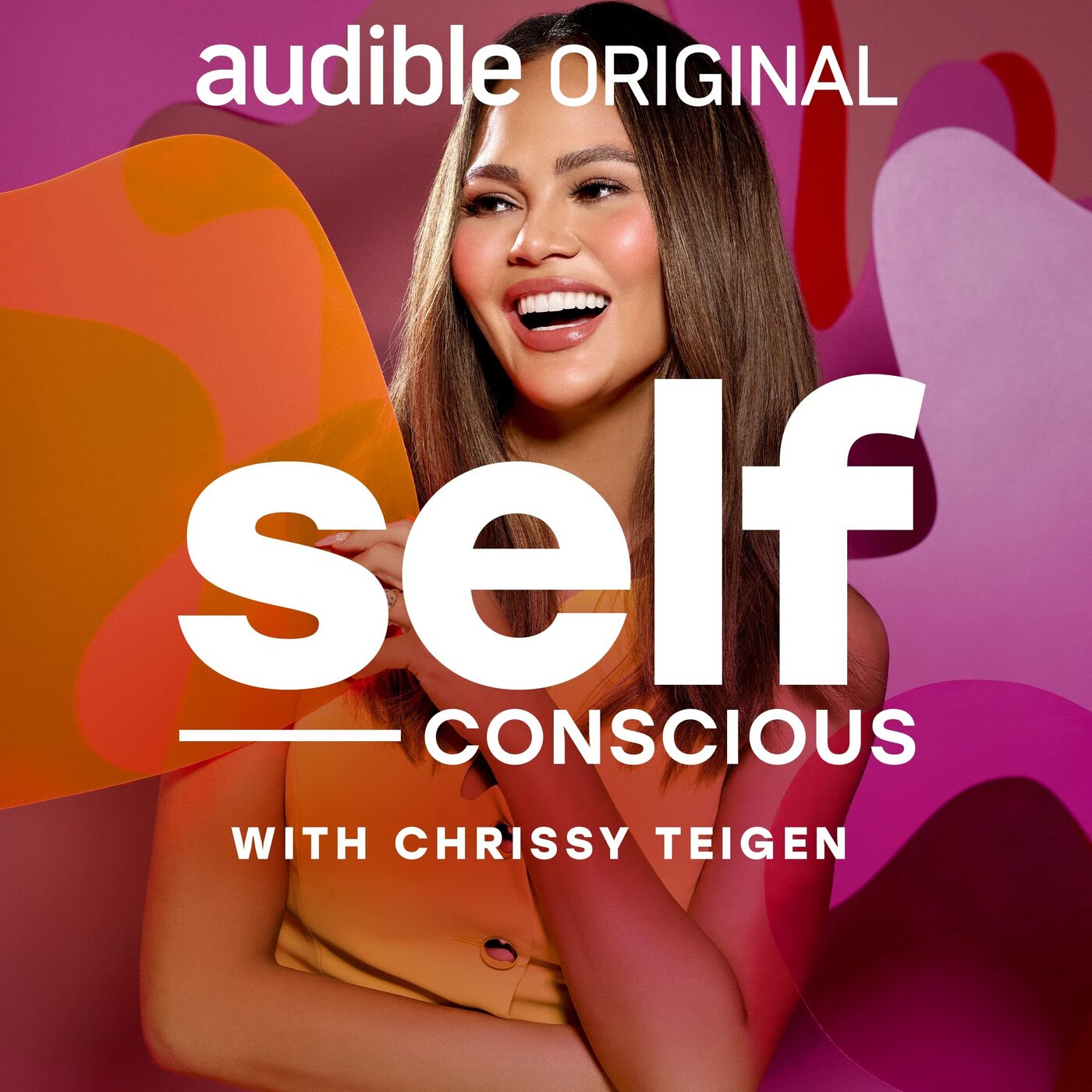
Loading summary
Transcript87 lines
- [00:01]
A
Hey, it's Chrissy. Dig deeper with today's guest and hear more from all our groundbreaking guests on Audible. From bestsellers and new releases to podcasts and Audible Originals. Discover the next step on your journey. Go to audible.com chrissyonaudible you're listening to Self Conscious with Chrissy Teigen, an Audible original podcast. Join me as we explore the cutting edge of health, wellness and personal growth with the world's leading experts and thinkers. From inspiring stories to actionable insights, our conversations aim to help you lead a healthier, happier and more productive life. We live in a culture that tells us we need to be loud to matter. That if we're not constantly broadcasting our lives and radiating main character energy, then we're somehow falling behind. Less seen, less valuable, less real. I've spent most of my adult life in that spotlight. I've learned how to perform, how to be funny, how to be sharp, how to be louder than my own discomfort. And for a while that worked. Until it didn't. Because eventually all that noise, both external and internal, starts to drown out the quieter parts of ourselves. The parts asking for something different. Something slower, more grounded, more honest. Today I'm joined by Susan Cain, the best selling author of Quiet and Bittersweet. Her groundbreaking work challenges the cultural script that says in order to succeed, we must be loud, bold and constantly performing Susan's Audible original A Quiet Life in Seven Steps offers a roadmap for what comes next. A way of living that sees your sensitivity, your sorrow, your longing, and yes, your quiet, not as liabilities but as your greatest strengths. Susan Cain, welcome to Self Conscious. We talk to a lot of different authors, a lot of different speakers, but we never really talk about the quiet. It seems to be really celebrated now when people are loud, when people are attention seekers, the loudest one in the room, the hustlers, the people that are super driven and just very forward facing. And we often don't give ourselves enough credit for the beauty in a quiet life. I feel like I needed this right at this time.
- [02:37]
B
I'm so intrigued by something that you just said, which is what is it about where you are right now that makes you really resonate with this topic?
- [02:47]
A
Something people may not know about me unless you follow my every step is while we are very in the public eye, when we are in the public eye, we are very out of it. When we're out of it, we're very much homebodies. I don't feel the pressure anymore. And I think that really just comes with age and confidence. I have this big growing family and moments that I want to be there for them that don't involve the chaos that was going on in my early 20s. And I love those days. I love that I had them. But I am so happy now with less noise.
- [03:24]
B
I think you've really put your finger on something, because most people who crave a quiet life have felt, from the time they were very little, that there was a difference between the way they wanted to spend their time and the way they felt was socially acceptable to spend their time. So there's a feeling you might want to be just playing with one friend, but you're supposed to be out in camp with lots of friends or whatever it is. And then there does come a time in life where some of those things, social obligations, seem to float away and fall away, and people feel like they can live a little bit more in accordance with what they actually want to do. And I always say to people, imagine that you have a weekend with no social obligations, no professional obligations. How would you choose to spend it if you had that? And the answer to that question tells you so much about what your true preferences are for how you want to spend your time. And then the next question is, how do your typical weekends look compared to that ideal one? And for a lot of people, there's a big difference between that ideal and the reality that they're living.
- [04:38]
A
So you spent years thinking about what it means to live quietly in a world that really, honestly, really rewards being loud. What made you want to explore that?
- [04:50]
B
I am a quiet person by nature. And so what that meant for me was from a very early age, I was just. I didn't have a vocabulary for it or language for it, but I was very aware that there was this big gap between how I loved spending time versus how you were supposed to spend time.
- [05:09]
A
Even when you were a little kid?
- [05:10]
B
Oh, even when I was a little kid, yeah. Not so much within my family, because all my family is pretty quiet, and we're all, like, huge readers, and we would sit and read together. Oh, a quiet family. I can't imagine.
- [05:19]
A
Yeah.
- [05:20]
B
But it was like, the minute I would emerge from the family, I became aware of that. So I always had a lot of friends, and I always liked to play with my friends one on one. But there was a kind of. I don't know, a kind of thrust, a drive all the time to big, loud group settings that kind of mystified me as to why people found them so much fun. So that was just in the background as I was a kid, and Then before I became a writer, I had this weird decade long detour as a corporate lawyer. And I started to notice in my legal career that we would talk all the time about kind of differences in people's backgrounds and so on that would lead them to show up differently in a negotiation, in the context of a meeting in court, whatever. But I thought that the biggest difference that no one was talking about was this question of whether you were by nature more of an introvert or an extrovert. And I started doing research and finding that personality psychologists call this the north and south of human temperament. You know, whether we have this tendency to kind of be a little more inward or a little more outward facing. And yet there was no language for talking about it. So I decided to write about it.
- [06:35]
A
Some people now say they're an extroverted introvert. An introverted extrovert. But you gave some middle ground. What's the introverted extrovert? The ab.
- [06:42]
B
Oh, you mean the ambivert.
- [06:44]
A
Ambivert. Ambovert.
- [06:45]
B
Ambivert.
- [06:46]
A
Ambivert. I hadn't heard that ever.
- [06:48]
B
Yeah, I know. It's a term that psychologists came up with because there really are people who feel that they're not exactly one or the other.
- [06:54]
A
Yeah. Okay, so go through what is introvert and what is an extrovert?
- [06:58]
B
So a really quick rule of thumb of how to think about it is to imagine that you're at a party that you're truly enjoying with company that you truly love.
- [07:08]
A
Okay, that's hard enough as it is.
- [07:13]
B
And then imagine that you're, you've been there for about two hours. Okay? Okay. So after two hours there are going to be some people, it sounds like maybe not you, but there are going to be some people who feel like they have an inner battery. And that battery is getting charged up by all the different stimuli and inputs that they're getting from this party experience. And so now they're looking for the after party. And people like that tend to be more extroverted. These are just quick rules with them. And then there are people for them.
- [07:47]
A
Too, by the way. That's so great.
- [07:48]
B
No, they're both great ways of being. The real question is just figuring out who you are and being able to live in accordance with that and having all the people around you live in accordance with who they are. Okay, so the introverts at the party are the ones whose inner battery, after the two hours with their beloved friends, their inner battery is now drained. And so they're wishing they could press the button and just Automatically be transported home. And that metaphor of just imagining yourself with an interior battery that gets charged or drained depending on what's happening, it's incredibly useful for understanding yourself and for understanding people around you. It's also interesting to know it's just a metaphor. What's really happening is that we have different kinds of nervous systems, and some people have nervous systems that kind of get. An introvert's nervous system tends to get overloaded when too many things are happening.
- [08:45]
A
Yeah. Is it like overstimulation?
- [08:46]
B
It's a kind of overstimulation, yeah. So for us to get back into equilibrium, we need quiet. And for extroverts, the liability is an extrovert's nervous system can feel too easily understimulated if not enough is happening. And then you feel kind of bored and unhappy. And it's incredibly useful to know this about your nervous system, because if you start paying attention and just asking yourself every hour or so throughout the day for a couple days, do I feel like I'm in a state of nervous system equilibrium? You're going to start noticing what gets you into equilibrium and what jolts you right out of it. And it's a completely different way to live once you do that.
- [09:27]
A
I feel like I had this false sense of being an extrovert because of the lifestyle that I lived growing up in Hollywood in, like, primo time to grow up. There was no, like, camera phones, no anything. So, like, we had a good time in my early 20s to, like, mid-20s. And I don't feel like without drugs or alcohol, I would have ever continued any party ever. There's, like, no way. But I can. But John often does long stints of sobriety for being on tour and stuff. And that guy, he can. If it's Grammy night or something, he wants to go here, here, here, here. And so do you think it's possible for an extrovert and an introvert to be in a relationship and have the balance that they need to have?
- [10:17]
B
Oh, I think it's more than possible. I think it's really common.
- [10:21]
A
Okay.
- [10:21]
B
It's really common for extroverts and introverts to be attracted to each other as friends, as workmates, as romantic partners, because I think we all kind of know what we're good at, what our strengths are, and where we need somebody to ground us. And so my husband is also much more extroverted than I am. And I love it. I love it that we'll go in a long car ride and he never runs out of anything to Say to me, that's great. And I think he appreciates that I'm kind of more quiet and centered and ground the whole family just through that kind of energy. Having said this, like, I. I know from all my research that there's a lot of happy introvert extrovert couples who nonetheless face the following dilemma, which is you just alluded to it, okay, it's Friday night, it's Saturday night. How do you want to spend your time? And the introvert is probably going to want to be sitting and watching Netflix on the couch, and the extrovert is going to be wanting to invite all their friends for dinner. And how do you work that out? Yeah, I think the best way to work it out is to kind of negotiate it out in advance. So to understand, first of all that you're each coming to your preferences not because you're a bad person or don't understand the other, but just because this is who you are. And then how do you meet each person's needs? And so maybe you decide in advance. We're going to do, I don't know, two group dinners per month, and we're going to do two cozy nights at home per month, or whatever you work out between you. The idea is to negotiate it once so you don't have to bicker about it every Friday night, every Saturday night.
- [12:07]
A
Can an introvert become an extrovert in life? Or is that something you're born with? That's your attachment style. That's it for you. Do people change?
- [12:18]
B
It's a complicated question, because, yes, we change. Yes, we acquire all kinds of skills that we didn't always have. So an extrovert can acquire the skill of being able to be quietly.
- [12:29]
A
I would feel like I was pulling somebody down if I made an extrovert become an introvert.
- [12:34]
B
Well, I don't think the goal should be trying to make someone become who they're not. The goal goal is for all of us, whether we're extroverts or introverts, to acquire skills that we need just to help us in this life, but to acquire the skills, but still to stay true to who you are. So, I mean, I'll just give you the example. In my own case, I was always someone who hated public speaking, like, really hated it. But then when I started becoming a writer and I knew that the only way to be able to advance ideas in the world that we have is to be able to speak publicly, I just learned how to do it. And people say to me sometimes now, and, you know, now I. I go and I give a gazillion talks a year. I just gave one yesterday in la. And people will say, oh, you're an extrovert now. I'm like, no, no. I'm exactly the same introverted person I always was. And I have this new skill. If anything, most people tend to become more introverted as they get older. They tend to be seeking more quiet, which I think you alluded to when we first started talking that you were feeling that way.
- [13:41]
A
I always bring up the Real Housewives on this show, but I'm always so amazed at how much energy and how much freedom they seem to long for after their kids leave the nest. And I feel like these women become so much more. They're probably always extroverts, though, and they just had it, like, stuffed down because they were raising families and things. But, man, when those kids leave the nest, they seem like complete extroverts. Like, completely put themselves out there. Extremely social, loud, starting businesses, leaders. I'm always, like, completely amazed by it. And I'm like, maybe that'll be me one day. I'm like, maybe I'm just going to get this, like, big burst of energy where I want to be out and I want to be working out every day, and I want to have social dinners with friends. So sometimes when I feel like I'm a little lonely or that maybe I'm, like, too much of a house cat, I'm like, okay, maybe in my 50s and 60s I'll get there because I watch these women.
- [14:38]
B
But I don't know. To me, none of that is the question. The question is, what do you feel like at that given moment? I keep coming back to the question of, imagine that you don't have any obligations. What would you choose? What would you choose? I know, because there's so much cultural expectation that we all have of how we're supposed to spend our time. It's really hard to let that out.
- [14:58]
A
We talk about that all the time here. I do whatever and whatever I feel like I should be doing. I grew up in, like, a household where I wanted to be great and perfect and listen to everybody and be like, the good kid.
- [15:12]
B
And that's why you feel the need to be the host who makes everybody comfortable when you're out.
- [15:16]
A
And I feel like that, even if it's not what I want, I take it as a win because I did something. I did it, and I did it the right way, and I pleased people and they left happy. So oftentimes, like, I have this feelings app you're supposed to enter in your feelings that you feel. I never know how I'm feeling. I just do as I'm told. One thing that I want to get away from is feeling bad about doing nothing. Whatever. Nothing is. Like if I am painting or writing. Not writing. Writing is work. But if I'm doing something where there's no one to receive it or enjoy it, or if it's just to pass the time for myself, I'm very hard on myself about it, and I feel like I'm getting there. But it's definitely hard to not do something that isn't getting you praise. Basically, I'm like a praise seeker.
- [16:14]
B
And what about your own praise?
- [16:17]
A
Doesn't matter.
- [16:17]
B
Praising yourself doesn't matter. No, no, that's not.
- [16:20]
A
That means nothing. No. I need the praise from strangers and loved one. And in a family where that didn't come very easy, I'm just always seeking approval and praise. And I think that goes into why I like to do a lot for my children too. Cause it meant that I was a great mom, and I did it, and I almost, like, check it off my list. Like, were you a good mom today? Yes. I was like, it's crazy.
- [16:51]
B
Well, did you say with your feelings app that when it asks you, what are you feeling at this moment that you have trouble, I don't know, knowing what it is that you're feeling?
- [17:00]
A
I am blank. Yeah, I'm totally. You know, your therapist, they love those questions. And how does that make you feel? I am. I go nothing. I feel nothing. Which is weird because I'm a very emotional, empathetic person. But unless it's a scenario that's outside of me. How do you feel about the conflict in the Middle East? That makes me gutted. I feel horrible about that. I know that. But if it's like, how do you feel on any given day, you know, just like sitting on the couch, I can't relate a word to it. So can you unpack this whole idea of quiet in the context of your audible original? It's a tough question. What is quiet?
- [17:46]
B
Yeah. So a third to a half of the people in this world, depending on which study you look at, are introverts. So that's one out of every two or three people that we know. And yet the world is designed for the extroverted half of us. And that. That is a waste of talent, it's a waste of energy, it's a waste of happiness. Because what introverts do when they're doing best is they listen deeply they occupy very easily that state of flow that we were talking about before, where you're inside your own mind and deeply engaged with a problem, so you're able to solve problems. You're able to get deeply creative. There's an aspect also of leadership that I think we don't talk about enough. We assume that to be a good leader, you have to be the kind of very extroverted, very charismatic and dominant personality. But when we look at who have been some of the most meaningful, profound leaders, both politically and in business, and all the rest, you often find very quiet, reflective, introverted people. I'll give you an example of somebody like a Gandhi. Gandhi was such a shy and quiet child. He used to run home from school as soon as the bell rang to avoid socializing with his classmates. And even later, if you read his autobiography, he talks about how as an adult, he was very uncomfortable running meetings. He didn't like that feeling of having to be on. But what he had, and what many introverts have, what introverts by nature do, what quiet people by nature do, is they're tuning in very deeply to their own frequency. So they're lavishing all their social energy on a few beloved people, and they're lavishing their intellectual energy on a few beloved projects. So they have a really deep sense of conviction about what they're doing. So you get somebody like Gandhi who is full of conviction, and you end up attracting other people who are on that same frequency and who have that same sense of conviction. And so there's an incredible power that happens when you're willing to live on that more quiet frequency, because it's a place where you really believe what you believe, and you attract other people who believe it, too. And it's a place that gives you the freedom that creativity actually really requires. So we actually know from the studies that the most creative people in all fields tend to be extroverted enough that they can advance their ideas and exchange their ideas with other people. But they are introverted enough that they can tune into their own frequency and tune out all the noise and all the mishmash and all the social expectations that are coming at them. And that's how they get to the core of originality. So somebody like a Philippe Stark, the great designer, he used to say that he would go off for months by himself and not even pick up a magazine during those periods of time, because he knew that was the only way to tune into his own original ideas. Because as human beings, we're such social, all of us, we're such social and porous beings that just to be in a room with each other, we're taking in all the vibes of all the people around us. So if you want to get to that core of originality, if you want to get to that place of deep conviction, you have to be willing to turn inward and go quiet, at least for a period of time.
- [21:33]
A
A lot of people associate sorrow with being an introvert versus happiness and joy, which is an extroverted term. And we're told that happiness means being cheerful all the time. How do we start letting go of that idea?
- [21:52]
B
What I'm really trying to get at with the quiet life is a way of being in the world, like a frequency that many people are naturally on. And that, I believe, offers many people a richer and deeper form of happiness for being on that frequency. But it's not the form of happiness that we see when we turn on the TV and see a commercial of people like jumping for Joy. It's not that it's a different kind of happiness. There's a trait called high sensitivity that I talk about a lot. And people who are highly sensitive, they react more intensely to everything that's happening, both the good and the bad. A highly sensitive person is going to see the beautiful sunset, and they're going to be filled with a kind of euphoria at the beauty of it. And again, that's not a jumping for joy kind of euphoria. It's a much quieter version of what euphoria looks like. And a sensitive person is also probably going to feel the pains of the world more acutely and be that much more aware of them. And what we found through studies that we did for my book Bittersweet, we actually found that people who are in this bittersweet state of mind and this kind of more highly sensitive framework, they're more likely to do creative work. And they're also. It's easier for them to reach states of awe and wonder and transcendence. Because there's something about the kind of awe that you get when you're beholding beautiful music or in nature, or you're having the transcendent moment where you've forgotten about yourself. You just feel connected. There's something about that that is open not only to the yellow and orange side of life. You know, it's open to the blue and green side of life as well, because it's open to everything. That's what it really is. And the totality of the world includes both of these states of being. So to be Fully alive. And to get a little bit closer to wisdom involves being open to all of that instead of closing ourselves off.
- [24:01]
A
Yeah, you can't be one if the other didn't exist. What is happiness? Have you never been sad before?
- [24:05]
B
Exactly.
- [24:07]
A
You talk about emotional pain that doesn't go away. What can we learn when we stop trying to escape that discomfort?
- [24:14]
B
The first thing we learn is that this is part of life, that joy and sorrow are a fundamental part of life. They both are. And we live. Well, I was going to say we live in a society that's comfortable with the joy and not with sorrow. That's not actually even true, though, I think because we're so uncomfortable acknowledging the sorrow part of life. It also means that when we are in joy and when things are going well for us, there is a kind of guilt that many people feel about acknowledging that and embracing that. Whereas if we realize that it's just the way life is, that it's a combination of both of these states of being, then we can inhabit the joy without feeling guilty, and we can actually acknowledge that we're feeling sorrow without feeling embarrassed about it. What I always say to people is, whatever the emotional pain is that you can't get rid of, and most people have that in their lives, whether it's a pain left over from childhood or from a grief that has never fully resolved, or whatever it might be, whatever the pain you can't get rid of to turn that into your offering, your creative offering, or your offering in the world in general. And this is something that human beings are primed and designed to do. So it's really interesting when you look at it like during the pandemic, suddenly the number of applications to medical school and nursing school went up after 9, 11. The applications to become a firefighter went up. There's something in the human condition and human nature that responds to deep troubles by trying to do something generative that doesn't fully resolve them. But my favorite Leonard Cohen quote is the one about, there's a crack in everything, and that's where the light gets in. So if we deny ourselves the ability to understand what our sorrows are, we're also denying the ability to find that light. And when I say all this, I don't mean to say you have to do some grand action like sign up to be a firefighter or. Another example is a woman I'm thinking of whose child was killed by a drunk driver, and she started the organization Mothers Against Drunk Driving. So those are amazing things. But you don't have to to do anything on that grand a scale, it's enough to do things in smaller and quieter ways that are just generative acts of healing, that are responses to whatever your pain is that you can't get rid of.
- [27:02]
A
So we live in a world that rewards louder, faster, shinier. What does quiet success look like to you?
- [27:10]
B
Quiet success looks like doing things on your own terms. And if you are faster, louder, shinier by nature, then it looks like doing it that way. If you are quieter, more reflective, more cerebral by nature, then it looks like doing your work and living your life that way. It's a question of being on the right frequency for you. And so much of what I'm trying to do with a quiet life is give people the permission to live on the frequency that they feel that they're meant for. In fact, I can't tell you how many letters I've gotten since my first book, Quiet, was published that include the word permission. That's probably the word that comes up the most. Like, oh, finally I have a sense of permission to be who I actually am.
- [28:05]
A
That's so freeing for people to hear, especially people like me that punish ourselves for not being what we think we're supposed to be. To all different types of people, really allowing yourself to feel and being confident enough to feel the way you feel without any external validation is so important.
- [28:25]
B
And to be who you are. I mean, I'll tell you this like real light bulb moment that I had when I was writing Quiet, which is I was telling a friend about it and I was making the case to her about all the different people who have contributed to the world in such profound ways because of their quiet temperaments, not in spite of them, but because of them. And she said, yeah, and even if they hadn't made those contributions or didn't have those achievements, they still should be who they are. And I think that that's something that we really lose sight of in a culture that's all about, what did you call it? Main character energy.
- [29:04]
A
That you're still worthy. And you're still.
- [29:06]
B
That you're still worthy. Yeah, like the whole idea of dividing people into main characters over here and NPCs or non playing characters over there, I think that just disrupts some of the best of like Judeo Christian teachings that there is innate value equally in every human being. And that's really like the underpinning of everything that I'm talking about.
- [29:31]
A
It is really true. Like we put so much on them that we are like humans and we're meant to Create. And we're meant to build. And we're meant like, no, we were born to live. Hear more from today's guest by going to audible.com chrissyonaudible that's audible.com Chrissy C H R I S S Y on Audible and now for the toolkit. Each episode, our guests distill their expertise into practical and actionable insights. Today, Susan takes us through two exercises aimed at creating a more intentional life.
- [30:27]
B
So one of the things that we talk about in the quiet life is the question of how to spend your time and becoming aware of what your daily emotional patterns are. Because I think most of us don't pay attention to this. But if you start noticing, you're going to realize that you wake up in the morning feeling one way, and then in the afternoon, you tend to feel another way. In the evening, you tend to feel a different way. And once you know this about yourself, you can react to those patterns and design your day around it. So I want to talk about that with you. Okay, so let me ask you, when you wake up in the morning, how do you usually feel?
- [31:04]
A
Like shit.
- [31:06]
B
Okay.
- [31:07]
A
I hate the mornings.
- [31:09]
B
Is that because you're feeling anxious in the morning or blue or.
- [31:13]
A
No, it's because I got horrible rest. Usually. My sleep is full of different anxieties and horrific nightmares sometimes. And it's a constantly disturbed sleep for me.
- [31:27]
B
Oh, gosh.
- [31:27]
A
Yeah. Night sweats, everything. So I never have a great sleep.
- [31:31]
B
Oh, that's terrible. Yeah. And so when does it usually go, the bad feelings, when do they usually dissipate? Ooh.
- [31:37]
A
It takes a while to shake them out of me because of sometimes how bad the nightmares are. I mean, we're talking, like, plane crashes that I survive every single night, that I, like, replay through all the time. The same anxiety nightmares that John left me and I have to find a home. And this, like, it's just like, they're. And it takes me a while to, like, come back from that, like, sadness in real life.
- [32:05]
B
It's very weird. Yeah. And also, you know, your cortisol is highest in the morning. We're all that way. And so it may be a matter of waiting until the cortisol dissipates.
- [32:15]
A
Yes. Usually a shower is what completely resets me. I can be sick. I can be in a terrible mood. A shower totally brings me back to life.
- [32:25]
B
So that's really important. And that's one of the things I wanna really emphasize, that there are a lot of people who wake up in the morning feeling some version of what you just described. It's incredibly common, whether it's because of the not good sleep and the nightmares or because of just high levels of cortisol or whatever it is. But if you know that that's happening, first of all, you know not to pay that much attention to the thoughts that come at that moment. Because I'm sure when you're lying there in bed before the shower, if you start thinking about what you have to do that day, you're going to be coloring it in very gray tones. But that shower is really key for anybody who's listening right now to know that if you're somebody who gets trapped in those morning blues, you need to have a ritual that lifts you out of that state and tells your body, okay, we're moving into phase two over here. And if you're listening and you're thinking, oh, I don't like my morning shower, it could be meditation. Oh, I could drag my ass in.
- [33:22]
A
There, I don't like it either.
- [33:23]
B
It can be music. There's a lot of different ways to get yourself into a different state.
- [33:27]
A
Yes, absolutely.
- [33:28]
B
So when is the time of day that you're feeling at your best? Is there a predictable time of day when that happens?
- [33:35]
A
Probably around, we'll say like 3:30pm When I start to get charged up for dinner and know that the babies are waking up, the kids are coming home from school, and I'm buzzing about. Yeah.
- [33:52]
B
So if you know that you have buzzy energy predictably at a certain time of day, Coming back to that idea of the scheduling, like, you want to really be designing your days so that you're in that nervous system, equilibrium as much as possible. So you want to schedule your, like, high energy, high creativity activities for the moment when you're buzziest and happiest.
- [34:17]
A
See, that's good to hear. Because sometimes I schedule it for the morning as a way of, oh my gosh, I'm going to get this over with and then I can have my buzzy time.
- [34:24]
B
Oh, yeah, well, maybe you want to schedule for the morning, like the. Oh, I have to answer 9,000 emails, so I'll do that when I'm not at my happiest and most creative. But I'll get the work done.
- [34:36]
A
Yeah, okay, that's great.
- [34:37]
B
Should we talk about the millionaire in time?
- [34:38]
A
Oh, yeah.
- [34:40]
B
So when my husband and I were first dating, we went to see this movie about the poet, Billy Collins. And he said, in this movie, he said, I'm not a rich man, but I am a millionaire in time. And the idea is that we all have in our lives the things that matter absolutely the most to us, the work that matters the most, the causes that matter the most, the family that matters the most. And in the service of those core personal projects, we will do all kinds of things that may or may not feel great in the moment, but they're serving a deeper purpose of how we want to live. And I know for many people who are listening, they're going to know right away what their core personal projects are. But if you're someone who doesn't know or you're not quite sure, especially in the workspace or the creativity space, I would say ask yourself, what did you love to do when you were little that made the hours fly by? This is actually something that psychologist Carl Jung talks about. If you tune into who you were when you were little, you're tuning into who you really are right now that you might have forgotten. And it doesn't mean you're going to want to do the identical thing. Maybe you love dancing when you were little and you're not exactly a dancer now, but you probably want to be spending more time in movement and with beauty in some way. The other question that I ask people, and I don't know if this will resonate to you, but to pay attention to who do you envy? Because envy is a very. It's an ugly emotion, but it tells the truth about what we really value. And I realized this personally when, when I was a lawyer, I was still a corporate lawyer. And sometimes I would see friends of mine from law school who had gone on to do these amazing things of arguing before the Supreme Court or whatever, and I found I was happy for them, but I did not envy them at all. And then I would hear about someone who had written a book and it would be full of envy. And that really told me what it was I wanted to do. The final question we can ask is what do you love to do that is not tied to either a paycheck or to public a claim? You're just doing it.
- [37:02]
A
Susan, thank you so much. That was beautiful. I learned so much. I am. What's the word again?
- [37:08]
B
Ambivert.
- [37:09]
A
I'm an ambivert. Thank you so much for joining us today on Self Conscious. Thank you.
- [37:13]
B
Thank you so much, Chrissy. It was so great to be here with you and get to talk to you and your incredibly gracious host.
- [37:19]
A
Thank you. Thank you, Susan. I want to thank you today for joining me on Self Conscious. Susan Cain's audible original, A Quiet Life in Seven Steps is out now. Until then, tune in, turn on and feel better. This is Chrissy Teigen and you've been listening to Self Conscious, an Audible original podcast. This has been an Audible original produced by Audible, Q Code and Huntley Productions Hosted by Chrissy Teigen Written and executive produced by Jimmy Jelinek Executive producers for Q Code Shen Yun Hu and Alexa Gabrielle Ramirez Executive producer for Huntley Productions Chrissy Teigen executive producer for Audible Stacy Creamer Recorded and engineered by Ben Milchev Filmed by Bridger Clements Production Coordinator Brian Coulter Edited, mixed and mastered by Ben Milchev Head of Creative Development at Audible Kate Navin Chief Content Officer Rachel Giazza Copyright 2024 by Audible Originals, LLC Sound Recording Copyright 2025 by Audible Originals, LLC.