
Podcast
Sensemaking with Wolé and Tobi
Hosted by Wolé and Tobi · EN
Sensemaking (formerly titled 'The Yellow Pill') is a podcast where Wolé and Tobi navigate life, work, technology, and culture with thoughtful conversation, personal clarity, and modern insight, one honest episode at a time.
10episodes
Episodes
Newest firstAll episodes

119: Cars Weren't Supposed to Feel Like This
Apr 2100:32:56Tap to summarizeSo a Chinese car nobody had heard of is now the best-selling vehicle in the UK. This kicked off a whole conversation about modern cars for us: why they feel off, why new doesn't mean better, and why Wolé would genuinely rather buy a 2010 than anything on the market today. We get into the stuff that quietly annoyed us, but we couldn't quite explain: rubber timing belts that degrade into your engine, sensors crammed into bumpers that no longer exist, EVs that go zero to 60 in seconds and somehow feel like absolutely nothing. We also talked about growing up with cars — the specific ones that gave us joy, the ones that gave us headaches, and the very real Nigerian car ladder from small Camry all the way to the Range Rover. It's a weird one. But a good one. . . . If, while you’re listening, something crosses your mind, or you get that urge to jump into the conversation, we’d love to hear from you! Please send us a quick voice note using here: http://bit.ly/sensemakingvn
Transcribe →
118: The Case for Getting Your Hands Dirty
Apr 1300:35:40Tap to summarizeWhat begins as a DIY story turns into a conversation about why some cultures build things themselves, and others have forgotten how — and what gets lost when an entire generation grows up treating practical skills like they don't count. We get into education, labour, cost, and craft. Why does a carpenter send his son to study medicine? Why did we spend years labelling insects in school but never take workshops seriously? And what happens to quality — in roads, in work, in training — when nobody sticks around long enough to learn a trade properly? There's also something in here about just starting. About the gap between the person who plans and the person who doubts, and what it looks like when one of them picks up a shovel anyway. If you've ever talked yourself out of trying something because it seemed too hard, or wondered whether the things you learned in school actually prepared you for anything useful, this one's for you. . . . If, while you're listening, something crosses your mind, or you get that urge to jump into the conversation, we'd love to hear from you! Please send us a quick voice note using here: http://bit.ly/sensemakingvn Join our WhatsApp Community for episode alerts and to chat with other listeners and us: https://chat.whatsapp.com/E1zfJLM46L01jR809JmURz
Transcribe →
117: Why Your Favourite Tech Company Might Not Survive
Mar 3000:48:57Tap to summarizeYou use their apps every day. You've watched their stock prices climb. Maybe you've even built your career around their tools. But what if the tech companies you rely on most can't actually explain how they make money? In this episode, we get into something that's been on both our minds for a while — the growing gap between what the tech industry celebrates and what it actually delivers. We're not coming at this as industry analysts or investors, but think of us as two people who use these products, work in and around tech, and have started to notice that a lot of what gets called "innovation" doesn't seem to solve problems anyone actually has. We talk about AI — what's changed recently, what the difference is between the tools that just talk back to you and the newer ones that can actually do things on your behalf, and why that distinction matters even if you've never written a line of code. We go company by company and ask uncomfortable questions. Why has one of the biggest names in AI backtracked on so many promises? Why does a company worth billions still not have a clear product focus? And why are some of the fastest-growing tools in tech already showing signs they won't last? So we put together a test. Three fundamentals that any business — tech or not — should be able to answer. Is there a real problem worth solving? Is there a reason for people to choose you over the alternative, or over doing nothing at all? And do the economics actually work — are you making more than you spend to serve each customer? It's not complicated. But it's surprising how many of the biggest names in tech can't pass all three. We also zoom out and ask which tech companies have genuinely lasted. Which ones have become as permanent as a bank or a soft drink brand? The answer is shorter than you'd think, and it raises its own set of questions about what the last twenty years of tech have actually given us. ... Jargon Decoder — a few terms we throw around in this one, explained plain: Agentic AI — AI that can take actions for you (book a flight, fill out a form, organise your files) instead of just answering questions in a chat window. Generative AI — AI that creates things — text, images, code. ChatGPT is the most well-known example. When someone says "AI" casually, this is usually what they mean. Unit economics — whether a company makes more money per customer than it costs to serve that customer. The most basic maths of whether a business can survive. Future state selling — pitching investors on what a product will do someday, rather than what it does now. A red flag when the "someday" keeps moving. Moat — what stops a competitor from copying your business. Borrowed from the idea of a castle moat — something that protects you. ... If, while you're listening, something crosses your mind, or you get that urge to jump into the conversation, we'd love to hear from you! Please send us a quick voice note using here: http://bit.ly/sensemakingvn ... Join our WhatsApp Community for episode alerts and to chat with other listeners and us: https://chat.whatsapp.com/E1zfJLM46L01jR809JmURz
Transcribe →
116: When People You Rated Stop Making Sense
Mar 2300:33:57Tap to summarizeWhat happens when something you used to believe doesn’t make sense anymore? In this episode, we get into that experience of going back to people, ideas, or opinions you’ve held for a long time, and realising you’re not as convinced as you once were. Sometimes it’s obvious why. Other times, you can’t even trace where the belief came from, but it’s just been there. So we try to unpack that. Why did this make sense to me before? Was it the idea itself, or the person saying it? And what does it actually mean to change your mind? We also talk about how this shows up with public figures. People you used to listen to, agree with, or rate, and then, over time, you just stop connecting with. And even between us, we realise we don’t handle it the same way. Sometimes it’s a slow drift, where you just stop paying attention. Other times it’s more direct, you hear something, and you’re like, yeah… I’m done. That opens up a few other things. Like why some people never really evolve with their audience. How easy it is for your identity to get tied to certain beliefs. And how you can end up holding onto views long after the moment that made them useful has passed. . . . If, while you’re listening, something crosses your mind, or you get that urge to jump into the conversation, we’d love to hear from you! Please send us a quick voice note using here: http://bit.ly/sensemakingvn
Transcribe →
115: Why Reality TV Hooks Us
Mar 1600:43:14Tap to summarizeIn this episode, we talk about reality TV. Love Island, Love Is Blind, Big Brother, The Traitors — and the strange hold these shows seem to have on people. Most of us know they’re ridiculous. And yet somehow we keep watching. What is it about these formats that works so well? At first, we’re just comparing the shows we’ve been watching and noticing how similar they often feel. The same types of contestants show up. The same conflicts repeat. After a while, you start to see the patterns. That leads us to a bigger question. What actually happens when you take a group of ordinary people, put them in a closed environment, add cameras, pressure, and incentives, and let things play out? We talk about how quickly people start performing for the audience, how incentives shape behaviour, and why these shows often become predictable once you’ve watched enough of them. But even with all that, there’s still something oddly compelling about watching people placed in intense social situations and seeing what happens. So the conversation becomes less about the shows themselves and more about what they reveal about us. Why do we enjoy watching these social experiments? And what does reality TV say about human nature? . . . If, while you’re listening, something crosses your mind, or you get that urge to jump into the conversation, we’d love to hear from you! Please send us a quick voice note using here: http://bit.ly/sensemakingvn
Transcribe →
114: Living Locally in a Global Crisis
Mar 900:38:10Tap to summarizeIn this episode, we try to make sense of the latest tensions involving Iran, the Gulf States, and everything that seems to be unfolding around it. We’re not experts on geopolitics, but like most people, we’re trying to understand what these kinds of global events actually mean for everyday life. Along the way, we end up talking about how much the global economy depends on the Gulf region — from oil and jet fuel to the flow of people, money, and trade through places like Dubai. We also touch briefly on something that’s been on our minds lately: the growing connection between AI companies and military systems. But the conversation slowly turns into something more personal. How do you live your life when the world constantly feels like it’s on the brink of something? With wars, economic uncertainty, and new technologies appearing in the news almost every day, it can feel like there’s always something big happening somewhere. Yet at the same time, life keeps moving. People still wake up, go to work, make decisions, and deal with whatever is happening in their own lives. So this episode becomes less about geopolitics and more about that tension — how to stay aware of the world without letting it overwhelm you. In other words, how do you keep living your local life while the world feels increasingly chaotic? . . . If, while you’re listening, something crosses your mind, or you get that urge to jump into the conversation, we’d love to hear from you! Please send us a quick voice note using here: http://bit.ly/sensemakingvn
Transcribe →
113: If We Were 18 Today, Would We Still Go to Uni?
Mar 200:48:19Tap to summarizeShould you still go to university in 2026? In this episode of Sensemaking, we wrestle with a question that feels increasingly uncomfortable: Is higher education still worth it? With rising tuition costs, student debt, AI reshaping white-collar work, and youth unemployment climbing, the old promise — “go to school, get a good job” — doesn’t feel as solid as it once did. So what exactly is university for now? We explore: The rise of the NEET generation (young people not in education, employment, or training) Whether degrees still translate into earning power Why migration has become a hidden driver of education decisions The generational gap between parents and today’s students What university actually gives you beyond a job And what they would tell their own 18-year-old selves today To be real, this isn’t a rant against education, but an honest attempt to make sense of a system that feels like it’s shifting beneath our feet. So we ask again: If you were 18 right now, would you still choose university? . . . If, while you’re listening, something crosses your mind, or you get that urge to jump into the conversation, we’d love to hear from you! Please send us a quick voice note using here: http://bit.ly/sensemakingvn
Transcribe →112: Rethinking Work, Starting With the Job Market
Feb 2300:35:01Tap to summarizeA simple question about today’s job market led us somewhere deeper. We began by reflecting on what we’re seeing — shifting hiring patterns, oversaturated applications, the quiet disappearance of certain entry-level pathways, and the rise of AI-augmented talent. But as the conversation unfolded, it became clear that the real question wasn’t just about jobs. It was about work itself. What makes someone valuable in their work? Is experience still defined by time, or by exposure and context? And as new tools begin to compress the distance between beginner and expert, what happens to the structures we’ve built around expertise, hierarchy, and apprenticeship? If knowledge can be accelerated, what becomes of judgment? If output can be amplified, what becomes of experience? . . . If, while you’re listening, something crosses your mind, or you get that urge to jump into the conversation, we’d love to hear from you! Please send us a quick voice note using here: http://bit.ly/sensemakingvn
Transcribe →
111: Are We Thinking Clearly About AI?
Feb 1801:06:54Tap to summarizeWe’re living through something strange, and nobody really knows how it ends. In this episode, we try to articulate that feeling — the sense that something massive is happening, billions are being poured in, companies are racing, narratives are hardening… and yet nobody actually knows how this ends. It feels like we’re inside a chapter that will later get a name. The “AI Boom.” The “AI Bubble.” The “AI Reset.” We just don’t know which one. We talk about: Why so many powerful people sound absolutely certain about the future What incentives are driving the hype (and who benefits if we believe it) Whether this is genuine transformation — or another cycle of over-promise But more importantly, this was a very human conversation about our scepticism and curiosity in all of this. About choosing to think for yourself instead of joining the hive mind. About asking what responsibility looks like when you’re building, investing, working, or creating in the middle of something that might reshape everything. Because sometimes the most important thing isn’t knowing what will happen, but being aware that you’re already living through it. . . . If, while you’re listening, something crosses your mind, or you get that urge to jump into the conversation, we’d love to hear from you! Please send us a quick voice note using here: http://bit.ly/sensemakingvn
Transcribe →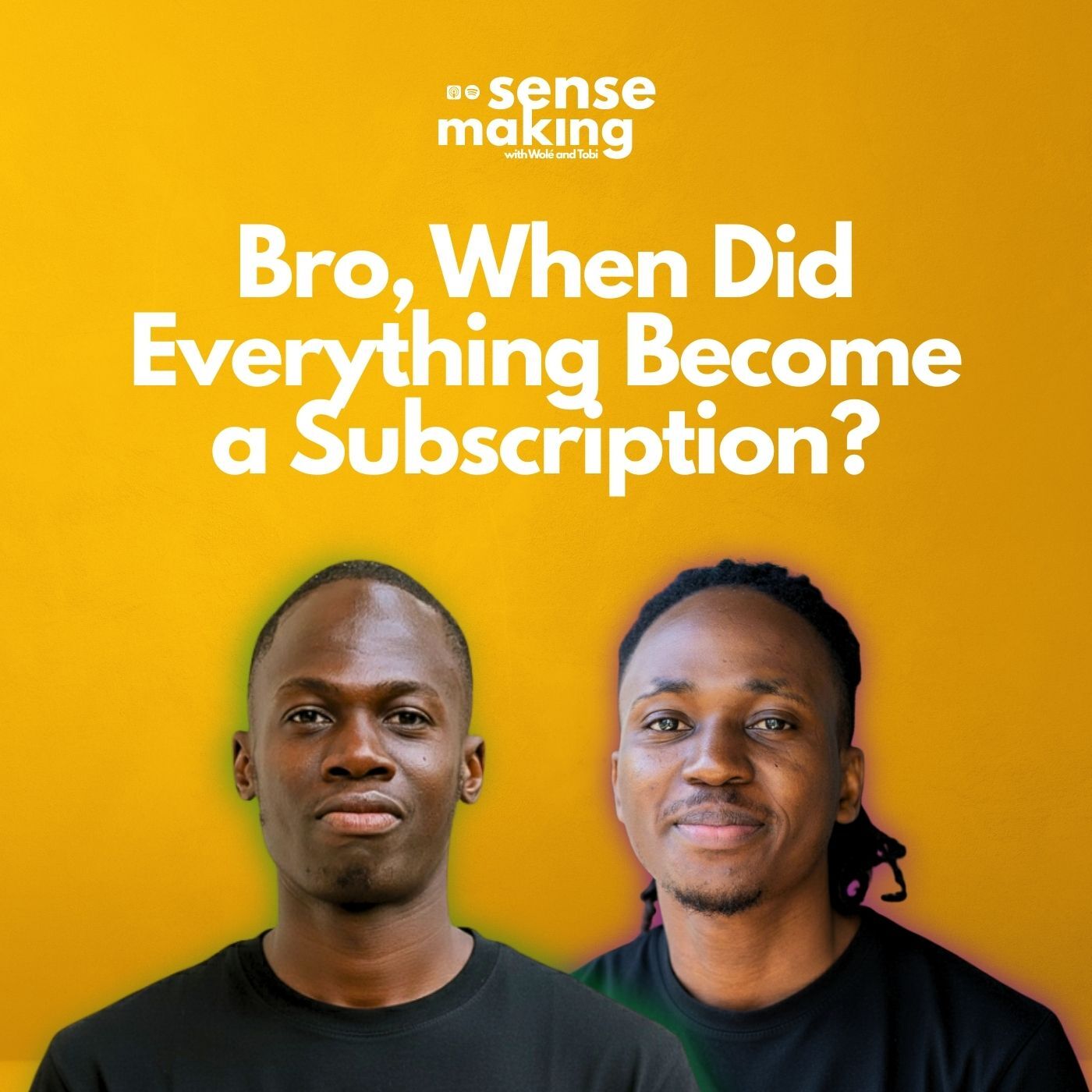
110: Bro, When Did Everything Become a Subscription?
Feb 1100:59:27Tap to summarizeSubscriptions used to be simple. A newspaper. A gym. Maybe a DVD club if you were feeling fancy. Now they’re everywhere: apps, TV, work tools, cars, even things in your house. And somehow none of them feel expensive on their own… until you look at them together. This episode starts with a quiz, but it quickly turns into a bigger conversation about how the subscription model has quietly taken over modern life. We talk through how and when this shift happened, why entertainment subscriptions dominate so many budgets, and why cancelling things often feels harder than it should. Subscriptions are everywhere now — from entertainment to work to things we used to own. But then you step back and realise how quietly that changed everything. And you start wondering if it’s actually better. We compare our own subscription lists, talk about the “zombie” payments we forgot to cancel, debate ownership vs access, and question whether this model is even sustainable long-term. Plus: which subs are genuinely worth it, which ones feel like scams in disguise, and the simple rules we use to avoid drowning in monthly charges. If you’ve ever looked at your bank statement and thought, “wait… what am I even paying for?” — this one’s for you. . . . If, while you’re listening, something crosses your mind, or you get that urge to jump into the conversation, we’d love to hear from you! Please send us a quick voice note using here: http://bit.ly/sensemakingvn
Transcribe →