Podcast
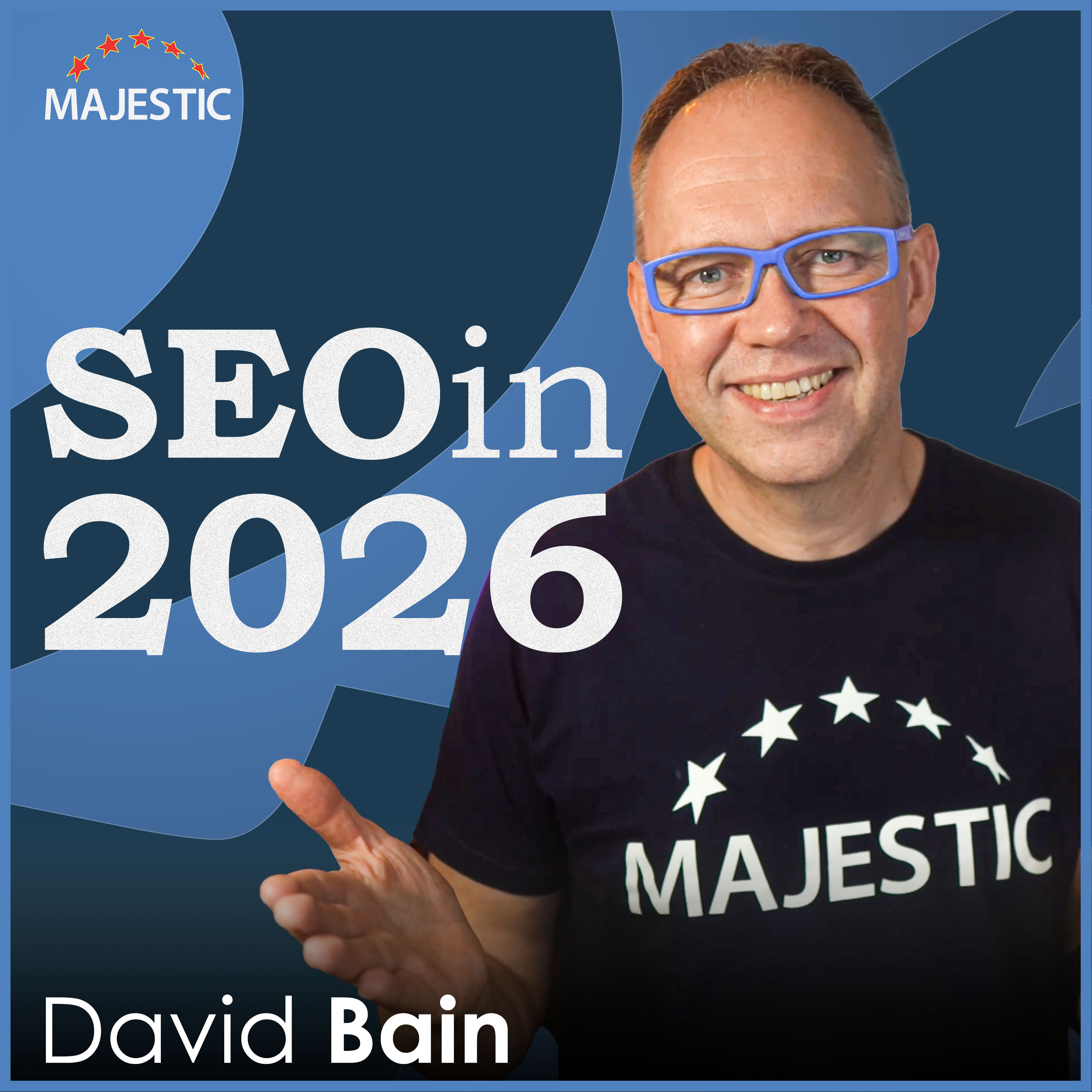
SEO in 2026
Hosted by Majestic.com · EN
SEO is continuing to change at an alarming pace. And yet, in some sense, the principles of good SEO remain the same.
Hello, and welcome to SEO in 2026 – a significant repository of current thinking from many of the world’s leading SEOs.
We're pleased to be able to welcome you to the fifth book and fifth series in this podcast, now well and truly an annual tradition, brought to you by Majestic.
“How people search has seen a bigger shift in the last 12 months than the last 12 years, and this makes SEOin2026 a must-read for anyone working in the industry. Majestic has brought together 117 of the SEO industry's brightest minds to share their insights into what matters, and what doesn't, to continue to drive growth with organic search during a period of massive uncertainty, and the book should be seen as a valuable reference point to keep your strategy on the right track.”
JAMES BROCKBANK
Managing Director and Founder, Digitaloft
“I highly recommend that every SEO professional set aside a couple of days for SEOin2026. You'll thank me for helping you plan your year effectively. I'm extremely grateful to have the opportunity to work alongside some of the world's leading SEO champions.”
NITIN MANCHANDA
Founder & Chief SEO Consultant, Botpresso
“This collection of wisdom from many of the best minds in SEO today is a great line in the sand of where we as an industry are, what problems we face, and how we tackle them. Anyone in SEO or marketing should be dipping into this on a regular basis.”
SIMON COX
Technical SEO Consultant, Cox and Co. Creative
“This series continues to be the industry’s leading source of the most timely advice a marketer could ever want. The most forward-thinking SEO experts in the world come together once a year to create this invaluable collection of new knowledge that should never be passed up on!”
PAM AUNGST CRONIN
President and Founder, Pam Ann Marketing and Stealth Search and Analytics
“2025 has been a sprint for the SEO industry, with AI reshaping how we understand visibility, relevance, and authority. SEOin2026 is not just another trends book; it’s a roadmap for what’s actually coming. I loved being part of it and seeing how experts around the world approach the same challenges from different angles.”
RAMONA JOITA
SEO Consultant and Founder
“David is good at drawing out the substance of a conversation. He will explore the topic and challenge assumptions, steer the conversation into an unexpected direction, and build on your ideas – making you think a bit deeper and sharper. Our recent conversation flew by as always, and as always – I’ve come out energised about the topic with more to think about.”
SUKHJINDER SINGH
Freelance SEO Consultant
111episodes
Episodes
Newest firstAll episodes
Don’t accept a janky website – with Jono Alderson
May 100:17:02Tap to summarizeTo commence our technical SEO discussion, Jono Alderson advises against settling for an average website.Jono says: “Stop accepting technical mediocrity.”What does mediocrity look like in the world of technical SEO?“We all know it, and we see it all the time. We have accepted that it's normal for websites to be rubbish.Whether they're the ones we work on, our clients’, or the ones we browse, things are slow, we hit 404 errors, there's a bunch of JavaScript loading so that when you click the thing, it doesn't respond quickly, stuff doesn't quite show on screen properly, the font's too small, things are ugly, it takes four minutes for something to add to the cart, and then the cart was empty all along.Somehow, we're all okay with this. It's so normal for all of these interactions to be this bad that we just get on with it – and, for the most part, Google has coped with that and made the most of the web being janky, broken, and poorly built.However, as we enter the age of AI, the rules change slightly because those systems aren't as good at unpicking that mess. They’re simply not as incentivised to. When you look at their commercial, political, and product roadmaps, and the way they interact with websites, it's a very different machine. They are much less tolerant of faults, errors, omissions, and gaps – and they won't put in the same resources that Google has to wade through that.We all feel how janky the web is, and see it all the time, and we just kind of accept it. It's nice to take a step back and say, actually, this isn't good enough. It's not how it should be.”
Transcribe →
Bring together your traditional, digital, and brand PR – with Charlotte Crowther
Apr 3000:15:28Tap to summarizeIn the previous tip, Eva Cheng shares the value of combining social and content with digital PR. Charlotte Crowther adds to that by also incorporating traditional PR.Charlotte says: “Don't ignore digital and brand PR. They are becoming really entwined with SEO, GEO, and LLMs.Ignoring branded digital PR is going to have a large impact on your visibility, particularly as we're seeing a move towards a zero-click world.”What are the differences between traditional, digital, and brand PR? Where are they blurring, and where do they remain separate?“Back when marketing first started, we thought of marketing as an entire piece, and traditional PR fed into that.With the rise of SEO, particularly in the early 2000s, there came a brand-new side of things, which was link building. That has since morphed into what many of us now know as digital PR. However, we've been seeing a blurring of the lines.We can no longer look at traditional PR (newspapers, radio, TV) and digital PR (online content) as two separate things because a brand is living and breathing. It should be the same message everywhere a consumer sees it.It's making sure that we're working together, making content work as hard as possible for that brand – but also, really importantly, staying true to that brand, true to the brand voice, and true to the brand values so that, no matter where a consumer sees you, everything aligns.”
Transcribe →
How To Create a SERP Monopoly with Off-Page SEO - Jeremy Moser
Apr 2900:19:07Tap to summarizeJeremy Moser discusses how to create a SERP monopoly with off-page SEO. Talking points include: How to crowd SERPs with your brand and capture more mindshare at the bottom of the funnel - Why leveraging paid off-page strategies can still work - Zero click searches are less common at MOFU and BOFU searches, your goal is going narrow and deep and capturing market-share at decision making stages - Topic Taker strategy is not just for traditional blue link SEO, it currently is the most impactful AEO lever you can pull and the window won't last forever...
Transcribe →
Align social and content to boost your digital PR – with Eva Cheng
Apr 2800:15:39Tap to summarizeEva Cheng shares that aligning social and content strategies will boost your digital PR success.Eva says: “Make your digital PR work harder with social and content alignment.”What does digital PR look like in 2026?“Digital PR in 2026 is all about trying to get your work featured within AI searches.We’re now seeing that a lot of people are relying on AI for the simplest queries, like the best restaurants to go to, travel tips, and advice for something that is a lot simpler and easier than Google.Even with Google’s AI overviews, the main focus at the moment is trying to get that exposure, so that AI recognises it and pulls it through for your brand.”
Transcribe →
Get the press talking because AI will be listening – with James Brockbank
Apr 2700:17:42Tap to summarizeOne of the key reasons why you should be embracing digital PR in 2026 is that AI pays a keen ear to what the press is saying.James says: “You need to be earning press mentions if you want your brand to be recommended by AI-powered search.”Why do you suggest press mentions over other content online?“When I talk about AI-powered search, I'm talking about Google's AI overviews and AI Mode, but also the AI chatbots like ChatGPT and those sorts of platforms.They disproportionately pull their sources from trusted and authoritative sources: third-party mentions on the web. It just so happens that a large percentage of those are what we would class as press publications.It's all rooted in the idea that you can't be recommended as the best if you're the only person who's saying it. When AI-powered platforms are making summaries and recommendations, they're pulling from a multitude of sources, almost for validation that you should be recommended. One of the most effective ways to do that is to get mentioned in the right way in press publications.”
Transcribe →
Leverage digital PR to unlock AI search visibility – with Annabelle Sacher
Apr 2400:16:44Tap to summarizeAnnabelle Sacher shares that digital PR is one of the most powerful keys you can use to unlock the door to AI search visibility in 2026.Annabelle says: “As we move into 2026, it's clear that AI search strategy needs to become a core focus for us as SEOs.We know that the search landscape is evolving really, really fast. While, currently, AI only makes up a small percentage of the search landscape, it's growing – and it's growing quickly. One of the biggest unlocks/most powerful levers in this new era is digital PR (and I'm not just saying that because I'm a little biased).While general industry consensus suggests that platforms like YouTube, Reddit, and Wikipedia are the most heavily cited by AI systems (which is not untrue), what my peers and I are increasingly noticing across the industry is that features in high-quality, topic-relevant, authoritative publications are having a significant impact on AI-driven search visibility.I'm noticing a really clear trend through my work with clients: AI systems are prioritising credible and relevant media placements, and those are being served more and more frequently in AI-generated responses. This is a really big opportunity for brands to tackle the new world of AI search.If you want to future-proof your SEO strategy, it's key that you invest in digital PR that earns mentions and backlinks from trusted voices in your niche. It's not only going to build more broad brand authority, but position your content, brand, and products to be surfaced by AI – which might very well become the dominant mode of search.”
Transcribe →
Raise your editorial standards – with Alex Moss
Apr 2300:22:52Tap to summarizeOne way that you can compete with other sites that are relying too heavily on AI is to raise your editorial standards, explains Alex Moss.Alex says: “Be concise and raise the game of your editorial standards.”Why is being concise more important nowadays?“Machines, LLMs, and agents are all ingesting content using tokenization. The more tokenization that's used, the more processing power is required. It’s almost like the content version of site performance and site speed.If there's a slow-loading site, it's going to take a while for people to load, which might impact UX and other metrics like CTR. But when it comes to content, content for content’s sake was a bit of an old, grey hat technique of just scaling content and doing any old thing to get as much exposure, and as many keywords, as possible. Now, being too detailed doesn't always help. Don't blabber on too much, is the informal way of saying it.Often (especially with tech or startup sites), you go to the About page, read four sentences, and you still don't know what they do. They use very colourful, fluffy, and salesy words to impress the human. Right now, though, the audience is not just a human; machines are the audience as well. They're ingesting that content, and they don't get sold by that kind of language. They get sold by direct language: things that get to the point, answer the questions, and solve a problem. That is the direction content should be going.We've let ourselves down over the last few years by lowering the standards of editorial in general, so that anyone can make content for content's sake. Now, this will take away content mediocrity and raise those standards – not just in general everyday content, but also for journalistic editorial content online. They will have to adapt to higher standards in order to have the best exposure.”
Transcribe →
Analytics should be core to your SEO strategy in 2026 - Jeremy Horne
Apr 2200:15:53Tap to summarizeJeremy Horne shares that analytics should be core to your SEO strategy in 2026 Talking points include: What is a media mix model? Why should analytics be at the core of a marketing strategy? How do you use analytics to power a marketing strategy? How often should you revisit your analytics in relation to powering your marketing strategy? What metrics are key? What software do you use? How do you work with other marketing departments? How has this changed over the years? How is this likely to continue to change?
Transcribe →
Unlock revenue potential by building collection pages – with Joe Hale
Apr 2100:15:40Tap to summarizeIf you’re an e-commerce business, Joe Hale suggests that you may be missing out on a significant ranking opportunity.Joe says: “E-commerce stores need to be using collection pages to maximise the potential of their SEO.”What are collection pages for e-commerce sites?“Collection pages for e-commerce sites are essentially category pages. They are lists of products that live on the site, and there's so much potential that so many brands aren't taking advantage of.There is no technical difference between a collection page and a category page, but I use the term ‘collection’ because that's what it's called on Shopify. Many of our clients (and many e-commerce businesses around the world) use Shopify, and it actually makes it easier to build out these pages.You can build out a collection or a category page across any CMS, but on Shopify, it's so easy to use. It can be done poorly, because the barrier to entry is much lower, but that allows people to get involved, undertake this as a project, and build out this opportunity from a non-branded keyword perspective.When people are doing it poorly, they just build collections for the sake of it, or they might build three different variations of the exact same type of collection. It might be that they exclude one type of product in one, or they built a collection of t-shirts three years ago, and then they built another collection of t-shirts two years ago, and then another one year ago.Actually, part of the process is a lot of cleanup as well. Because it's so easy to fill out these collections, people just go in and make new ones rather than optimizing the ones that are already there.”
Transcribe →
Produce meaningful research to stand out in AI search – with Andreas Voniatis
Apr 2000:15:21Tap to summarizeOnce you know what you want to be an expert in, Andreas Voniatis advises that you should produce meaningful research to stand out in AI search.Andreas says: “Produce scaled insights in your content, to get your website AI-recommended.”Is that the same as scaling content production?“No. Scaled insights is about producing research that has achieved a significant sample size, which means that the insights contained therein, within your content, have significance.That's really important for AI because it means that it's likely to generalise well, and whatever you're describing is likely to apply in the real world.”Is it more linked to enhancing your own personal and brand authority?“That's a very succinct way of putting it.”
Transcribe →