Podcast
Shelter in displacement (Forced Migration Review 55)
Hosted by Oxford University · EN
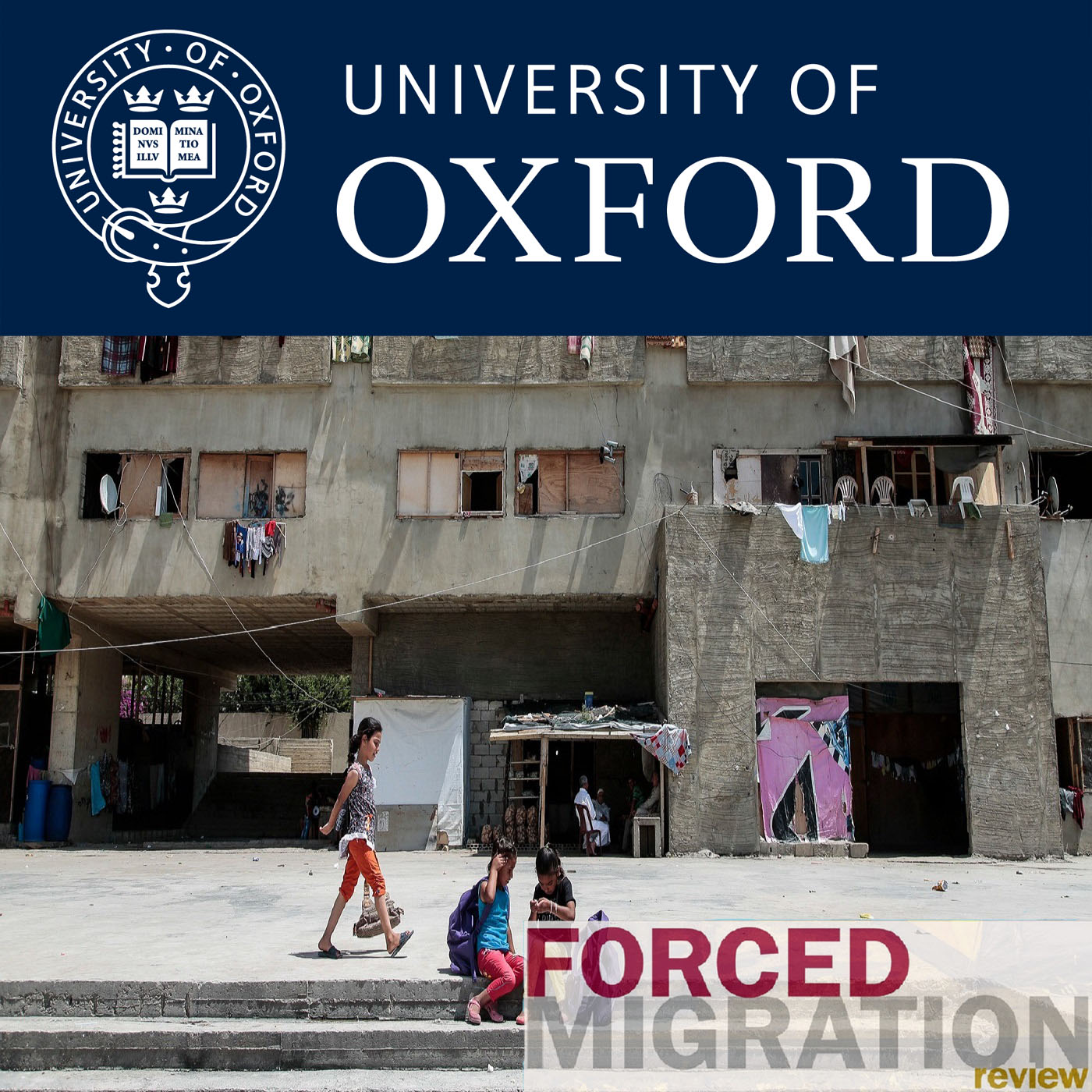
All displaced people need some form of shelter. Whatever the type of shelter which is found, provided or built, it needs to answer multiple needs: protection from the elements, physical security, safety, comfort, emotional security, some mitigation of risk and unease, and even, as time passes, some semblance of home and community. This FMR looks at the complexity of approaches to shelter both as a physical object in a physical location and as a response to essential human needs. It also contains seven ‘general’ articles on other forced migration topics.
11episodes
Episodes
Newest firstAll episodes
FMR 55 - Low-cost, locally available shelters in Pakistan
Dec 18, 201700:10:50Tap to summarizeFlooding in 2010 affected 18 million people in Pakistan. With declining donor funds and flooding again in 2011 and 2012, the humanitarian community required low-cost solutions that could be scaled up.
Transcribe →FMR 55 - From the Editors
Jul 13, 201700:04:41Tap to summarizeAll displaced people need some form of shelter, and circumstances dictate that in reality not much of it conforms to the typical picture of a tent or tarpaulin nor meets official standards.
Transcribe →FMR 55 - Refugee settlements and sustainable planning
Jul 13, 201700:08:08Tap to summarizeWe need to develop refugee settlement planning processes that not only facilitate long-term planning but also allow for incremental upgrading. The case of M’Bera in Mauritania illustrates this.
Transcribe →FMR 55 - Shelter in flux
Jul 13, 201700:10:41Tap to summarizeCurrent humanitarian guidelines do not sufficiently cover what shelter means in volatile and protracted conflict settings, particularly outside organised camps. We propose improved tools that will address that gap.
Transcribe →FMR 55 - An architectural investigation into the provision of refugee accommodation
Jul 13, 201700:08:42Tap to summarizeWhen challenged to investigate accommodation options for refugees in their city, architecture students found that there are simple and plausible architectural answers for the integration of refugees in medium-sized European cities such as A Coruña.
Transcribe →FMR 55 - The case for self-recovery
Jul 13, 201700:13:20Tap to summarizeMost families recovering from the catastrophe of a disaster rebuild their own homes. This practice of self-recovery by non-displaced communities has potential for displaced populations too.
Transcribe →FMR 55 - Pre-fabricated or freely fabricated?
Jul 13, 201700:09:11Tap to summarizeThe architectural forms of emergency shelters and the ways they are created play a significant role in the ability of their inhabitants to deal with their displacement and to perhaps feel, even temporarily, at home.
Transcribe →FMR 55 - Shelter for refugees arriving in Greece, 2015-17
Jul 13, 201700:10:23Tap to summarizeMass arrivals in Greece since 2015 have far exceeded the supply of acceptable shelter. The attempts to provide solutions continues.
Transcribe →FMR 55 - From drawing-board to Jungle
Jul 13, 201700:07:29Tap to summarizeOur research and development department has been working on a shelter solution in accordance with the requirement of improving logistics, installation, flexibility, the use of natural resources and, above all, the improvement of living conditions.
Transcribe →FMR 55 - The diversity of data needed to drive design
Jul 13, 201700:08:08Tap to summarizeThe developers of the Refugee Housing Unit know every aspect and component of their design but can never know what it is like to wake up in one of them every day.
Transcribe →