← Simon Dixon Hard Talk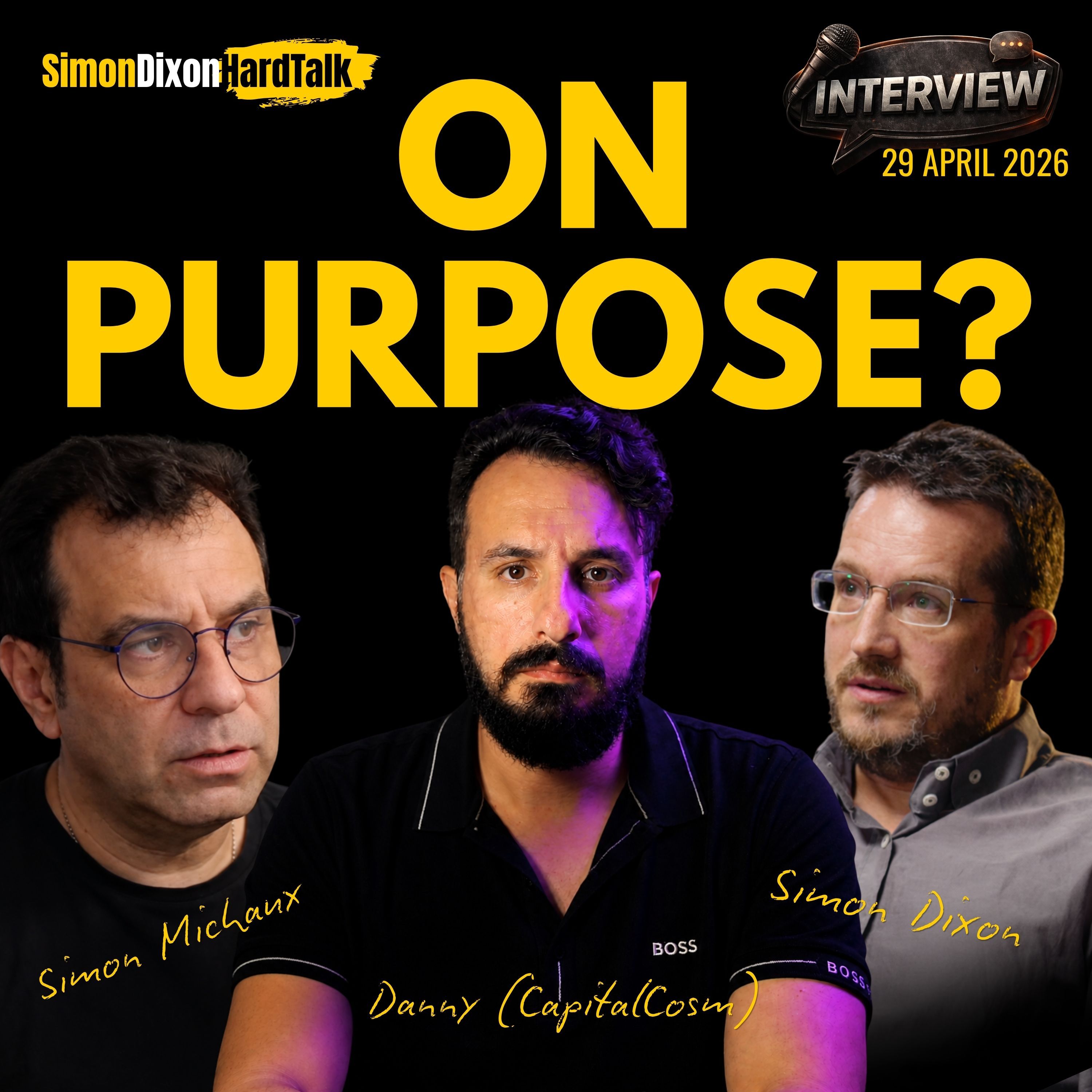
Simon Dixon Hard Talk
Are The Elite Trying To Destroy The World...On Purpose? | Simon Dixon & Simon Michaux
01:39:06
Loading summary
Transcript117 lines
- [00:00]
Simon Dixon
The second they want to rug, pull the system into one cbdc. The infrastructure is there and all you do is you say to Americans, hey, you know your bank account, the you used to have $10,000. You don't have $10,000 anymore. Download this app, sign this terms and conditions. And America already has its central bank digital currency, but it's wholesale. It's called Fed. Now you can, you can extend that to retail once you build on top of the rails.
- [00:28]
Simon Michaux
What does this chart, this one here? When, when this is commodities price and the fact that we're seeing blowouts and things are swinging everywhere. To me this is the system trying to thermodynamically correct before it collapses. What do you mean?
- [00:49]
Danny
You're watching Capital Cosmic. My name is Danny. It is April 28, 2026. 6th. And we've got a blockbuster episode for you today. We've got both Simons in the house. We've got Simon Dixon and Simon Michaud, two big fan favorites on the channel here, who both have a pretty robust working model of geopolitics elite society and how the world really works. And so we're going to dive into each, both of their models and see and compare, compare and contrast to see what are the similarities, what are the differences and you know, can we, can we kind of consolidate both models into one working model? We'll see. Before we get started, hit the like and subscribe button. Everyone, let's go ahead and juice this video in the algorithm and get it out to as many people as possible. Jens, thank you so much for coming on.
- [01:41]
Simon Michaux
Hello, Danny. Hello, Simon.
- [01:43]
Simon Dixon
Hello.
- [01:45]
Simon Michaux
So I'd like to kick off by saying I do very much appreciate Simon's work. So it is a pleasure to talk with you.
- [01:55]
Simon Dixon
Okay. Yeah, I'm looking forward to seeing what useful discussion we can have together for sure.
- [02:01]
Danny
Well, let's kick it off with you, Simon. Michelle, run the audience through what your model of the world is. And then we'll do the same thing with Simon Dixon as well. And we'll take it from there. We'll just rip off each other.
- [02:13]
Simon Michaux
Okay, so before we kick off though, my methods, I'm a technical analyst, I don't really know much about finance and markets. What I do know is industrial structures, in particular, raw materials from mining. I was educated in the Australian mining industry and so I'm interested in managing, looking at data signatures associated with energy, oil, gas, coal and uranium and the industrial systems around that. And so I'm looking at that side of things. So I don't, I'm not very good at predicting short term models and prices and stuff like that. So but, but my analysis is the structural side. So I see the world in layers. Like there's different layers and there's different and, and I use systems methodology to describe what I'm seeing. Right. So what I've got is, is if I may share my screen, we just work this out. So it does work. So I've got two more. I, I work on the principle of the horse race so I look at different theories and we see how things work. So I'm now looking at two horses, two theories. So one theory is we're looking at a civil war in what we call deep state or committee of 300 where one side is destroying the other side's capability. Where one side was the global imperial idea and the other side is more localized regional system. And the regional system wants to destroy the capability of the global system. So the international reputation will never be trusted or believed again by what's happening. And I, I believe this is on purpose. At the same time the Israeli influence over the U. S Government's been spotlighted for the public and has deteriorated. And it's also possible that for example if the U. S just packs up and goes home early from the Iran war and leaves Israelis to face the music, they may well be wiped out as a consequence of the Middle east situation. And I have a quick analysis of what's actually been taken offline if we have time. But U.S. canadian, Mexican and Venezuelan oil are now much more valuable than they were before. And so the old system seem wiped out. So I call this one the global imperial petrodollar empire versus the new American power bloc where they're interested in north and South American continents. So the other one, the other, the other theory which I think is happening and I'm kind of leaning to this one now for the information I collected in the last couple of days. Techno feudalism overseeing regional blocks versus the people who are used to self determination. So there's one actual plan and everywhere we presented as fake theater we're looking at the destruction of the current economic and industrial models. People all over the world are put into a desperate situation which will make them very susceptible to suggestion and to make way for the uncloaking of the new system. In my opinion most of it's already built. It's just wants to uncloak now. And so AI and automation are being implemented everywhere, especially in government. And we've got the Data centers and 5G infrastructure that's coming up there's the two. What's interesting to me is both of these are going to the same outcome. We've been funneled to the same basic outcome. And that outcome is as follows.
- [05:36]
Simon Dixon
I comment on that and then we'll do the outcome.
- [05:40]
Simon Michaux
Let me pull out so we can stop sharing.
- [05:44]
Danny
By the way, guys, feel free to jump in at any point, please.
- [05:47]
Simon Michaux
Sure.
- [05:48]
Simon Dixon
So like, you know, when, when you're in different circles and people try to model like you, you get taken down a model of conspiracy theory. You know, there's a. There's a grand group of people that are engineering the world or you end up in a model of. Actually there are very important, influential factions of power that are pushing an agenda and there is competing agendas and you can kind of use the big levers of power, military power, choke points, financial capital power, and now technological power as well. And I find it somewhat of a less interesting discussion to think about whether there's 300 people in a committee organizing everything versus a power struggle at the top and can allocate capital, allocate technology, because I found that a lot of people fail in their mission. You can try and you can see that in things like if you read a book like Covert Regime Change, you'll find that America and the Deep State have tried to execute like hundreds of regime changes and they have a very low success rate. And we're seeing that really in what I call Operation Ajax 2.0 recently, where they tried to create civil unrest like they did in 1953 in Iran with CIA and MI6. And often it doesn't work. And so when I look at how financial powers react to that is that they engineer resource extraction strategies and they hedge for when it goes wrong. And so they use the derivatives market so that whatever the outcome is, we're kind of okay with the outcome. And we can switch our derivatives in order to kind of. Because they don't succeed in many cases. And I also see the top as a massive power struggle. So sometimes like I look at the big powers as, like the military industrial complex, the financial industrial complex, and the technical industrial complex. And often they can be aligned and they can do a model of profit from war finance, the war finance, the rebuild and build a technocratic surveillance state, and they can all go in sync. But sometimes different factions of power go off kilter and engage in a war where they have shares in each other. But ultimately in the end it tends to be like capital and financial power at the top because they get to create the currency, they got the insurance contracts they got the financialization and securitization. So even the military companies are just shares in the end. And they need access to capital. You can resist against it by like, say, a Pentagon budget via the governmental system. And so that's why they exert such influence over lobbies. Or you can just give them access to capital that you can issue them bonds, you can allow share buybacks, you can allow them to collateralize against their stock. And so in terms of how the top works, in my understanding of the world, there is a more nationalistic faction of power and a more globalistic faction of power and finance and transnational capital. The most important faction of power is global in nature. And so it has no nationalistic legacy. While it does benefit from controlling and creating the dollar and dollar as world reserve currency gave it significant power. It recognizes that there is an end game. And so you have to hedge against the Federal Reserve System. You have to plan for a multipolar financial system. You have to have global financial centers all around the world because the bounds of what you can do with a currency inevitably implodes upon itself. However, something like a military industrial complex, they tend to be associated with more nationalistic and patriotic types of. They think of the US military as the US and so resource extraction and, you know, dollar dominating the world for America is a more nationalistic view of the world. And often those are in, are in, are in. They can, they can play in tandem with each other, but sometimes they go off from each other. And so when I think of Israel, Zionism, evangelical Christian, neocons, I think of that as more of a, you know, a, the US dominant world. And then it also has a bit of a friction with people's understanding of the world. So some people think that Trump is taking on the crown. You know, that's a, that's a narrative. The British Empire, the crown, the legacy power, which to a certain degree you can, you can personify that as what is London still got that it didn't have. It's got Lloyds of London, it's got the gold markets, it's got FX and derivatives markets. But Wall street as a mechanism is already taken over significant degrees of those functions. And so transnational capital really has financial centers. And so in the London side, you've got the insurance side and the derivative side, and you've got all the legacy British East India Company drug trafficking routes that was connected with Iran, with Israel, with Lebanon, with China, with all the different opium wars and various other things. And then you have the, the American side, which I think is personified by, you know, Wall Street. But all of those have merged to a certain degree. So this whole thing of the US Empire taking on the deep state of the remnant empire, I think fails as a model from here because I think they've, they've merged into one model. So anything around like, you know, Trump taking on the, the crown, I think has failed as, as a mechanism of understanding the world. It certainly existed. There was certainly an infiltration with the creation of the Federal Reserve system, with civil wars, with various other things and world wars. But, you know, people struggle with these different maps. And so if in the end I put it down to if you follow the money and you follow the capital flows, it's a lot easier to see that there is a global agenda. And that kind of goes to your competing model. And that competing model is you have transnational capital. But what is transnational capital is power is personified by access to capital. It's not capitalism or communism. People get that wrong as well because the transnational capital was effectively communism and capitalism were Western ideologies. They funded both and fascism at one point. You had the Hitler regime, you had the Federal Reserve, and you had the Bolshevik revolution and the creation of the Soviet Union. That's all funded by the same transnational capital that wants to create strategic tension. So that doesn't personify it. But imagine if we enter, and this will be my final point, and then you can go to the next thing. Imagine if we enter into a world where money is no longer relevant, where the algorithm is more important. I think the technological industrial complex is currently subordinate to capital. It needs funding for its data centers. It needs to engineer a global reset in order to create the justification for the fed to purchase 7 to 10 trillion dollars worth of bonds. And those need to go into data centers. The AI trade, the technological industrial complex, Palantir, the police and surveillance state. But is there going to be a time when these technology, these algorithms make money irrelevant and we enter into a world where the algorithm is the ultimate mind control and all of these police and surveillance state. And so I think there is a side battle. Think of the legacy power as the military industrial complex. It was turned into global by the financial industrial complex. And I think the financial industrial complex want multipolar world centers all around the world that they can control more currencies, more resources. But technology has the global one state government. And it requires the disruption of the financial industrial complex by taking us into a world where capital is less important than data.
- [14:55]
Danny
So, so just really quick, Simon Dixon and correct me if I'm wrong, Michelle is. I, I don't think Simon Row is advocating for like the Crown versus Trump narrative that you see.
- [15:08]
Simon Michaux
One narrative I've heard that's not quite what I mean, but that is a narrative I've actually, it, it's, it's, it's been put out there as a suggestion which makes me inherently suspicious of it.
- [15:20]
Simon Dixon
Yeah. And also that, that goes into Israel because they think of the crown as the Rothschild family and then the Rothschilds created Israel and then you have all the Lloyds of London and then you have a conspiracy theories that believe that the Ayatollah in Iran was groomed in France by MI6 and the British Empire. And so therefore the strategic tension between Iran and Israel and the protection of the drug trafficking routes after the Opium wars goes back to the Crown and the British Empire is kind of where that side comes in. And if you look at Trump, he's like, okay, we're taking on Venezuela, we're taking on Iran, we're going to, we're protecting the petrodollar. We're aligned with the Gulf countries which you know. And again the Gulf countries historically were created in size pico by the British and French Empire. That's where it comes from. So it's easy to manipulate that narrative into a Q Todd type of MAGA where we're going to take on the British Empire while in fact they're actually building a police and surveillance state and deconstructing the constitution right in front of them. The maga's magazine.
- [16:32]
Danny
Yeah, yeah. I don't think that's seven Michelle's position. But Simon Michaud, go ahead and respond.
- [16:36]
Simon Michaux
So well, what, what I'm, what's interesting is, is these bait rough theories seem to be digesting each other. That's what I'm saying. It's really hard to tell one from the other. The idea of the civil war started when I first saw, do you remember the Trans Pacific Partnership, TTP, TTIP, TiSA, three big agreements between the large corporations and I suppose the money interest of the world and the governments of the world. And my understanding was that they were trying to integrate all trade away from the BRICS economies and into the United States controlled sectors. And what I thought when I looked at this, it was a replacement of the 1973 petrodollar like that. And this was to be rolled out the global financial crisis, 2008 they had the swine flu pandemic at the time they were rolling at the swine flu vaccine at the time, what they needed was for this to work. It was a, another false flag. So they had nine, 11 in 2001. They needed another false flag like that to convince the public to go along with whatever they're looking at. What's interesting is the Iran closing of the Hormuz Straight that actually fits the profile of a false flag, as in that could be the trigger to orchestrate everything from, from this point on. So, so, so then they had the idea of, of a civil war starting up. Like the faction that's been in control of the American system since the end of World War II had, was then challenged by another faction. And they would say, look, you've been in charge all this time, you know, we want our turn now. And, and you started to see news, you had to be looking for it, but you started to see news news feeds that suggested that there was trouble in paradise. People were starting to fight amongst themselves. And as I understand it, the first time the global hegemon was challenged was when Russia entered the Syrian war in 2014. We're not going along with this anymore. And then you had the BRICS strategy rolling out and then you had Donald Trump and you had the very public bitter feud between Trump and the rest of the establishment. And I was watching that with, you know, what the hell am I watching here? Because there was Trump in the 2016 election and the lead up to seemed he was in open warfare with the rest of the American establishment in a way where they were airing lots of dirty laundry. They were red pilling massive chunks of the population. So this is the idea of there was some kind of factional war. On the other hand, the global nature of capital, as you point out, as Catherine pointed out, the same people who are organizing the last system were now organizing the current incoming system. The idea of the global coup d', etat, the financial coup d'. Etat. So are we seeing a civil war or are we seeing a series of events to convince the public to go along with this idea that they've put up? So, so, and what like I, I see, I see tells every now and then that support these ideas. Like I'm developing a project in Uruguay and I was talking to some people in Uruguay and they were saying we're very interested in a energy solution that would be make us more self sufficient because the Americans are pushing all South American nations to be under the control of Venezuela. And the word he used was like a junkie. And so whatever happened in Venezuela, it's still in play. It's just that the information is not publicly available. So whatever that was, it's still sort of happening sort of behind the scenes. So what that was, I don't know. But that does suggest the Americans are still very active in South America.
- [20:49]
Simon Dixon
Well, the Venezuelan stuff is pretty interesting because if you look at what's happened now, the entities that are likely to benefit from the refinement of Venezuelan hard crude oil is actually highly likely a subsidiary of Saudi aramco, which at 100% owns a refinement facility in Texas at the same time, the one that's going to be receiving the most of the LNG sales contracts from American. And again, I think the big mistake people think of is they think of America as a country. I think of America as a series of companies and a financial industrial complex. And so, you know, the Americans, they get all the debt, they pay for everything. The Americans, they get the inflation, because the idea is that you will own nothing and be happy. That's the goal of the west, the west vision. But a couple of companies get to make all these massive LNG sales. And one of them is golden pass, which is 70% owned by Qatar and 30% owned by Exxon. And so when you look at the Texas mining stuff, the winners are going to be Cheniere Energy, Chevron, Exxon, Golden Pass, Halliburton, some other infrastructure plays. And these are members of Transnational Capital. They're all public companies. They all need access to finance. So this was like a super subsidy for them. Obviously, you've got the military budget going up from a trillion to a trillion and a half. So that was a stimulus check for Lockheed Martin, General Dynamic, Raytheon, Palantir, Boeing, everybody as well. And who owns all those shares is the financial industrial complex. So what happens here in Venezuela as well is that Iran was providing some of the drone infrastructure. Saudi Aramco is getting to hedge some of their exposure from the current Iran closure of the Hormuz. And the oil is being sold to China. So it's still being sold from Chevron to China. Nothing actually changed. It was just the companies that get to benefit and the price at which they get to charge. And so it's kind of pushing that strategic choke point through the companies and the refiners in Texas. And then we got a beta test of what a sheer terrorist energy lockdown looks like, which was Cuba. And so if you look at Cuba right now, this is what some of the more distressed countries that are exposed to this are about to experience in Southeast Asia. I'm not talking about Taiwan, Japan, South Korea, they'll solve their problem, but they may need to sell some U.S. bonds and U.S. equities to get there because they got massive trade surpluses and they own significant assets and they'll just pay the higher price. They'll be pushed more into China and brics and they may need to sell some of their bonds and they'll end up with an FX swap line, which many of them already have most likely. Which means that they get to have more control over the US Fig in terms of. Because what America has said is you can't sell your bonds. Japan, you cannot sell your bonds. It will drive yields up, the mortgages will break, it will have big problems. And it said to the Gulf, you can't sell your equity, you can't sell your AI stocks, you can't sell any of those stocks. Instead, we'll give you an FX swap line which is extending the FICC to these global centers that are going to be more aligned with China in the end as a result of this, it's going down that multipolar route. But what we're seeing with the countries that are seriously distressed, particularly in India, like all of those tiny little businesses that are selling Indian street foods, they need their propane gas, they haven't got it, that's gone up 4x. So those businesses are going bust. That's a humanitarian crisis that's wiping out of small businesses. Same will happen in America, same what happened in Europe. Same will happen in certain countries. And so Cuba is the example of where they're about to take us. Because in Cuba it's kind of like what Gaza happened, but without the bombing, the hospitals stopped functioning. They didn't have access to the energy. People stayed at home because the hospital was closed. You have the energy lockdowns, you have an agenda to profit from renewable energy, biofuels and serious innovation in alternative energy. BlackRock's portfolio benefits from all of that. So their assets under administration is only going up because they're hedging the companies that are losing from this. We're getting the new alternative routes. We're getting preparation for a post OPEC world, a world where oil and LNG can dominate for now to power. But what are they doing there? Can AI is an LNG guzzler. It is just taking all of this LNG and is monetizing it and building out the police and surveillance state. And so, you know, we're getting all these new forms of energy alongside all the assassinations of the nuclear, you know, innovators and professors and stuff like that.
- [26:31]
Simon Michaux
Yeah, what you said something very interesting. One of the things I'm actually sort of looking at is the nature of what I believe the nature of what we call money is going to change. We are in a massive transformation at the moment that I don't believe many people really understand. And when cryptocurrencies were invented, when they were brought to our attention, it wasn't just the value of the stock. Each cryptocurrency did something that was valuable, Veritasium, for example. And, and when I was trying to actually sort of work out a counter solution, we had all these problems on the books. What do we do? How can we meet these problems? And I'm talking in an industrial context. And what I came to, the conclusion was money was a decision making system to decide who owned what and who did what. And could we break that up where we had systems running in parallel? And that's discussion for another time. But what you're describing is essentially the same thinking from somewhere else like that where you say money is not going to become relevant anymore, there's going to be a decision making system in its place. And that to me makes a lot of sense. But of course the question of who controls that decision making system and what do they actually want and do they care about us?
- [27:55]
Simon Dixon
No, they don't is the answer. And you can see that in. So look, I've been, I've been involved in bitcoin from day dot, like from when it was $3 and I became a shareholder in 100 different companies. So I got deep insights into the psyops of the industry. And, and it really, when you, when you have a level of detail of knowing the developers and various other things, a very nuanced conversation. But to me the story in a nutshell is I believe bitcoin came from intelligence. I believe it was a CIA, NSA type of project. But if you look at the factions of power, there was digicash, which was effectively shut down by the banks because they allowed for private transactions. And the, the way the chokehold was that the bank shut it down because it needed access to the banking and it anonymized the transactions within the banking system. But David Chom, who effectively was teaching in Netherlands, had students and one of those was Len Sassermann. And then there were companies that were incorporated and how Finney was around that time zone. And so the cypherpunk movement that led to the creation of Bitcoin came from those circles of David Chom, Lens, Acerman, how Finney and the others now both of Those died under suspicious circumstances. So you know the how Len Sasserman was allegedly one month after one of the early developers that Satoshi handed the project over to was Gavin Andreessen. Gavin Andreessen said that he's going to have a meeting with the CIA to discuss Bitcoin. Satoshi left the project. And a month after Len Sasserman committed suicide from depression. Allegedly, allegedly. And, and then later we had Hal Finney as well who can, you know, got a condition that allegedly died from natural causes. But you know, those were in my mind Satoshi Nakamoto and the coins can never be retrieved. But what I think they did is I think they open sourced it. And that wasn't meant to be the project. By open sourcing it, it created proof of work as we know it. When they released the white paper. Proof of work, which was launched in January 2009 created a resistance infrastructure, but it was dependent upon energy. Effectively you had open source development where all the code, so there's no backdoor hosted on a decentralized network of supercomputers. And ironically who are the largest bitcoin sovereign miners today? Iran, Russia, uae. Interesting. And so you have that distributed supercomputer that allowed you to transact outside of the dollar dominated sanction system. Again, legal disclaimer here. I'm not advising anyone. You have to follow the law in your country. You are subject to the law no matter what you do with your money, whether you can do it. If you're committing a crime, you're committing a crime. I'm just explaining structurally how this is set up. And then you had the traceability but with the way to obfuscate it. One of the earliest developers, Amir Taki, who was targeted, all of these people were targeted in the Epstein files he created with Gregory Maxwell. They created Coin during where you could obfuscate your transactions. And the mining was powered by energy. But if the miners get out of control, there's a network of nodes and we got 25,000 nodes. You can have competing implementations which checks the developers and they enforce the mode. It created a genuinely decentralized structure. If you look at the Epstein files, Epstein tried to infiltrate the various developers, create centralized companies like Blockstream. And he had his guy, which was Brock Pierce. Now Brock Piers invented Tether which he then sold to an exchange called Bitfinex. And later that became the precursor for stablecoins and central bank digital currencies. That's the project they wanted to create which was the same as Digicash. You have the banks that can perform a freeze function, but traceability and programmable money. Whereas bitcoin actually created a breakaway from that which gave effectively elites an exit. So I always think of when the British Empire, they tax everybody in a normal tax structure, but they created all the colony islands so the elites could escape, they could have a safe haven for both tax financial. Bitcoin's the same. The elites want it. So it was open sourced and released as Satoshi Nakamoto. But the real project that they wanted was stablecoins and central bank digital currencies. So now if you look at where we are now, Trump, which was his primary backer, was Elon Musk, a node in the technical industrial complex. They immediately went into Stargate project. They immediately said we're going to be crypto capital of the world. They infiltrated the bitcoin conferences and Trump started using them. Right now we've got the FBI director right now in real time speaking at the bitcoin conference, the head of the SEC speaking at the bitcoin conference and the organizer of the bitcoin conference, who was he? David Bailey. He took his bitcoin, put it in a Wall street wrapper and acquired the bitcoin media companies and the bitcoin conference companies and raised finance via counterfeitzgerald, who's Howard Lutnick, who's connected to the Epstein file. So clearly the bitcoin treasury companies, Michael Saylor, Jack Mallows, through borrowing against your bitcoin, all of these I believe are covert infiltration attempts to centralize as much bitcoin as possible. But they're still giving you bitcoin in self custody. They arrested the samurai wallet developers and pardoned everyone else. Justin sun was pardoned and he created a crypto scam with the Trump and the Witkoff family and all sorts of craziness. So when you go through this, you can see what they wanted to create. So now Europe is launching its central bank digital currency, the digital euro. All the technical companies and financial companies are arguing to make sure you need a banking license to issue a stablecoin. And so that's the privatized interest. The FIC takes private extraction through American infrastructure. The rest of the world is on CBDCs, the China Infrastructure, the European infrastructure. Then you make sure that no one can own their bitcoin. You incentivize them to custody. It's through bitcoin, treasury companies, ETFs. But the elites get the exit or bitcoin in self custody when they want to exit the system. But you get the full implementation of Genius act and Clarity act, which is the extension of the Patriot Act. And what was the false flag to get us there? It was the Trump administration taking on the Fed, taking on the deep state, while he effectively creates an Orwellian 1984 programmable nightmare. And who's being groomed as the person that will broker the peace in Iran? J.D. vance. And J.D. vance was groomed by Peter Thiel, who is the Palantir guy. Now Palantir is getting all the contracts from open, from closed borders across everywhere, every. The Gaza contracts, the. The police and surveillance state. Palantir is the most essential node in the global government. That's coming from the Trump administration. And J.D. vance represents that, that handover.
- [36:11]
Simon Michaux
It always struck me that Bitcoin and all the other cryptocurrencies, their true purpose was to educate the public in what this, what this was like, what a cryptocurrency was. And the plan always was to roll out their own programmable. Well, I guess we call it a programmable currency that's not going to wipe everything else out in some form, whether that's accepted, whether that works or not.
- [36:39]
Simon Dixon
Most people think it's like a backdoor. It's just structurally impossible to have a backdoor. Then they start thinking about energy dependency and quantum. But the quantum resistance side is just upgrades. We're already there. It's just Satoshi's wallets that are impacted at this point. Then they think, okay, are they wiping out the energy grids as the control grid? Well, that's when nuclear comes in, alternative energies, countries that hate each other. The largest miners are still Russia, China, Iran, private interest in America, UAE diversified Central and Southern America, various other things. So the only story that makes sense is what Brock Piers tried to do, which is the gateway drug story. And so Brock Piers tried to persuade me that Satoshi Nakamoto was Dr. Craig Wright and that was bitcoin cash. It was a fork of Bitcoin. There was. Then he also created Tether and then sold it to Bitfinex. And now all the freeze functions are the tethers that are happening with paying for Iran with stablecoins. All of the quote, unquote, Lazarus North Korean hacks, which I believe are hidden Israeli hacks. They're also always exposed by Zach xbt, who's connected to Israel. So you can see the psyops there. The Trump administration is just taking everything out through World Liberty Financial. But who are crypto? Crypto was always funded by Silicon Valley. It was always a centralized alternative implementation. And then immediately we Started to see that this week when the defi function, when they started to confiscate some of the Iran money in stablecoins, the foundations that were funded by Silicon Valley just froze some of the pro at the protocol level like arbitrum layer 2 they started to perform free functions and then hackers start to hack all the defi contracts and then immediately everyone goes into bitcoin or bitcoin ETFs. So you can see that the crypto sector, the stablecoin sector, the tokenization, the securitization financialization is the World Economic Forum you will own nothing and be happy agenda and the Wall street agenda is to centralize as much of as can and get the stablecoins favorable terms to the banks. And Bitcoin in self custody which is a small number running their nodes is the exit for the elites. So they created the exit and they created the psyop. But the end result is integration with artificial intelligence, programmable money and social credit scores which effectively is being built as we speak right now. And you get the two tiered narrative America, we're not that crazy leftist radical carbon credit. So you got all the energy problems, you're getting the renewable, you get the central bank digital currencies, we get the stable coins. We're, we're the capitalists, we're going to make America great again. While you're the radical leftist, we're the far right nationalists. Those are really being pushed. But it's all one agenda. It's the same agenda because the European Union is a Bank for International Settlements project. The largest shareholder of the bank for International Settlements is the Federal Reserve. The Federal Reserve is owned by the banks. The banks are all public companies and they're managed by BlackRock, State street and Vanguard. The largest shareholders of BlackRock, State street and Vanguard are the foreign sovereign wealth funds, the Chinese sovereign wealth Fund and
- [40:18]
Simon Michaux
CCP and they control SWIFT as well.
- [40:22]
Simon Dixon
So they're building SIPs as the alternative to Swift. And then who got the Enbridge project which was the network of central bank digital currencies. It was created by the bank for International Settlements and then suddenly it was handed over to uae. And UAE is getting the FX swap line. UAE is leaving opec. UAE is aligning with Israel. This is FIC penetrating the GCC while they do the same with India in order to penetrate brics. But they're pushing into a multipolar world. What was the PSYOP for? The global reset closure of Straight for me. Energy crisis, food crisis, repricing of 50 commodities, an inflationary crisis followed by a recession. And however long they want to do it, however long they want to push it, a Great Depression. So 100%. And if you look at the Strait of Hormuz right now, what do you need to open it? You've got Lloyds of London, that's not insuring the ships. You've got a U.S. blockade, which is Blackrock, State street and Vanguard, which are negotiating their portfolio. And then you've got the irgc, which is the military industrial complex aligned hardliners that can enforce the blockade. And you can get a Lloyds of London contract if you can get a security guarantee. And what is happening with Iran? Iran's being vassalized into China. UAE is a FIC node and that's being vast. And Israel's been vassalized into gcc. And so you can see multipolarity with a global surveillance state.
- [41:59]
Danny
Simon, let's, Simon. Michelle, respond here really quick. Go ahead, Simon.
- [42:02]
Simon Michaux
Look like a grand bargain. Like I, I, I. Okay, I had the two basic wings of, of the idea. And one of those, it's all fake and we're being, we, we are being orchestrated with something like, and I'm still trying to, to turn it between the two. I did actually do an analysis of, or a very, using an actuary software of what would happen if the Strait of Hormuz was open tomorrow, as in how long would it take to recover? And the other one was what would happen if it stayed closed for five months and opened on July 1st. And the answer is, you know, as, as you said, like, like damage is permanent. And so this, this, this could well be. You know, my working theory at the moment is this is the event that's synthetic. The whole thing is so in your face, unnecessary to create a particular outcome. And that outcome, it's about the destruction of the existing system so they can create the next system that can be inserted in its place. And we're watching it happen. Right.
- [43:08]
Simon Dixon
So should we have a look at your second slide? Because I think that was your second slide.
- [43:12]
Simon Michaux
That was indeed my second slide. So let me share the share screen. Okay. And after that I got two questions because two questions for you. All right, so what we are seeing now, so this is where we ended last time, your two basic wings. And I am leaning to the, to the techno feudalism. So what we're seeing the great reset. So this is to convince us, to convince this necessary, we need some kind of false flag of some kind. I made this slide before the Iran thing happened. But when I look back on it is the closure of the Strait of Hormuz and the whole Israeli strike to take out the Iranian leadership. All of that fits this profile. So what they're bringing in or what we're seeing is a programmable money similar to Bitcoin but controlled from a central point or controlled somehow. And there's, there's many options there. A social credit system similar to what's, you know, Sesame Credit in China or now Vietnam digital passport. This is what they tried to bring in with COVID you know, the environmental, social management. So esg, what will be allowed, we won't allow you to purchase beef and steak because you've, you've used too much carbon for this month. It'll be something like that. The police surveillance state. So digital privacy is gone, you can see that now. But also private ownership. You will own nothing and you'll rent everything from the state at their sufferance and permission. And, and I, you know, to me that the vector for that is we have an economic crash, everything becomes worthless. To survive, banks have to call in all their debts and anything attached to a loan, like a mortgage or even a car loan has to be transferred to the bank for assets for their own survival. And so all of a sudden anyone who owes any money at all, all of a sudden doesn't anything. So we've got the AI decision making system. AI has been rolled out all over the place. I see so many people promoting the idea that AI will save humanity and will solve all their problems. But I'm also seeing bad actors making sure that we see the worst outcome. We've got data centers and data fusion centers to manage the data flows. Like all these data centers that have been put up. I've yet to see an economic reason of why they're happening. To me, it's not a business reason to make money, it's more strategic. And what I'm also tracking, and this is actually related to my professional work, is the semiconductor technology and the raw materials behind it. The new tech that's actually sort of coming out is actually you merge the semiconductor tech with the AI and use the data centers to collect the information. That's the actual control grid. So some technocracy was promoted, promoted a couple of decades ago. But I think this is a version that's been twisted and techno feudalism sits, sits better here. So how do we get there? So we're going to, I can see us being put into a series of situations to get economic defensation. An energy shortage of some kind, food shortage or some kind of Physical lockdown like what they tried with COVID but more effective. So the vectors to get there. Another pandemic has declared terrorism. We've been in the war against terrorists since 2001. Famine Now I can see a famine being organized. If things go keep going in a particular direction then we've got the good old fashioned walk if war a chance. But the way I think it's going to get, get through this, I believe will be a cyber information bomb because that's the easiest way to destroy everything at the moment. Some, some sort of cyber attack that's so ubiquitous and so destructive. And what I believe is behind all of this is the long range view of transhumanism where they want to merge humanity with a global technocratic system, technology, system. So that's, that's the model that I've been working on at this time. It's again I'm not attached to any of these ideas like I'm happy to see a new idea come up. One of the fails possible fails of if the straight of Hormuz resolves is off and everything goes back to normal, then I've got to, you know, maybe think about eating my hat.
- [47:50]
Simon Dixon
I don't, I don't think so. I think they've already achieved it. Even if the straight opens tomorrow, we'll still, we'll still get that.
- [48:00]
Simon Michaux
Yeah.
- [48:01]
Simon Dixon
Because this is going to take months now. If we, if we're close for another month or two then you're closer and closer to that.
- [48:09]
Simon Michaux
Yeah.
- [48:09]
Simon Dixon
I thought my, my miscalculation is I thought this war was going to be similar to the 12 Day War once it happened. I look at who benefits from this. So Russian national oil interest and LNG kicking ass, Iran kicking ass. Yeah, they've got rebuild contracts and all of that will come through the companies that I listed earlier, the energy companies within America. This is a massive wealth transfer over from the average American to the shareholder class. Massive biggest. We'll see then. You've got what, what led up? What led prior to this? Well we, we had like the beta test. So all of that was beta tested in uk. You know UK was kind of pre crime, manufacture, civil unrest play, immigration and religious tensions. Religious, you know, all those racial tensions, all of that type of stuff. You know all of that was beta tested in UK and it just so happens that across Europe and UK we had windfall taxes on the North Sea oil production leading up to this. So we destroyed our investment innovation because we made it harder for businesses to want to invest. We had the Germany operation to
- [49:38]
Danny
cut
- [49:38]
Simon Dixon
off all of its energy from Russia, the Nord Stream pipeline, the hollowing out of the manufacturing base, the shutting down of all the nuclear power plants, all of that was leading up to this. And then the Russia, Ukraine escalation. So all of that was to just fully turn Europe and UK into a collateralized debt obligation. Even before that we had Brexit to separate. The bank of England always separated itself from the European Central bank. But then we had Brexit which took UK out. So you can have a separate node from the European project as well. You had all of that leading up to this. That clearly is nonpartisan. Long term portfolio management strategies, obviously you had Covid, you had the esg, all the stuff you mentioned. I agree with all of that. And it all came from the blackrock level, the capital class, the World Economic Forum, the business class. And all of it really dictated capital flows. This is accelerating. There's no way they could do another famine, right? Every, if they, when they, every time they try and create a new one, everyone's like, yeah, you know, everyone's like, yeah, yeah, do one. But the straight up or moose is one you will do. Because if you don't have your oil and you don't have your gas and you don't have your energy, you're gonna lock down. You're gonna be like, for the good of my community, I'm gonna consume less energy. You're gonna do it. I'm gonna comply.
- [51:19]
Simon Michaux
Why would I?
- [51:20]
Simon Dixon
I'm not gonna, you know, I'm not going to resist against that because I've got a community and if I'm guzzling energy like crazy, I'm going to think about my fellow community. So it is very similar to you're the grandma killer if you don't take a vaccine or wear a mask.
- [51:38]
Simon Michaux
Right.
- [51:38]
Simon Dixon
But this one more is more, this one's better to enforce, you know, because less people are going to resist against like genuine shortages in energy.
- [51:49]
Danny
Yeah. What's the significance right now? Because this is breaking today, the UAE leaving OPEC and OPEC plus, what will, what will impact, what impact will that have on energy prices? Simon, Michelle, I'll let you take that one.
- [52:04]
Simon Michaux
So that's an interesting one. If, if UAE does, does actually leave or they have left, then OPEC as a control structure will become less relevant and a new control structure will take its place, but according to new rules, with new, new actors. So see, now we're back to the idea that Iran and UAE are actually quietly, you know, collaborating. So what's, here's an idea. Here's a, here's a question for you, Simon. World Economic Forum rolled out a, this, this great reset and they did it in a way which was stupid. It did it in a way that antagonized everyone. But it described what they were doing. What I've been working on, this basic idea is the World Economic Forum will introduce the system, there'll be a backlash, the World Economic Forum will be disbanded. As Kazi Irides, we've gotten rid of them, but then the system gets implemented anyway under a different form. Right, like under, under a different name, a rebranding now. So, so back to the idea that OPEC is, might be breaking up. Is it okay, is it the case of we had control structures that worked a couple of decades ago, but now they're in the way. Now they're not quite what's wanted by the architects of this particular situation going forward. And they want the old structures to break apart and dissolve for reasons that, you know, the old, the magician does something with one hand. But really something is happening over there. Like to me, we're actually seeing the break apart of the conventional control systems have been in place for the last 50 years and something else has taken. Taking its place. Simon, what do you think of that idea?
- [54:09]
Simon Dixon
Potentially. So let me say what I think's happening with UAE and this is evolving story. I think the financial industrial complex, the FIC is building penetration centers for a multipolar world. And in the BRICS corridor it's India and in the GCC corridor it's uae. And so you. I don't think this breaks down opec. I think the UAE was the first to join Abraham Accords as a major economy and normalize with Israel. And so that create a, created a good bad cop game between Saudi and uae. They compete, but they're in the same GCC bloc. You can effectively destroy UAE's reputation and brand Saudi as like the one that's, you know, it's got Mecca, it's got Medina, it's the one that held out on the Palestinian cause till the bitter end, until there was a solution and it effectively saved the region because it had its alternative pipeline while the Strait of Hormuz was closed. So Saudi and UAE and then Israel's going, you know, UAE is going down the opposite. It's being rebranded as almost East Israel. It funded a lot of anti Islam propaganda across Europe and UK to try and get the population from UK over to UAE and get all the billionaires and millionaires. It was the first one that was economically Most distressed because of its major inputs which affects all the GCC but tourism and financial services. It created crypto capital. So it's doing the police and surveillance state. It built out a lot of the data set, the data center infrastructure and it was the one that bribed World Liberty Financial. So when Binance was pardoned CZ Binance relocated to the UAE which was, remember what happened to Binance. It was the largest crypto exchange in the world. It was taken down in the Biden administration. CZ went to prison but rather than being like sbf, he got four months sentence instead. And the condition of the settlement was that the US becomes the compliance department for Binance. So the DOJ took over Binance's compliance and the first thing they did during the genocide was was suspend Palestinian accounts, Turkish accounts, Lebanese accounts and freeze all of their money. And then Binance got its license within uae. It still got its Cayman island hold code structure but UAE became the key license of it. Then there was all the deals, right? There was the investment in Binance for two to billion. And what was that done by Trump's USD 1 stablecoin and so they were funneling money via Trump's World Liberty Financial project and Stablecoin in order to get like these different, these, these different terms. They also ended up being in the stress. The first one that Scott Bent said we'd like to support UAE and give them an FX swap line instead of. So what they're doing is effectively and if you look at the UAE ETFs retail was selling. A lot of people were selling their houses. They even had disjointed in the bitcoin to gold market. All the people that were leaving UAE sold their gold for bitcoin and gold was trading at like a discount to spot. They've still got the drug trafficking routes from Iran, remember Iran and uae. Iran UAE is the second largest trading partner of Iran. China is number one. All of the circumvention of sanctions for Iran happened via UAE and the SIPs in China routes. So you know that, that, that that whole flow has, has maintained throughout. If, if they were in a war then UAE could just shut off all trades and, and that would be a big problem now Then we got the sanction relief, then we got the old trading for the straight of a moose. Then we got the fruit, the freezing of the tether stable coins but the allowing of the USD 1 infrastructure. So you can clearly see when you follow the money that there is very theatrical elements to what we're witnessing now the Deaths are real. The crime, all of that's real. You know, if you think the military industrial complex needs to fake deaths, no, they'll kill children. We saw that in Gaza. You know, this is the, this is what they've always done. So when I say theatrical, I don't mean that, I don't mean to diminish the crimes against humanity that are being committed here. But they are engine, they are clearly engineering something. And the enemies that we think are the enemies are not the enemies. And we've seen that for many, many years. We've seen in Iran Contra affair the CIA disclosures that Iran, Israel and America were working on drug trafficking routes via the contras in Nicaragua that integrated the
- [59:43]
Simon Michaux
CIA to get drugs into America.
- [59:46]
Simon Dixon
These were remnants of the opioid. So why are we getting escalation in Lebanon right now? Well, that's part of the drug trafficking routes via Turkey that go into, you know, from these old, from these old trade routes via Iran and Afghanistan. And so you can see all of these different wars and the different trade routes that happen. And the world is definitely not as we see it. But what is happening with UAE is retail was selling but BlackRock, State street and Vanguard, their positions in real estate went up, their ETF went up, same with Israel. So this is just an institutional compromise of here is the new financial industrial complex node in order to penetrate into a multipolar world while we build the technocratic state which is the global one world government at the same time which requires multipolarity as a bridge drug. So I don't think they're taking down opec. I think they're just, they're just doing a bit of good cop, bad cop and redefinition.
- [60:51]
Simon Michaux
So what, what do you see as the global. So the. We hear about this cryptocurrency, this, this programmable currency, like you hear Catherine talk about it a lot. What form do you think it will take and how will they introduce it?
- [61:09]
Simon Dixon
So you already have Genius act and clarity act and stablecoins in America. America, you know, we got $300 billion of market capitalization behind stablecoins. You already have a central bank digital currency. Within China we have the digital euro which was beta test and been rolling out this year. We had the Enbridge project that plugs together the haven centers, uae, Saudi Arabia, Thailand, Hong Kong and China. So there you've got the Enbridge project that circumvents SWIFT for the drug trafficking routes, the legacy routes. And so now you've got Enbridge, you've got the bank for International Settlements project, the European Union and, and the digital euro. You got China and the CCP. 110 countries are plugged into SIPs, which is China, China's payment rail now. And they built a system which is growing significantly because all of the tariff policies and the closure of the Strait of Hormuz and the sanctions drove adoption for SIPs because everyone had to have their alternative manufacturing base, import, export structure. What it also did is it drove all the gold away from the west and over to the East. So the Shanghai trade is all done in gold if you want to circumvent sanctions or purchase oil. So if you've got dollars, you can exchange your dollars for gold. You can take that gold and buy oil in Iran and then that goes and ends up in the Shanghai coffers. At the same time in the west we know that structurally there's way more paper gold and paper silver than there is gold and silver. And so the China payment system can rug pull the American system. And we've got a beta test that with silver and we've got a beta test of that with gold. So what we're seeing is the system is fragile in the west because of all the paper derivatives contracts which kind of lies into the London, New York rails. But the transfer of the physical commodities is going across to China, Shanghai, Singapore, the actual commodities because they're backed, the paper contracts are being left in the debt. So the over leverage is being left in the west and then gold is becoming part of that settlement rails. And the only currency from Iran that couldn't be confiscated was the Bitcoin. The Bitcoin in the exchange was confiscated, the stablecoin was confiscated, the crypto was confiscated. The bitcoin in self custody still remains in Iran. And so the bitcoin in self custody becomes that actual settlement layer and the gold in custody becomes the layer that can be confiscated. The Enbridge Central bank digital currency project concentrates, concentrates, concentrates. And then if you want to rug pull the whole system, the Fed just stops buying the treasuries in the west and all the gold is in the east already. The second they want to rug pull the system into one cbdc, the infrastructure is there and all you do is you say to Americans hey you know your bank account that you used to have $10,000, you don't have $10,000 anymore. Download this app, sign this Terms and conditions. And America already has its central bank digital currency, but it's wholesale, it's called Fed. Now you can extend that to retail Once you build on top of the rails.
- [65:11]
Simon Michaux
So in other words,
- [65:16]
Simon Dixon
You can have a financial system where you just do an alternative bailout system. With a cbdc, you could do a great taking. You know, you could do a big print that's executed via a stablecoin, you could do a great taking where effectively only the custodians own the assets and you can replace them with a tokenized shitcoin and a CBDC and a stable coin.
- [65:42]
Simon Michaux
So yeah, the work I'm doing is to map the industrial physical assets on the ground and you ask the basic question of, you know, who controls all the production of metals and mining and minerals and manufacture and the front end of the value chain from mining to smelting and refining to manufacture. China in its own territory, owns and controls directly something like 70% of the industrial network worldwide.
- [66:11]
Simon Dixon
Wow.
- [66:12]
Simon Michaux
Then they've got, then I can show you the numbers if you like. Then on top of that, which I haven't done yet, is the Chinese capital controls and ownership of industrial ports, railways and factories internationally. So what I was going to say is the, the in, in the layer of the China plan, the BRICS plan, the one belt and road where they want to own and control everything by 2049, that seems to be in progress, but this plan seems to plug into it somehow. And. Yeah, and so I've been trying, trying to make sense of what the hell I'm seeing here. Yeah.
- [66:52]
Simon Dixon
Have a look at the Panama Canal. That, that sums it up. Right. What was the Panama Canal negotiation? It was between a Hong Kong shell company directly connected to the CCP and BlackRock Portfolio Company which has a financial industrial complex fund that invests in these strategic choke points.
- [67:16]
Simon Michaux
Right.
- [67:17]
Simon Dixon
And so. And they've got 40 different negotiations that are being settled.
- [67:21]
Simon Michaux
There's the strategic choke points all over the world. Like Panama Canal was developed and dug by the Americans, but as of a few years ago, Chinese companies controlled by the CCP own both ends of that canal. So another choke point is the ships that go around the south southern tip of South America and the Caper Good Horn in South Africa. Right. And, and the Chinese are there. And the other one's the Suez Canal. I haven't looked into that one, but yeah, and so I've been seeing, seeing.
- [67:59]
Simon Dixon
And by the way, that comes into UAE and Saudi and Iran because they're going to end up with effectively determining the ratio of the Petro Yuan to the Petro dollar.
- [68:12]
Simon Michaux
Right.
- [68:12]
Simon Dixon
And that's why this is a huge negotiation. Uae, Saudi and Iran all have a
- [68:17]
Simon Michaux
piece of that, so I was in Hong Kong and I was presenting thorium molten salt energy system and I spoke to a couple of officials there. Like there was a governor of one of the provinces. And so he took me aside and we were talking. He made a point of laughing at me. He says look, the west is on fire and we're not going to lift a finger to help you and everything east is going to divorce everything West. And I go oh really? Okay, so but that is also, it's just as susceptible to capital controls as everyone else. Like, like the people I was talking to that, that was in one layer and their perception of the world was only within that layer. And so what we're talking about here is the global currency systems and the negotiations between say the hedge funds that are beholden to the CCP and the hedge funds like BlackRock and Vanguard and State Street. And what's your opinion on the BRICS economy long term plan? What do you think they're up to or where do they fit into your model is a better way to put it.
- [69:34]
Simon Dixon
So firstly, you're right, there's only real two. When you look at it and you simplify it down, there's only two two powers in the world. There's the CCP and the financial industrial complex. The financial industrial complex has co opted every sovereign wealth fund, whether it be Norway, whether it be the Gulf countries, whether it be uae, whether it be Singapore. They've, they've co opted which is why they co invest in everything. But who funds them all? China. So China buys all of their commodities and all of their, and all of their goods and exports, everything. So those are the only two powers. It's the financial industrial complex and the CCP that is a power struggle. So how do you penetrate the ccp? You can't penetrate the CCP because they won't open up. Which is why this whole gold thing exists because they're not going to, they don't want you to hold Yuan, they don't want it. They want capital control controls. They don't want a corporate takeover of the CCP like happened in the rest of the world. And so the, the BRICS is just effectively big. It represents that negotiation. It is China let's face it, with strategic tent, with strategic tension from commodity driven countries and alternative manufacturing bases. So all the currencies that are outperforming the dollar, the dollar is doing well since the Iran war relative to the path it was on. But every currency that's connected to real commodities and energy is outperforming It, Brazil, Australia even though they're in major distress, the economy is decoupled. The reality of that K shaped economy I always talk about the rich get richer, the poor get poorer. That's the, the, the same for all of them. But which is what I think the UAE role as well is. So you have GCC is Saudi with friction, strategic tension from the financial industrial complex which is represented by UAE and Qatar. BRICS is China with strategic tension by Russia and, and India and that is the future of the project. But you know the, the Western financial industrial complex will still dominate the western hemisphere America. The rich will get richer, the poor get poorer until eventually the civil unrest is so bad that it's the police and surveillance state they're already trying to engineer that you know false flag assassination, assassinations of Trump and just they're getting comical now. People, people don't even talk about like we if can you imagine we just started this show and this is the first time we talked about an assassination tab of the US President. That's how people don't care anymore or believe it anymore. Like that's how crazy it is.
- [72:36]
Danny
I think a Fox News poll, I think a Fox News poll said that 70% of people polled believe it was staged.
- [72:45]
Simon Dixon
I mean it's not even worth talking about like literally that's what it's got to now it's crazy but yeah so look transnational capital and the technical industrial complex, that's the real, that's the real battle and the real power structure of the world is the financial industrial complex and the ccp. That's what the world.
- [73:09]
Simon Michaux
I saw a news flash pass. I haven't checked it out to see if it's real yet but did the U S Treasury recently announce it was insolvent? Was that correct?
- [73:20]
Simon Dixon
Well and what did they follow up with? Well they followed up with don't sell our Treasuries, we'll give you an FX swap line.
- [73:29]
Simon Michaux
Yeah,
- [73:33]
Simon Dixon
we'll buy some of the treasury auctions. So they did. The Fed started engaging in yield control and the treasury started doing buybacks of their long term bonds and rolled it over with short term bonds.
- [73:48]
Simon Michaux
Yeah, but none of that's going to work, right? These are short. It's like a band aid on a bullet wound. If that is
- [73:57]
Simon Dixon
as long as the growth rate of GDP outperforms the average interest on the US government debt. Currently the average interest on the US debt is 3.3% and every auction is going up because there's no rate where it goes down even if you roll over on the short term, which is why they needed to regime change the Fed. And they put Kevin Washington who's claiming they're not going to increase the balance sheet if he's not going to increase the balance sheet. He's basically saying we're going to a depression and the world's over as we, the order's over as we know it. He's increasing the balance sheet and he's justifying how we can get those rates down.
- [74:40]
Simon Michaux
They're gonna have to print like never before.
- [74:42]
Simon Dixon
Yes, massive, massive money printing. Every single auction is increasing the average cost on the dare. The problem is gdp. Now GDP is let's roll over the money, let's spend the money to prop up the stock market. And if we increase the military industrial complex from a trillion and a trillion and a half, we just found half a trillion of gdp because that, that is all GDP they're printing to spend on stocks. And then the stocks is sales for the, for the military companies. They're hyper financializing, securitizing and faking gdp. What, what is the casualty of that? The casualty of that is that the rich get richer. You're getting the inflation side and you're getting, once you've had inflation, you then get unemployment. In the recession, you're just sacrificing Americans jobs, sacrificing and creating a cost of living crisis. But the stock market and GDP are printing that. It's above the average on the debt. You carry that on until America's in absolute carnage because there's so much civil unrest from wealth inequality that then you usher in the police and surveillance state and call it GDP and do a UBI or whatever you need to do.
- [76:08]
Danny
Would it be fair to say that we see nominal growth in the stock market, but in real terms it may not keep up with that nominal growth
- [76:18]
Simon Dixon
as long as you can print a higher gdp, even if it is at the expense of the American people. Even if it is, you lose 60% of consumption from the poor. But the rich prop up the whole economy and the 1% of oil companies make such large profits and LNG makes such large profits, it's still GDP. All you need is that GDP for somebody. And so that's why they're transforming the, accelerating the economy into wealth inequality and you carry on. And then eventually the banking system will not use treasuries as the collateral, which is why there's still the gold trades, the bitcoin trade, the foreign currency trade, the multipolar trade. And the straight of famous is just, just the catalyst for getting those repricing everything.
- [77:16]
Danny
What assets class benefit the most in this, in this new world?
- [77:21]
Simon Dixon
Commodities, energy, fixed supply, assets, stealth, custody, gold, silver, all of the different commodities. I mean, this is your area, Simon.
- [77:35]
Simon Michaux
A data signature on exactly that. I'd be very interested in your opinion.
- [77:41]
Danny
Yeah, go for it.
- [77:42]
Simon Michaux
Okay, so this, this is something I've actually shown before, Danny, but this is. Okay. Share. Okay. And are you seeing a PowerPoint presentation?
- [77:58]
Danny
Yes.
- [77:59]
Simon Michaux
Okay, so what we're seeing here, Simon, is all the, the metal prices for that the World bank tracks for this is the commodities, the monthly price spot prices averaged over a month back to 1960, January. So base metals, precious metals and oil, gas and coal. And in another analysis I put in fertilizers. So what I've done here is I got that data and index the number 100 up against the month December 2001. And what that does is overlie overlay structures to see periods of relative stability. I've got one chart that shows a big blowout in 1972, but you had a period of relative stability. And in January 2005 that happened. So. And that correlates with. So there's the US decouples from the gold stand. That's even bigger one, the Iran oil embargo of 1979 is where this spike is associated with. If the GFC is this dip here.
- [79:05]
Simon Dixon
The quantitative easing era, the embargo was 73, but was there a 79? One the. The Iranian Revolution.
- [79:12]
Simon Michaux
Iranian Revolution, sorry, yeah, that's. That's what I meant. There is. And COVID 19. And then you've got the war in Ukraine. If I updated this chart to what's happened since the war in Iran, the swings are getting bigger. So this was actually started in. It correlates with a, a signature in the oil industry. Oil plateaued very for a relatively short period of time in January 2005. And it caused this blowout. And ever since then the system's been trying to correct. And what that was was here's oil production. And in January 2005, oil production plateaued. And what that was driven by. See this dip here? That was the Iraq War in 2003 that took Iraq offline. And then the Saudis were told to increase production. They could only take it so far. Here is the oil rig count. And so they had a 146% increase in rig count in exchange for a 4% contraction. And so. Yeah, anyway, what does this chart, this one here, this is commodities price. And the fact that we're seeing blowouts and things are swinging everywhere. To me this is the system trying to thermodynamically correct before it collapses. What do you make of this?
- [80:38]
Simon Dixon
This one's completely beyond my pay grade in terms of the short term. But it does feel like a rug pull, right? Yeah, it does feel like a 29, 1930s depression type of setup with commodities.
- [80:53]
Simon Michaux
So check this out. This is 1971. So now that the numbers January 1970 is 100. So that's that point in there. Right. And so we got prior to the decoupling of gold standard and then after you've got this blowout and so the set and this blowout was actually more savage. And so I've.
- [81:14]
Simon Dixon
Yeah.
- [81:15]
Simon Michaux
Anyway, I won't take too much of your time with that, but this is a signature I found that told me in no uncertain terms that for 20 years now the system has been trying to change. And those commodities prices, that's the heartbeat of the global economy. That's the transfer point between those who extract raw materials and make metals and those who buy metals to manufacture stuff. Right. And that that level the system is trying to transform to something else. And it seems to be related to oil.
- [81:57]
Danny
Are we heading towards resource nationalism?
- [81:59]
Simon Michaux
I believe so, actually.
- [82:04]
Simon Dixon
It's actually the solution as well. Like it totally is the solution if you want a nationalistic agenda. But if you're controlled by the financial industrial complex, you don't care about a nationalistic agenda. So we may see countries that genuinely try and be nationalistic. And we remember what that looked like from the depression of what you had the 29 rug pull, the over leverage. You had the Feds that crashed the market. You had the massive concentration of wealth. You had the rise of fascism and Hitler. You then had the expulsion of the Rothschilds from Germany. They then reinvented currency as under National Socialism, which was a labor backed currency. They employed everybody in order to build out all the factories and the manufacturing base. Germany. And then Hitler started investing in war which took away the productivity. And then you had the recovery of the Valmar Republic from prior to this. And then you had World War II and then we had the Holocaust and the building of the US military industrial complex. You know that that's kind of the sequence of if we're moving towards nationalism. But what's different today? I don't think there are many. There's only one national country in the world and that's China. Yeah. The rest is controlled by transnational capital. But there are countries that have nationalized their resources. Iran, Russia and then you've got the commodity countries as well. Those are going to be the stock markets that outperform the S and P and the currencies that outperform the dollar. The dollar is moving to hyper financialization and securitization and asset stripping for transnational capital until the treasury can no longer perform its function as the reserve collateral of the global financial system. And that's why gold is, is becoming more of a reserve asset. And that only reversed when you went to war with Iran.
- [84:34]
Simon Michaux
See, this is a magnificent plan that's been brought to fruition after years, years of action. So my understanding of the only way it's not going to work is if human consciousness grew as a group says we're not going to go along with this. Right. That's the only path out of this. I, I can see. What about you? Do you see, do you see this as an inevitable or do you see like there's a, there's a way that this could fail?
- [85:02]
Simon Dixon
Well, I, as a man of God, I do believe there is a greater plan. And this is but a human plan. That's me personally. So there's that to factor into the equation. Then there is, I believe the only way to defeat this system is that you change it from within. I believe that our votes don't matter. There's no political solution.
- [85:29]
Simon Michaux
Agreed.
- [85:30]
Simon Dixon
I do believe there is a financial solution. And so if we boycott and we become the next elite that know how to play the market, then the next set of elites are the ones that can change the system from within. And I do believe that there is genuinely, you know, historical records of sustainable finance. And then it gets into the usury conversation and interest and various other things. That only happens from his. Here's the issue as I see it, and this has been my experience, it was my spiritual belief that said that I need to be on a different path. So Bitcoin gave me financial freedom and because it was sovereign, I was able to unwind all my compromise networks like companies and investments and things that take you down darker paths. But, but there's kind of two types of people. There are people that benefit from this system and because their financial interests are aligned with continuing the same system, they don't talk out. And sadly, those are the people with the capital to actually make a difference because they can allocate real capital. Now you saw things like the Norwegian sovereign wealth fund, De Invest from everything in Israel. That's great. That's, that's the type of shit that makes a real difference as well as our individual spending habits. We should all do that. You know, we should be spending locally, we should be supporting our local businesses, we should, we need our money to go around our local communities much, much more because that we're going to look after each other. But then there are people that see this system is effed up and they're on the wrong side of this system and they're whinging and moaning and shouting and crying and screaming and burning down warehouses and they're going to get more and more extreme their action because what else do you do? But they don't have the money to make a difference and they don't care. And so they've algorithmically turned those into, into building social credit scores and surveillance systems and giving you freedom of speech but not freedom of reach so that they can build your social credit score and your police and surveillance state. The only one that makes a difference is a movement here where we allocate our money in micro which does make a difference that will help our local communities. But you need the wealthy to, to actually use their capital to break the system. And the problem is there's not enough of those. So if we can create more people that are wealthy that are willing to opt out and use their capital to buy the lobbies, support the local politicians that haven't been corrupted and change the system from within because you have to beat the system. If you don't beat the system, you're broke and you're down there. If you beat the system you need, you're co opted in the system and you're the only ones that can make a difference and there's not enough of them. And that's kind of why I joined Danny and speak to people like you and do podcasts, because once you understand the system, maybe you can just, you can win and then you can make a difference. That, that's, that's the only ways I know of how to do this.
- [88:57]
Simon Michaux
Understanding, widespread understanding of the issue. That's also why I joined podcasts like this. So my plan, my counter plan to this set of challenges in front of us was to develop a small scale, an example of a series of technologies that we could put together in a small community that actually could make a difference in terms of energy and also industry and food production and make a small community. And with that comes an evolution of what we call money as well. But, but at a tart it is a community. And like and the form of that community, sacred masculine collaborates with sacred feminine in community, in collaboration. And that's the heart of everything. And that might Sound a little odd in a conversation like this, but our society at the moment, our social contract has become deeply unkind to the point where there is no trust between us. Like every human relationship is founded by four pillars. You've got love, trust, respect and honor. And they don't exist in, in many of the modern dialect dialogues anymore. And so, so to make a parallel system, at the heart of all of it is an energy and an energy system that is small in footprint, that is actually high quality. This is the thorium msr. So, so, but what I'm saying is where we wind up is with, is what you're trying to describe there as well. And that tells me that's the logical outcome of what we do. A localized, a localized community that does things differently. And we just don't play along with this, this narrative.
- [90:40]
Simon Dixon
Yeah, and it comes down to my personal belief system, which is that maybe we don't get to fix the world. Maybe the world is full of problems. And if you're blessed with wealth, then maybe that's a test. And the test is, do you do more good with that wealth or do you do more bad with that wealth? Do you get co opted into the system or do you fight the system? And maybe that's just what life is. Maybe we don't get to fix it, but maybe we get to test whether we put more, you know, you talk about energy, spiritual energy, behind our money because I believe there is money that is destined to do evil and get lost and there is money that is destined to multiply. And I think there's more of a spiritual connection that people need with money and what we do with our money. And it's only money that's going to break the monetary system. I think.
- [91:40]
Simon Michaux
So as a culture though, as a society, we've got to understand the difference between those different kinds of money. And we've got to make a conscious choice of which one we actually engage in. It's like another way of saying that you've got two basic opposing forces. You've got the principle of creation and the principle of destruction. Like are you creating stuff that has a way of creating things as it goes forward, or are you supporting actions that will accelerate entropy and the erosion and destruction of stuff? And so again, it seems to boil down to those two options. When you get down to it, you
- [92:18]
Simon Dixon
can see that, and you can see that in the real economy versus the speculative economy, is there any value creation in this transaction or are you contributing to the extraction problem? You know, you know, are you investing or Are you gambling? Are you trading? You know, these, this seems to be a yin, a yin and yang in life.
- [92:43]
Danny
Well, it's become, it's become ubiquitous nowadays. I mean, gambling has become universal throughout the Western sphere now. I mean, young people are all into gambling now, speculating into the stock market and all this other stuff.
- [92:57]
Simon Dixon
Them, and I do believe they are the, the there, there is a scop there that it feels like for the west, the number one career choice for men is gambling, and the number one career choice for women is only fans.
- [93:15]
Simon Michaux
Oh, wow, that's harsh. But yeah, now that you mentioned it, I, I, I listened to, I became very interested in the Venus project that was founded by Jacques Fresco. He was a futurist that did a lot of his work in the 70s. And he actually had a post on YouTube where he described his life like he lived quite a long time. And he saw In World War II countries taking turns in destroying everything. Right. And at the end, like, or in the Depression, there were still goods in the warehouses, but no one had any money. You know, he would say that the system was fundamentally flawed with what humanity actually needed. But when we got to World War II, he said both sides were taking turns to absolutely destroy everything. And, and vast amounts of resources would be consumed to rebuild everything. And the people rebuilding everything happened to be the same people who were destroying everything. And there was this, this was, there was something fundamentally wrong with how we're approaching everything. And one of the things I'm working on is what I call the resource balanced economy, which is an evolution of Fresco's work here, the resource based economy. But I'm using the mathematics of ecology, systems ecology from Howard Odom, to actually sort of develop a resource management system. And then that will have to plug into a financial system. And that's something I'm a long way off actually doing, but that's the direction I'm trying to go in.
- [94:55]
Simon Dixon
Well, I think it is both architectural and spiritual, so it requires engineers and it requires a greater sense of purpose. There is a grand architecture. If you just look at the Federal Reserve System, it ends this way. It's math, it's code, it's inevitable, predictable, guaranteed. So there's architecture and engineering, and then there's how we as individuals combat and react to the system. I just want to say it feels like a good place. I've really enjoyed battling out these ideas and your slides and stuff. So I think it's going to be something we should do more.
- [95:36]
Simon Michaux
I would like to come back again and talk with you some More about some ideas. I'm finding a lot of the talking heads I used to follow on on the Internet don't seem to have any idea what's happening in the last couple of weeks. There's no clue. And, and, and, and I just see things so differently. But I do like how you think, Simon. So if you're agreeable. Yes, I would like to come back and talk again.
- [96:06]
Danny
All right, well we'll get that set up in the future. Future. Now, Simon Square, thank you so much for both of you coming on. Do appreciate it.
- [96:15]
Simon Dixon
Yeah, thanks for hosting Danny. You always do some amazing conversations. So really appreciate you putting this together.
- [96:21]
Simon Michaux
Yeah, you're a good host, Danny. You've got some excellent guests on.
- [96:25]
Danny
Yeah, well, well I'm very selective of my guests because I mean as you alluded to the, the quantity is there but the quality is severely diminished.
- [96:36]
Simon Dixon
Yeah.
- [96:36]
Danny
As time goes on. So higher quality people on the Internet. So I'm always happy to have you guys on.
- [96:43]
Simon Michaux
Quality will be required. So quality will manifest somehow because it's needed.
- [96:49]
Danny
100 well, hey, where can people find either one of you guys or those that are interested? Simon, Michelle, go ahead.
- [96:57]
Simon Michaux
So SimonMichaux.com that's my professional work website that holds all my published works. Promethean-nexus.com is my plan society, what we could look like for the future. VulcanCatalyst.com is the industrial project that will generate revenue which will fund and finance that project.
- [97:19]
Danny
Awesome. Simon Dixon.
- [97:22]
Simon Dixon
Yeah, I mainly just focus on putting out lots of thoughts and archiving ideas as real events are happening. So I do these really long live events on YouTube, like sometimes three to four hours where I just every week just go through all the different monetary flows and kind of put it out there in real time as a discipline for myself. So you can catch those on YouTube. Simon Dickson. I recognize that they're long form and some people don't want that detail. So then I chuck them into AI and create 5 minute and 20 minute summaries on my blog, SimonDixon.com as well as the long form content. And then if you want my micro thoughts, real time I'm on X is where I hang out. X YouTube and SimonDixon.com I can't manage much more than that.
- [98:13]
Danny
All right, well hey, we'll have the links to all of your socials down below guys so be sure to check them out. Everyone, Simon and Simon, thank you so much for coming on. I really enjoyed this one. I'm sure the people, people watching on the other side have as well. And if you did, be sure to hit that like button so this video gets out to as many, many people as possible. Seems like a civic duty, right? You know, this information isn't really readily available and you know, let's try to get this out to as many people as possible. Hit the subscribe button if you haven't already, to subscribe to the channel so you don't miss an episode. Hype the video if you're watching on your phone, if you click the like button, the Hype button should appear right underneath it. So if you don't mind hyping the video, that goes a long way as well. And check us out on capitalcosm substack.
- [98:59]
Simon Michaux
Com.
- [98:59]
Danny
Get all my episodes early ad free and uncensored. So I will catch you all next time. Thanks for watching. Bye.