← Simon Dixon Hard Talk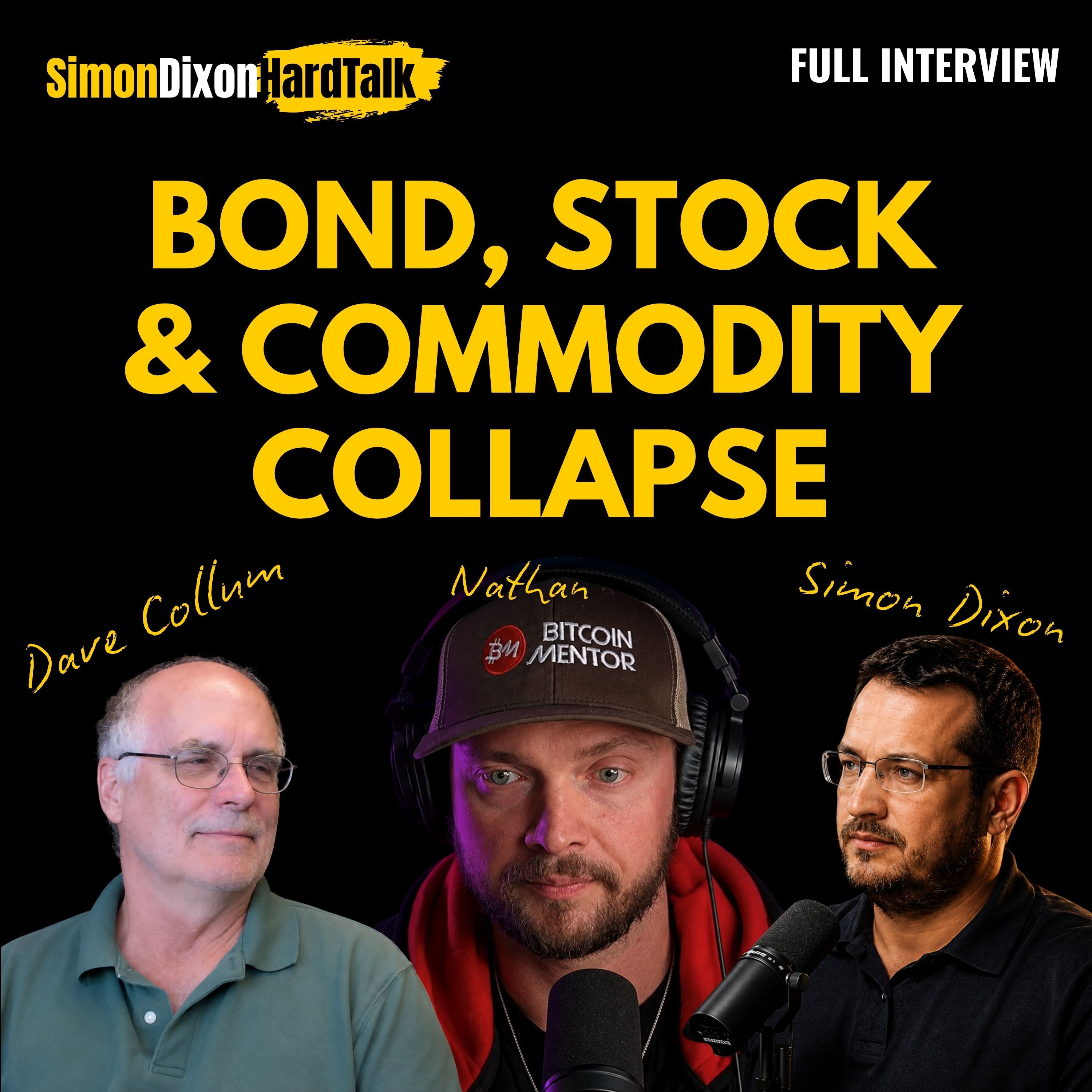
Loading summary
Transcript201 lines
- [00:03]
A
We recently had the US and Iran technically break the ceasefire. Are we actually getting close to a deal?
- [00:09]
B
I think it's already been signed. America is not a sovereign state. It is controlled by complexes.
- [00:14]
C
It really looks to me like someone put cement blocks under the Iran war to make sure that the headlines were about the war, not about the markets.
- [00:22]
B
You've literally got a stock rug pull from China, a bond rug pull from China and a commodity rug pull from from China.
- [00:30]
C
The SpaceX IPO is fantasy. It's priced at 100 times sales. The fact that they have to jam liquidity into the system to accept these IPOs tells me that we're in a dying, gasping, final phase of capitalism.
- [00:45]
B
Capitalism is death, there's no doubt about it.
- [00:47]
C
What strikes me as a Ponzi scheme on trillions of dollars scales, Larry Fink
- [00:52]
B
is not our friend. Strategy is not our friend. 21 Capital is not our friend.
- [00:56]
C
Everything I know says that when you displace the system from equilibrium, the further from equilibrium you are, the more violent and destructive the return trip.
- [01:08]
A
Simon, Dave, thank you so much for jumping back on for an update, guys. Really appreciate you stopping by. We've got a lot to cover today. Essentially we have the AI and the Space X IPOs that are kind of reshaping the market. We got Kevin Warsh and the Fed and what they're going to do about rising interest rates and of course the, the strait of horror moves which we recently had the US and Iran technically break the ceasefire, but yet somehow the deal seems to be progressing forward. We're just days away. So Simon, starting with you, we flagged the China summit as when we were expecting to get the deal. It's now come and gone with no announcement yet. It does seem like things have definitely changed. So what's your read on the situation? Are we actually getting close to a deal and is there something that's keeping this dragging on?
- [01:47]
B
Yeah, so yeah, I'm going to have to move the goalposts. I was looking at the China summit for announcement, but I do think it drove things forward. So it was very uneventful in Western media, but what actually was it? Well, it was essentially all of the key players from the financial industrial complex and the technical industrial complex and a few players from military side. Meeting with Xi Jinping and I would call it more of a check in report. You don't go to these meetings to start negotiations, you go to these meetings for optical reasons. So when you need the photo moment, you do the actual meeting. And there was a bit of symbology you know, it was very much on China's terms. There was an element of, you know, shorter chair for Trump, higher chair for Xi Jinping, a little bit of optics not meeting at the, you know, the airport, which is actually how he did it with Putin. So he kind of put them both on equal terms. But I think the most important thing from it was that it was actually the real players in the AI race and those that are going to be determined in the future of payment corridors that Trump brought to the meeting. And it also led to a bit of a stock market pop, which was the desired photo moment. Immediately after it, we got about 20 shipments passing through the Strait, and we had right now all of the, what I call feeding public narrative for the relative audience. So you've got Israel feeding its relevant narrative, you've got Trump feeding his narrative, and you've got Iran feeding their narrative when all of them are sat down negotiating. So what people said would never happen has already got a memorandum of understanding. However, I believe that everyone needs their exit off ramp narrative, and that's what I think we're leading to. You know, Trump needs the photographic moment of, you know, I got, I got the best deal and I forced Iran to do a deal. That's the optics he needs. Going into the midterm, Iran needs to say, we resisted under all pressure, we never caved in, we got the tollbooth or whatever terms they get in the end. And then Israel needs to say, you know, they were doing the good cop, bad cop. Anytime America wanted to delay, they say Israel blackmailed us and persuaded us to do it. That leads to a change in the terms. And then America and everyone in Pakistan comes back with a slightly updated memory of understanding. I think it's already been signed and now they're just playing theatrics in order to get what the final MOU is. And then there'll be a 30 day, 60 day, 90 day, you know, sanction relief, stroke reparation investment, stroke unfrozen funds, and everyone walks away with, with their victory narrative and we move to the next stage. So that's how I interpreted it. And leading into the other stories, and I'll pause here. I think now they're trying to time it with the liquidity needs of the major IPOs that are coming. So that's my next goalpost. I think they really need major liquidity leading into the IPOs, and then also making it a successful IPO. And we've kind of led to these all or nothing events with these IPOs. So I'll kind of pause there.
- [05:36]
A
Before I let Dave jump in here, I just want to quickly the with regards to the way that they're hanging on to the deal coming narrative. So what I kind of mean by that is previously it seems like every time they said they were close to a deal it would last for about 24 hours. That tend to be on like a Friday or going or Sunday going into the Monday markets open. But they've held on that like we're close to a deal for a few days now. Are you reading that as a significant change or am I making something out of nothing?
- [06:06]
B
No, I believe the deal is still coming. Now there may be one more escalate to de escalate because as I said, Trump needs his photo ops moment. If he doesn't get his photo ops, then the midterm election's done. And he kind of went off the rant and said let's move this into Abraham Accords. So in order to get a deal, everyone needs to join Abraham Accords. That sets off a new negotiation cycle with all the potential members. Now, many of them probably won't join and Abraham Accords may be dead. However, we've still got the holdout where Saudi Arabia is saying unless there's a Palestinian solution, there is no Abraham Accords. So it kind of just sets up the next phase of US exit from the region and but I think they're trying to time it. You can tell the market doesn't believe that there's another escalation cycle. We got gold 4500, we got Vix at about 17. That's you know, if it would be above 2530 if they believe that this was going to enter into another kinetic phase. We got record highs on the S and P above 7,500. Again, what has changed is bond yields. Bond yields are showing significant stress and they went above the 5.6, 5.1% on the 30 year and 5. 4.6% on the 10 year. And that creates serious issues in the real estate market. And so the narrative brought it down ever so slightly, but they are far away from where they need to be. And so the bond market is really saying get this wrapped up, we can move to an equity market IPO and everything's good. But oil prices will go back up again if there is another escalate to de escalate phase. But all in all, the market is definitely not pricing in World War three, a nuclear reaction from Israel or something that's going to be more systemic.
- [08:07]
A
Dave, what's your read on the situation. What are your thoughts there?
- [08:12]
C
I'm guessing more. The SpaceX IPO is fantasy, in my opinion. It's priced at 100 times sales, which is just ludicrous. The fact that they have to jam liquidity into the system to, to, to accept these IPOs tells me that we're in a dying, gasping final phase of capitalism. It just, it just feels truly terrible that this kind of crap has to occur. I watched Larry Fink on stage the other day saying, look, harsh reality is all these data centers are going to have to come out of the pension funds of the capital is going to have to come out of pension funds of mom and pop. And I'm going, and then what you're going to do is you're going to default on them, just like broadband in the 2000 bubble and you're going to fuck the pension funds completely. And so again, gasping capitalism. The markets, the equity markets are suspicious as hell. They look to me like before the Iran war, they were rolling over in a serious way. It really looked like it was forming this bound of a top and was finally going to projectile vomit its way through what I think should be a secular bear market. And then all of a sudden, just out of the blue, it just spikes and just never looks back. And you hear stories of the gamma squeeze, which actually makes sense to me. And I find a gamma squeeze particularly EV because of the fact that it takes a market that's going up and then it pumps the mechanism to make it go up faster and faster and faster. So it strikes me as a Ponzi scheme on trillions of dollars scales. And I could imagine the gamma squeeze being driven by call option buying by price insensitive buyers, AKA sovereign states of some kind. Ours would be my first choice probably, if I had to guess. But at some point the gamma squeeze has to undo because the call option buyer has to stop buying. Well, they don't have to, but you would think they would. And then all of a sudden Wall Street's got to liquidate all those equities they bought as hedges against the call options. And so they're going to all get sold. And so it just completely unwinds. And that could be the beginning of a secular bear market. I don't know. It really looks to me like someone put cement blocks under the IR to make sure that the headlines were about the war, not about the markets. I totally agree that the bond market is showing stress. My nightmare scenario for many, many years has been a secular bond and equity market simultaneously. We haven't seen one of those since the 70s. And that would be ugly. And I think the bond market is, I'm seeing people, serious players, quoting, you know, 12 to 14% yields over the next half dozen years. That would, that would destroy a lot of, there'd be a lot of corpses in the street if, if that happened. So the idea that markets look forward always makes me laugh. Shut up, Doug. That's my dog was almost put down a week ago and is now thriving. I think, I think, I think we're so off kilter and here as a scientist, what I'll tell you is everything I know says that when you displace the system from equilibrium, the return trip, the further from equilibrium you are, the more violent and destructive the return trip. So think avalanche, earthquake bombs, you name it, exploding laboratory experiments got out of whack. And in all those cases it's a return to stability the hard way. And it seems to me that for the last dozen years we have pushed the markets way past a logical topping point. And I made a compelling case, I think, in 2015, that the market had yet again gotten in the nosebleed section. And 10 years later, here we are much, much higher. And by reasonable valuation metrics, we're 150, 200% over historical average valuation. I sincerely believe that if we don't have a regression to the mean in our future, then capitalism is destroyed. And so the optimist says we're going to have a regression to the mean. The pessimist says we're not. And so, and that puts it in the, you know, 75% correction. Assuming, assuming it doesn't do any damage, that just gets us back to fair value. Assuming the economy doesn't get destroyed and wiped out and, you know, banged up and, and the nightmare scenarios, it takes a dozen years to do it so that the boomers will basically be tortured to death in their final years. So that's what I watch. My question I have is, who's driving the cab right now, Iran, China or US? Israel. My completely uneducated guess is that Iran, China have total control of the story. Simon, is that right? Simon?
- [14:01]
B
I completely agree with that, but also I'd add another dimension to that, which I always. I've said America is not a sovereign state. It is controlled by complexes. And so the financial industrial complex is partnering with the Gulf sovereign wealth funds. And China normalized between Iran and Saudi Arabia. And so Iran, China, brics, I believe they're executing an expulsion from the US from the region. And the China meeting was really a Check in between the FIC and China. And so it's not really us. And tying the conversations together, us is the stock market. Capitalism is dead, there's no doubt about it. Because the number one contributing factor to whether this market continues is, is really three things. But one overarching, which is money printing. In order to fix the bond market, the only thing you can do to get those yields down so that you don't crash the real estate market, which also breaks banking, is for the Fed to buy those, to buy those bonds. And so it looks like the, whatever, the Kevin Wash effect, let's say. I'm really confused as to what he will end up doing. I think I know what he's going to end up doing, but it's the opposite of what's being said, which is that you get those short term rates down. The Fed expands the balance sheet and you need a few things in order to do that. So the stock market is really a function of money printing. So the balance sheet has to expand. Maybe you could do it some covert way where you do some regulatory reform and the banks expand their balance sheet and you have to compensate them with new lax liquidity requirements or reserve requirements. Maybe there's a way of doing it that way. The second thing is ETF inclusion and index inclusion. And so they're changing the rules. They're saying now if you do a trillion dollar ipo, you can be included in the index from day one. And so now Goldman Sachs is trying to rush out $3 trillion IPOs, OpenAI, Anthropic and SpaceX. And so you really see the narrative lining up. The third thing is just media manipulation of narrative. And what we're really leading up to is a national security that if we do not figure out how to get data centers on space in order to control the world through AI and robotics, then China will take over the empire and communism will win. And so all of the podcasts, all of the VC bros, all of the tech executives, they're all pushing that the solution to America dominating the world is to get data centers in space and power artificial intelligence so that the AI arms race really is one. And so they're doing, really pushing out that. And that kind of coincides with these elaborate valuation trillion dollar IPOs that from day one will be included in the indexes. Just so like Larry Fink said, the pensioners that are buying these s and P ETFs and just passively investing can really bootstrap the price. So the banks like SoftBank that have got about a $60 billion leverage position in OpenAI is able to dump into this liquidity and then they can open up the private credit markets and lead to a big money printing exercise which will be justified under energy, there's an energy crisis which powers this AI. So we've got all the LNG and we've got this. We need to win the national security arms race that can justify a really big money printing exercise. And really they can just sacrifice the world, the dollar as world reserve currency and we can move into an inflation recycle. And Scott Walsh has already, not Scott Walsh, sorry, Kevin Walsh has already indicated that what he means Freudian slip, by
- [18:26]
C
the way, that was a Freudian slip right there.
- [18:28]
A
Fed and treasury merged.
- [18:31]
C
Yes, it was, wasn't it?
- [18:33]
B
It definitely was. But he's already indicated, he's already indicated we just need to change the, how we measure inflation and what we'll be using. So we're getting the old trick, you know Americans, the average American that is broke right now, that is on the poverty line, he's going to be paying more for his mortgages, his debt, credit card rates are going up, food is food, inflation and energy prices are going up. That's basically everything that they can afford is going up. So they're really driving the K shaped
- [19:11]
C
economy too, which they can't afford it, which they can't afford either because credit card debt has grown something like 9% a year for the last three years. And as Stephanie Pomboy says, they're not buying more units of anything, they are buying 9% more of the same number of units. And so the consumer in the Michigan consumer confidence numbers one of the twos at an all time low. I think it's that one. But, but labor force participation's at a terribly low state too. So the, the jobs numbers are baloney. The claim I, I hesitate to say this, Mike Green will be lurking out there, but I think inflation is way worse than they're telling us. Mike is arguing that that's the conspiracy theory. I think Mike's brilliant, but I don't agree with that part. And, and I still cling to the idea that for 15 years Warsh has been talking about the absurdity of Fed policy. I have trouble imagining that that was just a limited hangout. Now he's just going to do like all the other. And what really bothers me are the guys who for the last 15 years have said we kept rates too low, too, too long. And I always add to that too many times and then to that I now add and you want to do it again? You sound like a, that just makes no sense. I, I, my, my optimistic doom loop is that war is here to blow up the system.
- [20:56]
B
Yeah, well if the Fed believes in capitalism, then blow up the system. The Fed doesn't believe in capitalism. I think it's managing capital outflows for transnational capital and trying to build a post dollar dominated world. And so that involves asset stripping right till the end, until the banks won't accept treasury as collateral. And at the moment everything's saying that the banks are still going to accept Treasuries as collateral. All the foreign central banks, they're not accepting it, they're going into gold. Even India right now is telling its people, please stop buying gold with the rupee while the Indian central bank is buying gold and printing rupees. And so I know central banks don't believe the story. The Fed seems to continue to this. So have we got a genuine regime change at the Fed? I don't know, but buckle up if he's ready to kill this AI and IPO market there is.
- [22:10]
C
So where's the capital going to? You talked about the passive flows, but passive flows aren't adequate to absorb $3 trillion IPOs.
- [22:21]
B
No, which is why I think you got to pump the, you know the, the narrative that this is AI for national security and we need to get data centers on the moon in order to power, you know, this. And, and it kind of ties as well with the Iran operation. Imagine you have a very, you know, you have a very symbolic moment, a bit like the British Empire's moment with the Suez Canal, but you get it with the straight of Hormuz. And you also have the narrative that by the way, it was AI powered drones and ballistic missiles that by the way, we're dependent upon China for the components. America can't produce them without China, which kind of shows that we're not going to World War Three. But you get a bit of, yeah, the only way to deal with this is to print an exorbitant amount of money, increase the Fed balance sheet or figure out how the banks do it and just keep pumping the K shaped economy. I just can't see any situation in which they give up and return to capitalism unless gravity tells them that they've got no choice anymore.
- [23:35]
C
I just had this image of, of China launching missiles and blowing up data centers on the Moon. I have, I have.
- [23:47]
B
Space wars is definitely the next, the next.
- [23:50]
C
Well, you know, there's already enough craters. You know, what's another couple of craters on the moon. It's curious.
- [23:59]
B
Big money printing you can justify. Right there, Dave, that's exactly right.
- [24:06]
C
For many years I've actually said that if you think the Fed works for the United States, you're dreaming. The Fed works for multinational banks which have no sovereign ties whatsoever. So this is like we've gone full. Nathan Rothschild. Right. We've really crossed the Rubicon. This is. I'm just gonna. Here's what I keep next to my desk. It's a, that's a box cutter for slicing my wrist or hijacking a plane. I don't know. One of the two.
- [24:42]
A
Well, quickly, Simon, in that, in that framework, I'm trying to think of the reason. Is it possible that part of the reason they have to push for this trillion dollar valuation to get it into the index is to get those passive flows, is to have the, the acceptable narrative that the public would, would take. Right. If basically, if the public starts holding those positions as part of their, and things start going to hell in a hand basket, then not only the military side, but they can justify propping them up for military reasons and everybody feels like it's part of their actual savings. So they're fine with it and they're okay with the money printing going forward.
- [25:16]
B
Yeah, I mean, you know, but that, that has been the boomer story, right? It is. There is a small class of Americans that the money printer is serving, which is those that got on the real estate ladder and those that had the 401k for several decades and are coming to retirement. And so at what point are they going to rug pull them or are they just going to, you know, think about, you saw what Nvidia was doing. So Nvidia is now, you know, past the $6 trillion valuation. In order to facilitate that, you know, Trump was trying to enforce chip sales onto China. China came back and said, for national security, we prohibit any of our companies buying Nvidia chips. But you still got the pump in the market. And then it didn't correct to the, you know, to the same degree. Then they came out and said, right, we're going to take $85 billion and do share buybacks. And so they're attracting, they're speaking to the growth investor, trying to get more of their money. Now S and P is approaching the Magnificent Seven, controlling almost 50% of the
- [26:29]
C
S and P. So let me see, the share buyback is because their shares are so cheap that they should buy back their shares. That's the Peter lynch model. It doesn't seem to fit in the modern era just hasn't for two decades or three decades. But just had to insert that.
- [26:47]
B
Yeah, well it's not, I think Dave, you're still in analyzing real world fundamentals.
- [26:54]
C
I'm analog.
- [26:58]
B
This is just pumpamentals or whatever we want to call it. And so the 85 billion isn't about investing in value for Nvidia, it's about attracting growth investors. So the tech Bros that have sold their bitcoin, sold their crypto and are now trading these, these IPOs as part of a gambling portfolio because they're trying to, you know, fit in the world today on Robinhood or whatever, but it also attracts the big growth money. It also, what they did is they increased their dividend per share from $0.01 to $0.25. And so now they're trying to get Coca Cola investors and your Berkshire Hathaway style investor thinking that this isn't only tech, this isn't only growth, this isn't only national security, this isn't only geopolitical significance with Fed money printing, it's also a dividend stock as well. And so Nvidia is doing every trick to attract every single investor because people are going to be selling their Nvidia in order to buy into these IPOs and they've still got the circle jerk of selling contracts to each other and the revenue that they're selling. I mean these IPOs are selling revenue forward of about five years of the biggest growth story of a projected story that every single enterprise in the world is going to be adjusting and buying tokens of AI. The valuations are horrific.
- [28:35]
A
They're incredible. They're absolutely off the charts. I'm curious Dave, your thoughts actually on that too with the basically the hyperscalers investing in the chip manufacturers investing in the, the AI companies and the money just going round and round and being marked as, as revenue on their, their balance sheet. I think I saw that like, and I think it's anthropics and. Or Is it open AIs? One of them was similar valuations to Samsung but like a fraction of the revenue actually coming in. So Dave, what are your thoughts on the AI circle jerk going on right now?
- [29:03]
C
You know the metaphor I've liked for the last couple of months is the ping pong balls and the mousetraps in the big container and it's a stable system and then they throw in one ping pong ball and they all start flying all over the room. And so I have this religious level faith that capitalism is not dead, it's just in an induced coma and that price discovery will be resurrected and that I know of no way to document in history except for if you want to include the present of something that got way over value that didn't find its way back to dirt cheap. And so as a consequence, I think we could write a textbook for the next boom bust book that describes this era and how completely idiotic it was. And so I really, I think everything you describe makes total sense to me. The one thing that I can't accept is that it'll work, right? I think that's right. So I think this is a patient with stage four cancer of the liver and they're going to faith healers in Indonesia and stuff to try to figure out how to cure their problem, when in fact it's time to put your affairs in order. And what bothers the shit out of me is the time variable. And so crashes do nothing. They absolutely do nothing. Because dip buyers have so much muscle memory for the last four decades it's always paid to buy the dips and so they can be depended on coming in to buy the dips, especially if the feds are buying call options and forcing gamma squeezes and things like that. But I believe at some point it's just all four engines are on fire. You're at 35,000ft and we're now saying, well, let's take it to 45,000ft. And as they say in the manual, flight manual, it says you will have enough gaps to get to the crash site. And I think the crash site will be a multi decade bear market. But it's consistent with the idea of pushing the United States out of the Middle east, of pushing the United States into a secondary status compared to its current status. And whether that's all intentional, I can't fathom. But if you want to know what you can't fathom, read Kathy o' Brien's book Transformation that makes all this look really very normal and realistic. Kathy o' Brien's book on MK Ultra will blow your brains out your ears. And I've somehow got to find out if this is true. It seems like we're in the Kathy o' Brien transformation phase of capitalism. So, so, so I, I, I've kind of lost my, my mind at this point. I, I was, I was, I was too bearish and I wasn't too bearish in 08 09. I had tons of cash. I actually, I don't even know if I lost money during that particular bear market at all. I mean, I actually, there might have been One year, little diplomatic. I've never ridden anything down hard, never in my life. If I had big exposure to one of the big drawdowns. I've never lost 50% on my equities or anything because I was out in 99. I was very underexposed in 07. And I do worry at some point karma is going to get me and find a way to make me ride a 50% or more downswing, even though I'm invested for the dystopian, post apocalyptic world.
- [33:16]
A
Dave, what do you think could drive us into a new bear market? It would be just we can't sustain the valuations based on continuing capital kind of coming in. Or would it be something like the large tech players in the space aren't actually buying the services of these giant AI IPOs.
- [33:33]
C
My favorite metaphor, My favorite metaphor. Richard Russell, when asked, why can't this keep going? He said, go into your child's room and start stacking blocks and keep stacking them and keep stacking them. At some point the stack gets so high that it becomes so shock sensitive that it takes the butterfly flapping its wings on the other side of the world to trigger someone downstairs slamming a door. You know, something like that. And all of a sudden, boom. The pile's a big pile of rubble on the floor. We went from instability or metastability to stability in a heartbeat. Now markets have a way of dragging that out over time. Nikkei. Think of the Nikkei, right, the Nikkei. If you, if you started buy, if you own The Nikkei in 89, you're still toast. You're completely toast. You've fried the last 35 years of your life.
- [34:35]
A
Well, you're nominally par now, aren't you? Is that about where we are?
- [34:38]
C
Nominally at par? Which means you're not. And you also burnt 35 years staying nominally at par, right? So you're now a very old man and you spent all your capital because you didn't get any gain.
- [34:49]
B
But if you are throughout the AI trade, right, Nathan?
- [34:53]
A
Yeah, it's a little bit rough.
- [34:57]
C
We're not going to pick guys when they're struggling. I am not going to shit on them and they're welcome to berate me for not owning it when it's soaring, that's fine. But I'm not going to beat on you when it's struggling and gold struggling right now. But if you were a brand new graduate of Tokyo University in 1989 and you started averaging in a passive flow way into the Nikkei, you broke even in 20 years you spent 20 years breaking even, having zero exposure in 1989, just starting. And as a consequence, that shows you that I believe that markets can become uninvestable, just uninvestable. There will be winners. Statistically, stochastically, someone will win. And we'll declare that. Remember, Bill Miller beat the s and P 13 years in a row. He said, oh, he's just such a genius. The 14th year he gave back all his net gains because he held the banks going into 0809. So statistically speaking, there's going to be a Warren Buffett. Statistically speaking, there's going to be the other guy who we don't ever read about because he's dead. And I believe that'll happen. I just don't know what the trigger will be, in part because if it takes a butterfly flapping its way wings, I'm not going to be watching butterflies. Right. I'm just going to wait until some angry Tunisian lights himself on fire and starts Arab Spring. Right?
- [36:37]
A
Yeah.
- [36:38]
C
One guy, one in flat, one highly flammable Tunisian, started Arab Spring.
- [36:44]
B
That's right.
- [36:47]
C
So that's my optimistic view, my pessimistic view is it's not going to happen. I'm going to go to my grave waiting. Yeah.
- [36:56]
A
The kind of meltdown scenario.
- [36:57]
C
Market. I'm not buying this market. Period. Period.
- [37:01]
B
Yeah. So I can think of. Nay, I can think. There's. There's three things I'm watching that could blow it up. The first is the bond market. The bond market is the real stress. Like, yeah, the, you know, you got UK at about 6%. You've got real stress as a result of the closure of the Strait. I mean, while America's complaining about inflation, Europe and UK have a real growth issue. There's no vision. They've got a debt issue. They're more likely to need an IMF bailout than anyone in the countries that are, you know, impacted by food insecurity. All of the other components that were meant to come out of the Strait, you know, they. They had to sell mo. You know, a lot of them had to sell their Treasuries in order to be able to pay for these inflated prices for the commodities and oil and energy that they needed. And then they had to negotiate through, you know, the black. The black routes of how to get, you know, to get these components via Iran, uae, Hong Kong, China. And so that started to lead to a lot of treasury selling, which pushed out the bond yields. And, you know, we then started to see the more developed countries that were Impacted like uae, say you get an FX swap line. Just don't sell your bonds, don't sell your equities, please don't sell. We'll give you, put some currency here and you can print the dollars, we'll give you the dollars, just don't sell the Treasury. So there's that game. And there's only really three institutions that I think there's four of them. There's the bank for International Settlements, there's the Federal Reserve, there's the bank of Japan and there's the People's bank of China that really control whether banks still continue to use U.S. treasuries as collateral. So the moment those institutions decide which is fully in the hands of transnational capital, then they have the tools to engineer a rug pull. That's the bomb.
- [39:25]
C
Haven't they shown evidence they've made that decision?
- [39:30]
B
I think.
- [39:32]
C
Aren't they selling?
- [39:34]
B
The central banks are selling but they're engineering that everyone else is the buyers. And so when they're managing other people's money, the sovereign wealth funds are selling. They're buying equities instead of bonds, the central banks are buying gold instead of Treasuries. And then in the US side they're just trying to engineer. So there's still demand whether it's borrowing from Japan, whether it's a basis trade in Cayman island, whether it's launching stablecoins to try and subsidize whatever they can do. So Americans are going to be the bag holders. There's no two ways about it. But I think they're trying to do a managed transition which is use the pump of the US economy to get better terms into a multipolar world. So that's.
- [40:28]
C
The US economy sucks though. The US economy sucks compared to what they say, right?
- [40:35]
B
Oh, I completely agree with that. I mean there is zero reality between stock markets and economies today. I mean even the London Stock Exchange is at near all time highs and the economies are just.
- [40:47]
C
Look at what the DAX did over a period where Germany self destructed. They might as well just, you know, they might as well just swallow, you know, Drano and, and, and, and but Germany couldn't have done a better job at destroying the most important economy in Europe. Yeah, and, and, and, and yet the D sword.
- [41:09]
B
Yeah and, and had something to do with the CIA blowing up Nordstream pipeline as well and something black rock.
- [41:16]
C
They also got rid of all their other power sources and everything. Right. They're, they're now digging people, they're discovering mummies and peat bogs. Again, right. I mean they're, they're, they're just, they're just, they got nothing.
- [41:30]
B
Yeah. There's only one way to explain it and that is that politicians are installed in order to serve transnational capital. There's no way politicians are that dumb or you know, they're just puppets for, for a transnational agenda.
- [41:45]
C
If an organic chemist in Ithaca can figure this out, the guys at the top can figure this out.
- [41:51]
B
Yeah. In the stock market there is, there's another. So I put it in the commodity, that's the bond market one in the stock market. The reality is is that the real valuation of the AI trade is happening in China. So Deep Seek just raised at 45 billion valuation while OpenAI is trying to raise a like 900 billion and they can do 90% at 10, 10% of the cost. And they've got all the energy, they've got the solar, the EVs, the batteries, the rare earth minerals. So, so there is a structural rug pull of the deep seat moment in the stock market that China could, could pull at the moment that they wanted to. But I think they want to get all the capex expenditure they want to raise at these inflated valuations. They've got the energy crisis, big oil, Big LNG are crushing it at the expense of the American people. And so I think there is a setup there if they wanted to rug pull the stock market.
- [43:00]
C
This reminds me by the way of when AOL sold to Time Warner in which Steve Case was criticized because he sold this fantastic wealth generating cash machine to a fuddy duddy old company, Time Warner, when in fact Steve Case was saying look, let's get something concrete for these fake chits that we've got here. Other companies tried to do it and there was shareholder revolts because they wanted to hang on to Yahoo and things like that. And so it's the same sort of story by the sounds of it where they're trying to keep, they're trying to keep their valuations up just so that they can maybe get some hard assets in place of fake assets.
- [43:49]
B
Yeah, and I think that story is still playing out because the remnants of that was SoftBank and Long Term Capital Management.
- [43:57]
C
And SoftBank blows my circuits. Every time I think SoftBank is going to die, it comes back like a zombie.
- [44:04]
B
They've gone all in in OpenAI. So watch the AI trade. They got 60 billion leverage investment and they're selling everything to they, they took like they sold their 21 capital, Jack Mallor's Bitcoin Treasury Company at a $250 million loss in order to get more OpenAI on the secondaries. So they're, they're going all in. And you know, what is it that they know? Is this an engineered blow up the Japan trade or is this something that they know that's going to be leading into a pump and dump cycle? I have no idea.
- [44:46]
C
A question I asked in a zero hedge debate as a so called moderator. I'm not a very good moderator to the extent moderators are supposed to shut their fucking mouse. But I asked why did the yen carry trade not blow up the world? What's your answer to that?
- [45:06]
B
Because the bank of Japan and the Fed figured out how to engineer the continuation in the K shaped economy and hide it all in Cayman Islands with the basis trade and lever it up and we still have not unwound that trade. So it is still going.
- [45:23]
C
They are so it simply doesn't. It's like the sixth sense. He doesn't know he's dead.
- [45:30]
B
Yeah, yeah. And that kind of.
- [45:33]
C
I'm a metaphor guy.
- [45:34]
B
I'm a metaphor guy as well.
- [45:37]
C
That's a simile. But yeah, there's a, there's a third
- [45:41]
B
market where you could rug pull it. And by the way you could rug pull all these simultaneously if there was really a 19.
- [45:48]
C
Oh I think they will see that's the ping pong ball model. Yeah, I think once the dominoes start falling they'll be putting out fires all over the planet.
- [46:00]
B
Yeah, right.
- [46:01]
C
This is, this is and this looks way worse than 07. I told my class in March of 07 the banking system was about to collapse. I really did tell them that on March of 07 I stood up and I have this tendency to do Tourette's like outbursts to the class including F bombs. And I turned to him and I just said out of the blue the banking system's about to collapse. And then the story that I just love to tell is two years later I had the same group in a seniors honor thesis class the first day I said so this is February of 09 now. And I said didn't I tell you the banking system was going to collapse? They said yes. I said did your econ professor say that? And they said no. And I said what are those assholes paid for? And then my first guest lecturer because there are a lot of guest lectures in this course was the former CEO of Morgan Stanley bank who had cut his teeth on mortgage backed securities and he spent two hours talking to class about the complete carnage of the GFC.
- [47:07]
B
Yeah, and we still got $2 trillion of Larry Fink's mortgage backed securities on the Fed's balance sheet. They're still there.
- [47:14]
C
That's truly unbelievable. Yeah. Why they don't dock from My dog had diabetes, almost died from toxic shock or something. Why the banking system should get the same damn thing.
- [47:28]
B
Yeah, completely agree. Simon.
- [47:29]
A
What was the third element? I think I missed it there. We had the bonds and then we had the deep seek attack on the equities. And then there was the third risk that Dave was saying that all could go off at the same time. And the other thing I just want to make sure I get in there to come back perhaps afterwards is with treasure. Sorry. With Turkey selling off all their Treasuries and gold, my immediate thought was the risk of wouldn't treasury selling beget treasury selling. As cost of capital goes up, I would imagine you have more inflation around the world, need to sell off more Treasuries and it just gets into a vicious cycle.
- [47:59]
B
Yeah, those two are related actually. The third market is if you look at the gold market and we saw it in silver and you can go down to more and more commodities as well. But I mainly focus on gold. The London is clearly drinking. Yeah, yeah, you said London. London has clearly issued many, many, many times more derivatives contracts. And gold they can settle. And if you look at all of these flows, there's currency wars like with Turkey, which has been a long term target of these London currency wars. They had to sell all their US Treasuries and all their gold, but it all ends up in Shanghai. And there was an announcement this week as well where Hong Kong is now allowing for these, you know, unbacked gold contracts for the first time to happen via the Hong Kong gold corridors. And with uae, which is the other most important one you have, the most important corridors are Switzerland, Hong Kong, uae. And what am I missing? Singapore. Switzerland and Singapore. Yeah, you're right. So we're starting to see more and more, but the outflow of gold from the west over to Shanghai right now. And we all know that Shanghai doesn't have these derivative contracts, so they don't have to settle this gold. So if they wanted to engineer a similar event like we saw before Christmas with the squeeze on silver and then that still exists. The Western gold derivative market is propped up by the lender of last resort being the central bank willing to lend and people accepting ETFs instead of physical gold that's hiding all of that mess. That mess still exists. But Shanghai has the gold and it doesn't have the derivative contract. So you've literally got a stock rug pull from China, a bond rug pull from China and a commodity rug pull from China the moment.
- [50:19]
C
And Chinese citizens own a lot of gold now. China's drawn gold into China through private investment too. Yeah. Why is gold doing what it's doing? It seems to just be hovering. What are the two equal and opposite forces acting on gold right now?
- [50:46]
B
Well, I mean, I still think it's the derivative complex and the market, not the central banks are loading up on gold, but any managed funds, they're dumping the Treasuries. They're still playing into the returns that they need on the stocks and they're still pushing people into Treasuries. And so I just think the people in the know are accumulating. But it's a very patient trade. It's designed to drain people that aren't patient. Is a bit like what we're going through in the bitcoin space right now. There is, you know, massive, you know, ever since blackrock, Jane street and strategy and all the Wall street players came in, you know, they're just trying to centralize as much bitcoin as possible. And they're using these paper contracts in order to try and get. Get the bitcoin in, you know, in the hands of the people in the know that are the same people that are able to manage a transition. And their trade has always been the same thing is patient capital relative to impatient retail and also the ability to control institutional money. Right now, look at if you want any institutional investor that wants to scenario plan any event, we're talking a pension fund, we're talking a sovereign wealth fund, we're talking an endowment fund. They're all using BlackRock's Aladdin technology. And so if BlackRock pushes out the data, for example, how do I scenario plan for the straight of Hormuz and what allocations of capital should I have? They're all pushing capital in the same direction because they're all using the same technology in order to build out their models. And so BlackRock has significant ability to control these markets, which is why, you know, we don't have pricing doesn't exist. It is all institutional and centralized control.
- [52:55]
C
Not good for the long run. Yeah. When Let me ask you this. Seemingly my questions could get dumber faster than you can answer the questions. How did Goldman lose supremacy to BlackRock?
- [53:17]
B
So Goldman's is still vastly important in the investment banking era. But with the birth of ETFs, the asset managers, I think became I call them a complex for a reason because you need to securitize everything. But BlackRock controlled the capital and so they got the contract with the Federal reserve during the 2008 crisis to manage their own mortgage backed securities and which companies would go bust and they bought, they managed to get a leverage purchase of all the ETFs from London from Barclays and so they seem to have been the net beneficiary alongside JP Morgan of the 2008 crisis during the COVID time treasury got the contract to use Aladdin for all the Stimmy checks. And so it was really, I think they were given the superior artificial intelligence technology in a public private partnership and they became the lead node in the asset management industry. Now JP Morgan is still far and away the most important in the commercial banking. Goldman still I think is vastly important, important in securitization but it seems like
- [54:47]
C
did they get neutered by becoming a bank?
- [54:51]
B
Yeah, well Goldman, you know, kind of just in order to get their money said we're a retail bank, we're not an investment bank now.
- [54:57]
C
Right. Did that therefore take them out of the top dog spot? Was that a neutering to survive?
- [55:05]
B
I think it was just the general trend of asset management becoming more important because if you think about it the old financial weapon of mass destruction was always currency wars which was always FX dominated in London UK the new tool is ETFs and so if you want to really control like you know, it's index fund inclusion and in a multipolar world they're managing the flows of capital via ETF flows and blackrock dominates that game. They dominate ETF more than anyone and I think ETF has become more important for managing global flows of capital than the orthodox currency war allows you to destroy an economy like Turkey like they did in Iran. But it's when you negotiate the ETF flows that you really get the value and so that you know they've gone since the closure of the strait of Amuse BlackRock's gone from 12 trillion to 14 trillion and now they've got 25 trillion of people, you know, of funds using their technology. That one two punch I think has just given them an extremely. And remember the asset manager also controls the bank because the banks are public companies so they're the number one shareholder in everything underneath them.
- [56:36]
C
Here's an extraordinary stat. In 10 years JP Morgan is up sixfold. That's not a stuffy old bank, that's not nine to three bankers hours performance on the stock market. I mean There's a million stories like that. I think Intel's up 200% since April 1st or something crazy like that. This is not price discovery by any stretch of the imagination. Right. This is what's so frustrating to me. Now. Did you happen to pick up an article that. Actually I picked up in a secondary response in a tweet, and I think it's been long since forgotten otherwise, Buffett wrote an article in 77 talking about in detail how inflation destroys equity returns. And you got to read it. I'll send it to you if you can't find it. But it's a 1977 article that got republished by Barron's or Forbes, I think, in 2011. And he goes through the detailed analysis of what inflation does to equity returns and why, and there's some real subtleties that I can't even reiterate. But I was left, first of all, stunned by the fact that this write up is of a kind that I haven't read coming out of Wall street for years. It's just Wall Street's filled with bullshit jargon about, about liquidity flows and stuff like that. And it's not jargon because it's real, but it's not about cash returns. It's not about cash flow due to wealth creation. It's not about, it's, it's not about capitalism. Everything is some technical analysis term. And again, it frustrates me because I want to be able to invest in a rational world. And this is, there's no rational world. And maybe over in Indonesia there's a rational price discovery going on, but I'm not qualified to do that.
- [58:47]
B
Yeah, well, you know, we got to remember, we got to get to the roots of, underneath all of this is a Ponzi scheme and the central banking system is a Ponzi. So you know, when you build upon a foundation of in order to have a dollar, you have to lend a dollar and there is interest to pay on top of that dollar, but the interest doesn't exist, then fundamentally it only takes you to where we are. And it's just maths at that stage that you have to find a new way of rolling over the Ponzi, which means get the consumers to take on more debt, securitize and get the businesses to take on more debt. And if all goes wrong, get the government to take on more debt through war, and then if all goes wrong, put it on the Fed's balance sheet. And remember who the shareholders of the Fed are. It's the banks. They get to create the dollar and also have the asset managers that are taking all of your money and investing in the products that they're creating that Goldman's create. So they've got every ounce of this. And the reason JP Morgan can 6x is because Central banking is a centralizing force. And so America, prior to it was a state banking system prior to central banking. And that's still what you have in China. And state banking means you have thousands of banks that know that you've got to lend to productive means, not consumption with local knowledge, with local relationships, with local business. And as long as your credit creation goes to local business with local knowledge, then you can have assets that outperform the interest. But if the money goes towards consumption on credit cards, war or unproductive means. Hitler learned that lesson. He learned that lesson. You end up with a Volmar Republic. You change it by issuing currency for productive means backed by labor. And then the moment you start spending it on war and destruction of things, you end up destroying the currency. And then an external central bank can come along, issue a currency war, and the wealth inequality gets so bad that you end up with the rich and the poor hating each other. And that's the situation we're in right now. But China's still got that state banking system. So maybe there's the sanity, but they won't let you in because they don't want anyone else in because they don't want, you know, they want to do it for their own insular economy because they had 100 years of humiliation. Currency wars, civil wars, and they know drug wars.
- [61:38]
C
Drug wars. Yeah, I got an argument. I think it was with Kennedy, it's either Stanford or Berkeley. And I think it's Kennedy in which I made the argument that the Great depression ended in 45, not 1940, 41, that World War II didn't end it. And I made the argument, you know, there was, you know, limited consumption. And, you know, and he said, well, you know, that story's overstated. And the GDP grew by X percent over the war years. And I waited about 10 years before I challenged him again and I said GDP really should include a depreciation rate. So the guy who builds a. The guy, if I give you 20 bucks and you buy a souffle, that's not the same as if I give you 20 bucks and you buy a tool that you can use to fix things. So the guy who creates the DeWalt drill created a lot more wealth than the guy who created the ribeye at your local restaurant. That has A life expectancy of around 15 minutes. And I made the argument that during World War II, all that GDP were things that had a life expectancy of microseconds once they were dropped on the ground and that the entire GDP was the war. And the only thing I would concede to him was that one of the things that we did retain was we got better at the Henry Ford mass production model. We got way, way. So at the end of the war we knew how to make on in volume, but all the we made was crap because we all got blown up and sunk. And you know, we lost something like 65,000 pilots and training sessions for World War II. There's some absurd losses in World War II. We gave tons to the Russians, so our GDP was totally false. We also went deeply into debt, as you know, and so we pulled consumption forward too. I just don't see where what we're creating now is that much is wealth. One of the arguments I made, and then I recently heard someone else make it and I was finally satisfied. I said healthcare should not be in the GDP because healthcare really now, modern healthcare really reflects the tremendous costs and burden of keeping a rapidly depreciating asset. What we call the boomers on the street, like a 15 year old Corvair where it's in the shop all the time and all those parts you're paying for and all those repairs. That's not wealth creation because if it wasn't breaking down, you'd be richer. Right. So it's a Bastiat broken window argument. And so the boomers are contributing huge amounts to the numerical GDP while at the same time sucking the system dry and that we should all just be euthanized. And I had this funny exchange with Milo Yiannopoulos of all people, right.
- [65:09]
A
As a throwback.
- [65:11]
C
There's a throwback. And he said you're a traitor to your generation. Which at first I thought he's insulting me. And then he said, you might survive the purge in which we kill all the boomers. And I thought about, I said, oh, I think he's actually being supportive. And my response to him was, I said, you know, I'm really thrilled to hear that. I was kind of counting on surviving that purge. Yeah, but the boomers all dying off would, would really save us a ton of money.
- [65:46]
B
Well, if you took out healthcare, yeah, but, but, but it's GDP at the end of the day, right. So I don't.
- [65:53]
C
Now see, I don't buy is GDP numerically, yeah, but it's not wealth creation.
- [65:59]
B
Oh, completely agree with that. But that's the right.
- [66:01]
C
Well, gross domestic product. I put a capital P on product, right?
- [66:06]
B
Yeah.
- [66:07]
C
It's not supposed to be a money velocity.
- [66:09]
B
You are the product in case I am the product. And hence why, you know, even right now you look at the closure of the Strait of a Moose and you see why is it that a bunch of countries that have the largest deserts could create food insecurity in the countries that can grow the most amount of food and vegetables that have the richest land? And then you realize it's petrochemicals. And then you realize that if we have to create petrochemicals in order to eat in countries that are now going through food insecurity because they can't get those fertilizers and petrochemicals and that it was Rockefeller that created that whole petrochemicals. It makes a lot of sense why we're poisoning people and our food is so bad and that we consider healthcare as GDP because it's just a scam. Like it's, you know, going to therapists, going to continually subscribe. And, and then that also explains the war economy as well, because you're, you're quite right that the biggest, the biggest gift that World War II that the Brits ended up hosting in US was the World bank and the IMF. And the World bank and the IMF said, yeah, you got the manufacturing base. Yeah, you didn't get blown up. So let's export dollars all around the world and let's decouple it from gold. And if we can get everybody into dollar debt, then we can just blow up their countries, regime, change them, and come get Halliburton and all of our companies to come back and build back better. And so that was, you know, the origins of the model. If you read a book like Confessions of an Economic Hitman.
- [68:08]
C
I didn't finish that book. Not because I didn't buy the model. I didn't finish because I didn't buy. I didn't buy the story that the guy, John. What's his name? Perkins.
- [68:21]
B
Yep.
- [68:22]
A
John Perkins. Yep.
- [68:23]
C
I didn't buy the fact that he was, that he was central. I got the feeling he was telling a story that he did not participate in.
- [68:32]
B
Okay.
- [68:34]
C
And so I thought he was a poser, which is why I didn't finish the book. Yeah, I do know the story. I do know this. I've read enough books on the CIA and MKUltra and everything that totally, totally gets swallowed by the basic. I just finished a Family of Secrets about The Bushes. That's a nasty story in its own right.
- [68:55]
B
Oh, the Bushes, Yeah. I mean, you know, the Bushes, you know, they. After the assassination of King Faisal and the transition to the petrodollar that's now being deconstructed, the Bushes joined the Safari club. And the Safari Club was the intelligence network between France, uk, Saudi, CIA, and various other interests in the Middle East. And they are the ones that groomed Osama bin Laden as a CIA asset. And it was. George Bush was the one that set up that group in order to create the narrative that's needed for all the wars in order to. And as the Bush family were prolific in oil interests and their grooming and, you know, and anyone that's actually studied, 9 11, reaches the conclusion that there was a joint operation between Saudi intelligence, Mossad and CIA, and it provided.
- [70:06]
C
And who did what is the vague part. The part we don't. The part we don't have a good read on is who did what. Right. So we don't know. You know, the dancing Israelis means Israel knew. The Israeli art students inside the towers suggest Israel was involved. But the Saudis were in the plains. But those guys apparently died. And we certainly.
- [70:34]
B
And one of them was also a agent as well.
- [70:37]
C
And one of them was also a Mossad agent. Yeah, I, when I only. I mentioned Kathy O' Brien's book, she's an MKUltra sex slave. And I've seen so many podcasts, but the book does this amazing job of pulling it all together into one big cohesive narrative. And I've actually kept a running list of all the famous people who are pedophilic, pervert, satanic, you know, brutal bastards.
- [71:08]
B
You got Jimmy Savile on the list?
- [71:11]
C
Well, Jimmy's not even on the list. Although Jimmy would be on the list if it wasn't a US centric program. Jimmy Savile. This story can go on forever. No, but Dick Cheney, George Bush senior, Ronald Reagan, George Bush Jr, Arlen Specter, and it goes on and on. Governors and mayors and presidents of countries. And, and you, you have to conclude one of two things. Reading her book, you have to conclude that she's completely psychotic and is lying from head to toe, or that this upper elite is really, is really like, you know, nine foot, you know, zombies running the world. They're just, they're just. And I'm, I, I believe that she's telling the truth and that these people are evil. That she tells a story of Hillary going down at her. And Bill walks in the room and Hillary pulls her face up and says something about a meeting. She says, well, how'd the meeting go? And Bill doesn't even flinch. And just stories like that. But apparently Dick Cheney was well endowed and beyond brutal with his weapon of choice. Senator Robert Byrd was truly an extraordinarily evil bastard. Not to mention he was a grand wizard of the KKK and like that. But so the book Transformation, I recommend people read it, but only if you've already started to ponder this, because if you go, if you go into the steep end of the pool with a virgin head, you're not going to make it 10 pages in before you quit.
- [73:00]
B
Yeah.
- [73:01]
A
Actually on that note, Dave, I want to ask you something because I'm curious your read on this. So my, I'm always starting with the base assumption that anyone gets into a position of power is already corrupt and evil.
- [73:11]
C
That's correct. I believe that's absolutely correct.
- [73:14]
A
Correct. And so if they get there, we can just kind of assume that moving forward. So I want to get your take actually on Thomas Massie in him getting primaried and not being there anymore. I'm. I'm just curious what your read of the situation is and, and him ultimately.
- [73:31]
C
Well, Massey is sort of 80% good guy to me, and that is that there's things he could have done, he didn't do, and I don't know why, and I'm not in his shoes. And to show you how dangerous that world is, I remember when MTG quit and I was on a podcast with a couple people and they were criticizing her from head to toe for quitting. They said, look, you know, you don't. You stayed till the end of the term. And at one point she said, you want me to get Charlie Kirked? I'm going, that's kind of telling you the story about why she quit. She was going to get killed. And I was defending her. And what this podcast group didn't realize is I had just finished brawling with Ted Cruz and Mark Levin and Victor Davis Hanson for, for using the word Hitler in a, in a podcast. And, and, and so I was pretty fried myself. So I was sympathetic to those who'd say it, I'm out of here. And they said, well, you know, she took on the job. And I go, she, she agreed to be a congresswoman, not a Navy seal. I mean, this is this. She didn't sign up for that part. So. So Massey had information that he didn't give us. Yep. And I don't know what to make of that. But, but generally I would say that Massie being run out of town on a rail, I think destroyed maga. I, I think it, I think it was a thermonuclear weapon right in the middle of maga. Maybe that's what it was about. I think even if he had not successfully been primary, the purpose of the, of the primary still was totally effective. So if you're some generic congressperson and you watch Massie get taken to the, to the, to the, to the precipice, even if he doesn't get shoved over, which he did, probably by rigging the election, I'm appalled. I didn't even think of that until after the election. And I was a big believer in the 2020 rig. And so, and I was embarrassed. I go, you didn't think about the fact they rigged the election. All of a sudden, it seems obvious they did. But, but the message is, we can take down Thomas Massie or if he had won, still the message, we almost took down Thomas Massie. You're much more vulnerable. Don't fuck with us. And so I think the message was clear. Even if Massie had not successfully been taken out, I think the fact he's been sexually taken out is very destructive to any sort of Republican coalition. And do I really care? I'm not sure because they're probably pedophilic, blood sucking vampires anyways, so why do I care? But to those who thought they cared, I voted for Trump three times. He's completely lost me. He's completely lost me. You name what he said he'd do, and I'll tell you how he didn't do it. And there might be 4D chess going on in the background, but at some point, 4D chess has to translate into a checkmate. And Doge looked phenomenal to me. We got nothing. Did you watch the Carlson Carlson interview? Buckley and Tucker Carlson. It's really worth watching.
- [77:03]
A
I don't think I saw that one, no.
- [77:05]
C
So Buckley, Carlson and Tucker Carlson did a show and I wasn't going to watch it. Someone said, no, you got to watch it. And so I watched it. They start out and unfortunately, if you're anti Trump, you'd quit within 15 minutes. And when I post on Twitter, I said, look, no matter whether you lean way left or way right, stay with this, you will be rewarded for staying with it, trying to get people to not hang up on it because of it. So they started explaining why they were, why Buckley was so enthusiastic about Trump back way before anyone else was even willing to admit it, back in 15. And then they Slowly go through the rotting process and by the end they're just saying there is nothing left here. We've got nothing, no level of support left in us. One thing that Buckley said that bothered me because I was so troubled by the event, but it hadn't clicked quite at the level that Buckley got to was the January 6th story where I think the response to January 6th was one of the most treasonous events in US history. To me, I think the incarceration of all these people in what were gulag level conditions, it was just horrible for doing nothing right. For exercise. Some guys maybe should have done a little time for doing something bad, but the wholesale incarceration was just a trees this moment. I'd like to find the guys who did that, throw them in jail, throw away the key, period. Qed, hang him from the neck until that. I have no sympathy for that crowd. But. And Trump pardoned him on day one, which was good. But Buckley pointed out that for four years he had the podium, he had a voice, he had a powerful voice even though he wasn't president. And he said or did nothing. He could have said they're being treated poorly. He could have defended the Republican Party, didn't back anybody. Unforgivable Republican Party, a bunch of cowards. They. They wouldn't defend the guys who went there. These are, you know, 18% of the guys who were there were unemployed. They, they were veterans. There's. It was kind of a. A slice through real. The bottom of the K of the K shaped economy. Yeah. And yet no one backed him. They were left to rot in jail for four years. No one backed him. And it hadn't clicked how, how profoundly negligent that was. That's what bothered me the most about that interview. The interview's really good. And Buckley really brings an A game to the interview.
- [79:42]
A
Definitely worth digging out.
- [79:43]
C
I dig it out. I dig it out.
- [79:45]
A
Simon, I was curious if you had any thoughts or comments on Massie and how you viewed it. Because again, starting from that position, that like, while he was there, I was kind of working on the assumption, like, are you playing the heel? Are you for real? Because again, the assumption is if you made it, you're corrupted. But now that he's out, maybe, maybe some of it was real. I don't know. What are your thoughts, Simon?
- [80:03]
B
Yeah, so my thoughts on this is, look, in terms of like what we were talking about before, to, to understand how power works, you have to really understand how the Mafia works. And the Mafia is, you know, you initiate people in, they Take tasks and you have to prove yourself with fulfilling those tasks. And then if you want to, if you want to climb the ladder, you have to go shoot someone and you have to have compromise where you can't leave. That's how politics is done, from my understanding. And so if you, if you take, you know, you first try and fund them, and then they have to work for the lobby, and their job is to have an acceptable narrative to make people believe that they're working for the people while they work for the lobby. That's the job of a politician. And so your job is to create all of the popularity. One way of doing that is to introduce a bill that will never get through, like end the Fed. So if you say end the Fed, everyone loves you, but it will never actually happen. The Fed, the Fed won't be ended. And so that's a good strategy. It was like the bitcoin one, you know, the rug pull on the bitcoin people that Trump did say, even we
- [81:21]
A
have the new one now. The. What is it? Arma. It's like American modernization or something. Assets. Yeah. Is that just setting up for midterms again? Something that's never going to be passed? Just trying to carry some favor for midterms?
- [81:32]
B
Yeah. All you're trying to do is you're trying to get people to believe that your vote matters and that you need to invest more time in the political process so that you don't look at who's really controlling the game. And so you have funding and then you do tasks, then you have bills that get popularity and then you have to work for power. And if you still manage to work for power, then you get more funding from the lobby, then you go into a compromise network. You have to be groomed into maybe doing something that would get you on an Epstein file or all the other Epstein's. He's just one of them. And then you kind of go down a path of what power do you serve, which lobby do you serve? And then by the time you get to Trump's position, you have to be in some sick call or do something really twisted so that you can never deviate away from power. And if you do, you end up JFK at the most extreme. But that's like, you know, the whole, the whole process of politics. But your job is to make the people believe you work for them while you work for the lobby. And so with Thomas Massie, there are different factions of power, right? There's the military lobby, which is aligned with Zionism in Israel, and then there's the financial lobby, which is aligned with different factions, whether it be bank for International Settlements or other, other types of legacy finance lobbies. And so he, he kind of. So he got attacked by the Israeli lobby because he, he delivered what I consider to be useful to transnational capital, but not to military, which is the release of the Epstein files. What did he do in the release of the Epstein files? He released enough to weaken the dollar, lose faith in the American system as an ethical party, throw the royal family and the crown under the bus, you know, really throw Israel under the bus. Because now at that point, after that point, everyone's like, okay, these are Mossad operations. You know, you gave the plausible deniability from the military to say, if it wasn't for blackmail, we wouldn't be doing this. You know, that kind of narrative that's really going right now, like Trump is fighting not because, you know, the military profits from war with Iran and we want to hollow out the middle class and transfer wealth upwards. He's doing it because Israel rules the world and therefore he's blackmailed and he's on the Epstein files. And that's a more acceptable narrative than, by the way, the system is fundamentally set up to steal your money and to price you out and to transfer wealth upwards to transnational capital. So it's like he released a more acceptable narrative. And all of the perpetrators of the fic, like the Lex Wexner's, you know, that's kind of too old. Where it took out, you know, the JP Morgans, the real people that probably control the Epstein files, it deviated attention away from them and over to everything else. And so going into the Iran war and the closure of the Strait of Hormuz, you had the perfect thing, which is, all right, Israel controls us and therefore we're doing it for them. And therefore we can blame them for all their crimes against humanity, but we wouldn't do it if it wasn't for them, you know, so. And that is consistent with a multipolar world where Israel is going to be dumped, there's an acceptable divorce story, you'll phase out the funding, and then Israel needs to be more useful to UAE and India and BRICS and gcc, and then we're going to have Iran sanction relief. So to me, if I look again, you probably might call me crazy, but when I look at doge, that helped the technical industrial complex, it gave them data collection. And when I look at tariff war, that helped brics, it moved the world to multipolarity and was wealth transfer upwards. When I look at Epstein files, that was dismantle the empire that props up the dollar and expose Israel the crown, that type of stuff. But all of it gives you an acceptable narrative. We're taking on the deep state. This is maga. The Q Todds have kind of like still bought into oh yeah, Trump is the wild card. And so when you have people like Thomas Massie, it distracts attention from who's really calling the shots. And you get to push the narrative that Trump is going to actually make a difference and just get people to buy into the political process. So they're like, okay, it's actually progressing. Q is happening, trust the plan. And kind of Thomas Massie was just another faction of power to show, oh, by the way, Israel is in charge and all these crimes against humanity, it's not how our system is structured. It's not our stock market that benefits from it. It's actually just because we're blackmailed. And so it may not, it may just be not as coordinated as that. But that's how I interpret it.
- [86:59]
A
Dav, you have anything you want to respond there with?
- [87:01]
C
Well, there is a curious Trump seemed unabashedly blaming Israel himself. You know, saying we did it because Israel asks us to phrases like that. And I'm 99% popular in Israel, as you said. I remember seeing that clip going, it's got to be AI. I asked Grok, I said, please tell me this is AI. And so it seemed to me that he was playing into the Israel did it theme. I do not let Israel off the hook because I do think they're kicking the out of. They've already kicked the out of Gaza and I think they're kicking the out of the Lebanon. And I just don't like it. And I know that we've done worse. And the question is, why does this bother me? Why does this one bother me? And I realized it's because like, let's take 9 11. We were in on it. I can imagine a scenario where Dick Cheney and his oversized Dick, according to Kathy o' Brien and his buddies, said, look, we've got to get to the Middle east and the only way we're going to get there is to have a catastrophic false flag moment. And they tried to blow up the towers, didn't work. So I said, okay, we're going to really have to do it this time. If you are in a. And I could imagine that if you're in a position that they're in, you have to be able to make calls like that or you can't have that position. So when you drop people on Omaha beach, you know tens of thousands are going to die. You have to live with that. And so I could imagine Dick Cheney and these guys were in on 911 and that they really sincerely believed it was in America's best interest. Now the problem I have with the Israel story is I'm having trouble saying that we're doing that because it really is in America's best interest. I really do feel like we're not doing what's in America's best interest and that we are controlled.
- [89:11]
B
That's where you have to make the separation between even the confessions of an economic understanding of the world. It's not America is a nation state, it's America as a vehicle, just like the British Empire was, of transferring wealth from the people through the debt markets over to the equity markets and transnational capital and America, and that is the Post World War II Bretton Wood system, because the Federal Reserve was the same system. You had the bank of England, the British East India Company and the government that takes on the debt in order to bankrupt the government, bankrupt the businesses and bankrupt the people, transfer wealth up peak centralization, then destroy the currency as world reserve currency and then set up a new host which was Federal reserve, World War I pump, Great Depression, World War II, Cold War, fake war on terror, and now immigration crisis in order to manufacture civil unrest.
- [90:19]
C
It seems to me there's an optimum in the curve where you need the masses to share enough of the wealth to not become a problem. And it seems to me they're overshooting,
- [90:36]
B
unless that's part of what you want. So if you want a technocratic Orwellian police and surveillance state, then the strategy
- [90:44]
C
seem to be heading straight for.
- [90:46]
B
So then the strategy that they've always used in the rest of the world, you just bring it back home, which is civil unrest, color revolutions, domestic terrorism, privatized police state. I mean, there's 2 million people in prisons in America that every person in prison is just simply a dividend to private corporate interest. Every deportation, they built out all the Palantir technologies, they've got all the Doge data. And so if you want to disrupt Europe, UK asset, strip America and concentrate all the wealth upwards while you move into multipolarity and you have a larger global Palantir artificial intelligence data centers in space, CCB integrated infrastructure of one global government, then you need to manufacture civil unrest. And so you need algorithms to drive people into the most extreme version of themselves and Then you shake them all up and then you get what you've got, Bank Secrecy Act, Patriot act, genius act, Clarity act, and you've got the full justification for programmable money integrated into everything that America has already beta tested around the world, particularly in Gaza.
- [92:09]
C
Do you think there's a wholesale eugenics component to this story?
- [92:17]
B
The whole populate depopulation thing that came out of the Club of Rome in 68 from the Rockefeller thing? And I do believe there's a faction of power that believes in that and it's the same one that did the whole climate change, blaming it on the people so that everyone was radicalized into the ESG narrative and the pushing of renewable energy. And if you think about it, that led to those factions of power were the same ones that funded the Bolsheviks, introduced communism into the Soviet Union, overthrew the Russian Tsar, then you ended up with installing communism into China and the Mao side. And that was very much a depopulation agenda.
- [93:04]
C
It certainly did depopulate a few people, not to mention more recently the one child law, which has extreme consequences 20, 30, 40 years later.
- [93:22]
B
Well, this is why I think we're splitting the world up into multipolarity. So if you're, if you've got a spreadsheet at the top of the world, you're saying, okay, we've got 250 million aging population in China, we've got collapse in birth rates all around the world, so we replace all the workers with AI and robotics to the extent we can, then we need someone to consume. Where are the birth rates? They're in Africa, they're in Southeast Asia and they're in the, in Middle Eastern countries. And so if they're going to be the consumers and everyone else is going to lose their job and be put on a central bank digital currency and a stablecoin what Elon calls a universal high income. And by the way, if it was high income, why don't you just put everyone on it right now? What are you waiting for? Because you got all the tech and you know, then, then that's why I think they're splitting the world up to multipolarity While developing a CCP, PBoC, bank for International Settlements, Federal Reserve stablecoin, central bank digital currency, pre crime Minority Report. And that's where all the civil unrest comes from. For me. If America didn't go into civil unrest, if Europe didn't do it, if UK didn't do it, you just pay someone like Tommy Robinson to create it, then you do a color revolution, then you
- [94:54]
C
put MI6 characters, complex characters, Tommy Robinson,
- [95:00]
B
I mean, he's Israel funded, so he's not that complex, Right?
- [95:03]
C
Well, it was complex until I knew that. And, and I still somehow have this funny feeling that there's an optimum where the people will reach some. A control burn will get out of control.
- [95:23]
B
The only way to do that, in my perspective, Dave, is for people to stop believing in the political process, stop voting, stop thinking there's another hero. There never is. The system's too big than anyone. I mean really, if anyone was, if you still believe in politics, and if anyone was going to change the system, it would have been Trump. Right?
- [95:43]
C
So if that's exactly right. The last hope. The last hope.
- [95:48]
B
So now if you buy into another one, then you're an idiot, quite frankly. So now you need to look at what really controls power and it is transnational capital, from all my research and finance. So how do you break that? Well, you break that if there is coordination for people to say in a coordinated fashion, to negotiate with power, to boycott how they spend their money, to exit the system, Bitcoin and gold in self custody. And if everyone in a coordinated fashion said, all right, break this cabal or I'm not paying my mortgage and I'm not paying my rent, that breaks the system. And they don't want you to know that. They want you to think that it's because of the app seen files, it's because of this, it's because all of the. It's because of the radical left, it's because of the far right, it's because of the Muslims, it's because of the Jews, it's because of the evangelical Christians, it's because of the Democrats, it's because of the Republican. Everything but what it actually is, which is transnational capital managing a portfolio and debt is the instrument for your subordination.
- [96:50]
A
They have to maintain that political narrative in the sense that you have to think that you have some hope or some control or the whole thing just falls apart. Which makes sense. Sense of why they invest. Because I was thinking about like, what's the point in continuing to prop up the idea that you have political influence? That's what pacifies you. And not only that, there's. I'm making this weird connection. Simon, I'd be curious your thoughts on it. Not only does belief in the political system pacify you, but it also like neuters and sterilizes you. Meaning that like in Canada, I think birth rate's like 1.25 per woman. I think the US is like 1.4. But it's anecdotal. But if I look at the people who.
- [97:23]
C
The Canadians are too busy choking the chicken. But that's a separate issue. True.
- [97:27]
B
That would be.
- [97:28]
A
That'd be another interesting one to go down and why that might be the case.
- [97:30]
B
That is another psyop like pornography and only fans. You know that, that was a, you
- [97:37]
C
know, you know who owns the, the porn. The porn system.
- [97:40]
B
Yeah. Bunch of Israeli oligarchs.
- [97:43]
C
That's right. And so coming back there.
- [97:47]
A
But the thing that I, that I, I keep coming to is the idea that at least for those that I know that no longer believe in the political system, they also reject the not having kids. They also reject the not having.
- [98:00]
C
So they're playing right into it.
- [98:02]
A
They get, they get. It's almost like they get out of it. They actually get out of this. As soon as you stop believing in the political system, you start to opt out of everything that's going on.
- [98:11]
B
Yeah.
- [98:12]
C
The other thing is.
- [98:14]
B
Oh, sorry, gone. Dave.
- [98:16]
C
It's a more, It's a more dangerous. We, we could oppose the power structure. When guns were the major weapon, the digital world were powerless, in my opinion. Now you guys, I know you guys like bitcoin, but, but, but, but, but Bitcoin still needs on ramps and off ramps to get to the, the real world.
- [98:39]
A
I, I agree. Unless you're going in a completely circular economy which is like what we're trying to set up here.
- [98:45]
C
We're literally just going closed system, closed
- [98:47]
A
system, peer to peer. And while I agree that the digital risks are unbelievably high, we do have tools that are work, that work. Encryption does work. We do have things that can at least get outside of it or can't necessarily be controlled like we just had. What is it, Marty? Melanie released Noster vpn. They start to shut off VPN providing access. We've got white noise from oh geez. Max Hillebrand for encrypted communication signal like that again is not relying on a centralized server. That these tools aren't necessarily well known in the public. You can escape the digital Panopticon, but you're gonna have to go out there and learn a few things. But Simon, but you're also.
- [99:24]
C
The question is we're not at the point where you can go with those tools. My understanding, I'm just guessing. Let me put it to the guest level. Can you go buy a pizza yet? Can you buy the pizza? With these highly, highly encrypted digital tools, you can be. We're not there yet.
- [99:42]
A
No, the closest, like if, assuming the. Assuming I don't actually know the guy at the pizza shopping doesn't just take bitcoin directly from me because I have those people that I could just pay beef with bitcoin, which is phenomenal. But like the closest that I could think of, of getting that is there. I can get on to like prepaid Visa cards from bitcoin without anybody touching it in between. So I could sneak kind of into the existing financial rails through some of those means.
- [100:04]
C
Visa card.
- [100:06]
A
Right. I'm still having to tap in so I could do it in. In a way where that I'm anonymous on the buy. I'm anonymous holding it, so there's nothing directly linked to my id, but still Visa, like if they somehow knew that it was me, they could stop. Yeah.
- [100:19]
C
Debanking scares the shit out of me.
- [100:21]
A
They're coming for you, Dave. I guarantee it. I'll help you when it does.
- [100:24]
C
Yeah, I know. E banking really scares the shit out of me because you really are. A great analogy is the discussion of tribalism in prehistoric period where your tribe was about 120 people and if they made the decision that you were an asshole and they banned you from the tribe, you died.
- [100:47]
A
If you can't trade, you're done, you're done.
- [100:49]
C
If you are not part of a tribe, you don't go out there solo and survive in the rough world of prehistoric mankind. Debanking is effectively that you are being kicked out of the tribe. I understand the wild enthusiasm for bitcoin. There's a hypocrisy amongst, I would say the. The ignorant participants in that they think they can't be touched. Whereas the serious bitcoiners I know are sitting there going, we've got major battles ahead of us to win before we can't be touched. I also think there's a terrible hypocrisy when people get all wildly enthusiastic when Larry Fink signs off on bitcoin. Yeah.
- [101:35]
A
And I go, there are others too.
- [101:37]
C
The biggest punk ass bitch in the world just joined your team. You should be bothered by that. You know, there's some. There's a problem that's not libertarianism. Let's start with that. Right?
- [101:48]
A
Yeah.
- [101:50]
B
This is the important part. Like this is the great place to like as the ending conversation, I think, because all the innovation of that, which is why Larry Fink's a psyop to the bitcoin community, which is why Michael Saylor's a psyop to the bitcoin Community because all of the innovation around all of that decentralized. Once you get to the realization that the battle is centralization, central banking, central bank, digital currencies versus decentralization and you realize that all the crypto scams, all the Stablecoins or the CBDCs, they were all psyops to take you away from bitcoin, all the Wall street wrappers, all the ETFs, all the borrow against your bitcoin and custody it here. All of that was to distract people from what's really happening now. They don't want to get rid of the actual. It's kind of like I always liken it to the British Empire always allowed the tax havens to exist because the elites wanted them. They want bitcoin and self custody to exist because they want to use it because they know that it came out of an open source movement. And all of that innovation around integrating with community banks, with more decentralized banks integrating with, you know, all of that, all of the decentralization, all of the solutions, the VPN side, the you own your own identity that you own your own. All of that comes from understanding how to hold bitcoin in self custody. And if you can just pacify somebody into saying no, no, I'll just do it via my pension because it's tax efficient and I'll buy it via BlackRock's ETF and then we'll put. They'll custody it in Coinbase and Coinbase is a public company and they all rely upon capital from the debt capital markets and equity capital markets. And then they'll pay yield by borrowing. You know, they're doing exactly what they did for gold. They're trying to make it where nobody ends up owning the gold. They end up owning an IOU gold or a paper gold and people will fall for that and sadly the vast majority will do it that way. But all of the exit, all of the community based, all of the sovereign, individual sovereign company, even sovereign countries if they want to some power against imf, even Iran right now if you look at it, they're the largest sovereign bitcoin miner plugged into nuclear power, not nuclear bombs. I know we're being told that this is about nuclear bombs. It's actually about nuclear power and the fact that they're mining bitcoin and then they created a way of people being able to pay for the straight of a moose. It was their stable coins that got confiscated. It was a defi contracts that got reversed. But their bitcoin is still with them in Self custody. And now they're able to negotiate with that position and probably become Bitcoin capital at the end of all these sanctions being removed. So all this to say is that global. I own my own money. I can spend my own money and the central bank can't debase it. They're coming after it hard and most people are falling for it. So Larry Fink is not our friend. Strategy is not our friend. 21 Capital is not our friend. In fact, on Nathan show, I went through the psyops with the Epstein trying to infiltrate the centralized companies and all these things. And it's so sad to see so many bitcoiners fall for the science. But there is still a hardcore community that get the. That this. That they're able to free themselves. And Nathan and myself are examples of those people. But of course there's. There's. It's a. It's a spectrum. I still have to pay within the rules of the country and the island that I live on. I still have to pay for the spending Money within Visa, MasterCard and Community Banking and credit union rules. And so it will never be perfect. But you should never allow that to stop you from experiencing the 80% of what you can get. And. And they'll keep it because they want to use it.
- [106:04]
C
Yeah. Build it.
- [106:05]
A
You can. I'm. We're going to have our little market here come up in June and I. For any feds that are currently listening, I'll just. Oh, and I'll do it. I'm definitely gonna be buying beef jerky with bitcoin and reporting it to absolutely fucking no one. And no one will know that it will happen. Like that's like. You gotta start somewhere. And that's where we start.
- [106:25]
B
Yeah.
- [106:25]
C
Keep it refrigerated. God. Speaking of bad stories, that's about as funny as Erica Kirk right there.
- [106:38]
A
Worst possible example. They've ruined that word, unfortunately.
- [106:41]
C
Oh my God. Are they still trying to put Erica Kirk in some place important or is that. Is this just Entertainment Value
- [106:50]
B
usa? Have you been following that story? Is it still.
- [106:53]
C
I have been following this right now.
- [106:58]
B
Dude.
- [106:58]
A
Okay.
- [106:59]
C
I'm not.
- [107:00]
A
Ben Shapiro put out a Fortnite video. I didn't think it was real. I had to go to his channel and double check. The views have cratered and he put out a fucking Fortnite video. That's how bad it's gone.
- [107:12]
C
Tp. But. But Erica. I hear people say that she's going to be on the 2028 ticket. I'm going. You got to be kidding it just. She is the most inauthentic person I think I've ever seen. I am 98% confident that that chick was trafficked from childhood, possibly from birth, and that she's actually a relatively failed experiment in the MK Ultra world. I don't think she's very good at her role. She's a lousy actress. Let's start with that.
- [107:51]
B
I haven't been deep down the rabbit hole, but there's the whole family, dod, Romania connection. It's all there.
- [107:57]
C
Yeah. Yep. The trafficking from Romania and her mother being. The other interesting thing is so many of these trafficked spooks, you know, the trained assassins, come from military families. It's really interesting. I'm trying to piece it all together and it is just chaos and. And I. I don't know if I'm. I don't know if it's at any point going to turn out to be a productive intellectual exercise. It. It could be I'm just wasting my time, but. But I've been trying. I've been trying.
- [108:37]
A
It's at least worth exploring. And as you continue down that rabbit hole, I'll have to have you back on to tell me exactly what you find, and I'll be. I'll be terrified to actually learn it. Before we. Before we jump, I did want to ask Dave and you, Simon, what is the say, particularly with, like, the street of Hormuz, what most has your attention right now? What should people be watching for? Dave, I'll start with you.
- [108:59]
C
I'll believe it's open when I see it. I was going to ask Simon the question, what percentage of the original flow rate is still now occurring? My guess is it's not a very high percentage. So you can focus on the fact ships are getting through, but what percentage of what used to get through is getting through? And I think it's pretty small. Yes.
- [109:18]
A
No, I was gonna say even quickly. I know that the Navy was escorting some through, I think, this morning. And then similarly, Simon, just to tag on there, what's the flow is going to be like when it opens back up again? Because now there's a whole new risk at play. I don't think it will be as much.
- [109:31]
B
Yeah, right. I can't say, you know, who. Who knows, really? We're working off the sources we have. I can certainly say that it's increased since the China meeting. And I. I can certainly say that this is a manufactured crisis and it is highly managed. And in order to get a shipment through, you need to get insurance, which comes from Lloyd to London and at Lloyds of London insurance will require that you need to have assurances that the US isn't going to blow you up and that the IRGC isn't going to blow you up. So I know that all the powers and there's only nation states that are willing to take that risk and if they're willing to take that risk is because they're in the inner circles of knowing that they won't be blown up. And so it's a small club and we're not invited, but it's increasing. It's a manufactured crisis. This is a disaster in so many ways for so many. But I know who's crushing it. I know that OPEC is crushing it. I know that the Gulf countries were hedged in order, but they need to open fairly soon. I know that there were significant investments in Texas infrastructure from both Qatar. I know that Saudi Aramco and Paul Singer connected to Israel is going to be benefiting from much of the refinement from Venezuela. I know that Iran is fine, it can be closed for as long as you need it. They're going to be fine. I know that China was 100% prepared. In fact, their reserves somehow are going up and they're crushing it. And they have significant leverage over Taiwan to diplomatically reunify. I know that a small number of companies, Chevron, Exxon, Golden Pass, Cheniere Energy are getting record profits. I know the stock market's doing incredibly well. I know that even in Taiwan that's got an energy crisis and a chip crisis has still got stock markets that are doing incredibly well. I know that India is the net loser. And I know that UAE and India, which are corridors within BRICS and GCC being gobbled up by the financial industrial complex to prepare for a multipolar world. And I'm pretty sure that the second that the IRGC powers within America and the Gulf countries want to open, it will be opened. And I'm pretty sure we're hearing that phase. But you do need a Hollywood movie. And so I think there's still one more escalate to de escalate.
- [112:04]
C
I began to question, I began to question how much the 70s crisis was a completely fabricated crisis. And the two. There's two tidbits that keep catching my attention have been bugging me. One is Mike Wallace interviewed the Shah of Iran and the Shah said to him somewhat cryptically, your problem with oil in the United States is not due to reduced flow. And Wallace was confused by this. The Shao is basically saying, don't look to us for your oil crisis. It's originating elsewhere, which I think one would argue is Exxon Mobil, et cetera. And then the second thing that really struck me is we had alternate day pumping gas. And the more I've thought about that, the more absurd that is, because by pumping gas on alternate days, let's say my license plate says I can pump on Monday, Wednesday, Friday. How in any way is that restrictive? To me, that just means I have to go to the gas station on Monday, Wednesday, Friday. I also can't go to the grocery store necessarily at 2:00 clock in the morning. So I don't shop at 2:00 clock in the Morning. Right. And while I'm pumping gas on Monday, Wednesday, Friday, the Tuesday, Thursday, Saturday crowd is not competing, so there shouldn't be lines at the pumps. And so those lines and that bad imagery make no sense to me unless the goal is to get oil to go up fivefold, which it did.
- [113:46]
B
I was gonna say.
- [113:47]
A
The narrative just seems to create. It's almost like creating a rush for the exits. Like you. If you tell them that you can only go on these certain days, you're going to change their behavior. They might actually be feeling up more regularly because they have the false sense of constriction, false sense of they can
- [114:01]
C
hide massive price spikes. Yeah. Behind the panic.
- [114:07]
B
I won't go too deep into it in the closing, but there's a lot there. The Yukpa War. So that's the Israel side. Then you've got the reaction. You've got the assassinations of King Faisal in the lead up. You've got the creation of the Safari club. You've got the reaction of what happened in Venezuela, what happened in Iran and what happened to the Gulf countries. You have the creation of the petrodollar, you have the OPEC story that led to the creation of the petrodollar. And then eventually you get the Iranian revolution against the Shah in 79. So you can look at what happened and you can see what war was needed in order to manufacture that event.
- [114:56]
A
Perfect place, Perfect place to wrap it.