← Simon Dixon Hard Talk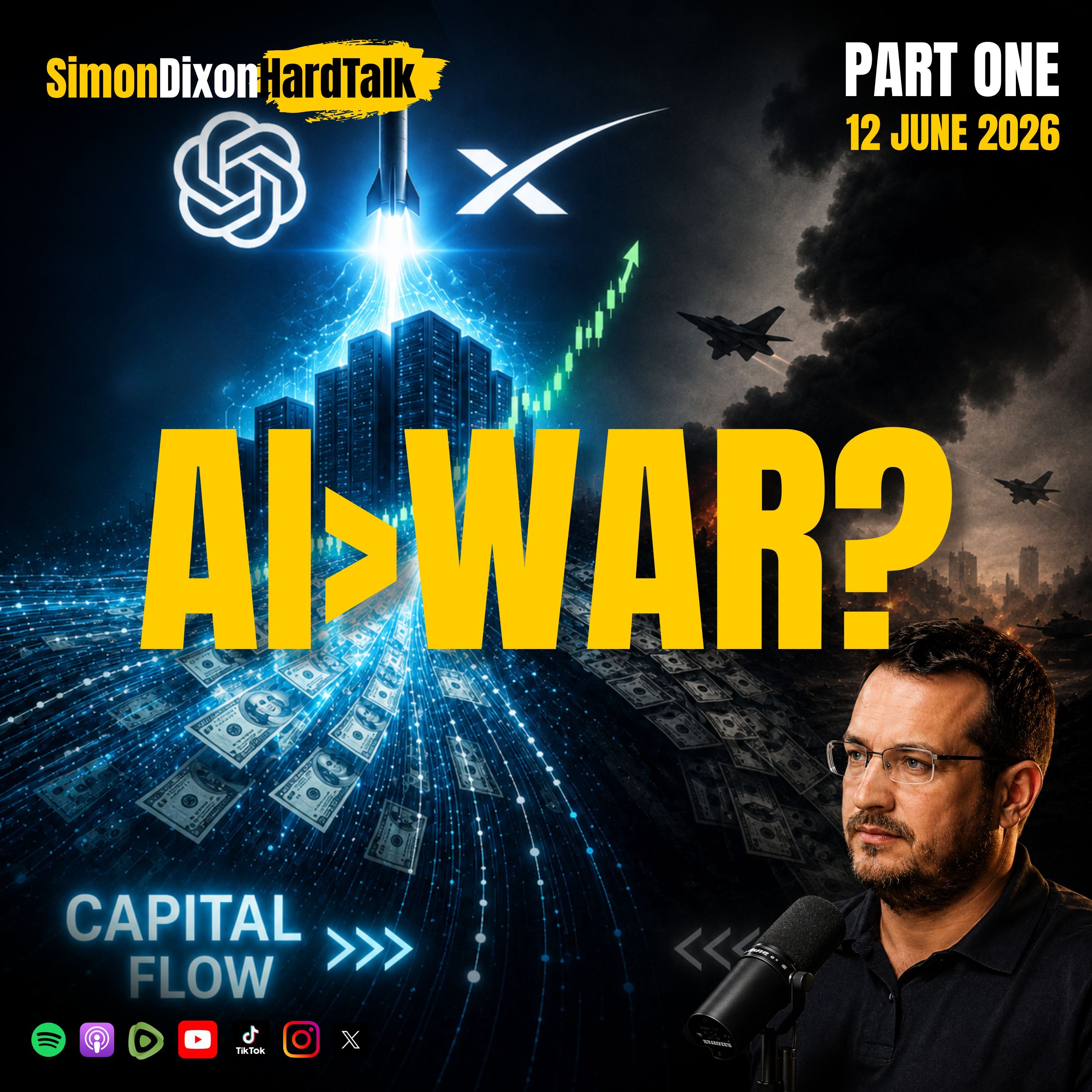
Simon Dixon Hard Talk
Did AI Become More Important Than War? | Simon Dixon Hard Talk LIVE (Part One)
02:08:49
Loading summary
Transcript1 lines
- [00:01]
A
Hey, hey, sovereign wealth builders. Simon Dixon here. And welcome to another episode of Simon Dixon Hard Talk Live. We've got lots to cover today. If you watch last week, you'll know that several of our predictions came true. So I hope it was useful. And we'll carry on analyzing to discuss what will be coming next. But the main episode that we're going to be discussing today from the context of macro, from the context of geopolitical, and from the context of Bitcoin and tech is we're going to be discussing, did AI end the Iran war? And of course, as always, in order to answer that, we're going to follow the money and we'll go through what was announced this week and what we said last week and what we're expecting next. And so we're going to do that in part one. Part one we're going to be doing and discussing, you know, did AI become more important than wars? And we will be just, we will be going through everything that we need to go through in order to answer that question. And we did a format last week that I think some of you liked, which was we streamed this live and then we went over to a premiere on YouTube of the next video. And in part two, which follows on from this theme, it was from an interview I did Face to Face on the Peter McCormack Show. And really we really focused on AI governments and the fact that we already have a private public partnership governance structure using AI here already. And so part two is, you can go over to YouTube and we'll put a link below where you can watch the interview I did where we answer the question, is the AI government already here? And so that's exactly what the theme of everything we're going to be discussing today. So let's jump right into part one. Did AI become more important than war? Well, not literally. So AI didn't necessarily end the war, but I do believe if everyone was around last week, you'll know that I said we're going to need a narrative of signing the MOU agreement that I believe has already been agreed. But we're looking for the perfect exit strategy, a Hollywood movie, more destruction that leads to more rebuild contracts. And we got that this week. But has it ended the war? Well, maybe there's more to go. So not literally, but we're certainly directionally going where I have been saying and where I've been predicting since 2023, where we're headed by following the money. So where did the AI capital cycle and the SpaceX and OpenAI IPO anthropic AI and the liquidity needs become more important than the military industrial complex and the continued escalation in the Middle East. And that's what we're going to be discussing today because effectively that's what happened. So while everyone was saying we're going deeper and deeper into the escalation cycle, last week we were saying they need a clean day on Friday and then that leads to a weaker narrative and then our Taco Tuesday or whatever we happen. But directionally we're moving towards this deal because the world order has changed and I won't repeat it, you can go through previous episodes, but last week we really covered the AI bubble and what we need to think about it and, and we said it's really going to kick off with this SpaceX IPO and that that is creating a ginormous capital relocation and a liquidity squeeze in all markets in order to suck up the hundreds and billions of dollars that are needed in order to invest in this. So we got the announcement of an Iran deal. Now there's nothing special there. We've had about 39 of them, I think it was said. And you know, on off, on off is the complete narrative. But you can see that we had the framework of a 14 part deal again, but it was confirmed from both sides and we get the usual escalation back and forth in terms of is it happening, is it happening? But no matter what, we clearly are moving forward to this deal. Now most people think Israel rules the world and therefore Israel is going to, you know, hijack it. But remember, when you understand that Israel is simply a representative of the military industrial complex and Trump is aligned with the financial industrial complex, then you'll know that Israel plays the role of bad cop while Trump plays the role of good cop, while Iran plays the role in the IRGC of escalation resistance until we get to a deal. And at the same time, last week we discussed the whole bitcoin side and micro strategy and what that means and how all of the liquidity was being sucked out because BlackRock's Aladdin algorithm sucked out liquidity from the Bitcoin ETF and then to much of the AI structure. So let's jump straight in with understanding. We got a bunch of macro data. Are we moving directionally towards this whole fiscal dominance strategy? Well, if you remember what we've been saying on the macro side is that everything is being pushed into the stock market, the world reserve currency is being sacrificed in the dollar and that's creating stress in the bond market. But the average cost on the US national debt is 3.3%. Well now if you refinance any debt, whether it be a short term treasury or a 10 year yield or a 30 year, on the 30 year you're looking at above 5%. That structurally is an impossibility. And the only thing you can do is fiscal dominance where you print as much money as possible, manufacture inflation and try and inflate away the debt by having these negative yielding bonds. But if the market doesn't like it, then foreigners start selling their bond. So whenever foreigners sell bonds you get a correction in the price of the bond which means that you need to have a higher yield. That is what interest rate do you pay on that bond in order to attract the new investors to pay the full price? And so as foreign investors are selling their bonds, you get an increase in this price which increases the national debt. As you increase the interest on the national debt that blows out the deficit. And if you get a decrease in tax collected then this creates a bit of a doom loop where more people sell bonds which increases more rates. And then you need an intervention from the Federal Reserve. But you need to manufacture inflation in fiscal dominance which requires you to to sacrifice world reserve currency. So what data did we get? Well we got producer price index PPI which was 6.5%. That means that the input cost of goods is now based upon this matrix 6.5%. That is the highest since November 2022, which was after the, you know, the escalation between Iran, Russia and Ukraine. And we had the oil crisis that led to the inflationary cycle, that led to inflation in transitory and then that broke the bond market. That led to Peter Thiel manufacturing, the bankruptcy of Silicon Valley bank that led to the justification for the Federal Reserve intervention. And this is now the highest we've been since September 2022. We also had CPI data, consumer price Index. Now remember Producer price index is a basket of goods for the production of goods. And so later the consumption of goods. The consumer price index is the PPI leads the CPI. And so the CPI is now above 4% again at 4.2%. And the only way to get that down in a fiscal dominance is to get a ginormous productivity increase. That productivity increase can only come from AI and robotics and AI and robotics creates structural unemployment. And so we're going to be going through how that plays out in the years ahead. Now we're in this AI bubble and we got the SpaceX IPO which isn't really a space company. It is an AI company. But now inflation is back above 4% and so it never got to that 2% mark. I think we had 63 months above the 2% target. Interestingly, do you know where that 2% target comes from? Some people think it's like some economic concept, maybe Milton Friedman and the Chicago School of Economics. And the monetary side, it actually came from someone on TV in New Zealand saying inflation should probably be about 2%. And then the New Zealand Central bank implemented that as policy. And then it became a policy globally around the bank for International Settlements and the Federal Reserve. So it literally came from a TV show. And that is really theatrically how economics is because it's sponsored from the top level in order to create these research papers that get out and make up the economic science and justifies the policy from the corporate sponsors. Anyway, so as we know, that means that it's very problematic because inflation means higher rates on the bonds. Higher rates on the bonds accentuates that doom loop. Also, what happens with higher rates is it starts to impact the banking sector because now if you want to mortgage and take out a mortgage, mortgage rates are now above 7%. That is the big problematic area where you might need an intervention from the Fed. But you don't get an intervention from the Fed unless you can manufacture a crisis and a narrative in order to justify it. So this essentially since 2020, we now have dollar purchasing power, which is down 30% just in the last five years based upon all of that money printing. So if you were saving your money in fiat currency, and the best of them is the dollar, you've lost 30% of your purchasing power. At the same time, what does the bond deal be paying you? Nothing to compensate for that. So bondholders are taking a real negative yield and that is set to continue. And so that's why we're getting these bond yields up. But that creates a problem with the national debt. And so that is why not. The only thing we can do here is come up with a new mechanism for the banks or the Fed pushing yield curve control to get those yields down. And so bond yields are remaining elevated and the war narrative is making it worse. So I've always said follow the bond market in order to find out what Trump's going to announce. Because bondholders, when the 30 year yield is above 5% and the 10 year is above 4.5%, we've come slightly below that on the 10 year, which sets mortgage rates. And on the 30 year we're still above that 5%. But the bond Market remains. The key signal here and preceding every single recession is oil price spikes. And so when oil price spikes, you then need demand destruction in order to get prices down. Demand destruction means people stop buying because they can't afford it. And so if all the average consumers money is going on energy, on mortgage, on interest and on food, then you get demand destruction. As the price of energy goes up, producers have to pay more to get goods around. Everything is based upon energy and then that eventually translates into consumer goods. And only the Fed can ultimately fix those yields. And they fix those yields by the Fed buying them when foreigners aren't buying them. But we're getting a movement from the traditional buyers. The petrodollar is dying. As I've covered with the UAE leaving OPEC with the Japan carry trademark, we had the ECB that hiked their rates. So Europe is hiking rates and Canada is hiking rates and now Japan's going to be hiking rates as well. That breaks the Japan carry trade as it breaks the petrodollar. And so you end up needing to issue countries like UAE FX swap lines so that they can create dollars through their own central bank. And you get these FX swap lines and that's what's happening right now to stop people selling their, selling their bonds because you can't have yields go up. But in order to do that you need the crisis. And so what is the crisis narrative we're getting? Well, I do believe that this AI bubble, even though AI is going to change world, we're definitely in a pump and dump cycle. And so at some point we need this big sell off. Now what's going to break that sell off in order to justify the money printing? Well, we had big movements down, so the S and P started this week positively. And then we had big moves. Like you know anyone that follows the S p movements of 1%, 2%, these are now trillion dollar moves, like 3 trillion dollar moves. And so this week we had the S P coming down as a result of the escalation. The NASDAQ was down, we had gold down as well. We had silver down with it. We have bitcoin down with it. We had about $2.5 trillion wiped off the market in one day. And we get this jobs report and this jobs report is saying that we've got another 172k jobs added. Now where are those jobs now when you look into it, these are not good things. Most of the jobs were added in healthcare and government. So, so that means that we had a correction as a result. It takes A long time for the data to adjust to reality because we had tariffs, we had the structural, as a department of government efficiency, big layoffs within the government. We then had the reversal of tariffs, reversal of some of those decrease in jobs. And we're still getting some of the weird data from COVID as well and the lockdown. So anyway, when your economy and your jobs are based upon young people working in healthcare to look after old people in an aging population, when more and more people are going to need access to their pension, that creates a liquidity squeeze. So those demographical issues are very, very hard to reverse. That's why you had immigration, because the only way to solve that is you have immigrants that increase the tax base at the bottom so that you can have more tax revenue to look after the old. And you employ people in health care and government as well for that. But with the jobs in financial services, which is the vast majority of the US economy, 70% of it is service based, 68% of that is consumption and 50% of the consumption is from the ultra wealthy. The other 50% is from people that can't afford these prices. Then you have to have these types of actions here. Jobs are being significantly cut in the crux of the US economy, which is technology and financial services and many people attributing artificial intelligence and robotics to that. And this is during the build out infrastructure phase. Now remember with the AI, you've got to build out these ginormous data centers, but the chips that they're buying from Nvidia that require rare earths from China and Taiwan and TSMC and South Korea and the different supply chains have been impacted. Buy this oil and buy this higher, higher prices of oil. That investment needs to be made again. So you've got all of this liquidity that is being sent around. Google, Oracle, Nvidia. And that's why when we covered the China meeting, they needed to ensure that those supply chains are still intact. So Trump took the financial industrial complex, the technical industrial complex executives and made sure that there's going to be no issue with Taiwan. And Xi Jinping set his terms and said, don't worry Apple, you can still have your factories. Don't worry Tesla, you can still have your rare earth minerals. But this is the world order. Now you have to listen to me and Gulf countries and Iran, there are sources of energy. Now I've got the largest oil reserves in the world and you're looking to export. So we can return back to buying some of your LNG and oil. However, we need you to exit the Middle east and we need regional stability. And so what we've been witnessing is the transition towards a deal based upon effectively China and Russia supporting the military industrial complex in Iran, the Gulf countries having to have their exits in the region of the US military bases, and then a negotiation with the financial industrial complex for rebuild contracts and a movement towards that. That's why you have this on, off, on off, on off. You need the three way exit narrative as well. But anyway, you can't lower rates when employment data is good and the economy is red hot and inflation is ripping or roaring or increasing. So how do you deal with that situation? Well, the reason that we're getting a bit of a correction in the market was because people were factoring that there isn't going to be a rate cut. There can only in fact be a rate increase. And a rate increase could cool down the whole economy. And so now we've got Kevin Walsh starting next week, which is the spokesperson for the banks, the same banks that own the Fed and the shareholders in the Fed. And as you increase its balance sheet, they get a 6% dividend off the balance sheet as well. And so really we're pushing the debt interest up, which is increasing into this blowout cycle. And so we're getting this massive fiscal dominance where everything's going into stocks as a result of this inflation, where those holding fiat currencies are getting poorer and poorer and poorer. So growth can only come from productivity. And so this is why we flip the entire chessboard of the world upside down for AI, as I've been covering years ago, before we even had any of this, October 7th and this movements away, you know, around understanding what's happening in the energy markets, this transition to lng. So anyway, the market on the surface appeared data appeared strong, but when you dig into it, the Fed cut rate expectations are just significantly reduced now. And so if we get a rate hike increase, this is why you've got to get those high valuations now. And we've got to move into not just the SpaceX IPO, but the open, you know, the, the chat GPT IPO, open AI and the anthropic one as well, and all the ancillary ones that are happening around it as well. So anyway, we had the SpaceX IPO launch today. I'll give some more analysis on it. We're going to get through the first week the price was launching. A lot of the data was happening around $135. I looked and it was trading about $129 can't really read much into it until a lot later. But the SpaceX IPO really what happens next here is everything, which is why we need to really. You can't look at the war situation without looking at the AI situation. And that's connected as well because this is all about energy. When you get sanction relief in Iran, there's going to be 2 to 4 million new barrels of oil that come upon the market. Now it won't be the same. And then we get also the GCC oil coming back. Now that would be at lower prices, so that would create more demand and that's the only way to kind of get out of this bind. But the financial industrial complex only cares about these higher contracts resetting the order. And that's why we're getting this on off narrative all along. And so we've still got to see the supply chain issues that are going to be coming out during the next year or so that we've been covering as well. So what is the narrative, what is the situation right now? Well, the entire system, the dollar system is betting upon this AI trade, this productivity increase as a result of unemployment. So we got to understand what that actually means. The disaster that we're leading up towards that can justify the money printing that is the only way of resolving this is that private credit is the too big to fail narrative. Much of this data center build out was done upon private credit. Private credit is just individuals lending money at higher yields, but some of them borrow it from the banks. So it's connected to the banks, is connected to the private equity side. Some of it happens via BlackRock and these different funds. We've had stress there, but that's the bailout mechanism because that connects it to the bank. So that gives you the too big to fail, socialize the losses and privatize the gains whenever it's needed. Now the capital expenditure on these AI data centers is what's providing all or the growth. So if you look at it really 50% of the S and P is the tech companies which are all investing in this growth and they're sending contracts and they're doing it just like we saw during the 2008 financial crisis. They're doing it via SPV structures that sit off balance sheet so they can sign contracts amongst each other in order to get access to that computer. And they're splitting them up and we're getting a narrative that this is going to be paid for. Larry Fink said, by your pension, by Americans and Trump saying, I'm meeting the AI executives in order to make sure that Americans get a stake in it, that is socialize the losses and privatize the gains. Because remember what these data centers are, the chips will be out of date in three years. And then you got to start again, and then you got to start again and, and then you got to start again. And we already know that the cost of doing this in China is significantly cheaper. So why are we getting these high capex expenditures right now into record valuations while levering up and all the companies doing it on debt? Because they know there's going to be a bailout. That's that moral hazard. And they know they want to get the best valuations here. And so they wanted to include SpaceX in the S P index so that you can get all of that pension fund money via the indexes, via BlackRock ETF into the AI trade. And if they're going to bail it out, that bailout probably has to happen with some kind of stable coin backed by Treasuries that are going to be real loss making in terms of real inflation. And then that can calm down the inflation and try and get it back. But you know, inflating away the debt is the strategy here. So what does that require? Well, it requires a disaster that justifies the quantitative easing. But what is the goal here? The goal is most likely what AI produces. If you can have structural unemployment through AI and robotics, you can create the justification for this universal basic income, as Elon Musk would call it, a universal high income. And so, you know, this is really what we need to watch out for now. The timing is impossible. I think I know that this is going to happen. We're getting the setup. I've sniffed this out, I've seen this before. But the timing will be the hardest part and that affects everything. And so this is, you know, we're starting to see sign kinds of, you know, Broadcom is really exposed to this kind of, you know, expansion, but it was expanding like crazy. And then the stock started falling into the narrative. We also started to see that Oracle is doing a 50 million debt and equity raise. We also saw that Nvidia memory demand narrative is starting to weaken as well. We had a sell off in the Korean markets and South Korea is massively skewed towards the AI trade as well. Same in Taiwan, tsmc, the market sold off significantly into this. We had the same real volatility, which again, the Taiwan stock market is heavily connected to tsmc, which is connected to China, which is connected to Nvidia which is connected to these IPOs. We had intel which needed government intervention and now the government is saying, well, let's force it into potentially backup contracts with both Google and Nvidia. And so they started reporting that they may be doing backup manufacturing via Intel. At the same time, Taiwan is starting to those that are Western aligned, they might start building out the chips contracts in Arizona. While those that are China aligned and can see the future, they're starting to build chip independence. And Taiwan, there's not enough thing, they can do it. The Silicon Shield will eventually die. But chip independence is very important as we build this global technocratic one world corporate government that I covered in part two as a result of China negotiating with the technical industrial complex. So a lot of these deals are being done off balance sheet. What does off balance sheet mean? It means financial industrial complex. What does financial industrial complex? It means partnerships with sovereign wealth funds which are funded by energy purchases from China, which means more influence from transnational capital. So this is really hiding the reality and is spreading the revenue and that's causing these inflated numbers into these, I mean AI valuations that have no reflection on reality. Now don't get me wrong, the private equity, those early investors in the private equity and vcs, they're going to cash in. I think this is their exit. I think retail is the, is that exit, which is why you're having such a strengthening of narrative. And once they've got that exit, they will rotate into other asset classes. That's why I think we started to see the outflows of the Bitcoin ETF into this artificial intelligence. But Trump basically said that he's going to be meeting with the AI executives, which means you are the product. You're the one that's going to be buying this stuff. Now we know that it requires significant reinvestment. So the private Equity and the VCs, they're going to do very well. We may get a pump into good positive news around what's happening in Iran. That may create some liquidity as well at the same time. But we also know that we need the QE narrative. So it may be, and again, timing is the impossible part here that we man that they squeeze everything they can into the exit liquidity, manufacture the overvaluation narrative. Maybe China at the right strategic time does another deep seat story as I've been covering in previous episodes, and then that creates the correction that justifies the print and they get, you know, those investors in these IPOs get wiped out if they weren't trading they're the exit liquidity and then the repurchases happen at the lower, lower valuation and they the second round investors, the second wave make all the money. Now I'm not sure, you know, I don't want you to trade upon this my approach. I'll share with you what I do in these events, but I'm pretty sure the people in the middle right now are going to be the ones that get screwed if they end up holding the bag. And everything becomes timing which drives you into speculation. And we all know how that ends. It's the insiders that win in the speculation game. So we are seeing the pension mortgage backed security global dump via passing on through these institutional structures the Global Financial Crisis 2008 narrative all over again with a new flavor and it is this one. So Google said that it's going to be spending almost a billion dollars a month to gain access to data centers and they've signed a contract with SpaceX and so SpaceX is building it out and there is so much demand for this compute because we're turning the whole world upside down for AI and people are doing the most inefficient things like it costs a lot of money to use AI in terms of the energy and rather than using GPS people are using travel with ChatGPT or their AI which is burning significant energy. Why these higher prices are cashing in for LNG companies and big Oil. The higher prices are making more and more people bankrupt where they have to sell their assets and concentration is going up as a result of this manufacture by the closure of the Strait of Hormuz. But Google was saying we'll buy a billion dollars of these AI data centers and that was announced just before the ipo. So the AI liquidity squeeze is really creating this mortgage backed security off balance sheet circular economy of contracts in order to manufacture numbers so that you can justify the liquidity need. So anyway, the SpaceX IPO is today. We'll see how it goes, we'll review it next week. The OpenAI IPO, they announced their filing and the anthropic IPO filing has already happened that liquidity needs to be spread out and we're getting this AI capital cycle accelerating and it's going deeper and deeper into debt. And deeper into debt means that you lean into the too big to fail private credit banking markets as well. So as we said, the chip, everything that's being spent right now will be worthless in three years. So you've got to spend again and that needs to be factored into the equation. The main question that I have when we need to think about this, what does this actually mean? What does this mean for you? What do we need to prepare for? What can we draw into this ahead? Well, do fund managers need to call existing assets and sell those existing assets in order to invest into the next AI cycle? What is the capital rotation? Is that what we're seeing right now? Well, I think it is. Which means that the capital rotation may come back into other assets. And so we've got to keep an eye on that. And the way we keep an eye on that is by following ETF flows, as I covered last week. But we also need to think about how do we manage what's going to come as a result of AI, as a result of these massive productivity increases? Who's going to benefit from it? Who's going to make the money from that? Is it going to concentrate? Who's going to get that productivity? So Trump says that the market should be green when it started crashing. And so the market turned around based upon market saying that this should be green. We got the announcement with Iran, obviously, and Jensen from Nvidia says that everyone needs to buy the dip when it came down. So we're getting these announcements that's trying to drive this market manipulation and really just have a soft landing narrative. But have no doubt we are in an AI bubble and these valuations don't reflect reality and AI is going to change the world. And so what do we do with that? Well, we're being told that we're going to get abundance, which is going to be universal high incomes, because universal basic income, really, I thought through this long and hard, it's the only way to solve it. And yeah, we call it a universal basic income, but really, let's face it, you know, we have this unemployment benefits, a dole, whatever you want to call it. But if we do enter into this world where people are on a universal income, probably paid by stable coins, probably algorithmically integrated with your social credit score and, and your artificial intelligence spending behavior. But are we going to be in an abundant world? Because what does AI do really? It puts the cost of everything down. And so it is incredibly deflationary at the same time as this fiscal dominance inflation. So you've got these offsetting forces of money printing creating inflation, AI creating productivity and deflation. And so what does that mean? What that means is wealth redistribution because AI makes production cheaper, so it makes it cheaper to produce goods. Ppi, not cpi. AI does not automatically make people richer, it does make producers Richer. So those are the producing things and it does make those that own the assets, that get the market timing right richer as well around the pump and dump cycles. So ownership matters. This is why I've been saying all along the only way to beat this cycle is to own assets. Because fiat currencies are being destroyed as the world reserve currency, the dollar is sacrificed to enter into this multipolar world. That FIC is engineering with transnational capital while building this Orwellian technocratic global artificial intelligence, technical industrial complex led global market. So the Magnificent Seven is really where revenue already we can look to that, right? They're the ones using the AI because they're building the AI and they're the ones that are doing, if you look at the job data, all the unemployment and so revenue per employee is rising. So that means by creating unemployment and increasing productivity, you're bringing in more revenue, more profit, profit, more productivity per employee. So that will be reflected in share prices. So we're concentrating wealth and remember 10% own, 92% of all the stocks. And, and so if the higher prices is leading to people needing to sell their assets ahead of this and then we get a decrease in prices as a result of this productivity, is that going to make people richer overall? Well you will be given enough income to just keep alive the consumption. Because if everyone's getting unemployed, what is the upi? The UPI is effectively giving you enough money to continue consuming so that the revenue can increase into the very companies. So this is massive concentration into the wealth of those that own the assets. And you can compare that. So if you compare the Magnificent Seven where the revenue per employee is going up, take a broader index like the Russell 2000, revenue per employee is falling. So if in the general sense, revenue per employee is falling in the general sense and it's going up in the Magnificent Seven, then that's the story. The stock market is not at all time highs. The tech companies, the AI bubble, the fiscal dominance, the mcfic tick, military industrial complex, technical industrial complex, financial industrial complex are redistributing. And this is the asset stripping phase that I've always talked about. And we got a little bit of, you know, they'll install some AI regulation now people think, oh the companies don't want regulation is useless. The AI regulation is to build a moat. It always has been in financial services. And so that's to stop people competing whether it will work or not. We've got a very different technology, but it's incumbent protection always has been. Do the, do the Crime, pay the fine. Only the large companies that have regulatory capture can do that. And so regulations is a moat in order to keep out competition. So surveillance will expand. And that's why these trends, nothing you know, is irreversible. So UBI is the likely outcome as a result of this. It's the only outcome I can think of and it's the one that I think ties in with fiscal dominance and this technocratic control grid that's being built. So what does this mean for you as the average person? Now, if you don't own assets, it means consumption support. You receive enough money just to consume when you're unemployed. And you can think about it, unemployment benefit, a dole, whatever you want to call it. We have this all around the world already, but it's just about to get more extreme. This is what I was covering last week, remember? Sick, the subscription industrial complex. Hey, by the way, thanks in the comments for all the feedback on that. I was also thinking of another word, subordination industrial complex. Because really all of these subscriptions, debt, everything is about really building up a subordination complex. And I think UBI is one of those examples is to make you subordinate to the UBI and control the spending and everything. So what do you think about subordination industrial complex? Maybe I'll start using that. So we got Mick Military industrial Complex, fic, Financial industrial complex, tic, Technical industrial complex and Sick, I was playing with it last week. I said subscription industrial complex, but I think it's subordination industrial complex. Control of food supplies, control of interest, debt, equity, various other things. Anyway, let me know in the comments what you think. But this is the people that don't own the assets and they want you to not own anything. You will not. You will own nothing and be happy. The World Economic Forum agenda here. The AI machine can effectively produce enough for everyone globally, the entire population. But will it be distributed that way? And that is really the question. Who owns the machine? Who owns the AI machine? And so as part of this pump and dump cycle, if this is the overvaluation, if the VCs are exiting into this bubble now, there'll be lockup periods, 30, 16, 90 days, all this stuff and we're going to watch out and I'll give commentary. I'll be the first to say I can't figure out the timing on this and the timing matters obviously, but who's going to own the AI machine? If the VCS and everyone's exiting there, then we get the capital rotation, then we get the narrative that pumps into the second wave investor, maybe you need to crash in between. Then that second wave investor is going to own the machine because they're going to buy back cheaper and they are the ones that are going to get the too big to fail private credit, socialize the losses, privatize the gains. You got to be careful here. And you have to own the assets at the end of it. And we're really moving towards this world, this bifurcated world, control grids. And I'll cover that more in the crypto stablecoin, Bitcoin story as well. But AI abundance is being sold as a story about cheaper goods. And so really I do believe that this makes everything cheaper. If the input costs the ppi, we had this pump and now we're going to get everything cheaper. And this drives the cost down and down and down, then really everything should get cheaper. And the real question is it's kind of not whether things become cheaper, it's really who owns the assets that benefits from this economy and who owns the assets producing the cheaper goods. And I think that's the question. I think that's what everyone needs to adjust to. Because Approximately in this AI trade about 200 years, productivity gains have flowed back to workers because businesses still need labor. And that's why you had trade unions and that's why you had labor negotiations. And always inflation has been above the wage increases since we had globalization and labor lost more of its power. But as labor loses more and more of its power, workers have been able to kind of gain from this productivity increase alongside the capital. And AI changes that equation because effectively, what does it do? It automates the worker itself. So we're automating the worker. And so the wage that once kind of flowed towards labor as a result of productivity increases. This remains with the owner and the asset owner and the capital, it remains as profits, which means higher valuations, higher profits, because you're sinking your costs, the production costs are sinking here. So AI is not really just another productivity tool. It's not the same as previous productivity where the tractor comes along and now the farmer no longer needs to use the hoe in order to do it manually. And potentially this is narrative. And I think it will be the first technology that basically automates general purpose human intelligence. And that's the pitch we've been given. Now that could be a pitch, but I think we're starting to see it. If you're not using AI, you're falling behind, you're not productive. And so previous technical revolutions, they kind of Replaced specific jobs and replaced it with another job. AI replaces the ability to remain in, you know, to retain the next job. I think that's different. And guess what? All the people that don't want you to know this, that raising billions into AI, the Jeff Bezos is off the world, the Elon Musk of the world, they're selling you a utopia. So this kind of. Let's look at what the optimistic case here is. The optimistic case is that, okay, we end up with lots of productivity, lots of new jobs, and these new jobs appear. Is that really going to happen? Well, the job data says that it's the government and healthcare and financial services and tech and the engines of growth is not producing the jobs and they're not reappearing. There was also manipulation of the data in that they are using job postings. And apparently the rate at which job postings lead to hiring is going down as well. So the burden of proof is now really explaining what those jobs are. And if anyone can tell me, please do say, say in the comments, what are those new jobs? Because I can't see them. And that's really the optimistic case. So maybe this is massive productivity and it leads to new jobs. But the largest beneficiaries are not the workers. The largest beneficiaries are certainly the owners. And so you either need to have a strategy around that to own assets or you get crushed. And so, and you got to get the market timing right as well because of this inherent nature. So those that own the AI companies, those that own the compute infrastructure, those that own the semiconductor companies, those that own the data platforms, those that own the energy infrastructure, and those that own the capital itself, that is the fic, other people that are going to be the net beneficiaries. So the AI booming is creating one of the most, greatest concentration of, of ownership in modern history. And if we add a pump and dump cycle in another 2008 style event, that's what I think we're being led up to. And this is the game that everyone needs to get ahead of. So the wealth transfer is really not from like poor countries to rich countries. It's from labor to capital. And that's what I think AI does. That's what I think the wealth transfer is, is from labor to capital, is from workers to those that are the asset owners, is from the wage earners to the shareholders. And the compensation that people get out of this is that AI makes consumption cheaper. So if everything gets cheaper, then the worker will be able to afford more. But it does not make ownership cheaper because the assets are going up and up and up. And that's the fiscal dominant structure, I.e. the consumption is getting cheaper. You end up with a universal basic income if you haven't prepared for this, which makes sure that the consumption continues for those that own the shares and the capital. But those that own the infrastructure are the ones that are going to be the net beneficiaries here. So you may be able to afford like a better AI doctor, for example. The cost of hiring a doctor may get significantly cheaper as a result of this. You may be able to afford better AI teacher, maybe all universities go open. I think that's going to happen. You may be able to afford a significantly better AI assistant to do a lot of your work for you. But what's not getting cheaper, the house, the land, the shares, the equity and all of the productive assets, they're going to get harder and harder to own, which is why you need a strategy for this. And so one thing that I've always said is buy Bitcoin into weakness in self custody. Whenever the price goes down, you get more Bitcoin for your fiat currency. And then this fixed supply asset may mean that you end up in a longer term strategy of being able to buy your assets, buy your house if they go up at a faster rate, which historically they always have done. Now we're getting weakness into this AI narrative capital rotation, a lower Bitcoin price which allows you to either buy more Bitcoin with your fiat currency or you're a great capital allocator and you're able to pick exactly the right place to be and you're in these AI trades or maybe you're doing a combination of the two. Again, I like to boycott the system with Bitcoin, but I understand that people may have to play with the system to beat the system in order to be in a position to do the capital rotation. So assets are going to become harder and harder to own as a result of AI. Now couple that with tokenization where they won't even let you own the asset, they want the custodian to own the asset and you to own the token. And you've got these structural paper contracts where they don't want you to own the bitcoin, they want you to own the paper Bitcoin. So daily life gets cheaper, but ownership gets more expensive. And that's what I think we're witnessing. That's the trend that I'm looking out for. And that's what I think the data is. This is the hidden wealth transfer. So the headlines during this whole thing will say to you, everything's getting cheaper. AI is making everyone's life better. You now have universal basic income, you don't need to work. But it is a wealth transfer between those different things that are happening. And so the middle class was effectively built upon ownership. That was the boomers after world wars that were able to get the real estate at an affordable rate. They were able to leverage up the debt. They own the property, they own the businesses, they own the stocks, they have the savings. And AI essentially threatens to separate consumption from ownership. And that's what I think everyone needs to prepare for. So citizens may consume more, but they'll be owning less if they don't get this trend right, if they don't become the asset owner. And that is really the universal basic income, or what Elon Musk calls the universal high income. It doesn't solve the problem, it concentrates wealth significantly. That's why I've always said you've got to have a plan for the next five, 10 years. Even if it takes longer, takes shorter, whatever it is, you still got to start working. I talked about, there was an episode on my blog, SimonDixon.com how to develop a 10 year plan, how to understand these different trends. But UBI is effectively consumption support, let's call it what it actually is. And ownership is wealth creation. And you need to become an owner rather than a consumption supporter. It's going to be the subordination industrial complex, the subscription industrial complex. Basically a monthly payment is not the same as owning the productive assets. You don't get more productive and get ahead unless you get more productive and then own the assets. That's why you got to lean into this maximum productivity increase in order to spend less than you earn and invest the difference in the assets. Own more Bitcoin this month in the sovereign strategy and then diversify accordingly in order to play some of the different things. Now remember, you know, the future may become a world where citizens rent access to virtually, you know, all so all sorts of things. And so really that is the subscription industrial complex. They want you to rent it rather than own the assets. And specifically the assets that are producing it. Because that's why they create these manufactured crisis to make sure that you own nothing and you're happy. That is it. You will earn nothing. Excuse me, We will price you out of the assets and you'll be happy because you've got the universal basic income, which will be programmatic money, which will be the one global governance structure so the most, the most important question of the AI area really is not how intelligent will AI become. I think the most important question is who owns the intelligence. That's the important part. It's an ownership story. So can we make it decentralized? That's what we did with Bitcoin. We made it decentralized. Nodes enforced the rules. There was no centralized server, a largest distributed supercomputer in the world, and the code was open source, so people could audit it and people could verify their own transactions, own their own value and send it peer to peer with everyone else in a decentralized way. Can we do that with AI? That's really the question. And we cover that in part two with my interview with Peter McCormack. So every major technological revolution created new billionaires AI may create, and I think it already is creating the first trillionaires that are publicly known. There's probably trillionaires already, but the first trillionaires that are publicly known. The abundance story is real. This will make things very abundant. But the ownership story is what really determines your future. And who benefits from this? Because if you don't own the assets. Again, I'll keep repeating, and this is why I keep coming back to the same theme in every episode. Because we have to follow the money to understand the big macro trends so we can then develop the micro strategies. And in the AI era, ownership matters more than labor and that's what the adjustment everyone needs to make. And I did cover that in the ten year plan, which is why I think basically Bitcoin becomes increasingly more important in that era, despite the fact that it's on the wrong side of the capital rotation, which means you get to buy more Bitcoin with your fiat currency if you got a longer term strategy. And that's why Wall street wants your Bitcoin. That's why they're manufacturing these price corrections and centralization strategies. So AI is concentrating the ownership of intelligence. And Bitcoin remains one of the few assets that allows the ordinary person to own a piece of the future rather than simply consume it. And so that's why Bitcoin as store of value versus Bitcoin as median of exchange is the important preservation, which is why we always fought for cheaper nodes so that anyone can run a node, you can have your freedom and then you can spend your Bitcoin as you choose. But that's the game changer. So we, I believe are in the NAI pump and dump cycle and is being engineered in order to concentrate ownership into fewer and fewer hands. That's the story of the post1971 era since the dollar came off the gold standard. Whether it be long term capital management, whether it be the global financial crisis, whether it be Covid, whether it be the Russia Ukraine war, whether it be the closure of the Strait of Hormuz manufactured crisis that engineer concentration of wealth upwards so that you will own nothing and move towards this technocratic happy. So that's what I think it is. So timing is the hard part, as I said. Dollar cost averaging is the equalizer by the way. And that has always been the solution. Not trying to time the market, but I've always said own more bitcoin this month, you can apply that to own more gold this month, you can apply that to own more of the AI infrastructure each month and you can apply it to all of those. But spend less than you earn, invest the difference in assets, build a sovereign strategy, build yourself custody strategy, and then you can purchase the living assets based upon being on the right side of this massive wealth transfer. And it's only debt and leverage. It can make it where you don't end up with the assets because you use it as collateral. You get wrecked, you get margin called you over speculate on derivatives or perpetuals, you borrow against your Bitcoin, you end up buying a Treasury company. You do it through micro strategy. You try and you don't get the upside because you're doing it through stretch. You end up not receiving that dividend. All the things I covered last week. So tie that into the announcements now and the MOU and try and get some of the timing right because it's difficult. So last week I predicted my longer term thesis that the MOU and the deal has already been done, but it would be announced around liquidity needs for the financial industrial complex. And we got that, we got that like clockwork. People were saying to me, yep, it happened that way. Others you can criticize whether I get the timing right, but this one I got right. The strategy has never changed my long term trajectory of this. As more information becomes available, I realize that we're in acceleration here. We're doing more at a faster pace than I imagined would be done. I thought this would take a longer time. But did AI end the Iran war? That's the question I want to come back to. So what actually happened this week? Well, we had another escalation theater. Some people were thinking this is it, World War 3, others are my long term listeners, you know, they kind of sit back and they know what's going to come next. We don't know the exact thing, but they know that there's a narrative that Israel rules the world. Israel is bad cop. You know they're connected to the military industrial complex, the bribes there are to profiteer from war. That's connected to laundering money back into good cop, which is the US And US is captured by the financial industrial complex. And underneath the FIC is the mic and tick, the technical industrial complex, the subordination industrial complex. Underneath that they try and make sure you own nothing and be happy. They're building the technocratic global governance structure. They need China in order to build that transnational capital is providing the capital like the Gulf countries. And the FIC is using your pension, your insurance, your endowments to pull together all the money so that you own the debt and you become the bag holder as well in your pension. And US needs a way of plausible deniability. It's not US is because Iran forced us through. It's the Epstein network. Even though the Epstein network goes back to the deep state and the military industrial complex and it's the funneling off of the debt and transferring wealth over to the asset holder and the shareholder. Now Iran plays the resistance narrative. Underneath that there is genuine resistance. I want to go through a few things because people get confused about this, but that story is still shaping out. You get the Israel and Iran, you know, strategic tension that justifies all the wars for all the decades and everything I've covered previously, not going to go through it again. But anyway, so Israel strikes Iran. So that plays into the narrative that it's not America. We didn't know about this. This is Israel making us, dragging us into making shitloads of money out of war. It's those pesky, just Israel on their own. And yeah, we get that, you know, we, we. Everything they're doing is evil, evil, evil in terms of the death, the, the genocide, everything humanitarian hat hat on. I'll never forgive what is being done there. But we know where money comes back to. It comes back to the ticket testing their technology for military profits so that the FIC can pump the stock market and transfer wealth and build out this multipolar world as also this global technocratic governance structure. So anyway, Iran strikes back. And the Iran strikes they just happen to be missiles that launched at US bases in Jordan which leads to a new rebuild contract in Jordan which hasn't been targeted yet. We get the same in Bahrain and apparently in Bahrain that targeted American fighter jets and various other things. We also get some escalation in Iraq and we get the same in Kuwait. So all of those were strategic M assets which are essential for the forever war in the Middle East. Which means the that this is the exit of the forever war model, providing that the FCC can get contracts led by the Gulf countries that is funded by China to turn the Middle east back into West Asia. As we get this so called trade war where all of the executives of the fic, MIC and TICK meet in Beijing where Xi Jinping agrees to provide them with all the rare earth minerals and components and cheap labor. And we have this transition that requires weakening the dollar and removing the dollar as world reserve currency. While Trump being a populist leader with a MAGA narrative of we're doing it to rebuild the manufacturing base when really they're just building AI and robotics. So the MIC forever war model, as I've always said, needs to be replaced with rebuild contracts for the financial industrial complex and in partnership with transnational capital. So Israel needs to be weakened as well. Israel has been more and more privatized. The only port that hasn't been targeted by Iran is the one owned by India. Because Iran and India have a partnership. We got the taking out of key assets within UAE. We also got an understanding after this that $3 billion have been transferred. Remember I told you that Iran and UAE work together in the sanctions circumvention infrastructure and the UAE has built out the network of central bank digital currencies by enbridge that plug into the China SIP system and the China cbdc and that they play both sides. They normalize with Iran so that they can acquire assets. Sorry, normalize with Israel so they can acquire assets that are being privatized into the Abraham Accords, which means that the GCC becomes effective controllers. Then you have a good game, good cop, bad cop between UAE and Saudi. UAE acquires the assets as bad cop and then Saudi is good cop. And they get to be the holdout and say Palestine won't happen until. No normalization will happen until there's a Palestinian state. The more the GCC acquire assets in Israel, the more they control Israel, the more US gets to exit, which weakens Israel. And then you get the Palestinian state, but it needs to be negotiated with the relevant powers. And those powers and Iran and Saudi were normalized via China. And China doesn't want Israel to be a MC asset. It wants regional stability and so do the Gulf countries. So you have to, you need a theater in order to manage that transition when you're dealing with the MIC terrorists here. Okay, so Israel then goes back to targeting Beirut and striking in Lebanon. And Lebanon provides the COVID for Israel as the Iran deal is negotiated. And so we get this on, off, on, off based upon whether Lebanon is included. In the meantime, Hezbollah is being weakened by airstrikes from Israel. And Israel and the IDF are being weakened via ground infiltrations. And whenever Israel kills civilians for mick and infrastructure the terrorist state for mick, they always do civilian targets so that the resistance has the retaliation. And then you get that strategic weakening which is what we're seeing at the moment. That then leads into another track, which is the integration of Hezbollah into Lebanon that I've been talking about as we had with Houthis, signing an agreement with Saudi in Yemen and then also the border peace Gaza with Hamas. And the more weakening of Israel, the better those terms get. The longer this takes, the better terms go towards the gcc. And so we get this painful humanitarian disaster of trying to expel the terrorists from the region. And by terrorists, I mean Israel and the US mic, the resistance needs to go through this integration process. And that's what we've been, I believe, witnessing. So Trump now says they won't get involved in Lebanon as a result of that trying to separate the tracks. Trump later then announces that there's going to be a retaliation. There was a massive amount of strikes around strategic targets in Iran. Those all need rebuild contracts. And the deal that was leaked and it was leaked again in the New York Times said that Trump says the deal know he gets leaked in New York Times. And and then Trump comes out and says the deal remains on track leading into the SpaceX IPO. So then we have a bit of a narrative, a bit of a theater again, good cop, bad cop between Trump and Netanyahu. This is a theater where effectively Trump gets to say I called the shots. Netanyahu will do as I say. That's for Maga for US audience. Trump then comes out and says the deal will continue despite the the strikes. Netanyahu comes out and says these are our terms. That's in Hebrew for Israelis, for the radical Zionists so that it can maintain into the next election cycle leading into the regime change that I think we're going to have in October within Israel and negotiation continues. Now, I'm not saying I'm not ignorant enough to say this is it. Allegedly there's going to be an MOU signed in Europe and it's going to be called the Islamabad Accords. Maybe it happens, maybe it doesn't. We definitely get this liquidity cycles, but directionally the deal will be done. I can't predict all the bits in between and it's irrelevant as well. But you can see the framework of the deal. Sanction relief 300 billion investment fund. Now remember what I said, I everyone, they were framing that as reparations. I said that would be a fund, that would be contracts that would be signed. So you know, the strikes, it was said that won't stop negotiations. We'll see. But directionally you can see where this is headed. So remember what I said right back on day one when I went on like those early podcasts. I said we're witnessing a managed transition which has bounded escalation between FIC and MIC based upon China's normalization between Iran and Saudi Arabia, based upon America now transitioning to being an energy exporter, particularly with LNG that requires AI inputs. And this is about nuclear weapons as a forefront narrative, but it's really about nuclear energy. That was my long term thesis before any of this. So my framework is that Trump answers to fic as I've always said, in case you're new to this, I got a lot of new subscribers. Netanyahu answers to Mick and the question is, did Wall street need a deal while the MIC needed escalation. So the FIC wants regional stability but it owns the MIC as public companies. So it makes money from all the bombs, all the, all the different type of thing. But the MIC needs escalation in order to gain more power and that's connected to the radical Zionists which needs the death to America, death to Israel narrative that I've covered in order to justify the war that allows for the trillions of dollars to be laundered through and back into the US stock market. So for me this is just portfolio management for a company like BlackRock, State street and Vanguard. And the fig Iran has destroyed more and more of the U. S bases. Now that leads to new agreements. Israel has, you know, basically cleared some of the strategic routes in Lebanon that are going to be needed for these different type of ports. And there's different new order in these different routes that's happening in Gaza, in Iraq as well, that's happening. And then the US is destroying Iranian infrastructure for the rebuilt. The Gulf is going to provide the capital, the China's Belt and Road initiative and there'll be a framework that puts FIC in his place but compensates it for regional stability as well. But the main terms are set by China because the US FIC and make and take need access to all of those that trade and so they get their rare earth minerals, they get their cheap labor in factories and the condition from China is hands off Taiwan. So they both work on becoming chip independent. Russia gets Ukraine with some FIT contracts. FIT gets oil and LNG that resets the world order through the Strait of Hormuz and insurance contracts. Mick gets war compensation through European Union, through more access to resources for fic via Venezuela. SpaceX, you know, gets its IPO into a decent narrative and that's kind of where we are now today on Friday. And so the IPO needs continue. There's going to be a lot more liquidity that's needed into this. I've already said we've got the open air nodes. It needs a significant confidence into that ipo. Anthropic needs significant confidence rather. And the bond market is under pressure and it needs quantitative easing. So you need to pump this for as long as you can, knowing that you're going to socialize losses and privatize the gains. So you have basically created the 2008 moral hazard that I talked about. So the final Hollywood movie may be built around these IPO cycles and the big print, we may have seen it, but I'll keep reviewing as well. But you've got to keep following the money. So who are the potential winners in this? Well, as I said, FIC would minnow, Fiqu would mint, would win over Mickey. Mick represents the Greater Israel project. You know the, the different narratives in Iran as well, the US manufactured like you know, the Khalifa and the Shia supremacist type of taking over Islamic State type of stuff that provides the COVID story. But it's going to be the technical industrial complex, it's going to be the financial industrial complex and it's going to be the reconstruction contracts which I believe are going to be paid for and not just paid for, but invested by the Gulf sovereign wealth funds, the BRICS development banks, Belt and Road initiative. And what I wanted to do is before we get into the bitcoin part, I saw a post which I really liked from an account that I follow. Evan writes on X and it went through a bit of the history of Iran as the useful enemy. Now people get very upset with this because all of their ideology comes in and there is genuine crimes against humanity here. But in my follow the money narrative I have to take off my humanitarian hat, as I often have and become inhumane. Real politik analyze things as they are, not as I want them to be. If they were as I want them to be, it would be completely different. But if you Think back and this is what the post went through. There's two ways that the McVic and Tick can think about this. You can either have a friendlier on which means that you get one arms contract. That's how this whole mess started. You know, the Shah was doing a 1.7 billion dollar contract and it's pretty boring. It's not. Doesn't make that much money when there's tens of trillions of dollars to be made from war. So you can have a hostile Iran. Now, under a hostile Iran, what did the MIT get? It got 50 years of arms contracts. It got negotiation with all the Gulf countries, it got the Gulf bases as a result of the petrodollar. The petrodollar was as a result of the assassination of King Faisal. That led to the Yom Kippur war from Israel. That led to the oil embargo. That made a lot of money for the oil producers. And then there was an agreement to price it in dollars. The petrodollar hold those funds in U.S. treasuries and the yield on the U.S. treasuries would go back into the military industrial complex. That would lead to building the base that would protect the petrodollar. And then you get an infiltration by the CIA, Mossad, MI6 and subordination contracts that you have to fight against. And so Saudi said if we can't beat them, buy them. And so they started building their sovereign wealth fund. And then that started being funded more by China as China grew, as it had globalism. And then Saudi would get more and more influence and eventually get some of their guys like the CEO of Saudi Aramco on the board of BlackRock. So now they can be a part of the portfolio management. Then you get to set terms and you can demand a Palestinian state while Iran creates the resistance which fuels the profits of the MIC but also creates negotiation power. And then when China normalized between Iran and Saudi, you now got resistance that creates negotiation power in, in terms of Mick. Then you have FIC nodes through transnational capital. And then you can take on the colonizers, the U.S. israel, and then you can buy Israel into Abraham Accords and you can bribe the President Trump through affinity partners which is funded by Saudi so that Trump makes money into all of these deals. And then Jared Kushner can compensate the radical Zionists into this reality that requires more privatization. And I think that's the strategy. You also get fleet deployments. If you do it this way you get weapon sales continually and you get permanent military pressure. Trillions and trillions of dollars. There's always the justification for more war. You manufacture a fake war on terror and then you can weaponize all the religions in order to, you know, radicalize Zionists through lobby pressure. And you can have a cover story for this profiteering and money laundering. You get the petrodollar that replaced, you know, the gold standard that was propped up by, you know, the IMF system. And that's why you end up with the status quo. So there are powers within the irgc, the benefits from the status quo. There are the forces that lobby Israel that benefit from war and status quo. There are the previous boomers that were radicalized into the evangelical Christian neocon narrative, that are funded by APAC and military and financial that benefit from the status quo. And this is the transition that we're witnessing that I've been covering. The de radicalization, the changing of the narrative, the acceptable resource, the divorce, the plausible deniability. And so what when Evan wrote that post on the history of Iran. Is basically saying that Orachi. So what I've been saying about Orochimaru is that Iraqi was in the negotiations before, was in the negotiations, now, is in the negotiations after. And all those that were in the negotiations were the people that are still alive today that are driving the process. But the negotiations from Iran's side are really going to drive Iran into the system, but on China's terms rather than fixed terms. And that requires this type of theatrical, managed transition. And really Orochi is performing the role of the shah, but I think it's more multipolar aligned and that is reflective into the new multipolar world order. And that's why the re. You know, the worst Iran is off financially. The fund will be used in order to rebuild, but also it pushes Iran deeper into China. And then you get this, you know, this, this reset of the world order accordingly because China doesn't want Israel as a great Israel project destabilizing the region. But they don't PR things, they don't press things, they do things effectively. But if we go back in history, there were some declassified documents and I wanted to corroborate the story. So I looked into them. And there were. BBC Persian basically reported in 2016 that there was a declassified US diplomatic cables that revealed effectively contracts between Khomeini, you know, after the revolution, not Khomeini. I get those wrong ways sometimes. And now we've had, you know, the different ayatollahs and obviously we had the decapitation campaign. But the Original at the 1979 revolution, Khomeini's circle, through these wires that were released, were, you know, communicating into the Carter administration. And this was before the 1979 revolution and he was in exile in France at the time. And many people believe that that might have been an MI6 op. Khomeini was reportedly in these declassified documents. And I went through them and basically reassured Washing and the Carter administration that the American interests in the Iran world would not be threatened under the new government. Now one could say, well, this is back then, maybe things have changed. But according to these declassified communications, Khomeini's camp basically indicated that the oil would still continue flowing and that American interests would be protected and that the transition of power could occur without any military intervention. And so Khomeini got reassurance from America that this transition could happen and that there would be no military intervention to overthrow the Shah with the Iranian revolution and end up where we are today. So Khomeini, in these documents and declassified documents, you could say, well, maybe they're games, maybe not, but reportedly communicated, basically, you will see we are not in any particular animosity with the Americans. And these were the communications. There was a general report and, and this was that General Robert Heise in the document was sent to Tehran and was doing the, basically the final days of the Shah's rule. This was during the final days of the Shah's rule and later became central to basically the debates over whether Washington would discourage any of the military interventions and the coups that could happen that could have preserved the Shah and not allow the Iranian revolution to happen, not allow this monarchy and this theater theocratic structure that emerged. And so those negotiations were all declassified into the documents. And you can look these up as well. But the traditional narrative that came across, you know, after this was that America lost Iran because Shishar was an ally of America in a puppet, no doubt about it. But he started to go off on his own track as well. And so what could the Mick do in order to do, in order to, you know, alleviate the fact that America may be losing Iran? And you can see that the Shah, towards the end they had all this pro Palestinian side, was revealing things about Israel and control over media and you see those infamous clips as well. But the, but the alternative interpretation, if you read these documents and then you understand operations like Operation Gladio by Paul Williams and you understand the Iran Contra affair and stuff, is that America chose not to save the Shah because a hostile Iran was more Useful than an independent Iran. Going through the framework that I said, you either have one contract or you have 50 years of hostility which led to trillions of dollars of money laundering and profiteering from war. Now you can just align incentives. It doesn't need to be a grand conspiracy to see how aligned incentive and covert operations. Remember these things happen by infiltrating at the top. It doesn't mean that everyone's in the grand conspiracy. Most people don't know who they work for because they don't follow the money. And so a friendly Iran would lead to regional stability, which is less profit, less debt, less profits for MIC and fic. And so fewer military deployments, fewer arms contracts, and basically less jurisdiction for the, you know, the permanent military presence that America needed to destabilize the region. Which is why you need something like the Greater Israel Project to destabilize the region. Plausible deniability. Siphon off and justify the contracts. Israel gets to build this criminal state and you get to radicalize and recruit an army that commit crimes against humanity and then test the technology based upon the population growth. And you have a Palestinian laboratory and all the horrific things that have happened as a result of this. Whereas if you change it to a hostile Iran, think about it. You get the Gulf bases, so you get leverage over Iran and the strategic tension between the Gulf countries and Iran. You get fleet deployments that you get to fund through the petrodollar. You get weapon sales continue revolving door into the yield on the petrodollar by the US Treasuries. You get to prop up the dollar as world reserve currency. You get additional military budgets that you can justify to the Americans. Hence why you manufacture the fake war on terror. And you have false flags like 911 that happened via Safari Club, which was a George Bush operation that had significant oil interest in a partnership between Mossad, Saudi intelligence and CIA. You get permanent regional pressure that justifies this and you get the Iran threat that you continually use that narrative, death to America, death to Israel, which becomes a very important weapon. Remember in the Iraq war, they had the fake anthrax that was sent through to the journalists and it said death to America, death to Israel. And the Palestinian stuff, they tried to blame it on the Palestinians. They tried to connect Osama Bin Laden and a CIA asset that was manufactured via the intelligence operations in Saudi after the assassinations. You get to use that narrative in order to justify war. You got the Iran Iraq war, that they basically killed close to a million people, many children. So what we're Seeing in, in Gaza was normal. So when you think this isn't how America operates, this is how Israel operates. Now, Israel operates exactly how America's always operated, which is the same way the Brits and the Dutch and the other colonial European empires operated. Nothing new there. So you get close to a million people that were killed while the US is publicly backed by Iraq and was later implicated in sending Iran and doing Iran's deals with Iran in 1980, or providing weapons for both sides, including chemical weapons to Iraq, which gives you your WMD narrative while also providing weapons in Iran, even after the Shah, after those contracts. And that was called the Iran Contra affair. I've covered it many times. You can check out my blog, go to Simon Dixon put in Iran, you can see the history of all these different things and cover ops. So Iran became the central justification as a result of this for basically the Carter administration doctrine. The Carter doctrine. And so you had an operation, I think it was called centcom, which was the Carter doctrine. You had Gulf military expansion as a result. You had arms sales to Gulf monarchies, You had decades of regional military interventions. You had the petrodollar framework, and you had the very useful narrative that Iran is two weeks away from a bomb so that you could radicalize the Americans. And you create the religious strategic tensions via the terrorist factories, via Israel, which created and manufactured isis, Al Qaeda, the idf, the Zionists, the Christian Zionists, the Jewish Zionists. Re, you know, re educated, infiltrated many of the Christian religious institutions. But this went across multiple administrations, which is why I said the politicians are just the front people. Trump's not in charge yet. Trump's waiting instructions. His job is to be the front person for real power, just as Netanyahu was the front person for real power. But we had decades and decades without resolution, and never did you ever have Iran and Israel actually attack each other. You just had the expansion of funding resistance as well. Now, as I said, this can happen at the highest level. It can be covert as well. So whether you agree or disagree with the conspiracy or whether it is, you know, the interpretation, it doesn't really matter because it still suggests that there were relationships. And realpolitik means that you have vested interest. And vested interest creates the preservation of power structures. But all of the evidence shows that Washington, Khomeini and the Ayatollah in general was way more complex than the public narrative at the very least. And again, this isn't saying that there's some grand conspiracy. This is saying, what do you do in survival mode in order to deal with the Mick and the fic. But it's way more complicated than it was presented at the time. And it's plausible that this carried on over time. So these cover operations are basically in layers as well. So it's always on a need to know basis. So many people don't know as they work for as well. So think of this as a few layers. So with the resistance, you have layer one. This is ordinary people that have been through general, that have been through, you know, genuine trauma, and they're basically defending their homeland. They got genuine resistance. They are doing what you would probably most likely do if you were in their framework. Now they're framed as, you know, for the west terrorists. Another person's terrorist is another person's freedom fighters. But they are the victims of much of the death and destruction that Mick just doesn't care about. The terrorism that props up the dollar and profits from it. But these resistance movements, you know, they, they have genuine grievances, and that's layer one. What's layer two? Well, the layer two is the ideology. You frame and put some religion on top, and then you infiltrate much of religion, religious infrastructure. So you have people that have genuine grievances as the soldiers and the resistance. Then you can have radicalization operations by weaponizing ideology. So they are genuinely fighting for their religious cause. They're fighting for their religious narrative. They're fighting for their political narrative, whether it be a state, whether it be a theocracy, whatever it be. They're fighting for their expansionist belief that that's what they're doing. They're furthering the cause, they're furthering the ideologies. And it is, you know, strategies that are being used. This is like for Israel, the Greater Israel project, the settlements you financially incentivize as well. You create an apartheid state with European Ashkenazi Jews on top. Then you have the local, you know, Jews from the Middle east in another layer. Then you have the Ethiopian Jews, which are a layer down in a caste system. Then you have the imported work to replace the Palestinians, whether it be the Taiwan, you know, the Thai, the Filipinos and various other things. And then you have the Palestinians that they consider at the bottom of the chain. Then you create the type of environment that justifies such a. Such a behavior that leads to this inhumane, genocidal behavior. Then on the other side, you create these global Islamic state narratives as well. And people believe and they buy into them, and that's the vast majority of the people. But what about layer three? Layer Three is at the top. This is basically the state bargaining. State bargaining is not ideological, it's not radicalized, it's not genuine grievances at that stage. It is realpolitik because you have to deal with your neighbors, you have to deal with your enemies. And so this is state level bargaining. It doesn't even need to be conspiratorial. It can be just geopolitical survival, regime survival, it can be power, structural survival. It can be vested interest in military structures across parallel structures, even integrated into mafia networks with blackmail operations. And so to think that these are just conspiracies, it's reality. Thinking that this doesn't exist is really a conspiracy theory. So at that layer, it's geopolitical negotiations. This deals between power structures, power dynamics, and often countries are captured as America, as uk, as the West. There are other types of structures within Iran. You have the Ayatollah, you have the Iranian Republic, and then you have the government, which has a democratic process but signed off in a theocratic way. Then you have absolute monarchies in the Gulf countries. These all have different power structures and power dynamics based upon central banking, maintaining of resources, regime change, color, revolutions, bribes, usaid, all sorts of stuff. But it's power structures that are negotiating with each other and they trade conflict for leverage. This is why you get the funding of these proxy groups, of these militia groups, of these. And this is not unique to Iran, despite the fact that you're told that this is just Iran. This happens by the largest one that does this is in America. This happens by Russia, this happens by Turkey, this happens by Saudi, this happens by uae, in Sudan, in Libya, in Yemen. And so if you're just being told one narrative, you know, you're not being told the full story. But most people, they, you know, focus on layer one. They think it is, you know, layer one or layer two. But what we're witnessing right now, some people think of this all ideology and religion. That's the soldiers, that's the management, that's the middle management. At the top layers, it's different. So very few focus on layer three, which is why I always focus there and follow the money. And Evan did a great article on that. So which, you know, goes through some of the history. So we're living through basically layer three right now. Iran appears to be negotiating, you know, away much of its regional axis, which is what we've been saying, you know, how do you get the access to be integrated into the politic, political side, into the army, so that there's not External forces. That's being done in exchange for sanction relief normalization investment contracts via a fund releasing of oil onto the market and basically a seat at the table in the emerging multipolar world order that is headed by China negotiated with the sovereign wealth funds into the FIC and transnational capital. It's the smartest thing to do because the world order has changed and this is how you get more leverage. But you can't just do it because everyone's focused on layer one and layer two. And that is why you need such a transition as we're having right now. So Orochi is effectively doing the shards job again was the premise of the article, but in a different flavor. And that is bringing Iran back into the integration of the system. So what did we have? Trump canceled the escalation cycle at the moment. It said that the MOU is going to be signed next week. That then leads to 60 days of negotiating term. This is how any investment banking, merger and acquisition deal was time you set milestones in case things go off board. And apparently this is ready to be signed in Europe, but it's going to be called the Islamabad Accords because Pakistan did the hard work and that was because China Belt and Road initiative in Pakistan to reverse IMF influence. Now obviously they're still Pakistan is at their lowest end of dollars. But you saw prior to this that Saudi Arabia refinanced some of the UAE funds. And so that is more aligned with making sure Saudi interests are protected. Who wants no resistance and UAE is acquiring Israel assets. You see the basic narrative just doesn't get you there. But these are nuanced conversations. You have to follow the money. You have to be willing to put some time into this and invest the structure. So Iran then says that there's no negotiations right now anymore, they're pulling out. Then you get, okay, here's what's agreed, the usual, you know, theatrics that are needed. But Pakistan is saying that negotiations will continue and the deal will be done. China and Russia, Mick, are basically testing their intelligence which is providing all of these infrastructure targets as well. And the US effectively get to use Israel as bad cop because they are bad cop. And don't get me wrong, this is not to obfuscate Israel from their crimes against humanity. That's the jurisdiction. But they work for greater powers. Who are they lobbied by? Who's Mick? You know, it is what Israel was set up for originally by the British Empire U.S. you know, the Israel gets to do the bad cop side when it is needed and The Americans and MAGA get to have this theatrical side where eventually Trump pulls away from Netanyahu and Maga Todds get to say, you see, you see, Trump was playing 5G chess. But the question, and we'll return back to it, did AI literally end the war? Well, the answer is no. But did the AI capital cycle require stability right now in this moment? And I think possibly yes. And that's why I followed the money and hypothesized that we would get this. I originally thought we'd have it done by the China Xi Jinping meeting, but that's what led to effectively the opening up of the straight of a moose based upon the Taiwan side and the agreements with the trade war as well. So let's watch this roll out and we've got to watch the bond yields, we've got to really track the AI liquidity needs, the stock needs. I'll be following the ETF loads as well. And I want to cover one more thing so that we can then tie all this together and theorize where it goes next and how you protect yourself. So let's talk Bitcoin for the final section and a bit of crypto and a bit of AI because they're all tied together as well. So I want you to understand that if you're playing the investment game, successful investors, they dollar cost average because market timing is very hard and they buy every single month. But they buy their positions into fear. And sometimes they say, all right, I'm going to position into fear. And retail sells interfere. And so retail selling their bitcoin right now and MicroStrategy is buying it. The AI rotation is happening where retail is a fit. Well, institutional had to sell some of their Bitcoin and some of all their Bitcoin ETF because they need to make the AI trade as well. You know, that's mandated to make sure they don't miss out on some of these things potentially. But that's the capital rotation. So retail sales fear institutions basically they always sell into greed. So when everyone is at maximum greed point, they're selling. And I know this because I was a market maker and I used to sell into the sales traders. We used to play the liquidity cycle. And I worked in corporate finance when we would take these companies public before I left investment banking. So I know this through first hand experience. I also used to work in stockbroking where we would create these narratives to sell stocks. And so this is all direct experience. And I know you know that when there is IPOs on this highest highest level, then BlackRock manages the asset managers manage their portfolios around that. So retail buys greed, so they buy the top and they buy into the greed cycles as well. So if you apply this same lesson to Bitcoin and look at what's happening in Bitcoin and AI right now, this is a brilliant accumulation period and I have seen these time and time again. Only four times have I seen Bitcoin below the 200 day moving average. Now it may go down further. Great. That means that you get to buy more Bitcoin with your fiat currency. But if you're waiting for it to go down, you won't get the timing perfect. And you're doing it in self custody as you're getting to drain the system a little bit. But you can focus on your ownership. That's the important part here. That's the key message I want you to take away. You have to focus on your ownership and you have to own more bitcoin, maybe more gold, maybe more AI stocks. However you're playing the strategy and leaning into this every month. And you need to become an owner. So I also want you to focus on self custody because self custody is the only way. That's why I can constantly reiterate that and that's why we're getting this whole thing. And I covered some of the previously around MicroStrategy. Now why do I focus so much on MicroStrategy? MSTR MicroStrategy STRC, the new yield product from MicroStrategy and iBit, the Bitcoin ETF, because they have become the central bank of paper Bitcoin and they have won the narrative for the short term price. Their job is to centralize as much Bitcoin as possible. And so if you want to know what's happening in the price of Bitcoin short term, you just need to look at MicroStrategy, Bitcoin Accumulation and the premium or discount to the net asset value. You need to look at strc, what yield they're paying and the premium or discount to the $100. And you look at the inflows and outflows of IBIT combined with fear and greed narrative as well as the accumulation through nodes like jamestree and Cantor Fitzgerald to try and get as much of that bitcoin away from self custody and into Wall street rappers where it's nicely controlled by the fic, where they can leverage it for derivatives and create paper Bitcoin and also get you to borrow against it so they can mine some fiat currency and margin call you or earn fees if they don't margin call you. So strategy was down heavily as a result of what we covered last week. Won't go into it but 32 bitcoin sell then 1115 purchase. The sale was at $77,000. The purchase was at $65,000. There was some dilution and then you get a change in the bitcoin per share to defend the premium and all the tools. Think of this financial industrial complex has the little knobs that the arbitrage is compress in order to short term control the price of bitcoin. They've won that game. I warned everyone along the way. I told everyone from Bitcoin at $3 to accumulate as much as you can own more bitcoin every single month. Before I was sharing how the exchanges were playing that game. Now it's Wall street and now they've got the tools. So now we're in this where everyone was saying don't worry, we're a mature asset right now. I was saying no, no, expect big corrections in bitcoin. You got the real manipulators in now. You got their fit in. And that's what happened. And so people were ready. If you're long term followers but Saylor is effectively becoming the paper bitcoin central bank. Kevin Walsh, Jerome Powell type of character. We need to watch what they say which is the phase at which we have hit. Right now we're not going to be able to change that. Now what we can do is we can boycott the system with self card custody. We can stop caring about price by being a longer term investors. We can boycott the banks by not using their leverage. But we can understand of some of the price by understanding the game that we're in right now. And the short term price is owned by fic. We can stop pretending that. So BTC purchases continue from strategy. They want to centralize as much as they can. I hope that you won't be a part of that. You'll end up with your own bitcoin so that we can maintain more in self custody because that's an important property and their dollar reserves are increasing as well at the same time. So the main point here is that MSTR is the FIC Bitcoin financialization vehicle. It is an arbitrage vehicle and it wants to centralize as much bitcoin as possible. It's not on our team. It short, you know basically short can, you know controls the the price short term through the complex that's been built and then you just follow the IBIT inflows and outflows to see what institutions are doing with Bitcoin and outnote. You can see that there was, in this crash there was $4 billion of outflows around the AI trade that we covered. How do you get that? Well, blackrock has their Aladdin technology and anyone that's scenario planning, the closure of the strait of a moose with the AI trade, they would be given the same strategy. And that leads to these capital outflows that then leads to a narrative that decreases. The premium cracks, the price crashes Bitcoin. And then when you decouple from the strc yield at $100, you get more subordination, more dividend commitment. And those dividends can be switched off at will. Which tells us, you know, really the, the arbitrage that's being played right now. So with MSTR you follow the M nav and the premium and the arbitrage that you can look at. And it is just you have to play the short term versus the long term game. On the short term you have to become a trader. And I don't encourage that. That's their game, they win that game. That's the paper bitcoin game, that's the leverage game. But the long term you can just self custody dollar cost average and you can own more bitcoin every single month. That's real bitcoin. That's the real game. That's your game. That's the game that anyone can win. And you don't have to own a whole bitcoin. You can do it with any amount. But you can, you can even manage capital as well using relative strength. So you know, I said some people will own assets but always try and be in the, in the best asset. That's a lot harder game. That's the manipulator game. You can try and do it or you can have hot, you know, part of your portfolio that does that or you can just do the okay, I've got a long term thesis, I need more bitcoin. I'm happy when it crashes. So I dollar cost average, whatever the price is, I buy every month, dollar cost average, bitcoin, gold, AI, whatever you need to do. But you have to own more assets. And that is not the same as crypto. Bitcoin is not crypto. Crypto is a thick psyop to build programmable custody, programmable money, central bank, digital currency, stable coins, tokenized assets where you will own nothing and be happy. That is the Siobhan. And we saw this with all of the different Crypto scams and foundations and what happened with Cardano and near protocol and all of these things, you don't want to be playing that game. That is the degenerate gambling game where they are issuing crypto to end up with more bitcoin at the expense of you. The stable coin is the programmable money, the ubiquitous. This is the integration with central bank digital currencies. This is becoming the payment rails for artificial intelligence. Agents will be programmed where you allocate some of your funds to a stablecoin that that agent can access and they will probably trade, manage your finance, whatever it may be, manage your payments. And so stablecoins is the programmable money. It will be integrated with AI and you need your freedom money outside of that as well, your freedom savings. Now with programmable money, it's all built upon networks like Ethereum which are proof of stake. Proof of stake means whoever owns the coins owns the stake and owns the network. Which is why In a Bitcoin ETF BlackRock can try and they can own as much bitcoin as possible, but they don't control the network because it's proof of work, that's miners and nodes. But with proof of stake they own the network. So they'll try and get as much stakes as possible. Own as much of the network as possible so that they can control the governance through stablecoins. So they want to control that layer one and Bitcoin remains savings technology with a payment system built on top of it that you can send anywhere and you can take with you at scale. So I just want to end on a few more things and a few more lessons. For those of you that were with me back in the 2020, 2021, 2022 leverage cycle, you may have missed all of that if you're new to the channel, but an old sbf, Sam Bankman Fried popped up. That was part of the ops from those cycle, the whole Peter Thiel operations where he destroyed Silicon Valley bank by coming on spaces and withdrawing his money and getting everyone to withdraw their money. Then you had FTX that was connected to Sullivan and Cromwell which are Deep State Mossad, CIA type of legal firms who were also on the board. SBF and the connections and the follow the money. And you can see that it went back to Silvergate bank and the stablecoin network they built between Signature Silvergate Silver, Silicon Valley bank and some of the other banks that were taken out in that period that bought the technology from Facebook Libra that was all funded via founders funds and the Peter Thiel networks that were connected to Jeffrey Epstein and some of the infiltration operations. I've covered many of those on my blog. I'll give you some link to them as well if you want to catch up on the history. But take SBF as a lesson. He applied this week. He's in prison after defrauding billions of dollars via his hedge fund Alameda. He came from Jane street, which was part of the arbitrage network that Peter Thiel came from and the currency wars and these currency operations like George, people like George Soros and Peter Till. But he requested a pardon and he requested a pardon with Trump. And I want you to understand just the lesson of what happened. So when FTX went bankrupt, it goes into a FIC process and that fit process is called Chapter 11. And it's a big club and you're not invited. I went through my one when I was a creditor within Celsius and I read through 4,000 page documents and spent two and a half years trying to help victims of that one. And I was personally had a $45 million claim. Fortunately, you know, I can afford to lose that. But there were 650,000 victims. Many of them couldn't afford. Some had their whole entire lifetime savings, pensioners, all sorts of stuff. I've covered this many times if you're a long term listener. But operation choke point 2.0 was the operation that effectively broke those banks that exposed the fraud that led to chapter 11. And once chapter 11, Sam Bankman, fried by spending client money, actually was a seed investor in the biggest AI companies, Anthropic SpaceX, you know, they, they use client money in order to purchase these major, major assets. He also had a lot of client bitcoin. And what did the FIC do with those assets? Well, they auctioned off all the discounted assets like Solana to the highest FIC bidder. They auctioned off all the AI private equity at the lowest pretty much rates at that, at that time, yeah, they were taking on the risk, but they also dollarized the Bitcoin at $17,000. And as part of the pardon, SBF is saying, See the price of bit. Well, he's not saying this, but because the price of many of the assets went up, he's saying if you had one bitcoin, you were only entitled to $17,000 back. You should have been entitled to one bitcoin back. That's how I lobbied the judge for the first time to make the Celsius bankruptcy significantly better. Got it where we couldn't get the bitcoin back, but we got them to not sell the bitcoin so that we ended up getting settled in bitcoin and now we're receiving more bitcoin as a result of that. But that didn't happen in ftx. That was my, you know, I worked hard to try and achieve that with the other creditors as well, and I'm very proud that we got that. But this was a massive AI asset transfer to the FIC. It was locking in Bitcoin at $17,000 so the SBF could eventually then try and apply for a pardon and say nobody was harmed. But he got bailed out by the appreciation in the assets which were then auctioned off to others as well. So anyway, understand that chapter 11 is one process and what's happening with MicroStrategy is why would they want to put it in chapter 11? People are focused on the bankruptcy. They could because they'll fic will benefit from it. But in the meantime they can manipulate the short term price and try and persuade you to custody your bitcoin with them and borrow against it and gamble with them so that they end up with your bitcoin and that's much more useful to them. And so, you know, it's the same thing that we saw with all the foundation coin. Zcash, I call it Zio cash came from technology in Tel Aviv University, had a trusted setup that was like a trust me bro, where Peter Dodd, the Zionist, we had to trust that he destroyed the keys and then it was connected to a company and that company was funded by Zionists like Barry Silbert and others. And then we had to trust these invisible transactions and now AI does a hack on it and they're saying, trust me bro, it's okay they didn't print more zcash, but they can't prove that without doing destroying the network type of thing. And so all of these different things, whether it be Cardano we're seeing right now, whether it be hype, whether it be near, none of them are bitcoin. Once you learn that lesson, it's what they are. Degenerate gambling tools with centralized foundations. The AI is going to probably destroy their security model. And that's why we focus. And I've always asked that bitcoin remains different because of its structure. So I did a few things this week and we're going to be coming towards the end. But I, I put together a blog after an interview I did on Tom Bal's Impact Theory channel. It's approaching a million views. If you haven't watched it again, hopefully watch that. I think we're on about 700,000 at this time. We got a million on the Peter McCormack one. Hopefully we can have second wind on that and we get to a million views. That would be Great. We're already at 6, 700,000 in the top 10 videos of all time. So very, very grateful. If you haven't watched it, go and watch it. But we took out. Many people took clips out of it because they like some of the stuff that I said. And one of the bits I was asked questions on who I thought Satoshi Nakamoto is. So if you go over to SimonDixon.com you can find a blog and we'll put it in the description as well. On who is Satoshi Nakamoto? And I really want you to understand this subject because people are saying. So confused because I do think that it was. It did come from an open source offshoot from an intelligence op around digital currencies, CBDCs and stable coins and stuff. But go check it out. I gave a short clip there. Watch the video and then you can go get a link to the full video. And I link to other blogs. If you want to understand bitcoin, I want you to understand there are ops to make sure you don't own bitcoin. One is saying that it's an intelligent op and a bit of truth makes you miss the point. And so go check out that blog on who is Satoshi Nakamoto at the bottom of it. I link to other ones if you really want to dig deep. Because I've answered all these questions. It's not like some people tell me, oh, you're falling for it. I created a blog on whether bitcoin was a CIA asset. And I went through an honest analysis, like three hours of went through all the different stuff you can link through that and had created a video on that. I also did it on whether a blog on whether bitcoin was created by Jeffrey Epstein. People think that. So I went through all the Epstein infiltration operations so that you cannot fall for these things. I also link to how Jane street and Strategy and JP Morgan and blackrock manipulate the price so I don't run away from these things. I want you to understand these things so that you're not feared into the ops. That means you end up giving your bitcoin to the custodian. Also those that try and push hard forks, different versions of bitcoin. You know, I give it a critique on whether bitcoin was hijacked and went through the different hijacking operations and gave the other side of the story because people confuse you with one side. So I'll put the link in the description here. And I just want you to understand that FIC want your bitcoin and they want you to custody and they use all of this in order to do that. So now let's move into the final conclusion and we're going to wrap all this up and that's going to do it for this episode of Simon Dixon Hard Talk Live. So AI, I believe does actually create abundance, but ownership is what's going to determine who benefits from it for real. And that's what you need to understand. It's the ownership that's going to determine whether you're in a position to benefit from it through asset ownership. Real war definitely creates destruction, but it's going to be the contracts of the rebuild that determines who's in charge, who profited from this. And so it's not the narrative that you need to follow, it's how did that building get destroyed and who invested and profited from the rebuild that tells you what's really happening. And they'll never tell you that. I think AI crashes the next capital cycle and I think there is inherent rug pulls built into it that I've been covering. But I think bitcoin remains one of the few ways that ordinary people can basically own part of the future rather than rent the assets or rent the access in the subscription industrial complex. And that's why I'm keen for everyone to explore self custody. I think we're going to have an AI pump and dump cycle and that crisis is needed in order to get the quantitative easing that justifies the money printing in order to socialize the losses. And I think that's going to be very hard to time, so I'm not going to even try and time it. But we will keep watching and we will keep covering. But it's self custody, it's accumulation and becoming an asset owner which is going to be protecting you. And it's following the money rather than the narrative that I'll keep doing and, and hopefully you will keep watching and enjoying. And so with that in mind, we're now going to move over to part two, which is my interview with on Peter McCormack's show. It was a face to face interview. We're going to premiere that now and we'll link to the video where you can watch it. But this is going to be everything we're doing on the live part of the segment and hopefully this will push you over or link through to part two with the Peter McCormack interview. And that's where I'm going to be sharing that the actual AI government, the global structure, it's actually here. And what you can do with AI as somebody that needs to lean into it. And we discuss that on that podcast. So always remember, you are alive at one of the scariest, interesting and most exciting times in financial history. Some are going to get wrecked and that's going to be labor. Others are going to do really well. That's going to be the asset owner that gets this right. I want you to be on the right side of the change because when you're on the right side of the change, I want a community of people because it's the community that's going to be able to help people to manage this transition. And those are going to need to be sovereign people. And hopefully that will help you create a sovereign company where you can own your sovereign assets and maybe you can just make your country a bit more sovereign. But understand that it's following the money that's going to make that difference. And so I'm going to see you this time next week. We'll see what happens with the SpaceX IPO. Enjoy the journey and hopefully we can move forward with more peace. If the mint gets drained, that's what we need to drain. And you do that with Bitcoin in self custody. Peace.