← Simon Dixon Hard Talk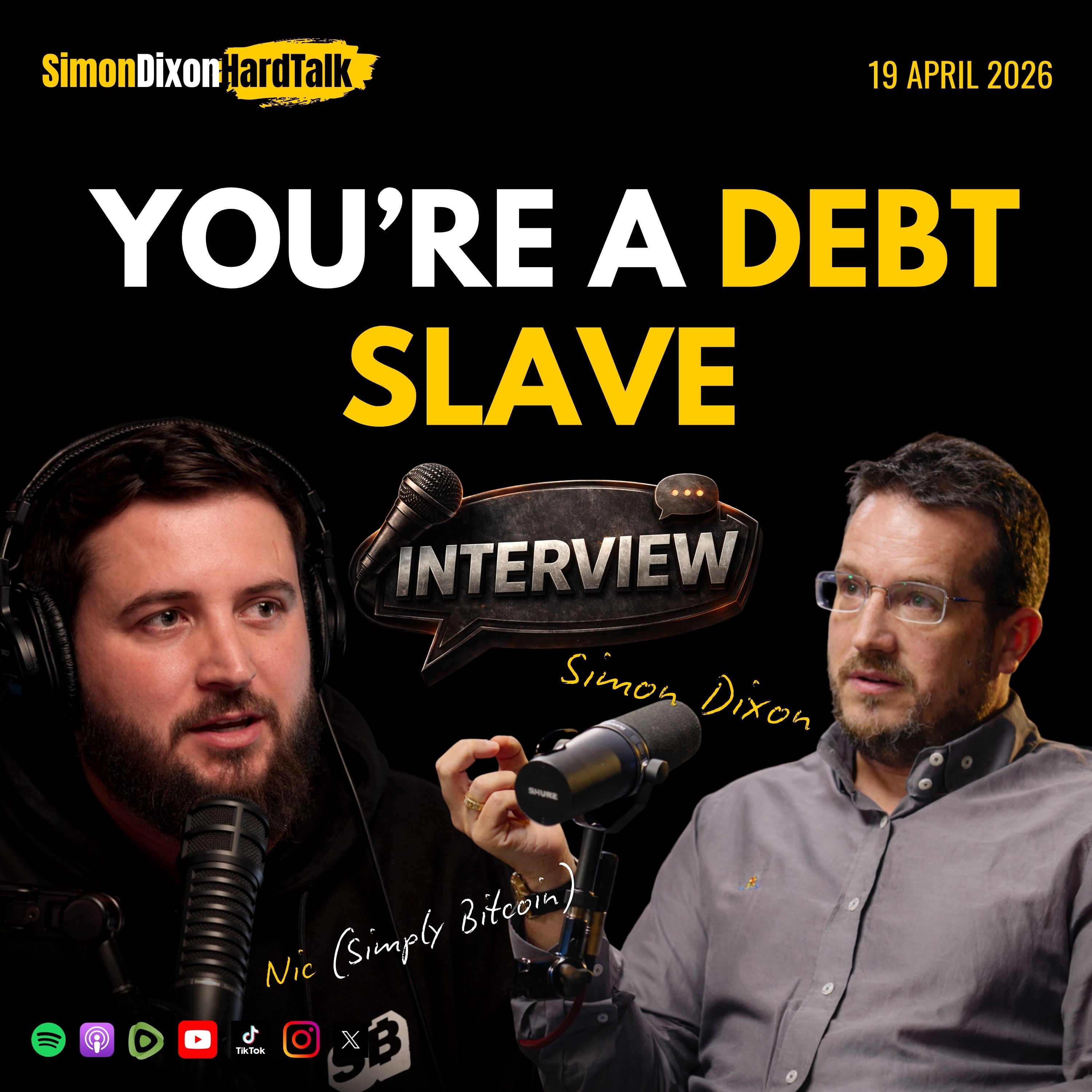
Simon Dixon Hard Talk
How The Banking System Turned YOU into a DEBT SLAVE | Simon Dixon on Simply Bitcoin (19 April 2026)
01:07:40
Loading summary
Transcript35 lines
- [00:00]
A
So in part two, I did an interview on Simply Bitcoin, which we're going to play right now. And if you want to understand why this, why this keeps happening and why the debt keeps rolling over, I answered all those questions in the interview and why it's always the same players that are always winning because sadly people are playing the game wrong. Once you understand the rules, then you know how to win. So you have to understand the system and it's only through understanding the system that you'll do that. So in part two, I answered that question on the Simply Bitcoin. I go through the financial industrial complex structurally, if you haven't watched some of my previous videos, the debt based system, how it works, why it's a Ponzi scheme, the governance, you know, as the different tools of governance and of course bitcoin as the exit. So enjoy Part two, how the banking system has turned you into a debt slave. My interview on Simply Bitcoin and this was aired on 19th April 2026. Always remember you're alive at one of the craziest and most interesting times in financial history. Some are going to get wrecked, others are going to do really well. I want you to be on the right side of that change. Peace. I'll see you next week. I have to take people to a dark place because.
- [01:31]
B
No, let's do it.
- [01:32]
A
Once you know how the system works, you know how to win. And so here's how we win. We're not going to fix the system, but what we can do is absolutely. Commercial banks, they create, you know, dollars, pounds, euros every time they issue a loan. And in order to issue more loans, their first goal is to turn every single individual into a collateralized debt obligation by getting them addicted to debt, either via mortgages, via credit cards, via student loans, via inflation that doesn't increase at the same rate of their wages, you effectively turn every individual into a debt slave. They socialize the losses across all the individuals of a nation and, and they privatize the gains. Your vote doesn't matter because they have access to the deep state. And so once you understand this, you realize it's a big club and you're not invited.
- [02:26]
B
We're not in it. Yo. Welcome to another episode of Simply Bitcoin irl. I haven't done one in a while, but I have the one and only legendary Simply Simon Dixon. Thank you for. Thank you so much for joining me.
- [02:42]
A
Pleasure. Thanks for having me. Again, what are we going to be talking about today?
- [02:46]
B
Well, I mean, Simon, this is the first episode I've, I've, I've ever had with you personally and I've just been a huge fan of all the content that you've done for, you know, not only your channel, but a lot of the other content creators in the space. And I think your view on things, especially because of how much time you've been in the industry, Simon, are very unique. And I think it's people that, I think it's important that people pay attention to that specifically. So you've coined the term, you know, financial industrial complex, which kind of reminds me of the military industrial complex. And you, you're making the case that basically that is what we are up against. So, you know, for our viewers. What are you talking about when you say that?
- [03:32]
A
Yeah, so many people. I've spent probably the last 25 years of my life directly working in the financial industrial complex, fighting the financial industrial complex from both a political, business and investing level as an activist investor. And that kind of drove me to bitcoin and also academically, you know, teaching and learning what this concept of a financial industrial complex is. And really it has captured all western governments, it has co opted governments that effectively manage to keep their resources and build sovereign wealth funds and it cooperates with sovereign governments like the Chinese Communist Party, which effectively is a government where no one is above it within their, you know, within their ecosystem. And then you've got the other extreme, which is somewhere like America or uk where the government are fully subordinate to this financial industrial complex. So what does it consist of? Well, at the base layer it is the creators of fiat currency, which is the commercial banks. And those commercial banks, they create, you know, dollars, pounds, euros every time they issue a loan. And in order to issue more loans, their first goal is to turn every single individual into a collateralized debt obligation. And that means that by getting them addicted to debt, either via mortgages, via credit cards, via student loans, via inflation that doesn't increase at the same rate of their wages, you effectively turn every individual into a debt slave. Now some people take that debt and they purchase assets and they're able to beat the inflation. Most people take that debt and they consume and they end up in an ever increasing cycle of debt. And even as they succeed, as they become higher and higher up in a corporate ladder, then they end up with a better house on debt or a better car on, on debt or rolling over debt to purchase assets and it's just effectively a never ending cycle of debt. Now some people take that debt and they build a company and that Company basically then gets co opted by a cycle of the financial industrial complex. Initially it may be venture capital where you give away some of the ownership of your company to investors. Then maybe your company succeeds a little bit further and you get access to the private equity or the private credit markets. But the ultimate goal is to turn you into a Wall street vehicle and Wall street rapper by taking you public. And then once you're public, as you go further and further up the ladder, they try and load you up with bonds and corporate debt and junk bonds and various other things. All of them make you subordinate to a governance structure where you need more and more capital to grow. As you grow further and further, you then need to be included in the index funds. And as you go further and further up their cycle, you realize that it's the index funds and the investment banks and the bond market that controls you, your board, your governance structure and your mission. And so this is through the investment banking sector, the private equity sector, and you know, the, the, the venture capital sector. Then what happens is effectively they need a mechanism for investing, but they don't want to use their own money. They can create money through their private, you know, through the retail banks, but then they also want to manage people's money. And so they create insurance products, they create pension products, they create endowment funds where they can influence the university education system, they can influence the state governments, but effectively they manage these large pools of capital that gives them trillions of dollars that they can then allocate and dictate the flow of capital via the asset management industry. Finally, when they take bets with your money and when they create money and they need the whole system to be guaranteed because the entire economy is subordinate to this structure. And so they have a central banking system. And within the central banking system they effectively every time things go wrong, they socialize the losses across all the individuals of a nation and they privatize the gains. Then they need to control the government. And so when the government effectively borrows money, they want to be the lender of the money and they also want to be the recipient of the money within their portfolio. And so we have these lobbies which effectively rent the Senate, the Congress, in order to control the politicians and direct the flow of money printing into their corporate entities that they own shares of. And then finally they need wars. Because what happens is once the individuals are all in debt and the companies are all subordinate to your debt and your debt capital markets and equity capital markets, and the government is subordinate to your debt, you need mechanisms for making sure that that debt continually rolls over forever in a Ponzi scheme because there's never enough debt to pay off all the money. And the currency actually is debt. And so you need that to continue. And so the mechanism for doing that is effectively the military industrial complex, a group of military companies that create war. And what they do is they have underneath them access to intelligence agencies in the deep state. And those deep state intelligence agencies are able to bribe judicial branch so they can manipulate the law in their favor even when they get it wrong. And effectively at the very top of this, they install board seats into all public companies. They have shares in virtually everything. They become the number one shareholders via ETFs and managing the pension money. And effectively they control every aspect of government, every aspect of corporate, every individual that's in debt. And whenever it goes wrong, they socialize the losses and privatize the gains until eventually they dump all the debt on the government and the people. And then they need to create an inflationary cycle, reset the empire and go find a new world order in order to do the cycle again. You know, they did this with the Dutch, they did this with the British, they've now done it with the Americans. And now we're looking at a transition into the next structure of the financial industrial complex. So what do they have to do? They then have to co opt every country so they partner with any country that keeps their resources and they get sovereign wealth funds and the ones where they can destroy all their resources, privatize it, securitize it, tokenize it, burden them with debt, destroy their currencies through currency wars. They effectively make their central banks a member of the central banks of central banks, which is the bank for International Settlements. They burden them with debt through the International Monetary Fund and then they bail them out through the World Bank. And this is the financial industrial complex.
- [11:17]
B
Absolutely fascinating. And so many things that I would think are not interconnected are all interconnected. And I was just connecting the dots while you were talking about that. And it's true BlackRock and Vanguard do own a big portion of every Fortune 500 company. It's true that essentially, you know, the Federal Reserve essentially bails out the United States government every, every so often. It's true that they, we, we see this trend of continuous wars and there's really no good explanation for it until, you know, you laid out what you laid out. We had what I think what really opened my eyes Simon, was we had this so called outsider that ran on the platform of ending the wars in the Middle East. You know, he really moved the Overton window in his famous debate back in 2016 where he said he called out the Iraq war, which is something that you're not supposed to do, survived an assassination attempt, you know, came up with this cabinet that was bipartisan. He had RFK Jr. He had Tulsi Gabbard, and then within a year, within one year, he essentially transformed into George W. Bush 2.0. And then once again, the United States finds itself in another war in the Middle East. So. And Simon, please, you know, correct me if you think I'm wrong here, but it almost feels as if elections really don't have consequence. And it almost feels like it is not a country, you know, by the people, for the people. I think as long as there's a central bank in place, it's going to be a country by the government for the benefit of the government. What is your take on that?
- [13:04]
A
Yeah, it's one step further. And this is where people really get confused because I'll call it the FIC now rather than the Financial Industrial complex. So the FIC also fund all the universities and the education. So they turn doctors into drug dealers, they turn economists into debt dealers. And they basically co opted all of the economic models that came from previous literatures. And they kind of said, you know, the world is either socialist, communist, capitalist or fascist and the Wall street controls them all. Also all of them, they engineered and created them through wars, but it's a false illusion. And so people look at these different models and they think it's the government. The government has two functions in a system that's fully captured by fic. The first function is they are a piggy bank. Their job is to create a new narrative of how the money gets from the money printer or any budget that they benefit through the bond market, through the government there, over to the corporate sector. And they just need to say, whatever. If you're on the left, you say social programs. Who manages those social programs? The big insurance companies and the fic. And then if you're on the right, you say, oh, let's create a deregulated environment. And, and then in that deregulated environment, you reallocate all the money over to favorable terms for the fic. And so the FIC goes on an M and a spree. They're able to monopolize further. Miraculously, they pretend they're trying to like be conservative and pay down the debt, but because the dollar is debt, because money is debt, you can't pay it down. And so you have these little gains like the Department of Government Efficiency where they pretend they're going to pay down the debt. And what do they end up doing? They actually end up just giving all the data to their portfolio companies like Palantir, because they control the surveillance state and the technical industrial complex, the tic, and they put budgets from the Pentagon over to the military industrial complex, the mic, and they own shares in all those companies. And so the government is a piggy bank for the financial industrial complex. They go, they receive all the yield on the bonds, they manage all of your money and they control the governments. The government also performs a second function which is that, well, a couple of functions. One is that they create an illusion that they the the budget that they need is from your tax. Tax is actually just a way of taking money out of the the system and dampening inflation. And so if you want to control the inflation to a certain degree, you need to find new ways of taxing people. And that takes money out of the system to dampen some of the inflation. But they never use it to balance their budget because particularly in America, the dollar is the debt, the currency is the debt, and the largest export of the FIC is debt. And that's why you got up to almost 40 trillion in the case of America. The third thing they do is they create a narrative where people think they have a democracy and they get a say and that their vote matters. Your vote doesn't matter because they have access to the deep state and the deep state engineers and controls the media. And the media creates a strategic tension of left and right. And so they just go ping pong left to right throughout that. And they're a battering ram. Their job is just to create a narrative. And each time they create a narrative in a new election, you get pissed off and think you need to regime change. And so you regime change and you either go further to the left, further to the right, and you keep going and you look and you blame the politician. They're so stupid, they're incompetent. Most of them are highly competent that you just don't know who they work for. They work for their lobbies. And so whenever I look at a politician, I just go down the list of who their largest funders are and I predict what I think the agenda is going to be. So the government are a battering ram, a mechanism for dampening inflation through tax and a piggy bank. Their job for the FIC is to dump all the debt on the people and make sure that that money goes into propping up their share prices until they control most of the assets. And so governments are irrelevant other than performing that function for the fig. And people, People get very confused by that.
- [17:56]
B
Yeah, no, and it's extremely confusing, Simon, to say the least. And I, you know, I really, you know, for me, I even, you know, and I've been in bitcoin for a decade, but I even went, fell for the, for the, you know, because I saw it, you know, the questionable 2020 election and then, you know, Trump, the assassination attempt, the epic picture of saying him, fight, fight, fight, fight, fight. So I even fell into the whole, you know, left and right kind of debate. But what I've come to realize this year, and I think you've, you've really had your, your finger on the pulse on this for a very, very long time now, is the elections are inconsequential. There is no left and right. I completely agree with you in terms of the legacy media being used as a tool to divide and conquer, right? When the left is in power, the right wing media is like, it's the left fault. When the, when, you know, when the right is in power, the left wing media goes, and it's the right, the right's fault, the pendulum swings, so to speak. But that, that mechanism that you just described continues, you know, continues doing what it's doing. Why do you think not enough people have woken up to this reality? Because for me, it was really this year that I really woke up to it. I didn't have a lot of faith in elections before. I think as a bitcoiner, you inherently believe that the solution to this is to opt out. Putting your bitcoin into self custody, that's really the most powerful vote you can make. But do you think that the Overton window is shifting enough? Do you think that people are finally coming to, to that realization? Because from what I'm seeing is Trump's base is completely divided at this point. You have, you know, independent media, like Tucker, like Candace, you know, like the big ones, right? They're, they're basically saying, like Trump, what are you doing? You know, you betrayed your base and then you turn on Fox News, you live in a different reality. You know, they're like cheerleading him along. It's Looney Tunes. It's crazy. So is the Overton window shifting? Do you see people waking up to this reality? Are they still kind of stuck in this matrix?
- [20:12]
A
I think people have been more awake than they ever have in their lifetime. But it's generational, so a change in the Vampire is not really something we all live through. Most people die before an empire changes. So everybody that's awake today is finding out what a regime change looks like. And the FIC is executing a regime change right now. And so what that looks like is things like we are experiencing. You need to the British people, up Until World War I and through World War I and World War II, they thought that the Brits were civilizing people, exporting democracy, and they were beacons of freedom and goodness and civilization. And then when we had World War I and World War II and there was a regime change from the bank of England to the Federal Reserve, from the, you know, the Dutch East India Company to the British East India Company to the military industrial complex in America, and then later blackrock State street in Vanguard. People, you know, it's not until the end that you realize, oh, the British Empire was evil. And then the history books are rewritten. And then you have to go through a undo all of the media manipulation and education manipulation that you did to make people think that they were doing good through this whole time. And so we're going through a re education camp within America now. That's not because they're like, okay, we need to change America is because they're systematically doing a managed transition away from dollar as world reserve currency to a world of multipolarity. And so within that, you need to deconstruct everything that propped up the dollar. There are several mechanisms that propped up the dollar. One of them is the Japan carry trade, which was leftover mechanism from World War II when you installed the bank of Japan. There was also the installation and regime change around the German central bank after the, you know, the Hitler regime was taken out. The governor of the Federal Reserve was also his brother. The Wahlberg family was also the leader of the Rice bank, the German bank. So Wall street was effectively funding fascism. It also executed a regime change within Russia where it replaced the saw with the Soviet Union and created the Communist Manifesto that was funded by Wall Street. They also switched over to the Federal Reserve System. So you had fake capitalism, Communism and fascism. And that made the strategic tension and the justification for all the war. Then you need a narrative. You need the Soviets to believe that they're fighting. You need the fascists to believe that they're fighting. You need the capitalists to believe that they're fighting. And you need them all to believe that they are effectively in a holy battle for good and they're on the right side of history. So you write history to that effect. And so The American empire was built upon that, but now they're deconstructing it. So you break the Japan carry trade, you break the euro dollar which was based upon Germany being a manufacturing base and that required cheap energy. And you break the petrodollar, which is what we're witnessing right now. You also have to regime change some of the powers that propped up the dollar. The quote unquote deep state, which was covert wars all around the world via funding mechanisms like USAID and the National Endowment of Democracy. You say you install someone as president that's taken down the deep state. And when you take down the deep state, you take down the constructs that propped up the dollar so it looks like you're doing good. That was the Doge operation. Then you also need to have a mechanism for ruin. Every relationship that propped up American hegemon power, that was tariffs. And so tariffs renegotiated every relationship, made all the small business, many small businesses in America go bankrupt because it was a tax on American small business, allowed foreign organizations to put transnational capital to purchase infrastructure that was going bankrupt as a result of the exports and tariffs and also drove everyone towards China's manufacturing base. And so you need to frame America as a destabilizing force and China as a beacon of stability. And so there's been lots of operations. Tariffs was the perfect one to do it. Then you need to systemically wipe out the morality of what people believe. That was the Epstein files. And so by releasing the Epstein files, you make everybody understand that much of this blackmail network, the propped up corporate America was actually an evil blackmail and pedophilia ring. And actually it was weapons trafficking, humans trafficking, sex trafficking and everything that people, normal people think are disgusting and you effectively destabilize the empire. Then you need a global reset event. That's what we're experiencing right now, which is the closure of the strait of hormones which leads to the changing and repricing of 50 different commodities energy. And that sets the new world order. So in the 15th of May 2020 this year, Trump will be meeting with Xi Jinping. And the outcome of that was effectively will be the next world order that will mark the change. And Trump delivered that. Because then you look at, well, who benefited from this? You have a look. Well, it was the countries that actually had nationalized oil, that's Iran and Russia. It was the country that had the manufacturing base and everyone's exports were dependent upon, that's China. And then it was the private corporate interest that managed to get new LNG contracts And new oil contracts. That was Chevron, Exxon, Cheniere energy, which is 70% owned by Qatar, 30% owned by Exxon. And golden, sorry, golden pass is 70% owned by Qatar. And then Cheniere Energy as well. And so when Trump says we're kicking ass, we're taking on China, we're closing the streets and we're getting all the energy, America has all the solution. America doesn't have a sovereign world fund. America doesn't benefit from it. American private corporate interest, or big oil, which represents 1% of GDP benefits, but 60% of GDP, which is the American people suffer because they pay the inflation, which just came in at 4%, and then they also pay the increase in the debt which is about to come in at 40%. And where did that money come from? The military industrial complex. They got 1.5 trillion stimulus check. The financial industrial complex. They own all of the different companies and they get a concentration of power because this will lead to a big print just like after the global financial crisis. And what else will happen? Well, the civil unrest that results from this food insecurity, you know, supply chains that break down lockdowns is operation warp speed 2.0, just like Trump did in term one. Who benefits from that? The technical industrial complex with their police and surveillance state. So what did Trump do? He put the PayPal mafia in through the Department of Government Efficiency. He created effectively what is now our social credit score through X. And now, and now today they announced that everyone's going to be trading and doing financial services and stablecoins through X. That's your social credit score. They said freedom of speech, but not freedom of reach because they weren't censoring anymore. They wanted us to talk so we could build our score. They then did Genius act and Clarity Act. They did stablecoins and then they handed over the yield to the banks and the financial industrial complex. The tech companies needed to apply for banking licenses in order to pay yield on their stablecoins. So they had to join the Federal Reserve System, which is the number one shareholder of the bank for International Settlements effectively. And you know, and, and also you get the stimulus check for the military, the massive money printing for the FIC, and then the police and surveillance date for the ticket. Who is Trump funded by now? Let's look at the lobby that installed him. The number one funder was Elon Musk. So Elon Musk got, you know, he got his, he's a node in the tick. The second biggest funder was the banking dynasty of the Mellon banking family. Fic. And who was the third largest funder? Mariam Adelson. Mariam Adelson is connected with Israel. Israel is a node for the MIC to create war in the Middle East. And so you get a mixed stimulus, a fixed stimulus, and a tick stimulus. So Trump's job is just to take all of this and make it look like it's for the American people. MAGA. And then you get psyops by the CIA like Q, where people think he's playing 5D chess, so they start publishing every move, and his MAGA base just becomes the. The lowest denominated idiot in the end because things just get worse and worse and worse. And then suddenly you say, well, he's working with China, he's working with Russia, and lo and behold, we get a multipolar world. And he has delivered. Now he will be known as, like, a traitor. He created a war. Everyone will be confused. But that's because you thought he worked for the American people. He worked for the fic, and he did a great job for the fic. And everything he's doing is rational because they're cashing in and they're doing incredibly well. And the people are paying the debt and they get the inflation. And so once you understand this, you realize it's a big club and you're not invited.
- [31:00]
B
We're not in it, Simon. So you're blowing my mind right now. And a lot of these things, again, I'm connecting the dots while you're talking. And again, it explains a lot of the actions. Right. That he's making. That, again, as you said, are confusing. Right. They don't kind of make sense.
- [31:16]
A
Who.
- [31:16]
B
But you did describe earlier on in the, in the conversation how this has been happening since like, basically it was World War I, then World War II, and it's kind of like this kind of regime change that happens every. Every cycle. Who, who, who are the puppet masters here? Like, who are the. The main beneficiaries? These, like, you know, rich families. Where are they based out of, like, you know, who. Who's really pulling the strings?
- [31:43]
A
Yeah, people want to think that this is some organized cabal that never changes. It actually is a ruthless game of backstabbing, and it is a governance structure more like a Mafia. If you continue to add value to the Mafia, then you continue to rise in the Mafia. If you don't. If you don't continue to provide value to the Mafia, then you get knocked down. The Mafia. And what does that look like? Well, everybody, as they climb the ladder, needs to be integrated into a compromised network. And so that's why you saw so many names in the Epstein files. You know, there are blackmail networks, there are compromised networks, but mainly it's done through capital. So then you look at who's on top of capital. Well, originally it was the Dutch. You know, is the Dutch that created this construct with the Dutch East India Company, the limited liability company, the stock market and the bond market that came from the Dutch Empire. Then when the Brits created a superior military fleet, they took over the constructs. We had the British East India Company, we had the bank of England, and we bankrupted the British government. And then once we got to the bankruptcy phase, you need a change of empire. So World War I was that. And so during World War I, effectively you created what later became Israel by the Rothschild family. And you know, that was to destabilize the Middle east and get access to oil. You then did the Bolshevik Revolution, which was to get access to Russia's oil. And then you created the bank for International Settlements to manage Germany reparations into the British Empire and the American Empire. And then the Federal Reserve System was the precursor to making all of that happen. Then you needed a pump cycle, which was a debt leveraging event, the 29 cycle. Then you needed a Great Depression where the Fed rug pulled everybody and ended up concentrating all banks into a smaller and smaller number of banks rug pulling everybody's wealth. You go into a Great Depression, which is effectively a wealth confiscation exercise. You steal everybody's gold, you take Germany's gold, you take the British colonial gold, you take Russia's gold, you put it in the Fort Knox and the Fed, and then you steal the American people's gold by making it where they have to hand it in and gold ownership illegal. And then you effectively need a World War II. The winner of the war gets to rewrite history. So everything we were told about World War I and World War II was completely false. But then you have an event, a New World Order, as it were, which was Bretton Woods. And so Bretton woods effectively was where you had this military industrial complex. Now what happened at that time, you had the wealthy European families, the Rothschilds, the Warburgs, all the legacy, you know, the Medici families and all these various wealthy families. They became the shareholder class in the managed transition. And so they ended up with shares in many of the banks, many of these different things, but then a different, you know, a manufacturing base and a military companies. Lockheed Martin, General Dynamic, Raytheon, Boeing, they all became really important. And so you manufacture strategic tension. Communism versus capitalism, the Cold War. This is to make sure that you can continually fund wars. And then we entered into that power change. Now what happened is when they entered into the Korean War and then the Vietnamese War, based upon the communism versus capitalism argument, they funded Europe, they split it up, and they funded the rebuild on both sides. They effectively entered into a phase of bankruptcy, which was 1971. They regime changed JFK into Lyndon B. Johnson. Lyndon B. Johnson started continuing the Vietnam War. The Vietnam War bankrupted the US Government. And then what they said is, now, you know that promise that we made where everyone can convert their dollars into gold at the imf, you kind of can't do that anymore. So everybody changed it. Where your currency is not backed by gold, your currency is backed by dollars, our dollars are backed by gold. But now you can't exchange them for gold. And so we entered into the next cycle, which was the petrodollar. So now you had military being important, legacy finance being important, and the shareholder class. But when they managed to actually default and remove the gold standard, we entered into the rise of FIC as a primary power. Now what they needed is a mechanism for propping up the death. And so they created the petrodollar. This is when the CIA assassinated King Faisal. Israel pushed and created a destabilization force in the Middle East. You had the Yom Kippur War. King Faisal then did an oil embargo that led to the the in 1973, the stagflation. And that also led to an intelligence network called Safari Club that laid the construct for what later became 911 via Saudi intelligence, Israeli intelligence and the CIA. And then they created the fake war on terror as the next mechanism so that you could always have strategic tension in the Middle east and push the narrative away from communism versus capitalism to the war on terror. But it was propped up by the petrodollar. You had to ensure that none of the countries in the Middle east could unify around their oil resources. And King Faisal was the last one that did that. So they assassinated, regime changed and created the petrodollar. Now the petrodollar said every time you purchase oil in dollars, you must purchase US Treasuries, lend it back to the US government so that we can roll over the debt based Ponzi scheme. And effectively that went right through to Trump administration one. The debt went spiraled, spiraled, spiraled. We had the fake war on terror, we had 911 in order to justify the narrative that led to Patriot Act. Then you had fake anthrax operations to say it was Saddam Hussein and Iraq. Then you had Iraq, Sudan, Libya, you know, all, everything that led to basically Iran, where we are right now, all of that was a mechanism for rolling over the Ponzi scheme and extracting wealth and dumping all the debts on the US government so that the American people could pay for it. That creates extreme wealth inequality. And, and you had complete subordination of government by the FIC because as soon as you went away from the, the, the gold standard, there was no, there was no resistance on the da. There was no mechanism for any country doing anything. So then you had the dollar milkshake theory where all of the countries were lending and buying treasuries. Treasuries became the most liquid and backed up by the petrodollar. But what happened during Trump administration? One massive change. America became an energy exporter and energy neutrality. That broke the petrodollar. And so the deep state, effectively the UNI party had to regime change from that moment because now what was happening, the Gulf countries, America didn't need the Gulf countries for energy anymore. And so now you've got America competing with the Middle east to export their energy, oil and lng. And so where did the Gulf, where did the Middle east go? Well remember China joins the World Trade Organization and effectively America set about asset stripping all the American people and creating a hyper financialized economy. They wanted to financialize, securitize and later tokenize every aspect of America. And then they outsourced all the manufacturing to China. And so China built the manufacturing base to the point where the military industrial complex couldn't create a weapon without China. And so China then managed to get all the rare earth minerals with Africa and all these different things that we're seeing right now. And the military industrial complex game, fully subordinate to FICC and FIC now didn't need the petrodollar and the Gulf sovereign wealth funds. Where were they getting all their money? They were selling all their energy to China. So China now says hey, we don't want a Middle east that props up the petrodollar for America. We're going to create BRICS and de$ize. And so the uni party set about creating a managed transition away from the petrodollar system by strategically weakening the dollar. So they broke the Japan carry trade slowly. They used Trump in order to ruin the European relationship with NATO and then they broke the petrodollar with the, you know, with the Gaza genocide and the Iran war.
- [41:23]
B
Wow, lots to Unpack there, Simon. I want to take, you know, because I want to take the rest of the podcast to insert a little bit of optimism in here because, like, clearly, you know, as. As you've so eloquently described and how I've noticed as well, clearly, you know, the American people, I would say most people in their countries don't really have control over the destiny of the future of their countries. I think, I think we can all agree to that at this point. It's clearly undeniable. But what I would say is, Simon, I think there's two elements that I'm seeing that I think have. Have changed the game, so to speak. First was the rise of social media and the ability for us to have these types of conversations and then these types of conversations directly sent to our viewers, therefore bypassing the gatekeepers of information that I think governments were used to having for, I would say, until the age of social media. And you saw how much pushback they really gave when the majority of people started consuming information via social media rather than the legacy media. And then the other, I would say, pivotal shift that I think is coming is the disintermediation of kind of money and state. Right. And I think we're in the very early innings of that. Do you think that those two things, the disintermediation of information and the disintermediation of money, are going to play a role in people really getting. Reclaiming back their financial sovereignty? And when I mean that, I don't mean, you know, reclaiming back, you know, the. The nation state. I think the nation state is a. Is an aged model, in my view, but really reclaiming financial sovereignty over themselves. All right? And then, of course, that gives them the ability to vote with their feet, go to more favorable jurisdictions. Where is bitcoin fit into all of this? Like, what's your take?
- [43:28]
A
Yeah, absolutely. I have to take people to a dark place because.
- [43:34]
B
No, let's do it.
- [43:36]
A
Once you know how the system works, you know how to win. The biggest problem in the world is that the people that are winning, those that control the fic, which is, as I said, a network of wealth that is transnational. It doesn't have an America first agenda. It doesn't have a European first agenda. It doesn't have a UK first agenda. It doesn't have a Canada, Australia first agenda. It is complete asset stripping for the fig. Okay? Once you know that, you realize, so our government are captured, they don't work for us. That's not going to change. You're not going to change it. The only way you change it is by playing the rules that they play by. And the rules that they play by is that they buy the politicians. And that's what the lobbies do. They know that politics is a pay to play system. And so that's the only game that you can win. You vote with your money. Now immediately most people think well I don't really have any money, you know, I'm in debt or I've got money, but what do I do? I think the most important thing to understand is that the wealthy are going to change the system. So you're either wealthy or you're not. But it is only the wealthy that get to play the political game. Once you know the rules, you focus where you can make a difference. How do you impact the wealthy? You impact the wealthy by boycotting the constructs that allow the thick to have their power. And that's what everybody can do. Everybody can do it. When I first discovered how this system works and it's been a Life obsession for 25 years, the first thing I tried to do was get involved in politics. And then I realized that the politicians weren't going to listen to anything. I was asking politicians to change the system when they were being paid by the people that I was trying to take their power away from. Useless. So then I tried to like be involved in, you know, teaching at the educational system. I got chucked out of London School of Economics, I got chucked out of Birkbeck, I got chucked out of University College of London. You know they just, the, the university was the establishment. They don't even teach you how money works in reality in economics because they're training you for the debt based system for the fig. So then I said why don't I create my own bank, a non fractional reserve bank where people could own their money. I got rejected by the bank of England. They said you need $60 million to continue this business plan. 60 million pounds. And then they said and also you need to build it on top of another bank. So they said you can you build it on Barclays. So, so I'm saying, so I want full reserve but I need to take my customers full reserves and put them in a fractional reserve bank so that they get the money. Okay? Yes, that's how the system works. So all right. So then I was like can I get direct access to the bank of England? And they said no, you got to have a full banking license. So basically then I realized there's no point in that. This is the point when I discovered bitcoin. This was 2011 and I was invited to the first Bitcoin in Prague. And bitcoin was about $3. And I realized, wow, this technology exists outside the system. It was all the things I was trying to create in a bank. Money you can own, money you can spend and then money that has a fixed supply that takes on the central bank from the debasement and money printing. So then I set about investing in all the companies and I invested in Coinbase, Kraken, bitstamp, Bitfinex, Circle, over a hundred different companies in the sector. They all became went public and became banks. And so they became a part of the establishment. Then I started looking at investing in other people. They all became Bitcoin treasury companies and subordinates of Wall Street. Then I started looking how can I use my bitcoin? And I put some money in Celsius and realized that these are all scams as well that are trying to get you to borrow against your Bitcoin. And I just went through the whole cycle and realized that our sector keeps getting sucked in and sucked in. And then they came a mechanism for getting everyone to leave their Bitcoin in custody with coinbase and a BlackRock ETF. And BlackRock ended up with the most profitable ETF based upon Bitcoin. And everyone kept buying microstrategy shares or a Bitcoin ETF and then borrowing against their Bitcoin. And then everyone was giving Wall street more power with their Bitcoin. And so here's how we win. They will use Bitcoin to make their system more powerful. I've submitted to that. We're not going to fix the system, but what we can do is opt out and boycott the system, which is exactly how Bitcoin was designed. So you can home mine if you want to compete with the central bank. You can hold it in self custody if you want to compete with the custodians. And you can buy Bitcoin if you want to compete with the Fed. And then you can take your wealth and you can join a lobby if you want and try and change the system once you're wealthy. Or you can just opt out of the large FICC portfolio companies and go local, support your farmers, support local spending, support your local communities wherever you can. Don't borrow against your Bitcoin unless it's part of a managed plan and it's the minority of it. So you can boycott the Fed by owning Bitcoin, you can boycott BlackRock by holding it in self custody rather than ETF. You can boycott the banks by not borrowing against it. You can boycott transnational capital multinational institutions by building your own parallel supply chains. Once you become sovereign, get out of cities, go urban like build your own parallel systems, parallel networks, build your own decentralized social media platforms. We contribute to that, invest in companies that are investing the real battle. There is no borders, there is no country. This is a technical industrial complex, police and surveillance day that is being built by fic. And the best you can do is exit and just don't support it. And we were given that gift. Satoshi Nakamoto Open source this project, I believe originally this was meant to be intelligence agency project and it was got. It came out as open source code. And that open source code had many, many infiltration attempts at centralization. There there were hard forks to try and put us onto a new chain. There were trying to get us into stablecoins. There were attempts to centralize developers through funding different companies. There were every attempt, there was centralization and mining, there was all sorts of stuff. But the network remained as decentralized as it could be. Where there was a geographically diverse network of bitcoin miners in countries hosted in countries that hate each other, some private, some public, some sovereign, some national, some international, some decentralized around different structures, we managed to keep the node networks where we could keep the miners accountable. As long as you run your own node, we were able to fight back against the custodians by opting out of the exchanges. And every time someone left it in an exchange, they got rug pulled and they started rebuilding in self custody, having more resilience by owning their own bitcoin. And when every time they tried to infiltrate the developers, we get competing implementations, we get competing node structures, we get hard forks, soft forks, we get an open source boardroom. When we take our eye off the ball, somebody comes along and says hey, why were they doing these things? You know, why was. Who are the developers? We need to understand more about them. And suddenly we get all those attention. So all this to say I am extremely hopeful and grateful that we are able to exit, we are able to boycott. And I spent my whole life and it wasn't until 2011 that I discovered there was actually a way of doing it. And anybody can do it. And all you need to do is implement some simple rules, spend less than you earn, invest the difference in sovereign assets. If you want to do a gold in self custody, fine. But bitcoin in self custody is where you can exit your country when Your country gets too oppressive, you can send it to anyone in the world. When you want to support new supply chains anywhere in the world. You can self mine from anywhere. You can take cheap energy in one country and you can plug into a self mining network. You can memorize a phrase and you can take that with you wherever you want to go. And nobody can take it unless they physically get you. You can spend it in a innocent until proven guilty system and no central bank can debase it. That changes the world for you. If you use it the way Bitcoin was originally designed. But they're going to try and steal it. They're going to psyop you into custodians and centralization. And we've all learned it. I fell for them all. The reason I can share this is because I've done everything wrong in bitcoin in my 15 years of being involved. So I have massive hope. And what is the future of the world? The future is decentralization. No doubt about it. We need decentralized social media. We need to take what we did in bitcoin. We need to take level layer two payment networks. And the only people that are going to make this are sovereign individuals, sovereign companies and sovereign countries. And as these big constructs break down, have no doubt about it, this is the deconstruction of federal government structures replaced with transnational control grids. It's only the people that are opt out that are going to have the skills of owning their own private keys and the security of knowing how to protect themselves. And there's only going to be a few people that do that sadly. And you're the ones that are going to be the elites that effectively bring a new form of responsibility and so build those parallel systems because it's at the end is you, your family, your community and the people around you and the systems you build. And Bitcoin is the base layer for that.
- [54:16]
B
Amen. I absolutely love the way you articulated that Simon. And know I've, I've said many times, right, it's, it's bitcoiner slavery. If enough people, if enough of us take self custody, we'll win and there's no nothing they can do about it. So I haven't spent 25 years going down the rabbit hole you've gone down. But you know, in the decade that I've been, I've, I, I, it's interesting to me that I've, I've come to these very similar conclusions. And also too I think Simon, this particular cycle, I think the thing that troubled me the most was the financialization of Bitcoin by that complex. And the conversation moved from this revolutionary, this revolutionary zeal that was happening. And you felt it on X, you felt it in the community. You felt people really wanted this change. And it became about which again, a lot of these people are my friends, so I'm not trying to pick on any of them. But it became about the treasury companies, it became, you know, about the ETFs, that, that was really what was popular in the news cycle. And if you make content, you, you, you, you, you kind of have to talk about the things that are being discussed in the news cycle. And I think this last, this previous cycle, it was the paper bitcoin summer, it was bitcoin financialized. And I think a lot of people forgot why we are here. We are here to fix the money, fix the world. And the only way you do that is by buying bitcoin, earning bitcoin, mining bitcoin and putting that bitcoin into self custody. That has not changed. Right. Of course you can take risks with a small percentage of your portfolio, but ultimately they are risks. And ultimately you have to be aware that it doesn't equate to Bitcoin and self custody. Right. And you have to acknowledge the risks that come with whatever it is that you decide to do.
- [56:22]
A
Yeah, the right way to frame that is, you know, you have spending money. Most people need money in a bank. They can't take currency risk. You want to minimize that to risk manage. But then you have saving. Bitcoin is my savings, but if I then do something with it, I use it as collateral or I purchase a share instead of a Bitcoin or I hold it an exchange. You no longer have Bitcoin and so you now have some kind of investment vehicle with counterparty risk. And you know, it's not bitcoin at that stage. So anytime you do something with your bitcoin, it's no longer your bitcoin in most cases. And so that's the way to think about it.
- [57:09]
B
Absolutely.
- [57:10]
A
It's a form, it's a form of
- [57:11]
B
iou, I would say. And again, there's the counterparty risk that you're talking about. But I love how this ended up going full circle. Right. You started describing exactly, you know, who runs the world. Right. What is the actual situation in terms of, of people and their governments. And then we ended with the solution and, and now I, I kind of want to end the podcast with this. Simon, what is your vision for the world? You know, 1020 years from now, as the bitcoin ethos and the adoption of bitcoin inevitably spreads, I, I fundamentally believe that bitcoin is not just a financial innovation, Simon. I think it, it is not only a revolution, but I also believe that it is a political and cultural movement as well. Specifically if you have bitcoin in self custody. So with all that being said, first of all, do you agree? And second of all, you know, where do you see the world 10, 20 years from now?
- [58:16]
A
Yeah. So I think, to quote Lynn Order, nothing stops this train. And by nothing stops this train, we are shifting to a world of multipolarity. Nothing's going to stop that. So we're not going to have one dominant hegemon and one dominant empire, which means we're going to have multiple currencies, which brings multiple, you know, rails that are needed in order to facilitate a world of multipolarity. We're already starting to see that the largest sovereign bitcoin miner in the world, Iran, was able to build sovereign wealth as a jurisdiction and immediately when they wanted to change and accept currency for opening shipments in the straight of a moose, bitcoin was the currency that they could accept. And stablecoins was the one that got confiscated and the money in the bank was the one that's frozen right now. And I'm not talking about circumventing sanctions because sanctions were lifted. That's not legal advice or anything like that. You know, you need to understand what you're doing. I'm just saying that that's the, you know, that's an. It gives you a glimpse of what the world is in for now. Sadly, I would love to say, and I, I've debated Jeff Booth before, who I'm sure you've had on your show, and he believes bitcoin's going to fix everything. I don't subscribe to that. I think bitcoin is going to create a next cycle of elites, and your job is to become one of those elites and the rest are going to hold it in custody and make the FIC more powerful. And I don't think anything's going to change that. And so it's going to be a small minority of bitcoiners that will stay to the bitcoin ethos and with that responsibility becomes the responsibility that comes with you being an elite, if you see the cycle all the way through. So what do I think the future of the world is? Well, the fall of the US Empire into a regional hegemon rather than global hegemon. I think is inevitable, predictable, guaranteed from here because fix doing it. And so that means that effectively is the rise of the countries that are on the wrong side of the bomb. And so America was on the right side of the bomb and everyone else or a lot of other countries were on the wrong side of the bomb. So remember, capital flows and so you will see other currencies outperform the dollar, you will see other stock markets outperform the S and P. But in a neutrality world, you've got bitcoin and you've got gold and those two exist. And so Bitcoin allows you to ride this wave wherever it goes, but you can also take that wherever you want to go because there will be losers, winners and we will enter into a new empire. People think like a fourth turning is the end of all the world. No, it's going to get worse and worse. The living standard in the west is going to get worse and worse. Nothing's going to change, nothing's going to change out the, the FIC is going to extract everything that it can, but it's going to redeploy that capital into the global south where the populations are Africa, the country that was on the wrong side of the bombs and the extraction, you know, Southeast Asia, those countries are going to rise. China's going to be investing around the world, it's going to be a different thing. I'm not saying you live in China, I'm not saying you have to like what the CCP is, but China does not have a track record of trying to bomb the world. So you don't have to live in the places to benefit from that. But you need to be sovereign as a sovereign individual. And that's what bitcoin enables for you. Absolutely. So to me, sadly, it's not going to change the world, but it's going to allow you to exit and you as an elite, you can try and change the world. And that's what I think you can do 100%.
- [62:01]
B
And I agree with, I agree with, with, with that because, and I've talked about this as well, right? Like I think that as bitcoin continues to increase in price, if you define what someone, an ultra high net worth individual, there's about a quarter million of them on earth, someone who has $30 million worth of assets or more and if Bitcoin reaches a 300 or 400 or $500,000 price point, about 30 to 40% of those individuals are going to be bitcoiners, Right? So and those individuals that are worth that amount of money and more are really the ones that have the most amount of influence in society. Like that. That's undebatable. Now, my, my question to you, Simon, and I'm sure the audience is going to enjoy this question, is how much bitcoin do you need to be in the new elite?
- [62:57]
A
Yeah, I think it's very individual. Depends where you live, depends on circumstances. I think everyone should try and play the, the cost arbitrage. Make sure you live somewhere where the costs are lower. You earn somewhere where you can take advantage of that arbitrage. You need to maximize the differential between your income and your expenses. And you need to own more bitcoin every month and you need to do that for 10 years and you need to not deviate that. And you don't need to look at the price. If the price is going down, great, you're going to have more bitcoin. If the price is going up, then your fiat net worth is going up. Just think of it like that. And mine as much fiat currency in order to get as much bitcoin so that you can exit the system. It's impossible for me to say, you know, for you, because people have different, they've got different responsibilities. You've got college, you've got families, you've got countries like, you know, I can't give that type of financial advice. Your job is just to own more this month than last month and do that for, for at least 10 years and we'll come back on this podcast if we're. I'm sure you'll still be here in 10 years. And I did that for the previous 10 years. And, you know, since $3, I've been telling people to do that. And my network of millionaires, billionaires, elites, people that got wrecked and everything, you know, are people that are actually changing the world behind the scenes. And so, yeah, you know, set yourself a goal. What's right for you. Like, get, gain some financial literacy, learn how to read your personal balance sheet, your personal income statement. Take on, really take. This is a, I'll leave you with this thing. Look, when I was deep in debt, because I, I, I, you know, I was deep in debt when I first discovered bitcoin. You know, for me, I had like £250,000 in debt. When I first discovered bitcoin, I'd felt my business was rinsing me. I'd left my job. My last bit of credit card debt was to go and speak at that first bitcoin conference. It was my wife that actually put, you Know, allowed us to take our last bit of money, scrimp together a flight and go and speak at that conference. But I had to make a decision, and I'm not saying this is the right decision for you because there's consequences to it, but I just defaulted on my debt and decided to buy bitcoin instead.
- [65:25]
B
I did the same thing. I maxed out all my credit cards
- [65:29]
A
in 2016 to buy Bitcoin. Yeah. So I defaulted on it all and just bought more bitcoin because I needed to break the cycle somehow. I'm not saying that's right for you. There's consequences, there's fights, there's all sorts of stuff. But the things they don't want you to know is how this system works. Because you know what breaks the system? What breaks the system is when you don't pay your debt. Because the whole thing is debt.
- [65:55]
B
And of course, this is not, this is not financial advice. Right. We're not giving financial advice. We're not, you know, we're not talking about all of that. We're just talking about our personal experiences. Simon Dixon.
- [66:06]
A
I did come back and pay it, for the record. I came back and negotiated a settlement, but it was only once. I had a few years in order to get bitcoin.
- [66:14]
B
Of course. Yeah, because then it negatively affects you. You can't get a car, you can't, you know, the system, you know, essentially excludes you out of it unless you, you know, you settle it. But Simon, it's been an absolute honor. You know, I've, I've, I've heard you so many times, not only on your own channel, on other podcasts, but it's been a pleasure to actually have this conversation with you myself. So I really enjoyed it. Thank you so much for coming on and hope to have you on the show again in the future. Thank you.
- [66:46]
A
Yeah, thanks for having me. You can follow me on X. That's where I kind of give real time updates. I got a YouTube channel and what I found is I do very long analysis on bitcoin, Tech, money, geopolitics, sometimes like three, four hours every week. It's like a discipline for me just to keep me doing it. But I kind of break. I found I trying to use AI to get like take my four hour rant and put it in 10 minutes. And so I publish those on my blog, SimonDixon.com no sponsorship, no monetization, no business model, no products or anything. I just do it because I want as many people to be a part of this as possible. Because I think we got some rough times ahead. And you need to know a storm is coming so that you can build your house, prepare your house, get your raincoat, get your umbrella, because everyone else is telling you it's going to be fine. It's not going to be fine. You need to prepare. Love it.
- [67:39]
B
Well, thank you so much, Simon.
- [67:40]
A
Appreciate it.