← Simon Dixon Hard Talk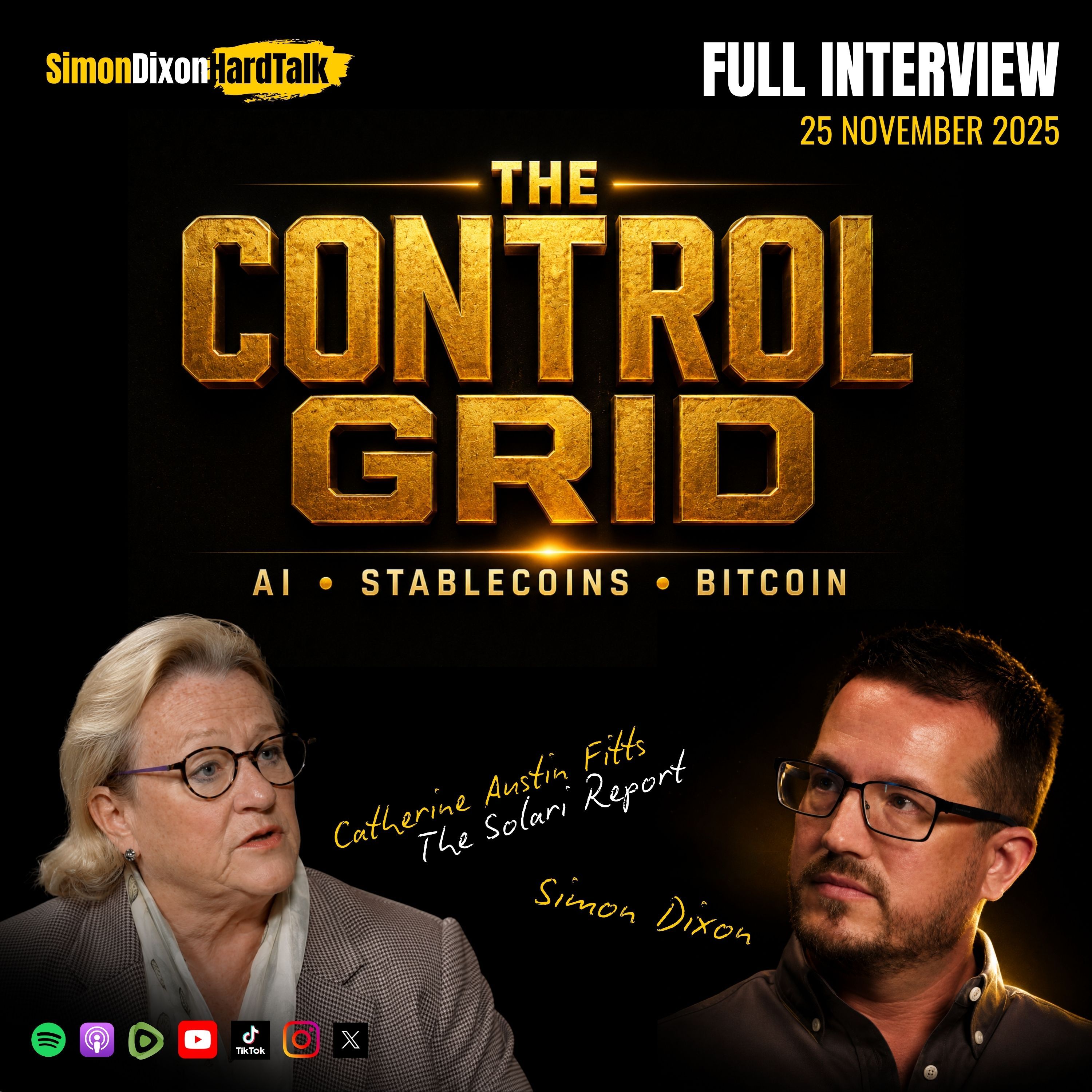
Simon Dixon Hard Talk
The Financial Reset: AI, CBDCs & Currency Wars | Simon Dixon with Catherine Austin Fitts
02:36:01
Loading summary
Transcript372 lines
- [00:00]
Host
Foreign.
- [00:14]
Catherine Austin Fitts
Ladies and gentlemen, welcome to the Solari Report. I'm joined today by somebody I've been listening to for a long time, Simon Dixon. I will tell you, Simon and I have two things very much in common. We both left investment banking disgusted by the corruption and we were seeking freedom and our pathways have been different. But I think Simon, you and I are sort of looking for the same thing. How do you navigate an unbelievably corrupt financial system? And I really appreciate everything you've done to bring light to that and everything you're doing to try and help people be free under the circumstances. So many things to talk about. Some of your background. After you left Investment Banking in 2006, you created back to the Future. That was the title of your book on bitcoin or.
- [01:02]
Simon Dixon
Yeah, so I wrote a book on bank, bank to the Future and we tried to create a non fractional reserve bank called bank to the Future as well.
- [01:10]
Catherine Austin Fitts
But now bank to the Future, if you go to the bank to the Future website, it's a fintech firm, correct?
- [01:15]
Simon Dixon
Yeah, we're actually just manage assets. So we invested in all the major companies in bitcoin and we're not open to new customers. We were investing in the industry when, before Silicon Valley and everyone came in.
- [01:28]
Catherine Austin Fitts
But you have extraordinary experience in investing in bitcoin companies. So you've invested in the exchanges and you know a wide of wide variety of bitcoin related companies. So you have a lot of experience as an asset manager and investor and venture capitalist in the bitcoin area, right?
- [01:46]
Simon Dixon
Yeah, I mean, yeah, invested in about 100 companies. Some of the big names, I won't tell you the failures, but some of the big names are Coinbase, Kraken, Bitstamp, Bitfinex Circle, Ripple Labs, Robinhood, Blockchain.com, exodus. So some of the biggest names in bitcoin were in that portfolio amongst the failures.
- [02:10]
Catherine Austin Fitts
Right, well here's what's interesting though. You've learned a lot from failures. So it started with your dad losing his pension fund in the dot com bubble, which I can't imagine how frustrating that must have been. I was very frustrated during the dot com bubble and then. But you had one custodian fraud essentially, or one fraud in the bitcoin space or the crypto space. And you lived through the bankruptcy experience, which is quite an extraordinary experience.
- [02:40]
Simon Dixon
Absolutely, yeah. So my journey in finance began when my father spent his whole life going from, you know, rags during World War II in Bristol and then making his first £1 million throughout his whole life, and then losing the whole thing in the stock market. And so he didn't know what he was doing. And he asked me, son, who's got my money? Where is my money? And I didn't have to answer that question. So I spent the 20, the next 25 years on that journey answering that question for my father, which he actually passed away in 2002 on the day that Celsius, the Ponzi scheme and fraud that I was a shareholder in and invested in, closed its door to 650, 000 victims after it was a CR,
- [03:33]
Catherine Austin Fitts
wasn't it, a crypto firm? Or if it was 2002, that would have been too early.
- [03:38]
Simon Dixon
Did I say 2002 to 2022.
- [03:42]
Catherine Austin Fitts
Right.
- [03:43]
Simon Dixon
22 three years ago.
- [03:45]
Catherine Austin Fitts
Right.
- [03:45]
Simon Dixon
And yeah, so. And that was that took 650,000 victims, some of whom lost their entire lifetime savings by investing in Celsius by a fraudster called Alex Majinski, who's been serving 12 years now. But in that whole experience, I learn how Corrupt the Chapter 11 system is as well.
- [04:11]
Catherine Austin Fitts
It's unbelievable.
- [04:13]
Simon Dixon
Yeah, yeah. So that was, you know, I, I read 4, 000 documents, every single court documents, attended every single court hearing virtually and participated in the process on maximizing the recovery for all those victims. And that, that took about two years of my life. And, you know, fortunately, bitcoin had treated me very well. My father lost all his money from fraud, and then he passed away on the same day. So I kind of dealt with, dealt with my bereavement by losing myself in a, in a Chapter 11 case and helping many, many retirees and pensioners that thought there would be no return. Some committed suicide, sadly, others had to move countries. But we maximized what we could from the recovery using Bitcoin and law and Chapter 11 and many of the nuances from it and making sure justice was served. And justice was served.
- [05:19]
Catherine Austin Fitts
Yeah, you're lucky, though. I was an Investment Advisor for 10 years after leaving investment banking, and I helped a couple people clean up for Madoff, and it's just extraordinary to watch what can happen and what did happen. Okay, well, let me keep going. You had one of the first books or the first book on bitcoin, but now you have a very successful podcast called Bitcoin hardtalk. You're on 107th episode, am I correct?
- [05:50]
Simon Dixon
Yes. And I go live every week following the money. This week in bitcoin, this week in macro, this week in geopolitics. And some people don't know how, you know, technology, macroeconomics, and geopolitics actually all connect. So I connect all the dots and follow the money each week.
- [06:07]
Catherine Austin Fitts
Yeah, it's one thing. I like to do the same. Okay, so we're going to dive in and I want to start with stablecoins because stablecoins is something that, you know, I watched the Fed work on potentially doing a CBDC and then flip the framework with treasury into stablecoins that could be set up to be programmable money. Something I'm very concerned about. But, but clearly indicating that stablecoins is going to help them accept dollar dominance. But if you look at their projections. I know, and you spent a lot of time looking at stablecoins and I think you understand it very well. If you look at their projections, they're basically. Bassin is saying he expects to issue 3 trillion by the end of the decade. Now, at the current deficit run, you need 10 trillion by the end of the decade, not including what you need to roll over the huge amount that you've got with short maturities. So 3 trillion is just a drop in the bucket. So my question to you is, do you think that they're planning on being able to issue way more than the 3 trillion they're talking about?
- [07:18]
Host
Yeah.
- [07:18]
Simon Dixon
So this relates to Genius Act. So what I'll do is I'll answer that question and go back to history of stablecoins a bit and then bring it to where it is now. But Genius act is the new regulations under the Trump administration. There's a couple of key clauses that the bank lobby made sure that they got. The first was that you can take the reserves at the Fed and you can use them to back a stablecoin. And so there's approximately 3.5 trillion at its peak. There's. It went down a bit to 2.8 trillion recently, but obviously from the government shutdown, we had this treasury account and all that stuff and craziness on that side. But the point is there's about $3 trillion that in theory, through Genius act, can be turned into a stablecoin as long as you have a banking license. And so that is the way of ensuring that the stable coins and leveraging up the reserves can, can, can happen. And also, if you have a banking license, you're able to play yield directly on your stable coin. So to understand what stable coins are, it's worth studying a bit of the history. So I, I invested in a company called Bitfinex and they were the ones that acquired the first ever stablecoin that they later changed the name to. Tether and Bitfinex, essentially it was really hard to go from one exchange to another because if you put your dollars in one exchange, then to try and get it back into banking and arbitrage and go to another exchange, you'd probably get your bank account shut in the process and you wouldn't be able to orb. It might take you three weeks to get through that, which is useless. And so essentially Bitfinex, the exchange purchased some technology and rebranded it Tether, I think it was originally called True USD or something like that. And they realized that through this mechanism a lot of the other exchanges started using Tether as an alternative to, to having a bank account. Because when you're running an exchange the hardest problem is the banking relationship. And so, you know, other exchanges took the fact that they didn't need a bank account and launched and one of them was Binance. And so in 2017 this little arbitrage, stablecoin became the backbone of the banking system for Binance. And Binance became the largest crypto exchange in the world, now with about 3, almost 300 million users. And they built the whole thing because they didn't need to deal with a banking issue. But that burdened Bitfinex with the banking issue. And so we ended up in a scenario where all the banks then shut down the banking behind Bitfinex and Tether. And at one stage Tether was getting governments that would seize certain bank accounts. And then that meant that the way that Tether was designed is you issue a coin and every coin is backed by a dollar. But you obviously don't leave billions of dollars in a bank account because your FDIC risk is through the roof. So you have to then relend it to the US government by buying short term Treasuries. And so they have to be short dated because if somebody wants to redeem their tether, you know, for those dollars, then if they don't have those reserves in cash at a bank, they need to sell the Treasuries and then settle the dollars. And that was kind of, you know, the idea. But once you went into Tether, very few people went out. And so they ended up with billions and billions of dollars and today are now the 18th largest lender to the US government.
- [11:21]
Catherine Austin Fitts
Right.
- [11:22]
Simon Dixon
And then they would take the yield that they would receive because these, you know, sending a digital dollar is easy as sending an email in kind of an innocent until proven guilty system. So they could be freezed, they could be censored, they could be, they're subject to all ofac Rules, but you could send them and then if you, you know, you're, you're innocent first and then they have to prove you're guilty and then freeze them and seize them. So that was very useful, particularly in countries that wanted to protect themselves and use a digital dollar, couldn't get a bank account. And so what they would end up doing as the yield on short term Treasuries went from the ZIRP environment to a higher environment, higher interest environment, suddenly they became the most profitable company in the world.
- [12:12]
Catherine Austin Fitts
Right. And they weren't sharing any of the float with the customer, were they? Right, right. So they got the whole float.
- [12:17]
Simon Dixon
Yeah, so they got the whole yield. And then they'd take the yield and, and buy bitcoin and invest in bitcoin mining operations. And so they'd end up, you know, building all these bitcoin mining operations around the world. They'd have, you know, and then as, as the price of bitcoin went up, they never needed to sell the bitcoin. And so it reached the stage where, you know, they were more profitable than BlackRock and Citibank. And, and they only had like a hundred staff. And so it created this incredible arbitrage between the dollar and bitcoin where essentially in the end, through this crazy set of turn of events, the US government was paying Tether to hold one of the largest bitcoin positions. And this kind of realization of what happened with Tether led to the realization that you can create these neo fintech banks. The government realized that they could find a new home, roll over debt.
- [13:20]
Catherine Austin Fitts
Right.
- [13:21]
Simon Dixon
And then other companies realized that they could try and use similar arbitrages to end up with bitcoin on their balance sheet and companies like strategy and various other things, but it all came from that, that little thing.
- [13:33]
Catherine Austin Fitts
Yeah. And also what you've got is you've got the Fed that's trying to, to coming out of the pandemic is trying to drop its treasury position because you, you, you've gotten shorter and shorter. You've got more to roll every year. And foreign, and most foreign investors are downsizing their treasury position. So you are very eager to find new markets. And essentially what you discovered is that with a stablecoin you can basically turn treasury bills into a little currency. Right.
- [14:08]
Simon Dixon
And then you look at the scale. So the market's about let's say 300 billion now. But you, you talked about the big numbers. So there's $10 trillion to roll over. So you know, it's kind of the stablecoin Industry is comparable to about the amount of tariff revenue that had come, that has come in. So the, these incremental improvements are not changing the model. So what we're witnessing on the macro environment right now is they need to roll over their debt. You know, and we're seeing this big spike in terms of Cayman Islands as the largest foreign lender to the US government, which we know is a tiny economy. So that's all the hedge funds and shenanigans that are happening in the background.
- [14:54]
Catherine Austin Fitts
I always believe that they, they basically worked with a hedge fund. So the hedge funds could take, you know, could borrow short, lend long or, or borrow long lunch or, you know, they could work the federal credit arbitrage and finance their position. And, and basically if you look at how they interacted with them, it was a no risk position on their part.
- [15:15]
Simon Dixon
Yeah, absolutely. And so we're witnessing that, you know, essentially this is just an ultra financialized and the government is just subsidizing all this rampant speculation and stablecoins is just another mechanism for doing it. So the Trump administration via his family launched their own one and they started doing, you know, Trump doing all these covert deals which would combine tariff with foreign direct investment with issuing a stablecoin with Gulf countries looking to build like a tax neutral kind of stablecoin rail between America, right, and the Gulf countries. And then obviously that ties into all the massive geopolitical shifts because the Gulf countries historically were there to prop up the petrodollar, but now America competes as a energy exporter. And so where does the Gulf get all of its sovereign wealth that's making all these investments? Well, its largest customer is China. And so you've got Chinese money via golf tax neutral jurisdictions with stablecoin rails facilitating all of this foreign direct investment where essentially the Gulf countries are buying up America. And then you've got these deals that the Trump administration are doing. I'll dive into one. Basically the Abu Dhabi and UAE Sovereign Wealth Fund. They wanted to invest in Binance, which we talked about the largest exchange that was essentially taken down by the doj. The founder CZ got a four month sentence, but clearly managed to negotiate turning Binance into an asset. Because one of the conditions of the settlement after paying the $47 million fine was that the US would become the US department would become the compliance department for Binance. And so there was this massive data extraction exercise on these 285 million accounts. And then the Abu Dhabi Sovereign Wealth Fund said we'd like to invest $2 billion in Binance and so after Trump went and did his tour of the Middle east, he came back and said, well, if you want to invest in Binance, do it via my new stablecoin through a company called World Liberty Financial that The Donald Trump Jr. And Eric Trump have created with Steve Witkoff as the main investor, the envoy to the Middle east that's negotiating these deals and said, you put $2 billion in this account, we'll buy Treasuries while the rate's artificially high. That gives us $60 million of passive income every year. And then we'll issue $2 billion of our stablecoin USD1. Then Binance will support that stablecoin as one of their stable coins. CZ will get pardoned. And now we've facilitated $2 billion a trade by doing one of these deals. And so every time you hear about these foreign direct investment and these crypto policies, you can just follow the money and figure out what's happening here. But essentially there is capital outflows, the Gulf of buying up all the assets. Trump is facilitating the reverse IMF strategy, as it were, where the Gulf countries are buying and you've got these crypto rails and stablecoins that are being built. And then at the same time there is a big macro policy. What's the macro policy at the moment? Well, it's fiscal dominance, it's spend the economy, screw the economy, everything's on the stock market. Roll over the debt as much as possible, invest as much in these AI contracts, these military contracts. Make sure that they circulate around the stock market to get these GDP prints, make the GDP print look great, make the stock market look great, and then simultaneously basically knock the interest rate down 300 basis points is the stated goal to about a quarter of a percent. Essentially you're inflating away the debt, you're screwing the economy for those that own the assets. You're making that K shaped economy go like crazy. And then you're going to get the stable coins and the pension funds in a deregulated environment with all of these lower interest rate Treasuries. So you're asking the stablecoin issuers and the American people through these Cayman island elaborate schemes, deregulation to subsidize below market debt in an environment where the U.S. government and U.S. treasuries have never been riskier. You know that because the 20 year and 30 year treasuries, they're going up, you know, they, they require, they're fluctuating around this 5 and 6%, 4 to 6% depending on the duration. But he's trying to get the short term treasuries at 0.25% which essentially means, you know, fiscal dominance. Stablecoin issuers dump it in the pension funds and just run this crazy, crazy experiment of the rich getting richer and the poor getting poorer, which is just leaving to this extreme populism and very unstable, you know, economy that we're seeing witnessing right now.
- [21:10]
Catherine Austin Fitts
So I don't know if you ever watched Tim Dillon, but he's a comedian who does sort of a new show and he says, he said we used this in the annual wrap up. He said under Trump, America's become. And he kind of looks off in space and he says an auction, unfortunately that's fair.
- [21:30]
Simon Dixon
I mean, you know, essentially presidents are what narrative do we need to tell people in order to sell bonds? They're all bond salespeople. I think it was Scott Besant that said my job is I'm a bond dealer. You know, that is my job. And that is accurate.
- [21:45]
Catherine Austin Fitts
Well, but here's what's interesting. If you, I haven't, I haven't done a complete survey, but if you look at certainly state pension funds, they've downsized a lot from the treasury market to, to buy private equity. And if you think they would have gotten clocked on their treasury bonds, where do you see what's happening to them on private equity? It's worse.
- [22:04]
Simon Dixon
So I'm very familiar with private equity because that's where, you know, on Bitcoin, private equity was my game.
- [22:12]
Catherine Austin Fitts
Right.
- [22:13]
Simon Dixon
And the challenge with private equity is the lack of ability to price, but the way you price it because, you know, at bank to the Future, we always had to give, you know, we, we have to submit to our regulators what is the value of the assets that you are custodying for your customers. And therefore we'd have to make a price on an illiquid asset. And the methodology you'd have to use is mark to market. But where is the market? Well, it's the last funding round or maybe someone does a secondary trade. And so you have these elaborate ways of trying to figure out what is the value of these very highly illiquid assets that may take seven to ten years to mature.
- [22:54]
Catherine Austin Fitts
Right.
- [22:55]
Simon Dixon
And in the end you find out that the way most people market is they use you engage in a smaller secondary trade where two investors agree to trade with each other that sets the price. But it could have been via some covert mechanism that two of your LPs or sophisticated investors traded with each other just to Set the price, then you market to market. And then now, if you're able to dump that into a deregulated pension environment, you can essentially have these valuations that at some stage, with private equity, we had about a 25% hit rate, which is one of the best in the industry. But 75% of those are going to be marked to zero at some stage. And that is a very inappropriate mechanism for pensions. But obviously you talk about it as if we're bringing access to all the big deal flow to you, but no, it's exit liquidity. That's exactly what it's going to be.
- [24:01]
Catherine Austin Fitts
Right, okay, so back to stablecoins. Here's the question. I don't know where you were in 1989. Where were you in 1989?
- [24:13]
Simon Dixon
I was nine years old in Bristol.
- [24:16]
Catherine Austin Fitts
So you probably don't remember when the wall came down in Berlin, there were great discussions that it was going to take 10 years to unify Germany. They would have to have negotiations and treaties and everything else. And the Chancellor just literally in the first, very early on just said, okay, we offer a sweet premium to the East Germans to come in the Deutsche mark. And literally the country was unified overnight through the currency. Now, if you look at what the US says it's going to do with stablecoins, it's basically going to go out and try to offer stablecoins to every citizen of the planet who can access through the mobile payment systems, you know, through Apple, Pay, Google, pay, whatever can access stablecoins and get them off of their local currency and onto stablecoins. Right. So you're basically making a tender for 8 billion citizens and saying, get off your currency. Come on, our currency. Now, the question that I don't understand the answer to is how many countries can stop you from moving on to a US dollar denominated stablecoin? Does China, I'm assuming China has the hardware to stop this?
- [25:27]
Simon Dixon
Yeah, this is an ultra, ultra interesting question because it does come back into the capital controls and then it comes into a conversation that I think we both have aligned in from studying your content, that we're actually who rules the world and who's making these decisions? Is America really sovereign? Is America America first? And I've spent a lot of time in trying to answer that question. How can we, particularly in the uk, how can you be in an environment where there's record mental illness, there's low birth rates, there's drug addiction, the bins aren't being collected anymore, there's clear immigration operations in order to create Racial and religious tensions, and yet there's still $3 billion to defend democracy. And Senator Zelensky, you know, how, how do these two things compute? Well, they don't until you figure out who's actually in charge. And our governments are not sovereign, right? So the, the, you know, Kyustama does not work for the British people. Trump does not work for the American people. You know, Macron does not work for the French and Mertz doesn't work for the Germans. They actually work for their lobbies and that pay for them. And their lobbies are corporate interest. And within corporate interest, you have what I try to classify as powerful factions. The most powerful is what I call the financial industrial complex. That's the banks, the money printers that create the dollars and the euros and the pounds. They own the Federal Reserve. You have the private equity industry, you have the venture capital industry, and you have the investment bank that financializes and securitizes everything. And then you have the ability to control all of that access, you know, the passive investment flows, which is the ETFs and money managers. And so ultimately, on the top of this power structure is the sovereign wealth and the money managers, because everything's public and every politician is for sale through lobby. And so ultimately you have this financial industrial complex which can, you know, vassalize all of what looks like, you know, you think Tesla is a powerful company run by the richest man in the world, like Elon. But actually he's, he's, he is allowed to be the highest net worth person, right, as long as he gets those Pentagon budgets and various other budgets into the right place. And then they will lend him money against his stock in order to keep him in the network, as it were, because they can knock you off the network by sending the hedge funds on your share price, sending the derivatives complex on you, and then it can make, you know, they can give you a margin call. So through this access to capital, you have this financial industrial complex that actually, you know, is able to control many of the levers.
- [28:35]
Catherine Austin Fitts
So one of my nicknames for it is the financial bazooka. Your face is a financial bazooka.
- [28:41]
Simon Dixon
Yeah, I use a few words. Financial weapons of mass destruction, financial terrorism. I like financial bazookas. And so, you know, these are useful terms in really describing what is a reality.
- [28:54]
Catherine Austin Fitts
Right?
- [28:56]
Simon Dixon
And so then you ask, right, well, you know, what is the goal? Is the goal really to save the dollar? Well, when I look at what a company like BlackRock, State street and Vanguard are doing, I see capital flows that are pricing new financial products in foreign currencies. I see policies that are being influenced in order to weaken the dollar. And so if you push this stablecoin strategy, you have this tension between strengthening the dollar and weakening the dollar. Now, if you weaken the dollar, you set a series of events, you know, kind of reverse. Bretton was two, which is, you know, if you're a country like Saudi Arabia, you've got vast sovereign wealth, you've got resources, you've got trade surplus, you know, you've got fiscal surplus, you've got. What do you. What are you going to do when you're, when your currency is pegged to the dollar? Well, if you weaken the dollar, you have to actually sell Treasuries and sell your gold reserves to protect the peg.
- [30:04]
Catherine Austin Fitts
Right?
- [30:05]
Simon Dixon
Now, you might do that for a little bit of while. But if you look at Saudi Arabia, they're actually, you know, through the Gulf countries, they're the largest investors in BlackRock. They have Saudi Aramco CEO has a board seat on BlackRock. And so you've seen this partnership between the Gulf countries and the financial industrial complex emerge. And so therefore, at some point, the financial industrial complex can send monetary policy wherever it wants because it's banks are the shareholders in the Fed. It dominates fiscal policy. BlackRock, a lot of the fund managers use Aladdin as their data Sources, which is BlackRock Technology. Treasury uses it, the Fed uses it. And so you've got all these data feeds that go out to all of this vast network of capital. And when I look at what they're signaling by following the money, they're signaling that they're trying to weaken the dollar and they're trying to push it into multipolarity. And so what I see right now in this chaos is a tension between different factions, because while the financial industrial complex is the most powerful, there are other complexes. There's the military industrial complex that was more nationalistic, that was create wars globally in order to get the world addicted to IMF debt through covert operations. But it was all about propping up the dollar, strengthening the dollar. And then you have the technical industrial complex, which is all the data feeds, all the surveillance, all of the back doors into nsa deep state. And that works its way up to military. And so you have these power factions that are often aligned. But I believe right now we have a tension between strengthening the dollar through military industrial complex operations, technical industrial complex operations like stablecoins, but ultimately the financial industrial complex. They want the world to be, I believe, multipolar, which I think is a conclusion you came to and they want to partner with these different blocks. And so ultimately they will win, which to me translates into a weaker dollar breaking the pegs, dismantling the petrodollar, dismantling the euro dollar and supporting the petro yuan. So that eventually the Gulf countries can sit between the BRIC blocks through the GCC blocs and be at the center between America as a regional power dominating the region. But the dollar needs to be shrunk to a regional currency. It's no longer the global hegemon.
- [32:48]
Catherine Austin Fitts
They seem to have concluded that the one world thing doesn't work. And you need these, you basically need America running North and South America and China and Russia running the other block.
- [33:04]
Simon Dixon
Yeah, with the Gulf sovereign wealth in the middle with tax neutral and then rails. And so this is why there's a push to essentially, you know, figure out what is the forever war model is coming to an end in the Middle East. Now that's framed as Trump is the president of peace. I know this is the financial industrial complex which has been negotiating to say, right, the military companies, which, they're all public companies as well. So they have voss the finance rule rules all in the end. But they enter into these games in order to determine the outcome. And I believe that the money managers hedge all the outcomes. You know, they, they hedge, they, they could use the deep state in order to escalate attention, you know. But more and more of those cover operations have been failing because there's competing powers. That means that, okay, more and more of our operations are failing.
- [34:01]
Catherine Austin Fitts
Right.
- [34:01]
Simon Dixon
And so what we can do is let's, let's enter into these games which is, you know, things like the Greater Israel Project, Ukraine, and let's create as much chaos as possible so that the finance companies and the Gulf countries can enter into this negotiation. And the Gulf countries are saying, we want regional stability, we want control of our region. The financial industrial complex is saying, well, if I'm going to stop the military and the Greater Israel Project and the Forever War Project, what are you going to give me? And so they're negotiating over Syria, they're negotiating over Lebanon, they're negotiating over Palestine, Israel, the entire Levant. And they're deciding who's going to get who, who's going to control what flows. And then now they're essentially saying, and the whole catalyst for this is in that area of the region was the rise of China, right. America becoming an energy exporter, competing with the Gulf countries, and then the Gulf countries getting all of their revenue from selling energy to China and So China came along and said, hey, we can de$ize here. You know, if, if bricks align with the Gulf countries and we play these games and then you negotiate with America in the region and the financial industrial complex, we can get a military exit. And so therefore you had all these signals like Xi Jinping and China came out and normalized between Iran and Saudi Arabia. Now we're getting essentially the full vassalization of Israel, Lebanon, Yemen, all of these regions. And the only way you can do that is to resolve the Palestinian issue, normalize between Iran and Saudi Arabia, stop having the military use Israel as a tool for conflict and destabilization and allow it to be a normal state. And then simultaneously the military, you know, the military. The military exit slowly in exchange for financial stability. And so all of these deals are being negotiated.
- [36:14]
Catherine Austin Fitts
Yeah, so I agree. All these deals are being negotiated. I, I'm not sure they want Israel to be a normal state. I think what they wanted was they wanted to basically clear Gaza, redevelop it, and redevelop it in a way that Israel could be a very big part of what I call the control grid. So a major player in the control grid, but I think you're right, not a major player in basically starting wars all over the Middle East.
- [36:46]
Simon Dixon
Yeah. And that tension in that, that's definitely what they wanted. It was, you know, let's take all of the technology that is completely illegal we could never do in America. We do that via Israel.
- [37:00]
Catherine Austin Fitts
Right.
- [37:00]
Simon Dixon
You know, when these companies need legitimization, they get acquired by Google and, and you know, rolled in.
- [37:06]
Catherine Austin Fitts
Right.
- [37:07]
Simon Dixon
But all the COVID really illegal stuff that we could never get congressional approval for, that's unconstitutional. We do that via Israel. And then, yeah, we want Israel to stop being funded for destabilization and instead gain as much territory as possible. If you can ethnically cleanse the Palestinians. Then they tried to get Egypt to take the Palestinians. They said, well, pardon the $18 billion IMF debt if you take them in. And then, you know, it was. And then Jordan held the fort, Egypt held the fort. But why did they do that? Because there was a competing tension, which is China and brics backing the Gulf countries as the most important customer, saying, no, we want as least power for the financial industrial complex in the Middle east and we want to give you as much power. And we will then reinvest through the Belt and Road initiative in these different tensions. And so that's that Israel essentially is Greater America project for the financial industrial complex.
- [38:12]
Catherine Austin Fitts
Right, right. They're very much part Of. So I, you know, I absolutely agree with that framework. One of the things I do think. There's one story I want to tell you, and then I'll. I'll talk about China in a second. 9 11, literally. So I'm in the middle of litigating with the Department of Justice. And in the process, I'm working with about 12 different major Washington law firms, you know, either on my side or their side, and ancillary litigation. So I'm just dealing with partners from big Washington law firms. I never heard the word Dubai out of any of their mouths. And then the day after 9 11, suddenly they're all going to Dubai like that. It was like somebody hit a switch. And literally Dubai was open for business. And every major Washington law firm was going to Dubai. It was beyond belief and very much a structured, planned phenomena. And to this day, when you move the army to the Middle east, then you can move a lot of other stuff to the Middle East. It's pretty clear. But Dubai was off and running.
- [39:26]
Simon Dixon
Yeah, absolutely. You know, I've spent a lot of time studying his operations. The conclusions that I came to is, you know, there was definitely factions of CIA, Saudi Intelligence, and Israeli intelligence involved in different parts of that. That operation.
- [39:46]
Catherine Austin Fitts
And British Intelligence. British intelligence is always there.
- [39:53]
Simon Dixon
Yeah. You know, MI6 was all over the. You know, the Middle east and Africa and everywhere. Yeah. You know, the. The previous colonies. And so you. Yeah, you had that. And. Yeah, it's. It's. I mean, you can just read the actual FBI, you know.
- [40:16]
Catherine Austin Fitts
Right.
- [40:17]
Simon Dixon
Documents and see the bits that were whitewashed. You know, the Mossad agents.
- [40:23]
Catherine Austin Fitts
I. I was the first person to write it, was. I published it on September 17. That the official story was hogwash.
- [40:31]
Simon Dixon
So amazing. I. I have to go back and learn all of your work and get back to it because for some reason, the algorithms didn't put you in front of me.
- [40:41]
Catherine Austin Fitts
Really.
- [40:42]
Simon Dixon
But as soon as I found your work, I was like, how. How have we not been connected? But the algorithms didn't let us meet.
- [40:49]
Catherine Austin Fitts
Yeah. So my 911 claim to fame was I wrote an article accusing Condoleezza Rice during her official testimony on 911 of lying. And I sent it to Rice, the President, the vice President. It got picked up by upi, went viral, and three days later, I was poisoned and almost didn't make it.
- [41:11]
Simon Dixon
Wow. Okay. And all the anthrax operations are connected to Iraq.
- [41:14]
Catherine Austin Fitts
I started a group called Unanswered Questions, myself and three other activists working with Scoop Media in New Zealand. And we took the position that we can't, we can't, you know, we can't produce an evidentiary train. So we can't, we can't figure out what really happened. But we can ask, citizens can ask questions. And we ran a process where citizens all over the world were sending in and we were batching and bringing forth their questions, including to the commission. That turned into Paul Thompson's timeline. I don't know if you are familiar with his timeline. Essentially what it showed was the official narrative was complete bunk. Anyway, my interest in 911 was there was money going missing from the federal government and many of the offices and buildings involved in that money going missing were blown up. That happens wherever you have financial fraud. You tend to find that buildings with the records blow up. So that was one of the great blow ups. Okay, let me go back to stablecoins. What do you think the possibilities are in terms of what kind of market share stablecoins can build worldwide? Do you think Bessant's $3 trillion is a reasonable estimate or low or high?
- [42:34]
Simon Dixon
Well, again, I think you can. So I think the goal is to turn the dollar into a regional currency, which means weakening the dollar. But if you wanted to get $3 trillion, then you just launch a stablecoin based upon the Federal Reserves. Now what level of adoption it will get, you probably need an operation like how about pay every American $2,000? And now you've done it, you know, right? You can get everyone to have their $2,000 maybe roll over, you know, you know, this is the, you know, this is the, the types of gateway drugs where you download an app, download an app, get your $2,000. It's gonna destroy you anyway because it's just gonna be a stimulus to the market, right? Create more wealth inequality and just, just help the wealthy class. And you know, then if you're smart, you'll put it in assets to try and beat inflation. So that helps the market anyway, right. The rest will just pay off some interest on their debt because it would just give them a little bit of money to pay their bank interest. But you know, but you can get them to opt into the terms and conditions of the stablecoin.
- [43:53]
Catherine Austin Fitts
Right. So I think a lot of the control is going to come through the terms and conditions.
- [43:58]
Simon Dixon
I absolutely agree. Yeah. And you can see where we're creeping up to like with the ancillary companies. So you know, you got the, you got the PayPal mafia. So you've got, you know, you got Elon Musk that suddenly has access to vast data through doge pretending they're going to pay down the national debt. If anyone needs to hear this, the dollar is debt, you can't pay down the debt. You know, the dollar is debt, there is no such thing. If you want to pay down the debt, you'll trigger the depression like we've never seen before. So. And any belief that you're going to pay down the debt without radically taking on the financial industrial complex, reforming the whole system and doing something radically different in terms of money is the only way you can do that. And that's not happening. And this is a rollover scheme, not pay off the debt.
- [44:50]
Catherine Austin Fitts
Right.
- [44:51]
Simon Dixon
And so you've got, you know, what do we do? So we have Doge, then we have, you know, turn all our cars into data with Tesla. Then we have, let's go to the, let's go to the financial industrial complex. Let's make Jack Dorsey sell X. I'll borrow against my Tesla stock to buy it and then co invest with the Gulf countries. You'll start to see that as a reoccurring theme. You got people that are meant to be these entrepreneurs that are the richest people in the world according to, but their net worth is dependent upon their stock price. And the financial industrial complex lends money against their stock price as a control mechanism. And so that's how they get them in compliance and then they always co invest with the Gulf countries. So this is a reoccurring theme, but levered billionaire American entrepreneurs that borrow against their stock in order to invest with the Gulf countries.
- [45:53]
Catherine Austin Fitts
Right. And have to do what they're told.
- [45:55]
Simon Dixon
Absolutely. And so you have to give a backdoor to NSA and then so you get to buy X. Now X becomes the freedom of speech platform. What does that mean? So we kind of did that censorship thing, you know, when we tried to stop people talking about vaccines and everything. It's kind of reached the point where why don't we try something different? Why don't we push the world into this artificial intelligence, you know, push all of these budgets into an AI war with China, which means it's, it's a national security risk if we don't put billions and billions and billions and billions and billions into artificial intelligence and data centers.
- [46:37]
Catherine Austin Fitts
Right. But they're not trying to win the war.
- [46:41]
Simon Dixon
No.
- [46:41]
Catherine Austin Fitts
Right.
- [46:42]
Simon Dixon
Yeah.
- [46:42]
Catherine Austin Fitts
Right.
- [46:42]
Simon Dixon
I don't, I don't think there is a war. I think China already won the war. And this is the execution of the world order.
- [46:48]
Catherine Austin Fitts
Right.
- [46:48]
Simon Dixon
Of multipolarity based upon BlackRock's tariff policy, not Trump's tariff policy.
- [46:54]
Catherine Austin Fitts
Right.
- [46:54]
Simon Dixon
You know, tariff was a perfect way of engineering this, but. Yeah. And so you get freedom of speech, not freedom of reach. What does that mean? Is saying, well, we won't draw attention to your content, but we'll let you speak, say everything you believe in. Talk about Israel, talk about Zionism, talk about how you hate the Muslims, talk about jihad, talk about whatever you want, talk about misogyny, talk about everything that creates massive, massive tensions. You get your freedom of speech, which I'm glad for, because, you know, I'm gonna utilize it while I can. But you're building your social credit score, right? You know.
- [47:37]
Catherine Austin Fitts
Right.
- [47:38]
Narrator
Yeah.
- [47:38]
Simon Dixon
And so Elon was that. And then you've got, you know, Peter Till, Palantir, all of the.
- [47:44]
Catherine Austin Fitts
You know, Twitter's really a honey trap.
- [47:48]
Simon Dixon
Yeah.
- [47:49]
Catherine Austin Fitts
It's really a surveillance device in a honey trap. But I'm with you. I use it while it's still available.
- [47:56]
Simon Dixon
You have to lean into it. You got no choice. We're all in this, right?
- [48:00]
Catherine Austin Fitts
We are all in this. Let's talk about asset tokens and crypto. I have tried for years to understand what the plan is with asset tokens, and for the life of me, I can't figure it out. It was one of the reasons I wanted to talk with you. I can't figure it out. And part of it is usually I think they're making it up as they go. I think the plans are fluid. They're trying things. But I just finished reading the Clarity act for the third time. So the House has passed an act called the Clarity act that if the Genius act regulated stablecoins or set up a regulatory framework for stablecoins, the Clarity act is supposed to create a regulatory framework for almost everything else, including asset tokens. And after passing the House, it's gone over to the Senate, and the Senate came back with a very different version, including a fair amount on something called Affinity Asset, which is regulated by the sec. So one of the issues is what will be regulated by the CFTC and what will be regulated by the sec. So that's one of the issues. Now they're saying they're going to have that passed by Thanksgiving, which is this Thursday. Do you have any idea if the Clarity act really will pass this year?
- [49:22]
Simon Dixon
It's going to pass no matter what. Whether it passes this Thursday or not, I'm not too sure, you know, if I don't get too engaged in the political process of the timing of the passing. But this is going to pass because this is the financial industrial complex's policy Right. This isn't a resistance against Wall street, this is a strategy, you know, for. This is for Wall Street. Yeah, for Wall Street.
- [49:47]
Catherine Austin Fitts
So one of the things that has had me baffled is if you look at how they describe the use of asset tokens, they're very conceptual and very vague. So if you listen to Larry Fink, he's saying every stock and bond, all securities, will have a asset token that mirrors it. And for some reason this is attractive, I'm assuming on the theory that putting it on a blockchain or making it programmable will somehow make the clearance settlement management system easy. But the nuts and bolts of what they're going to do and how they're planning on doing is not clear. It's not clear from listening to them and it's not clear from reading the Clarity Act. Now, in Washington, when we wanted to understand what a bill was before we'd read it, we take the name and then we would invert it. So if it said, you know, community making communities wonderful, it was like, oh, rape and gentrify and plunder places, you know, and so we would just invert the name. So when they call it the Clarity act, you know, you invert the name and it's like, you know, total confusion here. So do you have any clear picture of how they want to use asset tokens, particularly in connection with the securities and derivative markets?
- [51:07]
Host
Yeah.
- [51:07]
Simon Dixon
So firstly, it's important to understand where this came from. So you have Bitcoin, which is a bearer asset. There's no physicality, you know, it exists as maths and code. You can own it on your own device, you can send it, but the, what you're sending is the asset. It's a bearer asset. Now what Wall street and the financial industrial complex have tried to do is turn that bearer asset into custody security, which is Bitcoin. ETFs companies like strategy and so what they want to do is encourage you not to own a bearer asset, but own it with them. And then they give you a security or a Wall street wrapper on top of it. Now with the real world asset, what we have found throughout this whole industry, we, we used to call them security tokens. They later got called real world asset. We had gold backed tokens throughout the entire history of blockchain. We've been doing all sorts of stuff with what else could you do? And in the end you go round this absolute merry, go round the distraction and realize that when you take a bearer asset, that is a cryptographic token that you can send to anybody else. It doesn't really matter if it's backed by something else, because there's something else in custody, is held with a centralized custodian and it backs down to law. Because I could say this token gives me a piece of gold, but if someone won't give me a piece of gold for it, then it doesn't really matter. You use the legal system at that stage to try and rely on whether this gold can be redeemed, you know, whether this token can be redeemed for gold. And so as soon as you connect physical world to digital world, everything breaks because it then relies on trust. And the whole point of Bitcoin was a trustless way to send transactions with no bank.
- [53:12]
Catherine Austin Fitts
Right.
- [53:12]
Simon Dixon
No central bank.
- [53:13]
Catherine Austin Fitts
Right.
- [53:13]
Simon Dixon
And so what you've done is this really a bit scammy way of saying let's take all of these securities, you know, like tokens and stuff like that and assets, and let's turn them into commodities and let's turn commodities into securities. And so you can basically transform the nature of these products depending on whether you want them to be an SEC or cftc. Which is why this is the real friction point here, because what does it actually do? Well, if you tokenize a real world asset like a gold ETF or a gold backed token, you essentially give the gold to the custodian and you get a security or a representation of that gold in return. So you centralize the actual asset while giving people a token.
- [54:07]
Catherine Austin Fitts
You centralize it, but you also do something else, which is traditionally what they've done when they centralize it this way. They've expanded it, whether it's through naked short selling or collateral fraud. So yeah, I don't know if you've ever read the prospectus for the BlackRock ETF for Bitcoin. They don't even pretend to have the bitcoin. They said it's an investment to achieve a performance like bitcoin.
- [54:36]
Simon Dixon
Yeah, exactly. BlackRock ETF doesn't have any bitcoin. They have a Coinbase IOU. The promises that they have some bitcoin in custody.
- [54:48]
Catherine Austin Fitts
Right, exactly. So it's, it's a, it is a scam.
- [54:53]
Simon Dixon
Yes. Now it comes with a few more benefits. Firstly, when you centralize it, you've got the ability to do the lending against it, use it as collateral, build the derivatives complex, you know, and engage in fractional reserve bitcoins essentially, but do the same. But then with the token you get a few more interesting things. You get the full neoliberal dream of assets that can be Sent completely globally, completely programmable. So in, in the current version of the system, you know, you, you can't go from the New York Stock Exchange to the Tokyo Stock Exchange without an incredibly complex process and floating some of the stock on both markets. With this, in theory, you could open up all of these different markets into one market so you can centralize it all.
- [55:50]
Catherine Austin Fitts
So suddenly I can trade the Tokyo exchange and the Swiss exchange using the token in a way that's much more liquid and easy for me.
- [55:59]
Simon Dixon
Yes, you can send it from one exchange to another, which is something you can't currently do easily. You can also make it programmable. And so you can then put the surveillance state in and you can say in transferring this token, if your social credit score says this, then you can have all the iterations of central bank digital currencies and the privatized version through stablecoins and all that stuff. So in terms of a World Economic Forum globalist Larry Fink blackrock type of vision, tokenizing everything is incredible. You get to securitize, financialize and tokenize. You can do it with your carbon credit scores. You can turn that into a token. You can do it with everything. If you haven't got the right ESG score as an individual, you could, yeah,
- [56:51]
Catherine Austin Fitts
but how does the token relate to the asset? In other words, can you only tokenize something if you own it or can you create a token on things that you don't?
- [57:02]
Simon Dixon
Oh, it's a promise. So when you connect the digital with the physical, it's just legal system and promise. There is no way of connecting that. And so you're just centralizing everything in custody, giving people a programmable digital asset that you can then perpetuate and put out in the world. But if you ever try to exchange that asset for the actual underlying commodity, you rely upon the legal system and trust and the custody structure. So it doesn't change anything really other than making everything programmable 247 and the illusion of self custody when the actual asset is in custody.
- [57:47]
Catherine Austin Fitts
Well, but if you want to soak up a huge amount of credit and money created, you know, that normally would turn into pure inflation of real assets. If, you know, if you create more and more digital assets or digital commodities, you just have a way of soaking up all this money.
- [58:09]
Simon Dixon
Yeah, you can soak up liquidity. You can increase the velocity with velocity. You know, it's all sorts of, it is the 1984 Orwellian nightmare that they are ushering in and they're, they're, you know, they're doing it in the name of becoming crypto capital of the world, when really to me this is just ushering in the artificial intelligence, social credit score. You know, digital money, monetary system is, it's all, it's all. We have never moved closer and closer and closer to right what, what Larry Fink and the World Economic Forum always wanted. There's, there's a slight nuance and subtlety in that. The reason you're getting these competing narratives, like look how woke and socialist the, the Europe Europe is. You know, it's becoming this central bank, digital currency control grid, digital id. So what America gets to do is because Europe, you know, all of Europe, all of uk, even Israel, people think Israel rules the world. Israel's vassalized into the same network. You know, they're mainly aligned with the military industrial complex, but when finance wants to take over, they will financialize Netanyahu, privatize many of the assets, and that's the role of uae.
- [59:38]
Catherine Austin Fitts
I have to interrupt. I saw your post about privatizing the nuclear arsenal.
- [59:43]
Simon Dixon
Yeah.
- [59:43]
Catherine Austin Fitts
In Israel. I'd never thought about that. And I was, you know, I don't know enough, I don't have enough background to know what the evidence is, but I thought that was very intriguing and because I do believe the financial complex is more powerful than Israel.
- [59:58]
Simon Dixon
So absolutely, to me, Israel is weaponizing religion. You know, so you use the, the history of Judaism in order to recruit an army that then work for the military, industrial complex, destabilization campaigns, ethnic cleansing. You have all the technology that you can do that would never be allowed within America. Then you have the covert operations to create the militia groups that you think are the Islamist terrorists, but work for intelligence at the, you know, and obviously have been radicalized from all the wars that were created as a result. And then you have the, you know, the narratives that are pushed back into the evangelical Christian, more modern interpretations of prophets versus country and evangelical Christians believing that they need to protect the country. And so you've weaponized Christianity, you've weaponized Islam, you've weaponized Judaism, and that is how the military make a lot of money out of the region. Now, in the meantime, people have the narrative saying, but Israel's, you know, all of the narrative has shifted where they're like, what is Israel doing for us? Well, it was a money laundering mechanism for taking Pentagon budgets and then the money always went up to the US stock market in the end. And, you know, through Lockheed Martin, General Dynamic, JP Morgan and all these different companies and Boeing and Palantir. Now and so if you look at it, people are like, yeah, but we spent 400 billion on Israel. But you made $10 trillion of revenue into the stock market. But that's not for the benefit of the Americans. So the Americans are like, oh yeah, but they're just extractive, you know, they've co opted everything to me. Mossad, CIA, that's one network they work for, mainly military and corporate interest. And you have this really nice plausible deniability story where you can say it wasn't us that did the genocide, it was them. It wasn't, you know, they, they controlled, they blackmailed us. That's the only reason why we did it. It wasn't because military paid, it wasn't, you know, it was because they epstein us, you know, you know, I, I, I, you know, it just, you create this plausible deniability that when America needs to divorce from Israel, they can even. And if you look at the algorithms right now on X, you could go to X right now and depending on what side of the algorithm you're on, you'll have a space with agents that are saying how Qatar rules the world and it's all the Islamist terrorists. And then you'll have another space with. And you know, I don't like to use the word anti Semitic because Palestinians are Semitic. I like to say Jew haters. There is a revival of that Nazi narrative of people that will spend the whole day saying how every problem in the world is because of Jews. And you can have those, those two algorithms are going to be pushed at the same time as having these civil unrest campaigns.
- [63:18]
Catherine Austin Fitts
Yeah, but part, you know, part of it is that there's something about the human race we want to scapegoat. And I remember when I first left the establishment, I got on a listserv and there was a huge war going on. It was for researchers researching the narcotics trafficking. And you had one group that said it's all the Jews and another group that said it's all the Vatican and the other group says it's all the mesas. And I had to explain to them, if you look at how those groups interact within a place, you know, so a city in America, they, they compete and cooperate. They have to, otherwise you can't, you know, they have to do it together. And if you look at who's doing it, it's all of us. If you look at who's going to work and doing it, or who's financing it in their 401k, in other words, it's, you know, it's a Much more integrated model. And, and, but there's this need to find this scapegoat of somebody way, way over there. I'll never forget. One guy was trying to lobby me to cover or promote climate change on Solaria, which I wouldn't do. And he kept insisting that the spraying was being done by the Chinese and the American military was helpless to stop it. It was like, wait a minute, you're saying the Chinese are spraying over Omaha, Nebraska, but the American military can do nothing? It was quite extraordinary.
- [64:41]
Simon Dixon
You got it. So it's the communists, it's the radical left, it's the Democrats, it's the Republicans, it's the capital. This, it's the Muslims, it's the Jews, it's the. You know, you th. Those are very deliberate, where your worldview turns into the algorithm and it radicalizes you further and further into that. And then suddenly you can find all the evidence around the history of banking and the Jewish connection. But again, if, even if you look at that, you know, that was because historically usury was forbidden within Christianity.
- [65:16]
Catherine Austin Fitts
Right.
- [65:16]
Simon Dixon
In Judaism, you couldn't lend at usurious rates to each other, but you could lend to non Jews. And so the Jews, you know, created the banking system for people we call Christians. I don't like to use these labels, but.
- [65:30]
Catherine Austin Fitts
Right.
- [65:30]
Simon Dixon
Christian aligned power. And then they became powerful.
- [65:35]
Catherine Austin Fitts
Right.
- [65:36]
Simon Dixon
But you know, this scapegoat mechanism has always been a very useful tool.
- [65:40]
Catherine Austin Fitts
Right.
- [65:41]
Simon Dixon
And you've got to see above it, and it's very, very difficult to see above it. But you have to, because it's very easy to go down that conspiratorial route and find all the evidence that backs up your belief that every problem in the world is because of Zionist Jews. But where does the money go back? And the money tells you the truth.
- [66:01]
Narrator
What is narrative warfare and information operations? Imagine stories so powerful they can shape how entire populations see a conflict or a country. That's what narrative warfare is all about. It's a way to influence opinions and beliefs using carefully crafted stories and messages. It's a key part of information operations which aim to control what people think and feel about a situation. Instead of just using facts and figures, narrative warfare uses stories that stick in the mind because humans naturally remember stories better than raw data. Throughout history, nations have used this tactic to justify military actions, sway public opinion, and even scare opponents. For example, governments create stories that make their side look like heroes or victims, while painting the enemy as villains. These stories are shared through media, social networks and official statements. The goal is to create A perception that supports their strategic goals. Narrative warfare also influences how the world views a conflict. By framing events in a certain way, a country can make its actions seem justified or moral. It can highlight contradictions in an adversary's behavior, making them seem untrustworthy or aggressive. This can weaken their legitimacy without any physical fighting. Another important aspect is psychological impact. When a narrative is convincing enough, it can generate fear or doubt among the enemy's population. By spreading stories about military strength or potential threats, an adversary can create uncertainty and pressure without firing a single shot. This kind of influence can be very effective in shaping the outcome of conflicts. In modern warfare, controlling the narrative has become just as important as controlling territory. It's a way to win battles in the minds of people both at home and abroad. This shift from traditional combat to information and psychological tactics shows how powerful stories can be in shaping the course of history. So narrative warfare is really about using stories as a strategic tool to influence perceptions, attitudes, and behaviors on a large scale.
- [68:20]
Simon Dixon
Where does it actually end up? Who does it enrich in the end?
- [68:24]
Catherine Austin Fitts
Right. It's a much. It's a much more granular story. Okay, so let me keep going.
- [68:29]
Simon Dixon
Oh, I wanted to go back to stablecoins for that, because I went on this tangent, but in America, America is fully privatized. So the corporate interest controls the government, the lobbies.
- [68:41]
Catherine Austin Fitts
Right.
- [68:41]
Simon Dixon
But in Europe, you know, the European Central bank, the European Union, these were bank for International Settlement projects. And so Europe and Australia and Canada, they're completely vassalized. And so they. You get to have the narrative of a command and control, socialist, communist type of. So America, J.D. vance gets to say, see, look at these crazy radical leftist socialist wokeists, transgender, all that LGBTQ stuff, you know, climate change warriors. We're the capitalists, they're the communists. And look what's happening to their country. But it's all going up to the same structure. So in Europe, we'll have a central bank digital currency. In uk, we'll have a central bank digital currency. But the narrative is that we're going to do it the right way. We're the capitalists, we get a stablecoin. And so even though the whole European economy goes right up to the US Stock market via NATO and all of these euro dollar schemes, the narrative will be, we're the crypto capital of the world. We're the capitalists, and they're the crazy communists. Look, why they're going down.
- [69:53]
Catherine Austin Fitts
Here's what I see. Instead of the New York Fed issuing the cbdc, the companies that own the New York Fed are going to issue the cbdc. And that gives you one degree of separation protection from Congress and the people's elected representatives. So it's a much more potentially dangerous system than even a cbdc. I mean a CBDC issued by the New York Fed is subject to public policy considerations and disclosure powers that one issued by its owners is not subject to.
- [70:33]
Simon Dixon
Yeah, you've nailed it. And then you go back in history and you look at who's gonna be the net beneficiary. Well, JP Morgan's gonna be an important node for a covert central bank digital currency that sucks up everything, as is America. America is there to suck up all into the corporate interest and the stock price. And so by, by having the privatization narrative, you've got a technocratic corp to crazy ruled by, you know, because, and, and constitutionally that was the setup of America if you think about it.
- [71:09]
Catherine Austin Fitts
But here's what they want to do, what you're trying to do with programmable money and a digital ID and then the surveillance network which we got to talk about. What you're trying to do is you're trying. The bankers assume control of monetary policy in the United States in 1913. Now you are going to assume complete control of fiscal policy. I mean once this system is in place, you don't need a legislature, you don't need an executive branch. Now you may keep them for theater, you know, you may keep them for show, but the bankers control fiscal policy entirely.
- [71:43]
Simon Dixon
I love this conversation. We agree on so many different things. So they got control of monetary policy because who are the shareholders of the Fed is the private banks. The private banks, they put a laxi there called the chairman of the Federal Reserve and the governor that implement the bank's policy. Then you have Treasury. Treasury is a piggy bank for reallocating those money through the debt markets and capital markets into the same privatized interest. The asset managers own all the assets, you pay your pension. They get all the board seats through index investing, you know, your insurance premiums or your social systems, the insurers, all of that goes up into the money managers. They then use that in order to control companies, construct financial products. You know, you have that whole thing. But now with you've got a beautiful narrative right now, which is Trump, the guy that they tried to assassinate, the guy they tried to use all the lawfare on, the one that actually got through to take on the deep state. He's the one that's going to use fiscal dominance, remove all power from the banks, hand it over to treasury, when it's an identical system, you've now got the same people issuing the stable coins. And so all you're doing is you're getting fiscal. You know, you're controlling treasury, you're controlling Fed, you've got Senate, you've got Congress through lobby and then the deep state has judicial. You have centralized everything. But you've got the perfect, like Trump was just so perfect for taking almost like his cult following.
- [73:25]
Catherine Austin Fitts
It was six weeks before Butler on Money and Markets. So John Titus and I do a show on the Slur Report every week called Money and Markets. Six weeks before Butler said they have chosen Trump. They're putting Trump in to get the control grid. That's his job and that's what he's going to do.
- [73:41]
Simon Dixon
You can follow his funding. If you look at his funding, his largest backer was Elon Musk technical industrial complex. Then you had the Mellon banking family financial industrial complex. Further down you had Marion Adelson which was the Israel part. So try and get as much in the Greater Israel project while we move to regional stability for the bank so we can implement the technology. And so he is a perfect reflection. And so when you get all these kind of Epstein email leaks, I think what this is is that if you look at Biden, he was a neocon, so he was more aligned with military than financial.
- [74:20]
Catherine Austin Fitts
Yes.
- [74:21]
Simon Dixon
Whereas Trump is pure financial. He, you know, he, he's got the narrative of we're taking on the banks, but he's a transactional guy.
- [74:29]
Catherine Austin Fitts
Right.
- [74:29]
Simon Dixon
And he's definitely ushering in the vision of BlackRock and the technical financial complex there.
- [74:37]
Catherine Austin Fitts
Right.
- [74:37]
Simon Dixon
Which I believe right now in some places is in conflict. So most of the time they're aligned.
- [74:44]
Catherine Austin Fitts
Well, here's the tension. I mean, basically the tech guys have said we can help you extend and evolve. So you want to do a going direct reset. And in fact, so every 80 to 120 years, the central bankers do a reset and they evolve or shift the currency. This time, in essence, they're going to end currency. I mean that's what programmable money is. There's no liquidity. Essentially your, your ending currency as we know it. And so the tech bros are coming in and saying, we can do this with you. And traditionally Silicon Valley and the finance guys, you know, that's not a happy cultural merger there. And so they have a lot to work out if this is really going to happen. Yeah.
- [75:32]
Simon Dixon
And then you've got the traditional. Historically the military has been more nationalistic, but that kind of is the roots of the military industrial complex was really the roots of the post World War II Bretton woods order with the manufacturing base in America. Obviously that's all gone to China now, but that was the roots of the nationalistic faction of power. What's good for Boeing is good for America. What's good for General Motors is good for America type of thing. But now they're saying, right, well, finance wants to do this global brics, gcc, multipolar world regional blocks thing. We, we don't really want to end the forever war. So Netanyahu was kind of our guy at military, he was privatizing, he was doing all of our military operations. And so, you know, what, what's in it for him? What's he going to get? What's his negotiation? And the military basically, I think have said, well, we'll compensate you if you, if we make Middle east into regional stability. We now don't control that side of the world. That's China's territory. That's bricks, right? That's gcc, that's regional. None of them compete with American power on their own, but together they do. And so they all went into blocks. They all aligned and then they said, well, we'll give you Europe. Like, you get Russia, Ukraine, war, you get trillions of dollars printed from the European Central bank, you get bank of England money, you get NATO pushing up their budgets to 5% and you can come back and do the banana republic with the Central and Latin America again.
- [77:19]
Catherine Austin Fitts
So here's the question, what is their plan in the Ukraine? Because it looks to me like no one's given up on the idea that ultimately they can implode Russia. I don't think they can. So they've lost, but they wanted, they seem to think that they can keep it going forever.
- [77:38]
Simon Dixon
Yeah, I don't see, I don't think that there was ever a Russia, Ukraine war. I think there was a clearance. CIA financial industrial complex, military industrial complex, war on Europe to vassalize Europe.
- [77:55]
Catherine Austin Fitts
Correct. I totally agree.
- [77:58]
Simon Dixon
Yeah. And then split Russia closer to China for the brics. Right, yeah.
- [78:02]
Catherine Austin Fitts
Well, when you put on the sanctions, all you managed to do is shift an enormous amount of low cost energy out of Europe into China. You know, big win for China.
- [78:14]
Simon Dixon
Yeah, absolutely. And Europe essentially had, you know, the ESG narrative, the climate change narrative, invest trillions of dollars into renewable energy. But Europe was propped up by big Germany. Germany was a manufacturing base. That manufacturing base required Russian cheap gas. When you break that, you break Europe. And that's exactly what we saw. At the same time as fracking. America becoming energy independent and becoming a net exporter of energy. So you blow up north Nord stream pipeline, you expand NATO, you do a colored revolution in Ukraine, you then go to Zelensky and then you have an operation to agitate Russia which pushes Russia to China vassalizes Europe and then we use the last Ukrainian in a proxy war. And in the end BlackRock maybe owns all of the grain fields, the land, the reconstruction contracts in the portfolio. And Russia.
- [79:17]
Catherine Austin Fitts
It is a clearance. It is a clearance. Yeah, right.
- [79:20]
Simon Dixon
We get to use the UK to collateralize their country. The Gulf countries get to buy up more and more assets. The financial industrial complex gets a place for more of its data centers. Energy for artificial intelligence, water supply, rare earth minerals. And America knew all along that there is no such thing as a war between America and China. That doesn't exist, that breaks everything. It breaks. There is no model.
- [79:52]
Catherine Austin Fitts
Well, it's like a Siamese twins having a war.
- [79:55]
Simon Dixon
Yeah.
- [79:56]
Catherine Austin Fitts
How do Siamese twins have a war?
- [79:58]
Simon Dixon
Exactly. Right, exactly. So you know, you, you, you reset the world order. And look, I, I'm not saying that what, what I've learned about factions of power is people like to move towards a conspiracy theory of an organized cabal. I think it's more decentralized than that. I think they get their operations wrong all the time and they are in power struggles and it's basically determined by your access to choke points and wealth. And so wealth changes. And so sometimes, you know, with the rise of India you've noticed that Hindu affiliated wealth has risen. So you've got more factions of Indian power in the network. With the rise of the Gulf countries you've got Muslim affiliated wealth. That's been a growing trend. With the rise of China you've had atheist affiliated wealth which has grown significantly. And so over time you can essentially own the west by doing a deal with BlackRock and buying their shares. Then you own the West.
- [81:03]
Catherine Austin Fitts
But I think the way things work. So the chairman of our firm, when I was on Wall street, so the partners would come in on. We'd have a day right after January 1, the partners would come in and the chairman would walk in and say, let me tell you what's going to happen this year. In other words, they had plans. But the reality is life is fluid. Plans don't always work. And so within those say they set strategic goals and then things change and happen and you know, it's fluid. So there's a lot, but there's a lot of planning. I mean the plans are, you know, you got a 10 year plan, a five year plan, a one year plan. It's very planned out and, but it's also within those plans, it's very fluid and they don't always work. So completely agree.
- [81:52]
Simon Dixon
And they hedge, they have a plan for every outcome. So if, you know, if there probably would have been a plan for what happens if Ukraine could actually take out Russia, there would have been a plan planned for that. It didn't work that way, and they probably knew it wouldn't work that way. But you know, they've got their derivatives, they've got their hedge funds, they can hedge different bets, they've got their vassalization strategy, they've got the key resources that they're looking at, and they've got a plan for what happens if we go to multipolarity. So it's all hedged.
- [82:27]
Catherine Austin Fitts
One of the things that really argues for, for what you're saying is Russia is the first time I've seen the West's hybrid warfare not work. And yet their central bank was pretty loyal to the West. And if you look at why and how the hybrid warfare didn't work, it looks to me like Putin had a lot of help from the West. So there were factions in the west that were helpful and that argues that they wanted a multipolar world.
- [83:00]
Simon Dixon
Yeah, I agree with that as well. And if you look at the history of Putin, obviously you had the fall of the Soviet Union and then you had the oligarchs that were looking to financialize, securitize, privatize all of the resources. And Putin was the resistance against that. He took on some of the oligarchs and some of the power and nationalized many of the resources. And so within Russia, although of course there's propaganda, we'll never know the truth, but within Russia, there is a very populous movement right around what he did for Russia. And while we may be led to believe that this is just some tyrant, and of course there are, I mean, this is a, you know, you know, there, there is corruption in everything and there is power struggles and there is different networks and all these different factions of power, but really his thing was that he didn't allow for the nationalization of all the assets, and he took on the oligarchal power. And so from that moment when you couldn't get neoliberalism within Russia, which was kind of a Bolshevik revolution that led to the creation of the Soviet Union in the first place by Wall street funding both Hitler, Fascism, creating the Federal Reserve, and also the Soviet Union for Your communism, you fund all ideologies. He was a resistance against that. And so you can imagine in that that there was lots of negotiations with the financial industrial complex that also has power within Russia and there's a whole structure within Western power versus sovereign power.
- [84:43]
Catherine Austin Fitts
So let me ask you one question before we move on or actually two questions. The UAE transfer on Enbridge, do you think that is. Maybe it's just a symbol, but do you think that was an important transaction on Umbridge? No, on the BRICS separate system it was a digital transfer to China. But it did use the Enbridge system.
- [85:09]
Simon Dixon
Yeah, yeah, I do. So there's a few currency war apparatus that have been set up on this stage. Firstly, the BRICS single currency, I believe was a Goldman Sachs operation to try and turn BRICS into Europe. And I think they realized that and avoided doing a single currency because it's a vassalization strategy. So I don't think we get the BRICS single currency, but they have all been building their own payment rails. Now UAE is kind of an interesting one because within the Gulf countries they pay good cop, bad cop, right? You know, with, you know, Saudi is I believe the most important power, you know, powerful player action. But then UAE is very, you can. UAE, for example, can buy Israeli stocks. Saudi can't buy Israeli stocks. And so UAE is kind of a way of eventually buying Israel when you want to put in a Gulf country cabinet that's no longer aligned with military operations but is actually aligned with finance and GCC stability. And so UAE I think is an important node in that structure. But via Hong Kong and the bank for International Settlement Projects, they created this network of central bank digital currencies. And you've had these different beta tests through Enbridge and stuff. I haven't seen anything substantial yet. But the creation of these alternative payment rails. India has been the most successful at liberating themselves through payment rails. And China's created this crazy network of how to circumvent sanctions and allow for barter trades to happen via, you know, China's essentially piggy bank of you can buy our goods, you get access to credit here. And all of the different mafia networks that allow for the oil trades to all continue. Sanctions is no longer a viable thing, right?
- [87:10]
Catherine Austin Fitts
Absolutely. So Russia, Russia, Moscow started or the bank of Russia put an office in Beijing in 2017so they could settle in gold. Now, I don't know how much they've been settling in gold, but that capacity and all the different swap lines are there. So they've been doing many Many things to trade direct or settle in gold or their own currencies for a long, long time. And it shows you how long and hard it is to build that. But that capacity is, it's over the hump, it's past the tipping point.
- [87:51]
Simon Dixon
Yeah, absolutely. And you know, that's why we, we saw like, I see like the remnants of the last operations. I think the Pakistani and Indian conflict, you know, was, was kind of a. You've got China, you know, you've got historical IMF power that is now deep into the Chinese Belt and Road Initiative. And they, they, the financial industrial complex want to penetrate the regional blocks as much as possible in this negotiation to multipolarity. And so India was like the main penetration for bricks, UAE was the main penetration for gcc. But at the same time, you know, and that's a lot of what we're seeing, all of these negotiations and.
- [88:33]
Catherine Austin Fitts
Right.
- [88:33]
Simon Dixon
And trades, you know, happening right now. And then. Yeah, I mean there, there is the, the alliance between Iran, Russia and China was the end of sanctions. And that's why we're seeing countries like Syria where you have the ex head of ISIS in the White House negotiating with Trump. And that can only happen when you understand that these people were never religious Islamist terrorist ideologues. They were pay for play rental militias to destabilize countries. And that's what you're seeing across Africa right now. So, right. What, what I see with Trump is you see an announcement that comes from Truth Social that says like, you know, the Muslims, you know, the Islamist terrorists are killing Christians in Nigeria. What that actually means is it's a signal out there to say to Nigeria, go east, start negotiating with brics, because you know, we can no longer actually do these cover operations. And what we want you to do is we're going to stop these funding of these destabilization campaigns, but only once you do a deal with the financial complex on regional stability and resources. But once you're done, then work with China and work in multipolarity. But it's a signal to the world. It's saying there's a white genocide in South Africa. He's saying America is no longer a reliable trading partner. We're weakening the dollar, we're deconstructing and even the deep state, we're taking on the deep state. What does that mean? It means that you're taking down usaid, which propped up the dollar. That was the covert operations that forced everyone into slavery.
- [90:33]
Catherine Austin Fitts
I think USAID was basically, you go into a country and you Buy people?
- [90:39]
Simon Dixon
Yes.
- [90:39]
Catherine Austin Fitts
You know, you buy a lot of people, you make up all these crazy things and you use it to buy people. Now they don't need soft power, they've got hard power. So if you look at the surveillance technology, the satellites and other invisible weaponry they're rolling out, I think they think that hard power is cheaper and easier than soft power.
- [91:01]
Simon Dixon
So look, we're going to end into this regional bloc, multipolar world. The more and more I watch, the more I think the thesis is correct. And I'm almost certain this isn't the west being defeated by the rising brics. This is BRICS working with the financial industrial complex. So the Western, the western banks and financial institutions are not fighting, they're making this happen.
- [91:26]
Catherine Austin Fitts
The west financed China, the West financed the BRICs. This is all.
- [91:33]
Simon Dixon
Yeah, yep. Now and then you end up with, right, well what is the next phase? So we move into blocks and we've got this massive, massive amount of investment into AI data centers, surveillance technology, you know, real world assets. Tokenize everything, financialize, securitize everything. And then you have sovereign countries that don't have western central banks, they have resource backed currencies and they are able to. But what are they doing? They're saying, you know, say Saudi for example, it has essentially its own resources, it has a population that aren't taxed much, that, and it has a currency pegged to the dollar but it has its own central bank. What are they going to do? Well they're saying we just want the data centers here. And so they'll say we'll invest a trillion dollars which is reverse IMF decolonization essentially of the region and saying right, Nvidia build here. You know, and they, everyone's fighting for the data based upon how much sovereign wealth they have. But in the end it is this, yeah. This technical industrial complex that's propped up by the financial industrial complex.
- [92:58]
Catherine Austin Fitts
Right.
- [92:59]
Simon Dixon
And if you think about what military is, more and more of the contracts are cyber security, cyber warfare, artificial intelligence.
- [93:07]
Catherine Austin Fitts
Right. And I hate to, I have to throw in weather warfare. You know, the, the Iranians just announced they may have to evacuate Tehran because they're out of water.
- [93:17]
Simon Dixon
Yeah, I haven't been down that rabbit hole so I'll start going through there. But clearly you know, there's all these, you know, pray to Allah for the drought to end and you can't have data centers if you've got nuclear energy. Which is what the main thing is when, when you're moving from narratives for the military industrial complex to narratives for the financial industrial complex. You switch from nuclear bombs to nuclear power.
- [93:43]
Catherine Austin Fitts
Right.
- [93:43]
Simon Dixon
You know, this is a. Is. This is an energy play.
- [93:46]
Catherine Austin Fitts
Right?
- [93:47]
Simon Dixon
And if the.
- [93:48]
Catherine Austin Fitts
If.
- [93:48]
Simon Dixon
If. And. And Iran, to me, is totally on board with this. This vision, this regional vision.
- [93:56]
Catherine Austin Fitts
Right.
- [93:56]
Simon Dixon
They're. They're not, you know, they're not. They. They have to maintain their narrative as a resistance against Western, but at the highest level of power. And I do mean Khomeini, you know, it's pragmatic, right? It's completely pragmatic.
- [94:12]
Catherine Austin Fitts
Right.
- [94:13]
Simon Dixon
They're going to get the removal of their sanctions. They're going to be able to use nuclear power, obviously. They, you know, they leverage the funding of proxies in order to get more power in this negotiation. They became the boogeyman. When really, if you look at groups like Hamas, they weren't funded by Iran for the last decade. That was funded via Qatar. Qatar is the largest ally of us in the Gulf country, including UAE and Qatar. And they compete.
- [94:43]
Catherine Austin Fitts
I think I mentioned it. Witkoff let it slip on. He was being interviewed with Kushner, and he let it slip that the master redevelopment plan has been in place for two years. And Kushner almost fell off his chair because he's like, shut up. Shut up. You could see he looked very distressed. It takes a couple years to build a master development plan of that size, but it means they had it in time to figure out where the bombing would clear. You know, in other words, the bombing gets designed to clear as opposed to have a war.
- [95:17]
Simon Dixon
Yeah.
- [95:17]
Catherine Austin Fitts
And so somebody had to finance Hamas. And it's always been amazing to me that anybody believes the official narrative, because if you look at. If you look at what it takes to operationalize a military with tunnels and weapons for year after year after year, that's a lot of money. And if you understand the financial pipes, you know that no money can get through unless somebody wants it to get through.
- [95:45]
Simon Dixon
Exactly. This is the most surveilled, you know, or like technical industrial complex nightmare in terms of surveillance in Gaza with the most sophisticated and illegal intelligence agencies, Mossad, which are 100, aligned with factions of CIA. We're led to believe that, you know, that. That massive, vast tunnel network and that operation on October 7, which was so radically different in the media to what actually happened, that we're led to believe that, you know, if. If you believe that, then there's a. There's a. There's a, you know, a sand guy in a cave in Afghanistan that took down those twin towers.
- [96:42]
Catherine Austin Fitts
It just. So the last Thing I want to go before I turn to Bitcoin is Ripple. XRP and Ripple. What do you think their role is intended to be?
- [96:51]
Simon Dixon
Yeah, so I invested in Ripple Labs, the company in the real early days before I, before like in the fintech days. Ripple Labs is, you know. So the token was created by the same person that created Mount Gox, which was the exchange that got hacked in 2014.
- [97:15]
Catherine Austin Fitts
Right.
- [97:15]
Simon Dixon
And was sold to Mark Capellis, which was the front guy to take the blame. But he actually bought an exchange, it was missing 80,000 Bitcoin. And Jeb McCaleb, the guy that created the XRP token, also created, you know, Mount Gox and Stellar and other cryptos as well. So he's like a serial tinkerer. But there was a bunch of banking technology that's got nothing to do with the token that was trying to create competition to Swift and they ended up with 60% of all of those tokens on the balance sheet of the company. And you had investments in XRP from like Matthew Mellon, who sadly passed away and like from the Mellon banking family that put millions and millions into these tokens. And they were just selling these tokens to all the different banks and then they classify that as revenue. And so they've now got like this multi billion dollar, 40 billion valued company that has a bunch of tokens which is deeply centralized, but then they're building out these different stablecoin rails and you know, it's, it's, it's by, you know, trying to work with the banking establishment, I think an early operation in order to try and you know, get some of these competing projects, you know, and I haven't found anything too sinister, but it's kind of this bridge between a banking psyop pretending to be a cryptocurrency in the decentralized world.
- [98:58]
Host
The story you're about to hear isn't about crypto, it's about power. The kind of power that doesn't win elections, it decides them. The kind of power that doesn't follow markets, it makes them. And at the center of this power sits one man, Peter Thiel. Thiel isn't just a billionaire. He's the Deep States technologist. A Stanford bred intelligence asset whose companies power the surveillance architecture of the modern world. A CIA partner, an FBI informant, the architect behind Palantir, the data harvesting machine used by the entire Five Eyes alliance. And Israel. Thiel has the eyes. Elon Musk, his oldest co conspirator, has the vehicle. And together they've been building the rails for A new digital order.
- [99:45]
Simon Dixon
When I co founded a technology startup, our our goal was nothing less than to replace the US Dollar by creating a new digital currency.
- [99:53]
Host
This doesn't start with crypto. It started with PayPal. Thiel and Musk's original vision wasn't a payments app. It was a plan to digitize the entire global financial system. They failed, but their dream never died.
- [100:09]
Catherine Austin Fitts
Essentially, if done right, X would become,
- [100:13]
Simon Dixon
I don't know, maybe half of the global financial system.
- [100:17]
Host
Thiel calls this era the Straussian moment. A Pax Americana enforced not with soldiers, but with surveillance. And while they build rockets, social networks and spyware, they quietly began funding the companies that would rebuild the monetary system from the ground up. And one of those companies is ripple. In 2013, Thiel's founder fund became a seed investor in Ripple, the plumbing for the coming digital financial system. Thiel had the intelligence Rails. Musk had the communication rails. Ripple would become the payment Rails. And it didn't stop there. In 2012, a year before that seed deal, Brad Garlinghouse was invited to Peter Thiel's secret tech conference dialogue. It's essentially the Tech Bilderberg Group, a secret gathering of 10 to 12 elites from government, military and tech. Three years later, Brad becomes CEO of Ripple. Coincidence? Maybe. But it shows something undeniable. Ripple's leadership has been swimming in the same waters as the architects of the new digital world since the beginning. And now Thiel's political machine has moved into position. His protege, J.D. vance, now sits in the White House. Vance says Thiel's lecture at Yale was the most significant moment of his life. Thiel made Vance. Vance is pro crypto. And Ripple donated $50 million to Fairshake, the largest pro Trump crypto pack of the 2024 cycle. If everything goes to plan, Thiel's network has a 12 year Runway to reshape the global system. Trump, 24, Vance, 28, Vance 32. And ripple perfectly positioned to be the core infrastructure of that system. System. And now fresh revelations. Documents show Peter Thiel in Epstein's network. From private dinners to funding corridors to intelligence linked operations. Another thread connecting the same elite circles that silently build global systems behind closed doors. We've recently seen the ideological pivot. For over a decade, Thiel, Tucker Carlson, Roger Ver, all sold Bitcoin as the path to freedom. Now every one of them suddenly declares Bitcoin compromised, infiltrated, co opted by intelligence agencies. A narrative shift so abrupt it reveals the truth. Bitcoin was the diversion. Ripple and compliant digital assets were the destination. Now Teal built the eyes, Musk built the network, Ripple built the rails and together they form the backbone of the digital order rising beneath our feet. This is no longer about markets, this is about who will control the next system. And the evidence suggests very clearly that Ripple was chosen long ago.
- [103:02]
Catherine Austin Fitts
My impression is they were trying to simply create an alternative settlement system for the banks.
- [103:10]
Simon Dixon
Yes. And it didn't need the token.
- [103:13]
Catherine Austin Fitts
Right, right.
- [103:13]
Simon Dixon
And so they funded the whole thing on the token and created this whole model of. And now they're using the value of their token on the company balance sheet to acquire real businesses.
- [103:23]
Catherine Austin Fitts
Right.
- [103:23]
Simon Dixon
You know, custody business, settling, clearing businesses and.
- [103:27]
Catherine Austin Fitts
Right.
- [103:27]
Simon Dixon
So they created this model of how to have a token on a balance sheet that you can then use to acquire these different plumbing within the banking side.
- [103:37]
Catherine Austin Fitts
Right.
- [103:37]
Simon Dixon
But I haven't seen them do anything real yet.
- [103:40]
Catherine Austin Fitts
Yeah, it's token, it's really token as ipo, right?
- [103:45]
Simon Dixon
Yes.
- [103:45]
Catherine Austin Fitts
Right.
- [103:46]
Simon Dixon
So, you know, I mean you sell a token and this is important part about clarity, by the way, which before we go on to the next slide, which is the battle between CFTC and sec, is really important because if, if these tokens are securities, then you have the accredited investor rules and you have one year lock in before they can trade, which is the rules of securities. If you are a commodity, then it's retail investor with no lock in, you can trade straight away. So you can launch a token and have a multi billion dollar market before even creating any value. And you can sell that to retail.
- [104:26]
Catherine Austin Fitts
Right. And there is one exemption for 75 million or less for a year. And so to me, one of the attractions has always been is it possible to do an IPO essentially without all the heavy litigation and legal risk that comes with it?
- [104:47]
Simon Dixon
Yeah, there was, over time there was a relaxation of the Reg. D accredited investor exemptions. They created something called the Jobs act which created two new forms of regulations, Regulation CF Regulation A and Regulation A plus. And essentially they were watered down IPOs, but they're still pretty sophisticated operations.
- [105:08]
Catherine Austin Fitts
It's too complicated, it's too expensive, it's too, you know, and tokens was potentially a way around that. Well, let's see what comes out. But one of the things that would be very interesting, you know, we keep getting members of the administration saying the economy in 2026 is going to be fantastic. And meantime you're seeing delinquencies all across the credit scale. So auto loans, student debt, mortgages, everything. You know, it looks like the middle class economy is in a complete meltdown. But meantime, the Trump administration Keeps saying, it's going to be wonderful. It's going to be wonderful. And I keep thinking, you know, what are they talking about? And I'm wondering if they get the Clarity act and then literally try and let Main street raise money with tokens.
- [105:59]
Simon Dixon
Yeah, no, sadly I'm a bit more skeptical and sinister that I think that the financial industrial complex are in charge.
- [106:07]
Catherine Austin Fitts
Right.
- [106:07]
Simon Dixon
They're doing civil unrest campaigns, they're trying to asset strip the entire collective west and they're going to give everyone else a universal basic income and a surveillance state. They want a revolution because they would use that like a 911 operation for Patriot Act 2.0 and whatever they want to do on the more extreme of what doesn't get in Clarity or genius,
- [106:29]
Catherine Austin Fitts
that's exactly what I see. So I'm with you.
- [106:34]
Simon Dixon
I'm really sad for the people that kind of believe what Trump is selling. And please don't take this as Trump Derangement syndrome. I also have Bind and Derangement syndrome and Clinton Derangement syndrome and Keir Starmer Derangement syndrome. I just see them as all part of the same control grid with a different narrative. And the big sad thing about Trump is he does have a cult following that thinks that there is a plan that should be trusted and he's going to make America great again. And the tariffs are about rebuilding the manufacturing base and putting jobs back. I see robotics, I see artificial intelligence, I see a great stock market, but I see severe wealth inequality. And every matrix of what makes a functioning economy and a functioning society is getting worse and worse and worse.
- [107:24]
Catherine Austin Fitts
So I remember being told at one point, we're going to ship all the manufacturing to China. They will get all the pollution because if we keep it here, way too much pollution. They'll get the pollution. In the meantime, we bust the unions, then we bring back the manufacturing and it's all automated. Yeah, and that, that was, you know, that was a discussion I had in 2008.
- [107:49]
Narrator
Yeah.
- [107:50]
Simon Dixon
And it's really sad because we, we are at extreme highs in stock market. Extreme. An extreme K shaped economy. Like the, the level of indebtedness is, it's, it's hit breaking point. Like you, the civil, the, the, the, the rich and you know, poor versus rich is like, it's just reaching that point right now where if you're dependent upon a government, they're not going to look after you. There is no plan.
- [108:24]
Catherine Austin Fitts
Right.
- [108:25]
Simon Dixon
And you have to look after yourself.
- [108:27]
Catherine Austin Fitts
Well, I would say the opposite. You know, if you look at America, America's Being poisoned? Yes, they're just being. I mean, the life expectancy is being intentionally lowered across the board, and there's no doubt about it. So, you know, you're in a war. And what's interesting is I just came from two and a half months of traveling around and doing meet and greets with our subscribers. And what's incredible is the people who faced that war 10 years ago and have been taking evasive action ever since are doing really, really well.
- [109:00]
Host
Yes.
- [109:00]
Catherine Austin Fitts
You know, I look at you and I would say you're doing really, really well, but you faced the music in 2006 and then have been, you know, trying to find, you know, successful evasive action ever since. Is that a fair description?
- [109:14]
Simon Dixon
I would absolutely say that. So it takes a long time to prepare. It really does. Like, when I realized how. How immorally, how immoral the financial system is, I left in 2006. When I realized what the UK was going to be, I left in 2015, and I've been preparing ever since.
- [109:35]
Catherine Austin Fitts
Now where, where are you now, Simon?
- [109:37]
Simon Dixon
I live on a little island called the Isle of Man.
- [109:40]
Catherine Austin Fitts
Oh, really? Okay. Yeah, yeah.
- [109:42]
Simon Dixon
I picked this island. You know, bitcoin blessed me. I could go where I need to go. But there was one thing unique about the Isle of Man is it is illegal for the government to borrow money.
- [109:54]
Narrator
See this island right in between Great Britain and Ireland. So what if I told you it's neither part of the UK or Ireland and not even officially a country? So what is it really? This is Isle of Man, a place with no army, but a flat that looks like this.
- [110:10]
Catherine Austin Fitts
This.
- [110:10]
Narrator
And here's where it gets even weirder. The Isle of Man is what's called a crown dependency. It makes its own laws, has its own parliament, and even speaks its own endangered language. But when it comes to defense or diplomacy, that's still handled by the uk. Now here's something interesting. It also has zero corporate tax, which means online gambling empires, shipping firms and crypto companies love it here. Oh, and once a year, this quiet island turns into a real life racetrack. It hosts the Isle of Man tt. It's tiny, quiet, quirky, and somehow one of the richest islands on earth.
- [110:50]
Simon Dixon
And so as a consequence of that, while we are kind of dependent for energy from the United Kingdom, we're in the Irish Sea. The. The community spirit on the island is, is an actual community where even if, you know, we, we have something called a tax cap here. And so you, you have basically a subscription to the island. If you want to think of it like that and it's a contribution to the community. We only have four people in prison.
- [111:21]
Catherine Austin Fitts
Wow.
- [111:23]
Simon Dixon
In the entire island, you know, the front page newspaper is somebody ran over a chicken and, and didn't stop and tell the police or something like that. You know, that's, that' as it gets because it's still got that community spirit. And, and to me it was amazing to see that. That actually a lot of the degeneracy that we see in society, the, the urban decay, the lack of investment in infrastructure is actually because of debt. And it just really highlights to me the, the government, when they take on that debt, they become a tool for somebody else's agenda.
- [111:59]
Catherine Austin Fitts
And one of my favorite books is a history of Central banking by a South African. And one of the things he points out is as soon any society that legalizes usury, it is simply a matter of time before they fail.
- [112:14]
Simon Dixon
Yes, that's a great book. I think it was Mark Goodwin, the History of Central Banking and the Enslavement of Mankind.
- [112:20]
Catherine Austin Fitts
No, this one was Steve Goodson. Yeah, Steve Goodson.
- [112:23]
Simon Dixon
Sorry if I got the name.
- [112:25]
Catherine Austin Fitts
Yeah, Good Mark, good. In fact, Good Goodwin. Mark Goodwin is doing a series on Saleri called Digital Assets, Digital Currency.
- [112:33]
Simon Dixon
Interesting.
- [112:34]
Catherine Austin Fitts
Yeah. So he wrote a bitcoin book. Not as early, but he used to be editor of Bitcoin magazine.
- [112:40]
Simon Dixon
Ah, interesting.
- [112:41]
Catherine Austin Fitts
Okay, so, so let's turn to Bitcoin. So one of the things, so you and I have a different take on Bitcoin, but I, I believe at a minimum that the financial guys want to use it to reset the system and I expect the price to go up a lot more. So I think for some period of time while the limit's on, it's a speculative asset. But it's a pretty easy bet that they're going to try and run it up a fair amount. Where you and I disagree is I think they can, they can pull the limit anytime they want to.
- [113:28]
Simon Dixon
As in increase it from 21 million.
- [113:31]
Catherine Austin Fitts
Right. And not just through ETFs, you know, or the games they can play in the, in the, if they securitize it, I think they can literally change the limit on Bitcoin anytime they want.
- [113:42]
Simon Dixon
Yeah.
- [113:43]
Catherine Austin Fitts
So, yeah. And so one of the things, let's say somebody's in your position, they've done well, they own bitcoin, they own bitcoin related businesses. That means you've always got to be managing it so that you're making sure you're taking your profits and investing in real assets and you have plenty of real assets. If that should happen. And what's interesting is Mark thinks they're going to take it up and hold it there. I think they're going to take it up and pull it back down. So it'll be a pump and dump, you know, I mean, it pumps and dumps as it goes, but ultimately, you know, there'll be a dump after the whales get out. Mark thinks, no, they're going to keep it there just to capitalize the system. But I don't think we know. And I have to tell you, I think they make it up as they go, so there's no way to know.
- [114:34]
Simon Dixon
Yeah, so. Absolutely. So what do we know about bitcoin? There is only 21 million Bitcoin, but there certainly is a lot more paper bitcoin, and they've built up the bitcoin derivative complex. You are seeing it in real effect right now. So in my opinion, people get confused because when I talk about these things, people get upset because there's this celebrity worship, godlike characters within the bitcoin ecosystem. And one of those is Michael Saylor. And Michael Saylor is. I try to tell people that it's not a personality attack. He created the best pitch for bitcoin in order to centralize as much bitcoin as possible and get people to borrow against their Bitcoin. Because he created the narrative, the, the dollar is being devalued. Bitcoin's going up. So put your bitcoin in custody, borrow against it and attack the system.
- [115:37]
Catherine Austin Fitts
Right. So I have to tell you, I've listened to a lot of your description of Sailor, and you have it totally nailed.
- [115:42]
Narrator
Okay?
- [115:43]
Catherine Austin Fitts
You, you understand exactly what's happening, why it's happening, how it happens. And the fact that he's completely under the control of the finance guys.
- [115:51]
Simon Dixon
Yes.
- [115:52]
Catherine Austin Fitts
They've got him by the short hairs.
- [115:54]
Simon Dixon
And there's no exceptions to that rule. Because I know how these financial industrial complexes are built from working in investment banking and from studying it on the outside as well, and from creating a business where you're. You're drugged into Silicon Valley money, you know, and you get all these gateway drugs. And then if you're, if you go, if you have enough compliance, you end up a public company. And then if you end up, if you have enough compliance as a public company, you get to borrow against your stock. And then if you borrow enough against your stock, you end up in an index fund. And if you end up in an index fund, you get passive income. And then you're fully vassalized at that point. Where if you don't comply they can knock you out of the index. And they have creeped through strategy. There was a shell, a public company and then it created, okay, we'll sell more stock in order to buy more Bitcoin. And then slowly you get these different types of products being built. Slowly you get I'll buy more Bitcoin and I'll borrow it from all these corporate bond investors. So now you've got the dollar vigilantes. You also have a new product which monetizes volatility. So now you've got James street in and the hedge funds in. And then you've got a new product that gives a higher yield, higher risk dividend. And so now you've got the mutual fund investors in. So now you've got, you know, and then we'll get into the NASDAQ 100. So now you've got BlackRock and now you've got Vanguard and so now you've as, as you progress you've got all the different players, you've got the, the, the derivatives complex, you've got the, you know, the Cantor Fitzgeralds that are bringing in all the other bitcoin companies saying hey Jack Mallers, why don't you tell everyone that you're going to create a bitcoin treasury company. Hey David Bailey, you control some bitcoin media, you're the bitcoin magazine guy, why don't you create a bitcoin company? Hey Adam back, you're in Canada, right? Here's a tax efficient structure so that you can roll 30,000 bitcoin into a Treasury company and then borrow against it for your other company Blockstream and stuff. And it's very tempting for these different financial weapons of mass destruction that they've created. But now they've built the whole complex to control the short term price of Bitcoin and manipulate people into borrowing against their bitcoins so that they can all be margin called issue stablecoins backed by Treasuries that will subsidize these lower rates. And you've got these counter Fitzgeralds that are just bringing more and more people into centralizing Bitcoin. And at the center of the whole thing you've got strategy which is a beautiful narrative of saying JP Morgan knocks you out of the index. And Jack Mallers, you'll now lose your banking at JP Morgan. So you put a certificate up showing that you've lost your banking service and now suddenly we can do buy strategy, crash JP Morgan operation. And then Jack Maller's just launched his borrow against your bitcoin service. And so now everyone can lever up and borrow at the price at the bottom. Say, hey, when's the best time to get out a bitcoin backed loan at the bottom of the market? So now let's do a short squeeze and take on JP Morgan. We're taking down the banks and meanwhile you have vassalized the entire strategy into the financial industrial complex and all of these different constructs have been built.
- [119:52]
Catherine Austin Fitts
I used to call them the boys. One of the things the boys love to do is if you won't back them, if you won't finance them, they create all these different ways of taking you down that. Here's the alternative. If you're not going to be with me, then here's an alternative that you are attracted into because it's going to socket to the man. Right. And then we take you down again and again and again. It's amazing. And my favorite one, I was at a bitcoin conference in 2017 and I was trying to talk everybody Bitcoin was running up and I was trying to just say, look, if you're. Because everybody was trading and so they were swapping back and forth between different cryptos. And I said, you're creating realized gains. If you don't escrow in the dollar when it dumps, your tax liability is going to be bigger than the value of your whole position. So for God's sakes, when you trade, when you create a taxable event. And they kept saying, oh, it's all secret, we don't have to pay taxes. I said no. And it was after the dump in the Wall street journal, they announced 10,000 new auditors just going after crypto. Yeah. So they know what they're doing.
- [121:07]
Simon Dixon
Yeah. So you know that that complex has been built. And you know, if you think about what strategy is, it's borrow more from Wall street bond vigilantes, hedge funds, raise more in equity and get more bitcoin in a centralized company.
- [121:26]
Catherine Austin Fitts
So if, if you look at your advice. So you're saying if you do bitcoin self custody and don't borrow.
- [121:33]
Simon Dixon
Yes.
- [121:34]
Catherine Austin Fitts
Because then you can, you can rock and roll. You can rock and roll with the ups and downs, Right?
- [121:39]
Simon Dixon
Correct. So my simple advice is that I think of. So bitcoin is if you own it in self custody, which is, is an if. Now if you own it in self custody, it's, it's money that you can own and you can take with you wherever. Whatever your government does, you may get exit taxes. You still have A legal framework to play within. But you know, it's money you can own, it's money you can spend in a innocent until proven guilty system. If you're committing crime with it, you've created an immutable record. So you know, Right. It's still. But. And it's money that has a fixed supply, which means that there only will be 21 million. But they can manipulate the short term price. But that's always been the case with the bitcoin exchanges. I know because I'm a shareholder in many of them.
- [122:29]
Catherine Austin Fitts
Right.
- [122:30]
Simon Dixon
You know, essentially Mount Gox was a fractional reserve Bitcoin because it lost 90% of the Bitcoin but still owed that amount of bitcoin to people that thought they had bitcoin.
- [122:42]
Catherine Austin Fitts
Right.
- [122:42]
Simon Dixon
But then the exchange closes and then they realize they don't have the bitcoin. And so self custody is how you avoid that.
- [122:50]
Catherine Austin Fitts
If somebody's listening to this and they say okay, well where do I go to do self custody? How do I learn how to do self custody? What are the wallets that I should use? What would you recommend?
- [123:03]
Simon Dixon
It's a deeper subject but I publish on SimonDixon.com like different courses where you can learn how to self custody. I'm fortunate enough to have no monetization, no sponsorship, I haven't got anything to sell. I'm literally just trying to build a community of people that want to, that want to get themselves more sovereign.
- [123:25]
Catherine Austin Fitts
Right.
- [123:25]
Simon Dixon
So there's nothing to sell there, you know.
- [123:29]
Catherine Austin Fitts
Right.
- [123:29]
Simon Dixon
But I, I've, you know, I've, I have like videos where you can watch out to self custody and the different things is a deep subject and it's very boring for this but. Right. You know, my simple rules are
- [123:44]
Catherine Austin Fitts
learn,
- [123:45]
Simon Dixon
learn how to self custody. Own more bitcoin this month than the last month regardless of price. So you won't out trade Wall street, but you can out invest them and own it. In self custody you get to boycott the Fed, really is money outside the Fed. If you don't own it via an ETF, you get to boycott BlackRock. If you don't borrow against it then you're not creating fiat currency and giving them custody service to char. So don't borrow against it, don't use any leverage, don't trade and just have more bitcoin this month than the previous month and do that for a four year cycle.
- [124:27]
Catherine Austin Fitts
I'm just going to add my caveat. If I'm right and they change or pull the limit or engineer a permanent dump, you want to be ready to run.
- [124:42]
Simon Dixon
Yeah, but I don't think that if we look at the construct of how Bitcoin is created, you cannot change 21 million unless you can co opt all of the developers. You can and all of the mining ecosystem, get as much Bitcoin in an etf, get all of the nodes to agree that you're going to upgrade and then not have a user activated soft fork. And so you actually the ability to change it from 21 million requires co opting of almost every part of the ecosystem.
- [125:20]
Catherine Austin Fitts
So in 1996 when I started litigating with the Department of Justice, I would have said that that was impossible. Having litigated with the Department of justice until 2011 and dealt with massive physical harassment, surveillance and learning every dirty trick in the book, what I will tell you is I think it's much easier for them to do that than you probably think. And it was a shocking process to come to that conclusion. And it's a conversation I'd be happy to have with you. Because the way you control technology is not through technology, but it's by controlling the people who manage the technology. And their ability to move in and manage and control thousands of companies and people is phenomenal. And I wouldn't have believed it was possible, but now I do. But I don't think that time is near. So it's not something, it's not a 2026 problem.
- [126:26]
Simon Dixon
What I can tell you, we can continue to debate it, but there are choke points across the whole of the Bitcoin ecosystem.
- [126:33]
Catherine Austin Fitts
Absolutely.
- [126:34]
Simon Dixon
And those need to be aware as certain risks, you know, it's not a guaranteed thing. Yeah.
- [126:42]
Catherine Austin Fitts
So before I turn two, two other things on on Bitcoin, the Bitcoin strategic reserve. We've seen both the President and the Secretary of Treasury say they're only going to put Bitcoin in the strategic reserve that, that they seize. And we just saw this seizure of the Prince Group. You've covered it and it's remarkable. I was on the board of directors when the Department of Justice did a huge seizure of bcci, the sort of BCCI situation and did a huge seizure and didn't want to give the money back to the victims, they wanted to keep the money. It was the same exact fact pattern that we see in the Prince Group. And this one is extraordinary because you're talking about a huge cybercrime operation and the US goes in and seizes the bitcoin and China, if I understand it, is arguing that the money should go back to the victims and the US is like, no, we're going to keep it. So any thoughts on what is happening now with this seizure and the Bitcoin strategic reserve?
- [127:55]
Simon Dixon
Yeah, so it's very interesting. So the language around the executive order for the Bitcoin strategic reserve was very similar to the Gold Seizure act in 1933. And so you notice that some of the. With the out without the seizure. Yeah. If you compare some of the term wow. You will see that there are very, very similar, similar like conditions there. But it didn't have the.
- [128:24]
Catherine Austin Fitts
Simon, how did you figure that out?
- [128:28]
Simon Dixon
Someone did an analysis. I think I used AI to just do an analysis between the two.
- [128:32]
Catherine Austin Fitts
Wow.
- [128:32]
Simon Dixon
Yeah, okay. But it's, it's very, it's very interesting that some of the language seemed to have been borrowed from, from that. Now there are. The US Government allegedly has. And we don't know this because there was a freedom of information fira that was very strange in terms of whether they had 10,000 Bitcoin or what they have. But now they're claiming they have 325,000 bitcoin. No one can verify that. Now that came from three pockets. The first was the Silk Road seizures.
- [129:07]
Catherine Austin Fitts
Right.
- [129:08]
Simon Dixon
And when the first thing the Trump administration did was pardon Ross Albright.
- [129:12]
Catherine Austin Fitts
Right.
- [129:13]
Simon Dixon
Which is the dark web website that was some of much of bitcoin's early volume. And so, you know, that's I think a legitimate seizure because who were the victims there? Drug dealers. So if reasonable case. But the second two are very illegitimate. The second one was, I know because I'm a Bitfinex shareholder. There was 119,000 Bitcoin hat from Bitfinex and I worked with the victims of the hack in order to put together a recovery plan where we didn't go into chapter 11 and we actually recovered everybody's funds by, you know, avoiding the Chapter 11 process. So the lawyers couldn't sell the bitcoin and all the things that happened in Celsius and Mount Gok. So I've got very niche experience from these, these different cases. However, the shareholders, which were the victims because we made the victim shareholders, they recovered or the Department of Justice recovered those bitcoin and so they managed to get a hundred and a hundred thousand bitcoin. Now, in terms of who they're telling us the hacker is, that's a wild story. Just look up Razzle Dazzle, the crocodile of Wall street and you'll be amazed and shocked at what you see who they're telling us the hacker is. But apparently it was her partner that had Ukrainian connections and Saudi passports and all sorts of weird things connect. Even Celsius, the Ponzi scheme, deep connections to Netanyahu. Some of the hacks, you know, the, one of the hacks was the shareholders. The niece and nephew of Benjamin Netanyahu, the co founder of the company is now doing an AI startup with the Prime Minister's Office of Israel. The co, the, the person that was head of loans is in the social media propaganda department for the idf. Like very strange connections that you see in all of these cases. And then don't even get me started on SPF and ftx. But Bitfinex, the, the, it was, you know, those Bitcoin that were recovered by the Department of Justice belong to the victims and we, we thought as shareholders because the Department of Justice is going to be giving them back. They haven't come back yet and they were included on the, on the balance sheet of the bitcoin strategic reserve. So I'm not sure what's going to happen there. But remember, Bitfinex is a partner with Tether. Tether suddenly gets allowed to operate, a genius at compliance stablecoin and is contributing to the ballroom in the White House with the tech bros. You know, so you've got all these different things that are happening and, and Bo Heinz which was part of the PayPal mafia in terms of, part of the David Sachs team, was the head of the crypto and AI department. He suddenly leaves the White House and has joined the board of Tether. So you get all of these different types of shenanigans that are happening. And then the third was, you know, an outright scam in, you know, that was done out of, what am I trying to say? Not Colombia. Why am I getting a Cambodia, right? Yeah, it was done out of Cambodia and China wanted to seize all the coins because there were Chinese victims, there was global victims, Americans, Canadians, Europeans, complete, you know, fraud and scam. And now America announced that it's adding 127,000 bitcoin to its strategic reserved that it seized. And so now it's got 325,000 bitcoin in its strategic reserve that belong to Bitfinex victims and the victims of the fraud. And that's the bitcoin strategic reserve.
- [133:05]
Catherine Austin Fitts
So it's a very interesting model that you allow massive cybercrime and then when it matures you just basically seize everything and move it into the Department of Justice.
- [133:25]
Simon Dixon
This is pure speculation because I got zero evidence for it. But in my mind I've got a conspiracy theory that is consistent with my understanding of other things. But you know, we're always told that there's Russian hackers, Chinese hackers and North Korean hackers and Lazarus. I've got a feeling that that's Israel. And I think that these hacking operations, if they end up as Bitcoin strategic reserves on Treasury's balance sheet. And we know what happened to the confiscated gold from America. It was used as it sits on the Federal Reserve's balance sheet and Treasury's balance sheet. So it's the collateral. But it doesn't help, it's, it doesn't help the government in the end because the power structure is the financial industrial complex. So I think the narrative is that we're going to save the dollar, we're going to save America.
- [134:24]
Catherine Austin Fitts
Right, exactly. That's the narrative. But is the, is that strategic reserve being leased to BlackRock or any of the ETFs?
- [134:33]
Simon Dixon
Not yet. So all we know is that we don't know where it's stored.
- [134:37]
Catherine Austin Fitts
No, the Marshalls are using Coinbase.
- [134:40]
Simon Dixon
Okay, so it's at Coinbase. And Coinbase is the custodian for the BlackRock ETFs and the other ETFs. So.
- [134:46]
Catherine Austin Fitts
Right.
- [134:46]
Simon Dixon
And Coinbase I was an early investor in and once they went public, I sold all my shares. I'm kind of in a cleansing phase right now where I'm trying to get back to being this self custody Bitcoin purist. I invested in all these companies and now they've been co opted by the financial industrial complex. And so as soon as they go public, I sell them and buy Bitcoin in self custody. But Coinbase is again, as soon as you are a public company, you're now part of the apparatus.
- [135:16]
Catherine Austin Fitts
Yeah, so I've done a lot of research on the asset forfeiture fund at the department. At one point I hired the lawyer that created it during my litigation. Anyway, immediately I wanted to see who the custodian was. As soon as they created it, sure enough, the Marshalls had done a deal with Coinbase and I thought, oh, blackrock and Marshalls at the same time, how convenient.
- [135:42]
Simon Dixon
Yeah, I do, I do remember seeing that it was Coinbase custody. Yeah, so the custody service was, you know, the custody service was developed, then they went public and then they did, you know, and now the, you had operation choke point 2.0. You had all the crypto scam takeout, the Celsius Ponzi's, the, the FTX Ponzis, you know, you had all of them wiped out. You had the CZ takeover of you know, sorry, the US Government takeover of Binance. In the compliance side, you had the Biden administration, that was very unfavorable.
- [136:21]
Catherine Austin Fitts
Right.
- [136:22]
Simon Dixon
Suddenly you get the, the Bitcoin etf, then you get the deregulation environment, the Trump administration, and then everything that the bank and financial institutions need to build the Bitcoin industrial complex.
- [136:35]
Catherine Austin Fitts
Right. So Garrett Gensler was my best friend in business school, and in fact, I got him an interview with Goldman Sachs. That was one of my claims to fame. He didn't have a suit, so I took him to Brooks Brothers and bought him a suit.
- [136:51]
Simon Dixon
Yeah, okay. Anyway, I think the chairman of the SEC is, you know, part of a greater power structure, let's say that.
- [137:02]
Catherine Austin Fitts
Right, exactly. Okay, so how do we stop the control grid? So in America, if you look at how the control grid's working, and it's sort of the same model in each place, you have programmable money. So if you read the Genius act, treasury is set up to provide a pipe that every issuer has to feed into that is know your customer and money laundering regulations. But I'm assuming the whole Palantir AI system can come in through that pipe and certainly what it looks like to me. So you got programmable money with the stablecoins, then you've got a push for a real digital ID with a real ID system. And then you have an extraordinary move locally to build out the hardware, both telecommunications drones and AI data centers to deliver both the surveillance and the dynamic application of the programmable money. You've got three legs to the stool and people are pushing back on everyone, but they're clearly designed to snap together in that kind of system. I don't see there's no way to push back other than to scramble the system. So I don't know if you saw it, the former head of MI6 just came out and said that Starmer's plan for the digital ID was insane because you put everybody in one database and everybody's going to hack it. Yep.
- [138:44]
Simon Dixon
And there's lots and lots of contracts between the UK government and Palantir. So I think it just feeds up to that same structure. I think the Department of Defense has Palantir contracts, the National Health Service has Palantir contracts. And, you know, there's Palantirs over everything. So, you know, Palantir with Peter Thiel and then the CIA funding through the Silicon Valley, all this stuff. So, you know, these are clearly front companies for privatizing.
- [139:15]
Catherine Austin Fitts
Right.
- [139:15]
Simon Dixon
All of these control grids. And, you know, all I say is the same Thing I said with the bitcoin side, your job is to try. And I don't think you. Nothing stops this train. Like I'm, I'm up for a fight, but I'm not up for a fight that I can't win. And so I think we have come too far. And I think your job is to exit the system where you can. And so my, what I tend to do is I try and get as much bitcoin in self custody with my fiat currency. I don't borrow against it. The, the things that I said, I hedge with gold and I reallocate my money into community. Any fiat currency is in community banking. If I need banking, I invest in any kind of decentralized systems that can create friction and resistance against it. Decentralized artificial intelligence. And all of these have spectrums because there's always a choke point at some point. But I've come to the conclusion that it's about better rather than worse because if you do nothing because you're trying to achieve perfection, there is no perfection.
- [140:36]
Catherine Austin Fitts
Right.
- [140:37]
Simon Dixon
And then you have to spend local. Like I really believe that people should support local business more than big business. I think cities are going to be very, very bad places to live. I think people should go urban and across the country. You see, it's a weird phenomenon I've seen because people build these amazing communities but they tend to go around like a cult leader and some kind of like weird cult. Like why not just do it without the cult? Like why can't people just look after each other right. Within a community? And so I do think, well, many
- [141:14]
Catherine Austin Fitts
do, but they don't talk about it and they certainly don't brand it as a thing.
- [141:18]
Simon Dixon
Yeah, right, exactly. So, you know, as much grass as you can touch, as much community and just really, I think we get into a higher purpose at this stage. Like for me, I, I personally believe that there is a higher plan which is our creator. And whether you believe that or not, whatever your spiritual or religious beliefs may be, I kind of have to go with that and know that in every empire you, it's like an elastic band. You stretch it, you stretch it, you stretch it. But look at the British Empire, it's a, it's a, it's a shambles. Look at the Portuguese Empire, look at the Italian empire, look at the Roman Empire, look at all these previous empires. They are just shadows of what look like an unstoppable network at the time.
- [142:11]
Catherine Austin Fitts
Right.
- [142:12]
Simon Dixon
And so, you know, community, whatever your beliefs may be, I, I believe that money also has Spiritual energy.
- [142:20]
Catherine Austin Fitts
Mm.
- [142:20]
Simon Dixon
So if you achieve, if you achieve your money through means that are very questionable, and you know in your heart whether it's questionable or not, you may, unintentionally, you may. You know, part of what I say about all of these systems is many people don't know who they work for. Like, I'm not like, Jack Malice probably doesn't know who he works for because it's all this, you know, these layers and layers and layers. You just think you're building a business and you're working for your funders.
- [142:45]
Catherine Austin Fitts
So one of the things I like about your work is you understand the financial bazooka and that it can, you know, you have to be prepared to duck at any point. Right. And that's essential.
- [142:56]
Host
Yeah.
- [142:57]
Catherine Austin Fitts
So.
- [142:58]
Simon Dixon
And you're going to need community, you're going to need as much autonomy and sovereignty as you. As you can. And we have to look after each other. And to look after each other, we need to recognize that these devices are feeding us hatred. They're stopping us from having children. They are psychological operations. Now, I can't avoid it. I need AI to be as productive and function in today's world. And so it's just a commitment to, I think, listen to your heart. Understand that you're not going to get perfect. You can only do better and worse. And if I'm choosing between buying on Amazon or buying from my local farmer, I know that I consciously will try to buy from my local farmer. If the question is, do I give blackrock my money or do I hold it in self custody? Sometimes tax and inheritance means you have to be a little a part of this system.
- [143:58]
Catherine Austin Fitts
Right.
- [143:58]
Simon Dixon
But where you can always just try and do better and better and better. And I think there is spiritual energy that comes from that.
- [144:07]
Catherine Austin Fitts
Right.
- [144:07]
Simon Dixon
And I believe that there is a higher plan. And I don't think evil gets rewarded without being destroyed.
- [144:13]
Catherine Austin Fitts
Yes. Well, it's got to. See, I think this whole system, the reason I pulled out in 98 was I thought the plan was going to fail. I just think if you look at what they're doing and how they're doing it, it has the seeds of its own destruction and I don't want to be a part of it, so. Yeah, right.
- [144:32]
Simon Dixon
But yeah, I really believe in boycotting. And you know, if you, if your vote doesn't matter, which I've come to the conclusion it doesn't in terms of the political system is completely captured. And so if your vote doesn't make a difference, your money does. And so.
- [144:50]
Catherine Austin Fitts
And Your actions. Yes. Your money and your actions make huge difference. I'm gonna get personal and say, say I hope you're having lots and lots of children.
- [145:00]
Host
Yeah.
- [145:01]
Simon Dixon
So it's a self responsibility. That's what they want you to be. Be the opposite of it. I think you said when they give a title to a narrative, it's the opposite. You know, every accusation is a confession. These, these are truisms, you know, and, and the, the media is just simply a function of what they want you to believe, not what is true. And so once you recognize these things, there's an empowerment in it when you're saying, all right, well, why does the Financial Times want me to believe this is where everyone allocating capital, there's an agenda behind it. And so.
- [145:36]
Catherine Austin Fitts
Right.
- [145:36]
Simon Dixon
You know, and you know, if, where you can share this content. Like I think there's, there's power in information.
- [145:43]
Catherine Austin Fitts
I also think they're trying to make you incoherent.
- [145:46]
Simon Dixon
Yes.
- [145:46]
Catherine Austin Fitts
So, so. And it's very important to stay coherent.
- [145:50]
Simon Dixon
Yes.
- [145:51]
Catherine Austin Fitts
And yeah.
- [145:52]
Simon Dixon
And we just have to recognize that there is vast evil, but there is vast good. And speak to your neighbors, speak to people, and you realize we are, we are good people. We do have to get along. And the vast majority of people that you know, so just try and make people better. And, and what else can we do?
- [146:13]
Catherine Austin Fitts
By any chance have you gotten to know or met John Christensen?
- [146:17]
Simon Dixon
I haven't, no.
- [146:19]
Catherine Austin Fitts
Do you know who he is?
- [146:20]
Simon Dixon
I don't know.
- [146:21]
Catherine Austin Fitts
He. He made a documentary with. What's the name of the reporter? I think it was Nicholson. It's called the Spider's Web. It's about the British offshore system. And we have an interview with him on the Solaria report. And you're eligible for a complimentary subscription. I'll send you one. All guests get a complimentary subscription. But I would suggest you look up the documentary the Spider's Web and watch it.
- [147:09]
Simon Dixon
I had complete access to all the client files and this is what I found. There were some insider traders, some market, market rigging, some avoiding disclosure of conflicts of interest, illicit arms trading, illicit political campaign donations, contract kickbacks, bribery, fraudulent invoicing, trade mispricing, and at the bottom, tax evasion. If you come from the same kind of background, you know the right people, then all the kind of legal niceties will often fall away. You can get away with doing all sorts of.
- [147:49]
Catherine Austin Fitts
John Christensen might be somebody you would like to connect with. He's very, very special and all right. He's. He's done a lot of digging, particularly in the islands. I think he was economic development officer in Jersey, so.
- [148:06]
Simon Dixon
Amazing. Okay.
- [148:07]
Catherine Austin Fitts
Yeah.
- [148:07]
Simon Dixon
Well, I'm really grateful to have found you and that you brought me on and that I can be a part of the community, because I'm ashamed that I haven't understood more of your work because you seem to have been down this rabbit hole for longer than myself. And I can't wait to discover more of what you've created and what you've helped people.
- [148:27]
Catherine Austin Fitts
Please don't go down all the rabbit holes I've gone down. Yeah, it's a waste of your. It's not a good use of your time. But in the process of trying to figure out what in the world was going on, I think I've tried to go down just about every rabbit hole there is. And in fact, we did an interview. Joseph Farrell, he's a scholar that I do a lot with. We did an interview. Who is Mr. Global? Trying to explain the very top of the system and what things look like from Mr. Global's point of view. And. And all we do is we go through all the different theories, you know, and. And describe them. So, yeah, you know, I. I have some insight into the system, but I don't begin to have. You know, I couldn't prove it. What's going on in a court of law, I'll say that.
- [149:14]
Simon Dixon
Absolutely. Well, it's. It's a collective thing, and I'll leave one rabbit hole if people want to go down. Many people ask whether bitcoin was created by the CIA and who Satoshi Nakamoto is. I just created a three hour video on YouTube so you can look up Simon Dixon. Oh, really? CIA? And if anyone wants to go down that rabbit hole, I. Yeah, I'd pulled together.
- [149:37]
Catherine Austin Fitts
Okay. I saw the title, but I didn't realize what it was. Three hours. Okay.
- [149:42]
Narrator
All right. So today we're diving into a theory that's been absolutely blowing up the crypto space. It comes from a nearly three hour long podcast episode hosted by the one and only Simon Dixon, a true bitcoin OG on his show Bitcoin Hardtalk. And it was all about trying to answer a question that just keeps coming up. Specifically this one wild theory about who really created bitcoin. And when I say wild, I mean we're talking about a story that pulls in international spies, the mob. I mean, it's a real rabbit hole. Okay, let's get into the first clue. And believe it or not, the theory starts with the name itself. So the podcast brings up this idea from a guy Named Richard Warner. He points out that in Japanese, you say the family name first. So it would be Nakamoto Satoshi. And if you break that down, nakamoto can translate to center origin. And satoshi, that can mean intelligence. So you put them together and what do you get? Central intelligence. Kind of spooky, right? So the question is, was this some kind of clever wink in a nod from an intelligence agency? A clue left behind, just hiding in plain sight for anyone who bothered to look? Okay, but that leads to the next big question. The motive. I mean, why on earth would a government agency create a decentralized currency? It seems totally counterintuitive. Well, the podcast dives into two pretty compelling and honestly kinda chilling potential reasons. First, there's the gateway drug theory. The idea is that bitcoin was just a trial balloon, you know, a way to get us all comfortable with the idea of digital money before they roll out their own stuff. Central bank Digital Currencies, or CBDCs, which they would totally control. The second theory is. Well, it's a lot darker. It's the honeypot theory that bitcoin was designed to get everyone to pour their money into it, only for the creators to flip a switch on a secret backdoor and seize it all. But here's where the story gets really, really weird. Just when you think it's all about spies and government agencies, the podcast takes a massive left turn. It suggests a deeper, darker origin story that doesn't start with the CIA. It starts with the mob.
- [152:01]
Catherine Austin Fitts
Okay, I'll take a look. Simon. Well, it's been just a real pleasure. I've enjoyed your work for a while now, a couple years, and I really appreciate what you're trying to do and I really enjoy talking to you. Thank you for joining us on the Solera Report. Tell everybody again where they can find you and follow your work.
- [152:20]
Simon Dixon
Yeah, so I'm mainly on X imondixon Twit from when it was called Twitter, and I'm on YouTube. Simon Dixon. I go live every week where I do this week in bitcoin, this week in macro, this week in geopolitics. Three hours every week, following the money in real time.
- [152:38]
Catherine Austin Fitts
Well, but it's good because you connect the dots between all these different areas and it is very good.
- [152:45]
Simon Dixon
I do. And then I use AI to condense it down to 5 minute and 20 minutes as well. So. And then I publish those on my blog, SimonDixon.com okay, I've been using.
- [152:55]
Catherine Austin Fitts
Claude, what have you been using?
- [152:57]
Simon Dixon
I got a team, but we're mainly in, like, the Google ecosystem. And then we got some.
- [153:01]
Catherine Austin Fitts
Okay.
- [153:02]
Simon Dixon
We invested in, like, some decentralized companies, which we've been playing with as well, so. But it's mainly my team at this stage. Okay.
- [153:11]
Catherine Austin Fitts
Okay. Well, Simon Dixon, you have a wonderful day, and thank you for joining us on the Solaria Report. Thank you, ladies and gentlemen. You have a great evening. Bye. Sam. Sa. Sam.
- [155:42]
Narrator
Sa.