← Simon Dixon Hard Talk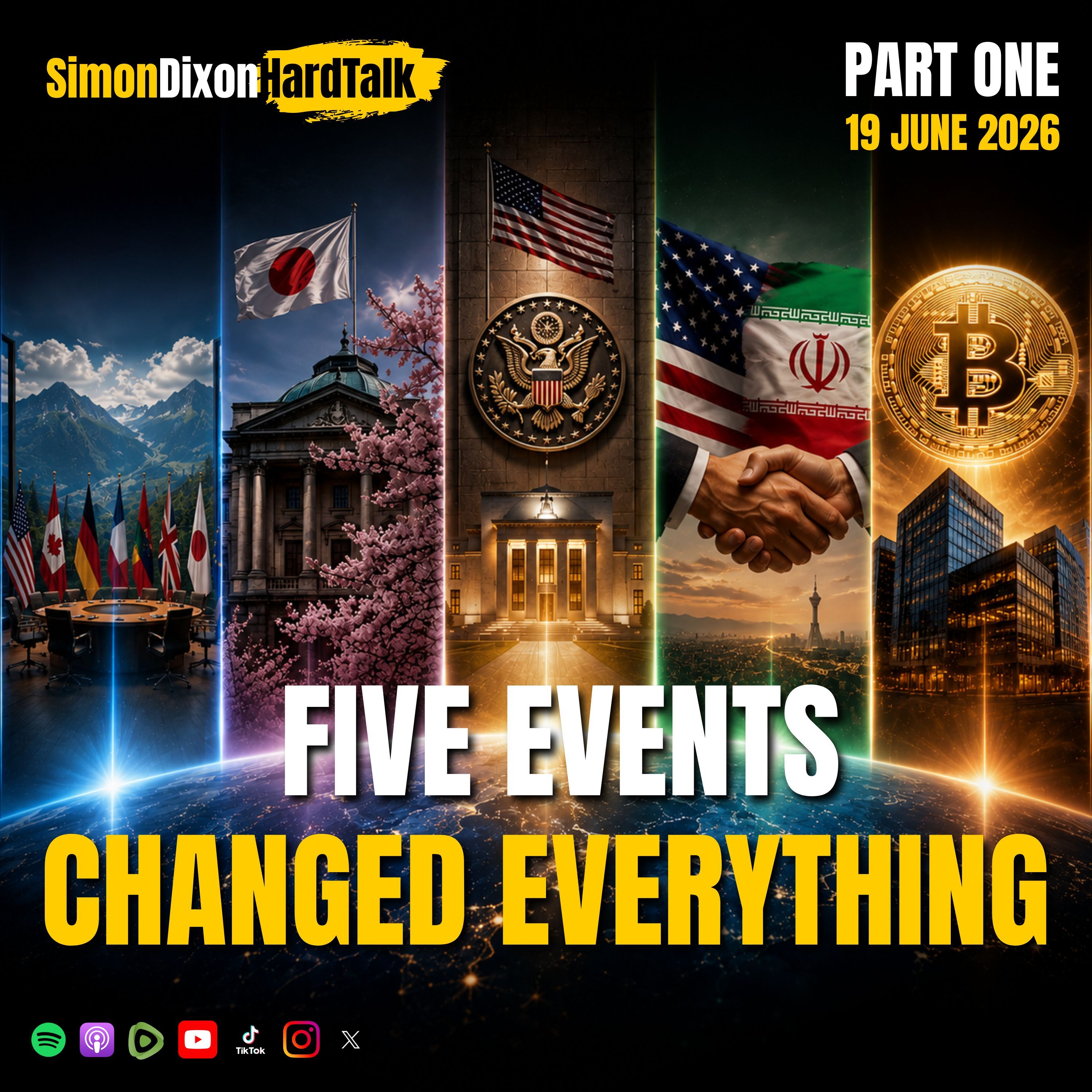
Simon Dixon Hard Talk
The Five Events That Repositioned The World This Week | Simon Dixon Hard Talk LIVE (Part One)
01:55:50
Loading summary
Transcript1 lines
- [00:00]
A
Hey, hey, sovereign wealth builders. Simon Dixon here. And welcome to another episode of Simon Dixon Hard Talk Live. As always, we've got a ton of stuff to cover. In fact, there was one thing for every day this week. We're now on Friday. And this really was the week that the world got repositioned. We had a lot of stuff come together, whether it was the G7 meeting, whether it was a relationship between Iran, Israel and us, whether it was central banks and changing policies, or whether it was bitcoin treasury companies and the implosion of some of those. We're going to be going through all of it today. And in part one, we're going to be covering each of those event, the five events that repositioned the world that happened this week. And in part two, once we're done, we're going to be premiering an interview I did on BTC sessions with Nathan and really we discuss who really won the Iran war. And Clue, spoiler alert, it definitely wasn't usa, but you might be a little bit surprised. So this may be one of the most consequential and important weeks of 2026. And I'm not just saying that to be hyperbolic because it's been a, you know, we've been covering it each week on Simon Dixon Hard Talk Live, but a bunch of it came together. I think I should be a Hollywood script writer. It seems like following the money allows you to write the scripts and the scripts are really playing out. Thank you all for your comments on X from those people that recognized that we were able to get so far ahead. And while Zionists are melting down and those that believe Israel is the sole force that rules the world are trying to figure out what's going to happen here. It really makes sense when you follow the money and you really think who want who won this? And so we're going to be reviewing the five events and we're going to be analyzing it from our five, from our frame. And we're going to be covering the five major events and they all happened consecutively starting from Monday. So Monday was the kickstart of the G7 meeting. And then on Tuesday we had the bank of Japan increase rates as we were predicting. And then on Wednesday we had the Federal Reserve, the first one with Kevin Walsh where he kept rates unchanged as we were expecting. Then we had on Thursday the Iran US memorandum which was signed prior to it was meant to be signed. And amongst all of this, we had bitcoin treasury companies really defining and demonstrating how Jane street blackrock strategy and the general financial industrial complex of leverage is able to utilize these Bitcoin treasury companies as many of our long term thesis. And it really was amazing. On Simon Dixon Hard Talk Live we started covering what was happening with strategy very, very early when it was really unpopular, just like we were covering what would happen with Iran and Israel very, very early when it was really unpopular. But now it's becoming mainstream narrative. So we're starting to see more and more people realize what strategy in these Bitcoin treasury companies are. And now anyone can talk about it. But what we do here is we talk about it when everyone hates you. We have the hard talk, the hard talk where it's really early, everyone hates you for everything you're saying. But then later it becomes okay and you know, kind of normalized and more and more people are able to say it. And so we'll take the hit as always, I'll take the hit. Why? Because I've been working on my sovereign strategy. I've been removing all the layers that mean that it's unacceptable for me to share things early because I've been removing all the subordination layers. And that's really what Simon Dixon Hard Talk Live is all about. Taking you from subordinated to sovereign. It's a spectrum. It's a journey. It takes a decade to put together a plan. But every day you have to ask yourself, am I more subordinated or am I more sovereign every week? Was I more subordinated this week or more sovereign this week every year? Am I more subordinated this year or more sovereign this year? And that's a spectrum that we unearth. And you're never going to be fully sovereign. We're all subordinated to something. But our job is to peel off the layers one by one so that we can journey through and we can make better decisions and we can have, you know, a north guiding star. Anyway. Well, anyway, individually none of these events would really seem that related. What's the G7 got to do with Bitcoin treasury companies? What's the bank of Japan got to do with what's happening at G7? What's the regime change at the Fed got to do? But together they all tell one story and that's the story of following the money. And by following the money, we're able to remove ourselves from media manipulation and politicians that work for lobbies but pretend they work for us. So let's jump straight in G7 event now as G7 becomes less of a share of GDP relative to BRICS in a multipolar world. It's more interesting watching the narratives than the actual impact. Because all of those leaders and even Trump saying I'm in charge and then knocking on Keir Starmer's shoulder, you know, really is the layers of subordination because they all work for the financial industrial complex and to lesser degrees, the military or technical industrial complex, but they all have lobbies and they're all prostitutes for real power. And they all need you to believe that if only I change those people, or if only I believe in those people, then maybe everything will change. And guess what? Spoiler alert, it won't. The sooner you opt out, the sooner you realize unless you can buy those politicians and you're part of the lobby, then you're not factored into the equation. You are the product, you are the collateralized debt obligation, or you are the power that needs to be subordinated into compliance and their power structure by either putting you and wrapping you in a public company, taking your business and giving you Silicon Valley funding, wrapping you up as a collateralized debt obligation, indoctrinating you into university lobby funded narratives, making you subordinate to banks, whatever they need, pushing you into left and right divides, different identity politics, whatever they need to do to keep you distracted from reality. And our job is to have the hard talk so that you can have the hard talk with yourself. Take a good look in the mirror and get ready for all of these, all of these psyops that are happening around us. But anyway, I think the highlight, and even though I know there's an element of theatrics, because we were predicting this for the last years, that I said there will be a day after the transitionary war, after the theatrical war, that you will see the regime change in Israel and a slow transition in narrative away from Trump, who was funded predominantly by the Gulf countries turning on Israel, who was being fund, you know who was funding him via Mariam Adelson, but she was third in line. Above him was the banking Mellon dynasty and above them was Elon Musk. The technical industrial complex, financial industrial complex, military industrial complex with personal wealth via Jared Kushner's affinity partners that was funded by the Gulf countries. So there's the order. While publicly you were told Israel rules the world and everyone was looking at apac, you had go funding on top, Elon Musk and technical industrial complex underneath, Mellon family and financial industrial complex underneath that. And then finally military industrial complex and Mary Medelson via Israel first policies. That is the chaos that's needed to get the forever war continuation. But at the top, the Gulf with FIC and TICK won a regional stability plan. And so that's why we've had this managed transition. And by following the money, we can check the flows and we can get ahead of the narrative. So anyway, there were a couple of comments at the G7 meeting. Firstly, Trump was trying to exert dominance over all the Europeans and other G7 countries that's part of the Western hemisphere, becoming subordinate to fic, MIC and tick, escalating from the mixide in Europe and the decoupling with Japan that happened through the Japan carry trade, which would be event two. So Trump's Israel comments, what were they? Trump very publicly, in a rare moment, criticize Israel's Lebanon strategy. Now remember, this is a mixed strategy. And so by having strategic tension through operations like Operation Gladio, you're able to create the justification and the narratives needed to justify war spending, which allows you to issue more debt in the bond market, get the American or the taxpayers to pay for it through inflation, and then redirect it through these laundering organizations like Israel back up into the companies that benefit from the laundering operation. And so Israel is performing that function. And strategic tension via IRGC and the Iranian Islamic Republic for funding the different groups creates that strategic tension. Now whether you engineer that strategy, who's on board to that, you just follow the game theory and the, the interests and you can see how we got, we got here. So the Lebanon strategy is part of that strategic tension. And by Trump exposing it, you get the plausible deniability, you know, managed divorce strategy that I've been saying would come next, leading into the regime change, given that Netanyahu would have used his leverage in order to negotiate his exit. Trump making sure he doesn't go through the impeachments and the financial incentives that had to have been set up to get there. And then you get a Gulf aligned regime change within Israel ready for strategic acquisitions. But in order to do that, you need to give the thing that Trump would have got, given that effectively Iran very publicly won this war. And so Trump needs his narrative to take away, which is the divorce narrative away from Israel, so that the Q Todds and Maga Todds who are part of that psyop get to say, oh yeah, we're now taking on Israel after Tucker Carlson, Candace Owen, Nick Fuentes, various others were given the traffic to expose Israel for what it is, you know, A and, and then you get that plausible deniability. So I'll give a little quote from Trump at the G7 meeting. He said Israel has Been fighting Lebanon far for far too long. The second quote, you don't have to knock down an agree an apartment house every time you are looking for somebody. So there was a whole lot more and it was talking about Hezbollah and various other things but this really was, you know Trump publicly showing the managed divorce narrative that led to remember that I said after this war you need to transition. You need to reposition the neocon evangelical Christians. That's the Tucker Carlson, Candace Owen, Nick Fuentes role through media in order to decouple them from their belief around Israel mainly focused on the boomers, the younger generation. The Gaza genocide was enough. The boomers, they seem to ignore the Gaza genocide and there's still a lot more work to be done there. But you need to tackle that narrative. You then and we had a massive Zionist meltdown. You know we had the Ben Shapiro's, we had the Mark Levins, we had the Laura Loomis all melting down at what was actually signed because Iran won the war very publicly in terms of the theatrics here. So why is this important? Well this happened just before the Iran deal was actually signed. And so you got the G7 comments, then you got the signing. And that very publicly symbolizes two world leaders that the American empire can no longer exert influence. This is the American Empire's Suez Canal moment that happened in 1956 to the British Empire when effectively the British Empire could no longer use its navy in order to defeat Egypt from privatizing the Suez Canal. That was the final transitionary phase after all the financial transactions had already happened. Transitioning the bank of England to the Federal reserve, World War I, Great Depression after a pump, World War II. All of those events that led to the IMF World Bank Trade all currencies against dollars and dollars being tradable against gold. That built the military industrial complex through the bond market, pumped all that value into the stock market until eventually you asset strip the entire US just like the bank of England did with the British East India Company. Now you have blackrock, Federal Reserve, massive national debt, asset stripping and setting up the world empire while you extract as much value through fiscal dominance and currency revaluations that are happening right now. But anyway, this was just before the Iran deal was actually announced. So this is part of the managed divorce strategy. And this is a thesis that I've been putting together of what would happen after what I thought I called the second round of the 12 day war. Obviously this was 100 days and they condensed about five years into about three months. But it's not really a divorce between America and Israel. It's a managed transition while FIC and TIC try to maintain as much as they can and negotiate into the different nodes of the Gulf countries in Iran and with China, while managing this multipolar world transition, really it is a divorce between Washington, which is fully subordinate to lobbies, so you know, the nation state, the political side, and Netanyahu strategy, which was alignment with military. So this is publicly part of that divorce strategy. You know, you do the genocide, you release the Epstein files, you do the trade war that drives everyone to China, and, and then finally you get the closure of the Strait of Hormuz, and then you take all those radicalized evangelical Christians that confuse Israel the prophet with Israel the political country, and you make it where it's harder and harder then to justify any of the ethical considerations around this. So it's big part of the de radicalization process. But anyway, the alliance still survives to the extent it can. But rather than being a MIC node for the forever war, Israel becomes a FIC node for regional stability, which sounds absolutely crazy, but in order to manage that transition, you get as much land as you can to negotiate for FIC before Israel is regime changed and then privatized and acquired by the Gulf countries, in line with China's vision of the world, which requires normalization between Iran and Saudi Arabia. And so the alliance still survives, but is repackaged, rebuilt and regime changed. But the strategy changes. As we've been predicting and looking for now, I think the leadership will change and that leadership has to, right up until October, lean into the more radicalized Zionist vision of a post US military funded Israel. And so in order to maintain that transition, while in the background they'll be funded predominantly by these GCC negotiations, they still need to maintain the radical Zionist outlook. At the same time, I think they're preparing, and I said in previous episodes that Arachi is being framed for future leadership alongside Gallivant and the Khomeini, you know, son, and, and that was a continuation of his father's strategy of slowly moving towards a new strategy of integration based upon the relationship with China. And so you also need to groom J.D. vance. So J.D. vance was meant to get credit for Trump becoming very unpopular. JD Vance maintaining the agreement, Pakistan getting the name Islamabad Accords, but then signing in Versailles, which has symbolic meaning, which I'll be going through soon. And so JD Vance increasingly, you know, started to show frustration at Israel at the same time, while looking like he was the one that was pushing for Peace. And we. And who is J.D. vaughn? He's Palantir's guy. So he's the tick guy. Now we'll see what happens on the CO option of the Democrat leadership. But my guess at this stage is that you get Trump and remember what I said during the Biden thing, I said Trump will be elected because he was chosen to go to war with Iran. And then after Trump, you may Most likely get J.D. vance, which is a tick guy that builds out the police and surveillance state and the control grids because he's Palantir funded, Peter Thiel's guy. And then you get a far movement towards the left where essentially you can have civil unrest and maybe a switch back to Democrat to get people believing of all that shit that happened that was because of the far right Republicans. And now we need to move more to the left again and you get people buying into that. That's probably what the next two election cycles, 2028 and 2032 look like. That's my current hypothesis. We'll adjust that as more financial information becomes available, we'll be looking at the lobbies that fund J.D. vance moving into these, these campaigns. But anyway, you can see that JD Vance is being groomed for that role. And in a tick dominated world, Trump was aligned with fic, Biden was aligned with Mick, and JD Vance is aligned with tick. So there's really, you know, trying to accelerate the tension between Washington and the current Israeli leadership is what I was predicting and what we started to see at the G7 meeting and throughout this whole week. So there was a massive narrative shift before the actual policy shift. Now I will be looking out for that integration between the Israeli intelligence and the Israeli army and the American army. That may be a few things. I discussed that in my recent interview on Capital Cosm. I haven't really committed to my full analysis on it right now. It may just be one of those bills that's designed to create tension, distract people because it will never get through. It may also be actually more reflective of what the reality of the relationship between the MIC is there. And so what happens is I gave the example of the Silicon Shield on Danny's Capital Cosm interview that I released premiered on my YouTube channel yesterday. And I gave the example of with Taiwan, both China and the Tick know that they're going to be independent or they're going to need to be chip independent. So you need tick infrastructure in both China and America. They can't be both dependent upon Taiwan. And so by everybody knowing that the Silicon Shield as it's called the agreement that protected Taiwan because everyone needed chips or the empires need a chip so no one could invade or disrupt. But by knowing that America is moving towards chip independence through the CHIPS act and TSMC building manufacturing capacity in Arizona and at the same time knowing that China's going chip independent through the Huawei infrastructure building that's happening there, you know that those in Taiwan that know the future of our industry is integration with China will kind of lean into helping China become chip independent. Whereas those that are anti China but more American, Western aligned, they are brain drained into Arizona and they build the chip factories and they kind of help America get the edge. But through a natural selection you separate when none of the value maintains in the Silicon shield. Because eventually China and America are going to be chip independent, but they're working together through this TIC global control grid. Which is why you had the meeting between the TIC executives, the FIC executives and Xi Jinping and the ccp, by the way. I say CCP because most people in China it's cpc, but people know CCP in the West. So I say that even though I know it's a Western term, but we could say CPC to be more politically correct if everyone wants. But you know, this is what I think might result of that. But I'll keep reviewing. It might be part of a civil unrest campaign, it might be part of something, a distraction campaign that has no, no way to get through. Or it might actually be to separate Mossad, CIA, choosing which side they're going to be going down as Israel gets acquired into the Gulf and becomes part of the West Asia as well through its integration and you know, and regime change. But anyway, the narrative shift happens before the, the policy shift. So anyway, what did we get at G7? Well, there was a lot of talk around Lebanon, Israel, US relationship, Ukraine, Ukraine, Russia, energy, artificial intelligence, regulations, all the things, all the World Economic Forum agendas. Remember regulations are moats for transnational capital. And the large multinational corporations, they pretend that they don't want regulations. Regulations is what protects large corporate interests from small business. And so the moats are being built around regulations. We're getting that movement towards digital ID with using the Internet to protect our children. You have to verify you're 16, all those different things that are being beta tested. But anyway, my MC compensation theory I think became very apparent at the G7 meeting. I think it was pretty vindicated, which is that the, the Iran deal that was signed after these different, you know, condemning of Israel from the us it reduces Middle Eastern war opportunities because now you have to move to defense, you know, sales which are significantly less profitable than forever was. And so Mick, you know, doesn't simply lose revenue. I've always said that you need to have a police and surveillance state in America and Europe and you need more war in Europe. And so the G7 was simultaneously signaling that the Ukraine funding, they need more funding for Ukraine. They probably want to remove the release the sanction money. You had more EU sanctions, more NATO escalations and more Russian sanctions. You know, that's signaling that there's significantly more money, as I've always said, and a longer term approach with the Russia Ukraine war. And so, you know, we, we're seeing more of the European manufacturing base that was destroyed for building cars and various other things is resurfacing as a European military industrial complex. And so we're starting to see more IPOs around Germany, military complexes and European. We saw the narrative of Europe going more independent. They're all controlled by the same BlackRock ETF flows. But you know, we're going to see, you know, there was more narrative around needing to spend more on military, more NATO expansion at the G7 meeting, more middle east becoming a financial industrial complex by signing the MOU and various other things. And the opportunity, but effectively the Middle east is now FIC opportunity negotiating with power structures in the region and Europe is now more of an opportunity for micro as well. And this has been a long term thesis and that's how you split the world up into multi polarity. But there is the Lebanon holdout clause which is why I thought it's interesting that Trump decided to focus on Hezbollah and Lebanon while making Israel and that divorce narrative because the deal is now signed but they've got the holdout clause. If you go back to, I think it was when I On my blog SimonDixon.com I gave like eight, nine weeks where I was covering just the Iran war and I think it was week four or week five on my blog where I said Lebanon would be the holdout clause. You need that because during once you've got the MOU signed and then you go into final term sheet, you need an escalation clause and eventually we need to move towards the Lebanon Hezbollah integration and political process. And so you need some kind of managed transition to go from one side to the other side. But they're all connected. If Iran is no longer going to be following the resistance strategy, but testing through different, you know, slow milestones, a transition to regional integration. And so Lebanon is the Holdout clause. The deal is now signed. The final settlement is not signed, though. So we've gone from letter of intent, which was the early negotiations, to memorandum of understanding, which is we're all on the same page here, and we publicly communicated it with a PR strategy to final terms, which are going to take another 60 days. But you still need to have, you know, leverage in those negotiations of making people believe that this could still escalate toward World War Three. And so Lebanon is the, the leverage point that has essentially been set up. So what does it mean? It means Israel hasn't signed the deal. Everyone believes, or many people believe. Israel rules the world and they're autonomous and so they could escalate towards Lebanon. That accentuates the divorce narrative and plausible deniability while simultaneously being able to negotiate a land grab in Lebanon that then leads to the next, you know, land for settlement, which will be more leverage for FIC rather than the forever War Greater Israel project. For Mick, that's the change. And so Israel can escalate. And what happens when Israel escalates? What they tend to do is they always go after civilian targets. And so when they go after civilian targets, that, that inspires a reaction with a narrative from the resistance, which, by the way, is genuine. I'm not saying everyone's, you know, these are higher level infiltrations, but the genuine grievances and deaths, they're real. Mick doesn't care about those things. And then Iran can react through Hezbollah, but Washington effectively can stay out. And so they get the ability to say, right, US doesn't get involved. Which is what I think happens from here. But we know nothing happens in Israel without, you know, Western Mick. I mean, CIA, Mossad, these are one thing effectively, and nothing can happen without them. And even Trump reiterated and JD Vance reiterated, all these weapons are made with American hands, which has surveillance built into them and control built into them. And they were paid for with American taxpayer money. That's real, or, you know, that is the money laundering operation exposed. And the rest of the world, you know, the, at the geopolitical leadership level, they now understand the order's changing everyone. Change your, your strategy accordingly. And that's why you have to have these theatrical symbols as well. But anyway, the Washington basically, I think, will be less willing to be involved. Which means you can have Iran, Israel go after Hezbollah, Hezbollah retaliate, and you can have Iran green lighted to retaliate on Israel. What's the purpose of that? So you can simultaneously integrate Hezbollah into the Lebanese process as the need for Resistance diminishes. Israel gets strategically targeted for rebuild contracts and acquisition by into the Gulf corridor. And Iran gets its preservation narrative as this goes through a massive change. And we already saw, you know, the Ayatollah came out and said look, I didn't want to do this, but I trust Galiband and Orochi and you know, the reformist party and the Democratic party within Iran in order to sign this MOU and give this a chance. So this is how you preserve, you know, the change without an uprising. Even though we're starting to get signs of dissatisfaction in the political process within Iran, but nothing that leads to a full blown coup and it won't be backed by external forces in order to disrupt. Just like we've always had Mossad, CIA, MI6 and Operation Ajax in the past. So anyway, Hezbollah may be weakened before integration or they may get a position of strength depending on what's, you know, for negotiating into the Lebanese process. But Israel may also be weakened through the retaliation before integration as well. And both become easier to absorb basically into the GCC brics allegiance with Iran and the new architecture that involves the exit of us and the refactoring of Israel from mcnode to fake node. And so really that's what we've got to watch. And I will be watching very closely around the different elements of the deal. But the key question is, is with Lebanon will be the final battlefield before integration. Personally I think it will. And if you look at the 14 points of the deal that have now been published, we'll go through that in further events. They're all around defining the new world order based upon financial regional investment contracts. And so that's what I got from the G7 meeting. I think it vindicated what we've been our long term thesis of directionally where this is going. So now let's jump into what happened on Tuesday. That was Monday when the G7 meeting kicked off on Tuesday, event two, we had the bank of Japan which did a rate increase towards 1%. So the bank of Japan raises rates to 1%. This is the highest that they've ever been since in this post World War II order prior to the quantitative easing being invented and the massive correction in the markets that turn Japan into Zombieland, where it had to offer free money to any speculator that wanted to borrow it for free. And then that created the Japan carry trade which allowed people to hedge out the risk and use the bank of Japan as a piggy bank with the Federal Reserve. And then the Fed could then push that into hedge funds, we could then to the basis trade where they lever up the US Treasuries into the kilter and Japan becomes the largest foreign holder of U.S. treasuries, which is the Japan carry trade. At the same time you have the petrodollar and the euro dollar, which I've talked about. But if you're managing a transition away from America being the global hegemon, you break the Japan carry trade, you change the euro dollar, make up and you, and you also break the petrodollar. So why this matters? Well, Japan has been basically one of the final sources of cheap liquidity that exists out there. So this needs to be managed very, very carefully. And so by slowly increasing rates, you break that Japan carry trade and you manage the liquidity away into domestic purchases. And so the American, you know, the American and the FIC become the purchasers, they receive the yield. But you don't want to break the bond market at the same time. You know that eventually when something breaks, you socialize the losses, privatize the gains and the Fed will be able to manage those yields and take on the balance sheet. And so the global carry trademark is dependent upon Japan at the moment, I. E. The bank of Japan. And if you break that, then Japan goes more eastwards and liquidity drives effectively bond prices. So you've got to be very careful a lot of the equities. The bank of Japan owns significant equities. It owns its own debt as well because it is an exporter. And that exporter has massive trade surplus. And it invests that in bonds and US Treasuries and US equities, as does the petrodollar and the Gulf countries as well. So that also has an impact in currencies. The demand for the dollar, the process of weakening the Japanese yen, the process of how you manage the Chinese Yuan, which is effectively they want a weaker currency. They don't want to be world reserve currency, but they want gold reserves that maintains this value so that they can strategically weaken it. With the Japanese yen, it is deeply dependent between a partnership between the bank of Japan and the FX swap lines and the Federal Reserve managed by the bank for International Settlements as well. And so in the currency side, that's a very important relationship. Japan needs to purchase its energy and its oil. It is very important in the AI trade as well. And the robotics trademark and all of the different risk assets need to be managed in this transition. And so big picture, this is effectively end of free money via the bank of Japan. It's the end of easy liquidity. So you need to manage that transition carefully. But pushing away bit by bit is the signal to all the central banks and the hedges that this source of capital is no longer there. This is trying to remove liquidity without causing instability in this managed transition. So the key question is, can the system survive without endless liquidity from the bank of Japan? And we all know what happens if they get the operation wrong. Well, they got the derivatives market where they hedge both sides, so they asset strip for as long as they can. They do it all funded by the national debt. But if it leads to a systemic risk event, they're too big to fail. So they socialize the losses, privatizer gains, and the Fed takes on the final debt. That's what's happening on the Japan side so far, no big. And this is what I think the FIC is trying to do. Manage transition rather than catastrophe, but ready for catastrophe, because then you can socialize the losses, do the big print and get the QE to take on. Get QE to take on the debt. So that was Monday. On Monday we had the G7. On Tuesday we had the bank of Japan. What about Wednesday? Well, Wednesday was event three. This is when we had the Federal Reserve meeting with the first one ever with the regime changed, Chairman of the Federal Reserve, which is Kevin's war. So it was his first ever meeting. Now remember, FOMC is predominantly a bunch of banks and the Fed is owned by the banks. So while everyone focus on Kevin Walsh, which certainly he has influence, but he's only the chairman, his job is to read the script of what is decided by effectively the governors and the board which represent the bank's interest. And so I was suggesting that his first meeting would be rates unchanged. The narrative was built that he was gonna, he was a Trump puppet and he was gonna reduce rates. And the MAGA people were like, Trump's taking on the Fed and the Fed's gonna be powerless and we'll launch stable coins. And we're taking on, you know, the old British, you know, financial system and the Rothschilds and various other things. That was what the queue drops were kind of signaling for the CIA psyop. But rates remained unchanged. And so no real surprise there because leading up to this, we had the closure of the Strait of Hormuz and the closure of the Strait of Hormuz led to an inflation recycle based upon the oil price shot. And we also had tariffs and various other things. So the real story is that. What did he focus on? Well, he focused on There will be less communications. So he wants market to decide rather than announcements to decide. He also talked about five task forces that will be set up. One of those is focused on data. And data is code word for saying, while we're focused on keeping inflation at 2% target, we probably need to change the way in which we measure inflation and so expect a task force to continue along that. But he did reiterate that there will be a 2% target. Now, what does that do, reiterating the 2% target when effectively he said the Fed has failed at their job? Because I think it's like 36 months or, you know, where we've been above 2%. It's a way of saying we're going to increase rates in terms of market expectations, which is the opposite of what the narrative of regime change by Trump, which was going to be forcing decreasing rates. So now he's made a commitment that he's going to be focused on that 2% target. And that really pushes the public debate to focus on rates again. So everyone will be debating. And whatever the Fed does means that you've got all of the markets by the kahunas. And so the narrative was meant to be that Trump's taking power away, merging treasury, launching stable coins. But no, instead, genius act gave the banks the ability to use their Fed reserves to back a stable coin yield, gave the banks the advantage. And they said, if you want to launch stable coins and pay yield, then crypto companies, you need to become banks. And so this is concentrating the power into the FIC and giving everything to the fic. Because now the FIC can really. The real debate is not about what's happened, it is about power. You know, the Fed's position, it currently, it controls, you know, the credit creation, it controls liquidity, it controls the banking system, but the banks are the shareholders, so they're the real controllers there as well. It controls the bond market, whether you do QE or qt. It controls the stock market, whether you decrease rates and pump liquidity. It controls the housing markets. If you allow bond markets to rip on the 10 year, then that determines the rate of credit card debt, mortgage rates, private credit, all that stuff. Government financing through the bond vigilantes. And basically the opposite of the MAGA narrative. The MAGA says Trump is taking on the Fed. The reality is Trump has given the Fed and the FIC maximum power. Think about it. Right now, there's only really two outcomes that are possible. There's two outcomes that are available to the Fed right now. Option one, they can basically create a crack up boom where they do what Trump says. They look like a Trump puppet because they significantly reduce the rates. It allows them to refinance the debt on the short term and short term and at these lower rates. And it gives it transport, it pushes those bonds over to pensioners. And because that creates inflation, it means that whoever the bondholders are, they get a negative real yield. So you dump that onto the Fed and this allows you to manage that transition, you dump that onto pensioners, but really you're letting inflation rip, redefining the definition of inflation and the data while you're asking people to take on negative real yielding bonds. And so that's what happen if you lower rates and you do what a Trump puppet would do, but that would create massive asset inflation, which is why it's called a crack up boom. You basically inflate away the debt, massive asset price inflation. The stock market has a continuation of, of the bubble. The reality. You invest into data, you do fiscal dominance, you have a real estate rally, and then you need to increase the balance sheet to get those rates down on the longer term because it was the longer term that was determining that which forces qe. This leads to a credit expansion, more and more lending by the banks. This leads to a dollar debasement. You give up world reserve currency, foreigners continue to sell off their bonds. And this is effectively where we were with the tariff policy. But you have a final speculative boom. You have the AI boom. You have the, you know, the too big to fail because it's funded by private credit. You have national security because China will win the AI arms race if we don't do it. You have, we got to put, you know, data centers on space in order to, you know, make sure that we have the energy saving. And that's really option one. So, but the Fed decides because the Fed can decide whether they decrease the rate and that's the cycle you choose. Option two is the alternative, which is a controlled rug pull. So you could decide to hold rates or you could decide to push them higher. You'd have all the justification you need because you've got inflation, you've got this tight economy, but the stock market is booming like crazy and you've got unemployment figures. If you decrease rates, you're basically fighting against that. But if you increase rates, you're doing what the Fed would do under normal circumstances if it was considering unemployment and inflation. But you create a massive economic slowdown. And so really this would be asset price correction. And asset price correction doesn't seem like an option here. But that would lead to capital reallocations into a multipolar world. And so basically, if the Fed wants a recession, this is what they did in the booming 1920s. The Fed created a recession after World War I that led to the Great Depression. And then the Great Depression created the environment that led to World War II. And then you had the transfer of wealth to the Fed, to the imf, to the World bank. And then that fueled the military industrial complex. Then they came off the gold standard in 71. Then you had the petrodollar, then you had FIC dominance. Globalization, China, manufacturing base asset stripping through the bond market and pumping the stock market, where we are right now, fiscal dominance. But anyway, this would be a debt restructuring. But if the Fed wanted to do that, they could. And so they could choose the moment when they want to rug pull the American economy, which is why the Fed wins either way and which is why the FIC has hedges and it's why you can socialize the losses and privatize the gains. So, you know, you cut rates and you're basically helping growth into a Trump rules the world narrative while the banks rule the world in the FIC there. Or you can hold rates and increase them, which you can say you're fighting inflation. And if you're fighting inflation, you can manage a transition into the multipolar world. And this is effectively why, you know, they're doing this, because once you do that, you then get a bit of a, an uprising of the extreme polarized left and the potential of a genuine uprising. You know, if you had forks in the street, you had an uprising, you had a tradition to a more communistic wealth redistribution. FIC doesn't want that. It would rather have multipolarity. So as the tensions get higher and higher and higher, you could, you get, you know, you get your, you genuinely could have your thing disrupted by doing what Putin did. You know, Putin basically took on the oligarchs and do what China did as well. China basically nationalized all the banks. Putin nationalized the energy. And that's a genuine threat to fig. If you were to switch to communism, if you were to switch to, and communism is not the right word, but more of a government managed genuine uprising against fic. And so if, you know civil unrest is coming, you transition into multipolarity and you know, you've got the demographic issues, all the other consumption issues on debt, all this stuff, wealth inequality. So anyway, the Fed has the perfect narrative either way. The Fed controls timing, the Fed is controlled and owned by the banks. The banks are nodes in the fic. And the fic remember who's the largest shareholder in Switzerland's bank for International Settlements. It is the Federal Reserve because it's based upon the gdp. So if you adjust the GDP and you adjust it into multipolarity, then you give the other central banks more power in the bank for International Settlements. And this is how you manage everything from Basel in terms of the figure. And so, you know, we're meant to be believing that this is what Trump is coming after. I think he's a World Economic Forum. And Vic, he's doing everything he's meant to do, which is why he's still doing a great job for them. And so the bank for International Settlements is the central bank of central banks. We talked about it a lot over time and it's very interesting that the other events were done in Versailles because the bank for International Settlements was formed out of the Treaty of Versailles after World War I. We'll go more a bit about over that. But this is really the global coordination layer with the Federal Reserve being the one that has the highest voting right and the highest gdp. So this is where central banking power remains intact no matter what happens into a multipolar world. And so the key question is, will the Fed take us into a crack up boom under the new regime change Chairman Kevin Walsh, or will we do a controlled correction? I personally believe it will rinse the crack up boom for as long as possible and then the Fed has full control when to manage the full transition once you've got all the assets you can. And that's what I think the managed transition is. And so really that brings us into Event four that happened. So just as a recap, on Monday we had G7, on Tuesday we had bank of Japan, on Wednesday we had Federal Reserve. And on Thursday, lo and behold, the thing that everyone told me could never happen happened, which is Iran US signed the Memorandum of Understanding and this really is the biggest event of the week. Despite all the other things that happened. This is signed earlier than expected. It was meant to be signed on Friday. The bank of England held rates on Thursday due to the kind of, the negative, you know, the potential of negative growth, the stagflationary environment. But by signing this at the, you know, with the G7, with the other Europeans there, you really have the justification for holding rates at the bank of England as well. Because it can be a, let's see what happens with energy costs, let's see what happens there. But it was signed In Versailles and the really the key terms of the MoU that was signed, going through it, there was 14 different points but follow the money, those are the most important one. It effectively ends military operations. So as I've said, Iran has destroyed US bases, those U. S bases which gave the iron donors power, which gave Israel its power, which gave strategic tension and the need for resistance, which allowed the money laundering operation between the bond market and stock market to happen. This ends military operations with the, the, the clause that I talked about with Lebanon in order to re escalate if we need to, but never. It would always be bounded escalation. Just as I said with the closure of the Strait of Hormuz, every time the rates went above 5% on the 30 year, 4.5% on the 10 year and 120% on the one month forward oil WTI or Brent crude, you needed a taco narrative market manipulation to renegotiate more contracts. It was bounded escalation. It never went to demand destruction global depression territory. And you know, and, and so this is bounded escalation as well throughout the 60 day period. But it also gave sanction relief. Sanction relief is effectively code word for opening up the Iranian economy to, into a multipolar world order. It was also releasing frozen assets. So when the Shah purchased equipment from the Mick and then we had the 1979 Iran Revolution, then we had the sanctioning of those funds. Trump admits for the first time that this was Iran's money and we're just giving Iran money back. So we had, you know, the, the, the release of frozen assets. We had sanction relief. These are all financial transactions and that corrected oil prices and also pushed down the bond yields and started transitioning to the next phase which is what was needed on the 30 year and the 10 year it also had oil waivers. So basically every day Iran has 2 to 4 million barrels of oil that can come into the market. They're a member of OPEC which coordinates amongst the Gulf countries. But with UAE coming out of OPEC you now have the BRICS agreement which is multipolarity version of OPEC with UAE having FX swap lines instead of just Japan. So now you've replaced the carry trade over to UAE from Japan and anyone else that gets an FX swap line to stop them selling their equities to CR that would crash a market or stop them selling their bonds that would blow out the yields on these bonds. And so you get these oil waivers. What else? Well, Iran has the second largest supply of lng, LNG that will power AI and robotics as well as a civilian nuclear program that is currently probably the largest bitcoin miner in the world, that can also become a source of artificial intelligence, robotics, energy. EVs leaning into that trade with China. And so is that going to be priced in yuan in bitcoin or dollars? That's what's being really negotiated. And so we saw all of those narratives happen within Iran. So that really sets the framework. So how these deals are structured over the next 60 days is why you needed this managed transition and why you needed for Iran to remain intact. While you pretended you were regime changing, but you took out the ones that wouldn't be on board with this plan and moving forward that are incentivized with Mick through the forever war, which is continuation of resistance that creates the strategic tension that justifies the budget to Israel, that justifies the money printing and America paying the bill for all of these wars that redistributes wealth in a K shaped economy up to stockholders in the mic. If Iran and US sign a deal then that breaks that trade, which is why I think this had to happen. So it also talked about Hormuz reopening America ending the blockade during the 60 days. And we've already started to see Qatar shipments head over to India. So this is already happening. And the whatever will happen, the negotiation phase with Hormuz, which they're saying will be controlled by Amman and Iran with in partnership with negotiations with strategic Gulf countries, strategic Gulf countries that are also partnered with fic. So that's where you get this FIC aligned reorganization. And also there will be reconstruction plan. That reconstruction plan, as I said, wouldn't be reparations, it would be investment contracts. And those investment contracts I think will predominantly come from the Gulf, which will is the process of normalizing that China does between Iran and Saudi Arabia. And that's what plugs everything together. And so we now enter into a 60 day negotiation period and already on cue, Iran is escalating with Lebanon. We got the Lebanon narrative, we got America exerting its influence and we'll see what happens in that escalation cycle. We had a narrative that I believe said, look, you know, Trump came out and basically said why don't we just get Syria to manage this better? They'll do a better job with Hezbollah than Israel. Wow, you know, that's pretty thing. What is. What have I been saying? Everyone else was saying because Jelani was ex isis, it therefore and ISIS was an Israel Western tool, that Jelani was aligned with Israel. I said no, he's aligned with Turkey and the Gulf countries. And so his job is to be a placeholder for Turkish and Gulf power. Israel will try and grab more land in order to try and get back to the Greater Israel Project and Mick, but if they lose, give the leverage to fic. And now we get this narrative that Trump saying Syria, why don't you do it? I personally don't think that will happen because that will lead to regional instability. And that's kind of a forever war model. Make ISIS or ex ISIS members are now aligned with the Syrian government, fight against Hezbollah. That would be sectarian tensions. Do your whole Shia Sunni thing. And that's part of the forever war model. That's what if Mick was still in charge, that's what would happen. But because F is in charge, I don't think that will happen. And so what might happen is Iran gets permission to target Israel without America, which we know what would be the end result of that? That would be destruction that needs to rebuild contracts that only the Gulf countries can afford. So we will see. Those are all possibilities. And, but I expect some kind of escalation there, but bounded escalation, as I said, it's not going to kill the deal. It's not going to lead to World War iii. It's not going to need to nukes. It's not going to lead, I don't believe, to US intervention, but we'll keep watching that and see if, how, how my thesis plays out. But we had Trump statements, you know, around that around and you know, I interpreted that as a green light for Iran to target Israel as it targets Lebanon. And that fulfills the goals. It also helps in the negotiation process with Hezbollah in Lebanon knowing that Iran targeted Israel and, and you, you can have that kind of peace negotiation that maintains regional stability there. So Trump's statement anyway confirmed that Iran's money belongs to Iran. That's a radical change in narrative. You never get those types of emissions. It was also talking about something that led to a bit of the strengthening of the dollar as well. Because he said, well, if we start doing this, people won't trust the dollar, which is true, but too late. But we had a strengthening of the dxy, which is the west underlying currencies, but the other multipolarity currencies, they were strengthening relative to the dollar while the dollar was strengthening less to Western aligned currencies like the Japanese yen, the European, the euro and, and the Australian dollar and the Canadian dollar. Anyway, all this to say is that Trump didn't want a global recession. So I always said. And he admitted this, he said, follow the money, follow the markets. You know, we, we every time we said this, the markets did this. And the market was the indicator. And really, Trump is saying stuff because his job is to weaken the empire and reveal it for what it is so that all these tools don't work anymore. And now you get transparency, but the prevention of a global recession. And there was also talks and the reason and the justification for signing this deal that Trump gave was because strategic petroleum reserves were running out. And if you look at it, China controlled oil prices through its massive reserves. But it was Japan and America that were draining their reserves. What happened to the MAGA narrative that they're draining China and their reserves? No, it was America and Japan that got drained to their reserves. Taiwan had to lean into bailouts with China and China controlled the pricing because of its reserves. Prior to this, I saw, I told you China has a massive chunk of the market, which is why it was boying it was buying all of this oil. And it allowed these Venezuela operations and Syrian operations to happen as well, because they were splitting the world up. They negotiated this. It was an alternative to World War iii, which is a good thing. What else was in the deal? Civilian enrichment allowed. So nuclear energy program. Trump said the justification is because other people can do it. So how can I stop Iran doing it? I mean, these are major, major shifts in narratives. This is, you know, empire unmasked. This is not the stupid oh, we're trying to prevent. They're about to blow us up with a nuke. We care about women's rights. This is not we. They are radicalized regime and we're taking on the Islamists. All of that BS is going away. This isn't death to America, death to Israel. This is the raw, hard follow the money reality. And everyone else will watch this and say, right, if Iran can do it, we need to start showing more autonomy as well. So anyway, as soon as Iran is relieved from sanctions, there are 147 million barrels ready. Who buys those? What currency? There's going to be relief on all of these. These sanctions for before, they had to sell them to China and they created the Hong Kong UAE sanction circumvention monetary routes via the gold markets and oil markets that we've been talking about. But anyway, I mean, that's roughly $13 billion to hit the market and countries already calling Iran saying we need to buy them. And so, you know, these are, these are how you reset. This is just like Tariff policy. Every contract is a renegotiation as a result of this. So anyway, I'll be watching in future episodes all of the oil exports that happened here. What happens in the Hormuz, you know, Iran can still escalate in these bounded escalations depending on what happens with Lebanon. I'll also be following the insurance premiums. I think insurance markets are going to make it more expensive in the Hormuz forever. And so that changes these alternative routes that are going to be built. There'll be continual premiums. I'll be looking at the different LNG shipments as well. We'll be looking at the release of the frozen assets, how that happens. We'll be looking at Chinese participation, we'll be looking at Indian participation as well. Why the deal is, you know, is is different this time is because we've already seen Qatar LNG, which is now shipped out to India. So this isn't the same escalate to de escalate that we were covering before. This is real. We even had meetings between UAE and Iran. I've often said they're playing good cop, bad cop in this operation. And the 5D chess is happening with Gulf countries, BRICS and Iran. We also saw the Qatari and Iran energy integration meetings. Said in regional stability, you need these different corridors to be built to make sure regional stability maintains. We also started to see announcements around different forms of electricity grid integrations. The key point here is that the Gulf states acted like peace was coming before that. And I, I followed the money and I told you the deals that were happening in Texas with Saudi Aramco and Golden pass, you know, 70 owned by Qatar Energy and Exxon. But Iran's new strategy from here, as I said, what was the old model? The old model was you fund Hezbollah, you fund Hamas, PMF as well. You find the Houthis and the resistance axes genuinely allows for the resistance against the mick, which is done via Israel and Jews Muslims hating each other narrative that gives negotiation leverage for removing sanctions. And this is, you know, what people found hard to believe that Iran was doing that. You know, that's how geopolitics works here. You can still be ideologically aligned in terms of resistance. But the end here is that resistance comes to an end because the alternative is you fund MICK and create the justification for the forever warm up. So the new model under fic, which we're transitioning to right now is trade, it's energy, it's infrastructure rebuild, it's bricks alignment, it's SEO alignment, Shanghai Corporation, Agree Organization, It's GCC capital, it's China, it's, it's basically, you know, transitioning the world based upon trade, transit corridors, trade corridors. The key points is that it's no longer, you know, what you're doing is you're, you're surrendering one form of leverage and trying to replace it with another form of leverage. And so the, you're changing the leverage from what it was before, from resistance for sanction relief into now, you know, providing the justification for the military industrial complex to create war to the financial industrial complex. And your leverage now becomes your geography, your strategic geography. Iran has very strategic geography. Around the Gulf, around Central Asia, around South Asia and you know, different caucuses, different areas, different north, south corridors. That's the real leverage now. And so the big question is who's going to be the partners for the rebuild? Who's going to provide that funding? Who's going to actually build it? I think it's going to be GOLF funding. I think it's going to be some Iran autonomy from the deals and I think it's going to be rebuild in partnership with China and then there's going to be defense contracts across the region aligned with brics Russia, some thick leverage based upon the leverage that they have, but also regional defense contracts across Pakistan, Egypt, Iran, Saudi funded and Turkey. And so is Iran effectively at the end of this going to become a partner or simply an energy supplier. And that will really determine. And that's what we need to watch over the next 60 days as well. So what was event four? The event four was the we on the signing of the MOU, but the next one was the Versailles. You know, why was this done in Versailles, why was this done in Paris? And at the same time we had a big, a bit of bitcoin stuff which I want to cover as well around all of this to tie it all together into what you can do and what's happening. So why does Versailles matters? Well, Versailles really is very incredible. It's incredibly symbolic. It represents change and shift in powers. It represents the monarchy, it represents shifting to revolutions, it represents the French Revolution and the Napoleonic Wars. It represents the rise and fall of the French Empire. It represents the battles between France and Britain, the Battle of Waterloo where Rothschild gained its power over the debt capital markets. It represents debt structuring. It represents one of the most important events in history that set the post World War II Bretton woods order, which is the Treaty of Versailles. The Treaty of Versailles was an agreement in Versailles in 2019 after World War I and it was really set the origins for World War II because what happened after the Treaty of Versailles? Well, one of the things that was there is that it set up the money, the, the money, the monetary system from previous Versailles operations as well. So at the Treaty of Versailles you had the bank for International Settlements that was formed. It was formed to manage the reparation payments of Germany to the rest of the western aligned forces and it had to be paid in gold and it was done with money printing via the German central bank and it was aligned with Rice bank during World War II. It also supported the Hitler regime in when Hitler invaded Czechoslovakia, the bank for International Settlements transferred the name of the gold from Czech Czechoslovakia over to Germany. So it determined the outcome of the war after there was a monetary reform. So let's go through some of the monetary history now that led to the inflationary cycle, the Valmar Republic and the monetary reform that happened in Germany, which people know the Holocaust and the history there and the crimes that happen there, but they don't know the monetary history. And I've covered it many times. But there were two key things that happened in Versailles. So the money, the monetary sovereignty battle between France that needed funding in the Napoleonic wars and the revolutions in order to maintain an independent central bank rather than borrowing from the Rothschild banking dynasties was a key feature of the war. What did Napoleon do? So if you look back at the monetary flows, I've often said the Napoleonic wars were bankers wars against the Rothschild families and an independent central bank that was not a debt based central bank under the Rothschild format. And what did Napoleon do because he didn't want to borrow money and didn't want to be subordinate to the Rothschild family that he knew would have led to the types of Rothschild actions that led to the bond market where the Rothschilds ended up cornering the British Empire by pretending after the Battle of Waterloo that France was going to win. And everyone started selling off their British bonds and then covertly the Rothschild family was buying them at the cheap and then announced that England had won. And then that created the massive pump and the complete subordination of the British government to the Rothschild bondholders. Napoleon didn't want to go down that route. So instead of taking on the debt in this bankruptcy, he started selling off assets. And what was one of the key assets it was Louisiana sold to the United States of America. And so rather than taking on a Rothchild Lane, Napoleon sold Louisiana to America, which was one of the best investments the United States of America had made as well. But this was all about avoiding dependency upon banking power. And this was sovereign financing. How do you finance yourself? Wars being kept in check when one is doing it via a debt based system and the money prints are in the bank of England and the other is trying to remain independent through the central bank of France. Well anyway, that was one of the big stories. The other big part of the Versailles story is the bank for International Settlements. That's where this emerged. It emerged from the post World War I architecture that was set up after World War I. The bank for International Settlements later became the central bank of central banks. But really it was a relationship between the Rice bank, the bank of England, the Federal Reserve, the Bank for International Settlement and the Swiss bank that funded both sides of the war. There was a moment when the bank of England transferred gold over to Germany while simultaneously being at war, you know, with Germany through the British Empire. That shows the separation of central bank and government. And this is really what did German, you know what, what did German Germany do after the Treaty of Versailles? Well, the debt was really loaded up and it became such a massive debt burden that it was asset stripping the economy. So the banksters were asset stripping the economy. Kind of like what's happening with us right now. The reparations were defined in hard money, but you could print the fiat currency which led to the hyperinflationary cycle and that then led to the economic collapse because of the currency collapse, where people those famous barrels of currency in Germany that were being used to heat houses because they were more valuable as wood or fire than they were as currency. But the resistance against that was a movement called National Socialism. That is what later became combined with a monetary policy plus a fascist policy. But what was the initiation of the monetary policy of that separate it with the fascist side as well? Well, there was arrest of Louis. Let me get the name right. Yeah, Louis Nathan Day Rothschild. I'm just making sure I get the right, the right Rothschild on the notes. He was arrested by Hitler and then they launched the monetary reform. And the monetary reform was a labor backed currency. The abolished usury, that abolished the process of combining credit based system where money is created as a debt. And so it was straight, it was basically state driven credit that was invested in the productive side of the economy. That's what built Germany's manufacturing base. That is the same manufacturing base that is being rebuilt right now by the financial industrial complex. So companies like Volkswagen came from there. It employed people, it gave them incentives to have children. It was labor backed. But all of the investment went into debt free Manufacturing base and it was non inflationary and it got rid of all the debt and it became made Germany very sovereignty. Now what did the bank for International Settlements do? It created an environment where if you can fuel war and why Hitler was funded by Wall street, then rather than that labor backed currency going to productive lending as it does in China right now, state backed banking, you can make it go to war. And that's unproductive lending. Then you can use the speculative markets, the financial industrial complex, to launch a currency war. And that's exactly what lost the war. It was when productive spending was used to fuel unproductive spending which needed gold, which then required invasion, which was mercantilism. And the bank for International Settlements on Wall street facilitated that process. And that's what ended up, you know, with the defeat because the economic, when the economy transitioned to a war economy rather than a productive economy, you end up in the situation, this asset stripping state power and handing over to private power. So this battle between war power, monetary reform, this is a cyclical thing that's happened time and time again. And I think you can draw some parallels with what's happening with Iran right now. Effectively the Iranian revolution rejected western financial industrial complex integration because that's what the Shah was doing. And so that revolution was a rejection of fic. But when you reject FIC and you don't have a western central bank based upon usury and a debt based Ponzi scheme, you become embedded in military conflict in order to fight off the central banksters. And when you get embedded in MICK architecture, you end up serving the mick. And so this battle, you revolt against fic, but that creates the war where you become the justification for printing money in the invading country or the west in this case. And so this tension between FICK and MICK seems like a cyclical repetition of what we can learn from here. But now what happened after the Iranian revolution, the funding of resistance, and I've covered the history in many previous episodes, became the justification for money printing in the bond market in order to fund Israel and create a narrative and strategic tension that led to the laundering of money through FIC into mick. And so this seems to be the cycle. MICK is now subordinate to fic, but there's a cyclical element where you use MICK to do destruction and rebuild the forever war model, the regional stability model. And that is the model. So we're now moving towards FIC integration. And you have to use your military to resist against the military, the, your military industrial complex to resist against their military industrial complex in order to set the terms of the rebuild and fic. And that's the key points. If you look at the mou, it was covering what a FIC world looks like. But what is the difference here? Previously we were going from the Dutch Empire to the British Empire to the American Empire. Western aligned factions of power that are changing under one fic. Now FIC is negotiating with brics based upon genuine China autonomy and a model where various Gulf countries got to keep their assets. But they were kind of aligned with it because they didn't have the military. So if you look at the Gulf countries, they had to align with FIC because they don't have independent military but they use their resources and that made them part of being able to influence fic. China and Iran they have their military and Russia they have their own financial system and they have their own different models here. So this is why we're moving to multipolarity. But in order to subordinate Iran as much as possible, you need to destroy as much infrastructure for rebuild. That's what we witnessed. You then need to make sure that people, the vested interest that wouldn't be on board the plan are no longer there, which is what we witnessed. And then you need to make sure that there is an element of continuity in leadership and you have some covert operations that's managed by the country that doesn't have the press department, which is China. And so military leverage in Iran is now becoming financial leverage. And that's why I'm watching this, because if it is golf, my guess is that it's going to be predominantly funded by Gulf countries. And that was the trade, the trade by Iran that they had to use is either get regime changed into forever war or internal change in order to align with multipolarity and regional stability. Given that the Gulf countries have their financial leverage and China has their resource and manufacturing base leverage. And then they aligned into these blocks and they would be able to decolonize from the Western forces. And that's what we've been witnessing. And this is why it was a slow transition and I think FIC adjusted to that reality. And now the MIC is for rent by FIC and FIC is transnational. And the Tick wants to build a global AI and surveillance state and that's China in America, but the private corporate Tick interests. So this is why gcc, FIC and China won the war and that's who won. And I think that will be reflected in the end term sheet that we'll be watching. There is trillions in sovereign wealth that Needs a home to invest. Iran has significant assets and significant geostrategic positioning and the need for resistance is no more. And if you sign a deal between us and Iran that breaks the Israel narrative, then Mick is shedding itself off its assets and shedding itself of its partnership that led to the forever war, the death and destruction. So the region needs investment on every point as a result of this. And that's the opportunity. The opportunity is the rebuild of the infrastructure, the rerouting of energy routes, the currency that they're traded, the ability to have sovereign wealth funds, the new ports and who controls those ports, the logistics, the infrastructure, the insurance, the currency, the FX swap line, the OPEC, the BRICs, the GCC, the ASEAN, the SEO, the FIC, the MIC, the TIC and the partnerships, the telecom infrastructure, who's going to control the data, the data centers, the nuclear energy, the new forms of energy, the hydro energy, the solar energy, the lng, the liquefied natural gas, the police and surveillance state, everything. These are all reconstruction, repositioning. And the key point to this ownership is more profitable than war, the destruction phase. And that's how we were able to predict what seemed unpredictable. So I think the FIC is taking the lead from the Western side. This week we basically connected on Monday we had the G7 event, new narratives, but also old narratives with Russia and Ukraine, new narratives with Lebanon, Israel, US and Iran. We had the continuation of the breaking of the Japan carry trade on Tuesday with the bank of Japan. We had the regime change at the Fed and the first meeting by Kevin Walsh, the ability to have dual narrative. So the Fed has complete control over where we go next through rate increases, QE rate decreases and open market policies. On Thursday we had the signing of Iran, the Bank of England not doing much reflective of the old guard of power, one of the lesser important nodes relative to the Fed in terms of previous empires at the bank for International Settlements. And then we had whatever we're going to call this Islamabad Accords at the new Treaty of Versailles Signed at Versailles. Islamabad Accords, whatever we're going to end up calling this. The symbolism is incredible. Islamabad Accords is the recipient of the Belt and Road initiative after expelling IMF interest while the Gulf countries refinanced that IMF debt when Pakistan ran out of its dollars during COVID originally funded by uae, refunded by Qatar and Saudi China sets those corridors. Then it is signed from west in its retreat. Versailles, the old God, the old monetary reforms, the old revolutionary monarchs, changes of power, this environment that set up the Great Depression and World War II that led to the creation of IMF and World Bank. Transnational global entities that have now used this energy crisis to concentrate wealth up to transnational capital that are now building this police and surveillance state based upon the global control RID A1 technocratic rule based upon where the data centers are formed. And this is the new structure. The new structure is that FIC is negotiating the opportunity into the Middle east with the Gulf countries, with the Shanghai Cooperation Organization, with brics, Brazil, Russia, India, China, South Africa and the new members, uae, Iran, Saudi Arabia as an observer, Ethiopia, Indonesia, Hope I'm not missing anyone. And Egypt of course. So the FIC is negotiating into that corridor via the Middle east, which sets the terms of the petrodollar and petro yuan as well as the network of central bank digital currencies that was handed over from Enbridge over to China, uae, Hong Kong, in the case of Europe, that's mixed territory. That's mixed opportunity manufacture, civil unrest, build a police and surveillance state, do the same in America, continue the Putin is Hitler narrative, fight to the last Ukrainian Russia ends up with its land, blackrock ends up with the portfolio companies, ends up with the rest. And then global AI is China and tick. So China and the executives that met in Beijing are building out the one glow, one global technocratic control grid. So Mick gets NATO spending that was all solidified this week. Ukraine gets more corrupt spending that goes back into mix stocks. You get more weapon sales, you get more intelligence integration, you get more defense budgets, you get a mixed stimulus fit, gets reconstruction contracts, rebuild contracts, infrastructure contracts, capital deployment, more yield acquisitions, mergers and acquisition activity, trade contracts, more insurance contracts. And tick gets AI and robotics, it gets eight data centers in space. It gets every form of energy. It gets nuclear program, hydro, it gets renewable energy contracts, it gets stable coins, it gets social credit scores, it gets central bank digital currencies. And when the people, when there is too much asset stripping because all the assets are concentrated in these pricing events, it gets universal basic income, which we covered in detail last week and the impact that has, which is why asset ownership is the way you protect yourself. And so I want to go through one more thing and I just want to reiterate that throughout all these different events every each week, there was still the operation to make sure that you don't own Bitcoin, just like the operation to make sure that you don't own gold and you hold it in custody as a paper contract. Instead, the Bitcoin FIC op that I've been Covering over the years and the resistance against itself. Custody should be becoming more and more apparent as we have these experiential learning lessons in real time. It is the same story. It is power and ownership. And the way they get power and ownership over you is through leverage. You remain in custody, you remain sovereign, you give up custody, you become subordinate to someone's leverage, whether it's debt, whether it's equity, whether it's derivatives, whether it's leverage, whether it's blackmail operations, whether it's degeneracy, whether it's through having, you know, a weak person, bad health, bad family values, whatever it may be. That's how they get. That's how the leverage your resistance is. Ownership. Ownership without custody. That's control. And so what did we see with one of the bitcoin treasury companies that I've been warning you against all along? Well, an article was released around Justin. Ah, sorry, I'm butchering your name, Justin. I'll make sure I try and put the article below. Anyway, he released an article around Nakamoto, the bitcoin treasury company the vassalized into subordination. David Bailey, one of the largest bitcoin conferences, a bitcoin venture capital fund and a bitcoin magazine media company. And by creating transferring dollars into Bitcoin in a bitcoin treasury company and then purchasing the bitcoin at the top and then manufacturing a crash like the 10:10 operation happened last year on Binance, then you end up with them having to borrow against their Bitcoin. That means that you need to transfer your Bitcoin into the custodian that's issuing the loan. And the custodian, in the case of Nakamoto that was issuing the loan was a company that I invested in as a seed investor back, way back in the day, a company called Kraken. And so Kraken now controls the bitcoin in order to issue the loan and provide the collateral. And according to the article, 85% of all the bitcoin is now pledged collateral against that loan. You add massive expenses, which means that you may need to sell the bitcoin in order to cover it. And if you can engineer price corrections, you can get a margin call on that loan where Kraken calls Nakamoto and says, put the rest of your bitcoin in or we're selling it. And if you don't put the rest of the bitcoin in, they sell it. And if you can't cover the interest, you need to sell more bitcoin in order to Cover the interest. And that's why they create these vehicles like strategy to arbitrage and control the short term price so that it can put you in liquidation crisis, liquidation risk as a result of you taking on counterparty risk. The lesson here is debt changes everything. Which is why I talk about subordination vehicles, the subordination industrial complex. They want you subordinate and you resist by being sovereign. And this is what financialization and the financialization cycle has done. It is to remove ownership from you and give you a paper version so that you can be leveraged through securitization, so that you own a paper version or a security so that they can then use the derivative market in order to re hypothecate and engineer a too big to fail system. Socialize the losses, privatize the gains or draw you into chapter 11 where they can lock in the price of Bitcoin, take the bitcoin, auction it off to the FIC and recycle through these M and A transactions and distress sales. So they want to create systematic risk. This is the design of the system. This is what the Fed was created for. This is why after it was created in 1913 we had World War I, then we had a pump cycle, then we had a Great Depression wealth transfer. This is why we had long term capital management. This is why we had the global financial crisis where BlackRock's technology was used in order to acquire the assets. Take out Bear Stearns, take out Lehman brothers, strip the ETF department from from Barclays and give it to JP Morgan and and BlackRock. This is why we had Covid, this is why we had the tariff war. This is all concentration of wealth in a K shaped economy to make more and more businesses subordinate to the financial industrial complex. And the only way I know to fight back is through self custody in an asset where you can own it, you can spend it and they can't debase it, but they can create paper versions of it to try and psyop you into giving it to them. And so when you have self custody, you have no lender to be subordinated to, you have no counterparty to be subordinated to, you have no margin call to be subordinated to. You have no liquidation terms to be subordinated to. Unlike strategy. Now strategy as I've said, levered up on a Bitcoin, you know, share price M nav premium where it could sell shares in order to buy Bitcoin and then that dilutes the shareholders but they end up with more Bitcoin in a price rise that's great. When the price is going down, you end up diluting shareholders. You end up with a premium that is shrinking. Once the premium shrinks, where the value of the shares or the market cap of the company is close to the value of the Bitcoin, you no longer have any shareholder value. So you need to create a new product. What was that new product? It was convertible debt. Now convertible debt means that the FIC lends money to you, they get a higher yield and if the price is going up, it converts into equity. That's all good, but if the price is going down, then it never converts to equity and you need to repay that loan. From my understanding, there's about $10 billion of convertible debt plus the yield that needs to be paid on that debt. So this works if the conversion happens, but if the price doesn't go up and the conversion doesn't happen, then you can engineer the short term price. You have a two way bet there from the fixed perspective, but it doesn't work if the conversion doesn't happen. So now what do you do if the conversion doesn't happen? Well, if the conversion, if the price is falling and therefore it never triggers into equity and you've got approximately $10 billion of exposure, then debt must be repaid. Where do you get the money to pay that debt? You either issue more options, create more arbitrage, or you issue more equity. But if the premium's not there, then what you do, as long as the premium's there, you can keep doing that and you increase the dividend on strc, what you'll call digital credit, which is really just another convertible debt instrument that stays at $100. That takes away the upside of bitcoin. But you try and guarantee with the value in your equity that you'll keep the price at $100. You can either incentivize as it decouples people to buy it, arbitrage it, or pay more dividend, or just stop paying the dividend. And so this is not a Ponzi scheme. It is a subordination vehicle to centralize as much Bitcoin as possible and make sure that you own a security that Jane street and the financial industrial complex can use to control the short term price of Bitcoin and nothing more, nothing less. So you either miss you more equity, you issue more debt, or you sell the bitcoin. And so that's why shorter term, this is a great opportunity for those that are dollar cost averaging to build a bitcoin position over the next years that they could never have built before because they built this game, they're deploying this game. They won't be able to control the long term price because self custody bitcoin, you own, you spend and they'll only ever be 21 million and more of them disappear over the time as people lose them. But they want to centralize as many of them as possible. That's what these vehicles are for. Bitcoin treasury companies are subordination vehicles for fic. It's structural, it's architecture. Whether it happens on purpose by the people being fooled into creating one or it's done more maliciously, I don't care, I don't matter. It's just structure. It's incentives, it's game theory, it's architecture. It's got forget the personalities, forget the celebrity worship. It is what it is. So equity issuance dilutes the bitcoin per share and this whole thing can create some more, you know, bitcoin selling pressure. And it can either destroy the vehicle into chapter 11, which I don't think is the goal, or keep the vehicle alive to try and centralize as much of it as possible. The refinancing needs ever increase, it creates a dependency upon fic for that refinancing. Or when the fic doesn't want to do it, you create a retail project product. And that's why we're getting maximum amounts of arbitrage volume here. The premium risk can disappear and then you need a new tool. So the model requires the premium. The model requires the price of bitcoin to go up to keep that model alive. But in the meantime, as it goes down, you can try and centralize as much of that bitcoin as possible. And that premium can fund bitcoin purchases. And that's the structure. If it works. If the premium depreciates and it goes into a discount, we saw all that before. Now you're Barry Silber. Now you're GBTC Global Bitcoin Trust company. This isn't new, this is done before. And that was plugged into Gemini and FTX and Celsius and, and in the engineered operation choke 2.0. I did a video, I did an interview on the what Bitcoin did podcast recently. It may have been released today, but next week I think we're going to play it. And I went through this in detail, in detail. But we've already seen this before with operation choke point 2.0. Now it can lead to a chapter 11 cycle or it can, and then that concentrates wealth Upwards as well. I'm not saying strategy is going to go into chapter 11, but they can take all the other vehicles into chapter 11 and centralize it further. That was the end result and that was when Barry Silbert and GBTC ended up creating the Bitcoin etf. That Bitcoin ETF was then done by Blackrock and all the other FIC providers in order to push that premium and discount into the ETF vehicle. So it's a centralizing force. The value proposition seems to change. But the key points here, Bitcoin is not the risk because it's no longer the risk of Bitcoin, it's the financialization that's the risk, provided you're not becoming a trader. So how do you win? You own more Bitcoin this month than last month. You hold it in self custody and if you want to support the network, you run nodes and you become more sovereign, not less for it. Sovereign. So the final thesis of putting this all together is that this week, I think while it seems like unrelated events, I think this week must be remembered as the week where really the world repositions itself. The Versailles meeting I think will go down in history. The MOU will go down in history. The bank of Japan going in independent and breaking the Japan carry trade, it will go down in history. The G7 meeting where the narrative between the crate, the divorce between Israel and us started and set up the next game that would lead to the breaking of the petrodollar, the GCC side, all of that was set up long term. But many of it came together this week and anyone that's watching Simon Dixon Hard Talk Live would be prepared for that and was able to position himself accordingly. The key is getting ahead. Look, I've noticed something that I say very unpopular things and then two years later they kind of become popular. And it's safe to say it, but I try and say it when it's unsafe to say it. And right now I already led into that you will be told Israel rules the world and it's unpopular to say the otherwise. Two years ago I was telling you about all the Israeli ops, 9, 11, you know, JFK, all that type of stuff. The false flag of October 7th when it was really, really unpopular. Now it's very popular to talk about it. Same with the Celsius side. I remember going through that. Same with Bitcoin, same with banking reform. Like when you follow the money, it gets you two years ahead. You say the things that gets you hated and then in two years it becomes a Popular narrative. And then you got to say the things that get you hated again. That's what I try and do on Simon Dixon Hard talk live. So anyway, the world has been repositioned. The Middle east is moving towards integration and regional stability and partnerships with FIC Thick becomes the danger, whereas Mick was the danger. Europe moves towards, you know, a. I mean basically a subordinate to Mick and continued tension. The Fed remains the ultimate power power of the financial industrial complex in cooperation with the asset managers and BlackRock and the investment banks like JP Morgan. But ultimately the Fed can decide when this transition happens or how far they can asset strip into this K shaped economy. The FI is strengthened overall because Trump was a FIC agent, Biden was mainly a MIC agent, Trump was a FIC agent and JD Vance will be a tick agent. Mick basically secures future revenues. And we had the real understanding if those of the were watching between the Bitcoin financialization, one of those things I was talking about Micro Sailor when it was really unpopular and again not the character, just what was being created here did the same with Jack Matters and Nakamoto and David Bailey. And then it becomes okay to say it. We're now in the okay to say it stage where everyone starts the same people that were pushing the Bitcoin treasury companies and now, you know, traffic whoring of criticizing the Bitcoin treasury companies and getting margin called. So bitcoin financialization will accelerate. It's inevitable. It's predictable. And my final message to you, as always, is follow the money. The money will tell you basically where the power is moving, what's happening. We'll keep covering it when conflict is ending, when others think it's still continuing because of history, where capital is flowing. And really we can try and have a hypothesis for what happens next. And that's what I try and do every single week. So I'm going to ask you a favor. I don't take any sponsorship. I'm as sovereign as I could be. Everything I share is things that I do I don't monetize. I've got monetization off on all of my channels. I sold my business. So I'm not trying to upsell you into anything. I and you know, have no partnerships or affiliate schemes where I'm trying to push you in a certain direction based upon financial interest. So all I like is that if you enjoy this, I do this for myself so that I have every week have to have the discipline of putting this together and following the different tasks. It gives me a goal. But what I'D really appreciate is if you could subscribe to me on YouTube if you're not a subscriber. Already we got 172000 subscribers. I think that maybe 60, 70% of you that are watching are not subscribed. If you appreciate it, then I'd like to get that up to at least 210000 subscribers. In commemoration of Bitcoin's 21 million supply. Let's see if we can get there. So please do subscribe. Hit the bell symbol, hit all. And I promise you I will keep adverts off, I won't have any sponsorship and I'll just give you the best of what I've got. And I need you to subscribe as well. Now if YouTube takes me down, I need you to head over to Rumble and put in Simon Dixon. Go to my channel and follow me over there because we're going to be going there if they take me down. I also want you to follow me on X if you're not where I give real time updates at Simon Dixon Twit. And just in case YouTube takes us out, we'll continue to stream that as well. Now also I'd like you to head over to Apple if you're an iPhone user and subscribe to my podcast so that you can download this and watch us on the move in case any of those social networks take me out. When we're building our social credit score, you could do the same in Spotify if you use Android or another one as well, look up and hit there and then it will notify you and then it will download right to your phone. So you can do this while you're at the gym, do this while you're driving, whatever it may be. And also@Simon Dixon.com in case I get taken out of all those networks. And once the social credit score and AI grids become too thin, I've been feeding all of my content to produce blogs, to produce five minute whiteboard videos, to create 30 minute, 20 minute summaries so that you can save having to watch this whole thing. All of those are hosted on SimonDixon.com if you would like to receive a newsletter every week where I don't sell anything, don't promote anything, but I just give you a weekly newsletter because if I get taken out, my only choice is to email you because I built my own infrastructure to try and be as sovereign as possible on SimonDixon.com so as a reward for you joining my newsletter and you can create a username and password and we've got a membership portal which is the community I've built that I think we may need to use one day as our social credit scores and AI and CBDCs and everything gets more aggressive. Get yourself a username and password over@simondixon.com Go to the homepage and press I think there's a yellow button at the front. There's a bunch of videos there. You can even get the first published book in the world to include bitcoin for free as a PDF. A video series I created in 2020 called the Great Depression of the 2000 and 20s and a bunch of backups for everything. You can communicate with all the other people there as well. We'll figure out how to make that more useful as a community as we progress. But that's what I'm doing. Make sure you've got a username and login. Always remember you are alive at one of the most interesting and exciting times in financial history as well as one of the most petrifying times if you don't have access to this information. So please share, please like please share it with other people that you think should get access to this information. Even if this is a condensed version on my blog or this video just a retweet. Please leave some comments. I do read those to create more content. Things you agree with, things you disagree with really helps the algorithm to get this out to more people. And I will continue to go on other people's podcasts. Can you post on X and let me know and tag other people where you'd like me to be on their podcast? Let's do this together as a community effort. Some are going to get wrecked, others are going to do really well. I want as many people in my community that are on the right side of this change so I have a 10 year plan whether this happens faster or not and and hopefully we can make this transition together with In Peace. So now at part two I'm going to play over and premiere on my YouTube channel right after this and it will redirect it if you're watching this live on YouTube over to an interview that I did on BTC sessions where I discussed who actually won the war and how it's not usa and Nathan teases out many of the content that I haven't covered before. So that would be premiering over on my YouTube channel and I look forward to seeing you this time next week on Simon Dixon Hard Talk Live Peace.