← Simon Dixon Hard Talk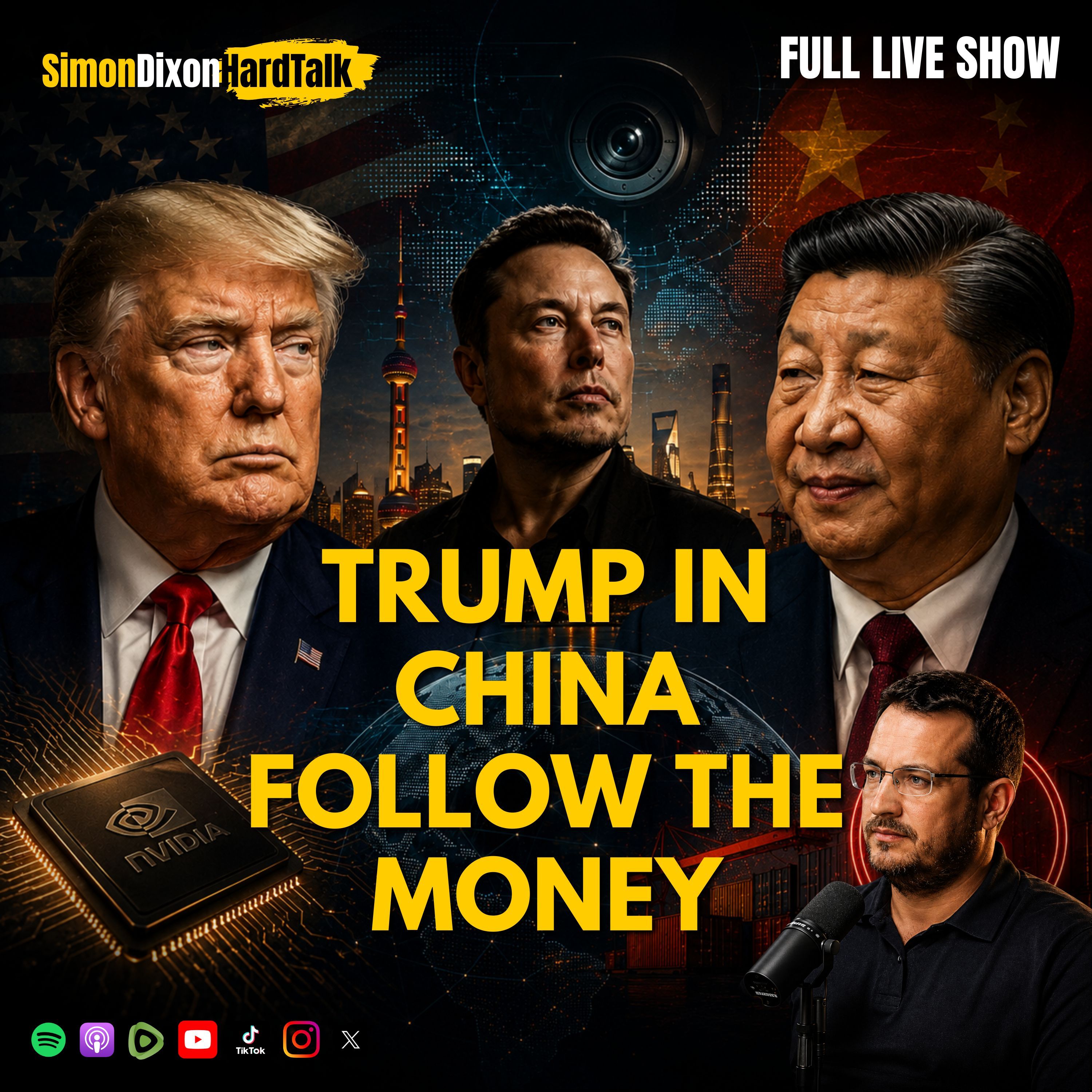
Simon Dixon Hard Talk
Trump in China: Follow the money & the AI Surveillance State Arms Race | Simon Dixon Hard Talk LIVE
03:20:38
Loading summary
Transcript151 lines
- [00:01]
A
Hey, hey, sovereign wealth builders. Simon Dixon here. And welcome to another episode of Simon Dixon Hard Talk Live. So the meeting happened this week, the meeting between Trump and Xi Jinping. And in the media it was pretty uneventful. But as always, that's only if you're following the headlines rather than following the money. It's actually a really big deal when you follow the money. So we're going to be diving into all of that today. And this title or this week, the title of the show is going to be Trump in China. China Follow the Money and the AI surveillance state arms race. And this was a movement towards that. When you have the financial industrial complex and the technical industrial complex representatives and we're talking about The C suite CEOs of the who's who of the shareholder class behind it meeting with Xi Jinping and the ccp, you really get an idea of around that table is who the decision makers are. And in the case of the ccp, the final decision makers and in the case of the shareholders and the executives, the executives and whose shareholders that they answer to. And when they're around the table and they're negotiating deals, everyone's focused on what they need you to focus on, which is obviously the nuclear program in Iran and various other things. But when you follow the money, you realize that that is the construct of a one world technocratic government in the arms race. What it looks like because of the financial barriers that are put up between the capital controls of the CCP and the private sector interest of the financial industrial complex, we're going to be digging into all of it. So as usual, I'm going to be doing a bit of a live segment now. And then last night I did an interview on Suleiman Ahmed show. I was just after the, the, you know, the live announcements, we had several announcements. One of those was kind of the theatrical bit, the power play showing Xi Jinping and Trump and all of the, the different accustoms and, and formalities around that. Then we had a little bit of a glimpse into the elites meeting with the CCP and the executives that are the paid agents of the shareholder class doing their bidding. And we got little, little bit of clips and everyone creates their usual conspiracy theory and, you know, little clips around that. But then we had two statements. One was from China, an official statement which focused on Taiwan. And then there was an official announcement from the White House which would have been very carefully crafted and we're going to break it down. And there was a bunch of stuff that I wanted to cover in the interview, but it was a shorter one as you know, with my market updates. And so we're going to play that interview but I'm going to give you the bit that I wasn't able to cover before then. And we'll put that all together and we'll call that part one. I'm going to be calling that Silicon Valley meets ccp. What the, you know, the surveillance state and the arms race and what the meetings was all about. And then we're going to be going into part two which is on protecting yourself. This was an interview that I did a week and a half ago maybe or maybe a couple of weeks ago with it was hosted by Kyle Chessy and he invited myself, Catherine Austin, Fitz. And what was the subject? We were talking about really opting out of the grid. Understand that, you know, the different types of parallel systems, hard assets and the fight for freedom. And also we had Ian Davis on the show so there was three of us. Ian Davis has written a book I haven't read yet, but I certainly is on my reading list around the private public partnerships of the technocratic surveillance state being built by Palantir and the other chat tech bros. So I'll make sure I get to that at some point. But it was great to do a show with Catherine and Ian and we're going to be going through that in part two. So let's jump straight into the China summit. Right before we do that we've got to take a little bit of a look at the market. The market is re hitting its boiling point. So we had a ginormous fiscal dominance led crack up boom in the stock market. As we've always said, they're sacrificing the dollar in order to roll over the debt at ever increasing interest rates with the hope that they can roll it over in the short term by regime changing the Federal Reserve and pushing down those rates. That's creating more stress in the longer term bond markets so that they can pump all that value into the stock market and asset strip the west while they're managing the capital outflows and negotiating the multipolar world order. And that was really reflected in the nodes and the bond market for anyone connected to the US empire. So this week we got to the danger point, the ones I've been warning you about. Now remember what I said when gold is going up, if, if we were in a genuine World War 3 scenario, gold would be going up, oil would be going up and bonds would be flying out. Now we're getting gold going down at the same time as oil just being manipulated by the market but within the bounded escalation, never going above that $120 on the futures market. But the actual delivery of oil is significantly higher depending on where in the world you are. Which is causing stock markets to rally based upon rolling over of the US debt. But the bond market is showing severe stress and so the 30 year treasury printed its first bond above 5%. That means there are people in the world that are willing to lend to the US government for 30 years at 5% despite the highly likely scenario that that's going to be negative yielding. We had CPI come in at 3.8% in US this week and I had a little bit of a moment where I saw Andrew Tate tweeting that there's a life hack that people can earn 5% for 30 years. I tried to put it in reality on X saying that's a 1.2% real yield after the 3.8 CPI, if you believe the CPI. But what's happening in food? Beef is going up 77% since January in US alone, let alone everywhere else. The cost of food inflation is ramping up. We're getting more and more people that are really noticing it in the supermarket. The cost of energy is at these incredibly high levels due to lng, the manufactured global reset closure of some straight of the moose, the manufactured crisis. And what happens with bonds? Well the 10 year treasury on the US bonds, the most liquid market in the world is now over 4.5% and they printed above 5% on the 30 year, which means, which translates into mortgages being 7% in the case of the U.S. if you want to roll over now, the only private credit that's rolling over is that invested in AI data centers. Because we're leading up to the big crack up boom of the overvalued artificial intelligence trade. I covered more about that in the Solomon Ahmed interview, which we'll be covering soon. But meanwhile, what's happening in the rest of the world? Well in Japan, the zero interest rate environment for the rolling over, the carry trade that clips 101 leverage out of the bond market for hedge funds in Cayman Island. Japan is now really decoupling in terms of its longer debt. Now remember, the Japanese debt is effectively to itself. And although they have 250% debt to GDP, they have one of the largest trade surpluses of assets in the world, a capital account surplus, which means they've got lots and lots of assets and most of the debt is to itself. So it's a different Beast but it's decoupling from the Federal Reserve system as that Japan carry trade gets more and more under stress. And there was a couple of interventions in order to rebalance the US dollar to Japanese. One trade. The currency pair in the UK, the guilt market is blowing out almost to 6%. I think we had over 5.8% and we don't have the world reserve currency in the uk. So this is, this is severe asset stripping by the City of London at the rest of the UK and they've got the FX departments and the Lloyds of London that is manufacturing much of the crisis alongside the financial industrial complex and the factions of power within the IRGC that benefit from the status quo and the higher oil prices. This is pushing the affordability crisis further and further out. The UK bond market is seeing that stress. So is Japan and so is us. What does that mean? There's not going to be a lowering interest rates. What does that mean? It means that in order to move into an inflationary environment they're going to put rates up at some point and as those rates go up, it means your mortgage goes up. If you're on those flexible trackers or if you've got your locked in lower interest rates in the US then you can't roll over at these higher rates which causes severe stress for many. So the real estate market has seized up. Now at this point transactions aren't being done, they can't be done at these rates and that's only going to get worse. And that has stress on the banking market and the bank market connected to the private credit which is connected to the AI trade means that we're engineering the big print narrative. We need a crisis in order to severely print money to bail out the financial industrial complex, to socialize the losses and privatize the gains. That is most likely by my estimation going to be the AI trade in an environment of sere distressed where you have to bail them out. And that will be the data center build out that we've seen. I covered more of that in the Solomon Ahmed trade. But we had higher inflation and the bonds are preparing for higher and higher inflation. And everyone knows that CPI is not reflective of the reality of the average person. So we're getting ready for more and more inflation. Now that can lead to during a bailout environment, a recession to get prices back down and a crisis that requires a bailout so they can pump stocks to new all time high and take this to the severe end of debt cycle asset stripping that we've always been Preparing for. So with that in mind, now we need to think about what's happening in the China Summit. Well, there was not, it was really uneventful for those that don't follow the money. But the first thing is that we had an announcement from the White House and the White House put a probably about five things in that tweet or that post that are worth understanding. The first one is that they indicated that China is going to start buying some oil and liquefied natural gas from America. Now if he weren't a long term listener as Simon Dixon hard talk, then you wouldn't have known, maybe you wouldn't have known that China stopped purchasing oil and LNG from America very recently and they strategically did it because it was part of the manufactured trade war. And this is all part of. If you, if you understand the history and you've been a long term listener, you'll know that this isn't Trump derangement syndrome. I did the same under Biden because it's the Uni Party. But the reason they installed Trump was to break up the empire and transition us to multipolarity was my baseline thesis. And the way to do that was through a series of policies. So immediately you had the Department of Government Efficiency which pretended that you could pay down the national debt and rebuild the manufacturing base. Of course you can't because you can't repay the national debt because the dollar is debt. And so that would be a severe depression. So they pretended they could while Elon Musk for the Technical Industrial Complex pushed out a bunch of data into Palantir and Xai for our social credit scores and for the police and surveillance state. Then they stopped pretending that they could pay down the national debt and they started blowing it out again. And there was no real efficiency because they can't have efficiency. The waste is part of what backs the dollar. You need to blow things up through the military, rebuild it and do the whole economic hitman model. For those of you familiar with John Perkins book Confessions of an Economic Hitman, which lays out the whole model and it will really help you, by the way, understand what's happening today. It goes through the history of Saudi, Iran, various other things, the model that is being utilized today, and then combine that with Simon Dixon hard to alive in order to bring it to today's models. What happened after the Department of Government Efficiency? Remember my coverage? We did World Liberation Day. That was to liberate the world from the dollar. And that was the narrative that we're bringing back the manufacturing base. No you're building AI data centers for robotics to alleviate all the unemployment that this is going to create because there is way more important thing which is the semiconductor chip. And so I said that that would lead to because Iran was installed to go to war with Iran. I said that prior when Biden was, was there. Everyone said I'm crazy, he's the anti war president is what they, they told me. But I said he'll be installed to go to war with Iran because it's about nuclear energy and the narrative will be nuclear bomb. But the reason that's happening is because China's normalized between Iran and Saudi Arabia and you need an event in order to exit the US from the region and replace the military industrial complex forever war model with the financial industrial complex, regional stability and compensate it with another war. And so tariffs was, if you remember correctly I said three things will happen. Firstly, you'll get American small business paying it and you'll get bankruptcies, concentrate wealth upwards. That happened. We had record bankruptcies. We had 95% of tariffs was paid by the American small business and the large business was able to offset it through their international trade because they produce in China. Then you would have the export dependent countries that would have bankruptcies that would concentrate wealth upwards into the larger multinational corps that happened. Then you would have the whole world renegotiating with brics, China looking crazy, sorry, America looking crazy and China looking like the stable trading partner. All of that happens. Then you would have repricing events. So what did we do next? Now we needed to weaken the dollar further and dismantle everything that backed up the deep state behind the forced US dollar and the petrodollar. And that was with the release of the Epstein files. If you remember I was saying why you should vote for Trump, you'll get the Epstein files, potentially probably not the 911 files, the JFK files and then you can understand the truth about how the system works. Well that discredits the system and drives everyone into international multipolar world order which is the financial industrial complex agenda. But it also sets up the technocratic one world global government that is really being set up around these AI data centers and allows for the renegotiation of all of those data centers. So what do you need for that? You need an energy crisis and a pricing crisis. And so war with Iran, closure of Strait of Hormuz, no ships can get insured by Lloyds of London. IRGC higher factions decide what ships can come through and you get a blockade on a blockade so that The US can also say if you want a shipment through like it got through to Pakistan because China broke at it for the, for the peace talks, then you have an operation which I underestimated. If you remember I said the 12 day war was theatrical, you can cover it. And I said that I thought that the 12 Day War plus Lo$Liberation Day would be enough for us to transition to the multipolar world order. It turned out there was a trick that I didn't see which is the manufactured global crisis and repricing event. Never waste a good crisis. So you have the next operation which is a continuation of the Iran war in order to regime change parts of the IRGC that are aligned with the military industrial complex, the radical Zionists that I believe will be regime changed within the next year. Weaken the economy so that you have to have massive rebuild and investment, privatize a lot of the resources in Israel. The stock market goes to new all time high, the Israeli shekel goes up against the dollar and then you asset strip it through privatization programs. Trump was bribed through affinity partners with Jared Kushner as the manager connected to Israel. And affinity partners was funded by billions of dollars of Saudi sovereign wealth fund and other Gulf sovereign wealth funds so that through that mechanism Trump can profit through the bribe while Israel becomes a toxic asset and over the years privatized into the gcc, the Gulf countries, Iran goes closer to China. And then you have an event that needs rebuild contracts. You destroy the US assets, the the US bases, you destroy the energy infrastructure but have enough where you can still control prices through Saudi Arabia's back ports, UAE's back ports. And then you have a back and forth. The deaths are real, the military's always worked this way. But an event that leads to the removal of the proxies. Then you have two proxies left of the Iran side or the resistance. One is in Lebanon with Hezbollah, the other is the Iraqi resistance in Iraq. The crisis sends Iraq into crisis. They are wedged where they can't get their energy, they can't export their energy. And so we're getting lots and lots of civil unrest within Iraq which justifies the negotiations in order to resolve Iraq, just like Syria was resolved as well. And then you allow Israel and Hezbollah to go at it, strategically weaken each other, Israel weakens Hezbollah on the in the air and Hezbollah weakens Israel on the ground. But Iran no longer backs it and needs a narrative in order to let that still happen, but make, you know, continue the negotiations. You have a version of the IRGC which is going to be normalized with China and the Gulf countries. Then you have the compensation of the financial industrial complex and then negotiation away from forever war to genuine defense contracts. And you take out all of the paths and trade routes, renegotiate all the ports for a multipolar world, as per the China plan. Once you've done that, there is a World Economic Forum agenda that sits on top of that, which is to price everyone out, renegotiate all the energy routes, the trade routes. And Trump and the IRGC just need to go back and forth, back and forth while all those negotiations happen. Eventually they announce a deal. And I was anticipating that it's likely that the China summit could be the announcement of the deal. It wasn't, but what did we get? That's what we're going to go through. So the first thing that we saw is an indication from the White House, not a confirmation from China, but an indication from the White House without China disputing it, which is, you know, strategic ambiguity, that China will be buying oil from the U.S. now, remember what we've covered on Simon Dixon Hard Talk. China stopped buying oil in May 2025. Dollar Liberation Day from America, that is Dollar Liberation Day was April20. April 2, 2025. So this is oil that China, it just puts us back to the status quo. They also stopped buying LNG in February 2025. And China started building the largest reserves and started, you know, preparing for the Venezuela because it knew all this was going to happen because the world leaders had already negotiated this. And war is the theatrical element and a way of execution, executing the transition and satisfying all the private corporate interest in the MICK and the FIC and the TICK at the same time as the CCP and the world leaders in the region. And so LNG, the China stopped buying LNG from China from, from the U.S. or U.S. private corporate interest in February 2025. So this was just a low card. So when they say, yes, China's going to do it, it looks like a big deal. Yeah, China's capitulating to America and Trump maga, we're going to be selling our oil, makes America look strong while it retreats to regional power and the MAGA people are all happy. The narrative persists that this was all about choking China when really the CCP and private transnational capital had already been negotiating all of this long in advance. Now things can go wrong. There's lots of things that can go wrong in geopolitics and therefore you adjust. But the plan was set and you can See it by following the money. So the low value card was for China to buy LNG and oil from America and put it back to where it was. But also that's a return to the way that the deal they already had, China was going to buy it anyway because China's buying energy from anywhere. They're buying it from Russia, they're buying it from Guyana, they're buying it from Venezuela. Even US is still allowing it even though the, you know, the. They agreed and China retreated from Venezuela and was preparing for it in advance anyway and so did Russia. Just like we had in Syria where Iran, Russia and China, no reaction while Turkey comes in, backs the hts and then you get the placeholder gcc. Turkey puppet Jelani, who's been regime changed from ISIS to head of state, goes meet Trump, negotiates with the banks and financial institutions what the rebuild contract looks like and then receives funding from the GCC as we saw with Pakistan as well. And we're seeing it all over and we're seeing settlements and negotiations everywhere while it looks like chaos. So anyway, China was going to be buying it anyway because they buy it from everywhere. Russia, Africa, Central and South America, Iran, the Gulf countries. Anywhere where there is energy, China will be buying, they're buying renewal, they're creating renewables, hydro, nuclear, lng, biofuels, you know, fossil fuels, coal, oil, whatever. China needs energy because they're powering their artificial intelligence and robotics manufacturing base through open source technology at a fraction of the cost to what America's selling it to in building out these, these massive data centers. And so China was going to buy it anyway. So. Okay, great, that gives the face saving part that they need. What was the other part? The other part was that there's going to be agriculture, trade. Now remember, a lot of this is around fertilizers. Fertilizers are petrochemical, which is poisoning our food. But you know, hopefully many farmers that will be funded by local people, community led people that would be funding their local supply chains and investing in their local farmers can maybe use this opportunity to stop selling poisoned food. But if we can get to that, that would be great. It costs a lot more. So that's the problem. So you have to be able to beat inflation and invest your money into assets to beat inflation because they're driving everyone into the poison feed. And so there'll probably be some announcements around fertilizer, soya beans, beef. The soya bean side is the same deal that's happening with India. If you remember the trade deal Modi got A lot of pushback from the fathers and there was revolts because the farmers wanted to sell their soybeans and they were buying them from America. So Modi had to resist and do it and double down into a trade deal that stopped buying soya beans from America and allowed the farming industry to do that. But now it looks like this manufactured crisis is trying to reverse that trend. So it looks like there's going to be some compensation to the farmer industry in America. But who are the pharma industry at this manufactured crisis? Well, the farmers are struggling. High energy prices, high input costs, low lack of access to petrochemicals, fertilizers and so they're being priced out of the market. And the farming food industry is concentrating upwards with all these bankruptcies. So four companies that make up the agritech industry are acquiring everything that all happen to be BlackRock portfolio companies too. So they're doing deals with themselves in a multipolar world in order to get that strategic leverage. And Trump is a lackey in front to say that he's doing it to make America great again. And it looks like beef is one of the important parts there. So that may be a genuine thing that happens for the financial industrial complex as this manufacture crisis bankrupts many of the farmers. Now the other thing is that there was a bit of a boost in Boeing's share price, an essential node in the military industrial complex. And Boeing was rumored to have a deal to sell 500 planes to China. China. America still dominates the Boeing and plane industry. China's been building its capabilities, but China allegedly was going to buy 500 rather than 200. So there was going to be an order for another 300. That means this is why, you know, local are not being chose chosen over these higher prices of for selling to foreigners. So, so they're rebuilding all of the manufacturing and infrastructure bases globally, preparing for the fact that America's going to be asset stripped, become a regional power. And they're building out their nodes globally using these manufacture crisis and war in order to manage their portfolio. But there was a bit of a crash in the price of Boeing leading into a general correction after this huge gamma squeeze rise in the market. It's been unbelievable valuations. You know, we're getting 5 trillion dollar 6 trillion dollar Nvidia depending on volatility just because they go to Shanghai. But remember Trump announced that they're going to allow China to buy some Nvidia chips. China doesn't want to buy Nvidia chips. China has been saying and restricting its Companies from buying them because they want to build their local chip independence. And that's why they were talking about Taiwan. See. So the only thing China said publicly was Taiwan is, is our red line, you know, and that's why this whole thing is about chip independence. Chip independence in America, chip independence in China. And disrupting the Strait of Hormuz disrupts the helium trade, which renegotiates all contracts, does force majeures, and we're ending up into an acceleration into the AI trade. We also saw that I cover more about that in the Suleiman Ahmed interview as well. But there was a correction in the bow in price because it was confirmed that they're only going to order 200 planes rather than 500. Now there was some talk about fentanyl. As you know, I've talked about following the money in the drug trade. And it is the mechanism by which The Deep State, MI6, CIA and Mossad and Five Eyes fund itself by facilitating human trafficking, sex trafficking, weapons trafficking, drug trafficking and human trafficking. And it is supported at the governmental level and it is tolerated because there's a whole infrastructure that's built up around the facilitation of drugs. All the money laundering networks that involves nodes in Hong Kong, in uae, in the Iran trade, in the different black market ops, in the Saudi Arabia banking system, through to the CIA protection and the facilitation of the partnership with the cartels. And so whenever you hear about something around fentanyl, it just means that maybe they're recycling the supply chains. Drugs ain't gonna stop. You know, this is how the deep state funds itself is supported at the governmental level. So that's just a narrative. Remember, whenever they want to go to war and whenever they need a manufacturer narrative for a strategic negotiation, they leave a public facing, you know, we are moral, we're trying to do the right thing. And then there's a real thing. And so fentanyl is the front story. So you can say, look, we have 600,000Americans that, that have drug overdoses systemically built and protected by the CIA and the Deep State. But we need to have a front story. Even though the drugs will continue, the deaths will continue and the, the trafficking will continue, maybe they're rolling over supply chains, but the fentanyl story is the front facing story and the drug trafficking routes still continue and that won't stop. So so far you've got the pharma side, you've got the oil side, you've got the, you've got the fentanyl side and these are all low ball stuff. So what is it? What else did we see? Now we had an announcement, but we don't have the details yet because Visa and MasterCard were there. Now what does the financial industrial complex want to do? It wants to pivot away from a dollar dominated world because Swift has been hedged out by the network of central bank digital currencies and all the alternative payment routes that have been built at the domestic level in China, India, Russia, across the Gulf countries, in, you know, all those, those different alternative payment routes that have been built out that can work without Visa or MasterCard. But now in a multipolar world, the FIC want to build the gateway rails into the Chinese SIP system and the alternative payment. So if you can have multiple payment Systems rather than one Visa and MasterCard dollar dominated payment system, then you can charge fees on the convertibility and off ramps and on ramps into the systems. There's not a chance in hell that Visa or MasterCard is going to be able to penetrate China because China has been building a strategy for over 100 years after the century of humiliation. And that has been a continuation strategy. And they know that currency wars, the Swift system sanctions and Visa and MasterCard weaponization of payments is the colonial technique. They know that by now. So they're not going to let them in. So this is Visa and MasterCard hedging away from the American dominated dollar system which will be managed over the next 10 to 20 years by building multi financial nodes around the world for a multipolar system. And so Trump will be facilitating those introductions to see how those rails can plug into each other, which opens up the purchases into China. But also China will maintain its severe capital controls so that its currency can't be weaponized through these currency wars. And that's done via the gold oil markets, via UAE and Hong Kong, and also the sanction market where you can get discounted oil from Iran and Russia. And if you want to do that, if you want to get Chinese yuan, you have to deposit gold from UAE or Hong Kong into Shanghai. And then when it stays in Shanghai, they're building up their gold reserves. And whenever a Western country, the FIC wants to target a new currency, like they did in Turkey, Turkey has to sell its gold, it goes to uae, then it ends up in Shanghai, then you end up with yuan, and then you can use that yuan not as a currency war, but within the Chinese banking system to purchase all the imports that you need. And so I'll keep watching that because that is a very interesting development. But it's certainly not going to be leading to visa and MasterCard colonizing China, because that's why they're building these systems in the first place. Okay, then finally, on the geopolitical side, what did it cover? So it said from the White House that Iran cannot have a nuclear program and that China is committed to that fact and that China is committed to resolving the war and not returning to war, and that Iran should also allow for free passage without a fee and the opening up of the Straight of Hormuz. And so we've got. What have we got here? So we've got Iran that was able to exert, you know, dominance through closing the Straight of Hormuz, charging fees. Everything that happened there. The stable coins were confiscated and frozen. The Bitcoin remained the. But the alternative payment systems via UAE still preserved. While we're being told Iran and UAE are meant to be at war. That's some of the theatrical element. Again, the, the deaths are real, the destruction is real. But this is what you do when you're trying to have a decolonization event and maintain and preserve this new order. And so we had the Strait of Hormuz, which is very similar to the end of the British Empire via the Suez Canal. And, you know, that marked the end of the British Empire when the Brits could no longer protect it through his naval fleet. You have a similar event which sends a signal to the world that we're moving to multipolarity. So renegotiate your trade. If tariffs weren't enough for you, please push into a multipolar world. Please start building with China into the Belt and Road initiative. Please build your own economies so that you can raise the level of your local population by building manufacturing in your countries, which then provides some of the consumption that will be lost as the American middle class are just deep in debt and falling off the, falling off the ladder. And, and it really is a way of Iran saying we resisted against that, but China that purchases all of our oil pushed against that. And so, you know, that's how we get out of our public facing narrative for the Iran nuclear program and the opening up of the Strait of Hormuz as per whatever is negotiated between all regional parties. Before this war, I think it would have been set, but maybe renegotiated by opportunists that decided to do false flags and push the negotiation in their favor. But what we have is the perfect off ramps. Now, I was looking for a theatrical off ramps by the Trump administration, and I think there was a failed one that we covered. If you go to my blog, SimonDixon.com, you can see the nine different weeks that I covered every single week and the different phases as I saw it by following the money. And I said you need a theatrical end. And one of them was the failed attempt at grabbing the highly enriched uranium and then leaving and saying we did it, we ended the nuclear program. Then everyone gets their off ramp narrative that seemed to have failed by local factions of power in the IRGC that may be not on board the plan and then we've had the continuation of it. We're either going to just quietly end up into some kind of announcement of a deal as a result of China and saying this was to avoid World War iii. And you know, America can say what they need to say. Israel gets to continue with Lebanon, Iran gets to say what it needs to say and can say we can. Then everyone can say, well China was the reason that we ended up at this deal, which we broke it via Pakistan and that sets the the world order. Or we need an escalate to de escalate theater again and there will be some kind of event in the coming weeks that manipulates the markets again, allows everyone to get to the final stage in negotiation, guarantees the crisis that we're going to be seeing over the next year and pricing everyone out of their goods so that the middle class and poor have to sell any assets that they have left and positions for the police and surveillance state technocracy as a result of any civil unrest that they could garner from this manufactured crisis. But this is how we get a deal done. So China doesn't confirm it, America announces it. Strategic ambiguity. Iran has a reason why they have to follow it. And then we move to the end negotiation and end state which is the China plan which was worked on for the last five years. That was the reason why you needed this war in the installation of Trump and the Gulf countries Normalization deal with Iran continues and then we end up in the regional stability model over time. And I think next we move to the regime change within Israel within the next year through the political process and whatever Netanyahu managed to negotiate to protect his position. We then get the introduction of Clarity Act. I cover that more in Suleiman Ahmed's interview that we're going to be doing which is the final piece of legislation before the midterms when in the next two years you can't get anything done. But everything's about manufacturing civil unrest and pumping up the stock market, justifying the big print and Building out all the growth on the AI data centers so that for the next regime within America, whether it's J.D. vance or a version of that on the Democrat side, whatever it may be, it will still be the technocratic foundation that has been built here and that requires false flags and civil unrest. So that's how you get a deal done. Now remember what I said, I said UAE leaving opec, which breaks the petrodollar, is I think the signal that we're already there and we're close to the end. And so that has been done. And that means that now everyone's free to go into the BRICS energy agreement that was agreed 11 months prior to, to this. And everyone gets their FX swap lines, the FIC gets what they've negotiated in their nodes and you can asset strip the us, turn it into a regional power and then use its, its, you know, its final assets in negotiating this transition to multipolarity. So to me, what was this operation in the end, with hindsight, I told you what I predicted up front. I told you what I got wrong and what I got right. The result is exactly the same, that this was to manufacture the inflation that was needed in order to justify the big print and the crisis that comes in order to reset the world order into multipolarity. We are transitioning the world into LNG electricity, nuclear powered AI and robotics. And that is why in Shanghai, silicon valley and financial industrial complex elites needed to meet with the ccp. And that's what I think the Shanghai summit was all about. And it's really to push forward in the public narrative of the AI arms race, which is real. And in the Suleiman Ahmed interview I talked about the structural rug pools that are built into this whenever you need to do that. So without further ado, there's going to be a couple of things that we're going to do from here. That's the analysis. I'm going to go through the other part of it which, which is the interview that I did yesterday with Suleiman Ahmed. And then after that we're going to be going into the Kyle chassis panel that we did with Catherine Austin, Austin Fitz and Ian Davis, where we go through solutions on exiting understanding, the cbdc, the whole AI stuff that's being built in the background. And then that's going to be it for this episode of Bitcoin Hard Talk. So we'll go over to the interview. Now. What I'd love for you to do is do me a favor just before we play it, please subscribe to this channel if you're not a subscriber. Already we're getting more and more interviews. I'm getting to spread the word and help more people protect themselves. We're on a really good run. YouTube could rug pull me at any point. So follow me on Rumble as well follow me on X where I give real time analysis. I'm building my social credit score with freedom of speech but not freedom of reach. And so I need your support there and in case all at some point my narrative may not be popular. And so what I'm doing is I'm building a black backup infrastructure on SimonDixon.com please sign up for a free Simon Dixon Hardtalk membership portal over there. If everything gets rugged, we're going to be doing everything from within there and building a community of people that are protecting themselves in this environment. I've also got if you like to listen to these in bits because they're very long, there's a couple of solutions I have for you. Firstly, go to the Apple podcast and you can listen to it in bits and download it. Same with Spotify as well. The other one you can do is on SimonDixon.com every time I do an interview or do a live we break it into parts and I get AI to create a summary 5 minutes, 15 minutes and a written summary video so that it gets the key points in case you just don't have time. Make sure you're always looking at the blog on SimonDixon.com if you sign up and register for free, I'll email you each week with a newsletter so you're completely up to date with everything. Here's my promise is no sponsorship. There is no monetization on any of my channels. There is no business model upsell. It is just me trying to remain as independent and sovereign as possible. And last week I even gave a whole lecture. Not lecture, what is it? A whole episode on what you need to do to remain sovereign and build a 10 year plan as well. I want as many sovereign people in the community willing and prepared because at the end of the day it's through decentralization that we win is rejecting all the divide and conquer narratives that they're trying to push us into and recognizing that we are actually in a battle between centralization and decentralization and the tools exist because the elites want them to exist and so you can use them too and you can chip away week by week, month by month and don't get despondent. So without further ado, we're gonna head over to my interview that I gave yesterday in real time after the China summit with Solomon Ahmed. I'll see you on the other side.
- [46:01]
B
Welcome Simon Dixon onto the show. He is a financial expert. In addition to that, he is a bitcoin og. But this guy knows his stuff, whether it's finances, whether it's the market, whether it's what's going on from a geopolitical perspective. So, Simon, thank you for joining us. How are you?
- [46:19]
A
Awesome.
- [46:20]
C
Very good.
- [46:20]
A
What are we going to discuss today?
- [46:22]
B
Well, what we're going to discuss is China. China, China, China. So Trump is gone to China. He took an array of people. He took the head of Nvidia. The Nvidia stock prices basically went excessively high. He was Elon Musk there. Big tech, Silicon Valley, all the big wigs, I believe they said these, these people's net worth is trillions of dollars. Tell us what's going on.
- [46:52]
A
Yeah, so I think it's important to set the framework, then we can get into China. But if you look at the US Market, it is on, like, an unbelievable run. So the bond market is showing distress, but the stock market, we got the Dow Jones breaking 50,000. We got the S&P 500 breaking, breaking 4,500. But that's not the complete story. The complete story is that anything to do with AI and building data centers is the entire US Economy right now. And so while we got stimulus checks for military companies from the trillion to a trillion and a half, we've got the blowing up of lots of equipment and then the replenishing the supply that can provide some stimulus to the stock market. The financiers are really around the stress in all markets except for anything to do with AI. And so we've got these ginormous IPOs that are coming through like OpenAI trillion dollar valuation, SpaceX, potentially $2 trillion valuation. There's lots of trading of these private stocks ahead of the expected IPOs, and it's dominating the S and P. So one of the misleading things about the S and P as an index is that you could go up. You know, you could look at the entire index, but all companies could be doing badly, but something could drag it up. And that's the whole point here. The tech companies are absolutely going through the roof. And the real sense of growth in other sectors is the higher oil prices that are being driven into these artificial intelligence data centers. So if you think about it, you're manufacturing data centers now that are twice as large as Manhattan, that, like, people are talking about that is consuming all of this high price electricity. And there is a narrative of a bubble which it leads us up to what's happening with China right now that we're in an AI arms race, which is an existential threat. They compare it to the nuclear arms race, you know, during the World War II era. And, and, and therefore invest whatever, do whatever, just get the money together to invest in these, this build of these data centers. And that's where all the job growth is coming from. Everything else, it's not doing so great unless it complements it. One of the, one of the areas that is stressful. And while the stocks are going to all time high, you've got the GDP growth from all these subsidized markets and this new AI build. But you're getting more and more people complaining that they're not able to access water or because they're competing with these data centers for the water or the affordability of the electricity, is pricing people out. And so you're starting to see like a lot more distress and debate around this whole strategy as you would expect with such a, with such a big manufacturing build. But at the same time the demand for US Treasuries, which is the bond market, the demand to lend to the US Government by foreign nation states and central banks is going down because people are selling Treasuries for gold, unless you can force someone into a relationship through trade deals. And so that's why you've got things with Europe and India and particularly China, because China reduced its treasury position over a longer term time frame from 1.4 trillion to about 650 billion. Now what happens when you sell Treasuries, but there is other demand for it. And you know, so private investors are investing in Treasuries, but the nation states are doing that to a lesser degree and they're choosing gold. But when you start selling those, the debt, it pushes the yield up or the amount that the US government has to pay in order to persuade someone to lend it money. And what we got right up to this is for the first time since 2007, right before the global financial crisis, we had a bond auction of 30 year US treasuries and that required an interest rate above 5%. We've been talking about how 5% is a very significant number that's also causing, and it's seizing up the property and real estate market because no transactions are getting done other than the very, very high end level because people can't refinance their mortgages. And as is 30 year treasury bond yield goes up, so do the rates on the mortgages. So mortgage rates are about 7%. And so that, because that means that the, the real estate market is the first sign of stress that we're seeing as a result of it. The only way to call that down is, is to print a lot of money and get the buyer of last resort, the Federal Reserve, to purchase those Treasuries so that you can get the yield down a bit through putting increasing the Fed balance sheet. And so that's really the next game. And so what we seem to be leading up to, particularly going into this China side and the Iran war, is really, really high energy prices. That's driving a lot of the stock market growth. But it's creating stress on the bond market, which then creates stress on the real estate market. But in the, in the front end, if you're leading into an election, you get to say growth and GDP are at all time highs or they're, they're very, you know, manageable levels. They're good levels. There's a good growth economy and there's a great stock market, which is the two things that Trump wants and needs. And so you've got to sacrifice world reserve currency, weaken the dollar in order to really print, print, print lots more money. And that that's happening. And you can see that's going to be happening in the bond market. So when you combine all those markets together, that sets up the framework. What does the Trump administration need? It needs, it needs a narrative to justify why the Federal Reserve should bail out the system, which is the AI narrative. It also needs something that creates the additional GDP because there's a lot of stress at these prices. Inflation CPI came in at 3.8% and that's just the beginning. You know, that you could say is the delayed effect from some of the tariff policy potentially. But it won't be until we get to the next couple of quarters that we'll see the real impact of the supply chain issues and all of the costs of everything going up as a result of the closure of the straight of hormoose. And so you know there's going to be inflation, you know there's going to be issues in the mortgage markets, you know that the bond yield is getting unsustainable and you know you've got to roll over the debt and you've got to. The only one that's the buyer of last resort is effectively the Fed. So then what does Trump do going into this China meeting? Well, he gets together the executives of what I Always talk about the financial industrial complex, military industrial complex, technical industrial complex. What's really interesting is you have Boeing there, but not so many of the military companies. I've always said Trump works for technology and financial more than military, and you have to give military some compensation for the fact that he's favoring technical and financial. But it was all the, the executives of who's who in American, you know, corporate executives, that all joined him. Why? Because a lot of these companies, let's say Tim Cook from Apple, they're investing in new, you know, new factories or within America as part of their settlement with the tariffs to appease the. The. To appease the goal. However, Apple's like the perfect example of the China America relationship. They manufacture all of their phones in China, and China, their rules has always been, we don't mind you as an American company setting up your factory here and benefiting from our labor, our, our cheaper, you know, production costs, all of our innovation in supply chains and manufacturing. However, you have to do everything with Chinese companies. And so, you know, and we have to be able to take that know how and implement it into our own companies, whether it be Huawei or somewhere else. And so that's kind of the rules of doing business in China. So what I think is interesting is to go through what the different things that the White House tweeted out. I'll take a pause there in case you've got some questions.
- [56:46]
B
Yeah, and that's actually what I want to get down to is what did they tweet out? Now, one of the things they mentioned was that there was going to be Chinese investment into the United States of America and US Investment into China. Now, I know in the past you've said that, and your position is that if you invest in a country, you're essentially buying assets in a country and you're kind of having some form of leverage. But this statement seems to suggest that the US Is going to invest in China and China is going to invest in us. This was the White House statement. What's your thoughts on that?
- [57:18]
A
Yeah, that's really interesting. There's a lot to read into this and a bit of speculation that I'll make. So, as you said, people confuse what foreign direct investment is. Trump, he kind of says stocks are at high. GDP is great. We got the hottest economy in the world, and we've got $18 trillion of inbound investment. Now, Apple was one of the domestic investors, but a chunk of what he says is the $18 trillion is kind of half agreements or kind of semi agreements and a memorandum of understanding as opposed to actual full blown commitments. But the way that foreign direct investment works is that whoever invests in either the equity or debt and we've got the unwinding of the petro dollar as part of what we're seeing here, but whoever ends up buying the equities gets a significant voting right. And so you can use legal constructs in order to protect yourself. But as America is an open market and China is a closed market, China's very protective over what investments they let in. They want to control the terms. They want to make sure that the Chinese Communist Party is always, never has a corporate takeover or a more powerful construct that can covertly come in. And that was really from its century of humiliation, it became a very protective, you know, story. But the way foreign direct investment is in an open market is think of it like a syringe. A syringe like you agree that you're going to have some medicine injected and you think it's for your good, but then as you put it in, you suck out the blood because you're taking the dividends and the returns to the foreign investor. And then you can use your voting rights in order to get more control over policies. And so if you're investing in a company like Nvidia and Nvidia chips are geopolitically and strategically important and you give voting rights to the Chinese sovereign wealth fund, then they can block and have a say over where those chips actually go to. And in order to actually violate that, you'd have to do what America has always complained other countries doing, which is you'd have to take away someone's shareholding and nationalize it if you want to protect yourself, which has always been like that would be the end of American capital markets if they were ever to do that. Now the problem with America is $69 trillion of assets are foreign controlled. And so there is always through this mechanism covert influence voting. Right. And remember we were talking about the bond market. The bondholders control the policy. You can circumvent Federal Reserve policy through the buying and selling of Treasuries. And so this is the friction of what happens with these open markets. And so when you're saying China's going to be investing X amount depending on how it's done, that is a recognition of handing over of some of the power and joining America and China and giving China some more power. And they're using their massive trade surplus, their massive assets that they have. But it also does a few other things. It Brings in the question of how do you pay? What are we doing with our currency? And so what you have noticed during the Iran war is that relative to the Chinese Yuan, the yuan has been strengthening and the dollar has been weakening, but the dollar has been strengthening relative to other currencies except the currencies that are connected to vast commodity trades and energy trades. So what's really happened is that there has been a currency war in the background and a lot of the, the maneuvering that we've been seeing throughout these is resetting. And so when China's currency has been strengthening and America's, the dollar has been weakening relative to the two, that resets some of the trade balance relationships. And now if you then agree that China's saying we're going to be buying some oil from you, that achieves a few geopolitical strategic goals. But it also gives China, who has $1.4 billion barrels of oil in reserve, provides all of the fund or the mo, the vast majority of funding to the GCC by purchasing their energy and also to Iran. And now if they start purchasing oil, then they start to influence both the petrodollar and the Petro Yuan and can manage that transition and have more influence over it as well as depending on the outcome of what happens with the uae, Saudi and Iran, they will also have influence in that managed transition of the Petro Yuan and the petro dollar. And also one more thing, remember AI works of liquefied natural gas. And so LNG is becoming one of the most strategic things as we're transitioning away from just burning oil and putting in, you know, and using fossil fuels over to electricity being way, way more significant, hence why we got electric cars, hence why we got an energy crisis, hence why we're, we're pushing all of this LNG into these data centers because it is eating the markets alive and transitioning us to a full blown AI and robotics economy. And that also requires many of the rare earth minerals that China has a monopoly on right now. So it's a very, it's very interesting just in that initial one investing whether they're going to be buying oil. And then we've got to get into the geopolitical consequences as well.
- [63:35]
B
But they also said in that same statement, just based on what you said, that the US is going to be investing in China as well. So then is that not the case when it comes to the US where the US has taken control over China and having a certain amount of leverage?
- [63:51]
A
Yes, that will tie the two together economically, but also Remember, China is a closed market controlled by the Chinese Communist Party. And so while in America the corporations are larger than the government and have more influence over the government through lobbying, in China, the corporation is subordinate to the government. And so if you invest in a Chinese company, it's always on China's terms and those terms are always subordinate to the ccp. So you can't have this covert hostile takeover mechanism that China can do in America, but America can't do in China.
- [64:28]
B
Interesting. So basically you're saying because if an American company was to invest in China, they wouldn't have control because the Chinese government is the overseer of what's happening essentially.
- [64:41]
A
And you have to play Chinese rules. And Chinese rules are Apple, you can set up your factory here, but you have to play within the confines of our regulations. And you know, we don't really have copyright, we really don't have intellectual property protection. And so we can, we can you get to make iPhones, we get to benefit from it. But at the same time we also turn Huawei into a leader. And now many would say they've built the capacity, the education, the work ethic where they're leading in many of these fields as well. Also less corruption. You can corrupt the government side, which obviously massive corruption there, but you can't have a company superseding the national interest like you can in America. So America, they call them globalists, you know, global companies simply because, you know, they're able to not work in America's national interest. They can export capital globally, they can, can offset tariffs with China and they can just have a global strategy rather than an America first strategy. And there's not much the government can do about it.
- [65:57]
B
So just to understand this properly, you're saying that when China invests, when a Chinese companies invest in the United States of America, that's really the Chinese government investing because the Chinese government controls the corporations within China, whereas when American corporations invest in China, it has no kind of linked to the government, they're just profit making themselves. And what essentially happens is China's just get, they're following the rules which is within China, so they don't have the same type of leverage. Is basically. Is that, is that what you're saying?
- [66:27]
A
Yeah. So this is the corporate power in America rebasing in China subordinate to the ccp while China gets voting rights in American cor companies.
- [66:41]
B
So it's essentially the opposite of what Trump claimed. Right. Because Trump claimed that he was going to bring manufacturing back to the United States of America. He claimed he was Going to bring industry back to the America. And yet this entire flight full of oligarchs and billionaires is to do the opposite, right?
- [66:58]
A
It certainly is. With the exception of one thing. He will fulfill his promise when it comes to AI data centers. That's it. And the whole rebuild the manufacturing base was how do we get data centers in America, which is vital. How do we become chip independent? And how do we get Americans and H1BS to build what replaces everyone's job in the future, which is AI and robotics. So you get the AI and robotics in America because that's needed, but also the military side moving into the new technological warfare. It's cyber security, it's integration with drones. It's not humans fighting, you know, with big battleships anymore. And so what we're really doing here, if we, if we bring it down, we're flipping the entire world up with AI and robotics, with the CCP and Nvidia and energy companies and technology companies like Google and Apple. Those are our rulers. And they're all meeting in Shanghai to put together deals that tie that together. It's closer and closer and closer to one global government with different parties really unifying around artificial intelligence and robotics.
- [68:29]
B
So you don't even believe that this AI race is real? You think that this between China and the United States of America. I know internally it's a bit different story, but between China and United States of America, you don't think this AI race is real, where they want to basically have a race with China? You think this is just a mode to manipulate the Western audience to say, guess what? We need to beat China in this race. Therefore you need to sacrifice X, Y and Z. In order for us to win this race, there needs to be no guard rails, no safeguarding. There needs to be. We need to use excessive amount of energy. You're going to have to use less energy. Like are you saying, I mean, that could still be the reason and yet they still have the race? Or are you saying the entire race is just a facade as well?
- [69:12]
A
No, the race is on. There's a few things. What does America need? America has to remember what I said when Trump Games came in. I was also saying, he's here to asset strip America and push everyone to China. And tariff policy was a way of doing it. Department of Government efficiency was a data collection exercise. Epstein files was to devalue the dollar and ruin the reputation, make disharmony, manufacture, civil unrest. And then the final thing is the closure of the Strait of a Moose energy crisis that resets the order and then you go to Shanghai and no, I don't. There is genuinely a race. But what has, what is the only strategy America can do at the end of its debt cycle? It has to justify a big ginormous money printing exercise like Covid. And it needs to be bigger than Covid. And that's what the, that's what the narrative is. And the way you can tell that is China has been it's got a big fund which invests just in hardware and infrastructure for its AI and robotics industry. But a very first time it opened up to software. And the first software investment it made this week was in Deep Seq and that was at a $45 billion valuation. Now Deep Seek can do 90% of what the best AI in America can do. So it's not as good, but it's good enough is open source and, but it's a fraction of the pot of the cost. So if you're printing $10 trillion, let's say in order to bail out the economy, transfer all the wealth into the stock market, devalue the currency and world reserve currency, shrink America into a regional power, do all this foreign direct investment, then the final, the final thing you would need to do is justify that big print. And then there are two I've talked about in the China America relationship. There are two structural rug pulls, I call them. One of them is that if you like OpenAI is a trillion dollar valuation. Deep Sea is the 45 billion valuation and that's open source. So the moment you want to switch the narrative, you could crash the stock market, get the money printing, invest it all in the data centers under the new infrastructure of the lower cost base. But you get all of your GDP growth, you get to manipulate the stock market, make everything look good in the meantime at these really, really inflated valuations. It's kind of like the stock market boom and bust. Like it was genuinely life changing technology that changed everything. But you had that overvaluation, venture capital bubble correction and then all the companies like you had a massive a load of companies that went bust concentration and then a few companies that became the Googles, the Apples, the Amazons and that's one of the structural rug pools that's built into this that China could use if it wanted to. But the other one, can I just
- [72:26]
B
ask you a question on that one then please tell me about the other one. So but just to understand this because obviously the stock market now is at its all time high, you're saying China has the ability to crash the US stock market and then essentially are you talking about China or the big tech be able to buy into. What I'm trying to ask this question is I am a big believer that the stock market is going to crash at some point. I'm not sure I'm if you agree or whatever. But the point is I do believe it's going to crash and if it crashes, that will be in time. Where essentially what is the stock market crash? It's the smaller companies get eaten up by the larger companies. It's like a corporation control. It's a monopolization and then you rebuild and you do like it's like a boomerang and then you rebuild and then it becomes even higher. So I'm actually a big believer that this is about to happen. I know you may disagree. I don't know if you'd agree or not, but, but that would be in my view, like who would cause that? That I don't know. Like you would know better. Is that big tech, is that China or even. Do you think that's not even possible.
- [73:26]
A
It's at the moment. What will, what will happen? If the stock market ever goes to any type of crash, then immediately the Fed will purchase the bond, purchase bonds and do a bailout. So they will socialize the losses and privatize the gains if there's anything significant. The reason is, is because America is so over leveraged at these debt rates that if there was a stock market crash and it led to a recession and tax revenue started to go down, it would blow out the whole, the whole deficit, the, the structural deficit. And it would affect, it would, it would, it would be the end of the US Empire if, if that ever were to happen. And so they will always bail it out. Now why would they, what would stop them being able to bail them out is the bond market. And so once the banks stop using U.S. treasuries as collateral, which is the backbone of the entire Western financial system, then that's game over time. China doesn't want that to happen. So China protects the bonds and manages a very slow transition in the bond market. And so while it's investing in the belt and road initiative and slowly dominating certain regions like Africa, and then we had the issues with Central and South America that led to Venezuela and everything. They're slowly managing their belt and road initiative build dominating certain resources but not crashing the treasury market, if they wanted to, which they don't want to, they could and that is suddenly sell their bonds, crash the treasury market. But the banks and the Federal Reserve would come in and bail out the system. But if, if, if, if people stopped having faith in US Treasuries, then that breaks the banking system and the whole game is over. Now the financial complex knows that. So they're investing in multipolarity, they're setting up financial hubs, military hubs, technical hubs all around the world. And they're utilizing this final phase to pump stocks and then use America's geopolitical strategic importance to, to strip as many assets. You know, whether it be India and brics, whether it be UAE in the gcc, whether it be, you know, certain Venezuela in Central and South America. Trump is just delivering for the globalists, whatever you want to call them. And the military is being used to asset strip, asset strip and concentrate wealth up and up and up. And that's why these, they're becoming bigger and bigger and bigger. And so if China wanted to crash the stock market, it could. And if the, if they're partnered with finance houses that want to manage capital outflows, they'd rather get a multipolar world set up first and they'd rather get as many nodes around the world so that they can manage those capital outflows. But if at the end of time,
- [76:39]
B
yeah, but if the aim is to strip the United States of America, I think that's been one of your themes, theories for a while, right? If the aim is to strip the United States of America, based on the way you explained it in this interview, if you were to hypothetically, I'm talking about Big Tech, I'm not talking about China, although I know they may be working together, right. But Big Tech, if they were to crush the stock market artificially or intention, I don't know how you do it, but basically crush the stock market and then have the US government bail it out.
- [77:08]
A
Right. As per what they've always done.
- [77:10]
B
That's an. Would that not be what the aim of the game? Because you again, cause more debt, you strip United States of America more, you remove assets from the US Government and give them back to the corporations. Like if you know this is going to be essentially the end of the US Empire, the aim is to just steal as much as possible. Would that not be a move they would make?
- [77:29]
A
Yes. However, you want to use America while it's still powerful. And so if you, for example, have Nvidia in America and you can negotiate with China by saying you get access to our chips and China needs those chips or wants those chips, which is why Taiwan becomes so important, then you will use the empire While you can, to get as much as you can while building alternative centers. And so you'll get those data centers all around places that you can dominate. So you want as many other countries weak while the American military can still make countries weak. And then you use that in order to invest and rebuild. And you use all of America's assets to create, to gain as much leverage as you can before you do anything like that. So it's like a 20 year strategy really much like the British Empire, you they asset stripped it. We had decades of really weak growth and all of our assets ended up in America and the financial powers still remained in both America and the Brits and the, and the Dutch side. Okay, so that's how I would manage it if I were trying to guess what they're doing.
- [78:47]
B
Okay, what was the second point you made? Because I've got a few more questions for you, Ashley.
- [78:51]
A
There was a second element I talked about the bond market. So that's another one. But that connects to the stock market. The other one is the west, let's say New York and London, they have derivative contracts that relate to commodities that vastly supersede the amount of commodities they actually have. And so there is quadrillions of paper gold and paper silver and paper contracts that doesn't actually have the gold and silver. And so there is a, a race with central banks to acquire it and get the actual silver in your country. And so more and more gold has been leaving London, which is still important and making its way over to uae, Hong Kong, Singapore and China and also Russia and any other countries. And you're seeing like for example in Turkey there was a recent another attempt to have a currency war with Turkey and they had to sell their gold in order to protect it. That then goes round into the UAE ports and then back into Shanghai. Now Shanghai is actually does not have derivative contracts that supersede the amount of commodities. So the only thing that can, once you expose that and it got exposed during COVID where people said if you create an event where people actually want their physical gold and physical silver and we've seen a few of those. We saw that leading up to Christmas in the silver market, if you create an event where people want it, then the central banks, the Federal Reserve and, and the bank of England or the European Central bank or the Swiss Central bank, they can lend some of their gold, but they know that it doesn't exist. And so if you lose faith in the derivative System and the ETF and that's why they created ETFs because they don't want anyone owning gold. They want a blackrock IOU version of gold, knowing that structurally the derivatives market doesn't have enough contracts and China does. And so China's picking up all of the gold without the derivative contract. And so if you wanted to rug pull the west, you create any type of event that leads to people wanting their commodities in physical form. And then eventually if the central bank say, hey, I'm not lending it, I'm keeping it, then you've got another structural rug pool that's built into the system.
- [81:29]
B
And another question I've got for you is because you're on the, on this kind of strand, I know it's not a bit irrelevant, but I agree with you in terms of this etf. It's a mass scam, essentially. You don't own anything.
- [81:42]
C
Right.
- [81:42]
B
And so people are investing in a number of these ETFs, thinking that they've got access to Bitcoin or various other commodities and they don't really have access to them. I know it's not that relevant to this conversation, but I think it's really important. I know you're a big advocate for basically having Bitcoin, but in a decentralized manner, having it in a wallet that isn't part of the ecosystem. What's self custody? Sorry, what's. How does that work? How does the self custody aspect work?
- [82:12]
A
Yeah, I mean, you know, very briefly, Bitcoin is just a. You know, it's 24 words, and you need to store those 24 words somewhere. And there's dedicated devices and hardware wallets where you can store those 24 words where it's not connected to the Internet. And just by having those 24 words, you can go anywhere in the world and bring your Bitcoin with you. And so it's only by gaining access to those 24 words that someone can steal your Bitcoin or it can be confiscated. But what Bitcoin allows you to do is bring it into your own possession, much like having a pile of cash under a mattress or a bunch of gold bars. But the difference here is that you just have a tiny specialist device, or if you're crazy enough, you could. Yeah.
- [83:00]
B
So it's a specialist physical device you have, correct?
- [83:03]
A
Yeah, it's called a hardware wallet. There's many of them out there, so you can look them up.
- [83:08]
B
But if someone was to steal our wallet, as long as you had the 24 words, you could just access it somewhere else, Right? Or not.
- [83:14]
A
Well, they. If they stole your wallet. Yeah. And you would secure it. It's beyond the scope of what we're doing. There's many best practices to secure it. Yeah, but, yeah, if you got to your 24 words and someone stole your wallet, it would be, it would be a race to drain that and send those Bitcoin over to a wallet you control. So, yeah, it's a, it's, it's all the responsibility that comes with, you know, it. Imagine this device contains a billion dollars.
- [83:43]
B
Just so. So if you got the hardware wallet. Let's say you got the hardware wallet. I steal your wallet. I don't have the 24 words. I can drain it.
- [83:54]
A
You could drain it if you can get the physical wallet.
- [83:57]
B
Yeah, without the words.
- [83:59]
A
You. You do the passwords that protected it, and, and you had the PIN codes and the 2fa device, so you'd put layers and layers of protection on top of it. But if you had all of that, then. Yeah, whoever. Because once you've got the hardware wallet and you can get into it and unlock it, then you can get the 24 words.
- [84:20]
B
Okay, that's a bit, that's a bit concerning because, like, if you're traveling, like, the security could just take it off you do, you know?
- [84:28]
A
No, no, not really. Well, firstly, you don't, you don't need the wallet. The wallet is a bit of a distraction. You just need the 24 words and you could use any wallet you could take. You could have five hardware devices, one here, one in a safety deposit box, one in Singapore or wherever you are. And as long as you've got that passphrase, you can take that wallet and you can access it on any of those devices. It's a bit beyond the scope of this, but maybe we'll do a whole thing.
- [84:58]
B
Yeah, yeah, that's. That's a bit concerning, actually. I've got too many questions. But anyway, let's bring it back to. I was just thinking, because you mentioned about how ETFs are risky. So coming back to the China, China, US conversation, the trade talks, the summit, and you've seen these American corporations, they've basically gone there and essentially Trump has taken them there and it's to enrich them. And so I thought, people claim this was a war with China, but if this is a war with China, why is all these corporations and oligarchs benefit?
- [85:31]
A
As I've always said, Trump has significant private investment with the Gulf countries and significant financial incentives in aligning with China. And I've looked at every single policy he's done and I've said that's the MAGA front facing narrative. But when you follow the money, here's how he's personally enriching himself and here's how it helps the movement towards multipolarity. And so from, you know, from the Biden days, I've been sharing how I thought, you know, Trump would, would help China and would help, you know it, that, that it would help bricks.
- [86:10]
B
Okay. And so chip Trump's move right now is to, it's essentially benefiting China because these corporations are going to invest and essentially be under the proviso of China, right? And then China is going to essentially whatever they're investing in the United States of America. It's the CCP taking control over American assets. Now coming back to it. We've seen and we've, if you look at the US there's like Silicon Valley, there's big tech and big tech is essentially taken over the White House. You look at Palantir, you look at J.D. vance, you look at all these people and I know J.D. vance didn't go there, but that's more because of like they have to keep one high level official in the United States of America in case like something goes wrong. So but in terms of if you look at the way the US is going, it is basically big tech Palantir who are directing the way the world is going to go. The future of the United States of America. Right.
- [87:10]
A
Palantir is becoming, I think, the global government that is trying to get control over as many nodes as it can globally. So we're starting with its sphere of influence which is using, you know, the Gaza genocide to test technology, doing occupation as a service in west bank, doing genocide as a service in Gaza, doing drone integration in Ukraine, doing crowd control in Saudi Arabia at the annual Hajj pilgrimage, doing open border, closed border ice, privatized prison deportation sector integrated into El Salvador prisons with an education system based upon AI Doge seemed to have pushed all the V, all the data over there. European Union civil unrest campaign, pre crime arrest integration with NHS and farm data in UK Department of Department of Defense integration in terms of military warfare. It is absolutely getting government contract after government contract after government contract. So Palantir is the company that wants to be the privatized public partnership, public private partnership, one world government. But there's only one node that it can't control, it's the ccp. And so if you can't beat the ccp, you have to negotiate with the ccp. Which is why these big negotiations are happening here. Because You've got a walled garden around, you know, China that is built to make sure that it is a resistance as possible. And then you've got the rest of the world that's the, the victim of financial terrorism from the, the British American transatlantic empire, as it were. And then you've got obviously the Israel nodes and integration. And so Israel is, you know, got the cyber security and artificial intelligence there. That's their two growth areas as well as like they got banking, defense, cyber security, artificial intelligence and tech. And whenever you want to test the illegal shit, then you do it via Israel. But what we're starting to see is that western companies like Apple are buying up a lot of those, those technologies. And those companies you're getting through Abraham Accords, a lot of investment, foreign direct investment through Abraham Accords. And then you're getting the COVID Saudi Arabia, Trump affinity partners, Jared Kushner purchases. And Israel is privatizing more and more. It's got two IPOs that are coming up to privatize state assets. Its biggest defense companies are already public. BlackRock already has significant ownership structure in the Israeli ETF. The stock market's being pushed to new all time highs while the state assets are being depleted. And so you're really seeing the transfer of Israel assets into private corporate interest and away from the nation state as a result of all of these, these different things.
- [90:39]
B
So you mentioned about the data centers and you said that the data centers is essentially what the United States of America is going to be focusing on. This is going to be the direction they're going towards. What I mean, how many data centers do they basically, how many data centers do they want to erect in the United States of America? What level of energy is required, what level of infrastructure is required to get there? Because again, we just look, when you look at the United States of America and you look at the Western world, they're very, they're not forward thinking or they're not as progressive when it comes to this building of these infrastructures.
- [91:14]
A
Yeah, well, the west, because it's privatized, it's got the, the, the, the privatized model. The companies think about their quarterly earnings and that's what determines their stock prices. The executives are incentivized through share options and those share options kick in if your share price goes up. They have a ginormous financial industrial complex like the biggest, you know, 70% of America is service based. And by far the largest part of that is financial speculation, gambling, derivatives and all those things. That's the final area of the British Empire, you got insurance derivatives and some of these commodity and FX contracts. So they can still do the FX manipulation in, in City of London, but New York has ginormous financial speculation. And so they control share prices. Short term you can't control long term, but short term you can manipulate. And so through this, this is how finance controls and subordinates all of the companies. And then the government is subordinate to all of those companies and they install all the board seats and everything. And so what is really interesting, and they control all the tech companies as well and so and the military companies. So they've got every sector and big pharma and the energy. So you've got this portfolio of trillions and trillions of dollars. And what you're seeing is they're just eating up the markets with this entire AI and robotics infrastructure. That is because there is somewhat of a internal struggle at these higher echelons of power between what if money's not important in the future? And what if we control everything through algorithm and we can put everyone on a universal basic income and we can concentrate assets into fewer and fewer hands and we can price everyone out of the market where they have to sell all their assets and then we can buy all the assets in distress and then maybe artificial intelligence and robotics starts doing more and more and more and those that control the data center control everything. And then you can have a one global world government. I think that is a agenda as part of this. And that means that how do you work between the importance of data and algorithm versus the importance of financial transactions? At the moment, finance rules, it controls military, it controls technology. But eventually technology could become more important. And so over the years ahead we have that internal struggle to deal with. So not only do we have supply chain issues, not only do we have unemployment crisis, not only do we have energy crisis, not only do we have wealth concentration and wealth transfer, not only do we have universal basic incomes for those that lost their. We may have the disruption of money in the end through technology. And that takes us to a world that's very, very hard to understand. And I think the CCP want to control that world and I think the finance companies, they're just working on their quarterly. And then when you have someone like Trump in charge, you know that he just does a two year cycle, then he tries to get, you know, everyone gets dissatisfied and then they become rendered useless for the next two years and then you just groom the next one, whether it's JD Vance for Palantir or whoever it may be. But Trump gets to get as rich as he can. And that's why right now they're plugging, they're rushing the banks and the technology companies are rushing to try and get through Clarity Act. Yeah, that's the final piece in the surveillance state legislation that would completely remove the Constitution. When you have bank secrecy act, which is where you can circumvent the Constitution by calling it terrorism, then you have the Patriot act, which is using the word terrorism to circumvent the Constitution as well. But build justify the removal of all amendments as a result. So you have spy software and everything that was created through anti money laundering laws and then national security. Then you combine it with what they got through, which is Genius act, that's programmable money that favors a covert central bank digital currency, but privatized. And then you just need Clarity act, which is making sure that the game goes to the banks and not and not the tech companies. So there's a bit of a battle in clarity between tech and finance. And there's two directions that can go. And depending on who wins that battle, you want to get Clarity act before the midterm elections because the Democrats are essentially holding it and saying, Trump, you made $6 billion through all of your crazy crypto scams. We're going to put an ethical clause in there and that ethics clause is being used by the lobby to get it over to the, to the banks rather than to the tech bros. That battle has to happen. Clarity act comes through. That's the final piece of legislation. And then Trump can be as useless as you need to do. He can extract as much wealth and he can just get the stock markets higher and higher and higher, roll over the Ponzi strip, as much assets as possible and, and maybe the next two years you can't get anything done.
- [97:01]
B
Yeah, yeah. And in terms of data centers, I did have a few more questions for you, but we need to wrap up. So we'll obviously get you back on some of the time and I know you'll be on the space Letter, but
- [97:10]
A
installed with significant funding from Elon Musk and the technical industrial Complex, significant funding from the Mellon banking family and the financial industrial complex. And then the third largest was Mariam Adelson. The connection to Israel and the military industrial complex.
- [97:29]
C
Three of the sharpest minds in finance, intelligence and surveillance research in one room for the first time. And what they laid out should terrify every single person watching.
- [97:41]
D
From 1998 to 2015 that we know of, there was 21 trillion of what's called undocumentable adjustments. And there's no way to know without auditing the New York Fed accounts for the US Government how much money is missing.
- [97:59]
C
That's Katherine Austin Fitzgerald, former Assistant Secretary of housing under George H.W. bush, then offered a seat at the Federal Reserve Board and she turned it down. She's the woman the Feds tried to bury for asking where the money went. Besides her. Simon Dixon, the banker who called the FTX Celsius and Luna collapses before they happened.
- [98:24]
A
Don't listen to anything anyone says. Let's look at what they do. So whatever Elon says is rubbish. Whatever Trump says is rubbish.
- [98:31]
C
And Ian Davis, the British investigative journalist documenting the public private partnerships nobody else will touch. They mapped the control grid, the trillion dollar print they say is coming. The crypto bill they call a Trojan horse. And the one move you have left before BlackRock owns your entire neighborhood.
- [98:54]
A
They're deliberately trying to manufacture civil unrest.
- [98:58]
C
Catherine calls it the Mr. Global system. Simon calls it the worst crisis we've ever seen. Ian calls it the dark enlightenment. By the end of this, you'll know what to call it. And most importantly, very, very importantly, you will know what to do about it. And again, remember, nothing in this video is financial advice. So for educational purposes only, guys, without further ado, let's bring these three titans to the stage. All right, Ian, Katherine, Simon, everyone, thank you guys so much for taking the time to be here. Really appreciate it. It was hard to coordinate all three of you busy schedules, but really appreciate you being here. And without further ado, let's, let's get into it. So palantir, they decided $300 million deal with the US Department of Agriculture. They're now involved in food systems, health care, weapons, immigration enforcement, and space force. When one private company starts doing this many government jobs without voters having a say, are we already living under a corporate government?
- [100:04]
D
So I just have to jump on on this because when I was Assistant Secretary In 1989, I used to have massive fights with the defense contractors to give me the data that I needed to run my operation. And they would refuse to. And we used to call it the data beast and the war with the data beast, and that was in 1989. So at that time there were 24 covered agencies and in fact, all of their bank accounts were consolidated into a few banks and all of their data providers and payment systems were consolidated into a few corporate entities. So Palantir is a new phase of something that's been building for a long time. If you look at so many years ago, Amazon put together a cloud for the CIA, but integrating all 17 intelligence agencies. And now DoD has done a similar sort of cloud contract using Amazon, Oracle, Microsoft and a few others. So if you look at the integration of the federal government through corporate cloud contractors and IT payment contractors, that process has been going on for a long time. And of course Palantir is just taking it to a whole new level because you're connecting it up to the satellites, the WI fi, and integrate it with the surveillance system and the AI data centers. So this is a new phase of something that's been going on for a long, long time.
- [101:29]
A
Yeah, absolutely. I'll jump in. This whole public private partnership, we're really hitting the critical mass here where effectively central banking dumps the bill on the people and then that's rerouted through the bond markets and stock markets into these private public partnerships. And Palantir really is the chosen one, as it were, particularly in collaboration with the other members of the PayPal mafia. So we seem to be getting our artificial intelligence, police and surveillance state and it's going through a bit of a recognizable pattern. So some of the early beta tests were done through the Palestinian laboratory. So we had surveillance as a service in west bank, we had genocide as a service in Gaza, and then it tends to come around and you beta test it on the uk. So in UK there was a lot of social media scraping data, pre crime arrests, classification of resistance and any protests as domestic terrorists and open borders, closed borders, and then a desire to tackle, for example, ensuring that you are of the correct age to be consuming adult content online at the moment. The latest one that we're getting in UK is tenancy protection acts, which in the middle of a manufactured crisis that we're seeing with the closure of the Strait of Hormuz, you're starting to see that now all of a sudden Palantir is moving deeper into the US infrastructure through agriculture and food, in the middle of manufacturing, food and security. So Palantir is really aggressively moving to effectively a privatized version of the US government, police and surveillance, state, training, ICE agents, classifying groups, any resistance as domestic terrorism. And it's getting incredibly noticeable and aggressive right now.
- [103:47]
E
Yeah, I would echo both of what's just been said because another way of looking at this is there was some research that was done by a couple of political scientists in 2014 called Gillens and Page, and they looked at 1800 policy decisions or policy initiatives over a 30 year period in the U.S. so they published in 2014. So they were going back to the 80s, the late 70s, early 80s. And they concluded that what. The way that the, the government was functioning in the US at that time was what they called a functional oligarchy. So there were, there were different model, different models of potential democratic models. One of them is elite domination. Another one is, I can't remember the different, the different models, but their analysis of how policy functioned was that it effectively amounted to what they called a functional oligarchy. I think MIT put a study out as well in 2021 where they were just considering what they were just essentially considering foreign policy. So they were looking at how foreign policy. Whose interest does foreign policy reflect? And they consistently found that it was reflecting whatever the agenda was of the corporate lobby at the time. So, and this, this was Again, this was U.S. foreign policy. But we see exactly the same everywhere else in the world where we look, you know, and going back to the, the idea that public private partnership is very much driving policy agendas everywhere. And I mean a classic example of that is if we look at how sustainable development has developed over the years with the, the significant input, input of globalist think tanks which, let's face it, represent corporate interests, often represent corporate interests, then what we are seeing is a move away progressively. A move away. And you know, in my opinion, that as that the speed of that transition away from what we might call an I, you know, a traditional view of what we might consider to be political government decision making being driven by political concerns moving towards what are the pressing concerns of the private sector. I think that's accelerated notably since the, not probably the 1990s. And now as you know, as we're saying, Palantir is really representative, I would say of that system. And one of the really interesting things, observation that Simon made actually, and something that I've discussed in my book is how bold they are now. It's, it's all. It's almost as if what we, we don't care anymore. We don't, we don't care. The gloves are off now. We are, we are quite. And in, and in a sense there is a, there is a, an agenda there. What they, the Palantir often talk about. Representatives of Palantir often talk about this notion of the agentic state where government itself is eroded and replaced by private governance of some kind of. So I guess at some point some corporation has to stand up and say, well, we can run things better than government. And maybe. I think, I think we're starting to see Palantir move into that, that role at least.
- [107:30]
C
Yeah, we'll get into the. Those kind of CEO government, CEO ran states in a bit. But Ian, you briefly just mentioned agentic kind of sovereign agentic cities or states or whatever. But you specifically talk about sovereign AI cities being built right now. Nigeria I guess has one already, potentially Gaza. The pitch essentially is that residents get everything taken care of for them. Food, water, shelter, necessities. But the catch is that they have to sign away all their assets and their rights essentially to live in this kind of society. So maybe you can just because I, I had never heard of that before and it's pretty wild, especially considering the fact that I don't. As someone who uses AI frequently I don't think that AI is quite there yet in the, in the, you know, in the capabilities of being at, you know, it's coming, it is coming AGI asi. You know, I mean I'm pretty sure we can do an entire show on how we're birthing this new species that probably makes everything we're talking about obsolete in the future because it will be an apex species. That's my opinion. But, but curious to get your thoughts Ian, if you can elaborate a little bit more on how far along are we in these kind of AI sovereign states or cities being built?
- [108:48]
E
Well just to, just to start off by saying there's a lot of flim flam in the talk around AI in my view, as you rightly said, it's not, it's not as close to being the thing that they say it is yet in my view there's a lot of catastrophic forgetting and all these kind of technical technological problems that need to be overcome first before it is even close to being theory of mind AI in, in a, in a word in a workable sense. So I think there's a lot of sales pitch around AI. But yeah, I mean so if you look at somewhere like etana started in 2020 so it this very much tied up with these economic free zones or special economic zones, SEZs or and there's a model of economic zones or rather there's a range of economic zones. At one end you've just got the sort of very kind of basic freeport which is a zone where warehousing costs might be subsidized or you might get sort of relief on import and export duty all the way up to the Charter City and the Smart City state. So at one end you've got kind of the free ports that are currently being constructed in the UK. For example BlackRock have got an investment with, with the British government to develop 12 free ports in the UK all the way up to Shenzhen for example, in China, which is a, a smart city of, in a special economic zone of 17 million people. So Atana at the moment, I think there's, it's currently got, I think that, I think they say that it's currently got about a thousand or so or, or more than that, companies registered in Atana for the regulatory relief that they get by, by doing so. So it's very much to attract, in this case foreign investment there. There is a proposal that there'll be about 1 to 2,000 people living in, at, in Atana. If you look at what the UN says about the deployment of special economic zones around the world, it is currently saying that there are more than 5,000 that are actively being installed. So they're at various stages of development. If we look at what is proposed for Gaza for example, or the new Gaza, that is obviously, I mean if you, if you're charging people a billion dollars or charging corporations a billion dollars to buy into your new city state project, which is what it's proposed to be, then obviously that buy in comes with, you know, there has to be value there and that value is going to be the deregulation that comes with. And if we think about Israel's very prominent role in kind of the tech industry, you can see that, that being extended to Palestine or the. I, you know, I, I hate even saying it, but the, but the new Gaza and, but interestingly, when you look at the development plans that they've got for Gaza, they're splitting it up into four zones and, and the industrial and retail and the, and the kind of urban sort of spaces for development, spaces for, for leisure activities are far. There's something like 75% of what's left. So there's not much scope for, for human habitation to, to be in that new plan. So unfortunately, you know, we are in a situation at the moment where one of the, one of the things that I, you know, one of the reasons that I recently wrote the book about that is, is that, you know, these plans are progressing in front of our eyes. They are a bit like when we were just talking about Palantir. All the, all the kind of things that we might think are theoretical, they're actually, we can actually see them. They're, they're actually doing it now.
- [112:59]
C
Yeah, thanks, Ian. And do you think, just real quick before we go to the next question, do you think these are being set up kind of as like test beds? And then, because it sounds like, yeah, big Players are involved.
- [113:11]
E
Yeah, no, yeah. I mean if you've got, for example, you've got Prospera in Honduras, which I think the current population of that's about 2,000 so. Or 1,000 to 2,000 people. So that's, that's combining development or special economic zones, attracting foreign investment with in this case some residential spaces. So they're looking to, to bring the two, bring the things together as I said, all the way. You know, you can, you can look at the progress of special economic zones in China the, since the, you know, the late 70s to today. I mean that is a mass that's been a massive experiment in smart city design and, and the potential for smart city kind of. Well, these things achieved.
- [113:56]
C
Yeah, these things are all like, you know, from what I understand, my perspective has always been like things like Prospera and Charter cities. You know, especially when you guys got guys like Patrick Friedman in there who you're kind of taking the charge. My, my understanding, because I was a fan of the Sea Setting Institute long ago what they were doing. I like the idea of, you know, sovereign governments being set up all around the world with, you know, kind of competing for citizens and residents. I thought that would be a complete paradigm shift. So everything that, that you said so far sounds to me pretty utopian. But I'm curious like your whole thought on this and why you wrote the book on this, is this like a good thing that's happening or is this, you know, is there something that you haven't told us yet that this is,
- [114:40]
E
I think, I think like any, the use of any technology, it's not the technology itself or it's not even the necessarily the idea itself, which is, which is bad. You know, so the, the potential for, for governance as a service, obviously that appeals to libertarian minded people and there'll be a lot of people that are libertarian minded that are very interested in what's happening in places like Prospera. Yeah, and rightly so. And what, why wouldn't they be? But if you start getting down into the nitty gritty of something like the Network State, which is the basis for the, the model that they're trialing in, for example, Prospera, that is a, that is a. One of the things that I noticed in the Network State, written by Balaji Srinivasan, is there's no clarity in there about what kind of unified ledger he's talking about. There's no mention in there whether it's, whether it's permissioned or permissionless. It is a subject which isn't touched. Why? Because you change the nature of the project depending on what model you've got in mind. Now, in Srinivasan's case, he says all value goes digital and nothing exists unless it's on chain.
- [115:57]
A
Yeah.
- [115:58]
E
Now he. And now if you look at what other people like, people like Lewis Mosley in the uk, who's a representative of Palantir, when they're talking about all value going digital, they literally mean. Or Larry Fink, another good example, they literally mean everything.
- [116:16]
C
Yeah.
- [116:16]
E
Everything going digital. Now, if that includes our rights are, you know, even the functional things like the licenses that we use, every. Everything only existing in a. In a functional capacity, on a ledger of some kind, and therefore controlling access to that centralizes power. It doesn't decentralize it, which is that. Which is the antithesis of the libertarian ethos, if you like. Yeah.
- [116:48]
C
My guess with Balaji is that, you know, he built a framework and the intention was for. For people to deploy their own network states and, you know, maybe build those into charter cities. And so maybe leaving some things ambiguous was intentional, allowing whoever's heading up these projects to decide on their own. And I guess that's part of the interesting thing about it. But I want to get to the next question because my audience is mostly a crypto audience and there's a lot of people trying to rooting for the Clarity act right now. We had Genus act passed last year. Clarity act right now. And you know, it hasn't seemed to gone through right now, but a lot of people that are going to watch us are rooting for Clarity act because they believe it'll make their bags appreciate in value. Right. Their holdings go up because we'll get all kinds of, you know, more buying and things like that. But from my understanding is that I think all three of you guys believe that there's a lot of that act would do more harm than good. If any of you guys would like to step in and elaborate, please go ahead.
- [117:56]
A
Well, I guess I could give a quick summary of where we're at. I think it's important to understand the background. And originally you had Bitcoin. This project, I personally believe. I've always said Satoshi was Hal Finney and Len Sasserman, both who were connected via David Chom in Netherlands through their cryptography work. And that led to what I think was a. If you think about what the project was and David Chom's project Digicash, it was effectively a mechanism for creating private transactions on top of a banking layer. And it was Shut down because they did private transactions. And the choke point was the banking layer. From there you had Bitcoin. Bitcoin took out the banking layer and then you had an open source project that was effectively funded by providing electricity into miners. And then rules were enforced by nodes and then new code was suggested in an open source way by developers. But if you look back what we've seen through the Epstein files, that there was interest around about this was 2009 and 2011. Jeffrey Epstein tried to contact some of the early developers like Amir Toki and Gavin Andreessen. Gavin Andreessen, if you look back at it, he left the project. Sorry, Satoshi left the project when Gavin Andreessen said that he was going to meet the CIA. Also Len Sasserman after one month after that was, was allegedly, you know, hung himself. And also later you had, you know, accident with Hal Finney as well. And so that's kind of like the, the history and the early infiltration attempts with Jeffrey Epstein were Gavin Andreessen, Amir Taki and what were the projects that Amir Taki was working on? Well, it was coin joins and private transactions. So how you can obfuscate your transactions by using a wallet that joins all the different dots together. There was the privacy layer, the open source layer, the decentralized layer. Then you had Peter Thiel come along in the Epstein files and he was saying, how is our, I forget the word right now. How was our info, you know, our destabilization project going in Bitcoin? And it was talking about unit of account, median of exchange. The Bitcoin community are confused. They don't know whether it's money or store of value. But this is when Brock Pierce came on the scene. And Brock Pierce was the one that paid for some developers to create stablecoins. And stablecoins later became the precursor for central bank digital currencies. And Brock Peers on multiple occasions was facilitating investments for Jeffrey Epstein into various companies. Some were like Blockstream, which employed a bunch of the developers and various other things. So we had this whole background. But clearly one thing I've always said, Brock Piers, I remember from the early Bitcoin conferences, he was the one that tried to tell me that Dr. Craig Wright was Satoshi Nakamoto. And that was obviously the hard fork into a more centralized version of Bitcoin called Bitcoin cash. So when you look back at all these things, you can see that the real project was a gateway drug into a Stablecoin which is the precursor for central.
- [121:36]
C
Just real quick, just to make Sure, I heard you. Because I always associate Craig. Right. With bitcoin sv.
- [121:46]
A
I know he started with bitcoin cash and then he forked off a bitcoin cash with bitcoin sv.
- [121:50]
C
So. So Craig Wright, I didn't know this. So Craig Wright and, and Roger Ver were working together.
- [122:00]
A
Yeah. So if you, if you look right back in the early bitcoin days, the big advocates for bitcoin cash were Jihyun Wu, which was the creator of bitcoin cash, Bitcoin ABC it was called then. And then he was funded by Sequoia Capital via Beijing, his company in Beijing, which was doing asic miners. Then you had Roger Ver, who was an early investor. Yeah. And then you also had Dr. Crave Wright who was supported by John Matonis. John Matonis was from the Bitcoin foundation and he was the one that introduced Dr. Craig Wright and said he's Satoshi Nakamoto. And then if you remember Gavin Andreessen, the developer said, I've got inequivocal cryptographic proof that he is, he does control the Satoshi wallet, which then was proven false. So you had John Matonis. Wow. You had Gavin Andreessen, you had Dr. Craig Wright. And then later Roger Ver said, I think he's Satoshi and he's part of bitcoin cash, which was created by Jihan Wu out of China. And so that was like that, that kind of fork off project. But really then there was the other project which was the Brock Beer side. So he came in, started facilitating investments into Coinbase and Blockstream via some of the GarageBand, different funds that Jeffrey Epstein was involved with. And, and then you had obviously his contact with Gary Gensler, the head of the sec that then came from mit. And MIT was the one that when the Bitcoin foundation went bust and they tried to take over some of the funding and their project became forks stablecoins and central bank digital currencies. So now if you forward to where we are now, Trump was installed with significant funding from Elon Musk and the technical industrial complex, significant funding from the Mellon banking family and the financial industrial complex. And then the third largest was Mariam Adelson, the connection to Israel and the military industrial complex. So those were like his three funding. And the first thing he said is he infiltrated the bitcoin conference and said we're going to turn America into crypto capital. Then he started making significant wealth by launching meme coins, by launching World Liberty Financial, by selling off presidential pardons to CZ Justin sun started engaging in probably $6 billion of fraud, alleged very questionable activities, tripled his net worth just through his crypto investments and didn't do anything for Bitcoin. But what was the first thing we got? We got Genius Act. Genius act effectively was stablecoin legislation that tilted the favor for a covert central bank digital currency to JP Morgan. Because in order to launch a stablecoin and pay yield, you had to get a banking license. Now there were then lots of controversy around could stablecoins pay yield? And then you had Clarity Act. In order to give clarity, are you regulated by the occ, the currency commission, are you regulated by the SEC as a security or are you regulated by CFTC as a commodity? And right now we got a markup which was from the banking lobby, which effectively made it where the only way to pay straight up yield is to have a banking license. But the crypto lobby through the Trump administration got it where you could connect stablecoin yield to a rewards program or a loyalty program. But at the same time he started issuing banking licenses for the various crypto stablecoin issuers. So really these are the COVID favorable terms to get a banking license. And obviously the end goal of all of this is the precursor to what Larry Fink, what the World Economic Forum want, which is the tokenization and the programmability of that. And we started to see lots of freeze functions in defi contracts, freeze functions in stablecoins. But you know, the bitcoin in self custody via, you know, has not been able to be frozen. And so we started to see new infiltration attempts into new implementations of Bitcoin. And you can start to see some of the core developers. There's been a lot of controversy where people have been chucked out, fired and people are starting to really relook which members of the Bitcoin core developers might be alternative agendas. And we've had competing implementations. So all of that to say is that stablecoins combined with social credit scores, which is Elon Musk's part of the play in apps. And the reason that things are starting to become more obvious right now is because they want us talking. They're deliberately trying to manufacture civil unrest. They're drawing us into our most radical version of ourself through content and control of algorithms. And then they want the unrest to implement the police and surveillance state, which has been a long term project through Patriot act, through Genius act and now Clarity act in order to essentially replace the Constitution with this programmable 1984 Orwellian state. And Palantir is the other part. AI social credits, stablecoins. You got the complete control grid.
- [127:46]
C
I wanted to Simon, on some that note, because it might be a little confusing for some of the viewers who haven't maybe watched our previous interviews, but you did, you did say that folks like Peter Thiel and Elon Musk and others essentially kind of are controlling Trump or you know, funded the campaign and have a lot of influence over there. And then it would seem that when we look at like a central bank, digital currency and social credit scoring systems and a control state that that would be the wish of the government, would be the first thing that most people look at.
- [128:27]
D
So can I jump in and just describe this from the consumer standpoint?
- [128:32]
C
Yeah, let me just finish the question, Captain, and then you assignment can answer. But just so it's clear for the audience. But Simon, in the past you had said that even guys like Elon Musk are, has been vassalized or taken over because of, you know, by the essentially the financial industrial complex or the proof of weapons system. So, so I get the question is here, is that if Elon has more power than Trump or the government in some degree, and Elon has been so vocal about, you know, freedom and censorship resistant. And was it, you know, was building X money originally before Bitcoin to try to build a permissionless or like a peer to peer system that can circum, you know, circumvents the banks and stuff. It doesn't, it doesn't seem like Elon's nature to want to release something like a credit scoring system. Right, A social credit scoring system. But I was wondering if you guys can clear this up so people understand what's, what's being talked about here.
- [129:28]
A
Yeah, I'll say stuff. And then let's have, let's hear from Catherine because she's got some brilliant stuff to say on this as well. It's important a few things you have to understand. Don't listen to anything anyone says. Let's look at what they do. So whatever Elon says is rubbish. Whatever Trump says is rubbish. You just got to follow their money and understand what they're investing in and what they're doing. And you'll realize they're doing the exact opposite of what they're saying. And so it's not correct to say Elon controls Trump. It's correct to say that the political system is a pay to play system. And if you want policy, you write policy, as Ian talked about earlier via NGOs and think tanks. And then they look like government policy, but they're actually privately funded. And then your policy becomes an auction. And various Congress members, Senate members, and presidents will say, how much are you willing to pay me to do this? And so then it becomes a monetary auction. And the job of the President is to make it look like it's in support of the American people or an American first agenda, or to make America great again. But that's just narrative to put something acceptable. So politicians play a couple of roles. They're a battering ram to take the blame for all the things that happen as a result of corporations using us as collateralized debt obligations. But also they're there to just spin. Spin narratives to make you think something else is happening. And again, Elon is an entrepreneur. An entrepreneur is subordinate to capital. And so his net worth is tied to his share option program. You know, Elon being the richest person in the world doesn't mean he can write a check for a trillion dollars. A Saudi prince can write a trip for a trillion dollars. Somebody that's got a billion dollars in bitcoin can send a billion dollars in Bitcoin. Net worth in the American system means that you have options programs, you have debt, you have leverage, and your net worth is very much paper for compliance with the blackmail operation and a capital requirement structure. He works for financial capital, but he also gets money from Pentagon and government budgets. And then, so if you look at the top of it, it really is the, what I call the financial industrial complex now, just on the cbdc. Then we'll go over to Catherine. CBDC is a goal for China, it's a goal for Europe. It's a Bank for International Settlements, European Union project. America is where you extract all the privatized value via the stock market. But everywhere else, they get centralized states that plug in. And the project for central bank digital currencies, it started with Enbridge at the bank for International Settlement, it moved over to uae and it's plugging uae, Saudi Arabia, Thailand, China and Hong Kong together, which are all the big nodes for a lot of the drug cartels and drug trafficking routes as well. And so if you look at the Iran operation right now, all of the laundering and circumvention of sanctions for Iran, for Russia, happen via uae. So UAE is kind of becoming a new node in this control grid as well.
- [132:47]
D
Wow.
- [132:47]
C
Catherine. Sorry, go ahead.
- [132:49]
D
Yeah, so I agree with everything that Ian and Simon have said so far. I just want to make sure that the individual, you know, the citizen or consumer can understand it from their point of View.
- [133:00]
A
Thank you.
- [133:01]
D
So let's look at some models. The US government spends 6 to 7 trillion dollars a year, and it receives approximately 4 trillion dollars in revenues and taxes and tariffs and fees. And that means it goes to the bond market for $2 to $3 trillion a year. And that's what controls the White House and the President are not in control. And I would say that Trump was put in, as Simon described, the President does the marketing. Trump was put in to market the control grid, using election fraud, immigration, child safety, some of these other things. And that's what he's been doing. So day one of the administration was data centers, because if you're going to do that social credit system, you're going to collect and manage and analyze in real time enormous amounts of data. The way you can see where this started to go immediately in the administration was what they did with Doge. And that describes Elon Musk's role in Palantir. What did Doge do? If I was going to stop financial fraud or lower the deficit and the government, there are certain places I would automatically go. I would automatically go to the government accounts at the New York fed, particularly for DOD and HUD, where 20 plus trillion dollars is missing. You know, there are certain places I would go to stop the fraud and to stop the drain on the deficit. That's not where Doge went. If you wanted to build AI with high quality payment system for the purpose of building, whether it's social credit systems or control systems, you would go exactly where Doge went. And what was interesting is the moment that Doge got the first three or four immediate downloads of agency data, it did a deal with Palantir, and Palantir stock just went to the moon.
- [134:51]
C
Wow.
- [134:52]
D
And that deal was Doge AI and Palantir AI. And from then on. Now that gives them tremendous amounts of data. Managing that data takes equipment, it takes people, it takes machinery. And that's when the Department of Defense and other agencies started doing enormous high margin contracts with Palantir, presumably to help manage that data and integrate it with other things. Okay, now let me take the next step. The important thing to understand about public private partnerships, and if you read Ian's book, he's written a lot about this. Public private partnerships are designed to use public money to transfer technology, authority and other things to private companies where they couldn't possibly do it on an economic basis in the market. The problem with that system as it's evolved over the decades and decades is it's highly uneconomic. I have an Online book called Dylan Reed and the Aristocracy of Stock Profits. And it talks about how you use taxpayers money to fund private companies, drive their stocks up, they generate capital gains, that money goes back to Congress's capital gains. And so that's part of the machinery that we're seeing. And the problem ultimately for a society is if you're doing and growing these public private partnerships and we are exploding them as we speak, you need to subsidize them. The reserve currency can help subsidize. But one of the reasons we're seeing so much more violence happening globally and abrogation of sort of our global cop obligations is it's taking more and more plunder to keep a highly uneconomic series of public partnerships going. So there's a fundamental economics here that is driving you one, towards the competition over cost of capital and energy with China, but also driving you into this control grid because that's going to facilitate the ultimate plunder, particularly in the Western world. So let's look at this from a consumer's point of view. What you're doing with stablecoins in the genius act is it sort of a phase to get in ultimately to a pure CBDC system. But what you're doing is you're moving the consumer from what I call and it was the escape key substack that first described it this way, from two lock money to three lock money. So very simply, if I'm banking and I'm a consumer, there are two people who get to agree to transaction. One is the buyer and the other is the seller. That's the two locks. The financial institution can intercede as they did with the Canadian truckers for know your money or sanctions or other things. But generally it's a two lock system. The power of moving everything onto the distributed ledger, whether it's through the genius act with stablecoins or digital tokens, with the Clarity act and the rules on yield for stablecoins. So those two acts are trying to get the consumer to move out of two lock money to three lock money. What is three lock money? Three lock money is between the buyer and the seller is literally a third lock which is is being engineered with AI up to real time. It can not only have highly complex algorithms and rules, but those rules can change dynamically in response to our behavior. And it can be done on a custom basis, one on one. This is why we need the explosion of data centers to manage the data. So we're talking about a very highly customized system. Now what does that system do? That system can Literally give the bankers not just control of monetary policy, but now they can not only control fiscal policy, but implement fiscal policy and strip all legislatures and executive branch of all their power. That doesn't mean they'll go away. They may continue to use them as theater as they now do. But we're looking at a system, if it goes live and we go to an all digital system, means that the consumers, every transaction is subject to, let's call that third lock, Mr. Global. Mr. Global has a say in every transaction, you know, in the system. But, but now we're talking about a world where there's absolutely no representative government. They can decide what the taxes are and just take them out of your account, including stripping you of all your assets. So what do we see in Gaza? Because I think Gaza is a perfect example of the prototype. Gaza is a method. And what they're saying is we take your land and we give you a token. And that token, what will it be? It will be literally the equivalent of your governance system. It will come with your governance system. And so from a consumer standpoint, you do not want to go into a three lock system, in other words. And so if you go to Solari right now, we just published a day, we filed comment to the OCC on Friday who are taking comments on the Genius act because there's a rulemaking process. And so there is still time at the state legislators and with the regulators to put up guardrails against that third lock. And that's the question, if you're a consumer or you know, anyone, how do you stop that third lock from going into effect and literally plundering all your assets to keep the system going.
- [140:25]
C
Yeah, toward, toward the end of this in a little bit I want to ask all of you guys about, you know, what this world looks like that we're building and how to, how to opt out of it if anyone wants to.
- [140:33]
A
But before what Catherine said, the just so there's some action on the Clarity act right now, it's currently had all of its reviews. The bank lobby have just put forward their draft which is the, the bankers association. But what's going to enter now is a political process. Because Trump has committed so much fraud with World Liberty Financial, the Democrats are going to push back because of the ethics clause and the ethics is going to be about politic politicians engaging in crypto and doing what. And so that's the next phase of any type of delay or political process for anybody that wants to involve themselves in it.
- [141:15]
C
Thanks, Katherine. One of the things that I mean sure stood out. What you were just talking about, I'm sure the viewer will too, is you talked about $20 trillion of money missing. And I know that you've been speaking about the fact that there's parallel societies being built, built out right now that most people aren't aware of. Can you elaborate a little bit more on that?
- [141:42]
D
Yeah. So if you come to Solaria, we have a website called missingmoney.solar.com and we have.
- [141:49]
C
How do you spelling that? Solari.
- [141:50]
D
So people know S O L A R I. So it's solar with an I at the end.
- [141:55]
E
Okay.
- [141:55]
D
And we have seven briefing papers that describe the financial and monetary laws related to financial management the federal government. A process began in fiscal 1998 where the federal government started to massively ignore the laws related to both the constitutional laws and the legislative laws and regulations as to how money's supposed to be managed from the federal government. And from 1998 to 2015, that we know of, there was 21 trillion of what's called undocumentable adjustments. And there's no way to know without auditing the New York Fed accounts for the US Government how much money is missing in terms of credit and cash. I suspect it could be more than that. Now, that 21 trillion of undocumentable adjustments can be money coming in and going out. So, for example, when we went to Iraq, we changed the rules. So Iraqi oil revenues are deposited in the New York Fed. So that could be incoming as well. What happened was there was a major blow up after 2015, which was the largest amount that went missing, and pressure on the government to obey the audit laws of the government. And the resolution of that in the first Trump administration was to adopt a policy called Federal Accounting standards advisory board 56, which basically said the government can keep secret books. And when you combine that with the classification laws and the national security laws, it also means that large contractors and banks doing business with the federal government can also keep secret books. Now, what that means is if you and I look at the large cap stock market or the equivalent in the bond market, the disclosure is meaningless. If you're an investment advisor, you have no idea what the actual finances are. It's one of the reasons I love listening to Simon and Ian, because you'll get a better sense of what the financials are from listening to them describe what's happening than reading the financial statements. Anyway, so. So from then on, we. We've sort of been in never never land where the federal government is completely out of control. Now it's not just that there was 21 trillion in undocumentable adjustments. We know during the bailouts, according to the Levy Institute, 29 trillion got loaned or given. The TARB inspector general said it was 23 trillion dollars. But suffice that when you add that to the 5 trillion injected during the going direct reset during the pandemic, not even counting quantitative easing, you're talking about $55 trillion. So the question is, where is that money gone and what has it done? And my theory is, and you would hear this during the 90s, the bankers would say democracy, the republic form of government no longer works. We, the bankers need to control monetary policy centrally. And I think what they started to do is implement a financial coup where literally you move money out of the existing entities and you move it into other entities. We know the offshore havens ballooned tremendously during this period as the money went missing. And then you use that money to build a new system. And what is that new system? That new system is a system where the backers control fiscal policy as well as monetary policy. How do you implement that? You implement that with very expensive and very luxurious public private partnerships that lead you into what Simon was describing with the social credit system. Now, there was tremendous pushback against cbdc. And the Fed Chairman has said clearly we need authorizing legislation in the United States to do cbc. The weakness of the central bank from the banker's point of view in the US is it's a creature of Congress and Congress has the power to pull the rug on it. And so I think what they've decided to do is go with the stablecoin digital token construct. At some point they will reach the point where they can then implement a straight CBDC if they want to. They may not need to, but they've been very cagey about making sure no legislation would pass in the United States that would prevent a CBDC after 2030. So I'm assuming that the fight they've been making to stop legislation against CBDC is to protect ultimately that ability to do it. And the important thing to understand is, as we've described, this is a global process. What you're watching, the constructs of how the EU will do it is different than how the Chinese will do it. But what we seem to have is a global agreement on using an all digital system to implement a frightening level of central control of all citizens. And that's why it's very, very important that anybody listening to this understand what they can do to shift us from going into a state of what's really to me, a slavery system.
- [147:10]
C
So when you talk about parallel societies and how what you just explained really benefits the folks at the top, are you talking about something just more like a K shaped economy or are you talking about like literally this money's going missing and people at the top are building some other sort of their escape hatch or some way for them to, or what's, what does that mean?
- [147:34]
D
So I think, I think you're literally talking about a financial coup where you shift the resources. So I think that 21 and 29 trillion was shifting as much as you could shift through financial assets. The big play is, is if you look at the balance sheet of the United States, our real assets on the balance sheet in the United States are much greater than the money's been shifted out. So when people say we have $39 trillion of debt, we have hundreds of trillions of dollars of real assets on that balance sheet. And I think the big play is how do you get that shifted into private hands? We've shifted money. If you look at the technology we've shifted since World War II into corporate and private hands, it's, the value is astronomical. I don't even begin to know how to totally value it. But there's still plenty of real assets to be moved, particularly the national lands and all the minerals and other resources on it. So the coup is far from over. Now where have they shifted it? I don't feel like they've shifted it necessarily to another place. It's in accounts separate from the government. So it's, you know, it's literally a financial coup. You move it out. I always said the pandemic was that money breaking back in. What we saw during the pandemic was an effort to shut down Main street and consolidate massive market share upstairs into the publicly traded stocks. So this is a process and it's ongoing and it's far, far from over.
- [149:04]
A
Yeah, Carl, as you, as you point out, you got the K shape side which is all the on balance sheet stuff. You know, that's perpetuated by the fact that all currency is debt and therefore it's a Ponzi scheme because the money to pay the interest on the debt doesn't exist. And therefore you always have to roll over the government, individual and corporate debt which creates that K shaped economy which is the concentration of all legitimate reported assets. But then you have the black ops economy. This is, call it the remnants of the Dutch East India Company, the British East India Company, all of those, drug trafficking, weapons trafficking, human trafficking, Sex trafficking routes, those are all off balance sheet. And so the amount of fraud that happens off balance sheet via the deep state intelligence networks that is run by shadow governments, you could think of it as massive centralized concentration and centralization of power at the state level. Then you get the deconstruction of the state into private interest through private public partnerships. And then through the black ops, you have this one world government agenda.
- [150:18]
D
So Simon, I've always wanted to ask you if you thought they were going to run a two database system, all the COVID stuff on an open database and all the overt stuff on the distributed ledger. Because I just don't see them putting that stuff on a distributed ledger.
- [150:34]
A
It's why I know that privacy and self custody and the two tiered system they're building in Bitcoin right now will exist because it's a bit like you have the UK and then you have the islands. The islands exist because elites want them to exist in Bitcoin for everyone. They want Bitcoin in custody through a BlackRock ETF via strategy and a Treasury company. And they want you to leverage against it, borrow against it. So you mine fiat currency using your crypto in a Wall street wrapper. But then the elites, they want the exit, you know, they want to be able to take their wealth and they want to coin join it and they want it in self custody where they can transport it wherever they want to go. So it's kind of that two tier system.
- [151:23]
D
I had a great laugh thinking that you were right when the US Marshals and BlackRock decided to use the same custodian.
- [151:34]
A
Yes,
- [151:36]
D
okay, now I see it.
- [151:39]
A
Yeah, they turned like Coinbase into a public company and then under the Trump administration you had all of these companies go in public and then that's leading into Clarity Act, Genius act, and then bringing it all under bank secrecy act and various other things.
- [151:55]
E
I mean, one thing, I'm going back to what Catherine was saying about, you know, we, we can look at kind of where budgets and where money has gone missing in budgets and we can try and work out where it might be now if we knew. But if you, even if you just step back and just look at the nature of what the global economy is supposed to be, you know, if, if we, if we think about, you know, the average, and I don't want to get into the weeds of talking about whether GDP is a realistic thing at all, but, but nonetheless, if we just look at the numbers, so GDP supposedly globally is about 100 trillion. Ish. Ish. Then you take into assets, you know, maybe 500 trillion in total, you know, on an annual basis in terms of money sloshing around. Then you start looking at things like the derivatives market and then you look at the debt and on its face it's absurd. On its face. You know, on its face there isn't enough money on the planet to cover any of those debt obligations.
- [152:57]
D
Yeah, but the debt obligations are contrived. We could have just issued greenbacks and we didn't need to have any debt. But let me just bring up one thing which is to me the little secret here, and that is in the 90s when I was first discovered, relational databases. I downloaded all the federal, U.S. federal data on spending and credit and taxation and I started to look at it by place and I took, we had this program with MIT. So I took my smartest MIT PhD and I asked him over the weekend, please figure out if we could just re engineer all this money to make things as wonderful as possible. What's possible. So we were stimulating what was possible if we re engineer all the money. And he kept coming back to me and I kept saying it's impossible. That's too, I mean the pie was growing. So I mean he was just creating massive amounts of wealth. And I just said that can't be true. Finally said look, you gotta take some days off and go look in my numbers and get into it. And what I discovered, and it's much worse. Now words cannot express to you how financially expensive tyranny is because you not only encourage enormous waste, but you pay people to become progressively more unproductive, which they do. You know, everybody develops bad habits, but both the low and middle and upper, everybody develops bad habits because you can just go plunder and get more money, especially if you have the reserve currency and a big military. But words cannot express to you how much wealth could be theoretically created if we reduce, steadily reduce tyranny. Tyranny is unbelievably expensive. And that's the little piece of good news in all of this is that in theory, you know, we could have a pretty amazing world.
- [154:50]
A
Yeah, the thing on the. Absolutely agree with that. Like you know, just an incredibly inefficient use. And, and the human capital costs, the psychological costs like these psychological operations, they are, they are really dehumanizing like, and we're in, I can see that in the relationship. The breakdown of the family, birth rates, like suicide rates, traffic, drug addictions, career choices. Like in every matrix you can see the human cost of this system. I wanted to point out as well. One other thing, in the derivative market, it's important to understand that the west, like the collective west via London and New York, has significantly more paper contracts on gold and silver and even Bitcoin now than there is gold, silver and Bitcoin in existence. And structurally that's playing into a lot of the changes that we're seeing right now. So China by definition in Shanghai is accumulating as much real gold as possible without having paper derivative contracts on top of it, while the west is losing gold and losing silver and losing real commodities while increasing the number of paper contracts. That creates a structural instability in the Western financial system that China is very aware of. And so if you look at the legacy history, UAE is becoming the new Switzerland. It's kind of forming every relationship. On the front end it looks like UAE is a proxy of Israel, but at the same time it does all of the money laundering operations for Iran while normalizing with Israel. It hosts cop like climate change conferences while being the third largest oil producer. It's come out of OPEC now at the same time as being creating new energy markets with brics. It hosts Russian oligarchs as well as American kernels. And so in the Western side, you kind of see one side of it, but they're being formed. But if you look at uae, it's where a lot of these, the ones with the largest gold markets are the ones where the legacy black op operations to gold markets exist. So, you know, for example, if you've got dollars, you can buy gold with your dollars and then you can go to UAE and then you're able to buy discounted oil in, in the sanctioned countries and then that the gold ends up through this transfer in the Shanghai market, which makes sure that it doesn't get out because it's got capital controls. And so more and more derivatives contracts are being constructed. And if you look at, for example, Hong Kong's another one that was the remnants of the Opium wars and the drug trafficking routes, and effectively those gold to drug and black op markets, they still exist in these havens. And all of that gold is going eastwards and the paper contracts are going westwards, which creates a structural rug pull on the entire economy the moment China wants to use it.
- [158:06]
D
So Simon, when you say that UAE runs Enbridge, what does that mean? What's their role in Enbridge?
- [158:13]
A
Yeah, it's interesting because it is framed as a federated network of nodes where every country effectively runs a node. But there was this really weird handover from being a bank for international Settlements project to kind of UAE being like the one that was leading the project. And it kind of reminds me of like the European Union. It was like, it was always like the bank for International Settlements always wanted to centralize Europe into a single currency. And then suddenly it became the European Union and these unelected officials. And it's just a very weird handover that doesn't quite mean anything. And so uae, all of the different countries, they're running these federated nodes. They have their own central bank digital currencies, and it requires this network of federated nodes to verify transactions in a more centralized way, but with a decentralized infrastructure so that not one of the countries has more power than the others.
- [159:20]
D
Okay.
- [159:21]
E
I mean, I was, I was interested that. I mean, I would think when we consider about, you know, what the, the underlying kind of technology that is kind of pushing all this, the development of AI. If we, I think deep seat V4 has just come out, hasn't it? So deep seat V4 is kind of the kind of agentic, the, the, the long chain kind of agentic AI that, that people have been sort of anticipating and waiting for. And if you look at the development of that, that couldn't have happened without Western. Well, basically Nvidia GPUs, the development of it couldn't have happened without that sharing of technology or transfer of technology. Now when the Trump administration, I mean, going back to what we were mentioning earlier about how, and what something Simon said about how the narratives we are given are meaningless. They are. Well, they're not meaningless. There's an intent to them. There's a propaganda intent to them, invariably, but they're not. If we believe what we're told, we are barking up the wrong tree completely. Because Trump, Trump said at the time that, you know, they, that they had to do something about specifically Deep Seat using, using Nvidia GPUs. We can't have that anymore. That's not happening anymore. We're, we're stopping all that immediately. And, but what he didn't mention and what, what people didn't know perhaps was that he just signed an agreement, a supply contract agreement with the AI Development Hub in the United Arab Emirates that he called, I think he called it the, the U.S. uAE AI accelerator. And, and the agreement was that these, that these Nvidia GPUs would be sent en masse to the UAE for. And that is outside of China. That is China's primary hub for AI development, you know, outside of China. So the, so, so the development was ongoing. They've moved to Hawaii chips now. And I think it's the accent. Is it the accent chip? They've moved to a gpu. They've moved to. But, but nonetheless, that development. And one of, one of the things that, that we're. Another narrative that we're given is this notion that there's this competition at a global level between, you know, what appear to be adversarial nation states, blocks even, or. And when you start looking into how things such as AI development play out, collaboration is far more common than adversarial confrontations. There's far more collaboration that goes on, especially when we're talking about something that has such a, an enormous global impact. So, for example, Enbridge, you know, looking at the future of the international monetary and financial system, how is, how is this, how is this system going to work? So you get international collaboration between, you know, nations more or governments more often than not than you see the. Any kind of confrontation. And we are laboring under the. Or given the given to believe in these narratives that are based on confrontation. But most of the time when you look at it, the confrontation is not there.
- [162:51]
A
Ian, I wanted to completely agree with that. Sorry, Carl, we're just conversating off. I hope you're okay with this.
- [162:58]
C
No. Good, go ahead.
- [162:59]
A
Yeah, but a couple of points. The precursor to the UAE Nvidia chip deal as well was that Trump launched World Liberty Financial in his new stablecoin and they invested $2 billion which went into the Stablecoin. The Stablecoin is investing in Treasuries. That kicks off 60 to 80 million dollars worth of yield. And then they invested it into Binance. And Binance was then regulated within the uae. And remember, what was the precursor to Binance under the Biden administration? Well, it was taken out in Operation Choke 2.0. And the condition of the settlement was CZ only got four months in prison, but the US Department of Justice had to take over the compliance department. Now that's 285 million accounts. And one of the first thing they did during the Gaza genocide is they started to say that Palestinian accounts are frozen, Lebanese accounts are frozen, Turkish accounts are frozen. And that was on request of the, you know, Israel, Israel for Israeli forces. And so. And then you had CZ come out, then you had World Liberty Financial, then you had that investment in Binance, Binance gets a license in UAE, UAE invest $2 billion in Trump stablecoin, and then CZ gets a presidential pardon and Justin sun comes along who's, you know, who basically revamped The ICO that was failed. And then the Trump administration engage in all these interesting investments that are deeply connected to fusion and energy and all sorts of stuff and energy plays. And then if you think about it, what's happening in Iran? Well, Iran, UAE and Russia are the largest sovereign bitcoin miners in the world. And it's believed that Iran was powering its bitcoin mining with nuclear energy, hence the whole nuclear conversation. And then Trump's public company suddenly becomes a nuclear fusion company and starts becoming a bitcoin strategic reserve company. And then you just see all these, because I know all the different relationships in terms of the companies that they partnered with. You can see all the corruption there. And then one more to your point on collaboration. I talked about the structural rug pull that China has with the derivative market. There is also another one on the AI market. So what I think is happening here, this is my theory, is that we've just manufactured the pricing and energy and food crisis. This is going to be the worst crisis we've ever seen. It's not factored into the market right now. Food insecurity. This is pricing people out of the market in a major, major way. We have to have structural higher prices. Those that are on the bread line, they have to sell their assets, meet their living costs. This is you will own nothing and be happy World Economic Forum agenda to the highest degree. But the interesting thing is what does it actually lead to? Well, the stock markets are at new all time highs and what are we getting? What is the narrative now? China's about to win the AI race. Energy is national security and so therefore energy and AI is the justification for the ginormous money printing. Bailout yields are going through the roof. That's affecting mortgages, that's pushing higher bankruptcies. We've got Palantir integrated with the U.S. department of Agriculture. Like you've got all of these mass bankruptcies of businesses, just like Covid, just like tariffs, just like this one. So this is massive concentration of wealth upwards, massive merger and acquisition activity, massive bankruptcies. You engineer that civil unrest and then eventually the yields go out. And so the Fed needs to start buying the yields. So you have regime change at the Fed, which we've got now, and regime change at the Fed is that you need to probably increase the Fed's balance sheet. What's the narrative and justification national security for artificial intelligence? We need to bail out the AI companies because they can't afford these energy costs. And so all of the jobs are coming from building out data centers. So Then you get that narrative, you get your big print, you get your 7 to 10 trillion dollars, whatever it's required. But what have we already seen? Anyone that's engaging or doing anything with AI right now knows that China has figured out how to do what America's doing at one fifth the cost. And they're using their completely different infrastructure. And America is using this bailed out incredibly expensive ginormous data center grids that we're building. And so when you want to, when you want to do another rug pull, you just say, by the way, all of that was wasted, but we might as well repurpose it and use it right now. Because China's got, you know, they're doing all the alternative energy. We're going to get, obviously the big renewable energy investment across Europe. We're going to be doing windmills, nuclear, we're going to be doing hydro Cuba type of energy. So that picks up again, blackrock's making record profits on the final parts of oil and energy, record profits on renewable energy. And then it's going to have a massive concentration of power into BlackRock portfolio companies with each rug pull.
- [168:42]
D
Right, but you're back to this dynamic of the plunder model is getting less and less economic, requiring more and more plunder. And the question is, can they hold that together with the programmable money? Sorry, Ian, go ahead.
- [168:56]
E
Well, no, but, but war is the gift that keeps on giving, isn't it? If that's what you want to do. I mean, war is fantastic for that. I mean, we saw that the Crystal leader, George Ava from the IMF as pretty much as soon or about a couple of weeks after the conflict with Iran started, she gave a speech in which she said, going back to what you were saying earlier, Catherine, that obviously what this means is that the tight fiscal space that governments have got has got to be more closely coordinated with monetary policy. So we better put the central banks in charge of government policy and government spending commitments. That has to happen in order, I mean, this speech was unbelievable. In order that we can ensure that sustainable development goals are met. That our new partnership with the International Energy Agency, which means that basically we're going to ration energy on a global scale to, through a centralized mechanism with the bank for International Settlements.
- [169:54]
D
Well, if you, if you look at programmable money, it's very much designed to, you know, to do one on one resource and energy allocation with the programmable money rules. I mean, that's at the very heart of social credit.
- [170:09]
E
And it's the, and it's the heart of technocracy. Because when you think about it, I mean, from in my, my view, technocracy is the, is the, it's the control of the distribution and allocation of all resources right down at the individual level. It's, it's, it's, it's. And that is how, and when we think about how programmability would work within the kind of monetary system, that essentially is what it would achieve. I think as Simon was alluding to earlier as well, that, you know, we, it would enable. I mean, I don't think, and I think one of the problems that sometimes that people like us have in trying to articulate this is that it's almost beyond imagination, people to kind of realize what can be achieved with the system that they're creating. I mean, the notion, as you said, in real world, in real time, that a decision can be taken an instant, that a transaction is made about whether or not that transaction, transaction will be allowed in your case. And that will be Based upon the AI's reading of your basically social credit data that you've accumulated that's building your digital twin of you that's going to run parallel with your life. I mean, it is, I mean, dystopian doesn't even really start to start to explain it. And, and I think that is one of the problems that we've got in trying to get people to, I mean, we're gonna go on, I know later we're going to talk about, potentially talk about potential solutions. Yes, but even getting people to wrap their heads around the nature of the problem because, because it is almost, it is almost beyond comprehension. But it, you know, the fact that, you know, you've got systems like, for example, Palantir Gotham, that, that governments around the world have bought, I think the, the US government's bought it, the uk, the British government's bought it, the German government's bought it, that enables the unification of disparate databases. So when you've got something like Trump's EO saying that they're going to eliminate information silos, how is that going to be done in a, in a technological sense? And people think, you know, if you're imagining teams of bureaucrats sitting around, you know, which people probably do, thinking that this is some sort of bureaucratic exercise, it isn't. AI changes all that. So systems like Gotham can take all the data from, you know, the Department of Justice, all the data from the irs, all that can take it and unify it into a single searchable database that can then when a token is applied to you as a representative within that, within that, that effectively unified system. Every single aspect of your, every single part of your data can be pulled out of that in real time by systems like Palantir, Gotham. That's what, that's what it, what they're building, that infrastructure that's being rolled out and governments are just adopting it. Most people don't even know that their governments have got this stuff. And the objective is quite clearly the thing that we've all been trying to warn people about for a while, which is this totally unbelievable control system. And it is happening. It doesn't really matter where you look.
- [173:29]
D
So, Ian, I just have to tell you, we've been working with state legislators to try and put up guardrails on programmable money. But we have three one minute videos that show three central bankers telling you they're going to do this. And what's remarkable is with those three one minute videos we can take a legislator who doesn't even know that this exists. And you know, within, within three minutes they can say, oh my God, this is real, because they are telling you what they're going to do.
- [173:59]
E
Yeah, I mean, that's one of the things that I often point out is that you know nothing that I, you know, nothing in our work and I'm sure nothing in SIM work as well. I mean, when nothing that we're saying is hidden, it's all public domain information, right? It's all, it's all, you know, we've got people that, you know bankers and you know, people like Georgie Average, she just stood up and gave a speech where she said we're basically going to control the planet. I mean, so, so you just, you just kind of think, well, this, people are saying this stuff. They're not joking, they're not joking. That's serious,
- [174:36]
C
Ian. I, I think I just want to get this across because I think it's important. You talk about the dark, you talk about dystopian, they talk about the dark enlightenment. And then you've got this kind of, it's this political philosophy being run out of Silicon Valley and you've got guys like Peter Thiel, JD Vance and Dreeson behind this. Can you just elaborate on that a little bit?
- [174:57]
E
Yeah, I mean, I mean, I think an interesting way to look at that is. So Mark Anderson is the head of Anderson Horowitz partner, Anderson Horowitz. He wrote a thing in 2023 called the techno Optimist Manifesto within. And within it he said, we are accelerationist and we use the plural we. So he said we are accelerationists. And he's now, he then subsequently ended up being, you know, largely in charge of appointments to the Trump administration from all accounts. And now, you know, the, the, the, the group of people. So we might think about him, Theo Anderson, Larry Ellison, Palmer, Lucky, you know, Sam Altman, these guys that have got an outsized influence obviously over the current Trump, over the current US Government. So when he said we are accelerationists, it's important, what does that mean? Well, accelerationism really is an aggressive investment strategy in disruption of technology in startups. So you, you aggressively invest in a startup, you know, more or less to see what would happen. But the, but the, but the point is that, that it, that you focus particularly on disruptive technology. So for example, Sequoia Capital invests in robot dogs and then they, you know, because they can then be weaponized and, and you know, change the face of armored warfare. So, so that, that, so you, you, that's the point of accelerationism. And that comes from this idea of the Dark Enlightenment, which was a treatise that was written by a guy in the year in the UK called Nick Land, just based upon the ideas of this, of another group of people who might loosely refer to themselves as neo reactionary thinkers, people like Curtis Yavin, people very close to Peter Thiel. And they, and they believe in this notion of using disruptive technology to, it kind of stems from Joseph Shumpler's argument of creative destruction is that you can use that to shape markets. And because markets have got a, an associated sociopolitical power goes with that, you can also use it to disrupt socio political structures, governments, you can start shaping things through this aggressive use of venture capitalism.
- [177:24]
D
So can I, can I just jump in? And part of that is if you're going to operationalize disruptive things in government, if you can bring in a group, as Ian is describing, who will ignore the laws and the regulations. So part of the DOGE operation was bringing in teams of people who can shift the government operations out of line control where they will not implement things that are in violations of laws and regulations and shift them into private contractors who will then just simply ignore the laws and regulations. So that's part of the acceleration.
- [178:03]
E
Yeah, certainly, yeah. I mean, if you can, I mean, I explored thinking about whether or not, personally I don't think that there is much of any kind of what you might call a philosophical underpinning to the way these, these guys, and they are mainly guys, the way they think. I, I think it's more expediency. Whatever suits our Agenda, because the agenda is the same as we were just talking about globally. You know, it's, this is the imposition of technocratic control on population. That's what they want, how they get there, you know, and I think basically they've just pounced on the ideas that have come out of the dark enlightenment because that works. That's, oh, well, let's use that idea. We will give that a go. But they, but they have extensively put it into practice and they're, you know, and they're clearly doing that at the moment with, you know, for, you know, a good example might be the use of. So Mark Zuckerberg, very close to the same group, I think Facebook, when it was still Facebook before it became meta. It might have been when it was meta. I think it's, it's sort of kind of PR spiel was move fast and break things. Which is, which is the, which is the epitome of the kind of accelerationist view view of things. They release Libra Coin knowing full well it's not going to fly. That, you know, the, their, their filings that they filed with the SEC where they more or less admit we know this isn't going to work, but they invested a lot of money in it. So why did they do that if they know it's not going to work? Because that's what creative destruction does it. Creative destruction is to create a threat in this case of unregulate, of the unregulated issuance of effectively money, which then causes the, the, the result that you're actually looking for, which is the creation of a regulatory framework for the future of digital currency, which is we end up with, you end up with the genius act. So, so that is, they are, have applied this and they are applying it consistently to change and shape, not just markets, as I said, but you know, the, the wider implications of, of, of shifting global markets as they can. Musk quite obviously uses social media. And one thing going back to what you were saying earlier when we were talking about these people like the, and Musk and Anderson and all these different people, to my view, their characters, they're, they're, they're, they're, they're not f, they're not fictive cartoons. They're just, they're just Personas that, that are, that are front worship.
- [180:53]
A
Like they're there for idol worship.
- [180:54]
E
Yeah, they're Personas that are fronting networks for whatever agenda.
- [180:59]
D
Their goal is to make control look fashionable.
- [181:02]
A
Yeah, yeah.
- [181:03]
E
I mean one of the things that Musk has done this politically but he, he did this with the dogecoin as well. Is, is, you know, the, the kind of experiments that would be of particular interest to this gaggle of repeat oligarchs is, is that you know, if you just make offhand comments on, on social media, if you're Elon Musk and you say oh the dogecoin is the best kind, best thing since sliced bread, what market impact will that have? And they're constantly hoovering up this data and analyzing it and, and looking at what, you know, how they can manipulate things. So he took that coin from a joke to I don't know what the market cap ended up being. $14 million or whatever it ended up being. But, but it, but, but it's, it's not that, that they're particularly interested in in this case the value of the, of the joke meme coin. It's. It's the effect of manipulating information. How can, how can we manipulate that to get what we want which is to, is to aggressively alter the trajectory of things as they currently stand.
- [182:16]
A
That you're seeing that with Musk on X like at many of the attempted color revolution and regime change operations. So you know he was pushing Tommy Robinson in UK to manufacture civil unrest for social media scraping and pre crime arrests. He was involved in Maduro with Venezuela, he was involved in Lulu Brazil. Like you know, if you look through the neo regime change has been create a narrative use algorithm in order to create a radicalized version of the narrative and then platform various characters and you know, if anyone has done any studying like just in terms of you know, Tommy Robinson and his connection to Israel and various other civil unrest campaigns, those are obvious. But also if you look at the final part that you were asking about Kyle is JD Vance for those that don't know, just for completion. I'm sure everyone on here knows but J.D. vance is not J.D. vance's name. He claims he's a veteran, but I think he was like in marketing or something like that. He was a young venture capitalist that was groomed by Peter Thiel with no experience in investing. And then suddenly he becomes the, the Vice President of United States. You know, after a being groomed by Peter Thiel and Palantir.
- [183:45]
C
Wow. Simon, I want to circle back to something you said earlier because I think it might be useful for our viewers. You talked about the fact that we've had the military industrial complex and the, and has had it's. It's stimulus check essentially next. Is that an attack? And you start talking about the bailouts and the, the only way is for kind of the Fed to print their way out of this and we have the new Fed installed. What is that going to mean and look like and when and what does that do to assets? People watching this, what should they be aware of? I mean is there a way that they can position themselves for this? And you did say it would be bigger than that printing would be bigger than Covid.
- [184:28]
A
Yeah, the, the whole point here is that we're in the fiscal dominance stage. What that means is that you create justification to print as much money as possible, which is creating an affordability crisis. That affordability crisis is sending small to medium sized private businesses, farmers, those types of low margin business. It's either driving them into capital distress, sell or bankruptcy. But the real value is concentrating up into the magnificent seven technology companies, the S&P 500. There is also a global multipolar world operation. Prior to the Iran war, most foreign stock markets were outperforming the S and P and those foreign currencies, with the exception of a few, were outperforming the dollar. And so that was creating massive capital outflow. Now as soon as the Iran war started, we reversed that trend. We started getting the strengthening of the dollar again because there was all of these new budgets, these new stimulus into increase the military budget from a trillion to a trillion and a half. The, you know, we also looked at the, the massive profits that the energy companies are, are creating now you're getting a lot of the price gouging. But also we started to get a bit of a blowout from foreign countries and central banks selling their U.S. treasuries. But that led to an open, a real reform within the system. Like again uae, uae. It was like framed in the media that UAE is in distress. But all of the retail, they were selling their houses, all of the local population, they were selling their gold for bitcoin to flee. We had a big correction in the price of the assets, but it was massive increase in institutional ownership of UAE assets in the UAE etf. And so UAE was like this engineered disaster. The financial industrial complex took over more and more of those assets. Then even though they got $270 billion of US dollars and $1.4 trillion of assets and US equities and various other things, we were told that they might need an FX swap line. What that means essentially is you're doing what happened to Japan where FX swap lines is how you get the hedge funds that have this Japan carry trade where effectively you can borrow. The UAE can now create dollars Like Euro dollars, like the European Bank. That's a very exclusive club. The ones that get FX swap lines currently right now are the Swiss Central bank, the Canadian Central bank, the European Central bank, the Japanese Central bank, and the bank of Japan. Now it went over to uae. Why did it go over to uae? Well, UAE was saying, look, we could sell our bonds because they're a big part of the bond vigilante group, or we could sell our equity, we could crash your stock market, or we could pump the yields on your, on your bond market. That would then kill your mortgage market, your auto loan market, your credit card market. And so they said, well, you can't sell them, so we have to give you an FX swap line. Now, UAE can create dollars just by printing their own currency depositing at the Fed. And then new dollars are created and handed over to uae. This is Rails.
- [188:11]
D
You also have a marvelous way to toggle back and forth east to west on the COVID side in very free liquid forms. Quietly.
- [188:22]
A
Absolutely. And then at the same time, they come out of opec. But opec. And now effectively prior to this, there was the announcement of the new energy market cooperation via bricks.
- [188:34]
D
Right.
- [188:34]
A
And so they were coming out of OPEC anyway, but they used the disaster to do it. They framed that. Even right now we're getting escalation between UAE and Iran, and yet the largest trading partner for Iran, number one, is China. Uae. So, you know, there's such a theatrical element to the headline that this is an engineered and manufactured crisis. Look, when you follow the money, if right now the China was genuinely in a war with America, they just say, your military industrial complex is over. We'll stop exports, it's done. And they can't manufacture another weapon without like China. Russia could say, we'll stop enriching uranium, uranium for your nuclear program. UAE would say we'll stop trading with Iran. And you could go into nuke, you know. And isn't it very convenient, by the way, that all of the targets that have been destroyed were U.S. military industrial complex targets in the Gulf countries that are now being renegotiated energy contracts that force majeure. But what happened to Qatar's energy infrastructure? Oh, it just so happens that prior to this, there was a new company called Golden Pass. Golden Pass is getting all the LNG contracts from Texas. 70% owned by Qatar Energy, 30% owned by Exxon. Also, where does the Venezuelan oil refinement happening in Texas? There's only one company that can do it. It's a subsidiary of Saudi Aramco 100% owned by Saudi Aramco. So if you look at this, the U.S. military Industrial Complex is a for rent militia to get resources for transnational global capital. And transnational global capital consists of the largest sovereign wealth fund, China, the largest manufacturing base, all of the sovereign wealth funds at the key strategic choke points, whether it be uae, Qatar, Saudi Arabia, Singapore, Norway and Europe. And the privatized Financial Industrial Complex, BlackRock, State Street, Vanguard, and now the Federal Reserve is being opened up as we transition to this multipolar world where what was opec? OPEC was. There were two parts to the petrodollar. One part was the oil and pump controller pricing and then the other side was the purchasing of U.S. treasuries. If you break OPEC, you break the purchase of U.S. treasuries. If you break the euro dollar, you break the purchasing of U.S. treaSuries. If Japan starts increasing their interest rates, you break the Japan carry trademark. And all of this creates financial stress that concentrates wealth upwards. BlackRock's assets under administration, that's gone from 12 trillion to 14 trillion.
- [191:34]
D
Okay, so Simon, the institutional is rejecting Treasuries. The whole goal of stablecoin is to go globally and capture some of that market back with be successful.
- [191:50]
A
Yeah. So what, what I think they're trying to do with stablecoin, again, you're having a bit of a regional focus. So immediately you saw Iran when they started saying, okay, the straight for Morse is closed, but anyone can pay with Bitcoin. And that wasn't confiscated. Anyone can pay with Stable coins. Those were a free function. They called, they called tether. They got frozen at the same time we had the defi hit from some of the hacks. Whenever you hear North Korea and Lazarus, think Israel. And when you see Zach xpt, recognize that he's an agent of Israel. And so when Zach XBT is exposing something and they say it's North Korea, Lazarus, that's the Israeli crypto hacking operations, which I couldn't prove it. There's lots of circumstantial evidence that I believe that to be true. And then also in many of the Chapter 11 bankruptcies, you had Mezinski and his connection to Israel and all the people that got away with it, they're doing business with the Prime Minister's office of Israel. So cybersecurity hacking, when you hear North Korea, think Israel. And so that's, you know, I forgot where I was. Oh yeah. So stablecoins, then you had the defi like freeze functions and arbitrum and the layer Two, as a result of these confiscations everything went into either bitcoin in self custody or a BlackRock Bitcoin ETF after that. And then you got the acceleration of clarity act as well. And so you can see that I think what they're doing with the stable coin is they're saying will dollarize Central and Latin America, will CBDC Europe, America a regional power after this war, after we price everyone out and manufacture a crisis it will lead to a deal. It will be Pakistan which is essentially a front for China. The financial industrial complex might get a piece of the Strait of Hormuz, but you'll get this new opening up of Iran, opening up of the energy. There'll be pipelines between the Gulf countries and Iran and suddenly the IRGC will be a regionally integrated version. And you've got UAE and Israel, Israel being the technical industrial complex, UAE being the financial industrial complex. And now they're just building military new contracts across transnational capital. So you're getting all these regional agreements signed where destroyed. So now you've got Saudi, Turkey, Egypt and Pakistan forming a defense corridor and then you've got uae, Israel, India forming an alternative defense corridor. And you can see the strategic tension set up for the next multipolar world order as we speak.
- [194:50]
C
Simon, just, just, just to be, just to kind of bring it back to the. What does this money printing look like? You know more than Covid. Just so it's crystal clear, are we going to see markets, bitcoin, stocks, things like that look like 2021 post Covid. So for the viewer watching this or are you basically. Yeah. Is that positioning in bitcoin for example, do you expect a big kind of rally coming soon?
- [195:17]
A
Yeah, look the idea here is that for the average person you're not going to be able to get on the right side of these trends. The market manipulation is insane. Like we've seen this with Jane street with ETFs, all sorts of stuff. The average person, if the only way you can defeat this financially is to own assets and the only way to beat the market manipulators is to dollar cost average. So you just have to pick your assets and there's different things you can do there but it's the only way you're going to financially survive this. So whenever they're crashing markets, your dollar cost averaging into cheaper prices and you're just not picking the, you're not trying to guess these geopolitical market manipulations. Markets have no bearing on reality right now look at Palantir Palantir is the highest performing stock because it's geopolitically, strategically important and it's chosen to be the new surveillance state government. There's no reality in markets right now. It's all geopolitical strategic importance. It's all ETF, passive flow via BlackRock and managing all the money. And it's all media narratives.
- [196:30]
E
Right.
- [196:30]
D
But the individual person can't solve. We've been in an environment where you could solve your problems by having money. We're going into a bifurcation with hard assets where, you know, money helps. But if you don't take action locally, particularly with respect to food and health.
- [196:52]
A
Yeah.
- [196:52]
D
You, you are going to find yourself dependent on a food system which is poisoning you and a health system which is poisoning you. So you've got to start to organize locally. It's a much longer conversation. But you can't solve that problem with food. You're going to have to solve that problem with local organization and it's going to be critical because you can have all the money in the world, but if you're poisoned, you're going to lose. So, so you have got to deal with what I call the great poisoning. And that's going to take local organization. So get, get off the couch and start building into the kind of independent systems you need to be successful.
- [197:32]
C
Yeah.
- [197:33]
A
Connecting those two dots, I've looked around my local community and I've looked at every supply chain and I've asked people, what investment do you need for us to work together and build our local parallel systems? So if we've got farmers that are struggling, I'm investing in farmers. We need the food.
- [197:50]
D
Right.
- [197:50]
A
And, and you know, I'm, I'm getting to know my neighbors and my local community and I'm saying, right, what, what parallel systems can we build together? You know what under this scenario, what are we all going to do collectively? Because on my island we already ran out of diesel.
- [198:07]
D
There are a lot of farmers going bankrupt and they are an opportunity. They are absolutely an investment opportunity for many people, particularly if they're willing to switch to much healthier food.
- [198:18]
A
I agree. Because BlackRock's either going to own them or your community's going to own them. There's no in between.
- [198:23]
E
Yeah. And one of the things I would, I would just say, you know, we often think that, you know, when we're talking about these subjects, people often accuse me and I'm sure they accuse you as well of being black pilled. Right. That you do. You're just talking about all the problems and you're not offering solutions. The only solutions that can come, can come, can only come from us. They can only come from us. So unless, as Catherine just rightly said, unless you are willing to act to do something to improve your lot, then everything is black pilled. Everything is black pilled because as Simon just said, you've got two choices. You either going to submit to what's coming down the road or not. And that means doing something. And that does mean getting together with people in your local community, trying to maximize your independence from this thing that's coming, coming towards us. Because that maybe the black pilled element of it is that there is no choice in to that extent. But that doesn't mean by any extra the imagination that we have to succumb to a single aspect of it, not one we can resist every single bit. But we must do something. You have to do something.
- [199:41]
C
I think that, I mean this is something that I've been thinking about for a long time, I mean, without even knowing everything that you guys have talked about, because I learned from each of you and Simon and I have had multiple conversations in the past where I learned a ton. But for anyone who's paying attention, doesn't really need to know necessarily all the depth of the things that we've covered to understand that it's probably pretty important that you start taking action to, to protect yourself about what's coming. The world obviously is changing very fast and it's for anyone who's paying attention, it's pretty easy to see that direction that we're moving in. Catherine, like you rightfully called out, it deserves a bigger conversation. And we don't have any more time today, but I would love to invite you guys back either together, collectively, if you, if we can make it work, or individually to see how we can individually take care of ourselves, our family, our loved ones, things like that. Because Ian, as you point out, we, we see this conversation seems like a black pill conversation, but the intention is to help people.