← Simon Dixon Hard Talk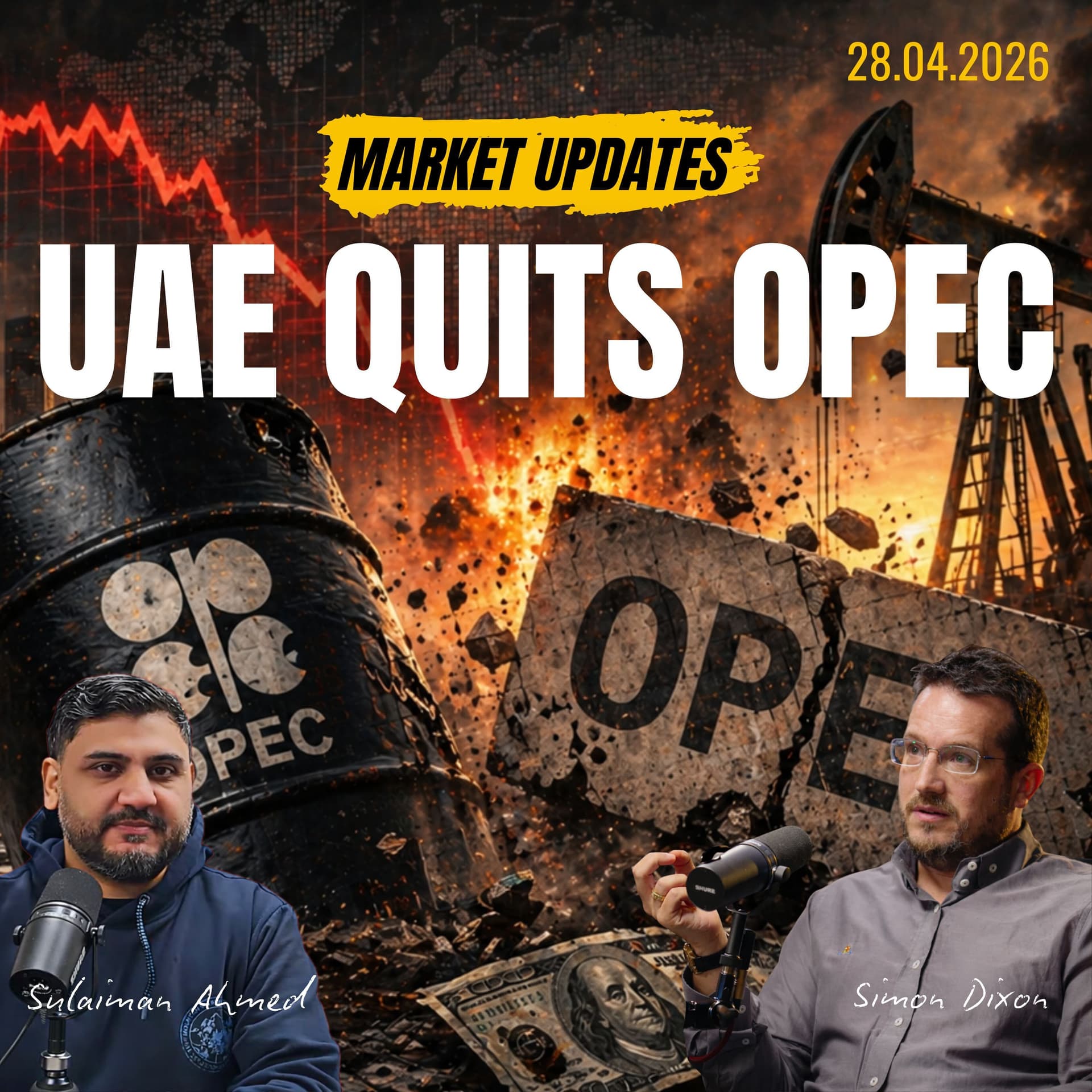
Simon Dixon Hard Talk
UAE LEAVES OPEC, Is This The End Of Saudi Arabia and Opec Countries? | Market Update
00:43:16
Loading summary
Transcript33 lines
- [00:00]
A
Huge news. And the news is that the UAE has decided to leave opec. And so we're gonna have Simon Dixon coming on the show and financial expert, a bitcoin OG who's gonna break it all down for us. What is the implications of it? Are we gonna have a major oil crisis? Why did the UAE do this? What was the reason for it? What is the impact it's gonna have? And what is their psychology? Is this an act of desperation? I know Simon's gonna say it's not, but let's see what he's got to say. Simon, thanks for joining us. Hope you're doing well. How are you?
- [00:37]
B
Very good, Solomon. Thank you. Yeah, pretty. Pretty big news. So it's a pretty geeky topic, but I think we'll try and cover it in terms of its implications, but pretty big implications.
- [00:49]
A
Yeah.
- [00:49]
B
All right. Well, obviously the news is that UAE is leaving opec. One could say that this is a spontaneous decision. I tend to believe that it's got to be understood in combination with a lot of other things that happened over the years. And so if we kind of break it down, it really is about some of the monetary and financial architecture. So just in simple terms, if we look at uae, we know that, Solomon, you are no big fan of UAE for quite legitimate reasons. But if we strip out some of what we think about UAE and look at what the implications are, obviously they normalized with Israel in the Abraham Accords, and then in 2024, they joined BRICS at the same time that Iran joined BRICS. And then Saudi at the same time joined as an observer, and so. And also Egypt joined at that same time. They also. UAE provides the financial infrastructure that effectively allows Iran to circumvent some of the sanctions, which gave it some of its relief. And at the same time, the two largest trading partners as a result of this with Iran is, number one, China, because they don't care about the sanctions, and UAE, because it provided some of that infrastructure. And that kind of also lays into some of UAE's foreign policy many of the crimes against humanity that we've been witnessing. But the Libya and Sudanese operations kind of tie into the Gold Corridor. And if you look at the Gold Corridor trades, it starts to make sense why they might leave OPEC and what they've actually been building over these years leading up to this. They also did an integration into the Chinese payment system, SIPs, which has now got about 110 different countries as well. They. Because they employ a lot of, you know, in. Employ a lot of people in Building infrastructure and kind of. You know, many people have criticized how they treat like the underclass in Southeast Asia, India, Pakistan, various other places. But they're a ginormous source of remittances as well. At the same time, they put together a policy to become the crypto center of the Middle east and successfully did that. They also are the third largest bitcoin mining country in the world. The first is Iran, the second is Russia, and the third is uae. But also they took over a European project by the bank for International Settlements called Enbridge, which is a network of central bank digital currencies that plugs together Saudi Arabia, uae, Hong Kong, China and Thailand. And all of those are significant in terms of the gold trade and the different types of corridors that are set up. So that was all before we entered into this war. When we entered into this war, we had obviously the targeting of US infrastructure, Mossad, CIA infrastructure, US bases and some of the air, which really hit the tourism industry and some of those corridors. But recently leading up to this, we got an announcement from the Federal Reserve that UAE is looking for an FX swap line. Now it was framed as UAE in distress. While they have had significant impact on their economy as a result of this war, they still have $270 billion of dollar cash reserves and about 1.4 trillion of US assets, US treasuries and various other assets and port infrastructure investments and everything that they've had around the world. Now where this becomes pretty significant. And again, I don't want to be too geeky because all of these are pretty interesting to a geek like me, but the FX swap line is, think of it as a mechanism for trying to incentivize somebody that has aspirations of being a financial center to have a Federal Reserve guarantee at the same time as incentivizing them not to sell their Treasuries and not to sell their equities. Because the US is in a situation where it has to have a continual purchase of its stock market and it can't allow any of its foreign investors to sell its bonds. The reason for that is because as you sell your bonds, a buyer like UAE or Japan or any of these countries, when a bond price goes down, the U.S. debt, the yield goes up, which means the cost for America refinancing its debt, all of American mortgage market, all of the credit card market, all of the auto loan market, all of the extreme consumption economy that is over leveraged on debt, the cost goes up and it hits a bit of a blowout. And also the interest on the national debt at these record levels. And so what this kind of means is that America, in its stage of its debt cycle right now is transitioning from being able to dictate and enforce countries to accept the dollar, buy Treasuries and lend it back to them, to you being able to leverage America by buying US equities and US Bonds and requesting an FX swap line. And what an FX swap line means is that you print your local currency, which in the case of UAE is pegged to the dollar, and then you deposit it at your account at the Federal Reserve. The Fed creates some brand new dollars, which increases the national debt, creates inflation, but they can charge interest on that new debt and give this swap line. And so they use the local currency that a country is printing and exchange it for dollars. And so this gives us effectively a country, the ability to do what Japan did, what the European Central bank did, what the Swiss Central bank did, what the Canadian Central bank, what the bank of England did, which is an exclusive club. It allows you to get America to print dollars, and you leverage them by not selling your equities and not selling your bonds. This is the FX swap line. And then immediately when UAE said we want an FX swap line, and scott percent announced started saying, well, we'll look to do that with all other partners across the Gulf as well, and some of the Asian countries that might need it, like South Korea or maybe even Taiwan or whatever it may be. Japan's already got that. And so when you combine all these things together, you've got alternative financial systems that are being built upon the Federal Reserve System. You've got a mechanism for increasing debt, and you've got a mechanism for stopping countries from selling their bonds and selling their equities. Pull that all together. And that is really the death of the petrodollar in what it was after the last oil embargo. And really a different type of way of people circumventing sanctions as well. Let's say, for example, you have US dollars and you would like to trade with a sanctioned country, then what you could do if you wanted to purchase some of Iran's oil, then you could take your US Dollars in the Western markets or the UAE markets or the Singapore markets or the Hong Kong markets. You can exchange your dollars for, for gold, and then you can ship via the Strait of Hormuz your gold to Shanghai, and then Shanghai will allow you, they'll keep that gold and then they'll give you a credit of Chinese yuan. But that yuan has to stay within China because China has capital controls. It doesn't want to export it. It doesn't want to be in a position that America's in where the financial industrial complex can take down its economy and own its economy. And that's where the Strait of Hormuz becomes essential for these gold routes. And then you can use your yuan to get Chinese exports and then you can import some of the oil. And that's really the alternative routes that have been set up. And it kind of combines all of these, these different effects. So why is now the time that UAE might leave opec? Well, allegedly, I mean, I've been looking at it. They've been building a lot of their capacity and infrastructure and they were in a long term argument with Saudi in terms of trying to get an increased quota with OPEC to push more oil out there. I think this is really an excuse to say we're going on our own path because at the end of this, if there is going to be sanction relief for Iran, those corridors are going to significantly change. Rather than Iran selling their oil to China at a discount, you're going to have three countries which historically performed Saudi's role. So Saudi as the largest exporter and the one able to produce oil at the cheapest rate with the smallest population to export more and more of it is kind of like the central bank of oil. But now they went to about 30% petro yuan over petrodollar. But now you're at the end of this. If we get to sanction relief, you're going to have the new increased capacity from uae. If it leaves opec, you're going to have Saudi and then you're going to have Iran as well, which will be another 2 to 4 million barrels that can sell at that price. And really there's a bit of an internal, I think struggle to control the petro yuan and the petrodollar. And so this is a move from UAE which will in the end, I believe lead to lower oil prices and just give it a bit of leverage in the post world order that emerges once the Hormuz opens and once we get to the other side of this.
- [12:06]
A
Okay, I've got quite a few questions on this if that's okay. And I do want to talk about OPEC as well. But just before we do, in terms of the uae, I've been looking into this in quite a lot of detail from my understanding. Yeah, you're right, they always wanted an increased capacity. They were our claiming today that they're able to increase their capacity by one point can you hear me?
- [12:27]
B
Yeah.
- [12:27]
A
Oh, okay. They, they, they are, they are talking about increase in the capacity and they are claiming today that they can increase the capacity by 1.5 to about 2.2 million barrels a day. But I looked into this a lot of detail and actually if you look at the pipeline through Fajera, you're looking at possibly 400,000 to 700,000 barrels. That's not consequential enough to even touch upon the Saudi grip on the oil industry. You know, isn't it. Saudi can hit up to about 10 million barrels possibly. I know right now it's a lot less because of the closure of the straight. So right now they don't have that capacity. They have maybe a bit more than what they already had. I know they're thinking about creating more pipelines, but how does that make them the kind of third, you know, with Iran. I understand with Saudi and said, I don't see how this makes them the third kind of element within that.
- [13:25]
B
Yeah, well, it depends what the truth is really. So what other analysts are saying that they have been working in the years prior to this at building infrastructure that can significantly increase their capacity. And then we've also had in conjunction with this the different battles over their ports in Somaliland, Horn of Africa, different trade routes that could circumvent, you know, these different things. So I, we will find out what the reality is. But some analysts are saying that they built infrastructure that would be able to increase up to 4 million barrels. Apparently. I'm not sure if that's true. That's significant. I mean that's on par with Iran, which sounds aggressive, but even if it is 1 million barrels, 2 million barrels, I think it's still a player. And yeah, apparently they've been building out their capacity, but obviously the straight is closed right now, so they can't do anything right now. This is all about what it looks like after the straight is open and what the post order looks like.
- [14:32]
A
Well, the clip they're claiming, I think they have a pipeline that doesn't go through the straight. So this extra capacity of 400 to 700000 barrels would be circumventing the straight. From, from my understanding, which I say for, From I read 400, 700, 000, but they're claiming 1.5 to 2. Or you're saying some people are saying 4 million. So I get, we get, I guess we've got a big variance in the amount. Okay, the second question I've got for you is one of the positions in Both you and I hold is that we believe that Saudi and the UAE are kind of not having this kind of disconnect and they're kind of kind of using UAE as the bad cop for what the entire region wants to do and what Saudi wants. But now I think in this commentary you mentioned how this is almost rivaling Saudi. So do you think, are you thinking it's a bit different now or what's. What's your perspective?
- [15:27]
B
Yeah, I think both can be true. I think there is a recognition that we're entering into a new world order. There is a recognition that people are building the rails for multipolarity and there is a need to remain as one unified front of the GCC and play the good cop bad cop role. And clearly to me Saudi is being branded as good cop and UAE has been branded as bad cop. But you can look across the GCC and you can see how they're managing Israel normalization. Abraham Accords via uae. You can see how they're managing Enbridge network of central bank digital currencies. You can see how they're managing the different, you know, ports in the region. You can see that they're trading. I think Yemen versus Somaliland was, was a trade. And I think there's still Sudan and Libya which is going to hopefully resolve itself in the next year or so after this. And I think at the same time everyone also wants to negotiate for their own position of power. And so there is always the opportunity. UAE is really building itself as a financial center and financial hub. It will take a hit after what's happened, but we have seen that it's just really, I think UAE has been vassalized more into the financial industrial complex more than ever. Like the ETFs are purchasing more real estate from the retail sellers. You had those Bitcoin to gold corridors being built. And I think to me, in recognition that the GCC is going to be a front that is aligned with brics and will be able to manage those FX swap lines with the Federal Reserve System, that everyone's going to perform a slightly different role. And then you've got Qatar in the mix and then you've got Q8 and you've also got Turkey to factor in. So you can see those internal power struggles and you can also see, I think coordinated games with good bad cop. And I think both are true.
- [17:41]
A
Okay, that makes sense. And then in terms of opec, if you can explain to the audience what OPEC is. OPEC essentially was a. And actually is it explain if it's even a good thing because I don't see how it's a good thing. These countries have essentially what I mean, let me know what your thoughts are like what colluded together to make sure the price of oil remains high. Now, I understand if you're a poor country and you're worried that your oil, which is your only means to make money, you need the price to be higher. But most of these countries, other than maybe you could say Venezuela and Iran due to sanctions, the rest of these countries who are part of OPEC are very financially wealthy countries. But if you can explain to the audience what OPEC is, what this agreement is and whether you think it was a good thing or not.
- [18:26]
B
Yeah, OPEC is disgusting. This is one thing I complete, I completely agree with Trump on. He's, you know, he's always hated OPEC and for different reasons. But the issue, you know, so OPEC is a cartel where they engage in price fixing. And so those that are important enough to impact the price of oil, they coordinate on when they're going to relief, when they're going to release reserves or when they're going to build up reserves. And through what we've even seen with the straight up for moose, when you change those amount of oil on the market, people are currently buying oil across the, across the world at about $170 right now to get real oil, despite what the futures market is saying. And that's a horrible thing. We're, we're seeing the humanitarian impact of that around the world. It is price fixing. It is illegitimate wealth if you're in a, if you're in a competitive market and it relies upon all of the players in a game, theoretical prisoner's dilemma, never defaulting from the quota. And so you have two parts. You have opec, which is where you effectively get a quota from Saudi Arabia with all the bells and whistles that comes with that in geopolitics. And then opec, which is Russia as well. And so Russia really is Saudi and Russia become the price fixes. But you could argue that it was a resistance against the, you know, the, the US Corporate financial industrial complex. Big, big oil as well. But the, the key difference here is that if you look at Saudi, they can produce a barrel of oil for about $2 to $10. But the terms that Saudi has with its population is that we give you all of your welfare needs taken care of. And so they have a large fiscal demand for their population. And so to meet fiscal break even, they need to charge about $70. But if it was without, if they don't factor in their fiscal budget and providing welfare for their population and making it where the people don't need to pay any tax, they can produce to about 2 to $10. In America, they need about $50 to break even. And once you go below $50, the companies are selling at a loss. And so through this type of thing, you've got OPEC and opec, which also consists of Iran as well, and various others that are less aligned outside the Gulf countries. Yeah, they're able to collude and just artificially push prices higher and interfere in geopolitical events. It gives them power in enforcing embargoes. We saw that during the Biden administration, that Saudi chose Russia and Putin over Biden when last time America was going through its inflation cycle as a result of the Russia Ukraine war. And so it gives power, it props up these sovereign wealth funds. But at the same time, there is a ginormous power game, which is that China's inventing all the alternative forms of energy and we're seeing lots of nuclear energy professors that get assassinated because it is a mafia. This is the highest level, the biggest pools of money, the highest levels of power and mafia games in the world. And so they're preventing alternative energy from succeeding. And nuclear energy is the real game, which is why the civilian nuclear program with Iran becomes such a big thing. I mean, they've been producing bitcoin at about $0.02 electricity when the rest of the world is like at 4 to 5 cents, which means that they're producing more Bitcoin in their mining operations because they're using nuclear. So, you know, it is a disgusting thing. And there is a. We've been told for decades, and we're always told that we're going to hit peak oil where oil runs out. It's why all these countries are looking to diversify their economies. But there is a real reality, which is that China doesn't have, you know, so they use coal, they use solar, they use wind, they use hydro, they use nuclear. They use everything that they can because they want to remove their dependency away from that. And that is what, in effect is propping up these sovereign wealth funds. It is China purchasing all this energy as the world's manufacturing base.
- [23:16]
A
But just on that, in terms of, just to kind of look at the other perspective, if it's true that oil is going to run out, which again, I understand the other theory is that possibly it's not true. But anyway, let's assume that it's true that Oil is going to run out, then do these countries not have a responsibility to make sure that they don't just flood the market and then just completely run out as well? So would that not be a benefit? I know there's. I agree with you, by the way. I'm just trying to play devil's advocate. Is there not some kind of benefit to essentially keep control measures? Because you flood the market, you run out of oil, that would be an even bigger crisis.
- [23:53]
B
I'd agree with you if alternative energy didn't exist, but we got amazing alternative energy and those industries are being suppressed in order to prop up the profits of big oil. So it's purely individual sovereign survival and corporate cartels and profiteering. The real price of energy should be significantly cheaper. But there is a World Economic Forum, global agenda to make everything unaffordable so that there's massive concentration of wealth upwards. And so to me, you need to flood the markets with energy. You need to get energy as cheap as possible and you need to compete and you need to innovate in alternative energy to help get, you know, to just really help innovation and free trade prevail. But yeah, so I'm all for breaking up these cartels. I think it's great for the consumer, but it also creates a massive power play and power struggle and kind of. I think what really comes here is even if UAE can't affect too much, which I think they can at the end of this war. They can't during this war, but at the end when the straight is open, it's what other players will do, how others will react to this. But I'm all for get the price of energy down. I think it's good for the consumer. I think it's bad for large pockets of corporate monopolies and cartels and sovereign wealth funds and the financial industrial complex in general, I'd like to starve them if we could.
- [25:33]
A
Yeah, I'm in agreement with you. I'm not sure if UAE can do it individually, but I think the cascading effect, if like lots of countries do it, then it could cause a huge impact. But just on that, Simon, we seen the price of oil, I believe go to $111 today. Correct me if I'm wrong, that's despite this announcement. Now, if the straight wasn't closed, one would assume that an announcement like this would just completely drop the oil prices significantly. Now, is it the fact that what's happening in the war is just completely. This, this is the oil prices is completely ignoring what this or Is it that substantively, actually, the market doesn't think that this would have a huge impact in a real tangible way?
- [26:18]
B
No, I think it is that it makes no difference while the strait is closed. But once the strait is open and there is a deal and there is some kind of settlement or the natural conclusion of whatever the negotiated outcome may be, I think it will have an impact. And I think. I think there's the potential to actually really kill the power of Opeca. And, you know, it's game theory and, and I think that will help get energy prices down, but there's no impact right now. So that's not. That's not really factored in. And I do personally believe right now the, the war has hit a stage where this is highly coordinated in order to manufacture a global crisis. And that global crisis is going to benefit many of those members of opec, the financial industrial complex, the police and surveillance state, the military budgets, the big print. So the height, this is massive wealth transfer and concentration of wealth from here on in. And all those that benefit from it are the ones that actually have the power to reach a resolution and come to an end right now. So I think we've hit that stage right now where they're trying to make manufacture a crisis like Covid.
- [27:43]
A
Oh, I think it's much worse than Covid. I mean, just to add to what you're saying, I've heard for a very long time, honestly, this is going to sound like a conspiracy theory, but watch out for 2026, 2027. Something huge is going to come and the financial market will be destroyed in a way that's never been seen in, over in around a century. And so they were basically saying it's going to be maybe as bad, if not worse than the Great Depression. And a few years ago, you couldn't see, you know, you'd see, like, how are they going to do this? Well, we're seeing it happen in real time, so I, I agree with you. This was definitely manufactured in order to cause the harm that we're seeing. But in terms of coming back to the oil price, sorry, Saudi Arabia. Saudi Arabia. This is a big blow to Saudi Arabia. The UAE has literally just given them a headboard. What is Saudi Arabia going to do? How are they going to react? MBS isn't a man of great patience. He doesn't like to be disrespected unless it's bad. Donald Trump, how is he going to react. React to this?
- [28:46]
B
Well, I subscribe to a high degree of coordination between Saudi and uae So I think they've been trading and I think this is part of their trade. So I think they've been settling portrayed routes, I think they've been settling quotas and I think that this would have been part of UAE's pre agreed negotiation. That's just my, I couldn't prove it, but that's my personal belief. But if we are to believe that this is a genuine, you know, trade and oil war, Saudi is still the most important power in terms of its population relative to its cost of production, relative to what it can export and it still has very important relationships with both America and China. And so I would expect a genuine, it is a blow because it's taken away a massive tool for, for Saudi. You can either lean into it and constrict your reserves and try and protect the price, in which case you get a disjoint between. Because even uae, they started creating their own oil markets. And so just like you're seeing WTI and Brent crude disjoint, you're also getting prices in Amman and prices in Dubai. So they built infrastructure to, to have these arbitrages or you kind of push your price down in which case it's going to severely impact the vision 2030 where he's trying to diversify his economy because there's lost profits to fill up the sovereign wealth fund to invest in things. So all in all, I think this move is bad for Saudi Arabia. But I think there would have been some quid pro quo in the background where Saudi may have made up for it. One of the things that I have been doing is looking at the COVID deals and one of the most likely beneficiaries of Venezuelan oil refinement in Texas is a subsidiary of Saudi Aramco, 100% owned also Golden Pass with Qatar. A lot of the LNG sales are going via Golden Pass. And Golden Pass is 70% owned by Qatar Energy and 30% Exxon. So prior to this as China was building up ginormous reserves. So they're a player as well. I think there are so many players that the tool that Saudi once had is a dying tool and we're going to enter into a more competitive market. And yeah, I do think it is, it accelerates the need to diversify that economy further for Saudi.
- [31:34]
A
So just coming back to this point, so, so your point is this, this harm Saudi irrespective. But there is a possibility this could have been some concession. And that's possible either way. But either way it is a kind of big problem for Saudi because if the UAE does it this. So let's hypothetically, let's go with your thing. Let's say it is a concession. Right? Because one possibility is not concession. That's a major blow on Saudi. Saudi needs to do something about it. The second possibility is it's a concession. But even if it's a concession now you're going to have other OPEC members saying wait a sec, do we really need to stay in this? Saudi is actually the biggest beneficiary, they're producing the most oil. Maybe we can jump out. I mean this may start causing some form of cascading effect.
- [32:21]
B
It could. But I see UAE as a foothold in the GCC for the financial industrial complex. You know, it is so much a financial center and normalized with western interest while hedging Eastern interests. And I think we're going to see, I think Saudi is going to lean more and more into Petro Yuan Brics layers. And at the end of this, you know, it also ties into the holdout for the Palestinian cause was actually Saudi. And so if you look at these big things, these big public facing things, what is the normalization agreements going to look like? Saudi has the holdout there. You've got the Enbridge project, you've got opec, you've got alternative financial rails, you've got UAE being more and more Western financial interest investing. There's, there's a lot to play with and there's a lot to negotiate in this new world order that we're essentially entering into.
- [33:33]
A
Okay, and now we, the prices of oil right now is $111. We're getting very close to your breaking point of 115. Obviously he's not got many more rabbits he can pull out the hat other than maybe removing the blockade. Do you think that's what happens next? Because we're getting close to 115 again and he posted Summer today had no impact on the price of oil.
- [33:57]
B
Yeah, there's a couple of things in my mind. I find it pretty interesting that in the straight of Hormuz we've got these islands and three of them are disputes between UAE and Iran. Yeah, and I'm not sure whether those have been settled. And we're going to get a bit of theatrics with a, some kind of invasion that gives Trump the Hollywood movie the B2 Bombers. I, I'm preparing for some kind of theatrical end game and announcement of, of a deal because I, I think that negotiations never stop throughout this whole process despite what we're being told and maybe those UAE islands are part of it. I, I do know that there are, you know, there are these major powers and yeah, whether, whether we're just going to get the announcement of a deal. But yeah, as you said throughout this whole time I've said when the 30 year yield on U.S. treasuries hits 5%, we're about 4.9% right now and going up when it, the 10 year treasury which determines mortgages hits 4.5%, we're over 4.3% now. And when the one month oil futures on WTI approaches $115, we need some kind of event that crashes the price back down, normalizes those yields and I feel like the next one is likely to be the final one. So maybe we get an escalate to de. Escalate, maybe we get a deal. But I think at this stage nothing stops this train. And yeah, I'm expecting something but even
- [35:43]
A
the escalate element of it, would that not just increase the oil prices that would cause it to go above the barriers that you're talking about?
- [35:54]
B
Yeah. So whenever we get the announcements, you have an event that drives the prices up significantly blows through it and then a movie that kind of gets the prices back down or an announcement or a Laurel and Hardy show where everyone says you said this, I didn't say this. So you know, we, we enter into one of those. But to me we're getting close to something substance, substance, substantive, don't have to say something substantial needs to be announced. And my, my only pushback on that, on my own analysis here, is that I do believe greater powers are manufacturing a global reset. And all of the powers, whether it be banking and financial powers, whether it be military budgets, whether it be technical, police and surveillance state, whether it be Russia, whether it be China, whether it be Iran, all of those powers can kind of allow this to go on and create an absolute humanitarian crisis and disaster. And we're starting to see on the media kind of that Covid style of thing. We're seeing in India that the price of propane gas, which is like those canisters that power all the street food that's gone up 4x. So that's bankruptcy for those businesses. For those small businesses, we're seeing the supply chains around semiconductor chips in terms of Netherlands, South Korea, Taiwan. So I think they've got a big, they've got a big thing for us. We're good, we're going to get that. But I think maybe it goes on for longer because they want to manufacture a Deeper crisis.
- [37:38]
A
Yeah, yeah. And wouldn't that be. If that's the case, which I agree with. I think that is the aim. If that's the case, would they not want the. They would do another bombing campaign? It may go on for a lot longer because it. If you basically continue this current situation, let's say for another week or two, then you do a bombing campaign and a fight for like a month, maybe even whatever you can do, whatever your capacity is, Their current capacity seems larger than the original capacity. So they went for 39 days. So you could go for another 39, 40 days, maybe longer. And then you go back into this ceasefire phase again. You do that for long enough and you basically get the complete, as you, as you mentioned, the complete destruction of society. This kind of surveillance Palantir type state you saw in the alleged attempted assassination.
- [38:26]
B
J.D.
- [38:26]
A
vance was removed before President Trump. Right. So that kind of shows the psychology of either he's really important or he's the real president or whatever it is. So quite clearly that technocratic aspect is more important than getting to a deal or a ceasefire, based on what you're saying. Right.
- [38:43]
B
Yeah. Isn't it, Isn't it funny, Solomon, that we've hit a phase with these false flags that we've been talking for about half an hour and there was a meant to be an assassination attempt on the President of the United States and we didn't even talk about it because virtually no one believes it.
- [39:01]
A
True, true.
- [39:03]
B
That's kind of the stage that we've hit now in terms of the clown show. Yeah. And look, the. Yes, I do think there is a very evil agenda that's at work here and it concerns me significantly. So, you know, that's all that's happening when I have my analytical hat now, if I step aside from that and put my humanitarian hat on, this is the poorest in society that are impacted by this. You know, in Southeast Asia, you know, Japan will be. That. Japan will be fine. Taiwan will be fine, South Korea will be fine. They'll figure out how to either sell their bonds, get an effect swap line more aligned with China or more like whatever they're going to do, but it's the poorest in society that they're already having another, yet another crisis. And I can't help but think that this is population control taking the most unproductive from society in the moment when there is a aging population and a pension crisis. And just like Covid, I, I'm. I'm really concerned about what they're actually doing here. And I've hit a stage in life where I think they're perfectly capable of doing the most evil things. And so the, you know, the, the developed countries, they're going to pay higher prices, they're going to sell their assets if they're on deep in debt, if they're on, you know, you will own nothing and be happy. But when it comes to, you know, Vietnam, when it comes to Philippines, when it comes to the underclass in uae, the underclass in Cambodia, Hong Kong, you know, these places even like Pakistan, Bangladesh, India, all of them, Philippines, Indonesia and even you know, the, the Indian in America, you know, the, the, the parts of the population that have been forgotten, they've lost their jobs, they're, they're homeless, they're on the streets, they're addicted to drugs. They were just holding on.
- [41:19]
A
Yeah.
- [41:19]
B
Now their rent's going up, their energy prices are going up. Across England, you know, it's, we're just going deeper and deeper and deeper into this K shaped economy. And to me we're hitting the breaking point where that class, you know, they, they, they, they will coordinate, they will organize. We're starting to see across America warehouses being burnt down, you know, that we'll get more and more of this civil unrest. And my, my, my, the sad part is, is that even if we don't get it, I think CIA, Mossad, MI6, the deep state, they'll, they'll manufacture it anyway. They're doing colored color revolutions in the west because every single contract is going to the new privatized U.S. government, which is Palantir, I mean the Department of the U.S. department of Agriculture signing agreements, owning all the farming data, the food supply data, aggregating all of it. Every single department across Europe, across uk, across United States. We are handing over power to, you know, Palantir AI, we're building our social credit scores and there's more and more programmable money technology that is going to be utilized in order to fix some of these financial disasters because they're not going to let the system crash. They're going to bail it out and you're going to pay for it and everyone's going to pay for it through higher prices. The debt's going to increase and that's going to disproportionately benefit the asset holders, which is a smaller and smaller class. And the underclass are just hitting breaking point if they weren't a breaking point already. So it's really sad.
- [43:05]
A
No, no, I completely agree with you. Simon. Simon, thanks for taking your time out to join us really appreciate your analysis. I think people learn a lot from this stream, especially in terms of everything related to opec. But everything else we discussed as well.