← Simon Dixon Hard Talk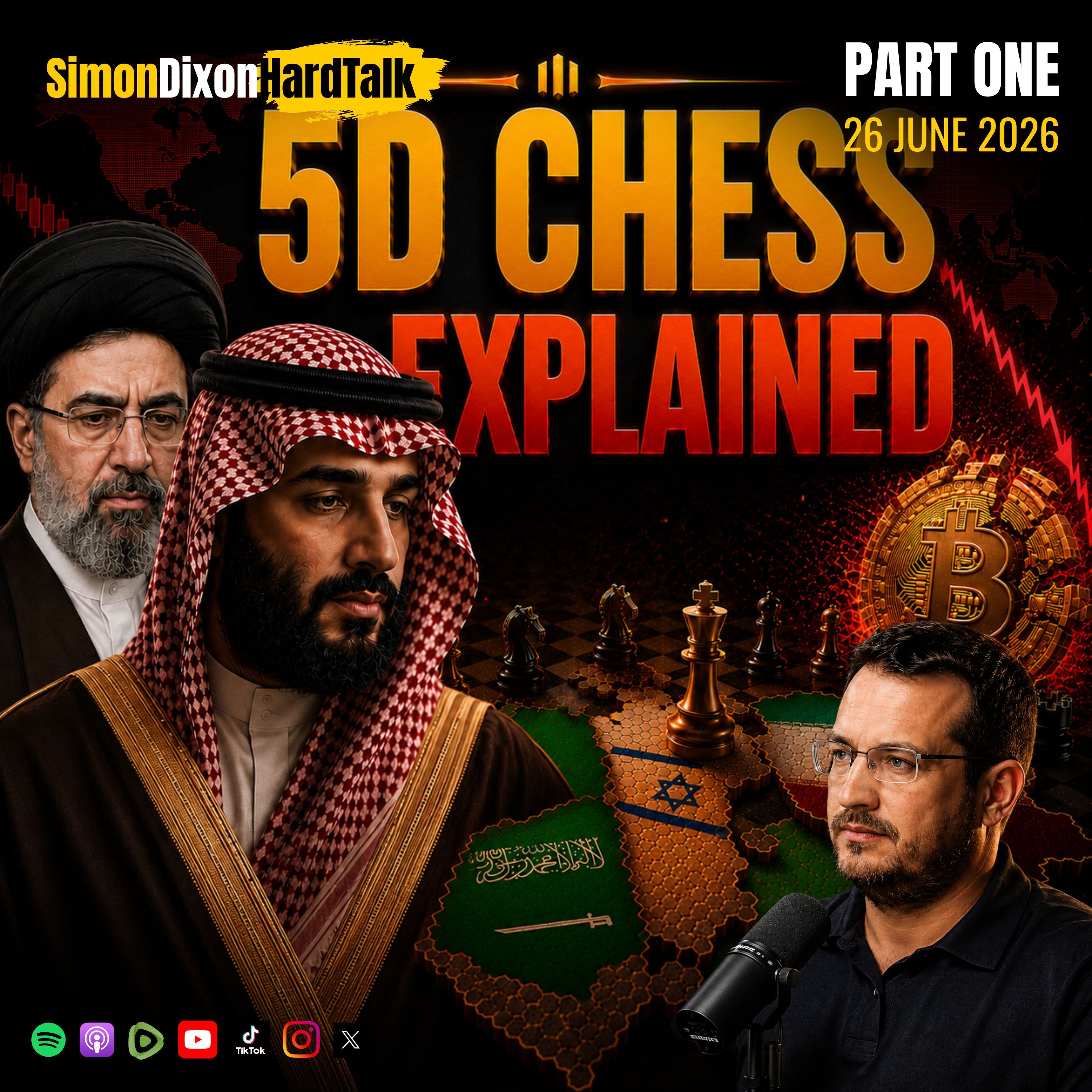
Simon Dixon Hard Talk
🇬🇧 UK Regime Change, Middle Eastern 5D Chess & the Bitcoin Treasury Company Meltdown | Simon Dixon Hard Talk LIVE (Part One)
02:24:12
Loading summary
Transcript1 lines
- [00:00]
A
Hey, sovereign wealth builders. Simon Dixon here and welcome to another episode of Simon Dixon Hard Talk Live. We are headed to the real regime change and that is that we've had UK regime change and I think we're headed for the Israeli regime change as well. We're going to dive into all of that and we're also going to be diving into the meltdown in the bitcoin treasury market. And of course, we're going to be connecting the dots and how you need to protect yourself. So this episode of Simon Dixon Hard Talk Live is called the UK and Israel just got regime changed for the AI era. We are moving into the MIC era or we're moving away from the MIC area military industrial complex over to the tick era, the technical industrial complex. And that was all while bitcoin was crashing. How do we interpret that and what are we going to do in order to take advantage of this opportunity? Well, we'll be discussing this in two parts. In part one, as usual. This is a live part of the show. This is where we're going to be discussing the UK regime change. We're going to be diving deep into UK politics and how it intersects with US politics and particularly the bond market, the treasury market. We're to going also going to be reviewing and actually going back to exactly where we are in the Middle Eastern 5D chess. And I've always been saying the Iranians, the Chinese and brics and the GCC have all been on the same side in order to expel us from the region by partnering with FIC in order to 5D chess outmaneuver MIC. So the financial industrial complex is the Middle east, while the technical industrial complex regime change operations happen. So what does that mean for the military industrial complex? Well, that's where Europe comes in. We are also going to be discovering the bitcoin treasury company meltdown. And as always in part two, we can then go over to a new premier video. And that premiere was a interview I did a while back on bitcoin archives. We, we played part one and premiered it on my channel. But we're now going to be doing part two, which was really focusing on the fact that bitcoin has now effectively crashed below 60,000. At the time of the recording, I was expecting continued weakness and guiding people why it's happening, what's happening with the treasury companies, what Wall street is doing and what to expect over the months, the and the years ahead. So this is really the battle for bitcoin sovereignty and that's where I was interviewed on bitcoin archives with Archie and that's part two of the interview. So hang around till the end and it will redirect you if you're on YouTube or you can head over to my YouTube channel on Simon Dixon 21 and it will, you'll be able to see the premiere there right after this live stream show and as always, you can get them on my podcast, Apple podcast, Spotify, or you can watch this on Rumble or X as well. Right, let's jump right into the UK regime change. A lot of people have been asking me, can you tell me what's going on in the UK? We've had our seventh regime change in the last 10 years because one president or prime minister in the UK serves a particular agenda, then they get regime change and then we move on to the next agenda. And they need you distracted thinking that if you change the prime Minister then everything's going to change. And they keep giving you a different flavor and a different rotation between the military funding, the technical funding and the financial funding. So what does this regime change represent? We're going to be diving in. We're going to be going through also the legislative changes that are happening and how they coincide with what we're seeing in the regime change. So why is Britain entering into another phase of likely austerity? What does that mean for you? What does that mean for your investments? We'll also, as we said, we'll be going through why the Middle east has fundamentally changed already and our theory and our framework, we're going to be reviewing it that we've been covering over the years. If you're a long term listener, if you're new, welcome. We'll share the framework. We'll share how I think it's been vindicated and how many of my followers were prepared for it. While everyone else is left scratching their head why we've got Iran meeting the UAE and Iran meeting with Saudi and this new Muslim nation alliance that has formed that we knew was coming all along because we were able to follow the money and see the capital flows. And we'll also be covering why bitcoin. Treasury companies are becoming increasingly more important in understanding where the market goes next. So just before we do that, let's do a little bit of a market check in. So this week we had for the first time since, well, how long ago was it? 20, 21. The Bitcoin has now traded below $60,000 and we'll be diving into that in the next. In the, towards the end of this, gold went below its 4000 mark at 3960 and I think it jumped straight up slightly Bitcoin Treasury Company structured product that we need to follow now strc that was sold as a, you know, kind of like a money market fund where you would get your $100 back as principal plus receive a dividend on it. Well now that $100 went below $73 and I think it's about $75 now. Thankfully all my long term listeners would have avoided this and now it's kind of become cool to talk about this stuff. But we were covering it when everyone hated us for covering it as well. The dollar has been strengthening relative to the other western aligned currencies. DXY, it's over $101. We were expecting a weakening and a return to a dollar weakening strategy into a multipolar world. But ever since the Iran war it spiked up from $96 to approximately $101. There was significant dollar strengthening ever since the Iran war and US started and now we've got to get through all of this restructuring of oil. And of course all oil is priced in dollars and this is going to take us some time to get through. But in the meantime WTI West Texas oil is now and went below $70 and Brent was about $75 which is Brent crude oil in the North Sea of England. Now all this time people were paying, you know, Japan was paying approximately $170 for its oil in any kind of relationship it could get through the straight of Hormuz. But we were watching the bond markets and recognizing that this war has to come to a resolution. But it was bounded escalation based upon following the oil markets and the bond market. So where are the bond markets now? Now that we have signed the MoU the 30 year yield has come back below its 5% to approximately 4.86%. Now now remember the current, the, the current debt of the U.S. almost $40 trillion is paying an average of 3.3%. And so even at these rates, even if they roll over on very short term treasury bonds it's still going to be above 3.3%. And if they do it on the 30 year it's 4.68% and in the case of the 10 year 4.37, 4.37% rather. So you know the yield is going up on the national debt and that is the problem that we're dealing with here. And so that is having an impact on inflation. We got a print of PCE inflation. PCE is normally lower than CPI which is Consumer Price Index. And this is what the Federal Reserve actually used. So CPI was at 4.2%, PCE is about 4.1%. So it gives the Fed a little bit of wiggle room to say that the numbers are better. And Kevin Walsh is talking about having a committee installed in order to try and change the definition of inflation. We had a big correction in the AI trades. Trillions of dollars were wiped off global markets. We've currently got the Korean and the Taiwanese market corrections. And that was after a US market correction which was led by the AI companies. The SpaceX IPO is now just a little bit higher than the initial IPO price, but it's corrected back a little bit. So we'll be watching with interest. That AI trade really is the entire market right now. And you can see that the AI companies are trying to get as much debt and equity capital into these markets. But OpenAI decided to delay its IPO until 2027 due to market concerns at the moment. So let's see what that actually means in terms of Bitcoin ETFs. We continue to have a huge institutional sell off via the BlackRock ETFs and the other ones. We had, in fact, the largest 30 day outflow from Bitcoin ETFs, and it was a record of about $6.4 billion last week alone. And that is the rotation that we've been talking about out of the Bitcoin ETF and into the AI trade as well. That was about $233 million of selling pressure and outflows via the ETFs at the same time as some of the things we've been talking around the Bitcoin treasury companies. So that's giving you a little bit of a flavor of the market. And at the end of this, of course, we'll be saying how you can protect yourself and position yourself through. But let's dive into the main topic right now, the UK regime change. So Britain is entering into another managed regime change. We've had so many different regime changes in the uk, whether it be Liz Truss, whether it be Rishi Sunak, whether it be Boris Johnson, whether it be Keir Starmer, each of them performed a very specific function. It was Boris Johnson who was there to enforce the lockdowns and all of the blackmail operations that exist around him. And his controversial character. Rishi Sunak, of course, was our ex Goldman Sachs guy that was the biggest investor through his family in vaccines and Minerva. And so he was there to profit significantly from the rollout. Of vaccines and play along with the narrative that was pushed out there. Notice that Tulsi Gabbard has been actually releasing files now around the biofuels that were developed in Ukraine. And then Fauci was sending that money over to the Wuhan lab that led to the COVID outbreak. We've now got official confirmation that this was a bioweapon that was developed by the west and lab grown in China as well, in order to have the plausible deniability story that Trump called the China virus. And then we had operation warp speed 2.0 to inject everybody with these vaccines. So anyway, in the uk the faces change. Then we had Keir Stormers. There was Liz Trust in the middle. Liz Trust was regime changed by the bank of England after the gilt markets crashed. We're going to be discussing the relationship between the UK gilt market, which is UK national debt, and the US treasury and the US national debt as well. But the faces change, the agenda remains the same. They just are paid by slightly different factions of power within the financial industrial complex or the different complexes that sit underneath it. So anyway, I've always said that Keir Starmer represents, in terms of this more aligned faction of power, military industrial complex first, financial industrial complex third and technical industrial complex second. So Mick Tick and then fic, in that order. He was always meeting with Larry Fink. We had the different tax policies that destroyed the energy industries in the uk. We also had the civil unrest campaign by fueling up racial tensions. Immigrant, you know, always having a other to blame with immigration policies, energy policies that discouraged the development of energy from the North Sea and also the funding of the Ukraine war and pushing out the narrative that we've seen continually. And so remember that if you look at Keir Starmer's background, the reason that I always said that is that he used to be the DPP and so he would be in charge of prosecuting various people. And who was his biggest target? What made his career? Well, it was prosecuting Julian Assange which was effectively trying to push a allegations of sexual. I won't say it on YouTube, you know, grape claims and pin them on Julian Assange while. Because Julian Assange created WikiLeaks that was powered by Bitcoin, which exposed the military industrial complex for much of its crimes against humanity in Iraq, the various funding of isis, the, the various other operations in Syria and all of the Mick whistleblowers that want to anonymously leak documents, you know, like also Edward Snowden as well. But anyone that wants to do that it was Keir Starmer that tried to pin these grape claims on, on Julian Assange and that later into, you know, turned out that he was innocent of those claims and he was able to have all those charges dropped. But that was his connection to military intelligence and the military industrial complex. Remember how these operations work. You have to prove your utility to real power and then you get to have a role as a politician. And your job is to pretend that you work for the British people while you work for your lobby power. And politicians are, you know, they're not elected. They're installed rather than elected. And so what was his real role? Well, his real role was to create the narrative that we are defending democracy. So while the UK is having record levels of dissatisfaction in terms of wealth inequality, in terms of homelessness, in terms of the need for immigrants in order to facilitate a pension crisis, and then creating white nationalist movements and fueling strategic tensions between these different factions, then having a legal immigration that is able to be weaponized in order to create this strategic tension while we're having higher than ever suicide rates, drug addiction, homelessness and wealth inequality is really starting to create this environment of constant regime change. He needed to play the role of pretending that we were defending democracy while he sends vast amounts of money over to Ukraine and then it is siphoned off through these political systems and spent back into the military industrial complex in order to create these mixed stimulus checks. And that was really his main role. And so that's why you always have pictures of him hugging, you know, the, you know, the Ukrainian Prime Minister present. I always forget which one it is. Is he a prime minister or a president in this one? But Zelensky, you know, who was installed via CIA ops after the 2014 regime change that happened. And then the CIA was stoking the war in order to stoke a retaliation from Russia so that America could vassalize Europe into the McVick and tick while BlackRock was managing its strategic investments in renewable energy and shutting off various forms of nuclear energy and then making it where those sanctions would lead to. The cutting off of the LNG from Russia in into Europe or at least severely making it at a price due to sanctions enforced by Europe where it destroys the economy, destroys the manufacturing base. And then what happened to Germany? Germany then starts taking all of its car production, all of its productive manufacturing base, and now we're getting more and more IPOs into German military industrial complex. So it was to change the region into a mixed stimulus check ahead of the fact that we were going to have the operation in the Middle east that I've been covering. And you could see all of those flows if you were following Lockheed Martin, General Dynamic, Raytheon, if you were following their balance sheet, you could see the contracts that were changing in the Middle east and Europe and moving also towards cybersecurity and artificial intelligence to stimulate the tick as well. Well, that phase is becoming politically exhausted. The jig is up. People sense the corruption, people no longer believe that they're defending democracy. People are starting to really figure this out and start to say what is going on in our country. And so what's the next phase? The next phase belongs to the technical industrial complex. And that is where AI surveillance sponsored by Elon Musk through nodes like Tommy Robinson, who's paid by Israel, are here in order to manufacture the type of environment where the average Brit starts to become more and more dissatisfied so that they can justify the acceleration of the digital prison that's being built. That was beta tested in Gaza is now more and more the most extreme version was in Gaza, now coming to the uk, spread out across Europe and then implemented most likely through false flags and border controls and various other things across the us. This now becomes all about AI surveillance, digital identity, predictive policing. And the best way to do that is to have one of these far right while you have the remnants of a left labor leadership. And so you regime change Keir Starmer, so that we move away from this Mick led order, move to a tickled order manufacture civil unrest and strategic tension. And then you have an uprising from the far right aligned factions that all work for the same powers, all sponsored by the same lobbies. The end result is you get more Palantir contracts, more digital infrastructure, more monitoring, more facial identity, more cctv, more social division used to justify all of these different changes. You start highlighting, you know, sexual crimes against underage children, you know, grooming gangs, whatever it may be. You then say that the Internet now needs you to have an identity in order to use it. You say you're protecting our children, but really what you're doing is you're adding the identity layers that later will be enforced, where you have to have the digital ID that is integrated into the CBDC or stablecoin in order to access these processes. And so really this is a political personalities changing in order to distract people into blaming. All right, that was the Labour Party that did this. Now we need this new party, whether it's reform, whether it's Nigel Farage, whether it's Rupert Lowe, different flavor of the exact same thing, but the infrastructure won't change, the setting will remain. And you'll always be thinking it's those idiot politicians and maybe you get a few more regime change on the way up, but the next political cycle really, I think will be dominated by more civil unrest. And that will be monetized through the rollout of these large government contracts with these artificial intelligence, social credit, core score. And so that requires more fear, more division, more media outrage, more algorithmic turning you into the most extreme version of yourself. And you need to control the inputs of your information and make sure that you're not blaming the other. And really allowing the government to be the battering ram when really the government is just a front for real power and you vote with your money. And that's why we focus on sovereign strategies as I cover every single week. But media and outrage will all be used to justify this expanding surveillance power. That's why you have Tommy Robinson, who's paid by Israel. That's why he's partnered with Elon Musk, who's a node of the tick. That's why you have these ultra high focus on racial tensions, religious tensions, immigration policy and various other things. Again, I'm not saying that the changes aren't real, but the real reason that these are happening is your World Economic Forum agenda. It's the real corporates that have captured the government, that are able to manufacture these different operations as well. And so don't fall for it. If you think Andrew Tate's going to create something with the Bruv Party that's going to change anything. No, he's not. He's there to make Muslims look crazy. Nigel Farage is there in order to manufacture the anti immigration policy. Rupert Lowe is there as an ex financier to do the same thing. They all need financing. And even if they are not aware of the power dynamics and power structure right now, as soon as they come into power they will be because they need the campaign financing. And then as soon as they get into power, Liz Trust, you know, gets a little bit of a meeting with the bank of England and the bondholders and the lobbies and the real power and the bank of England and various other factions are able to, you know, soon, soon show them how power actually works. If they don't know already, which I'm pretty sure they do. But anyway, they all just become useful political vehicles. And regardless of whether they understand or whether they actually have incentives that drive that type of behavior, or whether they actually need to be in a blackmail operation, nothing stops this train and it's the same similar power dynamics that is and the same type of thing that's emerging in America right now. Because as we've always said, Palantir via Peter Thiel groomed J.D. vance, whose name is not J.D. vance, who had a venture capital fund, who was not a venture capitalist that received 15 million of political funding despite the fact that he wasn't a politician. And he's the one that is being shown as the sane one next to Trump's craziness. Trump gets to make all the profit. J.D. vance gets to look like the sane one. And then at the same time you do a similar strategy on the Democrat side and you just get a different flavor of the same thing. So JD Vance is complete is, you know, repeatedly, you know, and increasingly being represented as the next political phase, which is a tick node. And so if you get that in UK and you get that in America, then you have the European Union, which is captured by the European Central bank, then you have all of the bank for International Settlements nodes and you have this tick transfer. And normally you do that via central bank digital currencies integrated into stablecoins. And so what did we start to see? Well, the first thing, in order to transition to either a CBDC standard or a stablecoin standard, and one can lead to the other, you just try two different operations. Britain isn't financially sovereign. That's the first thing to understand. It is over. You know, it is at 100% debt to GDP but at the same time growth is slowing down in inflation is rising, which makes a stagflationary environment. But also, you've got to understand the structure of this debt. The structure of this debt is Britain is no longer world reserve currency. It can't run the structural twin deficits that US can, I. E. You know, imports more than it exports in the case of America, and also taxes significantly less than it spends. That is what gives America the ability to have the world reserve currency because it has to continually and always create demand for U.S. treasuries. That is the nature of the relationship that transition during and Pre World War I between the bank of England and the Federal Reserve was the structure and the nature of this sovereign relationship to subordinate the government to its bondholders, to the bank of England and the private corporate interest which was the remnants of the British East India Company that was concentrated and consolidated into its neo form across blackrock, State street and Vanguard today. And so the the biggest misconcept misconception in British politics is that British Britain issues its own Currency. But as it is not financially sovereign in practice. Here's how it actually, actually works. So the bank of England has a debt based Ponzi scheme. There's private four state clearing, four to five clearing banks in the uk. Hsbc, rbs, Lloyds. I think they added Metro bank there. And what am I missing? Whatever it is, NatWest or something, I forget. But the big four clearing banks with the other additional ones that they've had as well as the NEO ones, they basically get to create the pound. But they get to create the pound every time somebody borrows through a mortgage, through credit card debt, through any type of debt or any debt restructuring that is, you know. And then the bank of England socializes the losses and privatize the gains, guarantees the system. But the debt has to continue. But as the UK became a vassal state when the bank of England became less interesting than the the the Federal Reserve because GDP determines how many shares you get in the bank for International Settlements. The UK separated the City of London where all the banks and the bank of England are from the uk. That's its own jurisdiction. It is independent of London and the rest of the uk. But the UK depends heavily on leverage US capital buying of British guilds. And remember what I said, ETFs. The now that 50% of markets are controlled by ETFs are the new way of subordinating governments. And BlackRock is the largest issuer of many of those ETFs. But it is the leverage US capital that buys British gilts that makes Britain subordinate to U.S. bondholders and the U.S. capital markets. What happens is that you have institutions that borrow dollars and BlackRock has several funds of leveraged loans to borrow the dollars in order to purchase the UK bonds. So the institutions are able to borrow those dollars. Now remember that can be connected to the Japan carry trade where they can get 0% money from the bank of Japan. They can then lever it up and hedge out the currency risk between the bank of Japan and the fed and the $JPY. They can then use that as collateral to get a leveraged loan. With that they can use those dollars which are continually strengthening against the pound in general, hedge out some of the currency risk, do some FX swaps between the Federal Reserve and the bank of England to create more Euro dollars. And then they can use that in order to buy UK debt in order to get a basis trade. And then they can do that on a riskless basis using these arbitrage. But they use the gilts then as collateral and then they can Expand the leverage. And so the UK is a collateralized debt obligation where the losses are socialized and the gains are privatized through this too big to fail collateralized leverage debt obligation. And so you can take the gilts, then use it as leverage in order to expand more leverage and just repeat the cycle again and again and again and use the UK government as the collateral in order to pull out any of these returns and concentrate wealth and make the UK subordinate to bondholders. And so this really makes Britain a complete dependency upon the American balance sheet. And so the American balance sheet becomes very significant. It's not British savers that are purchasing the vast majorities of these guilds. It is in fact US leverage and access to the markets and the connection between the central banking markets. So that's why every incoming Prime Minister within the uk, they have a plan. They may be giving all of these promises. They may know how power structure works, they may not know how power structure works, but they then suddenly meet the gilt market and they realize how they need to be subordinate to a FIC agenda, a financial industrial complex agenda, which rotates between MIC and TIC at the moment. And so below the FIC you have military industrial complex, technical industrial complex. You can manage those portfolios. And that's the transition from we're going through right now. It was Liz Truss that found this out in the most obvious way that it really demonstrated how quickly markets can remove a government and regime change. And now we're getting that very same regime change as we move from MIC to fic. Sorry, Tick. Now, the way you do that is, as I said, you put a leftist labor leadership regime change, a previous one, have all eyes on the new one, which we're being told is Andy, Andy. Andy Burn. Burnon is the new person that apparently we, the UK is meant to have. It's been regime changed to. And then you create a far right alternative movement that you draw more and more attention to. So whether it be Nigel Farage or it be Zach Palanaski, whoever comes next faces basically the same structural problem. So it doesn't matter who you get, and that is that the United Kingdom as a government and as a even monarchy is subordinate to the City of London, which is its separate jurisdiction. And that's Britain's real economy. And it has been weakening for decades because power shifted from the bank of England to the Fed, which is really the structural shift that we've been seeing ever since World War I, which is the same shift that the Fed is putting America through now that it's maxed out on its debt to GDP ratios. And we have hit extinction levels in terms of birth rates in both UK and America and across Europe and across western colonized parts of Asia. And really the birth rates are only really happening in the Middle east, in Southwest Asia, in some of the Muslim countries, and then also in Africa. And so really, you know, these demographic changes, which is why we're seeing so much strategic tension around these immigration policies which are the remnants of the wars that FIC profits from when they fund both sides as well. And so the City of London has essentially become embedded inside of the US dollar system ever since Britain, the Bretton woods, you know, collapsed and that was the post World War II order. Then we moved to the petrodollar and then that came off the gold standard and that's when we entered into the euro dollar, Japan carry trade and petrodollar system, all of which which have been systemically dismantled. Now if you move UK into austerity and you crash some of the various assets through tax policy, then you can asset strip the UK, get all of that value back into the US liquid markets and then manage via ETFs and currency regimes to switch to a multipolar order. And so that's the operations that we're seeing right now. American capital again borrows dollars, that American capital then with the borrowed dollars buys the UK gilts. It then uses the UK gilts as collateral, it uses your money to structure it into a fund, then it has leverage funds and then they lever up more as we enter into more of these pension crisis, which then requires immigrants to come in in order to facilitate more tax to pay for the aging population as a result of the boomers retiring. And then you keep basically monetizing all of this leverage, getting fees on all of these collateralized debt obligation. And Britain's sovereignty, it complacently depletes and is maintained over time by increasing needs to asset strip the country fully subordinate to the fic. That creates more strategic tension as the wealth inequality in the K shaped economy is accelerate. And then you monetize that through either military operations, the police and surveillance state, which requires technology. So that's a cycle FIC to mic to tick is what we're going through. But nothing stops the train in terms of my outlook for UK and same across Europe as well. Austerity will likely continue if you enter into a stagflationary environment. Then there may even be an IMF bailout, IMF bailout connected to again transnational capital, which is why The Ukraine war was all funded via collateral from the bank of England through the IMF and Russia. The IMF and Blackrock will end up with all the assets through the strategic operation, which is why the CIA escalated agitated Russia in order to destroy Europe and move towards this, this, this operation that we've seen. And then the MIT gets to test new weapons in Ukraine, on Russia and the tick gets to integrate their technology into these drones until the last Ukrainian when they've all either left the country or there's no one left to fight, in which case you then get a rebuild contract phase based upon the outcome of those operations. So Starmer was there in order to allow that to happen. You know, you know, Boris Johnson was there in order to do the lockdowns. Rishi Sunak was there in order to profit from the vaccines. Liz Truss was there in order to be regime changed by the bond market when she tried to do something. And then we ended up with Kia Starmer which is the MIC node. And now we need to move over into a TIC node and the foundation has been set. So expect higher taxes. Millionaires and billionaires have left which reduces tax revenue. So that means you tax higher on those that are left. You get reduced benefits from those that are on the benefits you get stagflationary environment, highly likely with low growth rates and higher inflation. And only way to fix that is through AI robotics. Unemployment, which pushes through the police and surveillance state. You basically get lower living standards which has been the trend. And the politicians keep changing in order to excuse the change and make you think that all we need to do is change the politicians while the trajectory never actually changes. So what else did we have in the UK? Well, there was announcement around ISA changes. ISAs are individual savings accounts in the UK and what they do is they give you tax benefits for saving and consuming fit products. The UK has now confirmed that the taxation of interest earned on cash on any cash inside Stock and share ISAs from April 2027 is now going to be increasing. And so the cash and ISA allowance for that is now going to be removed. In 2027 we also had windfall taxes on energy. We also had massive changes around real estate in order to encourage innovation institutional ownership of real estate, but discourage people from owning their own houses and renting them out. So you will own nothing and be happy. What does that mean? Sell your assets or hold them in custody with fic and then by manufacturing inflation crisis or cost of living crisis, you then get replaced with a universal basic income where you're happy because you don't have to necessarily work. AI takes your job, that's what you will own nothing and be happy. We also saw that the cash ISA allowance is being reduced. So the amount you're able to contribute to your ISA and get tax exemption, that's all being reduced. The government is gradually closing basically every avenue available to savers, with the exceptions of those that are able to structure their life around some kind of institutional structure as well. This is happening across real estate, across energy, across savings. And in the end, the FIC sends the private equity shekels in in order to acquire those assets on the cheap and asset strips the country further and further and further. We also had announcement this week around a change in policy. So we had new regulations around crypto in the uk, but suddenly we get a reversal around stablecoin policy. Surprise, surprise, an essential tick node. So while the bank of England works on its CBDC policy, while the digital euro accelerates, the cbdc, in case it's not ready to implement that, you have to slowly implement it. In the meantime, you build privatized programmable money through stablecoins and the financial and technical industrial complex is able to, you know, build and slowly roll out that programmable money. So Bitcoin, basically, sorry, Britain has simultaneously relaxed its stablecoin rules, because what is programmable money or stablecoins, what are they backed by? Well, it's becoming the infrastructure in order to roll over the debt and integrate with some of the social credit scores and AI things that are being built. But what are stable coins backed by? They're backed by government debt. In the case of a pound stable coin guilt. In the case of a U.S. stablecoin, U.S. government treasuries. And that U.S. government can then through regulations like the genius act, be used by taking your reserves at the Fed and issuing a stablecoin against it. So this is to lever up the system in the back end while having full reserve on the front end, which incentivize you to full reserves. You still have fractional reserve in the central banking system, but you have full reserve on the front end with programmability. And then you can encourage people and do different payouts, bailout schemes, helicopter money, whatever it may be, using these stable coins and cbdc. And that is leading into regime change that is to favor the, the tick. And so who benefits from all of that government debt? Well, as we said, it is mainly done through these leveraged ETFs and so BlackRock is able to create more of these leveraged ETFs and then they're able to tokenize them and then they're able to use stable coins as well. In that as well. That means that they custody the asset and you get the token. And so you will own nothing and be happy ready for the UBI rollout, which encourages adoption of either stable coins or cbdc which then can be used as collateral for that capital in order to asset strip further and further and concentrate wealth upwards. And so this really the tick provides the AI, the surveillance, the digital identity, all of the excuses to roll it out, the predictive policing, which is where we had protests and various other things. Now we're getting more and more about quantum computing as well, which is the pinopticon or the optagon, the digital octagon, whatever we call that of the programmable money and the control grid. And so together they build a programmable strategy and then you back it by the debt, the guild so that the bondholders control the government. And then you asset strip into the private sector, into those only assets which are then controlled by the asset managers. This is the full fixed cycle. And so CBDCs aren't really the only route to do it. You can do it via the central bank or you can do it via the large technical companies or the financial houses as well. So we had an announcement by on the US side, switching gears slightly, that the US House has put together an act that essentially will delay a Federal reserve CBDC until 2030. So they're giving stable coins a head start while CBDCs can happen in 2030. What they don't say is that the Fed already has a wholesale CBDC called Fed now for clearing between the banks. Now that can be rolled out in retail by 2030 after getting stablecoin adoption. And so it's not stopping. A CBDC is delaying a CBDC while you have the privatized stablecoin version. But it doesn't stop the architecture persisting because you had genius act and likely clarity act as well after that. So stablecoins and tokenized treasuries and digital identity and private payment Rails are all producing basically the similar outcome, but just a different beneficiary and a different structure again there. So we started, we saw some announcements from Trump around investing into QuantumMore and so Trump has accelerated quantum computing. This is basically billions of dollars that are now going to be flowing into quantum infrastructure and that is a stimulus check for TIC at the same time as the government investing in intel stimulus check for semiconductor chip manufacturing, domesticating and agencies are basically participating for the post encryption security model I've talked about quantum resistant addresses in Bitcoin. You can check out my blog on SimonDixon.com but this have impact some of the early Bitcoin wallet addresses and then the different phases that need to go as quantum becomes another pillar alongside AI, digital identity, social credit scored surveillance, stablecoins and CBDCs. And quantum really is the end game control grid that has enough power as a result of this. Now what do you need? Where's the energy going to come from? Well that was the SpaceX IPO. SpaceX and we're starting to see similar structure built out in different nodes in Japan and South Korea as well. So while these markets are at these inflated rates, we're seeing a lot of fundraising action. So SpaceX got the $2 trillion IPO out there that gives it what's known as an ATM where your stock can print money through stock to acquire company through securities. Then you do a debt offering which subordinates it to corporate debt bondholders. And SK Hynix, one of the big AI infrastructure players within South Korea is now raising the fifth largest ipo. Now relative to what we've seen with many of the SpaceX IPO, it kind of looks small, but it's still huge. These are numbers we've never seen before. That's accelerating what I said, the liquidity drain that we talked about where liquidity that would have been invested in other things that is Bitcoin ETFs. Many of the institutions using BlackRock's Aladdin technology for scenario planning is allowed to engineer sell Bitcoin, manufacture Treasury company weakness, release some of the Epstein files around operations to infiltrate Bitcoin and make everyone sell their Bitcoin. Get as much of it leveraged in perpetual futures or margin called collateralized Bitcoin loans so that you can concentrate coin as possible. That's the long term operation we've been saying. And the liquidity drain really accelerates that, which is why you're getting corrections in the price of Bitcoin to fool you into selling your bitcoin. So it ends up in a bitcoin treasury company and and some of the things that we've been covering. So the SpaceX is now, rather than just doing the equity raise, it's now trying to get out another $20 billion of debt. And we were told that that's 5x over subscribed. So the demand for these debt instruments is still there, which is a reflection of the fact that now everyone's passive investing into these etf. The Debt creates more dependency. The equity basically creates more dependency on BlackRock and the ETF. And this is increasingly more funded by Pentagon contracts, which provides the revenue that's needed in order to create these SpaceX dependencies. And then that's providing a lot of the infrastructure that's needed for the energy to power all this quantum and all this AI and all these data centers. Now you have bondholders ultimately are able to control the future in combination with the institutional shareholders and Elon's incentivize through its share price and share options and the upside and the shareholders get to control narrative in order to create the AI arms race that justifies the money printing that will eventually happen through QE and the additional government spending in order to get the money to stimulate the stock price, leave the debt, the national debt on the average American person and transfer all the wealth through fiscal dominance into the asset holder. And then the owners of the infrastructure is fic. In the end they beef up their balance sheet with the actual assets while you end up with the token or the security as well. As I said, SK Hynix is now raising approximately $29 billion into these liquidity rotations and that is ginormous AI capital, which is it's going to continue for a while. Now interestingly, OpenAI delayed their IPO, that was the announcement. But now we're getting into the anthropic and various other parts of the ecosystem. So liquidity is being drained and fully integrating. And we had a big correction in AI securities which is how you concentrate wealth higher up into these chains as well. And that really is what's causing a lot of the price correction in Bitcoin. Now you circumvent that by having a longer term strategy and the more fiat currency you own in order to buy Bitcoin at cheaper prices, when your dollar cost averaging every month means that you get to have more Bitcoin as we get through this cycle and the longer it goes for, the longer you get to accumulate. And we'll be covering that at the end. Now that's everything I wanted to cover in the uk. How it connects to the US market and the regime change operations and what it means as we transition, you know, from Mick led to tickled as the new weapon that FIC is monetizing. Now I want to switch attentions into the next regime change operation. So I've long forecasted that after you get the changes that were a partnership between Iran and the Gulf countries backed by China that were able to exert influence over fic, where the fit can then regime change from MIC to tick in the Middle east and therefore provide a lot of their energy into a multipolar world. As a large Chinese and tickled global control grid is built is my longer term zoom out what is happening here when we zoom into those operations like the UK regime change. I've always said that the next part, when the Strait of Hormuz opens and the Iran war moves to this next phase, which it is right now, then we move to Israel regime change. And the Israel regime change will be moving Israel from a thick node to asset, stripping all of its tick assets that will be acquired and integrated into the gcc. That will then allow for the rise of a Palestinian state and a Gulf led order that is normalized with Iran and backed by China. That requires the expulsion of of the US and the changing of the world order that FIC is on board with in order to invest into multipolarity. And that is really the Middle Eastern thing that we've been covering for years now time and time again. And so that is the core analytical framework that I've been sharing. So let's look at really the recent developments and review exactly what happened this week and what has happen. I think everything is validating the framework now. If you've been joining me on spaces, you'll know that for the years both on this show and many of the spaces I've been debating, I've been violently opposed. I've been ridiculed and called everything under the sun for getting people years ahead of exactly what is happening now. And those people that were saying Israel rules the world, they're all like, you know, and the Zion, you know, the Zionists control all the Gulf countries. They're now saying they can't make sense of what is actually happening. They're like, all right, so the Gulf countries are normalizing with Iran and a new framework is being built between Turkey and Egypt and Pakistan and Iran and the Gulf countries. And now they're leaning into BRICS infrastructure and the US bases have been, I thought Israel ruled the world. Turns out that when the timing is ready, as I always told people that FIC and Mick can introduce via their US relationships regime change within Israel because it is a plausible deniability operation, but it is to launder money back to power that is hosted on the US markets. And so I think this really vindicates now, I think personally everything that people are watching, more and more people are saying it now that it's becoming very clear that this is the power dynamics and power structure. And so this really, I think, validates what we've been covering. And you know, if it didn't, then I tell you what I got wrong, because I only care about accuracy. I don't care about popularity. I don't care about what is the popular narrative. You know, I was sharing people about Israel when it was very, very unpopular. Now it's very, very popular. And I'm sharing the real power dynamics of that which is very unpopular. And in another couple of years it will become apparent. And me saying that the Gulf countries were working with Iran, that upset people that are pro Iran, that upset people that are pro Zionists, that upset people that for some reason have a weird belief or, you know, are connected to some kind of dominatrix, that Israel controls them. And, you know, all of these different narratives and all I've been trying to share is what I think is factually accurate, whether it's popular or not, because with accuracy we can get ahead. Now everyone else is reporting this as it happens, but we've been covering this for a long time. And so I think events are leading towards what we've been saying for a long time, which is a negotiated regional reconstruction, set of reconstructions that changes the world order. When I was debating people like Professor Zhang, you know, he was in our debate, respectfully, he was saying that Israel is going to blow up Al Aqsa Mosque and the Muslims are going to be then in World War Three and then China is going to get involved and Russia is going to get involved. And you know, everyone was really saying, and then Israel's rules the world and they're going to do the Samson option and then we're going to move to nuclear war. You know, that was the main dominating projection, if you don't understand the power dynamics. And many people are really holding on to that belief. Now, if I was completely wrong, then I did just because I want to be able to in a world of imperfect information where I'm not connected to intelligence agencies, I don't have access to information that the world leaders do that are negotiating and managing these shifts, as well as the private corporate interests that can manage these operations. But I'm using and analyzing with you in real time where I think this goes. And I think I've been vindicated. And I think that I got a lot of people ahead of this stuff. And I think it took a lot of stress off people because they weren't constantly trying to manage for World War 3 while everyone else was whipping them up into a frenzy and making them feel Powerless because they're dominated by this undefeatable Israel that apparently controls everything. And then, and then, you know, it gives them an excuse not to do anything because this power is too great. And they don't become sovereign and they don't put together a 10 year plan and they don't get ahead. They don't start to understand that you vote with your money and they start trying to change your political process. And they're in the cycle of working for power whether they know it or not. But the war was never the end game. We were predicting that the end game is the new regional architecture that is being set up right now. That is set up around diplomacy, negotiations, pragmatisms, reorganization of world order, destruction where it is needed and rebuild where it needs to be negotiated so that we can move into an environment of mutual trade, mutual investment and the framework that we use in order to get. There was something that, there was a brilliant video that brother Shahid Bolson released on the Middle Nation channel where he went through this. All of the factors of this controlled demolition framework. I've been a student when it comes to Middle Eastern politics or Shahid for a while and this whole controlled demolition and this new regional order, he released a video where we reviewed it. I'm going to go through many of the things that were covered in that video as well. But basically the managed transition towards a multipolar system and basically this internal struggle that was happening with Iran that was aligned with China, between the different factions of power within Iran and that is the pragmatists we, you know, the pragmatic side and really the hardliners. Now hardliners is weaponized by the west as a, you know, a propaganda term to make it out like, you know, the Islamist terrorists or whatever, which are often funded by intelligence agencies in order to achieve geostrategic goals. And people think it's something to do with religion or whatever. The soldiers may be there, but the leaders are doing it for geopolitical resource extraction, change of order type of things, often funded by the west by the way as well. But hardliners I define as somebody that wouldn't be on board with the plan for ideological reasons. And so therefore they would never be on board a more pragmatic plan because maybe they got belief systems that states that can't happen for whatever reason. And those hardliners are in Israel as radical Zionists as well. They're also in America as evangelical Christians, radicals as well, as well as some of the hardliners in the Shia IRGC aligned Factions that may hold belief systems that would never put them in line with the plan. And so the hardliners would resist the plan. And they're mainly inadvertently or advertently serving a MIC agenda. The forever war model in the Middle east, you know, the hardliners in Iran alongside the hardliners in Israel, alongside the hardliner neocons in America, justify trillions of dollars of forever war spending by having a continual narrative of strategic tension that justifies the war. And so within these regional power structures, I believed, and this framework believed, and the middle nation analysis believed that the pragmatists aligned with China were aligned with the Gulf countries and they were able to exert leverage over transnational capital in the FICO who were on the same page. But they needed a war in order to transition to a mick aligned version of the hardliners in Israel, IRGC and America. And that was the operation. And in order to achieve that, it required China and FIC powers via Trump to negotiate, you know, based upon whatever covert signals or whatever, but an agreement that World War three was not practically possible. And then so we enter into Trump administration. Remember, Trump was always paid off by the Gulf people focused on his Israeli funding that was to radicalize. And then the media would then expose Israel for what it is. Meanwhile, Jared Kushner via affinity partners and capital has been paid off by Saudi Arabia to the tunes of billions through an investment fund called Affinity Partners. They then set up through the envoy Steve Witkoff in the Middle east and Jared Kushner and the Trump family World Liberty Financial crypto project that's 49% owned by UAE in order to siphon off stablecoin backed funds for the Trump family. Those blackmails effectively made Trump a puppet for real capital, which was significantly greater than the lobby money he received from Miktick and FIC and Israel. And so the strategy was I believe led by FIC in partnership with the Gulf sovereign wealth funds who had normalized with Iran via China that was purchasing all of the energy and agreement between OPEC members and Western private corporate. Big Oil and Big LNG basically engineered what we witnessed with the closure of the Strait of Amus. But the end result is that it would need vast amounts of reconstruction capital across Gaza, across Lebanon, across the, across the Gulf countries and across Iran. And so by basically reconstruction capital would end up replacing military intervention as the primary mechanism for exerting influence over the region, I. E. Replacing the forever war model with regional stability based upon reconstruction contracts. And so that was the Islamabad accordion. And that negotiation was happening before the war, I believe even during Trump administration, one with the assassination of Qassem Soleimani and the kind of weak attack, return attack from Iran and then the slow movement through up to October 7th and the slow removal and weakening of the resistance factions and the regime change internally within Iran with helicopters that fell down, decapitation campaigns and part of that would have been outsourced, as crazy as it sounds to America to destroy the infrastructure, Iran to destroy the infrastructure within the Gulf and Israel to engage in the decapitation campaigns with an exit narrative and Israel ending up significantly weaker at the end of it and regime change afterwards once Trump changes his narrative. Now, how were we able to cover that before it actually happened? Well, because we were following the money. Now we didn't get all the details right. You know, you can't follow every step and get together. It's the directional momentum that I believe has been spot on. And so what did the memorandum of understanding? Well, we covered this last week, but let's recap the key elements that are actually in it. And what's changed this week that kind of shows us that we're moving in this direction? Well, there was an immediate and permanent termination of military operations across all fronts and including Lebanon. Now that has happened in Lebanon, but there is continual destruction and bombing that is happening now. I prophesize that maybe Israel and Hezbollah are going to be able to strategically weaken each other and potentially there'll be a retaliation from Iran to exert and blow its final weapons for more reconstruction contracts or that doesn't necessarily need to happen and the agreement holds here. So either way, it's not an escalation that destroys the MoU. The agreement will be signed, the deal will be done. There was negotiations before the war, during the war and after the war. And all that we're negotiating are still alive today. The ones that wouldn't be on board the plan are not with us today. So, So what do we end up with at the end of this? Well, the end, we end up with a mutual respect for sovereignty. And that was part of the MoU and non interference clause. Now let's look at that. What does that mean on us? That effectively means the operation is over. So the MOU states that the US Will not interfere in politics. Now, on the Iran side, they haven't done anything in US Interfere in Gulf politics, interfere in Lebanon, Yemen, Gaza, Israel side. And so if we're removing all of that, what does that effectively mean? It means that you are trading resistance for regional stability and investment contracts and that's what I believe will be signed in the end deal. Now, it won't be explicit, but Lebanon is one way of getting that to actually happen. And so Hezbollah is still there right now. That's the current state, state of the current state. But the US has now committed to lift the blockade and not interfere in Iranian politics. That's the exact set of circumstances that are needed. Like Iran never interfered in US politics, so that doesn't mean anything. So effectively that clause means us isn't going to be interfering in Iranian politics politics anymore. Now, in exchange for the removing of the blockade from the US side, Iran guarantees commercial passage through the straight of Hamus. But that's for the next 60 days and it's going to be without a fee. Now prior to this there were fees charged in Bitcoin or Chinese yuan and the stablecoin fees were frozen by Scott percent under Operation Economic Fury and Operation Epic Fury. But now for the next 60 days there'll be no fee. Now we're getting this whole argument between Rubio saying there'll be no fee and Iran saying we'll be charging a service charge to guarantee safe passage, which is different from a toll which is even if there's no safe passage on that. So we're arguing over semantics. My prediction is that there will be some kind of fee at the end of it because I believe that's part of changing the world into multipolarity. And so once you start charging on the straight of Hamus, then we'll, we'll look at other ones that can do that as well. So that's being debated back and forth and we're getting a bit of theatrics. Trump saying it will never be charged. I believe it will in the end of it. Let's see if that works out. The Iran nuclear program has just completely remained as the status quo and the final negotiations will define it. That's what we've always seen. The nuclear program was always the front narrative for the military industrial complex. And so whether that stays or goes, it will be phased out over time because it kind of holds people onto the return for war if things aren't going back, if I don't think it will. But you know, that's kind of hold on to the narrative. Maybe Iranian oil exports will be will continue through U.S. waivers and frozen investment assets are due to be released. We've had a whole load of back and forth. Apparently we've had some money and not other. But the waivers on sanctions are that we've had many, many shipments from Iran that have left the Strait of Hormuz. Now we've had some from Qatar, but also the removal of sanctions on petrochemicals. So this is a mechanism for removing sanctions in exchange for investment contracts that will most likely come from the gcc. GCC influence fig influenced Mick Trump was able to create the courier political narrative and the reason he wasn't able to say what was coming next is because he probably didn't know he was getting instructions. He's not the governor, he's the middle management. The communication of the US narrative And so the infrastructure that was destroyed likely being drive driven by the Gulf countries and Iran was retaliating by destroying US infrastructure in the Gulf countries, which benefits China that throughout this whole thing stopped importing oil. So it couldn't have been about choking off China and they were controlling the price of oil because China knew about what was happening in Venezuela, what what was happening in Syria and what was happening in Iran and the trade war all ahead of time because before the trade war they stopped purchasing oil and LNG from America. And now returning to that isn't is a return to the status quo. So it's quite clear that either they had intelligence that knew about it or there's a degree of coordination between factions of power and trading into these trade wars. So in the announcement was a reconstruction contract worth hundreds of billions of dollars is established. And I said last week, whoever pays for it. And what I've been saying constantly is whoever pays for it sets a world order. Now that determines how much power does FIC have and how much power does GCC have? Because I reckon it's going to be predominantly gcc. There was also future reductions in U. S military presence near Iran and that's built into the agreement as well, which is a strategic retreat of America to a regional power. And so what's the current situation that we have today, this week? Well, we have Hezbollah that has remained in Lebanon and that is despite an MoU that is calling for the end of all of the different operations within Lebanon. The further Israel goes, the more it violates it, the more negotiation power FIC has. So that means Israel is no longer working for Mick in this sense, is now working for fic. Israel says it's not bond by part, you know, it's not bound by parts of the agreement. So that's allowing leverage to continue. Israel remains heavily dependent upon the US for military support, for arms transfers and for diplomatic backing. And so Israel can be dumped in a second. The so Israel clearly is, you know, that's the power dynamic there with Mick and fake there. The Gulf states basically increasingly hold all of the reconstruction capital. The only one that can afford this capital is China, FIC and the Gulf sovereign wealth funds. And the Gulf sovereign wealth funds are going to be the one that are going to be creating the economic influence and shaping the region's future instead of Mick and the forever war in Israel. So we got lots of announcements. We had an announcement and a meeting last week that Egypt is hosting meetings. And that was done between Pakistan and Qatar and the GCC and many of the representatives. There were meetings between UAE and Iran, there were meetings between Saudi and Iran, there were representatives with the gcc, Pakistan, Qatar meetings with Iran as well. And suddenly we're moving towards what I talked about a long time ago, that Turkey would provide the US Military industrial complex manufacturing base, Pakistan, the nuclear mites, Saudi, the capital uae, the purchasing of Israeli assets, Yemen controlling the strategic ports, Iran and Oman controlling the strategic ports and agreement and investments in those ports with Gulf capital to set the order with a US strategic exit and new defense agreements with China, Israel and Egypt that provides the military might and the, and the very advanced, you know, physical ground based military which Turkey also contributes to. So now you've got Turkey, Pakistan, Egypt, Saudi, gcc, uae, Iran all doing agreements together. The part that nobody said could happen because they would say Iran was at war with uae, UAE was at war with Iran. And now they're kind of saying, all right, they're just negotiating on the fly based upon reality. No, there was five DJS being played and it wasn't by Trump, it was by the region. And this was a new regional order in order to change it. And Washington is, as part of this, becoming increasingly frustrated by Israel. And everyone told me that can't happen because Israel has full control over America. But what we haven't heard from is, is Gaza yet. And so I believe that it will start with Lebanon being the leverage, then we'll move into that framework being used in Gaza, which will be GCC controlled for both and GCC capital while we enter into broader regional settlements and that they're being negotiated, set the framework. And then while JD Vance and even Hillary Clinton was talking about how bad the US Israel relationship is and how they tell them what to do and Trump's doing it and JD Vance is doing it. Like the things that people said are based upon their understanding of power dynamics, they're not allowed to say because they're Epstein filed or whatever. Now this is showing the real structure. What did Trump say He started talking about us, Syria and Lebanon. We covered this. A bit weak as well. There was Trump's comments on Syria. That was basically saying that Israel can't manage this Lebanese situation. Instead it should be Syria managing the affairs. What is that? Think about it. Everyone else was saying that Syria's Israeli puppet because Jelani's ex isis. And I said no, Jelani was paid for by Turkey and GCC and he's a placeholder. While the new order is being set up to represent Turkey and GCC interest. Now we're seeing that and now people are starting to realize that Syria is controlled by GCC and Turkey interest. With the negotiation for Israel, that used to be MC forever war is now FCC regional stability. And now people are thinking, suddenly everyone's changing and Egypt's exerting power. I said no. Egypt right at the beginning on October 7th started pushing back against US IMF bribes. They were bribed to pay off their IMF debt of $18 billion. Egypt said no. It took golf money, it took China Belt and Road initiative money. And everyone was telling me, yeah, but Egypt's a vassal state for America and so is Lebanon. I was saying, yes, Lebanon is, but that's why we're having change here and that's why Egypt is no longer because they didn't ethnically cleanse the Palestinians and people were stuck on old narratives of America dominates the world and Israel controls America. So they got all the interpretations wrong. Basically when you look at what's happening there with Syria is that you're basically replacing a GCC back. Syria that used to be an Iran backed and Iran influenced Assad regime across the entire Levant through Hezbollah in Lebanon, through the Hamas in Gaza and through the Houthis in Yemen. But the Houthis signed an agreement with Saudi. Lebanon's now negotiating the agreement with Hezbollah. Iraq has been, you know, pretty much changed and now Iran is signing a deal which means that there's no longer need for resistance. Resistance is only needed if Israel rules the world. Israel doesn't rule the world. And that's what we're about to see. And so influence is gradually changing from Iran. You know, managed networks that were there to lift sanctions and get negotiation leverage to sanctions now being lifted, the leverage removing there, which no longer means that there's no, there's no justification for Israel and Israel can't add value to mic, so it has to add value to FIC and tick, which requires regional stability and then regime change in Israel. So it's moving from Iran led countries to actual state sovereign Integration of those resistance into the state armies and the state political systems which are effectively controlled by GCC managed regional integration and the rails that have been built that will also have investment contracts into, into Iran. And so all I interpreted this is that the players are now learning from the IMF strategies but building their own version. And that's what the, the analysis and the middle nation analysis laid out as well. So Lebanon remains, you know, the key kind of unresolved piece of the broader settlement. And I think that continues while we enter into this 60 day phase because there are important things in terms of one of the most important thing who's going to invest in the reconstruction and will there be a toll or a payment mechanism on the Strait of Hermes and he will control that. Those are the most important things right now. And the US Israel dynamic is already shifting. There's more and more criticism of Israel from figures that previously would never have said it and Anil supporters, that's movement towards the Israeli regime change operation. So the political preparation for reconstruction is everything that's happening right now. And the US Israel relationship will get weaker and weaker and weaker. Netanyahu's political, you know his case and the dependency upon perpetual crisis and conflict goes away. Israel appears increasingly isolated all around the world from the emerging regional order and architecture. We've gone from talking about Abraham accords to talking about these different, you know, a Muslim version of NATO being formed. We've got Switzerland meetings where Iran would cancel certain diplomatic meetings following, you know, renewal of Israel going aggressively over Lebanon. That may be the mick factions trying to get their last power, but they're being controlled and dominated by Fick and Washington repeatedly applying pressure. And then these major Saudi agreements that are happening between Washington and Saudi without any Israeli participation. So Israel started the war and now the memorandum of understanding is being negotiated without Israel being in the room. And more and more Israel is saying we think in Israel media. Now look at this, the polls that I saw. And you know, polls can be manipulated of course, but apparently 10 to 15% of Americans in this poll believe that Iran won the war. Which means that 85% believe that the US won the war. So on the propaganda side, Fox News, CNN or that side, apparently according to this poll, 85% of Americans think they won the war, even though the MOU was so pro Iran. But then based upon this new regional stability, now compare that to the polls that we saw this time in Israel. 90% of Israelis believe Iran won the war. Only 10% believe Israel won the war. So the majority of Americans believe that Trump won. The majority of Israelis believe that Iran won. That's how you set up for regime change. And who's being positioned as the peacekeeper JD Vons Techno tickno that we covered earlier. So that tells you that media is being used either through these poles which bear no reality, or to shape perception in order to lead to Israeli regime change, in order to lead to Trump being rewarded for his work for fic and then JD Vance being positioned for tick next. So all of the focus has shifted away from Iran being the number one funder of terrorist states, which is only an old narrative that's held up by Laura Loomer, Mark Levine, Ben Shapiro, whose ratings are going down. You saw Ben Shapiro, traffic is going down. He's trying to raise finance right now and trying to do an IPO for his, for his network. What's it called? I can't forget Daily Wire. They're trying to go public. I mean, who would invest in Daily Wire? Only somebody that wanted to acquire Israeli propaganda assets. Maybe the Gulf countries buy it. And the people that get the power dynamics wrong will say that's because Israel controls the Gulf when Gulf is depleting these assets. So it will be interesting to see. I mean, you know, let's watch these flow of funds. Or it could just be the last grasp of Israel old power and radical Zionists that are trying to, that haven't quite got the memo yet and can't read the room. And they're still trying to shift. But all of the heat that was in Iran right now is now on Israel. The narrative has completely shifted from Iran to Israel. Now US has always been the largest sponsor of terrorism. That's always been the case. But they get to blame, shift it and Israel gets to be weakened and acquired and the assets that are left, fic, GCC and the slow rise and the managed rise. And what will all the Israelis that aren't bored, they'll just leave. They're all leaving. And that depletes the population, weakens it as well. And so Iran's internal transformation, I believe has already happened. And in the middle nation it went through who was actually taken out during this campaign within Iran. And so the conflict, I, you know, believes that this was never primarily about an actual regime change that would be Israel power. And it was more about some kind of change in the conventional sense of who the IRGC is aligned with, which is this whole pragmatism versus hardliner debate. And this is about facilitating an internal political transformation within Iran by Iran on Iran's Terms based upon a pragmatic alignment with China. And so the hard line factions that were significantly weakened as a result of this indicates that the pragmatic leadership is now consolidating power where it didn't exist before. And the officials that were actually removed during this campaign over the last 90 days, which remember, I thought would be like a 12 day war, it turned out it was a 30 day war and then 60 days of shenanigans in order to move to an MOU being signed. But look at who's actually no longer with us. The Commander in Chief of the irgc, the Chief of Staff of the Iranian Armed Forces, the Intelligence Minister, the commander of the besiege, the Senator, sorry, the senior IIG Intelligence leadership, the head of the military office of the Supreme Leader, the Secretary of the Supreme National Security Council. All of these people are no longer with us today. And everyone that was involved in the negotiations is still with us. And so these removals basically I think represent the institutional hardline veto votes that would never move towards this nor this new vision of the region and were most likely aligned with the strategic tension between Iran and Israel that led to massive war profiteering. Whether they know it or not, or whether they've controlled by certain factions or not for whatever reason, we don't need to know, we just need to know incentives. And this is what prevented Iran from basically becoming, pursuing this regional strategy. And that is now, I think, the pragmatic leadership that exists today. So we've got Masoud Pro Sheshkin, which is the political arm. We've got Abbas Arachi, which is the diplomatic negotiations. We've got Mohammed Javid Zarif, which is the intellectual architecture of the region and the investment contracts and how to remain regional stability stable. And we have Mujtaba Khomeini, which is basically the continuity between the Ayatollah, the previous Ayatollah and the family continuity, which is the religious establishment and the pragmatic direction of the religious establishment to keep Iran under the same structure that has continuity as well. But now everyone is framed completely differently and everyone's focusing on Israel as a terrorist rather than Iran as a terrorist. And so we saw, as I said, more and more U.S. s diplomatic signals. J.D. vance publicly stated that he's that Israel. Oh, basically, yeah. J.D. vance, there was another quote this week as well where he stated that those that were responsible for killing the protesters in Iran, which was the manufactured narrative that justified the war, they've all gone. So now JD Vance is saying that now that doesn't mean, I believe that. But why are they signaling that Washington views the post war Iranian leadership as basically differently than the previous one? They're not calling it a regime right now. The news is saying the Iranian Republic a lot more when they used to say regime. So now we're starting to see diplomatic language and we're starting to see Trump that came out and suggested that Syria, you know, would be better placed to manage Lebanon than Israel. That was a very famous con comment we had Hillary Clinton that came out and was criticizing Netanyahu specifically and really, you know, criticizing the U. S Israel relationship based upon her experience never could have happened before. And basically this was all to interrupt the part of the broader political, you know, repositioning that is happening right now. This is all being repositioned and this wasn't an isolated statement. They keep happening. GCC reconstruction strategy is really being laid the framework. And so we expect GOLF dominated investment contracts and reconstruction with GOLF companies supported by China and Russia, increasingly with compensation contracts for FIC based upon how much leverage was exerted here, which is mainly based upon how much did they bribe Trump in order to support FIC in, in this managed transition. And so what we need to focus on next and what we'll be focusing on the years ahead is the reconstruction efforts and who gets to invest and reconstruct, both in terms of contracts and money, of the energy infrastructure, the oil and gas facilities, the refineries and the ports, all importantly the rail and transport corridors, the housing that was destroyed, the commercial real estate, the telecommunications, the logistic infrastructure, and that was all destroyed via America in Iran. Now we'll watch who gets those contracts and who puts the capital in the reconstruction. Capital is the primary mechanism for basically setting the long term regional integration. And it will be very different from Western IMF capital because these are neighbors. And the defense packs are being set up across Iran, across Turkey, across Pakistan, across Egypt, across the Gulf. So more and more investment will increasingly replace military interventions. There will be further ones in order to get to these resolutions. But nothing stops this train in terms of the mechanism for exerting influence through destruction and rebuilder contracts. Now the bit that we really need to understand that sets the multipolar world order is looking at what happens with the straight of Hormuz and the maritime sovereignty and different ports around the world as a result. So I believe that after the 60 days there will be a framework for service fees, toll fees, whatever they need to call it diplomatically in order to achieve this. And it won't just be Amman and Iran because there will be the Gulf interest that need to be factored in as well. And that will be tied into sanction relief and reconstruction contracts to determine where the money comes from. US is showing posturing saying we want you all the sanction money. We'll buy us soya beans. And Iran is showing this posturing saying we don't want those genetically modified soybeans all to be all true, we'll see what actually happens there. But more to say the sanction money being spent there will likely be because there's some give and take around the Strait of Hormuz, which is the important part. So Iran has indicated the Hormos basically will never return to its previous operating model. What was its previous operating model? It was U.S. defense, a regional defense agreement between different powers. But it was to allow for the free passage based upon the British naval fleet and the American naval fleet, old world order, which was to stop other countries having leverage over Western imperialism. And so if that changes, we've seen what leverage can do and other countries have seen what leverage can do. So expect the temporary toll free period over the next 60 days to eventually be replaced with some form of commercial fee structure, whatever it may be. And if that happens, it basically completely ends the old world order and it creates precedence for all the different ones we've already seen. Baba Mandeb. Now what's interesting is that is Yemen or the Houthis that control that now if Houthis have signed agreed agreement with Saudi Arabia and Yemen needs reconstruction contracts based upon Gulf money, then that is a resolution there. What about the Strait of Malacca? I mean that's the most strategic port into the Asian corridors. That's controlled by Singapore, Indonesia and Malaysia, two sectarian, sorry, two secular Muslim countries. Yemen, Muslim country, Iran, Muslim country, Singapore, obviously they're representing thick but now bricks aligned and ASEAN corridor interest into the Asian nations. You also have the, the Sunda Strait as well. You have the Lombak Strait. You have the Suez Canal which is controlled by Egypt as a result of decolonization and nationalization from the British Empire, another Muslim country. You have the Panama Canal being resolved in the Western Hemisphere. And Indonesia has already basically floated that the Malacca Strait might be something that needs to be negotiated or changed prior to this. Egypt already controls the Suez. The Houthis have already demonstrated strategic leverage over the Baba Mandeb and the the Red Sea that leads into the Suez Canal. And prior to this, Panama has become basically a geopolitical choke point between the US and China, as is many of the assets across Venezuela. And so this is the negotiation into the multipolarity. Basically every major maritime choke point is basically watching what will happen in the Strait of Hamus. And that will likely set the model and then we'll manage to that transition. Maritime sovereignty maybe become the basically in, you know, increasingly negotiated. And the choke points will become strategic leverage for a country exerting sovereign power and regaining asset, you know, some of the access to some of their assets rather than simply being just transit routes. This challenges basically the framework of the post World War II freedom of navigation act and the framework that was set up. And so again this is a big indication of the multipolar transition. Again, this is a historic shift away from the US Unipolar Freedom of navigation order towards this motor regional framework. And the Middle east increasingly is organized through all of these diplomatic routes, investment agreement, sovereign world fund infrastructure rebuilds, investment contracts and basically regional economic integration. And so this is not permanent military intervention. This is the end of the forever war model. This is Gulf capital replacing American military powers and International Monetary Fund subordination. This is China providing the diplomatic architecture via Pakistan that the GCC is providing basically the investment and financial frameworks and architecture into this multipolar world. This is us gradually reducing its direct military footprint and influence on across the different financial architectures across the region. And that is what I said when China normalized between Iran and Saudi Arabia in 2023. And so really what is the end result of this? Well, the end result is not who won the war, it's who now reshapes peace. It's not who won the war is who reshapes peace. And who reshapes peace changes everything. It is Gulf capital versus Western capital via fic. And FIC becomes the enemy of subordination into these capital structures up to old tricks. And that's really the danger of the future here. And the GCC led investment in terms of being distinct and distinct, different from basically IMF and World bank model and capital, You know, effectively if you can't beat them, then Iran applied the military pressure while the Gulf negotiated the financial pressure. And that was the 5D chess. And now we'll see what happens during the peace agreements. And the goal is regional integration through Gulf sovereign wealth and regional defense contracts and bribing or paying off Western diplomacy into a declining empire as the manufacturing base in China rises. And that's the new financial industrial complex era that we'll have to continue to benefit. Obviously there's dangers involved there and that's what we need to look at. Okay, what else have I got here? Right, so what will we look out for next? Lebanon is what we're looking out next. That's the next major negotiating priority after Lebanon. I think we'll be returning to what's happening in Gaza based upon the border peace framework. But the new Gulf reality and the new reality of the Iran MoU, once we've got golf and sorry, once we got Gaza and Lebanon as a framework, then I think we move into North Africa. Sudan sets, starts to set itself, unwinding the crimes against humanity that the, that the, that the mick inflicted there. Then you get Libya and then I think there is a model for reconstruction and capital allocation that will be dominant across the region in terms of all the strategic choke points as well as the important places across North Africa as well. And that will set the new regional order. And so now how is oil markets reacting and what are they telling us? Well, this week basically oil markets continue to fall despite the fact that there were still some geopolitical tensions. And so what have we learned from this? Well, we've learned that the geopolitical tensions are not signaling that the market believes this will escalate further and the deal won't hold. Oil markets are telling us the deal will hold despite any tensions we see. But what else did we see? We saw that China reduced their imports of oil significantly. And it was China, Japan and us that were really determining the strategic bounded escalation of oil prices. China by not importing US by draining its strategic petroleum reserves and Japan by consuming its energy while it's managing a currency crisis. So who were the net losers? India and Japan were the net losers. The Japan carry trade, while the bank of Japan was increasing rates, breaking the Japan carry trade, India weakened into a BRICS order and away from an American order. UAE given the thick nodes to break the petrodollar as it leaves and sets up an alternative network of CBDCs and FX swap lines where it can create dollars with its own currency that breaks the petrodollar and then the strategic weakening of the UK into this euro dollar market and the Western hemisphere and the operations that we saw here. So China effectively controls the marginal price and the marginal demand for oil and that led India into Iran. Now why were the ports in Israel not targeted? Because Iran has relationships with India and India controls the ports. And so this is the asset stripping of Israel into these regional orders as well. Saudi continue to expand its storage capacity. The alternative routes between Iran. Sorry, the alternatives. The unsanctioning of oil from Iran and Russia, the Draining of the strategic petroleum reserves from America and Japan, the alternative pipelines from UAE and Saudi Arabia, and the reduction of imports from China meant that all of the demand for oil was being met. In hindsight, it was the chain, the supply chains that were breaking. It was the force majeure, LNG contracts that were the real story, because LNG is determining the future of the inputs of AI as well as the future reconstruction of nuclear energy across the region, as well as the new Qatari LNG contracts, because Iran has the second largest LNG reserves in the world. So India was effectively importing at a record amount while its currency was being revalued. And it's where did it all of its imports come from? Record amounts of oil from Russia. The US exports, they were increasingly elevated, but they were keeping their domestic fuel prices basically under pressure because they were exporting. And so when Trump start to say, start to have a go at those, you know, the gas companies, the gas companies are the smaller businesses, it's the exporters that were exporting the LNG and the transition and the time lag that is keeping the gas prices higher while Trump puts pressure to try and take pressure away from himself. And it's the outbound shipping of Hormuz that is now significantly higher because the MOU was signed and the exports are significantly higher than the inbound flows. And so the closing and reopening of Hormuz is basically no longer simply about physical disruption. It's shaping increasingly the, you know, the switching routes, who's receiving it, the insurance premiums and basically the reporting and everything, that's the adoption and who's Iran aligned with and the storage capacity and everything that needs to be negotiated. But India and Japan where the net losers. India pushed more into China, Iran pushed more into China and brics. But what about Japan? The Japan, the Japanese yen was weakening towards, basically it's the, the lowest levels since the mid-1980s. So while the price of oil was going up, Japan's currency was weakening. So Japan had to pay the highest price for oil of all at the same time as the bank of Japan increasing its rates and not giving America and the Japan carry traders free money. So Japan has already spent approximately 73 billion in trying to intervene in its currency because the price for paying for that oil was unbearable. And Japan's important for the AI trade as well. So it's only got limited intervention capacity, which is reportedly basically, you know, this is making breaking the Japan carry trade. And what assets does Japan have to pay for this? U.S. treasuries and so foreign reserves, including U.S. treasuries, basically is the strategy of how they can recover from this. So continued yen weakness is basically based, you know, could put additional pressure on the global bond markets if Japan, the second largest holder of bonds, has to sell them. What about uk, the other largest foreign holder? So Japan and uk and so these are why it's very important to watch the regime change in UK and the regime change in Japan. One more regime change that we need to cover. All eyes on Venezuela, the Maduro operation and everything that's happening right now, it could be preparing for what could become one of the largest sovereign debt restructuring in history. So Venezuela needs approximately $250 billion of debt to restructure. It's the largest debt restructuring in history. Oil production is central to the entire future of Venezuela. And it is very hard, clunky, gunky oil that maybe Saudi Arabia's infrastructure in Saudi Aramco in Texas would be the one that benefits from that. But the reconstruction investment opportunities that were fueled by China prior to this and whether it's fic, whether it's Gulf beneficiary refinement infrastructure or whether it's, you know, Chinese money or whether it's Western money, that's going to determine, I believe the level of civil unrest in Central and South America and the degree of control of the that side of the Global south that the that the privatized FIC control. So I'm going to be watching it very, very carefully. And coincidentally amidst all of that debt restructuring after the regime change operation, after the lack of investment that required higher energy prices to get it, that required the closure of the Strait of Hormuz, there were massive earthquakes and natural disasters that happened this week. And sadly that creates more subordination the level of reconstruction contracts. And we already saw USAID coming in. US is never aid to help. It is always strategic infrastructure acquisitions and removal and subordination power just like the IMF has always done in Venezuela. So expect this is going to, I'm really going to be watching the destruction of the currency wars, the rebuild contracts, as well as any stablecoin adoption in the Western hemisphere as a result of the regime change operations. So expect more political and economic realignment around Venezuela and it may return to US aligned or it may go more into influence in the other direction. So those are all the regime change operations. Talking of regime change and the other operations we need to close off as we did last week on the updates on Bitcoin treasury companies. So the market is basically now after all the warnings I gave over the years in the hard talk is beginning to reprice the Bitcoin treasury companies in every way. Capital is becoming more expensive for bitcoin treasury companies. In fact, the options to sell equity when their equity is trading at a discount to the Bitcoin that they hold, the M NAV means that they can't sell more equity because it dilutes Bitcoin per share. And so shareholders get screwed in terms of the amount of Bitcoin. So that really shuts off that form. The only thing they can do is hold up their Bitcoin as collateral in order to borrow against it. In the case of the non. I'm not talking about strategy here or micro strategy. MSTR talking about the other ones like Nakamoto, which now has 85% collateral in Kraken for distressed loans, which can lead to margin calls, which can lead to chapter 11 and distressed acquisition. So most of the chat and that allows you to lock in the bitcoin price at the bottom, as we learned. And so leverage and balance sheet quantity mean that they're probably not going to be able to acquire more Bitcoin. And that matters more than anything else. As we lead into acquiring the different infrastructure, the companies, you know, that's a distressed acquisition operation through and through. Now the companies that are dependent upon continual equity issuance are basically increasingly facing this pressure, this liquidity, the deeper trading of discounts and more and more tightness. Some of them are selling their Bitcoin which is creating the downward pressure on this. We've got a new node that is being collateralized as a strategic debt obligation into Wall street subordination, which is Adam Back's bstr. Shareholders are going to be voting on the basically Bitcoin stranded Treasury company merger, which is a spacious, which is the strategy that Cantor Fitzgerald follows in order to acquire companies, put them into public offerings and then subordinate them to the financial industrial complex. The voting will happen on the merger. So Adam Back's company basically is expected to debut with approximately 30,021 bitcoin immediately, which would make it one of the largest corporate Bitcoin holders out there after strategy. So we'll keep watching that and I expect that it will go through continual stress and merge Blockstream into the structure and then be set up for some kind of M A activity or Chapter 11 distress in order holding the the bitcoin price at the bottom of the market. After the manipulation through Jack Maller's vehicle that Cantor Fitzgerald is also managing now, the one that will remain in my opinion. And again, don't trade on this, avoid all this. You know, I've always been advocating to avoid this. It's just important for us to stand the dynamics. The one that will remain, I believe is strategy because it's equity. M Nav, again is negative right now, but it's got the dollar reserves to see through it. STRC, it's structured product that's meant to remain at 100 is now increasingly remaining at a discount. But it's got approximately one year of Runway with where it doesn't need to sell any of its bitcoin. Now it can sell its bitcoin and that can be used as a mechanism for controlling the price of bitcoin in the short term as well through these Wall street vehicles. But I personally don't believe its future is in chapter 11. I think the FIC want to keep this vehicle. This is basically a fear and an accumulation vehicle to centralize as much bitcoin as possible. Now, by not owning it, you don't need to participate in that. But I don't think it's got the same future as the other bitcoin treasury companies. The ATM to acquire more bitcoin is basically dying until bitcoin recovers. And when they want to turn it back on again in order to manipulate the price upwards again, then they can just turn the ATM on again and they can start to play with the different structured products around strategy. Now, I believe Wall Street's in the accumulation phase and they want to, you know, get you levered up so that you end up on the wrong side of those trades. But the only option I see right now for strategy is to use some of those dollar reserves in order to buy back more strc. So you want to. I think that he'll be looking to potentially or the strategy that I think he should follow is try and get STRC back to 100. It's currently at 75, 25 discount and paying 11 and a half percent dividend on top of that, which may have to go up. If it goes up, then that increases the, the obligation on all of the STRC structure products, which can lead to shortening the cash flow. And so the only real option I think is to take some of those dollars, buy back STRC and try and get it back to 100 prop par and that eliminates strc, which reduces the amount of yield. And it, my understanding is it could buy at the $75, so we get a 25% upside there while simultaneously reducing the amount of obligations of yield and not buying Any more Bitcoin, that's what I think it should do next. Now whether it will do that or not, we shall see. But FIC decide, shareholders decide. And then it may lead into an M and a spree in order to get more Bitcoin by concentrating some of the other bitcoin treasury companies in the years ahead, then it can lead into a cycle of distress. That's more weakness in bitcoin. And then they can turn around the price of bitcoin by reversing all of the cogs as the cash need comes over the next year or so. This is what I think fixed strategy is. So the key distinction for investors is don't mess around with those centralized games where you're subordinate to the counterparty risk and the executives and the board and not knowing what they'll do. Owning Bitcoin is not the same as owning a bitcoin treasury company. Owning any shares in a bitcoin shares leverage vehicle, ETFs. These are all completely different things. Where we are today is that I believe that basically bitcoin is trading below $60,000 now. And I think it's a patience game, which means that the way you win into a potentially weakening market, and I expect more weakness here, is to not try and guess the bottom of the market because you'll never get it wrong. And then it could go off without you as historically done. But dollar cost averaging, as I've always said, own more bitcoin this month than the previous month. If you earn income in fear on a weekly basis. Own more bitcoin this week than last week. If you earn fear on a daily basis or whenever you receive income, own more Bitcoin as you receive that income than you did the previous day or before you receive the income. The further that goes down in price, the more Bitcoin you end up with on the other side. And you value your wealth in bitcoin as it goes up or when it goes up or if it goes up. Not financial advice. Then you get more fiat purchasing power in order to leverage or you know, your influence over the future direction when you have increased dollar purchasing power in the fiat world. I don't mean leverage your job. You know, we want to get more sovereign that rather than subordinate. But if we look at bitcoin as a snapshot today, how are we doing? So we've mined about 20 million bitcoins. There's another million Bitcoin to be mined over the next 120 years and there's only a million left. Which means that the four year cycle is less relevant in terms of its impact. But almost 11 million bitcoin are sitting in unrealized losses, according to a service where I was analyzing the blockchain called Glass Node. If you want to check out all that data, Glass Node's got some interesting tools. So 11 million Bitcoin are currently at an unrealized loss. So 75% of all the circulating supply. And I'm not quite sure how they measure circulating supply, but they're held by long term holders that, you know, roughly one third of them, they basically are temporarily underwater. So long term holders that they define never move their Bitcoin and 1/3 of them are underwater. And so we either flash them out, which is what I think the FIC operation is, get them to lever up, borrow against their Bitcoin. If they don't do that, get the new investors to not buy bitcoin but buy financial products instead. Or make them think that the market's dead and it's not recovering. Basically fear them out of the market. And the fear is basically returning to the market in a historically high level right now. And that's always been the opportunity. The fear times is when you get to actually really increase the number of Bitcoin you own as a person at cheaper and cheaper prices. And so Bitcoin in what it does is not collapsing in any way, shape or form. I have zero concern about that. It still allows me to own my own money in self custody without a bank. It still allows me to send any transaction peer to peer without government permission and without anyone in the middle. It still allows me to know that the monetary policy will never change. And when people lose their Bitcoin it decreases the number of bitcoin available. And there's only ever going to be another million bitcoin mined. And 20 million have already been mined. And so that all is known without any intervention from central banks and is still the largest distributor sent network of miners in a multipolar world where countries that hate each other are mining, which decentralizes it further more and more options around nodes. We've got another Bitcoin war coming up in August and then the next year where miners get to signal before it reverses back to another version of the code. You can go to SimonDixon.com and see some of the blogs I did around the different operations in hijacking Bitcoin and knots versus Core. You can see all that type of stuff on my blog if you want to get involved in that. Those are coming to a debt, you know Upcoming deadlines in August and then one year from that as well. And we'll see how that new potential internal attack vector plays out to make bitcoin stronger as it always does. The nodes are stronger than ever. The mining. Every time anyone switches off mining to power some AI or anything like that, the difficulty rate adjusts and that's built into this cycle. And then it becomes more profitable for people to mine, which incentivize new efficient energy sources, a new integration with grid infrastructure, new opportunities to decentralize further. And we've had more attention on the coders and regime change in the core developers with alternatives coming as well. So all of those are going stronger than before. So nothing around Bitcoin is collapsing. It's just having this liquidity squeeze which I think creates a massive tightening with issues around these treasury companies. Wall street and the liquidity rotation into AI, all of those are happening at the same time, which for me buys you more time to dollar cost average and end up with more bitcoin when the tide changes. Can't give you financial advice, but I think it's a great chance for people to increase the number of bitcoin that they own into these different narratives. So remember, all asset classes are kind of competing for the same liquidity. Right now you've got ETF outflows which is institutions selling their Bitcoin ETF that leads to selling a bitcoin so that they can invest in other things. You've got treasury companies which are in peak as I covered as well as the strategy around MSTR and the different narratives that's causing all the fear. We have treasury reorganizations which is giving more control to fic. We have all of the AI fundraising that's happening that's creating the capital rotation. We've got the sovereign bond issues with yields around the euro dollar, the petrodollar and the Japan carry trade. We've got more and more issuance that's needed to roll over the government debt in the Ponzi scheme. While central banks are no longer using Treasuries to the same degree as a reserve asset and using gold instead. We've got the AI bubble in the stock market, we've got the derivatives paid paper contracts in the commodity markets. We got potentially higher interest rates into the regime change that's happened at the Fed. We've got quantitative easing that requires a massive correction and narrative in order to socialize losses and privatize gains. How do you protect yourself through it all? The only way is long term strategy and whatever percentage of Your approach is buying into self custody bitcoin dollar cost average in order to because you ain't going to get the speculation right and speculation is what they want you to do. Investing outside the system is not what they want you to do. So my view hasn't changed in terms of the long term advice that been sharing in terms of since bitcoins at $3 the safest way to own Bitcoin remains self custody. Counterparty risk means that ETFs have custodial risk. Treasury companies means corporate risk and counterparty risk on top of each other. Using it within a custodian to borrow against it by getting a bank loan means counterparty risk, margin risk as well as custody risk. Self custody preserves your sovereignty so that you can move further and further from subordination to sovereignty. And so my framework for what's actually happening we will continue to give updates on. But I believe Bitcoin into a multipolar world which we are transitioning from one dominant monetary dollar based system towards another monetary order supports the need for Bitcoin in the longer term. And the fact that sovereign debt is expanding supports the need for fixed supply assets over the long term. The fact that AI is demanding more and more capital supports the fact that more and more institutions that don't hold that whole Bitcoin in self custody would want to sell their custody Bitcoin in order to invest into the higher return AI trade at the moment. The fact that governments need more and more buyers of their debt supports the fact that a fixed supply asset that is not dependent upon any central bank is how you understand what may happen here when it when the policy is enforced through mass and code. The fact that there's going to be a change for the tick to a stablecoin standard reiterates the difference between Bitcoin and self custody and stable coins that can be frozen and freeze functions and programmed. The fact that there is now going to be tokenized government debt reiterates the need for self custody, running nodes, using coin joins and engaging in things that can't be programmed at the base layer. The fact that digital identity is coming into integration with CBD's AI and surveillance control grids reiterates the need for sovereignty over subordination. And the fact that this architecture tells me from every aspect that this is where we're heading means that Bitcoin remains the only globally scarce digital asset that operates without outside the system that gives you more of that sovereign ability and you need more of it into weakness. So my closing thoughts on this episode of Simon Dixon Hard Talk Live is that this analysis has never been ever about predicting every headline and following the news and listening to politicians. It's always been about understanding the different incentives by the most important ones that have the power, the not the ones that have the fake power that need access to the different capital flows that tell us a different story and who benefits from those capital flows. And so each week we follow liquidity, we follow incentives, we follow capital, and most importantly, we follow the money. And so that's going to be everything for this episode of the UK and Israeli regime change while Bitcoin is crashing and the consequences for you. So now I'm going to ask you to go over to part two. And in part two it was from a recent interview I gave in London with Bitcoin archives before all this happened with the treasury companies that outlined everything that happened with the treasury companies, why I was expecting bitcoin to continually have weaker prices. And so now we've got bitcoin below 60k and the battle for Bitcoin sovereignty. That's going to be with Bitcoin archives and an interview with Archie. And that was actually part two of a podcast that I released and Bitcoin Archive released as well. Right. So just before that starts playing, I'm going to ask you to do several things. Firstly, if you've watched all of this and you got to the end and you're not a subscriber, I don't have any monetization on, I don't take any sponsorship, I don't have any adverts, I don't upsell you into any type of business model. I'm not changing my narrative to push some kind of agenda into a Treasury company or a bit back bitcoin back loan or any of that stuff. And so what I ask for you is please hit the subscribe button, hit the bell symbol and hit all. I will then continue to give you notifications every time I upload a new interview. Every Friday I'll do a long form analysis just like this. And if YouTube doesn't like this, then please head over to Rumble right now and become a follower of my channel on Rumble. The links will be below as well. Now, if you use Apple Podcasts, look up Simon Dixon Hardtalk Live and subscribe to my podcast on either Spotify or Apple Podcasts. That way you can download this and you can break it up into pieces, watch the whole thing, go to the gym drive and listen to it at the same time. Also following me on Imondixon twit on X which is when it used to be called Twitter where I give you all my real time updates as well. Then finally one last thing I'd like you to do. Head over to SimonDixon.com we're building an environment increase. Apple takes us down, Google takes us down, Amazon takes us down, YouTube takes us down, any of these different services take us down. What I do is I take all of this long form content and my team and Azad feed it into AI and we post five 10 minute whiteboard videos as well as 2030 minute AI summaries as well as written blogs using AI in order to make it easier for you to consume this with all the links to the long form content, Part one, Part two, various other things all in one place and a membership portal that gives you access to all my previous content. You know, Great Depression of 2020 video series, a PDF download of the first ever book I wrote in 2011 that was the first published book to include bitcoin and a community of other people that are all building their sovereign strategies that you can communicate with and you can get a username and login. The reason I do that is because if I get taken out of any of these networks I'd like to email you a newsletter with these updates. Again, no upsells, no products, no business model, no monetization, no sponsorship. Just a community of people that are trying to get themselves from fully subordinate, partially subordinate to a sovereign as they could possibly be and build a longer term plan and me sharing the things that I'm doing and the community sharing the things that they're doing. So always remember you are alive at one of the craziest, harshest but exciting time in financial history. If you're on the right side of these trends, some are going to get wrecked, the majority are going to get wrecked. Others are going to do incredibly well. I'd like you to be on the right side of that change by following the money. I'd also hope that we can do this and build a community of people that are as sovereign as possible so that we can do this with as much peace, love and unity as possible. Because sadly I think it's going to be carnage for the rest. And so please take those actions. Subscribe to this channel and please leave a comment below on YouTube. Like it and let me know what you'd like to see in future episodes and how I can what you thought about any of this stuff and push back on anything I covered as well because I'd like to know how you think my analysis may be wrong so that we can get better analysis and better information and. And follow the money together. So enjoy. Now part two of my interview with Archie from Bitcoin archives on the battle for Bitcoin sovereignty. Now Bitcoin has crashed below $60,000. Peace.