← Simple Farmhouse Life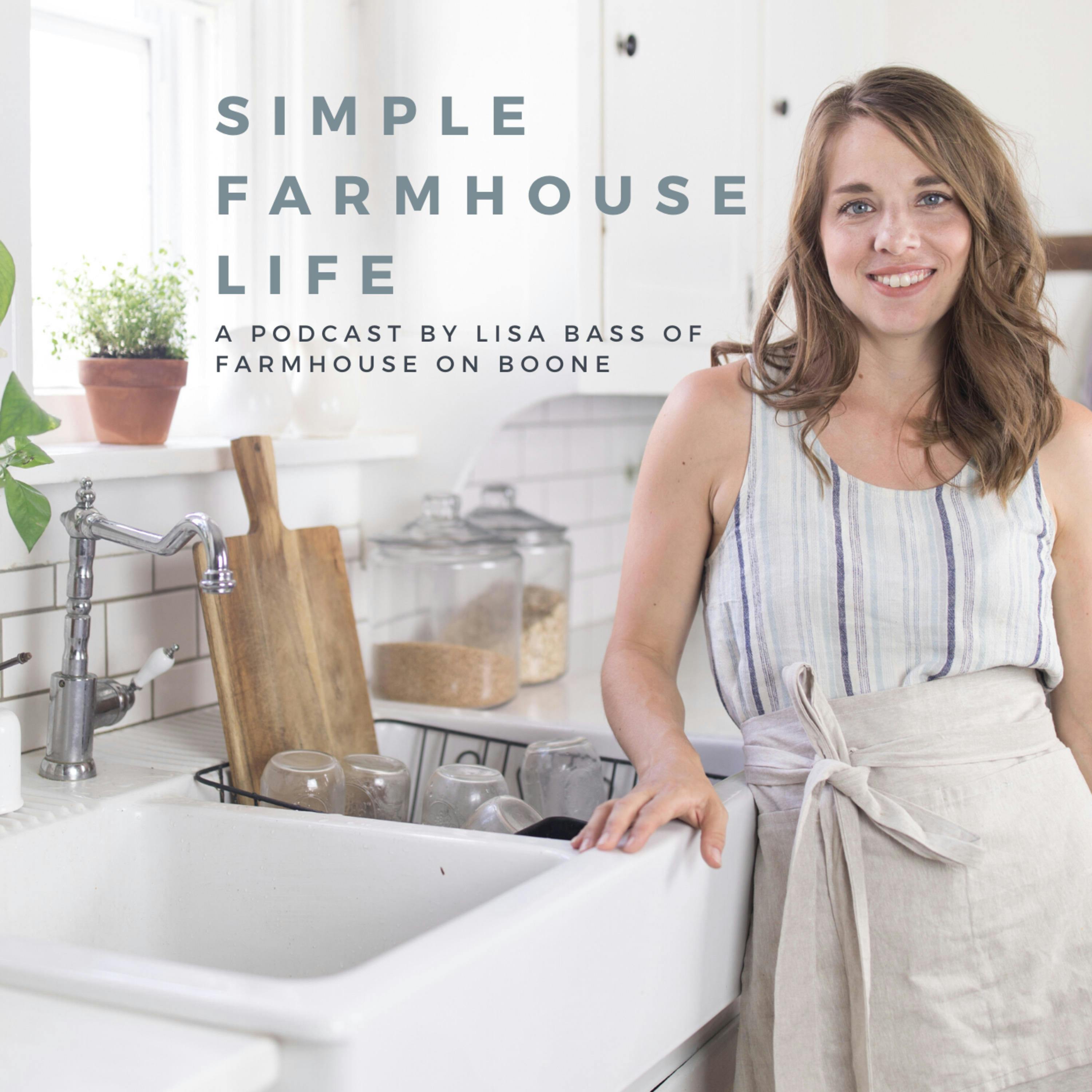
Simple Farmhouse Life
266. Homemaker Q&A: Grocery budget, breastfeeding and fertility, my best marriage advice, and more!
00:45:31
Loading summary
Transcript18 lines
- [00:00]
Lisa
When I was really having to think through our budget trying to feed my family healthy on a budget, there were certain things that I realized were really pricey for the amount that they were going to fill up my family and tried to avoid those things. How much is this filling up my family per dollar, per ounce and kind of making all those calculations? I think you could find some ways to cut there, but definitely always still worth it. If all you can buy is grocery store stuff, stay in the perimeter and don't worry about it being organic.
- [00:29]
Unknown
My name is Lisa, mother of eight and creator of the blog and YouTube channel Farmhouse on Boom. On this podcast I like to talk about simplifying your life so you can live out your priorities. I help you learn how to cook from scratch and decorate on a budget through this podcast and my courses Simple Sourdough and the Simple Sewing Series. I also help people reach their goals from home through my business courses, Create youe blog Dream and YouTube Success Academy. I will leave links to these resources in the show notes and description box below.
- [00:55]
Lisa
Now let's get into the show. Welcome back to the Simple Farmhouse Life podcast. Today I'm going to be doing another solo episode where I answer some of your questions over on the question box. If you aren't on social media, you can get this over at bit ly sfl. SFL is capital lowercase questions. It is case sensitive. But I get lots of new questions in this little question box which has been really nice because it's an easy place for me to go. So the questions and record these episodes. So as many of you may know, you're seeing our farmhouse here in the background. But I did announce recently that we are moving and by the time this comes out, we have moved. Which is why I'm trying to get a bit ahead on my podcast recording because I want to not have to like, while we're actually getting settled into our home, have to figure out like where I'm even going to record a podcast. I'll go into it just slightly here, but I do know that you all can go over to YouTube and listen to the whole story on why we're moving. One of the questions in here was in regards to moving, somebody said, I saw your house for sale. So at time of recording, our house is under contract. So unless something happens, which of course future me will know, but unless something happens with that contract, we will have already sold the house too by the time this comes out. Now with our Boone street home, when we sold it about six years ago, the first contract fell through for whatever reason. I don't even remember what it was at this time, but so I know that that can happen. So we'll see. But it currently is under contract and we have already moved by the time this comes out. You can find that full story. There's a the thumbnail will say we are moving or the title will say we are moving. Over on my farmhouse on Boone, my main YouTube channel. So briefly, we bought a farm back in April and we are going to be building there, but we are living in a house in between. So it's a lovely little historic house in town. There's many reasons why we decided to do it this way, but ultimately the building project is already underway and we needed to be very available for that and checking in on it every single day. I've heard from pretty much everybody who's ever built a house that you cannot just give a builder plans and then come back in six months or nine months. It's like a very hands on thing where if you don't watch it, there'll be miscommunications. There will be things that you had a vision for where if you weren't there, they'll quickly make a decision which not any fault to builders because I know how that is. There's things that are like, okay, this is the plan. But then all along the way things come up. We've had that just with renovations in our home where something will come up and if you're not there, the contractor, in order to stay on schedule, will just make that decision on your behalf. So that's why we're going to be putting a lot of focus into that build. Because I said this in the other video. I don't ever like to say forever home just because I think that things can always change. Like who knows, when we're 75 we might know we'll live somewhere else. But this will likely be, I mean, probably, hopefully we're still living at this farm when we're 75, so it'll likely be the home that we live in forever. I don't love to say the word forever home because things always can change. But this will more likely be if everything goes in our plans, the one that we would love to live in. So I want to make it a home that will suit our needs for a really long time. I'm thinking about grandkids in this house with this property. I'm thinking about future daughters in law and sons in law and just the big family that we could have. And hopefully, hopefully they're all living around here. And so all of my thoughts and plans are going toward that very futuristic version of my life. So that's been something that a lot of my brain space has been devoted to in the last year is just that whole thing. We've been wanting more property for a while. We have been wanting to expand our farm and where we are. I know people don't really, I don't show, you know, our whole surrounding just for privacy sake. I don't show everything. But we are on a busy road. It's nice and set back from that busy road. So it's with the fencing, our kids can play outside, it's no problem. But there's nowhere to really expand. This is the, the seven acres that we have here are the seven acres that we will always have connected to this property. There won't be any other way to expand it. And so we've, we've had our sights on that for a while and we were able to purchase a farm back in April and now we're going to begin our build. So I'm not even going to be living in this house anymore, which is, it's so interesting. That's something you've been planning on for a while. We've had the move in date set for a while and it just doesn't even feel real that I won't be coming back here and this house is going to be empty. But I know that that is going to be the case in just a few days. Okay, let's see the questions. Hi Lisa, I want to thank you for the time and effort you take out of your day to make these podcasts. I've learned so much from watching you on your blog. You've mentioned a couple times that you keep a stock pot going on your stove and periodically add different bones and veggies as well as adding more water throughout the week to make bone broth. My question is, do you leave it on your stovetop overnight for multiple days without refrigerating it? Do you leave your burner on continuously while it's simmering for multiple days? I make bone broth and if I want to cook it longer than I refrigerate it overnight, then put it back on the burner the next day. So I just leave it on there? I'm comfortable with that now for some of you, maybe you wouldn't even sleep well that night knowing that your burner was going. But I have for many, many years. I remember when we first got married even, well, probably like a year in something like that. I Started doing the bone broth and people like would come in our house. I can remember one person in particular that was in our lives like 13 years ago. You leave that going all the time, like even overnight. So I know that I've been doing it for quite a while and I've been comfortable with that. In our last house, we had a glass stove. So it was just, you know, a little heating element basically, or a glass electric stove. And in this house it is a little flame. But I'm comfortable with that because our stove actually has standing pilots that go all the time. So there's always a little flame going. Because we have a 1949 stove and oven, or at least we do currently, we'll have something in our brand new house. We don't have that in our in between house, but there's always little flames going in it. And so I'm just like, yeah, I'm used to there being that, that going on. So I'm comfortable with that. And if you keep it at a certain heat, it's okay for it to stay out. You don't have to refrigerate something when it's hot. Is your raw dairy grass fed? I do not have grass fed raw dairy available. The raw dairy I would sooner have available would be from cows. I'm not sure what all they're fed. Is that even worth it? So what, what's the lesser of the two evils that are grass fed? Pasteurized milk from the grocery store. So all cows are grass fed. In the wintertime they'll be hay fed, which is just grass that's been dried. And when grass is fresh in the spring, summer and fall, they'll be out on grass. So all that needs to be the staple nutrient. Staple nutrients for all cows. But then maybe you're referring to when they're milking the cow, do they feed the cow grain? And I used to, before I actually had my own dairy cow. I asked that question to all the farmers where I got milk. And they would say, well, we do feed them grain during milking. And I was like, man, I wish I could find somebody who only fed them grass. And now after having a dairy cow, I realize how important that dairy ration is during milking. They will drop in production if they're not fed a certain amount of grain per day. And also it keeps them very occupied while you're actually getting up. You know, they're trying to get all that milk out. So I would be more concerned that it is high quality grain. But even if it's not because it's, it's so funny. Like I have all these standards and then once I have a dairy cow, it's like, okay, well this week I can't get to that store, that feed store that has the high quality organic dairy ration that I want. And since I can't get there, but we still have the milk, I'll just run down to town really quick and get something that's not even organic. So it's funny because I've totally done that in a pinch and then we obviously still consume the milk, but when it's something that I'm going to seek out, I'm like, okay, do you do non gmo? Do you do organic feedback? In fact, in my current situation, I can't even remember if I've ever even asked our dairy farmer what they feed the cows at all. I'm mostly just concerned. Well, I'm mostly concerned that it's that it's clean, that it's raw, that it's handled properly. But that's not something that I would, I would definitely still personally. Now you can do what you want and make the decision that you want to make. I would personally still get raw milk over pasteurized milk. Hi, Lisa, I'm wondering if you let your babies and toddlers put things like grass sticks, sand in their mouths. I'm fearful of my baby choking and she's eight months old, so she just wants to put everything in her mouth. I avoid putting her down in nature, but I also think that physical contact with the natural world is so important for our health, especially our microbiome. What do your tiny ones do when outside? So my kids actually get over the putting things in their mouth phase really young. I've noticed compared to other mom friends that I have and my sisters who have babies for whatever reason, they all get past that stage really young. They also don't take pacifiers ever. I tried with all eight kids, none of them would take it. So I kind of think somehow maybe it's a related thing. But of course, any 8 month old will put, if you put them down on the beach, they'll put the sand in their mouth, the rocks in their mouth, I think. Right. I think that's when mine were still doing that. Victor's been out of the stage for a really long time, but he is 16 months, so it's hard for me to remember exactly when it ends, but it ends a lot sooner. Some people's kids do it still at 2, plus mine stop a lot younger. I would not want to let My baby put grass sticks, any sand in their mouth. Just because I have seen babies choke, especially on leaves. They, they just like the way that they are. You know, you can imagine leaves, they're very hard to get out of a child's windpipe because with the, like the Heimlich maneuver, there's not. It's kind of an airy thing. You understand what I'm saying? It's hard to get that out. And I also am fearful of choking. Now Victor, at his age, he doesn't really put things in his mouth if they aren't food. He understands when things are food and when they're not. And so I let him sit down and it's okay if he gets really dirty. I'm not worried about that. The like you said, the only thing I would be worried about is choking. And so you know your baby. And if they will put everything in their mouth, I would just wear them on my back or hold them or give them something large like you give them a really big rock or a really big stick. But I would not want them to put little chokable things in their mouth at all. No, I wouldn't like that. Highly. So can you talk more about how breastfeeding has affected your ability to conceive? I had a really hard time getting my body ovulate again after feeding my first baby on demand for almost two years. In the end I had to wean her completely and I still had to wait six months. I've heard this, I have heard this happening with certain people. So mine is directly related to when they sleep through the night. And even still it affects my body. So like right now, still things have not regulated to the point of conception, but it's different for everybody. So for some people, they can nurse all night, do no passes co sleep on demand, and then still get pregnant right away. For some people they have to wean completely and it really, it almost doesn't even help for a person who is one way to tell the other person what to do because it seems to be a like genetic thing. Like some people that happens with. And some people it doesn't because I've. I've compared notes with lots of mom friends and the one, the ones who always are, you know, four months, five months, six months postpartum, they continue to be that way through several kids. And then same with the ones who nurse, you know, they cannot conceive at all until their child is completely weaned. I am somewhere in between. And that's thankfully hasn't been. That's been like a really good thing for me because it makes it to where my babies are very naturally spaced, at least usually two plus years, sometimes two and a half years, but without having to do anything, without any effort to not make that happen. But also usually when I'm about ready for another baby, it seems to work out. So I'm glad that that's the way my body works. A lot of people, including myself, have had success with Vitex for decreasing prolactin, which is what causes that to happen. But if your body is one that just will not get pregnant until the baby weans, that might not be enough. That gentlemen action of that herb might not be enough to bring your babies closer together. Which it's. It's a tricky thing because you want to continue to nurse the baby, but yet you also want to have a baby that's not three, four years apart. Everybody's different on that. Some people like that larger spacing, but a lot of people want their babies a bit closer together. I don't know. It's the way God designed it, but it doesn't work that way for everybody. I'm fully aware of that. So many moms I've talked to have completely different experiences when it comes to that. For me, if they sleep through the night, usually within three to six months, things start to regulate out sometimes with the help of Vitex.
- [15:09]
Unknown
It's that time of year, the holidays are quickly approaching and you might be stressing about gift shopping because even if your kids have had their list ready all year, chances are good there are at least a few items on those lists that you know they'd love, but that maybe give you pause. One of these might be a smartphone. It seems like kids. Kids are asking for these at a younger and younger age these days. And like many parents, you probably have concerns about handing them the same kind of smartphone you use. And with good reason. My oldest two are 16 and 14 this year, and there are plenty of occasions where they have plans that don't involve me. And I'd like to reach them, but I also do not want them to get addicted to an iPhone already. That's why I want to tell you about Gab's holiday sale. Gab is the leader in save phones and watches for kids, teens and tweens. With no social media apps, no Internet browser and GPS tracking, Gab devices were built from the ground up specifically for kids and teens and are the way to keep your kids safely connected. And Gab phones and watches are still tech. Kids actually want like the Gab Music app which lets kids stream clean music. For older kids, there's the Gab Phone 4 Pro with hundreds of vetted third party apps that can only be installed at parents discretion. Kids also get unlimited talk and text with Gab messenger, the first messaging video calling app designed with kid safety as the top priority. Other safe device options or parental controls let you know what's already been accessed. But Gabs phones and watches are built with smart filtration that proactively blocks harmful content before it ever reaches your kid. It really gives me peace of mind knowing that I can reach my kids with their Gab phone, but I don't have to worry about what they're reaching on it. That's why I really think Gab is a must have this year and I can't recommend enough that you and your family give them a try and do it now because right now Gab is offering huge discounts on their phones and watches. The best part? There's no contract required. Just go to gab.comsfl to get started. That's Gab G A B B.comsfl gab.comsfl terms and conditions apply. Creating really great retail experiences is tough, especially with multiple stores, teams of staff, fulfillment centers, separate workflows. It's a lot. But with Shopify Point of Sale you can do it all without complexity. Shopify's Point of Sale system is a unified command center for your retail business. It brings together in store and online operations across 1000 locations. Imagine being able to guarantee that shopping is always convenient. Endless aisle ship to customer buy online pickup in store, all made simpler so customers can shop how they want and staff have the tools to close the sale every time. And let's face it, acquiring new customers is expensive. With Shopify POS you can keep shoppers coming back with perfect personalized experiences and first party data that give marketing teams a competitive edge. In fact, it's proven based on a report from EY businesses on Shopify POS see real results like 22% better total cost of ownership and benefits equivalent to an 8.9% uplift in sales on average relative to the market set surveyed.
- [18:04]
Lisa
Want more?
- [18:04]
Unknown
Check out shopify.com farmhouseallcase and learn how to create the best retail experiences without complexity.
- [18:12]
Lisa
Shopify.com farmhouse all right, another nursing question I have been asked here. Hi Lisa, I'm currently still nursing my 15 month old and expecting my second baby in January. I was wondering if you could talk a little about nursing all your kids. How long you nurse for if you've ever tandem nurse and if you ever dealt with a nursing aversion. Thanks so much. It's so affirming to hear the opinions of an experienced mom. Even though you say you're not an expert, your advice is more valuable than any expert. Well, thank you very much. So all of my kids nursed until about anywhere from 15 to 18 months. Victor is over 16 months and he is still so interested in nursing. He could nurse any time of the day, all day, whereas the rest of my kids and I think that's why he's very much delayed any future children at this point. The rest of my kids seem to be really done with nursing around anywhere from that 15 to 18 months. They get very distracted by things that are going on around them. They pop their heads up and they just want to do that. They don't want to sit and nurse. Whereas Victor is definitely more of a nurser. There are a lot of different experiences when it comes to that. Some people say they have to wean all of their kids sometime around three because they want to nurse forever. Mine have been very sometime around 15 to 18 months, they're kind of just over it and I'm usually always pregnant and my milk decreases and so at some point they basically wean themselves and it's not really an issue. I will see if Victor how long he wants to nurse for. Maybe I will actually end up nursing well past that 18 month mark. But for my other kids it just never worked. I usually the milk dries up, the baby gets over it. It's not something that I really feel like pushing. I've also never tandem nursed because my milk always does dry up whenever I'm pregnant with the next baby. It's never something that goes all the way through. And you asked about nursing aversion. That only happens to me when I'm pregnant. And so usually sometime around, I think around somewhere between 12 and 20 weeks of pregnancy when my milk dried up and so they're not really getting much. I usually have to cut it off at that point too because it doesn't. It just. Yeah, I have a nursing aversion but never before then. Nursing has always been very easy and straightforward for me. Thankfully it's been something that's worked out really well. I'm a homeschool mom too. I want to cook from scratch more like you, but have no clue how to have time to do both well. So I would recommend just keeping it very, very simple. Get just staple ingredients, whole grains, meat, fruits, veggies, cheese, Dairy and just cooking those and not worrying about very elaborate recipes. So flavoring every the meat with lots of salt, serving it alongside a vegetable, whatever, you know, whether you want to roast it or. There's a lot of different options you can do for cooking meat and cooking vegetables. But I would say just keeping it so, so simple and not using this as a time to make very elaborate recipes. Do the ones that you don't have to look up, you can just make them without even thinking. Get some staple ones that don't take very much time and just make them over and over again when you feel overwhelmed. To me, that's the biggest tip. Can you explain the routine of making milk kefir without having a cow for daily milk? I currently do bi weekly milk pickups so I do not have constant access to fresh milk. Is it still possible to make milk kefir? Well, the great thing about milk kefir is it preserves milk by adding the probiotics to it. So when you get milk every other week, you'll notice that by about day 10, your milk is really sour and you really don't want to put it on cereal or you know, just want it in recipes and that's it. If you earlier in that week just really make tons and tons of milk kefir, like maybe, I don't know how big your family is, but for me a half gallon a day and just keeping it on the counter that whole time, that will keep your milk through to your next milk pickup from going sour and just being milk kefir. You can also take your milk on day 10 and turn it into milk kefir. So when it's starting to go sour. So for me, I think when you're only doing bi weekly milk pickups, just get more of it and ferment a lot of it either right up front or when it's starting to go sour. That's really going to be a great asset to you if you're only getting biweekly milk pickups. Because by about day even, honestly, 8, 9, 10, all the way through day 14, your milk is probably getting pretty sour and not very usable. And so I think milk Keeper would be a great thing for you. You mentioned getting half a beef from your sister. Do you also get the organs? If so, what organs do you get? What do you do with organ meat and how do you cook them for your family? So I used to be so big into organ meat and I've gotten, just to be completely honest, very lazy about it and end up getting the organ meats a lot of times and then not even using them or giving them to the dog or the chickens. So that's just the truth. I do not like beef liver. I have not found a way to disguise it. I mix it in with the just like with ground beef or even sausage. Try to take a meatloaf and just put like a little portion of it and I can just always taste it and I've gotten pretty lazy about it so I don't really use those. I will say something like heart is a lot easier to enjoy even though it sounds more disgusting. It actually tastes just like beef. So I'm not currently your person to talk about organs even though I know they're so good for you. I have just become a baby about it and just make the foods that I like all right Hi Lisa, Lengthy question here. I'm a stay at home mom of three, my spouse works a blue collar job and we're living on one income at the moment. We do not have the budget to source the best quality foods that I'd like to have for my family. Example, instead of raw milk I buy organic. I use grass fed butter when I'm able. Avocado and olive oils are now my non negotiable staples for cooking. Bacon's a weekly stapler on here, but I normally buy the regular store brands available, sometimes organic if I can afford to spend the extra that week. We also eat farm fresh eggs from a local farm 95% of the time unless for some reason they aren't available. I use sourdough from time to time. What are some of the main staples that you would start with if you are in my situation to be sure your children are getting the best nutrition possible? Is cooking from scratch still beneficial even when you can't afford the cleanest ingredients? Any advice? Appreciate it and I greatly enjoy this whole episodes. So I totally was in your situation when we had three small kids like you and my grocery budget was very very tight and I would say I don't know how the situation is with raw milk in your area or if you have called a bunch of farms and tried to source that. But for me at that time getting raw milk from a local farmer wasn't a lot more expensive than buying organic milk from the store. Personally for me if I wasn't getting raw milk I would just go ahead and skip the organic milk altogether because it's usually ultra pasteurized and so in that case I'd almost sooner just get regular 2% milk. But I would still try to see if I Could find a farm where it was a bit cheaper to get raw milk and use that as one of the staples. I would also highly recommend stop stocking up on whole grains and just using that to bulk up a lot of your meals. Because you mentioned things like bacon. Bacon's such an expensive meat. It's more of a flavor that's a luxury. Whereas something like a pound of organic ground beef, at least where I am, you can get that at Aldi for pretty cheap. I get it now for my sister, but you can get it for pretty inexpensively. Whole chicken is cheaper than buying chicken breasts. So focusing on a lot of those cheaper cuts, but quality. If I wasn't going to buy any of it organic or from a local farm, which would be even better than sourcing it organic from a store. I still think it is totally worth it to cook from scratch. But you can even cut your budget more if you are focusing on the less expensive meats that really have that bulk to satiate and fill your family. If it's not out yet, I can't remember which episode is coming out sooner, this one or that one. Actually, I think it's going to end up being possibly next week, unless I'm mixing up my schedule here. But I have an episode coming out or did come out already, I don't know. With Sue Becker from Bread Becker's and she talks about the foundation of using whole grains for your diet and how inexpensive that is, especially when you buy them in bulk. So bulking up your meals with something like that is a great way to make your family full without having to spend a lot of money on things. I always tried to. When I was really having to think through our budget for trying to feed my family healthy on a budget, there were certain things that I realized were really pricey for the amount that they were going to fill up my family and try to avoid those things. So just like a stupid example, but things like berries, those are really expensive to buy. High quality, out of season, you know, if you can't find them locally that you pick yourself organically, they're really, really expensive. So they don't end up really filling anybody up. So instead things like bananas, freeze those and put those in your smoothies. Using local milk as a foundation, whole grains. Just looking at each thing and thinking, okay, how many. How much is this filling up my family per dollar per ounce? And kind of making all those calculations, I think you could really find some ways to cut there. But again, definitely always still worth it if all you can buy is grocery Store stuff, stay in the perimeter and don't worry about it being organic. It's still definitely healthier to buy, you know, meats, cheaper vegetables. Focus on getting the less expensive, more in season, cheaper fruits, and avoiding anything where you're paying for the packaging. If it's not organic, it's still gonna be better for you by a long shot. How do you manage dishes with such a large family? We're a family of three and hope.
- [28:40]
Unknown
To grow it a lot.
- [28:41]
Lisa
And it already feels like the sink is constantly filled with dishes, even when we do them as we go. I can't imagine what it'll be like when we have more miles to feed if we have guests over. The amount of dishes feels so overwhelming. I have never noticed dishes piled high in your videos. So what is your strategy? Pretty much what you said. We just wash them as we go. We do have lots of hands helping. And I'm also. I realized this. I'm also not very particular about dishes. If they look and feel clean, I'm good. And I know that some of you are like, ah, but I, I don't get super particular about them. And we wash them very, very fast. I do not, like you said, I do not leave dishes piled up in the sink. I mean, rarely. There are times when it happens, but not beyond what my sink can handle, which I have a fairly small sink here in this house. And I don't let them pile up. We just keep rinsing them, keep going. We also do a lot of cast iron, so I don't wash that every single time. I think having a lot of help with a lot of the kids really helps too. We all wash dishes, we all put dishes away. It isn't something that feels super overwhelming, but we also don't have a ton of dishes, so we just have to really keep things moving. Rinse and repeat as we go. All right. I'm recently a new wife and mom. A lot of the furniture in my home is when I was single or before being a mom. It doesn't feel like me anymore. I'm wondering if you have any advice on where to start. I've been getting a few pieces here and there that I enjoy, but I'm tempted to just get rid of everything and start fresh. I remember this really well because when Luke and I were first married, he brought all of the furniture that he had from just, I don't know, he acquired from hand me downs and things like that. And it was all super ugly furniture. What I did to make it work because again, we had Zero budget. There was no way I was just going to go online or go into a store and buy something brand new. So what I started by doing was taking. He had these really heavy wooden pieces that had two cushions on it. So the whole frame was wood and there was two cushions on it. So. And the fabric on the cushions was awful. So I took some white fabric and made just some covers on them and put a little throw blanket on it. And that helped us stretch it along for a really long time. But like you said, over time, mostly through things like Craigslist at the time, now you use Facebook Marketplace or thrift shops or hand me downs, I started adding in pieces that were just a little bit better. Depending on your budget. I wouldn't just throw it all away and start fresh. Now, if you can do that, that's great, but I think for a lot of young moms, that's not something that's really possible. So be patient and try to keep your eye out. At thrift shops on Facebook Marketplace. People are constantly getting rid of things for free that they just no longer need, and they want an easy way to get rid of it. I mean, honestly, I do that a lot of times. I'm more in a season of life where when I have something that isn't working in our home anymore, I will want to get rid of it easily without a lot of back and forth. And so I'll list things for free all the time. And I see things for free all the time. So keep your eyes peeled. See how you could transform something, maybe make it new with some paint or some fabric. But if I were you, I would be patient because if you get really antsy and just buy everything brand new, what happens with that is you spend a whole bunch of money and then you're kind of married to that item because you want it to work forever because of what you spent on it. If you buy any furniture brand new, it's going to be so expensive that you're going to not be able to swap things out. And what I think is really neat and charming about a lot of homes, especially when the homemaker is on a budget, is it looks very collected, very pieced together in a beautiful way. And when something doesn't work, she maybe sells it or, you know, trades it to a. With a friend and pieces something else in. And it's an evolving process that isn't instant and it ends up looking more beautiful. And with that lower investment, she has the freedom to swap things out because she isn't putting all of her resources like the money that she's saved forever into this one piece and then realizing oh maybe that debt, it didn't work in here. I feel like it's such a less committal way to decorate.
- [33:11]
Unknown
I have been drinking a morning smoothie for years. I like to pack in probiotics and vitamins and protein and greens and a few months back I started adding in AG1 because it has vitamins and minerals, adaptogens, pre and probiotics, antioxidants, superfoods and AG1. Ingredients are sourced for absorption, potency and nutrient density to deliver the foundational nutrition that we need to keep going. Now, AG1 does not have to be taken in a smoothie form. That's just how I like to do breakfast, so it makes it really easy for me. It can also be mixed into water or whatever drink that you are drinking in the morning and they have it to where you can just convenely put a scoop in. Or the travel packs help you stay consistent. When traveling for the holidays, I like.
- [33:56]
To do frozen fruit, raw milk, kefir.
- [33:58]
A scoop of AG1 and some collagen peptides. It's also excellent for digestion and gut health. So this holiday season try AG1 for yourself or even gift it to someone special. It's the perfect time to focus on supporting your body with an easy and surprisingly delicious daily health drink. And that's why I'm so excited to be partnering with them. And AG1 is offering new subscribers a free 76 gift. When you sign up, you'll get a welcome kit, a bottle of D3K2 and five free travel packs in your first box. So make sure to check out drinkag1.comfarmhouse to get this offer. That's drinkag1.com farmhouse to start your new year on a healthier note.
- [34:36]
Lisa
All right. I would love to hear how you get your kids to play outside so much. I have two girls, 1 and 4 and they love to be outside but I'm trying to figure out how to keep them warm with winter coming up. Also my girls want me to play with them but I don't love constantly playing with them if that makes sense, she says. I feel like it sounds horrible but I'd love to be able to do some gardening while they play and explore on their own. So this just has to do with your kids ages and like currently you have a four year old and a one year old so there's not some maybe older kid kind of helping direct them. So right Now I have six boys that are ages 11 and under. And so so many times they get going on something together where they're all building a fort or some game I don't even understand. And it really takes the pressure off, mom, because I don't have to go back to being a kid and remember how to imagine. Because it's hard for parents that part of our brain develops and we're kind of past that in a lot of ways. And so don't feel horrible if you find it a stretch to play with your kids because it is hard, because inside there's laundry, there are dishes, there are meals to make. And so there's a lot of work that you need to do inside. And so being outside 247 with your kids isn't actually practical. And being in my situation where there's old kids, young kids. My husband's home, he's outside right now. Kids are all outside all afternoon. Because it's a beautiful day today. It does make it a lot easier. I was home with my six boys several days last week. Luke was hunting. There were just various things that the girls were out doing. So I was home with just the six boys and I was able to do things inside with the way our windows are in this house now, in our future farmhouse that we're building, top priority to have play spaces and windows very accessible. So like in my current house, I can look out the kitchen window and see the whole side yard they play in. I can look out the front window all from the kitchen, the front kitchen window to see the little swing they play in over here. And I can look out the back mudroom windows all from the vantage point of my kitchen to see the trampoline. You know, I can see the barn. So they, they played outside a ton, but I didn't have to be out with them at all points. Now there were some times that I did. And then what I'll usually do is I'll keep the little ones in with me. So your only kids you have right now are little. So if I, you know, if the big boys want to go play something where I really can't see them, I'll make the three year old and the one year old sit inside with me while, you know, they can be playing all around the kitchen, getting stuff out. You know how little kids do while I am making dinner, working on my computer, doing laundry, and then the big kids will play outside. So when I say all my kids play outside, there are plenty of times where the little kids are in with me and I mean the rest of them can. So it's normal for you to feel like that's a challenge and just know that it'll get a lot easier when those two girls are older. You can. They can play a lot on their own and they won't need so much help from you. Now, we do keep a lot of things and it's actually really tricky because since we're moving in a few days, we've already moved the trampoline, we've already moved the swing set. So many things that the kids love to play that help them to spend a lot of time outside aren't here. So they're forced to find more creative ways. But they're definitely finding it to be a challenge. I've had to kind of inspire them with. We have kites right now. We have bubbles, sidewalk chalk to get them to stay outside. Oh, I also let them take all of the last of the pumpkins I had on the porch and carve them. So there are things, you know, and your girls are younger, but there are things you can do, ideas that you can sometimes spark to get them to want to play a little bit more. But with the ages that your kids are. When my girls were those ages, we just did a lot of inside time. But then when we went outside and put them in the stroller, we go on long walks, I was very involved with it. It wasn't a thing where I'm inside, they're outside. And I think it's hard to see that day coming when you're in the situation you're currently in. But I'm telling you it is. It'll come one day. But it's hard for you to compare your life with your two kids to what mine looks like now. Because when my kids, I had two little girls those ages, it looks so incredibly different from how it does now for me. I don't think I could have even fathomed what that would look like. Okay, this is the last one, maybe. How did you handle going to prenatal appointments with so many little ones? I recently had my third baby in February, and it was tough taking my 6 and 2 year old to my prenatal appointments all the time. My husband did watch them when he was off work or he would come to some appointments, but it can be crowded. Okay, so the more kids I have, the less prenatal appointments I do. I know that there'll be some of you who will agree with that and some of you who won't, but the more kids I have, the more I know what to look for. I know what my Body does. Of course, things can be different, but I usually will book them way less. Now, my last birth, my midwife actually came here for prenatal appointments. That was the first time. There have been many babies where. Where I had to go to her, but even still, we would just do them way, way, way less. We ended up. I don't even know how many I ended up doing. There are certain markers throughout pregnancy where you'll want certain tests done to make sure that you're on track for certain things. But that's. That's my only answer. I just did a whole lot less of them. Of course, I have teenagers. I have my husband. He works. You know, we do this full time. So if I were to need to go to a lot of prenatal appointments, I would not be taking all my kids there. I would. I would just be leaving them at home with teenagers and with my husband. So I'm in a different situation in that way. But even still, I hate disrupting our whole flow and our whole day in the way that it normally goes to go all the way to a prenatal appointment because of how far they are, like, where they would be from our location. So even still, I. I wouldn't want to do a lot, but if I were to have to do something medically away from my home, I would not be bringing a bunch of little kids anymore. So, again, I'm just in a whole different season of life. Probably if I was in your shoes, maybe I would do, like a wagon or a stroller. Maybe bring some snacks. I'm always the worst mom with that, though. I always forget to bring snacks and things that will keep kids busy. But I know that's what other moms tend to do. They have a whole bag of tricks. So you could try that as well. This is a. This is something I don't feel qualified to answer, but I have been married for 17 years. This says, what's your number one piece of marriage advice? And I'm sure that I could think of something better. But I would say to not expect your spouse to be the same person as you like. The reason you married them is because they compliment you in some way, and they're probably better at a lot of the things that you're bad at. But a lot of times we're so prideful. We like to think that they should see things exactly as we do and then also enjoy them. So I really enjoy my spouse. I enjoy hanging out with him. We have cultivated a relationship that we enjoy. So we, like. We do date nights. And again, that's easier for me. Now I don't have to worry about getting childcare. It's something that we can just do on a whim. So we do it weekly and we love it and we have so much fun together. And I think the longer we're married, the more fun that we have together. So I guess that's my advice. If you're in a tough season, your kids are younger, and everything feels very overwhelming because you're learning how to do it. You're both learning how you're your flow is with everything. And you all likely do things very differently. My husband and I, we do things very differently. The way that we would manage the house if we were here all by ourselves would be different from how the other person would. So figuring out how to understand that their way isn't wrong, it's just different from yours. And then figure out who does what and having a lot of conversations so that you're not resenting each other for maybe thinking. A lot of times it's like communication things. One person thinks this person should be doing that, the other one thinks they should be doing that, and it just has to be talked out. And it does get so much better and so much easier the more years that you invest in it. All right, well, again, I will keep doing these. A lot of you seem to like the solo episodes, and the questions really help me to figure out what to even chat about. I'm sure a lot of you will have a lot of questions about our move and our new farm. So for all questions, head on over to Bit Ly forward slash forward slash SFL questions. The SFL is capitalized. We'll leave it linked down in the show notes in description box below. And I'll just keep on making these episodes every third. So as always, thank you so much for listening and I will see you in the next episode of the Simple Farmhouse Life Podcast. Thanks as always for listening to the Simple Farmhouse Life Podcast.
- [44:10]
Unknown
My husband Luke and I and our.
- [44:11]
Lisa
Eight kids work together side by side on our little homestead and use our blog, podcast and YouTube channel to reach other homemakers, home cooks and home setters with practical recipes and daily family life. For everyday sourdough recipes, make sure to check out our blog, farmosomboon.com and to dig deeper, we do also offer a course called Simple Sourdough over at Bit Vi Farmhouses Course. That's all one word. Bit Le Farmhouse Sourdough Course. If you're looking to learn how we.
- [44:42]
Unknown
Earn an income online, check out my.
- [44:44]
Free blog success masterclass at Bit Ly.
- [44:48]
Lisa
Farmhouse Blogging school and my YouTube course at Bit Ly Farmhouse YouTube course. All one word.